
Ezekiel 14:22

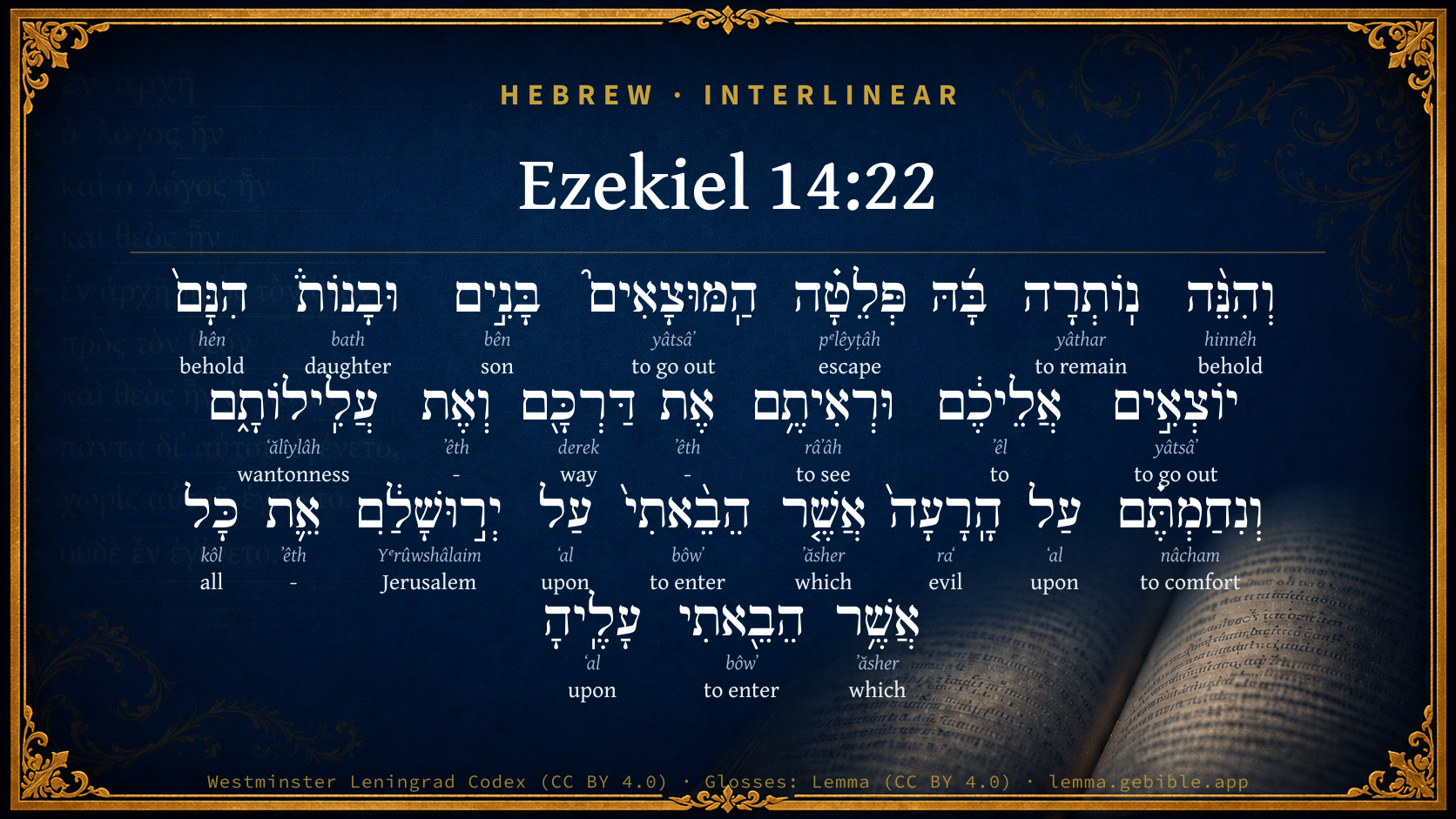
Hebrew (Westminster Leningrad Codex) Ezekiel 14:22 appears in the Hebrew Old Testament. The text above is from the Westminster Leningrad Codex. Each word links to its Strong’s number, a concise gloss, and parsing drawn from the Open Scriptures Hebrew Bible morphology. Click any word for its full Brown-Driver-Briggs (BDB) entry.
Download image
Cite this verse

Ezekiel 14:22 (World English Bible). Public Domain. Lemma interlinear Bible study tool, https://lemma.gebible.app/v/ezekiel/14/22.

Show BibTeX & RIS
BibTeX
RIS
English Translation
Yet, behold, therein shall be left a remnant that shall be carried forth, both sons and daughters: behold, they shall come forth to you, and you shall see their way and their doings; and you shall be comforted concerning the evil that I have brought on Jerusalem, even concerning all that I have brought on it.
World English Bible · Public Domain
Download a study sheet

One document with this verse’s original text, its word-by-word gloss line, the meaning frame, cross-references with their text, attributed commentary, and full source and license credits — printable, and it pastes into notes with its structure intact.

This verse Autodidact and up

Study sheet (.html) Plain text (.txt)

A passage Seminary Student

Up to 50 verses in one chapter. A passage sheet keeps up to 6 commentary sources and 12 cross-references per verse, in the order this page ranks them, and says so on the sheet whenever that leaves anything out. Ask for a single verse and you get the Autodidact verse sheet above.

Everything on this page stays free to read, with no account — the sheet is a download of what is already on screen, not access to it.

Want to remove ads? Support Godless Engineer
Compare translations 3

The same verse in 3 English versions, stacked beneath the original-language interlinear above. Click any original word for its lexicon entry.

Each is an independent rendering of the whole verse — the interlinear is not word-aligned to these translations.

Highlighted words mark where these versions differ — a whole-verse word diff, not a word-by-word alignment.

  • World English Bible Public Domain
    Yet, behold, therein shall be left a remnant that shall be carried forth, both sons and daughters: behold, they shall come forth to you, and you shall see their way and their doings; and you shall be comforted concerning the evil that I have brought on Jerusalem, even concerning all that I have brought on it.
  • King James Version Public Domain
    Yet, behold, therein shall be left a remnant that shall be brought forth, both sons and daughters: behold, they shall come forth unto you, and ye shall see their way and their doings: and ye shall be comforted concerning the evil that I have brought upon Jerusalem, even concerning all that I have brought upon it.
  • unfoldingWord Literal Text CC BY-SA 4.0
    Yet, behold! A remnant will be left in her, survivors who will go out with sons and daughters. Behold! They will go out to you, and you will see their ways and actions and be comforted concerning the punishment that I have sent to Jerusalem, and about everything else that I have sent against the land.

unfoldingWord Literal Text — © unfoldingWord, licensed CC BY-SA 4.0. Word-aligned USFM3 via Door43 (git.door43.org/unfoldingWord/en_ult).

Versions to compare (up to 4)

3 of 4 selected

Show all 18 translations

Every available English version of this verse, each an independent rendering of the whole verse.

  • World English Bible Public Domain
    Yet, behold, therein shall be left a remnant that shall be carried forth, both sons and daughters: behold, they shall come forth to you, and you shall see their way and their doings; and you shall be comforted concerning the evil that I have brought on Jerusalem, even concerning all that I have brought on it.
  • Berean Standard Bible Public Domain
    Yet, behold, some survivors will be left in it—sons and daughters who will be brought out. They will come out to you, and when you see their conduct and actions, you will be comforted regarding the disaster I have brought upon Jerusalem—all that I have brought upon it.
  • Majority Standard Bible Public Domain
    Yet, behold, some survivors will be left in it—sons and daughters who will be brought out. They will come out to you, and when you see their conduct and actions, you will be comforted regarding the disaster I have brought upon Jerusalem—all that I have brought upon it.
  • King James Version Public Domain
    Yet, behold, therein shall be left a remnant that shall be brought forth, both sons and daughters: behold, they shall come forth unto you, and ye shall see their way and their doings: and ye shall be comforted concerning the evil that I have brought upon Jerusalem, even concerning all that I have brought upon it.
  • American Standard Version (1901) Public Domain
    Yet, behold, therein shall be left a remnant that shall be carried forth, both sons and daughters: behold, they shall come forth unto you, and ye shall see their way and their doings; and ye shall be comforted concerning the evil that I have brought upon Jerusalem, even concerning all that I have brought upon it.
  • Revised Version (1885) Public Domain
    Yet, behold, therein shall be left a remnant that shall be carried forth, both sons and daughters: behold, they shall come forth unto you, and ye shall see their way and their doings: and ye shall be comforted concerning the evil that I have brought upon Jerusalem, even concerning all that I have brought upon it.
  • Geneva Bible (1599) Public Domain
    Yet beholde, therein shalbe left a remnant of them that shalbe caryed away both sonnes and daughters: behold, they shall come forth vnto you, and ye shall see their way, and their enterprises: and ye shall be comforted, concerning the euill that I haue brought vpon Ierusalem, euen concerning al that I haue brought vpon it.
  • Douay-Rheims (1899) Public Domain
    Yet there shall be left in it some that shall be saved, who shall bring away their sons and daughters: behold they shall come among you, and you shall see their way, and their doings: and you shall be comforted concerning the evil that I have brought upon Jerusalem, in all things that I have brought upon it.
  • Young's Literal Translation Public Domain
    yet, lo, there hath been left in it an escape, who are brought forth, sons and daughters, lo, they are coming forth unto you, and ye have seen their way, and their doings, and have been comforted concerning the evil that I have brought in against Jerusalem, all that which I have brought in against it.
  • Literal Standard Version CC BY-SA 4.0
    yet, behold, there has been left an escape in it, who are brought forth, sons and daughters, behold, they are coming forth to you, and you have seen their way, and their doings, and have been comforted concerning the calamity that I have brought in against Jerusalem, all that which I have brought in against it.
  • Unlocked Literal Bible CC BY-SA 4.0
    Yet, behold! A remnant will be left in her, survivors who will go out with sons and daughters. Behold! They will go out to you, and you will see their ways and actions and be comforted concerning the punishment that I have sent to Jerusalem, and about everything else that I have sent against the land.
  • unfoldingWord Literal Text CC BY-SA 4.0
    Yet, behold! A remnant will be left in her, survivors who will go out with sons and daughters. Behold! They will go out to you, and you will see their ways and actions and be comforted concerning the punishment that I have sent to Jerusalem, and about everything else that I have sent against the land.
  • Darby Bible Public Domain
    But behold, there shall be left in it those that escape, who shall be brought out of [it], sons and daughters. Behold, they shall come forth unto you, and ye shall see their way and their doings; and ye shall be comforted concerning the evil that I have brought upon Jerusalem, as to all that I have brought upon it.
  • World Messianic Bible Public Domain
    Yet, behold, there will be left a remnant in it that will be carried out, both sons and daughters. Behold, they will come out to you, and you will see their way and their doings. Then you will be comforted concerning the evil that I have brought on Jerusalem, even concerning all that I have brought on it.
  • Webster's Bible Public Domain
    Yet behold, therein shall be left a remnant that shall be brought forth, both sons and daughters: behold, they shall come forth to you, and ye shall see their way and their doings: and ye shall be comforted concerning the evil that I have brought upon Jerusalem, even concerning all that I have brought upon it.
  • Free Bible Version CC BY-SA 4.0
    Even so a few of them will survive, some sons and daughters who will be taken captive. They will be brought to you in Babylon, and when you realize what they did and how they acted, you will understand why I had to bring such a disaster down on Jerusalem—everything I did to it.
  • Bible in Basic English Public Domain
    But truly, there will still be a small band who will be safe, even sons and daughters: and they will come out to you, and you will see their ways and their doings: and you will be comforted about the evil which I have sent on Jerusalem, even about everything I have sent on it.
  • JPS Tanakh (1917) Public Domain
    And, behold, though there be left a remnant therein that shall be brought forth, both sons and daughters; behold, when they come forth unto you, and ye see their way and their doings, then ye shall be comforted concerning the evil that I have brought upon Jerusalem, even concerning all that I have brought upon it;

Literal Standard Version (2020), Covenant Press — licensed CC BY-SA 4.0. Text via the HelloAO Bible API (eBible.org). Unlocked Literal Bible (unfoldingWord) — licensed CC BY-SA 4.0. Text via the HelloAO Bible API (eBible.org). unfoldingWord Literal Text — © unfoldingWord, licensed CC BY-SA 4.0. Word-aligned USFM3 via Door43 (git.door43.org/unfoldingWord/en_ult). Free Bible Version, Dr. Jonathan Gallagher — licensed CC BY-SA 4.0. Text via the HelloAO Bible API (eBible.org).

Word by word

More ways to search: Search by grammar → Find every occurrence → Compare this word →

Practice this passage: Drill this verse → Learn its vocabulary →

עֲלִֽילוֹתָ֑ם
ʻălîylâh
H5949
“deeds · their”
Noun, Common, Feminine, Plural, Construct + Suffix, Personal, 3rd Person, Masculine, Plural
Part of Speech
Noun
Type
Common
Gender
Feminine
Number
Plural
State
Construct
Full BDB Definition

Origin: from H5953 in the sense of effecting

TWOT: 1627c

wantonness, deed, doing - wantonness - deed - practices, evil deeds
  1. וְהִנֵּ֨ה hinnêh H2009 “and · behold” Conjunction + Particle, Demonstrative
  2. נֽוֹתְרָה yâthar H3498 “to remain” Verb, Niphal, Perfect, 3rd Person, Feminine, Singular
  3. פְּלֵטָ֗ה pᵉlêyṭâh H6413 “escape” Noun, Common, Feminine, Singular, Absolute
  4. הַֽמּוּצָאִים֮ yâtsâʼ H3318 “the · gone out” Particle, Definite Article + Verb, Hophal, Participle Passive, Masculine, Plural, Absolute
  5. בָּנִ֣ים bên H1121 “sons” Noun, Common, Masculine, Plural, Absolute
  6. וּבָנוֹת֒ bath H1323 “and · daughters” Conjunction + Noun, Common, Feminine, Plural, Absolute
  7. הִנָּם֙ hên H2005 “behold · them” Particle, Demonstrative + Suffix, Personal, 3rd Person, Masculine, Plural
  8. יוֹצְאִ֣ים yâtsâʼ H3318 “going out” Verb, Qal, Participle Active, Masculine, Plural, Absolute
  9. אֲלֵיכֶ֔ם ʼêl H413 “to · you” Preposition + Suffix, Personal, 2nd Person, Masculine, Plural
  10. וּרְאִיתֶ֥ם râʼâh H7200 “and · to see” Conjunction + Verb, Qal, Sequential Perfect, 2nd Person, Masculine, Plural
  11. אֶת ʼêth H853 “-” Particle, Direct Object
  12. דַּרְכָּ֖ם derek H1870 “way · their” Noun, Common, Both, Singular, Construct + Suffix, Personal, 3rd Person, Masculine, Plural
  13. וְאֶת ʼêth H853 “and · -” Conjunction + Particle, Direct Object
  14. וְנִחַמְתֶּ֗ם nâcham H5162 “and · to comfort” Conjunction + Verb, Niphal, Sequential Perfect, 2nd Person, Masculine, Plural
  15. עַל ʻal H5921 “upon” Preposition
  16. הָֽרָעָה֙ raʻ H7451 “the · evil” Particle, Definite Article + Noun, Common, Feminine, Singular, Absolute
  17. אֲשֶׁ֤ר ʼăsher H834 “which” Particle, Relative
  18. הֵבֵ֨אתִי֙ bôwʼ H935 “to enter” Verb, Hiphil, Perfect, 1st Person, Common, Singular
  19. עַל ʻal H5921 “upon” Preposition
  20. יְר֣וּשָׁלִַ֔ם Yᵉrûwshâlaim H3389 “Jerusalem” Noun, Proper
  21. אֵ֛ת ʼêth H853 “-” Particle, Direct Object
  22. כָּל kôl H3605 “all of” Noun, Common, Masculine, Singular, Construct
  23. אֲשֶׁ֥ר ʼăsher H834 “which” Particle, Relative
  24. הֵבֵ֖אתִי bôwʼ H935 “to enter” Verb, Hiphil, Perfect, 1st Person, Common, Singular
  25. עָלֶֽיהָ ʻal H5921 “upon · her” Preposition + Suffix, Personal, 3rd Person, Feminine, Singular

About this verse

These counts appear in no published source. They are computed here, from the morphology-tagged text and Lemma’s own curated glosses. What Lemma adds →

27
words
19
distinct lemmas
Prophets
section

Notable vocabulary

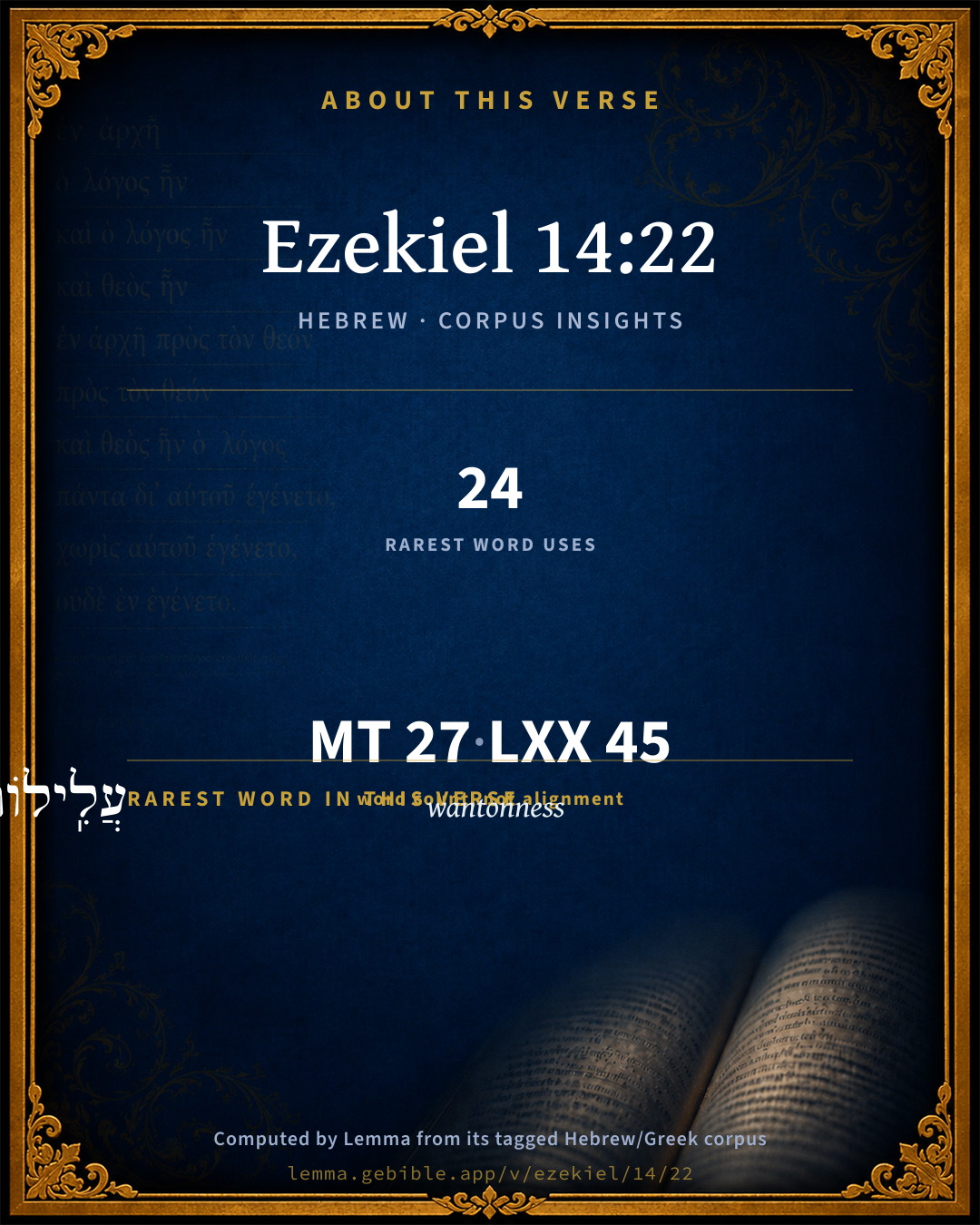
The rarest word here is עֲלִֽילוֹתָ֑ם wantonness H5949 — appearing just 24 times in the whole Hebrew Bible.

Shared distinctive vocabulary

עֲלִֽילוֹתָ֑ם wantonness H5949 occurs in 24 verses of the Hebrew Bible. Also found in:

Grammatical profile

  • 7 verbs
  • 8 nouns
  • 5 prepositions
  • 7 particles

Verb forms

  • נֽוֹתְרָה Niphal · Perfect
  • הַֽמּוּצָאִים֮ Hophal · Participle Passive
  • יוֹצְאִ֣ים Qal · Participle Active
  • וּרְאִיתֶ֥ם Qal · Sequential Perfect
  • וְנִחַמְתֶּ֗ם Niphal · Sequential Perfect
  • הֵבֵ֨אתִי֙ Hiphil · Perfect
  • הֵבֵ֖אתִי Hiphil · Perfect

Repetition

Words recur within this verse — often emphatic in Hebrew:

  • עַל upon H5921 ×3
  • הַֽמּוּצָאִים֮ to go out H3318 ×2
  • הֵבֵ֨אתִי֙ to enter H935 ×2
  • אֲשֶׁ֤ר which H834 ×2

Hebrew & Septuagint length

In English translation the verse runs 56 words from the Hebrew and 60 from the Septuagint (LXX English) — closely comparable.

A rough comparison of the two English renderings, which tokenize alike — not a word-level alignment.

Word counts can differ between the Hebrew and the Greek without any difference in meaning — e.g. the Hebrew direct-object marker אֵת has no separate Greek word, and Greek often adds the article ὁ.

In the original languages it is 27 Hebrew tokens and 45 Greek tokens — but the two are counted differently (Hebrew bundles its prefixes and suffixes into one token; the Greek is in lemma form), so that isn’t a like-for-like length.

Cross-references

23

Topical passages linked to Ezekiel 14:22 in the Treasury of Scripture Knowledge — connected by theme and wording, ordered by reader-vote popularity; previews shown in the World English Bible.

  • Ezekiel 12:16 But I will leave a few men of them from the sword, from the famine, and from the pestilence; that they may declare all their abominations among the nations where they come; and they shall know that I am Yahweh.
  • Ezekiel 20:43 There shall you remember your ways, and all your doings, in which you have polluted yourselves; and you shall loathe yourselves in your own sight for all your evils that you have committed.
  • Hebrews 12:6–11 For whom the Lord loves, he chastens, And scourges every son whom he receives."
  • Deuteronomy 4:31 for Yahweh your God is a merciful God; he will not fail you, neither destroy you, nor forget the covenant of your fathers which he swore to them.
  • 2 Chronicles 36:20 Those who had escaped from the sword carried he away to Babylon; and they were servants to him and his sons until the reign of the kingdom of Persia:
  • Isaiah 6:13 If there are yet a tenth in it, It also shall in turn be eaten up: As a terebinth, and as an oak, whose stock remains, when they are felled; So the holy seed is its stock."
  • Isaiah 10:20–22 It shall come to pass in that day, that the remnant of Israel, and those who are escaped of the house of Jacob, shall no more again lean on him who struck them, but shall lean on Yahweh, the Holy One of Israel, in truth.
  • Isaiah 17:4–6 It shall happen in that day, that the glory of Jacob shall be made thin, and the fatness of his flesh shall wax lean.
  • Isaiah 24:13 For thus shall it be in the midst of the earth among the peoples, as the shaking of an olive tree, as the gleanings when the vintage is done.
  • Isaiah 40:1–2 Comfort you, comfort you my people, says your God.
  • Isaiah 65:8–9 Thus says Yahweh, As the new wine is found in the cluster, and one says, Don't destroy it, for a blessing is in it: so will I do for my servants' sake, that I may not destroy them all.
  • Jeremiah 3:21–25 A voice is heard on the bare heights, the weeping [and] the petitions of the children of Israel; because they have perverted their way, they have forgotten Yahweh their God.
  • Jeremiah 4:27 For thus says Yahweh, The whole land shall be a desolation; yet will I not make a full end.
  • Jeremiah 5:19 It shall happen, when you shall say, Why has Yahweh our God done all these things to us? then shall you say to them, Like as you have forsaken me, and served foreign gods in your land, so shall you serve strangers in a land that is not yours.
  • Jeremiah 30:11 For I am with you, says Yahweh, to save you: for I will make a full end of all the nations where I have scattered you, but I will not make a full end of you; but I will correct you in measure, and will in no way leave you unpunished.
  • Jeremiah 31:17–21 There is hope for your latter end, says Yahweh; and [your] children shall come again to their own border.
  • Jeremiah 52:27–30 The king of Babylon struck them, and put them to death at Riblah in the land of Hamath. So Judah was carried away captive out of his land.
  • Ezekiel 6:8–10 Yet will I leave a remnant, in that you shall have some that escape the sword among the nations, when you shall be scattered through the countries.
  • Ezekiel 16:54 that you may bear your own shame, and may be ashamed because of all that you have done, in that you are a comfort to them.
  • Ezekiel 16:63 that you may remember, and be confounded, and never open your mouth any more, because of your shame, when I have forgiven you all that you have done, says the Lord Yahweh.
  • Ezekiel 36:31 Then shall you remember your evil ways, and your doings that were not good; and you shall loathe yourselves in your own sight for your iniquities and for your abominations.
  • Micah 5:7 The remnant of Jacob will be in the midst of many peoples, Like dew from Yahweh, Like showers on the grass, That don't wait for man, Nor wait for the sons of men.
  • Mark 13:20 Unless the Lord had shortened the days, no flesh would have been saved; but for the sake of the chosen ones, whom he picked out, he shortened the days.

Cross-references courtesy of OpenBible.info (CC BY 4.0).

Hebrew and Greek witnesses Masoretic Hebrew ↔ Greek Septuagint

The same verse in the two great witnesses to the Old Testament, shown verse-for-verse.

These are two independent witnesses, not word-aligned to each other, and the Septuagint is shown in lemma (dictionary) form.

Hebrew Ezekiel 14:22 Masoretic · Westminster Leningrad Codex

וְהִנֵּ֨ה נֽוֹתְרָה בָּ֜הּ פְּלֵטָ֗ה הַֽמּוּצָאִים֮ בָּנִ֣ים וּבָנוֹת֒ הִנָּם֙ יוֹצְאִ֣ים אֲלֵיכֶ֔ם וּרְאִיתֶ֥ם אֶת דַּרְכָּ֖ם וְאֶת עֲלִֽילוֹתָ֑ם וְנִחַמְתֶּ֗ם עַל הָֽרָעָה֙ אֲשֶׁ֤ר הֵבֵ֨אתִי֙ עַל יְר֣וּשָׁלִַ֔ם אֵ֛ת כָּל אֲשֶׁ֥ר הֵבֵ֖אתִי עָלֶֽיהָ

Yet, behold, therein shall be left a remnant that shall be carried forth, both sons and daughters: behold, they shall come forth to you, and you shall see their way and their doings; and you shall be comforted concerning the evil that I have brought on Jerusalem, even concerning all that I have brought on it.

World English Bible · Public Domain

Greek LXX Ezekiel 14:22 Septuagint · lemma form

καί ἰδού ὑπολείπω ἐν αὐτός ὁ ἀνασώζω αὐτός ὅς ἐκἄγω ἐκ αὐτός υἱός καί θυγάτηρ ἰδού αὐτός ἐκπορεύομαι πρός σύ καί ὁράω ὁ ὁδός αὐτός καί ὁ ἐνθύμημα αὐτός καί μεταμελέω ἐπί ὁ κακός ὅς ἐπιἄγω ἐπί ἰερουσαλήμ πᾶς ὁ κακός ὅς ἐπιἄγω ἐπί αὐτός

yet, behold, there shall be men left in it, the escaped thereof, who shall lead forth of it sons and daughters: behold, they shall go forth to you, and you⌃ shall see their ways and their thoughts: and you⌃ shall mourn over the evils which I have brought upon Jerusalem, even all the evils which I have brought upon it.

LXX2012 (modern English Septuagint) · Public Domain

Hebrew: Westminster Leningrad Codex (CC BY 4.0). Greek: Septuagint (public domain); English from LXX2012 (modern English Septuagint) (Public Domain). How the Septuagint differs from the Hebrew →

Targum (Aramaic paraphrase)

1

The Targum is the ancient Jewish Aramaic paraphrase of the Hebrew Scriptures — an interpretive translation, not the Hebrew text itself. Onkelos (literal) and Pseudo-Jonathan (expansive) render the Torah, and Jonathan the Prophets. Coverage is partial: where no permissively-licensed English translation exists for a verse, only the Aramaic is shown. This is verse-level text, not a word-by-word alignment to the Hebrew.

  1. Targum Jonathan Prophets (Joshua–Malachi)
    וְהָא אִשְׁתָּאֲרַת בָּהּ שֵׁיזֵיבְתָּא דְמִתַּפְקִין בְּנִין וּבְנָן אִינוּן נַפְקִין לְוַתְכוֹן וְתֶחֱזוּן יַת אוֹרְחֵיהוֹן וְיַת עוֹבָדֵיהוֹן וְתִתְנַחֲמוּן עַל בִּישְׁתָא דְאַיְתֵיתִי עַל יְרוּשְׁלֵם יַת כָּל דְאַיְתֵיתִי עֲלָהּ:

    (no public-domain English translation for this verse)

    Targum Jonathan — Aramaic: “Mikraot Gedolot” (public domain). English: “Sefaria Community Translation” (CC0 1.0 (public-domain dedication)); “London "Chaldee Paraphrase," 1871” (public domain). Text via Sefaria.

Commentary

Notes on Ezekiel 14:22 from classic Christian and Jewish commentators (each source and its license shown beneath its notes). The classic Christian expositions comment on the surrounding passage and are grouped to its opening verse, so a note may address several verses; the Jewish commentaries on the Tanakh (Rashi and others) are per-verse, so they appear only where the commentator wrote on this verse.

Lemma curates 59 commentaries, every one of them public domain or Creative Commons licensed, each selected and text-cleaned for this edition rather than reprinted as found. About our sources →

Ellicott's Commentary for English Readers

(22) Ye shall be comforted concerning the evil.—In this and the following verse it is promised that a remnant shall be brought from Jerusalem; and it is clearly implied that they shall come to Babylonia. There the present exiles shall see them, and thus be comforted. But in what sense comforted? The connection absolutely decides this: “when ye see their ways and their doings, ye shall know that I have not done without cause all that I have done in it.” That is, when you see the wickedness, of this remnant, you will cease to mourn over the judgment, for you cannot but perceive that it was a righteous act of God. The expression “sons and daughters” is used in Eze_14:22 with reference to the same phrase in Eze_14:16; Eze_14:18; Eze_14:20; and the form “they shall comfort you” in Eze_14:23 is explained by what is said in Eze_14:22, not as meaning “they shall administer comfort,” but “they shall be a cause of comfort” by showing you their exceeding wickedness.

A Bible Commentary for English Readers, edited by Charles John Ellicott (1878–1897) — public domain. Text from a community e-Sword module.

The Cambridge Bible for Schools and Colleges

gen. ed. J. J. S. Perowne

22. behold, therein shall be left] Rather: and behold, should there be left therein a remnant. After “behold” the verb is hypothetical, as often, e.g. ch. Eze_13:12, Eze_15:4. If some of the wicked in Jerusalem escape it is with a special design, viz. that those spared should reveal their great wickedness to the earlier exiles among whom they shall come, and thus shew how inevitable the destruction of the city was.

that shall be brought forth] The ancient versions read the active (hiph.) participle here: that shall bring forth sons and daughters. In Eze_14:18; Eze_14:20 it is said that the three great saints named should gave neither sons nor daughters; and here some would be spoken of who brought out sons and daughters. It is very doubtful if this pointed antithesis was in the mind of the prophet. His point is that if some in Jerusalem, men and women, escape, notwithstanding the principle that the righteous shall not save the wicked, it is for a special purpose, viz. to shew to the earlier exiles the great wickedness of Jerusalem, and thus comfort them over its fall. Both Jeremiah and Ezekiel regard the exiles carried away under Jehoiachin as the flower of the nation (Jeremiah 24), and those left behind as the dregs of the people. Of course it was the persons of rank and influence that were carried captive, while those left behind were the meanest, least educated and probably most idolatrous (Jer_24:8-10; Jer_29:16-20).

their way and their doings] Their evil “way” of life, and their gross idolatries.

comforted concerning the evil] The exiles of the days of Jehoiachin and those of earlier times, whose thoughts were keenly occupied with Jerusalem and its fate (ch. Eze_24:25), shall be comforted for its destruction when they see the way and doings of the new exiles. So corrupt and gross in their iniquities shall these appear to them that they will feel that no other fate than that which has befallen it was possible for Jerusalem; and that “not without cause” has Jehovah overthrown it (Eze_14:22). Cf. on “comforted” ch. Eze_32:31.

In the passage Eze_14:12-23 questions are not raised what “land” it is that Jehovah will bring his plagues of famine, sword and the like upon, nor when he will bring them. The cases supposed are merely illustrations of the principle that the righteous shall not save the wicked. And the application to Jerusalem is what the prophet has in view. See on ch. 18.

The Cambridge Bible for Schools and Colleges (gen. ed. J. J. S. Perowne; Cambridge University Press, 1878–1918) — public domain. Text from a community e-Sword module.

Trapp's Complete Commentary

John Trapp

Eze 14:22 Yet, behold, therein shall be left a remnant that shall be brought forth, [both] sons and daughters: behold, they shall come forth unto you, and ye shall see their way and their doings: and ye shall be comforted concerning the evil that I have brought upon Jerusalem, [even] concerning all that I have brought upon it.

Ver. 22. Yet, behold.] See a thing sudden and serious.

They shall come.] Be captives here, as you are.

And ye shall see their way.] How wicked it was, and worthy of punishment.

John Trapp, A Commentary or Exposition upon All the Books of the Old and New Testament (1647–1656) — public domain. Text from a community e-Sword module.

Joseph Benson's Commentary

Eze 14:22-23. Yet, behold, therein — In Jerusalem itself, though marked for utter ruin; in Judea, though condemned to suffer unexampled desolations; shall be left a remnant — That shall not be cut off by any of those sore judgments before mentioned, but shall escape and be brought forth into Chaldea, to be your companions in captivity; both sons and daughters — That shall be the seed of a new generation. And ye shall see their ways and their doings — “Ye shall be made sensible of their guilt and reformation.” Their sufferings shall be made instrumental in bringing them to a due sense of the greatness and aggravations of their former iniquities, and you shall hear them make a free and ingenuous confession of them, and an humble profession of repentance for them, with promises of amendment, and you shall see instances of this amendment, and be witnesses of the good their affliction has done them, and how prudently and patiently they carry themselves under it. And ye shall be comforted — “By their confession of their idolatries, by a conviction of my justice, and by the spirit of allegiance to me, which they shall propagate.” — Bishop Newcome. Concerning the evil that I have brought upon Jerusalem — Ye shall the less grieve when you are made sensible they were not punished beyond what their sins deserved, and that their sufferings have had a salutary influence on their spirit and conduct. This consideration will compose your minds, and make you give glory to God, and acknowledge his judgments to be righteous, though they touch you very nearly in the destruction of your friends and country. And they shall comfort you when ye see their ways, &c. — When you see them repenting of their sins and reforming their lives, humbling themselves before God, justifying his conduct toward them, and quietly accepting the punishment of their iniquity. And ye shall know that I have not done without cause — Not without a just provocation, and yet not without a gracious design; all that I have done in it — In Jerusalem and among its inhabitants. When afflictions have done their work, and have accomplished that for which they were sent, then will appear the wisdom and goodness of God in sending them, and God will not only be justified, but glorified in them.

Joseph Benson's Commentary on the Old and New Testaments (1811–1818) — public domain. Text from a community e-Sword module.

Whedon's Commentary on the Bible

Daniel D. Whedon

THE JUSTICE AND BENEFICENCE OF THE PUNISHMENT PROVED BY ITS EFFECTS, Eze_14:22-23.

22. Yet behold, therein shall be left a remnant — The “remnant” of righteous persons who remain will be worth more than the vast mixed multitude that called themselves Israelites. (See Isa_10:20-22.) They shall “bring forth sons and daughters” whose purity of life shall prove to all observers that the judgments were wise that had cut off the offending multitudes and left only a pure and zealous remainder. Dr. Davidson and others believe that the “remnant” referred to here is a remnant of the wicked which in after years, by their extreme wickedness, shall prove the justice of the punishments which fell upon their fathers; but the reference to the saved remnant in other places in Ezekiel (see Eze_14:11, etc.), as also in Isaiah and Jeremiah, taken in connection with the actual historic results of the punishment of Israel, discountenances this interpretation. (See notes Eze_6:8-10.)

Daniel D. Whedon (gen. ed.), Commentary on the Old and New Testaments (1874–1909) — public domain. Text from a community e-Sword module.

Tyndale Open Study Notes

Tyndale Open Resources

14:22-23 Some survivors would emerge from the devastating judgment (14:21) and join those already in exile. They would not survive because of their righteousness or that of their relatives, but simply as an object lesson for those in exile. As the exiles saw the depravity of this remnant, they would feel better about what God had done to Jerusalem. The exiles would know that God had not acted without cause but had acted with justice in his judgment upon Jerusalem.

Tyndale Open Study Notes — © Tyndale Open Resources, licensed CC BY-SA 4.0. Text via the HelloAO Bible API.

Geneva Bible (1599)

Geneva Bible translators

Read Ezek. 5:3.

Geneva Bible (1599) marginal notes — public domain. Text via Bolls.life.

Jamieson, Fausset & Brown

Robert Jamieson, A. R. Fausset & David Brown

Yet . . . a remnant--not of righteous persons, but some of the guilty who should "come forth" from the destruction of Jerusalem to Babylon, to lead a life of hopeless exile there. The reference here is to judgment, not mercy, as Eze 14:23 shows.

ye shall see their . . . doings; and . . . be comforted--Ye, the exiles at the Chebar, who now murmur at God's judgment about to be inflicted on Jerusalem as harsh, when ye shall see the wicked "ways" and character of the escaped remnant, shall acknowledge that both Jerusalem and its inhabitants deserved their fate; his recognition of the righteousness of the judgment will reconcile you to it, and so ye shall be "comforted" under it [CALVIN]. Then would follow mercy to the elect remnant, though that is not referred to here, but in Eze 20:43.

Jamieson, Fausset & Brown — Commentary Critical and Explanatory on the Whole Bible (1871) — public domain (CC PDM 1.0). Text via the HelloAO Bible API.

Adam Clarke's Commentary

Verse 22. Behold, they shall come forth unto you] Though there shall be great desolations in the land of Judea, yet a remnant shall be left that shall come here also as captives; and their account of the abominations of the people shall prove to you with what propriety I have acted in abandoning them to such general destruction. This speech is addressed to those who were already in captivity; i.e., those who had been led to Babylon with their king Jeconiah.

Adam Clarke's Commentary on the Bible (1810–1826) — public domain. Text from a community e-Sword/MySword module.

John Calvin's Commentaries

He now adds, there shall be a remnant in that escape. They explain this verse parenthetically, as if God by way of correction engaged to act more mercifully towards that city, than if he struck any land with only one scourge. They explain it thus: although these four scourges should meet together, yet I will mitigate the rigor of my vengeance, since some shall go out safely, and reach even to you. Almost all agree in this sense; but when I weigh the Prophet’s intention more accurately, I cannot subscribe to it: because God seems to me to confirm what he had said before, that he would be a just avenger of wickedness while he treats the Jews so harshly. To discover the most suitable sense, we must consider the condition of the exiles: it was surely worse than if they had been destroyed by a single death for they were dying daily; and at length, when cast out of the sacred land, they were like the dead. Hence that exile was more sorrowful than death, since it was better to be buried in the holy land than among the profane. Since, then, they had been mixed with dog’s, it was no life to them to protract a wretched existence amidst constant languor; and if the hope of restoration had been taken away, concerning which we are not now treating, and to which not a single syllable applies, exile was by itself like death. Since, then, the Prophet here says, that some should be left, to escape, he does not mean that they should be safe: hence this is not a mitigation of their punishment. For as we saw before, and especially in Jeremiah, those who died quickly were less to be deplored. (Jeremiah 22:10.) Finally, when the Prophet here says that some should come to Babylon, he does not promise them pardon, as if God was propitious to them, or noticed them favorably; no such thing: for he speaks of the reprobate, and of those who bore on their forehead the manifest sign of their impiety, and show by their whole life that they are abandoned, and most worthy of final destruction.

For he says, a departure of those who go forth shall come: sons as well as daughters shall come to you, says he, and you shall see their ways and their work: that is, you shall see that the men are so wicked, that their ungodliness shall compel you to confess the city to be worthy of perishing, and the people deserving destruction. For the word consoling, which the Prophet uses immediately afterwards, refers here to the acknowledgment of their wickedness appeasing the minds of those who formerly roared and murmured against God. Neither does he mean that consolation which, according to the common proverb, has many friends; but only the calm acknowledgment of God’s just vengeance, in which the ten tribes acquiesced. For before they saw the state in which the inhabitants of Jerusalem were, they thought that God was too severe, and hence their outcry and complaint against God. The Prophet, therefore, now says, that the sight of your wickedness will bring you consolation; for you shall see that it could not be otherwise, and that you deserved such punishment: hence, when you have acknowledged your abandoned wickedness, you will regard my justice with peaceful and tranquil minds; and you will so finish and cease your complaints which now agitate your minds in different directions. The rest, to-morrow.

John Calvin's Commentaries (1540-1563) — public domain. Text from the Calvin Translation Society English edition (1840s-50s) via the Christian Classics Ethereal Library (ccel.org). Calvin's coverage is partial (roughly two-thirds of the Bible); uncommented books and verses are honest gaps, never fabricated. The 19th-century editor's footnotes and remarks are omitted so the notes are faithfully Calvin's own voice.

John Gill's Exposition

And they shall comfort you, when ye see their ways and their doings,.... Not that their sinful ways and doings would be comfortable to them, but either their acknowledgments of them, and repentance for them; or, seeing their dissolute manner of life, it would be a means of composing their minds, and making them easy under the providence; being now satisfied that God was just in bringing upon them all the evils he had, and that they were punished according to their deserts, and less than their sins deserved:

and ye shall know that I have not done without cause all that I have done in it, saith the Lord God; that there was just reason for it; that he was sufficiently provoked to do it; and that it was necessary it should be done, for his own honour, and the good of others.

Next: Ezekiel Chapter 15

John Gill's Exposition of the Whole Bible (1746–1763) — public domain (CC PDM 1.0). Text via the HelloAO Bible API.

Haydock's Catholic Bible Commentary

CHAPTER XIV.

Left. Pastors will always remain to instruct God’s children. (Worthington) --- Doings. Their words (Calmet) and conduct even in captivity, will evince that they have not been punished unjustly. (St. Jerome) --- From them you may judge what sort of men their fathers were; or, as they have been spared for their virtue, you may conclude that the rest would not have perished, if they had been innocent. (Haydock)

George Leo Haydock (1774–1849), Haydock's Catholic Family Bible and Commentary, 1859 edition — public domain. Excludes Psalms (Douay-Rheims chapter numbering differs from Protestant) and Deuterocanonical books (Catholic canon only).

Matthew Poole's English Annotations

Therein; in Jerusalem itself, and in the land.

A remnant; some that escape, for though none could prevail with God to prevent the emptying the city and the land, and cutting off the most, yet this was not to extend to the utter cutting off and destruction of all.

Brought forth; by the proud, cruel, and barbarous conqueror bringing them in nakedness, chains, and in contempt more grievous than death itself.

Unto you; those naked, hunger-starved, derided captives, through heats and colds, through sands and tedious travels, shall come, though with great regret to you, to Babylon, whose condition they will either envy, or wish it their own.

Ye shall see; see them, and consider and know their way; what it hath brought them, how sinfully evil it was against God in their own land, and how miserably evil it is and must be with them in the enemies’ land.

Ye shall be comforted; not rejoice in your brethren’s misery, but comforted in remembrance of the good hour you resolved to obey God, in yielding up to the Chaldeans; comforted in the sense of your state much better then theirs, and in the vindication of you from the black aspersions the false prophets and their followers cast on you; and finally, comforted, in that your return, at set time promised, shall in its time be as surely made good as you see the threats are made good. God will be as true in his mercies as he hath been in his judgments; this is matter of great affliction and grief, that of comfort and hope.

Matthew Poole's English Annotations on the Holy Bible (1683–1685) — public domain. Text from a community e-Sword/MySword module.

The Pulpit Commentary

The words end with a gleam of hope shining through the judgments. For Ezekiel, as for Isaiah, there is the thought of a "remnant that shall return". (Isa_10:20-22) It has been questioned whether"the ways and the doings" which are to bring comfort to men"s minds are those of the evil past or of the subsequent repentance. I incline to the view that they include both. Men should see at once the severity and the goodness of Jehovah. His punishments had not been arbitrary nor excessive. They had also been as a discipline leading men to repentance. In each of those facts there was a ground of comfort for men who asked the question, which Abraham asked of old, "Shall not the Judge of all the earth do right?". (Gen_18:25) In either aspect men will recognize that God has not done without cause all that he has done. In this way the prophet seeks, as others have done since, to justify the ways of God to man. Ezekiel"s word for "remnant" is, it may be noted, not the same as Isaiah"s, its primary significance being "these that escape." Ezekiel does not quote the earlier prophet, though his thoughts are in harmony with him.

Vers. 22, 23. The reasonableness of God"s action.

There is that in human nature to which religion appeals, and by which religion asks to be judged. Religion does indeed speak with authority, but the authority is that of wisdom and righteousness. Man"s judgment and conscience approve the order of Divine providence, and the tenor of Divine revelation. More particularly, upon the suggestion of this passage, it should be remarked that

I THE DEALINGS OF GOD INCLUDE BOTH JUDGMENT AND SPARING MERCY. The prophet speaks both of "the sore judgments upon Jerusalem," and also of "the remnant that shall be brought forth, both sons and daughters." God is ever a God of justice and a God of mercy.

II GOD"S DEALINGS OFTEN PERPLEX OBSERVERS. "His ways are in the great waters." "Who can by searching find out God?" The firmest believer in Divine providence has frequent occasion to confess his utter inability to explain the events which happen around him. Why are some men prosperous, whilst others pass through affliction and calamity? Why do some escape in seasons of disaster, whilst others are overwhelmed? Why are God"s ways often to all appearance inconsistent with a regard to the equitable treatment of the wicked and the good? Such questions ever recur. They may, indeed, in the case of some observers, never be put; but when put they cannot be answered.

III YET TO REFLECTING MINDS GOD"S DEALINGS DO, ON THE WHOLE, APPEAR CONSISTENT WITH REASON AND RIGHTEOUSNESS. Individual facts may be difficult to reconcile with our religious beliefs, but general principles and laws, when we rise to them, are recognized as just and good. And the higher the view we take of human nature and human life, the more do anomalies disappear. If we clearly perceive that man is made for goodness, and not for enjoyment, that the earthly life is a discipline and a preparation, that the great end of all is that man may share the Divine nature and the Divine life, such convictions will help us to see and feel the wisdom and the goodness that distinguish God"s government of men. There is in God"s ways no error and no caprice.

IV GOD"S DEALINGS WITH NATIONS, AS WITH INDIVIDUALS, ARE INTENDED TO PROMOTE MORAL IMPROVEMENT. The expression used is very remarkable. The Lord assures those who observe his treatment of Israel that upon reflection they shall be "comforted" concerning the evil brought upon Jerusalem. The wisdom, and even the true benevolence, of the Divine ways shall in due time be made apparent. The cause for which what has been done has been ordered by providence shall be recognized and shall be approved as justifying the great Ruler and his government. Thus shall his Name be glorified. T.

Vers. 22, 23. The righteousness of God doubted and vindicated.

behold, therein shall be left a remnant that shall be brought forth," etc. Our text, as Fairbairn points out, "is addressed to the people already in exile, who are regarded as viewing the destruction about to be executed on Jerusalem with astonishment and some degree of dissatisfaction. The prophet tells such there would certainly be a remnant not, however, in the proper sense, as if they were themselves deserving persons, or spared for blessing for the sake of the pious among them but a remnant still so wedded to sin, and so manifestly deserving of severe chastisement, that every one would recognize the justice of God"s dealings toward them. "Ye shall see," to use the language of Calvin, "the men to be so wicked, that ye shall be forced to confess the city was deserving of destruction, and the men themselves worthy of death. And instead of murmuring and fretting against God, ye shall be satisfied it could not have been otherwise ordered, their wickedness was of so desperate a nature; so that with soothed and tranquil minds, ye shall henceforth proclaim my righteousness, and cease any more to utter the complaints which now disturb your minds! Let us consider

I THE CONCERN OF THE GOOD FOR THE RIGHTEOUSNESS OF GOD IN HIS JUDGMENTS. Ezekiel foresaw that his fellow exiles would be amazed at the sternness of the judgments of God upon Jerusalem. Those judgments would be of great severity. And amongst the exiles there were some pious persons who would be troubled with doubts as to whether the Lord had sufficient cause for what he had done there. They would be distressed with the suspicion that perhaps the visitation of God had been disproportionate in its severity that the sins of the people had not merited such punishment. And they would be distressed with misgivings as to the righteousness of God in the matter. "So long as we do not understand that God on just grounds acts sternly, so long are our souls distressed and tormented." Somewhat thus Abraham felt respecting the doom pronounced on Sodom and Gomorrah. "That be far from thee to do after this manner, to slay the righteous with the wicked, that so the righteous should be as the wicked; that be far from thee: shall not the Judge of all the earth do right?" We have here, as Robertson, in fragmentary hut striking and suggestive notes, remarks, "a suspicion of the Divine justice: the most horrible with which the mind of man can be tempted. Dreadful to doubt one"s own salvation, and feel suspended over the gulf! But a more terrible gulf when we doubt whether all is right here. "Oh, to sue the misery of this bleeding world!" Consider for a moment the misconception of these words, "Shall not the Judge of all the earth do right?" They have been used to prove the sovereignty of God. God is Judge, therefore what he does is right. He has a right, and therefore it is right. But Abraham does not say that. So far from acquiescing in the predestinarian feeling it is to be, and therefore it is right; God is a sovereign, and may do what he pleases he is precisely doubting this, whether, though God be Judge, his deeds are right, taking the moral sense of Abraham as a text, and considering it horrible if God"s acts do not agree with it. It is a perilous way of speaking, "God has a right to decree what he will; my salvation, your damnation." It is not so the Bible speaks. It appeals to the sense of justice, "Are not my ways equal?" etc. God never says, "I create a thing right, therefore I do it." God"s will does not make a thing right. It is God"s character which determines his will. For else, if the devil had created this world, wrong would be right, because his will, and we should have the terrible doctrine might makes right" ("Life and Letters," Appendix 3.) This is as applicable to the doubts and fears of the exiles as to the righteousness of God in his judgments upon Jerusalem, as to the doubts of Abraham as to the doom of the cities of the plain. This concern of godly men for the righteousness of God"s dealings implies:

1. An inward sense of righteousness. It is a testimony to the existence and exercise and majesty of the moral sense in man. It is an outcome of the working of conscience.

2. Deep solicitude for the honour of God. Any doubt of his holiness, or of the rectitude of his doings, causes sore pain to his people, and it does so because the glory of his character is unspeakably dear to them.

II THE CONVICTION OF THE GOOD OF THE RIGHTEOUSNESS OF GOD IN HIS JUDGMENTS. The Lord, by the prophet, assures the troubled exiles that they should know treat he had not done without cause all that he had done in Jerusalem.

1. This conviction would be wrought by the manifestation of the wickedness of the people. "Therein shall be left a remnant that shall be carried forth, both sons and daughters: behold, they shall come forth unto you, and ye shall see their way and their doings," etc. The remnant that should be carried into captivity would make it clear, from their degradation and sin, that the judgments inflicted upon Jerusalem were deserved by the guilty inhabitants thereof. The exhibition of their wickedness would manifest the justice of God in their punishment. The pious exiles in Chaldea would perceive "that such corruption had deserved such destruction." "God"s righteousness is clearly manifest in those that perish, as well as by means of those that escape.

2. This conviction would bring peace to the good. "Ye shall be comforted concerning the evil that I have brought upon Jerusalem," etc. "The comfort lies in the justification of the ways of God." Their painful doubts as to his righteousness would be destroyed. Their faith in him would be established. And faith brings peace and rest to the soul.

3. The production of this conviction was ordered by God. He did not chide or condemn them for their painful doubts; but promised them evidence for the invigoration and confirmation of their faith. And he so controlled events as to bring about this result. It appears from this that he is concerned

1. for the vindication of his own righteousness, and

2. for the peace of his people.

Wherefore in his own time he will remove every cloud that veils the rectitude of his works and ways, and make it apparent to the whole intelligent universe that all his purposes and operations are just and true.

CONCLUSION.

1. Let us cherish a strong assurance of the righteousness of God in all his designs and deeds.

2. If in anything his righteousness seems hidden from us, let us wait patiently for his own vindication thereof. W.J.

The Pulpit Commentary (1880–1919), ed. H.D.M. Spence-Jones & Joseph S. Exell — public domain. Text from a community e-Sword module.

John Wesley's Explanatory Notes

Their way - Their sin and their punishment. Comforted - In this proof of the truth of God.

John Wesley, Explanatory Notes Upon the Whole Bible (1754–1765) — public domain. Text via the GEBible commentary corpus.

unfoldingWord translationNotes

Door43 World Missions Community

General Information:

Yahweh continues to speak with Ezekiel about the punishment of the people of Israel.

Behold

The word "behold" here alerts us to pay attention to the information that follows.

left in her ... done against her

The word "her" refers to Jerusalem.

their ways and their actions

Both of these phrases refer to what the people of Israel have done. AT: "the way they live" or "the things they do" (See: Doublet)

be comforted concerning the punishment

This can be stated in active form. AT: "they will comfort you concerning the punishment" (See: Active or Passive)

translationWords

remnant

comfort

punish

send

Jerusalem

vain

Lord Yahweh

declare

unfoldingWord translationNotes — © Distant Shores Media and the Door43 World Missions Community, licensed CC BY-SA 4.0. Source: git.door43.org/Door43/en_tn.

Rashi

Rabbi Shlomo Yitzchaki (Rashi)

remains Heb. נוֹתְרָה, iyert rem[n]s in Old French, will have remained.

who are being brought out in captivity, and they will bring them here.

their deed Heb. עֲלִילוֹתָם, their deeds.

Rashi on the Tanakh — English translations: “The Judaica Press complete Tanach with Rashi, translated by A. J. Rosenberg” (CC BY 4.0); “Pentateuch with Rashi's commentary by M. Rosenbaum and A.M. Silbermann, 1929-1934” (public domain); “The Metsudah Tanach series, Lakewood, N.J” (CC BY 4.0); and “The Book of Joshua, Metsudah Publications, 1997” (CC BY 4.0). Text via Sefaria.

Lesson kit

Teaching starters — assembled from the data on this page, not authored interpretation. Every prompt links to the verse data it draws on. Edit before teaching.

Ezekiel, in the Prophets, opens this verse with 27 words (19 distinct Hebrew lemmas). Its most distinctive word is ʻălîylâh (“wantonness”). A historical commentator’s framing appears above. Read the whole chapter for the surrounding context.

Discussion questions

  1. How does “wantonness” (ʻălîylâh) shape what this verse is saying?
  2. Deuteronomy 22:14 shares the word «wantonness» with this verse. How do the two illuminate each other?
  3. “upon” occurs 3× in this one verse. What is the effect of the repetition?
  4. These translations render this verse differently; the difference is in the English rendering, not the original. What questions does that raise?
  5. The verb «נֽוֹתְרָה» is Niphal Perfect. How does its form color the action?
  6. Reading how Ellicott's Commentary for English Readers and The Cambridge Bible for Schools and Colleges read this verse, where do the two commentators agree and where do they part?

Things to notice

Reading settings

Reading text

Shown beneath each verse's original-language words.

Old Testament
Old Testament edition

Read the OT as the Masoretic Hebrew (MT) or the Greek Septuagint (LXX).

English shown for the Greek Septuagint (in the Hebrew ↔ Greek comparison).

Comparing translations? Open the Compare panel on any verse page to stack up to four side by side.