
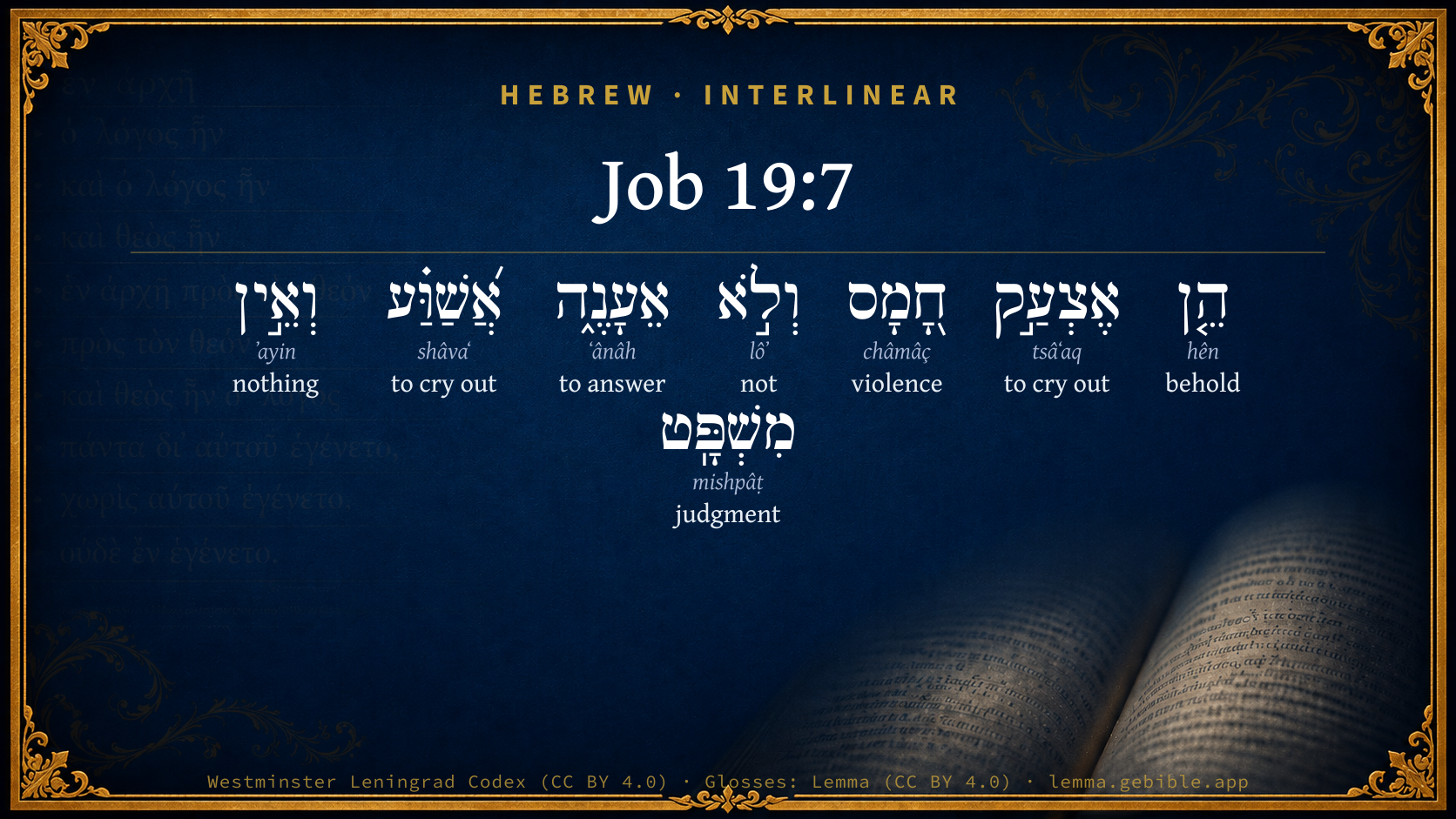
Job 19:7

Hebrew (Westminster Leningrad Codex) Job 19:7 appears in the Hebrew Old Testament. The text above is from the Westminster Leningrad Codex. Each word links to its Strong’s number, a concise gloss, and parsing drawn from the Open Scriptures Hebrew Bible morphology. Click any word for its full Brown-Driver-Briggs (BDB) entry.
Download image
Cite this verse

Job 19:7 (World English Bible). Public Domain. Lemma interlinear Bible study tool, https://lemma.gebible.app/v/job/19/7.

Show BibTeX & RIS
BibTeX
RIS
English Translation
"Behold, I cry out of wrong, but I am not heard: I cry for help, but there is no justice.
World English Bible · Public Domain
Highlights
  • 1 first appearance in the Hebrew Bible
Full analysis ↓
Download a study sheet

One document with this verse’s original text, its word-by-word gloss line, the meaning frame, cross-references with their text, attributed commentary, and full source and license credits — printable, and it pastes into notes with its structure intact.

This verse Autodidact and up

Study sheet (.html) Plain text (.txt)

A passage Seminary Student

Up to 50 verses in one chapter. A passage sheet keeps up to 6 commentary sources and 12 cross-references per verse, in the order this page ranks them, and says so on the sheet whenever that leaves anything out. Ask for a single verse and you get the Autodidact verse sheet above.

Everything on this page stays free to read, with no account — the sheet is a download of what is already on screen, not access to it.

Want to remove ads? Support Godless Engineer
Compare translations 3

The same verse in 3 English versions, stacked beneath the original-language interlinear above. Click any original word for its lexicon entry.

Each is an independent rendering of the whole verse — the interlinear is not word-aligned to these translations.

Highlighted words mark where these versions differ — a whole-verse word diff, not a word-by-word alignment.

  • World English Bible Public Domain
    "Behold, I cry out of wrong, but I am not heard: I cry for help, but there is no justice.
  • King James Version Public Domain
    Behold, I cry out of wrong, but I am not heard: I cry aloud, but there is no judgment.
  • unfoldingWord Literal Text CC BY-SA 4.0
    Behold, I cry, ‘Violence!’ but I am not answered; I call for help, but no justice.

unfoldingWord Literal Text — © unfoldingWord, licensed CC BY-SA 4.0. Word-aligned USFM3 via Door43 (git.door43.org/unfoldingWord/en_ult).

Versions to compare (up to 4)

3 of 4 selected

Show all 18 translations

Every available English version of this verse, each an independent rendering of the whole verse.

  • World English Bible Public Domain
    "Behold, I cry out of wrong, but I am not heard: I cry for help, but there is no justice.
  • Berean Standard Bible Public Domain
    Though I cry out, ‘Violence!’ I get no response; though I call for help, there is no justice.
  • Majority Standard Bible Public Domain
    Though I cry out, ‘Violence!’ I get no response; though I call for help, there is no justice.
  • King James Version Public Domain
    Behold, I cry out of wrong, but I am not heard: I cry aloud, but there is no judgment.
  • American Standard Version (1901) Public Domain
    Behold, I cry out of wrong, but I am not heard: I cry for help, but there is no justice.
  • Revised Version (1885) Public Domain
    Behold, I cry out of wrong, but I am not heard: I cry for help, but there is no judgment.
  • Geneva Bible (1599) Public Domain
    Beholde, I crie out of violence, but I haue none answere: I crie, but there is no iudgement.
  • Douay-Rheims (1899) Public Domain
    Behold I cry suffering violence, and no one will hear: I shall cry aloud, and there is none to judge.
  • Young's Literal Translation Public Domain
    Lo, I cry out -- violence, and am not answered, I cry aloud, and there is no judgment.
  • Literal Standard Version CC BY-SA 4.0
    Behold, I cry out—violence, and am not answered, I cry aloud, and there is no judgment.
  • Unlocked Literal Bible CC BY-SA 4.0
    See, I cry out, “Violence!” but I get no answer. I call out for help, but there is no justice.
  • unfoldingWord Literal Text CC BY-SA 4.0
    Behold, I cry, ‘Violence!’ but I am not answered; I call for help, but no justice.
  • Darby Bible Public Domain
    Behold, I cry out of wrong, and I am not heard; I cry aloud, but there is no judgment.
  • World Messianic Bible Public Domain
    “Behold, I cry out of wrong, but I am not heard. I cry for help, but there is no justice.
  • Webster's Bible Public Domain
    Behold, I cry out of wrong, but I am not heard: I cry aloud, but there is no judgment.
  • Free Bible Version CC BY-SA 4.0
    Even though I cry for help, I get no answer; even though I shout my objections, I get no justice.
  • Bible in Basic English Public Domain
    Truly, I make an outcry against the violent man, but there is no answer: I give a cry for help, but no one takes up my cause.
  • JPS Tanakh (1917) Public Domain
    Behold, I cry out: 'Violence!' but I am not heard; I cry aloud, but there is no justice.

Literal Standard Version (2020), Covenant Press — licensed CC BY-SA 4.0. Text via the HelloAO Bible API (eBible.org). Unlocked Literal Bible (unfoldingWord) — licensed CC BY-SA 4.0. Text via the HelloAO Bible API (eBible.org). unfoldingWord Literal Text — © unfoldingWord, licensed CC BY-SA 4.0. Word-aligned USFM3 via Door43 (git.door43.org/unfoldingWord/en_ult). Free Bible Version, Dr. Jonathan Gallagher — licensed CC BY-SA 4.0. Text via the HelloAO Bible API (eBible.org).

Word by word

More ways to search: Search by grammar → Find every occurrence → Compare this word →

Practice this passage: Drill this verse → Learn its vocabulary →

About this verse

These counts appear in no published source. They are computed here, from the morphology-tagged text and Lemma’s own curated glosses. What Lemma adds →

8
words
8
distinct lemmas
Wisdom
section

Notable vocabulary

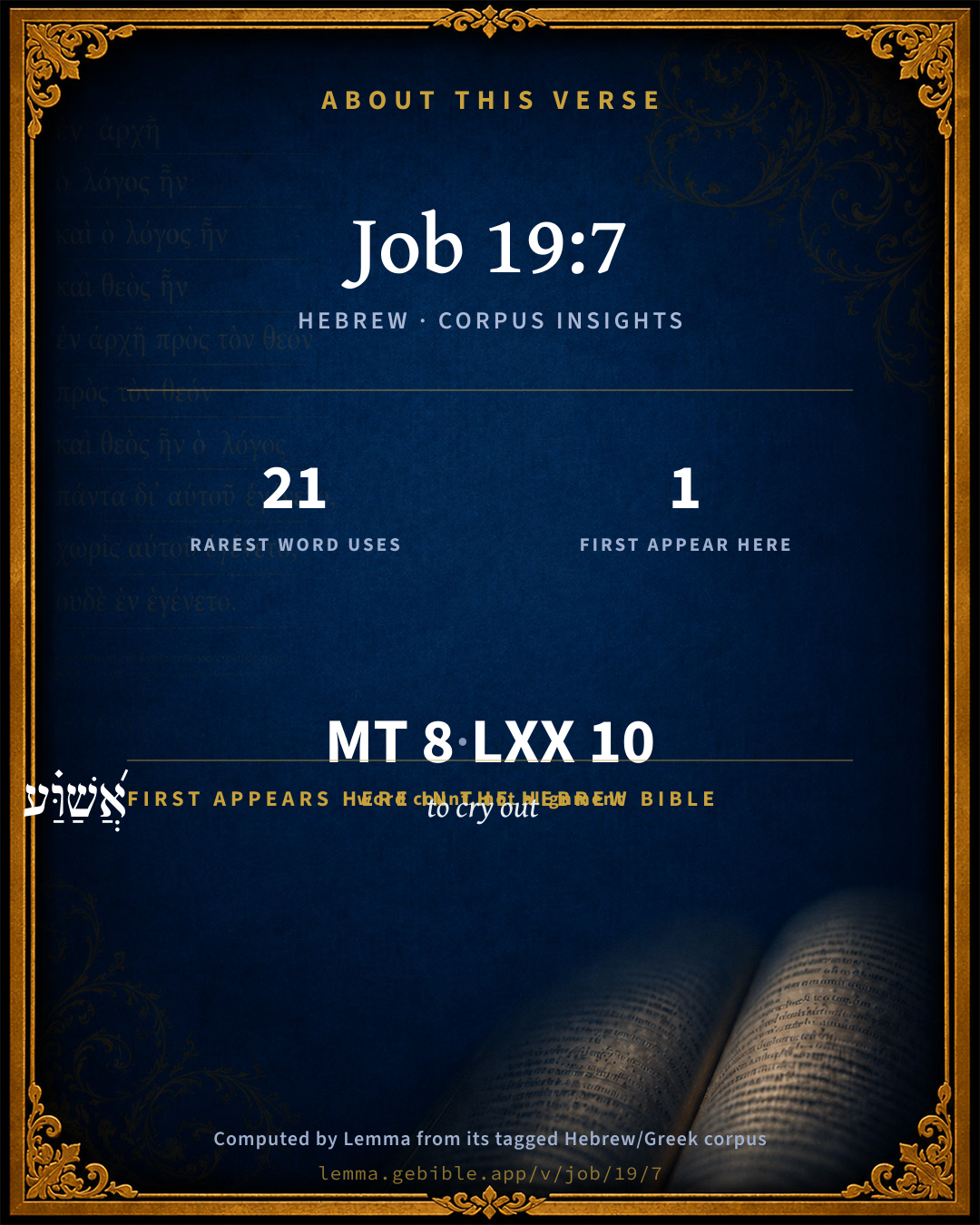
The rarest word here is אֲ֝שַׁוַּ֗ע to cry out H7768 — appearing just 21 times in the whole Hebrew Bible.

First appearance in Scripture

This word makes its first canonical appearance in the Hebrew Bible here:

  • אֲ֝שַׁוַּ֗ע to cry out H7768

Shared distinctive vocabulary

אֲ֝שַׁוַּ֗ע to cry out H7768 occurs in 21 verses of the Hebrew Bible. Also found in:

Grammatical profile

  • 3 verbs
  • 2 nouns
  • 3 particles

Verb forms

  • אֶצְעַ֣ק Qal · Imperfect
  • אֵעָנֶ֑ה Niphal · Imperfect
  • אֲ֝שַׁוַּ֗ע Piel · Imperfect

Hebrew & Septuagint length

In English translation the verse runs 20 words from the Hebrew and 19 from the Septuagint (LXX English) — closely comparable.

A rough comparison of the two English renderings, which tokenize alike — not a word-level alignment.

Word counts can differ between the Hebrew and the Greek without any difference in meaning — e.g. the Hebrew direct-object marker אֵת has no separate Greek word, and Greek often adds the article ὁ.

In the original languages it is 8 Hebrew tokens and 10 Greek tokens — but the two are counted differently (Hebrew bundles its prefixes and suffixes into one token; the Greek is in lemma form), so that isn’t a like-for-like length.

Cross-references

17

Topical passages linked to Job 19:7 in the Treasury of Scripture Knowledge — connected by theme and wording, ordered by reader-vote popularity; previews shown in the World English Bible.

  • Lamentations 3:8 Yes, when I cry, and call for help, he shuts out my prayer.
  • Habakkuk 1:2–3 Yahweh, how long will I cry, and you will not hear? I cry out to you "Violence!" and will you not save?
  • Job 21:27 "Behold, I know your thoughts, The devices with which you would wrong me.
  • Job 23:3–7 Oh that I knew where I might find him! That I might come even to his seat!
  • Job 30:20 I cry to you, and you do not answer me. I stand up, and you gaze at me.
  • Job 31:35–36 Oh that I had one to hear me! (Behold, here is my signature, let the Almighty answer me); Let the accuser write my indictment!
  • Job 34:5 For Job has said, 'I am righteous, God has taken away my right:
  • Job 40:8 Will you even annul my judgment? Will you condemn me, that you may be justified?
  • Job 9:24 The earth is given into the hand of the wicked. He covers the faces of the judges of it. If not he, then who is it?
  • Job 9:32 For he is not a man, as I am, that I should answer him, That we should come together in judgment.
  • Job 10:3 Is it good to you that you should oppress, That you should despise the work of your hands, And smile on the counsel of the wicked?
  • Job 10:15–17 If I am wicked, woe to me. If I am righteous, I still shall not lift up my head, Being filled with disgrace, And conscious of my affliction.
  • Job 13:15–23 Behold, he will kill me; I have no hope. Nevertheless, I will maintain my ways before him.
  • Job 16:17–19 Although there is no violence in my hands, And my prayer is pure.
  • Job 16:21 That he would maintain the right of a man with God, Of a son of man with his neighbor!
  • Psalms 22:2 My God, I cry in the daytime, but you don't answer; In the night season, and am not silent.
  • Jeremiah 20:8 For as often as I speak, I cry out; I cry, Violence and destruction! because the word of Yahweh is made a reproach to me, and a derision, all the day.

Cross-references courtesy of OpenBible.info (CC BY 4.0).

Hebrew and Greek witnesses Masoretic Hebrew ↔ Greek Septuagint

The same verse in the two great witnesses to the Old Testament, shown verse-for-verse.

These are two independent witnesses, not word-aligned to each other, and the Septuagint is shown in lemma (dictionary) form.

Hebrew Job 19:7 Masoretic · Westminster Leningrad Codex

הֵ֤ן אֶצְעַ֣ק חָ֭מָס וְלֹ֣א אֵעָנֶ֑ה אֲ֝שַׁוַּ֗ע וְאֵ֣ין מִשְׁפָּֽט

"Behold, I cry out of wrong, but I am not heard: I cry for help, but there is no justice.

World English Bible · Public Domain

Greek LXX Job 19:7 Septuagint · lemma form

ἰδού γελάω ὄνειδος καί οὐ λαλέω κράζω καί οὐδαμοῦ κρίμα

Behold, I laugh at reproach; I will not speak: or I will cry out, but there is nowhere judgment.

LXX2012 (modern English Septuagint) · Public Domain

Hebrew: Westminster Leningrad Codex (CC BY 4.0). Greek: Septuagint (public domain); English from LXX2012 (modern English Septuagint) (Public Domain). How the Septuagint differs from the Hebrew →

Commentary

Notes on Job 19:7 from classic Christian and Jewish commentators (each source and its license shown beneath its notes). The classic Christian expositions comment on the surrounding passage and are grouped to its opening verse, so a note may address several verses; the Jewish commentaries on the Tanakh (Rashi and others) are per-verse, so they appear only where the commentator wrote on this verse.

Lemma curates 59 commentaries, every one of them public domain or Creative Commons licensed, each selected and text-cleaned for this edition rather than reprinted as found. About our sources →

Trapp's Complete Commentary

John Trapp

Job 19:7 Behold, I cry out of wrong, but I am not heard: I cry aloud, but [there is] no judgment.

Ver. 7. Behold, I cry out of wrong, but I am not heard] Nothing is more natural and usual than for men in misery to cry out for help. Job’s great grief was, that neither God nor man would regard his moans or deliver him out of the net. God did not rescue him, men did not right him or relieve him. His outcry seemeth to be the same in effect with that of Habakkuk the prophet, Hab 1:2-3, "O Lord, how long shall I cry and thou wilt not hear? even cry out unto thee of violence, and thou wilt not save? Why dost thou show me iniquity, and cause me to behold grievance? for spoiling and violence are before me: and there are those who raise up strife and contention." "Wherefore lookest thou upon them that deal treacherously," &c., Job 19:13. Thus Job, but without an answer; as the lion letteth his whelps roar themselves hoarse for hunger, yea, till they are almost dead, before he supplieth them. Sure it is, that God always heareth his Jobs, though he doth not always answer in our time, and in our way. Yea, it is a hearing and an answer of prayer (saith one) that we can pray, though unheard and unanswered.

I cry aloud] Heb. I set up my note, cam gemitu et ululatu, with groaning and howling. Men never pray so earnestly as in greatest afflictions, Heb 5:7 Hos 12:4; then their prayers, like strong streams in narrow straits, bear down all that stands before them.

John Trapp, A Commentary or Exposition upon All the Books of the Old and New Testament (1647–1656) — public domain. Text from a community e-Sword module.

Tyndale Open Study Notes

Tyndale Open Resources

19:7 Help! (literally Violence!): Cp. Jer 20:8; Hab 1:2-3. • no one answers: See Ps 22:2; Lam 3:8; Hab 1:2-3.

Tyndale Open Study Notes — © Tyndale Open Resources, licensed CC BY-SA 4.0. Text via the HelloAO Bible API.

Jamieson, Fausset & Brown

Robert Jamieson, A. R. Fausset & David Brown

wrong--violence: brought on him by God.

no judgment--God will not remove my calamities, and so vindicate my just cause; and my friends will not do justice to my past character.

Jamieson, Fausset & Brown — Commentary Critical and Explanatory on the Whole Bible (1871) — public domain (CC PDM 1.0). Text via the HelloAO Bible API.

Adam Clarke's Commentary

Verse 7. I cry out of wrong] I complain of violence and of injustice; but no one comes to my help.

Adam Clarke's Commentary on the Bible (1810–1826) — public domain. Text from a community e-Sword/MySword module.

Ellicott's Commentary for English Readers

(7) Behold I cry out of wrong.—The description he now gives of himself as persecuted and forsaken by God is necessary to enhance the value of the confession he is about to make. Severely has God dealt with him, but that severity of dealing has only drawn him nearer to God and made him trust the more. He groups together a rich variety of figures to express his desolate condition. He is suffering assault, and can get no protection or redress; he is imprisoned on every side, his hope is torn up like the tree of which he had before spoken (Job_14:7).

A Bible Commentary for English Readers, edited by Charles John Ellicott (1878–1897) — public domain. Text from a community e-Sword module.

The Cambridge Bible for Schools and Colleges

gen. ed. J. J. S. Perowne

7. This drew from him in his helplessness cries of wrong, which were unheeded.

7–12. God’s hostility to him and destructive persecution of him.

In Job_19:6 the transition is already made to the account of God’s hostility. The picture is sufficiently graphic. First there was the general feeling of being entangled, as a creature snared.

The Cambridge Bible for Schools and Colleges (gen. ed. J. J. S. Perowne; Cambridge University Press, 1878–1918) — public domain. Text from a community e-Sword module.

John Gill's Exposition

He hath fenced up my way that I cannot pass,.... A metaphor taken from travellers, who not only meet with obstacles and obstructions in their way, which make it difficult; but sometimes with such enclosures and fences, that they are at a full stop, and cannot pass on, and know not what course to steer: the people of God are not inhabitants of this world, but pilgrims, strangers, and sojourners in it, and travellers through it; they are bound for another country, and are travelling to it; and though their way for far most part is indeed troublesome, but generally passable, or made so; yet sometimes not only is their way hedged up with afflictions, and they hedged about with them, that they cannot easily get out, and get through and pass on; and it is with much difficulty, and with being much scratched and torn, they do brush through; but they also at other times find God has built up a wall against them, and enclosed them with hewn stones, and so fenced up their way that they cannot pass on; such difficulties present as seem insurmountable, and they are at a standstill, and know not what way to take; which was now Job's case, see Lam 3:5; and this may not only respect the way of his walk in this world, but his way to God, either to the throne of his grace, or the tribunal of his justice: the way to God, as on a throne of grace, is only through Christ, the living way; which, though more clearly revealed under the Gospel dispensation, and therefore called a new way, yet was known under the former dispensation, and made use of; in which saints may have access to God with boldness and confidence: but sometimes this way seems by unbelief to be fenced up, though it is always open; and especially when God hides his face, and is not to be seen, nor is it known where to find him, and how to come up to his seat; and which also was Job's case, Job 23:3; and whereas he was very desirous of having his cause heard and tried at the tribunal of God, his way was so shut up, that he could not obtain what he so much desired, and knew not therefore how to proceed, and what course to take:

and he hath set darkness in my paths; and was like a traveller in a very dark night, that cannot see his way, and knows not what step to take next; so good men, though they walk not in the ways of darkness, in a moral sense, as unregenerate men do; yet even while they are walking in the good ways of truth and holiness, and while they are passing through this world, God sometimes withdraws the light of his countenance from them, so that they walk in darkness, and have no light, which is very uncomfortable walking; and when God may be said to put darkness into their paths, he not granting them the light of grace and comfort they have sometimes enjoyed; and so it is with them when under such dark dispensations of Providence, as that they cannot see the end of God in leading them in such ways; and then their case is such as it now was Job's; that they cannot see any way of getting out of it; as the Israelites at the Red sea, and Paul and the mariners when in a storm, and all hope of being saved was gone.

John Gill's Exposition of the Whole Bible (1746–1763) — public domain (CC PDM 1.0). Text via the HelloAO Bible API.

Albert Barnes' Notes on the Bible

Behold, I cry out of wrong - Margin, or “violence.” The Hebrew word (חמס châmâs) means properly violence. The violence referred to is that which was brought upon him by God. It is, indeed, harsh language; but it is not quite sure that he means to complain of God for doing him injustice. God had dealt with him in a severe or violent manner, is the meaning, and he had cried unto him for relief, but had cried in vain.

No judgment - No justice. The meaning is, that he could obtain justice from no one God would not interpose to remove the calamities which he had brought upon him, and his friends would do no justice to his motives and character.

Albert Barnes' Notes on the Bible (1834–1885) — public domain. Text from a community e-Sword/MySword module.

Haydock's Catholic Bible Commentary

Hear. Jeremias makes the same complaint, Lamentations iii. 8. (Calmet)

George Leo Haydock (1774–1849), Haydock's Catholic Family Bible and Commentary, 1859 edition — public domain. Excludes Psalms (Douay-Rheims chapter numbering differs from Protestant) and Deuterocanonical books (Catholic canon only).

Matthew Poole's English Annotations

I cry out, to wit, unto God by prayer or appeal.

Of wrong; that I am oppressed, either,

1. By my friends; or rather,

2. By God, who deals with me according to his sovereign power and exact and rigorous justice, and not with that equity and benignity which he showeth to the generality of men, and hath promised to good men, such as he knoweth me to be.

There is no judgment: God will not hear my cause, nor pass sentence; which I might reasonably expect from him; but he quite neglects me, and hath utterly forsaken me, and left me in the hands of the devil and wicked men. See the like complaints of other good men in the like case of desertion, Psa 13:2; 22:2; 88:15; Lam 3:8; Hab 1:2.

Matthew Poole's English Annotations on the Holy Bible (1683–1685) — public domain. Text from a community e-Sword/MySword module.

Whedon's Commentary on the Bible

Daniel D. Whedon

7. Of wrong — Behold, I cry aloud, “Violence!” and am not answered.

Hab_1:2.

Daniel D. Whedon (gen. ed.), Commentary on the Old and New Testaments (1874–1909) — public domain. Text from a community e-Sword module.

The Pulpit Commentary

Behold, I cry out of wrong; i.e. "I cry out that I am wronged." I complain that sufferings are inflicted on me that I have not deserved. This has been Job"s complaint from the first. (Job_3:26 Job_6:29 Job_9:17, 22 10:3, etc.) But I am not heard; i.e. "I am not listened to my cry is not answered." I cry aloud, but there is no judgment; or, no decision sentence." All Job"s appeals to God have elicited no reply from him. He still keeps silence. Job appears from the first to have anticipated such a theophany as ultimately takes place (ch. 38-41) and vindicates his character.

The cry unheard.

I IT MAY BE REALLY UNHEARD. That is to say, while of course God knows everything, he may not respond, may not heed. Why?

1. Because the cry is not addressed to the true God. The heathen priests on Mount Carmel screamed, "O Baal, hear us!" from morning till evening. "But there was no voice, nor any that answered". (1Ki_18:26) Men have their false gods now, i.e. their false ideas of God. A god who ignores sin, a god who is only amiable compliance, is not the true God. One who addresses such a god will not be heard.

2. Because the cry is not true. It is a formal petition, not a heartfelt prayer. The words may be loud, but the soul is silent. Christ says, "When ye pray, use not vain repetitions, as the heathen do: for they think that they shall be heard for their much speaking". (Mat_6:7)

3. Because the cry is not trustful. We may cry to God in wild despair; the prayer may be wrung out of an agony of the soul; it may be just the expression of a natural instinct; but it may carry with it no real confidence in God. The Divine response is according to our faith.

4. Because the cry is not accompanied by penitence. If we hold to our sin we cannot be saved from our trouble. While we excuse ourselves before God we make his ear deaf to our call. Nothing so effectually seals the gates of prayer as an impenitent heart.

5. Because the pity sought from God is not given to a brother man. The prayer of the selfish is not heard. Every time we repeat the Lord"s Prayer we remind ourselves that our trespasses are forgiven in proportion as we forgive those who trespass against us. This is the one, the only thing in the prayer that Christ selected for emphatic comment, adding, "If ye forgive not men their trespasses, neither will your Father forgive your trespasses". (Mat_6:15)

II IT MAY BE ONLY APPARENTLY UNHEARD.

1. Because there is no audible response. Our voice goes out into the silence. We strain our ears for one word of reply, but no sound reaches us. Though we spread out our hands and cry aloud, the calm heavens are still and apparently irresponsive. But, then, we are foolish if we expect an answer that shall be audible to our bodily ears, for God is a Spirit. Moreover, if we trust him, we should not think that he does not hear when he does not speak. Silence is not deafness.

2. Because there is no immediate relief. At present all seems as it was before we prayed. Does it not appear as though the cry had been wasted on the air? We have to learn patience. It may be well that the trial should last a little longer. In the end God will deliver his suffering children who trust themselves to him, but he may not give them sudden and immediate relief.

3. Because the response is not what we expected. God will not be dictated to. He will use his own judgment in his reply to us. He may give the very thing we ask for. But if that be not fitting he will reply in some other way. Assuredly he will reply. Therefore we must take a wider view of his action, and be prepared to receive God"s response in new and unlooked-for forms. Instead of removing the trouble he may give strength to bear it, Instead of prosperity he may give peace. Then we have no right to think our cry lost and neglected. It is heard. W.F.A.

The Pulpit Commentary (1880–1919), ed. H.D.M. Spence-Jones & Joseph S. Exell — public domain. Text from a community e-Sword module.

John Wesley's Explanatory Notes

Cry - Unto God. Wrong - That I am oppressed by my friends.

John Wesley, Explanatory Notes Upon the Whole Bible (1754–1765) — public domain. Text via the GEBible commentary corpus.

Keil & Delitzsch

C. F. Keil & F. Delitzsch

7 Behold I cry violence, and I am not heard;

I cry for help, and there is no justice.

8 My way He hath fenced round, that I cannot pass over,

And He hath set darkness on my paths.

9 He hath stripped me of mine honour,

And taken away the crown from my head.

10 He destroyed me on every side, then I perished,

And lifted out as a tree my hope.

11 He kindled His wrath against me,

And He regarded me as one of His foes.

He cries aloud חמס (that which is called out regarded as accusa. or as an interjection, vid., on Hab 1:2), i.e., that illegal force is exercised over him. He finds, however, neither with God nor among men any response of sympathy and help; he cries for help (which שׁוּע, perhaps connected with ישׁע, Arab. s‛t, from ישׁע, Arab. ws‛, seems to signify), without justice, i.e., the right of an impartial hearing and verdict, being attainable by him. He is like a prisoner who is confined to a narrow space (comp. Job 3:23; Job 13:27) and has no way out, since darkness is laid upon him wherever he may go. One is here reminded of Lam 3:7-9; and, in fact, this speech generally stands in no accidental mutual relation to the lamentations of Jeremiah. The "crown of my head" has also its parallel in Lam 5:16; that which was Job's greatest ornament and most costly jewel is meant. According to Job 29:14, צדק and משׁפט were his robe and diadem. These robes of honour God has stripped from him, this adornment more precious than a regal diadem He has taken from him since, i.e., his affliction puts him down as a transgressor, and abandons him to the insult of those around him. God destroyed him roundabout (destruxit), as a house that is broken down on all sides, and lifted out as a tree his hope. הסּיע does not in itself signify to root out, but only to lift out (Job 4:21, of the tent-cord, and with it the tent-pin) of a plant: to remove it from the ground in which it has grown, either to plant it elsewhere, as Psa 80:9, or as here, to put it aside. The ground was taken away from his hope, so that its greenness faded away like that of a tree that is rooted up. The fut. consec. is here to be translated: then I perished (different from Job 14:20 : and consequently he perishes); he is now already one who is passed away, his existence is only the shadow of life. God has caused, fut. Hiph. apoc. ויּחר, His wrath to kindle against him, and regarded him in relation to Himself as His opponents, therefore as one of them. Perhaps, however, the expression is intentionally intensified here, in contrast with Job 13:24 : he, the one, is accounted by God as the host of His foes; He treats him as if all hostility to God were concentrated in him.

Keil & Delitzsch — Biblical Commentary on the Old Testament (1861–1891) — public domain (CC PDM 1.0). Text via the HelloAO Bible API. (Old Testament only.)

unfoldingWord translationNotes

Door43 World Missions Community

General Information:

Job continues to speak to his three friends.

See, I cry out

"Pay attention, because what I am about to say is both true and important: I cry out"

Violence!

This is a cry for help. This can be stated clearly. AT: "Violence! Help!" or "Help! I am being attacked!" (See: Assumed Knowledge and Implicit Information)

I call out for help

"I shout for help" or "I cry for help"

but there is no justice

The abstract noun "justice" can be translated with a phrase that makes the meaning clear. AT: "but no one protects me from those who do me wrong" (See: Abstract Nouns and Assumed Knowledge and Implicit Information)

He has walled up ... darkness in my path

Job uses these images to describe how God has made him feel helpless and hopeless. (See: Metaphor)

He has walled up my way so that I cannot pass

"God has put a wall on the road that I am walking on" or "He has blocked the way so I cannot keep going"

He has stripped ... the crown from my head

Job uses these images to say that God has taken his good reputation, wealth, and dignity away from him. (See: Metaphor)

He has stripped me of my glory

Job speaks of his glory as if it were a robe that God has taken away. AT: "He has taken away my glory" (See: Metaphor)

he has taken the crown from my head

The crown refers to Job's dignity or honor. AT: "he has taken away my dignity and honor" or "it is as though he has taken my crown off my head" (See: Metaphor)

translationWords

call

just

darkness

glory

crown

unfoldingWord translationNotes — © Distant Shores Media and the Door43 World Missions Community, licensed CC BY-SA 4.0. Source: git.door43.org/Door43/en_tn.

Rashi

Rabbi Shlomo Yitzchaki (Rashi)

I cry out concerning violence but I am not answered.

Rashi on the Tanakh — English translations: “The Judaica Press complete Tanach with Rashi, translated by A. J. Rosenberg” (CC BY 4.0); “Pentateuch with Rashi's commentary by M. Rosenbaum and A.M. Silbermann, 1929-1934” (public domain); “The Metsudah Tanach series, Lakewood, N.J” (CC BY 4.0); and “The Book of Joshua, Metsudah Publications, 1997” (CC BY 4.0). Text via Sefaria.

Lesson kit

Teaching starters — assembled from the data on this page, not authored interpretation. Every prompt links to the verse data it draws on. Edit before teaching.

Job, in the Wisdom, opens this verse with 8 words (8 distinct Hebrew lemmas). Its most distinctive word is shâvaʻ (“to cry out”). A historical commentator’s framing appears above. Read the whole chapter for the surrounding context.

Discussion questions

  1. The word shâvaʻ carries the sense “to cry out.” How does it shape the verse?
  2. The word “to cry out” first appears here in Scripture. What is being introduced at this debut?
  3. Job 24:12 shares the word «to cry out» with this verse. How do the two illuminate each other?
  4. These translations render this verse differently; the difference is in the English rendering, not the original. What questions does that raise?
  5. The verb «אֶצְעַ֣ק» is Qal Imperfect. How does its form color the action?
  6. Reading how Trapp's Complete Commentary and Tyndale Open Study Notes read this verse, where do the two commentators agree and where do they part?

Things to notice

Reading settings

Reading text

Shown beneath each verse's original-language words.

Old Testament
Old Testament edition

Read the OT as the Masoretic Hebrew (MT) or the Greek Septuagint (LXX).

English shown for the Greek Septuagint (in the Hebrew ↔ Greek comparison).

Comparing translations? Open the Compare panel on any verse page to stack up to four side by side.