
Deuteronomy 31:27

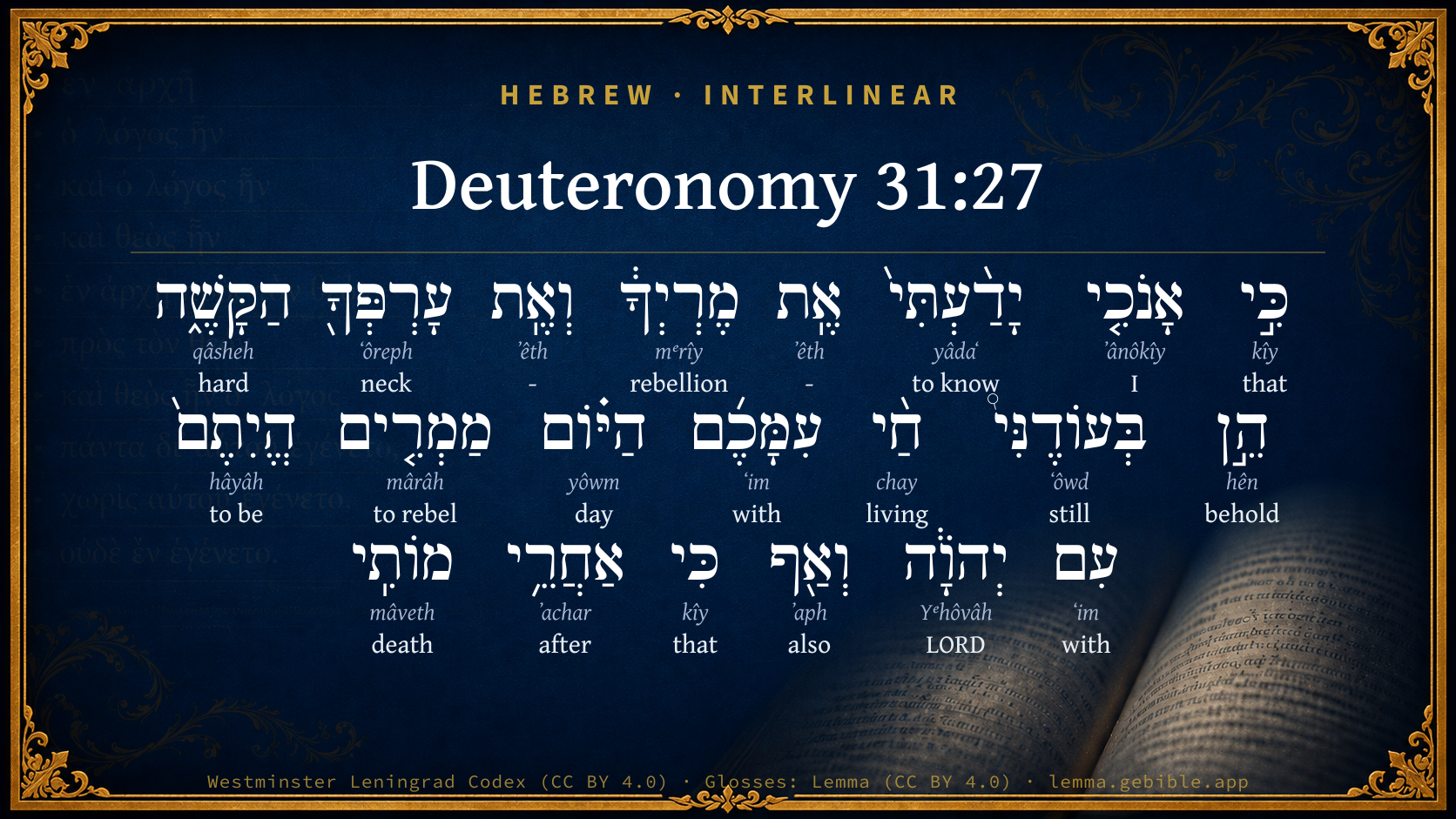
Hebrew (Westminster Leningrad Codex) Deuteronomy 31:27 appears in the Hebrew Old Testament. The text above is from the Westminster Leningrad Codex. Each word links to its Strong’s number, a concise gloss, and parsing drawn from the Open Scriptures Hebrew Bible morphology. Click any word for its full Brown-Driver-Briggs (BDB) entry.
Download image
Cite this verse

Deuteronomy 31:27 (World English Bible). Public Domain. Lemma interlinear Bible study tool, https://lemma.gebible.app/v/deuteronomy/31/27.

Show BibTeX & RIS
BibTeX
RIS
English Translation
For I know your rebellion, and your stiff neck: behold, while I am yet alive with you this day, you have been rebellious against Yahweh; and how much more after my death?
World English Bible · Public Domain
Download a study sheet

One document with this verse’s original text, its word-by-word gloss line, the meaning frame, cross-references with their text, attributed commentary, and full source and license credits — printable, and it pastes into notes with its structure intact.

This verse Autodidact and up

Study sheet (.html) Plain text (.txt)

A passage Seminary Student

Up to 50 verses in one chapter. A passage sheet keeps up to 6 commentary sources and 12 cross-references per verse, in the order this page ranks them, and says so on the sheet whenever that leaves anything out. Ask for a single verse and you get the Autodidact verse sheet above.

Everything on this page stays free to read, with no account — the sheet is a download of what is already on screen, not access to it.

Want to remove ads? Support Godless Engineer
Compare translations 3

The same verse in 3 English versions, stacked beneath the original-language interlinear above. Click any original word for its lexicon entry.

Each is an independent rendering of the whole verse — the interlinear is not word-aligned to these translations.

Highlighted words mark where these versions differ — a whole-verse word diff, not a word-by-word alignment.

  • World English Bible Public Domain
    For I know your rebellion, and your stiff neck: behold, while I am yet alive with you this day, you have been rebellious against Yahweh; and how much more after my death?
  • King James Version Public Domain
    For I know thy rebellion, and thy stiff neck: behold, while I am yet alive with you this day, ye have been rebellious against the LORD; and how much more after my death?
  • unfoldingWord Literal Text CC BY-SA 4.0
    For I know your rebellion and your hard neck; behold, while I am still alive with you today, you have been rebellious against Yahweh, and also surely after my death.

unfoldingWord Literal Text — © unfoldingWord, licensed CC BY-SA 4.0. Word-aligned USFM3 via Door43 (git.door43.org/unfoldingWord/en_ult).

Versions to compare (up to 4)

3 of 4 selected

Show all 18 translations

Every available English version of this verse, each an independent rendering of the whole verse.

  • World English Bible Public Domain
    For I know your rebellion, and your stiff neck: behold, while I am yet alive with you this day, you have been rebellious against Yahweh; and how much more after my death?
  • Berean Standard Bible Public Domain
    For I know how rebellious and stiff-necked you are. If you are already rebelling against the LORD while I am still alive, how much more will you rebel after my death!
  • Majority Standard Bible Public Domain
    For I know how rebellious and stiff-necked you are. If you are already rebelling against the LORD while I am still alive, how much more will you rebel after my death!
  • King James Version Public Domain
    For I know thy rebellion, and thy stiff neck: behold, while I am yet alive with you this day, ye have been rebellious against the LORD; and how much more after my death?
  • American Standard Version (1901) Public Domain
    For I know thy rebellion, and thy stiff neck: behold, while I am yet alive with you this day, ye have been rebellious against Jehovah; and how much more after my death?
  • Revised Version (1885) Public Domain
    For I know thy rebellion, and thy stiff neck: behold, while I am yet alive with you this day, ye have been rebellious against the LORD; and how much more after my death?
  • Geneva Bible (1599) Public Domain
    For I knowe thy rebellion and thy stiffe necke: beholde, I being yet aliue with you this day, ye are rebellious against the Lord: howe much more then after my death?
  • Douay-Rheims (1899) Public Domain
    For I know thy obstinacy, and thy most stiff neck, While I am yet living, and going in with you, you have always been rebellious against the Lord: how much more when I shall be dead?
  • Young's Literal Translation Public Domain
    for I -- I have known thy rebellion, and thy stiff neck; lo, in my being yet alive with you to-day, rebellious ye have been with Jehovah, and also surely after my death.
  • Literal Standard Version CC BY-SA 4.0
    for I have known your rebellion and your stiff neck; behold, in my being yet alive with you today, you have been rebelling against YHWH, and surely also after my death.
  • Unlocked Literal Bible CC BY-SA 4.0
    For I know your rebellion and your stiff neck; look, while I am still alive with you even today, you have been rebellious against Yahweh; how much more after my death?
  • unfoldingWord Literal Text CC BY-SA 4.0
    For I know your rebellion and your hard neck; behold, while I am still alive with you today, you have been rebellious against Yahweh, and also surely after my death.
  • Darby Bible Public Domain
    for I know thy rebellion, and thy stiff neck. Lo, while I am yet alive with you this day, ye have been rebellious against Jehovah; and how much more after my death!
  • World Messianic Bible Public Domain
    For I know your rebellion and your stiff neck. Behold, while I am yet alive with you today, you have been rebellious against the LORD. How much more after my death?
  • Webster's Bible Public Domain
    For I know thy rebellion, and thy stiff neck: behold, while I am yet alive with you this day, ye have been rebellious against the LORD; and how much more after my death?
  • Free Bible Version CC BY-SA 4.0
    I know how stubborn and rebellious you are. If you've already started rebelling against the Lord while I'm still alive, how much worse will you get after I die?
  • Bible in Basic English Public Domain
    For I have knowledge of your hard and uncontrolled hearts: even now, while I am still living, you will not be ruled by the Lord; how much less after my death?
  • JPS Tanakh (1917) Public Domain
    For I know thy rebellion, and thy stiff neck; behold, while I am yet alive with you this day, ye have been rebellious against the LORD; and how much more after my death?

Literal Standard Version (2020), Covenant Press — licensed CC BY-SA 4.0. Text via the HelloAO Bible API (eBible.org). Unlocked Literal Bible (unfoldingWord) — licensed CC BY-SA 4.0. Text via the HelloAO Bible API (eBible.org). unfoldingWord Literal Text — © unfoldingWord, licensed CC BY-SA 4.0. Word-aligned USFM3 via Door43 (git.door43.org/unfoldingWord/en_ult). Free Bible Version, Dr. Jonathan Gallagher — licensed CC BY-SA 4.0. Text via the HelloAO Bible API (eBible.org).

Word by word

More ways to search: Search by grammar → Find every occurrence → Compare this word →

Practice this passage: Drill this verse → Learn its vocabulary →

מֶרְיְךָ֔
mᵉrîy
H4805
“rebellion · your”
Noun, Common, Masculine, Singular, Construct + Suffix, Personal, 2nd Person, Masculine, Singular
Part of Speech
Noun
Type
Common
Gender
Masculine
Number
Singular
State
Construct
Full BDB Definition

Origin: from H4784

TWOT: 1242a

rebellion - rebellion - rebellious (in construct)
  1. כִּ֣י kîy H3588 “that” Conjunction
  2. אָנֹכִ֤י ʼânôkîy H595 “I” Pronoun, Personal, 1st Person, Common, Singular
  3. יָדַ֨עְתִּי֙ yâdaʻ H3045 “to know” Verb, Qal, Perfect, 1st Person, Common, Singular
  4. אֶֽת ʼêth H853 “-” Particle, Direct Object
  5. וְאֶֽת ʼêth H853 “and · -” Conjunction + Particle, Direct Object
  6. עָרְפְּךָ֖ ʻôreph H6203 “neck · your” Noun, Common, Masculine, Singular, Construct + Suffix, Personal, 2nd Person, Masculine, Singular
  7. הַקָּשֶׁ֑ה qâsheh H7186 “the · hard” Particle, Definite Article + Adjective, Adjective, Masculine, Singular, Absolute
  8. הֵ֣ן hên H2005 “behold” Particle, Demonstrative
  9. בְּעוֹדֶנִּי֩ ʻôwd H5750 “in/at · still · my” Preposition + Adverb + Suffix, Personal, 1st Person, Common, Singular
  10. חַ֨י chay H2416 “living” Adjective, Adjective, Masculine, Singular, Absolute
  11. עִמָּכֶ֜ם ʻim H5973 “with · you” Preposition + Suffix, Personal, 2nd Person, Masculine, Plural
  12. הַיּ֗וֹם yôwm H3117 “the · day” Particle, Definite Article + Noun, Common, Masculine, Singular, Absolute
  13. מַמְרִ֤ים mârâh H4784 “rebelling” Verb, Hiphil, Participle Active, Masculine, Plural, Absolute
  14. הֱיִתֶם֙ hâyâh H1961 “to be” Verb, Qal, Perfect, 2nd Person, Masculine, Plural
  15. עִם ʻim H5973 “with” Preposition
  16. יְהֹוָ֔ה Yᵉhôvâh H3068 “LORD” Noun, Proper
  17. וְאַ֖ף ʼaph H637 “and · also” Conjunction + Adverb
  18. כִּי kîy H3588 “that” Conjunction
  19. אַחֲרֵ֥י ʼachar H310 “after” Preposition
  20. מוֹתִֽי mâveth H4194 “death · my” Noun, Common, Masculine, Singular, Construct + Suffix, Personal, 1st Person, Common, Singular

About this verse

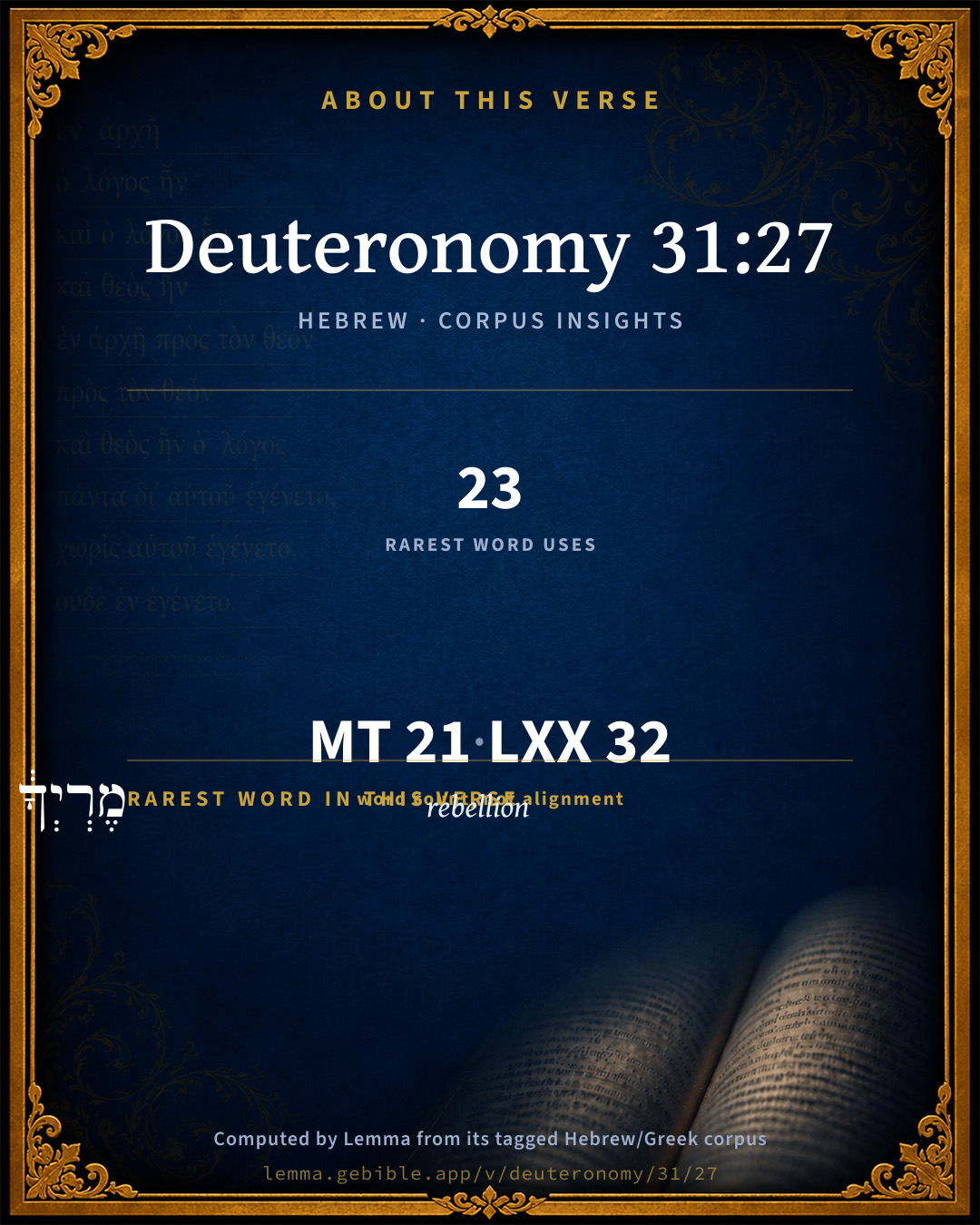
These counts appear in no published source. They are computed here, from the morphology-tagged text and Lemma’s own curated glosses. What Lemma adds →

21
words
18
distinct lemmas
Pentateuch
section

Notable vocabulary

The rarest word here is מֶרְיְךָ֔ rebellion H4805 — appearing just 23 times in the whole Hebrew Bible.

Shared distinctive vocabulary

מֶרְיְךָ֔ rebellion H4805 occurs in 21 verses of the Hebrew Bible. Also found in:

Grammatical profile

  • 3 verbs
  • 5 nouns
  • 2 adjectives
  • 1 pronoun
  • 3 prepositions
  • 2 conjunctions
  • 2 adverbs
  • 3 particles

Verb forms

  • יָדַ֨עְתִּי֙ Qal · Perfect
  • מַמְרִ֤ים Hiphil · Participle Active
  • הֱיִתֶם֙ Qal · Perfect

Repetition

Words recur within this verse — often emphatic in Hebrew:

  • כִּ֣י that H3588 ×2
  • עִמָּכֶ֜ם with H5973 ×2

Hebrew & Septuagint length

In English translation the verse runs 32 words from the Hebrew and 38 from the Septuagint (LXX English) — closely comparable.

A rough comparison of the two English renderings, which tokenize alike — not a word-level alignment.

Word counts can differ between the Hebrew and the Greek without any difference in meaning — e.g. the Hebrew direct-object marker אֵת has no separate Greek word, and Greek often adds the article ὁ.

In the original languages it is 21 Hebrew tokens and 32 Greek tokens — but the two are counted differently (Hebrew bundles its prefixes and suffixes into one token; the Greek is in lemma form), so that isn’t a like-for-like length.

Cross-references

8

Topical passages linked to Deuteronomy 31:27 in the Treasury of Scripture Knowledge — connected by theme and wording, ordered by reader-vote popularity; previews shown in the World English Bible.

  • Deuteronomy 9:24 You have been rebellious against Yahweh from the day that I knew you.
  • Deuteronomy 32:20 He said, I will hide my face from them, I will see what their end shall be: For they are a very perverse generation, Children in whom is no faithfulness.
  • Exodus 32:8–9 They have turned aside quickly out of the way which I commanded them. They have made themselves a molten calf, and have worshiped it, and have sacrificed to it, and said, 'These are your gods, Israel, which brought you up out of the land of Egypt.'"
  • Deuteronomy 9:6–7 Know therefore, that Yahweh your God doesn't give you this good land to possess it for your righteousness; for you are a stiff-necked people.
  • 2 Chronicles 30:8 Now don't you be stiff-necked, as your fathers were; but yield yourselves to Yahweh, and enter into his sanctuary, which he has sanctified forever, and serve Yahweh your God, that his fierce anger may turn away from you.
  • Psalms 78:8 And might not be as their fathers, A stubborn and rebellious generation, A generation that didn't make their hearts loyal, Whose spirit was not steadfast with God.
  • Isaiah 48:4 Because I knew that you are obstinate, and your neck is an iron sinew, and your brow brass;
  • Acts 7:51 "You stiff-necked and uncircumcised in heart and ears, you always resist the Holy Spirit! As your fathers did, so you do.

Cross-references courtesy of OpenBible.info (CC BY 4.0).

Hebrew and Greek witnesses Masoretic Hebrew ↔ Greek Septuagint

The same verse in the two great witnesses to the Old Testament, shown verse-for-verse.

These are two independent witnesses, not word-aligned to each other, and the Septuagint is shown in lemma (dictionary) form.

Hebrew Deuteronomy 31:27 Masoretic · Westminster Leningrad Codex

כִּ֣י אָנֹכִ֤י יָדַ֨עְתִּי֙ אֶֽת מֶרְיְךָ֔ וְאֶֽת עָרְפְּךָ֖ הַקָּשֶׁ֑ה הֵ֣ן בְּעוֹדֶנִּי֩ חַ֨י עִמָּכֶ֜ם הַיּ֗וֹם מַמְרִ֤ים הֱיִתֶם֙ עִם יְהֹוָ֔ה וְאַ֖ף כִּי אַחֲרֵ֥י מוֹתִֽי

For I know your rebellion, and your stiff neck: behold, while I am yet alive with you this day, you have been rebellious against Yahweh; and how much more after my death?

World English Bible · Public Domain

Greek LXX Deuteronomy 31:27 Septuagint · lemma form

ὅτι ἐγώ ἐπίσταμαι ὁ ἐρεθισμός σύ καί ὁ τράχηλος σύ ὁ σκληρός ἔτι γάρ ἐγώ ζάω μετά σύ σήμερον παραπικραίνω εἰμί ὁ πρός ὁ θεός πῶς οὐ καί ἔσχατο ὁ θάνατος ἐγώ

For I know your provocation, and your stiff neck; for yet during my life with you at this day, you⌃ have been provoking in your conduct toward God: how shall you⌃ not also be so after my death?

LXX2012 (modern English Septuagint) · Public Domain

Hebrew: Westminster Leningrad Codex (CC BY 4.0). Greek: Septuagint (public domain); English from LXX2012 (modern English Septuagint) (Public Domain). How the Septuagint differs from the Hebrew →

Targum (Aramaic paraphrase)

2

The Targum is the ancient Jewish Aramaic paraphrase of the Hebrew Scriptures — an interpretive translation, not the Hebrew text itself. Onkelos (literal) and Pseudo-Jonathan (expansive) render the Torah, and Jonathan the Prophets. Coverage is partial: where no permissively-licensed English translation exists for a verse, only the Aramaic is shown. This is verse-level text, not a word-by-word alignment to the Hebrew.

  1. Targum Onkelos Torah (Genesis–Deuteronomy)
    אֲרֵי אֲנָא יְדַעְנָא יָת סַרְבָנוּתָךְ וְיָת קְדָלָךְ דְקַשְׁיָא הָא בְעַד אֲנָא קַיָם עִמְכוֹן יוֹמָא דֵין מְסָרְבִין הֲוֵיתוּן קֳדָם יְיָ וְאַף אֲרֵי בָּתַר דְאֵמוּת

    (no public-domain English translation for this verse)

    Targum Onkelos — Aramaic: “Onkelos Genesis” (public domain); “Onkelos Exodus” (public domain); “Onkelos Leviticus” (public domain); “Onkelos Numbers” (public domain); “Onkelos Deuteronomy” (public domain). English: “Sefaria Community Translation” (CC0 1.0 (public-domain dedication)); “J.W. Etheridge. The Targums of Onkelos and Jonathan Ben Uzziel on the Pentateuch. London: Longmans, Green, 1862” (public domain). Text via Sefaria.

  2. Targum Pseudo-Jonathan Torah (Genesis–Deuteronomy)
    אֲרוּם גְלֵי קֳדָמַי יַת סוּרְהַבְנוּתְכוֹן וְיַת קְדַלְכוֹן קַשְׁיָא הָא עַד זְמַן דַאֲנָא בְּחַיִים בֵּינֵיכוֹן יוֹמָא דֵין מְסַרְהֲבִין הֲוֵיתוּן קֳדָם יְיָ וְאוּף כָּל דְכֵן בָּתַר דְאֵימוּת

    For your rebellion is revealed before me, and the obduracy of your neck. Behold, while I am yet alive among you today ye are rebellious before the Lord; but how much more when I am dead!

    Targum Pseudo-Jonathan — Aramaic: “Targum Jonathan on Genesis” (public domain); “Targum Jonathan on Exodus” (public domain); “Targum Jonathan on Leviticus” (public domain); “Targum Jonathan on Numbers” (public domain); “Targum Jonathan on Deuteronomy” (public domain). English: “The Targum of Jonathan ben Uzziel, trans. J. W. Etheridge, London, 1862” (public domain). Text via Sefaria.

Commentary

Notes on Deuteronomy 31:27 from classic Christian and Jewish commentators (each source and its license shown beneath its notes). The classic Christian expositions comment on the surrounding passage and are grouped to its opening verse, so a note may address several verses; the Jewish commentaries on the Tanakh (Rashi and others) are per-verse, so they appear only where the commentator wrote on this verse.

Lemma curates 59 commentaries, every one of them public domain or Creative Commons licensed, each selected and text-cleaned for this edition rather than reprinted as found. About our sources →

The Biblical Illustrator

Joseph S. Exell

Deu_31:27

Thy stiff neck.

Stiff necks

There are many stiff-necked people. They are met with in the workshop, in the office, and almost everywhere. I should not be surprised at all if we had many in this assembly whose necks are as stiff as it is possible to be. There are a great many necks stiff with pride and selfishness. There are some men who are saving money; who live in their freehold cottages; whose necks are too stiff to see that they ought to pay the rent of the cottage in which their poor old parents live, who, perchance, in some country village are getting parish relief. There are other kinds of stiff necks. From our childhood most of us have been taught to love the Saviour, to trust in God, and do good. Yet I am afraid that a great many of us have disregarded the advice of those who loved us, and we have grown so unwise that many of us have stiffened our necks against religion. There is a tendency, now and again, to sneer at religion, and to talk about it as if it were all nonsense. There are a great many men who stiffen their necks. This is unwise. Take the New Testament and study that life of Jesus Christ, as sensible men. Look at the book, examine its pages, and learn its religion. Do not stiffen your necks against God, against purity, against holiness. (Charles Leach.)

.

The Biblical Illustrator, edited by Joseph S. Exell (c. 1880s–1900s) — public domain. Text from a community e-Sword module.

Adam Clarke's Commentary

Verse 27. While I am yet alive - ye have been rebellious] Such was the disposition of this people to act contrary to moral goodness that Moses felt himself justified in inferring what would take place from what had already happened.

1. NEVER was a people more fully and faithfully warned, and from this very circumstance we may see that they were under no fatal constraining necessity to commit sin against God; they might have avoided it, but they would not. God was present to help them, till by their repeated provocations they forced him to depart: wrath therefore came upon them to the uttermost because they sinned when they might have lived to the glory of God. Those who abuse God's grace shall not only have that grace taken away from them, but shall be punished for the abuse of it, as well as for the transgression. Every sin is double, and must have a twofold punishment; for 1. Grace is resisted; 2. Transgression is committed; and God will visit for both.

2. How astonishing it is that, with such examples of God's justice before their eyes, the Jews should be so little affected; and that the Gentiles, who have received the Gospel of God, should act as if God would no more punish transgression, or that he must be so partial to them as to pass by iniquities for which the hand of his justice still continues heavy upon the descendants of Jacob! Let them take heed, for if God spared not the natural branches, he will not spare them. If they sin after the manner of the Jews, they may expect to be partakers with them in their punishments. What God does to nations he will do to individuals who reject his mercy, or trample under foot his grace; the soul that sinneth, and returns not to God by repentance and faith, shall die. This is a decree of God that shall never be reversed, and every day bears witness how strictly he keeps it in view.

3. The ode composed by Moses for this occasion was probably set to some lively and affecting air, and sung by the people. It would be much easier to keep such a song in remembrance, than an equal quantity of prose. The whole would have the additional circumstances of cadence and tune to cause it to be often repeated; and thus insure its being kept in memory. Poetry, though often, nay, generally abused, is nevertheless a gift from God, and may be employed with the best effect in his service. A very considerable part of the Old Testament is written in poetry; particularly the whole book of Psalms, great part of the prophet Isaiah, the Lamentations, and much of the minor prophets. Those who speak against poetic compositions in the service of God, speak against what they do not understand. All that a man hath should be consecrated to his Maker, and employed in his service; not only the energy of his heart and mind, the physical force of his body, but also the musical tones and modulations of his voice.

Adam Clarke's Commentary on the Bible (1810–1826) — public domain. Text from a community e-Sword/MySword module.

The Cambridge Bible for Schools and Colleges

gen. ed. J. J. S. Perowne

27. thy rebellion, and thy stiff neck … ye have been rebellious] Cp. Deu_1:26; Deu_1:43, Deu_9:6 f., Deu_9:13; Deu_9:23 f., Deu_10:16.

The Cambridge Bible for Schools and Colleges (gen. ed. J. J. S. Perowne; Cambridge University Press, 1878–1918) — public domain. Text from a community e-Sword module.

John Gill's Exposition

Gather unto me all the elders of your tribes, and your officers,.... The heads of the tribes, the princes, and all other inferior magistrates:

that I may speak these words in their ears; not the words of the law, but of the song which he was ordered to write, and is recorded in the following chapter:

and call heaven and earth to record against them; to bear witness of what he delivered to them, and to bear witness against them should they transgress the laws he gave them; and to bear witness that they had been faithfully cautioned against transgressing, and had been severely threatened, and the punishment plainly pointed out that should be inflicted on them in case of disobedience, so that they were left entirely without excuse.

John Gill's Exposition of the Whole Bible (1746–1763) — public domain (CC PDM 1.0). Text via the HelloAO Bible API.

The Pulpit Commentary

I know thy rebellion; rather, rebelliousness, i.e. tendency to rebel in Num_17:10, the people are described as yrim yneb, "sons of rebelliousness;" Authorized Version, "rebels."

The Pulpit Commentary (1880–1919), ed. H.D.M. Spence-Jones & Joseph S. Exell — public domain. Text from a community e-Sword module.

unfoldingWord translationNotes

Door43 World Missions Community

General Information:

Moses continues speaking to the Levites about all the Israelite people.

your rebellion and your stiff neck

Moses speaks to the Levites as if they were one man, so the word "your" is singular. (See: Forms of You)

your stiff neck

See how you translated "stubborn" in Deuteronomy 9:6.

how much more after my death?

This rhetorical question emphasizes how rebellious the people were. It can be translated as a statement. AT: "you will be even more rebellious after I die." (See: Rhetorical Question)

so that I may speak these words in their ears

Here "in their ears" means the people themselves. AT: "so that I may speak the words of this song to them" (See: Synecdoche)

call heaven and earth to witness against them

Possible meanings are 1) Moses is calling on all those who live in heaven and earth to be witnesses to what he says or 2) Moses is speaking to heaven and earth as if they are people, and he is calling them to be witnesses to what he says. A similar phrase appears in Deuteronomy 30:19. (See: Metonymy and Personification and Apostrophe)

you will utterly corrupt yourselves

"you will do what is completely wrong." See how you translated these words in Deuteronomy 4:16.

turn aside out of the path that I have commanded you

"stop following the instructions I have given to you." See how you translated these words in Deuteronomy 9:12.

what is evil in the sight of Yahweh

The sight of Yahweh represents Yahweh's judgment or evaluation. AT: "what is evil in Yahweh's judgment" or "what Yahweh considers to be evil" (See: Metaphor)

through the work of your hands

Here "your hands" means the people themselves. AT: "because of what you have made" (See: Synecdoche)

translationWords

rebel

stiff-necked

assembly

elder

tribe

word

heaven

earth

testimony

corrupt

turn

command

evil

anger

hand

unfoldingWord translationNotes — © Distant Shores Media and the Door43 World Missions Community, licensed CC BY-SA 4.0. Source: git.door43.org/Door43/en_tn.

Lesson kit

Teaching starters — assembled from the data on this page, not authored interpretation. Every prompt links to the verse data it draws on. Edit before teaching.

Deuteronomy, in the Pentateuch, opens this verse with 21 words (18 distinct Hebrew lemmas). Its most distinctive word is mᵉrîy (“rebellion”). A historical commentator’s framing appears above. Read the whole chapter for the surrounding context.

Discussion questions

  1. How does “rebellion” (mᵉrîy) shape what this verse is saying?
  2. Numbers 17:10 shares the word «rebellion» with this verse. How do the two illuminate each other?
  3. “that” occurs 2× in this one verse. What is the effect of the repetition?
  4. These translations render this verse differently. What is at stake in choosing one wording over another?
  5. The verb «יָדַ֨עְתִּי֙» is Qal Perfect. How does its form color the action?
  6. Reading how The Biblical Illustrator and Adam Clarke's Commentary read this verse, where do the two commentators agree and where do they part?

Things to notice

Reading settings

Reading text

Shown beneath each verse's original-language words.

Old Testament
Old Testament edition

Read the OT as the Masoretic Hebrew (MT) or the Greek Septuagint (LXX).

English shown for the Greek Septuagint (in the Hebrew ↔ Greek comparison).

Comparing translations? Open the Compare panel on any verse page to stack up to four side by side.