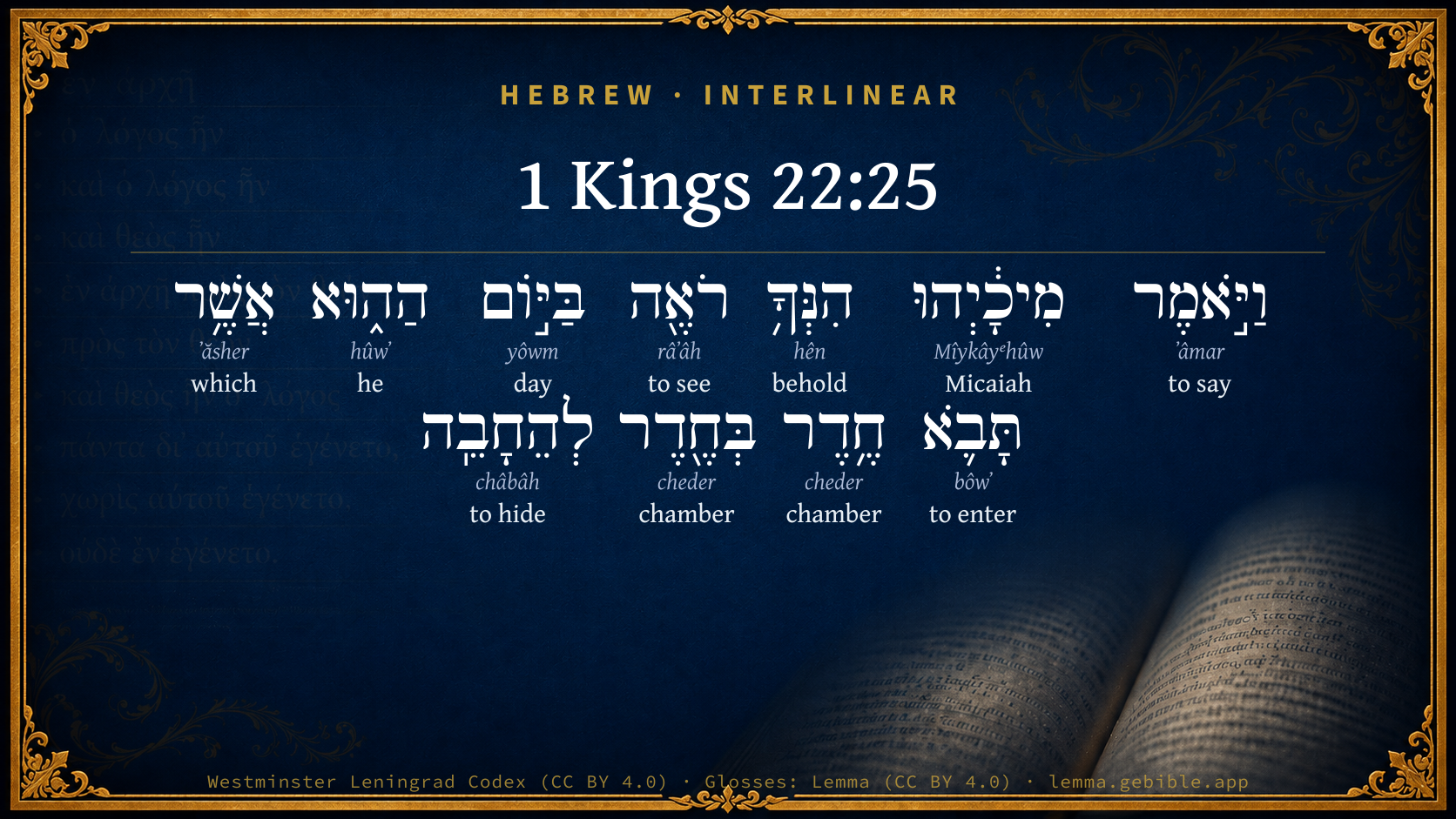
1 Kings 22:25

Hebrew (Westminster Leningrad Codex) 1 Kings 22:25 appears in the Hebrew Old Testament. The text above is from the Westminster Leningrad Codex. Each word links to its Strong’s number, a concise gloss, and parsing drawn from the Open Scriptures Hebrew Bible morphology. Click any word for its full Brown-Driver-Briggs (BDB) entry.
Download image
Cite this verse

1 Kings 22:25 (World English Bible). Public Domain. Lemma interlinear Bible study tool, https://lemma.gebible.app/v/1-kings/22/25.

Show BibTeX & RIS
BibTeX
RIS
English Translation
Micaiah said, Behold, you shall see on that day, when you shall go into an inner chamber to hide yourself.
World English Bible · Public Domain
Download a study sheet

One document with this verse’s original text, its word-by-word gloss line, the meaning frame, cross-references with their text, attributed commentary, and full source and license credits — printable, and it pastes into notes with its structure intact.

This verse Autodidact and up

Study sheet (.html) Plain text (.txt)

A passage Seminary Student

Up to 50 verses in one chapter. A passage sheet keeps up to 6 commentary sources and 12 cross-references per verse, in the order this page ranks them, and says so on the sheet whenever that leaves anything out. Ask for a single verse and you get the Autodidact verse sheet above.

Everything on this page stays free to read, with no account — the sheet is a download of what is already on screen, not access to it.

Want to remove ads? Support Godless Engineer
Compare translations 3

The same verse in 3 English versions, stacked beneath the original-language interlinear above. Click any original word for its lexicon entry.

Each is an independent rendering of the whole verse — the interlinear is not word-aligned to these translations.

Highlighted words mark where these versions differ — a whole-verse word diff, not a word-by-word alignment.

  • World English Bible Public Domain
    Micaiah said, Behold, you shall see on that day, when you shall go into an inner chamber to hide yourself.
  • King James Version Public Domain
    And Micaiah said, Behold, thou shalt see in that day, when thou shalt go into an inner chamber to hide thyself.
  • unfoldingWord Literal Text CC BY-SA 4.0
    And Micaiah said, “Behold you, seeing on that day when you enter a chamber in a chamber to hide yourself.”

unfoldingWord Literal Text — © unfoldingWord, licensed CC BY-SA 4.0. Word-aligned USFM3 via Door43 (git.door43.org/unfoldingWord/en_ult).

Versions to compare (up to 4)

3 of 4 selected

Show all 18 translations

Every available English version of this verse, each an independent rendering of the whole verse.

  • World English Bible Public Domain
    Micaiah said, Behold, you shall see on that day, when you shall go into an inner chamber to hide yourself.
  • Berean Standard Bible Public Domain
    Micaiah replied, “You will soon see, on that day when you go and hide in an inner room.”
  • Majority Standard Bible Public Domain
    Micaiah replied, “You will soon see, on that day when you go and hide in an inner room.”
  • King James Version Public Domain
    And Micaiah said, Behold, thou shalt see in that day, when thou shalt go into an inner chamber to hide thyself.
  • American Standard Version (1901) Public Domain
    And Micaiah said, Behold, thou shalt see on that day, when thou shalt go into an inner chamber to hide thyself.
  • Revised Version (1885) Public Domain
    And Micaiah said, Behold, thou shalt see on that day, when thou shalt go into an inner chamber to hide thyself.
  • Geneva Bible (1599) Public Domain
    And Michaiah saide, Behold, thou shalt see in that day, when thou shalt goe from chamber to chamber to hide thee.
  • Douay-Rheims (1899) Public Domain
    And Micheas said: Thou shalt see in the day when thou shalt go into a chamber within a chamber to hide thyself.
  • Young's Literal Translation Public Domain
    And Micaiah saith, `Lo, thou art seeing on that day, when thou goest in to the innermost chamber to be hidden.'
  • Literal Standard Version CC BY-SA 4.0
    And Micaiah says, “Behold, you are seeing on that day when you go into the innermost chamber to be hidden.”
  • Unlocked Literal Bible CC BY-SA 4.0
    Micaiah said, “Look, you will see on that day when you will go to hide in an inner room.”
  • unfoldingWord Literal Text CC BY-SA 4.0
    And Micaiah said, “Behold you, seeing on that day when you enter a chamber in a chamber to hide yourself.”
  • Darby Bible Public Domain
    And Micah said, Behold, thou shalt see on that day when thou shalt go from chamber to chamber to hide thyself.
  • World Messianic Bible Public Domain
    Micaiah said, “Behold, you will see on that day when you go into an inner room to hide yourself.”
  • Webster's Bible Public Domain
    And Micaiah said, Behold, thou shalt see in that day, when thou shalt go into an inner chamber to hide thyself.
  • Free Bible Version CC BY-SA 4.0
    “You'll soon find out when you try and find some secret place to hide!” Micaiah replied.
  • Bible in Basic English Public Domain
    And Micaiah said, Truly, you will see on that day when you go into an inner room to keep yourself safe.
  • JPS Tanakh (1917) Public Domain
    And Micaiah said: 'Behold, thou shalt see on that day, when thou shalt go into an inner chamber to hide thyself.'

Literal Standard Version (2020), Covenant Press — licensed CC BY-SA 4.0. Text via the HelloAO Bible API (eBible.org). Unlocked Literal Bible (unfoldingWord) — licensed CC BY-SA 4.0. Text via the HelloAO Bible API (eBible.org). unfoldingWord Literal Text — © unfoldingWord, licensed CC BY-SA 4.0. Word-aligned USFM3 via Door43 (git.door43.org/unfoldingWord/en_ult). Free Bible Version, Dr. Jonathan Gallagher — licensed CC BY-SA 4.0. Text via the HelloAO Bible API (eBible.org).

Word by word

More ways to search: Search by grammar → Find every occurrence → Compare this word →

Practice this passage: Drill this verse → Learn its vocabulary →

לְהֵחָבֵֽה
châbâh
H2247
“to hide”
Preposition + Verb, Niphal, Infinitive Construct
Part of Speech
Preposition + Verb
Stem
Niphal
Form
Infinitive Construct
Full BDB Definition

Origin: a primitive root [compare H2245 ]

TWOT: 590

to withdraw, hide, hide oneself - (Qal) to withdraw - (Niphal) to hide oneself, remain hidden, withdraw
  1. וַיֹּ֣אמֶר ʼâmar H559 “and · to say” Conjunction + Verb, Qal, Sequential Imperfect, 3rd Person, Masculine, Singular
  2. מִיכָ֔יְהוּ Mîykâyᵉhûw H4321 “Micaiah” Noun, Proper
  3. הִנְּךָ֥ hên H2005 “behold · you” Particle, Demonstrative + Suffix, Personal, 2nd Person, Masculine, Singular
  4. רֹאֶ֖ה râʼâh H7200 “seeing” Verb, Qal, Participle Active, Masculine, Singular, Absolute
  5. בַּיּ֣וֹם yôwm H3117 “in/at the · day” Preposition, Determined + Noun, Common, Masculine, Singular, Absolute
  6. הַה֑וּא hûwʼ H1931 “the · he” Particle, Definite Article + Pronoun, Personal, 3rd Person, Masculine, Singular
  7. אֲשֶׁ֥ר ʼăsher H834 “which” Particle, Relative
  8. תָּבֹ֛א bôwʼ H935 “to enter” Verb, Qal, Imperfect, 2nd Person, Masculine, Singular
  9. חֶ֥דֶר cheder H2315 “chamber” Noun, Common, Masculine, Singular, Absolute
  10. בְּחֶ֖דֶר cheder H2315 “in/at · chamber” Preposition + Noun, Common, Masculine, Singular, Absolute

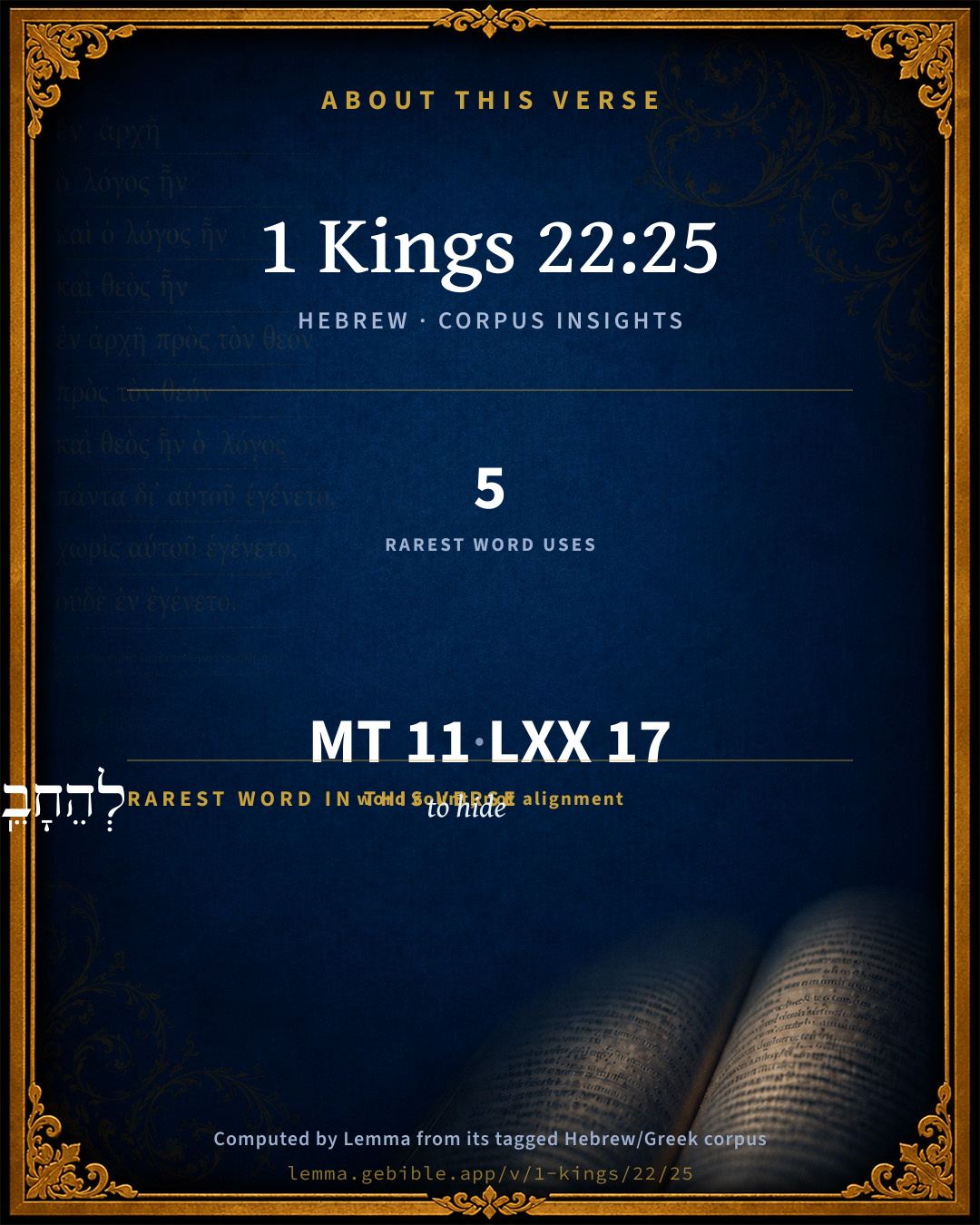
About this verse

These counts appear in no published source. They are computed here, from the morphology-tagged text and Lemma’s own curated glosses. What Lemma adds →

11
words
10
distinct lemmas
Historical
section

Notable vocabulary

The rarest word here is לְהֵחָבֵֽה to hide H2247 — appearing just 5 times in the whole Hebrew Bible.

Shared distinctive vocabulary

לְהֵחָבֵֽה to hide H2247 occurs in 5 verses of the Hebrew Bible. Also found in:

Grammatical profile

  • 4 verbs
  • 4 nouns
  • 1 pronoun
  • 2 particles

Verb forms

  • וַיֹּ֣אמֶר Qal · Sequential Imperfect
  • רֹאֶ֖ה Qal · Participle Active
  • תָּבֹ֛א Qal · Imperfect
  • לְהֵחָבֵֽה Niphal · Infinitive Construct

Repetition

A word recurs within this verse — often emphatic in Hebrew:

  • חֶ֥דֶר chamber H2315 ×2

Hebrew & Septuagint length

In English translation the verse runs 20 words from the Hebrew and 22 from the Septuagint (LXX English) — closely comparable.

A rough comparison of the two English renderings, which tokenize alike — not a word-level alignment.

Word counts can differ between the Hebrew and the Greek without any difference in meaning — e.g. the Hebrew direct-object marker אֵת has no separate Greek word, and Greek often adds the article ὁ.

In the original languages it is 11 Hebrew tokens and 17 Greek tokens — but the two are counted differently (Hebrew bundles its prefixes and suffixes into one token; the Greek is in lemma form), so that isn’t a like-for-like length.

Cross-references

10

Topical passages linked to 1 Kings 22:25 in the Treasury of Scripture Knowledge — connected by theme and wording, ordered by reader-vote popularity; previews shown in the World English Bible.

  • 1 Kings 20:30 But the rest fled to Aphek, into the city; and the wall fell on twenty-seven thousand men who were left. Ben Hadad fled, and came into the city, into an inner chamber.
  • 2 Peter 2:1 But there also arose false prophets among the people, as among you also there will be false teachers, who will secretly bring in destructive heresies, denying even the Master who bought them, bringing on themselves swift destruction.
  • Revelation 19:20 The beast was taken, and with him the false prophet who worked the signs in his sight, with which he deceived those who had received the mark of the beast and those who worshiped his image. These two were thrown alive into the lake of fire that burns with sulfur.
  • Numbers 31:8 They killed the kings of Midian with the rest of their slain: Evi, and Rekem, and Zur, and Hur, and Reba, the five kings of Midian: Balaam also the son of Beor they killed with the sword.
  • Isaiah 9:14–16 Therefore Yahweh will cut off from Israel head and tail, palm-branch and rush, in one day.
  • Jeremiah 23:15 Therefore thus says Yahweh of Hosts concerning the prophets: Behold, I will feed them with wormwood, and make them drink the water of gall; for from the prophets of Jerusalem is ungodliness gone forth into all the land.
  • Jeremiah 28:16–17 Therefore thus says Yahweh, Behold, I will send you away from off the surface of the earth: this year you shall die, because you have spoken rebellion against Yahweh.
  • Jeremiah 29:21–22 Thus says Yahweh of Hosts, the God of Israel, concerning Ahab the son of Kolaiah, and concerning Zedekiah the son of Maaseiah, who prophesy a lie to you in my name: Behold, I will deliver them into the hand of Nebuchadrezzar king of Babylon; and he shall kill them before your eyes;
  • Jeremiah 29:32 therefore thus says Yahweh, Behold, I will punish Shemaiah the Nehelamite, and his seed; he shall not have a man to dwell among this people, neither shall he see the good that I will do to my people, says Yahweh, because he has spoken rebellion against Yahweh.
  • Amos 7:17 Therefore thus says Yahweh: 'Your wife shall be a prostitute in the city, and your sons and your daughters shall fall by the sword, and your land shall be divided by line; and you yourself shall die in a land that is unclean, and Israel shall surely be led away captive out of his land.'"

Cross-references courtesy of OpenBible.info (CC BY 4.0).

Hebrew and Greek witnesses Masoretic Hebrew ↔ Greek Septuagint

The same verse in the two great witnesses to the Old Testament, shown verse-for-verse.

These are two independent witnesses, not word-aligned to each other, and the Septuagint is shown in lemma (dictionary) form.

Hebrew 1 Kings 22:25 Masoretic · Westminster Leningrad Codex

וַיֹּ֣אמֶר מִיכָ֔יְהוּ הִנְּךָ֥ רֹאֶ֖ה בַּיּ֣וֹם הַה֑וּא אֲשֶׁ֥ר תָּבֹ֛א חֶ֥דֶר בְּחֶ֖דֶר לְהֵחָבֵֽה

Micaiah said, Behold, you shall see on that day, when you shall go into an inner chamber to hide yourself.

World English Bible · Public Domain

Greek LXX 1 Kings 22:25 Septuagint · lemma form

καί εἶπον μιχαιας ἰδού σύ ὁράω ἐν ὁ ἡμέρα ἐκεῖνος ὅταν εἰςἔρχομαι ταμιεῖον ὁ ταμιεῖον ὁ κρύπτω

And Michaias said, Behold, you shall see in that day, when you shall go into an innermost chamber to hide yourself there.

LXX2012 (modern English Septuagint) · Public Domain

Hebrew: Westminster Leningrad Codex (CC BY 4.0). Greek: Septuagint (public domain); English from LXX2012 (modern English Septuagint) (Public Domain). How the Septuagint differs from the Hebrew →

Targum (Aramaic paraphrase)

1

The Targum is the ancient Jewish Aramaic paraphrase of the Hebrew Scriptures — an interpretive translation, not the Hebrew text itself. Onkelos (literal) and Pseudo-Jonathan (expansive) render the Torah, and Jonathan the Prophets. Coverage is partial: where no permissively-licensed English translation exists for a verse, only the Aramaic is shown. This is verse-level text, not a word-by-word alignment to the Hebrew.

  1. Targum Jonathan Prophets (Joshua–Malachi)
    וַאֲמַר מִיכָיְהוּ הָא אַתְּ חָזֵי בְּיוֹמָא הַהוּא דְאַתְּ עָלֵיל תָּוָן בְּגוֹ תָּוָן לְאִטַמָרָא:

    (no public-domain English translation for this verse)

    Targum Jonathan — Aramaic: “Mikraot Gedolot” (public domain). English: “Sefaria Community Translation” (CC0 1.0 (public-domain dedication)); “London "Chaldee Paraphrase," 1871” (public domain). Text via Sefaria.

Commentary

Notes on 1 Kings 22:25 from classic Christian and Jewish commentators (each source and its license shown beneath its notes). The classic Christian expositions comment on the surrounding passage and are grouped to its opening verse, so a note may address several verses; the Jewish commentaries on the Tanakh (Rashi and others) are per-verse, so they appear only where the commentator wrote on this verse.

Lemma curates 59 commentaries, every one of them public domain or Creative Commons licensed, each selected and text-cleaned for this edition rather than reprinted as found. About our sources →

Trapp's Complete Commentary

John Trapp

1Ki 22:25 And Micaiah said, Behold, thou shalt see in that day, when thou shalt go into an inner chamber to hide thyself.

Ver. 25. When thou shalt go into an inner chamber to hide thyself,] viz., From the Syrians’ invading; or rather from Ahab’s friends, who seeing him slain and the army routed, shall seek thee out to the slaughter for thy false prophecy.

John Trapp, A Commentary or Exposition upon All the Books of the Old and New Testament (1647–1656) — public domain. Text from a community e-Sword module.

Adam Clarke's Commentary

Verse 25. When thou shalt go into an inner chamber] It is probable that this refers to some Divine judgment which fell upon this deceiver. Hearing of the tragical result of the battle, he no doubt went into a secret place to hide himself from the resentment of Jezebel, and the Israelitish courtiers, and there it is probable he perished; but how, when, or where, is not mentioned.

Adam Clarke's Commentary on the Bible (1810–1826) — public domain. Text from a community e-Sword/MySword module.

The Cambridge Bible for Schools and Colleges

gen. ed. J. J. S. Perowne

25. Behold, thou shalt see in [R.V. on] that day] The small change harmonizes this passage with 2 Chron. What Micaiah was to see and be convinced of was, that the spirit of God had passed away from him and gone to Micaiah. The events would bring proof with them.

into an inner chamber] See note on 1Ki_20:3 above.

to hide thyself] When the news of the defeat came Samaria would be terrified, and such as expected the invader to come on, after his victory, would seek the securest places of concealment. The story tells us nothing of the events which followed Ahab’s death, but a man whose words, boastful now, were so belied in a few days would certainly desire to avoid being seen as much as might be.

The Cambridge Bible for Schools and Colleges (gen. ed. J. J. S. Perowne; Cambridge University Press, 1878–1918) — public domain. Text from a community e-Sword module.

John Gill's Exposition

So the king of Israel, and Jehoshaphat the king of Judah, went up to Ramothgilead. Which, according to Bunting (r), was twenty four miles from Samaria. That Ahab went is no wonder, it was his own motion first, his inclination led to it, his prophets encouraged him, and, in bravado to the prophet of the Lord, was determined upon it; but it may seem much more strange that Jehoshaphat should, after such an account as Micaiah had given, and who, doubtless, could observe a great difference between him and the prophets of Ahab; and yet there is much to be said which might incline him to go, as that there were four hundred prophets all agreed, and who made use of the name of the Lord, and pretended to be true prophets; and though he might suspect them, he could not confute them; and Micaiah, he prophesied evil of Ahab only, and therefore Jehoshaphat might think himself safe in going; and besides, he had given his word to Ahab, and he did not choose to go from it; to which may be added, that Ahab's cause was just, to recover a part of his own dominions.

(r) Travels, &c. p. 178.

John Gill's Exposition of the Whole Bible (1746–1763) — public domain (CC PDM 1.0). Text via the HelloAO Bible API.

Albert Barnes' Notes on the Bible

Micaiah addresses himself not so much to Zedekiah’s question, as to the main point which lies in dispute - which of them, namely, is a true prophet. “When the news, i. e., of Ahab’s death, caused by his following thy counsels, reaches Samaria, and thou hast to hide thyself from the vengeance of Ahaziah or Jezebel, then, in that day, thou wilt know whether I or thou be the true prophet.”

Albert Barnes' Notes on the Bible (1834–1885) — public domain. Text from a community e-Sword/MySword module.

Haydock's Catholic Bible Commentary

Go into a chamber, &c. This happened when he heard the king was slain, and justly apprehended that he should be punished for his false prophecy; (Challoner) though this be nowhere recorded, (Calmet) except in Josephus. (Worthington) --- He probably escaped death. (Salien)

George Leo Haydock (1774–1849), Haydock's Catholic Family Bible and Commentary, 1859 edition — public domain. Excludes Psalms (Douay-Rheims chapter numbering differs from Protestant) and Deuterocanonical books (Catholic canon only).

Matthew Poole's English Annotations

Out of a just fear and expectation of the deserved punishment of a false prophet, and of the great author and abettor of this pernicious war, and of Ahab’s destruction.

Matthew Poole's English Annotations on the Holy Bible (1683–1685) — public domain. Text from a community e-Sword/MySword module.

Whedon's Commentary on the Bible

Daniel D. Whedon

25. Go into an inner chamber — No account of Zedekiah’s subsequent history is recorded, but it has generally been, with much probability, supposed that when Ahab’s friends saw the fatal issue of this war for Ramoth-gilead, they bent their fury against this lying prophet and his associates, and then, too late, Zedekiah painfully recalled the saying of the man of God whom he so maliciously mocked.

Daniel D. Whedon (gen. ed.), Commentary on the Old and New Testaments (1874–1909) — public domain. Text from a community e-Sword module.

The Pulpit Commentary

And Micaiah said, Behold, thou shalt see Keil understands, "that the Spirit of the Lord had departed from thee." But the meaning rather appears to be, "Thou shalt see which was a true prophet." He does not answer the insolent question, but says," Thou wilt alter thy mind in the day," etc. With this may be compared our Lord"s words, Mat_26:64. He also manifests our Lord"s spirit (1Pe_2:22 sqq.) "as if the Great Example had already appeared before him" (Bahr) in that day when thou shalt go into an inner chamber (see note on 1Ki_20:30) to hide thyself. When was this prediction fulfilled? Probably when the news of the defeat reached Samaria, or on the day after Ahab"s death. Jezebel would almost certainly take summary vengeance upon the false prophets who were responsible for her husband"s death and the reverses of the army. Or if she did not, the prophets had good reason to fear that she would, and would hide accordingly.

The Pulpit Commentary (1880–1919), ed. H.D.M. Spence-Jones & Joseph S. Exell — public domain. Text from a community e-Sword module.

John Wesley's Explanatory Notes

Hide thyself - Probably he went with Ahab to the battle, after which he was glad to shelter himself where he could.

John Wesley, Explanatory Notes Upon the Whole Bible (1754–1765) — public domain. Text via the GEBible commentary corpus.

Scofield Reference Notes

C. I. Scofield

inner

Heb. "a chamber in a chamber." 1Ki 20:30.

The Scofield Reference Bible (1917 edition), notes by C. I. Scofield — public domain. Text from a community e-Sword module.

Lesson kit

Teaching starters — assembled from the data on this page, not authored interpretation. Every prompt links to the verse data it draws on. Edit before teaching.

1 Kings, in the Historical, opens this verse with 11 words (10 distinct Hebrew lemmas). Its most distinctive word is châbâh (“to hide”). A historical commentator’s framing appears above. Read the whole chapter for the surrounding context.

Discussion questions

  1. The word châbâh carries the sense “to hide.” How does it shape the verse?
  2. Joshua 2:16 shares the word «to hide» with this verse. How do the two illuminate each other?
  3. “chamber” occurs 2× in this one verse. What is the effect of the repetition?
  4. These translations render this verse differently; the difference is in the English rendering, not the original. What questions does that raise?
  5. The verb «וַיֹּ֣אמֶר» is Qal Sequential Imperfect. How does its form color the action?
  6. Reading how Trapp's Complete Commentary and Adam Clarke's Commentary read this verse, where do the two commentators agree and where do they part?

Things to notice

Reading settings

Reading text

Shown beneath each verse's original-language words.

Old Testament
Old Testament edition

Read the OT as the Masoretic Hebrew (MT) or the Greek Septuagint (LXX).

English shown for the Greek Septuagint (in the Hebrew ↔ Greek comparison).

Comparing translations? Open the Compare panel on any verse page to stack up to four side by side.