
Job 4:18

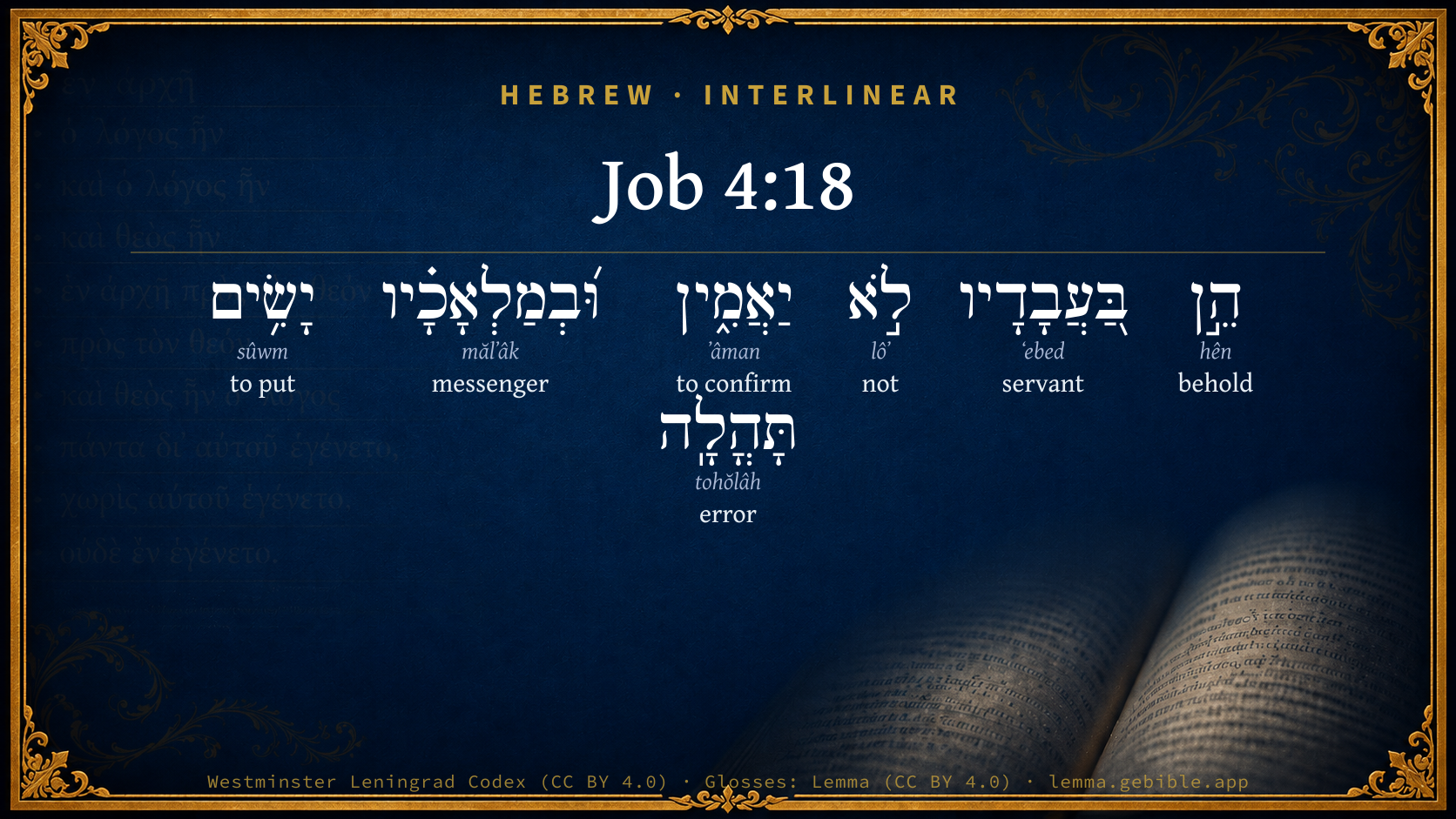
Hebrew (Westminster Leningrad Codex) Job 4:18 appears in the Hebrew Old Testament. The text above is from the Westminster Leningrad Codex. Each word links to its Strong’s number, a concise gloss, and parsing drawn from the Open Scriptures Hebrew Bible morphology. Click any word for its full Brown-Driver-Briggs (BDB) entry.
Download image
Cite this verse

Job 4:18 (World English Bible). Public Domain. Lemma interlinear Bible study tool, https://lemma.gebible.app/v/job/4/18.

Show BibTeX & RIS
BibTeX
RIS
English Translation
Behold, he puts no trust in his servants. He charges his angels with error.
World English Bible · Public Domain
Highlights
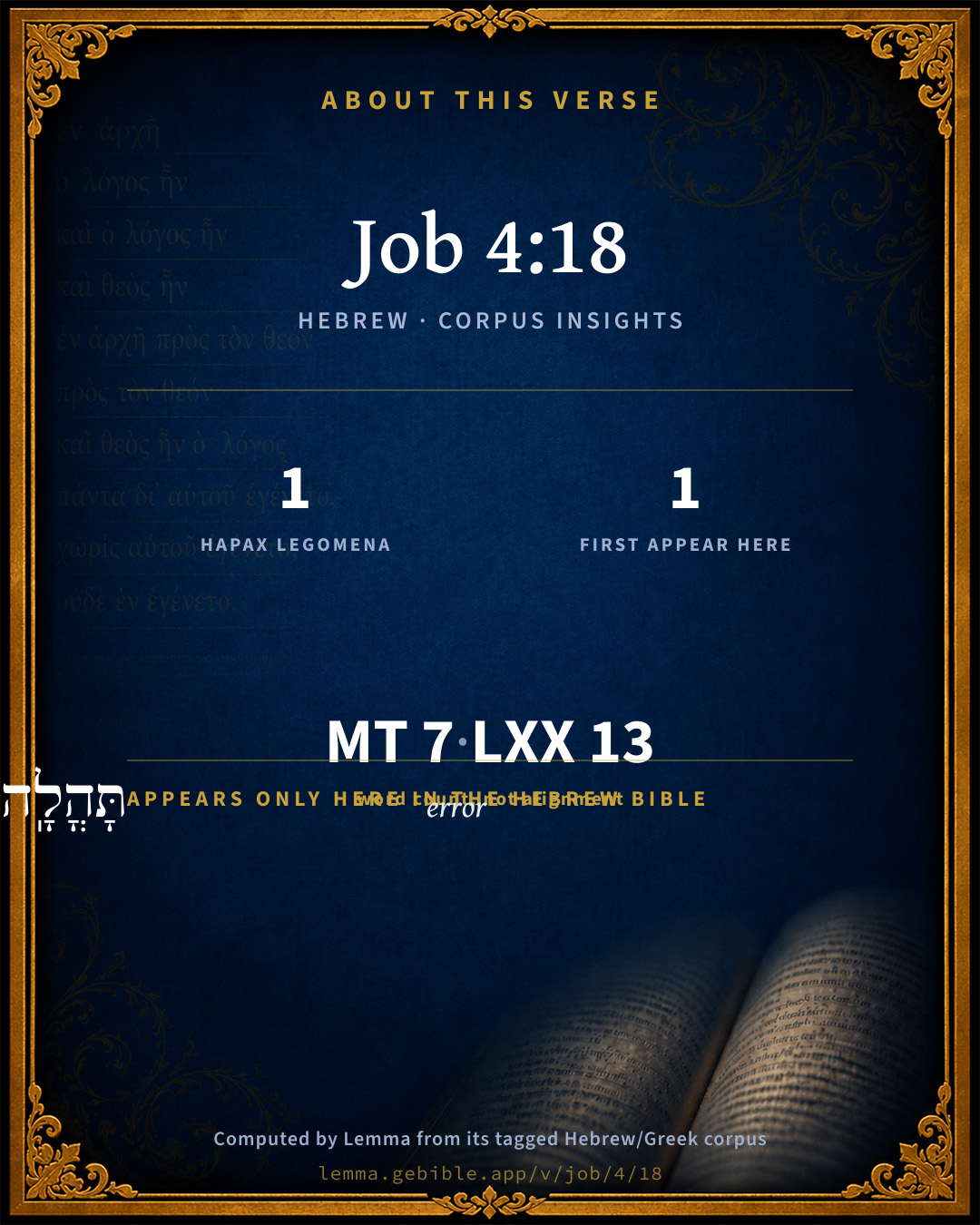
  • 1 hapax legomenon — only here in the Hebrew Bible
  • 1 first appearance in the Hebrew Bible
Full analysis ↓
Download a study sheet

One document with this verse’s original text, its word-by-word gloss line, the meaning frame, cross-references with their text, attributed commentary, and full source and license credits — printable, and it pastes into notes with its structure intact.

This verse Autodidact and up

Study sheet (.html) Plain text (.txt)

A passage Seminary Student

Up to 50 verses in one chapter. A passage sheet keeps up to 6 commentary sources and 12 cross-references per verse, in the order this page ranks them, and says so on the sheet whenever that leaves anything out. Ask for a single verse and you get the Autodidact verse sheet above.

Everything on this page stays free to read, with no account — the sheet is a download of what is already on screen, not access to it.

Want to remove ads? Support Godless Engineer
Compare translations 3

The same verse in 3 English versions, stacked beneath the original-language interlinear above. Click any original word for its lexicon entry.

Each is an independent rendering of the whole verse — the interlinear is not word-aligned to these translations.

Highlighted words mark where these versions differ — a whole-verse word diff, not a word-by-word alignment.

  • World English Bible Public Domain
    Behold, he puts no trust in his servants. He charges his angels with error.
  • King James Version Public Domain
    Behold, he put no trust in his servants; and his angels he charged with folly:
  • unfoldingWord Literal Text CC BY-SA 4.0
    Behold, he does not trust in his servants, and he charges his angels with folly.

unfoldingWord Literal Text — © unfoldingWord, licensed CC BY-SA 4.0. Word-aligned USFM3 via Door43 (git.door43.org/unfoldingWord/en_ult).

Versions to compare (up to 4)

3 of 4 selected

Show all 18 translations

Every available English version of this verse, each an independent rendering of the whole verse.

  • World English Bible Public Domain
    Behold, he puts no trust in his servants. He charges his angels with error.
  • Berean Standard Bible Public Domain
    If God puts no trust in His servants, and He charges His angels with error,
  • Majority Standard Bible Public Domain
    If God puts no trust in His servants, and He charges His angels with error,
  • King James Version Public Domain
    Behold, he put no trust in his servants; and his angels he charged with folly:
  • American Standard Version (1901) Public Domain
    Behold, he putteth no trust in his servants; And his angels he chargeth with folly:
  • Revised Version (1885) Public Domain
    Behold, he putteth no trust in his servants; and his angels he chargeth with folly:
  • Geneva Bible (1599) Public Domain
    Beholde, he founde no stedfastnesse in his Seruants, and laid follie vpon his Angels.
  • Douay-Rheims (1899) Public Domain
    Behold they that serve him are not steadfast, and in his angels he found wickedness:
  • Young's Literal Translation Public Domain
    Lo, in His servants He putteth no credence, Nor in His messengers setteth praise.'
  • Literal Standard Version CC BY-SA 4.0
    Behold, He puts no credence in His servants, || Nor sets praise in His messengers.
  • Unlocked Literal Bible CC BY-SA 4.0
    See, if God puts no trust in his servants; if he accuses his angels of folly,
  • unfoldingWord Literal Text CC BY-SA 4.0
    Behold, he does not trust in his servants, and he charges his angels with folly.
  • Darby Bible Public Domain
    Lo, he trusteth not his servants, and his angels he chargeth with folly:
  • World Messianic Bible Public Domain
    Behold, he puts no trust in his servants. He charges his angels with error.
  • Webster's Bible Public Domain
    Behold, he put no trust in his servants; and his angels he charged with folly:
  • Free Bible Version CC BY-SA 4.0
    If he doesn't even trust his servants, and he says his angels make mistakes,
  • Bible in Basic English Public Domain
    Truly, he puts no faith in his servants, and he sees error in his angels;
  • JPS Tanakh (1917) Public Domain
    Behold, He putteth no trust in His servants, and His angels He chargeth with folly;

Literal Standard Version (2020), Covenant Press — licensed CC BY-SA 4.0. Text via the HelloAO Bible API (eBible.org). Unlocked Literal Bible (unfoldingWord) — licensed CC BY-SA 4.0. Text via the HelloAO Bible API (eBible.org). unfoldingWord Literal Text — © unfoldingWord, licensed CC BY-SA 4.0. Word-aligned USFM3 via Door43 (git.door43.org/unfoldingWord/en_ult). Free Bible Version, Dr. Jonathan Gallagher — licensed CC BY-SA 4.0. Text via the HelloAO Bible API (eBible.org).

Word by word

More ways to search: Search by grammar → Find every occurrence → Compare this word →

Practice this passage: Drill this verse → Learn its vocabulary →

About this verse

These counts appear in no published source. They are computed here, from the morphology-tagged text and Lemma’s own curated glosses. What Lemma adds →

7
words
7
distinct lemmas
Wisdom
section

Notable vocabulary

1 hapax legomenon — a word that appears only here in the entire Hebrew Bible:

  • תָּהֳלָֽה error H8417

First appearance in Scripture

This word makes its first canonical appearance in the Hebrew Bible here:

  • תָּהֳלָֽה error H8417

Grammatical profile

  • 2 verbs
  • 3 nouns
  • 2 particles

Verb forms

  • יַאֲמִ֑ין Hiphil · Imperfect
  • יָשִׂ֥ים Qal · Imperfect

Hebrew & Septuagint length

In English translation the verse runs 14 words from the Hebrew and 13 from the Septuagint (LXX English) — closely comparable.

A rough comparison of the two English renderings, which tokenize alike — not a word-level alignment.

Word counts can differ between the Hebrew and the Greek without any difference in meaning — e.g. the Hebrew direct-object marker אֵת has no separate Greek word, and Greek often adds the article ὁ.

In the original languages it is 7 Hebrew tokens and 13 Greek tokens — but the two are counted differently (Hebrew bundles its prefixes and suffixes into one token; the Greek is in lemma form), so that isn’t a like-for-like length.

Cross-references

7

Topical passages linked to Job 4:18 in the Treasury of Scripture Knowledge — connected by theme and wording, ordered by reader-vote popularity; previews shown in the World English Bible.

  • Job 25:5–6 Behold, even the moon has no brightness, And the stars are not pure in his sight;
  • 2 Peter 2:4 For if God didn't spare angels when they sinned, but cast them down to Tartarus, and committed them to pits of darkness, to be reserved to judgment;
  • Jude 1:6 Angels who didn't keep their first domain, but deserted their own dwelling place, he has kept in everlasting bonds under darkness for the judgment of the great day.
  • Job 15:15–16 Behold, he puts no trust in his holy ones; Yes, the heavens are not clean in his sight:
  • Psalms 104:4 He makes his messengers winds; His servants flames of fire.
  • Psalms 103:20–21 Praise Yahweh, you angels of his, Who are mighty in strength, who fulfill his word, Obeying the voice of his word.
  • Isaiah 6:2–3 Above him stood the seraphim. Each one had six wings. With two he covered his face. With two he covered his feet. With two he flew.

Cross-references courtesy of OpenBible.info (CC BY 4.0).

Hebrew and Greek witnesses Masoretic Hebrew ↔ Greek Septuagint

The same verse in the two great witnesses to the Old Testament, shown verse-for-verse.

These are two independent witnesses, not word-aligned to each other, and the Septuagint is shown in lemma (dictionary) form.

Hebrew Job 4:18 Masoretic · Westminster Leningrad Codex

הֵ֣ן בַּ֭עֲבָדָיו לֹ֣א יַאֲמִ֑ין וּ֝בְמַלְאָכָ֗יו יָשִׂ֥ים תָּהֳלָֽה

Behold, he puts no trust in his servants. He charges his angels with error.

World English Bible · Public Domain

Greek LXX Job 4:18 Septuagint · lemma form

εἰ κατά παῖς αὐτός οὐ πιστεύω κατά δέ ἄγγελος αὐτός σκολιός τις ἐπινοέω

Whereas he trust not in his servants, and perceives perverseness in his angels.

LXX2012 (modern English Septuagint) · Public Domain

On this verse, Adam Clarke's Commentary discusses the Septuagint’s reading. Read the note in Commentary ↓

Hebrew: Westminster Leningrad Codex (CC BY 4.0). Greek: Septuagint (public domain); English from LXX2012 (modern English Septuagint) (Public Domain). How the Septuagint differs from the Hebrew →

Commentary

Notes on Job 4:18 from classic Christian and Jewish commentators (each source and its license shown beneath its notes). The classic Christian expositions comment on the surrounding passage and are grouped to its opening verse, so a note may address several verses; the Jewish commentaries on the Tanakh (Rashi and others) are per-verse, so they appear only where the commentator wrote on this verse.

Lemma curates 59 commentaries, every one of them public domain or Creative Commons licensed, each selected and text-cleaned for this edition rather than reprinted as found. About our sources →

Trapp's Complete Commentary

John Trapp

Job 4:18 Behold, he put no trust in his servants; and his angels he charged with folly:

Ver. 18. Lo, he put no trust in his servants, &c.] Those menial, domestic servants of his, the holy angels that wait upon him, and are at his hand to do his will. Servant is a name of office; and they delight rather to be called angels (that is, messengers) and ministering spirits, than principalities, thrones, dominions, &c. Now in these God put no trust, he found no such cause to confide in them, because not perfectly sure and loyal to him, further than upheld and assisted by himself. The Vulgate Latin hath it thus, They that serve him are not stable; that is, the good angels are not stable by their own strength, but by God’s stablishing of thereto stand when others fell. Hence, Psa 68:17, the angels are called Shinan, as God’s seconds, say some; the nobles of that court, the very next unto him; but others say they are so called from their changeable state, now taken away by Christ, under whom they are as a head of government, of influence, of confirmation, but not of redemption, as we. Christ, as God, giveth them their being, and all their excellencies. As mediator, also, he maketh use of their ministry, for the safe guard and comfort of his people.

And his angels he charged with folly] That is, he spared not the angels that sinned, as St Peter expounds it, 2Pe 2:4. Their sin is said to be folly, that is, pride and self confidence. How this folly and madness of theirs (depravity, the Vulgate rendereth it) shows itself, whether in affecting a divinity, or in envy stirred up by the decree of exalting man’s nature above angels in and by Christ, and appointing them to be good men’s guardians, which office they scorned; or whether their pride appeared by transgressing some commandments in particular, not expressed, as Adam’s was, it is hard to say. Sure it is, that they abode not in the truth, that they kept not their station, &c.; and that the good angels stand, and are out of danger of ever falling, it is of divine grace. Hence, Exo 25:19, the cherubims stand upon the mercy seat, and are made of the matter thereof.

John Trapp, A Commentary or Exposition upon All the Books of the Old and New Testament (1647–1656) — public domain. Text from a community e-Sword module.

The Biblical Illustrator

Joseph S. Exell

Job_4:18-21

And His angels He charged with folly.

Folly in angels

His angels He charged with folly. Revelation conveys to us the highly interesting information that there is between the great Spirit and man, an intermediate order of spirits whose habitation is in the high and holy place. But the discoveries which Divine revelation makes to us of the invisible world, surprising and sublime as they are, were not intended to raise our astonishment, or gratify our curiosity. They are uniformly brought forward in the Scriptures for practical purposes of the highest kind. The doctrine of angels is introduced to illustrate the amazing condescension of the Son of God. At other times it is taught for the consolation of the saints, who have assurance that they are encompassed, preserved, and provided for by Gods invisible host. At other times it is adduced to set forth the greatness, wisdom, and holiness of God on the one hand, and the folly, weakness, and nothingness of man on the other. This is the view introduced in the passage before us. Some of the angels, by pride and rebellion, forfeited their place. Was God, after this, to place His confidence in man, even though created in His image? What is asserted of angels is applicable to them still. God only possesses in Himself all excellence. Angels derive their being, and all its excellences, from Him. If the text is the estimate which the Most High forms of angels, how insignificant and contemptible must we be in His sight! What are our bodies, but moulded, moving, breathing, speaking clay! And what can be frailer than a house of clay! Practical lessons--

1. The subject teaches the folly of covetousness and ambition. Covetousness is in itself sinful, and as it usurps the place due to God in the heart, it is idolatry; but when viewed in the light of the text, it is folly and madness, and wilful madness, which exposes its victim to merited derision.

2. It teaches us to avoid pride and security.

3. It teaches us not to trust or glory in man. Why has God declared His trust in His servants, and accused His angels of folly, but to teach us more effectually the sin and danger of all creature confidence and boasting? (Thomas MCrie, D. D.)

The imperfect angel

I want to put the truth of Gods purity in its right relation to His patience and long-suffering and gentleness. Side by side with the texts setting forth Gods unapproachable purity, may be placed such texts as Isa_42:3, Mat_10:42, which set forth the patience and beneficence of His character, and the scrupulous and delicate equities of His administration. In the addresses of Eliphaz, Gods strict and unapproachable purity is depicted in exalted and impressive phraseology. This seer, Eliphaz, sinned through overweening confidence in his own prophetic gift. His error consisted in the misapplication of truths that were obviously inspired, rather than in the premises he laid down as the basis of his appeal to Job. He was right in his abstract principles. We may accept his truth about the inconceivable purity of God.

1. Gods ideals of purity are so transcendent and so terrible, that the purity of the angel nearest to His throne is little better than stain, shadow, darkness in comparison. His angels He chargeth with folly. But is not the whole subject, with the angel in the background, vague, misty, fanciful? It is surely not unscientific to assume the existence of the pure and mighty beings spoken of by seers and prophets of the olden time, nor speculative to ponder well the words which declare that in comparison with God Himself, the angels have about them traces of finite dimness, blemish, imperfection. Are the angels, then, frail and foolish and defective? Are the angels disfigured with limitation, even as we? Put them in comparison with man, fallen man, and they will well justify the title holy. Bring them into comparison with God, and the title will seem incongruous, arrogant, and misplaced. The fall of some of their number shows that, as a class, the angels have not yet passed beyond the stage of defectibility. They have not risen into a wisdom so complete that no illusion can betray it, nor into a strength so unassailable that no temptation can score its record of disfigurement upon their lives. They are free, it is true, from actual transgression, but they are passing through the first crude stages of a development in which, because of inward weakness and limitation, there is perilous room for the wiles of the tempter. They have not reached the transcendent holiness of God, who cannot be tempted with evil. An incarnation, with its perils and possibilities, would be fatal to an angel. God can never forget the frailty, weakness, limitation, that may be latent in the unfallen types of angelic life.

2. The holiness of an angel will appear as little better than a frailty if we think of it in comparison with the uncreated holiness of God. The Divine holiness has in it a transcendent originality, with which that of the creature can never hope to vie. The holiness of the angel is a mere echo. The angels are but copyists, and their workmanship is unutterably inferior to the original conception.

3. In the judgment of the Most High, the holiness of the angel verges upon a frailty, because of its inferior vitality and its less consuming fervour. No angel knows what it is to love with a mighty intenseness that makes the love necessarily vicarious, and the heart break with pure grief over the sin, and grief, and shame of others. No Bethlehems, or Gethsemanes, or Golgothas have ever immortalised angelic devotion and love. Their love, however crystal pure, is a love to which sacrifice is strange. It does not draw them into incarnations and propitiatory offerings, and down into the shadows of vast redeeming shames and agonies. If Jesus Christ is the Lamb slain from the foundation of the world, the Father must have been touched in some sense from everlasting with the same sorrow. Before all worlds there was some dim mystery of self-sacrificing pain in the heart of God.

4. The defect of the angel is a defect of narrowness. In comparison with the Catholic and all-comprehending love of God, his love is insular and restrained. All perfect moral qualities are boundless. The graces of these celestial envoys are dwarfed into frailty and insignificance when brought into contrast with the perfect moral life of God.

5. The holiness of the angel has about it the defect and limitation inseparable from the briefness of its own history. It is a frail thing of yesterday in comparison with the holiness of God. Think of the amazing epochs through which Gods holiness has been unfolding itself. The worth of a moral quality is proportioned to the period through which it has verified and established itself. Angel life is but of recent birth.

6. The holiness of the angel has about it the defect of immaturity. The insight and holiness of the angel are but starting points for some higher and more magnificent evolution of character, the first cell out of which shall issue the wonder and transfiguration of their after destiny . . . Consider the unparalleled patience and gentleness of God. His angels He chargeth with folly. Yes; but He keeps them at His feet, and with exhaustless grate carries on their education, epoch after epoch. Is there no contradiction in these views? No. Only He who is infinitely holy can afford to be absolutely gracious and gentle. His very greatness enables Him to stoop. The incomparable holy dare stoop to blemish, and frailty, and weakness, and help it out of its dark and humiliating conditions. There is no contradiction here.. Then again, the infinitely holy can discern the hidden promise and possibility of holiness in the weak and erring. It would be an awful thing if we were left to suppose that God was microscopic in His scrutiny for judgment and condemnation only, and not also for blessing and approval. He discerns hope and fine possibility all the more keenly through the very affluence of His own purity. The perfection of righteousness is realised in the perfection of love. (Thomas G. Selby.)

On Easter Day

In the resurrection we shall be as the angels. And that we might not flatter ourselves in a dream of a better state than the angels have, in this text we have an intimation what their state and condition is--His angels He charged with folly.

I. Of whom were these words spoken? Angels. But it does not appear whether good or bad angels; those that fell or those that stood. Calvin thinks the good angels, considered in themselves, may be defective. The angels were Created in a possibility of everlasting blessedness, but not in actual possession of it. This admits of no doubt, because some of them actually did fall.

II. What words were spoken?

1. What is positively said.

2. What is consequently inferred. (John Donne.)

The Biblical Illustrator, edited by Joseph S. Exell (c. 1880s–1900s) — public domain. Text from a community e-Sword module.

Joseph Benson's Commentary

Job 4:18. Behold, &c. — For it deserves thy serious consideration. These and the following words seem to be the words of Eliphaz, explaining the former vision, and applying it to Job’s case, and enforcing it by further arguments. He put no trust in his servants — That is, in his angels, as appears both by the next words of this verse, in which, by way of explication and restriction, they are termed his angels; and by the verse following, where men are opposed to them. They are called his servants by way of eminence, the general name being here appropriated to the chief of the kind, to intimate that sovereign dominion which the great God hath, even over the glorious angels, and much more over men: and God is said to put no trust in them, because if they were left to themselves, and the supplies of God’s power and grace were withdrawn from them, they would not even continue to exist, much less to be loyal and faithful. And his angels he charged with folly — That is, with vanity, weakness, infirmity, imperfection, in comparison with himself, their Maker. The word תהלה, toholah, here rendered folly, is one of the απαξ λεγομενα, the words only once occurring, and of consequence the more difficult to be understood. The Chaldee paraphrast renders it iniquity; Ab. Ezra, folly; Schultens derives it from an Arabic word, which denotes lapsing, or from another, which signifies deficiency, or imperfection. Houbigant renders the clause, And in his angels mutability was found. The most probable opinion seems to be, that this refers to the angels who foolishly and wickedly fell from God.

Joseph Benson's Commentary on the Old and New Testaments (1811–1818) — public domain. Text from a community e-Sword module.

Tyndale Open Study Notes

Tyndale Open Resources

4:18-21 The concept that God does not trust his own angels and that he charged his messengers with foolishness is otherwise unknown (but see Gen 6:1-4).

Tyndale Open Study Notes — © Tyndale Open Resources, licensed CC BY-SA 4.0. Text via the HelloAO Bible API.

Geneva Bible (1599)

Geneva Bible translators

If God find imperfection in his Angels, when they are not maintained by his power, how much more shall he lay folly to man’s charge when he would justify himself against God?

Geneva Bible (1599) marginal notes — public domain. Text via Bolls.life.

Jamieson, Fausset & Brown

Robert Jamieson, A. R. Fausset & David Brown

folly--Imperfection is to be attributed to the angels, in comparison with Him. The holiness of some of them had given way (Pe2 2:4), and at best is but the holiness of a creature. Folly is the want of moral consideration [UMBREIT].

Jamieson, Fausset & Brown — Commentary Critical and Explanatory on the Whole Bible (1871) — public domain (CC PDM 1.0). Text via the HelloAO Bible API.

Adam Clarke's Commentary

Verse 18. Behold, he put no trust in his servants] This verse is generally understood to refer to the fall of angels; for there were some of those heavenly beings who kept not their first estate: they did not persevere to the end of their probation, and therefore fell into condemnation, and are reserved in chains of darkness unto the judgment of the great day; Jude 1:6. It is said he put no trust in them-he knew that nothing could be absolutely immutable but himself; and that no intelligent beings could subsist in a state of purity, unless continually dependent on himself, and deriving constant supplies of grace, power, and light, from him who gave them their being.

And his angels he charged with folly] Not chargeth, as many quote the passage. He charged those with folly who kept not their first estate. It does not appear that he is charging the others in the same way, who continue steadfast.

The several translations of this verse, both ancient and modern, are different from each other. Here are the chief: -

In angelis suis reperit pravitatem, "In his angels he found perverseness," VULGATE. The SEPTUAGINT is nearly the same. II met la lumiere dans ses anges, "He puts light into his angels," FRENCH BIBLE. Even those pure intelligences have continual need of being irradiated by the Almighty; [Syriac] wa-bemalakui neshim tempo, "And he hath put amazement in his angels," SYRIAC. The ARABIC is the same. In angelis suis ponet gloriationem, "In his angels he will put exultation," MONTANUS. The Hebrew is תהלה toholah, irradiation, from הלה halah, to irradiate, glister, or shine. In this place we may consider angels (מלאכים malachim) as heavenly or earthly messengers or angels of the Lord; and the glory, influence, and honour of their office as being put in them by the Most High. They are as planets which shine with a borrowed light. They have nothing but what they have received. Coverdale translates the whole verse thus: Beholde he hath founde unfaythfulnesse amonge his owne servaunts and proude disobedience amonge his angels. The sense is among all these interpreters; and if the fallen angels are meant, the passage is plain enough.

Adam Clarke's Commentary on the Bible (1810–1826) — public domain. Text from a community e-Sword/MySword module.

Ellicott's Commentary for English Readers

(18) Behold, he put no trust in his servants.—The statement is a general one; it does not refer to any one act in the past. We should read putteth and chargeth. Eliphaz repeats himself in Job_15:15.

A Bible Commentary for English Readers, edited by Charles John Ellicott (1878–1897) — public domain. Text from a community e-Sword module.

The Cambridge Bible for Schools and Colleges

gen. ed. J. J. S. Perowne

18. he put no trust] Better, he putteth.

he charged with folly] Rather, he chargeth with error. The “servants” of God are here His heavenly ministers, as the parallel, “angels”, indicates. The word “folly” (tohŏlah) does not occur again in Heb., and its meaning must be in some measure conjectural. Dillmann has drawn attention to an Ethiopic root tahala, to err, and the word may be connected with this stem and mean error.

The Cambridge Bible for Schools and Colleges (gen. ed. J. J. S. Perowne; Cambridge University Press, 1878–1918) — public domain. Text from a community e-Sword module.

John Gill's Exposition

How much less on them that dwell in houses of clay,.... Meaning men, but not as dwelling in houses, in a proper sense, made of clay dried by the sun, as were common in the eastern countries; nor in mean cottages, as distinguished from cedar, and ceiled houses, in which great personages dwelt, for this respects men in common; nor as being in the houses of the grave, as the Targum, Jarchi, and others, which are no other than dust, dirt, and clay; for this regards not the dead, but the living; but the bodies of men are meant; in which their souls dwell; which shows the superior excellency of the soul to the body, and its independency of it, being capable of existing without it, as it does in the separate state before the resurrection; so bodies are called tabernacles, and earthen vessels, and earthly houses, Pe2 1:13 Co2 4:7; and bodies of clay, Job 13:12; so the body is by Epictetus (c) called clay elegantly wrought; and another Heathen writer (d) calls it clay steeped in, or macerated and mixed with blood: being of clay denotes the original of bodies, the dust of the earth; and the frailty of them, like brittle clay, and the pollution of them, all the members thereof being defiled with sin, and so called vile bodies, and will remain such till changed by Christ, Phi 3:21; now the argument stands thus, if God put no trust in angels, then much less in poor, frail, mortal, sinful men; he has no dependence on their services, whose weakness, unprofitableness, and unfaithfulness, he well knows; he puts no trust in their purposes, and resolutions, and vows, which often come to nothing; nor does he trust his own people with their salvation and justification, or put these things upon the foot of their works, but trusts them and the salvation and justification of them with his Son, and puts them upon the foot of his own grace and mercy: and if he charges the holy angels with folly, then much more (for so it may be also rendered) will he charge mortal sinful men with it, who are born like the wild ass's colt, and are foolish as well as disobedient, even his chosen ones, especially before conversion; or thus if so stands the case of angels, then much less can man be just before him, and pure in his sight: the weakness, frailty, and pollution of the bodies of men, are further enlarged on in some following clauses:

whose foundation is in the dust; meaning not the lower parts of the body, as the feet, which support and bear it up; rather the soul, which is the basis of it, referring to its corruption and depravity by sin; though it seems chiefly to respect the original of the body, which is the dust of the earth, of which it consists, and to which it will return again, this being but a poor foundation to stand upon, Gen 2:7; for the sense is, whose foundation is dust, mere dust, the particle being redundant, or rather an Arabism:

which are crushed before the moth? that is, which bodies of men, or houses of clay founded in the dust; or, "they crush them"; or "which" or "whom they crush" (e); either God, Father, Son, and Spirit, as some; or the angels, as others; or distresses, calamities, and afflictions, which sense seems best, by which they are crushed "before the moth" or "worm" (f); that is, before they die, and come to be the repast of worms, Job 19:26; or before a moth is destroyed, as soon, or sooner (g), than it is; so a man may be crushed to death, or his life taken from him, as soon as a moth's; either by the immediate hand of God, as Ananias and Sapphira, Act 5:5; or by the sword of man, as Amasa by Joab, Sa2 20:10; or rather, "like a moth" (h), as easily and as quickly as a moth is crushed between a man's fingers, or by his foot: some, as Saadiah Gaon, and others, render it, "before Arcturus" (i), a constellation in the heavens, Job 9:9; and take the phrase to be the same as that, "before the sun"; Psa 72:17; and to denote the perpetuity and duration of their being crushed, which would be as long as the sun or Arcturus continued, that is, for ever; but either of the above senses is best, especially the last of them.

(c) Arrian. Epictet. l. 1. c. 1. (d) Theodor. Gadareus, apud Sueton. Vit. Tiber. c. 57. (e) "conterent eos", Montanus, Mercerus, Michaelis, Schultens; "sub trinitas personarum", Schmidt; "angeli", Mercerus; so Sephorno and R. Simeon Bar Tzemach; "calamitates", Vatablus; so some in Bar Tzemach. (f) "conam verme", Coceius; so the Targum and Bar Tzemach. (g) "Antequam tinea", Junius & Tremellius; "citius quam tinea", Piscator. (h) , Sept. "instar tineae", Noldius, Schmidt; so Aben Ezra and Broughton. (i) "Donec fuerit Arcturus", Pagninus, Vatablus; so some in Aben Ezra, Ben Melech.

John Gill's Exposition of the Whole Bible (1746–1763) — public domain (CC PDM 1.0). Text via the HelloAO Bible API.

Albert Barnes' Notes on the Bible

Behold, he put no trust in his servants - These are evidently the words of the oracle that appeared to Eliphaz; see Schultens, in loc. The word servants here refers to angels; and the idea is, that God was so pure that he did not confide even in the exalted holiness of angels - meaning that their holiness was infinitely inferior to his. The design is to state that God had the highest possible holiness, such as to render the holiness of all others, no matter how exalted, as nothing - as all lesser lights are as nothing before the glory of the sun. The Chaldee renders this, “Lo, in his servants, the prophets, he does not confide;” but the more correct reference is undoubtedly to the angels.

And his angels he charged with folly - Margin, Or,” Nor in his angels, in whom he put light.” The different rendering in the text and in the margin, has arisen from the supposed ambiguity of the word employed here - תהלה tohŏlâh. It is a word which occurs nowhere else, and hence, it is difficult to determine its true signification. Walton renders it, gloriatio glorying; Jerome, pravitas, wickedness; the Septuagint, σκολιόν skolion, fault, blemish; Dr. Good. default, or defection; Noyes, frailty. Gesenius says that the word is derived from הלל hâlăl, (No. 4), to be foolish. So also Kimchi explains it. According to this, the idea is that of foolishness - that is, they are far inferior to God in wisdom; or, as the word folly in the Scriptures is often synonymous with sin, it might mean that their purity was so far inferior to his as to appear like impurity and sin. The essential idea is, that even the holiness of angels was not to be compared with God. It is not that they were polluted and unholy, for, in their measure, they are perfect; but it is that their holiness was as nothing compared with the infinite perfection of God. It is to be remembered that a part of the angels had sinned, and they had shown that their integrity was not to be confided in; and whatever might be the holiness of a creature, it was possible to conceive that he might sin. But no such idea could for a moment enter the mind in regard to God. The object of this whole argument is to show, that if confidence could not be reposed in the angels, and if all their holiness was as nothing before God, little confidence could be placed in man; and that it was presumption for him to sit in judgment on the equity of the divine dealings.

Albert Barnes' Notes on the Bible (1834–1885) — public domain. Text from a community e-Sword/MySword module.

Haydock's Catholic Bible Commentary

Angels, who fell, as the fathers explain it. (Estius) (Tirinus) --- Hebrew, "behold, he put no trust in his servants, and his angels he charged with folly," chap. xv. 15., and xxv. 5., and 2 Peter ii. 4. (Protestants) (Haydock)

George Leo Haydock (1774–1849), Haydock's Catholic Family Bible and Commentary, 1859 edition — public domain. Excludes Psalms (Douay-Rheims chapter numbering differs from Protestant) and Deuterocanonical books (Catholic canon only).

Matthew Poole's English Annotations

Behold; this deserves thy serious consideration. These and the following words seem to be the words of Eliphaz, explaining the former vision, and applying it to Job’s case, and enforcing it by further arguments.

In his servants, i.e. in his angels, as appears both by the next words of this verse, where they are called by way of explication and restriction his angels; and by the next verse, where men are opposed to them. They are called his servants by way of eminency, that general name being here appropriated to the chief of the kind, as is very usual in all authors in like cases; and withal, to intimate that sovereign dominion which the great God hath over the glorious angels, and much more over men, by virtue whereof he hath an unquestionable authority to treat them according to his good pleasure. And these God is said to put no trust in, because he could not be confident that they, if left to themselves, and destitute of the succours of his power and grace, would continue to be loyal, and faithful, and serviceable to him, and would not revolt from him, as some of their brethren had done. And for this cause God was pleased, after some time of trial, to give some special and further grace, either by Christ or otherwise, whereby they should be infallibly confirmed in the state of grace and felicity.

His angels he charged with folly, or, with vanity, i.e. he discerned folly and vanity in the angelical natures when he had first made them; which although he saw and pronounced them, no less than the visible creatures, Ge 1, to be very good in themselves, and free from the least degree or tincture of sin; yet, comparing them with himself, and considering them in themselves alone, he saw something of folly and vanity in their very natures, because they were creatures, and therefore subject to manifold changes; and, among others, to fall from God, or into sin, as it appeared by the sad experience of some of them. Seeing therefore the angels, which so far exceed mankind in wisdom, and strength, and purity, and justice, and all other perfections, do fall incomparably short of God in these things, it is most absurd, as well as impious, to think that man is more just or pure than God, as was said, Job 4:17, and as thou, O Job, seemest to surmise. Others, nor (Heb. and not; the negative particle being repeated out of the former branch of the verse, as it is Psa 9:18; Pro 17:26, and elsewhere) in his angels, in whom (both which particles are frequently understood, as hath been proved before) he put light, or splendour, to wit, singular wisdom and purity, beyond what he put in man.

Matthew Poole's English Annotations on the Holy Bible (1683–1685) — public domain. Text from a community e-Sword/MySword module.

Whedon's Commentary on the Bible

Daniel D. Whedon

18. His servants — The highest orders of angels are accounted as servants.

Put no trust — Trusteth not, in the sense of reliance. The same word is used (Isa_28:16) to express trust in the tried Cornerstone. “Since the angels are created they are not by their nature immutable, like God, and consequently not immovable from goodness and virtue.” — Chrysostom.

Charged with folly — תהלה. As this word is used nowhere else in the Bible, it is difficult to determine its meaning. Schultens derives it from a similar word in the Arabic, signifying lapse or failure. The Septuagint translates, he perceived perverseness (σκολιον τι) in his angels. Among the multiplicity of views (see Dr. Good) the best is that of Umbreit: “He attributeth imperfection to his angels.” In asking the question how an imperfect holiness can be attributed to the angels, Hengstenberg observes that “the idea of holiness in the Scripture embraces infinitely more than mere sinlessness; that it includes within itself the independent possession of the highest perfection.… That holiness in this sense does not belong to the angels, whose holiness is only relative, is evident from the possibility of their fall.… If God were like the angels he would not be the Holy One.”

Daniel D. Whedon (gen. ed.), Commentary on the Old and New Testaments (1874–1909) — public domain. Text from a community e-Sword module.

The Pulpit Commentary

Behold, he put no trust in his servants; rather, he putteth no trust"or he putteth not trust. The" servants" intended are those that minister to him directly in heaven, the members of the angelic host, as appears from the parallelism of the other clause of the verse. Even in them God does not trust implicitly, since he knows that they are frail and fallible, liable to err, etc., only kept from sin by his own sustaining and assisting grace. (Job_15:15, where Eliphaz expresses the same belief in his own person) And his angels he charged with folly; rather, chargeth. The exact meaning of the word translated "folly" is uncertain, since the word does not occur elsewhere. The LXX renders by skolion ti , "crookedness;" Ewald, Dillmann, and others, by "error." The teaching clearly is that the angels are not perfect the highest angelic excellence falls infinitely short of God"s perfectness. Even angels, therefore, would be incompetent judges of God"s doings.

The Pulpit Commentary (1880–1919), ed. H.D.M. Spence-Jones & Joseph S. Exell — public domain. Text from a community e-Sword module.

John Wesley's Explanatory Notes

Servants - They are called his servants by way of eminency, that general name being here appropriated to the chief of the kind, to intimate that sovereign dominion which the great God hath over the angels, and much more over men. With folly - Without all doubt, this refers to those angels who foolishly and wickedly fell from God.

John Wesley, Explanatory Notes Upon the Whole Bible (1754–1765) — public domain. Text via the GEBible commentary corpus.

Scofield Reference Notes

C. I. Scofield

trust (See Scofield "Psa 2:12").

fear (See Scofield "Psa 19:9").

The Scofield Reference Bible (1917 edition), notes by C. I. Scofield — public domain. Text from a community e-Sword module.

unfoldingWord translationNotes

Door43 World Missions Community

those who live in houses of clay, whose foundation is in the dust

This is a figurative way of describing human beings, who were created out of the dust of the earth and whose bodies are like houses, which are made of clay and have dirt foundations. (See: Metaphor)

who are crushed sooner than a moth

Possible meanings for this metaphor are 1) "who God destroys as easily as he crushes a moth" or 2) "whose lives are as short as the life of a moth." (See: Metaphor and Active or Passive)

translationWords

God

trust

servant

accuse

angel

found

unfoldingWord translationNotes — © Distant Shores Media and the Door43 World Missions Community, licensed CC BY-SA 4.0. Source: git.door43.org/Door43/en_tn.

Rashi

Rabbi Shlomo Yitzchaki (Rashi)

Behold...His servants the righteous. He does not trust that they will not sin against Him, and He takes them out of the world before their time.

reproach Heb. תהלה, an expression of folly.

Rashi on the Tanakh — English translations: “The Judaica Press complete Tanach with Rashi, translated by A. J. Rosenberg” (CC BY 4.0); “Pentateuch with Rashi's commentary by M. Rosenbaum and A.M. Silbermann, 1929-1934” (public domain); “The Metsudah Tanach series, Lakewood, N.J” (CC BY 4.0); and “The Book of Joshua, Metsudah Publications, 1997” (CC BY 4.0). Text via Sefaria.

Lesson kit

Teaching starters — assembled from the data on this page, not authored interpretation. Every prompt links to the verse data it draws on. Edit before teaching.

Job, in the Wisdom, opens this verse with 7 words (7 distinct Hebrew lemmas). Its most distinctive word is tohŏlâh (“error”). A historical commentator’s framing appears above. Read the whole chapter for the surrounding context.

Discussion questions

  1. The word tohŏlâh carries the sense “error.” How does it shape the verse?
  2. This verse holds 1 word here found nowhere else in the Hebrew Bible. What might the rare word draw attention to?
  3. The word “error” first appears here in Scripture. What is being introduced at this debut?
  4. Job 25:5–6 shares this passage’s theme. How do the two illuminate each other?
  5. These translations render this verse differently; the difference is in the English rendering, not the original. What questions does that raise?
  6. The verb «יַאֲמִ֑ין» is Hiphil Imperfect. How does its form color the action?
  7. Reading how Trapp's Complete Commentary and The Biblical Illustrator read this verse, where do the two commentators agree and where do they part?

Things to notice

Reading settings

Reading text

Shown beneath each verse's original-language words.

Old Testament
Old Testament edition

Read the OT as the Masoretic Hebrew (MT) or the Greek Septuagint (LXX).

English shown for the Greek Septuagint (in the Hebrew ↔ Greek comparison).

Comparing translations? Open the Compare panel on any verse page to stack up to four side by side.