
1 Kings 17:12

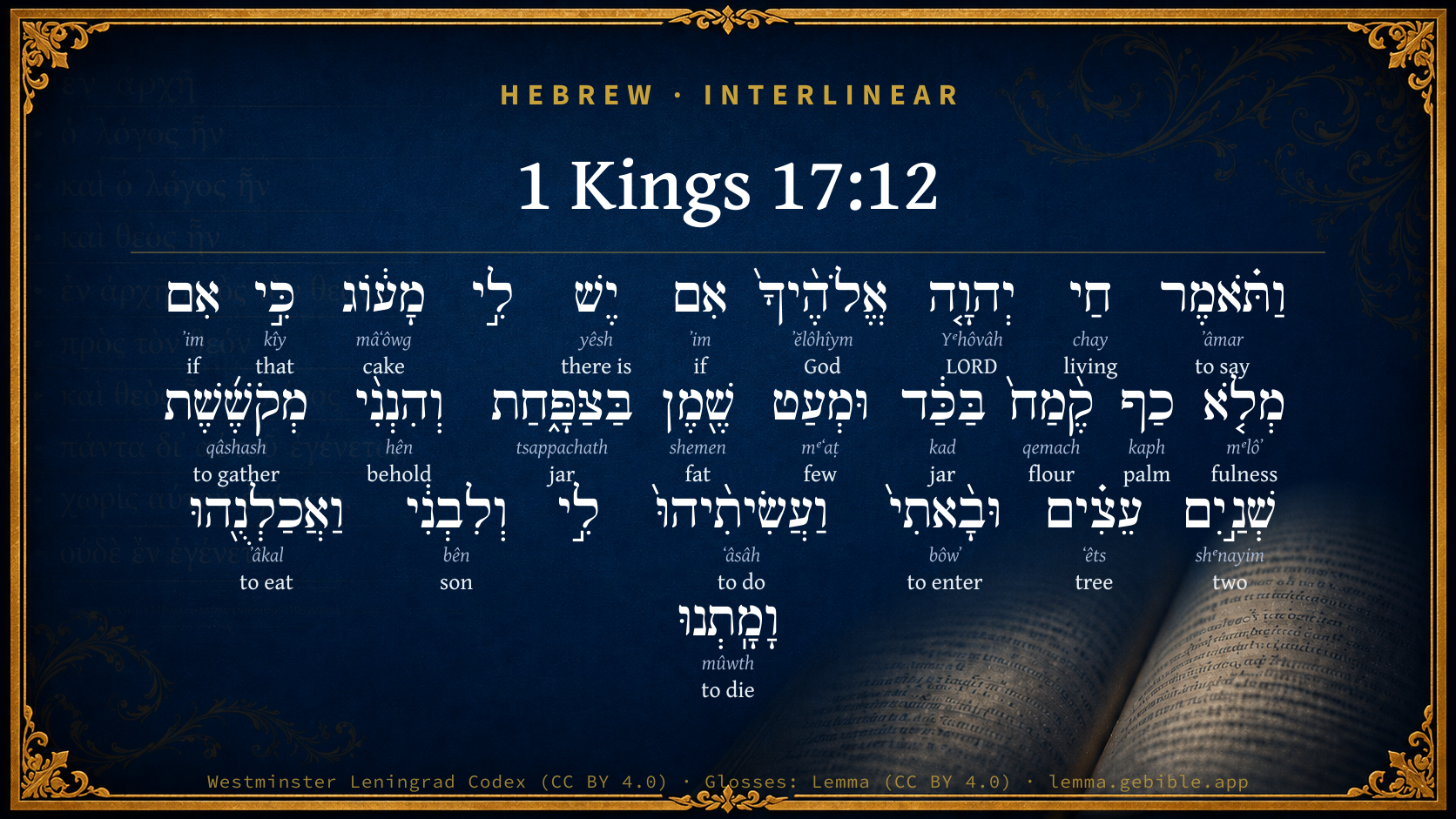
Hebrew (Westminster Leningrad Codex) 1 Kings 17:12 appears in the Hebrew Old Testament. The text above is from the Westminster Leningrad Codex. Each word links to its Strong’s number, a concise gloss, and parsing drawn from the Open Scriptures Hebrew Bible morphology. Click any word for its full Brown-Driver-Briggs (BDB) entry.
Download image
Cite this verse

1 Kings 17:12 (World English Bible). Public Domain. Lemma interlinear Bible study tool, https://lemma.gebible.app/v/1-kings/17/12.

Show BibTeX & RIS
BibTeX
RIS
English Translation
She said, As Yahweh your God lives, I don't have a cake, but a handful of meal in the jar, and a little oil in the jar: and, behold, I am gathering two sticks, that I may go in and bake it for me and my son, that we may eat it, and die.
World English Bible · Public Domain
Highlights
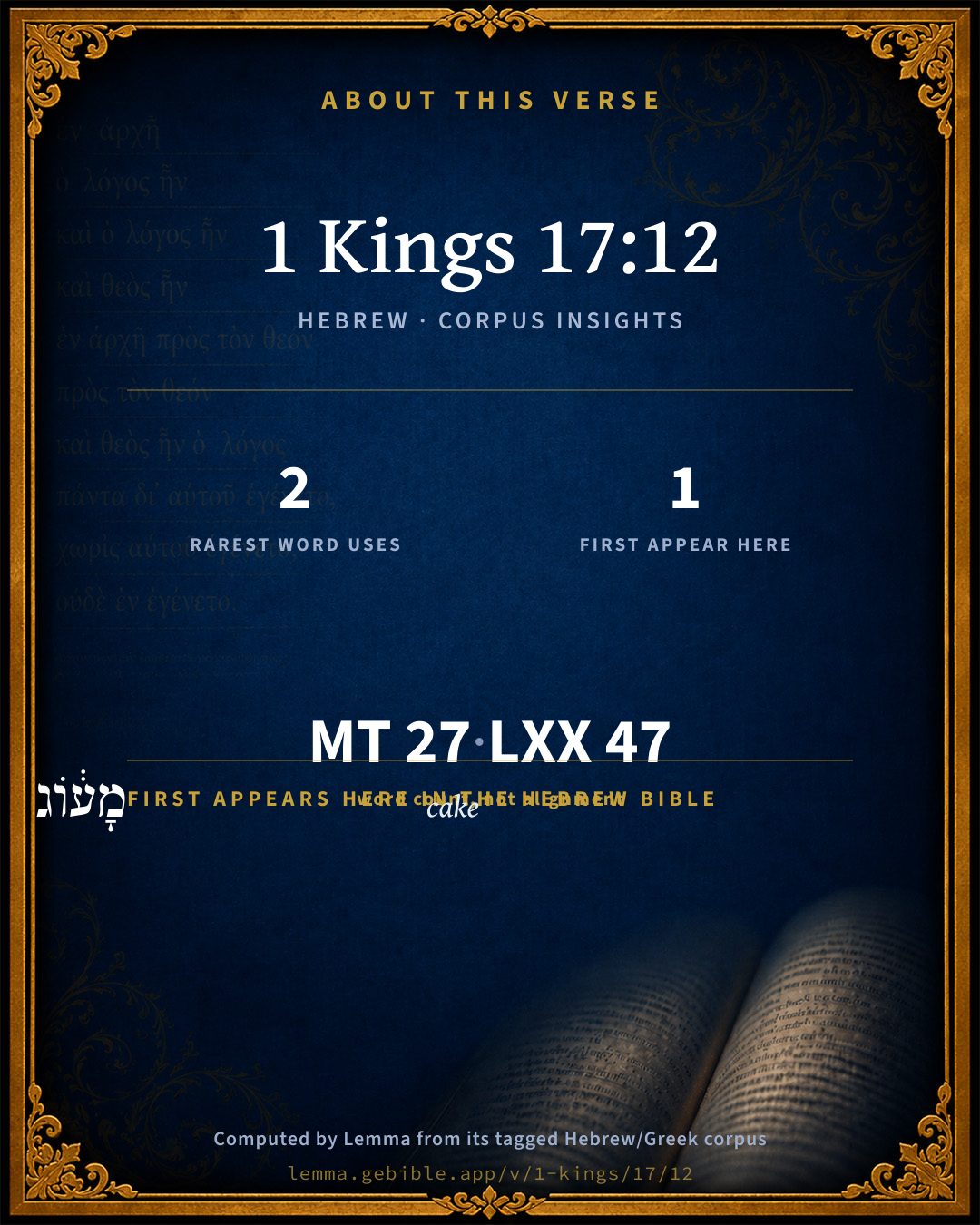
  • 1 first appearance in the Hebrew Bible
Full analysis ↓
Download a study sheet

One document with this verse’s original text, its word-by-word gloss line, the meaning frame, cross-references with their text, attributed commentary, and full source and license credits — printable, and it pastes into notes with its structure intact.

This verse Autodidact and up

Study sheet (.html) Plain text (.txt)

A passage Seminary Student

Up to 50 verses in one chapter. A passage sheet keeps up to 6 commentary sources and 12 cross-references per verse, in the order this page ranks them, and says so on the sheet whenever that leaves anything out. Ask for a single verse and you get the Autodidact verse sheet above.

Everything on this page stays free to read, with no account — the sheet is a download of what is already on screen, not access to it.

Want to remove ads? Support Godless Engineer
Compare translations 3

The same verse in 3 English versions, stacked beneath the original-language interlinear above. Click any original word for its lexicon entry.

Each is an independent rendering of the whole verse — the interlinear is not word-aligned to these translations.

Highlighted words mark where these versions differ — a whole-verse word diff, not a word-by-word alignment.

  • World English Bible Public Domain
    She said, As Yahweh your God lives, I don't have a cake, but a handful of meal in the jar, and a little oil in the jar: and, behold, I am gathering two sticks, that I may go in and bake it for me and my son, that we may eat it, and die.
  • King James Version Public Domain
    And she said, As the LORD thy God liveth, I have not a cake, but an handful of meal in a barrel, and a little oil in a cruse: and, behold, I am gathering two sticks, that I may go in and dress it for me and my son, that we may eat it, and die.
  • unfoldingWord Literal Text CC BY-SA 4.0
    And she said, “The life of Yahweh your God, if is to me a bread-cake, but only the fullness of a palm of flour in a jar and a little bit of oil in a jug. And behold me, gathering two sticks, and I will enter, and I will make it for me and for my son, and we will eat it, and we will die.”

unfoldingWord Literal Text — © unfoldingWord, licensed CC BY-SA 4.0. Word-aligned USFM3 via Door43 (git.door43.org/unfoldingWord/en_ult).

Versions to compare (up to 4)

3 of 4 selected

Show all 18 translations

Every available English version of this verse, each an independent rendering of the whole verse.

  • World English Bible Public Domain
    She said, As Yahweh your God lives, I don't have a cake, but a handful of meal in the jar, and a little oil in the jar: and, behold, I am gathering two sticks, that I may go in and bake it for me and my son, that we may eat it, and die.
  • Berean Standard Bible Public Domain
    But she replied, “As surely as the LORD your God lives, I have no bread—only a handful of flour in a jar and a little oil in a jug. Look, I am gathering a couple of sticks to take home and prepare a meal for myself and my son, so that we may eat it and die.”
  • Majority Standard Bible Public Domain
    But she replied, “As surely as the LORD your God lives, I have no bread—only a handful of flour in a jar and a little oil in a jug. Look, I am gathering a couple of sticks to take home and prepare a meal for myself and my son, so that we may eat it and die.”
  • King James Version Public Domain
    And she said, As the LORD thy God liveth, I have not a cake, but an handful of meal in a barrel, and a little oil in a cruse: and, behold, I am gathering two sticks, that I may go in and dress it for me and my son, that we may eat it, and die.
  • American Standard Version (1901) Public Domain
    And she said, As Jehovah thy God liveth, I have not a cake, but a handful of meal in the jar, and a little oil in the cruse: and, behold, I am gathering two sticks, that I may go in and dress it for me and my son, that we may eat it, and die.
  • Revised Version (1885) Public Domain
    And she said, As the LORD thy God liveth, I have not a cake, but an handful of meal in the barrel, and a little oil in the cruse: and, behold, I am gathering two sticks, that I may go in and dress it for me and my son, that we may eat it, and die.
  • Geneva Bible (1599) Public Domain
    And shee sayde, As the Lord thy God liueth, I haue not a cake, but euen an handfull of meale in a barrel, and a litle oyle in a cruse: and behold, I am gathering a fewe stickes for to go in, and dresse it for me and my sonne, that we may eate it, and dye.
  • Douay-Rheims (1899) Public Domain
    And she answered: As the Lord thy God liveth, I have no bread, but only a handful of meal in a pot, and a little oil in a cruse: behold I am gathering two sticks that I may go in and dress it, for me and my son, that we may eat it, and die.
  • Young's Literal Translation Public Domain
    And she saith, `Jehovah thy God liveth, I have not a cake, but the fulness of the hand of meal in a pitcher, and a little oil in a dish; and lo, I am gathering two sticks, and have gone in and prepared it for myself, and for my son, and we have eaten it -- and died.'
  • Literal Standard Version CC BY-SA 4.0
    And she says, “Your God YHWH lives, I do not have a cake, but the fullness of the hand of meal in a pitcher, and a little oil in a dish; and behold, I am gathering two sticks, and have gone in and prepared it for myself, and for my son, and we have eaten it—and died.”
  • Unlocked Literal Bible CC BY-SA 4.0
    She replied, “As Yahweh your God lives, I do not have any bread, but only a handful of meal in a jar and a little oil in a jug. See, I am gathering two sticks so I may go in and cook it for me and my son, that we may eat it, and die.”
  • unfoldingWord Literal Text CC BY-SA 4.0
    And she said, “The life of Yahweh your God, if is to me a bread-cake, but only the fullness of a palm of flour in a jar and a little bit of oil in a jug. And behold me, gathering two sticks, and I will enter, and I will make it for me and for my son, and we will eat it, and we will die.”
  • Darby Bible Public Domain
    And she said, As Jehovah thy God liveth, I have not a cake, but a handful of meal in a barrel, and a little oil in a cruse; and behold, I am gathering two sticks, that I may go in and dress it for me and my son, that we may eat it, and die.
  • World Messianic Bible Public Domain
    She said, “As the LORD your God lives, I don’t have anything baked, but only a handful of meal in a jar and a little oil in a jar. Behold, I am gathering two sticks, that I may go in and bake it for me and my son, that we may eat it, and die.”
  • Webster's Bible Public Domain
    And she said, As the LORD thy God liveth, I have not a cake, but a handful of meal in a barrel, and a little oil in a cruse: and behold, I am gathering two sticks, that I may go in and dress it for me and my son, that we may eat it, and die.
  • Free Bible Version CC BY-SA 4.0
    She replied, “As the Lord your God lives, I have no bread, only a handful of flour is left in a jar and a little bit of olive oil in a jug. Right now I am gathering a few sticks so I can go and cook what's left for myself and my son so we can eat it, and then we'll die.”
  • Bible in Basic English Public Domain
    Then she said, By the life of the Lord your God, I have nothing but a little meal in my store, and a drop of oil in the bottle; and now I am getting two sticks together so that I may go in and make it ready for me and my son, so that we may have a meal before our death.
  • JPS Tanakh (1917) Public Domain
    And she said: 'As the LORD thy God liveth, I have not a cake, only a handful of meal in the jar, and a little oil in the cruse; and, behold, I am gathering two sticks, that I may go in and dress it for me and my son, that we may eat it, and die.'

Literal Standard Version (2020), Covenant Press — licensed CC BY-SA 4.0. Text via the HelloAO Bible API (eBible.org). Unlocked Literal Bible (unfoldingWord) — licensed CC BY-SA 4.0. Text via the HelloAO Bible API (eBible.org). unfoldingWord Literal Text — © unfoldingWord, licensed CC BY-SA 4.0. Word-aligned USFM3 via Door43 (git.door43.org/unfoldingWord/en_ult). Free Bible Version, Dr. Jonathan Gallagher — licensed CC BY-SA 4.0. Text via the HelloAO Bible API (eBible.org).

Word by word

More ways to search: Search by grammar → Find every occurrence → Compare this word →

Practice this passage: Drill this verse → Learn its vocabulary →

מָע֔וֹג
mâʻôwg
H4580
“cake”
Noun, Common, Masculine, Singular, Absolute
Part of Speech
Noun
Type
Common
Gender
Masculine
Number
Singular
State
Absolute
Full BDB Definition

Origin: from H5746

TWOT: 1575b

cake
  1. וַתֹּ֗אמֶר ʼâmar H559 “and · to say” Conjunction + Verb, Qal, Sequential Imperfect, 3rd Person, Feminine, Singular
  2. חַי chay H2416 “living” Adjective, Adjective, Masculine, Singular, Absolute
  3. יְהוָ֤ה Yᵉhôvâh H3068 “LORD” Noun, Proper
  4. אֱלֹהֶ֨יךָ֙ ʼĕlôhîym H430 “God(s) · your” Noun, Common, Masculine, Plural, Construct + Suffix, Personal, 2nd Person, Masculine, Singular
  5. אִם ʼim H518 “if” Conjunction
  6. יֶשׁ yêsh H3426 “there is” Particle, Demonstrative
  7. כִּ֣י kîy H3588 “that” Conjunction
  8. אִם ʼim H518 “if” Conjunction
  9. מְלֹ֤א mᵉlôʼ H4393 “fulness of” Noun, Common, Masculine, Singular, Construct
  10. כַף kaph H3709 “palm of” Noun, Common, Feminine, Singular, Construct
  11. קֶ֨מַח֙ qemach H7058 “flour” Noun, Common, Masculine, Singular, Absolute
  12. בַּכַּ֔ד kad H3537 “in/at the · jar” Preposition, Determined + Noun, Common, Feminine, Singular, Absolute
  13. וּמְעַט mᵉʻaṭ H4592 “and · few of” Conjunction + Noun, Common, Masculine, Singular, Construct
  14. שֶׁ֖מֶן shemen H8081 “fat” Noun, Common, Masculine, Singular, Absolute
  15. בַּצַּפָּ֑חַת tsappachath H6835 “in/at the · jar” Preposition, Determined + Noun, Common, Feminine, Singular, Absolute
  16. וְהִנְנִ֨י hên H2005 “and · behold · me” Conjunction + Particle, Interjection + Suffix, Personal, 1st Person, Common, Singular
  17. מְקֹשֶׁ֜שֶׁת qâshash H7197 “gathering” Verb, Poel, Participle Active, Feminine, Singular, Absolute
  18. שְׁנַ֣יִם shᵉnayim H8147 “two” Adjective, Cardinal number, Masculine, Dual, Absolute
  19. עֵצִ֗ים ʻêts H6086 “trees” Noun, Common, Masculine, Plural, Absolute
  20. וּבָ֨אתִי֙ bôwʼ H935 “and · to enter” Conjunction + Verb, Qal, Perfect, 1st Person, Common, Singular
  21. וַעֲשִׂיתִ֨יהוּ֙ ʻâsâh H6213 “and · to do · him” Conjunction + Verb, Qal, Perfect, 1st Person, Common, Singular + Suffix, Personal, 3rd Person, Masculine, Singular
  22. וְלִבְנִ֔י bên H1121 “and · to/for · son · my” Conjunction + Preposition + Noun, Common, Masculine, Singular, Construct + Suffix, Personal, 1st Person, Common, Singular
  23. וַאֲכַלְנֻ֖הוּ ʼâkal H398 “and · to eat · him” Conjunction + Verb, Qal, Perfect, 1st Person, Common, Plural + Suffix, Personal, 3rd Person, Masculine, Singular
  24. וָמָֽתְנוּ mûwth H4191 “and · to die” Conjunction + Verb, Qal, Sequential Perfect, 1st Person, Common, Plural

About this verse

These counts appear in no published source. They are computed here, from the morphology-tagged text and Lemma’s own curated glosses. What Lemma adds →

27
words
24
distinct lemmas
Historical
section

Notable vocabulary

The rarest word here is מָע֔וֹג cake H4580 — appearing just 2 times in the whole Hebrew Bible.

First appearance in Scripture

This word makes its first canonical appearance in the Hebrew Bible here:

  • מָע֔וֹג cake H4580

Shared distinctive vocabulary

מָע֔וֹג cake H4580 occurs in 2 verses of the Hebrew Bible. Also found in:

Grammatical profile

  • 6 verbs
  • 12 nouns
  • 2 adjectives
  • 2 prepositions
  • 3 conjunctions
  • 2 particles

Verb forms

  • וַתֹּ֗אמֶר Qal · Sequential Imperfect
  • מְקֹשֶׁ֜שֶׁת Poel · Participle Active
  • וּבָ֨אתִי֙ Qal · Perfect
  • וַעֲשִׂיתִ֨יהוּ֙ Qal · Perfect
  • וַאֲכַלְנֻ֖הוּ Qal · Perfect
  • וָמָֽתְנוּ Qal · Sequential Perfect

Repetition

A word recurs within this verse — often emphatic in Hebrew:

  • אִם if H518 ×2

Hebrew & Septuagint length

In English translation the verse runs 54 words from the Hebrew and 60 from the Septuagint (LXX English) — closely comparable.

A rough comparison of the two English renderings, which tokenize alike — not a word-level alignment.

Word counts can differ between the Hebrew and the Greek without any difference in meaning — e.g. the Hebrew direct-object marker אֵת has no separate Greek word, and Greek often adds the article ὁ.

In the original languages it is 27 Hebrew tokens and 47 Greek tokens — but the two are counted differently (Hebrew bundles its prefixes and suffixes into one token; the Greek is in lemma form), so that isn’t a like-for-like length.

Cross-references

17

Topical passages linked to 1 Kings 17:12 in the Treasury of Scripture Knowledge — connected by theme and wording, ordered by reader-vote popularity; previews shown in the World English Bible.

  • Matthew 15:33–34 The disciples said to him, "Where should we get so many loaves in a deserted place as to satisfy so great a multitude?"
  • 1 Kings 17:1 Elijah the Tishbite, who was of the foreigners of Gilead, said to Ahab, As Yahweh, the God of Israel, lives, before whom I stand, there shall not be dew nor rain these years, but according to my word.
  • Genesis 21:16 She went and sat down opposite him, a good way off, about a bow shot away. For she said, "Don't let me see the death of the child." She sat over against him, and lifted up her voice, and wept.
  • 2 Kings 4:2–7 Elisha said to her, What shall I do for you? tell me; what have you in the house? She said, Your handmaid has nothing in the house, except a pot of oil.
  • Ezekiel 12:18–19 Son of man, eat your bread with quaking, and drink your water with trembling and with fearfulness;
  • 1 Samuel 14:39 For, as Yahweh lives, who saves Israel, though it be in Jonathan my son, he shall surely die. But there was not a man among all the people who answered him.
  • 1 Samuel 14:45 The people said to Saul, Shall Jonathan die, who has worked this great salvation in Israel? Far from it: as Yahweh lives, there shall not one hair of his head fall to the ground; for he has worked with God this day. So the people rescued Jonathan, that he didn't die.
  • 1 Samuel 20:21 Behold, I will send the boy, [saying], Go, find the arrows. If I tell the boy, Behold, the arrows are on this side of you; take them, and come; for there is peace to you and no hurt, as Yahweh lives.
  • 1 Samuel 25:26 Now therefore, my lord, as Yahweh lives, and as your soul lives, seeing Yahweh has withheld you from blood guiltiness, and from avenging yourself with your own hand, now therefore let your enemies, and those who seek evil to my lord, be as Nabal.
  • 1 Samuel 26:10 David said, As Yahweh lives, Yahweh will strike him; or his day shall come to die; or he shall go down into battle and perish.
  • 2 Samuel 15:21 Ittai answered the king, and said, As Yahweh lives, and as my lord the king lives, surely in what place my lord the king shall be, whether for death or for life, even there also will your servant be.
  • Jeremiah 4:2 and you shall swear, As Yahweh lives, in truth, in justice, and in righteousness; and the nations shall bless themselves in him, and in him shall they glory.
  • Jeremiah 5:2 Though they say, As Yahweh lives; surely they swear falsely.
  • Jeremiah 14:18 If I go forth into the field, then, behold, the slain with the sword! and if I enter into the city, then, behold, those who are sick with famine! for both the prophet and the priest go about in the land, and have no knowledge.
  • Lamentations 4:9 Those who are killed with the sword are better than those who are killed with hunger; For these pine away, stricken through, for want of the fruits of the field.
  • Joel 1:15–16 Alas for the day! For the day of Yahweh is at hand, And it will come as destruction from the Almighty.
  • 1 Samuel 20:3 David swore moreover, and said, Your father knows well that I have found favor in your eyes; and he says, Don't let Jonathan know this, lest he be grieved: but truly as Yahweh lives, and as your soul lives, there is but a step between me and death.

Cross-references courtesy of OpenBible.info (CC BY 4.0).

Hebrew and Greek witnesses Masoretic Hebrew ↔ Greek Septuagint

The same verse in the two great witnesses to the Old Testament, shown verse-for-verse.

These are two independent witnesses, not word-aligned to each other, and the Septuagint is shown in lemma (dictionary) form.

Hebrew 1 Kings 17:12 Masoretic · Westminster Leningrad Codex

וַתֹּ֗אמֶר חַי יְהוָ֤ה אֱלֹהֶ֨יךָ֙ אִם יֶשׁ לִ֣י מָע֔וֹג כִּ֣י אִם מְלֹ֤א כַף קֶ֨מַח֙ בַּכַּ֔ד וּמְעַט שֶׁ֖מֶן בַּצַּפָּ֑חַת וְהִנְנִ֨י מְקֹשֶׁ֜שֶׁת שְׁנַ֣יִם עֵצִ֗ים וּבָ֨אתִי֙ וַעֲשִׂיתִ֨יהוּ֙ לִ֣י וְלִבְנִ֔י וַאֲכַלְנֻ֖הוּ וָמָֽתְנוּ

She said, As Yahweh your God lives, I don't have a cake, but a handful of meal in the jar, and a little oil in the jar: and, behold, I am gathering two sticks, that I may go in and bake it for me and my son, that we may eat it, and die.

World English Bible · Public Domain

Greek LXX 1 Kings 17:12 Septuagint · lemma form

καί εἶπον ὁ γυνή ζάω κύριος ὁ θεός σύ εἰ εἰμί ἐγώ ἐγκρυφίας ἀλλά ἤ ὅσος δράξ ἄλευρον ἐν ὁ ὑδρία καί ὀλίγος ἔλαιον ἐν ὁ καψάκης καί ἰδού ἐγώ συνλέγω δύο ξυλάριον καί εἰςἔρχομαι καί ποιέω αὐτός ἐμαυτοῦ καί ὁ τέκνον ἐγώ καί ἐσθίω καί ἀποθνήσκω

And the woman said, As the Lord your God lives, I have not a cake, but only a handful of meal in the pitcher, and a little oil in a cruse, and, behold, I am going to gather two sticks, and I shall go in and dress it for myself and my children, and we shall eat it and die.

LXX2012 (modern English Septuagint) · Public Domain

On this verse, The Cambridge Bible for Schools and Colleges discusses the Septuagint’s reading. Read the note in Commentary ↓

Hebrew: Westminster Leningrad Codex (CC BY 4.0). Greek: Septuagint (public domain); English from LXX2012 (modern English Septuagint) (Public Domain). How the Septuagint differs from the Hebrew →

Targum (Aramaic paraphrase)

1

The Targum is the ancient Jewish Aramaic paraphrase of the Hebrew Scriptures — an interpretive translation, not the Hebrew text itself. Onkelos (literal) and Pseudo-Jonathan (expansive) render the Torah, and Jonathan the Prophets. Coverage is partial: where no permissively-licensed English translation exists for a verse, only the Aramaic is shown. This is verse-level text, not a word-by-word alignment to the Hebrew.

  1. Targum Jonathan Prophets (Joshua–Malachi)
    וַאֲמַרַת קַיָם הוּא יְיָ אֱלָהָךְ אִם אִית לִי מִדַעַם אֱלָהֵין מְלִי פִיסַת יְדָא קִמְחָא בְּמָנָא וּזְעֵיר מִשְׁחָא בִּצְלוּחִיתָא וְהָא אֲנָא מְגַבְּבָא תְּרֵין אָעִין וְאֵיהַךְ וְאֶעְבְּדִינֵיהּ לִי וְלִבְרִי וְנֵיכְלִינֵיהּ וּנְמוּת:

    (no public-domain English translation for this verse)

    Targum Jonathan — Aramaic: “Mikraot Gedolot” (public domain). English: “Sefaria Community Translation” (CC0 1.0 (public-domain dedication)); “London "Chaldee Paraphrase," 1871” (public domain). Text via Sefaria.

Commentary

Notes on 1 Kings 17:12 from classic Christian and Jewish commentators (each source and its license shown beneath its notes). The classic Christian expositions comment on the surrounding passage and are grouped to its opening verse, so a note may address several verses; the Jewish commentaries on the Tanakh (Rashi and others) are per-verse, so they appear only where the commentator wrote on this verse.

Lemma curates 59 commentaries, every one of them public domain or Creative Commons licensed, each selected and text-cleaned for this edition rather than reprinted as found. About our sources →

Trapp's Complete Commentary

John Trapp

1Ki 17:12 And she said, [As] the LORD thy God liveth, I have not a cake, but an handful of meal in a barrel, and a little oil in a cruse: and, behold, I [am] gathering two sticks, that I may go in and dress it for me and my son, that we may eat it, and die.

Ver. 12. I have not a cake.] Not so much food ready as a cake. Half a cake, we say, is better than no bread: but here it was not to be had. It is God’s glory to help at a pinch. This poor widow was not alone distressed, but the rest of the Zidonians also, who as they had sent their idolatry to Israel, together with their daughter Jezebel, so do they partake of their punishment. Menander, a heathen historian, brought in by Josephus, telleth of a great drought and dearth in the time of Ithobaal, king of the Zidonians, and that when he had appointed supplications to be made, a great thunder followed, and much rain fell. Ita Diabolus operum Dei Momus et Mimus, per Menandrum hoc egit, ut divinum miraculum in Iudaea editum vilesceret, fidem et authoritatem amitteret, et tanti operis gloria ad turpissima dola rediret!

But a handful of meal in a barrel.] Happy was it for this widow, that she was no niggard of her last handful. Her barrel and cruse had thereby no bottom. The mercy of God crowneth our beneficence with abundance. Not getting, but giving, is the right way to wealth.

For me and my son.] The Greek version hath it, My sons, as if she had many: and then her goodness was the greater in parting with any to the prophet, as Eucherius observeth.

John Trapp, A Commentary or Exposition upon All the Books of the Old and New Testament (1647–1656) — public domain. Text from a community e-Sword module.

Tyndale Open Study Notes

Tyndale Open Resources

17:12 by the Lord your God (literally as surely as the Lord your God lives): The wording reflects Elijah’s oath and pronouncement to Ahab (17:1). The Gentile woman’s oath does not necessarily claim that the Lord is her god, but it does affirm to Elijah that what she says is the truth.

Tyndale Open Study Notes — © Tyndale Open Resources, licensed CC BY-SA 4.0. Text via the HelloAO Bible API.

Geneva Bible (1599)

Geneva Bible translators

Hebrew, two.

For there is no hope of any more sustenance.

Geneva Bible (1599) marginal notes — public domain. Text via Bolls.life.

Adam Clarke's Commentary

Verse 12. A handful of meal in a barrel] The word כד cad is to be understood as implying an earthen jar; not a wooden vessel, or barrel of any kind. In the East they preserve their corn and meal in such vessels; without which precaution the insects would destroy them. Travellers in Asiatic countries abound with observations of this kind.

The word cruse, צפחת tsappachath, says Jarchi, signifies what in our tongue is expressed by bouteille, a bottle. Jarchi was a French rabbin.

Adam Clarke's Commentary on the Bible (1810–1826) — public domain. Text from a community e-Sword/MySword module.

Ellicott's Commentary for English Readers

(12) I have not a cake.—The famine may have already extended to Phœnicia; for there, according to Menander, it lasted for a year; or, since the country depended upon Israel for supplies, the distress may have been only the reflex effect of the famine in Israel.

As the Lord thy God liveth.—The phrase indicates a recognition of Elijah as a prophet of Jehovah the God of Israel, but probably (as, indeed, seems to be implied by the use of the words “thy God”) no acknowledgment of Him as yet by the woman herself, such as the neighbouring heathen (as, for example, Hiram in the days of Solomon) often yielded.

A Bible Commentary for English Readers, edited by Charles John Ellicott (1878–1897) — public domain. Text from a community e-Sword module.

The Cambridge Bible for Schools and Colleges

gen. ed. J. J. S. Perowne

12. meal in a [R.V. the] barrel … oil in a [R.V. the] cruse] The definite article is expressed in the original, and represented by the LXX. The barrel and the cruse were the special domestic articles in every house, and would be spoken of definitely.

two sticks] i.e. some small quantity. Thus we often say ‘a couple’ when we do not mean ‘two’ only.

my son] The LXX. renders by the plural ‘sons,’ perhaps because it is said, in 1Ki_17:15, that ‘she and he and her house did eat many days.’ Josephus gives the singular ‘my son’ as the Hebrew.

eat it, and die] The drought had already brought so poor a person to the point of starvation.

The Cambridge Bible for Schools and Colleges (gen. ed. J. J. S. Perowne; Cambridge University Press, 1878–1918) — public domain. Text from a community e-Sword module.

John Gill's Exposition

And she said, as the Lord thy God liveth,.... Which shows her to be a good woman, swearing by the living God, and him only, and that she took Elijah to be a good man, and a prophet of the Lord:

I have not a cake; greater or less, not a morsel of bread in the house:

but a handful of meal in a barrel, and a little oil in a cruse; these separate and unmixed, and not made into a cake, and dressed as she intended to do with them:

and, behold, I am gathering two sticks; or a few, which would be sufficient to bake such a quantity as her meal and oil would make; she speaks by the figure "meiosis", which expresses less than what is meant, as Ben Melech observes:

that I may go in and dress it for me, and my son, that we may eat it, and die; having nothing more left, and no expectation of any elsewhere, and the famine strong in the land; so that she could look for nothing but death after this was eaten.

John Gill's Exposition of the Whole Bible (1746–1763) — public domain (CC PDM 1.0). Text via the HelloAO Bible API.

Albert Barnes' Notes on the Bible

As the Lord thy God liveth - The words do not prove that the woman was an Israelite, or a worshipper of the true God; any Phoenician, recognizing in Elijah’s appearance the garb and manner of a Jehovistic prophet, might have thus addressed him: Baal-worshippers would have admitted Yahweh to be “a” living God. The woman does not say “as the Lord my God liveth.”

That we may eat it and die - Phoenicia always depended for its cereal supplies on the harvests of Palestine (1Ki 5:9 note); and it is evident that the famine was afflicting the Phoenicians at this time no less than the Israelites.

Albert Barnes' Notes on the Bible (1834–1885) — public domain. Text from a community e-Sword/MySword module.

Matthew Poole's English Annotations

As the Lord thy God liveth; by which she discovers, that though she was a Gentile, yet she owned the God of Israel as the true God.

Two sticks, i.e. a few sticks, that number being oft used indefinitely for any small number, both in Scripture, as Hos 6:2, and by other authors. That we may eat it, and die; for having no more provision, we must needs perish with hunger. For though the famine was only in the land of Israel, yet the effects of it were in Tyre and Zidon, which were fed by the corn of that land. See Act 12:20. Or the same famine might be in those parts also; the chief cause of the famine, to wit, the worship of Baal, being common to both places.

Matthew Poole's English Annotations on the Holy Bible (1683–1685) — public domain. Text from a community e-Sword/MySword module.

Whedon's Commentary on the Bible

Daniel D. Whedon

12. As the Lord thy God liveth — This was a formula somewhat peculiar to Elijah, (see 1Ki_17:1,) and her use of it indicates in her a knowledge and reverence of the God of Israel. But that she was a heathen, and not belonging to the tribes of Israel, seems evident from the manner in which she is mentioned in this passage, and also from the manner in which Jesus speaks of her in Luk_4:26. It is significant that in the time of famine Elijah finds a home and food in the land of Ethbaal, the father of the wicked Jezebel, (1Ki_16:31,) and in the house of a poor heathen widow, in whom he finds, as Jesus found in a woman of this same land, (Mat_15:28,) a faith unequalled in Israel

A barrel — כד, a pitcher, a bucket, or jar, for holding meal or carrying water. Gen_24:14.

Cruse — A flask for holding liquids. See cut at 1Sa_26:11.

Two sticks — That is, a few sticks. So two sheep, (Isa_7:21;) and two days, (Hos_6:2,) mean a few sheep and a few days.

Eat it, and die — A picture of uttermost woe and want; but a means of developing in her a noble faith.

Daniel D. Whedon (gen. ed.), Commentary on the Old and New Testaments (1874–1909) — public domain. Text from a community e-Sword module.

The Pulpit Commentary

And she said, As the Lord thy God liveth Bahr, Keil, al. conclude from this formula that the woman was a worshipper of the God of Israel. Bahr is extremely positive on this point, affirming that, had she been a heathen, the words would have been positively hypocritical, and more, that Elijah would never have been sent (Luk_4:26) to an idolater. He further suggests that possibly she was an Israelite by birth, who had been married to a Phoenician. But all this is extremely doubtful. In the first place, it is noteworthy that the words are, "Jehovah thy God," words which show that she recognized Elijah, perhaps by his Jewish face, probably by his prophetic dress (2Ki_1:8) as a worshipper of Jehovah. But had she also been the same, it is probable that she would have said "my God," for that form would not only have given greater force to her obtestation, but would have established a bond of sympathy such as Jews in a foreign land were only too glad to recognize between them. And the remark that it is hypocrisy to swear by a god in whom one does not believe is disposed of by the consideration that she may well have believed in the Lord as well as in Baal. See note on, 1Ki_5:7. The Tyrians knew nothing of monotheism I have not a cake nowm; , the synonym of hGu (ver. 13), the smallest kind of bread. It was baked in the ashes; hence the LXX ejgrufiav. We gather from this pitiful disclosure that the famine had already extended to Phoenicia, as it naturally would do, considering how dependent that country was on Israel for its breadstuffs; see note on 1Ki_5:9, 1Ki_5:11. Josephus (Ant. 8:13, 2) cites Menander as attesting to a year"s drought in the reign of Ethbaal, but a handful of meal in a Heb. the barrel dK probably connected with cadus, cadeau, etc.; bucket, pail, and a little oil in a cruse: and, behold, I am gathering two sticks i.e. , a few sticks (Gesenius). We may compare the German idiom ein Paar and our "two or three." But "two" in this sense occurs nowhere else in the Bible or three" is found in 2 Kings Isa_17:6; Amo_4:8. According to Roberts, the word is constantly used for "few" by the natives of India. This widow was evidently reduced to the greatest extremities that I may go in and dress it for me and my son The LXX has teknoiv here and in ver. 13, and takna in ver. 15. Bahr contends that Elijah first learnt from these words the mention of a son and the absence of any mention of her husband that he was addressing a "widow woman." But we read Gen_38:14, Gen_38:19, of "garments of widowhood" (cf., Deu_24:17) and ver. 10, "a widow woman," etc., almost implies that Elijah from the first recognized her as such, that we may eat it, and die.

The Pulpit Commentary (1880–1919), ed. H.D.M. Spence-Jones & Joseph S. Exell — public domain. Text from a community e-Sword module.

John Wesley's Explanatory Notes

She said - Therefore though she was a Gentile, yet she owned the God of Israel as the true God. Two sticks - A few sticks, that number being often used indefinitely for any small number. And die - For having no more provision, we must needs perish with hunger. For though the famine was chiefly in the land of Israel, yet the effects of it were in Tyre and Sidon, which were fed by the corn of that land. But what a poor supporter was this likely to be? who had no fuel, but what she gathered in the streets, and nothing to live upon herself, but an handful of meal and a little oil! To her Elijah is sent, that he might live upon providence, as much as he had done when the ravens fed him.

John Wesley, Explanatory Notes Upon the Whole Bible (1754–1765) — public domain. Text via the GEBible commentary corpus.

Rashi

Rabbi Shlomo Yitzchaki (Rashi)

Cake. [מעוג means] the same as עוגה [=cake].

A handful. [Targum] Yonoson rendered, “the palm of a handful.”

In a bottle. Bouteille, in O.F., as it is stated regarding Shaul, “the flask of water that was at [Shaul’s] head.”

We will die. From then on, we will die of hunger.

Rashi on the Tanakh — English translations: “The Judaica Press complete Tanach with Rashi, translated by A. J. Rosenberg” (CC BY 4.0); “Pentateuch with Rashi's commentary by M. Rosenbaum and A.M. Silbermann, 1929-1934” (public domain); “The Metsudah Tanach series, Lakewood, N.J” (CC BY 4.0); and “The Book of Joshua, Metsudah Publications, 1997” (CC BY 4.0). Text via Sefaria.

Lesson kit

Teaching starters — assembled from the data on this page, not authored interpretation. Every prompt links to the verse data it draws on. Edit before teaching.

1 Kings, in the Historical, opens this verse with 27 words (24 distinct Hebrew lemmas). Its most distinctive word is mâʻôwg (“cake”). A historical commentator’s framing appears above. Read the whole chapter for the surrounding context.

Discussion questions

  1. How does “cake” (mâʻôwg) shape what this verse is saying?
  2. The word “cake” first appears here in Scripture. What is being introduced at this debut?
  3. Psalms 35:16 shares the word «cake» with this verse. How do the two illuminate each other?
  4. “if” occurs 2× in this one verse. What is the effect of the repetition?
  5. The translations on this page render this verse differently — a whole-verse word diff, not a word-by-word alignment. What might account for the different wordings?
  6. The verb «וַתֹּ֗אמֶר» is Qal Sequential Imperfect. How does its form color the action?
  7. Reading how Trapp's Complete Commentary and Tyndale Open Study Notes read this verse, where do the two commentators agree and where do they part?

Things to notice

Reading settings

Reading text

Shown beneath each verse's original-language words.

Old Testament
Old Testament edition

Read the OT as the Masoretic Hebrew (MT) or the Greek Septuagint (LXX).

English shown for the Greek Septuagint (in the Hebrew ↔ Greek comparison).

Comparing translations? Open the Compare panel on any verse page to stack up to four side by side.