
Job 12:14

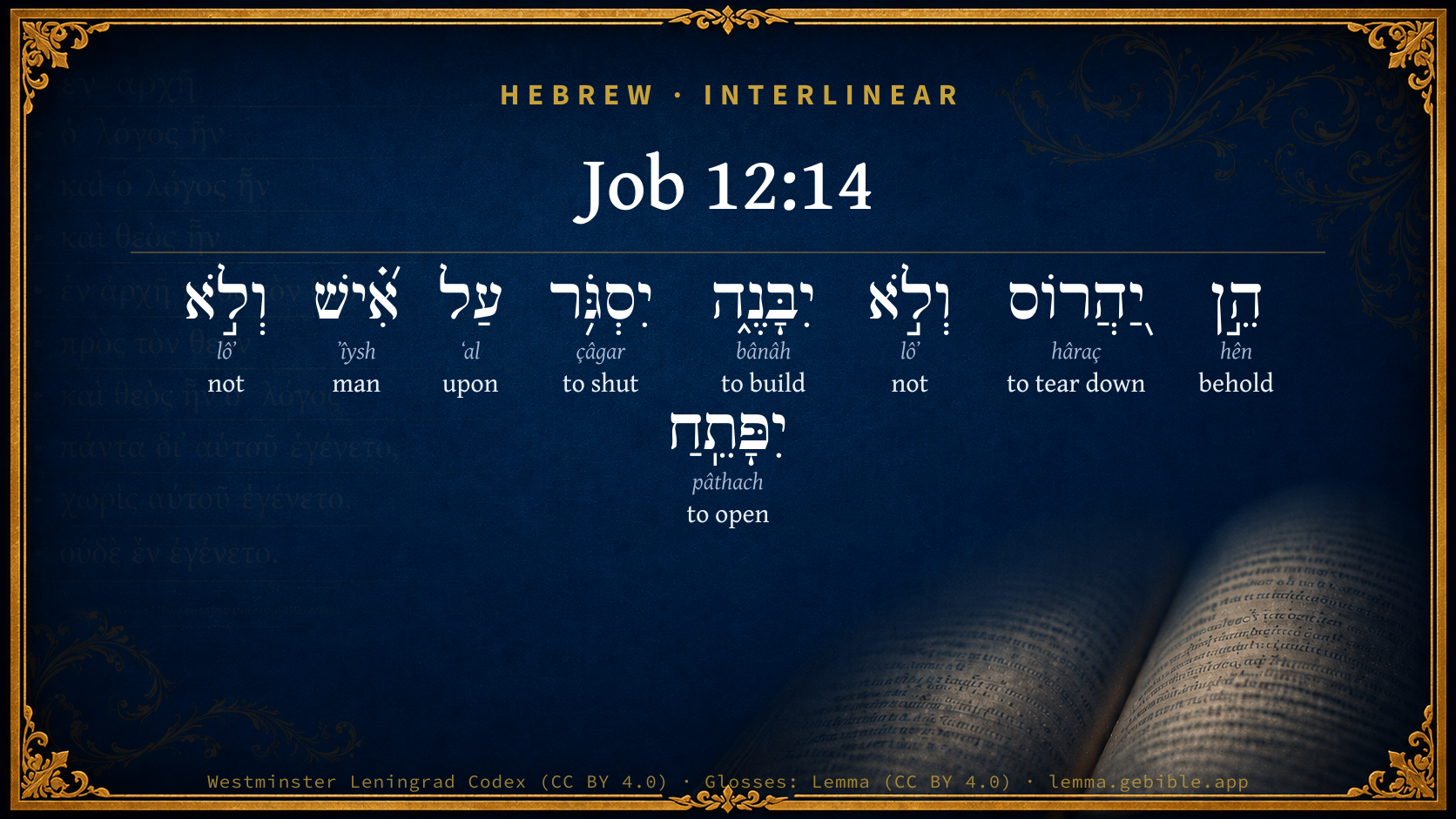
Hebrew (Westminster Leningrad Codex) Job 12:14 appears in the Hebrew Old Testament. The text above is from the Westminster Leningrad Codex. Each word links to its Strong’s number, a concise gloss, and parsing drawn from the Open Scriptures Hebrew Bible morphology. Click any word for its full Brown-Driver-Briggs (BDB) entry.
Download image
Cite this verse

Job 12:14 (World English Bible). Public Domain. Lemma interlinear Bible study tool, https://lemma.gebible.app/v/job/12/14.

Show BibTeX & RIS
BibTeX
RIS
English Translation
Behold, he breaks down, and it can't be built again; He imprisons a man, and there can be no release.
World English Bible · Public Domain
Download a study sheet

One document with this verse’s original text, its word-by-word gloss line, the meaning frame, cross-references with their text, attributed commentary, and full source and license credits — printable, and it pastes into notes with its structure intact.

This verse Autodidact and up

Study sheet (.html) Plain text (.txt)

A passage Seminary Student

Up to 50 verses in one chapter. A passage sheet keeps up to 6 commentary sources and 12 cross-references per verse, in the order this page ranks them, and says so on the sheet whenever that leaves anything out. Ask for a single verse and you get the Autodidact verse sheet above.

Everything on this page stays free to read, with no account — the sheet is a download of what is already on screen, not access to it.

Want to remove ads? Support Godless Engineer
Compare translations 3

The same verse in 3 English versions, stacked beneath the original-language interlinear above. Click any original word for its lexicon entry.

Each is an independent rendering of the whole verse — the interlinear is not word-aligned to these translations.

Highlighted words mark where these versions differ — a whole-verse word diff, not a word-by-word alignment.

  • World English Bible Public Domain
    Behold, he breaks down, and it can't be built again; He imprisons a man, and there can be no release.
  • King James Version Public Domain
    Behold, he breaketh down, and it cannot be built again: he shutteth up a man, and there can be no opening.
  • unfoldingWord Literal Text CC BY-SA 4.0
    Behold, he breaks down and it is not rebuilt; he closes upon a man and it is not opened.

unfoldingWord Literal Text — © unfoldingWord, licensed CC BY-SA 4.0. Word-aligned USFM3 via Door43 (git.door43.org/unfoldingWord/en_ult).

Versions to compare (up to 4)

3 of 4 selected

Show all 18 translations

Every available English version of this verse, each an independent rendering of the whole verse.

  • World English Bible Public Domain
    Behold, he breaks down, and it can't be built again; He imprisons a man, and there can be no release.
  • Berean Standard Bible Public Domain
    What He tears down cannot be rebuilt; the man He imprisons cannot be released.
  • Majority Standard Bible Public Domain
    What He tears down cannot be rebuilt; the man He imprisons cannot be released.
  • King James Version Public Domain
    Behold, he breaketh down, and it cannot be built again: he shutteth up a man, and there can be no opening.
  • American Standard Version (1901) Public Domain
    Behold, he breaketh down, and it cannot be built again; He shutteth up a man, and there can be no opening.
  • Revised Version (1885) Public Domain
    Behold, he breaketh down, and it cannot be built again; he shutteth up a man, and there can be no opening.
  • Geneva Bible (1599) Public Domain
    Beholde, he will breake downe, and it can not be built: he shutteth a man vp, and he can not be loosed.
  • Douay-Rheims (1899) Public Domain
    If he pull down, there is no man that can build up: if he shut up a. man, there is none that can open.
  • Young's Literal Translation Public Domain
    Lo, He breaketh down, and it is not built up, He shutteth against a man, And it is not opened.
  • Literal Standard Version CC BY-SA 4.0
    Behold, He breaks down, and it is not built up, || He shuts against a man, || And it is not opened.
  • Unlocked Literal Bible CC BY-SA 4.0
    See, he breaks down, and it cannot be built again; if he imprisons someone, there can be no release.
  • unfoldingWord Literal Text CC BY-SA 4.0
    Behold, he breaks down and it is not rebuilt; he closes upon a man and it is not opened.
  • Darby Bible Public Domain
    Behold, he breaketh down, and it is not built again; he shutteth up a man, and there is no opening.
  • World Messianic Bible Public Domain
    Behold, he breaks down, and it can’t be built again. He imprisons a man, and there can be no release.
  • Webster's Bible Public Domain
    Behold, he breaketh down, and it cannot be built again: he shutteth up a man, and there can be no opening.
  • Free Bible Version CC BY-SA 4.0
    If he tears something down, nobody can rebuild it. If he imprisons someone, nobody can free them.
  • Bible in Basic English Public Domain
    Truly, there is no building up of what is pulled down by him; when a man is shut up by him, no one may let him loose.
  • JPS Tanakh (1917) Public Domain
    Behold, He breaketh down, and it cannot be built again; He shutteth up a man, and there can be no opening.

Literal Standard Version (2020), Covenant Press — licensed CC BY-SA 4.0. Text via the HelloAO Bible API (eBible.org). Unlocked Literal Bible (unfoldingWord) — licensed CC BY-SA 4.0. Text via the HelloAO Bible API (eBible.org). unfoldingWord Literal Text — © unfoldingWord, licensed CC BY-SA 4.0. Word-aligned USFM3 via Door43 (git.door43.org/unfoldingWord/en_ult). Free Bible Version, Dr. Jonathan Gallagher — licensed CC BY-SA 4.0. Text via the HelloAO Bible API (eBible.org).

Word by word

More ways to search: Search by grammar → Find every occurrence → Compare this word →

Practice this passage: Drill this verse → Learn its vocabulary →

יַ֭הֲרוֹס
hâraç
H2040
“to tear down”
Verb, Qal, Imperfect, 3rd Person, Masculine, Singular
Part of Speech
Verb
Stem
Qal
Form
Imperfect
Person
3rd Person
Gender
Masculine
Number
Singular
Full BDB Definition

Origin: a primitive root

TWOT: 516

to tear down, break down, overthrow, beat down, break, break through, destroy, pluck down, pull down, throw down, ruined, destroyer, utterly - (Qal) - to throw down, tear down - to break through - to break down, break away - (Niphal) to be torn down, be thrown down - (Piel) - to overthrow, tear down - destroyer (participle)
  1. הֵ֣ן hên H2005 “behold” Particle, Demonstrative
  2. וְלֹ֣א lôʼ H3808 “and · not” Conjunction + Particle, Negative
  3. יִבָּנֶ֑ה bânâh H1129 “to build” Verb, Niphal, Imperfect, 3rd Person, Masculine, Singular
  4. יִסְגֹּ֥ר çâgar H5462 “to shut” Verb, Qal, Imperfect, 3rd Person, Masculine, Singular
  5. עַל ʻal H5921 “upon” Preposition
  6. אִ֝֗ישׁ ʼîysh H376 “man” Noun, Common, Masculine, Singular, Absolute
  7. וְלֹ֣א lôʼ H3808 “and · not” Conjunction + Particle, Negative
  8. יִפָּתֵֽחַ pâthach H6605 “to open” Verb, Niphal, Imperfect, 3rd Person, Masculine, Singular

About this verse

These counts appear in no published source. They are computed here, from the morphology-tagged text and Lemma’s own curated glosses. What Lemma adds →

9
words
8
distinct lemmas
Wisdom
section

Shared distinctive vocabulary

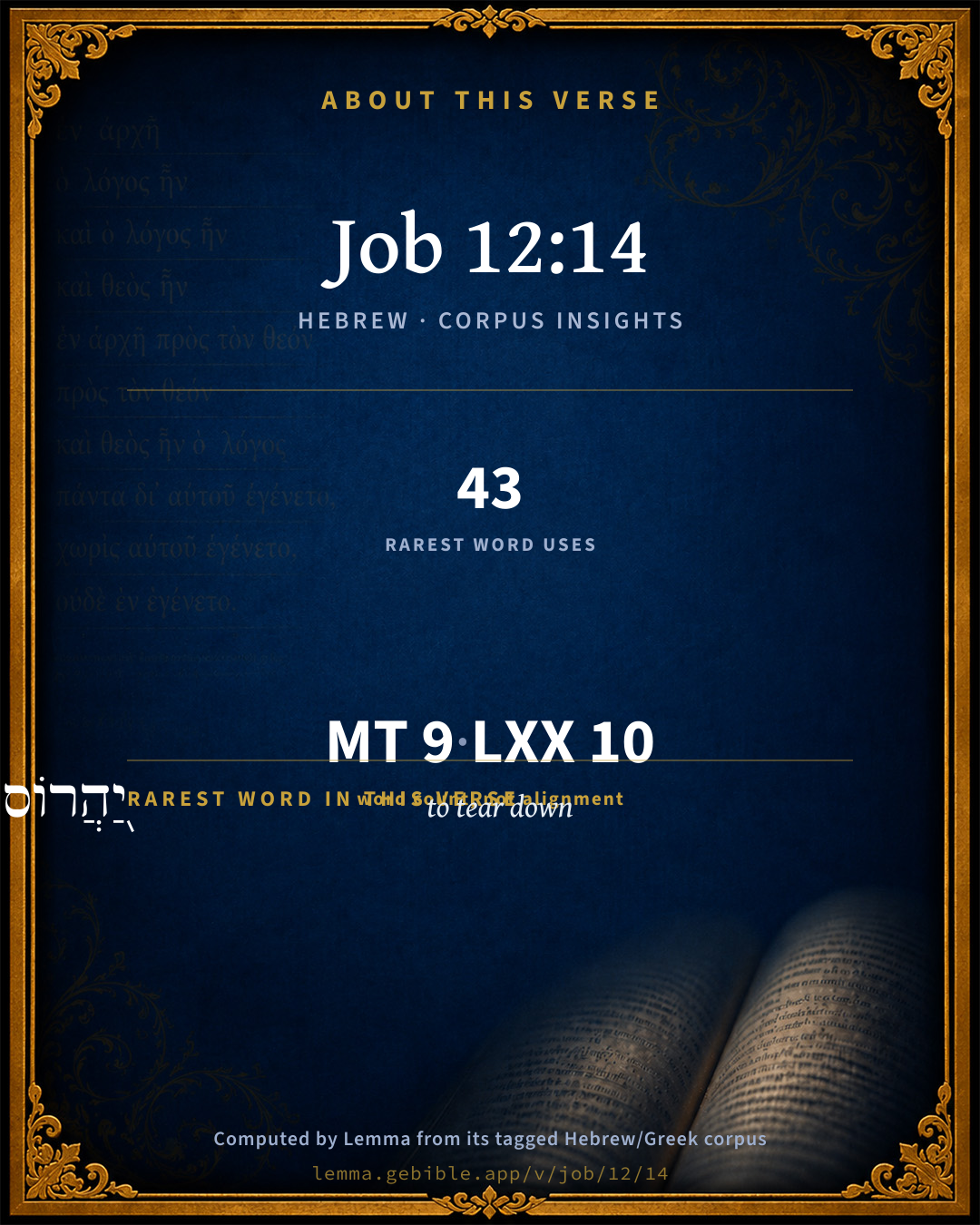
יַ֭הֲרוֹס to tear down H2040 occurs in 42 verses of the Hebrew Bible. Also found in:

Grammatical profile

  • 4 verbs
  • 1 noun
  • 1 preposition
  • 3 particles

Verb forms

  • יַ֭הֲרוֹס Qal · Imperfect
  • יִבָּנֶ֑ה Niphal · Imperfect
  • יִסְגֹּ֥ר Qal · Imperfect
  • יִפָּתֵֽחַ Niphal · Imperfect

Repetition

A word recurs within this verse — often emphatic in Hebrew:

  • וְלֹ֣א not H3808 ×2

Hebrew & Septuagint length

In English translation the verse runs 20 words from the Hebrew and 19 from the Septuagint (LXX English) — closely comparable.

A rough comparison of the two English renderings, which tokenize alike — not a word-level alignment.

Word counts can differ between the Hebrew and the Greek without any difference in meaning — e.g. the Hebrew direct-object marker אֵת has no separate Greek word, and Greek often adds the article ὁ.

In the original languages it is 9 Hebrew tokens and 10 Greek tokens — but the two are counted differently (Hebrew bundles its prefixes and suffixes into one token; the Greek is in lemma form), so that isn’t a like-for-like length.

Cross-references

16

Topical passages linked to Job 12:14 in the Treasury of Scripture Knowledge — connected by theme and wording, ordered by reader-vote popularity; previews shown in the World English Bible.

  • Isaiah 22:22 The key of the house of David will I lay on his shoulder; and he shall open, and none shall shut; and he shall shut, and none shall open.
  • Revelation 3:7 "To the angel of the assembly in Philadelphia write: "He who is holy, he who is true, he who has the key of David, he who opens and no one can shut, and who shuts and no one opens, says these things:
  • Job 11:10 If he passes by, or confines, Or convenes a court, then who can oppose him?
  • Malachi 1:4 Whereas Edom says, "We are beaten down, but we will return and build the waste places;" thus says Yahweh of Hosts, "They shall build, but I will throw down; and men will call them 'The Wicked Land,' even the people against whom Yahweh shows wrath forever."
  • 1 Samuel 17:46 This day will Yahweh deliver you into my hand; and I will strike you, and take your head from off you; and I will give the dead bodies of the host of the Philistines this day to the birds of the sky, and to the wild animals of the earth; that all the earth may know that there is a God in Israel,
  • 1 Samuel 26:8 Then said Abishai to David, God has delivered up your enemy into your hand this day: now therefore please let me strike him with the spear to the earth at one stroke, and I will not strike him the second time.
  • Job 9:12–13 Behold, he snatches away; who can hinder him? Who will ask him, 'What are you doing?'
  • Job 16:11 God delivers me to the ungodly, And casts me into the hands of the wicked.
  • Job 19:10 He has broken me down on every side, and I am gone. My hope he has plucked up like a tree.
  • Job 37:7 He seals up the hand of every man, That all men whom he has made may know it.
  • Jeremiah 51:58 Thus says Yahweh of hosts: The broad walls of Babylon shall be utterly overthrown, and her high gates shall be burned with fire; and the peoples shall labor for vanity, and the nations for the fire; and they shall be weary.
  • 1 Samuel 24:18 You have declared this day how that you have dealt well with me, because when Yahweh had delivered me up into your hand, you didn't kill me.
  • Isaiah 14:23 I will also make it a possession for the porcupine, and pools of water: and I will sweep it with the broom of destruction, says Yahweh of Hosts.
  • Isaiah 25:2 For you have made of a city a heap, of a fortified city a ruin, a palace of strangers to be no city; it shall never be built.
  • Jeremiah 51:64 and you shall say, Thus shall Babylon sink, and shall not rise again because of the evil that I will bring on her; and they shall be weary. Thus far are the words of Jeremiah.
  • Romans 11:32 For God has shut up all to disobedience, that he might have mercy on all.

Cross-references courtesy of OpenBible.info (CC BY 4.0).

Hebrew and Greek witnesses Masoretic Hebrew ↔ Greek Septuagint

The same verse in the two great witnesses to the Old Testament, shown verse-for-verse.

These are two independent witnesses, not word-aligned to each other, and the Septuagint is shown in lemma (dictionary) form.

Hebrew Job 12:14 Masoretic · Westminster Leningrad Codex

הֵ֣ן יַ֭הֲרוֹס וְלֹ֣א יִבָּנֶ֑ה יִסְגֹּ֥ר עַל אִ֝֗ישׁ וְלֹ֣א יִפָּתֵֽחַ

Behold, he breaks down, and it can't be built again; He imprisons a man, and there can be no release.

World English Bible · Public Domain

Greek LXX Job 12:14 Septuagint · lemma form

ἐάν καταβάλλω τίς οἰκοδομέω ἐάν κλείω κατά ἄνθρωπος τίς ἀναοἴγω

If he should cast down, who will build up? if he should shut up against man, who shall open?

LXX2012 (modern English Septuagint) · Public Domain

Hebrew: Westminster Leningrad Codex (CC BY 4.0). Greek: Septuagint (public domain); English from LXX2012 (modern English Septuagint) (Public Domain). How the Septuagint differs from the Hebrew →

Commentary

Notes on Job 12:14 from classic Christian and Jewish commentators (each source and its license shown beneath its notes). The classic Christian expositions comment on the surrounding passage and are grouped to its opening verse, so a note may address several verses; the Jewish commentaries on the Tanakh (Rashi and others) are per-verse, so they appear only where the commentator wrote on this verse.

Lemma curates 59 commentaries, every one of them public domain or Creative Commons licensed, each selected and text-cleaned for this edition rather than reprinted as found. About our sources →

Trapp's Complete Commentary

John Trapp

Job 12:14 Behold, he breaketh down, and it cannot be built again: he shutteth up a man, and there can be no opening.

Ver. 14. Behold, he breaketh down, and it cannot be built again] As he did the old world, Sodom and Gomorrah, many monarchies and empires, the tower of Babel, and other castles and houses which now live by fame only, if at all. If God have a mind to ruin these, who shall raise or repair them? Julian, the apostate, in spite of the Christians, set the Jews to work to rebuild the temple at Jerusalem, but they could never effect it by reason of a terrible earthquake, that slew the workmen and marred the materials (Am. Marcel., Socrat. 3, Theod., Ruffin.). The Arian bishops held a second council at Nice, with the purpose of having abolished the memory of the first together with the Nicene Creed, and to have established Arianism (Func.); but God disappointed them, and sent them packing thence by a huge earthquake, which overturned a great part of that city, and killed a number of people. Constans, nephew to Heraclius, the Greek emperor, and (three hundred years after him) Otho, emperor of Germany, endeavoured, but in vain, to make Rome the seat of their empires, as anciently it had been (Theophanes, Zonares, Cedrenus). God would not allow it so to be, saith Genebrard, because the kingdom of the Church, foretold by Daniel, was to have its seat there. If he had said, the kingdom of Antichrist, foretold by Paul and John the divine, he had hit the nail on the very head.

He shutteth up a man, and there can be no opening] He clappeth him up close prisoner, as Manasseh, Zedekiah, Bajazet, Boniface VIII, &c., or fasteneth him to his bed by some chronic disease (as he did Abimelech, Ahaziah, Asa, Aeneas, Act 9:33), or otherwise straiteneth him, that he knows not how to help himself, as he did Pharaoh, Saul (when the Philistines were upon him on every side), those refractories in Isaiah, Isa 9:2, and shall do the whore of Babylon, Rev 18:9-19, when her lovers shall bewail her, but not be able to help her, Job 12:9-10. For when God shutteth up any in this sort, they must lie by it till he please to release them and extricate them, as he did Joseph, Jehoshaphat, David, Peter, Valentinian, and many others, when they were even forsaken by their hopes.

John Trapp, A Commentary or Exposition upon All the Books of the Old and New Testament (1647–1656) — public domain. Text from a community e-Sword module.

Joseph Benson's Commentary

Job 12:14. Behold, he breaketh down — Houses, castles, cities; and it cannot be built again — It is not in the power of any creature to repair what he designs utterly to destroy. He shutteth up a man — In prison, or in straits and troubles; and there can be no opening — Without his permission and providence. Yea, he shuts up in the grave, and none can break open those sealed doors. He shuts up in hell, in chains of darkness, and none can pass that great gulf.

Joseph Benson's Commentary on the Old and New Testaments (1811–1818) — public domain. Text from a community e-Sword module.

Jamieson, Fausset & Brown

Robert Jamieson, A. R. Fausset & David Brown

shutteth up-- (Isa 22:22). Job refers to Zophar's "shut up" (Job 11:10).

Jamieson, Fausset & Brown — Commentary Critical and Explanatory on the Whole Bible (1871) — public domain (CC PDM 1.0). Text via the HelloAO Bible API.

Adam Clarke's Commentary

Verse 14. He breaketh down] He alone can create, and he alone can destroy. Nothing can be annihilated but by the same Power that created it. This is a most remarkable fact. No power, skill, or cunning of man can annihilate the smallest particle of matter. Man, by chemical agency, may change its form; but to reduce it to nothing belongs to God alone. In the course of his providence God breaks down, so that it cannot be built up again. See proofs of this in the total political destruction of Nineveh, Babylon, Persepolis, Tyre, and other cities, which have broken down never to be rebuilt; as well as the Assyrian, Babylonian, Grecian, and Roman empires, which have been dismembered and almost annihilated, never more to be regenerated.

He shutteth up a man] He often frustrates the best laid purposes, so that they can never be brought to good effect.

Adam Clarke's Commentary on the Bible (1810–1826) — public domain. Text from a community e-Sword/MySword module.

Ellicott's Commentary for English Readers

(14) Behold, he breaketh down . . .—God has equal power over the moral and physical world.

A Bible Commentary for English Readers, edited by Charles John Ellicott (1878–1897) — public domain. Text from a community e-Sword module.

The Cambridge Bible for Schools and Colleges

gen. ed. J. J. S. Perowne

14. breaketh down] e.g. fenced cities, devoting them to ruin, cf. ch. Job_15:28.

shutteth up a man] In prison, as captive kings and the like, cf. Jer_22:24 seq., 2Ki_25:27 seq.

The Cambridge Bible for Schools and Colleges (gen. ed. J. J. S. Perowne; Cambridge University Press, 1878–1918) — public domain. Text from a community e-Sword module.

John Gill's Exposition

Behold, he withholdeth the waters, and they dry up,.... Or "lays a restraint in" or "on the waters" (s); either in the ocean, as he did at the creation, when he gathered the waters that were upon the face of the earth into one place, and restrained them there, even in the decreed place he broke up for them, called the sea, and set bars and doors to keep them within bounds, whereby the places they left became dry and the dry land appeared called earth; and so at the time of the flood, when the waters which covered the earth and drowned the world were called off again, the face of it was dry, and so it remains, the waters of the great ocean being restrained from overflowing it; and also when God rebukes the see, and smites the waves of it, or withholds the ebbing and flowing of the tides brooks and rivers of water dry up; see Nah 1:4; or else this may be understood of God's withholding and restraining the waters in the clouds, and not suffering them to let down rain on the earth; when not only brooks dry up, as the brook Cherith did, where Elijah abode for sometime, but the fruits of the earth, trees, plants, and herbs dry up, wither and die; see Kg1 17:7; and this is an emblem in a spiritual sense of God's withholding the word and ordinances, the waters of the sanctuary the means of grace, and of fruitfulness; which when he does, the consequence of it is barrenness and unfruitfulness in kingdoms, cities, towns, families, sad particular persons; and of his withholding the communications of his grace, often compared to water in Scripture, even from his people; the effect of which is, that they are in, withering circumstances, the things that revive seem ready to die, though they shall not; love waxes cold, faith is ready to fail, and hope and strength seem perishing from the Lord:

also he sendeth them out, and they overturn the earth; as at the time of the flood, when the fountains of the great deep were broken up, and the windows of heaven were opened, and such vast quantities of water issued out as overflowed the whole world, by which it was overturned; and as the Apostle Peter says, "perished", Pe2 3:5; though this is also true of inundations that may have been since, which though not universal as that, yet so far as they have reached have overturned all in their way, and carried off the fruits of the earth, the habitations of men, and men themselves; whole countries, cities and towns, have been carried away by the waters of the sea, or sunk into it, particularly all that space. Where now is the Atlantic sea, as Pliny (t), from Plato, relates. It is well when the grace of God flows, and overflows, and superabounds abounding sin, and overpowers and overcomes carnal, earthly, and sensual lusts, and reigns where sin did, and teaches to deny ungodliness and worldly lusts, and to mortify the members on the earth.

(s) "detinebit in aquis", Montanus, Bolducius; "si contineat, vel cohibeat, q. d. imperium exerceat in aquas", Michaelis. (t) Nat. Hist. l. 2. c. 90, 92.

John Gill's Exposition of the Whole Bible (1746–1763) — public domain (CC PDM 1.0). Text via the HelloAO Bible API.

Albert Barnes' Notes on the Bible

Behold, he breaketh down - None can repair what he pulls down. Cities and towns he can devote to ruin by fire, or earthquake, or the pestilence, and so completely destroy them that they can never be rebuilt. We may now refer to such illustrations as Sodom, Babylon, Petra, Tyre, Herculaneum, and Pompeii, as full proof of what is here affirmed.

He shutteth up a man - He can shut up a man in such difficulties and straits that he cannot extricate himself; see Job 11:10. The Chaldee renders this, “he shuts up a man in the grave (בקבורתא) and it cannot be opened.” But the more correct idea is, that God has complete control over a man, and that he can so hedge up his way that he cannot help himself.

Albert Barnes' Notes on the Bible (1834–1885) — public domain. Text from a community e-Sword/MySword module.

Matthew Poole's English Annotations

He breaketh down, to wit, houses, castles, cities, which God designeth to destroy utterly.

He shutteth up; if he will shut up a man in prison, or in any straits or troubles.

There can be no opening, without God’s permission and providence.

Matthew Poole's English Annotations on the Holy Bible (1683–1685) — public domain. Text from a community e-Sword/MySword module.

Whedon's Commentary on the Bible

Daniel D. Whedon

14. Shutteth up a man — In the sense of closing over. This is explained by the nature of the prisons among the Hebrews, which were subterranean excavations, whose mouth was covered with a stone. Lam_3:53. The Chaldee renders it, “He shuts man up in the grave, and it cannot be opened.”

Saint Gregory moralizes upon this clause: “Evil deeds build a prison for man in the depths of his conscience. Habit bars the doors, and blindness of understanding darkens the windows. Thus God shuts him in. If ever the desire arise to break forth from his dungeon, he is not able.” But all this tends to depreciate the grace of the gospel, which is powerful to break any prison bar that habit or appetite has forged.

Daniel D. Whedon (gen. ed.), Commentary on the Old and New Testaments (1874–1909) — public domain. Text from a community e-Sword module.

The Pulpit Commentary

Behold, he breaketh down, and it cannot be built again. Professor Lee thinks that the allusion is to the cities of the plain. (Gen_19:24-29) But the sentiment is so general, that we may well doubt if particular instances were in Job"s mind. At any rate, the destructive agencies of nature must be as much included as any supernatural acts. He shutteth up a man. (comp. Job_11:10) God "shutsup" men when be hedges them in with calamities or other circumstances, which take away from them all freedom of action (Job_3:23 Job_19:8) When he does this, the result followsThere can be no opening. No other power can give release.

The Pulpit Commentary (1880–1919), ed. H.D.M. Spence-Jones & Joseph S. Exell — public domain. Text from a community e-Sword module.

John Wesley's Explanatory Notes

No opening - Without God's permission. Yea, he shuts up in the grave, and none can break open those sealed doors. He shuts up in hell, in chains of darkness, and none can pass that great gulf.

John Wesley, Explanatory Notes Upon the Whole Bible (1754–1765) — public domain. Text via the GEBible commentary corpus.

Keil & Delitzsch

C. F. Keil & F. Delitzsch

14 Behold, He breaketh down and it cannot be built again,

He shutteth up, and it cannot be opened.

15 Behold, He restraineth the waters and they dry up,

And He letteth them out and they overturn the earth.

16 With Him is might and existence,

The erring and the deceiver are His.

God is almighty, and everything in opposition to Him powerless. If He break down (any structure whatever), it can never be rebuilt; should He close upon any one (i.e., the dungeon, as perhaps a cistern covered with a stone, Lam 3:53, comp. Jer 38:6; על with reference to the depth of the dungeon, instead of the usual בּעד), it (that which is closed from above) cannot be opened again. In like manner, when He desires to punish a land, He disposes the elements according to His will and pleasure, by bringing upon it drought or flood. יעצר, coercet, according to the correct Masoretic mode of writing יעצר with dagesh in the Ssade, in order clearly to distinguish in the pronunciation between the forms j'a-ssor and jaa'ssor (יעצר);

(Note: Vid., my notice of Br's Psalter-Ausgabe, Luth. Zeitschr. 1863, 3; and comp. Keil on Lev 4:13 (Comm on Pent., Clark's transl.).)

ויבשׁוּ (for which Abulwalid writes ויבשׁוּ) is a defective form of writing according to Ges. 69, 3, 3; the form ויהפכוּ with the similarly pointed fut. consec., Sa1 25:12, form a pair (zuwg) noted by the Masora. By תּוּשׁיּה, which is ascribed to God, is here to be understood that which really exists, the real, the objective, knowledge resting on an objective actual basis, in contrast with what only appears to be; so that consequently the idea of Job 12:16 and Job 12:13 is somewhat veiled; for the primary notion of חכמה is thickness, solidity, purity, like πυκνότης.

(Note: The primary notion of חכם, Arab. hkm, is, to be thick, firm, solid, as the prim. notion of Arab. sachfa (to be foolish, silly) is to be thin, loose, not holding together (as a bad texture). The same fundamental notions are represented in the expression of moral qualities (in distinction from intellectual) by צדק, Arab. sdq, and רשׁע, (Arab. rs', rsg).)

This strophe closes like the preceding, which favours our division. The line with עמּו is followed by one with לו, which affirms that, in the supremacy of His rule and the wisdom of His counsels, God makes evil in every form subservient to His designs.

Keil & Delitzsch — Biblical Commentary on the Old Testament (1861–1891) — public domain (CC PDM 1.0). Text via the HelloAO Bible API. (Old Testament only.)

Lesson kit

Teaching starters — assembled from the data on this page, not authored interpretation. Every prompt links to the verse data it draws on. Edit before teaching.

Job, in the Wisdom, opens this verse with 9 words (8 distinct Hebrew lemmas). Its most distinctive word is hâraç (“to tear down”). A historical commentator’s framing appears above. Read the whole chapter for the surrounding context.

Discussion questions

  1. The word hâraç carries the sense “to tear down.” How does it shape the verse?
  2. How does Exodus 15:7, which shares the word «to tear down», read alongside this verse?
  3. What does the repetition of “not” (2× in this one verse) do in this verse?
  4. The translations on this page render this verse differently — a whole-verse word diff, not a word-by-word alignment. What might account for the different wordings?
  5. «יַ֭הֲרוֹס» is a Qal Imperfect verb. How does that grammatical form shape the action described?
  6. Compare how Trapp's Complete Commentary and Joseph Benson's Commentary read this verse. Where do they agree or differ?

Things to notice

Reading settings

Reading text

Shown beneath each verse's original-language words.

Old Testament
Old Testament edition

Read the OT as the Masoretic Hebrew (MT) or the Greek Septuagint (LXX).

English shown for the Greek Septuagint (in the Hebrew ↔ Greek comparison).

Comparing translations? Open the Compare panel on any verse page to stack up to four side by side.