
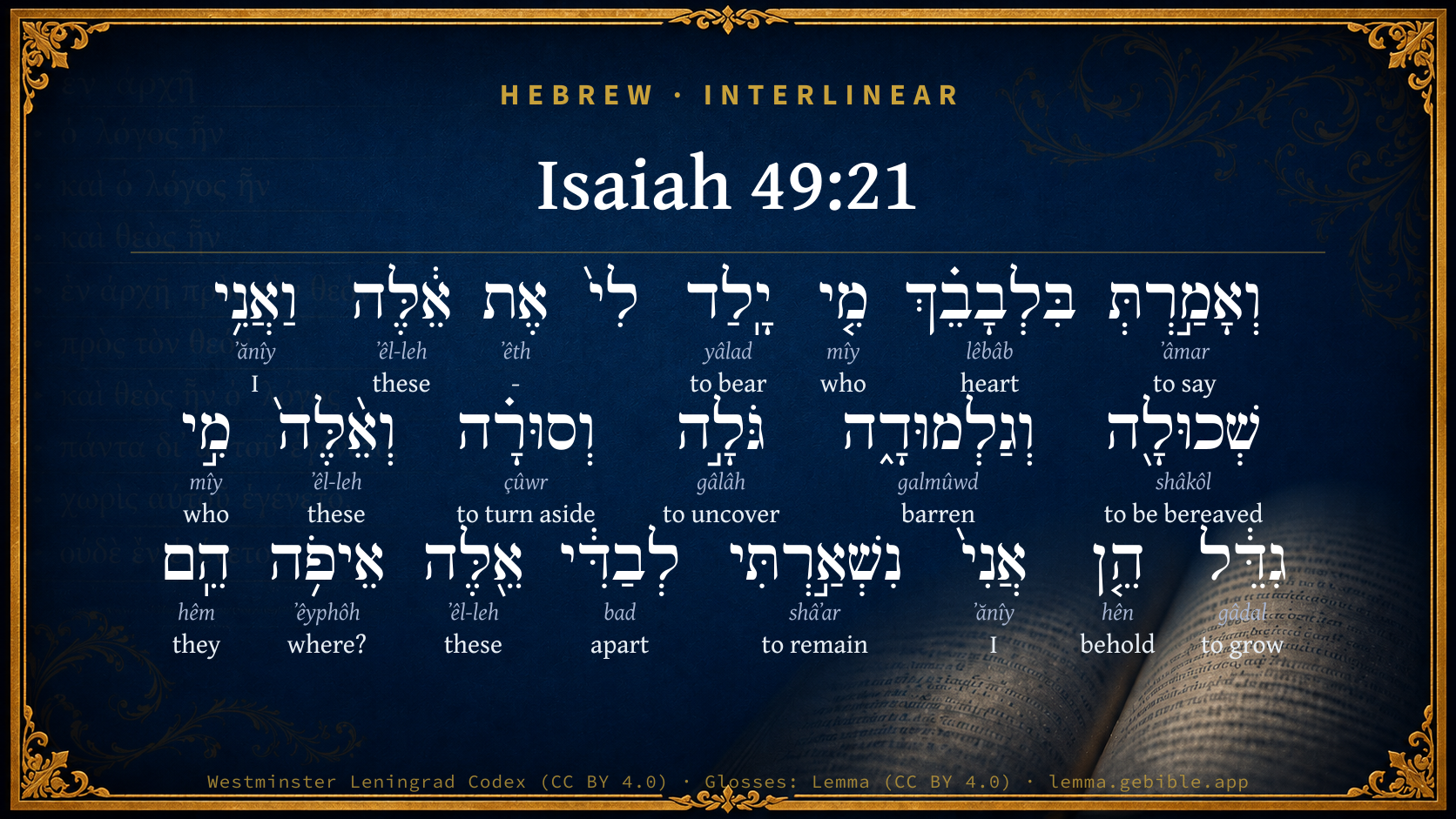
Isaiah 49:21

Hebrew (Westminster Leningrad Codex) Isaiah 49:21 appears in the Hebrew Old Testament. The text above is from the Westminster Leningrad Codex. Each word links to its Strong’s number, a concise gloss, and parsing drawn from the Open Scriptures Hebrew Bible morphology. Click any word for its full Brown-Driver-Briggs (BDB) entry.
Download image
Cite this verse

Isaiah 49:21 (World English Bible). Public Domain. Lemma interlinear Bible study tool, https://lemma.gebible.app/v/isaiah/49/21.

Show BibTeX & RIS
BibTeX
RIS
English Translation
Then shall you say in your heart, Who has conceived these for me, seeing I have been bereaved of my children, and am solitary, an exile, and wandering back and forth? and who has brought up these? Behold, I was left alone; these, where were they?
World English Bible · Public Domain
Download a study sheet

One document with this verse’s original text, its word-by-word gloss line, the meaning frame, cross-references with their text, attributed commentary, and full source and license credits — printable, and it pastes into notes with its structure intact.

This verse Autodidact and up

Study sheet (.html) Plain text (.txt)

A passage Seminary Student

Up to 50 verses in one chapter. A passage sheet keeps up to 6 commentary sources and 12 cross-references per verse, in the order this page ranks them, and says so on the sheet whenever that leaves anything out. Ask for a single verse and you get the Autodidact verse sheet above.

Everything on this page stays free to read, with no account — the sheet is a download of what is already on screen, not access to it.

Want to remove ads? Support Godless Engineer
Compare translations 3

The same verse in 3 English versions, stacked beneath the original-language interlinear above. Click any original word for its lexicon entry.

Each is an independent rendering of the whole verse — the interlinear is not word-aligned to these translations.

Highlighted words mark where these versions differ — a whole-verse word diff, not a word-by-word alignment.

  • World English Bible Public Domain
    Then shall you say in your heart, Who has conceived these for me, seeing I have been bereaved of my children, and am solitary, an exile, and wandering back and forth? and who has brought up these? Behold, I was left alone; these, where were they?
  • King James Version Public Domain
    Then shalt thou say in thine heart, Who hath begotten me these, seeing I have lost my children, and am desolate, a captive, and removing to and fro? and who hath brought up these? Behold, I was left alone; these, where had they been?
  • unfoldingWord Literal Text CC BY-SA 4.0
    And you will say in your heart, ‘Who bore these for me? And I bereft and barren, having gone into exile and having been turned aside. And who raised these? Behold, I, I was left by myself; these, where they?’”

unfoldingWord Literal Text — © unfoldingWord, licensed CC BY-SA 4.0. Word-aligned USFM3 via Door43 (git.door43.org/unfoldingWord/en_ult).

Versions to compare (up to 4)

3 of 4 selected

Show all 18 translations

Every available English version of this verse, each an independent rendering of the whole verse.

  • World English Bible Public Domain
    Then shall you say in your heart, Who has conceived these for me, seeing I have been bereaved of my children, and am solitary, an exile, and wandering back and forth? and who has brought up these? Behold, I was left alone; these, where were they?
  • Berean Standard Bible Public Domain
    Then you will say in your heart, ‘Who has begotten these for me? I was bereaved and barren; I was exiled and rejected. So who has reared them? Look, I was left all alone, so where did they come from?’”
  • Majority Standard Bible Public Domain
    Then you will say in your heart, ‘Who has begotten these for me? I was bereaved and barren; I was exiled and rejected. So who has reared them? Look, I was left all alone, so where did they come from?’”
  • King James Version Public Domain
    Then shalt thou say in thine heart, Who hath begotten me these, seeing I have lost my children, and am desolate, a captive, and removing to and fro? and who hath brought up these? Behold, I was left alone; these, where had they been?
  • American Standard Version (1901) Public Domain
    Then shalt thou say in thy heart, Who hath begotten me these, seeing I have been bereaved of my children, and am solitary, an exile, and wandering to and fro? and who hath brought up these? Behold, I was left alone; these, where were they?
  • Revised Version (1885) Public Domain
    Then shalt thou say in thine heart, Who hath begotten me these, seeing I have been bereaved of my children, and am solitary, an exile, and wandering to and fro? and who hath brought up these? Behold, I was left alone; these, where were they?
  • Geneva Bible (1599) Public Domain
    Then shalt thou say in thine heart, Who hath begotten mee these, seeing I am baren and desolate, a captiue and a wanderer to and from? and who hath nourished them? beholde, I was left alone: whence are these?
  • Douay-Rheims (1899) Public Domain
    And thou shalt-say in thy heart: Who hath begotten these? I was barren and brought not forth, led away, and captive: and who hath brought up these? I was destitute and alone: and these, where were they?
  • Young's Literal Translation Public Domain
    And thou hast said in thy heart: `Who hath begotten for me -- these? And I bereaved and gloomy, A captive, and turned aside, And these -- who hath nourished? Lo, I -- I was left by myself, these -- whence `are' they?
  • Literal Standard Version CC BY-SA 4.0
    And you have said in your heart: Who has begotten these for me? And I [am] bereaved and barren, || A captive, and turned aside, || And who has nourished these? Behold, I was left by myself, these—where [are] they from?”
  • Unlocked Literal Bible CC BY-SA 4.0
    Then you will ask yourself, 'Who has borne these children for me? I was bereaved and barren, exiled and divorced. Who has raised these children? Look, I was left all alone; where did these come from?'”
  • unfoldingWord Literal Text CC BY-SA 4.0
    And you will say in your heart, ‘Who bore these for me? And I bereft and barren, having gone into exile and having been turned aside. And who raised these? Behold, I, I was left by myself; these, where they?’”
  • Darby Bible Public Domain
    And thou shalt say in thy heart, Who hath borne me these, seeing I had lost my children and was desolate, an exile, and driven about? and who hath brought up these? behold, I was left alone; these, where were they?
  • World Messianic Bible Public Domain
    Then you will say in your heart, ‘Who has conceived these for me, since I have been bereaved of my children and am alone, an exile, and wandering back and forth? Who has brought these up? Behold, I was left alone. Where were these?’”
  • Webster's Bible Public Domain
    Then shalt thou say in thy heart, Who hath begotten these for me, seeing I have lost my children, and am desolate, a captive, and removing to and fro? and who hath brought up these? Behold, I was left alone; these, where have they been?
  • Free Bible Version CC BY-SA 4.0
    Then you will say to yourself, “Who gave birth to all these children for me? My children were killed and I was unable to have more; I was exiled and thrown aside—so who brought these children up? Look, I was abandoned, so where did they come from?”
  • Bible in Basic English Public Domain
    Then you will say in your heart, Who has given me all these children? when my children had been taken from me, and I was no longer able to have others, who took care of these? when I was by myself, where then were these?
  • JPS Tanakh (1917) Public Domain
    Then shalt thou say in thy heart: 'Who hath begotten me these, seeing I have been bereaved of my children, and am solitary, an exile, and wandering to and fro? And who hath brought up these? Behold, I was left alone; these, where were they?'

Literal Standard Version (2020), Covenant Press — licensed CC BY-SA 4.0. Text via the HelloAO Bible API (eBible.org). Unlocked Literal Bible (unfoldingWord) — licensed CC BY-SA 4.0. Text via the HelloAO Bible API (eBible.org). unfoldingWord Literal Text — © unfoldingWord, licensed CC BY-SA 4.0. Word-aligned USFM3 via Door43 (git.door43.org/unfoldingWord/en_ult). Free Bible Version, Dr. Jonathan Gallagher — licensed CC BY-SA 4.0. Text via the HelloAO Bible API (eBible.org).

Word by word

More ways to search: Search by grammar → Find every occurrence → Compare this word →

Practice this passage: Drill this verse → Learn its vocabulary →

וְגַלְמוּדָ֑ה
galmûwd
H1565
“and · barren”
Conjunction + Adjective, Adjective, Feminine, Singular, Absolute
Part of Speech
Conjunction + Adjective
Type
Adjective
Gender
Feminine
Number
Singular
State
Absolute
Full BDB Definition

Origin: probably by prolonged from H1563

TWOT: 354c

hard, barren, harsh, bleak - harsh, bleak (of a company of wicked men) - barren (of women)
  1. וְאָמַ֣רְתְּ ʼâmar H559 “and · to say” Conjunction + Verb, Qal, Sequential Perfect, 2nd Person, Feminine, Singular
  2. בִּלְבָבֵ֗ךְ lêbâb H3824 “in/at · heart · your” Preposition + Noun, Common, Masculine, Singular, Construct + Suffix, Personal, 2nd Person, Feminine, Singular
  3. מִ֤י mîy H4310 “who” Particle, Interrogative
  4. יָֽלַד yâlad H3205 “to bear” Verb, Qal, Perfect, 3rd Person, Masculine, Singular
  5. אֶת ʼêth H853 “-” Particle, Direct Object
  6. אֵ֔לֶּה ʼêl-leh H428 “these” Pronoun, Demonstrative, Common, Plural
  7. וַאֲנִ֥י ʼănîy H589 “and · I” Conjunction + Pronoun, Personal, 1st Person, Common, Singular
  8. שְׁכוּלָ֖ה shâkôl H7921 “bereaved” Adjective, Adjective, Feminine, Singular, Absolute
  9. גֹּלָ֣ה gâlâh H1540 “uncovering” Verb, Qal, Participle Active, Feminine, Singular, Absolute
  10. וְסוּרָ֗ה çûwr H5493 “and · removed” Conjunction + Adjective, Adjective, Feminine, Singular, Absolute
  11. וְאֵ֨לֶּה֙ ʼêl-leh H428 “and · these” Conjunction + Pronoun, Demonstrative, Common, Plural
  12. מִ֣י mîy H4310 “who” Particle, Interrogative
  13. גִדֵּ֔ל gâdal H1431 “to grow” Verb, Piel, Perfect, 3rd Person, Masculine, Singular
  14. הֵ֤ן hên H2005 “behold” Particle, Demonstrative
  15. אֲנִי֙ ʼănîy H589 “I” Pronoun, Personal, 1st Person, Common, Singular
  16. נִשְׁאַ֣רְתִּי shâʼar H7604 “to remain” Verb, Niphal, Perfect, 1st Person, Common, Singular
  17. לְבַדִּ֔י bad H905 “to/for · apart · my” Preposition + Noun, Common, Masculine, Singular, Construct + Suffix, Personal, 1st Person, Common, Singular
  18. אֵ֖לֶּה ʼêl-leh H428 “these” Pronoun, Demonstrative, Common, Plural
  19. אֵיפֹ֥ה ʼêyphôh H375 “where?” Particle, Interrogative
  20. הֵֽם hêm H1992 “they” Pronoun, Personal, 3rd Person, Masculine, Plural

About this verse

These counts appear in no published source. They are computed here, from the morphology-tagged text and Lemma’s own curated glosses. What Lemma adds →

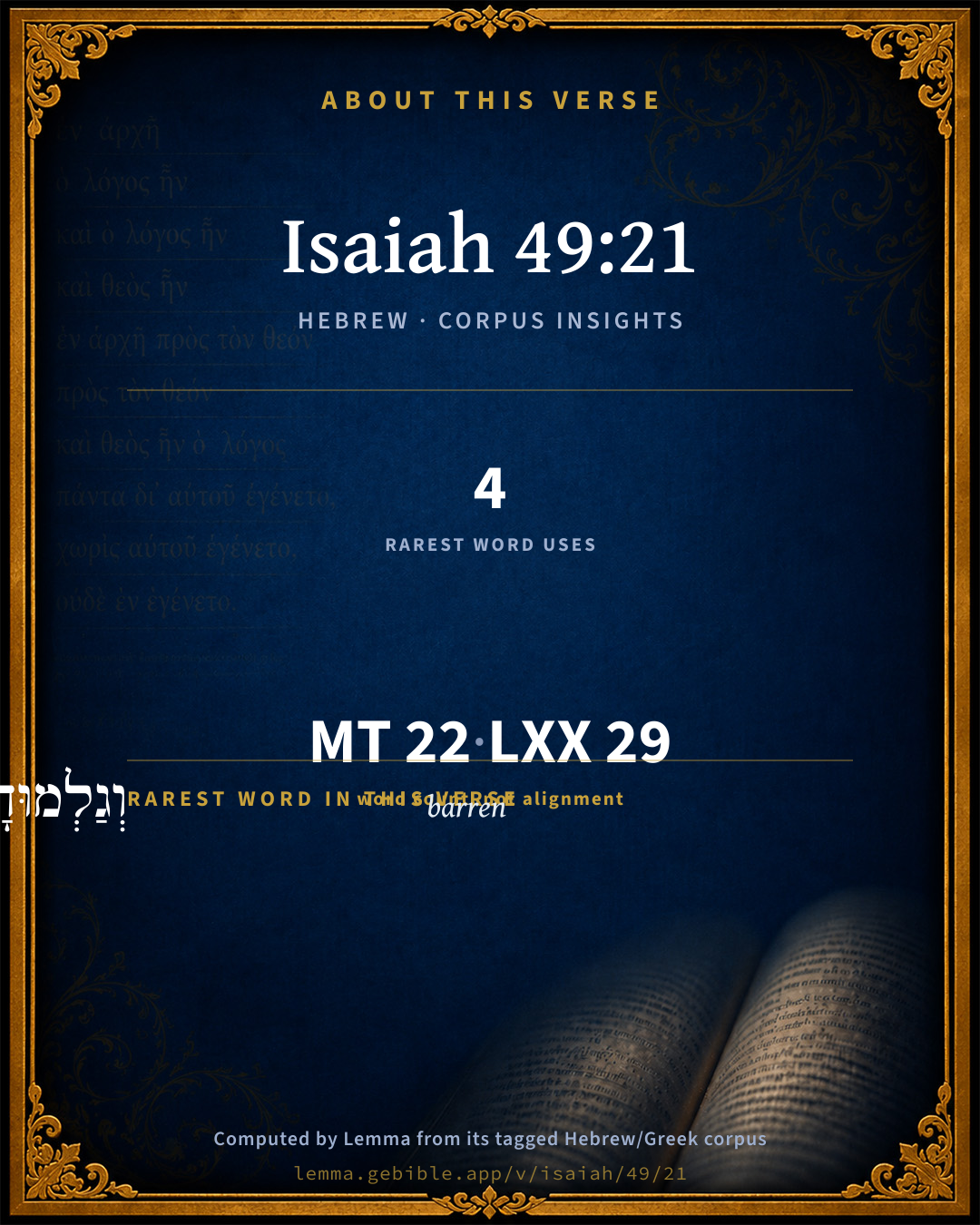
22
words
17
distinct lemmas
Prophets
section

Notable vocabulary

The rarest word here is וְגַלְמוּדָ֑ה barren H1565 — appearing just 4 times in the whole Hebrew Bible.

Shared distinctive vocabulary

וְגַלְמוּדָ֑ה barren H1565 occurs in 4 verses of the Hebrew Bible. Also found in:

Grammatical profile

  • 5 verbs
  • 2 nouns
  • 3 adjectives
  • 6 pronouns
  • 1 preposition
  • 5 particles

Verb forms

  • וְאָמַ֣רְתְּ Qal · Sequential Perfect
  • יָֽלַד Qal · Perfect
  • גֹּלָ֣ה Qal · Participle Active
  • גִדֵּ֔ל Piel · Perfect
  • נִשְׁאַ֣רְתִּי Niphal · Perfect

Repetition

Words recur within this verse — often emphatic in Hebrew:

  • אֵ֔לֶּה these H428 ×3
  • מִ֤י who H4310 ×2
  • וַאֲנִ֥י I H589 ×2

Hebrew & Septuagint length

In English translation the verse runs 46 words from the Hebrew and 38 from the Septuagint (LXX English) — closely comparable.

A rough comparison of the two English renderings, which tokenize alike — not a word-level alignment.

Word counts can differ between the Hebrew and the Greek without any difference in meaning — e.g. the Hebrew direct-object marker אֵת has no separate Greek word, and Greek often adds the article ὁ.

In the original languages it is 22 Hebrew tokens and 29 Greek tokens — but the two are counted differently (Hebrew bundles its prefixes and suffixes into one token; the Greek is in lemma form), so that isn’t a like-for-like length.

Cross-references

18

Topical passages linked to Isaiah 49:21 in the Treasury of Scripture Knowledge — connected by theme and wording, ordered by reader-vote popularity; previews shown in the World English Bible.

  • Isaiah 1:8 The daughter of Zion is left like a shelter in a vineyard, Like a hut in a field of melons, Like a besieged city.
  • Isaiah 3:26 Her gates shall lament and mourn; And she shall be desolate and sit on the ground.
  • Isaiah 5:13 Therefore my people go into captivity for lack of knowledge; Their honorable men are famished, And their multitudes are parched with thirst.
  • Isaiah 51:17–20 Awake, awake, stand up, Jerusalem, that have drunk at the hand of Yahweh the cup of his wrath; you have drunken the bowl of the cup of staggering, and drained it.
  • Isaiah 52:2 Shake yourself from the dust; arise, sit [on your throne], Jerusalem: loose yourself from the bonds of your neck, captive daughter of Zion.
  • Isaiah 54:3–8 For you shall spread aboard on the right hand and on the left; and your seed shall possess the nations, and make the desolate cities to be inhabited.
  • Isaiah 60:15 Whereas you have been forsaken and hated, so that no man passed through you, I will make you an eternal excellency, a joy of many generations.
  • Isaiah 62:4 You shall no more be termed Forsaken; neither shall your land any more be termed Desolate: but you shall be called Hephzibah, and your land Beulah; for Yahweh delights in you, and your land shall be married.
  • Isaiah 64:10 Your holy cities are become a wilderness, Zion is become a wilderness, Jerusalem a desolation.
  • Jeremiah 31:15–17 Thus says Yahweh: A voice is heard in Ramah, lamentation, and bitter weeping, Rachel weeping for her children; she refuses to be comforted for her children, because they are no more.
  • Lamentations 1:1–3 How does the city sit solitary, that was full of people! She has become as a widow, who was great among the nations! She who was a princess among the provinces is become tributary!
  • Matthew 24:29–30 But immediately after the oppression of those days, the sun will be darkened, the moon will not give its light, the stars will fall from the sky, and the powers of the heavens will be shaken;
  • Romans 11:11–17 I ask then, did they stumble that they might fall? May it never be! But by their fall salvation has come to the Gentiles, to provoke them to jealousy.
  • Romans 11:24 For if you were cut out of that which is by nature a wild olive tree, and were grafted contrary to nature into a good olive tree, how much more will these, which are the natural branches, be grafted into their own olive tree?
  • Galatians 3:29 If you are Christ's, then you are Abraham's seed and heirs according to promise.
  • Galatians 4:26–29 But the Jerusalem that is above is free, which is the mother of us all.
  • Luke 21:24 They will fall by the edge of the sword, and will be led captive into all the nations. Jerusalem will be trampled down by the Gentiles, until the times of the Gentiles are fulfilled.
  • Romans 11:26–31 and so all Israel will be saved. Even as it is written, "There will come out of Zion the Deliverer, And he will turn away ungodliness from Jacob.

Cross-references courtesy of OpenBible.info (CC BY 4.0).

Hebrew and Greek witnesses Masoretic Hebrew ↔ Greek Septuagint

The same verse in the two great witnesses to the Old Testament, shown verse-for-verse.

These are two independent witnesses, not word-aligned to each other, and the Septuagint is shown in lemma (dictionary) form.

Hebrew Isaiah 49:21 Masoretic · Westminster Leningrad Codex

וְאָמַ֣רְתְּ בִּלְבָבֵ֗ךְ מִ֤י יָֽלַד לִי֙ אֶת אֵ֔לֶּה וַאֲנִ֥י שְׁכוּלָ֖ה וְגַלְמוּדָ֑ה גֹּלָ֣ה וְסוּרָ֗ה וְאֵ֨לֶּה֙ מִ֣י גִדֵּ֔ל הֵ֤ן אֲנִי֙ נִשְׁאַ֣רְתִּי לְבַדִּ֔י אֵ֖לֶּה אֵיפֹ֥ה הֵֽם

Then shall you say in your heart, Who has conceived these for me, seeing I have been bereaved of my children, and am solitary, an exile, and wandering back and forth? and who has brought up these? Behold, I was left alone; these, where were they?

World English Bible · Public Domain

Greek LXX Isaiah 49:21 Septuagint · lemma form

καί εἶπον ἐν ὁ καρδία σύ τίς γεννάω ἐγώ οὗτος ἐγώ δέ ἄτεκνος καί χήρα οὗτος δέ τίς ἐκτρέφω ἐγώ ἐγώ δέ καταλείπω μόνος οὗτος δέ ἐγώ ποῦ εἰμί

And you shall say in your heart, Who has begotten me these? whereas I was childless, and a widow; but who has brought up these for me? and I was left alone; but whence came these to me?

LXX2012 (modern English Septuagint) · Public Domain

On this verse, Adam Clarke's Commentary discusses the Septuagint’s reading. Read the note in Commentary ↓

Hebrew: Westminster Leningrad Codex (CC BY 4.0). Greek: Septuagint (public domain); English from LXX2012 (modern English Septuagint) (Public Domain). How the Septuagint differs from the Hebrew →

Targum (Aramaic paraphrase)

1

The Targum is the ancient Jewish Aramaic paraphrase of the Hebrew Scriptures — an interpretive translation, not the Hebrew text itself. Onkelos (literal) and Pseudo-Jonathan (expansive) render the Torah, and Jonathan the Prophets. Coverage is partial: where no permissively-licensed English translation exists for a verse, only the Aramaic is shown. This is verse-level text, not a word-by-word alignment to the Hebrew.

  1. Targum Jonathan Prophets (Joshua–Malachi)
    וְתֵימְרִין בְּלִבִּיךְ מַן רַבִּי לִי יַת אִלֵין וַאֲנָא תִכְלָא וִיחִידָא גַלְיָא וּמְטַלְטְלָא וְאִלֵין מַן רַבִּי הָא אֲנָא אִשְׁתַּאֲרֵית בִּלְחוֹדִי אִלֵין הֵיכָא הֲווֹ:

    Then thou shalt say in thine heart, Who hath nourished up these for me, seeing I have lost my children, and have been solitary; an exile, and an outcast; who then hath brought up these? Lo! I was left alone; these, where were they?

    Targum Jonathan — Aramaic: “Mikraot Gedolot” (public domain). English: “Sefaria Community Translation” (CC0 1.0 (public-domain dedication)); “London "Chaldee Paraphrase," 1871” (public domain). Text via Sefaria.

Commentary

Notes on Isaiah 49:21 from classic Christian and Jewish commentators (each source and its license shown beneath its notes). The classic Christian expositions comment on the surrounding passage and are grouped to its opening verse, so a note may address several verses; the Jewish commentaries on the Tanakh (Rashi and others) are per-verse, so they appear only where the commentator wrote on this verse.

Lemma curates 59 commentaries, every one of them public domain or Creative Commons licensed, each selected and text-cleaned for this edition rather than reprinted as found. About our sources →

Trapp's Complete Commentary

John Trapp

Isa 49:21 Then shalt thou say in thine heart, Who hath begotten me these, seeing I have lost my children, and am desolate, a captive, and removing to and fro? and who hath brought up these? Behold, I was left alone; these, where [had] they [been]?

Ver. 21. Then shalt thou say in thine heart.] Est artificiosa fictio, et color rhetoricus.

A captive, and removing to and fro.] The condition of God’s Church on earth - to be afflicted and tossed from post to pillar, having no settled abode; as neither had the ark, but was transportative, till settled at length in Solomon’s temple.

John Trapp, A Commentary or Exposition upon All the Books of the Old and New Testament (1647–1656) — public domain. Text from a community e-Sword module.

Jamieson, Fausset & Brown

Robert Jamieson, A. R. Fausset & David Brown

Who, &c.--Zion's joyful wonder at the unexpected restoration of the ten tribes. Secondarily, the accession of spiritual Israelites to the mother church of Jerusalem from the Gentiles is meant. This created surprise at first (Act 10:45; Act 14:27; Act 15:3-4).

lost . . . am desolate, a captive, and removing to and fro--rather, "bereaved of . . . have been barren, an exile and outcast" [HORSLEY]. She had been "put away" by Jehovah, her husband (Isa 50:1); hence her wonder at the children begotten to her.

Jamieson, Fausset & Brown — Commentary Critical and Explanatory on the Whole Bible (1871) — public domain (CC PDM 1.0). Text via the HelloAO Bible API.

Adam Clarke's Commentary

Verse 21. These, where had they been - "These then, where were they?"] The conjunction is added before אלה elleh, that is, ואלה veelleh. in thirty-two MSS. (nine ancient) of Kennicott's, and fifty-four of De Rossi's, and so the Septuagint, Chaldee, and Vulgate. See on Isa 49:12.

Adam Clarke's Commentary on the Bible (1810–1826) — public domain. Text from a community e-Sword/MySword module.

Ellicott's Commentary for English Readers

(21) Who hath begotten me these . . .?—Better, who hath borne . . .? The widowed daughter of Zion cannot believe that these crowding children are her own, and asks, Who then is their mother? She, the widowed one, the prisoner, dragged hither and thither, could not claim them.

A Bible Commentary for English Readers, edited by Charles John Ellicott (1878–1897) — public domain. Text from a community e-Sword module.

The Cambridge Bible for Schools and Colleges

gen. ed. J. J. S. Perowne

21. Zion is bewildered at finding herself once more “a joyful mother of children” (Psa_113:9).

Who hath begotten] Rather, Who hath borne (in spite of the masculine gender of the verb). The peculiar figure is probably to be explained by the custom illustrated in Gen_16:1 ff; Gen_30:1 ff., &c. The exile was the time of Zion’s barrenness; the generation of Israelites that had grown up in a foreign land are regarded as not her natural children, although legally they belong to her, having been borne for her by a stranger.

seeing I have lost &c.] seeing I am childless and unfruitful. The clause immediately following (which must be rendered exiled and put away) introduces a conception alien to the image of the verse. Zion herself was not “exiled” but “left alone,” when her children were taken from her. The words are wanting in the LXX. and may be a gloss.

these, where had they been?] If this were the sense intended, the verb “had been” (or “were”) would probably require to have been expressed. But the question that Zion broods over is not where her children had been, but how she comes to have children at all, who are strangers to her. Render, therefore (with Dillmann), these, how (is it) with them? of what description are they? (cf. Jdg_8:18).

The Cambridge Bible for Schools and Colleges (gen. ed. J. J. S. Perowne; Cambridge University Press, 1878–1918) — public domain. Text from a community e-Sword module.

John Gill's Exposition

Then shalt thou say in thine heart,.... In, a way of admiration, secretly within herself, astonished at the numerous crowds flocking in;

who hath begotten me these? not their natural parents, nor they themselves;

for they are not born of blood, nor of the will of man, nor of the will of the flesh; nor ministers of the Gospel, though they are instruments, yet not the cause; but God only, Father, Son, and Spirit, to whom regeneration is only ascribed: regeneration is a wonderful work of God; it is unaccountable to the natural man; it is amazing to the saints themselves; and it is matter of astonishment to the church of God; especially when on a sudden, and without means, and in great numbers, men are born again; and particularly when these come from among the Gentiles, which seems to be the case here:

seeing I have lost my children; by captivity and the sword, by the tyranny and cruelty of the man of sin:

and am desolate; or alone, as if without a husband, or any to take care of her: this represents the church in the wilderness, during the reign of antichrist, Rev 12:14, while she seems to be forsaken of the Lord her husband, though she is not:

and a captive; to the Romish antichrist; see Rev 13:10,

and removing to and fro; being forced to flee from place to place, by reason of persecution: there is, no doubt, an allusion in all this to the case of the Jews in the Babylonish captivity:

and who hath brought up these? the same that begot them, even the Lord himself; who nourishes and brings up his children with the milk of the Gospel, and the breasts of Gospel ordinances; so that they are brought up from children to young men, from young men to fathers, till they become perfect men; even the church in the wilderness, with her children, are nourished by him, for a time, and times, and half a time, Rev 12:14 which is wonderful:

behold, I was left alone; seemingly without husband or children, in a desolate and wilderness state:

these, where had they been? in the ruins of Adam's fall; in a state of darkness; in the graves of sin; in a pit wherein is no water; in the hands of Satan, and among wicked men; even in Babylon itself, but now called out; see Rev 18:4.

John Gill's Exposition of the Whole Bible (1746–1763) — public domain (CC PDM 1.0). Text via the HelloAO Bible API.

Albert Barnes' Notes on the Bible

Then shalt thou say in thine heart - Thou shalt wonder at the multitude, and shalt ask with astonishment from where they all come. This verse is designed to describe the great increase of the true people of God under the image of a mother who had been deprived of her children, who should suddenly see herself surrounded with more than had been lost, and should ask in astonishment from where they all came.

Who hath begotten me these - The idea here is, that the increase would be from other nations. They would not be the natural increase of Zion or Jerusalem, but they would come in from abroad - as if a family that had been bereaved should be increased by an accession from other families.

I have lost my children - Jerusalem had been desolated by wars, and had become like a widow that was bereft of all her sons (compare the notes at Isa 47:8-9).

A captive, and removing to and fro - A captive in Babylon, and compelled to wander from my own land, and to live in a strange and distant country.

These, where had they been? - The image in this entire verse is one of great beauty. It represents a mother who had been suddenly deprived of all her children, who had been made a widow, and conveyed as a captive from land to land. She had seen ruin spread all around her dwelling, and regarded herself as alone. Suddenly she finds herself restored to her home, and surrounded with a happy family. She sees it increased beyond its former numbers, and herself blessed with more than her former prosperity. She looks with surprise on this accession, and asks with wonder from where all these have come, and where they have been. The language in this verse is beautifully expressive of the agitation of such a state of mind, and of the effect which would be thus produced. The idea is plain. Jerusalem had been desolate. Her inhabitants had been carried captive, or had been put to death. But she should be restored, and the church of God would be increased by a vast accession from the Gentile world, so much that the narrow limits which had been formerly occupied - the territory of Palestine - would now be too small for the vast numbers that would be united to those who professed to love and worship God.

Albert Barnes' Notes on the Bible (1834–1885) — public domain. Text from a community e-Sword/MySword module.

Matthew Poole's English Annotations

Then shalt thou say, not without admiration,

Who hath begotten me these? whence or by whom have I this numberless issue?

Seeing I have lost my children; seeing it is not long since that I was in a manner left childless. Am desolate; without a husband, being forsaken by God, who formerly owned himself for my Husband, Isa 54:5; Jer 31:32, and elsewhere.

A captive, and removing to and fro; which condition is in many respects a great impediment to the procreation of children. Who hath brought up these? the same thing repeated again to express the miraculousness of this work, and the great surprisal of the Jews at it; which showeth that he speaks of the conversion of the Gentiles.

Matthew Poole's English Annotations on the Holy Bible (1683–1685) — public domain. Text from a community e-Sword/MySword module.

Whedon's Commentary on the Bible

Daniel D. Whedon

21. Thou — Zion.

Shalt… say — Namely, to herself, in absolute wonderment.

Who hath begotten me these — The bereft, wondering captive has become the spiritual mother of a vast throng, and she inquires in ecstasy, Where had they been? This paraphrase is not fanciful, but touches the text at every point. It well describes the astonishment of the hitherto desolate Zion.

Daniel D. Whedon (gen. ed.), Commentary on the Old and New Testaments (1874–1909) — public domain. Text from a community e-Sword module.

The Pulpit Commentary

Who hath begotten me these? The Jewish Church is astounded at the influx of the Gentiles, and asks, "Where did they come from? Who has made them my children? Who has trained them?" That they are not her natural children she is sure, since she knows that she has been for a long time "bereaved and unfruitful" (Cheyne) a captive, and a "wanderer" (Kay). It is certain that the Jewish Church did not at first altogether welcome the incoming of the Gentiles. (Act_11:1-3 Act_15:1-11 Gal_2:11-14, etc.) But the guidance of the Holy Spirit surmounted the difficulty. (Act_15:28)

The Pulpit Commentary (1880–1919), ed. H.D.M. Spence-Jones & Joseph S. Exell — public domain. Text from a community e-Sword module.

John Wesley's Explanatory Notes

Who - Whence have I this numberless issue? Seeing - Seeing I was in a manner left childless. Desolate - Without an husband, being forsaken by God, who formerly owned himself for my husband.

John Wesley, Explanatory Notes Upon the Whole Bible (1754–1765) — public domain. Text via the GEBible commentary corpus.

Keil & Delitzsch

C. F. Keil & F. Delitzsch

The words that sound in the ears of Zion are now followed by the thought of astonishment and surprise, that rises up in her heart. "And thou wilt say in thy heart, Who hath borne me these, seeing I was robbed of children, and barren, banished, and thrust away; and these, who hath brought them up? Behold, I was left alone; these, where were they?" She sees herself suddenly surrounded by a great multitude of children, and yet she was robbed of children, and galmūdâh (lit. hard, stony, Arab. 'galmad, 'gulmūd, e.g., es-sachr el'gulmūd, the hardest stone, mostly as a sugstantive, stone or rock, from gâlam, from which comes the Syriac gelomo, stony ground, related to châlam, whence challâmı̄sh, gravel, root gal, gam, to press together, or heap up in a lump or mass), i.e., one who seemed utterly incapacitated for bearing children any more. She therefore asks, Who hath borne me these (not, who hath begotten, and which is an absurd question)? She cannot believe that they are the children of her body, and her children's children. As a tree, whose foliage is all faded away, is called nōbheleth itself in Isa 1:30, so she calls herself gōlâh vesūrâh, extorris et remota (sūr = mūsâr, like sūg in Pro 14:14 = nâsōg or mussâg), because her children have been carried away into exile. In the second question, the thought has dawned upon her mind, that those by whom she finds herself surrounded are her own children; but as she was left alone, whilst they went forth, as she thought to die in a foreign land, she cannot comprehend where they have been hitherto concealed, or where they have grown up into so numerous a people.

Keil & Delitzsch — Biblical Commentary on the Old Testament (1861–1891) — public domain (CC PDM 1.0). Text via the HelloAO Bible API. (Old Testament only.)

J. A. Alexander on Isaiah

Joseph Addison Alexander

“And thou shalt say in thine heart,” (i.e., to thyself, in strict agreement with the preceding verse, as a dialogue not between the mother and her children, but between the children in their mother’s hearing). This is consequently not an answer to what goes before, but an observation uttered, as it were, aside by an eye and ear witness of the struggle and the clamor for more room. With them the question is, ‘where they shall dwell’; with her it is, ‘whence they came. Who hath produced these for me?’ As in other cases the mother is said to bear a child to the father, so in this case one mother may without absurdity be said to bear a child to another, because in either case the essential idea is that of one person being provided with a child by another, whether it be a husband by his wife, or a childless woman by a woman who has children. The truth is, however, that the force and beauty of the passage are exceedingly impaired by cutting its bold figures to the quick, and insisting on a rigorous conformity to artificial rules, instead of resting in the general conception, so clearly and affectingly presented, of a childless mother finding herself suddenly surrounded by the clamor of a multitude of children, and asking in amazement whence they came and who they are. The distinction between father and mother is one which would never occur to the speaker in such a case, and may therefore be safely overlooked by the interpreter. The cause of her astonishment is then assigned. “And I was bereaved and barren.” These almost incompatible expressions for a childless one are joined for the purpose of expressing that idea in the strongest manner, and with more regard to the idea itself than to the rules of rhetorical propriety. An exile and a banished one. The last word strictly means removed, (i.e., from home and from society). “And these who brought up?” literally made great, as in Isa 1:2. “Behold, I was left alone (or by myself); these, where were they?” The pronoun at the end is emphatic: “where were they?” She asks how it is that she was so long desolate and childless, when she sees so many children round her now. The Zion of this context is the ancient church or chosen people, represented by the Sanctuary and the Holy City, as its local center and appointed symbol. Of this ideal subject, desolation, childlessness, captivity, exile, and the other varying conditions here described, may all be predicated with the same propriety. If this, however, be the true exegetical hypothesis, and no other seems to answer all the requisitions of the case, then the Babylonish exile, and the state of the church at that period of her history, has no claim to be recognized as anything more than a particular exemplification of the general promise, that the church, after passing through extreme depression and attenuation, should be raised up and replenished like a childless mother who suddenly finds herself surrounded by a large and joyous family of children.

Joseph Addison Alexander, The Prophecies of Isaiah (1846–1847; New York: Scribner, 1870–1878) — public domain. Text from a community e-Sword module.

unfoldingWord translationNotes

Door43 World Missions Community

General Information:

Yahweh continues speaking to Zion as if it were a woman. (See: Personification)

Who has borne these children for me?

Zion speaks of the people who are returning to inhabit the city as if those people were her children. Zion's question expresses her surprise that so many children now belong to her. (See: Metaphor and Rhetorical Question)

I was bereaved and barren, exiled and divorced

Zion describes herself as a woman incapable of having more children. She indicates the reasons for her great surprise. (See: Metaphor)

I was bereaved and barren

"I was mourning over my dead children and unable to have more"

exiled and divorced

"I was sent away, without a husband"

Who has raised these children? Look, I was left all alone; where did these come from?

Again, Zion uses questions to expresses her surprise. AT: "Look, I was left all alone; now all of these children that I did not raise have come to me." (See: Rhetorical Question)

translationWords

children

barren

exile

divorce

raise

unfoldingWord translationNotes — © Distant Shores Media and the Door43 World Missions Community, licensed CC BY-SA 4.0. Source: git.door43.org/Door43/en_tn.

Rashi

Rabbi Shlomo Yitzchaki (Rashi)

and solitary solede in O.F.

rejected Rejected by everyone. All say about me, “Turn away from her.”

Rashi on the Tanakh — English translations: “The Judaica Press complete Tanach with Rashi, translated by A. J. Rosenberg” (CC BY 4.0); “Pentateuch with Rashi's commentary by M. Rosenbaum and A.M. Silbermann, 1929-1934” (public domain); “The Metsudah Tanach series, Lakewood, N.J” (CC BY 4.0); and “The Book of Joshua, Metsudah Publications, 1997” (CC BY 4.0). Text via Sefaria.

Ibn Ezra

Rabbi Abraham ibn Ezra

נלמודה Desolate. Remaining lonely; comp. גלמוד solitary (Job 3:7). It is an adjective, of a quadriliteral root.

וסורה And removing to and fro. It is an adjective, and not a participle passive; for סור to depart is a neuter verb.

איפה where. It is a compound of two words אי and פה

Ibn Ezra on the Tanakh — English translations: “Sefaria Community Translation” (CC0 1.0 (public-domain dedication)); “Yalkut, Sifsei Chachomim Chumash, Metsudah Publications, 2009” (CC BY 4.0); and “Commentary of Ibn Ezra on Isaiah - trans. by M. Friedlander, 1873” (public domain). Text via Sefaria.

Lesson kit

Teaching starters — assembled from the data on this page, not authored interpretation. Every prompt links to the verse data it draws on. Edit before teaching.

Isaiah, in the Prophets, opens this verse with 22 words (17 distinct Hebrew lemmas). Its most distinctive word is galmûwd (“barren”). A historical commentator’s framing appears above. Read the whole chapter for the surrounding context.

Discussion questions

  1. The word galmûwd carries the sense “barren.” How does it shape the verse?
  2. How does Job 3:7, which shares the word «barren», read alongside this verse?
  3. What does the repetition of “these” (3× in this one verse) do in this verse?
  4. The translations on this page render this verse differently — a whole-verse word diff, not a word-by-word alignment. What might account for the different wordings?
  5. «וְאָמַ֣רְתְּ» is a Qal Sequential Perfect verb. How does that grammatical form shape the action described?
  6. Compare how Trapp's Complete Commentary and Jamieson, Fausset & Brown read this verse. Where do they agree or differ?

Things to notice

Reading settings

Reading text

Shown beneath each verse's original-language words.

Old Testament
Old Testament edition

Read the OT as the Masoretic Hebrew (MT) or the Greek Septuagint (LXX).

English shown for the Greek Septuagint (in the Hebrew ↔ Greek comparison).

Comparing translations? Open the Compare panel on any verse page to stack up to four side by side.