2 Chronicles 20:16

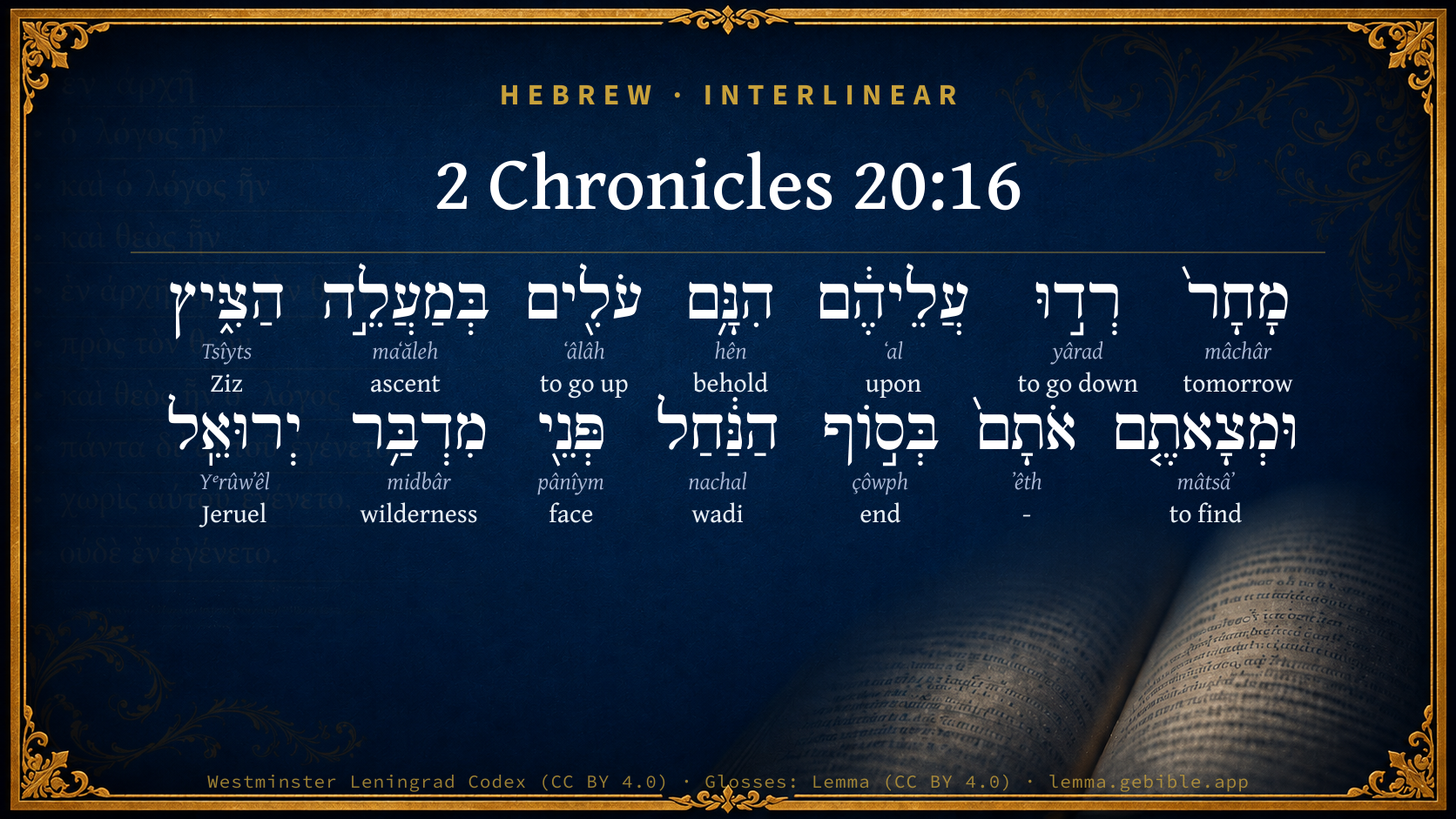
Hebrew (Westminster Leningrad Codex) 2 Chronicles 20:16 appears in the Hebrew Old Testament. The text above is from the Westminster Leningrad Codex. Each word links to its Strong’s number, a concise gloss, and parsing drawn from the Open Scriptures Hebrew Bible morphology. Click any word for its full Brown-Driver-Briggs (BDB) entry.
Download image
Cite this verse

2 Chronicles 20:16 (World English Bible). Public Domain. Lemma interlinear Bible study tool, https://lemma.gebible.app/v/2-chronicles/20/16.

Show BibTeX & RIS
BibTeX
RIS
English Translation
Tomorrow go you down against them: behold, they come up by the ascent of Ziz; and you shall find them at the end of the valley, before the wilderness of Jeruel.
World English Bible · Public Domain
Highlights
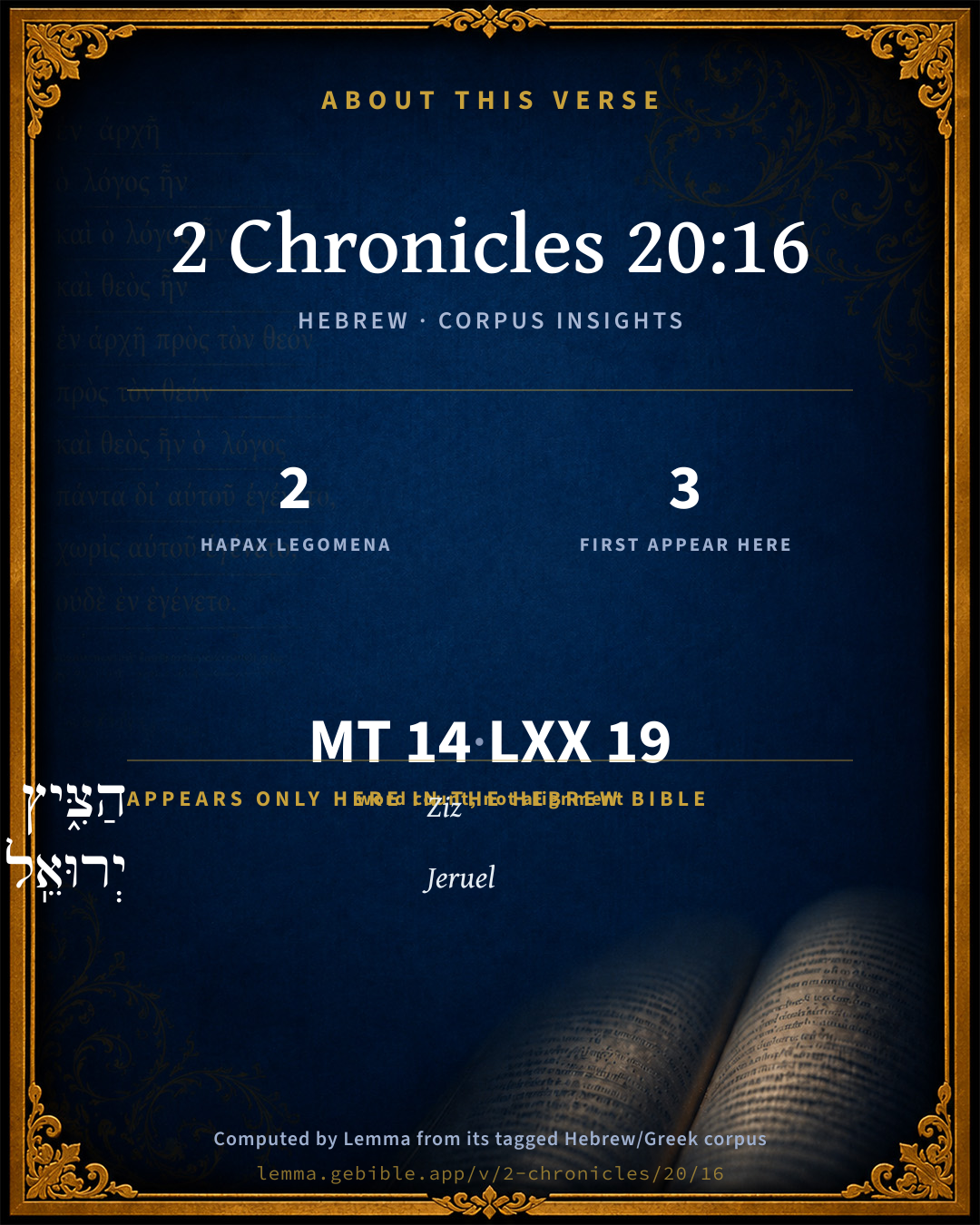
  • 2 hapax legomena — only here in the Hebrew Bible
  • 3 first appearances in the Hebrew Bible
Full analysis ↓
Download a study sheet

One document with this verse’s original text, its word-by-word gloss line, the meaning frame, cross-references with their text, attributed commentary, and full source and license credits — printable, and it pastes into notes with its structure intact.

This verse Autodidact and up

Study sheet (.html) Plain text (.txt)

A passage Seminary Student

Up to 50 verses in one chapter. A passage sheet keeps up to 6 commentary sources and 12 cross-references per verse, in the order this page ranks them, and says so on the sheet whenever that leaves anything out. Ask for a single verse and you get the Autodidact verse sheet above.

Everything on this page stays free to read, with no account — the sheet is a download of what is already on screen, not access to it.

Want to remove ads? Support Godless Engineer
Compare translations 3

The same verse in 3 English versions, stacked beneath the original-language interlinear above. Click any original word for its lexicon entry.

Each is an independent rendering of the whole verse — the interlinear is not word-aligned to these translations.

Highlighted words mark where these versions differ — a whole-verse word diff, not a word-by-word alignment.

  • World English Bible Public Domain
    Tomorrow go you down against them: behold, they come up by the ascent of Ziz; and you shall find them at the end of the valley, before the wilderness of Jeruel.
  • King James Version Public Domain
    To morrow go ye down against them: behold, they come up by the cliff of Ziz; and ye shall find them at the end of the brook, before the wilderness of Jeruel.
  • unfoldingWord Literal Text CC BY-SA 4.0
    Tomorrow, go down against them. Behold, they are coming up by the Ascent of Ziz. And you will find them at the end of the valley, before the wilderness of Jeruel.

unfoldingWord Literal Text — © unfoldingWord, licensed CC BY-SA 4.0. Word-aligned USFM3 via Door43 (git.door43.org/unfoldingWord/en_ult).

Versions to compare (up to 4)

3 of 4 selected

Show all 18 translations

Every available English version of this verse, each an independent rendering of the whole verse.

  • World English Bible Public Domain
    Tomorrow go you down against them: behold, they come up by the ascent of Ziz; and you shall find them at the end of the valley, before the wilderness of Jeruel.
  • Berean Standard Bible Public Domain
    Tomorrow you are to march down against them. You will see them coming up the Ascent of Ziz, and you will find them at the end of the valley facing the Wilderness of Jeruel.
  • Majority Standard Bible Public Domain
    Tomorrow you are to march down against them. You will see them coming up the Ascent of Ziz, and you will find them at the end of the valley facing the Wilderness of Jeruel.
  • King James Version Public Domain
    To morrow go ye down against them: behold, they come up by the cliff of Ziz; and ye shall find them at the end of the brook, before the wilderness of Jeruel.
  • American Standard Version (1901) Public Domain
    To-morrow go ye down against them: behold, they come up by the ascent of Ziz; and ye shall find them at the end of the valley, before the wilderness of Jeruel.
  • Revised Version (1885) Public Domain
    Tomorrow go ye down against them: behold, they come up by the ascent of Ziz; and ye shall find them at the end of the valley, before the wilderness of Jeruel.
  • Geneva Bible (1599) Public Domain
    To morowe goe yee downe against them: beholde, they come vp by the cleft of Ziz, and ye shall finde them at the ende of the brooke before the wildernesse of Ieruel.
  • Douay-Rheims (1899) Public Domain
    To morrow you shall go down against them: for they will come up by the ascent named Sis, and you shall find them at the head of the torrent, which is over against the wilderness of Jeruel.
  • Young's Literal Translation Public Domain
    To-morrow, go ye down against them, lo, they are coming up by the ascent of Ziz, and ye have found them in the end of the valley, the front of the wilderness of Jeruel.
  • Literal Standard Version CC BY-SA 4.0
    Tomorrow, go down against them, behold, they are coming up by the ascent of Ziz, and you have found them in the end of the valley, the front of the wilderness of Jeruel.
  • Unlocked Literal Bible CC BY-SA 4.0
    You must go down against them tomorrow. See, they are coming up by way of the pass of Ziz. You will find them at the end of the valley, before the wilderness of Jeruel.
  • unfoldingWord Literal Text CC BY-SA 4.0
    Tomorrow, go down against them. Behold, they are coming up by the Ascent of Ziz. And you will find them at the end of the valley, before the wilderness of Jeruel.
  • Darby Bible Public Domain
    To-morrow go down against them: behold, they come up by the ascent of Ziz; and ye shall find them at the end of the valley, before the wilderness of Jeruel.
  • World Messianic Bible Public Domain
    Tomorrow, go down against them. Behold, they are coming up by the ascent of Ziz. You will find them at the end of the valley, before the wilderness of Jeruel.
  • Webster's Bible Public Domain
    To-morrow go ye down against them: behold, they come up by the cliff of Ziz; and ye shall find them at the end of the brook, before the wilderness of Jeruel.
  • Free Bible Version CC BY-SA 4.0
    Tomorrow march down to face them. You will see them coming up the pass at Ziz—you'll find them at the end of the valley in front of the desert of Jeruel.
  • Bible in Basic English Public Domain
    Go down against them tomorrow: see, they are coming up by the slope of Ziz; at the end of the valley, before the waste land of Jeruel, you will come face to face with them.
  • JPS Tanakh (1917) Public Domain
    To-morrow go ye down against them; behold, they come up by the ascent of Ziz; and ye shall find them at the end of the valley, before the wilderness of Jeruel.

Literal Standard Version (2020), Covenant Press — licensed CC BY-SA 4.0. Text via the HelloAO Bible API (eBible.org). Unlocked Literal Bible (unfoldingWord) — licensed CC BY-SA 4.0. Text via the HelloAO Bible API (eBible.org). unfoldingWord Literal Text — © unfoldingWord, licensed CC BY-SA 4.0. Word-aligned USFM3 via Door43 (git.door43.org/unfoldingWord/en_ult). Free Bible Version, Dr. Jonathan Gallagher — licensed CC BY-SA 4.0. Text via the HelloAO Bible API (eBible.org).

Word by word

More ways to search: Search by grammar → Find every occurrence → Compare this word →

Practice this passage: Drill this verse → Learn its vocabulary →

הַצִּ֑יץ
Tsîyts
H6732
“the · Ziz”
Particle, Definite Article + Noun, Proper
Part of Speech
Particle + Noun
Type
Proper
Full BDB Definition

Origin: the same as H6731

TWOT: None

Ziz = "flower" - a pass going from the shores of the Dead Sea to the wilderness of Judah near Tekoa
  1. מָחָר֙ mâchâr H4279 “tomorrow” Noun, Common, Masculine, Singular, Absolute
  2. רְד֣וּ yârad H3381 “go down” Verb, Qal, Imperative, 2nd Person, Masculine, Plural
  3. עֲלֵיהֶ֔ם ʻal H5921 “upon · them” Preposition + Suffix, Personal, 3rd Person, Masculine, Plural
  4. הִנָּ֥ם hên H2005 “behold · them” Particle, Demonstrative + Suffix, Personal, 3rd Person, Masculine, Plural
  5. עֹלִ֖ים ʻâlâh H5927 “going up” Verb, Qal, Participle Active, Masculine, Plural, Absolute
  6. בְּמַעֲלֵ֣ה maʻăleh H4608 “in/at · ascent of” Preposition + Noun, Common, Masculine, Singular, Construct
  7. וּמְצָאתֶ֤ם mâtsâʼ H4672 “and · to find” Conjunction + Verb, Qal, Sequential Perfect, 2nd Person, Masculine, Plural
  8. אֹתָם֙ ʼêth H853 “- · them” Particle, Direct Object + Suffix, Personal, 3rd Person, Masculine, Plural
  9. בְּס֣וֹף çôwph H5490 “in/at · end of” Preposition + Noun, Common, Masculine, Singular, Construct
  10. הַנַּ֔חַל nachal H5158 “the · wadi” Particle, Definite Article + Noun, Common, Masculine, Singular, Absolute
  11. פְּנֵ֖י pânîym H6440 “face(s) of” Noun, Common, Both, Plural, Construct
  12. מִדְבַּ֥ר midbâr H4057 “wilderness of” Noun, Common, Masculine, Singular, Construct
  13. יְרוּאֵֽל Yᵉrûwʼêl H3385 “Jeruel” Noun, Proper

About this verse

These counts appear in no published source. They are computed here, from the morphology-tagged text and Lemma’s own curated glosses. What Lemma adds →

14
words
14
distinct lemmas
Historical
section

Notable vocabulary

2 hapax legomena — words that appear only here in the entire Hebrew Bible:

  • הַצִּ֑יץ Ziz H6732
  • יְרוּאֵֽל Jeruel H3385

First appearance in Scripture

These words make their first canonical appearance in the Hebrew Bible here:

  • הַצִּ֑יץ Ziz H6732
  • בְּס֣וֹף end H5490
  • יְרוּאֵֽל Jeruel H3385

Shared distinctive vocabulary

בְּס֣וֹף end H5490 occurs in 5 verses of the Hebrew Bible. Also found in:

Grammatical profile

  • 3 verbs
  • 8 nouns
  • 1 preposition
  • 2 particles

Verb forms

  • רְד֣וּ Qal · Imperative
  • עֹלִ֖ים Qal · Participle Active
  • וּמְצָאתֶ֤ם Qal · Sequential Perfect

Hebrew & Septuagint length

In English translation the verse runs 31 words from the Hebrew and 31 from the Septuagint (LXX English) — the same length.

A rough comparison of the two English renderings, which tokenize alike — not a word-level alignment.

Word counts can differ between the Hebrew and the Greek without any difference in meaning — e.g. the Hebrew direct-object marker אֵת has no separate Greek word, and Greek often adds the article ὁ.

In the original languages it is 14 Hebrew tokens and 19 Greek tokens — but the two are counted differently (Hebrew bundles its prefixes and suffixes into one token; the Greek is in lemma form), so that isn’t a like-for-like length.

Hebrew and Greek witnesses Masoretic Hebrew ↔ Greek Septuagint

The same verse in the two great witnesses to the Old Testament, shown verse-for-verse.

These are two independent witnesses, not word-aligned to each other, and the Septuagint is shown in lemma (dictionary) form.

Hebrew 2 Chronicles 20:16 Masoretic · Westminster Leningrad Codex

מָחָר֙ רְד֣וּ עֲלֵיהֶ֔ם הִנָּ֥ם עֹלִ֖ים בְּמַעֲלֵ֣ה הַצִּ֑יץ וּמְצָאתֶ֤ם אֹתָם֙ בְּס֣וֹף הַנַּ֔חַל פְּנֵ֖י מִדְבַּ֥ר יְרוּאֵֽל

Tomorrow go you down against them: behold, they come up by the ascent of Ziz; and you shall find them at the end of the valley, before the wilderness of Jeruel.

World English Bible · Public Domain

Greek LXX 2 Chronicles 20:16 Septuagint · lemma form

αὔριον καταβαίνω ἐπί αὐτός ἰδού ἀναβαίνω κατά ὁ ἀνάβασις ασας καί εὑρίσκω αὐτός ἐπί ἄκρος ποταμός ὁ ἐρῆμος ιεριηλ

To-morrow go you⌃ down against them: behold, they come up by the ascent of Assis, and you⌃ shall find them at the extremity of the river of the wilderness of Jeriel.

LXX2012 (modern English Septuagint) · Public Domain

On this verse, Ellicott's Commentary for English Readers discusses the Septuagint’s reading. Read the note in Commentary ↓

Hebrew: Westminster Leningrad Codex (CC BY 4.0). Greek: Septuagint (public domain); English from LXX2012 (modern English Septuagint) (Public Domain). How the Septuagint differs from the Hebrew →

Commentary

Notes on 2 Chronicles 20:16 from classic Christian and Jewish commentators (each source and its license shown beneath its notes). The classic Christian expositions comment on the surrounding passage and are grouped to its opening verse, so a note may address several verses; the Jewish commentaries on the Tanakh (Rashi and others) are per-verse, so they appear only where the commentator wrote on this verse.

Lemma curates 59 commentaries, every one of them public domain or Creative Commons licensed, each selected and text-cleaned for this edition rather than reprinted as found. About our sources →

Ellicott's Commentary for English Readers

(16) Against them.—Or, unto them.

They come up by the cliff of Ziz.—They are about ascending by the ascent of Hazziz. Vulg., “ascensuri enim sunt per clivum,” &c.

The brook.—The wâdy, ravine, or water-course.

The wilderness of Jeruel.—The name is unknown, but comparing 2Ch_20:2; 2Ch_20:16; 2Ch_20:20, it appears that the great stretch of waste, now called el Husâsah, from a wady on the north side of it, is intended. The “ascent of Hazziz” would be a pass or mountain path, leading up from Engedi to this desert table-land. (With the name Hazziz, comp. Hakkoz. Perhaps Husâsah preserves a trace of it. The LXX. has Ασαεῖς Syriac and Arabic, “the ascent of dawn,” omitting “Jeruel.”)

A Bible Commentary for English Readers, edited by Charles John Ellicott (1878–1897) — public domain. Text from a community e-Sword module.

Trapp's Complete Commentary

John Trapp

2Ch 20:16 To morrow go ye down against them: behold, they come up by the cliff of Ziz; and ye shall find them at the end of the brook, before the wilderness of Jeruel.

Ver 16. Behold, they come up by the cliff of Ziz] Which is said to be between the wilderness of Tekoah and the wilderness of Jeruel. Ziz signifieth a flower; it signifieth also, saith the Gloss, a caldron or pot; because in this place the enemies were cut in pieces, and made as meat for the pot.

John Trapp, A Commentary or Exposition upon All the Books of the Old and New Testament (1647–1656) — public domain. Text from a community e-Sword module.

Jamieson, Fausset & Brown

Robert Jamieson, A. R. Fausset & David Brown

they come up by the cliff of Ziz--This seems to have been nothing else than the present pass which leads northwards, by an ascent from En-gedi to Jerusalem, issuing a little below Tekoa. The wilderness of Jeruel was probably the large flat district adjoining the desert of Tekoa, called El-Husasah, from a wady on its northern side [ROBINSON].

Jamieson, Fausset & Brown — Commentary Critical and Explanatory on the Whole Bible (1871) — public domain (CC PDM 1.0). Text via the HelloAO Bible API.

The Cambridge Bible for Schools and Colleges

gen. ed. J. J. S. Perowne

16. the cliff of Ziz] R.V. the ascent of Ziz. The exact positions of this and of the “brook” and of the “wilderness” mentioned in this ver. are unknown, but probably the invaders followed not the direct road from En-gedi to Beth-lehem, but one a little to the left of this.

the brook] R.V. the valley (Heb. naḥal) strictly “ravine” or “water-course.”

The Cambridge Bible for Schools and Colleges (gen. ed. J. J. S. Perowne; Cambridge University Press, 1878–1918) — public domain. Text from a community e-Sword module.

John Gill's Exposition

Tomorrow go ye down against them,.... This was the fast day, and so not proper to march out in, but on the morrow they might go out with great confidence and intrepidity; and as Jerusalem was situated on an eminence, they are directed to go down:

behold, they come up by the cliff of Ziz; a steep hill, so called from the flowers upon it:

and ye shall find them at the end of the brook; on the bank of Kidron, according to Beckius, which seems not likely to be meant, since they went as far as the wilderness of Tekoa, Ch2 20:20,

before the wilderness of Jeruel; the same with that of Tekoa, or near it.

John Gill's Exposition of the Whole Bible (1746–1763) — public domain (CC PDM 1.0). Text via the HelloAO Bible API.

Haydock's Catholic Bible Commentary

Six. Some translate "flowry ascent." C. --- Prot. "the cliff of Ziz." H. --- If it had been Zin, we might understand the desert of stony Arabia, where Ptolemy places the town of Ziza. C. --- But we may recollect that the army was already advanced as far as Engaddi; (v. 2,) so that it seems to have lain nearer Jerusalem. H. --- Jeruel, "the fear of God," which name was given to the place, in consequence of the panic with which God struck the enemy. S. Jerom) M.

George Leo Haydock (1774–1849), Haydock's Catholic Family Bible and Commentary, 1859 edition — public domain. Excludes Psalms (Douay-Rheims chapter numbering differs from Protestant) and Deuterocanonical books (Catholic canon only).

Matthew Poole's English Annotations

Go ye down from Jerusalem, where he and his army now were; which stood upon high ground.

Matthew Poole's English Annotations on the Holy Bible (1683–1685) — public domain. Text from a community e-Sword/MySword module.

Whedon's Commentary on the Bible

Daniel D. Whedon

16. They come up by the cliff of Ziz — Better, the ascent, or pass, of Hazziz. This was the rocky mountain pass above Ain Jidy, that leads from the shore of the Dead Sea at that point up into the hill country of Judah. The name still lingers in the tract of table land called el Husassah. just northwest of the pass towards Tekoa. So these enemies of Judah came “by the very same route,” says Robinson, “which is taken by the Arabs in their marauding expeditions at the present day, along the shore as far as to Ain Jidy, and then up the pass and so northwards below Tekoa.”

The brook, before the wilderness of Jeruel — This brook, or valley, was one of the wadies running from the vicinity of Tekoa to the Dead Sea — perhaps the Wady Jehar, whose name may be the representative of the ancient Jeruel, and the desert of Jeruel must have corresponded nearly with the modern tract el-Husassah.

Daniel D. Whedon (gen. ed.), Commentary on the Old and New Testaments (1874–1909) — public domain. Text from a community e-Sword module.

The Pulpit Commentary

The cliff of Ziz. Read with Revised Version, the ascent of Ziz (or probably Hazziz), a place named only here. The Hebrew word here rendered "cliff" is the familiar hle) meaning "an ascent," or "a rising ground." It is replaced in the Septuagint by both ajnabasiv and prosbasiv. Stanley, in an interesting note on the word ("Sinai and Palestine," p. 500, edit. 1866), says it is applied to several localities in Palestine, viz.:

(1) The "Ascent of Akrabbim," i.e. scorpions (Num_34:4; Jud 1:36; Jos_15:3) on the south border of Judah and probably the same as the Pass of Safeh.

(2) "The going up to (or of) Adummim," i.e. the "ascent of the Red," near Gilgal, on border of Judah and Benjamin, (Jos_15:7 Jos_18:17) probably the same with the "Pass of Jericho.

(3) The" going up to Gut". (2Ki_9:27)

(4) Our present text.

(5) The "mounting up of Luhith" in Moab (Isa_15:5; Jer_48:5) The word is also applied to the steep pass from Gibeon to Beth-; (Jos_10:10 RAPC 1Ma 3:16) to the road up the Mount of Olives; (2Sa_15:30) and to the approach to the city in which Samuel anointed Saul, (1Sa_9:11) i.e. "the hill up to the city." The passage, Jud_1:8:13, Authorized Version "before the sun was up," Revised Version "from the ascent of Heres," possibly designates a rising ground, named. "the Ascent of the Sun," or, "of Heres." The following extract from Keil, with its quotations from Robinson, is interesting. "The wilderness Jezreel was without doubt the name of a part of the great stretch of fiat country bounded on the south by the Waddy El Ghar, and extending from the Dead Sea to the neighbourhood of Tekoa, which is now called El Hassasah, after a waddy on its northern side. The whole country on the west side of the Dead Sea," where it does not consist of mountain ridges or deep valleys, is high table-land sloping gradually towards the east, wholly waste, merely covered here and there by a few bushes and without the slightest trace of having ever been cultivated" (Robinson"s "Palest.," sub voce). Our present ascent of Ziz, or Hazziz, has perhaps remained in the Waddy El Hassasah Robinson takes it to be the pass, which at present leads from Ain-jiddy to the table-land. Yet it is described by him as a "fearful pass," and it can hardly be thought of here even if the enemy like the Bedouins, now when on their forays, may be supposed to have marched along the shore of the sea, and ascended to the tableland only at Engedi; for the Israelites did not meet the enemy in this ascent, but above upon the table-land." Josephus translates xyXih by eJxochv, but with no legitimate justification. The end of the brook; i.e. rather the end of the brook-way, or course of the brook when there was water to make one.

The Pulpit Commentary (1880–1919), ed. H.D.M. Spence-Jones & Joseph S. Exell — public domain. Text from a community e-Sword module.

John Wesley's Explanatory Notes

Go down - From Jerusalem, where he and his army now were; which stood upon high ground.

John Wesley, Explanatory Notes Upon the Whole Bible (1754–1765) — public domain. Text via the GEBible commentary corpus.

unfoldingWord translationNotes

Door43 World Missions Community

go down against ... Go out against

This is an idiom that means to go and meet the enemy army for battle. AT: "march against ... March out against" or "Go to battle against ... Go to battle against" (See: Idiom)

See

"Pay attention, because what I am about to say is both true and important"

pass of Ziz

This is a narrow valley between two mountains southeast of Jerusalem. (See: How to Translate Names)

the rescue of Yahweh with you

The word "rescue" can be expressed as a verb. AT: "Yahweh rescue you" (See: Abstract Nouns)

Judah and Jerusalem

Here these places represent the people from them. AT: "people of Judah and Jerusalem" (See: Metonymy)

translationWords

desert

unfoldingWord translationNotes — © Distant Shores Media and the Door43 World Missions Community, licensed CC BY-SA 4.0. Source: git.door43.org/Door43/en_tn.

Rashi

Rabbi Shlomo Yitzchaki (Rashi)

on the ascent to Haziz the name of a place.

Rashi on the Tanakh — English translations: “The Judaica Press complete Tanach with Rashi, translated by A. J. Rosenberg” (CC BY 4.0); “Pentateuch with Rashi's commentary by M. Rosenbaum and A.M. Silbermann, 1929-1934” (public domain); “The Metsudah Tanach series, Lakewood, N.J” (CC BY 4.0); and “The Book of Joshua, Metsudah Publications, 1997” (CC BY 4.0). Text via Sefaria.

Lesson kit

Teaching starters — assembled from the data on this page, not authored interpretation. Every prompt links to the verse data it draws on. Edit before teaching.

2 Chronicles, in the Historical, opens this verse with 14 words (14 distinct Hebrew lemmas). Its most distinctive word is Tsîyts (“Ziz”). A historical commentator’s framing appears above. Read the whole chapter for the surrounding context.

Discussion questions

  1. The word Tsîyts carries the sense “Ziz.” How does it shape the verse?
  2. 2 words here appear nowhere else in the Hebrew Bible. Why might the author reach for such rare wording?
  3. 3 words make their first appearance in Scripture here. What does this debut establish?
  4. How does Ecclesiastes 3:11, which shares the word «end», read alongside this verse?
  5. The translations on this page render this verse differently — a whole-verse word diff, not a word-by-word alignment. What might account for the different wordings?
  6. «רְד֣וּ» is a Qal Imperative verb. How does that grammatical form shape the action described?
  7. Compare how Ellicott's Commentary for English Readers and Trapp's Complete Commentary read this verse. Where do they agree or differ?

Things to notice

Reading settings

Reading text

Shown beneath each verse's original-language words.

Old Testament
Old Testament edition

Read the OT as the Masoretic Hebrew (MT) or the Greek Septuagint (LXX).

English shown for the Greek Septuagint (in the Hebrew ↔ Greek comparison).

Comparing translations? Open the Compare panel on any verse page to stack up to four side by side.