
Isaiah 64:5

Hebrew (Westminster Leningrad Codex) Isaiah 64:5 appears in the Hebrew Old Testament. The text above is from the Westminster Leningrad Codex. Each word links to its Strong’s number, a concise gloss, and parsing drawn from the Open Scriptures Hebrew Bible morphology. Click any word for its full Brown-Driver-Briggs (BDB) entry.
Download image
Cite this verse

Isaiah 64:5 (World English Bible). Public Domain. Lemma interlinear Bible study tool, https://lemma.gebible.app/v/isaiah/64/5.

Show BibTeX & RIS
BibTeX
RIS
English Translation
You meet him who rejoices and works righteousness, those who remember you in your ways: behold, you were angry, and we sinned: in them [have we been] of long time; and shall we be saved?
World English Bible · Public Domain
Download a study sheet

One document with this verse’s original text, its word-by-word gloss line, the meaning frame, cross-references with their text, attributed commentary, and full source and license credits — printable, and it pastes into notes with its structure intact.

This verse Autodidact and up

Study sheet (.html) Plain text (.txt)

A passage Seminary Student

Up to 50 verses in one chapter. A passage sheet keeps up to 6 commentary sources and 12 cross-references per verse, in the order this page ranks them, and says so on the sheet whenever that leaves anything out. Ask for a single verse and you get the Autodidact verse sheet above.

Everything on this page stays free to read, with no account — the sheet is a download of what is already on screen, not access to it.

Want to remove ads? Support Godless Engineer
Compare translations 3

The same verse in 3 English versions, stacked beneath the original-language interlinear above. Click any original word for its lexicon entry.

Each is an independent rendering of the whole verse — the interlinear is not word-aligned to these translations.

Highlighted words mark where these versions differ — a whole-verse word diff, not a word-by-word alignment.

  • World English Bible Public Domain
    You meet him who rejoices and works righteousness, those who remember you in your ways: behold, you were angry, and we sinned: in them [have we been] of long time; and shall we be saved?
  • King James Version Public Domain
    Thou meetest him that rejoiceth and worketh righteousness, those that remember thee in thy ways: behold, thou art wroth; for we have sinned: in those is continuance, and we shall be saved.
  • unfoldingWord Literal Text CC BY-SA 4.0
    You meet the one rejoicing and doing righteousness; in your ways they remember you. Behold, you, you were angry, for we had sinned against them eternity, so shall we be saved?

unfoldingWord Literal Text — © unfoldingWord, licensed CC BY-SA 4.0. Word-aligned USFM3 via Door43 (git.door43.org/unfoldingWord/en_ult).

Versions to compare (up to 4)

3 of 4 selected

Show all 18 translations

Every available English version of this verse, each an independent rendering of the whole verse.

  • World English Bible Public Domain
    You meet him who rejoices and works righteousness, those who remember you in your ways: behold, you were angry, and we sinned: in them [have we been] of long time; and shall we be saved?
  • Berean Standard Bible Public Domain
    You welcome those who gladly do right, who remember Your ways. Surely You were angry, for we sinned. How can we be saved if we remain in our sins?
  • Majority Standard Bible Public Domain
    You welcome those who gladly do right, who remember Your ways. Surely You were angry, for we sinned. How can we be saved if we remain in our sins?
  • King James Version Public Domain
    Thou meetest him that rejoiceth and worketh righteousness, those that remember thee in thy ways: behold, thou art wroth; for we have sinned: in those is continuance, and we shall be saved.
  • American Standard Version (1901) Public Domain
    Thou meetest him that rejoiceth and worketh righteousness, those that remember thee in thy ways: behold, thou wast wroth, and we sinned: in them `have we been' of long time; and shall we be saved?
  • Revised Version (1885) Public Domain
    Thou meetest him that rejoiceth and worketh righteousness, those that remember thee in thy ways: behold, thou wast wroth, and we sinned: in them have we been of long time, and shall we be saved?
  • Geneva Bible (1599) Public Domain
    Thou diddest meete him, that reioyced in thee, and did iustly: they remembred thee in thy wayes: beholde, thou art angrie, for we haue sinned: yet in them is continuance, and we shall be saued.
  • Douay-Rheims (1899) Public Domain
    Thou hast met him that rejoiceth, and doth justice: in thy ways they shall remember thee: behold thou art angry, and we have sinned: in them we have been always, and we shall be saved.
  • Young's Literal Translation Public Domain
    Thou hast met with the rejoicer And the doer of righteousness, In Thy ways they remember Thee, Lo, Thou hast been wroth when we sin, By them `is' continuance, and we are saved.
  • Literal Standard Version CC BY-SA 4.0
    You have met with the rejoicer || And the doer of righteousness, || In Your ways they remember You, || Behold, You have been angry when we sin, || By them [is] continuance, and we are saved.
  • Unlocked Literal Bible CC BY-SA 4.0
    You come to help those who rejoice in doing what is right, those who call to mind your ways and obey them. You were angry when we sinned. In your ways we will always be rescued.
  • unfoldingWord Literal Text CC BY-SA 4.0
    You meet the one rejoicing and doing righteousness; in your ways they remember you. Behold, you, you were angry, for we had sinned against them eternity, so shall we be saved?
  • Darby Bible Public Domain
    Thou meetest him that rejoiceth to do righteousness, those that remember thee in thy ways: (behold, thou wast wroth, and we have sinned:) in those is perpetuity, and we shall be saved.
  • World Messianic Bible Public Domain
    You meet him who rejoices and does righteousness, those who remember you in your ways. Behold, you were angry, and we sinned. We have been in sin for a long time. Shall we be saved?
  • Webster's Bible Public Domain
    \\64:6\\But we are all as an unclean thing, and all our righteousnesses are as filthy rags; and we all do fade as a leaf; and our iniquities, like the wind, have taken us away.
  • Free Bible Version CC BY-SA 4.0
    You join with those who are glad, and with those who do what's right and remember to follow your ways. But when we went on sinning, you became angry. How can we be saved if we go on like this?
  • Bible in Basic English Public Domain
    For we have all become like an unclean person, and all our good acts are like a dirty robe: and we have all become old like a dead leaf, and our sins, like the wind, take us away.
  • JPS Tanakh (1917) Public Domain
    (64-4) Thou didst take away him that joyfully worked righteousness, those that remembered Thee in Thy ways — behold, Thou wast wroth, and we sinned — upon them have we stayed of old, that we might be saved.

Literal Standard Version (2020), Covenant Press — licensed CC BY-SA 4.0. Text via the HelloAO Bible API (eBible.org). Unlocked Literal Bible (unfoldingWord) — licensed CC BY-SA 4.0. Text via the HelloAO Bible API (eBible.org). unfoldingWord Literal Text — © unfoldingWord, licensed CC BY-SA 4.0. Word-aligned USFM3 via Door43 (git.door43.org/unfoldingWord/en_ult). Free Bible Version, Dr. Jonathan Gallagher — licensed CC BY-SA 4.0. Text via the HelloAO Bible API (eBible.org).

Word by word

More ways to search: Search by grammar → Find every occurrence → Compare this word →

Practice this passage: Drill this verse → Learn its vocabulary →

שָׂשׂ֙
sûws
H7797
“rejoicing”
Verb, Qal, Participle Active, Masculine, Singular, Absolute
Part of Speech
Verb
Stem
Qal
Form
Participle Active
Gender
Masculine
Number
Singular
State
Absolute
Full BDB Definition

Origin: a primitive root

TWOT: 2246

to exult, rejoice - (Qal) to exult, display joy
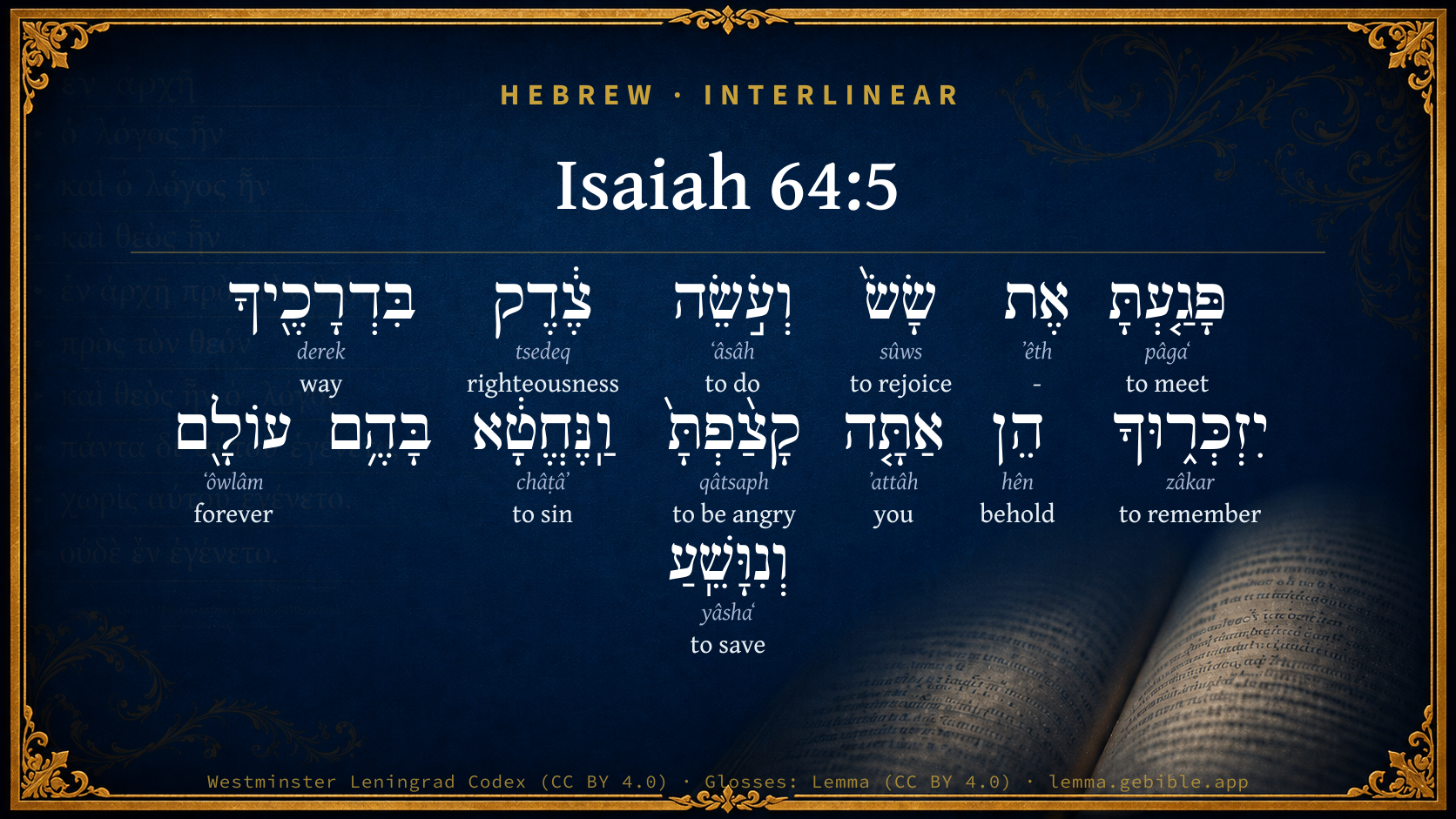
  1. פָּגַ֤עְתָּ pâgaʻ H6293 “to meet” Verb, Qal, Perfect, 2nd Person, Masculine, Singular
  2. אֶת ʼêth H853 “-” Particle, Direct Object
  3. וְעֹ֣שֵׂה ʻâsâh H6213 “and · doing” Conjunction + Verb, Qal, Participle Active, Masculine, Singular, Construct
  4. צֶ֔דֶק tsedeq H6664 “righteousness” Noun, Common, Masculine, Singular, Absolute
  5. בִּדְרָכֶ֖יךָ derek H1870 “in/at · ways · your” Preposition + Noun, Common, Both, Plural, Construct + Suffix, Personal, 2nd Person, Masculine, Singular
  6. יִזְכְּר֑וּךָ zâkar H2142 “to remember · you” Verb, Qal, Imperfect, 3rd Person, Masculine, Plural + Suffix, Personal, 2nd Person, Masculine, Singular
  7. הֵן hên H2005 “behold” Particle, Demonstrative
  8. אַתָּ֤ה ʼattâh H859 “you” Pronoun, Personal, 2nd Person, Masculine, Singular
  9. קָצַ֨פְתָּ֙ qâtsaph H7107 “to be angry” Verb, Qal, Perfect, 2nd Person, Masculine, Singular
  10. וַֽנֶּחֱטָ֔א châṭâʼ H2398 “and · to sin” Conjunction + Verb, Qal, Sequential Imperfect, 1st Person, Common, Plural
  11. עוֹלָ֖ם ʻôwlâm H5769 “forever” Noun, Common, Masculine, Singular, Absolute
  12. וְנִוָּשֵֽׁעַ yâshaʻ H3467 “and · to save” Conjunction + Verb, Niphal, Imperfect, 1st Person, Common, Plural

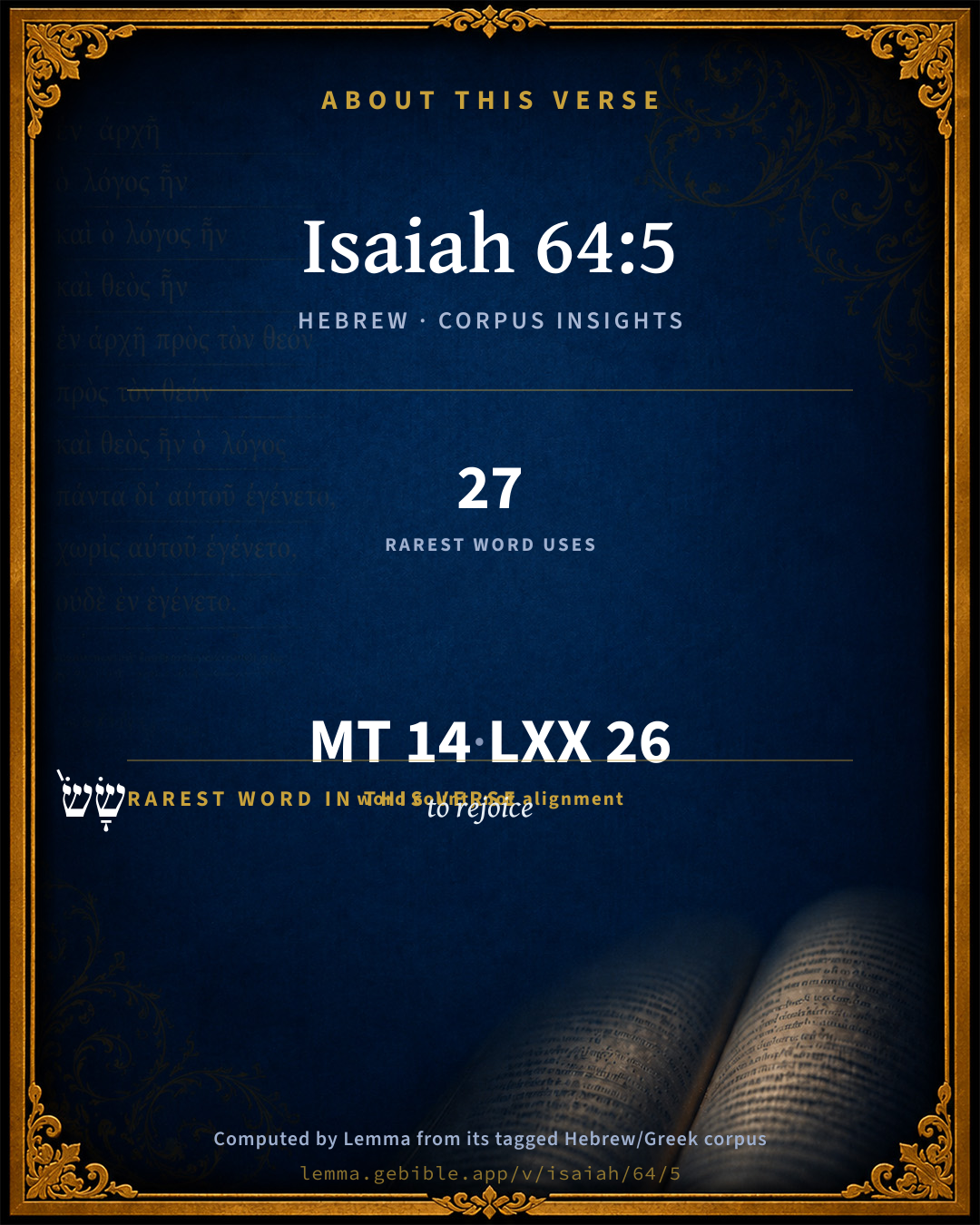
About this verse

These counts appear in no published source. They are computed here, from the morphology-tagged text and Lemma’s own curated glosses. What Lemma adds →

14
words
13
distinct lemmas
Prophets
section

Shared distinctive vocabulary

שָׂשׂ֙ to rejoice H7797 occurs in 24 verses of the Hebrew Bible. Also found in:

Grammatical profile

  • 7 verbs
  • 3 nouns
  • 1 pronoun
  • 1 preposition
  • 2 particles

Verb forms

  • פָּגַ֤עְתָּ Qal · Perfect
  • שָׂשׂ֙ Qal · Participle Active
  • וְעֹ֣שֵׂה Qal · Participle Active
  • יִזְכְּר֑וּךָ Qal · Imperfect
  • קָצַ֨פְתָּ֙ Qal · Perfect
  • וַֽנֶּחֱטָ֔א Qal · Sequential Imperfect
  • וְנִוָּשֵֽׁעַ Niphal · Imperfect

Hebrew & Septuagint length

In English translation the verse runs 35 words from the Hebrew and 28 from the Septuagint (LXX English) — closely comparable.

A rough comparison of the two English renderings, which tokenize alike — not a word-level alignment.

Word counts can differ between the Hebrew and the Greek without any difference in meaning — e.g. the Hebrew direct-object marker אֵת has no separate Greek word, and Greek often adds the article ὁ.

In the original languages it is 14 Hebrew tokens and 26 Greek tokens — but the two are counted differently (Hebrew bundles its prefixes and suffixes into one token; the Greek is in lemma form), so that isn’t a like-for-like length.

Cross-references

20

Topical passages linked to Isaiah 64:5 in the Treasury of Scripture Knowledge — connected by theme and wording, ordered by reader-vote popularity; previews shown in the World English Bible.

  • Acts 10:35 but in every nation he who fears him and works righteousness is acceptable to him.
  • Philippians 3:13–15 Brothers, I don't regard myself as yet having taken hold, but one thing I do. Forgetting the things which are behind, and stretching forward to the things which are before,
  • Hebrews 4:16 Let us therefore draw near with boldness to the throne of grace, that we may receive mercy, and may find grace for help in time of need.
  • Exodus 20:24 You shall make an altar of earth for me, and shall sacrifice on it your burnt offerings and your peace-offerings, your sheep and your oxen. In every place where I record my name I will come to you and I will bless you.
  • Exodus 25:22 There I will meet with you, and I will tell you from above the mercy seat, from between the two cherubim which are on the ark of the testimony, all that I command you for the children of Israel.
  • Exodus 29:42–43 It shall be a continual burnt offering throughout your generations at the door of the tent of meeting before Yahweh, where I will meet with you, to speak there to you.
  • Exodus 30:6 You shall put it before the veil that is by the ark of the testimony, before the mercy seat that is over the testimony, where I will meet with you.
  • Psalms 25:10 All the paths of Yahweh are loving kindness and truth To such as keep his covenant and his testimonies.
  • Psalms 37:4 Also delight yourself in Yahweh, And he will give you the desires of your heart.
  • Psalms 90:7–9 For we are consumed in your anger. We are troubled in your wrath.
  • Psalms 103:17 But Yahweh's loving kindness is from everlasting to everlasting with those who fear him, His righteousness to children's children;
  • Psalms 112:1 Praise Yah! Blessed is the man who fears Yahweh, Who delights greatly in his commandments.
  • Isaiah 26:8–9 Yes, in the way of your judgments, Yahweh, have we waited for you; to your name, even to your memorial [name], is the desire of our soul.
  • Isaiah 56:1–7 Thus says Yahweh, Keep you justice, and do righteousness; for my salvation is near to come, and my righteousness to be revealed.
  • Isaiah 63:10 But they rebelled, and grieved his holy Spirit: therefore he was turned to be their enemy, [and] himself fought against them.
  • Jeremiah 31:18–20 I have surely heard Ephraim bemoaning himself [thus], You have chastised me, and I was chastised, as a calf unaccustomed [to the yoke]: turn you me, and I shall be turned; for you are Yahweh my God.
  • Hosea 11:8 "How can I give you up, Ephraim? How can I hand you over, Israel? How can I make you like Admah? How can I make you like Zeboiim? My heart is turned within me, My compassion is aroused.
  • Malachi 3:6 "For I, Yahweh, don't change; therefore you, sons of Jacob, are not consumed.
  • Acts 10:2–4 a devout man, and one who feared God with all his house, who gave gifts for the needy generously to the people, and always prayed to God.
  • Hosea 6:3 Let us acknowledge Yahweh. Let us press on to know Yahweh. As surely as the sun rises, Yahweh will appear. He will come to us like the rain, Like the spring rain that waters the earth."

Cross-references courtesy of OpenBible.info (CC BY 4.0).

Hebrew and Greek witnesses Masoretic Hebrew ↔ Greek Septuagint

The same verse in the two great witnesses to the Old Testament, shown verse-for-verse.

These are two independent witnesses, not word-aligned to each other, and the Septuagint is shown in lemma (dictionary) form.

Hebrew Isaiah 64:5 Masoretic · Westminster Leningrad Codex

פָּגַ֤עְתָּ אֶת שָׂשׂ֙ וְעֹ֣שֵׂה צֶ֔דֶק בִּדְרָכֶ֖יךָ יִזְכְּר֑וּךָ הֵן אַתָּ֤ה קָצַ֨פְתָּ֙ וַֽנֶּחֱטָ֔א בָּהֶ֥ם עוֹלָ֖ם וְנִוָּשֵֽׁעַ

You meet him who rejoices and works righteousness, those who remember you in your ways: behold, you were angry, and we sinned: in them [have we been] of long time; and shall we be saved?

World English Bible · Public Domain

Greek LXX Isaiah 64:5 Septuagint · lemma form

καί γίγνομαι ὡς ἀκάθαρτος πᾶς ἐγώ ὡς ῥάκος ἀπο καταἧμαι πᾶς ὁ δικαιοσύνη ἐγώ καί ἐκῥέω ὡς φύλλον διά ὁ ἀνομία ἐγώ οὕτως ἄνεμος φέρω ἐγώ

For these blessings shall happen to them that work righteousness, and they shall remember your ways: behold, you were angry and we have sinned; therefore we have erred,

LXX2012 (modern English Septuagint) · Public Domain

On this verse, Keil & Delitzsch discusses the Septuagint’s reading. Read the note in Commentary ↓

Hebrew: Westminster Leningrad Codex (CC BY 4.0). Greek: Septuagint (public domain); English from LXX2012 (modern English Septuagint) (Public Domain). How the Septuagint differs from the Hebrew →

Targum (Aramaic paraphrase)

1

The Targum is the ancient Jewish Aramaic paraphrase of the Hebrew Scriptures — an interpretive translation, not the Hebrew text itself. Onkelos (literal) and Pseudo-Jonathan (expansive) render the Torah, and Jonathan the Prophets. Coverage is partial: where no permissively-licensed English translation exists for a verse, only the Aramaic is shown. This is verse-level text, not a word-by-word alignment to the Hebrew.

  1. Targum Jonathan Prophets (Joshua–Malachi)
    וַהֲוֵינָא כִמְסָאָב כּוּלָנָא וְכִלְבוּשׁ מְרָחֵק כָּל זַכְוָתָנָא וּנְתַרְנָא כְּמִתַּר טְרַף כּוּלָנָא וּבְחוֹבָנָא כְּרוּחָא אִתְנְטֵילְנָא:

    But we are all as an unclean thing; all our righteousnesses are as an abominable garment, and we all do fade as the fading of a leaf; and because of our sins, we are taken away as by the wind.

    Targum Jonathan — Aramaic: “Mikraot Gedolot” (public domain). English: “Sefaria Community Translation” (CC0 1.0 (public-domain dedication)); “London "Chaldee Paraphrase," 1871” (public domain). Text via Sefaria.

Commentary

Notes on Isaiah 64:5 from classic Christian and Jewish commentators (each source and its license shown beneath its notes). The classic Christian expositions comment on the surrounding passage and are grouped to its opening verse, so a note may address several verses; the Jewish commentaries on the Tanakh (Rashi and others) are per-verse, so they appear only where the commentator wrote on this verse.

Lemma curates 59 commentaries, every one of them public domain or Creative Commons licensed, each selected and text-cleaned for this edition rather than reprinted as found. About our sources →

Trapp's Complete Commentary

John Trapp

Isa 64:5 Thou meetest him that rejoiceth and worketh righteousness, [those that] remember thee in thy ways: behold, thou art wroth; for we have sinned: in those is continuance, and we shall be saved.

Ver. 5. Thou meetest him that rejoiceth and worketh righteousness.] That doth thy work diligently and with delight; that being acted by thee, acteth vigorously for thee. Tantum velis, et Deus tibi praeoccurret, saith an ancient, as the prodigal’s father met him upon the way. If ye be willing and obedient, ye shall eat the good things of the land, {Isa 1:21} which that we may be, Nolentem praevenit Deus ut velit, volentem subsequitur ne frustra velit, {a} God worketh in us both to will and to do of his own good pleasure. Howbeit he expecteth that we should go as far as we can naturally, if ever we look that he should meet us graciously. Though the miller cannot command a wind, yet he will spread his sails, be in the way to have it, if it come.

In those is continuance,] i.e., In those sins of ours; and shall we be saved? Or, In those ways of thine, thy ways of mercy and fidelity, is permanence; therefore we shall be saved, our sins notwithstanding.

{a} Augustine.

John Trapp, A Commentary or Exposition upon All the Books of the Old and New Testament (1647–1656) — public domain. Text from a community e-Sword module.

The Biblical Illustrator

Joseph S. Exell

Isa_64:5

Thou meetest him that rejoiceth

The godly man

I.

THE GODLY MANS CONDUCT.

1. He worketh righteousness. He does not confine himself to any department of action, it may be manual, commercial, literary, scientific, professional; but in all he worketh righteousness. He is right in all; rectitude, and not expediency, is his law.

2. He is happy in his work. He rejoiceth and worketh. A man that worketh righteousness is sure to be happy; his affections will be harmonious, his conscience will smile on him, his God will bless him. There is no happiness, but in work; and there is no happiness in work that is not the work of Thy ways. God has His ways and His methods of action, and they are manifold. He remembers God in His ways in nature, in the government of man, in the dispensations of redeeming grace.

II. THE GODLY MANS COMPANION. Thou (i.e. God) meetest him that rejoiceth. Such men have meetings with God.

1. Conscious meetings. All men meet with God, but they, are unconscious of it. The good man knows it; he can say, God is in this place.

2. Loving meetings. He meets him as the father met the prodigal son on his return, overflowing with love and joy.

3. Preparatory meetings. He meets them to prepare them for a meeting with Him that shall be uninterupted, beatific, and eternal. Conclusion: What a noble life is the life of godliness! Godliness is profitable unto all things, etc. (Homilist.)

How to meet God

In these ancient words, in very different phraseology indeed, we see a strikingly accurate and full anticipation of the very central teaching of Paul and his brother apostles, as to the way by which God and man come into union with one another. Thou meetest him that rejoiceth--that joy is to be manifested by working righteousness, but the joywhich is the parent of righteousness is the child of something else--those that remember Thee in Thy ways. If we ponder these words, and carefully mark their relation to each other, we may discern, as it were, a great staircase with three flights in it, and at the top Gods face.

I. WE HAVE TO BEGIN WITH THE LAST CLAUSE OF OUR TEXT. Thou meetest him . . . that remembers Thee in Thy ways. The first stage on the road which will bring any man into, and keep any man in, contact with God, and loving fellowship- with Him, is the contemplation of His character, as it is made known to us by His acts. God, like man, is known by His fruits. You cannot get at a clear conception of God by speculation, or by thinking about Him or about what He is in Himself. Lay hold of the clue of His acts, and it leads you straight into His heart. But the act of acts, in which the whole Godhead concurs, in which all its depths and preciousness are concentrated, like wine in a golden cup, is the incarnation and life and death of Jesus Christ our Lord. But note that word Remember, for it suggests the warning that such contemplation of the ways of the Lord will not be realized by us without effort. There are so many things within us to draw us away; the duties and joys and sorrows of life so insist upon having a place in our hearts and thoughts, that assuredly, unless by resolute effort, frequently repeated, we clear a space in this crowded and chattering marketplace of life, where we can stand and gaze on the white summits far beyond the bustling crowd, we shall never see them, though they are visible from every place. Unless you try to remember, you will certainly forget.

II. THE SECOND FLIGHT OF THIS GREAT STAIRCASE IS POINTED OUT IN THE FIRST CLAUSE OF MY TEXT, Thou meetest him that rejoiceth. That meditative remembrance of the ways of God will be the parent of holy joy which will bring God near to our heart. Alas, it is too often the very opposite of true that mens joys are such as to bring God to them. The excitement and often the impure elements that mingle with what the world calls joy are such as to shut Him out from us. But there is a gladness which comes from the contemplation of Him as He is, and as He is known by His ways to be, which brings us very near to God, and God very near to us. I think that we have largely lost the very thought that gladness is a plain Christian duty, to be striven after in the appropriate manner which my text suggests, and certainly to be secured if we seek it in the right way.

III. THE THIRD STAGE IS WORKING RIGHTEOUSNESS BECAUSE OF SUCH JOY. Thou meetest him that rejoiceth, and--because he does--worketh righteousness. Every master knows how much more work can be got out of a servant that works with a cheery heart than out of one that is driven reluctantly to his task. You remember our Lords parable where He traces idleness to fear: I knew thee that thou wast an austere man, gathering where thou didst not strew, and I was afraid, and I went and hid thy talent. No work was got out of that servant because there was no joy in him. The opposite state of mind--diligence in righteous work, inspired by gladness which in its turn is inspired by the remembrance of Gods ways--is the mark of a true servant of God. And the gladness which is wholesome and blessed, and is joy in the Lord, will manifest itself by efflorescing into all holiness and all loftiness and largeness of obedience.

IV. WE HAVE THE LANDING-PLACE TO WHICH THE STAIR LEADS. God comes to such a man. He meets him indeed at all the stages, for there is a blessed communion with God that springs immediately from remembering Him in His ways, and a still more blessed one that springs from rejoicing in His felt friendship and Fatherhood, and a yet more blessed one that comes from practical righteousness. For if there is anything that breaks our communion with God, it is that there linger in our lives evils which make it impossible for God and us to come close together. Remember if there is the practice of evil there cannot be the sunshine of the presence of God. But remember, too, that the commonest, homeliest, smallest, most secular tasks may become the very highest steps of the staircase that brings us into His presence. Conclusion: There are two kinds of meeting God. Thou meetest him that rejoiceth and worketh righteousness, and that is blessed, as when Christ met the two disciples on the road to Emmaus. There is another kind of meeting with God. Thou meetest him that rejoiceth and worketh righteousness, and that is blessed, as when Christ met the two disciples on the road to Emmaus. There is another kind of meeting with God. Who, making war, sitteth not down first, and consulteth whether he be able with ten thousand to meet him that cometh against him with twenty thousand? (A. Maclaren, D. D.)

Behold, Thou art wroth

An obscure passage

Text obscure. Possibly, Behold Thou wast wroth, and we sinned; Thy wrath was for ever, and we became transgressors. The general idea is that, through Gods wrath long continued, the people have sunk ever deeper into sin (cf. Isa_57:17; Isa_63:17; Koran, 27:4). (A. B.Davidson, D. D.)

Behold, Thou, Thou wast entered, and we stood as sinners; already we have long been in this state; and shall we be saved? (F. Delitzsch, D. D.)

The Biblical Illustrator, edited by Joseph S. Exell (c. 1880s–1900s) — public domain. Text from a community e-Sword module.

Joseph Benson's Commentary

Isa 64:5. Thou meetest him that rejoiceth, &c. — “Thou preventest, with the blessings of thy goodness, those that take pleasure in the ways of thy commandments, and live under a continual sense of thy providence.” Behold, thou art wroth — Or greatly angry; for, or because, we have sinned — Have been guilty of many and great offences, whereby we have provoked thy heavy displeasure. In those — Those ways of thine, thy ways of mercy, in which we have remembered thee; is continuance — Or, perpetuity; or, in those thou art ever to be found; and we shall be saved — At last, though thou art wroth, and we have sinned. “The mercy of the Lord is from everlasting to everlasting on them that fear him,” Psa 103:17. He always waits to be gracious, and through all ages meets his worshippers in his ordinances. This seems to be the sense of this obscure passage; at least it will bear this sense; and, as it is in perfect consistency with the general tenor of the Scriptures, it is certainly safer to admit it, unless a better can be proposed, than to have recourse to any mere conjectural alterations of the Hebrew text.

Joseph Benson's Commentary on the Old and New Testaments (1811–1818) — public domain. Text from a community e-Sword module.

Keil & Delitzsch

C. F. Keil & F. Delitzsch

The people who ask the question in Isa 64:5 do not regard themselves as worthy of redemption, as their self-righteousness has been so thoroughly put to shame. "We all became like the unclean thing, and all our virtues like a garment soiled with blood; and we all faded away together like the leaves; and our iniquities, like the storm they carried us away." The whole nation is like one whom the law pronounces unclean, like a leper, who has to cry "tâmē, tâmē "as he goes along, that men may get out of his way (Lev 13:45). Doing right in all its manifold forms (tsedâqōth, like Isa 33:15, used elsewhere of the manifestations of divine righteousness), which once made Israel well-pleasing to God (Isa 1:21), has disappeared and become like a garment stained with menstruous discharge (cf., Eze 36:17); (lxx ὡς ῥάκος ἀποκαθημένης = dâvâ, Isa 30:22; niddâh, Lam 1:17; temē'âh, Lev 15:33). ‛Iddı̄m (used thus in the plural in the Talmud also) signifies the monthly period (menstrua). In the third figure, that of fading falling foliage, the form vannâbhel is not kal (= vannibbōl or vannibbal; Ewald, 232, b), which would be an impossibility according to the laws of inflexion; still less is it niphal = vanninnâbhel (which Kimchi suggests as an alternative); but certainly a hiphil. It is not, however, from nâbhēl = vannabbel, "with the reduplication dropped to express the idea of something gradual," as Bttcher proposes (a new and arbitrary explanation in the place of one founded upon the simple laws of inflexion), but either from bâlal (compare the remarks on belı̄l in Isa 30:24, which hardly signifies "ripe barley" however), after the form ויּגל (from גּלל) ויּסך (from סכך), or from būl, after the form ויּקם, etc. In any case, therefore, it is a metaplastic formation, whether from bâlal or būl = nâbhēl, like ויּשׂר (in Ch1 20:3, after the form ויּסר, from שּׂור = נשׂר, or after the form ויּרע, from שׂרר = נשׂר (compare the rabbinical explanation of the name of the month Bul from the falling of the leaves, in Buxtorf, Lex. talm. col. 271). The hiphil הבל or הביל is to be compared to האדים, to stream out red (= to be red); האריך, to make an extension (= to be long); השׁרישׁ, to strike root (= to root), etc., and signifies literally to produce a fading (= to fade away). In the fourth figure, עוננוּ (as it is also written in Isa 64:6 according to correct codices) is a defective plural (as in Jer 14:7; Eze 28:18; Dan 9:13) for the more usual עונתינוּ (Isa 59:12). עון is the usual term applied to sin regarded as guilt, which produces punishment of itself. The people were robbed by their sins of all vital strength and energy, like dry leaves, which the guilt and punishment springing from sin carried off as a very easy prey.

Keil & Delitzsch — Biblical Commentary on the Old Testament (1861–1891) — public domain (CC PDM 1.0). Text via the HelloAO Bible API. (Old Testament only.)

MacLaren's Expositions of Holy Scripture

Alexander MacLaren

Isaiah

HOW TO MEET GOD

Isa 64:5.

The prophet here shows us how there is a great staircase which we ourselves build, which leads straight from earth to heaven, and how we can secure that we shall meet with God and God with us. ‘Isaiah’ is often called the evangelical prophet. He is so, not only because of his predictions of the suffering Servant of Jehovah which are ‘fulfilled’ in Christ, but because his conceptions of the religious life tremble on the very verge of the full-orbed teaching of the New Testament. In these ancient words of my text, in very different phraseology indeed, we see a strikingly accurate and full anticipation of the very central teaching of Paul and his brother apostles, as to the way by which God and man come into union with one another. ‘Thou meetest him that rejoiceth’; that joy is to be manifested by ‘working righteousness,’ but the joy which is the parent of righteousness is the child of something else-’those that remember Thee in Thy ways.’ If we ponder these words, and carefully mark their relation to each other, we may discern, as it were, a great staircase with three flights in it, and at the top God’s face.

We have to begin with the last clause of our text-’Thou meetest him . . . that remembers Thee in Thy ways.’

The first stage on the road which will bring any man into, and keep any man in, contact with God, and loving fellowship with Him, is the contemplation of His character as it is made known to us by His acts. God, like man, is known by His ‘fruits.’ You cannot get at a clear conception of God by speculation, or by thinking about Him or about what He is in Himself. Lay hold of the clue of His acts, and it leads you straight into His heart. But the act of acts, in which the whole Godhead concurs, in which all its depths and preciousness are concentrated, like wine in a golden cup, is the incarnation and life and death of Jesus Christ our Lord. There, and not in the thoughts of our own hearts nor the tremors of our own consciences, nor in the enigmatical witness of Providence-which is enigmatical until it is interpreted in the light of the Incarnation and the Crucifixion-there we see most clearly the ‘ways’ of God, the beaten, trodden path by which He is wont to come forth out of the thick darkness into which no speculation can peer an inch, and walk amongst men. The cross of Christ, and, subordinately, His other dealings with us, as interpreted thereby, is the ‘way of the Lord,’ from everlasting to everlasting. And it is by a loving gaze upon that ‘way’ that we learn to know Him for what He is. It is there, and there only, that the thick darkness passes into glorious light. It is at that point alone that the closed circle of the Infinite nature of Deity opens so as that a man can press into the very centre of the glory, and feel himself at home in the blaze. It is ‘those that remember Thee in Thy ways,’ and especially in that way of righteousness and peace, the way of the cross-it is they who have built the first flight of the solemn staircase that leads up from the lownesses and darknesses of earth into the loftinesses and lights of heaven.

But note that word ‘Remember,’ for it suggests the warning that such contemplation of the ways of the Lord will not be realised by us without effort. We shall forget, assuredly, unless we earnestly try to ‘remember.’ There are so many things within us to draw us away, the duties, and the joys, and the sorrows of life so insist upon having a place in our hearts and thoughts, that assuredly, unless by resolute effort, frequently repeated, we clear a space in this crowded and chattering market-place, where we can stand and gaze on the white summits far beyond the bustling crowd, we shall never see them, though they are visible from every place. Unless you try to remember, you will certainly forget.

Many voices preach to-day many duties for Christians. Let me plead for times of quiet, for times of ‘doing’ nothing, for fruitful times of growth, for times when we turn all the rout and rabble of earthly things, and even the solemn company of pressing duties, out of our hearts and thoughts, and shut up ourselves alone with God. Be sure you will never build even the first step of the staircase unless you know what it is to go into the secret place of the Most High, and, alone with God, to summon to ‘the sessions of sweet, silent thought’ His ways, and especially Him who is ‘the Way,’ both of God to us, and of us to God.

Now, the second flight of this great staircase is pointed out in the first clause of my text: ‘Thou meetest him that rejoiceth.’

That meditative remembrance of the ways of God will be the parent of holy joy which will bring God near to our heart. Alas! it is too often the very opposite of true that men’s joys are such as to bring God to them. The excitement, and often the impure elements, that mingle with what the world calls ‘joy,’ are such as to shut Him out from us. But there is a gladness which comes from the contemplation of Him as He is, and as He is known by His ‘ways’ to be, which brings us very near to God, and God very near to us. It is that joy which was spoken of in an earlier part of this context: ‘I will greatly rejoice in the Lord, My soul shall be joyful in my God; for He hath clothed me with the garments of salvation.’ Here, then, is the second stage-gladness, deep, pure, based upon the contemplation of God’s character as manifested in His work. I do not think that the ordinary type of modern Christianity is half joyful enough. And I think that we have largely lost the very thought that gladness is a plain Christian duty, to be striven after in the appropriate manner which my text suggests, and certainly to be secured if we seek it in the right way. We all know how outward cares, and petty annoyances, and crushing sorrows, and daily anxieties, and the tear and wear of work, and our own restlessness and ungovernableness, and the faults that still haunt our lives, and sometimes make us feel as if our Christianity was all a sham-how all these things are at enmity with joy in God. But in face of them all, I would echo the old grand words of the epistle of gladness written by the apostle in prison, and within hail of his death: ‘Rejoice in the Lord alway, and again I say rejoice.’ Recognise it as your duty to be glad, and if it is hard to be so, ask yourselves whether you are doing what will make you so, remembering ‘Thee in Thy ways.’ That is the second flight of the staircase.

The third stage is working righteousness because of such joy. ‘Thou meetest him that rejoiceth, and ‘-because he does-’worketh righteousness.’ Every master knows how much more work can be got out of a servant who works with a cheery heart than out of one that is driven reluctantly to his task. You remember our Lord’s parable where He traces idleness to fear: ‘I knew thee that thou wast an austere man, gathering where thou didst not strew, and I was afraid, and I went and hid thy talent.’ No work was got out of that servant because there was no joy in him. The opposite state of mind-diligence in righteous work, inspired by gladness which in its turn is inspired by the remembrance of God’s ways-is the mark of a true servant of God. The prophet’s words have the germ of the full New Testament doctrine that the first step to all practical obedience and righteous living is the recognition of the great truth of Christ’s death for us on the Cross; that the second step is the acceptance of that great work, and the gladness that comes from the assurance of forgiveness and acceptance with God, and that the issue of both these things, the preached gospel and the faith that grasps it and the love by which the faith is followed, is obedience, instinct with willingness and buoyant with joyfulness, and therefore tending to be perfect in degree and in kind. The work that is worth doing, the work which God regards as ‘righteous,’ comes, and comes only, from the motives of ‘remembering Thee in Thy ways,’ and rejoicing because we do remember.

And the gladness which is wholesome and blessed, and is ‘joy in the Lord,’ will manifest itself by efflorescing into all holiness and all loftiness and largeness of obedience. You may try to frighten men into righteousness, you will never succeed. You may try to coerce their wills, and your strongest bands will be broken as the iron chains were by the demoniac. But put upon them the silken leash of love, and you may lead them where you will. You cannot grow grapes on an iceberg, and you cannot get works of righteousness out of a man that has a dread of God at the back of his heart, killing all its joy. But let the spring sunshine come, and then all the frost-bound earth opens and softens, and the tender green spikelets push themselves up through the brown soil, and in due time come ‘the blade, and the ear, and the full corn in the ear.’ Isaiah anticipated Paul when he said, ‘Thou meetest him that rejoiceth and worketh righteousness.’

Lastly, we have the landing-place to which the stair leads. God comes to such a man. He meets him indeed at all the stages, for there is a blessed communion with God, that springs immediately from remembering Him in His ways, and a still more blessed one that springs from rejoicing in His felt friendship and Fatherhood, and a yet more blessed one that comes from practical righteousness. For if there is anything that breaks our communion with God, it is that there linger in our lives evils which make it impossible for God and us to come close together. The thinnest film of a non-conductor will stop the flow of the strongest electric current, and an almost imperceptible film of self-will and evil, dropped between oneself and God, will make a barrier impermeable except by that divine Spirit who worketh upon a man’s heart and who may thin away the film through his repentance, and then the Father and the prodigal embrace. ‘Thou meetest him,’ not only ‘that worketh righteousness,’ but that hates his sin.

Only remember, if there is the practice of evil, there cannot be the sunshine of the Presence of God. But remember, too, that the commonest, homeliest, smallest, most secular tasks may become the very highest steps of the staircase that brings us into His Presence. If we go about our daily work, however wearisome and vulgar and commonplace it often seems to us, and make it a work of righteousness resting on the joy of salvation, and that reposing on the contemplation of God as He is revealed in Jesus Christ, our daily work may bring us as close to God as if we dwelt in the secret place of the Most High, and the market and the shop may be a temple where we meet with Him.

Dear brethren, there are two kinds of meeting God: ‘Thou meetest him that rejoiceth and worketh righteousness,’ and that is blessed, as when Christ met the two disciples on the road to Emmaus. There is another kind of meeting with God. ‘Who, making war, sitteth not down first, and consulteth whether he be able with ten thousand to meet him that cometh against him with twenty thousand?’

Alexander MacLaren, Expositions of Holy Scripture (1904–1910) — public domain. Text from a community e-Sword module.

Tyndale Open Study Notes

Tyndale Open Resources

64:5-6 constant sinners . . . infected and impure with sin: See also 59:1-15. The only hope for salvation and transformation is through Jesus Christ (see Rom 7:25–8:11).

Tyndale Open Study Notes — © Tyndale Open Resources, licensed CC BY-SA 4.0. Text via the HelloAO Bible API.

Geneva Bible (1599)

Geneva Bible translators

That is, in thy mercies, which he calleth the ways of the Lord.

Thou wilt have pity upon us.

Thou showedst favor toward our fathers, when they trusted in thee, and walked after thy Commandments.

They considered thy great mercies.

Geneva Bible (1599) marginal notes — public domain. Text via Bolls.life.

Jamieson, Fausset & Brown

Robert Jamieson, A. R. Fausset & David Brown

meetest--that is, Thou makest peace, or enterest into covenant with him (see on Isa 47:3).

rejoiceth and worketh--that is, who with joyful willingness worketh [GESENIUS] (Act 10:35; Joh 7:17).

those--Thou meetest "those," in apposition to "him" who represents a class whose characteristics "those that," &c., more fully describes.

remember thee in thy ways-- (Isa 26:8).

sinned--literally, "tripped," carrying on the figure in "ways."

in those is continuance--a plea to deprecate the continuance of God's wrath; it is not in Thy wrath that there is continuance (Isa 54:7-8; Psa 30:5; Psa 103:9), but in Thy ways ("those"), namely, of covenant mercy to Thy people (Mic 7:18-20; Mal 3:6); on the strength of the everlasting continuance of His covenant they infer by faith, "we shall be saved." God "remembered" for them His covenant (Psa 106:45), though they often "remembered not" Him (Psa 78:42). CASTELLIO translates, "we have sinned for long in them ('thy ways'), and could we then be saved?" But they hardly would use such a plea when their very object was to be saved.

Jamieson, Fausset & Brown — Commentary Critical and Explanatory on the Whole Bible (1871) — public domain (CC PDM 1.0). Text via the HelloAO Bible API.

Adam Clarke's Commentary

Verse 5. Thou meetest him that rejoiceth and worketh righteousness - "Thou meetest with joy those who work righteousness"] The Syriac reads פוגע אתה שש בעשי poga attah shesh baashi, as above.

In those is continuance, and we shall be saved - "Because of our deeds, for we have been rebellious"] בהם עולם ונושע bahem olam venivvashea. I am fully persuaded that these words as they stand in the present Hebrew text are utterly unintelligible; there is no doubt of the meaning of each word separately; but put together they make no sense at all. I conclude, therefore, that the copy has suffered by mistakes of transcribers in this place. The corruption is of long standing, for the ancient interpreters were as much at a loss for the meaning as the moderns, and give nothing satisfactory. The Septuagint render these words by δια τουτο επλανηθημεν, therefore we have erred: they seem to have read עליהם נפשע aleyhem niphsha, without helping the sense. In this difficulty what remains but to have recourse to conjecture? Archbishop Secker was dissatisfied with the present reading: he proposed הבט עלינו ונושע hebet aleynu venivvashea; "look upon us, and we shall, or that we may, be saved:" which gives a very good sense, but seems to have no sufficient foundation. Besides, the word ונושע venivvashea, which is attended with great difficulties, seems to be corrupted as well as the two preceding; and the true reading of it is, I think, given by the Septuagint, ונפשע veniphsha, επλανηθημεν, we have erred, (so they render the verb pasha, Isa 46:8, and Eze 23:12,) parallel to ונחטא vannecheta, ημαρτομεν, we have sinned. For בהם עולם bahem olam, which means nothing, I would propose המעללינו hammaaleleynu, "because of our deeds; which I presume was first altered to במעלליהם bemaaleleyhem, an easy and common mistake of the third person plural of the pronoun for the first, (See Clarke on Isa 33:2,) and then with some farther alteration to בהם עולם behem olam. The עליהם aleyhem, which the Septuagint probably found in their copy, seems to be a remnant of במעלליהם bemaaleleyhem.

This, it may be said, is imposing your sense upon the prophet. It may be so; for perhaps these may not be the very words of the prophet: but however it is better than to impose upon him what makes no sense at all; as they generally do, who pretend to render such corrupted passages. For instance, our own translators: "in those is continuance, and we shall be saved:" in those in whom, or what? There is no antecedent to the relative. "In the ways of God," say some: "with our fathers," says Vitringa, joining it in construction with the verb, קעפת katsaphta, "thou hast been angry with them, our fathers;" and putting ונחטא vannecheta, "for we have sinned," in a parenthesis. But there has not been any mention of our fathers: and the whole sentence, thus disposed, is utterly discordant from the Hebrew idiom and construction. In those is continuance; עולם olam means a destined but hidden and unknown portion of time; but cannot mean continuation of time, or continuance, as it is here rendered. Such forced interpretations are equally conjectural with the boldest critical emendation; and generally have this farther disadvantage, that they are altogether unworthy of the sacred writers. - L.

Coverdale renders the passage thus: - But lo, thou art angrie, for we offende, and have been ever in synne; and there is not one whole. This is, I am afraid, making a sense.

After all that this very learned prelate has done to reduce these words to sense and meaning, I am afraid we are still far from the prophet's mind. Probably בהם bahem, in them, refers to דרכיך deracheycha, thy ways, above. עולם olam may be rendered of old, or during the whole of the Jewish economy; and ונושע venivvashea, "and shall we be saved?" Thus: - Thou art wroth, for we have sinned in them (thy ways) of old; and can we be saved? For we are all as an unclean thing, &c.

Adam Clarke's Commentary on the Bible (1810–1826) — public domain. Text from a community e-Sword/MySword module.

Ellicott's Commentary for English Readers

(5) Thou meetest him . . .—The “meeting” is obviously one of favour. That was the law of God’s dealings with men. He met, in this sense, those who at once rejoiced in righteousness and practised it. But with Israel it was not so. Their sins had brought them under His anger, not under His favour.

In those is continuance . . .—The clause is difficult, and has been variously interpreted—(1) “In these (the ways of God) there is permanence (literally, eternity), that we may be saved;” and (2) “In these (the ways of evil) have we been a long time, and shall we be saved?” The latter seems preferable. So taken, the clause carries on the confession of the people’s sinfulness.

A Bible Commentary for English Readers, edited by Charles John Ellicott (1878–1897) — public domain. Text from a community e-Sword module.

The Cambridge Bible for Schools and Colleges

gen. ed. J. J. S. Perowne

5. Thou meetest] (a perf. of experience). The verb is obviously used here in a good sense, as Gen_32:1.

that rejoiceth and worketh righteousness] i.e. that joyfully worketh righteousness. The words rejoiceth and are not in the LXX.

those that remember thee in thy ways] Cf. ch. Isa_26:8.

thou art wroth &c.] R.V. thou wast wroth and we sinned. Cf. ch. Isa_57:17.

in those is continuance and we shall be saved] R.V. “in them have we been of long time, and shall we be saved?” The text is quite unintelligible. LXX. has simply διὰ τοῦτο ἐπλανήθημεν. The last word suggests a satisfactory emendation (perhaps ונפשע for ונושע). Of further conjectural restorations one may be mentioned, due to Lowth. Instead of בהם עולם he reads בְּהַמְעַוְלם = “against the evil-doers”; thus obtaining a parallelism with the preceding line.

“Behold Thou wast wroth and we sinned,

Against the evildoers, and we fell away.”

This is at least a meaning, though not one that is altogether convincing.

The Cambridge Bible for Schools and Colleges (gen. ed. J. J. S. Perowne; Cambridge University Press, 1878–1918) — public domain. Text from a community e-Sword module.

John Gill's Exposition

Thou meetest him that rejoiceth,.... Not in a carnal way, nor in a sinful manner, nor in a hypocritical one, or in vain boastings, all such rejoicing is evil: but in the Lord, in the person of Christ; in the greatness, glory, and fullness of his person; at the promise, and in the view, of his coming in the flesh, as Abraham did; in the grace of God displayed in him, and in hope of the glory of God by him; such a frame of spirit is agreeable to the Lord:

and worketh righteousness; a truly gracious soul is not idle, but works; not in his own strength, nor for life, or anything but what is just and right; no man indeed can work out a perfect righteousness, nor should men attempt to work out one for justification before God; but should lay hold by faith on the righteousness of Christ, which is the evangelical and best way of working righteousness; and such do works of righteousness in faith, which is doing them in the best manner, and the course of life of such is righteous; and these are regarded by the Lord, especially such who rejoice to work righteousness, or do it, in a cheerful joyful manner, which perhaps is the sense of the words: now such the Lord "meeteth", or has been used to meet, in former ages, in all generations, even in a way of love, grace, and mercy; and prevents them with the blessings of his goodness; indulges them with communion with himself through his Son, typified by the mercyseat; and at the throne of his grace, and in his house and ordinances. The Jewish commentators understand this phrase in a different manner. R. Jonah and Jarchi interpret it of God's meeting the righteous, and removing them out of the world by death, according to Kg1 2:25 and Aben Ezra of his receiving their prayers and intercessions for others, according to Isa 47:3. Kimchi joins both senses together,

"the righteous, who were doing thy commandments with joy, are not now in the world, to stand in the gap for us.''

Those that remember thee in thy ways; they remember there is a God, and worship him; the perfections of his nature, and adore them; his works of providence, and admire them; and his blessings of grace and goodness, and are thankful for them: they remember him "in his ways"; in the ways of his providence, which are unsearchable, and past finding out; in the ways of his grace and mercy, so the Targum; or "for" or "because" (q) of these, and praise his name; and in the ways of his commandments, which they observe.

Behold, thou art wroth, and we have sinned; or because we have sinned (r); as for us, we have sinned, and justly incurred the displeasure of God; and it is no wonder he hides his face from us, and does not meet us, as he has been used to meet his people formerly. The people of God sin, and this is taken notice of by him, and resented; and which is the cause of all their afflictions, in which the Lord appears to be "wroth" with them; not that he is properly so, for afflictions to them are not in vindictive wrath; but he seems to be wroth with them, he carries it towards them as if he was, when he chastises them, and hides his face from them. In those is continuance, and we shall be saved: or "in these we have been of old" (s); that is, in these sins; we are old sinners, sinners in Adam, sinners from our birth, and so in these sins is continuance: saints indeed do not continue in a course of sin, yet sin continues in them, and they are continually sinning in thought, word, or deed; yet nevertheless there is salvation from all their sins in Christ, in whom they shall be saved: or there is continuance in works of righteousness, and in the cheerful performance of them; the principle of well doing continues in believers, which is the grace of God, and spiritual strength, by which they do well; and through the grace of Christ they persevere in faith and holiness, and, persevering herein, shall be saved. Or rather there is continuance in the ways of God, in the ways of his grace and mercy; in them there is constancy, perpetuity, and eternity, as the word signifies; his love is an everlasting love; his mercy is from everlasting to everlasting, and endures for ever; he is unchangeable in his grace and promises, and hence his people shall not be consumed in their sins by his wrath, but shall be everlastingly saved; which is entirely owing to his permanent and immutable grace, and not to their works of righteousness, as appears by what follows.

(q) "propter vias tuas", Piscator. (r) "quia vel nam peccavimus", Vatablus, Grotius, Forerius, Gataker. So some in Munster, "vau", is often causal. (s) "in his peccatis consenuimus", Tigurine version some in Munster; "in ipsis peccatis semper fuimus", Forerius.

John Gill's Exposition of the Whole Bible (1746–1763) — public domain (CC PDM 1.0). Text via the HelloAO Bible API.

Albert Barnes' Notes on the Bible

Thou meetest him - Perhaps there are few verses in the Bible that have given more perplexity to interpreters than this; and after all that has been done, the general impression seems to be, that it is wholly inexplicable, or without meaning - as it certainly is in our translation. Noyes says of his own translation of the last member of the verse, ‘I am not satisfied with this or any other translation of the line which I have seen.’ Lowth says, ‘I am fully persuaded that these words as they stand at present in the Hebrew text are utterly unintelligible. There is no doubt of the meaning of each word separately, but put together they make no sense at all. I conclude, therefore, that the copy has suffered by transcribers in this place.’ And after proposing an important change in the text, without any authority, he says, ‘perhaps these may not be the very words of the prophet, but, however, it is better than to impose upon him what makes no sense at all, as they generally do who pretend to render such corrupted passages.’ Arch. Secker also proposed an important change in the Hebrew text, but there is no good authority in the manuscripts, it is believed, for any change.

Without repeating what has been said by expositors on the text, I shall endeavor to state what seems to me to be its probable signification. Its general purpose, I think, is clear. It is to urge, as an argument for God’s interposition, the fact that he was accustomed to regard with pleasure those who did well; yet to admit that he was now justly angry on account of their sins, and that they had continued so long in them that they had no hope of being saved but in his mercy. An examination of the words and phrases which occur, will prepare us to present at a single view the probable meaning. The word rendered ‘thou meetest,’ (פגעת pâga‛ethâ) means probably to strike upon, to impinge; then to fall upon in a hostile manner, to urge in any way as with petitions and prayers; and then to strike a peace or league with anyone. See the word explained in the notes at Isa 47:3. Here it means, as I suppose, to meet for purposes of peace, friendship, protection; that is, it was a characteristic of God that he met such persons as are described for purposes of kindness and favor; and it expresses the belief of the petitioners that whatever they were suffering, still they had no doubt that it was the character of God to bless the righteous.

That rejoiceth - This translation evidently does not express the sense of the Hebrew, unless it be understood as meaning that God meets with favor those who rejoice in doing righteousness. So Gesenius translates it, ‘Thou makest peace with him who rejoices to do justice; that is, with the just and upright man thou art in league, thou delightest in him.’ So Noyes renders it, ‘Thou art the friend of those who joyfully do righteousness.’ Lowth ‘Thou meetest with joy those who work righteousness.’ Jerome, ‘Thou meetest him who rejoices and does right.’ The phrase used (את־שׂשׂ 'eth-s'ās') seems to me to mean, ‘With joy,’ and to denote the general habit of God. It was a characteristic of him to meet the just ‘with joy,’ that is, joyfully.

And worketh righteousness - Hebrew, ‘And him that doeth righteousness;’ that is, ‘thou art accustomed to meet the just with joy, and him that does right.’ It was a pleasure for God to do it, and to impart to them his favors.

Those that remember thee in thy ways - On the word ‘remember,’ used in this connection, see the notes at Isa 62:6. The idea is, that such persons remembered God in the modes which he had appointed; that is, by prayer, sacrifices, and praise. With such persons he delighted to meet, and such he was ever ready to succor.

Behold, thou art wroth - This is language of deep feeling on the part of the suppliants. Notwithstanding the mercy of God, and his readiness to meet and bless the just, they could not be ignorant of the fact that he was now angry with them. They were suffering under the tokens of his displeasure; but they were not now disposed to blame him. They felt the utmost assurance that he was just, whatever they might have endured. It is to be borne in mind, that this is language supposed to be used by the exiles in Babylon, near the close of the captivity; and the evidences that God was angry were to be seen in their heavy sorrows there, in their desolate land, and in the ruins of their prostrate city and temple (see the notes at Isa 64:10-11).

In those is continuance - Lowth has correctly remarked that this conveys no idea. To what does the word ‘those’ refer? No antecedent is mentioned, and expositors have been greatly perplexed with the passage. Lowth, in accordance with his too usual custom, seems to suppose that the text is corrupted, but is not satisfied with any proposed mode of amending it. He renders it, ‘because of our deeds, for we have been rebellious;’ changing entirely the text - though following substantially the sense of the Septuagint. Noyes renders it, ‘Long doth the punishment endure, until we be delivered;’ but expresses, as has been already remarked, dissatisfaction even with this translation, and with all others which he has seen. Jerome renders it, In ipsis fuimus semper - ‘We have always been in them,’ that is, in our sins. The Septuagint, Διὰ τοῦτο ἐπλανήθημεν Dia touto eplanēthēmen, etc. ‘Because of this we wandered, and became all of us as unclean, and all our righteousness as a filthy rag.’ It seems to me that the phrase בחם bâhem, ‘in them,’ or ‘in those,’ refers to sins understood; and that the word rendered ‘continuance’ (עולם ‛ôlâm) is equivalent to a long former period; meaning that their sins had been of long continuance, or as we would express it, ‘we have been always sinners.’ It is the language of humble confession, denoting that this had been the characteristic of the nation, and that this was the reason why God was angry at them.

And we shall be saved - Lowth renders this, or rather substitutes a phrase for it, thus, ‘For we have been rebellious’ - amending it wholly by conjecture. But it seems to me that Castellio has given an intelligible and obvious interpretation by regarding it as a question: ‘Jamdiu peccavimus, et serv-abimur?’ ‘Long time have we sinned, and shall we be saved?’ That is, we have sinned so long, our offences have been so aggravated, how can we hope to be saved? Is salvation possible for such sinners? It indicates a deep consciousness of guilt, and is language such as is used by all who feel their deep depravity before God. Nothing is more common in conviction for sin, or when suffering under great calamities as a consequence of sin, than to ask the question whether it is possible for such sinners to be saved. I have thus given, perhaps at tedious length, my view of this verse, which has so much perplexed commentators. And though the view must be submitted with great diffidence after such a man as Lowth has declared it to be without sense as the Hebrew text now stands, and though no important doctrine of religion is involved by the exposition, yet some service is rendered if a plausible and probable interpretation is given to a much disputed passage of the sacred Scriptures, and if we are saved from the necessity of supposing a corruption in the Hebrew text.

Albert Barnes' Notes on the Bible (1834–1885) — public domain. Text from a community e-Sword/MySword module.

Haydock's Catholic Bible Commentary

Thee. The little band of Judas was sincerely attached to the Lord, 2 Machabees i. 3. --- Sinned. This excited thy anger. Yet thou wilt shew mercy. Sin is often put for punishment. (Calmet) --- Vau means also, "for, and, yet." Protestants, "for we have sinned." But we follow St. Jerome and the Vulgate. (Worthington)

George Leo Haydock (1774–1849), Haydock's Catholic Family Bible and Commentary, 1859 edition — public domain. Excludes Psalms (Douay-Rheims chapter numbering differs from Protestant) and Deuterocanonical books (Catholic canon only).

Matthew Poole's English Annotations

Thou meetest him; or, wast wont to meet him; or, thou preventest him, Isa 65:24; Psa 21:2,3, as the father the prodigal. That rejoiceth and worketh righteousness, viz. that rejoice to work righteousness; the same thing expressed by two words, by a figure called hendiadis.

That remember thee in thy ways; an amplification of the former words: q.d. To walk in thy ways, whether of providence, precept, or counsel, by virtue of the covenant they have with thee.

Thou art wroth; for we have sinned: or, greatly angry; for or because we have sinned, and provoked thee to wrath thereby, 1Ki 8:46.

In those is continuance, i.e. to those that work righteousness; in for to.

We shall be saved, viz. in so doing, in working righteousness. Or, as some, by way of interrogation; in those, i.e. in our sins, is continuance, and shall we be saved? Or, in those, viz. works of righteousness, in keeping in them, is our continuance and means to be saved. Or, thou continuest to show mercy, and or therefore we shall be saved. The meaning of the place is to comfort the godly, that though they may have provoked God by their sins, yet, looking upon the ways of God’s former proceedings, (in which he still continues, being unchangeable,) they may find hopes of salvation; and this is that which is amplified in the three following verses.

Matthew Poole's English Annotations on the Holy Bible (1683–1685) — public domain. Text from a community e-Sword/MySword module.

Whedon's Commentary on the Bible

Daniel D. Whedon

5. Not to dwell on the many views of critics on the construction here, let it suffice to say that the probable meaning may be gained in a translation and paraphrase as follows: Thou didst favorably meet him (singular for plural) that rejoiced to work righteousness, when they remembered thee in thy ways. If this be put in the present tense, as it may be, it would read to us a general truth, useful to all: Behold, thou — gracious as thou art — wast angry, for we were guilty.

In those — Thy ways above mentioned.

Is continuance — Or, eternal permanence.

And we shall be saved — Namely, by trusting in thee.

Daniel D. Whedon (gen. ed.), Commentary on the Old and New Testaments (1874–1909) — public domain. Text from a community e-Sword module.

The Pulpit Commentary

Thou meetest him that rejoiceth. God "meets" with gracious welcome and ready aid whoever rejoices in doing righteousness and serving him, whoever "remembers him in his ways." But this, alas: is not the present relationship between God and Israel. God is "angry" with them they must, therefore, "have sinned;" and so they proceed to confess their sin. In those is continuance, and we shall be saved. This is a very difficult passage. Mr. Cheyne regards it as hopelessly corrupt. Bishop Lowth and Ewald attempt emendations. Of those who accept the present text, some understand "in those" of God"s ways, others of the "sins" implied in the confession, "We have sinned:" some make the last clause an affirmation, others a question. Delitzsch renders, "Already we have been long in this state (of sin), and shall we be saved?" Grotius and Starck, "If we had remained in them (i.e. thy ways) continually, we should have been saved.

Vers. 5-11. The cry of humiliation and of hope.

I THE CONFESSION. "Woe are we, for we are unclean!" Like the leper, dwelling alone without the camp, (Lev_13:44-46) so is the people; as he is cut off from the society of men, so they from the converse of God; or as something ceremonially polluted and defiled, (Lev_5:2 Deu_14:19) or morally defiled. (Job_14:4) The language carries a feeling of intense abhorrence. Under another figure, their penal offences have "carried them away like the wind," whither Jehovah is not; and they are as the leaves fallen and faded, from which all beauty has disappeared. In this degeneracy the very conscience and the religions instinct is dead, or in a state of lethargy. "How aptly is the state of a sinful world described! How indisposed to rouse itself to call upon God!" No man rises to God without an effort; and unless men make an effort for this, they fall into the stupidity of sin as certainly as a drowsy man sinks back into deep sleep. So nerveless are they, they cannot "stir themselves" to take hold on God. He, on the other hand, seems to have hidden his face from them, and to have given them over into the hand of their sins if this be the true rendering. Their iniquities tyrannize over them; they pine in them, and moral life seems, under such conditions, hopeless.

II THE PLEA OF THE CHURCH.

1. She reminds him of the fatherly relation. This includes creative energy and providential will. He has made them and moulded them, as clay is moulded by the potter. He, therefore, must restore them, and he alone; for they are wholly in his hand, and under his control. "The whole verse is an acknowledgment of the sovereignty of God. It expresses the feeling which all have under the conviction of sin, when sensible that they are exposed to the Divine displeasure for their transgressions. Then they feel, if they are to be saved, it must be by the mere sovereignty of God; and they implore his interposition to "mould and guide them at his will." Only when sinners have this feeling do they hope for relief; and then they feel that if they are lost, it will be right; if saved, it will be because God moulds them as the potter does the clay.

2. She reminds him of other motives for his interference. His holy cities have become waste, the holy and splendid house of Jehovah reduced to ruins, with all its precious objects. The land and the temple were alike dedicated, consecrated to God, hallowed also by the memory of ancestral piety. And what attachment stronger than that to places of worship where our forefathers engaged in the service of God? "It would be difficult to find any passage in the Bible, or out of it, to equal this in pathos. Here was an exiled people, long suffering in a distant land, with the reflection that their homes were in ruins, their splendid temple long since fired and lying in ruins, the rank grass growing in their streets, their country overrun by beasts and with a rank vegetation. To that land they sighed to return; and here, with the deepest emotion, they plead with God on behalf of their desolate country. We should go to God with deep emotion when his Church is prostrate, and then is the time when we should use the most tender pleadings, and our heart should be melted within us." We are reminded also of the lesson of childlikeness in prayer. Why should we ever be ashamed of the child-heart and the child"s utterance, "crying in the night, and with no language but a cry"? Wilt thou hold thy peace?" If there is any meaning in the names "Father" and "child" in religion, then such language is natural, reverent, justifiable; and the energy of the soul from which it springs is prevailing with the All-powerful and the All-merciful. "Here is a model of affectionate and earnest entreaty for Divine interposition in the day of calamity. Thus may all God"s people learn to approach him as a Father, and feel that they have the inestimable privilege, in times of trial, of making known their wants to the Most High. Thus pleading, he will hear us; thus presenting our cause, he will interpose to save us. J.

The Pulpit Commentary (1880–1919), ed. H.D.M. Spence-Jones & Joseph S. Exell — public domain. Text from a community e-Sword module.

John Wesley's Explanatory Notes

Meetest - As the father the prodigal. Worketh - That rejoices to work righteousness. Continuance - To those that work righteousness. Be saved - In so doing, in working righteousness.

John Wesley, Explanatory Notes Upon the Whole Bible (1754–1765) — public domain. Text via the GEBible commentary corpus.

J. A. Alexander on Isaiah

Joseph Addison Alexander

“Thou hast met with one rejoicing and executing righteousness; in Thy ways shall they remember Thee; behold, Thou hast been wroth, and we have sinned; in them is perpetuity, and we shall be saved.” There is perhaps no sentence in Isaiah, or indeed in the Old Testament, which has more divided and perplexed interpreters, or on which the ingenuity and learning of the modern writers have thrown less light. To enumerate the various interpretations, would be endless and of no avail. Nothing more will here be attempted than to give the reader some idea of the various senses which have been attached to the particular expressions, as a means of showing that we have at best but a choice of difficulties, and of procuring for our own exposition a more favorable hearing than it might be thought entitled to in other circumstances. The first verb has been variously taken in the sense of meeting as an enemy and meeting as a friend, making a covenant, removing out of life, interceding and accepting intercession. It has been construed as a simple affirmation, both in the past and present form; as a conditional expression and as the expression of a wish. The next verb has been also treated both as a direct and as a relative expression, ‘they will remember Thee,’ and ‘those who remember Thee.’ ‘Thy ways’ has been explained to mean the ways of God’s commandments and of His providential dispensations. ‘In them’ has been referred to ways, to sins, to sufferings, to the older race of Israelites. ‘olam has been treated as a noun and as an adverb; as meaning ‘perpetuity, eternity, a long time, and forever’. The last verb has been construed interrogatively (shall or could we be saved?), optatively (may we be saved), and indicatively, present, past, and future (we have been, are, or shall be saved).

Of the various combinations of these elements on record, the most important in relation to the first clause are the following: ‘Thou hast taken away those who rejoiced to do righteousness and remembered Thee in Thy ways.’ ‘Thou didst accept the intercession of those who rejoiced etc.’ ‘Thou didst encounter or resist as if they had been enemies those who rejoiced etc.’ ‘Thou meetest as a friend him rejoicing etc.’ ‘If thou meet with or light upon one rejoicing etc. they will remember thee in thy ways.’ ‘Oh that thou mightest meet with one rejoicing etc.’

Of the second clause, the following constructions may be noted: ‘In them (i.e., our sins) we have been always, and yet we shall be saved.’ ‘We have sinned against them (i.e., thy ways) always, and yet have been delivered.’ ‘In them (i.e., thy ways of mercy) there is continuance, and we are saved.’ ‘Thou wast angry after we had sinned against them (i.e., our fathers), and yet we are safe.’ ‘We have sinned in them (thy ways) of old, and can we be saved?’ ‘In them (our miseries) there is long continuance; oh may we be saved!’ ‘In them (the ways of duty) let us ever go, and we shall be saved.’ ‘Had we been always in them (Thy ways), we should have been saved.’ The general meaning of the sentence may be thus expressed in paraphrase: ‘Although thou hast cast off Israel as a nation, Thou hast nevertheless met or favorably answered every one rejoicing to do righteousness, and in Thy ways or future dispensations such shall still remember and acknowledge Thee; Thou hast been angry, and with cause, for we have sinned; but in them, Thy purposed dispensations, there is perpetuity, and we shall be saved.’ The abrogation of the old economy, though fatal to the national pre-eminence of Israel, was so far from destroying the true church or the hopes of true believers, that it revealed the way of life more clearly than ever, and substituted for an insufficient, temporary system, a complete and everlasting one. In this construction of the sentence, the verbs and nouns are taken in their usual sense, and the pronoun refers to its natural antecedent.

Joseph Addison Alexander, The Prophecies of Isaiah (1846–1847; New York: Scribner, 1870–1878) — public domain. Text from a community e-Sword module.

Kretzmann's Popular Commentary

Paul E. Kretzmann

An Appeal to Jehovah to Forsake His Wrath

v. 5. Thou meetest, in a friendly and kindly manner, him that rejoiceth and worketh righteousness, happy in observing the covenant faithfulness, those that remember Thee in Thy ways, doing His will with joyful willingness. Behold, Thou art wroth, He became angry, for we have sinned. In those is continuance, the persistence in sin being a punishment in itself, and we shall be saved, or, "how could we have been saved?" The people having hardened their hearts, the Lord gave them up to their obstinacy, so that their deliverance seemed impossible.

v. 6. But, or in consequence of this sad situation, we are all as an unclean thing, like the uncleanness of leprosy, and all our righteousnesses, all the deeds which men might consider righteous and laudable, are as filthy rags, loathsome objects, an abomination in His sight; and we all do fade as a leaf; and our iniquities, like the wind, have taken us away, as dried leaves are heaped up for destruction.

v. 7. And there is none that calleth upon Thy name, since unbelief and despair has taken hold of all hearts, that stirreth up himself to take hold of Thee, the great majority of the people being overwhelmed by a feeling of dumb resignation which excluded faith; for Thou hast hid Thy face from us, withdrawn His grace, and hast consumed us because of our iniquities, delivering them into the hand, into the power, of their iniquities, so that their guilt prepared the way to their destruction. Now, however, the suppliant once more changes His prayer to an urgent appeal:

v. 8. But now, O Lord, in spite of the seriousness of the situation, Thou art our Father, He Himself had begotten them in mercy; we are the clay and Thou our Potter, who chose and molded the people for His purposes, and we all are the work of Thy hand, both Israel’s history and position being in the guidance of Jehovah.

v. 9. Be not wroth very sore, O Lord, not to the last extremity nor for eternity, neither remember iniquity forever. Behold, see, we beseech Thee, we are all Thy people, the believers relying upon the fact of their having been chosen by the Lord as His own.

v. 10. Thy holy cities are a wilderness, this being a special appeal to the Lord to preserve His honor; Zion is a wilderness, Jerusalem a desolation, all of which ought deeply to affect His heart and arouse Him to a holy zeal in changing conditions.

v. 11. Our holy and our beautiful house, where our fathers praised Thee, the Temple in which the true worship had taken place, is burned up with fire, consumed by its flames; and all our pleasant things, the customs and everything connected with the cultus of the Jews, are laid waste, defiled by the heathen bands.

v. 12. Wilt Thou refrain Thyself for these things, O Lord? holding back from coming to the assistance of His people. Wilt Thou hold Thy peace and afflict us very sore? continuing the act of humiliating His people to the very limit. We have here a powerful appeal to the boundless mercy of the Lord, together with the firm confidence that He will not let destruction overtake His people. Even so the believers of all times trust in the covenant mercy of Jehovah and appeal to His fatherly love in all their prayers.

Paul E. Kretzmann, Popular Commentary of the Bible (1921–1924) — public domain. Text from a community e-Sword module.

unfoldingWord translationNotes

Door43 World Missions Community

General Information:

The people of Israel continue speaking to Yahweh.

call to mind

This is an idiom that means "remember." (See: Idiom)

translationWords

joy

mind

obey

anger

sin

unfoldingWord translationNotes — © Distant Shores Media and the Door43 World Missions Community, licensed CC BY-SA 4.0. Source: git.door43.org/Door43/en_tn.

Rashi

Rabbi Shlomo Yitzchaki (Rashi)

And we all have become like one unclean since the righteous have departed from us.

and like a discarded garment Heb. עַדִּים. [Jonathan renders:] and like a discarded garment, like a rejected garment, which all say, ‘Remove.’ עִדִּים is the Aramaic translation of removal.

and we...have withered like a leaf Heb. וַנָּבֶל, and we have withered like a leaf; fletrire in French.

and our iniquities carry us away like the wind [Jonathan renders:] And with our sins we were carried away like the wind.

Rashi on the Tanakh — English translations: “The Judaica Press complete Tanach with Rashi, translated by A. J. Rosenberg” (CC BY 4.0); “Pentateuch with Rashi's commentary by M. Rosenbaum and A.M. Silbermann, 1929-1934” (public domain); “The Metsudah Tanach series, Lakewood, N.J” (CC BY 4.0); and “The Book of Joshua, Metsudah Publications, 1997” (CC BY 4.0). Text via Sefaria.

Ibn Ezra

Rabbi Abraham ibn Ezra

ונהי כטמא כלנו But now we are all as an unclean thing.

עדים Filthy rags. It is derived from עַד spoil (Gen. 49:47); for the garment of the spoil is usually stained with blood.

וַנָּבֶל And we fade away. The radical נ and the prefix of the first person plural are contracted into one letter. The root of the word is נבל. Comp. נבלת, fading (1:30). There is no other word similar to it in form.

Ibn Ezra on the Tanakh — English translations: “Sefaria Community Translation” (CC0 1.0 (public-domain dedication)); “Yalkut, Sifsei Chachomim Chumash, Metsudah Publications, 2009” (CC BY 4.0); and “Commentary of Ibn Ezra on Isaiah - trans. by M. Friedlander, 1873” (public domain). Text via Sefaria.

Lesson kit

Teaching starters — assembled from the data on this page, not authored interpretation. Every prompt links to the verse data it draws on. Edit before teaching.

Isaiah, in the Prophets, opens this verse with 14 words (13 distinct Hebrew lemmas). Its most distinctive word is sûws (“to rejoice”). A historical commentator’s framing appears above. Read the whole chapter for the surrounding context.

Discussion questions

  1. How does “to rejoice” (sûws) shape what this verse is saying?
  2. Deuteronomy 28:63 shares the word «to rejoice» with this verse. How do the two illuminate each other?
  3. The translations on this page render this verse differently — a whole-verse word diff, not a word-by-word alignment. What might account for the different wordings?
  4. The verb «פָּגַ֤עְתָּ» is Qal Perfect. How does its form color the action?
  5. Reading how Trapp's Complete Commentary and The Biblical Illustrator read this verse, where do the two commentators agree and where do they part?

Things to notice

Reading settings

Reading text

Shown beneath each verse's original-language words.

Old Testament
Old Testament edition

Read the OT as the Masoretic Hebrew (MT) or the Greek Septuagint (LXX).

English shown for the Greek Septuagint (in the Hebrew ↔ Greek comparison).

Comparing translations? Open the Compare panel on any verse page to stack up to four side by side.