
Jeremiah 5:14

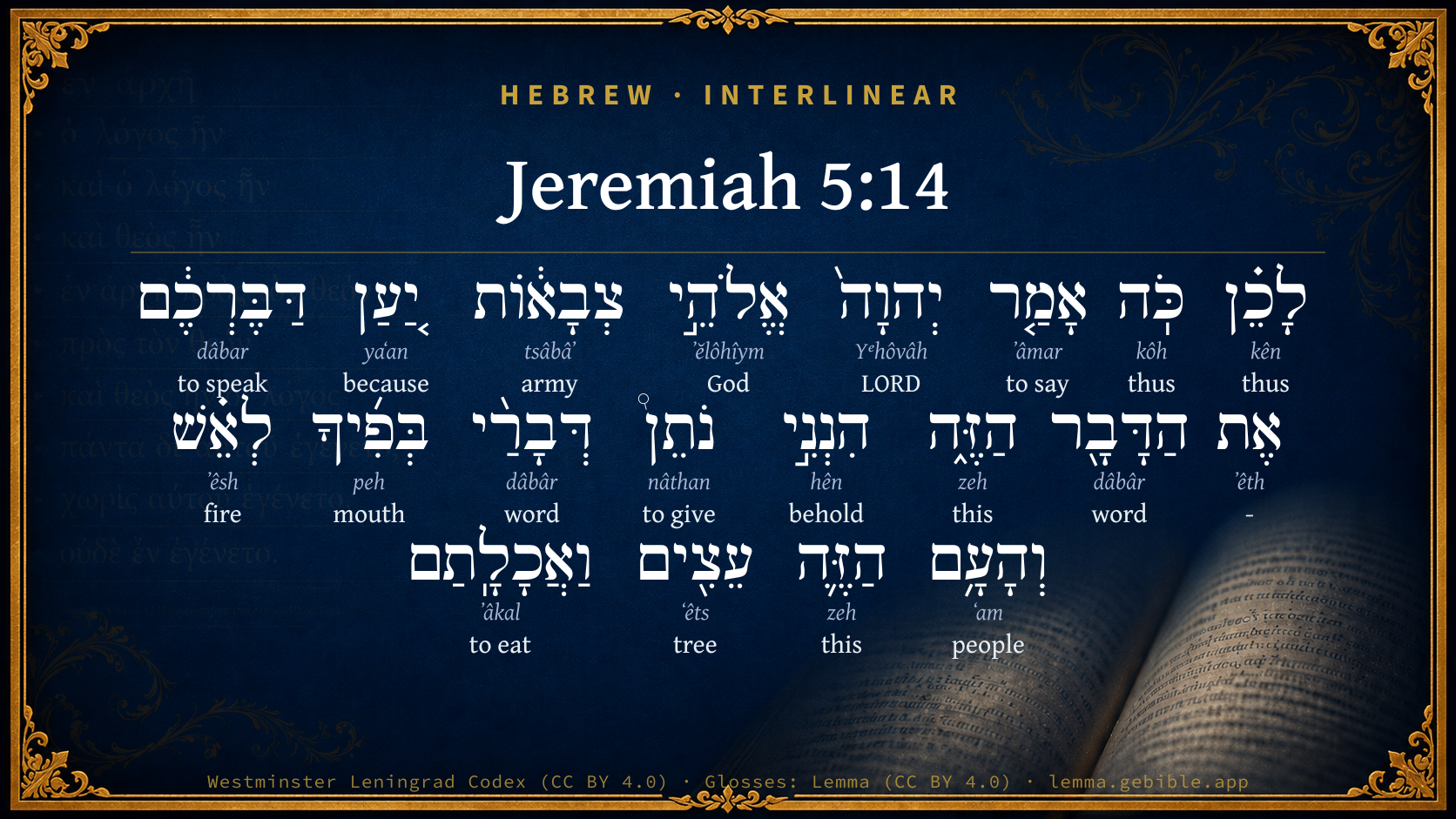
Hebrew (Westminster Leningrad Codex) Jeremiah 5:14 appears in the Hebrew Old Testament. The text above is from the Westminster Leningrad Codex. Each word links to its Strong’s number, a concise gloss, and parsing drawn from the Open Scriptures Hebrew Bible morphology. Click any word for its full Brown-Driver-Briggs (BDB) entry.
Download image
Cite this verse

Jeremiah 5:14 (World English Bible). Public Domain. Lemma interlinear Bible study tool, https://lemma.gebible.app/v/jeremiah/5/14.

Show BibTeX & RIS
BibTeX
RIS
English Translation
Therefore thus says Yahweh, the God of hosts, Because you speak this word, behold, I will make my words in your mouth fire, and this people wood, and it shall devour them.
World English Bible · Public Domain
Download a study sheet

One document with this verse’s original text, its word-by-word gloss line, the meaning frame, cross-references with their text, attributed commentary, and full source and license credits — printable, and it pastes into notes with its structure intact.

This verse Autodidact and up

Study sheet (.html) Plain text (.txt)

A passage Seminary Student

Up to 50 verses in one chapter. A passage sheet keeps up to 6 commentary sources and 12 cross-references per verse, in the order this page ranks them, and says so on the sheet whenever that leaves anything out. Ask for a single verse and you get the Autodidact verse sheet above.

Everything on this page stays free to read, with no account — the sheet is a download of what is already on screen, not access to it.

Want to remove ads? Support Godless Engineer
Compare translations 3

The same verse in 3 English versions, stacked beneath the original-language interlinear above. Click any original word for its lexicon entry.

Each is an independent rendering of the whole verse — the interlinear is not word-aligned to these translations.

Highlighted words mark where these versions differ — a whole-verse word diff, not a word-by-word alignment.

  • World English Bible Public Domain
    Therefore thus says Yahweh, the God of hosts, Because you speak this word, behold, I will make my words in your mouth fire, and this people wood, and it shall devour them.
  • King James Version Public Domain
    Wherefore thus saith the LORD God of hosts, Because ye speak this word, behold, I will make my words in thy mouth fire, and this people wood, and it shall devour them.
  • unfoldingWord Literal Text CC BY-SA 4.0
    Therefore thus says Yahweh the God of hosts: “Because you have spoken this word, behold, I shall place my word in your mouth for a fire, and this people wood, and it will consume them.

unfoldingWord Literal Text — © unfoldingWord, licensed CC BY-SA 4.0. Word-aligned USFM3 via Door43 (git.door43.org/unfoldingWord/en_ult).

Versions to compare (up to 4)

3 of 4 selected

Show all 18 translations

Every available English version of this verse, each an independent rendering of the whole verse.

  • World English Bible Public Domain
    Therefore thus says Yahweh, the God of hosts, Because you speak this word, behold, I will make my words in your mouth fire, and this people wood, and it shall devour them.
  • Berean Standard Bible Public Domain
    Therefore this is what the LORD God of Hosts says: “Because you have spoken this word, I will make My words a fire in your mouth and this people the wood it consumes.
  • Majority Standard Bible Public Domain
    Therefore this is what the LORD God of Hosts says: “Because you have spoken this word, I will make My words a fire in your mouth and this people the wood it consumes.
  • King James Version Public Domain
    Wherefore thus saith the LORD God of hosts, Because ye speak this word, behold, I will make my words in thy mouth fire, and this people wood, and it shall devour them.
  • American Standard Version (1901) Public Domain
    Wherefore thus saith Jehovah, the God of hosts, Because ye speak this word, behold, I will make my words in thy mouth fire, and this people wood, and it shall devour them.
  • Revised Version (1885) Public Domain
    Wherefore thus saith the LORD, the God of hosts, Because ye speak this word, behold, I will make my words in thy mouth fire, and this people wood, and it shall devour them.
  • Geneva Bible (1599) Public Domain
    Wherefore thus saith the Lord God of hostes, Because ye speake such wordes, beholde, I will put my wordes into thy mouth, like a fire, and this people shall be as wood, and it shall deuoure them.
  • Douay-Rheims (1899) Public Domain
    Thus saith the Lord the God of hosts: Because you have spoken this word, behold I will make my words in thy mouth as fire, and this people as wood, and it shall devour them.
  • Young's Literal Translation Public Domain
    Therefore, thus said Jehovah, God of Hosts, Because of your speaking this word, Lo, I am making My words in thy mouth become fire, And this people wood, and it hath devoured them.
  • Literal Standard Version CC BY-SA 4.0
    Therefore, thus said YHWH, God of Hosts: “Because of your speaking this word, || Behold, I am making My words become fire in your mouth, || And this people wood, || And it has devoured them.
  • Unlocked Literal Bible CC BY-SA 4.0
    So Yahweh, the God of hosts says this, “Because you have said this, see, I am about to place my word in your mouth. It will be like a fire, and this people will be like wood! For it will consume them.
  • unfoldingWord Literal Text CC BY-SA 4.0
    Therefore thus says Yahweh the God of hosts: “Because you have spoken this word, behold, I shall place my word in your mouth for a fire, and this people wood, and it will consume them.
  • Darby Bible Public Domain
    Therefore thus saith Jehovah, the God of hosts: Because ye speak this word, behold, I will make my words in thy mouth fire, and this people wood, and it shall devour them.
  • World Messianic Bible Public Domain
    Therefore the LORD, the God of Hosts says, “Because you speak this word, behold, I will make my words in your mouth fire, and this people wood, and it will devour them.
  • Webster's Bible Public Domain
    Wherefore thus saith the LORD God of hosts, Because ye speak this word, Behold, I will make my words in thy mouth fire, and this people wood, and it shall devour them.
  • Free Bible Version CC BY-SA 4.0
    So this is the reply from the Lord God Almighty: Because of what you've said, I will make my words like a fire in your mouth and you people like the wood it burns up.
  • Bible in Basic English Public Domain
    For this reason the Lord, the God of armies, has said: Because you have said this, I will make my words in your mouth a fire, and this people wood, and they will be burned up by it.
  • JPS Tanakh (1917) Public Domain
    Wherefore thus saith the LORD, the God of hosts: Because ye speak this word, behold, I will make My words in thy mouth fire, and this people wood, and it shall devour them.

Literal Standard Version (2020), Covenant Press — licensed CC BY-SA 4.0. Text via the HelloAO Bible API (eBible.org). Unlocked Literal Bible (unfoldingWord) — licensed CC BY-SA 4.0. Text via the HelloAO Bible API (eBible.org). unfoldingWord Literal Text — © unfoldingWord, licensed CC BY-SA 4.0. Word-aligned USFM3 via Door43 (git.door43.org/unfoldingWord/en_ult). Free Bible Version, Dr. Jonathan Gallagher — licensed CC BY-SA 4.0. Text via the HelloAO Bible API (eBible.org).

Word by word

More ways to search: Search by grammar → Find every occurrence → Compare this word →

Practice this passage: Drill this verse → Learn its vocabulary →

יַ֚עַן
yaʻan
H3282
“because”
Conjunction
Part of Speech
Conjunction
Full BDB Definition

Origin: from an unused root meaning to pay attention

TWOT: 1650e

because, therefore, because that, on account of (conjunction) - because of, on account of (preposition) - why (with interrogative pronoun) (preposition)
  1. לָכֵ֗ן kên H3651 “to/for · thus” Preposition + Adverb
  2. כֹּֽה kôh H3541 “thus” Adverb
  3. אָמַ֤ר ʼâmar H559 “to say” Verb, Qal, Perfect, 3rd Person, Masculine, Singular
  4. יְהוָה֙ Yᵉhôvâh H3068 “LORD” Noun, Proper
  5. אֱלֹהֵ֣י ʼĕlôhîym H430 “God(s) of” Noun, Common, Masculine, Plural, Construct
  6. צְבָא֔וֹת tsâbâʼ H6635 “armies” Noun, Common, Both, Plural, Absolute
  7. דַּבֶּרְכֶ֔ם dâbar H1696 “to speak · you” Verb, Piel, Infinitive Construct + Suffix, Personal, 2nd Person, Masculine, Plural
  8. אֶת ʼêth H853 “-” Particle, Direct Object
  9. הַדָּבָ֖ר dâbâr H1697 “the · word” Particle, Definite Article + Noun, Common, Masculine, Singular, Absolute
  10. הַזֶּ֑ה zeh H2088 “the · this” Particle, Definite Article + Pronoun, Demonstrative, Masculine, Singular
  11. הִנְנִ֣י hên H2005 “behold · me” Particle, Demonstrative + Suffix, Personal, 1st Person, Common, Singular
  12. נֹתֵן֩ nâthan H5414 “giving” Verb, Qal, Participle Active, Masculine, Singular, Absolute
  13. דְּבָרַ֨י dâbâr H1697 “words · my” Noun, Common, Masculine, Plural, Construct + Suffix, Personal, 1st Person, Common, Singular
  14. בְּפִ֜יךָ peh H6310 “in/at · mouth · your” Preposition + Noun, Common, Masculine, Singular, Construct + Suffix, Personal, 2nd Person, Masculine, Singular
  15. לְאֵ֗שׁ ʼêsh H784 “to/for · fire” Preposition + Noun, Common, Both, Singular, Absolute
  16. וְהָעָ֥ם ʻam H5971 “and · the · people” Conjunction + Particle, Definite Article + Noun, Common, Masculine, Singular, Absolute
  17. הַזֶּ֛ה zeh H2088 “the · this” Particle, Definite Article + Pronoun, Demonstrative, Masculine, Singular
  18. עֵצִ֖ים ʻêts H6086 “trees” Noun, Common, Masculine, Plural, Absolute
  19. וַאֲכָלָֽתַם ʼâkal H398 “and · to eat · them” Conjunction + Verb, Qal, Sequential Perfect, 3rd Person, Feminine, Singular + Suffix, Personal, 3rd Person, Masculine, Plural

About this verse

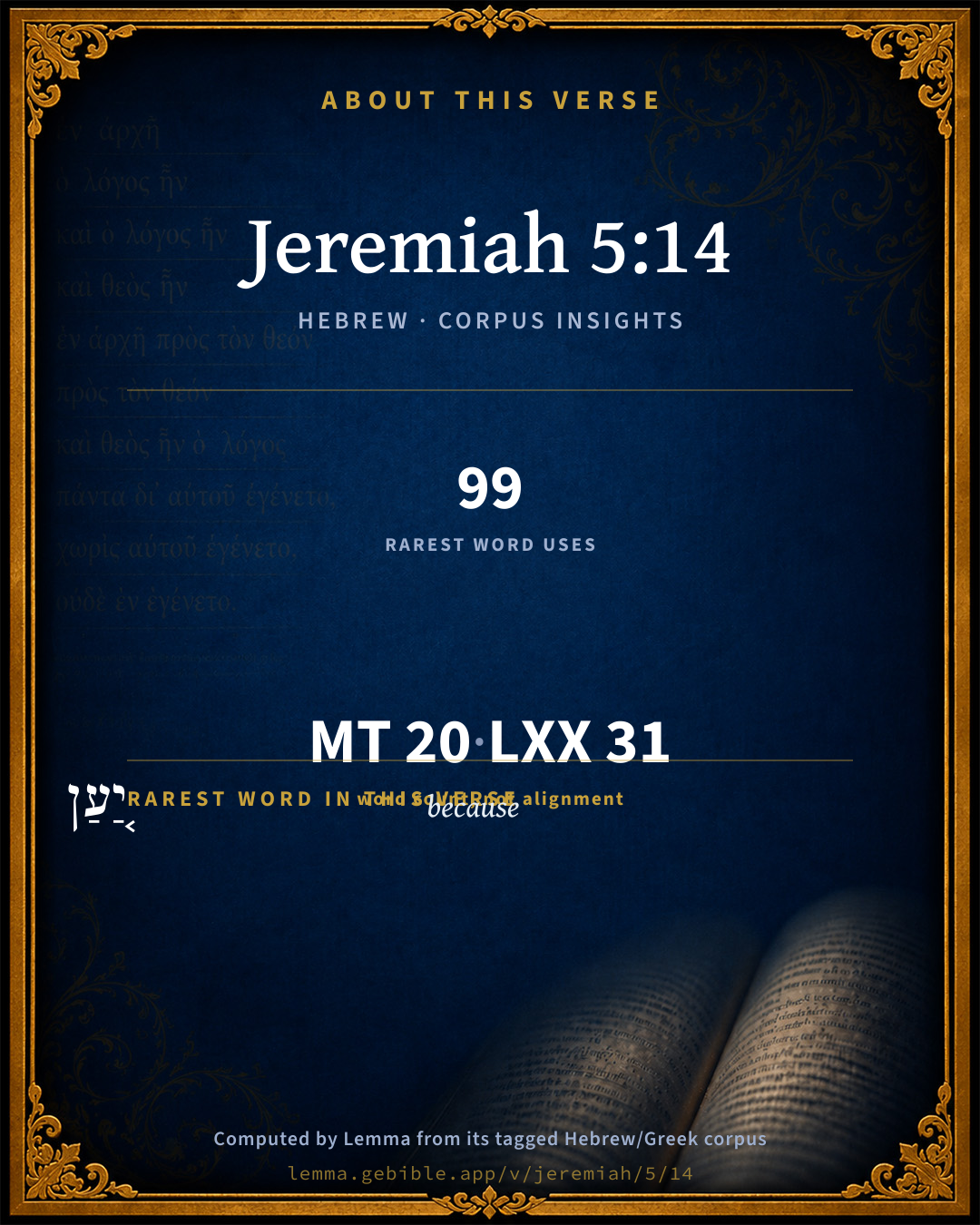
These counts appear in no published source. They are computed here, from the morphology-tagged text and Lemma’s own curated glosses. What Lemma adds →

20
words
18
distinct lemmas
Prophets
section

Grammatical profile

  • 4 verbs
  • 9 nouns
  • 2 pronouns
  • 1 conjunction
  • 2 adverbs
  • 2 particles

Verb forms

  • אָמַ֤ר Qal · Perfect
  • דַּבֶּרְכֶ֔ם Piel · Infinitive Construct
  • נֹתֵן֩ Qal · Participle Active
  • וַאֲכָלָֽתַם Qal · Sequential Perfect

Repetition

Words recur within this verse — often emphatic in Hebrew:

  • הַדָּבָ֖ר word H1697 ×2
  • הַזֶּ֑ה this H2088 ×2

Hebrew & Septuagint length

In the original languages it is 20 Hebrew tokens and 31 Greek tokens — but the two are counted differently (Hebrew bundles its prefixes and suffixes into one token; the Greek is in lemma form), so that isn’t a like-for-like length.

Cross-references

7

Topical passages linked to Jeremiah 5:14 in the Treasury of Scripture Knowledge — connected by theme and wording, ordered by reader-vote popularity; previews shown in the World English Bible.

  • Jeremiah 23:29 Isn't my word like fire? says Yahweh; and like a hammer that breaks the rock in pieces?
  • Jeremiah 1:9 Then Yahweh put forth his hand, and touched my mouth; and Yahweh said to me, Behold, I have put my words in your mouth:
  • Hosea 6:5 Therefore I have cut them to pieces with the prophets; I killed them with the words of my mouth. Your judgments are like a flash of lightning.
  • Revelation 11:5–6 If anyone desires to harm them, fire proceeds out of their mouth and devours their enemies. If anyone desires to harm them, he must be killed in this way.
  • 2 Kings 1:10–14 Elijah answered to the captain of fifty, If I be a man of God, let fire come down from the sky, and consume you and your fifty. Fire came down from the sky, and consumed him and his fifty.
  • Jeremiah 28:15–17 Then said the prophet Jeremiah to Hananiah the prophet, Hear now, Hananiah: Yahweh has not sent you; but you make this people to trust in a lie.
  • Zechariah 1:6 But my words and my decrees, which I commanded my servants the prophets, didn't they overtake your fathers? "Then they repented and said, 'Just as Yahweh of Hosts determined to do to us, according to our ways, and according to our practices, so he has dealt with us.'"

Cross-references courtesy of OpenBible.info (CC BY 4.0).

Hebrew and Greek witnesses Masoretic Hebrew ↔ Greek Septuagint

The same verse in the two great witnesses to the Old Testament, shown verse-for-verse.

These are two independent witnesses, not word-aligned to each other, and the Septuagint is shown in lemma (dictionary) form.

Hebrew Jeremiah 5:14 Masoretic · Westminster Leningrad Codex

לָכֵ֗ן כֹּֽה אָמַ֤ר יְהוָה֙ אֱלֹהֵ֣י צְבָא֔וֹת יַ֚עַן דַּבֶּרְכֶ֔ם אֶת הַדָּבָ֖ר הַזֶּ֑ה הִנְנִ֣י נֹתֵן֩ דְּבָרַ֨י בְּפִ֜יךָ לְאֵ֗שׁ וְהָעָ֥ם הַזֶּ֛ה עֵצִ֖ים וַאֲכָלָֽתַם

Therefore thus says Yahweh, the God of hosts, Because you speak this word, behold, I will make my words in your mouth fire, and this people wood, and it shall devour them.

World English Bible · Public Domain

Greek LXX Structure differs

In the Septuagint, Jeremiah is about an eighth shorter than the Hebrew and arranges its material differently — the Oracles Against the Nations (Hebrew chapters 46–51) appear in the middle of the Greek book, after 25:13. Because the chapter and verse boundaries do not line up, a verse-for-verse comparison with the Hebrew is not shown.

A verse-for-verse comparison isn’t shown here because the chapters and verses don’t line up. Switch to the LXX edition with the MT / LXX toggle above to read the Greek directly.

Hebrew: Westminster Leningrad Codex (CC BY 4.0). Greek: Septuagint (public domain); English from a public-domain English Septuagint. How the Septuagint differs from the Hebrew →

Targum (Aramaic paraphrase)

1

The Targum is the ancient Jewish Aramaic paraphrase of the Hebrew Scriptures — an interpretive translation, not the Hebrew text itself. Onkelos (literal) and Pseudo-Jonathan (expansive) render the Torah, and Jonathan the Prophets. Coverage is partial: where no permissively-licensed English translation exists for a verse, only the Aramaic is shown. This is verse-level text, not a word-by-word alignment to the Hebrew.

  1. Targum Jonathan Prophets (Joshua–Malachi)
    בְּכַן כִּדְנַן אֲמַר יְיָ אֱלֹהִים צְבָאוֹת חֲלַף דְאִתְנַבִּיתוּן יַת פִּתְגָמָא הָדֵין הָא אֲנָא יָהֵיב פִּתְגָמֵי נְבוּאָתִי בְּפוּמָךְ תַּקִיפִין כְּאֶשְׁתָּא וְעַמָא הָדֵין חַלָשִׁין כְּקַשָׁא וִיקַטְלוּנוּן:

    (no public-domain English translation for this verse)

    Targum Jonathan — Aramaic: “Mikraot Gedolot” (public domain). English: “Sefaria Community Translation” (CC0 1.0 (public-domain dedication)); “London "Chaldee Paraphrase," 1871” (public domain). Text via Sefaria.

Commentary

Notes on Jeremiah 5:14 from classic Christian and Jewish commentators (each source and its license shown beneath its notes). The classic Christian expositions comment on the surrounding passage and are grouped to its opening verse, so a note may address several verses; the Jewish commentaries on the Tanakh (Rashi and others) are per-verse, so they appear only where the commentator wrote on this verse.

Lemma curates 59 commentaries, every one of them public domain or Creative Commons licensed, each selected and text-cleaned for this edition rather than reprinted as found. About our sources →

Trapp's Complete Commentary

John Trapp

Jer 5:14 Wherefore thus saith the LORD God of hosts, Because ye speak this word, behold, I will make my words in thy mouth fire, and this people wood, and it shall devour them.

Ver. 14. Because ye speak this word.] Ungodly men shall one day answer, with all the world on fire about their ears, for all their hard and haughty speeches. {Jdg 1:15} They shall find that neither their own words are wind, but such as they shall give a sad account of; nor the prophet’s words wind, unless it be to blow them into the bottomless lake, and to torment their consciences, haply in the meanwhile more than wind doth men’s bodies, when gotten once into the veins or bowels.

Behold, I will make my words in thy mouth fire.] That is somewhat worse than wind. Oh fear this fire! vengeance is in readiness for the disobedient; {2Co 10:5} every whit as ready in God’s hand as in the minister’s mouth. See Zec 1:6. {See Trapp on "Zec 1:6"}

John Trapp, A Commentary or Exposition upon All the Books of the Old and New Testament (1647–1656) — public domain. Text from a community e-Sword module.

The Biblical Illustrator

Joseph S. Exell

Jer_5:14

I will make My words in thy mouth fire.

The potential word

Three elements of the power of the Gospel are here found.

I. The I will of the Almighty. That will is an ocean deep and wide as eternity and infinity. In that shoreless deep all the mighty orbs, suns, systems floated first by mere will of Jehovah. To that will every line of inspiration becomes either a ray of light, law, and peace, or a thunderbolt of justice.

II. the words of thy mouth. The language is human, but Divine in its source. In all the dealings of heaven with our race, created instruments have been used. A long line of prophets and patriots have been guided with the authority and power from the eternal throne. So that whether Jehovah will to rouse all the stormy elements of clouds above, and waters beneath, as by a shepherds staff, and styled the rod of God, on the kingdom of Egypt, or drive a broad dusty highway through the waves of the sea,--it is the same glorious God that is present in this sacred book. Ten thousand angels of the lifeguard around heavens throne could not change the heart of the weakest child. But aided by the will of the eternal majestic I of the text, a babe in the manger at Bethlehem will awaken a song that shall ring out in anthem heard far up among the golden spheres of heaven, and echo round and round our redeemed and regenerated world.

III. A fire purifies but consumes the chaff. (W. H. Van Doren, D. D.)

Gods Word as fire

seems to me that the Word of God in our churches is too much like a sight which you not infrequently see in our streets in winter: a heap of coals cast down from a cart in front of a house upon the frosty ground, with the snow lying all around it, and falling upon it from the bosom of the storm. It is a remarkable conjunction when you come to think of it--a heap of coals and a heap of snow. The snow lies upon the heap of coals as cold and unmoved as it could lie over a heap of granite stones; and yet that heap of coal contains a vast quantity of potential heat, heat enough to melt all the snow in the street and convert for the time being the winter around into summer. But so long as the coal is as cold as the snow, so long does it produce no effect. Supposing you were able to apply a burning coal from your kitchen fire to the cold coal outside, what a wonderful change you would produce. You would let loose the potential heat; you would transform that cold inert mass of coal into a fiery furnace, which would melt and evaporate all the snow around it. And more marvellous still would the effect of the Word of God be upon you, coming to your cold, hard, frost-bound heart, with power from on high kindled with the fire of Gods Holy Spirit. The potential heat in it would be set free, and it would transform your whole nature and life. (H. Macmillan.)

The Biblical Illustrator, edited by Joseph S. Exell (c. 1880s–1900s) — public domain. Text from a community e-Sword module.

Joseph Benson's Commentary

Jer 5:14-18. Wherefore, thus saith the Lord God of hosts — The prophet now, in the name of God, answers the blasphemous speeches of these infidels, ascribing to Jehovah that power and supremacy which were calculated to give his words the greater influence. Because you speak this word — because these scoffers express themselves in this manner; I will make my words in thy mouth fire, &c. — Thy words shall take effect, and thy predictions begin to be accomplished suddenly and unexpectedly, irresistibly and fiercely, (as fire is wont to kindle upon and consume dry wood,) to their utter overthrow and ruin. They shall be but fuel to my wrath, which shall be executed upon them by the Chaldean army. I will bring a nation upon you from far — The prophet, in the two following verses, “marks out the Chaldeans by their distance; by their power and valour; by their antiquity; by their language, unknown to the Jews; by their arms, their might, and their cruelty.” And they shall eat up thy harvest — In the field; and thy bread — In the house; which thy sons and thy daughters should eat — Necessary for the sustenance of thy own offspring. They shall consume all, leaving thee no supports of life, but bringing an utter famine upon thee. Here is a plain allusion to the predictions of Moses, Deu 28:49-51. They shall eat up thy flocks and thy herds — Out of which thou hast taken sacrifices for thine idols. They shall eat up thy vines and thy fig-trees — They shall leave thee no part of the produce of thy vineyards or fields. They shall empoverish thy fenced cities, &c. — After besieging, they shall take and destroy thy cities, though defended by high and strong walls; wherein thou trustedst — For the protection of the country; slaying the garrisons and inhabitants thereof with the sword, and leaving them desolate. See this also foretold, Deu 28:52.

Joseph Benson's Commentary on the Old and New Testaments (1811–1818) — public domain. Text from a community e-Sword module.

Tyndale Open Study Notes

Tyndale Open Resources

5:14-19 The approaching army was probably that of Babylon, which attacked Jerusalem in 605 BC. The Lord called the Babylonians to carry out the punishment he had promised (see Deut 28:15-62).

Tyndale Open Study Notes — © Tyndale Open Resources, licensed CC BY-SA 4.0. Text via the HelloAO Bible API.

Geneva Bible (1599)

Geneva Bible translators

Meaning, Jeremiah.

Geneva Bible (1599) marginal notes — public domain. Text via Bolls.life.

Jamieson, Fausset & Brown

Robert Jamieson, A. R. Fausset & David Brown

ye . . . thy . . . this people--He turns away from addressing the people to the prophet; implying that He puts them to a distance from Him, and only communicates with them through His prophet (Jer 5:19).

fire . . . wood--Thy denunciations of judgments shall be fulfilled and shall consume them as fire does wood. In Jer 23:29 it is the penetrating energy of fire which is the point of comparison.

Jamieson, Fausset & Brown — Commentary Critical and Explanatory on the Whole Bible (1871) — public domain (CC PDM 1.0). Text via the HelloAO Bible API.

Adam Clarke's Commentary

Verse 14. Because ye speak this word] Because ye thus treat my message, "I will make my words in thy mouth fire." They have said they are but air; but I will make them fire, and a fire too that shall devour them. And how this was to be done, and by whom, is mentioned in the next verse.

Adam Clarke's Commentary on the Bible (1810–1826) — public domain. Text from a community e-Sword/MySword module.

John Calvin's Commentaries

God shews here how intolerable to him was their wantonness in despising the prophets, through whom he would have himself attended to. Though Christ did not refer to this passage, when he said,

“He who hears you hears me, and he who despises you despises me,” (Luke 10:16)

yet it contains an eternal law; for God’s will from the beginning has been, that his servants should be obeyed, as though he himself had come down from heaven. Hence the Jews dealt no less contumeliously with God in despising his prophets, than if they had dared to treat God himself with contempt. God then now shews how much he abhorred that madness, through which they rendered void all the labors of his servants.

Therefore thus saith Jehovah, the God of hosts Jeremiah made this preface, that he might more effectually rouse the Jews; for if he had omitted Thus saith Jehovah, and had begun thus, “Because ye have announced this word, behold, as fire shall be the word of God, “his doctrine would have been objected to, and treated with contempt. But now, by alleging the name of God, and that not simply, but by adorning it with a high attribute, and calling him “the God of hosts, “he makes known his power in order to strike them with fear. He then says, “Thus saith Jehovah, the God of hosts, Because ye have spoken this word, “etc. Here he changes the persons often; and it behooved him to do so, that there might be more force and point in what he said. He ought to have said in the third person, “Because they have spoken thus, Behold, I will make my words in thy mouth, “etc.: but he now addresses the people, and then he turns to his servant Jeremiah. He therefore says, “Ye have indeed spoken thus;” that is, “Ye have scoffingly spoken, as though my prophets had nothing but the empty sound of words;” Behold, he says, I will make my words in thy mouth like fire, (he thus addresses the Prophet,) and this people shall be wood, and the fire shall devour them

God compares his own word to fire, not as in other places, nor for the same reason; but this similitude has a particular meaning, — that the prophetic word would consume the people as fire consumes dry wood or straw. In other places the word of God is called fire, because it kindles the hearts of men, because it cleanses or burns the filth within. But he treats not here of the benefit or the fruit which the faithful derive from God’s word: but God declares only that the doctrine of the Prophet would prove fatal to the people; and hence he expressly says, “I make my words in thy mouth like fire.” Had he said, “Behold, my words shall be like fire, and this people shall be stubble, “it would not have been sufficiently expressive. But as the people had been accustomed to scoff and say, “Ah! what are these prophets, and what are their words? they beat the air only;” as then the Jews had been wont to speak in this manner, he now replies to them, and says, “I will make my words in thy mouth like fire;” that is, Thy tongue alone shall be more than sufficient to destroy the whole people. Jeremiah teaches here the same thing with Paul, when he said,

“We have vengeance in readiness against all altitude which rises against the gospel.” (2 Corinthians 10:4, 5)

For it has ever been an evil, common to all ages, either to neglect, or wholly to despise the servants of God. When Paul saw that the gospel was despised by many, he said that he and other ministers had vengeance in readiness; as though he had said, “As many words as we speak shall be so many swords to slay all the ungodly; and though their hardness now reject the judgment of God, their perverseness shall avail them nothing. Let them now then know that there is so much power in my word, as though God were openly to put forth his hand from heaven, as though he were to dart forth his lightnings.” The same thing is what Jeremiah means here, Behold, he says, I will make my words in thy mouth fire; that is, there will be so much power in thy words, that the ungodly shall know to their own loss that thou art the executioner of my vengeance.

This passage ought to be carefully observed by us, lest by our ingratitude we shall so provoke God’s wrath against us, as that his word, which is destined for our food, shall be turned to be a fire to us. For why has God appointed the ministers of his gospel, except to invite us to become partakers of his salvation, and thus sweetly to restore and refresh our souls? And thus the word of God is to us like water to revive our hearts: it is also a fire, but for our good, a cleansing, and not a consuming fire: but if we obstinately reject this fire, it will surely turn to answer another end, even to devour us, and wholly to consume us.

But he says that this people would be wood: as the ungodly set up an iron front against God, they think they can thus drive to a distance his vengeance; the Prophet now laughs to scorn this madness, and says that they would be like wood or straw. It follows —

John Calvin's Commentaries (1540-1563) — public domain. Text from the Calvin Translation Society English edition (1840s-50s) via the Christian Classics Ethereal Library (ccel.org). Calvin's coverage is partial (roughly two-thirds of the Bible); uncommented books and verses are honest gaps, never fabricated. The 19th-century editor's footnotes and remarks are omitted so the notes are faithfully Calvin's own voice.

Ellicott's Commentary for English Readers

(14) The Lord God of hosts.—The solemn name (Jehovah Elohim Zebaoth) used for the second time in Jeremiah’s teaching (Jer_2:19). The message is partly to the people—“Because ye speak this word,” partly to the prophet who was sent to bear his witness against them—“I will make my words in thy mouth.”

A Bible Commentary for English Readers, edited by Charles John Ellicott (1878–1897) — public domain. Text from a community e-Sword module.

The Cambridge Bible for Schools and Colleges

gen. ed. J. J. S. Perowne

14. “Ye” (the people)—“thy” (Jeremiah’s). Cp. Jer_23:39.

The Cambridge Bible for Schools and Colleges (gen. ed. J. J. S. Perowne; Cambridge University Press, 1878–1918) — public domain. Text from a community e-Sword module.

John Gill's Exposition

Wherefore thus saith the Lord God of hosts, because ye speak this word,.... That it is not the Lord; it is not he that speaks; it is no prophecy of him, and therefore shall become wind, and come to nothing:

behold, I will make my word in thy mouth fire: it shall have its effect, and a dreadful one; it shall not become wind, but be as fire, not to enlighten the understanding, to purify the conscience, and warm the heart; but to torture, distress, and destroy, as the fire of the word out of the mouths of the two witnesses, Rev 11:5,

and this people wood, and it shall devour them; as wood is devoured by fire, so shall this people be destroyed by sword and famine, as the word of the prophecy has declared they should; and which was done by the following means.

John Gill's Exposition of the Whole Bible (1746–1763) — public domain (CC PDM 1.0). Text via the HelloAO Bible API.

Haydock's Catholic Bible Commentary

Fire. Thou shalt declare their impending ruin.

George Leo Haydock (1774–1849), Haydock's Catholic Family Bible and Commentary, 1859 edition — public domain. Excludes Psalms (Douay-Rheims chapter numbering differs from Protestant) and Deuterocanonical books (Catholic canon only).

Matthew Poole's English Annotations

Wherefore thus saith the Lord: these vile wretches having now done speaking, God begins to speak; and because they had thus slighted the prophet, and God speaking by him, (as in the next words,

Because ye speak this word, ) here tells them what he will do; or rather, turns himself abruptly to the prophet, as men usually do in a passion.

The Lord God of hosts; he makes his majesty and power known, to clothe his words with the greater terror. Because ye speak this word, viz. at the rate they discoursed in the former verse.

It shall devour them, i.e. it shall take place suddenly, and irresistibly, and fiercely, as fire is wont to take in dry wood, to their utter ruin and overthrow, Psa 83:14,15; Isa 9:18,19. They shall be but fuel to my wrath, which shall be executed by the Chaldean army, that shall consume and eat them up like fire; they shall find my words to be more than wind.

Matthew Poole's English Annotations on the Holy Bible (1683–1685) — public domain. Text from a community e-Sword/MySword module.

Whedon's Commentary on the Bible

Daniel D. Whedon

14. My words — Still God’s, though spoken by Jeremiah.

Fire — Rather, as a fire. The words, and the things expressed by them, are taken together. This threatening of judgments would be fulfilled, and so this word will be like the “fire” as to its devouring energy. See also Isa_1:31; Isa_10:17.

Daniel D. Whedon (gen. ed.), Commentary on the Old and New Testaments (1874–1909) — public domain. Text from a community e-Sword module.

The Pulpit Commentary

My words in thy mouth fire. (See on Jer_1:9, Jer_1:10)

Those who call the word of Jehovah a lie.

It has been a common folly, in connection with all the revelations which God has made at sundry times and in divers manners, to despise the authority of the messengers. Noah, Moses, David, and many others up to Jesus himself, could tell, along with Jeremiah, the same essential experience of contempt, rejection, and persecution. It is not for God to use those outward pomps and recommendations on which men count so much. A message unwelcome in itself is easily made of no repute when the messenger is devoid of outward state. Outward show, as every age can tell, counts for a great deal. Perhaps the visit of the Queen of Sheba would have been made far less of if she had not been a queen, or had come without the barbaric treasures which she spread forth in such great abundance. Simple lovers of truth, when their station happens to be obscure, are not much remarked. Here then was Jeremiah, asserting that he had come with a message from the Lord of the utmost moment, and he is rejected with the brusque intimation that his message is a lie and he himself an impostor. And this rejection is all the more noticeable because the words of the prophet must surely have had a strange impressiveness. None of the prophets could have spoken in the routine fashion of a herald announcing the proclamation which many times, perhaps, he has announced before. They must all, at least in the judgment of a few, have spoken with authority and not as the scribes. And Jeremiah at all events must have stood before the people, having every channel of outward expression filled from the sad experiences and emotions of his own inward life. The sorrows of which he spoke were as sorrows that he saw rising before his mind"s eye in all the horrors of their reality. The words, as he says in Jer_20:9, were often words that he tried to keep back, but that which was as a burning fire shut up in his bones must break out at last. And therefore, when the words did come, they were charged with a force of personal conviction and brotherly entreaty which in itself ought to have been enough to arrest attention. Moreover, sword and famine, future calamities with all their aggravations, were not the only things of which the prophet spoke. He had to deal with an actual present as well as a foreshadowed future. The present in which he and his audience lived teemed with idolatry, perjury, fraud, and oppression. These things were not lies. It was no lie to point to the manifest seed that Israel was sowing, and surely there was nothing more really reasonable than that there should be a reaping according to the sowing. At this height of rejection, then, God steps in to vindicate and honor his faithful servant. It is a melancholy kind of distinction, but a distinction nevertheless. His words were not only true words, but most terribly near to their fulfillment. It was not that Jeremiah himself was an agent in destroying, but his words became so immediately true, there was such a rapid production and concentration of the agents of destruction, as to make it quite proper to say that these words of the prophet were as consuming fire. But a few years, and many of these despisers found that the alleged lies were only too painfully true. It is not over lapsing centuries that we have to look for the fulfillment of Jeremiah"s gloomy prediction. Isaiah long before had sounded the note of warning, and now the peril is close at hand. It was inevitable that Jeremiah should speak with an urgency and excitement absent from the messages of his great predecessor. As the time of chastisement drew nearer, the warnings had to be louder, more disturbing, possibly more continuous. The mariner setting out on his voyage may be warned of some special danger lying in his track; but the adviser, while he may speak very earnestly, will not speak as does the man who, when the helmsman is close upon the danger, shouts to him, with utmost excitement and agitation, at once to change his course. God gave to Jeremiah this melancholy satisfaction, that while he had been, to his heart"s deepest sorrow, a messenger of woe, he had yet been approved, on the surest evidence, as a messenger of truth. Y.

The Pulpit Commentary (1880–1919), ed. H.D.M. Spence-Jones & Joseph S. Exell — public domain. Text from a community e-Sword module.

John Wesley's Explanatory Notes

It - The Chaldean army, shall consume and eat them up like fire.

John Wesley, Explanatory Notes Upon the Whole Bible (1754–1765) — public domain. Text via the GEBible commentary corpus.

Keil & Delitzsch

C. F. Keil & F. Delitzsch

But the people is to have proof of the truth of the word of the Lord. Because it, despising the threatening of punishment, says: Misfortune shall not light upon us, the Lord will make the word in the mouth of Jeremiah a fire, and the people wood, that the fire may consume it. On this figure, cf. Isa 1:31; Isa 10:17. Jer 5:15. explain this, and announce the inroad of a dreadful enemy that is to lay waste the land and consume the people. "A people from far," as in Jer 4:16. Judah is called "house of Israel," not so much because it is what remains of Israel, but because, after the captivity of the ten tribes, Judah regarded itself as the only true Israel or people of God. Further description of the hostile people is intended to show its formidable power, and to inspire dread. איתן, enduring, firm, strong; cf. Gen 49:24; Mic 6:2. מעולם, dating from eternity, i.e., very ancient, not of recent origin, but become mighty in immemorial antiquity. A people speaking a language unfamiliar to the Jews, to comprehend whom is impossible, i.e., barbarous; cf. Deu 28:49. Further (Jer 5:16), it is a race of very heroes, fully furnished with deadly weapons. J. D. Mich. took objection to the figure, "its quiver is as an open grave;" but his conjecture שׂפתו put nothing better in place of it. The link of comparison is this: as an open grave is filled with dead men, so the quiver of this enemy is filled with deadly missiles.

Keil & Delitzsch — Biblical Commentary on the Old Testament (1861–1891) — public domain (CC PDM 1.0). Text via the HelloAO Bible API. (Old Testament only.)

unfoldingWord translationNotes

Door43 World Missions Community

Because you

The word "you" refers to the people of Israel and Judah.

have said this

See what the people said in Jeremiah 5:12.

see

"look" or "listen" or "pay attention to what I am about to tell you"

I am about to place my word in your mouth

Here "place my word in your mouth" represents causing Jeremiah to speak God's message. AT: "I will cause you to speak my message" (See: Metaphor)

It will be like a fire, and this people will be like wood

Yahweh speaks of his message as if it were a fire, and of his people as if they were wood. (See: Simile)

For it will consume them

"For my message will consume them." Yahweh's message was about how he would punish his people, so he speaks as if his message would destroy them as a fire destroys wood. AT: "For when you speak my message, it will destroy the people of Israel as fire destroys wood" (See: Metaphor)

against you

"to attack you." The word "you" refers to the people of Israel.

house of Israel

The word "house" is a metonym for the family that lives in the house. In this case it refers to Israel's descendants. Here God was speaking to them. See how you translated it in Jeremiah 2:4. AT: "Israelites" or "people of Israel" (See: Metonymy)

this is Yahweh's declaration

Yahweh speaks of himself by name to express the certainty of what he is declaring. See how you translated this in Jeremiah 1:8. AT: "this is what Yahweh has declared" or "this is what I, Yahweh, have declared" (See: First, Second, or Third Person)

it is a lasting nation, an ancient nation

These phrases mean basically the same thing and emphasize how long the nation has existed. This refers to the nation from far away that Yahweh will bring against Israel. AT: "it is a very old and enduring nation" (See: Doublet)

a lasting nation

"an enduring nation" or "a very strong nation"

It is a nation whose language you do not know, nor will you understand what they say

These phrases mean the same thing and emphasize that the Israelites do not know the language of those people. It may imply that the Israelites have not had much contact with them. AT: "It is a nation whose language you will not understand at all" (See: Parallelism)

translationWords

Yahweh of hosts

word of God

fire

consume

nation

house

Israel

understand

unfoldingWord translationNotes — © Distant Shores Media and the Door43 World Missions Community, licensed CC BY-SA 4.0. Source: git.door43.org/Door43/en_tn.

Rashi

Rabbi Shlomo Yitzchaki (Rashi)

and it shall consume them Heb. ואכלתם.

Rashi on the Tanakh — English translations: “The Judaica Press complete Tanach with Rashi, translated by A. J. Rosenberg” (CC BY 4.0); “Pentateuch with Rashi's commentary by M. Rosenbaum and A.M. Silbermann, 1929-1934” (public domain); “The Metsudah Tanach series, Lakewood, N.J” (CC BY 4.0); and “The Book of Joshua, Metsudah Publications, 1997” (CC BY 4.0). Text via Sefaria.

Lesson kit

Teaching starters — assembled from the data on this page, not authored interpretation. Every prompt links to the verse data it draws on. Edit before teaching.

Jeremiah, in the Prophets, opens this verse with 20 words (18 distinct Hebrew lemmas). Its most distinctive word is yaʻan (“because”). A historical commentator’s framing appears above. Read the whole chapter for the surrounding context.

Discussion questions

  1. What does “because” (yaʻan) contribute to the verse as a whole?
  2. How does Jeremiah 23:29, which shares this passage’s theme, read alongside this verse?
  3. What does the repetition of “word” (2× in this one verse) do in this verse?
  4. These translations render this verse differently. What is at stake in choosing one wording over another?
  5. «אָמַ֤ר» is a Qal Perfect verb. How does that grammatical form shape the action described?
  6. Compare how Trapp's Complete Commentary and The Biblical Illustrator read this verse. Where do they agree or differ?

Things to notice

Reading settings

Reading text

Shown beneath each verse's original-language words.

Old Testament
Old Testament edition

Read the OT as the Masoretic Hebrew (MT) or the Greek Septuagint (LXX).

English shown for the Greek Septuagint (in the Hebrew ↔ Greek comparison).

Comparing translations? Open the Compare panel on any verse page to stack up to four side by side.