
2 Chronicles 29:19

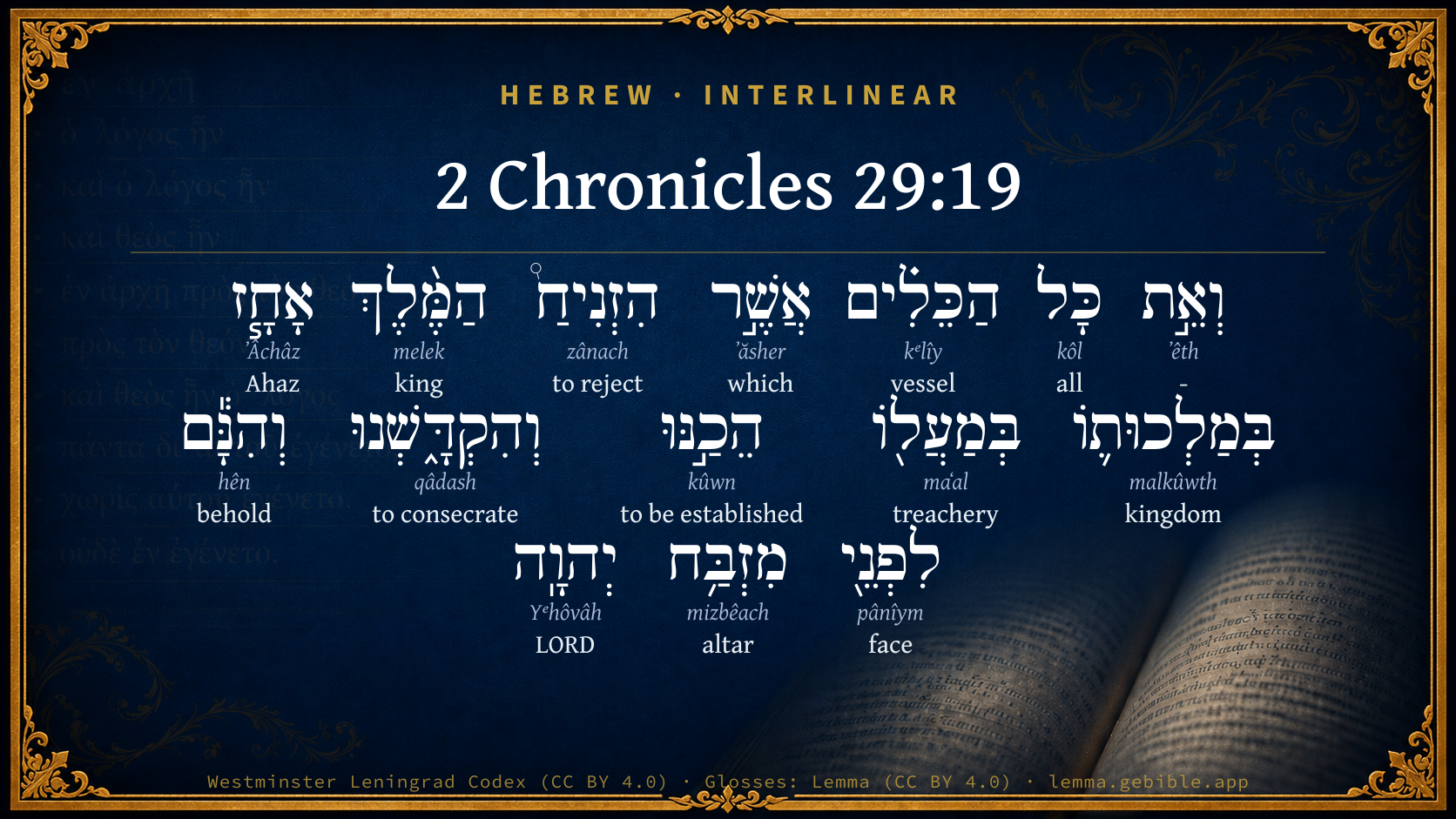
Hebrew (Westminster Leningrad Codex) 2 Chronicles 29:19 appears in the Hebrew Old Testament. The text above is from the Westminster Leningrad Codex. Each word links to its Strong’s number, a concise gloss, and parsing drawn from the Open Scriptures Hebrew Bible morphology. Click any word for its full Brown-Driver-Briggs (BDB) entry.
Download image
Cite this verse

2 Chronicles 29:19 (World English Bible). Public Domain. Lemma interlinear Bible study tool, https://lemma.gebible.app/v/2-chronicles/29/19.

Show BibTeX & RIS
BibTeX
RIS
English Translation
Moreover all the vessels, which king Ahaz in his reign did cast away when he trespassed, have we prepared and sanctified; and, behold, they are before the altar of Yahweh.
World English Bible · Public Domain
Download a study sheet

One document with this verse’s original text, its word-by-word gloss line, the meaning frame, cross-references with their text, attributed commentary, and full source and license credits — printable, and it pastes into notes with its structure intact.

This verse Autodidact and up

Study sheet (.html) Plain text (.txt)

A passage Seminary Student

Up to 50 verses in one chapter. A passage sheet keeps up to 6 commentary sources and 12 cross-references per verse, in the order this page ranks them, and says so on the sheet whenever that leaves anything out. Ask for a single verse and you get the Autodidact verse sheet above.

Everything on this page stays free to read, with no account — the sheet is a download of what is already on screen, not access to it.

Want to remove ads? Support Godless Engineer
Compare translations 3

The same verse in 3 English versions, stacked beneath the original-language interlinear above. Click any original word for its lexicon entry.

Each is an independent rendering of the whole verse — the interlinear is not word-aligned to these translations.

Highlighted words mark where these versions differ — a whole-verse word diff, not a word-by-word alignment.

  • World English Bible Public Domain
    Moreover all the vessels, which king Ahaz in his reign did cast away when he trespassed, have we prepared and sanctified; and, behold, they are before the altar of Yahweh.
  • King James Version Public Domain
    Moreover all the vessels, which king Ahaz in his reign did cast away in his transgression, have we prepared and sanctified, and, behold, they are before the altar of the LORD.
  • unfoldingWord Literal Text CC BY-SA 4.0
    and all the items which King Ahaz rejected in his reign in his unfaithfulness. We have prepared, and we have consecrated, and, behold, they are before the altar of Yahweh.”

unfoldingWord Literal Text — © unfoldingWord, licensed CC BY-SA 4.0. Word-aligned USFM3 via Door43 (git.door43.org/unfoldingWord/en_ult).

Versions to compare (up to 4)

3 of 4 selected

Show all 18 translations

Every available English version of this verse, each an independent rendering of the whole verse.

  • World English Bible Public Domain
    Moreover all the vessels, which king Ahaz in his reign did cast away when he trespassed, have we prepared and sanctified; and, behold, they are before the altar of Yahweh.
  • Berean Standard Bible Public Domain
    Moreover, we have prepared and consecrated all the articles that King Ahaz in his unfaithfulness cast aside during his reign. They are now in front of the altar of the LORD.”
  • Majority Standard Bible Public Domain
    Moreover, we have prepared and consecrated all the articles that King Ahaz in his unfaithfulness cast aside during his reign. They are now in front of the altar of the LORD.”
  • King James Version Public Domain
    Moreover all the vessels, which king Ahaz in his reign did cast away in his transgression, have we prepared and sanctified, and, behold, they are before the altar of the LORD.
  • American Standard Version (1901) Public Domain
    Moreover all the vessels, which king Ahaz in his reign did cast away when he trespassed, have we prepared and sanctified; and, behold, they are before the altar of Jehovah.
  • Revised Version (1885) Public Domain
    Moreover all the vessels, which king Ahaz in his reign did cast away when he trespassed, have we prepared and sanctified; and, behold, they are before the altar of the LORD.
  • Geneva Bible (1599) Public Domain
    And all the vessels which King Ahaz had cast aside when he reigned, and transgressed, haue we prepared and sanctified: and beholde, they are before the altar of the Lord.
  • Douay-Rheims (1899) Public Domain
    And all the furniture of the temple, which king Achaz in his reign had defiled, after his transgression; and behold they are all set forth before the altar of the Lord.
  • Young's Literal Translation Public Domain
    and all the vessels that king Ahaz cast away in his reign -- in his trespass -- we have prepared and sanctified, and lo, they `are' before the altar of Jehovah.'
  • Literal Standard Version CC BY-SA 4.0
    and all the vessels that King Ahaz cast away in his reign—in his trespass—we have prepared and sanctified, and behold, they [are] before the altar of YHWH.”
  • Unlocked Literal Bible CC BY-SA 4.0
    So we have prepared and we have consecrated all the items that King Ahaz removed when he acted unfaithfully during his reign. See, they are in front of the altar of Yahweh.”
  • unfoldingWord Literal Text CC BY-SA 4.0
    and all the items which King Ahaz rejected in his reign in his unfaithfulness. We have prepared, and we have consecrated, and, behold, they are before the altar of Yahweh.”
  • Darby Bible Public Domain
    and all the vessels that king Ahaz in his reign cast away in his transgression have we prepared and hallowed, and behold, they are before the altar of Jehovah.
  • World Messianic Bible Public Domain
    Moreover, we have prepared and sanctified all the vessels which King Ahaz threw away in his reign when he was unfaithful. Behold, they are before the LORD’s altar.”
  • Webster's Bible Public Domain
    Moreover all the vessels, which king Ahaz in his reign cast away in his transgression, have we prepared and sanctified, and behold, they are before the altar of the LORD.
  • Free Bible Version CC BY-SA 4.0
    We have recovered and purified all the items that King Ahaz threw away during his reign when he was unfaithful. They are now before the Lord's altar.”
  • Bible in Basic English Public Domain
    And all the vessels which were turned out by King Ahaz in his sin while he was king, we have put in order and made holy, and now they are in their places before the altar of the Lord.
  • JPS Tanakh (1917) Public Domain
    Moreover all the vessels, which king Ahaz in his reign did cast away when he acted treacherously, have we prepared and sanctified; and, behold, they are before the altar of the LORD.'

Literal Standard Version (2020), Covenant Press — licensed CC BY-SA 4.0. Text via the HelloAO Bible API (eBible.org). Unlocked Literal Bible (unfoldingWord) — licensed CC BY-SA 4.0. Text via the HelloAO Bible API (eBible.org). unfoldingWord Literal Text — © unfoldingWord, licensed CC BY-SA 4.0. Word-aligned USFM3 via Door43 (git.door43.org/unfoldingWord/en_ult). Free Bible Version, Dr. Jonathan Gallagher — licensed CC BY-SA 4.0. Text via the HelloAO Bible API (eBible.org).

Word by word

More ways to search: Search by grammar → Find every occurrence → Compare this word →

Practice this passage: Drill this verse → Learn its vocabulary →

הִזְנִיחַ֩
zânach
H2186
“to reject”
Verb, Hiphil, Perfect, 3rd Person, Masculine, Singular
Part of Speech
Verb
Stem
Hiphil
Form
Perfect
Person
3rd Person
Gender
Masculine
Number
Singular
Full BDB Definition

Origin: a primitive root meaning to push aside

TWOT: 564

to cast off, reject, spurn - (Qal) to reject - (Hiphil) to forcefully reject someone - to stink, emit stench, become odious - (Hiphil) stink (perfect)
  1. וְאֵ֣ת ʼêth H853 “and · -” Conjunction + Particle, Direct Object
  2. כָּל kôl H3605 “all of” Noun, Common, Masculine, Singular, Construct
  3. הַכֵּלִ֗ים kᵉlîy H3627 “the · vessels” Particle, Definite Article + Noun, Common, Masculine, Plural, Absolute
  4. אֲשֶׁ֣ר ʼăsher H834 “which” Particle, Relative
  5. הַמֶּ֨לֶךְ melek H4428 “the · king” Particle, Definite Article + Noun, Common, Masculine, Singular, Absolute
  6. אָחָ֧ז ʼÂchâz H271 “Ahaz” Noun, Proper
  7. בְּמַלְכוּת֛וֹ malkûwth H4438 “in/at · kingdom · his” Preposition + Noun, Common, Feminine, Singular, Construct + Suffix, Personal, 3rd Person, Masculine, Singular
  8. בְּמַעֲל֖וֹ maʻal H4604 “in/at · treachery · his” Preposition + Noun, Common, Masculine, Singular, Construct + Suffix, Personal, 3rd Person, Masculine, Singular
  9. הֵכַ֣נּוּ kûwn H3559 “to be established” Verb, Hiphil, Perfect, 1st Person, Common, Plural
  10. וְהִקְדָּ֑שְׁנוּ qâdash H6942 “and · to consecrate” Conjunction + Verb, Hiphil, Perfect, 1st Person, Common, Plural
  11. וְהִנָּ֕ם hên H2005 “and · behold · them” Conjunction + Particle, Demonstrative + Suffix, Personal, 3rd Person, Masculine, Plural
  12. לִפְנֵ֖י pânîym H6440 “to/for · face(s) of” Preposition + Noun, Common, Both, Plural, Construct
  13. מִזְבַּ֥ח mizbêach H4196 “altar of” Noun, Common, Masculine, Singular, Construct
  14. יְהוָֽה Yᵉhôvâh H3068 “LORD” Noun, Proper

About this verse

These counts appear in no published source. They are computed here, from the morphology-tagged text and Lemma’s own curated glosses. What Lemma adds →

15
words
15
distinct lemmas
Historical
section

Notable vocabulary

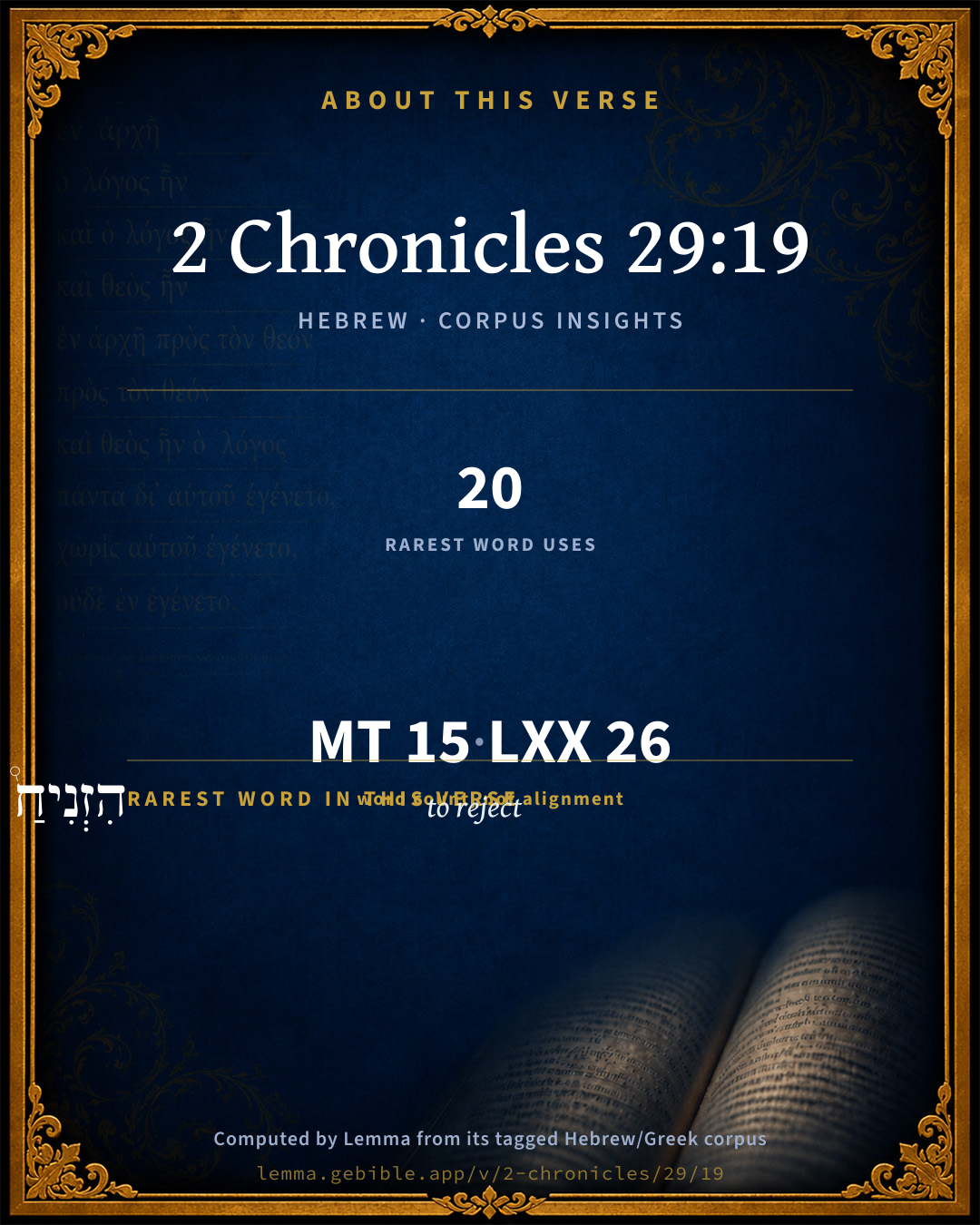
The rarest word here is הִזְנִיחַ֩ to reject H2186 — appearing just 20 times in the whole Hebrew Bible.

Shared distinctive vocabulary

הִזְנִיחַ֩ to reject H2186 occurs in 20 verses of the Hebrew Bible. Also found in:

Grammatical profile

  • 3 verbs
  • 9 nouns
  • 3 particles

Verb forms

  • הִזְנִיחַ֩ Hiphil · Perfect
  • הֵכַ֣נּוּ Hiphil · Perfect
  • וְהִקְדָּ֑שְׁנוּ Hiphil · Perfect

Hebrew & Septuagint length

In English translation the verse runs 30 words from the Hebrew and 28 from the Septuagint (LXX English) — closely comparable.

A rough comparison of the two English renderings, which tokenize alike — not a word-level alignment.

Word counts can differ between the Hebrew and the Greek without any difference in meaning — e.g. the Hebrew direct-object marker אֵת has no separate Greek word, and Greek often adds the article ὁ.

In the original languages it is 15 Hebrew tokens and 26 Greek tokens — but the two are counted differently (Hebrew bundles its prefixes and suffixes into one token; the Greek is in lemma form), so that isn’t a like-for-like length.

Cross-references

1

Topical passages linked to 2 Chronicles 29:19 in the Treasury of Scripture Knowledge — connected by theme and wording, ordered by reader-vote popularity; previews shown in the World English Bible.

  • 2 Chronicles 28:24 Ahaz gathered together the vessels of the house of God, and cut in pieces the vessels of the house of God, and shut up the doors of the house of Yahweh; and he made him altars in every corner of Jerusalem.

Cross-references courtesy of OpenBible.info (CC BY 4.0).

Hebrew and Greek witnesses Masoretic Hebrew ↔ Greek Septuagint

The same verse in the two great witnesses to the Old Testament, shown verse-for-verse.

These are two independent witnesses, not word-aligned to each other, and the Septuagint is shown in lemma (dictionary) form.

Hebrew 2 Chronicles 29:19 Masoretic · Westminster Leningrad Codex

וְאֵ֣ת כָּל הַכֵּלִ֗ים אֲשֶׁ֣ר הִזְנִיחַ֩ הַמֶּ֨לֶךְ אָחָ֧ז בְּמַלְכוּת֛וֹ בְּמַעֲל֖וֹ הֵכַ֣נּוּ וְהִקְדָּ֑שְׁנוּ וְהִנָּ֕ם לִפְנֵ֖י מִזְבַּ֥ח יְהוָֽה

Moreover all the vessels, which king Ahaz in his reign did cast away when he trespassed, have we prepared and sanctified; and, behold, they are before the altar of Yahweh.

World English Bible · Public Domain

Greek LXX 2 Chronicles 29:19 Septuagint · lemma form

καί πᾶς ὁ σκεῦος ὅς μιαίνω αχαζ ὁ βασιλεύς ἐν ὁ βασιλεία αὐτός ἐν ὁ ἀποστασία αὐτός ἑτοιμάζω καί ἁγνίζω ἰδού εἰμί ἐναντίον ὁ θυσιαστήριον κύριος

and all the vessels which king Achaz polluted in his reign, in his apostasy, we have prepared and purified: behold, they are before the altar of the Lord.

LXX2012 (modern English Septuagint) · Public Domain

Hebrew: Westminster Leningrad Codex (CC BY 4.0). Greek: Septuagint (public domain); English from LXX2012 (modern English Septuagint) (Public Domain). How the Septuagint differs from the Hebrew →

Commentary

Notes on 2 Chronicles 29:19 from classic Christian and Jewish commentators (each source and its license shown beneath its notes). The classic Christian expositions comment on the surrounding passage and are grouped to its opening verse, so a note may address several verses; the Jewish commentaries on the Tanakh (Rashi and others) are per-verse, so they appear only where the commentator wrote on this verse.

Lemma curates 59 commentaries, every one of them public domain or Creative Commons licensed, each selected and text-cleaned for this edition rather than reprinted as found. About our sources →

Trapp's Complete Commentary

John Trapp

2Ch 29:19 Moreover all the vessels, which king Ahaz in his reign did cast away in his transgression, have we prepared and sanctified, and, behold, they [are] before the altar of the LORD.

Ver. 19. Did cast away in his transgression.] Glorying, likely, in his sacrilege, and success there upon; as did Dionysius when he had spoiled a temple. Finding the winds favourable in his navigation, Lo, said he, how the gods approve of sacrilege! But he should have remembered that Nondum omnium dictum sol occiderat, his sin would shortly find him out.

John Trapp, A Commentary or Exposition upon All the Books of the Old and New Testament (1647–1656) — public domain. Text from a community e-Sword module.

Joseph Benson's Commentary

2Ch 29:19. All the vessels have we sanctified — Though the vessels of the sanctuary may be profaned for a while, God will find a time and a way to sanctify them. Neither his ordinances nor his obedient people shall be suffered to fail for ever.

Joseph Benson's Commentary on the Old and New Testaments (1811–1818) — public domain. Text from a community e-Sword module.

Adam Clarke's Commentary

Verse 19. All the vessels, which King Ahaz] The Targum says, "All the vessels which King Ahaz had polluted and rendered abominable by strange idols, when he reigned in his transgression against the WORD of the Lord, we have collected and hidden; and others have we prepared to replace them; and they are now before the Lord."

Adam Clarke's Commentary on the Bible (1810–1826) — public domain. Text from a community e-Sword/MySword module.

Ellicott's Commentary for English Readers

(19) Cast away.—The same word as “cast off” in 2Ch_11:14. The vessels so treated were the brazer altar, the brazen sea, and the lavers on the stands (2Ki_16:14; 2Ki_16:17).

In his transgression.—Unfaithfulness, or apostasy.

Have we prepared.—Ordered aright, put to rights. (H ̓̓çkannϋ, i.e., hγkξnτnϋ, 1Ch_29:16 here only.)

The altar of the Lord.—The brazen altar in the; court.

A Bible Commentary for English Readers, edited by Charles John Ellicott (1878–1897) — public domain. Text from a community e-Sword module.

The Cambridge Bible for Schools and Colleges

gen. ed. J. J. S. Perowne

19. cast away] According to 2Ch_28:24, “cut in pieces”; cp. 2Ki_16:17. The reference is probably to the “bases” and the “sea.”

in his transgression] R.V. when he trespassed.

have we prepared] Render, have we set up. Ahaz had taken away the supports both of the laver and of the sea (2Ki_16:17).

The Cambridge Bible for Schools and Colleges (gen. ed. J. J. S. Perowne; Cambridge University Press, 1878–1918) — public domain. Text from a community e-Sword module.

John Gill's Exposition

And they brought seven bullocks, and seven rams, and seven lambs, and seven he goats, for a sin offering for the kingdom, and for the sanctuary, and for Judah,.... To make atonement in a typical way, having respect to the sacrifice of the Messiah, for the sins of the king, his family and court, among whom idolatry had prevailed in the times of his father; and for the cleansing of the temple, which had been polluted by the idolatries of Ahaz; and for the expiation of the whole land; seven of each sort are ordered, though only one goat was required for a sin offering by the law, because of the multitude of transgressions that had been committed, and because of the length of time in which sacrifices had been neglected:

and he commanded the priests the sons of Aaron to offer them on the altar of the Lord: the altar of burnt offerings, whose business it was to do it.

John Gill's Exposition of the Whole Bible (1746–1763) — public domain (CC PDM 1.0). Text via the HelloAO Bible API.

Haydock's Catholic Bible Commentary

Defiled. Heb. "cast out (C.) in his." --- Forth. Heb. and Sept. "We have prepared and purified, behold they are," &c. H.

George Leo Haydock (1774–1849), Haydock's Catholic Family Bible and Commentary, 1859 edition — public domain. Excludes Psalms (Douay-Rheims chapter numbering differs from Protestant) and Deuterocanonical books (Catholic canon only).

Whedon's Commentary on the Bible

Daniel D. Whedon

19. The vessels, which… Ahaz… cast away — See 2Ch_28:24. 2Ch_29:20-36 describe the rededication of the temple, and should be compared with our author’s description of its first dedication by Solomon, especially the passages, 2Ch_5:11-14; 2Ch_7:4-11. The passage calls for no verbal comments, but we should note with what emphasis it is stated in 2Ch_29:24 that an atonement and sin offering were made for “all Israel,” as if at this new dedication of the temple they would obliterate the memory of old national strifes and divisions, and consecrate the whole nation as an unbroken community to God.

In public national offerings it was customary for the priests to slay and flay the victims, but on this occasion “the priests were too few,” (2Ch_29:34,) and were accordingly helped by “their brethren the Levites.” We are also informed that the Levites were more upright and prompt to purify themselves from past defilement than the priests. It is commonly supposed that the priests had been more implicated in the idolatrous practices of Ahaz than the Levites, and therefore many of them were slow of heart to respond to Hezekiah’s call to sanctify themselves. Urijah, the high priest, sacrilegiously participated in the impieties of Ahab. Comp. 2Ki_16:11; 2Ki_16:16.

Daniel D. Whedon (gen. ed.), Commentary on the Old and New Testaments (1874–1909) — public domain. Text from a community e-Sword module.

John Wesley's Explanatory Notes

Sanctified - Tho' the vessels of the sanctuary may be profaned for a while, God will find a time and a way to sanctify them. Neither his ordinances nor his obedient people, shall be suffered to fail forever.

John Wesley, Explanatory Notes Upon the Whole Bible (1754–1765) — public domain. Text via the GEBible commentary corpus.

Rashi

Rabbi Shlomo Yitzchaki (Rashi)

we have prepared and sanctified This is explained in Abodah Zarah (52b) in the chapter entitled “Rabbi Ishmael”: May vessels used in the Onias temple be used in the Temple?...He questioned him, “’That King Ahaz forsook, etc....we have prepared and sanctified.’ Does not ‘we have prepared’ mean that they immersed them and ‘sanctified’ mean that they consecrated them?” He replied, “Blessed are you to Heaven, for you have restored my loss to me. ‘We have prepared’ means that we have concealed them and ‘sanctified’ means that we consecrated others in their stead.”

Rashi on the Tanakh — English translations: “The Judaica Press complete Tanach with Rashi, translated by A. J. Rosenberg” (CC BY 4.0); “Pentateuch with Rashi's commentary by M. Rosenbaum and A.M. Silbermann, 1929-1934” (public domain); “The Metsudah Tanach series, Lakewood, N.J” (CC BY 4.0); and “The Book of Joshua, Metsudah Publications, 1997” (CC BY 4.0). Text via Sefaria.

Lesson kit

Teaching starters — assembled from the data on this page, not authored interpretation. Every prompt links to the verse data it draws on. Edit before teaching.

2 Chronicles, in the Historical, opens this verse with 15 words (15 distinct Hebrew lemmas). Its most distinctive word is zânach (“to reject”). A historical commentator’s framing appears above. Read the whole chapter for the surrounding context.

Discussion questions

  1. The word zânach carries the sense “to reject.” How does it shape the verse?
  2. How does 1 Chronicles 28:9, which shares the word «to reject», read alongside this verse?
  3. These translations render this verse differently; the difference is in the English rendering, not the original. What questions does that raise?
  4. «הִזְנִיחַ֩» is a Hiphil Perfect verb. How does that grammatical form shape the action described?
  5. Compare how Trapp's Complete Commentary and Joseph Benson's Commentary read this verse. Where do they agree or differ?

Things to notice

Reading settings

Reading text

Shown beneath each verse's original-language words.

Old Testament
Old Testament edition

Read the OT as the Masoretic Hebrew (MT) or the Greek Septuagint (LXX).

English shown for the Greek Septuagint (in the Hebrew ↔ Greek comparison).

Comparing translations? Open the Compare panel on any verse page to stack up to four side by side.