
1 Kings 11:31

Hebrew (Westminster Leningrad Codex) 1 Kings 11:31 appears in the Hebrew Old Testament. The text above is from the Westminster Leningrad Codex. Each word links to its Strong’s number, a concise gloss, and parsing drawn from the Open Scriptures Hebrew Bible morphology. Click any word for its full Brown-Driver-Briggs (BDB) entry.
Download image
Cite this verse

1 Kings 11:31 (World English Bible). Public Domain. Lemma interlinear Bible study tool, https://lemma.gebible.app/v/1-kings/11/31.

Show BibTeX & RIS
BibTeX
RIS
English Translation
He said to Jeroboam, Take ten pieces; for thus says Yahweh, the God of Israel, Behold, I will tear the kingdom out of the hand of Solomon, and will give ten tribes to you
World English Bible · Public Domain
Download a study sheet

One document with this verse’s original text, its word-by-word gloss line, the meaning frame, cross-references with their text, attributed commentary, and full source and license credits — printable, and it pastes into notes with its structure intact.

This verse Autodidact and up

Study sheet (.html) Plain text (.txt)

A passage Seminary Student

Up to 50 verses in one chapter. A passage sheet keeps up to 6 commentary sources and 12 cross-references per verse, in the order this page ranks them, and says so on the sheet whenever that leaves anything out. Ask for a single verse and you get the Autodidact verse sheet above.

Everything on this page stays free to read, with no account — the sheet is a download of what is already on screen, not access to it.

Want to remove ads? Support Godless Engineer
Compare translations 3

The same verse in 3 English versions, stacked beneath the original-language interlinear above. Click any original word for its lexicon entry.

Each is an independent rendering of the whole verse — the interlinear is not word-aligned to these translations.

Highlighted words mark where these versions differ — a whole-verse word diff, not a word-by-word alignment.

  • World English Bible Public Domain
    He said to Jeroboam, Take ten pieces; for thus says Yahweh, the God of Israel, Behold, I will tear the kingdom out of the hand of Solomon, and will give ten tribes to you
  • King James Version Public Domain
    And he said to Jeroboam, Take thee ten pieces: for thus saith the LORD, the God of Israel, Behold, I will rend the kingdom out of the hand of Solomon, and will give ten tribes to thee:
  • unfoldingWord Literal Text CC BY-SA 4.0
    And he said to Jeroboam, “Take for yourself ten pieces. For thus says Yahweh, the God of Israel, ‘Behold me, tearing the kingdom from the hand of Solomon, and I will give ten tribes to you.

unfoldingWord Literal Text — © unfoldingWord, licensed CC BY-SA 4.0. Word-aligned USFM3 via Door43 (git.door43.org/unfoldingWord/en_ult).

Versions to compare (up to 4)

3 of 4 selected

Show all 18 translations

Every available English version of this verse, each an independent rendering of the whole verse.

  • World English Bible Public Domain
    He said to Jeroboam, Take ten pieces; for thus says Yahweh, the God of Israel, Behold, I will tear the kingdom out of the hand of Solomon, and will give ten tribes to you
  • Berean Standard Bible Public Domain
    and said to Jeroboam, “Take ten pieces for yourself, for this is what the LORD, the God of Israel, says: ‘Behold, I will tear the kingdom out of the hand of Solomon, and I will give you ten tribes.
  • Majority Standard Bible Public Domain
    and said to Jeroboam, “Take ten pieces for yourself, for this is what the LORD, the God of Israel, says: ‘Behold, I will tear the kingdom out of the hand of Solomon, and I will give you ten tribes.
  • King James Version Public Domain
    And he said to Jeroboam, Take thee ten pieces: for thus saith the LORD, the God of Israel, Behold, I will rend the kingdom out of the hand of Solomon, and will give ten tribes to thee:
  • American Standard Version (1901) Public Domain
    And he said to Jeroboam, Take thee ten pieces; for thus saith Jehovah, the God of Israel, Behold, I will rend the kingdom out of the hand of Solomon, and will give ten tribes to thee;
  • Revised Version (1885) Public Domain
    And he said to Jeroboam, Take thee ten pieces: for thus saith the LORD, the God of Israel, Behold, I will rend the kingdom out of the hand of Solomon, and will give ten tribes to thee:
  • Geneva Bible (1599) Public Domain
    And said to Ieroboam, Take vnto thee ten pieces: for thus saith the Lord God of Israel, Beholde, I wil rent the kingdome out of ye hands of Salomon, and will giue ten tribes to thee.
  • Douay-Rheims (1899) Public Domain
    ,31And he said to Jeroboam: Take to thee ten pieces: for thus saith the Lord the God of Israel: Behold I will rend the kingdom out of the hand of Solomon, and will give thee ten tribes.
  • Young's Literal Translation Public Domain
    and saith to Jeroboam, `Take to thee ten pieces, for thus said Jehovah, God of Israel, lo, I am rending the kingdom out of the hand of Solomon, and have given to thee the ten tribes,
  • Literal Standard Version CC BY-SA 4.0
    and says to Jeroboam, “Take ten pieces for yourself, for thus said YHWH, God of Israel: Behold, I am tearing the kingdom out of the hand of Solomon, and have given the ten tribes to you,
  • Unlocked Literal Bible CC BY-SA 4.0
    He said to Jeroboam, “Take ten pieces, for Yahweh, the God of Israel, says, 'Look, I will tear the kingdom out of the hand of Solomon and I will give ten tribes to you
  • unfoldingWord Literal Text CC BY-SA 4.0
    And he said to Jeroboam, “Take for yourself ten pieces. For thus says Yahweh, the God of Israel, ‘Behold me, tearing the kingdom from the hand of Solomon, and I will give ten tribes to you.
  • Darby Bible Public Domain
    and said to Jeroboam, Take thee ten pieces; for thus saith Jehovah the God of Israel: Behold, I will rend the kingdom out of the hand of Solomon, and will give ten tribes to thee;
  • World Messianic Bible Public Domain
    He said to Jeroboam, “Take ten pieces; for the LORD, the God of Israel, says, ‘Behold, I will tear the kingdom out of the hand of Solomon and will give ten tribes to you
  • Webster's Bible Public Domain
    And he said to Jeroboam, Take thee ten pieces: for thus saith the LORD, the God of Israel, Behold, I will rend the kingdom from the hand of Solomon, and will give ten tribes to thee:
  • Free Bible Version CC BY-SA 4.0
    He said, “Jeroboam, take ten pieces. This is what the Lord God of Israel says. ‘Jeroboam, I am the Lord, the God of Israel, and I am going to take Solomon's kingdom from him and give you ten of the tribes.
  • Bible in Basic English Public Domain
    And he said to Jeroboam, Take ten of the parts, for this is what the Lord has said: See, I will take the kingdom away from Solomon by force, and will give ten tribes to you;
  • JPS Tanakh (1917) Public Domain
    And he said to Jeroboam: 'Take thee ten pieces; for thus saith the LORD, the God of Israel: Behold, I will rend the kingdom out of the hand of Solomon, and will give ten tribes to thee —

Literal Standard Version (2020), Covenant Press — licensed CC BY-SA 4.0. Text via the HelloAO Bible API (eBible.org). Unlocked Literal Bible (unfoldingWord) — licensed CC BY-SA 4.0. Text via the HelloAO Bible API (eBible.org). unfoldingWord Literal Text — © unfoldingWord, licensed CC BY-SA 4.0. Word-aligned USFM3 via Door43 (git.door43.org/unfoldingWord/en_ult). Free Bible Version, Dr. Jonathan Gallagher — licensed CC BY-SA 4.0. Text via the HelloAO Bible API (eBible.org).

Word by word

More ways to search: Search by grammar → Find every occurrence → Compare this word →

Practice this passage: Drill this verse → Learn its vocabulary →

קְרָעִ֑ים
qeraʻ
H7168
“rags”
Noun, Common, Masculine, Plural, Absolute
Part of Speech
Noun
Type
Common
Gender
Masculine
Number
Plural
State
Absolute
Full BDB Definition

Origin: from H7167

TWOT: 2074a

rag, torn pieces of garment or fabric
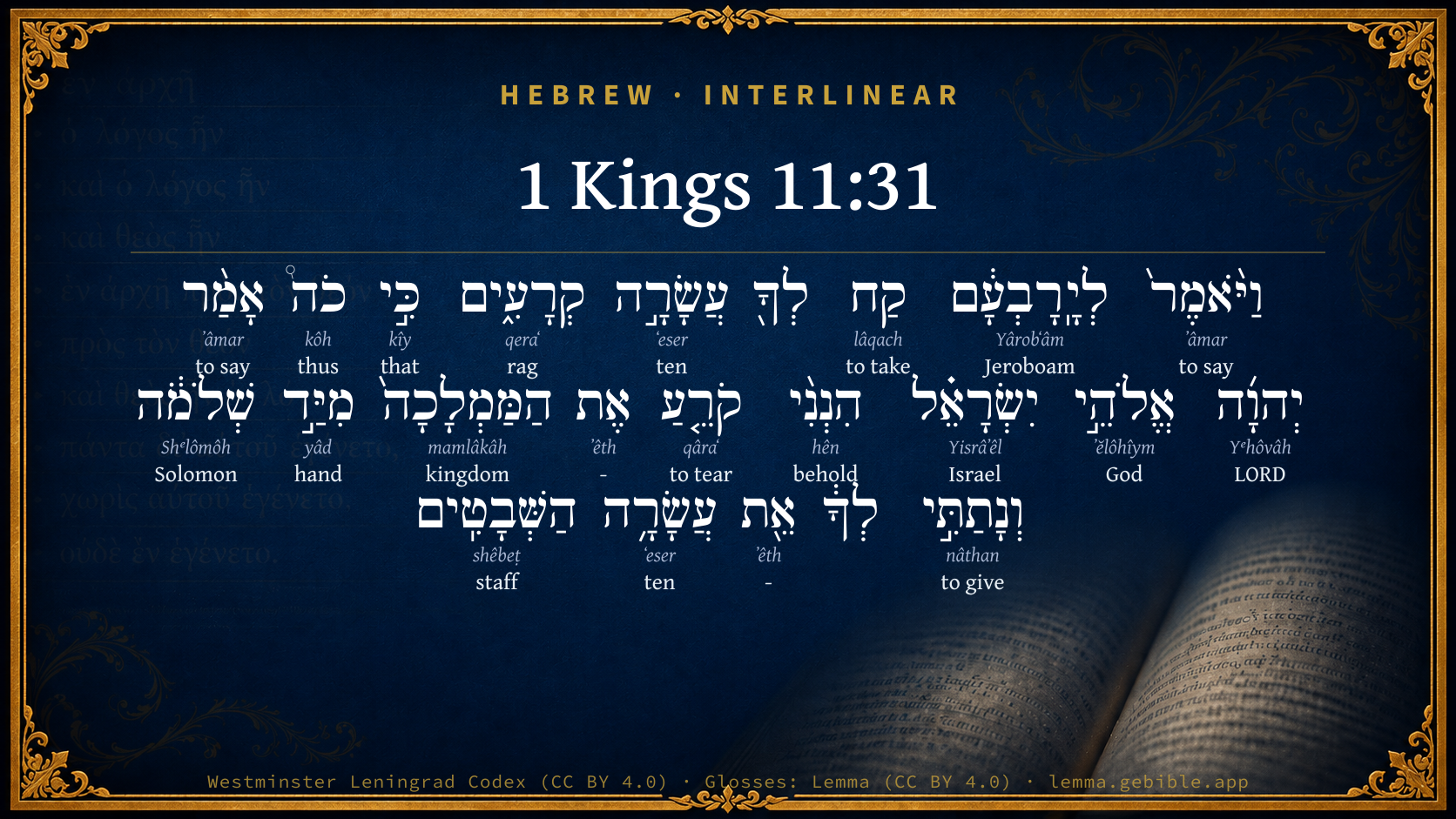
  1. וַיֹּ֨אמֶר֙ ʼâmar H559 “and · to say” Conjunction + Verb, Qal, Sequential Imperfect, 3rd Person, Masculine, Singular
  2. לְיָֽרָבְעָ֔ם Yârobʻâm H3379 “to/for · Jeroboam” Preposition + Noun, Proper
  3. קַח lâqach H3947 “take” Verb, Qal, Imperative, 2nd Person, Masculine, Singular
  4. עֲשָׂרָ֣ה ʻeser H6235 “ten” Adjective, Cardinal number, Masculine, Singular, Absolute
  5. כִּ֣י kîy H3588 “that” Conjunction
  6. כֹה֩ kôh H3541 “thus” Adverb
  7. אָמַ֨ר ʼâmar H559 “to say” Verb, Qal, Perfect, 3rd Person, Masculine, Singular
  8. יְהוָ֜ה Yᵉhôvâh H3068 “LORD” Noun, Proper
  9. אֱלֹהֵ֣י ʼĕlôhîym H430 “God(s) of” Noun, Common, Masculine, Plural, Construct
  10. יִשְׂרָאֵ֗ל Yisrâʼêl H3478 “Israel” Noun, Proper
  11. הִנְנִ֨י hên H2005 “behold · me” Particle, Demonstrative + Suffix, Personal, 1st Person, Common, Singular
  12. קֹרֵ֤עַ qâraʻ H7167 “tearing” Verb, Qal, Participle Active, Masculine, Singular, Absolute
  13. אֶת ʼêth H853 “-” Particle, Direct Object
  14. הַמַּמְלָכָה֙ mamlâkâh H4467 “the · kingdom” Particle, Definite Article + Noun, Common, Feminine, Singular, Absolute
  15. מִיַּ֣ד yâd H3027 “from · hand of” Preposition + Noun, Common, Both, Singular, Construct
  16. שְׁלֹמֹ֔ה Shᵉlômôh H8010 “Solomon” Noun, Proper
  17. וְנָתַתִּ֣י nâthan H5414 “and · to give” Conjunction + Verb, Qal, Sequential Perfect, 1st Person, Common, Singular
  18. אֵ֖ת ʼêth H853 “-” Particle, Direct Object
  19. עֲשָׂרָ֥ה ʻeser H6235 “ten” Adjective, Cardinal number, Masculine, Singular, Absolute
  20. הַשְּׁבָטִֽים shêbeṭ H7626 “the · staffs” Particle, Definite Article + Noun, Common, Masculine, Plural, Absolute

About this verse

These counts appear in no published source. They are computed here, from the morphology-tagged text and Lemma’s own curated glosses. What Lemma adds →

23
words
18
distinct lemmas
Historical
section

Notable vocabulary

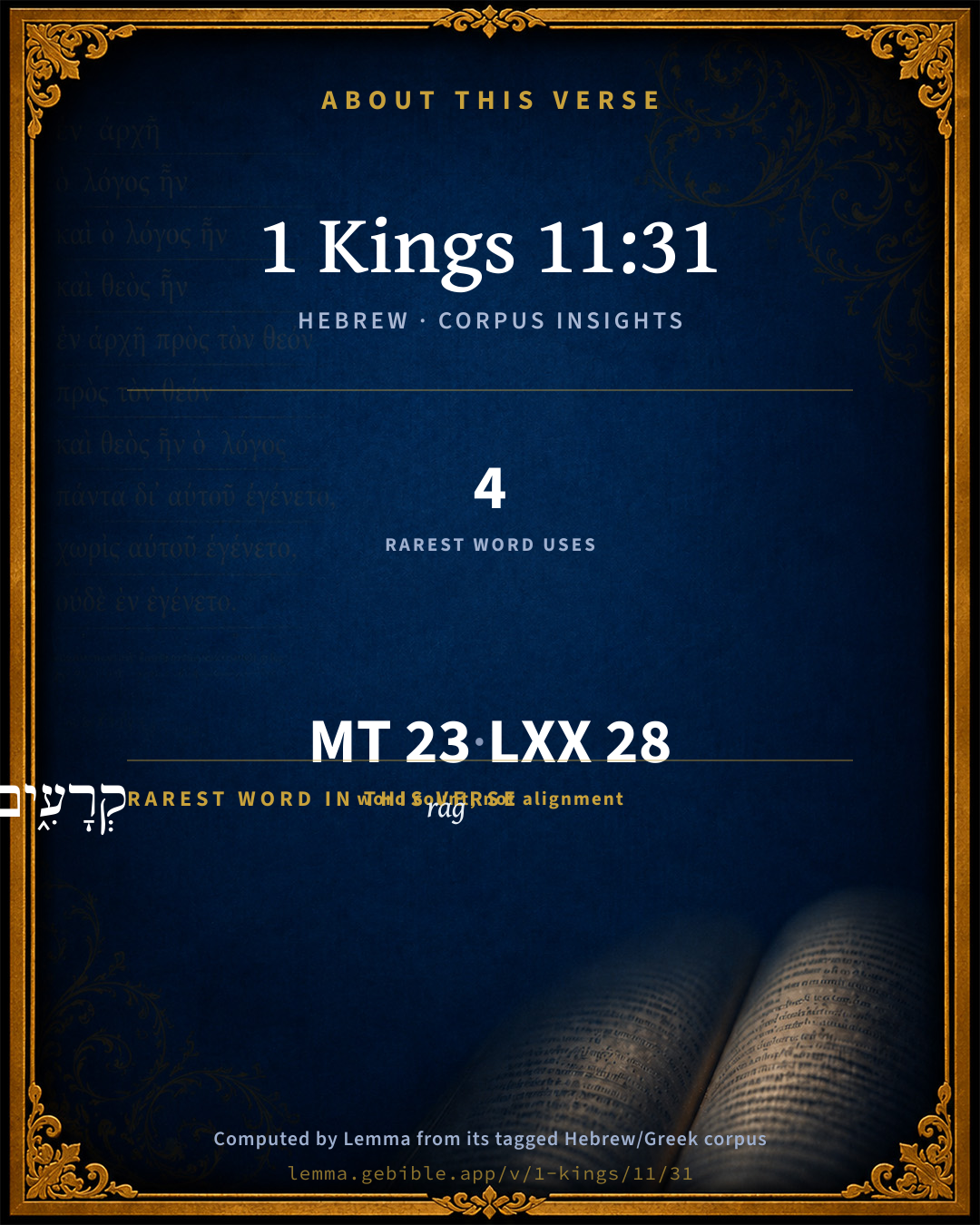
The rarest word here is קְרָעִ֑ים rag H7168 — appearing just 4 times in the whole Hebrew Bible.

Shared distinctive vocabulary

קְרָעִ֑ים rag H7168 occurs in 4 verses of the Hebrew Bible. Also found in:

Grammatical profile

  • 5 verbs
  • 9 nouns
  • 2 adjectives
  • 2 prepositions
  • 1 conjunction
  • 1 adverb
  • 3 particles

Verb forms

  • וַיֹּ֨אמֶר֙ Qal · Sequential Imperfect
  • קַח Qal · Imperative
  • אָמַ֨ר Qal · Perfect
  • קֹרֵ֤עַ Qal · Participle Active
  • וְנָתַתִּ֣י Qal · Sequential Perfect

Repetition

Words recur within this verse — often emphatic in Hebrew:

  • וַיֹּ֨אמֶר֙ to say H559 ×2
  • עֲשָׂרָ֣ה ten H6235 ×2

Hebrew & Septuagint length

In English translation the verse runs 34 words from the Hebrew and 35 from the Septuagint (LXX English) — closely comparable.

A rough comparison of the two English renderings, which tokenize alike — not a word-level alignment.

Word counts can differ between the Hebrew and the Greek without any difference in meaning — e.g. the Hebrew direct-object marker אֵת has no separate Greek word, and Greek often adds the article ὁ.

In the original languages it is 23 Hebrew tokens and 28 Greek tokens — but the two are counted differently (Hebrew bundles its prefixes and suffixes into one token; the Greek is in lemma form), so that isn’t a like-for-like length.

Cross-references

1

Topical passages linked to 1 Kings 11:31 in the Treasury of Scripture Knowledge — connected by theme and wording, ordered by reader-vote popularity; previews shown in the World English Bible.

  • 1 Kings 11:11–12 Therefore Yahweh said to Solomon, Because this is done of you, and you have not kept my covenant and my statutes, which I have commanded you, I will surely tear the kingdom from you, and will give it to your servant.

Cross-references courtesy of OpenBible.info (CC BY 4.0).

Hebrew and Greek witnesses Masoretic Hebrew ↔ Greek Septuagint

The same verse in the two great witnesses to the Old Testament, shown verse-for-verse.

These are two independent witnesses, not word-aligned to each other, and the Septuagint is shown in lemma (dictionary) form.

Hebrew 1 Kings 11:31 Masoretic · Westminster Leningrad Codex

וַיֹּ֨אמֶר֙ לְיָֽרָבְעָ֔ם קַח לְךָ֖ עֲשָׂרָ֣ה קְרָעִ֑ים כִּ֣י כֹה֩ אָמַ֨ר יְהוָ֜ה אֱלֹהֵ֣י יִשְׂרָאֵ֗ל הִנְנִ֨י קֹרֵ֤עַ אֶת הַמַּמְלָכָה֙ מִיַּ֣ד שְׁלֹמֹ֔ה וְנָתַתִּ֣י לְךָ֔ אֵ֖ת עֲשָׂרָ֥ה הַשְּׁבָטִֽים

He said to Jeroboam, Take ten pieces; for thus says Yahweh, the God of Israel, Behold, I will tear the kingdom out of the hand of Solomon, and will give ten tribes to you

World English Bible · Public Domain

Greek LXX 1 Kings 11:31 Septuagint · lemma form

καί εἶπον ὁ ιεροβοαμ λαμβάνω σεαυτοῦ δέκα ῥήγμα ὅτι ὅδε λέγω κύριος ὁ θεός ἰσραήλ ἰδού ἐγώ ῥήγνυμι ὁ βασιλεία ἐκ χείρ σαλωμών καί δίδωμι σύ δέκα σκῆπτρον

and he said to Jeroboam, Take to yourself ten pieces, for thus says the Lord God of Israel, Behold, I rend the kingdom out of the hand of Solomon, and will give you ten tribes.

LXX2012 (modern English Septuagint) · Public Domain

Hebrew: Westminster Leningrad Codex (CC BY 4.0). Greek: Septuagint (public domain); English from LXX2012 (modern English Septuagint) (Public Domain). How the Septuagint differs from the Hebrew →

Targum (Aramaic paraphrase)

1

The Targum is the ancient Jewish Aramaic paraphrase of the Hebrew Scriptures — an interpretive translation, not the Hebrew text itself. Onkelos (literal) and Pseudo-Jonathan (expansive) render the Torah, and Jonathan the Prophets. Coverage is partial: where no permissively-licensed English translation exists for a verse, only the Aramaic is shown. This is verse-level text, not a word-by-word alignment to the Hebrew.

  1. Targum Jonathan Prophets (Joshua–Malachi)
    וַאֲמַר לְיָרָבְעָם סַב לָךְ עַסְרָא סִדְקִין אֲרֵי כִדְנַן אֲמַר יְיָ אֱלָהָא דְיִשְׂרָאֵל הָא אֲנָא מַעֲדֵי יַת מַלְכוּתָא מִידָא דִשְׁלֹמֹה וְאֶתֵּן לָךְ יַת עַסְרֵי שִׁבְטִין:

    (no public-domain English translation for this verse)

    Targum Jonathan — Aramaic: “Mikraot Gedolot” (public domain). English: “Sefaria Community Translation” (CC0 1.0 (public-domain dedication)); “London "Chaldee Paraphrase," 1871” (public domain). Text via Sefaria.

Commentary

Notes on 1 Kings 11:31 from classic Christian and Jewish commentators (each source and its license shown beneath its notes). The classic Christian expositions comment on the surrounding passage and are grouped to its opening verse, so a note may address several verses; the Jewish commentaries on the Tanakh (Rashi and others) are per-verse, so they appear only where the commentator wrote on this verse.

Lemma curates 59 commentaries, every one of them public domain or Creative Commons licensed, each selected and text-cleaned for this edition rather than reprinted as found. About our sources →

Trapp's Complete Commentary

John Trapp

1Ki 11:31 And he said to Jeroboam, Take thee ten pieces: for thus saith the LORD, the God of Israel, Behold, I will rend the kingdom out of the hand of Solomon, and will give ten tribes to thee:

Ver. 31. I will rend the kingdom.] I who am the absolute disposer of the kingdom newly erected in the house of David, as is signified by my new garment now rent.

John Trapp, A Commentary or Exposition upon All the Books of the Old and New Testament (1647–1656) — public domain. Text from a community e-Sword module.

The Biblical Illustrator

Joseph S. Exell

1Ki_11:31-33

Thus saith the Lord God of Israel, Behold I will rend the kingdom out of the hand of Solomon.

The purpose of God

Nothing, we are told, succeeds like success. It is the sign of a man of transcendent genius and power that he is able to carry through all his projects, and bring his schemes to a successful issue. And yet God seems to fail. What could be a greater failure than this world, if it was made by a beneficent God, says the average observer? Why are evil, misfortune, pain, and failure so obvious in its history, and so marked upon its operations? So with Christianity itself; it is the commonplace of missionary meetings that only a small fraction of the world has as yet become Christian, after centuries of preaching and earnest effort. Even where the Church has spread, and fixed her seat, how many schisms and controversies rend her unity, how imperfect is the faith of professing Christians, how unworthy their lives, how poor the realisation of those promises to which they cling. Before we can criticise anything we must know the facts. Before we can give a worthy judgment we must be in a position to judge, and in pronouncing on the great work of God in the universe, we may well ask ourselves, are we in a position during our short visit, which we call life, when we know so imperfectly what came before, when we know absolutely nothing of what comes after--are we in a position to judge? There we stand with the vast ocean before us. Here the wave has receded and left a bare patch of sand, there it is thundering with overwhelming catastrophe against some crumbling barrier. Is the tide coming in, or is it receding? Is there a progress or a steady shrinking back? Before we can decide we have to move away. Has God failed? Is this world in any sense a mistake? Are the Chronicles of Israel and Judah an uninteresting record of a monotonous disaster, unedifying to the soul, and powerless to amuse any attention, or fire our enthusiasm? Is Christianity to alter its name to Civilisation T and to substitute the worship of the beautiful for the service of the sanctuary, the book of science for the Book of God? Is the Church to be carted away in its crumbling masses to the lumber room, where lie now covered with the dust of ages the mouldering forms of Utopias, Republics, and Cities of God, in the model room, where repose the unattainable visions of unpractical men?

I. The plan of God, regarded from the side of His wise omnipotence. Is this world a failure? Does it whirl unchecked and uncontrolled along an aimless path, where luck and fortune and chance are the apparent and only guide to its caprice? Is life a game of chess with an unknown adversary, whom we neither see nor hear--where a mistake on our part is followed by a blow, and that a blow without a word? Have vice and violence and cunning, on the whole, the upper hand in the control of the world? Have all the improvements, the luxuries, the refinements of life, only crushed off in their path a wider and a more sordid fringe of poverty, a moraine of misery, and secured the greatest happiness of the few at the expense of the happiness of the greater number? No! Just remember that God is dealing with a fallen world, a world not as He made it, but as man marred it. A child no doubt, as he lies on his bed, powerless, faint, and ill, crippled by an accident, thinks the doctor cruel as he handles his aching limb, and probes the dangerous wound, and prescribes the bitter medicine; he wishes to be free, to be active, to be playing with his fellows, to feel life in his limbs and health in his frame, to eat what is pleasant, to taste what is sweet, and to fill his life with joy. But the father or the mother, and those who have at heart his welfare, marvel the rather at the skill, the nerve, the resource of the careful physician who is bringing health out of sickness, and a wholesome life out of deformity and mishap. An orchard of trees pruned and cut back is a sorry sight to one, who does not understand the secrets of fruit-bearing, and will not be there to see the golden clusters in the rich autumn. God is dealing with a fallen world, where the measures must be largely remedial, and tending towards a future, rather than self-sufficient in the present. The world is better than it was, it has advanced, and is advancing. Although here and there men sigh over the barren sand, as the wave sighs off with a gasp and a groan, and a sound of falling and disaster. Look out over the world and you will see progress--you cannot deny it--a tending towards a renewal of that time, when in the beginning God saw everything that He had made, and behold it was very good; while by the side of progress we see the unerring punishment which overtakes sin and evil; retribution we call it; a sign that God has given us a law, which cannot be broken.

II. Equally shallow is the criticism which would believe the purpose of God to have failed in His church. The Church is Gods Kingdom set up for the better management of the world. And most emphatically the Church has not been a failure. We have the strange spectacle of lands, once covered with its beneficent richness, now barren and dry, and in the hands of the infidel. We see large fields of the Church, once covered with ripe grain, and rippled with the breath of Heaven, now lying fallow, untilled, apparently uncared for, and yet all waiting on the good purpose of God. If we refuse to despair of the world, much more do we refuse to despair of the Church. The purpose of God in spite of drawbacks is being worked out here. Who can deny it?

III. But there is another region where we are apt to charge God with failure. I mean the region of our own soul. God has called us through the Red Sea, and, we say, would God we had stayed in Egypt. God has led us into the promised land, and we say it is no land of milk and honey. Men turn round on the old Bible and say it has failed; on the simple life of prayer and devotion; and say that it has proved powerless to effect its purpose. It is a bitter thing, dear brethren, to look back on life and say that it has fared. To look back on a pure home and careful training only to deride it, and get away from it. To have that bitter severance in life, which owes no piety to the past, which has lost all sense of vocation, or duty, or mission, and simply lives on from day to day a life which would be bearable were it not for its pleasures, and hopeful were it not for its ambitions. It is a terrible verdict which the world records of a man when it says, He has thrown himself away. It is a terrible sense of failure, when a man owns to himself, I am not what I used to be. It is sad for the returning prodigal to think of a large portion of his life, of which the most hopeful wish would be, that it might remain a blank. It is a more awful thing for a man to feel that his early hopes and aspirations have failed, and that a brilliant morning is likely to be obliterated in a stormy sunset. What can be more sad than the complete breakdown of the moral sense in the heart once alive unto God? Wise Solomon sunk in sensuality; David, whose heart was responsive to every ripple of the Divine breath, dull and insensate; the altar of God spurned, Sunday desecrated; evil eagerly followed; the shame of vice causing no blush, the meanness of it no compunction? And yet Gods purpose survives in another way. Magdalen stands before the world to cheer it with the sight of penitent love, more deep, more utter, because like a precious flower, it has been snatched out of the abyss of sin. An Augustine stands before the world, stored with an experience written in letters of blood, and burned in with horror into his soul, invites those who have made shipwreck of youth, to hope to revive and seek Him ten times the more. Ah! my brethren, believe in the inherent vitality of all Gods good gifts to you. If ever you have been religious, when you now are cold and dead, cherish that seed of life. God means yet again to revive it if you will let Him. If ever your heart was open and responsive before sin blinded your eyes, and the ways of the world made you hard, put yourself back before the first wilful sin, and know and believe that God wishes to revive in you the promise of a better past. (W. C. E. Newbolt, M. A.)

.

The Biblical Illustrator, edited by Joseph S. Exell (c. 1880s–1900s) — public domain. Text from a community e-Sword module.

Adam Clarke's Commentary

Verse 31. Take thee ten pieces] The garment was the symbol of the kingdom of Israel; the twelve pieces the symbol of the twelve tribes; the ten pieces given to Jeroboam, of the ten tribes which should be given to him, and afterwards form the kingdom of Israel, ruling in Samaria, to distinguish it from the kingdom of Judah, ruling in Jerusalem.

Adam Clarke's Commentary on the Bible (1810–1826) — public domain. Text from a community e-Sword/MySword module.

Ellicott's Commentary for English Readers

(31, 39) Take thee ten pieces.—The message delivered by Ahijah first repeats exactly the former warning to Solomon (1Ki_11:9-13), marking, by the two reserved pieces of the garment, the duality of the “one tribe” reserved for the house of David; next, it conveys to Jeroboam a promise like that given to David (so far as it was a temporal promise), “to build thee a sure house, as I built for David,” on condition of the obedience which David, with all his weakness and sin, had shown, and from which Solomon, in spite of all his wisdom, had fallen away; and lastly, declares, in accordance with the famous declaration of 2Sa_7:14-16, that sin in the house of David should bring with it severe chastisement, but not final rejection. In estimating the “sin of Jeroboam,” the existence of this promise of security and blessing to his kingdom must be always taken into consideration.

A Bible Commentary for English Readers, edited by Charles John Ellicott (1878–1897) — public domain. Text from a community e-Sword module.

The Cambridge Bible for Schools and Colleges

gen. ed. J. J. S. Perowne

31. Take thee ten pieces] With this symbolical action of Ahijah may be compared the ‘horns of iron’ which Zedekiah made (1Ki_22:11) to express most significantly the way in which he prophesied that Ahab should repulse the Syrians.

out of the hand of Solomon] i.e. Of his immediate successor, as is explained in 1Ki_11:34.

The Cambridge Bible for Schools and Colleges (gen. ed. J. J. S. Perowne; Cambridge University Press, 1878–1918) — public domain. Text from a community e-Sword module.

John Gill's Exposition

But he shall have one tribe for my servant David's sake,.... See Gill on Kg1 11:13.

.

1 Kings 11:33

kg1 11:33

kg1 11:33

kg1 11:33Because that they have forsaken me,.... My worship, as the Targum; both Solomon and the children of Israel following his example; which is not to be wondered at, considering how prone they always were to idolatry:

and have worshipped Ashtoreth the goddess of the Zidonians, Chemosh the god of the Moabites, and Milcom the god of the children of Ammon; of which deities; see Gill on Kg1 11:5, Kg1 11:7.

and have not walked in my ways, to do that which is right in mine eyes, and to keep my statutes and my judgments, as did David his father; the several laws of God relating to religious worship especially, which David was a strict observer of; and therefore Solomon, having such a pattern before him, was the more blameworthy.

John Gill's Exposition of the Whole Bible (1746–1763) — public domain (CC PDM 1.0). Text via the HelloAO Bible API.

Matthew Poole's English Annotations

Take thee ten pieces; whence the kingdom of Israel is oft called the kingdom of the ten tribes; by which expression it may seem that David’s posterity should have one tribe reserved out of the kingdom of Israel besides that of Judah, which because of its greatness and eminency, is commonly distinguished from Israel, and that not only after the division of the two kingdoms, but even before it, as 1Sa 11:8; 2Sa 5:5.

Matthew Poole's English Annotations on the Holy Bible (1683–1685) — public domain. Text from a community e-Sword/MySword module.

The Pulpit Commentary

And he said to Jeroboam, Take thee ten pieces: for thus saith the Lord, the God of Israel, Behold, I will rend the kingdom out of the hand of Solomon, and will give ten tribes Keil insists that "ten" is here mentioned merely as the number of completeness; that, in fact, it is to be understood symbolically and not arithmetically. He further states that in point of fact the kingdom of Jeroboam only consisted of nine tribes, that of Simeon being practically surrounded by the territory of Judah, and so becoming incorporated in the southern kingdom. But surely, if that had been the idea in the prophet"s mind, it would have been better expressed had he torn off one piece from the garment and given the rest, undivided, to Jeroboam (Bahr). And the reference to the number of the tribes is unmistakable. As to Simeon, we have no means of knowing what part that tribe, if it still existed, took at the division of the kingdom. See on 1Ki_19:3. Its members had long been scattered, (Gen_49:7) and it gradually dwindled away, and has already disappeared from the history. But even if it had a corporate existence and did follow the lead of Judah, still that is not con. clusive on the question, for we know not only that the historian uses round numbers, but also that we are not to look for exact statements, as the next verse proves to thee.

HOMILETICS.

Vers. 31-35.

The Punishment of Solomon"s Sin.

We have lately traced the gradual declension in piety of this most puissant prince; we have seen him steadily sowing to the wind. The next thing Scripture records concerning him is the retribution which befel him. It is now for us to see him reaping to the whirlwind.

But in considering the recompenses of his sin, it is essential to remember

1. That we can only speak, because we only know, of the temporal punishment which attended him. It may be that was all. Possibly the flesh was destroyed that the spirit might be saved in the day of the Lord. (1Co_6:5) It may be that, foully as he fell, he did not fail finally, but of this no man can be certain. There is every reason to think that the question has been "left in designed obscurity" (Keble, "Occasional Papers," pp. 392-434, where the subject is discussed at considerable length), that no one might presume. It may be, therefore, that he still awaits the just recompense of wrath in the day of wrath. (Rom_2:5)

2. That if this temporal punishment does not strike us as severe considering the enormity of his sin and the greatness of the gifts and privileges he had abused it is partly because the temporal punishment was mitigated for his father"s sake. The avenging hand could not smite Solomon without at the same time hurting David. We are expressly told that Solomon was maintained on the throne all his life, and that one tribe was given the word implies that the gift was unmerited to his son, for David"s sake (vers. 34-36). If, therefore, we are tempted to think that the punishment was not exemplary, let us see in it an instance of God"s "showing mercy unto thousands" (sc., of generations, Exo_20:6) a proof of the Infinite Love which "remembered David and all his afflictions". (Psa_132:1) But such as it was, it was sufficient to teach us these two lessons at least.

1. "Be sure your sin will find you out". (Num_32:23)

2. "Whatsoever a man soweth, that shall he also reap". (Gal_6:7)

For this retribution was of two kinds. There was

I THAT WHICH SOLOMON SUFFERED IN HIS OWN PERSON; and,

II THAT WHICH HE SUFFERED IN HIS FAMILY AND KINGDOM. Under the first of these categories the following penalties are to be ranked:

1. His life was shortened. Probably by the operation of natural laws. It is not suggested that he was directly smitten of God; it is quite possible that his rank voluptuousness destroyed his energies and induced premature decay. But all the same his days were cut short. Not only was long life the principal sanction of the dispensation under which he lived, but it had been expressly promised him as the reward of piety. (1Ki_3:14) But his sun went down while it was yet noon. He was not sixty when the mandate went forth, "Remove the diadem, and take off the crown". (Eze_21:26) And if it be true, what Dr. Johnson said to David Garrick when the latter showed him his elegant house at Richmond, that great and rare earthly possessions "make deathbeds miserable," it must have cost Solomon a sharp pang to leave so soon his cedar palace and his chryselephantine throne.

2. His life was embittered. If, as is most probable, we have in the book of Ecclesiastes a chapter of his autobiography, it is clear that his glory brought him little satisfaction (ch. 3. passim; 5:13; 6:12; 7:26); there was a worm at the root of all his pleasures. Of what avail were his houses, his gardens, his pools of water, etc., so long as he had not the heart to enjoy them?

It is the mind that maketh good or ill, That maketh wretch"d or happy, rich or poor, For some, that hath abundance at his will, Hath not enough, but seeks a greater store.

He knew nothing of "the royalty of inward happiness." How different St. Paul, "Having nothing, yet possessing all things," etc.. (2Co_6:10) What a commentary on the "confessions" of Solomon, as they have been called, with their everlasting refrain, their vanitas vanitatum, is that confession of a man who suffered one long martyrdom of pain the Baptist minister, Robert Hall enjoy everything.

1. He was tortured by remorse. This is not expressly stated, but surely it may with good reason be inferred. For the wisest of men could not be so insensate, when he heard the message of doom, (1Ki_12:2) as not to reflect how different his end was to be from his beginning; how fair the flower, and how bitter the fruit. Surely the cry he has put into others" lips

2. would often rise from his own, "How have I hated instruction," etc. (Pro_5:12)

3. He was haunted by forebodings. "This great Babylon" which he had builded, how soon should it be destroyed. The empire which he had consolidated should barely last his life. "One tribe how those words would ring in his ears! Then he had good reason, too, to fear that his son was one of the class he had himself described, (Pro_10:1 Pro_15:20 Pro_17:25 Pro_19:18. Cf. Ecc_2:19) and no match for Jeroboam, of whose designs upon the throne he cannot have been ignorant. (1Ki_11:26, 1Ki_11:27) He had the mortification of knowing that his "servant" would enter into his labours. And to the prospect of dissensions within, was added the certainty of disaffection without. Hadad and Rezon were already on his border, and were only biding their time. The political horizon was indeed black and lowering.

4. He was harassed by adversaries. For it is clear from verses 14, 28, 26, that Solomon"s enemies were not content to wait for his death. Damascus was a thorn in his side. Egypt was a hotbed of intrigues. The profound peace which he once enjoyed he had lost. The clouds of war were not only gathering, but some of them had burst. His throne of ivory and gold can have been but an insecure and uncomfortable seat for some time before he vacated it.

II But men like Solomon think of posterity and of posthumous fame as much as of themselves. If every father has "given hostages to fortune," how much more vulnerable is a king in the person of his successor. Let us now trace the calamities which betel Solomon"s house and kingdom.

1. In the infatuation of his son. Was there ever a political crisis so wofully mismanaged as that which marked Rehoboam"s accession? A few pacific words, a graceful concession, and all would have gone well. But his brutal non possumus precipitated his downfall. It was enough to make Solomon turn in his grave. But it is for us to remember that "his mother"s name was Naamah, an Ammonitess". (1Ki_14:21, 1Ki_14:31) And this is the result of multiplying wives.

2. In the dismemberment of his kingdom. The vast empire which Solomon had founded with so much care and pains, how short a time sufficed to tear it asunder. What a contrast between the "one tribe" with its barren territory, and the description of 1Ki_4:20, 1Ki_4:21. How had he spent his strength for naught, or rather for his slave Jeroboam, who inherited all the fairest and wealthiest portions of the realm. And this was the end of his land hunger that he was left with the desert of Judah.

3. In the invasion of Shishak. For he had not long slept with his fathers when the vast treasures which he had lavished on the palace of the Lord and his own palaces were carried away to Egypt. All the precious metals which David had accumulated, all the acquisitions of Solomon"s fleets, all the royal offerings of the queen of Sheba and of tributary kings gone to the sons of the stranger, to the swart children of Ham. He had amassed prodigious wealth, but it was for aliens and enemies. Not only the shields and drinking vessels, but the candlesticks, bowls, and the very laminae which had glorified the sanctuary, all fell to the invader. What a case of Sic vos non vobis! What would Solomon have said could he have foreseen Rehoboam"s "Brummagem" shields, and the punctilious ceremony with which they were paraded and preserved? And this was the end of multiplying silver and gold to himself. He had put it all into a bag with. (Hag_1:6)

4. In the demoralization of his people. For the idolatries of Judah, the images, the groves, the Sodomites, (1Ki_14:23) were but the continuation and development of the idolatries which Solomon had inaugurated. His son did but reap the crop which himself had sown. Nay, so exact is the lex talionis that we presently find a queen of Judah erecting a "horror" for the most shameful of rites. (see note on 1Ki_15:13) And this was the result of building altars for his queens and princesses "on the hill that is before Jerusalem," that within a few years the Lord"s people, whose was the law and the temple, etc., built them high places, etc., "on every high hill and under every green tree". (1Ki_14:23)

1. In the captivity of the nation. For the dispersion and enslavement of the Jewish people, though only consummated some four centuries later, and though it was the retribution of a long series of sins, was nevertheless, in a sense, the result of Solomon"s sin. That is to say, his sin was (as ch. 9. vers. 6, 7 show) the first beginning of that ever deepening apostasy from the Lord, of which the captivity was, from the first, denounced as the punishment. Other princes no doubt followed in his steps and filled up the measure of iniquity, but the Grand Monarque of their race had first showed them the way. And so the people who had held sway even to the Euphrates were carried beyond the Euphrates, and those who had seen subject kings in their land became subjects in a foreign land. (cf. Jer_5:19) How full of instruction and warning is it that the

2. captivity which Solomon foretold (1Ki_8:46) he should have done so much to precipitate. He predicted, i.e. , both his own and his nation"s downfall.

3. But the multiplication of horses, that too, like the other sins, seems to have brought its own peculiar Nemesis. For whence, let us ask, came the army that pillaged Jerusalem, and carried off the treasures of the temple? It came in the footprints of the horses. First, the invasion of Solomon, and then the invasion of Shishak, "with twelve hundred chariots and threescore thousand horsemen". (2Ch_12:8) And what came of the horses supplied to the Tyrians and Hittites? See 1Ki_20:1 ("horses and chariots;" cf. ver. 25); 1Ki_22:31; 2Ki_6:15 2Ki_7:6, etc. It is extremely probable that the cavalry he supplied to foreign kings became an instrument in their hands to scourge his own people. Nor is it wholly unworthy of notice that the murderer Zimri was "captain of half the chariots". (1Ki_16:9) Assuredly, that unhallowed trade did not go unpunished.

Such, then, is the principal moral of this history: "Their sorrows shall be multiplied that hasten after another god". (Psa_16:4) And among the additional lessons which this subject teaches are these:

(1) That where much is given, much will be required;

(2) That judgment begins at the house of God;

(3) "He that knew his lord"s will and did it not shall be beaten with many stripes;

(4) "Every transgression and disobedience shall receive its just recompense of reward;

(5) "If God spared not the natural branches," etc.

The Pulpit Commentary (1880–1919), ed. H.D.M. Spence-Jones & Joseph S. Exell — public domain. Text from a community e-Sword module.

unfoldingWord translationNotes

Door43 World Missions Community

He said

Here the word "He" refers to Ahijah.

tear the kingdom out

Here "tear ... out" is a metaphor that refers to the action of forcefully removing. This is like a person tears apart a piece of cloth. See how you translated this phrase in 1 Kings 11:11. AT: "forcefully take the kingdom out" (See: Metaphor)

the hand of Solomon

Here "hand" is a metonym that refers to a person's authority, control and power. AT: "Solomon's control" (See: Metonymy)

Solomon will have

The name "Solomon" here is a metonym referring to his descendants. AT: "Solomon's sons will have" or "Solomon's descendants will have" (See: Metonymy)

Ashtoreth ... Chemosh ... Molech

These are the names of false gods. (See: How to Translate Names)

Sidonians ... Moab ... Ammon

These are the names of locations and the people groups that live there. (See: How to Translate Names)

what is right in my eyes

"Eyes" here is a metonym for someone's opinion or idea. This is a commonly used idiom. AT: "what I consider to be right" (See: Metonymy and Idiom)

translationWords

Yahweh

God

Israel

kingdom

tribe

servant

Jerusalem

forsake

worship

Sidon

Moab

Ammon

walk

statute

decree

unfoldingWord translationNotes — © Distant Shores Media and the Door43 World Missions Community, licensed CC BY-SA 4.0. Source: git.door43.org/Door43/en_tn.

Lesson kit

Teaching starters — assembled from the data on this page, not authored interpretation. Every prompt links to the verse data it draws on. Edit before teaching.

1 Kings, in the Historical, opens this verse with 23 words (18 distinct Hebrew lemmas). Its most distinctive word is qeraʻ (“rag”). A historical commentator’s framing appears above. Read the whole chapter for the surrounding context.

Discussion questions

  1. How does “rag” (qeraʻ) shape what this verse is saying?
  2. How does 1 Kings 11:30, which shares the word «rag», read alongside this verse?
  3. What does the repetition of “to say” (2× in this one verse) do in this verse?
  4. The translations on this page render this verse differently — a whole-verse word diff, not a word-by-word alignment. What might account for the different wordings?
  5. «וַיֹּ֨אמֶר֙» is a Qal Sequential Imperfect verb. How does that grammatical form shape the action described?
  6. Compare how Trapp's Complete Commentary and The Biblical Illustrator read this verse. Where do they agree or differ?

Things to notice

Reading settings

Reading text

Shown beneath each verse's original-language words.

Old Testament
Old Testament edition

Read the OT as the Masoretic Hebrew (MT) or the Greek Septuagint (LXX).

English shown for the Greek Septuagint (in the Hebrew ↔ Greek comparison).

Comparing translations? Open the Compare panel on any verse page to stack up to four side by side.