
2 Kings 7:2

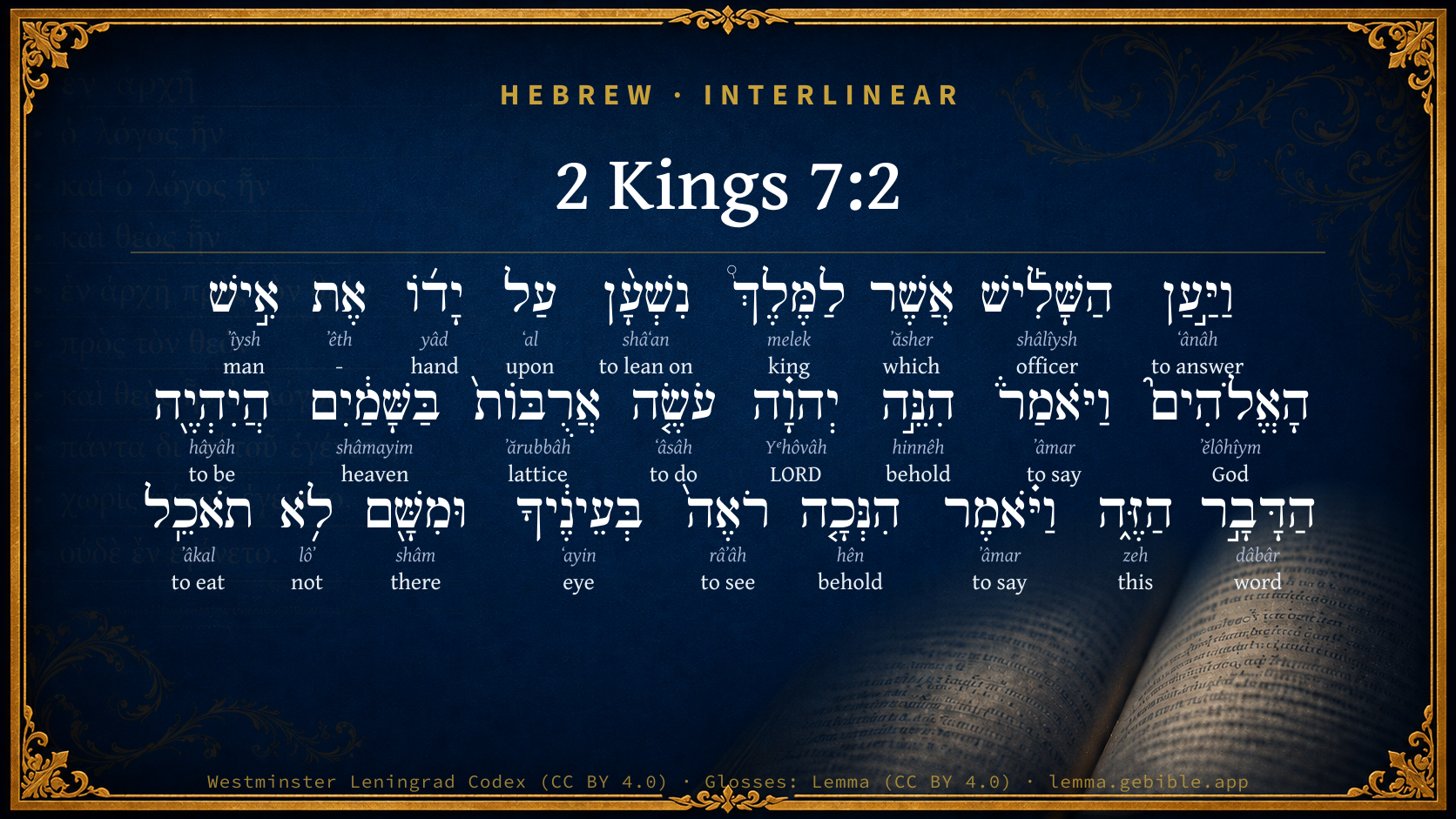
Hebrew (Westminster Leningrad Codex) 2 Kings 7:2 appears in the Hebrew Old Testament. The text above is from the Westminster Leningrad Codex. Each word links to its Strong’s number, a concise gloss, and parsing drawn from the Open Scriptures Hebrew Bible morphology. Click any word for its full Brown-Driver-Briggs (BDB) entry.
Download image
Cite this verse

2 Kings 7:2 (World English Bible). Public Domain. Lemma interlinear Bible study tool, https://lemma.gebible.app/v/2-kings/7/2.

Show BibTeX & RIS
BibTeX
RIS
English Translation
Then the captain on whose hand the king leaned answered the man of God, and said, Behold, if Yahweh should make windows in heaven, might this thing be? He said, Behold, you shall see it with your eyes, but shall not eat of it.
World English Bible · Public Domain
Download a study sheet

One document with this verse’s original text, its word-by-word gloss line, the meaning frame, cross-references with their text, attributed commentary, and full source and license credits — printable, and it pastes into notes with its structure intact.

This verse Autodidact and up

Study sheet (.html) Plain text (.txt)

A passage Seminary Student

Up to 50 verses in one chapter. A passage sheet keeps up to 6 commentary sources and 12 cross-references per verse, in the order this page ranks them, and says so on the sheet whenever that leaves anything out. Ask for a single verse and you get the Autodidact verse sheet above.

Everything on this page stays free to read, with no account — the sheet is a download of what is already on screen, not access to it.

Want to remove ads? Support Godless Engineer
Compare translations 3

The same verse in 3 English versions, stacked beneath the original-language interlinear above. Click any original word for its lexicon entry.

Each is an independent rendering of the whole verse — the interlinear is not word-aligned to these translations.

Highlighted words mark where these versions differ — a whole-verse word diff, not a word-by-word alignment.

  • World English Bible Public Domain
    Then the captain on whose hand the king leaned answered the man of God, and said, Behold, if Yahweh should make windows in heaven, might this thing be? He said, Behold, you shall see it with your eyes, but shall not eat of it.
  • King James Version Public Domain
    Then a lord on whose hand the king leaned answered the man of God, and said, Behold, if the LORD would make windows in heaven, might this thing be? And he said, Behold, thou shalt see it with thine eyes, but shalt not eat thereof.
  • unfoldingWord Literal Text CC BY-SA 4.0
    And the captain who to the king, leaning himself on his hand, answered the man of God and said, “Behold Yahweh, making windows in the heavens, may this thing be?” And he said, “Behold you, seeing with your eyes, but from there you will not eat.”

unfoldingWord Literal Text — © unfoldingWord, licensed CC BY-SA 4.0. Word-aligned USFM3 via Door43 (git.door43.org/unfoldingWord/en_ult).

Versions to compare (up to 4)

3 of 4 selected

Show all 18 translations

Every available English version of this verse, each an independent rendering of the whole verse.

  • World English Bible Public Domain
    Then the captain on whose hand the king leaned answered the man of God, and said, Behold, if Yahweh should make windows in heaven, might this thing be? He said, Behold, you shall see it with your eyes, but shall not eat of it.
  • Berean Standard Bible Public Domain
    But the officer on whose arm the king leaned answered the man of God, “Look, even if the LORD were to make windows in heaven, could this really happen?” “You will see it with your own eyes,” replied Elisha, “but you will not eat any of it.”
  • Majority Standard Bible Public Domain
    But the officer on whose arm the king leaned answered the man of God, “Look, even if the LORD were to make windows in heaven, could this really happen?” “You will see it with your own eyes,” replied Elisha, “but you will not eat any of it.”
  • King James Version Public Domain
    Then a lord on whose hand the king leaned answered the man of God, and said, Behold, if the LORD would make windows in heaven, might this thing be? And he said, Behold, thou shalt see it with thine eyes, but shalt not eat thereof.
  • American Standard Version (1901) Public Domain
    Then the captain on whose hand the king leaned answered the man of God, and said, Behold, if Jehovah should make windows in heaven, might this thing be? And he said, Behold, thou shalt see it with thine eyes, but shalt not eat thereof.
  • Revised Version (1885) Public Domain
    Then the captain on whose hand the king leaned answered the man of God, and said, Behold, if the LORD should make windows in heaven, might this thing be? And he said, Behold, thou shalt see it with thine eyes, but shalt not eat thereof.
  • Geneva Bible (1599) Public Domain
    Then a prince, on whose hande the King leaned, answered the man of God, and saide, Though the Lord would make windowes in the heauen, could this thing come to passe? And he said, Beholde, thou shalt see it with thine eyes, but thou shalt not eate thereof.
  • Douay-Rheims (1899) Public Domain
    Then one of the lords, upon whose hand the king leaned, answering the man of God, said: If the Lord should make hood-gates in heaven, can that possibly be which thou sayest? And he said: Thou shalt see it with thy eyes, but shalt not eat thereof.
  • Young's Literal Translation Public Domain
    And the captain whom the king hath, by whose hand he hath been supported, answereth the man of God and saith, `Lo, Jehovah is making windows in the heavens -- shall this thing be?' and he saith, `Lo, thou art seeing it with thine eyes, and thereof thou dost not eat.'
  • Literal Standard Version CC BY-SA 4.0
    And the captain whom the king has, by whose hand he has been supported, answers the man of God and says, “Behold, YHWH is making windows in the heavens—will this thing be?” And he says, “Behold, you are seeing it with your eyes, and you do not eat thereof.”
  • Unlocked Literal Bible CC BY-SA 4.0
    Then the captain on whose hand the king leaned answered the man of God, and said, “See, even if Yahweh should make windows in heaven, can this thing happen?” Elisha replied, “See, you will watch it happen with your own eyes, but you will not eat any of it.”
  • unfoldingWord Literal Text CC BY-SA 4.0
    And the captain who to the king, leaning himself on his hand, answered the man of God and said, “Behold Yahweh, making windows in the heavens, may this thing be?” And he said, “Behold you, seeing with your eyes, but from there you will not eat.”
  • Darby Bible Public Domain
    And the captain on whose hand the king leaned answered the man of God and said, Behold, if Jehovah should make windows in the heavens, would this thing be? And he said, Behold, thou shalt see it with thine eyes, but shalt not eat thereof.
  • World Messianic Bible Public Domain
    Then the captain on whose hand the king leaned answered the man of God, and said, “Behold, if the LORD made windows in heaven, could this thing be?” He said, “Behold, you will see it with your eyes, but will not eat of it.”
  • Webster's Bible Public Domain
    Then a lord on whose hand the king leaned answered the man of God, and said, Behold, if the LORD would make windows in heaven, might this thing be? And he said, Behold, thou shalt see it with thy eyes, but shalt not eat of it.
  • Free Bible Version CC BY-SA 4.0
    The officer who was the king's assistant said to the man of God, “Look, even if the Lord opened windows in heaven what you say couldn't happen!” Elisha replied, “You'll see it with your own eyes, but you won't get to eat any of it.”
  • Bible in Basic English Public Domain
    Then the captain whose arm was supporting the king said to the man of God, Even if the Lord made windows in heaven, would such a thing be possible? And he said, Your eyes will see it, but you will not have a taste of the food.
  • JPS Tanakh (1917) Public Domain
    Then the captain on whose hand the king leaned answered the man of God, and said: 'Behold, if the LORD should make windows in heaven, might this thing be?' And he said: 'Behold, thou shalt see it with thine eyes, but shalt not eat thereof.'

Literal Standard Version (2020), Covenant Press — licensed CC BY-SA 4.0. Text via the HelloAO Bible API (eBible.org). Unlocked Literal Bible (unfoldingWord) — licensed CC BY-SA 4.0. Text via the HelloAO Bible API (eBible.org). unfoldingWord Literal Text — © unfoldingWord, licensed CC BY-SA 4.0. Word-aligned USFM3 via Door43 (git.door43.org/unfoldingWord/en_ult). Free Bible Version, Dr. Jonathan Gallagher — licensed CC BY-SA 4.0. Text via the HelloAO Bible API (eBible.org).

Word by word

More ways to search: Search by grammar → Find every occurrence → Compare this word →

Practice this passage: Drill this verse → Learn its vocabulary →

אֲרֻבּוֹת֙
ʼărubbâh
H699
“lattices”
Noun, Common, Feminine, Plural, Absolute
Part of Speech
Noun
Type
Common
Gender
Feminine
Number
Plural
State
Absolute
Full BDB Definition

Origin: participle passive of H693 (as if for lurking)

TWOT: 156d

lattice, window, sluice - (CLBL) chimney (lattice opening where smoke escapes)
  1. וַיַּ֣עַן ʻânâh H6030 “and · to answer” Conjunction + Verb, Qal, Sequential Imperfect, 3rd Person, Masculine, Singular
  2. הַשָּׁלִ֡ישׁ shâlîysh H7991 “the · officer” Particle, Definite Article + Noun, Common, Masculine, Singular, Absolute
  3. אֲשֶׁר ʼăsher H834 “which” Particle, Relative
  4. לַמֶּלֶךְ֩ melek H4428 “to/for the · king” Preposition, Determined + Noun, Common, Masculine, Singular, Absolute
  5. נִשְׁעָ֨ן shâʻan H8172 “leaning on” Verb, Niphal, Participle Active, Masculine, Singular, Absolute
  6. עַל ʻal H5921 “upon” Preposition
  7. יָד֜וֹ yâd H3027 “hand · his” Noun, Common, Both, Singular, Construct + Suffix, Personal, 3rd Person, Masculine, Singular
  8. אֶת ʼêth H853 “-” Particle, Direct Object
  9. אִ֣ישׁ ʼîysh H376 “man of” Noun, Common, Masculine, Singular, Construct
  10. הָאֱלֹהִים֮ ʼĕlôhîym H430 “the · God(s)” Particle, Definite Article + Noun, Common, Masculine, Plural, Absolute
  11. וַיֹּאמַר֒ ʼâmar H559 “and · to say” Conjunction + Verb, Qal, Sequential Imperfect, 3rd Person, Masculine, Singular
  12. הִנֵּ֣ה hinnêh H2009 “behold” Particle, Demonstrative
  13. יְהוָ֗ה Yᵉhôvâh H3068 “LORD” Noun, Proper
  14. עֹשֶׂ֤ה ʻâsâh H6213 “doing” Verb, Qal, Participle Active, Masculine, Singular, Absolute
  15. בַּשָּׁמַ֔יִם shâmayim H8064 “in/at the · heaven(s)” Preposition, Determined + Noun, Common, Masculine, Plural, Absolute
  16. הֲיִהְיֶ֖ה hâyâh H1961 “to be” Particle, Interrogative + Verb, Qal, Imperfect, 3rd Person, Masculine, Singular
  17. הַדָּבָ֣ר dâbâr H1697 “the · word” Particle, Definite Article + Noun, Common, Masculine, Singular, Absolute
  18. הַזֶּ֑ה zeh H2088 “the · this” Particle, Definite Article + Pronoun, Demonstrative, Masculine, Singular
  19. וַיֹּ֗אמֶר ʼâmar H559 “and · to say” Conjunction + Verb, Qal, Sequential Imperfect, 3rd Person, Masculine, Singular
  20. הִנְּכָ֤ה hên H2005 “behold · you” Particle, Demonstrative + Suffix, Personal, 2nd Person, Masculine, Singular
  21. רֹאֶה֙ râʼâh H7200 “seeing” Verb, Qal, Participle Active, Masculine, Singular, Absolute
  22. בְּעֵינֶ֔יךָ ʻayin H5869 “in/at · eyes · your” Preposition + Noun, Common, Both, Dual, Construct + Suffix, Personal, 2nd Person, Masculine, Singular
  23. וּמִשָּׁ֖ם shâm H8033 “and · from · there” Conjunction + Preposition + Adverb
  24. לֹ֥א lôʼ H3808 “not” Particle, Negative
  25. תֹאכֵֽל ʼâkal H398 “to eat” Verb, Qal, Imperfect, 2nd Person, Masculine, Singular

About this verse

These counts appear in no published source. They are computed here, from the morphology-tagged text and Lemma’s own curated glosses. What Lemma adds →

26
words
25
distinct lemmas
Historical
section

Notable vocabulary

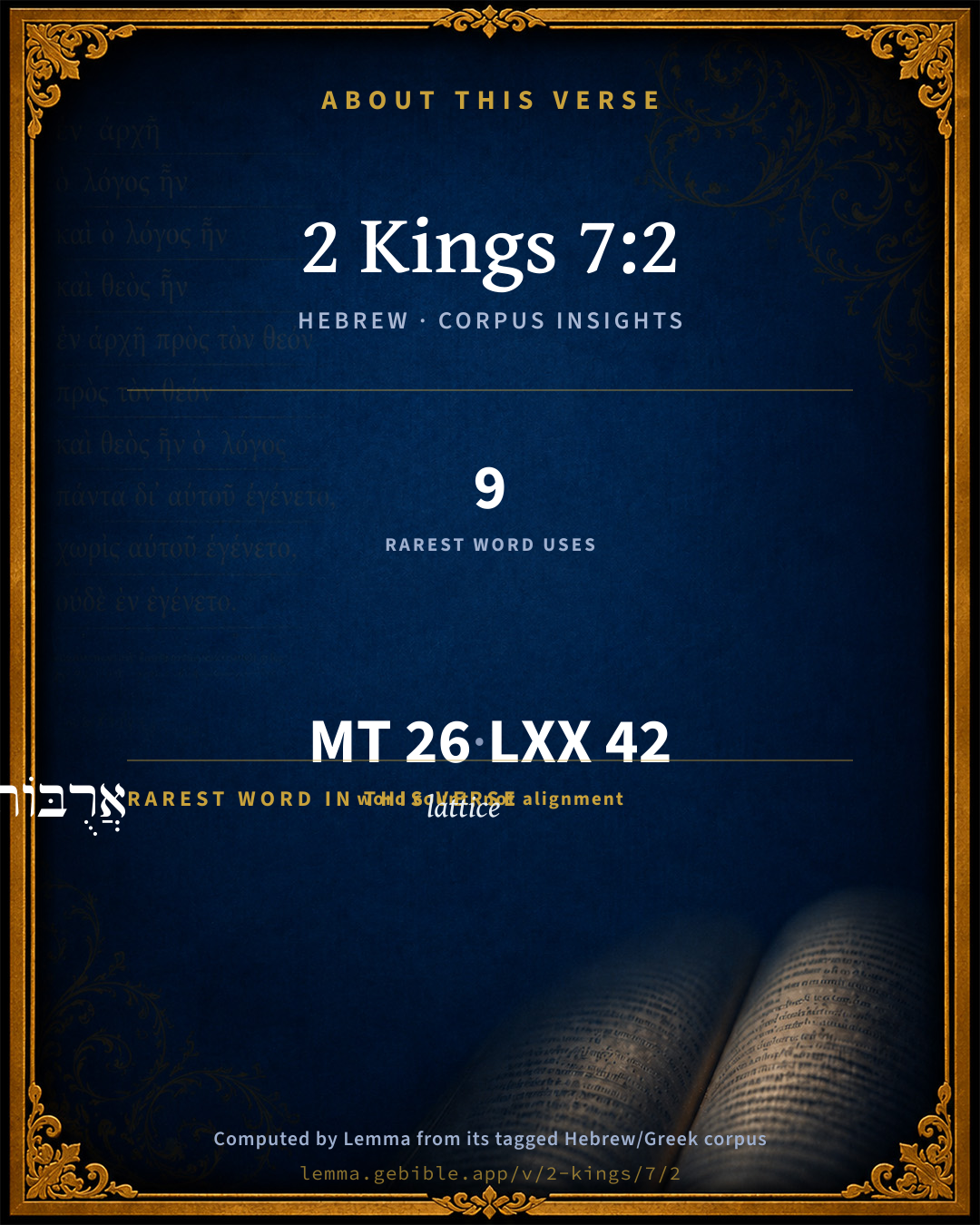
The rarest word here is אֲרֻבּוֹת֙ lattice H699 — appearing just 9 times in the whole Hebrew Bible.

Shared distinctive vocabulary

אֲרֻבּוֹת֙ lattice H699 occurs in 9 verses of the Hebrew Bible. Also found in:

Grammatical profile

  • 8 verbs
  • 10 nouns
  • 1 pronoun
  • 1 preposition
  • 1 adverb
  • 5 particles

Verb forms

  • וַיַּ֣עַן Qal · Sequential Imperfect
  • נִשְׁעָ֨ן Niphal · Participle Active
  • וַיֹּאמַר֒ Qal · Sequential Imperfect
  • עֹשֶׂ֤ה Qal · Participle Active
  • הֲיִהְיֶ֖ה Qal · Imperfect
  • וַיֹּ֗אמֶר Qal · Sequential Imperfect
  • רֹאֶה֙ Qal · Participle Active
  • תֹאכֵֽל Qal · Imperfect

Repetition

A word recurs within this verse — often emphatic in Hebrew:

  • וַיֹּאמַר֒ to say H559 ×2

Hebrew & Septuagint length

In English translation the verse runs 44 words from the Hebrew and 41 from the Septuagint (LXX English) — closely comparable.

A rough comparison of the two English renderings, which tokenize alike — not a word-level alignment.

Word counts can differ between the Hebrew and the Greek without any difference in meaning — e.g. the Hebrew direct-object marker אֵת has no separate Greek word, and Greek often adds the article ὁ.

In the original languages it is 26 Hebrew tokens and 42 Greek tokens — but the two are counted differently (Hebrew bundles its prefixes and suffixes into one token; the Greek is in lemma form), so that isn’t a like-for-like length.

Cross-references

14

Topical passages linked to 2 Kings 7:2 in the Treasury of Scripture Knowledge — connected by theme and wording, ordered by reader-vote popularity; previews shown in the World English Bible.

  • Genesis 7:11 In the six hundredth year of Noah's life, in the second month, on the seventeenth day of the month, on the same day all the fountains of the great deep were burst open, and the sky's windows were opened.
  • Genesis 18:12–14 Sarah laughed within herself, saying, "After I have grown old will I have pleasure, my lord being old also?"
  • Malachi 3:10 Bring the whole tithe into the store-house, that there may be food in my house, and test me now in this," says Yahweh of hosts, "if I will not open you the windows of heaven, and pour you out a blessing, that there shall not be room enough for.
  • Psalms 78:41 They turned again and tempted God, And provoked the Holy One of Israel.
  • Romans 3:3 For what if some were without faith? Will their lack of faith nullify the faithfulness of God?
  • 2 Timothy 2:13 If we are faithless, He remains faithful. He can't deny himself.
  • Numbers 11:21–23 Moses said, The people, among whom I am, are six hundred thousand footmen; and you have said, I will give them flesh, that they may eat a whole month.
  • 2 Kings 5:18 In this thing Yahweh pardon your servant: when my master goes into the house of Rimmon to worship there, and he leans on my hand, and I bow myself in the house of Rimmon, when I bow myself in the house of Rimmon, Yahweh pardon your servant in this thing.
  • 2 Chronicles 20:20 They rose early in the morning, and went forth into the wilderness of Tekoa: and as they went forth, Jehoshaphat stood and said, Hear me, Judah, and you inhabitants of Jerusalem: believe in Yahweh your God, so shall you be established; believe his prophets, so shall you prosper.
  • Psalms 78:19–21 Yes, they spoke against God. They said, "Can God prepare a table in the wilderness?
  • Isaiah 7:9 and the head of Ephraim is Samaria, and the head of Samaria is Remaliah's son. If you will not believe, surely you shall not be established.'"
  • Hebrews 3:17–19 With whom was he displeased forty years? Wasn't it with those who sinned, whose bodies fell in the wilderness?
  • Deuteronomy 3:27 Go up to the top of Pisgah, and lift up your eyes westward, and northward, and southward, and eastward, and see with your eyes: for you shall not go over this Jordan.
  • 2 Kings 7:17–20 The king appointed the captain on whose hand he leaned to have the charge of the gate: and the people trod on him in the gate, and he died as the man of God had said, who spoke when the king came down to him.

Cross-references courtesy of OpenBible.info (CC BY 4.0).

Hebrew and Greek witnesses Masoretic Hebrew ↔ Greek Septuagint

The same verse in the two great witnesses to the Old Testament, shown verse-for-verse.

These are two independent witnesses, not word-aligned to each other, and the Septuagint is shown in lemma (dictionary) form.

Hebrew 2 Kings 7:2 Masoretic · Westminster Leningrad Codex

וַיַּ֣עַן הַשָּׁלִ֡ישׁ אֲשֶׁר לַמֶּלֶךְ֩ נִשְׁעָ֨ן עַל יָד֜וֹ אֶת אִ֣ישׁ הָאֱלֹהִים֮ וַיֹּאמַר֒ הִנֵּ֣ה יְהוָ֗ה עֹשֶׂ֤ה אֲרֻבּוֹת֙ בַּשָּׁמַ֔יִם הֲיִהְיֶ֖ה הַדָּבָ֣ר הַזֶּ֑ה וַיֹּ֗אמֶר הִנְּכָ֤ה רֹאֶה֙ בְּעֵינֶ֔יךָ וּמִשָּׁ֖ם לֹ֥א תֹאכֵֽל

Then the captain on whose hand the king leaned answered the man of God, and said, Behold, if Yahweh should make windows in heaven, might this thing be? He said, Behold, you shall see it with your eyes, but shall not eat of it.

World English Bible · Public Domain

Greek LXX 2 Kings 7:2 Septuagint · lemma form

καί ἀποκρίνω ὁ τριστάτης ἐπί ὅς ὁ βασιλεύς ἐπι ἀναπαύω ἐπί ὁ χείρ αὐτός ὁ ελισαιε καί εἶπον ἰδού ποιέω κύριος καταρράκτης ἐν οὐρανός μή εἰμί ὁ ῥῆμα οὗτος καί ελισαιε εἶπον ἰδού σύ ὁράω ὁ ὀφθαλμός σύ καί ἐκεῖθεν οὐ ἐσθίω

And the officer on whose hand the king rested, answered Elisaie, and said, Behold, if the Lord shall make flood-gates in heaven, might this thing be? and Elisaie said, Behold, you shall see with your eyes, but shall not eat thereof.

LXX2012 (modern English Septuagint) · Public Domain

On this verse, John Gill's Exposition discusses the Septuagint’s reading. Read the note in Commentary ↓

Hebrew: Westminster Leningrad Codex (CC BY 4.0). Greek: Septuagint (public domain); English from LXX2012 (modern English Septuagint) (Public Domain). How the Septuagint differs from the Hebrew →

Targum (Aramaic paraphrase)

1

The Targum is the ancient Jewish Aramaic paraphrase of the Hebrew Scriptures — an interpretive translation, not the Hebrew text itself. Onkelos (literal) and Pseudo-Jonathan (expansive) render the Torah, and Jonathan the Prophets. Coverage is partial: where no permissively-licensed English translation exists for a verse, only the Aramaic is shown. This is verse-level text, not a word-by-word alignment to the Hebrew.

  1. Targum Jonathan Prophets (Joshua–Malachi)
    וַאֲתֵיב גִבָּרָא דְמַלְכָּא דְסָמִיךְ עַל יְדוֹהִי יַת נְבִיָא דַייָ וַאֲמַר אִילוּ יְיָ פְּתַח כַּוִין וּמָחִית טוּבָא מִן שְׁמַיָא הַיְהֵי פִּתְגָמָא הָדֵין וַאֲמַר הָא אַתְּ חָזֵי בְּעֵינָךְ וּמִתַּמָן לָא תֵיכוֹל:

    (no public-domain English translation for this verse)

    Targum Jonathan — Aramaic: “Mikraot Gedolot” (public domain). English: “Sefaria Community Translation” (CC0 1.0 (public-domain dedication)); “London "Chaldee Paraphrase," 1871” (public domain). Text via Sefaria.

Commentary

Notes on 2 Kings 7:2 from classic Christian and Jewish commentators (each source and its license shown beneath its notes). The classic Christian expositions comment on the surrounding passage and are grouped to its opening verse, so a note may address several verses; the Jewish commentaries on the Tanakh (Rashi and others) are per-verse, so they appear only where the commentator wrote on this verse.

Lemma curates 59 commentaries, every one of them public domain or Creative Commons licensed, each selected and text-cleaned for this edition rather than reprinted as found. About our sources →

Trapp's Complete Commentary

John Trapp

2Ki 7:2 Then a lord on whose hand the king leaned answered the man of God, and said, Behold, [if] the LORD would make windows in heaven, might this thing be? And he said, Behold, thou shalt see [it] with thine eyes, but shalt not eat thereof.

Ver. 2. Behold, if the Lord would make windows.] If he should rain down corn, as once he did manna. Thus he questioned not only the prophet’s truth, but also God’s power, like as those of old did, who said, "Can God prepare a table for us in the wilderness?" &c.

John Trapp, A Commentary or Exposition upon All the Books of the Old and New Testament (1647–1656) — public domain. Text from a community e-Sword module.

The Biblical Illustrator

Joseph S. Exell

2Ki_7:2

Then a lord on whose hand the king leaned, answered the man of God.

Rationalism

Around Samaria is drawn the fiery girth of Assyrian vindictiveness. Siege is laid to the city, and soon famine, most ghastly and horrible, appears. In the modern bombardment of a city, there is a grandeur mingled with the terror. The toss and burst of a bomb-shell kindles the eye of the artist, while the citizens perish. But there is no imagining the desolation of a city approached by an old-time siege, through years of starvation. The judgment-day only can reveal the anguish endured when Hamilcar besieged Utica, and Titus Jerusalem. Alas, for Samaria! What a crowd of hollow-eyed and staggering wretches filled the streets, crying for bread. So great was the scarcity of food that an asss head was sold for twenty-five dollars. Mothers cooked their children, and fought for the disgusting fragments. And still hunger pinched and drank up the life of the great city and lifted its wolfish howl in the market-place, and shovelled its victims into the grave. In the midst of all this, Elisha, in the name of God, said, Tomorrow the famine will be gone, and you will get a peck of flour for five shillings. A nobleman, who was the confidential friend of the king, stood by and laughed at the idea. He said, If a window shutter could be opened in the sky, and a lot of corn pitched out, you might expect it. Hal ha! you silly prophet; you cannot fool me! The prophet replied to the taunt by saying, Behold, thou shalt see it with thine eyes, but shalt not eat thereof. Before we come to the more cheerful phase of the subject, let us attend the funeral of that scoffer who was trod on in the gates. The obsequies shall be brief, for we have not much respect for him. I knew him well. You all knew him. He was an out-and-out Rationalist. Elisha, at Gods command, had prophesied plenty of fine flour on the morrow. Preposterous! said the sceptical nobleman. Where is it to come from? Why, every hole and corner of the city has been ransacked for flour. We have eaten up the horses. There is no prospect that the Assyrians will lift the siege; and yet, Elisha, you insult my common sense, and my reason, by telling me that to-morrow the market will be glutted with bread supplies. Away with your nonsense! Yet, notwithstanding it seemed unreasonable, the fine flour came; and, because of his unbelief, the Rationalist of Samaria perished. At this point the great battle of Christianity is to be fought. The great foe of Christianity to-day is Rationalism, that comes out from our schools, and universities, and magazines, and newspapers, to scoff at Bible truth, and caricature the old religion of Jesus. It says, Jesus is not God, for it is impossible to explain how He can be Divine and Human at the same time. The Bible is not inspired, for there are in it things that they dont like. Regeneration is a farce; there is good enough in us, and the only thing is to bring it out. Development is the word--development. What is still more alarming, is that Christian men dare not meet this ridicule. Christian men try to soften the Bible down to suit the sceptics. The sceptics sneer at the dividing of the Red Sea, and the Christian goes to explaining that the wind blew a hurricane from one direction a good while until all the water piled up; and, besides that, it was low water, anyhow, and so the Israelites went through without any trouble. Why not be frank, and say, I believe the Lord God Almighty came to the brink of the Red Sea, and with His right arm swung back the billows on the right side, and with His left arm swung back the billows on the left side; and the abashed water stood up hundreds of feet high, while through their glassy walls the sea-monsters gazed with affrighted eyes on the passing Israelites? Oh, you say, these Rationalists would laugh at me. Then let them laugh. The Samaritan sceptic laughed at Elisha; but when, under the rush of the people to get their bread, the unbeliever was trampled to death, whose turn was it to laugh then? The moment you begin to explain away the miraculous and supernatural, you surrender the Bible. Compromise nothing! Trim off nothing to please the sceptics. If you cannot stand the jeer of your business friends you are not worthy to be one of Christs disciples. You can afford to wait. The tide will turn. Gods Word will be vindicated; and though it may seem to be against the laws of nature and the rules of reason, to-morrow a measure of fine flour will be sold for a shekel; and then as the people rush out of the gates to get the bread, alas, for the Rationalist! he will be trodden under foot, and will go down to shame and everlasting contempt. You know that all the nations are famine struck by sin. They are dying for bread. Here comes through the gates a precious supply--not one loaf, but an abundance for all; pardon for all, strength for all, sympathy for all comfort for all! Will you have this bread that came down from heaven and which, if a man eat, he shall never hunger? Glorious gospel! So wide in its provisions. Whosoever! Mark you that God stopped Samarias famine, not with coarse meal, but, the text says, with fine flour. So the Bread of Life, with which God would appease our hunger, is made of the best material. Jesus was fine in His life, fine in His sympathies, fine in His promises. It means no coarse supply when Jesus offers Himself to the people saying, I am the Bread of Life.--Fine flour for a shekel. That day when the gates of Samaria were opened, why did they make such excitement about the flour? Why did they not bring in some figs, or pastry, or fragrant bouquets instead? The people would have run down the bouquets, and thrown away the figs, and trampled upon the pastry in the rush for bread. Effort has been made to feed those spiritually dying with the poesies or rhetoric, and the confectionary of sentimentalism. Our theology has been sweetened and sweetened until it is as sweet as ipecacuanha, and as nauseating to the regenerated soul. What the people need is bread, just as God mixes it--unsweetened, plain, homely, unpretending, yet life-sustaining bread. (T. De Witt Talmage, D. D.)

Presumptiveness of unbelief

What surprises me, what stumbles me, what frightens me, is to see a diminutive creature, a little ray of light glimmering through a few feeble organs, controvert a point with the Supreme Being; oppose the Intelligence that sitteth at the helm of the world; question what He affirms, dispute what He determines, appeal from His decisions, and, even after God has given evidence, reject all doctrines that are beyond his capacity! Enter into thy nothingness, mortal creature! What madness animates thee? How darest thou pretend, thou who art but a point, thou whose essence is but an atom, to measure thyself with the Supreme Being--with Him whom the heaven of heavens could not contain? (J. Saurin.)

A Divine teacher and a haughty sceptic

Here are two objects not only to be looked at, but to be studied:--

I. A divine teacher. Two circumstances connected with this promise will apply to the Gospel.

1. It was a communication exactly suited to the condition of those to whom it was addressed. People were starving, and the one great necessity was food, and here it is promised. Mankind are morally lost, what they want is spiritual restoration, and the Gospel proclaims it.

2. It was a communication made on the authority of the Eternal. Thus saith the Lord. That the Gospel is a Divine message is a truth too firmly established even to justify debate.

II. A haughty sceptic. Here is one of the most contemptible of all classes of men, a courtier, a sycophant in relation to his king, a haughty despot in regard to all beneath him. When he heard the prophets deliverance, he, forsooth, was too great a man, and thought himself, no doubt, too great a philosopher to believe it. It was the mans Self importance that begot his incredulity, and this perhaps is the parent of all scepticism and unbelief. (Homilist.)

The sin of unbelief

One wise man may deliver a whole city; one good man may be the means of safety to a thousand others. The holy ones are the salt of the earth, the means of the preservation of the wicked. Without the godly as a conserve, the race would be utterly destroyed. In the city of Samaria there was one righteous man--Elisha, the servant of the Lord. Piety was altogether extinct in the court. The king was a sinner of the blackest dye, his iniquity was glaring and infamous. Jehoram walked in the ways of his father Ahab, and made unto himself false gods. The people of Samaria were fallen like their monarch. In this awful extremity the one holy man was the medium of salvation. The one grain of salt preserved the entire city; the one warrior for God was the means of the deliverance of the whole beleaguered multitude. To-morrow, would they shout, to-morrow our hunger shall be over, and we shall feast to the full. However, the lord on whom the king leaned expressed his disbelief. We hear not that any of the common people, the plebeians, ever did so; but an aristocrat did it. Strange it is, that God has seldom chosen the great men of this world. High places and faith in Christ do seldom well agree. This great man said, Impossible! and, with an insult to the prophet, he added, If the Lord should make windows in heaven, might such a thing be. His sin lay in the fact that, after repeated seals of Elishas ministry, he yet disbelieved the assurances uttered by the prophet on Gods behalf. He had, doubtless, seen the marvellous defeat of Moab; he had been startled at tidings of the resurrection of the Shunam-mites son; he knew that Elisha had revealed Benhadads secrets and smitten his marauding hosts with blindness; he had seen the bands of Syria decoyed into the heart of Samaria.

I. The sin. His sin was unbelief. He doubted the promise of God. In this particular case unbelief took the form of a doubt of the Divine veracity, or a mistrust of Gods power. Either he doubted whether God really meant what He said, or whether it was within the range of possibility that God should fulfil His promise. Unbelief hath more phases than the moon, and more colours than the chameleon. Common people say of the devil, that he is seen sometimes in one shape, and sometimes in another. I am sure this is true of Satans firstborn child--unbelief, for its forms are legion. At one time I see unbelief dressed out as an angel of light. It calls itself humility, and it saith, I would not be presumptuous; I dare not think that God would pardon me; I am too great a sinner. It is the devil dressed as an angel of light; it is unbelief after all. A fearful form of unbelief is that doubt which keeps men from coming to Christ; which leads the sinner to distrust the ability of Christ to save him, to doubt the willingness of Jesus to accept so great a transgressor. But the most hideous of all is the traitor, in its true colours, blaspheming God, and madly denying His existence. Infidelity, deism, and atdeism are the ripe fruits of this pernicious tree; they are the most terrific eruptions of the volcano of unbelief. Unbelief hath become of full stature, when quitting the mask and laying aside disguise, it profanely stalks the earth, uttering the rebellious cry, No God, striving in vain to shake the throne of the divinity, by lifting up its arm against Jehovah. I am astonished, and I am sure you will be, when I tell you that there are some strange people in the world who do not believe that unbelief is a sin. Strange people I must call them, because they are sound in their faith in every other respect; only, to make the articles of their creed consistent, as they imagine, they deny that unbelief is sinful.

1. And first the sin of unbelief will appear to be extremely heinous when we remember that it is the parent of every other iniquity. There is no crime which unbelief will not beget. I think that the fall of man is very much owing to it. It was in this point that the devil tempted Eve.

2. Unbelief not only begets, but fosters sin. If man did but believe that the law is holy, that the commandments are holy, just, and good, how he would be shaken over hells mouth; there would be no sitting, and sleeping in Gods house; no careless hearers; no going away and straightway forgetting what manner of men ye are. Oh! once get rid of unbelief, how would every ball from the batteries of the law fall upon the sinner, and the slain of the Lord would be many. Again, how is it that men can hear the wooings of the Cross of Calvary, and yet come not to Christ? What is the reason? Because there is unbelief between you and the Cross. If there were not that thick veil between you and the Saviours eyes, His looks of love would melt you. But unbelief is the sin which keeps the power of the Gospel from working in the sinner., and it is not till the Holy Ghost strikes that unbelief out, it is not till the Holy Spirit rends away that infidelity and takes it altogether down, that we can find the sinner.

3. Unbelief disables a man for the performance of any good work. Whatsoever is not of faith is sin, is a great truth in more senses than one. Without faith it is impossible to please God. Faith fosters every virtue; unbelief murders every one. Thousands of prayers have been strangled in their infancy by unbelief. Unbelief has been guilty of infanticide; it has murdered many an infant petition; many a song of praise that would have swelled the chorus of the skies has been stifled by an unbelieving murmur; many a noble enterprise conceived in the heart has been blighted ere it could come forth, by unbelief. Many a man would have been a missionary; would have stood and preached his Masters Gospel boldly; but he had unbelief. Once make a giant unbelieving, and he becomes a dwarf.

4. Our next remark is--unbelief has been severely punished. Turn you to the Scriptures, I see a world all fair and beautiful; its mountains laughing in the sun, and the fields rejoicing in the golden light. I see maidens dancing, and young men singing. How fair the vision! But lo! a grave and reverend sire lifts up his hand, and cries, A flood is coming to deluge the earth-the fountains of the great deep will be broken up, and all things will be covered See yonder ark. One hundred and twenty years have I toiled with these my hands to build it; flee there, and you are safe. Aha! old man; away with your empty predictions! Aha! let us be happy while we may! when the flood comes, then we will build an ark; but there is no flood coming; tell that to fools; we believe no such things. See the unbelievers pursue their merry dance. Hark! Unbeliever. Dost thou not hear that rumbling noise? Earths bowels have begun to move, her rocky ribs are strained by dire convulsions from within; lo! they break with the enormous strain, and forth from between them torrents rush unknown since God concealed them in the bosom of our world. Heaven is split in sunder! it rains. Not drops, but clouds descend. A cataract, like that of old Niagara, rolls from heaven with mighty noise. Both firmaments, both deeps--the deep below and the deep above--do clasp their hands. Now, unbelievers, where are you now? There is your last remnant. A man--his wife clasping him round the waist--stands on the last summit that is above the water. See him there! The water is up to his loins even now. Hear his last shriek! He is floating--he is drowned. And as Noah looks from the ark he sees nothing. Nothing! It is a void profound. Sea monsters whelp and stable in the palaces of kings. All is overthrown, covered, drowned. What hath done it? What brought the flood upon the earth? Unbelief. By faith Noah escaped from the flood. By unbelief the rest were drowned.

5. And now you will observe the heinous nature of unbelief in this--that it is the damning sin. There is one sin for which Christ never died; it is the sin against the Holy Ghost. There is one other sin for which Christ never made atonement. Mention every crime in the calendar of evil, and I will show you persons who have found forgiveness for it. But ask me whether the man who died in unbelief can be saved, and I reply there is no atonement for that man.

II. Conclude with the punishment. Thou shalt see it with thine eyes, but shalt not eat thereof. It is so often with Gods own saints. When they are unbelieving, they see the mercy with their eyes, but do not eat it. Now, here is corn in this land of Egypt; but there are some of Gods saints who come here on the Sabbath, and say, I do not know whether the Lord will be with me or not. Some of them say, Well, the Gospel is preached, but I do not know whether it will be successful. They are always doubting and fearing. Listen to them when they get out. Well, did you get a good meal this morning? Nothing for me. Of course not. Ye could see it with your eyes, but did not eat it, because you had no faith. If you had come up with faith, you would have had a morsel. But, let me apply this chiefly to the unconverted. They often see great works of God done with their eyes, but they do not eat thereof. A crowd of people have come here this morning to see with their eyes, but I doubt whether all of them eat. (C. H. Spurgeon.)

Faith taunted

In this comparatively trifling event we see the end of the whole economy of nature as we know it. Tragical facts have overpowered us, have indeed almost blinded us as to the possibility of spiritual presences being in the universe, and we have said deliverance is impossible, and out of all this chaos God Himself could scarcely bring order. Looking upon the nations of the earth with their moral darkness, their barbarities, idolatries, cruelties, superstitions; observing how men hate one another, and delight in the shedding of blood; studying the whole map and plan of wickedness all but infinite, we have again and again said, though the Lord should open the windows of heaven--though the Lord should come in all His great might, yet surely this chaos could not be brought into order and peace even by the voice of Omnipotence. Looking upon the Cross of Jesus Christ as the medium of the salvation of the world, we have not wondered that men should account it foolishness. There seems to be no proportion between the cause and the effect, the means and the end. To the last, men passing by the cross shall wag their heads, and say to him who expires upon it, If Thou be the king or Saviour of the world, save Thyself, and come down. We are quite aware that the scoffer has an ample ground for mockery, if attention be limited by visible boundaries. It is not surprising that gibers should taunt believers, and that the prophets of Baal should turn round upon the Elijahs of the world, and in their turn enjoy the use of ironical appeal, saying, Cry aloud to your Christ, for he is king of the Jews; cry mightily to his God in heaven, for he has espoused him as his father; pray on still,--perhaps if you are not answered in the morning, you may be answered at night; cry lustily with growing energy to the supposed God of the heavens, and let him come out in reply if he can. We must submit to the taunt for the present. In our impatience we desire a manifest and decisive answer, yet all things proceed calmly as they were from the beginning. But our faith has been sustained by a doctrine corresponding to the prophecy,--namely, the Lord is not slack concerning His promise, as some men count slackness: for a thousand years are in his sight as one day, and one day as a thousand years. We are the victims of miscalculated time. We do not know the meaning of to-day or to-morrow: my soul, wait thou upon God; yea, wait patiently for Him, and comfort thyself with the truth that things are not what they seem: that immediately after human extremity there arises a light in heaven, and that in the midday of despair angels are sent with special messages from God. (J. Parker, D. D.)

The Biblical Illustrator, edited by Joseph S. Exell (c. 1880s–1900s) — public domain. Text from a community e-Sword module.

Joseph Benson's Commentary

2Ki 7:2. A lord on whose hand the king leaned — When he walked; said, Behold, if the Lord would make windows in heaven — Through which he should rain down corn, as once he did manna; might this thing be? — He could not conceive, considering the prodigious famine that then reigned in Samaria, and their being surrounded by a powerful army, that it was possible there should be such a change wrought by any means in a few hours, as that there should be such plenty to-morrow, where there was such want and distress to-day. He judged, as we too generally do, according to the visible appearance of natural and instrumental causes, and did not consider that with God all things are possible. Thou shalt see it with thine eyes, but shalt not eat thereof — A just punishment for his unbelief, by which he made not only the prophet, but God himself, (in whose name Elisha had long given full proof that he spoke and acted,) a liar. Here we see, as we have often seen elsewhere, that unbelief of God’s declarations and promises is a sin whereby men both greatly displease him, and deprive themselves of the favours he designed for them. The murmuring Israelites saw Canaan, but could not enter in because of unbelief. “Such,” says Bishop Patrick, “will be the portion of those who believe not the promise of eternal life; they shall see it at a distance, but never taste it.” Take care, reader, that this be not thy case! that a promise being left thee of entering into his rest, thou do not fall short of it.

Joseph Benson's Commentary on the Old and New Testaments (1811–1818) — public domain. Text from a community e-Sword module.

Tyndale Open Study Notes

Tyndale Open Resources

7:2 The disbelief of Joram’s officer would cause him to miss God’s blessings.

Tyndale Open Study Notes — © Tyndale Open Resources, licensed CC BY-SA 4.0. Text via the HelloAO Bible API.

Geneva Bible (1599)

Geneva Bible translators

Thy infidelity shall be punished herein when thou shalt see this miracle, and yet not be partaker thereof.

To whom the king gave the charge and oversight of things, as verse 17.

He mocked at the Prophet’s words, saying, that if God rained down corn from heaven, yet this could not come to pass.

Geneva Bible (1599) marginal notes — public domain. Text via Bolls.life.

Jamieson, Fausset & Brown

Robert Jamieson, A. R. Fausset & David Brown

a lord on whose hand the king leaned--When an Eastern king walks or stands abroad in the open air, he always supports himself on the arm of the highest courtier present.

if the Lord would make windows in heaven--The scoffing infidelity of this remark, which was a sneer against not the prophet only, but the God he served, was justly and signally punished (see Kg2 7:20).

Jamieson, Fausset & Brown — Commentary Critical and Explanatory on the Whole Bible (1871) — public domain (CC PDM 1.0). Text via the HelloAO Bible API.

Adam Clarke's Commentary

Verse 2. Then a lord] שליש shalish. This word, as a name of office, occurs often, and seems to point out one of the highest offices in the state. So unlikely was this prediction to be fulfilled, that he thought God must pour out wheat and barley from heaven before it could have a literal accomplishment.

But shalt not eat thereof.] This was a mere prediction of his death, but not as a judgment for his unbelief; any person in his circumstances might have spoken as he did. He stated in effect that nothing but a miracle could procure the plenty predicted, and by a miracle alone was it done; and any person in his place might have been trodden to death by the crowd in the gate of Samaria.

Adam Clarke's Commentary on the Bible (1810–1826) — public domain. Text from a community e-Sword/MySword module.

Ellicott's Commentary for English Readers

(2) Then a lord.—And the adjutant (shâlîsh: comp. 2Sa_23:8; 1Ki_9:22; 1Ch_11:11), or aide-de-camp or esquire (equerry).

On whose hand . . . leaned.—Comp. the similar expression in reference to Naaman (2Ki_5:18).

Leaned.—Was leaning.

Behold, if the Lord . . . this thing be?—This may be correct. Even granting the very unlikely supposition that Jehovah is about to make windows (Gen_7:11) in the sky, to rain down supplies through them, the promised cheapness of provisions can hardly ensue so soon. Or we may render, “Behold, Jehovah is going to make windows in the sky [i.e., to pour down provisions upon us]. Can this thing come to pass?” In any case, the tone is that of scoffing unbelief. Reuss renders, with French point, “Voyez donc. Iaheweh en fera pleuvoir! Est ce que c’est chose possible?”

Behold, thou shalt see.—Literally, Behold, thou art about (i.e., destined) to see. Elisha partly imitates the speech of the scoffer, which begins in the Hebrew with “Behold, Jehovah is about to make windows.” (Comp. 2Ki_5:26.)

A Bible Commentary for English Readers, edited by Charles John Ellicott (1878–1897) — public domain. Text from a community e-Sword module.

The Cambridge Bible for Schools and Colleges

gen. ed. J. J. S. Perowne

2. Then a lord] R.V. the captain. This is the usual rendering except in this narrative. The same change is made by R.V. in verses 17 and 19. The word is originally the title of some military officer. Hence the greater fitness of ‘captain’.

on whose hand the king leaned] For the expression cf. 2Ki_5:18, where Naaman describes himself as attending in this capacity. By taking the hand of any one as they walked by their side royal persons shewed their friendship and confidence.

Behold, if the Lord would [R.V. should] make windows in heaven] There is no mark of the hypothesis in the Hebrew, as is shewn by the italic ‘if’ of A.V. But the sense is hypothetical. Literally the words are ‘Behold the Lord [is] making &c.’ This is said in derision. Almost as if the captain had said, ‘I suppose then the Lord is going to make &c.’ and then he follows his scorn with a question. ‘Even then, could [R.V. might] this thing be?’ For ‘windows of heaven’ cf. Gen_7:11.

thou shalt see it with thine eyes] The answer to this mocking captain would be as hard for him to comprehend as was the promise of abundance which he was deriding. He, a person in close attendance on the king, to see the store which was promised and not partake of it was inconceivable. Doubtless his mockery grew louder still.

The Cambridge Bible for Schools and Colleges (gen. ed. J. J. S. Perowne; Cambridge University Press, 1878–1918) — public domain. Text from a community e-Sword module.

John Gill's Exposition

Then a lord, on whose hand the king leaned,.... Not figuratively, in whom the king confided, but literally, on whose hand he rested, and by whom he was supported, being a form and matter of state, while he and Elisha were talking together, or on whom he leaned as he came to him; this was a principal lord, the third to the king, as his title seems to denote; the word by which the Septuagint renders it is by Suidas (u) interpreted of such that held three spears in the hand together; and this was an honourable post, for a king to lean on him; such state was used by the king of Syria, Kg2 5:18 and by the kings and queens of Persia; so Gorionides (w) says of Esther, that on the third day; she put on her beautiful garments and glorious ornaments, and took two of her maidens with her, and put her right hand on one of them, and leaned upon her in a royal manner, or as was the manner of kings: the same

answered the man of God; the prophet of the Lord, as the Targum:

and said, behold, if the Lord would make windows in heaven, might this thing be? it is impossible it should be, if he was to open the windows of heaven as at the flood, and let down showers of wheat and barley, in like manner as he rained manna in the wilderness:

and he said; the prophet in reply to him:

behold, thou shalt see it with thine eyes, but shalt not eat thereof; wheat and barley sold at the above price, but should not taste of it, as a punishment of his unbelief.

(u) In voce (w) Heb. Hist. l. 2. c. 4.

John Gill's Exposition of the Whole Bible (1746–1763) — public domain (CC PDM 1.0). Text via the HelloAO Bible API.

Albert Barnes' Notes on the Bible

A lord - Rather, “the captain,” as in Exo 14:7; 1Ki 9:22; etc. The term itself, שׁלישׁ shâlı̂ysh (derived from שׁלושׁ shâlôsh, “three,”) may be compared with the Latin “tribunus.”

Windows - Rather, “sluices” (compare Gen 7:11). The “lord” means to say “If Yahweh were to open sluices in heaven, and pour down grain as He poured down rain in the time of the Deluge, even then could there be such abudnance as thou speakest of?”

Albert Barnes' Notes on the Bible (1834–1885) — public domain. Text from a community e-Sword/MySword module.

Haydock's Catholic Bible Commentary

Lords. Hebrew shalish, "an officer" of the first rank, Exodus xiv. 7. Septuagint Greek: tristates, which Josephus explains of one who "commands a third part of the army." (Calmet) --- Flood-gates. If corn should fall with the same abundance as water does from the cataracts of the Nile; or, Hebrew, "if the Lord should make windows," &c., to pour it down, (Calmet) could it possibly be so cheap? (Menochius) --- Thereof. Thus his incredulity was punished, ver. 17. (Salien) --- Reason must not pretend to reach the power of God, but ought to believe what he says. (Worthington)

George Leo Haydock (1774–1849), Haydock's Catholic Family Bible and Commentary, 1859 edition — public domain. Excludes Psalms (Douay-Rheims chapter numbering differs from Protestant) and Deuterocanonical books (Catholic canon only).

Matthew Poole's English Annotations

On whose hand the king leaned, when he walked. See 2Ki 5:18.

If the Lord would make windows, through which he could rain down corn, as once he did manna.

Shalt see it with thine eyes, but shalt not eat thereof; a just punishment for such peremptory unbelief, whereby he made not only the prophet, but even God himself, (in whose name it was evident Elisha said and did this and other things,) a liar.

Matthew Poole's English Annotations on the Holy Bible (1683–1685) — public domain. Text from a community e-Sword/MySword module.

Whedon's Commentary on the Bible

Daniel D. Whedon

2. A lord on whose hand the king leaned — Rather, the lord. שׁלישׁ, third man, was the name of one of the highest officers of state, and one of the nearest attendants upon his person. He was to the king of Israel what Naaman was to the king of Syria — prime minister. See 2Ki_5:18.

If the Lord — Literally, Behold, Jehovah making windows in heaven! Can this thing be? It is the language of scornful unbelief. The prime minister looks upon the thing foretold as a sheer impossibility, and treats the prophet’s words with contemptuous scorn. Only think, he says, of Jehovah opening the heavens and showering down meal and grain! Can such a thing be?

Thou shalt see… but shalt not eat — How this came to pass is told in 2Ki_7:17-20. Such scornful unbelief deserved a signal punishment.

Daniel D. Whedon (gen. ed.), Commentary on the Old and New Testaments (1874–1909) — public domain. Text from a community e-Sword module.

The Pulpit Commentary

Then a lord on whose hand the king leaned; rather, the lord, or the captain, as the word vylv is commonly translated (Exo_14:7 Exo_15:4 2Sa_23:8; 1Ki_9:22; 2Ki_9:25 2Ki_10:25; 1Ch_11:11 1Ch_12:18; 2Ch_8:9) For the habit of kings to lean on the hand of an attendant, see above. (2Ki_5:18)

Answered the man of God, and said, Behold, if the Lord would make windows in heaven, might this thing be? The king makes no reply; he waits for the result. But the officer on whose arm he leans is not so reticent. Utterly incredulous, he expresses his incredulity in a scoffing way: "Could this possibly be, even if God were to "make windows in heaven," as he did at the time of the Flood, (Gen_7:11) and pour through them, instead of rain, as then, a continual shower of fine meal and corn?" Disbelief is expressed, not only in the prophetic veracity of Elisha, but in the power of God. Hence Elisha"s stern reply. And he said, Behold, thou shalt see it with thine eyes, but shalt not eat thereof. At once a threat and a warning. If the thing was to be, and the lord to see it and yet not profit by it, the only reasonable conclusion was that his death was imminent. He was thus warned, and given time to "set his house in order," and to repent and make his peace with the Almighty. Whether he took advantage of the warning, or even understood it, we are not told.

The Pulpit Commentary (1880–1919), ed. H.D.M. Spence-Jones & Joseph S. Exell — public domain. Text from a community e-Sword module.

John Wesley's Explanatory Notes

Windows - Through which he could rain down corn, as once he did Manna.

John Wesley, Explanatory Notes Upon the Whole Bible (1754–1765) — public domain. Text via the GEBible commentary corpus.

Lesson kit

Teaching starters — assembled from the data on this page, not authored interpretation. Every prompt links to the verse data it draws on. Edit before teaching.

2 Kings, in the Historical, opens this verse with 26 words (25 distinct Hebrew lemmas). Its most distinctive word is ʼărubbâh (“lattice”). A historical commentator’s framing appears above. Read the whole chapter for the surrounding context.

Discussion questions

  1. How does “lattice” (ʼărubbâh) shape what this verse is saying?
  2. How does Genesis 7:11, which shares the word «lattice», read alongside this verse?
  3. What does the repetition of “to say” (2× in this one verse) do in this verse?
  4. These translations render this verse differently. What is at stake in choosing one wording over another?
  5. «וַיַּ֣עַן» is a Qal Sequential Imperfect verb. How does that grammatical form shape the action described?
  6. Compare how Trapp's Complete Commentary and The Biblical Illustrator read this verse. Where do they agree or differ?

Things to notice

Reading settings

Reading text

Shown beneath each verse's original-language words.

Old Testament
Old Testament edition

Read the OT as the Masoretic Hebrew (MT) or the Greek Septuagint (LXX).

English shown for the Greek Septuagint (in the Hebrew ↔ Greek comparison).

Comparing translations? Open the Compare panel on any verse page to stack up to four side by side.