
Psalms 139:4

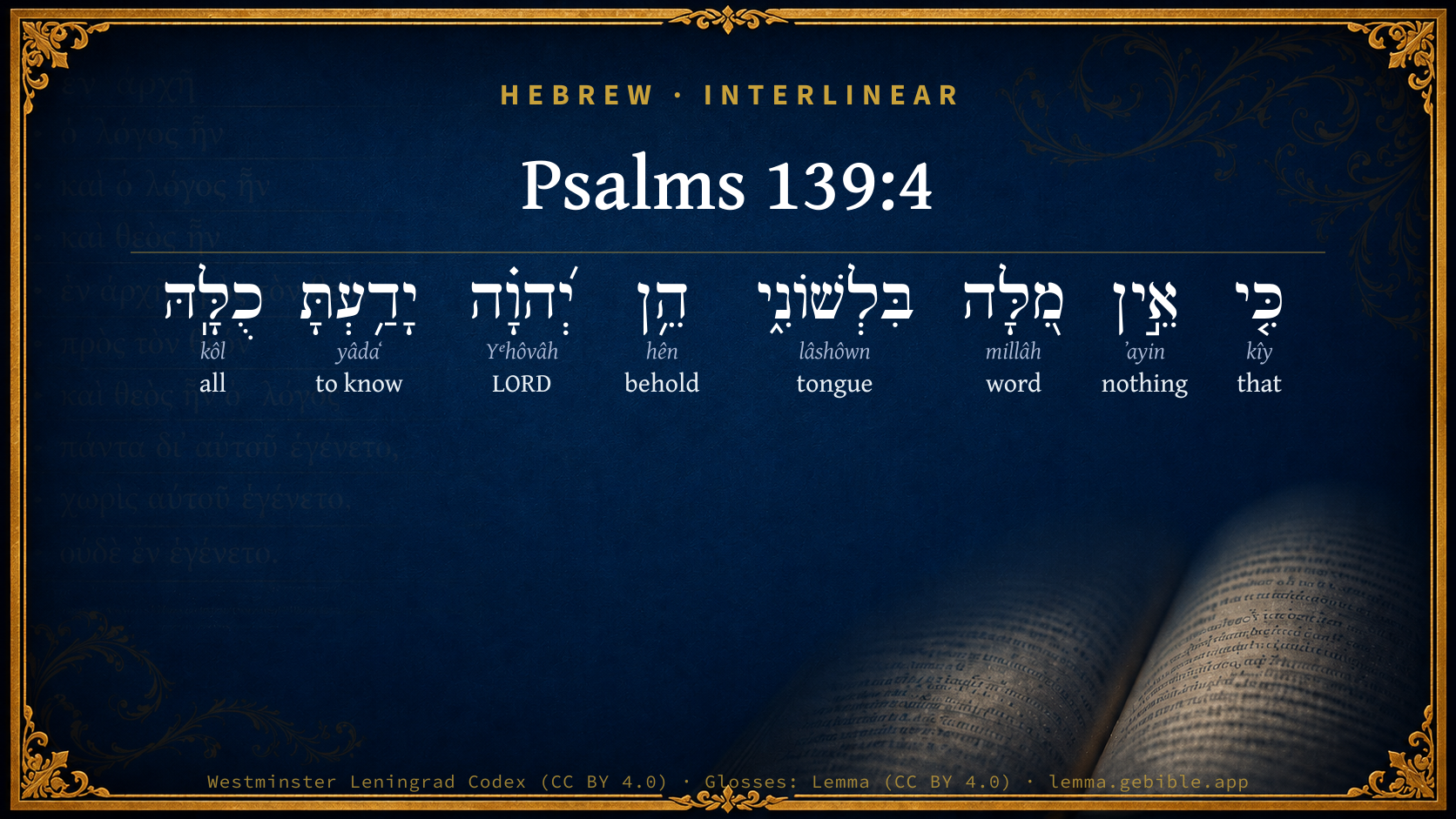
Hebrew (Westminster Leningrad Codex) Psalms 139:4 appears in the Hebrew Old Testament. The text above is from the Westminster Leningrad Codex. Each word links to its Strong’s number, a concise gloss, and parsing drawn from the Open Scriptures Hebrew Bible morphology. Click any word for its full Brown-Driver-Briggs (BDB) entry.
Download image
Cite this verse

Psalms 139:4 (World English Bible). Public Domain. Lemma interlinear Bible study tool, https://lemma.gebible.app/v/psalms/139/4.

Show BibTeX & RIS
BibTeX
RIS
English Translation
For there is not a word on my tongue, But, behold, Yahweh, you know it altogether.
World English Bible · Public Domain
Download a study sheet

One document with this verse’s original text, its word-by-word gloss line, the meaning frame, cross-references with their text, attributed commentary, and full source and license credits — printable, and it pastes into notes with its structure intact.

This verse Autodidact and up

Study sheet (.html) Plain text (.txt)

A passage Seminary Student

Up to 50 verses in one chapter. A passage sheet keeps up to 6 commentary sources and 12 cross-references per verse, in the order this page ranks them, and says so on the sheet whenever that leaves anything out. Ask for a single verse and you get the Autodidact verse sheet above.

Everything on this page stays free to read, with no account — the sheet is a download of what is already on screen, not access to it.

Want to remove ads? Support Godless Engineer
Compare translations 3

The same verse in 3 English versions, stacked beneath the original-language interlinear above. Click any original word for its lexicon entry.

Each is an independent rendering of the whole verse — the interlinear is not word-aligned to these translations.

Highlighted words mark where these versions differ — a whole-verse word diff, not a word-by-word alignment.

  • World English Bible Public Domain
    For there is not a word on my tongue, But, behold, Yahweh, you know it altogether.
  • King James Version Public Domain
    For there is not a word in my tongue, but, lo, O LORD, thou knowest it altogether.
  • unfoldingWord Literal Text CC BY-SA 4.0
    For there is not a word on my tongue; behold, Yahweh, you know all of it.

unfoldingWord Literal Text — © unfoldingWord, licensed CC BY-SA 4.0. Word-aligned USFM3 via Door43 (git.door43.org/unfoldingWord/en_ult).

Versions to compare (up to 4)

3 of 4 selected

Show all 18 translations

Every available English version of this verse, each an independent rendering of the whole verse.

  • World English Bible Public Domain
    For there is not a word on my tongue, But, behold, Yahweh, you know it altogether.
  • Berean Standard Bible Public Domain
    Even before a word is on my tongue, You know all about it, O LORD.
  • Majority Standard Bible Public Domain
    Even before a word is on my tongue, You know all about it, O LORD.
  • King James Version Public Domain
    For there is not a word in my tongue, but, lo, O LORD, thou knowest it altogether.
  • American Standard Version (1901) Public Domain
    For there is not a word in my tongue, But, lo, O Jehovah, thou knowest it altogether.
  • Revised Version (1885) Public Domain
    For there is not a word in my tongue, but, lo, O LORD, thou knowest it altogether.
  • Geneva Bible (1599) Public Domain
    For there is not a word in my tongue, but loe, thou knowest it wholy, O Lord.
  • Douay-Rheims (1899) Public Domain
    May all the kings of the earth give glory to thee: for they have heard all the words of thy mouth.
  • Young's Literal Translation Public Domain
    For there is not a word in my tongue, Lo, O Jehovah, Thou hast known it all!
  • Literal Standard Version CC BY-SA 4.0
    For there is not a word in my tongue, || Behold, O YHWH, You have known it all!
  • Unlocked Literal Bible CC BY-SA 4.0
    For before there is a word on my tongue, you know it completely, Yahweh.
  • unfoldingWord Literal Text CC BY-SA 4.0
    For there is not a word on my tongue; behold, Yahweh, you know all of it.
  • Darby Bible Public Domain
    For there is not yet a word on my tongue, [but] lo, O Jehovah, thou knowest it altogether.
  • World Messianic Bible Public Domain
    For there is not a word on my tongue, but behold, LORD, you know it altogether.
  • Webster's Bible Public Domain
    For there is not a word on my tongue, but lo, O LORD, thou knowest it altogether.
  • Free Bible Version CC BY-SA 4.0
    Lord, you even know what I'm going to say before I say it.
  • Bible in Basic English Public Domain
    For there is not a word on my tongue which is not clear to you, O Lord.
  • JPS Tanakh (1917) Public Domain
    For there is not a word in my tongue, but, lo, O LORD, Thou knowest it altogether.

Literal Standard Version (2020), Covenant Press — licensed CC BY-SA 4.0. Text via the HelloAO Bible API (eBible.org). Unlocked Literal Bible (unfoldingWord) — licensed CC BY-SA 4.0. Text via the HelloAO Bible API (eBible.org). unfoldingWord Literal Text — © unfoldingWord, licensed CC BY-SA 4.0. Word-aligned USFM3 via Door43 (git.door43.org/unfoldingWord/en_ult). Free Bible Version, Dr. Jonathan Gallagher — licensed CC BY-SA 4.0. Text via the HelloAO Bible API (eBible.org).

Word by word

More ways to search: Search by grammar → Find every occurrence → Compare this word →

Practice this passage: Drill this verse → Learn its vocabulary →

About this verse

These counts appear in no published source. They are computed here, from the morphology-tagged text and Lemma’s own curated glosses. What Lemma adds →

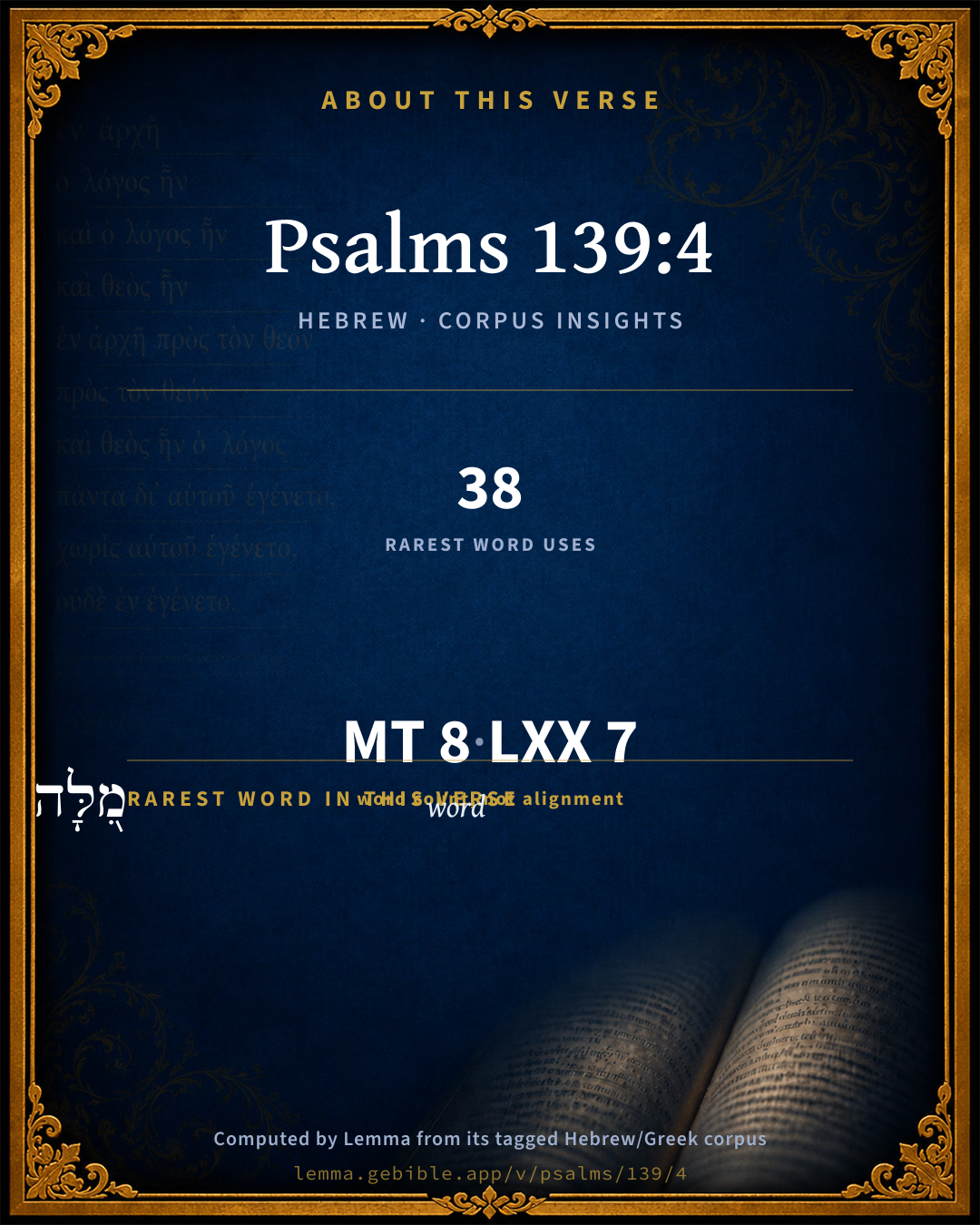
8
words
8
distinct lemmas
Wisdom
section

Shared distinctive vocabulary

מִ֭לָּה word H4405 occurs in 38 verses of the Hebrew Bible. Also found in:

Grammatical profile

  • 1 verb
  • 4 nouns
  • 1 conjunction
  • 2 particles

Verb forms

  • יָדַ֥עְתָּ Qal · Perfect

Hebrew & Septuagint length

In English translation the verse runs 16 words from the Hebrew and 17 from the Septuagint (LXX English) — closely comparable.

A rough comparison of the two English renderings, which tokenize alike — not a word-level alignment.

Word counts can differ between the Hebrew and the Greek without any difference in meaning — e.g. the Hebrew direct-object marker אֵת has no separate Greek word, and Greek often adds the article ὁ.

In the original languages it is 8 Hebrew tokens and 7 Greek tokens — but the two are counted differently (Hebrew bundles its prefixes and suffixes into one token; the Greek is in lemma form), so that isn’t a like-for-like length.

Cross-references

13

Topical passages linked to Psalms 139:4 in the Treasury of Scripture Knowledge — connected by theme and wording, ordered by reader-vote popularity; previews shown in the World English Bible.

  • Psalms 19:14 Let the words of my mouth and the meditation of my heart Be acceptable in your sight, Yahweh, my rock, and my redeemer.
  • Hebrews 4:12–13 For the word of God is living, and active, and sharper than any two-edged sword, and piercing even to the dividing of soul and spirit, of both joints and marrow, and is able to discern the thoughts and intentions of the heart.
  • Psalms 50:19–21 "You give your mouth to evil. You harnesses your tongue for deceit.
  • Job 42:3 You asked, 'Who is this who hides counsel without knowledge?' Therefore I have uttered that which I did not understand, Things too wonderful for me, which I didn't know.
  • Matthew 12:35–37 The good man out of his good treasure brings out good things, and the evil man out of his evil treasure brings out evil things.
  • Job 42:6–8 Therefore I abhor myself, And repent in dust and ashes."
  • Jeremiah 29:23 because they have worked folly in Israel, and have committed adultery with their neighbors' wives, and have spoken words in my name falsely, which I didn't command them; and I am he who knows, and am witness, says Yahweh.
  • Malachi 3:13–16 "Your words have been stout against me," says Yahweh. "Yet you say, 'What have we spoken against you?'
  • James 1:26 If anyone among you thinks himself to be religious while he doesn't bridle his tongue, but deceives his heart, this man's religion is worthless.
  • Job 8:2 "How long will you speak these things? Shall the words of your mouth be a mighty wind?
  • James 3:2–10 For in many things we all stumble. If anyone doesn't stumble in word, the same is a perfect man, able to bridle the whole body also.
  • Job 38:2 "Who is this who darkens counsel By words without knowledge?
  • Zephaniah 1:12 It will happen at that time, that I will search Jerusalem with lamps, and I will punish the men who are settled on their dregs, who say in their heart, "Yahweh will not do good, neither will he do evil."

Cross-references courtesy of OpenBible.info (CC BY 4.0).

Hebrew and Greek witnesses Masoretic Hebrew ↔ Greek Septuagint

The same verse in the two great witnesses to the Old Testament, shown verse-for-verse.

You’re reading Greek Psalm 138 (Hebrew Psalm 139). The Septuagint counts the superscription, so verse numbers can differ from the Hebrew — chapter-level alignment, not verse-by-verse. Numbering follows Rahlfs.

These are two independent witnesses, not word-aligned to each other, and the Septuagint is shown in lemma (dictionary) form.

Hebrew Psalms 139:4 Masoretic · Westminster Leningrad Codex

כִּ֤י אֵ֣ין מִ֭לָּה בִּלְשׁוֹנִ֑י הֵ֥ן יְ֝הוָ֗ה יָדַ֥עְתָּ כֻלָּֽהּ

For there is not a word on my tongue, But, behold, Yahweh, you know it altogether.

World English Bible · Public Domain

Greek LXX Greek Psalm 138:4 Septuagint · lemma form

ὅτι οὐ εἰμί λόγος ἐν γλῶσσα ἐγώ

For there is no unrighteous word in my tongue: behold, O Lord, you have known all things,

LXX2012 (modern English Septuagint) · Public Domain

Hebrew: Westminster Leningrad Codex (CC BY 4.0). Greek: Septuagint (public domain); English from LXX2012 (modern English Septuagint) (Public Domain). How the Septuagint differs from the Hebrew →

Commentary

Notes on Psalms 139:4 from classic Christian and Jewish commentators (each source and its license shown beneath its notes). The classic Christian expositions comment on the surrounding passage and are grouped to its opening verse, so a note may address several verses; the Jewish commentaries on the Tanakh (Rashi and others) are per-verse, so they appear only where the commentator wrote on this verse.

Lemma curates 59 commentaries, every one of them public domain or Creative Commons licensed, each selected and text-cleaned for this edition rather than reprinted as found. About our sources →

Trapp's Complete Commentary

John Trapp

Psa 139:4 For [there is] not a word in my tongue, [but], lo, O LORD, thou knowest it altogether.

Ver. 4. For there is not a word in my tongue] Though not yet uttered, or but whispered only.

Thou knowest it altogether] Every tittle of it; thou understandest the language of men’s hearts.

John Trapp, A Commentary or Exposition upon All the Books of the Old and New Testament (1647–1656) — public domain. Text from a community e-Sword module.

Joseph Benson's Commentary

Psa 139:4-5. There is not a word in my tongue, &c. — Thou knowest what I speak, and with what design and disposition of mind. There is not a vain word, not a good word, but thou knowest it altogether — What it means, what thought gives birth to it, and with what intention it is uttered. Or, as others render the clause, When there is not a word, &c.; thou knowest what I am about to speak, either in prayer to thee, or in conversation with men, when I have not yet uttered one word of it. Thou hast beset me behind and before — With thine all-seeing and all-disposing providence; so that, go which way I will, I am under thine eyes, and cannot escape its penetrating view in any way possible; and laid thy hand upon me — Thou keepest me, as it were, with a strong hand, in thy sight, and under thy power.

Joseph Benson's Commentary on the Old and New Testaments (1811–1818) — public domain. Text from a community e-Sword module.

J. A. Alexander on Psalms

Joseph Addison Alexander

4. (Psa 139:4) For there is not a word in my tongue, (but) lo, Jehovah, thou knowest all of it. The relation of the clauses may be also expressed thus in English, which, 0 Lord, thou knowest not, all of it (or altogether). In my tongue, in its power, or, as it were, in its possession. This verse merely applies to his words specifically what was said before of all his actions. The lo or behold is equivalent to see there, or to the act of pointing at the words as objects of sight and as actually present.

Joseph Addison Alexander, The Psalms Translated and Explained (1850) — public domain. Text from a community e-Sword module.

Geneva Bible (1599)

Geneva Bible translators

Thou knowest my meaning before I speak.

Geneva Bible (1599) marginal notes — public domain. Text via Bolls.life.

Adam Clarke's Commentary

Verse 4. There is not a word in my tongue] Although (כי ki) there be not a word in my tongue, behold O Jehovah, thou knowest the whole of it, that is, thou knowest all my words before they are uttered, as thou knowest all my thoughts while as yet they are unformed.

Adam Clarke's Commentary on the Bible (1810–1826) — public domain. Text from a community e-Sword/MySword module.

John Calvin's Commentaries

4. For there is not a word, etc. The words admit a double meaning. Accordingly some understand them to imply that God knows what, we are about to say before the words are formed on our tongue; others, that though we speak not a word, and try by silence to conceal our secret intentions, we cannot elude his notice. Either rendering amounts to the same thing, and it is of no consequence which we adopt. The idea meant to be conveyed is, that while the tongue is the index of thought to man, being the great medium of communication, God, who knows the heart, is independent of words. And use is made of the demonstrative particle lo! to indicate emphatically that the innermost recesses of our spirit stand present to his view.

John Calvin's Commentaries (1540-1563) — public domain. Text from the Calvin Translation Society English edition (1840s-50s) via the Christian Classics Ethereal Library (ccel.org). Calvin's coverage is partial (roughly two-thirds of the Bible); uncommented books and verses are honest gaps, never fabricated. The 19th-century editor's footnotes and remarks are omitted so the notes are faithfully Calvin's own voice.

Ellicott's Commentary for English Readers

(4) For there is not . . .—This has been understood in two ways:—

My tongue cannot utter a word which thou dost not altogether know.

or,

Before my tongue can utter a word thou knowest it altogether.

A Bible Commentary for English Readers, edited by Charles John Ellicott (1878–1897) — public domain. Text from a community e-Sword module.

The Cambridge Bible for Schools and Colleges

gen. ed. J. J. S. Perowne

4. God knows not merely the spoken word which men can hear, but its true meaning, and the secret thoughts which prompt its utterance. But the verse may also be rendered, For (when) a word is not yet on my tongue, Lo, thou &c. Before thought has formed itself into words and found expression, the Searcher of hearts knows it.

The Cambridge Bible for Schools and Colleges (gen. ed. J. J. S. Perowne; Cambridge University Press, 1878–1918) — public domain. Text from a community e-Sword module.

John Gill's Exposition

Thou hast beset me behind and before,.... Art on every side of me, all around me, like one besieged in a strait place; so that there is nothing I can think, say, or do, but what is known unto thee. The two Kimchis, father and son, render the word, "thou hast formed me": and interpret it of the formation of his body, of which, in Psa 139:14; see Job 10:8 but it denotes how God compasses men with his presence and providence, so that nothing escapes his knowledge;

and laid thine hand upon me; not his afflicting hand, which sometimes presses hard; though the Targum thus paraphrases it,

"and stirred against me the stroke of thine hand:''

but rather his hand of power and providence, to preserve, protect, and defend him. Or it signifies that he was so near to him that his hand was upon him, and he was perfectly known; as anything is that is before a man, and he has his hand upon.

John Gill's Exposition of the Whole Bible (1746–1763) — public domain (CC PDM 1.0). Text via the HelloAO Bible API.

Albert Barnes' Notes on the Bible

For there is not a word in my tongue - All that I say; all that I have power to say; all that I am disposed at any time to say.

But lo, O Lord, thou knowest it altogether - All that pertains to it. What is “said,” and what is “meant.” Merely to “hear” what is spoken does not imply necessarily a full knowledge of what is said - for it may be false, insincere, hypocritical. God knows exactly what is said and what is “meant.”

Albert Barnes' Notes on the Bible (1834–1885) — public domain. Text from a community e-Sword/MySword module.

Matthew Poole's English Annotations

Thou knowest what I speak, and with what design and disposition of mind. Or rather, as others render it, and which is more admirable, When there is not a word, &c. Thou knowest what I intend to speak, either in prayer to thee, or in conversation with men, when I have not yet uttered one word of it.

Matthew Poole's English Annotations on the Holy Bible (1683–1685) — public domain. Text from a community e-Sword/MySword module.

The Treasury of David

Charles H. Spurgeon

Ver. 4. For there is not a word in my tongue, but lo, O LORD, thou knowest it altogether. The unformed word, which lies within the tongue like a seed in the soil, is certainly and completely known to the Great Searcher of hearts. A negative expression is used to make the positive statement all the stronger: not a word is unknown is a forcible way of saying that every word is well known. Divine knowledge is perfect, since not a single word is unknown, nay, not even an unspoken word, and each one is "altogether" or wholly known. What hope of concealment can remain when the speech with which too many conceal their thoughts is itself transparent before the Lord? O Jehovah, how great art thou! If thine eye hath such power, what must be the united force of thine whole nature!

Ver. 4. For there is not a word in my tongue, etc. The words admit a double meaning. Accordingly some understand them to imply that God knows what we are about to say before the words are formed on our tongue; others, that though we speak not a word, and try by silence to conceal our secret intentions, we cannot elude his notice. Either rendering amounts to the same thing, and it is of no consequence which we adopt. The idea meant to be conveyed is, that while the tongue is the index of thought to man, being the great medium of communication, God, who knows the heart, is independent of words. And use is made of the demonstrative particle lo! to indicate emphatically that the innermost recesses of our spirit stand present to his view. John Calvin.

Ver. 4. For there is not a word in my tongue, etc. How needful it is to set a watch before the doors of our mouth, to hold that unruly member of ours, the tongue, as with bit and bridle. Some of you feel at times that you can scarcely say a word, and the less you say the better. Well, it way be as well; for great talkers are almost sure to make slips with their tongue. It may be a good thing that you cannot speak much; for in the multitude of words there lacketh not sin. Wherever you go, what light, vain, and foolish conversations you hear! I am glad not to be thrown into circumstances where I can hear it. But with you it may be different. You may often repent of speaking, you will rarely repent of silence. How soon angry words are spoken! How soon foolish expressions drop from the mouth! The Lord knows it all, marks it all, and did you carry about with you a more solemn recollection of it you would be more watchful than you are. Joseph C. Philpot.

Ver. 4. When there is not a word in my tongue, O LORD, thou knowest all; so some read it; for thoughts are words to God. Matthew Henry.

Ver. 4. Thou knowest it. The gods know what passes in our minds without the aid of eyes, ears, or tongues; on which divine omniscience is founded the feeling of men that, when they wish in silence, or offer up a prayer for anything, the gods hear them. Cicero.

Ver. 4.

1. Words on the tongue first in it, and in that stage known to God.

2. Words on the tongue very numerous, yet all known.

3. Word on the tongue have wide meaning, yet known "altogether."

Lesson: Take heed of your words not yet spoken.

Psalms 139:5*

Charles H. Spurgeon's The Treasury of David (1869–1885) — public domain. Psalms only. Text from a community e-Sword/MySword module.

Whedon's Commentary on the Bible

Daniel D. Whedon

4. For there is not a word in my tongue, etc.—Rather, When there is not a word in my tongue, behold, O Jehovah, thou knowest all. Before the word is spoken God sees back in the heart the thought and desire, and knows all that is within, whence words proceed.

Daniel D. Whedon (gen. ed.), Commentary on the Old and New Testaments (1874–1909) — public domain. Text from a community e-Sword module.

The Pulpit Commentary

For there is not a word in my tongue, but, lo, O Lord, thou knowest it altogether. What has been already said of deeds and thoughts is now extended to "words." God hears every word we speak.

The Pulpit Commentary (1880–1919), ed. H.D.M. Spence-Jones & Joseph S. Exell — public domain. Text from a community e-Sword module.

Lesson kit

Teaching starters — assembled from the data on this page, not authored interpretation. Every prompt links to the verse data it draws on. Edit before teaching.

Psalms, in the Wisdom, opens this verse with 8 words (8 distinct Hebrew lemmas). Its most distinctive word is millâh (“word”). A historical commentator’s framing appears above. Read the whole chapter for the surrounding context.

Discussion questions

  1. How does “word” (millâh) shape what this verse is saying?
  2. How does 2 Samuel 23:2, which shares the word «word», read alongside this verse?
  3. The translations on this page render this verse differently — a whole-verse word diff, not a word-by-word alignment. What might account for the different wordings?
  4. «יָדַ֥עְתָּ» is a Qal Perfect verb. How does that grammatical form shape the action described?
  5. Compare how Trapp's Complete Commentary and Joseph Benson's Commentary read this verse. Where do they agree or differ?

Things to notice

Reading settings

Reading text

Shown beneath each verse's original-language words.

Old Testament
Old Testament edition

Read the OT as the Masoretic Hebrew (MT) or the Greek Septuagint (LXX).

English shown for the Greek Septuagint (in the Hebrew ↔ Greek comparison).

Comparing translations? Open the Compare panel on any verse page to stack up to four side by side.