
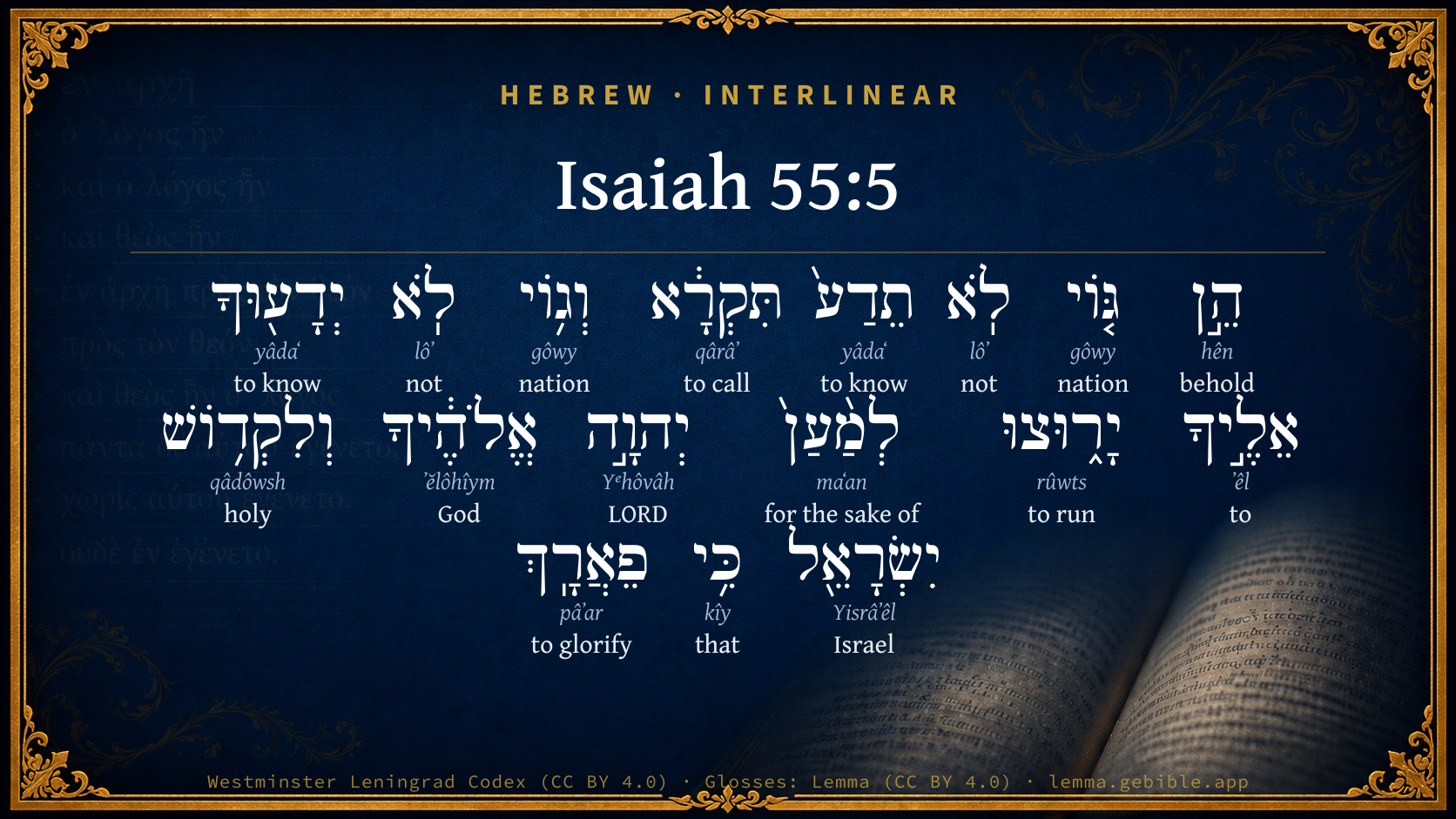
Isaiah 55:5

Hebrew (Westminster Leningrad Codex) Isaiah 55:5 appears in the Hebrew Old Testament. The text above is from the Westminster Leningrad Codex. Each word links to its Strong’s number, a concise gloss, and parsing drawn from the Open Scriptures Hebrew Bible morphology. Click any word for its full Brown-Driver-Briggs (BDB) entry.
Download image
Cite this verse

Isaiah 55:5 (World English Bible). Public Domain. Lemma interlinear Bible study tool, https://lemma.gebible.app/v/isaiah/55/5.

Show BibTeX & RIS
BibTeX
RIS
English Translation
Behold, you shall call a nation that you don't know; and a nation that didn't know you shall run to you, because of Yahweh your God, and for the Holy One of Israel; for he has glorified you.
World English Bible · Public Domain
Download a study sheet

One document with this verse’s original text, its word-by-word gloss line, the meaning frame, cross-references with their text, attributed commentary, and full source and license credits — printable, and it pastes into notes with its structure intact.

This verse Autodidact and up

Study sheet (.html) Plain text (.txt)

A passage Seminary Student

Up to 50 verses in one chapter. A passage sheet keeps up to 6 commentary sources and 12 cross-references per verse, in the order this page ranks them, and says so on the sheet whenever that leaves anything out. Ask for a single verse and you get the Autodidact verse sheet above.

Everything on this page stays free to read, with no account — the sheet is a download of what is already on screen, not access to it.

Want to remove ads? Support Godless Engineer
Compare translations 3

The same verse in 3 English versions, stacked beneath the original-language interlinear above. Click any original word for its lexicon entry.

Each is an independent rendering of the whole verse — the interlinear is not word-aligned to these translations.

Highlighted words mark where these versions differ — a whole-verse word diff, not a word-by-word alignment.

  • World English Bible Public Domain
    Behold, you shall call a nation that you don't know; and a nation that didn't know you shall run to you, because of Yahweh your God, and for the Holy One of Israel; for he has glorified you.
  • King James Version Public Domain
    Behold, thou shalt call a nation that thou knowest not, and nations that knew not thee shall run unto thee because of the LORD thy God, and for the Holy One of Israel; for he hath glorified thee.
  • unfoldingWord Literal Text CC BY-SA 4.0
    Behold, you will call a nation you have not known, and a nation, they have not known you, they will run to you, because of Yahweh your God, and for the Holy One of Israel, for he will glorify you.” q1

unfoldingWord Literal Text — © unfoldingWord, licensed CC BY-SA 4.0. Word-aligned USFM3 via Door43 (git.door43.org/unfoldingWord/en_ult).

Versions to compare (up to 4)

3 of 4 selected

Show all 18 translations

Every available English version of this verse, each an independent rendering of the whole verse.

  • World English Bible Public Domain
    Behold, you shall call a nation that you don't know; and a nation that didn't know you shall run to you, because of Yahweh your God, and for the Holy One of Israel; for he has glorified you.
  • Berean Standard Bible Public Domain
    Surely you will summon a nation you do not know, and nations who do not know you will run to you. For the LORD your God, the Holy One of Israel, has bestowed glory on you.”
  • Majority Standard Bible Public Domain
    Surely you will summon a nation you do not know, and nations who do not know you will run to you. For the LORD your God, the Holy One of Israel, has bestowed glory on you.”
  • King James Version Public Domain
    Behold, thou shalt call a nation that thou knowest not, and nations that knew not thee shall run unto thee because of the LORD thy God, and for the Holy One of Israel; for he hath glorified thee.
  • American Standard Version (1901) Public Domain
    Behold, thou shalt call a nation that thou knowest not; and a nation that knew not thee shall run unto thee, because of Jehovah thy God, and for the Holy One of Israel; for he hath glorified thee.
  • Revised Version (1885) Public Domain
    Behold, thou shalt call a nation that thou knowest not, and a nation that knew not thee shall run unto thee, because of the LORD thy God, and for the Holy One of Israel; for he hath glorified thee.
  • Geneva Bible (1599) Public Domain
    Beholde, thou shalt call a nation that thou knowest not, and a nation that knew not thee, shall runne vnto thee, because of the Lord thy God, and the holy one of Israel: for hee hath glorified thee.
  • Douay-Rheims (1899) Public Domain
    Behold thou shalt call a nation, which thou knewest not: and the nations that knew not thee shall run to thee, because of the Lord thy God, and for the Holy One of Israel, for he hath glorified thee.
  • Young's Literal Translation Public Domain
    Lo, a nation thou knowest not, thou callest, And a nation who know thee not unto thee do run, For the sake of Jehovah thy God, And for the Holy One of Israel, Because He hath beautified thee.
  • Literal Standard Version CC BY-SA 4.0
    Behold, a nation you do not know, you call, || And a nation who does not know you runs to you, || For the sake of your God YHWH, || And for the Holy One of Israel, || Because He has beautified you.”
  • Unlocked Literal Bible CC BY-SA 4.0
    Look, you will call to a nation that you did not know; and a nation that did not know you will run to you because of Yahweh your God, the Holy One of Israel, who has glorified you.”
  • unfoldingWord Literal Text CC BY-SA 4.0
    Behold, you will call a nation you have not known, and a nation, they have not known you, they will run to you, because of Yahweh your God, and for the Holy One of Israel, for he will glorify you.” q1
  • Darby Bible Public Domain
    Behold, thou shalt call a nation thou knowest not, and a nation [that] knew not thee shall run unto thee, because of Jehovah thy God, and the Holy One of Israel; for he hath glorified thee.
  • World Messianic Bible Public Domain
    Behold, you shall call a nation that you don’t know; and a nation that didn’t know you shall run to you, because of the LORD your God, and for the Holy One of Israel; for he has glorified you.”
  • Webster's Bible Public Domain
    Behold, thou shalt call a nation that thou knowest not, and nations that knew not thee shall run to thee because of the LORD thy God, and for the Holy One of Israel, for he hath glorified thee.
  • Free Bible Version CC BY-SA 4.0
    You will call nations you don't even know, and nations who don't know you will come running to you. For the Lord your God, the Holy One of Israel, I made you glorious.
  • Bible in Basic English Public Domain
    See, you will send for a nation of which you had no knowledge, and those who had no knowledge of you will come running to you, because of the Lord your God, and because of the Holy One of Israel, for he has given you glory.
  • JPS Tanakh (1917) Public Domain
    Behold, thou shalt call a nation that thou knowest not, and a nation that knew not thee shall run unto thee; because of the LORD thy God, and for the Holy One of Israel, for He hath glorified thee.

Literal Standard Version (2020), Covenant Press — licensed CC BY-SA 4.0. Text via the HelloAO Bible API (eBible.org). Unlocked Literal Bible (unfoldingWord) — licensed CC BY-SA 4.0. Text via the HelloAO Bible API (eBible.org). unfoldingWord Literal Text — © unfoldingWord, licensed CC BY-SA 4.0. Word-aligned USFM3 via Door43 (git.door43.org/unfoldingWord/en_ult). Free Bible Version, Dr. Jonathan Gallagher — licensed CC BY-SA 4.0. Text via the HelloAO Bible API (eBible.org).

Word by word

More ways to search: Search by grammar → Find every occurrence → Compare this word →

Practice this passage: Drill this verse → Learn its vocabulary →

פֵאֲרָֽךְ
pâʼar
H6286
“to glorify · you”
Verb, Piel, Perfect, 3rd Person, Masculine, Singular + Suffix, Personal, 2nd Person, Feminine, Singular
Part of Speech
Verb
Stem
Piel
Form
Perfect
Person
3rd Person
Gender
Masculine
Number
Singular
Full BDB Definition

Origin: a primitive root

TWOT: 1726 , 1727

to glorify, beautify, adorn - (Piel) to glorify, beautify - (Hithpael) - to glorify oneself - to get glory to oneself, be glorified - (Piel) to go over the boughs
  1. הֵ֣ן hên H2005 “behold” Particle, Demonstrative
  2. גּ֤וֹי gôwy H1471 “nation” Noun, Common, Masculine, Singular, Absolute
  3. לֹֽא lôʼ H3808 “not” Particle, Negative
  4. תֵדַע֙ yâdaʻ H3045 “to know” Verb, Qal, Imperfect, 2nd Person, Masculine, Singular
  5. תִּקְרָ֔א qârâʼ H7121 “to call” Verb, Qal, Imperfect, 2nd Person, Masculine, Singular
  6. וְג֥וֹי gôwy H1471 “and · nation” Conjunction + Noun, Common, Masculine, Singular, Absolute
  7. לֹֽא lôʼ H3808 “not” Particle, Negative
  8. יְדָע֖וּךָ yâdaʻ H3045 “to know · you” Verb, Qal, Perfect, 3rd Person, Common, Plural + Suffix, Personal, 2nd Person, Masculine, Singular
  9. אֵלֶ֣יךָ ʼêl H413 “to · you” Preposition + Suffix, Personal, 2nd Person, Masculine, Singular
  10. יָר֑וּצוּ rûwts H7323 “to run” Verb, Qal, Imperfect, 3rd Person, Masculine, Plural
  11. לְמַ֨עַן֙ maʻan H4616 “for the sake of” Preposition
  12. יְהוָ֣ה Yᵉhôvâh H3068 “LORD” Noun, Proper
  13. אֱלֹהֶ֔יךָ ʼĕlôhîym H430 “God(s) · your” Noun, Common, Masculine, Plural, Construct + Suffix, Personal, 2nd Person, Masculine, Singular
  14. וְלִקְד֥וֹשׁ qâdôwsh H6918 “and · to/for · holy of” Conjunction + Preposition + Adjective, Adjective, Masculine, Singular, Construct
  15. יִשְׂרָאֵ֖ל Yisrâʼêl H3478 “Israel” Noun, Proper
  16. כִּ֥י kîy H3588 “that” Conjunction

About this verse

These counts appear in no published source. They are computed here, from the morphology-tagged text and Lemma’s own curated glosses. What Lemma adds →

17
words
14
distinct lemmas
Prophets
section

Notable vocabulary

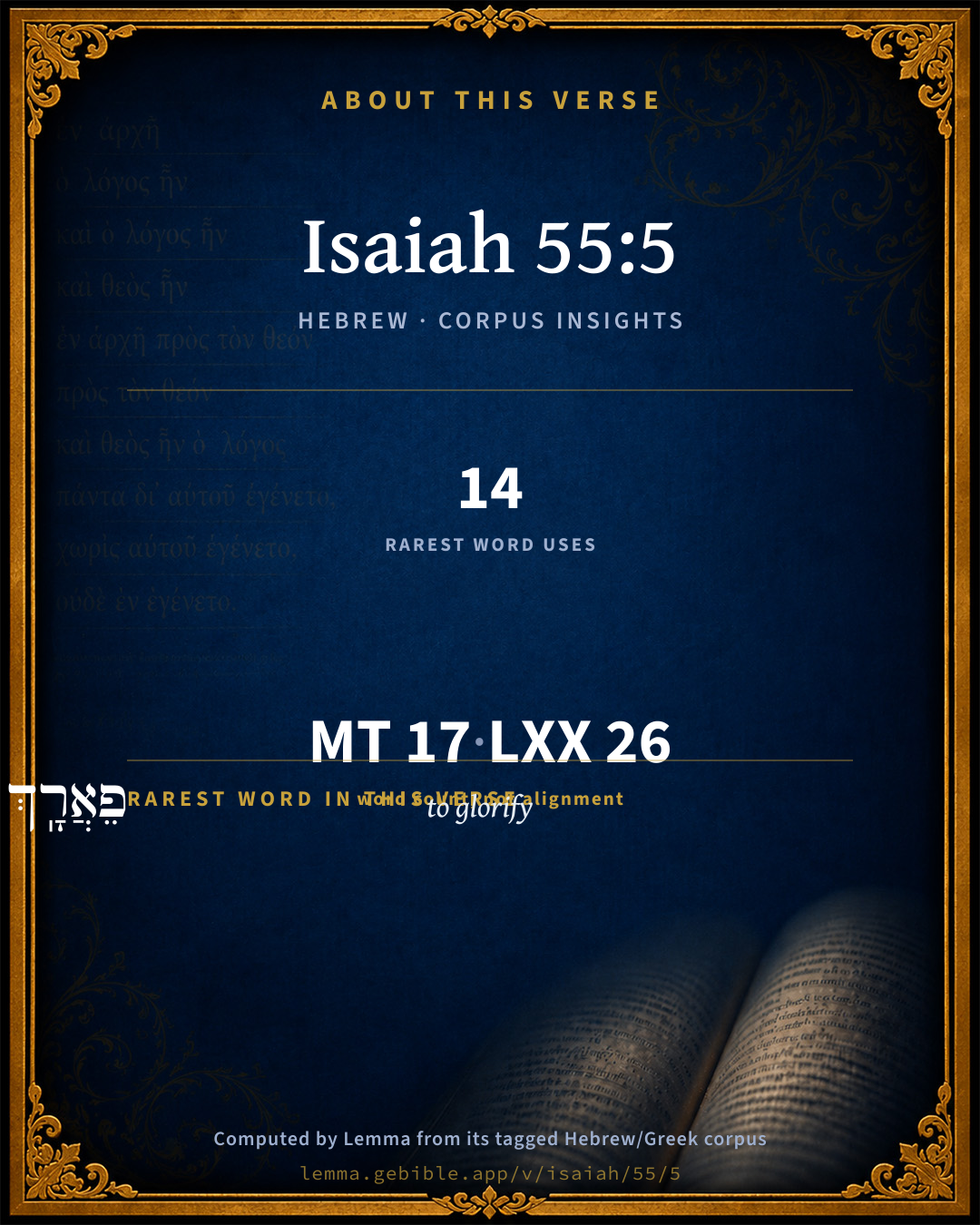
The rarest word here is פֵאֲרָֽךְ to glorify H6286 — appearing just 14 times in the whole Hebrew Bible.

Shared distinctive vocabulary

פֵאֲרָֽךְ to glorify H6286 occurs in 14 verses of the Hebrew Bible. Also found in:

Grammatical profile

  • 5 verbs
  • 5 nouns
  • 1 adjective
  • 2 prepositions
  • 1 conjunction
  • 3 particles

Verb forms

  • תֵדַע֙ Qal · Imperfect
  • תִּקְרָ֔א Qal · Imperfect
  • יְדָע֖וּךָ Qal · Perfect
  • יָר֑וּצוּ Qal · Imperfect
  • פֵאֲרָֽךְ Piel · Perfect

Repetition

Words recur within this verse — often emphatic in Hebrew:

  • גּ֤וֹי nation H1471 ×2
  • תֵדַע֙ to know H3045 ×2
  • לֹֽא not H3808 ×2

Hebrew & Septuagint length

In English translation the verse runs 38 words from the Hebrew and 41 from the Septuagint (LXX English) — closely comparable.

A rough comparison of the two English renderings, which tokenize alike — not a word-level alignment.

Word counts can differ between the Hebrew and the Greek without any difference in meaning — e.g. the Hebrew direct-object marker אֵת has no separate Greek word, and Greek often adds the article ὁ.

In the original languages it is 17 Hebrew tokens and 26 Greek tokens — but the two are counted differently (Hebrew bundles its prefixes and suffixes into one token; the Greek is in lemma form), so that isn’t a like-for-like length.

Cross-references

22

Topical passages linked to Isaiah 55:5 in the Treasury of Scripture Knowledge — connected by theme and wording, ordered by reader-vote popularity; previews shown in the World English Bible.

  • Isaiah 60:5 Then you shall see and be radiant, and your heart shall thrill and be enlarged; because the abundance of the sea shall be turned to you, the wealth of the nations shall come to you.
  • Isaiah 60:9 Surely the isles shall wait for me, and the ships of Tarshish first, to bring your sons from far, their silver and their gold with them, for the name of Yahweh your God, and for the Holy One of Israel, because he has glorified you.
  • Zechariah 2:11 Many nations shall join themselves to Yahweh in that day, and shall be my people; and I will dwell in the midst of you, and you shall know that Yahweh of Hosts has sent me to you.
  • Romans 15:20 yes, making it my aim to preach the Gospel, not where Christ was already named, that I might not build on another's foundation.
  • Genesis 49:10 The scepter will not depart from Judah, Nor the ruler's staff from between his feet, Until he comes to whom it belongs. To him will the obedience of the peoples be.
  • Psalms 18:43 You have delivered me from the strivings of the people. You have made me the head of the nations. A people whom I have not known shall serve me.
  • Isaiah 56:8 The Lord Yahweh, who gathers the outcasts of Israel, says, Yet will I gather [others] to him, besides his own who are gathered.
  • Isaiah 45:23 By myself have I sworn, the word is gone forth from my mouth [in] righteousness, and shall not return, that to me every knee shall bow, every tongue shall swear.
  • Isaiah 55:4 Behold, I have given him for a witness to the peoples, a leader and commander to the peoples.
  • John 17:1 Jesus said these things, and lifting up his eyes to heaven, he said, "Father, the time has come. Glorify your Son, that your Son may also glorify you;
  • Acts 5:31 God exalted him with his right hand to be a Prince and a Savior, to give repentance to Israel, and remission of sins.
  • Psalms 110:1–3 Yahweh says to my Lord, "Sit at my right hand, Until I make your enemies your footstool for your feet."
  • Isaiah 11:10–11 It shall happen in that day, that the root of Jesse, who stands for an ensign of the peoples, to him shall the nations seek; and his resting-place shall be glorious.
  • Isaiah 49:6 yes, he says, It is too light a thing that you should be my servant to raise up the tribes of Jacob, and to restore the preserved of Israel: I will also give you for a light to the Gentiles, that you may be my salvation to the end of the earth.
  • Acts 3:13 The God of Abraham, Isaac, and Jacob, the God of our fathers, has glorified his Servant Jesus, whom you delivered up, and denied in the presence of Pilate, when he had determined to release him.
  • Isaiah 52:15 so shall he sprinkle many nations; kings shall shut their mouths at him: for that which had not been told them shall they see; and that which they had not heard shall they understand.
  • Hosea 1:10 Yet the number of the children of Israel will be as the sand of the sea, which can't be measured nor numbered; and it will come to pass that, in the place where it was said to them, 'You are not my people,' they will be called 'sons of the living God.'
  • John 13:31–32 When he had gone out, Jesus said, "Now the Son of Man has been glorified, and God has been glorified in him.
  • Ephesians 3:5 which in other generations was not made known to the children of men, as it has now been revealed to his holy apostles and prophets in the Spirit;
  • Hebrews 5:5 So also Christ didn't glorify himself to be made a high priest, but it was he who said to him, "You are my Son. Today I have become your father."
  • Zechariah 8:20–23 Thus says Yahweh of Hosts: "Many peoples, and the inhabitants of many cities will yet come;
  • 1 Peter 1:11 searching for who or what kind of time the Spirit of Christ, which was in them, pointed to, when he predicted the sufferings of Christ, and the glories that would follow them.

Cross-references courtesy of OpenBible.info (CC BY 4.0).

Hebrew and Greek witnesses Masoretic Hebrew ↔ Greek Septuagint

The same verse in the two great witnesses to the Old Testament, shown verse-for-verse.

These are two independent witnesses, not word-aligned to each other, and the Septuagint is shown in lemma (dictionary) form.

Hebrew Isaiah 55:5 Masoretic · Westminster Leningrad Codex

הֵ֣ן גּ֤וֹי לֹֽא תֵדַע֙ תִּקְרָ֔א וְג֥וֹי לֹֽא יְדָע֖וּךָ אֵלֶ֣יךָ יָר֑וּצוּ לְמַ֨עַן֙ יְהוָ֣ה אֱלֹהֶ֔יךָ וְלִקְד֥וֹשׁ יִשְׂרָאֵ֖ל כִּ֥י פֵאֲרָֽךְ

Behold, you shall call a nation that you don't know; and a nation that didn't know you shall run to you, because of Yahweh your God, and for the Holy One of Israel; for he has glorified you.

World English Bible · Public Domain

Greek LXX Isaiah 55:5 Septuagint · lemma form

ἔθνος ὅς οὐ οἴδα σύ ἐπικαλέω σύ καί λαός ὅς οὐ ἐπίσταμαι σύ ἐπί σύ καταφεύγω ἕνεκεν ὁ θεός σύ ὁ ἅγιος ἰσραήλ ὅτι δοξάζω σύ

Nations which know you not, shall call upon you, and peoples which are not acquainted with you, shall flee to you for refuge, for the sake of the Lord your God, the Holy One of Israel; for he has glorified you.

LXX2012 (modern English Septuagint) · Public Domain

Hebrew: Westminster Leningrad Codex (CC BY 4.0). Greek: Septuagint (public domain); English from LXX2012 (modern English Septuagint) (Public Domain). How the Septuagint differs from the Hebrew →

Targum (Aramaic paraphrase)

1

The Targum is the ancient Jewish Aramaic paraphrase of the Hebrew Scriptures — an interpretive translation, not the Hebrew text itself. Onkelos (literal) and Pseudo-Jonathan (expansive) render the Torah, and Jonathan the Prophets. Coverage is partial: where no permissively-licensed English translation exists for a verse, only the Aramaic is shown. This is verse-level text, not a word-by-word alignment to the Hebrew.

  1. Targum Jonathan Prophets (Joshua–Malachi)
    הָא עַם דְלָא תֵידַע יִפְלְחִינָךְ וְעַם דְלָא יֵדְעוּךְ יִרְהֲטוּן לְאַסָקָא לָךְ מִסִין בְּדִיל יְיָ אֱלָהָךְ וּלְקַדִישָׁא דְיִשְׂרָאֵל אֲרֵי שַׁבְּחָךְ:

    Behold, a people which thou knowest not shall serve thee, and a people which hath not known thee shall run to offer tribute unto thee, because of the Lord thy God, and for the Holy One of Israel; for He hath glorified thee.

    Targum Jonathan — Aramaic: “Mikraot Gedolot” (public domain). English: “Sefaria Community Translation” (CC0 1.0 (public-domain dedication)); “London "Chaldee Paraphrase," 1871” (public domain). Text via Sefaria.

Commentary

Notes on Isaiah 55:5 from classic Christian and Jewish commentators (each source and its license shown beneath its notes). The classic Christian expositions comment on the surrounding passage and are grouped to its opening verse, so a note may address several verses; the Jewish commentaries on the Tanakh (Rashi and others) are per-verse, so they appear only where the commentator wrote on this verse.

Lemma curates 59 commentaries, every one of them public domain or Creative Commons licensed, each selected and text-cleaned for this edition rather than reprinted as found. About our sources →

Trapp's Complete Commentary

John Trapp

Isa 55:5 Behold, thou shalt call a nation [that] thou knowest not, and nations [that] knew not thee shall run unto thee because of the LORD thy God, and for the Holy One of Israel; for he hath glorified thee.

Ver. 5. Behold, thou shalt call a nation.] Yea, all nations that yet dwell in darkness and in the shadow of death, being utterly ignorant of God and his will, of themselves and their duties; but now, when they "shall know God, or rather be known of him," they shall run to Christ, yea, and "fly as a cloud," and flock into the church, as doves scour into their columbaries, rushing into the windows. {Isa 60:8}

Because of the Lord thy God.] Through the mighty operation of his Spirit by the preaching of his Word. The philosophers, though never so able, could hardly persuade some few to embrace their tenets. Plato went thrice into Sicily to convert Dionysius, but could not do it; Socrates could not work upon Alcibiades, nor Cicero upon his own son, because God was not with them, nor was willing to glorify his Son Christ by them, as he did afterwards by his holy apostles.

John Trapp, A Commentary or Exposition upon All the Books of the Old and New Testament (1647–1656) — public domain. Text from a community e-Sword module.

The Biblical Illustrator

Joseph S. Exell

Isa_55:5

Behold, Thou shalt call a nation that thou knowest not

Isaiahs anticipation.

We cannot tell what picture was in Isaiahs mind and hovering before his eyes. We do not know just what degree of visible sovereignty he hoped to see Jerusalem attain--but the essential idea is clear enough. He believes that all people were to turn to the Hebrews because the Hebrews were especially Gods people, because the nations would all feel that the God whom they all must have had been made known with the completest clearness and purity among the Jews. How clearly that prophecy has been fulfilled all subsequent history can tell. The Hebrew Book, the Hebrew men, have been the magnets which have drawn the worlds devotion. Into the midst of Judaism was set the incarnation of the Godhead, which, shining out from thence, has been the light which has enlightened every man. The Bible is the very epitome of Judaism, and the Bible is the centre more and more completely of the worlds devotion. Nations that know not thee shall run unto thee. What words like those could prophesy the scenes which have come in these modern days--Englishmen, Italians, Germans, Americans seeking the law of inspiration of their life in the old Hebrew Bible, turning those venerable pages to learn how they ought to live, drinking at the fountain of the ideas of Israel the strength and cleansing which their own modern life demanded. We abase the Jew, sometimes we sneer at him and despise him--but we live upon the thoughts which he has thought, and the visions which he saw of God make the very sunshine of our life. (Bp. Phillips Brooks, D. D.)

The helpfulness of spirituality

There is a certain sort of man who is among his fellow-men what Israel was among the nations. Other men are richer, other men are mightier than he. Often their riches and their might seem to crowd upon him, as Assyria and Egypt crowded upon Judea, and leave him no chance to breathe; but in the long run he is the king of life. Men turn to him in their deepest moments and with their deepest needs. He helps men very different from, very much greater than, himself. To become such a man is the truest and worthiest ambition of a human soul. To be content to live without being such a man in some degree shows a pusillanimous and feeble nature. (Bp. Phillips Brooks,. D. D.)

The spiritual man

What is it to be a spiritual man and to live spiritually? A spiritual man is a man who deals with the spirits and the souls of things, and lives for them. Here are two money-making men. One of them values his money for the comfortable uses he can put it to; the other is not satisfied until he has got at the heart of riches, and absorbed his wealth into his character, and made himself by it a richer nature and a fuller man. Here are two religious men. One of them rejoices in religion for the good it does. He says that it secures order in this world, and saves suffering in the world to come. Another man feeds his heart on the very substance of religion itself. To commune with God, and love Him and obey Him, is the very life of life. Spirituality is not an attainment, an acquisition of the nature; it is a quality of the nature. It is not a thing to be; it is a way of being everything. It must be very sweet and strong when this Judea-consciousness really takes possession of a man and fills him. It is not pride or conceit. It is something far sacreder than that. But into his ears there comes a message from God: I have appointed you to help your brethren. I have taught you to see the soul of things. I have filled you with the mystery of living, the awfulness of the soul. Behold, thou shalt call a nation which thou knowest not, and nations which know not thee shall run unto thee, because of the Lord thy God! If in any way God is making you a Judea--if He is using you for one of His gathering and distributing points of spiritual life, be satisfied. There is no nobler work which anybody in this world can do than that. To know God so that other souls may know Him from us; to be in any way a deepener and enlightener of the lives of our brethren--what is there for a man to thank God for like that? Do we question that question for a moment! Then look at Jesus! See how in Him you have the very pattern and perfection of that life. Jesus was among men what Judea was among the nations. The other exhortation is for Assyria and Egypt-for men of worldly ways and hard, unyielding natures. If you do not feel the power of Judaism, you ought to be very much afraid about yourself. If a spiritual life can be lived right by your side, and you receive from it no rebuke or invitation, then beware! That is a terrible condition. The spring wind calls to the rock, and it has no green answer to send back. God calls to you by His voice in an enlightened soul, and you are dead. (Bp. Phillips Brooks, D. D.)

He hath glorified thee

Christ glorified

I shall invite your attention to the declaration of my text--

I. AS IT RELATES TO THE HEADSHIP OF CHRIST OVER HIS CHURCH AND OVER ALL THINGS FOR HIS CHURCH. Look at the solemn position in which our Lord stood to be glorified, relative to His headship; that the headship of authority, of influence, of life, all should be concentrated in Him; that in the Church there should positively be no authority, no life, no Divine influence but what we have in Christ our Head; that His headship over the Church being that of authority, holds all worlds in abeyance, all enemies in subjection, all circumstances under His control, all souls at His command, all servants at His bidding, all ordinances and privileges for His bestowing; and it is by His authority alone that they are communicated. The centurion of old seemed to be conscious of this authority when he wanted Him to come and heal his servant. Lord, trouble not Thyself, said he, for I am not worthy that Thou shouldst enter under my roof. Whether it is for the breaking of a sinners heart, comforting the mourners soul, or loosening of legal bonds, it requires but His word, and it is done.

II. AS IT RELATES TO THE ECONOMY OF GRACE, in which He is pre-eminently glorified. This economy of salvation is complete, perfect and infallible.

III. AS IT RELATES TO THE ACHIEVEMENTS OF HIS LIFE AND DEATH, in all which He manifested forth His glory, as it is written of Him. If God has glorified Jesus thus, how shall I glorify Him? The most effectual way in which a poor sinner can glorify Christ, is by trusting to Him, and leaving everything with Him.

IV. AS IT RELATES TO THE DIGNITY OF HIS THRONE, UPON WHICH HE IS NOW GLORIFIED WITHIN THE VEIL. The prophet Daniel had a vision of this, when he was directed to speak of the different kingdoms that should be set up. This exactly accords with the language of the apostle, who, speaking of this glorious kingdom of Christ, says, that it is at the right hand of the Father in the heavens, far above all principality, and power, and might, and dominion, and every name that is named, not only in this world, but also in that which is to come. Christ, in His dignity and glorification, upholds the national glory of Zion; the national glory of His redeemed kingdom. (J. Irons.)

The glorified Christ

He hath glorified Thee.

1. By raising Thee triumphant from the dead.

2. By exalting Thee to the right hand of the Majesty on high.

3. By committing into Thy hands all power in heaven and on earth. (R. Macculloch.)

The Biblical Illustrator, edited by Joseph S. Exell (c. 1880s–1900s) — public domain. Text from a community e-Sword module.

The Preacher's Complete Homiletical Commentary

Joseph S. Exell (gen. ed.)

THE CALLING OF THE GENTILES

Isa_55:5. Behold, Thou shalt call a nation that Thou knowest not, &c.

It early obtained belief in the Christian Church, that Isaiah was sawn assunder for predicting so freely the vocation of the Gentiles by Messiah. Paul mentions it as a proof of his moral heroism (Rom_10:20-21, with Ch. Isa_49:6). These words were uttered long after this country was a part of the Gentile world; and perhaps, in importance, it is the principal instance of it, considering what we have become, what we have done, what we are doing, and what we seem destined to accomplish. The text calls for our attention—“Behold!” And what you are to behold regards the Messiah, and consists in these four things—

I. HIS AUDIENCE.

1. A nation that He knew not. This seems a paradox. Did He not know all His creatures? The apparent difficulty may be easily solved, when you remember that the word “knowledge,” in the Scriptures, signifies not merely intelligence, perception, apprehension; but approbation, regard, due acknowledgment (1Th_5:13, and others). The Messiah did not, and could not, view the Gentiles with regard and complacency; He could not thus know them. There was everything among them offensive to the eyes of His holiness. Idolatry is the essence of all evil—accompanied with cruelty, impurity, &c. Yet we do not deem it impossible that the heathen should be saved.

2. Nations that knew Him not. It is true, they did not love Him, but they could not, because they were destitute of the knowledge of Him, “sitting in darkness,” &c. It is not the reality of things, therefore, but the knowledge of them, which must affect and influence us (Rom_10:13-15; Ch. Isa_53:11, and others). This implies, therefore, the importance of what follows; viz.—

II. HIS WORK.

He will “call.” This takes in very much. He calls by the blessings of His gracious providence; by affliction, &c. You are all, therefore, among the called of God. Perhaps you have never, to this hour, obeyed His voice. But the calling here intended, is principally by preaching of the Gospel; for “faith cometh by hearing,” &c. His calling by the Gospel is not only to inform, but to accomplish their pardon. His calling was to awaken their attention, and to justify the appropriation of the blessings displayed.

III. HIS SUCCESS.

1. Observe the centre—“Thee” (Gen_49:10; Joh_6:68, and others).

2. The swiftness, “They shall,” not walk to Thee—they “shall run to Thee” (Ch. Isa_60:8; Heb_6:18). What can there be in any case that would induce a man to run, that might not be applied in a much higher degree to sinners, who are seeking salvation? The nearness of the danger? The magnitude of the object? The extreme want of it? The strength of their desire? The shortness and uncertainty of their opportunity?

IV. THE CAUSE OF HIS SUCCESS.

1. The glorification of the Messiah.

2. The season “hath,” marks the certainty of the accomplishment.

3. The connection this glory has with, and the influence it has over, this conversion of sinners. His glorification is the ground of all our confidence in God. Surely this is enough to induce and encourage them. This glorification furnishes Him as Mediator with His power to save, and it ensures the salvation of sinners.

“This day this Scripture is fulfilled in your ears.”—W. Jay: The Pulpit.

I. The Father speaking to the Messiah, assures Him of success.

I. The Call.—Behold, Thou shalt call a nation that Thou knowest not. Does not mean that Christ is ignorant of any nation, but that He does not know them as His followers, since they are not His followers. And nations that know not Thee. Perhaps, absolutely ignorant of Him; ignorant of Him, however, as the Messiah, the Son of God, their Saviour. He shall call them by His servants, His Spirit.

2. The result.—They shall, not walk, but run unto Him, indicating their eagerness and joy to receive Him. Has been partially realised in the past, is being realised somewhere every day, will be fully realised in the future. Every habitation of cruelty in the world to become the abode of peace and love. The dark places of the earth, to be lit up with the light of His Gospel. The knowledge of the Lord to cover the whole earth. Nations to be born to Him in a day. The kingdoms of this world, &c.

II. The cause of His success.

The nations will see by the agency of the Holy Spirit that God had appointed Christ to be the Saviour of man, and had glorified Him. May we give, labour, and pray, to hasten the dawn of this glorious day.—A. M’Auslane, D.D.

I. The condition of the Gentiles. Unknown. Unknowing. II. Their call. Effected by the Gospel. Eagerly received. III. The cause. Displays of Divine power. Diffusion of the Divine Spirit. Consequent on Christ’s glorification.—J. Lyth, D.D.

I. The gospel is for the world. II. The world is ready to receive it. III. Divine power accompanies it. IV. Therefore send it.—J. Lyth, D.D.

The Preacher's Complete Homiletical Commentary (gen. ed. Joseph S. Exell; Funk & Wagnalls, c. 1892) — public domain (pre-1929). A full-Bible homiletical/sermon-outline anthology covering 65 of 66 books (2 John is absent from the source module). Text from a community e-Sword module.

Geneva Bible (1599)

Geneva Bible translators

To wit, the Gentiles, which before thou didst not receive to be thy people.

Geneva Bible (1599) marginal notes — public domain. Text via Bolls.life.

Jamieson, Fausset & Brown

Robert Jamieson, A. R. Fausset & David Brown

thou--Jehovah addresses Messiah.

call . . . run--God must call, before man can, or will, run (Sol 1:4; Joh 6:44). Not merely come, but run eagerly.

thou knowest not--now as thy people (so in Mat 7:23).

nation . . . nations--gradation; from Israel, one nation, the Gospel spread to many nations, and will do so more fully on Israel's conversion.

knew not thee-- (Isa 52:15; Eph 2:11-12).

because of . . . thy God . . . glorified thee-- (Isa 60:5, Isa 60:9; Zac 8:23); where similar language is directed to Israel, because of the identification of Israel with Messiah, who is the ideal Israel (Mat 2:15; compare with Hos 11:1; see Act 3:13).

Jamieson, Fausset & Brown — Commentary Critical and Explanatory on the Whole Bible (1871) — public domain (CC PDM 1.0). Text via the HelloAO Bible API.

Ellicott's Commentary for English Readers

(5) Thou shalt call a nation.—The calling of the Gentiles and the consequent expansion of the true idea of Israel is again dominant. The words sound like an echo from Psa_18:43.

Because of the Lord thy God . . .—The words are repeated, as expressing a thought on which the prophet loved to dwell, in Isa_60:9.

A Bible Commentary for English Readers, edited by Charles John Ellicott (1878–1897) — public domain. Text from a community e-Sword module.

The Cambridge Bible for Schools and Colleges

gen. ed. J. J. S. Perowne

5. thou (Israel) shalt call a nation &c.] i.e. many a nation (see on ch. Isa_25:3) hitherto unknown to thee.

because of the Lord &c.] Cf. ch. Isa_49:7.

glorified thee] Cf. Isa_44:23, Isa_49:3.

The Cambridge Bible for Schools and Colleges (gen. ed. J. J. S. Perowne; Cambridge University Press, 1878–1918) — public domain. Text from a community e-Sword module.

John Gill's Exposition

Behold, thou shalt call a nation that thou knowest not,.... And even nations, as in the next clause; not all the individuals of them, though the Gospel is sent to all nations; and in the latter day the kingdoms of this world shall be the Lord's, and all nations shall serve him. It denotes a great concourse of people to Christ, even such as were not known by him: he knows all mankind as he is the omniscient God, and especially them that are his, these he has a special and peculiar knowledge of; he knows them as his beloved, chosen, and redeemed ones, even before conversion; and yet, in a sense, they are unknown to him before calling; they are not taken notice of by him in an open way; they are not owned and acknowledged to be his; there is no intimacy between them; they are not admitted to fellowship and communion with him. The phrase denotes them to be a foreign people, and so properly describes the Gentiles, who were without Christ, and aliens from the commonwealth of Israel. These, Jehovah the Father says, for these are his words to his Son, he shall "call"; not merely with an external call, by the ministry of the word, though this is Christ's call, and is the means of bringing souls to him; but sometimes this is a call of persons who are not chosen and saved, and is of no effect; but with the internal call, by his Spirit and grace, which is according to the purpose of God, and is peculiar to his elect; is the fruit of love, and by special grace, and to special blessings; is by the power of God, and is irresistible, unfrustrable, and irreversible: hence the following effect,

and nations that knew not thee shall run unto thee; knew not even God himself, as the Gentiles did not, much less the Messiah; they knew neither his person nor his offices, nor the way of peace, life, and salvation by him; were in a state of gross darkness; and to whom the Gospel was not known, which is a revelation of Christ, and of good things by him. Now the promise is, that, upon the above call, such persons should "run" unto Christ; light goes along with that call, directing to the object, where all grace and salvation be; life is infused, by which they are quickened, and move; and strength is given, by which they stand upon their feet, walk and run; efficacious grace, then exerted, draws them; and under a sense of danger, and in a view of safety in Christ, they run with all readiness and cheerfulness to him, and lay hold on him the hope set before them. The Targum adds,

"to bring tribute unto thee.''

Because of the Lord thy God; because of the love of God, with which they are drawn; and because of his power, which is put forth upon them; because of his grace, and the proclamations of it in Christ, and the declaration of his will, that whoever believes in him shall have everlasting life; and because he has appointed Christ, and him only, to be their Saviour and Redeemer; and because there is no coming to God but by him:

for the Holy One of Israel; or, "and" or "even to the Holy One of Israel" (i); that is, Christ, who is holy in his natures and offices, and the sanctifier of his people; to him shall they run, for the cleansing of their filthy souls in the fountain of his blood; and for the expiation of their sin and guilt, by his atoning sacrifice; and for righteousness and strength; for grace, and all the supplies of it; for peace, pardon, and eternal life:

for he hath glorified thee; that is, God the Father has glorified his Son, through the miracles wrought by him in his state of humiliation; by supporting him, as man, in his work, and under all his sufferings; and by raising him from the dead, and at his ascension to heaven; and by bestowing on him the gifts of the Spirit without measure, to give to others; which, with the reasons before suggested, induce, engage, and encourage sons to run to Christ, when called by his grace. Some understand all this of the first Christian church, consisting of believing Jews, who should call the Gentiles by her ministers unto Christ, by the conversion and accession of which she would be glorified. These nations are those the apostles were sent and preached unto, after the resurrection of Christ, all the nations of the world, even most distant and remote; and particularly those the Apostle Paul preached unto from Jerusalem, round about to Illyricum; and which the ministers of the word preached unto, in the first ages of the Gospel; such as those mentioned by Tertullian (k) in his time, as the Parthians, Medea, Elamites; the inhabitants of Mesopotamia, Armenia, Phrygia, Cappadocia, Pontus, Asia, and Pamphylia; the Egyptians, Africans, Romans, Getulians, Moors, Spaniards, Gauls, Britons, Sarmatians, Dacians, Germans, and Sythians; besides many other nations, provinces, and isles unknown, too many to enumerate, who professed the name of Christ; and yet more, when the whole Roman empire became Christian, in the times of Constantine; to which may be added the various kingdoms in Europe, which cast off the Romish yoke at the Reformation; together with many of the American nations, or new found world, who now embrace and profess the Christian religion.

(i) "et ad Sanctum Israel", Montanus, Cocceius. (k) Adversus Judaeos, c. 7.

John Gill's Exposition of the Whole Bible (1746–1763) — public domain (CC PDM 1.0). Text via the HelloAO Bible API.

Albert Barnes' Notes on the Bible

Behold, thou shalt call ... - This is evidently an address to the Messiah, and is a promise that the Gentiles should be called by him to the fellowship of the gospel.

That thou knowest not - The phrase ‘thou knowest not,’ means a nation that had not been regarded as his own people.

And nations that knew not thee - The pagan nations that were strangers to thee.

Shall run unto thee - Indicating the haste and anxiety which they would have to partake of the benefits of the true religion.

Because of the Lord thy God - From respect to the God who had appointed the Messiah, and who had organized the Church.

For he hath glorified thee - Joh 16:5. God had glorified him by appointing him to be the Messiah; and he would glorify him in the future triumphs of the gospel, in the day of judgment, and in the eternal splendors of heaven.

Albert Barnes' Notes on the Bible (1834–1885) — public domain. Text from a community e-Sword/MySword module.

Haydock's Catholic Bible Commentary

Not with approbation. (Haydock) --- The Gentiles are converted.

George Leo Haydock (1774–1849), Haydock's Catholic Family Bible and Commentary, 1859 edition — public domain. Excludes Psalms (Douay-Rheims chapter numbering differs from Protestant) and Deuterocanonical books (Catholic canon only).

Matthew Poole's English Annotations

Thou; thou, O Messiah, of whom he now spake, Isa 55:4, and to whom he suddenly turneth his speech, as is very common in the prophets;

shalt call a nation, to wit, unto thyself, and to the knowledge of thyself, as appears from the following words, and by thee unto acquaintance and fellowship With God.

That thou knowest not; or rather, didst not know, to wit, with that special knowledge which implies approbation, and tender care and affection, as words of knowledge are most frequently used in Scripture; the Gentiles, to whom in former times thou didst not make known thy law and covenant, and the way of salvation, Act 14:16; 17:30.

Nations that knew not thee, that had but little knowledge of God, and no knowledge of the Messiah,

shall run unto thee; upon thy call shall speedily and readily come to thee, to receive instructions from thee, and to follow thee whithersoever thou shalt lead them.

Because of the Lord thy God; because the Lord shall by many evident and unquestionable tokens manifest himself to be thy God, and thee to be his Son and faithful Servant.

For he hath glorified thee; because the God of Israel, who is the only true God, will highly honour thee, by his singular presence with thee, by his almighty power accompanying thy word, and making it wonderfully effectual for the conversion of an innumerable company, both of Jews and Gentiles, and by confirming thy word with illustrious signs and miracles, and particularly by thy resurrection and glorious ascension. These and other like considerations were the motives which convinced the Gentiles that Christ was the true Messiah, and the religion which he taught was the true religion.

Matthew Poole's English Annotations on the Holy Bible (1683–1685) — public domain. Text from a community e-Sword/MySword module.

The Pulpit Commentary

Thou shalt call a nation that thou knowest not. (comp. Psa_18:43) The object of address in this verse appears to be the Messiah. He, at his coming, will "call" into his kingdom "a nation," or rather, "people," with whom he has had no covenant hitherto; and they will readily and gladly obey the call. Thus God"s kingdom will be enlarged, and Israel"s glory will be increased, Because of the Lord... for he hath glorified thee. The great cause of the attraction will be the "glory" which God the Father has bestowed upon his Son, by raising him from the dead, and exalting him to a seat at his right hand in heaven. (Act_2:32-35 Act_3:13-15)

Man"s true glory.

"The Holy One of Israel, he hath glorified thee." We need to fill the word "glory," which often has such false renderings, with its true and ancient meaning.

I TRUE RELIGION GLORIFIES MAN. He cannot he really glorified by titles or splendours of fame, but only by beauty and majesty of being. God says, "I will make a man as the gold of Ophir." Man is only truly glorified as he fulfils the great end of his being, which is to be in his moral nature like God.

II THE HOLY ONE ACCOMPLISHES THIS. Christ took our manhood up into God. He redeemed body, soul, and spirit; so that all parts of our complex nature might be complete in all the will of God.

1. Christ glorified the body. He became man, not taking the nature of angels, but the seed of Abraham. Thus he shows us how to live a heavenly life in an earthly citizenship. False philosophies of religions had, in the East, put as the Manichaeans did-disdain on the body.

2. Christ glorified mans estate. He lived in humble estate, and showed that the poorest framework might enclose a Divine picture of character.

3. Christ glorified the soul. He lifted man as man above all grandeur of mere outward estate and honour, and propounded this great question, "What shall it profit a man, if he gain the whole world, and lose his own life?" That life was to be supreme in grandeur as a God-like life. "And the glory which thou gavest me," said our Saviour, "I have given them. W.M.S.

The Pulpit Commentary (1880–1919), ed. H.D.M. Spence-Jones & Joseph S. Exell — public domain. Text from a community e-Sword module.

John Wesley's Explanatory Notes

Thou - Thou, O Messiah. Call - To the knowledge of thyself. Knewest not - With that special knowledge which implies approbation. Because - Because the Lord shall by many tokens, manifest himself to be thy God, and thee to be his son and faithful servant. Glorify thee - By confirming thy word with illustrious signs and miracles, and particularly by thy resurrection, and glorious ascension.

John Wesley, Explanatory Notes Upon the Whole Bible (1754–1765) — public domain. Text via the GEBible commentary corpus.

J. A. Alexander on Isaiah

Joseph Addison Alexander

“Lo, a nation (that) thou knowest not thou shalt call, and a nation (that) have not known thee shall run unto thee, for the sake of Jehovah thy God, and for the Holy One of Israel, for He hath glorified thee.” The question which has chiefly divided interpreters, in reference to this verse, is, whether the object of address is the Messiah or the Church. The masculine forms prove nothing either way; because the Church is sometimes presented in the person of Israel, and sometimes personified as a woman. The most natural supposition is, that after speaking of the Messiah, He now turns to Him and addresses Him directly. If this be so, the verse affords an argument against the application of v. 4 to David, who could not be the subject of such a promise ages after his decease. At the same time, the facility with which the words can be applied to either subject, may be considered as confirming the hypothesis, that although the Messiah is the main subject of the verse, the Church is not entirely excluded. Their running indicates the eagerness with which they shall attach themselves to Him and engage in His service. ‘For He hath glorified thee.’ This expression is repeatedly used in the New Testament with reference to Christ. (See Joh 17:1; Joh 17:5; Act 3:13). The form of expression in a part of this verse seems to be borrowed from 2Sa 22:44; but the resemblance neither proves that the Messiah is the subject of that passage nor that David is the subject of this.

Joseph Addison Alexander, The Prophecies of Isaiah (1846–1847; New York: Scribner, 1870–1878) — public domain. Text from a community e-Sword module.

unfoldingWord translationNotes

Door43 World Missions Community

General Information:

Yahweh continues speaking to the people of Jerusalem.

the Holy One of Israel

See how you translated this in Isaiah 1:4.

translationWords

call

nation

Yahweh

God

Holy One

Israel

glory

unfoldingWord translationNotes — © Distant Shores Media and the Door43 World Missions Community, licensed CC BY-SA 4.0. Source: git.door43.org/Door43/en_tn.

Rashi

Rabbi Shlomo Yitzchaki (Rashi)

Behold, a nation you do not know you shall call to your service, if you hearken to Me, to the name of the Lord that is called upon you.

Rashi on the Tanakh — English translations: “The Judaica Press complete Tanach with Rashi, translated by A. J. Rosenberg” (CC BY 4.0); “Pentateuch with Rashi's commentary by M. Rosenbaum and A.M. Silbermann, 1929-1934” (public domain); “The Metsudah Tanach series, Lakewood, N.J” (CC BY 4.0); and “The Book of Joshua, Metsudah Publications, 1997” (CC BY 4.0). Text via Sefaria.

Ibn Ezra

Rabbi Abraham ibn Ezra

A nation, that thou knowest not, which thou hast not known hitherto, thou shalt call to come unto thee; comp. I called my servant, etc. (Job 19:16).

And nations that knew not thee shall run unto thee. This proves my explanation to be correct.

פארך He hath glorified thee. It is irregular; there is no other instance of a perfect verb having this form; but there is one of the weak verb: עׇנׇךְ He hath answered thee (30:19)

Ibn Ezra on the Tanakh — English translations: “Sefaria Community Translation” (CC0 1.0 (public-domain dedication)); “Yalkut, Sifsei Chachomim Chumash, Metsudah Publications, 2009” (CC BY 4.0); and “Commentary of Ibn Ezra on Isaiah - trans. by M. Friedlander, 1873” (public domain). Text via Sefaria.

Lesson kit

Teaching starters — assembled from the data on this page, not authored interpretation. Every prompt links to the verse data it draws on. Edit before teaching.

Isaiah, in the Prophets, opens this verse with 17 words (14 distinct Hebrew lemmas). Its most distinctive word is pâʼar (“to glorify”). A historical commentator’s framing appears above. Read the whole chapter for the surrounding context.

Discussion questions

  1. The word pâʼar carries the sense “to glorify.” How does it shape the verse?
  2. Exodus 8:9 shares the word «to glorify» with this verse. How do the two illuminate each other?
  3. “nation” occurs 2× in this one verse. What is the effect of the repetition?
  4. The translations on this page render this verse differently — a whole-verse word diff, not a word-by-word alignment. What might account for the different wordings?
  5. The verb «תֵדַע֙» is Qal Imperfect. How does its form color the action?
  6. Reading how Trapp's Complete Commentary and The Biblical Illustrator read this verse, where do the two commentators agree and where do they part?

Things to notice

Reading settings

Reading text

Shown beneath each verse's original-language words.

Old Testament
Old Testament edition

Read the OT as the Masoretic Hebrew (MT) or the Greek Septuagint (LXX).

English shown for the Greek Septuagint (in the Hebrew ↔ Greek comparison).

Comparing translations? Open the Compare panel on any verse page to stack up to four side by side.