
Numbers 31:16

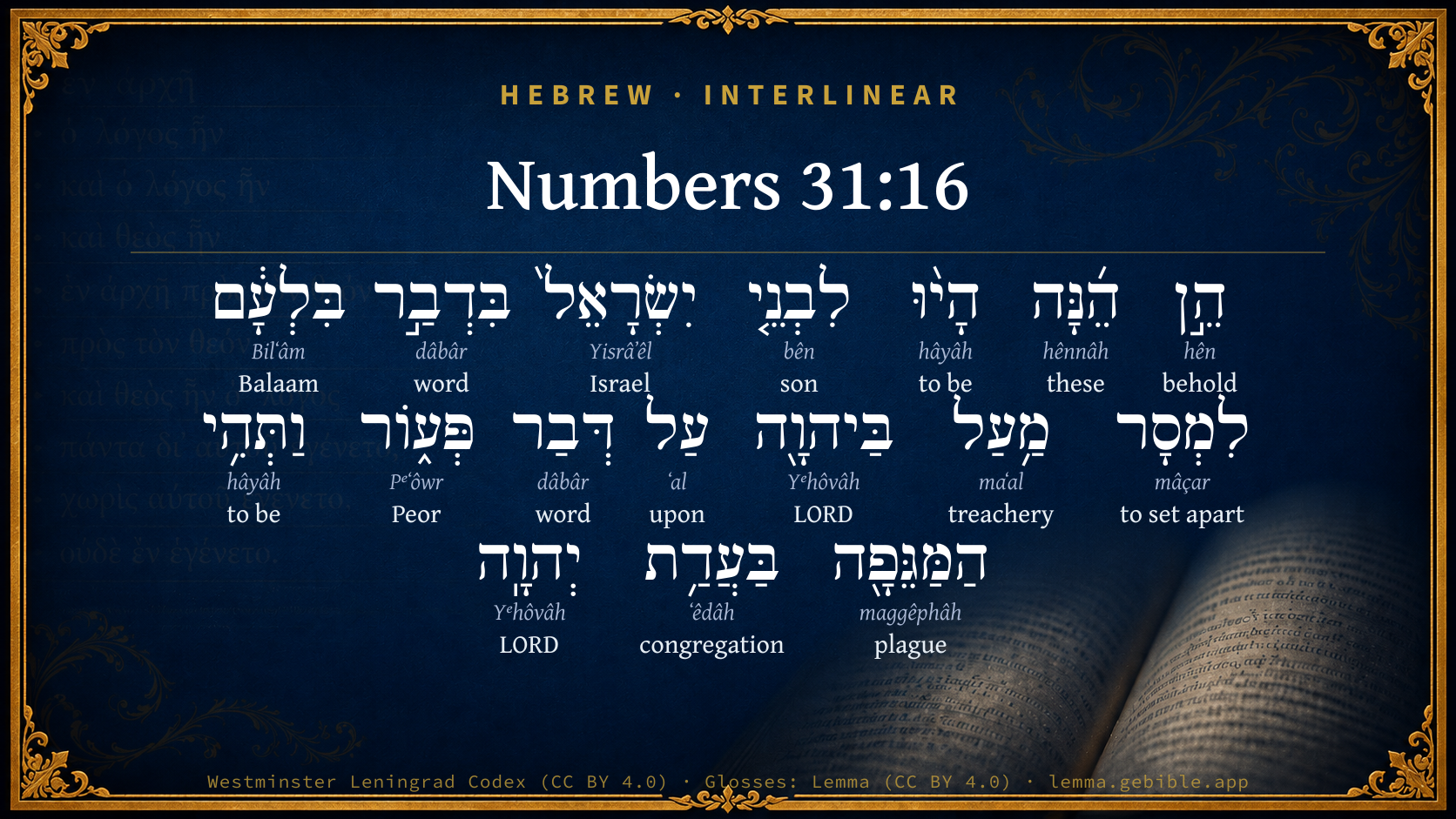
Hebrew (Westminster Leningrad Codex) Numbers 31:16 appears in the Hebrew Old Testament. The text above is from the Westminster Leningrad Codex. Each word links to its Strong’s number, a concise gloss, and parsing drawn from the Open Scriptures Hebrew Bible morphology. Click any word for its full Brown-Driver-Briggs (BDB) entry.
Download image
Cite this verse

Numbers 31:16 (World English Bible). Public Domain. Lemma interlinear Bible study tool, https://lemma.gebible.app/v/numbers/31/16.

Show BibTeX & RIS
BibTeX
RIS
English Translation
Behold, these caused the children of Israel, through the counsel of Balaam, to commit trespass against Yahweh in the matter of Peor, and so the plague was among the congregation of Yahweh.
World English Bible · Public Domain
Download a study sheet

One document with this verse’s original text, its word-by-word gloss line, the meaning frame, cross-references with their text, attributed commentary, and full source and license credits — printable, and it pastes into notes with its structure intact.

This verse Autodidact and up

Study sheet (.html) Plain text (.txt)

A passage Seminary Student

Up to 50 verses in one chapter. A passage sheet keeps up to 6 commentary sources and 12 cross-references per verse, in the order this page ranks them, and says so on the sheet whenever that leaves anything out. Ask for a single verse and you get the Autodidact verse sheet above.

Everything on this page stays free to read, with no account — the sheet is a download of what is already on screen, not access to it.

Want to remove ads? Support Godless Engineer
Compare translations 3

The same verse in 3 English versions, stacked beneath the original-language interlinear above. Click any original word for its lexicon entry.

Each is an independent rendering of the whole verse — the interlinear is not word-aligned to these translations.

Highlighted words mark where these versions differ — a whole-verse word diff, not a word-by-word alignment.

  • World English Bible Public Domain
    Behold, these caused the children of Israel, through the counsel of Balaam, to commit trespass against Yahweh in the matter of Peor, and so the plague was among the congregation of Yahweh.
  • King James Version Public Domain
    Behold, these caused the children of Israel, through the counsel of Balaam, to commit trespass against the LORD in the matter of Peor, and there was a plague among the congregation of the LORD.
  • unfoldingWord Literal Text CC BY-SA 4.0
    Look, these were by the word of Balaam for the sons of Israel to commit unfaithfulness against Yahweh concerning the matter of Peor, and the plague was among the congregation of Yahweh.

unfoldingWord Literal Text — © unfoldingWord, licensed CC BY-SA 4.0. Word-aligned USFM3 via Door43 (git.door43.org/unfoldingWord/en_ult).

Versions to compare (up to 4)

3 of 4 selected

Show all 18 translations

Every available English version of this verse, each an independent rendering of the whole verse.

  • World English Bible Public Domain
    Behold, these caused the children of Israel, through the counsel of Balaam, to commit trespass against Yahweh in the matter of Peor, and so the plague was among the congregation of Yahweh.
  • Berean Standard Bible Public Domain
    “Look, these women caused the sons of Israel, through the counsel of Balaam, to turn unfaithfully against the LORD at Peor, so that the plague struck the congregation of the LORD.
  • Majority Standard Bible Public Domain
    “Look, these women caused the sons of Israel, through the counsel of Balaam, to turn unfaithfully against the LORD at Peor, so that the plague struck the congregation of the LORD.
  • King James Version Public Domain
    Behold, these caused the children of Israel, through the counsel of Balaam, to commit trespass against the LORD in the matter of Peor, and there was a plague among the congregation of the LORD.
  • American Standard Version (1901) Public Domain
    Behold, these caused the children of Israel, through the counsel of Balaam, to commit trespass against Jehovah in the matter of Peor, and so the plague was among the congregation of Jehovah.
  • Revised Version (1885) Public Domain
    Behold, these caused the children of Israel, through the counsel of Balaam, to commit trespass against the LORD in the matter of Peor, and so the plague was among the congregation of the LORD.
  • Geneva Bible (1599) Public Domain
    Behold, these caused the children of Israel through the counsell of Balaam to commit a trespasse against the Lord, as concerning Peor, and there came a plague among the Congregation of the Lord.
  • Douay-Rheims (1899) Public Domain
    Are not these they, that deceived the children of Israel by the counsel of Balaam, and made you transgress against the Lord by the sin of Phogor, for which also the people was punished?
  • Young's Literal Translation Public Domain
    lo, they -- they have been to the sons of Israel, through the word of Balaam, to cause a trespass against Jehovah in the matter of Peor, and the plague is in the company of Jehovah.
  • Literal Standard Version CC BY-SA 4.0
    Behold, they have been to the sons of Israel, through the word of Balaam, to cause a trespass against YHWH in the matter of Peor, and the plague is in the congregation of YHWH.
  • Unlocked Literal Bible CC BY-SA 4.0
    Look, these women caused the people of Israel, through Balaam's advice, to commit sin against Yahweh in the matter of Peor, when the plague spread among Yahweh's community.
  • unfoldingWord Literal Text CC BY-SA 4.0
    Look, these were by the word of Balaam for the sons of Israel to commit unfaithfulness against Yahweh concerning the matter of Peor, and the plague was among the congregation of Yahweh.
  • Darby Bible Public Domain
    Lo, these, through the counsel of Balaam, caused the children of Israel to commit sin against Jehovah in the matter of Peor, and there was a plague on the assembly of Jehovah.
  • World Messianic Bible Public Domain
    Behold, these caused the children of Israel, through the counsel of Balaam, to commit trespass against the LORD in the matter of Peor, and so the plague was among the congregation of the LORD.
  • Webster's Bible Public Domain
    Behold, these caused the children of Israel, through the counsel of Balaam, to commit trespass against the LORD, in the matter of Peor, and there was a plague among the congregation of the LORD.
  • Free Bible Version CC BY-SA 4.0
    “You realize that these were the same women who seduced the Israelite men, leading them to be unfaithful to the Lord at Peor, following Balaam's advice! That's why the Lord's people suffered from the plague!
  • Bible in Basic English Public Domain
    It was these who, moved by Balaam, were the cause of Israel's sin against the Lord in the question of Peor, because of which disease came on the people of the Lord.
  • JPS Tanakh (1917) Public Domain
    Behold, these caused the children of Israel, through the counsel of Balaam, to revolt so as to break faith with the LORD in the matter of Peor, and so the plague was among the congregation of the LORD.

Literal Standard Version (2020), Covenant Press — licensed CC BY-SA 4.0. Text via the HelloAO Bible API (eBible.org). Unlocked Literal Bible (unfoldingWord) — licensed CC BY-SA 4.0. Text via the HelloAO Bible API (eBible.org). unfoldingWord Literal Text — © unfoldingWord, licensed CC BY-SA 4.0. Word-aligned USFM3 via Door43 (git.door43.org/unfoldingWord/en_ult). Free Bible Version, Dr. Jonathan Gallagher — licensed CC BY-SA 4.0. Text via the HelloAO Bible API (eBible.org).

Word by word

More ways to search: Search by grammar → Find every occurrence → Compare this word →

Practice this passage: Drill this verse → Learn its vocabulary →

לִמְסָר
mâçar
H4560
“to set apart”
Preposition + Verb, Qal, Infinitive Construct
Part of Speech
Preposition + Verb
Stem
Qal
Form
Infinitive Construct
Full BDB Definition

Origin: a primitive root

TWOT: 1224

to set apart, deliver up, offer - (Qal) to set apart - (Niphal) to be delivered over, be assigned to, be set apart
  1. הֵ֣ן hên H2005 “behold” Particle, Demonstrative
  2. הֵ֜נָּה hênnâh H2007 “these” Pronoun, Personal, 3rd Person, Feminine, Plural
  3. הָי֨וּ hâyâh H1961 “to be” Verb, Qal, Perfect, 3rd Person, Common, Plural
  4. לִבְנֵ֤י bên H1121 “to/for · sons of” Preposition + Noun, Common, Masculine, Plural, Construct
  5. יִשְׂרָאֵל֙ Yisrâʼêl H3478 “Israel” Noun, Proper
  6. בִּדְבַ֣ר dâbâr H1697 “in/at · word of” Preposition + Noun, Common, Masculine, Singular, Construct
  7. בִּלְעָ֔ם Bilʻâm H1109 “Balaam” Noun, Proper
  8. מַ֥עַל maʻal H4604 “treachery” Noun, Common, Masculine, Singular, Absolute
  9. בַּיהוָ֖ה Yᵉhôvâh H3068 “in/at · LORD” Preposition + Noun, Proper
  10. עַל ʻal H5921 “upon” Preposition
  11. דְּבַר dâbâr H1697 “word of” Noun, Common, Masculine, Singular, Construct
  12. פְּע֑וֹר Pᵉʻôwr H6465 “Peor” Noun, Proper
  13. וַתְּהִ֥י hâyâh H1961 “and · to be” Conjunction + Verb, Qal, Sequential Imperfect, 3rd Person, Feminine, Singular
  14. הַמַּגֵּפָ֖ה maggêphâh H4046 “the · plague” Particle, Definite Article + Noun, Common, Feminine, Singular, Absolute
  15. בַּעֲדַ֥ת ʻêdâh H5712 “in/at · congregation of” Preposition + Noun, Common, Feminine, Singular, Construct
  16. יְהוָֽה Yᵉhôvâh H3068 “LORD” Noun, Proper

About this verse

These counts appear in no published source. They are computed here, from the morphology-tagged text and Lemma’s own curated glosses. What Lemma adds →

17
words
14
distinct lemmas
Pentateuch
section

Notable vocabulary

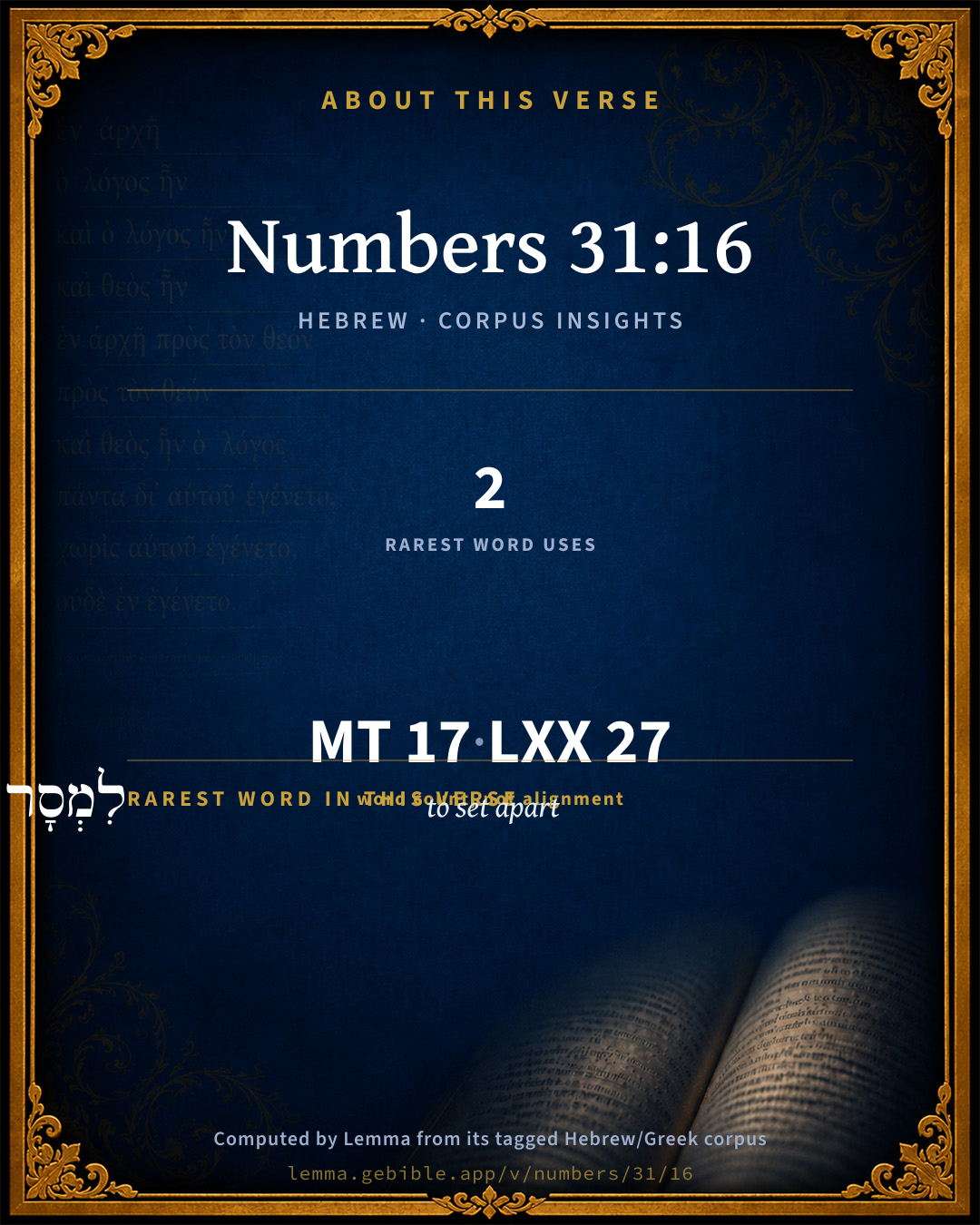
The rarest word here is לִמְסָר to set apart H4560 — appearing just 2 times in the whole Hebrew Bible.

Shared distinctive vocabulary

לִמְסָר to set apart H4560 occurs in 2 verses of the Hebrew Bible. Also found in:

Grammatical profile

  • 3 verbs
  • 11 nouns
  • 1 pronoun
  • 1 preposition
  • 1 particle

Verb forms

  • הָי֨וּ Qal · Perfect
  • לִמְסָר Qal · Infinitive Construct
  • וַתְּהִ֥י Qal · Sequential Imperfect

Repetition

Words recur within this verse — often emphatic in Hebrew:

  • הָי֨וּ to be H1961 ×2
  • בִּדְבַ֣ר word H1697 ×2
  • בַּיהוָ֖ה LORD H3068 ×2

Hebrew & Septuagint length

In English translation the verse runs 32 words from the Hebrew and 39 from the Septuagint (LXX English) — closely comparable.

A rough comparison of the two English renderings, which tokenize alike — not a word-level alignment.

Word counts can differ between the Hebrew and the Greek without any difference in meaning — e.g. the Hebrew direct-object marker אֵת has no separate Greek word, and Greek often adds the article ὁ.

In the original languages it is 17 Hebrew tokens and 27 Greek tokens — but the two are counted differently (Hebrew bundles its prefixes and suffixes into one token; the Greek is in lemma form), so that isn’t a like-for-like length.

Cross-references

9

Topical passages linked to Numbers 31:16 in the Treasury of Scripture Knowledge — connected by theme and wording, ordered by reader-vote popularity; previews shown in the World English Bible.

  • Numbers 25:1–9 Israel abode in Shittim; and the people began to play the prostitute with the daughters of Moab:
  • 2 Peter 2:15 forsaking the right way, they went astray, having followed the way of Balaam the son of Beor, who loved the wages of wrong-doing;
  • Revelation 2:14 But I have a few things against you, because you have there some who hold the teaching of Balaam, who taught Balak to throw a stumbling block before the children of Israel, to eat things sacrificed to idols, and to commit sexual immorality.
  • Deuteronomy 4:3 Your eyes have seen what Yahweh did because of Baal Peor; for all the men who followed Baal Peor, Yahweh your God has destroyed them from the midst of you.
  • Joshua 22:17 Is the iniquity of Peor too little for us, from which we have not cleansed ourselves to this day, although there came a plague on the congregation of Yahweh,
  • Numbers 24:14 Now, behold, I go to my people: come, [and] I will advertise you what this people shall do to your people in the latter days.
  • Numbers 25:18 for they vex you with their wiles, with which they have deceived you in the matter of Peor, and in the matter of Cozbi, the daughter of the prince of Midian, their sister, who was slain on the day of the plague in the matter of Peor.
  • Proverbs 23:27 For a prostitute is a deep pit; And a wayward wife is a narrow well.
  • Ecclesiastes 7:26 I find more bitter than death the woman whose heart is snares and traps, whose hands are chains. Whoever pleases God shall escape from her; but the sinner will be ensnared by her.

Cross-references courtesy of OpenBible.info (CC BY 4.0).

Hebrew and Greek witnesses Masoretic Hebrew ↔ Greek Septuagint

The same verse in the two great witnesses to the Old Testament, shown verse-for-verse.

These are two independent witnesses, not word-aligned to each other, and the Septuagint is shown in lemma (dictionary) form.

Hebrew Numbers 31:16 Masoretic · Westminster Leningrad Codex

הֵ֣ן הֵ֜נָּה הָי֨וּ לִבְנֵ֤י יִשְׂרָאֵל֙ בִּדְבַ֣ר בִּלְעָ֔ם לִמְסָר מַ֥עַל בַּיהוָ֖ה עַל דְּבַר פְּע֑וֹר וַתְּהִ֥י הַמַּגֵּפָ֖ה בַּעֲדַ֥ת יְהוָֽה

Behold, these caused the children of Israel, through the counsel of Balaam, to commit trespass against Yahweh in the matter of Peor, and so the plague was among the congregation of Yahweh.

World English Bible · Public Domain

Greek LXX Numbers 31:16 Septuagint · lemma form

οὗτος γάρ εἰμί ὁ υἱός ἰσραήλ κατά ὁ ῥῆμα βαλααμ ὁ ἀποἵστημι καί ὑπερὁράω ὁ ῥῆμα κύριος ἕνεκεν φογωρ καί γίγνομαι ὁ πληγή ἐν ὁ συναγωγή κύριος

For they were the occasion to the children of Israel by the word of Balaam of their revolting and despising the word of the Lord, because of Phogor; and there was a plague in the congregation of the Lord.

LXX2012 (modern English Septuagint) · Public Domain

Hebrew: Westminster Leningrad Codex (CC BY 4.0). Greek: Septuagint (public domain); English from LXX2012 (modern English Septuagint) (Public Domain). How the Septuagint differs from the Hebrew →

Targum (Aramaic paraphrase)

2

The Targum is the ancient Jewish Aramaic paraphrase of the Hebrew Scriptures — an interpretive translation, not the Hebrew text itself. Onkelos (literal) and Pseudo-Jonathan (expansive) render the Torah, and Jonathan the Prophets. Coverage is partial: where no permissively-licensed English translation exists for a verse, only the Aramaic is shown. This is verse-level text, not a word-by-word alignment to the Hebrew.

  1. Targum Onkelos Torah (Genesis–Deuteronomy)
    הָא אִינוּן הֲוָאָה לִבְנֵי יִשְׂרָאֵל בַּעֲצַת בִּלְעָם לְשַׁקָרָא שְׁקָר קֳדָם יְיָ עַל עֵסַק פְּעוֹר וַהֲוַת מוֹתָנָא בִּכְנִשְׁתָּא דַיְיָ

    (no public-domain English translation for this verse)

    Targum Onkelos — Aramaic: “Onkelos Genesis” (public domain); “Onkelos Exodus” (public domain); “Onkelos Leviticus” (public domain); “Onkelos Numbers” (public domain); “Onkelos Deuteronomy” (public domain). English: “Sefaria Community Translation” (CC0 1.0 (public-domain dedication)); “J.W. Etheridge. The Targums of Onkelos and Jonathan Ben Uzziel on the Pentateuch. London: Longmans, Green, 1862” (public domain). Text via Sefaria.

  2. Targum Pseudo-Jonathan Torah (Genesis–Deuteronomy)
    הִינוּן הִינוּן דְהַוָאָה תּוּקְלָא לִבְנֵי יִשְרָאֵל בְּעֵיצָתָא דְבִלְעָם לִמְשַׁקְרָא שְׁקַר קֳדָם יְיָ עַל עֵיסַק פְּעוֹר וַהֲוָה מוֹתָנָא בִּכְנִשְׁתָּא דַיְיָ

    These are they who caused the offence of the sons of Israel, by the counsel of Bileam, to do wrongly before the Lord in the matter of Peor, so that pestilence came upon the congregation of the Lord.

    Targum Pseudo-Jonathan — Aramaic: “Targum Jonathan on Genesis” (public domain); “Targum Jonathan on Exodus” (public domain); “Targum Jonathan on Leviticus” (public domain); “Targum Jonathan on Numbers” (public domain); “Targum Jonathan on Deuteronomy” (public domain). English: “The Targum of Jonathan ben Uzziel, trans. J. W. Etheridge, London, 1862” (public domain). Text via Sefaria.

Commentary

Notes on Numbers 31:16 from classic Christian and Jewish commentators (each source and its license shown beneath its notes). The classic Christian expositions comment on the surrounding passage and are grouped to its opening verse, so a note may address several verses; the Jewish commentaries on the Tanakh (Rashi and others) are per-verse, so they appear only where the commentator wrote on this verse.

Lemma curates 59 commentaries, every one of them public domain or Creative Commons licensed, each selected and text-cleaned for this edition rather than reprinted as found. About our sources →

The Biblical Illustrator

Joseph S. Exell

Num_31:16

The counsel of Balaam.

The counsel of Balaam

It would seem, then, that this people that was to dwell alone and not be reckoned among the nations had not dwelt alone; and that one man, at least, of the people in whom God had not beheld iniquity nor seen perverseness, had been guilty of the most flagrant iniquity and perverseness. For not only had he, an Israelitish prince, brought the daughter of a Midianitish prince unto his brethren--which was in itself an unlawful act--but he had done this openly and shamelessly, in the sight of Moses, and in the sight of all the congregation of Israel (Num_25:6). But how came it to pass that these Moabites and Midianites, who, only yesterday as it were, displayed such relentless hostility to Israel, should, to-day, be upon such friendly terms with them? How was it that, whereas but yesterday--so to speak--the king of Moab sent princes of Moab and Midian to Balaam, the son of Beor to Pethor in Mesopotamia, entreating him to come and curse the Israelites--sparing nothing to secure this end--these hostile princes are now giving their daughters to the Israelites in the most intimate companionship? Surely there must be some treachery in this proceeding! And so it seemed there was. Balaam, after his repulse by Balak, had fled, not to his own land, but to Midian, the confederate of Moab; and, not daring to curse the people himself, had suggested to the Midianites a method of leading them into iniquity, as a means of bringing a curse on them from God. And this new scheme had propitiated Balak, who had been so fiercely enraged against Balaam, and who now consulted (Mic_6:5) with Balaam; who counselled (Num_31:16) this expedient of mischief. So the matter came out upon the death of Balaam, and so is it explained in my text.

1. Balaam plainly committed this crime with his eyes open to the wrong be was doing. Out of his own mouth we may judge him. In a moment of prophetic inspiration he protested to Balak that his eyes were open; that he had heard the words of God, and knew the knowledge of the Most High. Balaams sin, then, was committed knowingly, consciously, wilfully. He was not overtaken in a fault. He set himself to do wickedly.

2. And he was influenced to take this course by the meanest of motives. He loved the wages of unrighteousness.

3. And if anything could have aggravated the meanness of the motive that influenced Balaam in betraying Israel, it was the baseness of the method he adopted to accomplish that design. God had revealed to him, in prophetic insight, the secret of Israels greatness and strength. And Balaam used the very inspiration which God gave him to injure, fatally, Gods own chosen people. And the cowardice of his procedure was in keeping with its baseness. He would not touch Israel himself. He dare not utter a word against them; but be could whisper suggestions of evil into the ears of others, that they might execute the diabolical design. (W. Roberts.)

Balaams devilish policy

This policy was fetched from the bottom of hell. It is not for lack of desire that I curse not Israel; thou dost not more wish their destruction, than I do thy wealth and honour; but so long as they hold firm with God, there is no sorcery against Jacob: withdraw God from them, and they shall fall alone, and curse themselves; draw them into sin, and thou shalt withdraw God from them. There is no sin more plausible than wantonness. One fornication shall draw in another, and both shall fetch the anger of God after them; their sight shall draw them to lust, their lust to folly, their folly to idolatry; and now God shall curse them for thee unasked. Where Balaam did speak well, there was never any prophet spake more divinely; where he spake ill, there was never any devil spake more desperately. Ill counsel seldom succeedeth not; good seed often falls out of the way, and roots not; but the tares never light amiss. This project of the wicked magician was too prosperous. (Bp. Hall.)

.

The Biblical Illustrator, edited by Joseph S. Exell (c. 1880s–1900s) — public domain. Text from a community e-Sword module.

Joseph Benson's Commentary

Num 31:16. Through the counsel of Balaam — Since the Moabites and their associates were taught by Balaam to acknowledge Jehovah to be a very powerful deity, even superior to the gods of other nations, (Num 23:19; Num 24:16,) is it not strange that they should have been induced, by Balaam’s persuasion, rather to entice the Israelites to their idolatry, than with them to embrace the worship of the true God? But the case appears to be that those idolaters considered the God of the Hebrews, not as the supreme God of the universe, but as a mere local deity, who might indeed be superior to other gods, but still was but the tutelary god of the Jews. Now with respect to those tutelary deities, their opinion was, that they required a certain form and manner of worship from their own people, which neglected, they incurred their grievous displeasure. Thus, as the Moabites and their confederates were under a persuasion that they could bring anger upon Israel from Jehovah, by seducing them from his instituted worship, so they might think themselves no less liable to the resentment of Chemosh, Peor, or some other of their own gods, had they adopted the Jewish modes and object of worship, and abandoned their own.

Joseph Benson's Commentary on the Old and New Testaments (1811–1818) — public domain. Text from a community e-Sword module.

Geneva Bible (1599)

Geneva Bible translators

For worshipping of Peor.

Geneva Bible (1599) marginal notes — public domain. Text via Bolls.life.

The Cambridge Bible for Schools and Colleges

gen. ed. J. J. S. Perowne

16. The wording of this verse is obscure in the Heb., but the R.V. gives the general sense. The rendering ‘to commit trespass’ is obtained by adopting a probable emendation, לִמְעֹל, for the late and difficult word לִמְסר ‘to deliver’ (see Num_31:5).

through the counsel of Balaam] Perhaps better in the matter of Balaam. This is a reference to an incident which is now lost, but which probably preceded Num_25:6 (see note there).

with regard to the matter of Peor] The writer refers in this clause to the quite distinct narrative in Num_25:1-5. In Rev_2:14 reference is made to the enticement by Balaam both to idolatry and to immorality.

The Cambridge Bible for Schools and Colleges (gen. ed. J. J. S. Perowne; Cambridge University Press, 1878–1918) — public domain. Text from a community e-Sword module.

John Gill's Exposition

But all the women children,.... The females among the little ones:

that have not known a man by lying with him; which might be pretty clear, and easily concluded, from their age:

keep for yourselves; either to be handmaids to them, or to be married among them when grown up, and become proselytes, and initiated into their religion.

John Gill's Exposition of the Whole Bible (1746–1763) — public domain (CC PDM 1.0). Text via the HelloAO Bible API.

Albert Barnes' Notes on the Bible

Caused ... to commit trespass - More literally, “became to the children of Israel for a cause (or, incitement) of treachery to the Lord.”

Albert Barnes' Notes on the Bible (1834–1885) — public domain. Text from a community e-Sword/MySword module.

Haydock's Catholic Bible Commentary

CHAPTER XXXI.

The sin of Phogor. The sin committed in the worship of Beelphegor. (Challoner) --- Many of the prostitutes had returned home, being terrified at the slaughter of their queen, Cozbi. (Haydock)

George Leo Haydock (1774–1849), Haydock's Catholic Family Bible and Commentary, 1859 edition — public domain. Excludes Psalms (Douay-Rheims chapter numbering differs from Protestant) and Deuterocanonical books (Catholic canon only).

Whedon's Commentary on the Bible

Daniel D. Whedon

16. Matter of Peor — See Num_25:3; Num_25:18, notes.

Daniel D. Whedon (gen. ed.), Commentary on the Old and New Testaments (1874–1909) — public domain. Text from a community e-Sword module.

The Pulpit Commentary

To commit trespass. lmArsmli See on verse 5. The word rsm seems to be used here much as the English word "levy" is used in such a phrase as "levying" war against a person.

The Pulpit Commentary (1880–1919), ed. H.D.M. Spence-Jones & Joseph S. Exell — public domain. Text from a community e-Sword module.

unfoldingWord translationNotes

Door43 World Missions Community

Look

This word is used here to draw the audience's attention to what is said next. AT: "Listen" (See: Idiom)

slept with a man

had sexual relations with a man (See: Euphemism)

translationWords

Balaam

sin

Yahweh

Peor

plague

had relations with

unfoldingWord translationNotes — © Distant Shores Media and the Door43 World Missions Community, licensed CC BY-SA 4.0. Source: git.door43.org/Door43/en_tn.

Rashi

Rabbi Shlomo Yitzchaki (Rashi)

הן הנה BEHOLD, THESE [WERE AN ENTICEMENT TO THE CHILDREN OF ISRAEL] — These: this word tells us that they recognised them, saying, ‘This is the woman through whom so-and-so fell into sin” (Yalkut Shimoni on Torah 785).

בדבר בלעם [THESE WERE AN ENTICEMENT] THROUGH THE WORD OF BALAAM — He had said to them: Even if you bring together all the hosts that are in the world you cannot overcome them. Are you perhaps more numerous than the Egyptians who had six hundred chosen chariots? Come and I will give you counsel: Their God has a hatred of immorality, etc., as it is related in the chapter חלק (Sanhedrin 106a) and in Sifrei Bamidbar 157:6.

Rashi on the Tanakh — English translations: “The Judaica Press complete Tanach with Rashi, translated by A. J. Rosenberg” (CC BY 4.0); “Pentateuch with Rashi's commentary by M. Rosenbaum and A.M. Silbermann, 1929-1934” (public domain); “The Metsudah Tanach series, Lakewood, N.J” (CC BY 4.0); and “The Book of Joshua, Metsudah Publications, 1997” (CC BY 4.0). Text via Sefaria.

Lesson kit

Teaching starters — assembled from the data on this page, not authored interpretation. Every prompt links to the verse data it draws on. Edit before teaching.

Numbers, in the Pentateuch, opens this verse with 17 words (14 distinct Hebrew lemmas). Its most distinctive word is mâçar (“to set apart”). A historical commentator’s framing appears above. Read the whole chapter for the surrounding context.

Discussion questions

  1. The word mâçar carries the sense “to set apart.” How does it shape the verse?
  2. How does Numbers 31:5, which shares the word «to set apart», read alongside this verse?
  3. What does the repetition of “to be” (2× in this one verse) do in this verse?
  4. These translations render this verse differently; the difference is in the English rendering, not the original. What questions does that raise?
  5. «הָי֨וּ» is a Qal Perfect verb. How does that grammatical form shape the action described?
  6. Compare how The Biblical Illustrator and Joseph Benson's Commentary read this verse. Where do they agree or differ?

Things to notice

Reading settings

Reading text

Shown beneath each verse's original-language words.

Old Testament
Old Testament edition

Read the OT as the Masoretic Hebrew (MT) or the Greek Septuagint (LXX).

English shown for the Greek Septuagint (in the Hebrew ↔ Greek comparison).

Comparing translations? Open the Compare panel on any verse page to stack up to four side by side.