2 Samuel 15:26

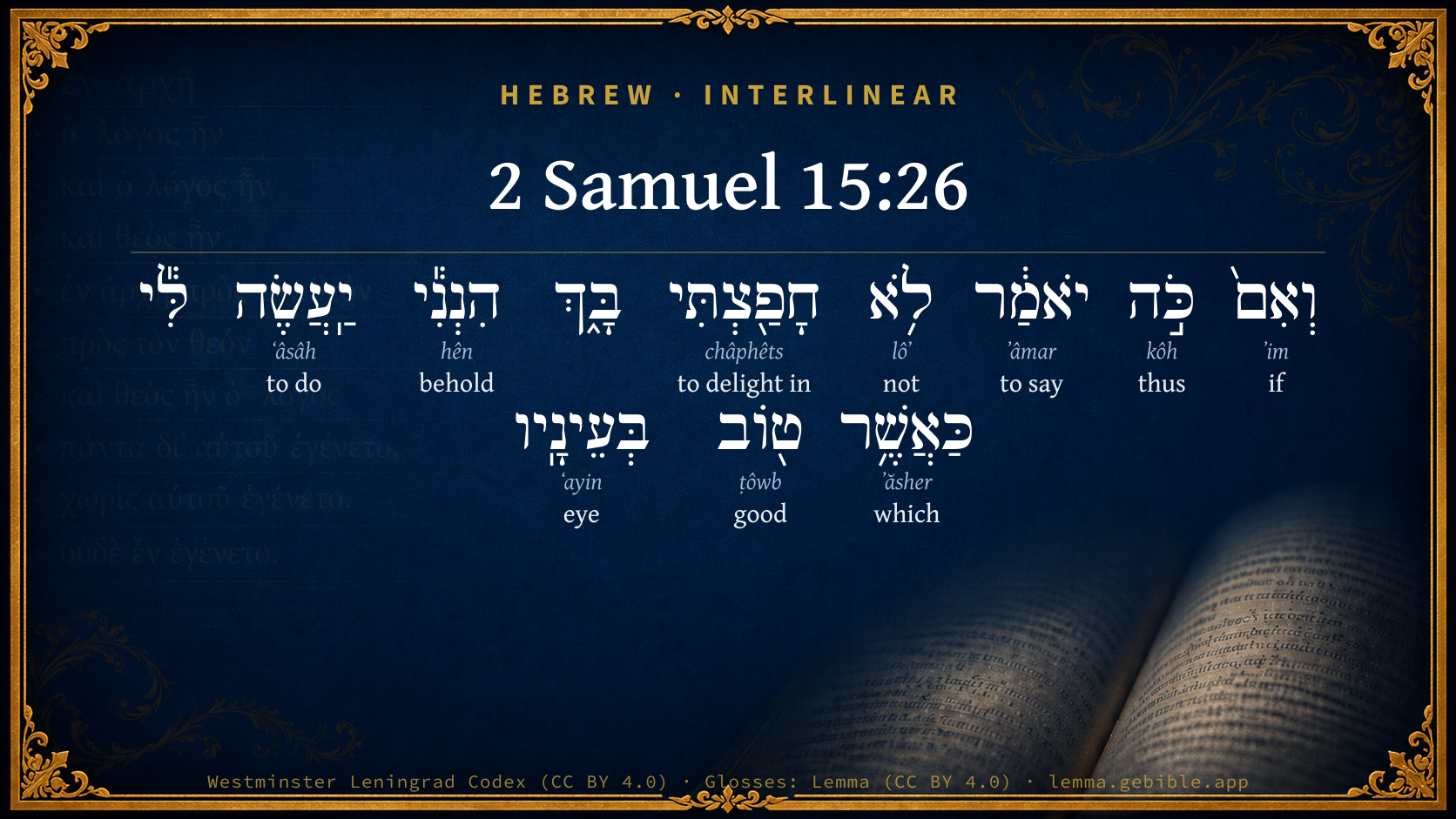
Hebrew (Westminster Leningrad Codex) 2 Samuel 15:26 appears in the Hebrew Old Testament. The text above is from the Westminster Leningrad Codex. Each word links to its Strong’s number, a concise gloss, and parsing drawn from the Open Scriptures Hebrew Bible morphology. Click any word for its full Brown-Driver-Briggs (BDB) entry.
Download image
Cite this verse

2 Samuel 15:26 (World English Bible). Public Domain. Lemma interlinear Bible study tool, https://lemma.gebible.app/v/2-samuel/15/26.

Show BibTeX & RIS
BibTeX
RIS
English Translation
but if he say thus, I have no delight in you; behold, here am I, let him do to me as seems good to him.
World English Bible · Public Domain
Download a study sheet

One document with this verse’s original text, its word-by-word gloss line, the meaning frame, cross-references with their text, attributed commentary, and full source and license credits — printable, and it pastes into notes with its structure intact.

This verse Autodidact and up

Study sheet (.html) Plain text (.txt)

A passage Seminary Student

Up to 50 verses in one chapter. A passage sheet keeps up to 6 commentary sources and 12 cross-references per verse, in the order this page ranks them, and says so on the sheet whenever that leaves anything out. Ask for a single verse and you get the Autodidact verse sheet above.

Everything on this page stays free to read, with no account — the sheet is a download of what is already on screen, not access to it.

Want to remove ads? Support Godless Engineer
Compare translations 3

The same verse in 3 English versions, stacked beneath the original-language interlinear above. Click any original word for its lexicon entry.

Each is an independent rendering of the whole verse — the interlinear is not word-aligned to these translations.

Highlighted words mark where these versions differ — a whole-verse word diff, not a word-by-word alignment.

  • World English Bible Public Domain
    but if he say thus, I have no delight in you; behold, here am I, let him do to me as seems good to him.
  • King James Version Public Domain
    But if he thus say, I have no delight in thee; behold, here am I, let him do to me as seemeth good unto him.
  • unfoldingWord Literal Text CC BY-SA 4.0
    But if he says thus, ‘I do not delight in you,’ behold me, may he do to me just as good in his eyes.”

unfoldingWord Literal Text — © unfoldingWord, licensed CC BY-SA 4.0. Word-aligned USFM3 via Door43 (git.door43.org/unfoldingWord/en_ult).

Versions to compare (up to 4)

3 of 4 selected

Show all 18 translations

Every available English version of this verse, each an independent rendering of the whole verse.

  • World English Bible Public Domain
    but if he say thus, I have no delight in you; behold, here am I, let him do to me as seems good to him.
  • Berean Standard Bible Public Domain
    But if He should say, ‘I do not delight in you,’ then here I am; let Him do to me whatever seems good to Him.”
  • Majority Standard Bible Public Domain
    But if He should say, ‘I do not delight in you,’ then here I am; let Him do to me whatever seems good to Him.”
  • King James Version Public Domain
    But if he thus say, I have no delight in thee; behold, here am I, let him do to me as seemeth good unto him.
  • American Standard Version (1901) Public Domain
    but if he say thus, I have no delight in thee; behold, here am I, let him do to me as seemeth good unto him.
  • Revised Version (1885) Public Domain
    but if he say thus, I have no delight in thee; behold, here am I, let him do to me as seemeth good unto him.
  • Geneva Bible (1599) Public Domain
    But if he thus say, I haue no delite in thee, behold, here am I, let him doe to me as seemeth good in his eyes.
  • Douay-Rheims (1899) Public Domain
    But if he shall say to me: Thou pleasest me not: I am ready, let him do that which is good before him.
  • Young's Literal Translation Public Domain
    and if thus He say, I have not delighted in thee; here `am' I, He doth to me as `is' good in His eyes.'
  • Literal Standard Version CC BY-SA 4.0
    and if thus He says, I have not delighted in you; here I [am], He does to me as [is] good in His eyes.”
  • Unlocked Literal Bible CC BY-SA 4.0
    But if he says, 'I am not pleased with you,' look, here am I, let him do to me whatever seems good to him.”
  • unfoldingWord Literal Text CC BY-SA 4.0
    But if he says thus, ‘I do not delight in you,’ behold me, may he do to me just as good in his eyes.”
  • Darby Bible Public Domain
    But if he thus say, I have no delight in thee; behold, [here am] I, let him do to me as seemeth good to him.
  • World Messianic Bible Public Domain
    but if he says, ‘I have no delight in you,’ behold, here I am. Let him do to me as seems good to him.”
  • Webster's Bible Public Domain
    But if he shall thus say, I have no delight in thee; behold, here am I, let him do to me as seemeth good to him.
  • Free Bible Version CC BY-SA 4.0
    But if he says, ‘I'm not happy with you,’ then here I stand. Let him do to me whatever he thinks best.”
  • Bible in Basic English Public Domain
    But if he says, I have no delight in you: then, here I am; let him do to me what seems good to him.
  • JPS Tanakh (1917) Public Domain
    but if He say thus: I have no delight in thee; behold, here am I, let Him do to me as seemeth good unto Him.'

Literal Standard Version (2020), Covenant Press — licensed CC BY-SA 4.0. Text via the HelloAO Bible API (eBible.org). Unlocked Literal Bible (unfoldingWord) — licensed CC BY-SA 4.0. Text via the HelloAO Bible API (eBible.org). unfoldingWord Literal Text — © unfoldingWord, licensed CC BY-SA 4.0. Word-aligned USFM3 via Door43 (git.door43.org/unfoldingWord/en_ult). Free Bible Version, Dr. Jonathan Gallagher — licensed CC BY-SA 4.0. Text via the HelloAO Bible API (eBible.org).

Word by word

More ways to search: Search by grammar → Find every occurrence → Compare this word →

Practice this passage: Drill this verse → Learn its vocabulary →

חָפַ֖צְתִּי
châphêts
H2654
“to delight in”
Verb, Qal, Perfect, 1st Person, Common, Singular
Part of Speech
Verb
Stem
Qal
Form
Perfect
Person
1st Person
Gender
Common
Number
Singular
Full BDB Definition

Origin: a primitive root

TWOT: 712 , 713

to delight in, take pleasure in, desire, be pleased with - (Qal) - of men - to take pleasure in, delight in - to delight, desire, be pleased to do - of God - to delight in, have pleasure in - to be pleased to do - to move, bend down - (Qal) to bend down
  1. וְאִם֙ ʼim H518 “and · if” Conjunction + Conjunction
  2. כֹּ֣ה kôh H3541 “thus” Adverb
  3. יֹאמַ֔ר ʼâmar H559 “to say” Verb, Qal, Imperfect, 3rd Person, Masculine, Singular
  4. לֹ֥א lôʼ H3808 “not” Particle, Negative
  5. הִנְנִ֕י hên H2005 “behold · me” Particle, Demonstrative + Suffix, Personal, 1st Person, Common, Singular
  6. יַֽעֲשֶׂה ʻâsâh H6213 “to do” Verb, Qal, Jussive, 3rd Person, Masculine, Singular
  7. כַּאֲשֶׁ֥ר ʼăsher H834 “like/as · which” Preposition + Particle, Relative
  8. ט֖וֹב ṭôwb H2896 “good” Verb, Qal, Perfect, 3rd Person, Masculine, Singular
  9. בְּעֵינָֽיו ʻayin H5869 “in/at · eyes · his” Preposition + Noun, Common, Both, Dual, Construct + Suffix, Personal, 3rd Person, Masculine, Singular

About this verse

These counts appear in no published source. They are computed here, from the morphology-tagged text and Lemma’s own curated glosses. What Lemma adds →

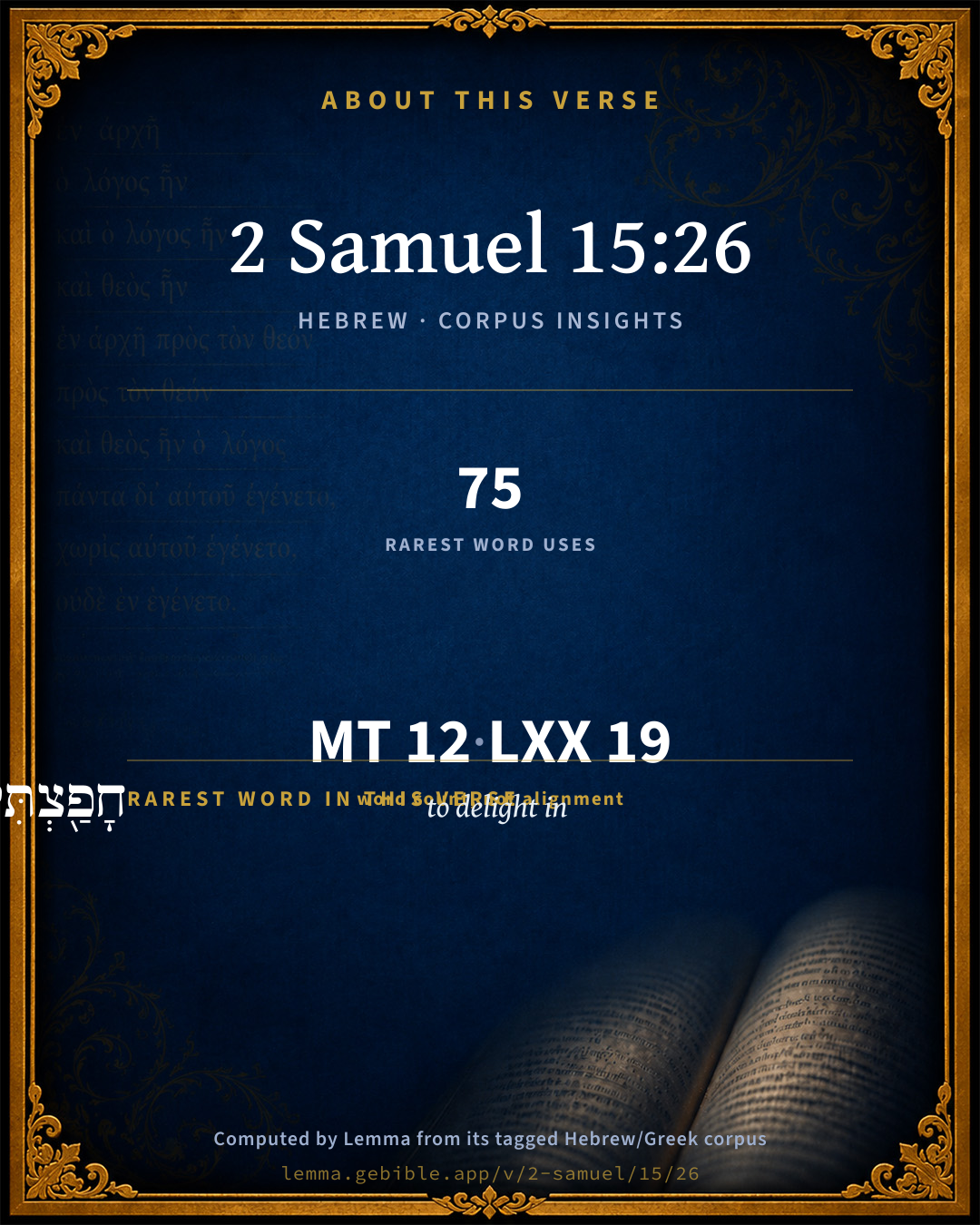
12
words
10
distinct lemmas
Historical
section

Grammatical profile

  • 4 verbs
  • 1 noun
  • 2 prepositions
  • 1 conjunction
  • 1 adverb
  • 3 particles

Verb forms

  • יֹאמַ֔ר Qal · Imperfect
  • חָפַ֖צְתִּי Qal · Perfect
  • יַֽעֲשֶׂה Qal · Jussive
  • ט֖וֹב Qal · Perfect

Hebrew & Septuagint length

In English translation the verse runs 25 words from the Hebrew and 30 from the Septuagint (LXX English) — closely comparable.

A rough comparison of the two English renderings, which tokenize alike — not a word-level alignment.

Word counts can differ between the Hebrew and the Greek without any difference in meaning — e.g. the Hebrew direct-object marker אֵת has no separate Greek word, and Greek often adds the article ὁ.

In the original languages it is 12 Hebrew tokens and 19 Greek tokens — but the two are counted differently (Hebrew bundles its prefixes and suffixes into one token; the Greek is in lemma form), so that isn’t a like-for-like length.

Cross-references

13

Topical passages linked to 2 Samuel 15:26 in the Treasury of Scripture Knowledge — connected by theme and wording, ordered by reader-vote popularity; previews shown in the World English Bible.

  • 1 Samuel 3:18 Samuel told him every whit, and hid nothing from him. He said, It is Yahweh: let him do what seems him good.
  • 2 Samuel 22:20 He brought me forth also into a large place; He delivered me, because he delighted in me.
  • 1 Kings 10:9 Blessed be Yahweh your God, who delighted in you, to set you on the throne of Israel: because Yahweh loved Israel forever, therefore made he you king, to do justice and righteousness.
  • Numbers 14:8 If Yahweh delight in us, then he will bring us into this land, and give it to us; a land which flows with milk and honey.
  • 2 Chronicles 9:8 Blessed be Yahweh your God, who delighted in you, to set you on his throne, to be king for Yahweh your God: because your God loved Israel, to establish them forever, therefore made he you king over them, to do justice and righteousness.
  • Isaiah 62:4 You shall no more be termed Forsaken; neither shall your land any more be termed Desolate: but you shall be called Hephzibah, and your land Beulah; for Yahweh delights in you, and your land shall be married.
  • Judges 10:15 The children of Israel said to Yahweh, We have sinned: do you to us whatever seems good to you; only deliver us, we pray you, this day.
  • Job 1:20–21 Then Job arose, and tore his robe, and shaved his head, and fell down on the ground, and worshiped.
  • Psalms 39:9 I was mute. I didn't open my mouth, Because you did it.
  • Isaiah 42:1 Behold, my servant, whom I uphold; my chosen, in whom my soul delights: I have put my Spirit on him; he will bring forth justice to the Gentiles.
  • Jeremiah 22:28 Is this man Coniah a despised broken vessel? is he a vessel in which none delights? why are they cast out, he and his seed, and are cast into the land which they don't know?
  • Jeremiah 32:41 Yes, I will rejoice over them to do them good, and I will plant them in this land assuredly with my whole heart and with my whole soul.
  • Matthew 1:10 Hezekiah became the father of Manasseh. Manasseh became the father of Amon. Amon became the father of Josiah.

Cross-references courtesy of OpenBible.info (CC BY 4.0).

Hebrew and Greek witnesses Masoretic Hebrew ↔ Greek Septuagint

The same verse in the two great witnesses to the Old Testament, shown verse-for-verse.

These are two independent witnesses, not word-aligned to each other, and the Septuagint is shown in lemma (dictionary) form.

Hebrew 2 Samuel 15:26 Masoretic · Westminster Leningrad Codex

וְאִם֙ כֹּ֣ה יֹאמַ֔ר לֹ֥א חָפַ֖צְתִּי בָּ֑ךְ הִנְנִ֕י יַֽעֲשֶׂה לִּ֕י כַּאֲשֶׁ֥ר ט֖וֹב בְּעֵינָֽיו

but if he say thus, I have no delight in you; behold, here am I, let him do to me as seems good to him.

World English Bible · Public Domain

Greek LXX 2 Samuel 15:26 Septuagint · lemma form

καί ἐάν εἶπον οὕτως οὐ ἐθέλω ἐν σύ ὁράω ἐγώ εἰμί ποιέω ἐγώ κατά ὁ ἀγαθός ἐν ὀφθαλμός αὐτός

But if he should say thus, I have no pleasure in you; behold, here I am, let him do to me according to that which is good in his eyes.

LXX2012 (modern English Septuagint) · Public Domain

Hebrew: Westminster Leningrad Codex (CC BY 4.0). Greek: Septuagint (public domain); English from LXX2012 (modern English Septuagint) (Public Domain). How the Septuagint differs from the Hebrew →

Targum (Aramaic paraphrase)

1

The Targum is the ancient Jewish Aramaic paraphrase of the Hebrew Scriptures — an interpretive translation, not the Hebrew text itself. Onkelos (literal) and Pseudo-Jonathan (expansive) render the Torah, and Jonathan the Prophets. Coverage is partial: where no permissively-licensed English translation exists for a verse, only the Aramaic is shown. This is verse-level text, not a word-by-word alignment to the Hebrew.

  1. Targum Jonathan Prophets (Joshua–Malachi)
    וְאִם כְּדֵין יֵימַר לָא רַעֲוָא קֳדָמַי בָּךְ הָא אֲנָא יַעְבֵּיד לִי כְּמָא דְרַעֲוָא קֳדָמוֹהִי:

    (no public-domain English translation for this verse)

    Targum Jonathan — Aramaic: “Mikraot Gedolot” (public domain). English: “Sefaria Community Translation” (CC0 1.0 (public-domain dedication)); “London "Chaldee Paraphrase," 1871” (public domain). Text via Sefaria.

Commentary

Notes on 2 Samuel 15:26 from classic Christian and Jewish commentators (each source and its license shown beneath its notes). The classic Christian expositions comment on the surrounding passage and are grouped to its opening verse, so a note may address several verses; the Jewish commentaries on the Tanakh (Rashi and others) are per-verse, so they appear only where the commentator wrote on this verse.

Lemma curates 59 commentaries, every one of them public domain or Creative Commons licensed, each selected and text-cleaned for this edition rather than reprinted as found. About our sources →

Trapp's Complete Commentary

John Trapp

2Sa 15:26 But if he thus say, I have no delight in thee; behold, [here am] I, let him do to me as seemeth good unto him.

Ver. 26. But if he thus say, I have no delight in thee.] As justly he may, for my many foul offences and daily disobediences, lay me aside as a broken vessel.

Behold, here am I.] Alexander the emperor in Herodian could say, χρη ανδρας γενναιους και σωφρονας ευχεθαι μεν υπαρχειν τα βελτισττα, φερειν δε τα προστπιπτοντα; It behoveth generous and wise men to pray that all may go well with them, but to bear patiently whatsoever shall befall them. A Christian followeth his suit for earthly things coldly and negligently, saith a reverend man, {a} as one indifferently disposed to them: or rather generously and nobly, tanquam Candidatus Caesaris, as a favourite of Caesar, as they were wont to say at Rome.

{a} Dr Stought.

John Trapp, A Commentary or Exposition upon All the Books of the Old and New Testament (1647–1656) — public domain. Text from a community e-Sword module.

Geneva Bible (1599)

Geneva Bible translators

The faithful in all their afflictions show themselves obedient to God’s will.

Geneva Bible (1599) marginal notes — public domain. Text via Bolls.life.

Ellicott's Commentary for English Readers

(26) Let him do to me as seemeth good.—David recognises that he is suffering under the punishment pronounced by Nathan for his sin, and he seeks to throw himself entirely into the hands of God, trusting in His mercy. (Comp. 2Sa_24:14.) He is, therefore, unwilling to have the ark carried with him lest he should seem to undertake to compel the Divine presence and blessing. He feels sure that if God so will, he shall be brought again in peace; but if not, yet he will perfectly submit himself to God’s ordering.

A Bible Commentary for English Readers, edited by Charles John Ellicott (1878–1897) — public domain. Text from a community e-Sword module.

The Cambridge Bible for Schools and Colleges

gen. ed. J. J. S. Perowne

26. I have no delight in thee] For as he had sung in the confident faith of happier days, deliverance from his enemies depended on God’s good pleasure. See ch. 2Sa_22:20, and cp. 1Ki_10:9.

behold here am I, &c.] Words of true resignation and humble submission to the will of God. He felt that he deserved this punishment for his sins.

The Cambridge Bible for Schools and Colleges (gen. ed. J. J. S. Perowne; Cambridge University Press, 1878–1918) — public domain. Text from a community e-Sword module.

John Gill's Exposition

But if he thus say, I have no delight in thee,.... As a king, or in his temporal prosperity, though he might and had delight in him as a chosen vessel of salvation, as a saint and child of God, and in his spiritual and everlasting welfare:

behold, here am I; his humble servant, ready to be, and do and suffer whatever is his pleasure:

let him do to me as seemeth good unto him; strip me of all the ensigns of royalty, dispossess me of my crown and kingdom, and dispose of me as seems good in his sight; who is a sovereign Being, and has a right to do with his creatures what he pleases.

John Gill's Exposition of the Whole Bible (1746–1763) — public domain (CC PDM 1.0). Text via the HelloAO Bible API.

Matthew Poole's English Annotations

I have no delight in thee; I will not receive thee into my favour, nor restore thee to thy throne and city, and to the enjoyment of my ark and ordinances.

Here am I, ready to obey him, and to submit to his will and pleasure concerning me.

Matthew Poole's English Annotations on the Holy Bible (1683–1685) — public domain. Text from a community e-Sword/MySword module.

The Pulpit Commentary

Let him do to me as seemeth good unto him. David"s answer is full, not only of devout resignation and trust in God, but is remarkable also for the absence of superstition. He feels that God will not judge him by any mere outward sign or privilege, but in truth and equity. If he deserves condemnation, he will not escape it by carrying the ark about with him. If, on the contrary, God accepts him, he will restore him to the enjoyment of his spiritual privileges, and bring him back to worship at the place which he has chosen for his dwelling. We must notice that he addresses these words to Zadok, who had remained with the ark. This was natural if Abiathar was occupied in offering, but hard to understand if he had gone up, that is, in advance of the ark, to acquaint David with their purpose.

The Pulpit Commentary (1880–1919), ed. H.D.M. Spence-Jones & Joseph S. Exell — public domain. Text from a community e-Sword module.

John Wesley's Explanatory Notes

Let him do - That we may not complain of what is, let us see God's hand in all events. And that we may not be afraid of what shall be, let us see all events in God's hand.

John Wesley, Explanatory Notes Upon the Whole Bible (1754–1765) — public domain. Text via the GEBible commentary corpus.

Lesson kit

Teaching starters — assembled from the data on this page, not authored interpretation. Every prompt links to the verse data it draws on. Edit before teaching.

2 Samuel, in the Historical, opens this verse with 12 words (10 distinct Hebrew lemmas). Its most distinctive word is châphêts (“to delight in”). A historical commentator’s framing appears above. Read the whole chapter for the surrounding context.

Discussion questions

  1. The word châphêts carries the sense “to delight in.” How does it shape the verse?
  2. How does 1 Samuel 3:18, which shares this passage’s theme, read alongside this verse?
  3. These translations render this verse differently; the difference is in the English rendering, not the original. What questions does that raise?
  4. «יֹאמַ֔ר» is a Qal Imperfect verb. How does that grammatical form shape the action described?
  5. Compare how Trapp's Complete Commentary and Geneva Bible (1599) read this verse. Where do they agree or differ?

Things to notice

Reading settings

Reading text

Shown beneath each verse's original-language words.

Old Testament
Old Testament edition

Read the OT as the Masoretic Hebrew (MT) or the Greek Septuagint (LXX).

English shown for the Greek Septuagint (in the Hebrew ↔ Greek comparison).

Comparing translations? Open the Compare panel on any verse page to stack up to four side by side.