
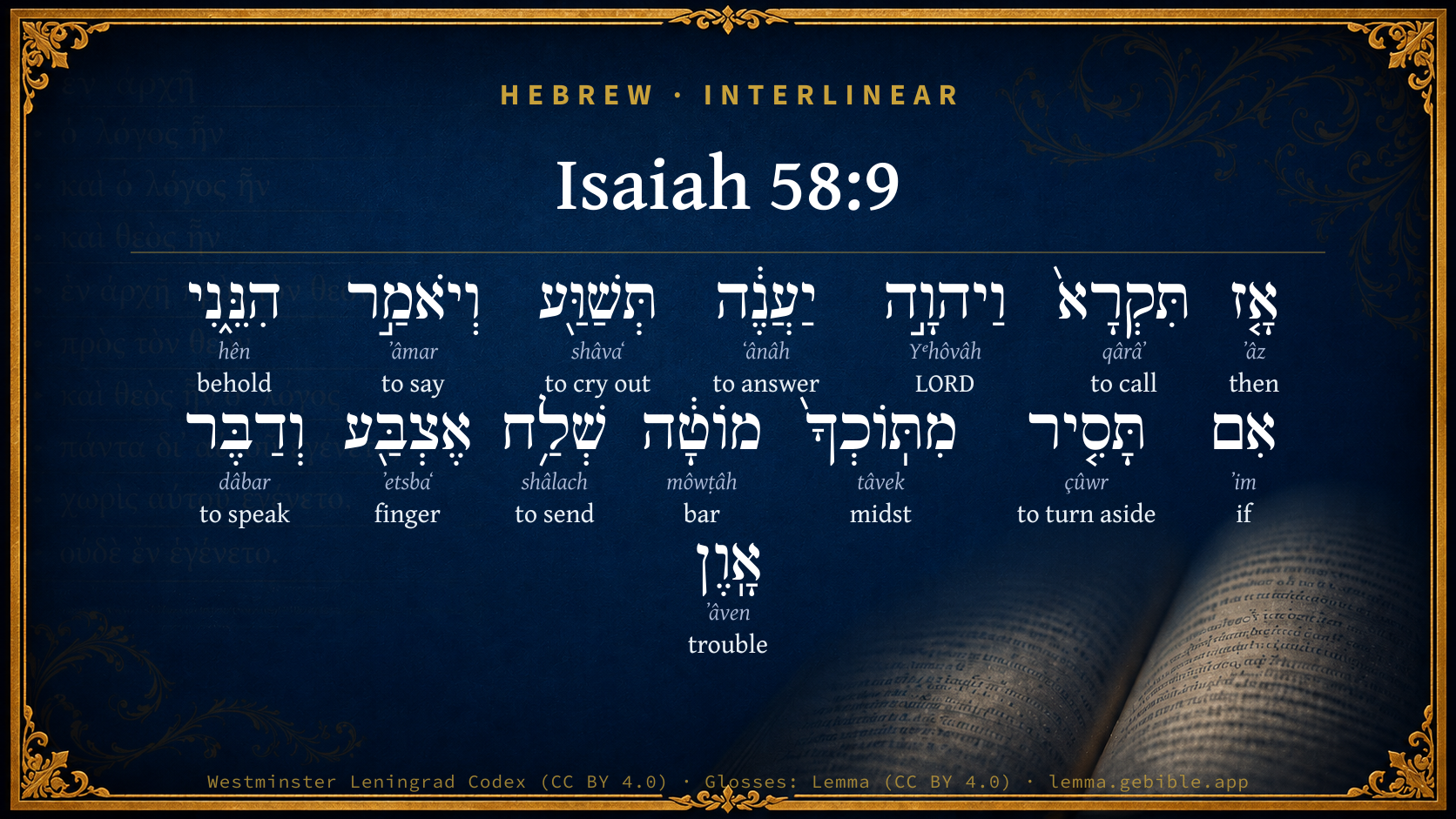
Isaiah 58:9

Hebrew (Westminster Leningrad Codex) Isaiah 58:9 appears in the Hebrew Old Testament. The text above is from the Westminster Leningrad Codex. Each word links to its Strong’s number, a concise gloss, and parsing drawn from the Open Scriptures Hebrew Bible morphology. Click any word for its full Brown-Driver-Briggs (BDB) entry.
Download image
Cite this verse

Isaiah 58:9 (World English Bible). Public Domain. Lemma interlinear Bible study tool, https://lemma.gebible.app/v/isaiah/58/9.

Show BibTeX & RIS
BibTeX
RIS
English Translation
Then shall you call, and Yahweh will answer; you shall cry, and he will say, Here I am. If you take away from the midst of you the yoke, the putting forth of the finger, and speaking wickedly;
World English Bible · Public Domain
Download a study sheet

One document with this verse’s original text, its word-by-word gloss line, the meaning frame, cross-references with their text, attributed commentary, and full source and license credits — printable, and it pastes into notes with its structure intact.

This verse Autodidact and up

Study sheet (.html) Plain text (.txt)

A passage Seminary Student

Up to 50 verses in one chapter. A passage sheet keeps up to 6 commentary sources and 12 cross-references per verse, in the order this page ranks them, and says so on the sheet whenever that leaves anything out. Ask for a single verse and you get the Autodidact verse sheet above.

Everything on this page stays free to read, with no account — the sheet is a download of what is already on screen, not access to it.

Want to remove ads? Support Godless Engineer
Compare translations 3

The same verse in 3 English versions, stacked beneath the original-language interlinear above. Click any original word for its lexicon entry.

Each is an independent rendering of the whole verse — the interlinear is not word-aligned to these translations.

Highlighted words mark where these versions differ — a whole-verse word diff, not a word-by-word alignment.

  • World English Bible Public Domain
    Then shall you call, and Yahweh will answer; you shall cry, and he will say, Here I am. If you take away from the midst of you the yoke, the putting forth of the finger, and speaking wickedly;
  • King James Version Public Domain
    Then shalt thou call, and the LORD shall answer; thou shalt cry, and he shall say, Here I am. If thou take away from the midst of thee the yoke, the putting forth of the finger, and speaking vanity;
  • unfoldingWord Literal Text CC BY-SA 4.0
    Then you will call, and Yahweh will answer; you will cry out, and he will say, ‘Behold me.’ q1 If you remove the yoke from your midst, the putting forth of the finger and the speaking of iniquity,

unfoldingWord Literal Text — © unfoldingWord, licensed CC BY-SA 4.0. Word-aligned USFM3 via Door43 (git.door43.org/unfoldingWord/en_ult).

Versions to compare (up to 4)

3 of 4 selected

Show all 18 translations

Every available English version of this verse, each an independent rendering of the whole verse.

  • World English Bible Public Domain
    Then shall you call, and Yahweh will answer; you shall cry, and he will say, Here I am. If you take away from the midst of you the yoke, the putting forth of the finger, and speaking wickedly;
  • Berean Standard Bible Public Domain
    Then you will call, and the LORD will answer; you will cry out, and He will say, ‘Here I am.’ If you remove the yoke from your midst, the pointing of the finger and malicious talk,
  • Majority Standard Bible Public Domain
    Then you will call, and the LORD will answer; you will cry out, and He will say, ‘Here I am.’ If you remove the yoke from your midst, the pointing of the finger and malicious talk,
  • King James Version Public Domain
    Then shalt thou call, and the LORD shall answer; thou shalt cry, and he shall say, Here I am. If thou take away from the midst of thee the yoke, the putting forth of the finger, and speaking vanity;
  • American Standard Version (1901) Public Domain
    Then shalt thou call, and Jehovah will answer; thou shalt cry, and he will say, Here I am. If thou take away from the midst of thee the yoke, the putting forth of the finger, and speaking wickedly;
  • Revised Version (1885) Public Domain
    Then shalt thou call, and the LORD shall answer; thou shalt cry, and he shall say, Here I am. If thou take away from the midst of thee the yoke, the putting forth of the finger, and speaking wickedly;
  • Geneva Bible (1599) Public Domain
    Then shalt thou call, and the Lord shall answere: thou shalt cry and hee shall say, Here I am: if thou take away from the mids of thee the yoke, the putting foorth of the finger, and wicked speaking:
  • Douay-Rheims (1899) Public Domain
    Then shalt thou call, and the Lord shall hear: thou shalt cry, and he shall say, Here I am. If thou wilt take away the chain out of the midst of thee, and cease to stretch out the finger, and to speak that which profiteth not.
  • Young's Literal Translation Public Domain
    Then thou callest, and Jehovah answereth, Thou criest, and He saith, `Behold Me.' If thou turn aside from thy midst the yoke, The sending forth of the finger, And the speaking of vanity,
  • Literal Standard Version CC BY-SA 4.0
    Then you call, and YHWH answers, || You cry, and He says, Behold Me. If you turn aside the yoke from your midst, || The sending forth of the finger, || And the speaking of vanity,
  • Unlocked Literal Bible CC BY-SA 4.0
    Then you would call, and Yahweh would answer; you would cry out for help, and he would say, “Here I am.” If you take away from among yourselves the yoke, the accusing finger, and the speech of wickedness,
  • unfoldingWord Literal Text CC BY-SA 4.0
    Then you will call, and Yahweh will answer; you will cry out, and he will say, ‘Behold me.’ q1 If you remove the yoke from your midst, the putting forth of the finger and the speaking of iniquity,
  • Darby Bible Public Domain
    Then shalt thou call, and Jehovah will answer; thou shalt cry, and he will say, Here I am. If thou take away from the midst of thee the yoke, the putting forth of the finger and the unjust speech,
  • World Messianic Bible Public Domain
    Then you will call, and the LORD will answer. You will cry for help, and he will say, ‘Here I am.’ “If you take away from among you the yoke, finger pointing, and speaking wickedly;
  • Webster's Bible Public Domain
    Then shalt thou call, and the LORD will answer; thou shalt cry, and he will say, Here I am. If thou shalt take away from the midst of thee the yoke, the putting forth of the finger, and speaking vanity;
  • Free Bible Version CC BY-SA 4.0
    Then when you call, the Lord will answer; when you cry out for help, the Lord will say, “I'm here.” If you get rid of oppression among you, if you stop pointing the finger and slandering others,
  • Bible in Basic English Public Domain
    Then at the sound of your voice, the Lord will give an answer; at your cry he will say, Here am I. If you take away from among you the yoke, the putting out of the finger of shame, and the evil word;
  • JPS Tanakh (1917) Public Domain
    Then shalt thou call, and the LORD will answer; thou shalt cry, and He will say: 'Here I am.' If thou take away from the midst of thee the yoke, the putting forth of the finger, and speaking wickedness;

Literal Standard Version (2020), Covenant Press — licensed CC BY-SA 4.0. Text via the HelloAO Bible API (eBible.org). Unlocked Literal Bible (unfoldingWord) — licensed CC BY-SA 4.0. Text via the HelloAO Bible API (eBible.org). unfoldingWord Literal Text — © unfoldingWord, licensed CC BY-SA 4.0. Word-aligned USFM3 via Door43 (git.door43.org/unfoldingWord/en_ult). Free Bible Version, Dr. Jonathan Gallagher — licensed CC BY-SA 4.0. Text via the HelloAO Bible API (eBible.org).

Word by word

More ways to search: Search by grammar → Find every occurrence → Compare this word →

Practice this passage: Drill this verse → Learn its vocabulary →

מוֹטָ֔ה
môwṭâh
H4133
“bar”
Noun, Common, Feminine, Singular, Absolute
Part of Speech
Noun
Type
Common
Gender
Feminine
Number
Singular
State
Absolute
Full BDB Definition

Origin: from H4132

TWOT: 1158b

pole, bar of yoke - pole - bar of yoke - of oppression (figuratively)
  1. אָ֤ז ʼâz H227 “then” Adverb
  2. תִּקְרָא֙ qârâʼ H7121 “to call” Verb, Qal, Imperfect, 2nd Person, Masculine, Singular
  3. וַיהוָ֣ה Yᵉhôvâh H3068 “and · LORD” Conjunction + Noun, Proper
  4. יַעֲנֶ֔ה ʻânâh H6030 “to answer” Verb, Qal, Imperfect, 3rd Person, Masculine, Singular
  5. תְּשַׁוַּ֖ע shâvaʻ H7768 “to cry out” Verb, Piel, Imperfect, 2nd Person, Masculine, Singular
  6. וְיֹאמַ֣ר ʼâmar H559 “and · to say” Conjunction + Verb, Qal, Imperfect, 3rd Person, Masculine, Singular
  7. הִנֵּ֑נִי hên H2005 “behold · me” Particle, Demonstrative + Suffix, Personal, 1st Person, Common, Singular
  8. אִם ʼim H518 “if” Conjunction
  9. תָּסִ֤יר çûwr H5493 “to turn aside” Verb, Hiphil, Imperfect, 2nd Person, Masculine, Singular
  10. מִתּֽוֹכְךָ֙ tâvek H8432 “from · midst · your” Preposition + Noun, Common, Masculine, Singular, Construct + Suffix, Personal, 2nd Person, Masculine, Singular
  11. שְׁלַ֥ח shâlach H7971 “to send” Verb, Qal, Infinitive Construct
  12. אֶצְבַּ֖ע ʼetsbaʻ H676 “finger” Noun, Common, Feminine, Singular, Absolute
  13. וְדַבֶּר dâbar H1696 “and · to speak” Conjunction + Verb, Piel, Infinitive Absolute
  14. אָֽוֶן ʼâven H205 “trouble” Noun, Common, Masculine, Singular, Absolute

About this verse

These counts appear in no published source. They are computed here, from the morphology-tagged text and Lemma’s own curated glosses. What Lemma adds →

15
words
15
distinct lemmas
Prophets
section

Notable vocabulary

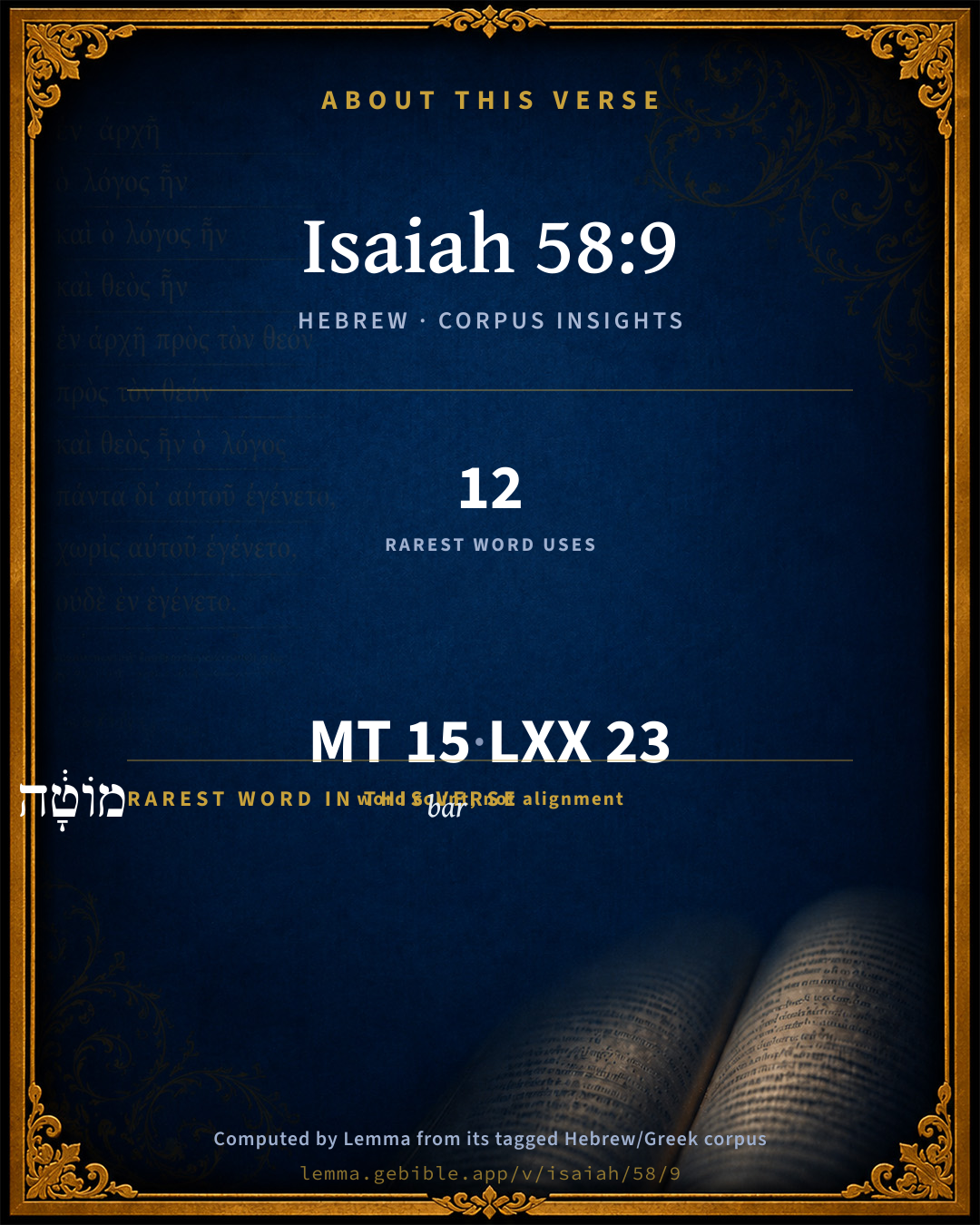
The rarest word here is מוֹטָ֔ה bar H4133 — appearing just 12 times in the whole Hebrew Bible.

Shared distinctive vocabulary

מוֹטָ֔ה bar H4133 occurs in 10 verses of the Hebrew Bible. Also found in:

Grammatical profile

  • 7 verbs
  • 5 nouns
  • 1 conjunction
  • 1 adverb
  • 1 particle

Verb forms

  • תִּקְרָא֙ Qal · Imperfect
  • יַעֲנֶ֔ה Qal · Imperfect
  • תְּשַׁוַּ֖ע Piel · Imperfect
  • וְיֹאמַ֣ר Qal · Imperfect
  • תָּסִ֤יר Hiphil · Imperfect
  • שְׁלַ֥ח Qal · Infinitive Construct
  • וְדַבֶּר Piel · Infinitive Absolute

Hebrew & Septuagint length

In English translation the verse runs 38 words from the Hebrew and 39 from the Septuagint (LXX English) — closely comparable.

A rough comparison of the two English renderings, which tokenize alike — not a word-level alignment.

Word counts can differ between the Hebrew and the Greek without any difference in meaning — e.g. the Hebrew direct-object marker אֵת has no separate Greek word, and Greek often adds the article ὁ.

In the original languages it is 15 Hebrew tokens and 23 Greek tokens — but the two are counted differently (Hebrew bundles its prefixes and suffixes into one token; the Greek is in lemma form), so that isn’t a like-for-like length.

Cross-references

22

Topical passages linked to Isaiah 58:9 in the Treasury of Scripture Knowledge — connected by theme and wording, ordered by reader-vote popularity; previews shown in the World English Bible.

  • Psalms 50:15 Call on me in the day of trouble. I will deliver you, and you will honor me."
  • Jeremiah 29:12–13 You shall call on me, and you shall go and pray to me, and I will listen to you.
  • Isaiah 65:24 It shall happen that, before they call, I will answer; and while they are yet speaking, I will hear.
  • Psalms 91:15 He will call on me, and I will answer him. I will be with him in trouble. I will deliver him, and honor him.
  • Matthew 7:7–8 "Ask, and it will be given you. Seek, and you will find. Knock, and it will be opened for you.
  • Isaiah 1:15 When you spread forth your hands, I will hide my eyes from you; Yes, when you make many prayers, I will not hear. Your hands are full of blood.
  • Psalms 34:15–17 Yahweh's eyes are toward the righteous. His ears listen to their cry.
  • Psalms 118:5 Out of my distress, I called on Yah. Yah answered me with freedom.
  • Psalms 12:2 Everyone lies to his neighbor. They speak with flattering lips, and with a double heart.
  • Proverbs 6:13 Who winks with his eyes, who signals with his feet, Who motions with his fingers;
  • Psalms 37:4 Also delight yourself in Yahweh, And he will give you the desires of your heart.
  • Psalms 66:18–19 If I cherished sin in my heart, The Lord wouldn't have listened.
  • 1 John 3:21–22 Beloved, if our hearts don't condemn us, we have boldness toward God;
  • Isaiah 57:4 Against whom do you sport yourselves? against whom make you a wide mouth, and put out the tongue? Aren't you children of disobedience, a seed of falsehood,
  • Isaiah 58:6 Isn't this the fast that I have chosen: to loose the bonds of wickedness, to undo the bands of the yoke, and to let the oppressed go free, and that you break every yoke?
  • Isaiah 59:13 transgressing and denying Yahweh, and turning away from following our God, speaking oppression and revolt, conceiving and uttering from the heart words of falsehood.
  • Zechariah 10:2 For the teraphim have spoken vanity, and the diviners have seen a lie; And they have told false dreams. They comfort in vain. Therefore they go their way like sheep. They are oppressed, because there is no shepherd.
  • Genesis 27:18 He came to his father, and said, "My father?" He said, "Here I am. Who are you, my son?"
  • 1 Samuel 3:4–8 that Yahweh called Samuel; and he said, Here am I.
  • Isaiah 30:19 For the people shall dwell in Zion at Jerusalem; you shall weep no more; he will surely be gracious to you at the voice of your cry; when he shall hear, he will answer you.
  • Isaiah 59:3–4 For your hands are defiled with blood, and your fingers with iniquity; your lips have spoken lies, your tongue mutters wickedness.
  • Ezekiel 13:8 Therefore thus says the Lord Yahweh: Because you have spoken falsehood, and seen lies, therefore, behold, I am against you, says the Lord Yahweh.

Cross-references courtesy of OpenBible.info (CC BY 4.0).

Hebrew and Greek witnesses Masoretic Hebrew ↔ Greek Septuagint

The same verse in the two great witnesses to the Old Testament, shown verse-for-verse.

These are two independent witnesses, not word-aligned to each other, and the Septuagint is shown in lemma (dictionary) form.

Hebrew Isaiah 58:9 Masoretic · Westminster Leningrad Codex

אָ֤ז תִּקְרָא֙ וַיהוָ֣ה יַעֲנֶ֔ה תְּשַׁוַּ֖ע וְיֹאמַ֣ר הִנֵּ֑נִי אִם תָּסִ֤יר מִתּֽוֹכְךָ֙ מוֹטָ֔ה שְׁלַ֥ח אֶצְבַּ֖ע וְדַבֶּר אָֽוֶן

Then shall you call, and Yahweh will answer; you shall cry, and he will say, Here I am. If you take away from the midst of you the yoke, the putting forth of the finger, and speaking wickedly;

World English Bible · Public Domain

Greek LXX Isaiah 58:9 Septuagint · lemma form

τότε βοάω καί ὁ θεός εἰςἀκούω σύ ἔτι λαλέω σύ εἶπον ἰδού παραεἰμί ἐάν ἀποαἱρέω ἀπό σύ σύνδεσμος καί χειροτονία καί ῥῆμα γογγυσμός

Then shall you cry, and God shall listen to you; while you are yet speaking he will say, Behold, I am here. If you remove from you the band, and the stretching forth of the hands, and murmuring speech;

LXX2012 (modern English Septuagint) · Public Domain

On this verse, Albert Barnes' Notes on the Bible discusses the Septuagint’s reading. Read the note in Commentary ↓

Hebrew: Westminster Leningrad Codex (CC BY 4.0). Greek: Septuagint (public domain); English from LXX2012 (modern English Septuagint) (Public Domain). How the Septuagint differs from the Hebrew →

Targum (Aramaic paraphrase)

1

The Targum is the ancient Jewish Aramaic paraphrase of the Hebrew Scriptures — an interpretive translation, not the Hebrew text itself. Onkelos (literal) and Pseudo-Jonathan (expansive) render the Torah, and Jonathan the Prophets. Coverage is partial: where no permissively-licensed English translation exists for a verse, only the Aramaic is shown. This is verse-level text, not a word-by-word alignment to the Hebrew.

  1. Targum Jonathan Prophets (Joshua–Malachi)
    בְּכֵן תְּצַלִי וַיָי יְקַבֵּל צְלוֹתָךְ תִּבְעֵי מִן קֳדָמוֹהִי וְיַעְבֵּד בָעוּתָךְ אִם תַּעְדֵי מִבֵּינָךְ אַסְטָיוּת דִין מִרְמַז בְּאֶצְבַּע וּמַלֵילָא מִלִין דְאוֹנֵס:

    Then thou shalt pray, and the Lord shall hear thy prayer; thou shalt supplicate before Him, and He shall grant thy supplication, if thou put away from the midst of thee perverted judgment, the pointing of the finger, and the speaking of violent words;

    Targum Jonathan — Aramaic: “Mikraot Gedolot” (public domain). English: “Sefaria Community Translation” (CC0 1.0 (public-domain dedication)); “London "Chaldee Paraphrase," 1871” (public domain). Text via Sefaria.

Commentary

Notes on Isaiah 58:9 from classic Christian and Jewish commentators (each source and its license shown beneath its notes). The classic Christian expositions comment on the surrounding passage and are grouped to its opening verse, so a note may address several verses; the Jewish commentaries on the Tanakh (Rashi and others) are per-verse, so they appear only where the commentator wrote on this verse.

Lemma curates 59 commentaries, every one of them public domain or Creative Commons licensed, each selected and text-cleaned for this edition rather than reprinted as found. About our sources →

Trapp's Complete Commentary

John Trapp

Isa 58:9 Then shalt thou call, and the LORD shall answer; thou shalt cry, and he shall say, Here I [am]. If thou take away from the midst of thee the yoke, the putting forth of the finger, and speaking vanity;

Ver. 9. Then shalt thou call, and the Lord shall answer.] Thou shalt have the royalty of his ear, easy access to, and all best success at, the throne of grace; no such cause to complain, as thou didst, {Isa 58:3} that thy prayers were lost.

If thou take away from the midst of thee.] E meditullio tui, from thy very heart, by an inward reformation; si animo, opere, et sermone aversaberis inhumanitatem, {a} if thou heartily hate cruelty and act accordingly.

The yoke.] As Isa 58:6.

The putting forth of the finger.] The finger of that wicked fist, {Isa 58:4} or that finger wherewith thou threatenest thy servants, or pointest at others in scorn or disdain, as the proud Pharisee seemeth to have done at the poor publican, when he said, I am not as that fellow. {Luk 18:11}

And speaking vanity.] Or, Violence, as the Chaldee here talk concerning the wringing and wronging of others. All this must be done, or else no hope that God will hear prayers; look to it. See Psa 66:18. {See Trapp on "Psa 66:18"}

{a} Jun

John Trapp, A Commentary or Exposition upon All the Books of the Old and New Testament (1647–1656) — public domain. Text from a community e-Sword module.

The Biblical Illustrator

Joseph S. Exell

Isa_58:9-11

Then shalt thou call

Gods wonderful response to His peoples prayers

When God calls to us by His Word, it becomes us to say, Here we are; what saith our Lord unto His servants?

But that God should say to us, Behold Me, here I am, is strange. When we cry to Him, as if He were at a distance, He will let us know that He is near, even at our right hand, nearer than we thought He was. It is I, be not afraid. When danger is near, our Protector is nearer, a very present help. Here I am, ready to give you what you want, and do for you what you desire. What have you to say to Me? God is attentive to the prayers of the upright (Psa_130:2). No sooner do they call to Him, but He answers, Ready, ready. Wherever they are praying, God saith, Here I am hearing; I am in the midst of you, nigh unto them in all things (Deu_4:7). (M. Henry.)

If thou take away from the midst of thee the yoke

One path to prosperity

In the figures implied the prophet represents extreme adversity; and by metaphors which he distinctly puts forth he describes renewed prosperity; and he connects the marvellous change from the deepest adversity to the highest prosperity with the avoidance or laying aside of three sins which then beset the people of God, and with the performance of two ordinary duties.

1. The besetting sins.

(1) Oppression If thou take away from the midst of thee the yoke, i.e oppression.

(2) Scorn and contempt. The putting forth of the finger is the spirit that speaks in the, Thou fool!

(3) And speaking vanity--evil speaking generally.

2. The duties.

(1) And if thou draw out thy soul to the hungry, and satisfy the afflicted soul--i.e give, serve, minister, according as men about you have need, and according as you have ability and opportunity.

(2) And satisfy the afflicted soul--i.e visit the widow and fatherless in their affliction--comfort those that mourn--endeavour according to your power to wipe away the tears from the eyes of all the sorrowful. (S. Martin.)

Oppression

The oppression of others is an early sin, a sin which you often see rampant among children--among very little children. Oppression is a household sin, it will be found more or less in almost every family. There may be some cases where it is not, but they are decided exceptions. And it is a sin in connection with all family relations. The godly husband is charged to love the wife even as himself, and even as Christ loveth the Church; but there are many husbands--some: professing to be Christs disciples--who are the wretched oppressors of wives. Oppression Is a household sin--seen in parents--seen in brothers and sisters--seen in the husband. And it is a social sin--seen in all the walks of life.

1. Especially where men employ each other, and take advantage of each others skill, and of each others strength. It is a national sin--seen more or less in all rulers; and an international sin--seen in the conduct of nations to each other. Manifestly, therefore, a very common sin is this putting on of the yoke--seen where men have no right to put on the yoke at all; and seen in a heavy yoke where men have only the right to put on a light yoke, and they impose a heavy yoke; and seen in thus keeping on of the yoke after the yoke should be removed. (S. Martin.)

Creed and outward ordinances not the supreme things

1. Nothing is here said about this people having declined from religious belief, or in this case from the observance of religious rites. God had to find fault with them on these grounds, but what I want you to notice is, that God is not speaking of such declension here. What does this show? It shows that a man, so far as the creed on his lip is concerned, may maintain his orthodoxy, and that a man, so far as religious ordinances are concerned, may maintain his devoutness, and yet have a heart thoroughly declining from Gods statutes.

2. There is an eternal connection between righteousness and blessedness.

3. The true state of individual saints and of congregations of saints is light, not obscurity; brightness, not dulness; happiness, not misery; spiritual health, not moral sickness; usefulness, not sterility and barrenness; continuance, not declension. (S. Martin.)

Putting forth of the finger

A gesture of derision. Hence the middle finger is called by Persius, digitus infamis. (J. A. Alexander.)

The Biblical Illustrator, edited by Joseph S. Exell (c. 1880s–1900s) — public domain. Text from a community e-Sword module.

Joseph Benson's Commentary

Isa 58:9-10. Then shalt thou call, &c. — They made great complaint, Isa 58:3, that God took no notice of their services, which complaint he seems now to refer to, as if he had said, These conditions being observed, call upon me, and thou shalt see I will regard, Psa 34:15. The Lord shall answer — He will give an effectual demonstration that he hears thee. He shall say, Here I am — A phrase that signifies a person to be ready at hand to help. If thou take away from the midst of thee — From among you; the yoke — All those pressures and grievances before mentioned. The putting forth of the finger — Done by way of scoff, or disdainful insulting; and speaking vanity — Any kind of evil words. Bishop Lowth renders it, “The pointing of the finger, and the injurious speech.” If thou draw out — Open, as when we open a store to satisfy the wants of the needy; thy soul to the hungry — Thy affection, that is, thy pity and compassion, to those in want of the necessaries of life; and satisfy the afflicted soul — With a real, substantial benefit, not contenting thyself with giving him merely kind words. For here the prophet expresses the work that is to be done, as in the former clause the affection wherewith it is to be done; otherwise it would only be what the Apostle James reproves, Jas 2:15-16. Then shall thy light rise in obscurity — See on Isa 58:8; and thy darkness be as the noon-day — In the very darkness of the affliction itself, thou shalt have comfort, Psa 112:4. There it shall be as the morning, still increasing, here as the noon-day, in its zenith, and height of perfection.

Joseph Benson's Commentary on the Old and New Testaments (1811–1818) — public domain. Text from a community e-Sword module.

Tyndale Open Study Notes

Tyndale Open Resources

58:9 the Lord will answer: Cp. 1:15; see also 19:22. • Stop . . . spreading vicious rumors: God calls for an end to acts and words that destroy relationships (see Prov 6:12-14).

Tyndale Open Study Notes — © Tyndale Open Resources, licensed CC BY-SA 4.0. Text via the HelloAO Bible API.

Geneva Bible (1599)

Geneva Bible translators

Whereby is meant all manner of injury.

Geneva Bible (1599) marginal notes — public domain. Text via Bolls.life.

Jamieson, Fausset & Brown

Robert Jamieson, A. R. Fausset & David Brown

Then . . . call . . . answer--when sin is renounced (Isa 65:24). When the Lord's call is not hearkened to, He will not hear our "call" (Psa 66:18; Pro 1:24, Pro 1:28; Pro 15:29; Pro 28:9).

putting forth of . . . finger--the finger of scorn pointed at simple-minded godly men. The middle finger was so used by the Romans.

speaking vanity--every injurious speech [LOWTH].

Jamieson, Fausset & Brown — Commentary Critical and Explanatory on the Whole Bible (1871) — public domain (CC PDM 1.0). Text via the HelloAO Bible API.

Ellicott's Commentary for English Readers

(9) Then shalt thou call.—The words point to the secret of the prayer which is answered in contrast to the formal worship that found no acceptance (Isa_58:2; Isa_58:4).

The putting forth of the finger.—The gesture (Cheyne compares the “infamis digitus” of Persius ii. 33) has in well-nigh all nations been a natural symbol of scorn. It is in action what the words “Raca” and “Thou fool” are in the language of Mat_5:22.

A Bible Commentary for English Readers, edited by Charles John Ellicott (1878–1897) — public domain. Text from a community e-Sword module.

John Gill's Exposition

Then shall thou call, and the Lord shall answer,.... A spirit of grace and supplication will be poured out upon the people of God; they will then pray without a form, and call upon the Lord in sincerity and truth, with faith and fervency; and the Lord will hear and answer them, and plentifully bestow his favours on them, so that they will have no reason to complain, as in Isa 58:3,

thou shalt cry, and he shall say, here I am; he will immediately appear to the help and relief of his people; they shall have his presence with them, to comfort and refresh them, to support and supply them, to protect and defend them:

if thou take away from the midst of thee the yoke; of human inventions, doctrines, rites and ceremonies, as in Isa 58:6, "the putting forth of the finger"; pointing at those that could not comply with them, by way of scorn and derision, as puritans, schismatics, &c. and persecuting them for it; and so is the same with smiting with the fist of wickedness, Isa 58:4; when this deriding and persecuting spirit is done away, then, and not till then, will the prayers of a people be heard, though under a profession of religion, and under the Protestant name: and speaking vanity; which also must be taken away, or desisted from; even speaking false doctrines, as the Syriac version; or which profits not, as the Vulgate Latin version; profane and vain babblings, Ti2 2:14, and threatening words, to such who will not receive them.

John Gill's Exposition of the Whole Bible (1746–1763) — public domain (CC PDM 1.0). Text via the HelloAO Bible API.

Albert Barnes' Notes on the Bible

Then shalt thou call - The sense is, that if we go before God renouncing all our sins, and desirous of doing our duty, then we have a right to expect that he will hear us. But if we go indulging still in sin; if we are false and hollow and hypocritical in our worship; or if, while we keep up the regular forms of devotion, we are nevertheless guilty of oppression, cruelty, and dishonesty, we have no right to expect that he will hear us (see the notes at Isa 1:15).

If thou take away ... the yoke - (See the notes at Isa 58:6).

The putting forth of the finger - That is, if you cease to contemn and despise others; if you cease to point at them the finger of scorn. It was usual to make use of the middle finger on such occasions. Thus Martial, ii. 28, 2:

Rideto multum -

- et digitum porrigito medium.

So Juvenal, Sat. x. 52:

- mediumque ostenderet unguem.

And speaking vanity - Lowth and Noyes render it thus, ‘The injurious speech.’ Kimchi understands it of words of contention and strife. The word used here (און 'âven) denotes either nothingness, vanity, a vain and empty thing Isa 41:29; Zec 10:2; or falsehood, deceit Psa 36:4; Pro 17:4; or unworthiness, wickedness, iniquity Job 36:21; Isa 1:13; here it means, probably, every kind of false, harsh, and unjust speaking - all of which probably I abounded among the Jews. The Septuagint renders it, ̔Ρῆμα γογγυσμοῦ Rēma gongusmou - ‘The word of murmuring.’

Albert Barnes' Notes on the Bible (1834–1885) — public domain. Text from a community e-Sword/MySword module.

Haydock's Catholic Bible Commentary

Finger, contemptuously, or threatening. (St. Jerome) --- Some explain it of the ordaining sacred ministers, or taking another’s property.

George Leo Haydock (1774–1849), Haydock's Catholic Family Bible and Commentary, 1859 edition — public domain. Excludes Psalms (Douay-Rheims chapter numbering differs from Protestant) and Deuterocanonical books (Catholic canon only).

Matthew Poole's English Annotations

They make great complaint, Isa 58:3, that God took no notice of their services, which complaint God seems now to satisfy: q.d. These conditions observed, call upon me, and thou shalt see I will regard, Psa 34:15. See Isa 1:18.

The Lord shall answer; he will give an effectual demonstration, that he hears thee, by the real answer that he will give to thy request, Psa 34:17; 99:6; 118:5.

Here I am; a phrase that notes a person to be ready at hand for work, as Isa 6:8; or for help, as God here, and Psa 46:1; or both, Psa 145:18,19.

From the midst; not a geometrical middle or centre, but having a place among others; the meaning is, from among you.

The yoke, i.e. all those pressures and grievances before mentioned, Isa 58:6; all that barbarous slavery they brought their brethren into; the particulars expressed by that one Hebrew word motah, three times used in this chapter.

The putting forth of the finger: there being often an indication of a man’s mind by the postures of several parts of the body, as of lust, malice, scorn, revenge, &c., Pro 6:12-14, this putting forth of the finger may point at divers things all springing from two roots; either the secret malice of the heart, or just and open violence. It is used,

1. Sometimes by way of scoff, reproof, or disdainful insulting, as the Pharisee seems to point at the publican, Luk 18:11; pointing with the finger, like winking with the eye, seeming to indicate something that may cause shame in another; and this is reckoned among great afflictions, Heb 11:36. See 2Ch 36:16; Jer 20:7;

2. Sometimes for beating, or other injurious treating men, seizing either their persons or estates: such a putting forth of the hand you have mentioned 1Sa 22:17; and this agrees well to the fist of wickedness, Isa 58:4; and so the finger may be put by a synecdoche for the hand, and that which before was called the fist may be here called the finger.

3. Sometimes as a token of putting suitors by, and refusing to hear their petitions and requests, seeking to them for mercy and pity.

4. Sometimes to express an angry mind, stirring up itself, either to the imperious commanding of a thing, or to revenge, whether by the gesture alone, or accompanied with menacing expressions. signifying thereby a purpose to put our power in execution.

Speaking vanity, Heb. aven; it signifies a lie, or iniquity, as Psa 5:5; 6:8; and so the sense may be, If thou dost not proceed to indecent expressions in thy strifes, brawls, and threatenings with thy finger, which seldom is done without sin; and thus the counsel here may suit with our Saviour’s, Mat 5:21,22, viz. not only not stretch out thine hand against thy brother, but not so much as be lavish with thy tongue: so speaking vanity may be a meiosis, for not railing; the LXX. render it muttering, which is an incomplete kind of speaking, whereby we reproach another in low, unformed, undigested expressions. But it seems here rather to signify affliction, not only because the word used in this place doth properly so signify, but because it is most agreeable to the matter discoursed of, and the Chaldee render it violence; and then the sense is, speaking words of affliction, or that will vex and grieve, like those words of Nabal to David’s servants, 1Sa 25:10,11; Pr 18:23. And thus it relates to their harsh and unjust commands, wherewith they were wont to burden their servants; a synecdoche of the kind.

Matthew Poole's English Annotations on the Holy Bible (1683–1685) — public domain. Text from a community e-Sword/MySword module.

Whedon's Commentary on the Bible

Daniel D. Whedon

9. Then — On ceasing to oppress, and engaging in works of kindness and helpfulness.

Call… answer — The one party having the confidence to “call,” and the other both the disposition and legally the power to “answer,” seeing that right actions proceeding from right motives had taken the place of wrong ones.

Daniel D. Whedon (gen. ed.), Commentary on the Old and New Testaments (1874–1909) — public domain. Text from a community e-Sword module.

The Pulpit Commentary

If thou take away from the midst of thee the yoke (comp. ver. 6). The putting forth of the finger. The pointing of the finger at any one in scorn. And speaking vanity; rather, speaking evil, or plotting evil, against others.

Conditions of answer to prayer.

Were these men, whose lives were spent for self, but who made a show of seeming to want God, proper persons to receive answers to their prayers? Let the Apostle James answer. "Ye ask, and receive not, because ye ask amiss, that ye may consume it upon your lusts". (Jam_4:3) God wants signs of right character in those whose petitions he grants; for such character is the only guarantee that what he gives is rightly accepted and rightly used. Here with special reference to the particular sins of the age, we have these conditions laid down.

1. Ceasing from stern and cruel dealings with those who serve us. "Takeaway the yoke" (see ver. 6).

2. Taunts of those who are recognized as the faithful servants of God, but de not make just the same expression of their piety that we do. "Putting forth the finger;" a gesture of derision. "Indicative of mockery and insolence towards the pious and persisting part of the nation" (Matthew Arnold).

3. Boasting. A spirit of self-satisfaction, which is quite inconsistent with any approach to God with expressions of need and fervent desires. "Speaking vanity." While these evils must be put away, it is made a further condition of answer to prayer, that he who prays shall be positively set upon doing good, caring for the hungry and the afflicted. As the immediate reference is to the prayers offered on the national fast-days, this homily may be made to hear specially upon national days of humiliation, Lenten times, etc. Such times are useful, and are necessary. They are called for by the Divine judgments. But the special danger of them is insincerity. The special condition of their acceptance with God is national turning from sin to righteousness and charity. Therefore, at such seasons, the work of God"s ministers is to produce due convictions of national sins. Our Lord taught conditions of prayer for his individual disciples, in his sermon on the mount. "For if ye forgive men their trespasses, your heavenly Father will also forgive you. R.T.

The Pulpit Commentary (1880–1919), ed. H.D.M. Spence-Jones & Joseph S. Exell — public domain. Text from a community e-Sword module.

John Wesley's Explanatory Notes

Answer - He will give an effectual demonstration, that he hears thee. Here l am - A phrase that notes a person to be ready at hand to help. Take away - From among you. The yoke - All those pressures and grievances before mentioned. Putting forth - Done by way of scoff, or disdainful insulting. Vanity - Any kind of evil words.

John Wesley, Explanatory Notes Upon the Whole Bible (1754–1765) — public domain. Text via the GEBible commentary corpus.

J. A. Alexander on Isaiah

Joseph Addison Alexander

“Then shalt thou call and Jehovah will answer, thou shalt cry and He will say, Behold me (here I am), if thou wilt put away from the midst of thee the yoke, the pointing of the finger, and the speaking of vanity.” The ‘then’ may either be connected with what goes before or correspond to ‘if’ in the other clause, like ‘then’, when, in English. The conditional form of the promise implies that it was not so with them now, of which indeed they are themselves represented as complaining in v. 3. The idea of this verse might be expressed in the occidental idiom by saying, ‘when thou callest, Jehovah will answer; when thou criest, he will say, Behold me.’ (See above, on Isa 50:2). The yoke is again mentioned as the symbol of oppression. (See v. 6.) The pointing of the finger is a gesture of derision The Arabs have a verb derived from finger and denoting scorn full ridicule. The object of contempt in this case may be the pious or the unfortunate. Words of vanity in Zec 10:2 means falsehood, which is here retained by some, while others give it the specific sense of ‘slander, secret and malignant machination, censorious and unnecessary fault-finding, strife and bickerings’. All these may be included in the general sense of evil speech or wicked words.

Joseph Addison Alexander, The Prophecies of Isaiah (1846–1847; New York: Scribner, 1870–1878) — public domain. Text from a community e-Sword module.

unfoldingWord translationNotes

Door43 World Missions Community

General Information:

Yahweh continues speaking to the people of Israel.

then your light will rise in the darkness, and your darkness will be like the noonday

"Your light" represents the acts of kindness that will be examples to everyone, and the "darkness," the bad deeds, will be overcome by their good deeds. (See: Metaphor)

translationWords

call

Yahweh

yoke

accuse

evil

light

darkness

unfoldingWord translationNotes — © Distant Shores Media and the Door43 World Missions Community, licensed CC BY-SA 4.0. Source: git.door43.org/Door43/en_tn.

Ibn Ezra

Rabbi Abraham ibn Ezra

From thy midst. From thy heart, or from the midst of Israel. מוטה Yoke. Slavery.

שׁלַח The putting forth. It is a verbal noun similar in form to the infinitive שְׁכַב to lie (1 Kgs. 1:21). The putting forth of thy finger, that is, the stretching out of the hand to smite the neighbour or to take away his property. ודבר And to speak. דבר is a verbal noun.

Ibn Ezra on the Tanakh — English translations: “Sefaria Community Translation” (CC0 1.0 (public-domain dedication)); “Yalkut, Sifsei Chachomim Chumash, Metsudah Publications, 2009” (CC BY 4.0); and “Commentary of Ibn Ezra on Isaiah - trans. by M. Friedlander, 1873” (public domain). Text via Sefaria.

Lesson kit

Teaching starters — assembled from the data on this page, not authored interpretation. Every prompt links to the verse data it draws on. Edit before teaching.

Isaiah, in the Prophets, opens this verse with 15 words (15 distinct Hebrew lemmas). Its most distinctive word is môwṭâh (“bar”). A historical commentator’s framing appears above. Read the whole chapter for the surrounding context.

Discussion questions

  1. What does “bar” (môwṭâh) contribute to the verse as a whole?
  2. How does Leviticus 26:13, which shares the word «bar», read alongside this verse?
  3. These translations render this verse differently. What is at stake in choosing one wording over another?
  4. «תִּקְרָא֙» is a Qal Imperfect verb. How does that grammatical form shape the action described?
  5. Compare how Trapp's Complete Commentary and The Biblical Illustrator read this verse. Where do they agree or differ?

Things to notice

Reading settings

Reading text

Shown beneath each verse's original-language words.

Old Testament
Old Testament edition

Read the OT as the Masoretic Hebrew (MT) or the Greek Septuagint (LXX).

English shown for the Greek Septuagint (in the Hebrew ↔ Greek comparison).

Comparing translations? Open the Compare panel on any verse page to stack up to four side by side.