
Isaiah 56:3

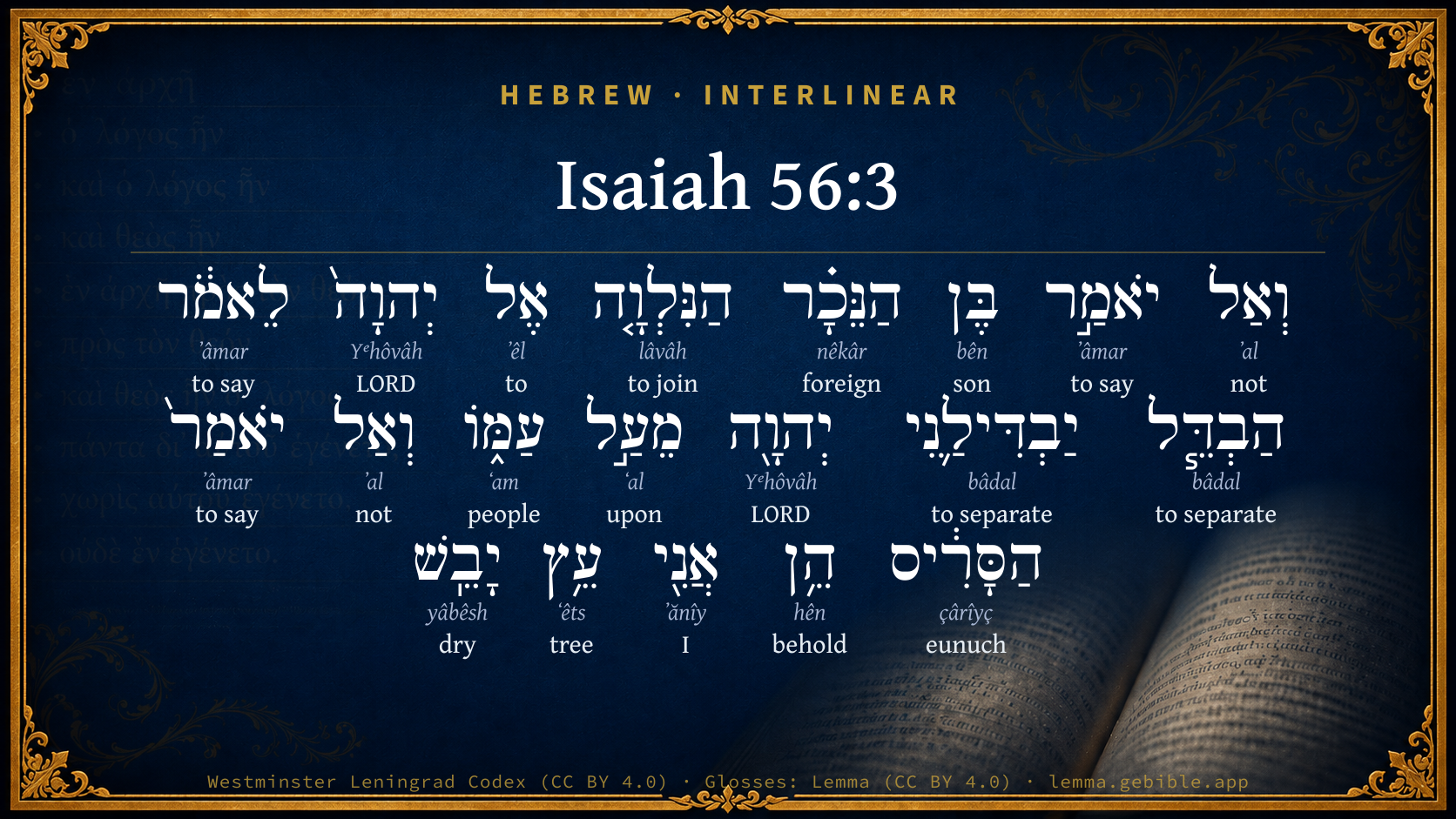
Hebrew (Westminster Leningrad Codex) Isaiah 56:3 appears in the Hebrew Old Testament. The text above is from the Westminster Leningrad Codex. Each word links to its Strong’s number, a concise gloss, and parsing drawn from the Open Scriptures Hebrew Bible morphology. Click any word for its full Brown-Driver-Briggs (BDB) entry.
Download image
Cite this verse

Isaiah 56:3 (World English Bible). Public Domain. Lemma interlinear Bible study tool, https://lemma.gebible.app/v/isaiah/56/3.

Show BibTeX & RIS
BibTeX
RIS
English Translation
Neither let the foreigner, who has joined himself to Yahweh, speak, saying, Yahweh will surely separate me from his people; neither let the eunuch say, Behold, I am a dry tree.
World English Bible · Public Domain
Download a study sheet

One document with this verse’s original text, its word-by-word gloss line, the meaning frame, cross-references with their text, attributed commentary, and full source and license credits — printable, and it pastes into notes with its structure intact.

This verse Autodidact and up

Study sheet (.html) Plain text (.txt)

A passage Seminary Student

Up to 50 verses in one chapter. A passage sheet keeps up to 6 commentary sources and 12 cross-references per verse, in the order this page ranks them, and says so on the sheet whenever that leaves anything out. Ask for a single verse and you get the Autodidact verse sheet above.

Everything on this page stays free to read, with no account — the sheet is a download of what is already on screen, not access to it.

Want to remove ads? Support Godless Engineer
Compare translations 3

The same verse in 3 English versions, stacked beneath the original-language interlinear above. Click any original word for its lexicon entry.

Each is an independent rendering of the whole verse — the interlinear is not word-aligned to these translations.

Highlighted words mark where these versions differ — a whole-verse word diff, not a word-by-word alignment.

  • World English Bible Public Domain
    Neither let the foreigner, who has joined himself to Yahweh, speak, saying, Yahweh will surely separate me from his people; neither let the eunuch say, Behold, I am a dry tree.
  • King James Version Public Domain
    Neither let the son of the stranger, that hath joined himself to the LORD, speak, saying, The LORD hath utterly separated me from his people: neither let the eunuch say, Behold, I am a dry tree.
  • unfoldingWord Literal Text CC BY-SA 4.0
    And let not the son of the foreigner joins himself to Yahweh say, saying, “Separating, Yahweh will separate me from his people.” And let not the eunuch say, “Behold, I a dry tree.”

unfoldingWord Literal Text — © unfoldingWord, licensed CC BY-SA 4.0. Word-aligned USFM3 via Door43 (git.door43.org/unfoldingWord/en_ult).

Versions to compare (up to 4)

3 of 4 selected

Show all 18 translations

Every available English version of this verse, each an independent rendering of the whole verse.

  • World English Bible Public Domain
    Neither let the foreigner, who has joined himself to Yahweh, speak, saying, Yahweh will surely separate me from his people; neither let the eunuch say, Behold, I am a dry tree.
  • Berean Standard Bible Public Domain
    Let no foreigner who has joined himself to the LORD say, “The LORD will utterly exclude me from His people.” And let the eunuch not say, “I am but a dry tree.”
  • Majority Standard Bible Public Domain
    Let no foreigner who has joined himself to the LORD say, “The LORD will utterly exclude me from His people.” And let the eunuch not say, “I am but a dry tree.”
  • King James Version Public Domain
    Neither let the son of the stranger, that hath joined himself to the LORD, speak, saying, The LORD hath utterly separated me from his people: neither let the eunuch say, Behold, I am a dry tree.
  • American Standard Version (1901) Public Domain
    Neither let the foreigner, that hath joined himself to Jehovah, speak, saying, Jehovah will surely separate me from his people; neither let the eunuch say, Behold, I am a dry tree.
  • Revised Version (1885) Public Domain
    Neither let the stranger, that hath joined himself to the LORD, speak, saying, The LORD will surely separate me from his people: neither let the eunuch say, Behold, I am a dry tree.
  • Geneva Bible (1599) Public Domain
    And let not the sonne of the stranger, which is ioyned to the Lord, speake and say, The Lord hath surely separate me from his people: neither let the Eunuch say, Beholde, I am a drye tree.
  • Douay-Rheims (1899) Public Domain
    And let not the son of the stranger, that adhereth to the Lord, speak, saying: The Lord will divide and separate me from his people. And let not the eunuch say: Behold I am a dry tree.
  • Young's Literal Translation Public Domain
    Nor speak let a son of the stranger, Who is joined unto Jehovah, saying: `Jehovah doth certainly separate me from His people.' Nor say let the eunuch, `Lo, I am a tree dried up,'
  • Literal Standard Version CC BY-SA 4.0
    Do not let a son of the stranger speak, || Who is joined to YHWH, saying, “YHWH certainly separates me from His people.” Nor let the eunuch say, “Behold, I am a dried up tree,”
  • Unlocked Literal Bible CC BY-SA 4.0
    Let no foreigner who has become a follower of Yahweh say, “Yahweh will certainly exclude me from his people.” The eunuch should not say, “See, I am a dry tree.”
  • unfoldingWord Literal Text CC BY-SA 4.0
    And let not the son of the foreigner joins himself to Yahweh say, saying, “Separating, Yahweh will separate me from his people.” And let not the eunuch say, “Behold, I a dry tree.”
  • Darby Bible Public Domain
    And let not the son of the alien, that hath joined himself to Jehovah, speak saying, Jehovah hath entirely separated me from his people; neither let the eunuch say, Behold, I am a dry tree;
  • World Messianic Bible Public Domain
    Let no foreigner who has joined himself to the LORD speak, saying, “The LORD will surely separate me from his people.” Do not let the eunuch say, “Behold, I am a dry tree.”
  • Webster's Bible Public Domain
    Neither let the son of the stranger, that hath joined himself to the LORD, speak, saying, The LORD hath utterly separated me from his people: neither let the eunuch say, Behold, I am a dry tree.
  • Free Bible Version CC BY-SA 4.0
    Don't allow foreigners who have dedicated themselves to the Lord say, “The Lord will definitely exclude me from his people.” And don't allow eunuchs to say, “Look at me—I'm as worthless as a dried-up tree because I'm childless.”
  • Bible in Basic English Public Domain
    And let not the man from a strange country, who has been joined to the Lord, say, The Lord will certainly put a division between me and his people: and let not the unsexed man say, See, I am a dry tree.
  • JPS Tanakh (1917) Public Domain
    Neither let the alien, that hath joined himself to the LORD, speak, saying: 'The LORD will surely separate me from His people'; neither let the eunuch say: 'Behold, I am a dry tree.'

Literal Standard Version (2020), Covenant Press — licensed CC BY-SA 4.0. Text via the HelloAO Bible API (eBible.org). Unlocked Literal Bible (unfoldingWord) — licensed CC BY-SA 4.0. Text via the HelloAO Bible API (eBible.org). unfoldingWord Literal Text — © unfoldingWord, licensed CC BY-SA 4.0. Word-aligned USFM3 via Door43 (git.door43.org/unfoldingWord/en_ult). Free Bible Version, Dr. Jonathan Gallagher — licensed CC BY-SA 4.0. Text via the HelloAO Bible API (eBible.org).

Word by word

More ways to search: Search by grammar → Find every occurrence → Compare this word →

Practice this passage: Drill this verse → Learn its vocabulary →

יָבֵֽשׁ
yâbêsh
H3002
“dry”
Adjective, Adjective, Masculine, Singular, Absolute
Part of Speech
Adjective
Type
Adjective
Gender
Masculine
Number
Singular
State
Absolute
Full BDB Definition

Origin: from H3001

TWOT: 837a

dry - dried
  1. וְאַל ʼal H408 “and · not” Conjunction + Particle, Negative
  2. יֹאמַ֣ר ʼâmar H559 “to say” Verb, Qal, Jussive, 3rd Person, Masculine, Singular
  3. בֶּן bên H1121 “son of” Noun, Common, Masculine, Singular, Construct
  4. הַנֵּכָ֗ר nêkâr H5236 “the · foreign” Particle, Definite Article + Noun, Common, Masculine, Singular, Absolute
  5. הַנִּלְוָ֤ה lâvâh H3867 “the · to join” Particle, Definite Article + Verb, Niphal, Perfect, 3rd Person, Masculine, Singular
  6. אֶל ʼêl H413 “to” Preposition
  7. יְהוָה֙ Yᵉhôvâh H3068 “LORD” Noun, Proper
  8. לֵאמֹ֔ר ʼâmar H559 “to say” Preposition + Verb, Qal, Infinitive Construct
  9. הַבְדֵּ֧ל bâdal H914 “to separate” Verb, Hiphil, Infinitive Absolute
  10. יַבְדִּילַ֛נִי bâdal H914 “to separate · me” Verb, Hiphil, Imperfect, 3rd Person, Masculine, Singular + Suffix, Personal, 1st Person, Common, Singular
  11. יְהוָ֖ה Yᵉhôvâh H3068 “LORD” Noun, Proper
  12. מֵעַ֣ל ʻal H5921 “from · upon” Preposition + Preposition
  13. עַמּ֑וֹ ʻam H5971 “people · his” Noun, Common, Masculine, Singular, Construct + Suffix, Personal, 3rd Person, Masculine, Singular
  14. וְאַל ʼal H408 “and · not” Conjunction + Particle, Negative
  15. יֹאמַר֙ ʼâmar H559 “to say” Verb, Qal, Jussive, 3rd Person, Masculine, Singular
  16. הַסָּרִ֔יס çârîyç H5631 “the · eunuch” Particle, Definite Article + Noun, Common, Masculine, Singular, Absolute
  17. הֵ֥ן hên H2005 “behold” Particle, Demonstrative
  18. אֲנִ֖י ʼănîy H589 “I” Pronoun, Personal, 1st Person, Common, Singular
  19. עֵ֥ץ ʻêts H6086 “tree” Noun, Common, Masculine, Singular, Absolute

About this verse

These counts appear in no published source. They are computed here, from the morphology-tagged text and Lemma’s own curated glosses. What Lemma adds →

20
words
15
distinct lemmas
Prophets
section

Notable vocabulary

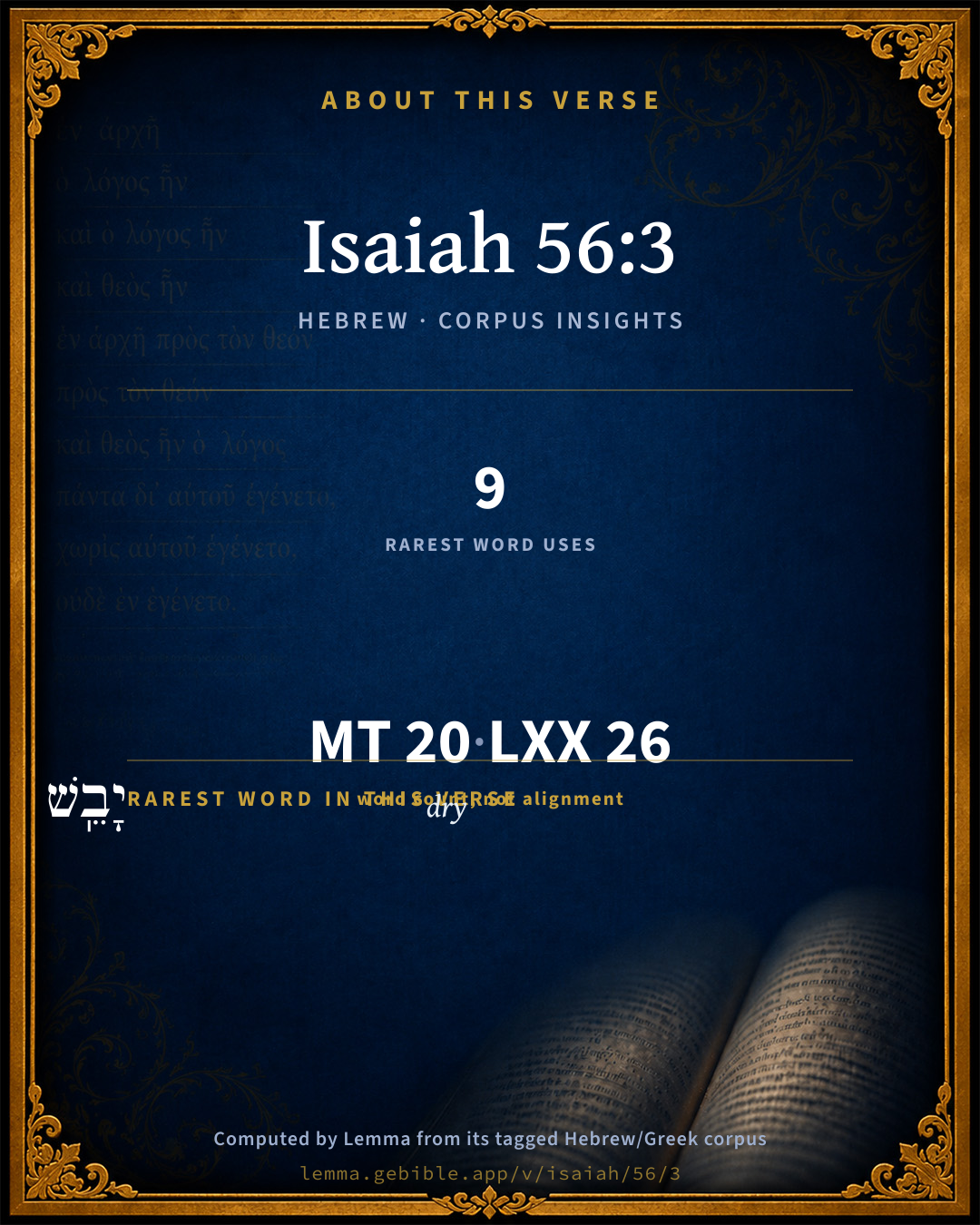
The rarest word here is יָבֵֽשׁ dry H3002 — appearing just 9 times in the whole Hebrew Bible.

Shared distinctive vocabulary

יָבֵֽשׁ dry H3002 occurs in 9 verses of the Hebrew Bible. Also found in:

Grammatical profile

  • 6 verbs
  • 7 nouns
  • 1 adjective
  • 1 pronoun
  • 2 prepositions
  • 3 particles

Verb forms

  • יֹאמַ֣ר Qal · Jussive
  • הַנִּלְוָ֤ה Niphal · Perfect
  • לֵאמֹ֔ר Qal · Infinitive Construct
  • הַבְדֵּ֧ל Hiphil · Infinitive Absolute
  • יַבְדִּילַ֛נִי Hiphil · Imperfect
  • יֹאמַר֙ Qal · Jussive

Repetition

Words recur within this verse — often emphatic in Hebrew:

  • יֹאמַ֣ר to say H559 ×3
  • יְהוָה֙ LORD H3068 ×2
  • הַבְדֵּ֧ל to separate H914 ×2
  • וְאַל not H408 ×2

Hebrew & Septuagint length

In English translation the verse runs 31 words from the Hebrew and 31 from the Septuagint (LXX English) — the same length.

A rough comparison of the two English renderings, which tokenize alike — not a word-level alignment.

Word counts can differ between the Hebrew and the Greek without any difference in meaning — e.g. the Hebrew direct-object marker אֵת has no separate Greek word, and Greek often adds the article ὁ.

In the original languages it is 20 Hebrew tokens and 26 Greek tokens — but the two are counted differently (Hebrew bundles its prefixes and suffixes into one token; the Greek is in lemma form), so that isn’t a like-for-like length.

Cross-references

29

Topical passages linked to Isaiah 56:3 in the Treasury of Scripture Knowledge — connected by theme and wording, ordered by reader-vote popularity; previews shown in the World English Bible.

  • 1 Corinthians 6:17 But he who is joined to the Lord is one spirit.
  • Matthew 19:12–30 For there are eunuchs who were born that way from their mother's womb, and there are eunuchs who were made eunuchs by men; and there are eunuchs who made themselves eunuchs for the Kingdom of Heaven's sake. He who is able to receive it, let him receive it."
  • Acts 10:34 Peter opened his mouth and said, "Truly I perceive that God doesn't show favoritism;
  • Numbers 18:4 They shall be joined to you, and keep the charge of the tent of meeting, for all the service of the Tent: and a stranger shall not come near to you.
  • Numbers 18:7 You and your sons with you shall keep your priesthood for everything of the altar, and for that within the veil; and you shall serve: I give you the priesthood as a service of gift: and the stranger who comes near shall be put to death.
  • Isaiah 14:1 For Yahweh will have compassion on Jacob, and will yet choose Israel, and set them in their own land: and the foreigner shall join himself with them, and they shall cleave to the house of Jacob.
  • Isaiah 39:7 Of your sons who shall issue from you, whom you shall father, shall they take away; and they shall be eunuchs in the palace of the king of Babylon.
  • Isaiah 56:5 To them will I give in my house and within my walls a memorial and a name better than of sons and of daughters; I will give them an everlasting name, that shall not be cut off.
  • Jeremiah 39:16–17 Go, and speak to Ebedmelech the Ethiopian, saying, Thus says Yahweh of Hosts, the God of Israel: Behold, I will bring my words on this city for evil, and not for good; and they shall be accomplished before you in that day.
  • Jeremiah 50:5 They shall inquire concerning Zion with their faces turned toward it, [saying], Come you, and join yourselves to Yahweh in an everlasting covenant that shall not be forgotten.
  • Daniel 1:3–21 The king spoke to Ashpenaz the master of his eunuchs, that he should bring in [certain] of the children of Israel, even of the seed royal and of the nobles;
  • Zephaniah 2:11 Yahweh will be awesome to them, for he will famish all the gods of the land. Men will worship him, everyone from his place, even all the shores of the nations.
  • Zechariah 8:20–23 Thus says Yahweh of Hosts: "Many peoples, and the inhabitants of many cities will yet come;
  • Matthew 8:10–11 When Jesus heard it, he marveled, and said to those who followed, "Most assuredly I tell you, I haven't found so great a faith, not even in Israel.
  • Matthew 15:26–27 But he answered, "It is not appropriate to take the children's bread and throw it to the dogs."
  • Luke 7:6–8 Jesus went with them. When he was now not far from the house, the centurion sent friends to him, saying to him, "Lord, don't trouble yourself, for I am not worthy for you to come under my roof.
  • Acts 10:1–2 Now there was a certain man in Caesarea, Cornelius by name, a centurion of what was called the Italian Regiment,
  • Acts 17:4 Some of them were persuaded, and joined Paul and Silas, of the devout Greeks a great multitude, and not a few of the chief women.
  • Romans 2:10–11 But glory and honor and peace to every man who works good, to the Jew first, and also to the Greek.
  • Romans 15:9–12 and that the Gentiles might glorify God for his mercy. As it is written, "Therefore will I give praise to you among the Gentiles, And sing to your name."
  • Romans 15:16 that I should be a servant of Christ Jesus to the Gentiles, ministering as a priest the Gospel of God, that the offering up of the Gentiles might be made acceptable, sanctified by the Holy Spirit.
  • Ephesians 2:22 in whom you also are built together for a habitation of God in the Spirit.
  • Deuteronomy 23:1–3 He who is wounded in the stones, or has his privy member cut off, shall not enter into the assembly of Yahweh.
  • Jeremiah 38:7–13 Now when Ebedmelech the Ethiopian, a eunuch, who was in the king's house, heard that they had put Jeremiah in the dungeon (the king then sitting in the gate of Benjamin),
  • Acts 8:26–40 But an angel of the Lord spoke to Philip, saying, "Arise, and go toward the south to the way that goes down from Jerusalem to Gaza. This is a desert."
  • Acts 13:47–48 For so has the Lord commanded us, saying, 'I have set you as a light for the Gentiles, That you should bring salvation to the uttermost parts of the earth.'"
  • Acts 18:7 He departed there, and went into the house of a certain man named Justus, one who worshiped God, whose house was next door to the synagogue.
  • 1 Peter 1:1 Peter, an apostle of Jesus Christ, to the chosen ones who are living as strangers in the Dispersion in Pontus, Galatia, Cappadocia, Asia, and Bithynia,
  • Ephesians 2:12 that you were at that time separate from Christ, alienated from the commonwealth of Israel, and strangers from the covenants of the promise, having no hope and without God in the world.

Cross-references courtesy of OpenBible.info (CC BY 4.0).

Hebrew and Greek witnesses Masoretic Hebrew ↔ Greek Septuagint

The same verse in the two great witnesses to the Old Testament, shown verse-for-verse.

These are two independent witnesses, not word-aligned to each other, and the Septuagint is shown in lemma (dictionary) form.

Hebrew Isaiah 56:3 Masoretic · Westminster Leningrad Codex

וְאַל יֹאמַ֣ר בֶּן הַנֵּכָ֗ר הַנִּלְוָ֤ה אֶל יְהוָה֙ לֵאמֹ֔ר הַבְדֵּ֧ל יַבְדִּילַ֛נִי יְהוָ֖ה מֵעַ֣ל עַמּ֑וֹ וְאַל יֹאמַר֙ הַסָּרִ֔יס הֵ֥ן אֲנִ֖י עֵ֥ץ יָבֵֽשׁ

Neither let the foreigner, who has joined himself to Yahweh, speak, saying, Yahweh will surely separate me from his people; neither let the eunuch say, Behold, I am a dry tree.

World English Bible · Public Domain

Greek LXX Isaiah 56:3 Septuagint · lemma form

μή λέγω ὁ ἀλλογενής ὁ προςκεῖμαι πρός κύριος ἀποὁρίζω ἐγώ ἄρα κύριος ἀπό ὁ λαός αὐτός καί μή λέγω ὁ εὐνοῦχος ὅτι ἐγώ εἰμί ξύλον ξηρός

Let not the stranger who attaches himself to the Lord, say, Surely the Lord will separate me from his people: and let not the eunuch say, I am a dry tree.

LXX2012 (modern English Septuagint) · Public Domain

Hebrew: Westminster Leningrad Codex (CC BY 4.0). Greek: Septuagint (public domain); English from LXX2012 (modern English Septuagint) (Public Domain). How the Septuagint differs from the Hebrew →

Targum (Aramaic paraphrase)

1

The Targum is the ancient Jewish Aramaic paraphrase of the Hebrew Scriptures — an interpretive translation, not the Hebrew text itself. Onkelos (literal) and Pseudo-Jonathan (expansive) render the Torah, and Jonathan the Prophets. Coverage is partial: where no permissively-licensed English translation exists for a verse, only the Aramaic is shown. This is verse-level text, not a word-by-word alignment to the Hebrew.

  1. Targum Jonathan Prophets (Joshua–Malachi)
    וְלָא יֵימַר בַּר עַמְמִין דְמִתּוֹסַף עַל עַמָא דַייָ לְמֵימָר אַפְרָשָׁא יִפְרְשִׁנַנִי יְיָ מֵעַל עַמֵהּ וְלָא יֵימַר סָרִיסָא הָא אֲנָא חֲשִׁיב כְּאָע יָבֵישׁ:

    Neither let the son of the heathen, that is joined to the people of the Lord, say, The Lord hath utterly separated me from His people: neither let the eunuch say, Behold, I am considered a dry tree.

    Targum Jonathan — Aramaic: “Mikraot Gedolot” (public domain). English: “Sefaria Community Translation” (CC0 1.0 (public-domain dedication)); “London "Chaldee Paraphrase," 1871” (public domain). Text via Sefaria.

Commentary

Notes on Isaiah 56:3 from classic Christian and Jewish commentators (each source and its license shown beneath its notes). The classic Christian expositions comment on the surrounding passage and are grouped to its opening verse, so a note may address several verses; the Jewish commentaries on the Tanakh (Rashi and others) are per-verse, so they appear only where the commentator wrote on this verse.

Lemma curates 59 commentaries, every one of them public domain or Creative Commons licensed, each selected and text-cleaned for this edition rather than reprinted as found. About our sources →

Matthew Henry's Commentary

The prophet is here, in God's name, encouraging those that were hearty in joining themselves to God and yet laboured under great discouragements. 1. Some were discouraged because they were not of the seed of Abraham. They had joined themselves to the Lord, and bound their souls with a bond to be his for ever (this is the root and life of religion, to break off from the world and the flesh, and devote ourselves entirely to the service and honour of God); but they questioned whether God would accept them, because they were of the sons of the stranger, Isa 56:3. They were Gentiles, strangers to the commonwealth of Israel and aliens from the covenants of promise, and therefore feared they had no part nor lot in the matter. They said, "The Lord has utterly separated me from his people, and will not own me as one of them, nor admit me to their privileges." It was often said that there should be one law for the stranger and for him that was born in the land (Exo 12:49), and yet they came to this melancholy conclusion. Note, Unbelief often suggests things to the discouragement of good people which are directly contrary to what God himself has said, things which he has expressly guarded against. Let not the sons of the stranger therefore say thus, for they have no reason to say it. Note, Ministers must have answers ready for the disquieting fears and jealousies of weak Christians, which, how unreasonable soever, they must take notice of. 2. Others were discouraged because they were not fathers in Israel. The eunuch said, Behold, I am a dry tree. So he looked upon himself, and it was his grief; so others looked upon him, and it was his reproach. He was thought to be of no use because he had no children, nor was ever likely to have any. This was then the more grievous because eunuchs were not admitted to be priests (Lev 21:20), nor to enter into the congregation (Deu 23:1), and because the promise of a numerous posterity was the particular blessing of Israel and the more valuable because from among them the Messiah was to come. Yet God would not have the eunuchs to make the worst of their case, nor to think that they should be excluded from the gospel church, and from being spiritual priests, because they were shut out from the congregation of Israel and the Levitical priesthood; no, as the taking down of the partition wall, contained in ordinances, admitted the Gentiles, so it let in likewise those that had been kept out by ceremonial pollutions. Yet, by the reply here given to this suggestion, it should seem the chief thing which the eunuch laments in his case is his being written childless.

Now suitable encouragements are given to each of these.

I. To those who have no children of their own, who, though they had the honour to be the children of the church and the covenant themselves, yet had none to whom they might transmit that honour, none to receive the sign of circumcision and the privileges secured by that sign. Now observe,

1. What a good character they have, though they lie under this ignominy and affliction; and those only are entitled to the following comforts who in some measure answer to these characters. (1.) They keep God's sabbaths as he has appointed them to be kept. In the primitive times, if a Christian were asked, "Hast thou kept holy the Lord's day?" He would readily answer, "I am a Christian, and dare not do otherwise." (2.) In their whole conversation they choose those things that please God. They do that which is good; they do it with a sincere design to please God in it; they do it of choice, and with delight. If sometimes, through infirmity, they come short in doing that which pleases God, yet they choose it, they endeavour after it, and aim at it. Note, Whatever is God's pleasure should without dispute be our choice. (3.) They take hold of his covenant, and that is a thing that pleases God as much as any thing. The covenant of grace is proposed and proffered to us in the gospel; to take hold of it is to consent to it, to accept the offer and come up to the terms, deliberately and sincerely to take God to be to us a God and to give up ourselves to him to be to him a people. Taking hold of the covenant denotes an entire and resolute consent to it, taking hold as those that are afraid of coming short, catching at it as a good bargain, and as those that are resolved never to let it go, for it is our life: and we take hold of it as a criminal took hold of the horns of the altar to which he fled for refuge.

2. What a great deal of comfort they may have if they answer to this character, though they are not built up into families (Isa 56:5): Unto them will I give a better place and name. It is supposed that there is a place and a name, which we have from sons and daughters, that is valuable and desirable. It is a pleasing notion we have that we live in our children when we are dead. But there is a better place, and a better name, which those have that are in covenant with God, and it is sufficient to counterbalance the want of the former. A place and a name denote rest and reputation; a place to live comfortably in themselves, and a name to live creditably with among their neighbours; they shall be happy, and may be easy both at home and abroad. Though they have not children to be the music of their house, or arrows in their quiver, to keep them in countenance when they speak with their enemies in the gate, yet they shall have a place and a name more than equivalent. For, (1.) God will give it to them, will give it to them by promise; he will himself be both their habitation and their glory, their place and their name. (2.) He will give it to them in his house, and within his walls; there they shall have a place, shall be planted so as to take root (Psa 92:13), shall dwell all the days of their life, Psa 27:4. They shall be at home in communion with God, as Anna, that departed not from the temple night nor day. There they shall have a name. A name for the good things with God and good people is a name better than that of sons and daughters. Our relation to God, our interest in Christ, our title to the blessings of the covenant, and our hopes of eternal life, are things that give us in God's house a blessed place and a blessed name. (3.) It shall be an everlasting name, that shall never be extinct, shall never be cut off; like the place and name of angels, who therefore marry not, because they die not. Spiritual blessings are unspeakably better than those of sons and daughters; for children are a certain care and may prove the greatest grief and shame of a man's life, but the blessings we partake of in God's house are a sure and constant joy and honour, comforts which cannot be embittered.

II. To those that are themselves the children of strangers.

1. It is here promised that they shall now be welcome to the church, Isa 56:6, Isa 56:7. When God's Israel come out of Babylon, let them bring as many of their neighbours along with them as they can persuade to come, and God will find room enough for them all in his house. And here, (as before) we may observe,

(1.) Upon what terms they shall be welcome. Let them know that God's Israel, when they come out of Babylon, will not be plagued, as they were when they came out of Egypt, with a mixed multitude, that went with them, but were not cordially for them; no, the sons of the strangers shall have a place and a name in God's house provided, [1.] That they forsake other gods, all rivals and pretenders whatsoever, and join themselves to the Lord, so as to become one spirit, Co1 6:17. [2.] That they join themselves to him as subjects to their prince and soldiers to their general, by an oath of fidelity and obedience, to serve him, not occasionally, as one would serve a turn, but to be constantly his servants, entirely subject to his command, and devoted to his interest. [3.] That they join themselves to him as friends to his honour and the interests of his kingdom in the world, to love the name of the Lord, to be well pleased with all the discoveries he has made of himself and all the memorials they make of him. Observe, Serving him and loving him go together; for those that love him truly will serve him faithfully, and that obedience is most acceptable to him, as well as most pleasant to us, which flows from a principle of love, for then his commandments are not grievous, Jo1 5:3. [4.] That they keep the sabbath from polluting it; for the stranger that is within thy gates is particularly required to do that. [5.] That they take hold of the covenant, that is, that they come under the bonds of it, and put in for the benefits of it.

(2.) To what privileges they shall be welcome, Isa 56:7. Three things are here promised them, in their coming to God: - [1.] Assistance: "I will bring them to my holy mountain, not only bid them welcome when they come, but incline them to come, will show them the way, and lead them in it." David himself prays that God by his light and truth would bring them to his holy hill, Psa 43:3. And the sons of the stranger shall be under the same guidance. The church is God's holy hill, on which he hath set his King, and, in bringing them to Zion Hill, he brings them to be subjects to Zion's King, as well as worshippers in Zion's holy temple. [2.] Acceptance: "Their burnt-offerings and their sacrifices shall be accepted on my altar, and be never the less acceptable for being theirs, though they are sons of the stranger." The prayers and praises (those spiritual sacrifices) of devout Gentiles shall be as pleasing to God as those of the pious Jews, and no difference shall be made between them; for, though they are Gentiles by birth, yet through grace they shall be looked upon as the believing seed of faithful Abraham and the praying seed of wrestling Jacob, for in Christ Jesus there is neither Greek nor Jew, circumcision nor uncircumcision. [3.] Comfort. They shall not only be accepted, but they themselves shall have the pleasure of it: I will make them joyful in my house of prayer. They shall have grace, not only to serve God, but to serve him cheerfully and with gladness, and that shall make the service the more acceptable to him; for, when we sing in the ways of the Lord, then great is the glory of our God. They shall go away and eat their bread with joy, because God now accepts their works, Ecc 9:7. Nay, though they came mourning to the house of prayer, they shall go away rejoicing, for they shall there find such ease, by casting their cares and burdens upon God, and referring themselves to him, that, like Hannah, they shall go away and their countenance shall be no more sad. Many a sorrowful spirit has been made joyful in the house of prayer.

2. It is here promised that multitudes of the Gentiles shall come to the church, not only that the few who come dropping in shall be made welcome, but that great numbers shall come in, and the door be thrown open to them: My house shall be called a house of prayer for all people. The temple was then God's house, and to that Christ applies these words (Mat 21:13), but with an eye to it as a type of the gospel church, Heb 9:8, Heb 9:9. For Christ calls it his house, Heb 3:6. Now concerning this house it is promised, (1.) That it shall not be a house of sacrifice, but a house of prayer. The religious meetings of God's people shall be meetings for prayer, in which they shall join together, as a token of their united faith and mutual love. (2.) That it shall be a house of prayer, not for the people of the Jews only, but for all people. This was fulfilled when Peter was made, not only to perceive it himself, but to tell it to the world, that in every nation he that fears God and works righteousness is accepted of him, Act 10:35. It had been declared again and again that the stranger that comes nigh shall be put to death, but Gentiles shall now be looked upon no longer as strangers and foreigners, Eph 2:19. And it appears by Solomon's prayer, at the dedication of the temple, both that it was primarily intended for a house of prayer and that strangers should be welcome to it, Kg1 8:30, Kg1 8:41, Kg1 8:43. And it is intimated here (Isa 56:8) that when the Gentiles are called in they shall be incorporated into one body with the Jews, that (as Christ says, Joh 10:16) there may be one fold and one Shepherd; for, [1.] God will gather the outcasts of Israel. Many of the Jews that had by their unbelief cast themselves out shall by faith be brought in again, a remnant according to the election of grace, Rom 11:5. Christ came to the lost sheep of the house of Israel (Mat 15:24), to gather their outcasts (Psa 147:2), to restore their preserved (Isa 49:6), and to be their glory, Luk 2:32. [2.] He will gather others also to him, besides his own outcasts that are gathered to him. Or, though some of the Gentiles have come over now and then into the church, that shall not serve (as some may think) to answer the extent of these promises; no, there are still more and more to be brought in: "I will gather others to him besides these; these are but the first-fruits in comparison with the harvest that shall be gathered for Christ in the nations of the earth, when the fulness of the Gentiles shall come in." Note, The church is a growing body: when some are gathered to it we may still hope there shall be more, till the mystical body be completed. Other sheep I have.

Matthew Henry's Commentary on the Whole Bible (1708–1710) — public domain (CC PDM 1.0). Text via the HelloAO Bible API.

Trapp's Complete Commentary

John Trapp

Isa 56:3 Neither let the son of the stranger, that hath joined himself to the LORD, speak, saying, The LORD hath utterly separated me from his people: neither let the eunuch say, Behold, I [am] a dry tree.

Ver. 3. Neither let the son of the stranger.] If a proselyte, let not him add extra words to the covenant of grace in Christ, and say, It belongeth not to me. Let not him turn the back of his hand to the promise, as if he were not concerned in it, because no Jew born; for now the wall of partition is by Christ to be broken down, and the rigour of that old prohibition taken away. {Act 10:34-35 Gal 3:28 Col 3:11 Eze 47:22}

Neither let the eunuch.] {See Trapp on "Mat 19:12"}

John Trapp, A Commentary or Exposition upon All the Books of the Old and New Testament (1647–1656) — public domain. Text from a community e-Sword module.

The Biblical Illustrator

Joseph S. Exell

Isa_56:3-5

Neither let the son of the stranger

The son of the stranger

The son of the stranger means simply the individual foreigner (R.., the stranger), not one whose father was a foreigner. (Prof. J. Skinner, D. D.)

The non-Israelite. (A. B. Davidson, D. D.)

Consolation far proselytes

The case supposed is that if a foreigner who has joined himself to the Lord, i.e has become a proselyte by accepting the symbols of Jewish nationality (circumcision, etc.), but now has reason to fear that his qualifications will be disallowed. It is likely that the immediate cause of apprehension was some manifestation of an exclusive and intolerant spirit amongst the leaders of the New Jerusalem. Against this spirit (if it existed) the prophets words enter a strong protest. (Prof. J. Skinner, D. D.)

Unbelief

Unbelief many times suggests things to the discouragement of good people which are directly contrary to what God Himself hath said; things which He hath expressly guarded against. (M. Henry.)

The eunuch

Eunuchs

We must understand those of Israelitish descent. (F. Delitzsch, D. D)

The eunuch a dry tree

The eunuch being a dry tree feels that having no children he will have no permanent place or name in the kingdom. (A. B. Davidson, D. D.)

The Biblical Illustrator, edited by Joseph S. Exell (c. 1880s–1900s) — public domain. Text from a community e-Sword module.

Joseph Benson's Commentary

Isa 56:3-5. Neither let the son of the stranger — The Gentile, who by birth is a stranger to God, and to the commonwealth of Israel. That hath joined himself to the Lord — That hath turned from dumb idols to the living God, and to true religion; speak, saying, The Lord hath separated me, &c. — For such shall be as acceptable to me as the Israelites themselves, and the partition wall between Jews and Gentiles shall be taken down, and repentance and remission of sins shall be preached and offered to men of all nations. Neither let the eunuch say — Who is here joined with the stranger, because he was forbidden to enter into the congregation of the Lord, Deu 23:1. Under these two instances he understands all those, who, either by birth, or by any ceremonial pollution, were excluded from church privileges, and so he throws open the door to all true believers. Behold, I am a dry tree — A fruitless tree, accursed by God with the curse of barrenness. For thus saith the Lord unto the eunuchs, &c. — That observe my commands, not by custom, or through force or fear, but by free choice, with love to them, and delight in them. And take hold of my covenant — That steadfastly keep the conditions of my covenant. Even unto them will I give in my house, &c. — In my temple, an emblem of the Christian church; a place, &c., better than of sons and daughters — A far greater blessing and honour than that of having a posterity, even my favour, and my Spirit and eternal felicity.

Joseph Benson's Commentary on the Old and New Testaments (1811–1818) — public domain. Text from a community e-Sword module.

The Preacher's Complete Homiletical Commentary

Joseph S. Exell (gen. ed.)

JOINED TO THE LORD

Isa_56:3; Isa_56:6. The sons of the stranger, that join themselves to the Lord.

The end of all worship is union with God. To this most glorious issue all the revelations of Scripture converge. It is the end of all teaching, and the seal of all perfection. Our Lord’s prayer for His people makes this the goal of Christian aspiration (Joh_17:21). But union with God is, like all other relations to the Supreme, attained only in and through the Mediator (Joh_17:3). It is the realisation of the one object of the redeeming economy. It has undoubtedly been the watchword of some of the sublimest systems of ethics based on erroneous doctrine. Buddhism and Pantheistic mysticism are instances.

Let us endeavour to realise the import and the power of this remarkable expression, “joined to the Lord,” which is the exponent and formula of vital truths and glorious privileges (1Co_6:17).

I. The nature of this alliance. What does it imply?—

1. The conviction of moral estrangement. Instead of that intimate union which man originally enjoyed, there is a wide and extended breach, &c. The manifold and painful evidences—alienation from God both in affection and action, &c. (Rom_8:7, and others). Such is our deplorable state previous to the period when we join ourselves to the Lord.

2. The full approval of God’s service. We never devote ourselves to those whose service we have a decided objection to; on the contrary we carefully avoid it. But naturally we are opposed to God’s righteous rule and service, hence the necessity of regeneration, that we may be inspired with a love of holiness, &c. External reformation will not suffice, for the heart will retain its original aversion to the Divine government and service. Only by regeneration does our judgment approve, and our will consent to the Lord’s service as pre-eminently righteous, &c. Then only do we “choose the things that please Him” (Isa_56:4).

3. The surrender of ourselves to His service (Isa_56:6). Simple approval and desire, though necessary, are not sufficient, they never cemented firm, durable alliance. There must be the actual yielding of ourselves to God in harmony with His gracious demands. This surrender must be unreserved, voluntary, constant. Prompted by obvious and powerful reasons. It is both right and reasonable, pleasant and profitable, &c. (1Ti_4:8, and others).

4. Spiritual union and oneness with Him. Not a mere figure of speech, but the greatest reality in human experience. New Testament illustrations. Even these figures can only faintly set it forth. The union is most intimate. One Spirit lives and moves, actuates and guides, both in the Head and members (1Co_6:17; Heb_2:11). We become one with God in thought and feeling and will. Are you “joined to the Lord “? For it is more than mere nominal Christianity, or profession of religion—it is spiritual and gracious. You may be joined to His Church and people, and yet not savingly joined to Him. Examine yourselves, and rest not until you have satisfactory evidence. But what are—II. The evidences of this alliance. We may know (Joh_14:20; 1Jn_5:20). The principal evidences are—

1. Trust in Christ alone for salvation. Faith is a self-conscious act, &c.

2. Deliverance from condemnation (Rom_8:1). From whence can condemnation come? (Rom_8:34).

3. Moral Regeneration (2Co_5:17; Gal_6:15). The new nature asserts its power, and refuses to be the slave of Satan, &c. Renewing grace creates a new world in the soul. We become conformed to Christ.

4. The inward testimony of the Holy Ghost (1Jn_3:24; 1Jn_4:13).

5. Fruitfulness in good works. This is the design and tendency of this alliance (Joh_15:4-5; Joh_15:8; Eph_2:10). Not the fair leaves of profession, but the fragrant and substantial fruits of righteousness (Php_1:11)—keeping “judgment,” doing “justice,” &c. (Isa_56:1; Isa_56:6; 1Jn_2:3; 1Jn_2:5; 1Jn_3:24).

III. The privileges of this alliance. If we are joined to the Lord we have—

1. Admittance to the fellowship and blessing of His Church (Isa_56:5; Isa_56:7). Regarded as His true worshippers. Prayers and praises—“spiritual sacrifices,” accepted. The highest possible honours conferred—Divine favour and friendship, &c. (2Co_5:21, and others). These honours impart true happiness, and are more valuable than any earthly advantage, because eternal and unchangeable (Isa_56:5).

2. His life (Gal_2:20; Col_3:4). Our spiritual life flows from Him. We dwell in Him and He in us. Our life from first to last is life in Christ.

3. His position (Eph_2:5-6).

4. His power, wisdom, &c. We have an interest in all that He is, and has (Php_4:13, and others).

5. His sympathy. Human, at best, is deficient. Sympathy between the head and members of the body. True of Christ (1Co_12:26-27; Eph_5:30; Act_9:4).

6. Answers to prayer (Joh_14:13; Joh_15:7; Joh_16:23; 1Jn_3:22).

7. Confidence at His coming (1Jn_2:28; Col_1:24). Then we shall participate in His glory! What wealth of privilege is ours. Language cannot express such glory as this. Who could have conceived that such blessedness could have been ours? Are we realising these privileges? Are we taking God at His word respecting them, &c.? If our privileges are great, great too are our responsibilities. Walk worthy of this relation, &c. CONCLUSION.—

1. This alliance is effected by cordially receiving God’s “salvation” as now “come,” and unhesitatingly accepting His “righteousness” as now “revealed” in Christ (Isa_56:1). There need be no doubt or hesitation in appropriating them as your own (2Co_6:2; Rom_3:22; Rom_2:28-29; Gal_3:28-29; Php_3:3). “Yield yourselves unto God” through Christ, and the alliance is formed; so simple, and yet so real is the transaction. Then you may testify with humble but assured confidence (Sol. Son_2:16).

2. This alliance is maintained by faith (Gal_2:20; Eph_3:17; Col_2:6-7).—A. Tucker.

The Preacher's Complete Homiletical Commentary (gen. ed. Joseph S. Exell; Funk & Wagnalls, c. 1892) — public domain (pre-1929). A full-Bible homiletical/sermon-outline anthology covering 65 of 66 books (2 John is absent from the source module). Text from a community e-Sword module.

Tyndale Open Study Notes

Tyndale Open Resources

56:3-7 The blessing (56:2) would extend to eunuchs and to the Gentiles.

56:3 Foreigners who commit themselves to the Lord would become full participants in the covenant community. Previously, their participation had been carefully regulated (Deut 23:3, 7-8). • eunuchs: In the past, an emasculated person was excluded from the community (Deut 23:1). Both eunuchs and foreigners had no share in Israel’s holiness and were considered marginal to God’s kingdom. In the age to come, God would bring to the center those who had previously been marginalized (cp. Matt 20:16).

Tyndale Open Study Notes — © Tyndale Open Resources, licensed CC BY-SA 4.0. Text via the HelloAO Bible API.

Geneva Bible (1599)

Geneva Bible translators

Let none think himself unmeet to receive the graces of the Lord: for the Lord will take away all impediments, and will forsake none which will keep his true religion, and believe in him.

Geneva Bible (1599) marginal notes — public domain. Text via Bolls.life.

Jamieson, Fausset & Brown

Robert Jamieson, A. R. Fausset & David Brown

God welcomes all believers, without distinction of persons, under the new economy (Act 10:34-35).

joined . . . to . . . Lord-- (Num 18:4, Num 18:7). "Proselytes."

separated--Proselytes from the Gentiles were not admitted to the same privileges as native Israelites. This barrier between Jews and Gentiles was to be broken down (Eph 2:14-16).

eunuch-- (Act 8:27, &c.). Eunuchs were chamberlains over harems, or court ministers in general.

dry tree--barren (compare Luk 23:31); not admissible into the congregation of Israel (Deu 23:1-3). Under the Gospel the eunuch and stranger should be released from religious and civil disabilities.

Jamieson, Fausset & Brown — Commentary Critical and Explanatory on the Whole Bible (1871) — public domain (CC PDM 1.0). Text via the HelloAO Bible API.

Ellicott's Commentary for English Readers

(3) Neither let the son of the stranger . . .—Two classes of persons were likely to suffer specially from Manasseh’s policy—(1) the heathen proselytes, who, as in Psalms 87, had been admitted as citizens of Zion under Hezekiah’s special protection; and (2) in the highest degree, those of that body who had been taken, as Ebed-Melech afterwards was (Jer_38:7), into the king’s household as eunuchs. The courtiers of Manasseh would taunt them as aliens, and in the second case would press the letter of Deu_23:2. The principle of Isaiah’s teaching was, of course, applicable to the Israelites who, like Daniel and his friends, had been mutilated against their will by heathen conquerors (Dan_1:3), and most commentators refer the words to such cases. It is scarcely probable, however, that the household of Hezekiah would have been supplied with home-born eunuchs, and, on the hypothesis which I have adopted, I find in the eunuchs a sub-section of the proselytes. The words put into the mouths of the complainers are the natural utterances of men treated as they had been.

A Bible Commentary for English Readers, edited by Charles John Ellicott (1878–1897) — public domain. Text from a community e-Sword module.

The Cambridge Bible for Schools and Colleges

gen. ed. J. J. S. Perowne

3. the son of the stranger means simply the individual foreigner (R.V. the stranger), not one whose father was a foreigner.

The Lord hath utterly separated] Render with R.V., will surely separate. The case supposed is that of a foreigner who has joined himself to the Lord, i.e. has become a proselyte by accepting the symbols of Jewish nationality (circumcision, &c.), but now has reason to fear that his qualifications will be disallowed. This anxiety is hardly to be explained by the law of Deu_23:3-8; for the regulations there laid down apply only to Moabites, Ammonites, Egyptians and Edomites; and the general tendency of the legislation is in favour of the religious rights of proselytes. (See the exhaustive monograph of Bertholet, Die Stellung der Israeliten und der Juden zu den Fremden, 1896.) It is more likely that the immediate cause of apprehension was some manifestation of an exclusive and intolerant spirit amongst the leaders of the new Jerusalem. Against this spirit (if it existed) the prophet’s words enter a strong protest (see Isa_56:6-7).

the eunuch] Such persons are excluded from the congregation by Deu_23:1. On that passage Prof. W. R. Smith remarks that “Presumably the original sense of this rule was directed not against the unfortunate victims of Oriental tyranny and the harem system, but against the religious mutilation of the Galli” &c. (Driver’s Deuteronomy, p. 259). If this be so, the present passage need not be regarded as superseding the Deuteronomic law; it may be only a protest against its extension to cases which it did not contemplate; for it is certain that those here referred to were “the unfortunate victims of Oriental tyranny.”

I am a dry tree] He could not become the head of a family in Israel, and therefore felt that he had no real and permanent share in the hopes of the nation.

The Cambridge Bible for Schools and Colleges (gen. ed. J. J. S. Perowne; Cambridge University Press, 1878–1918) — public domain. Text from a community e-Sword module.

John Gill's Exposition

Neither let the son of the stranger,.... A Gentile, that is so by birth, the son of one that is an alien from the commonwealth of Israel, a stranger from the covenants of promise, and so had no right to come into the congregation of the Lord under the former dispensation; but now the middle wall of partition being broken down, in the times to which this prophecy belongs, such are encouraged to expect admission:

that hath joined himself to the Lord; who, having a spiritual knowledge of him in Christ, loves him, believes in him, gives up himself to him, to walk in his ways and ordinances, and cleaves unto him with full purpose of heart; see Isa 44:5 such an one should not speak,

saying, the Lord hath utterly separated me from his people; by a law of his, Deu 23:3, for now the wall of separation, the ceremonial law, is destroyed, and God declares himself to be the God of the Gentiles, as well as of the Jews; and of all that fear God, and believe in Christ, of every nation, who are accepted with him; and that they are all one in Christ, and all partakers of the same promises and blessings; so strangers, and the sons of strangers, were to have an inheritance among the children of Israel in Gospel times; see Eze 47:22 and therefore should have no reason to speak after this manner:

neither let the eunuch say, behold, I am a dry tree; having no children, nor could have any; and to be written childless was reckoned a reproach and a curse; nor might an eunuch enter the congregation of the Lord, Deu 23:1, and yet such a man, having the grace of God, and acting agreeably to it, as in the following verse, should not distress himself on the above accounts.

John Gill's Exposition of the Whole Bible (1746–1763) — public domain (CC PDM 1.0). Text via the HelloAO Bible API.

Albert Barnes' Notes on the Bible

Neither let the son of the stranger - The foreigner who shall become a proselyte to the true religion.

That hath joined himself - That has embraced the true faith, and become a worshipper of the true God. It is evidently implied here that there would be such proselytes, and that the true religion would be extended so as to include and embrace them. The idea is, that they should be admitted to the same privileges with those who had been long recognized as the people of God.

The Lord hath utterly separated - Let him not esteem himself to be an outcast, or cut off from the privileges of the people of God. This language is used with reference to the opinion which prevailed among the Jews, that the Gentiles were excluded from the privileges of the people of God, and it is designed to intimate that hereafter all such barriers would be broken down. They who entered the church as proselytes from the pagan world, were not to come in with any sense of inferiority in regard to their rights among his people; but they were to feel that all the barriers which had heretofore existed were now broken down, and that all people were on a level. There is to be no assumption of superiority of one nation or rank over another; there is to be no sense of inferiority of one class in reference to another.

Neither let the eunuch say - This class of men was usually set over the harems of the East Est 2:3, Est 2:14-15; Est 4:5; and they were employed also as high officers at court Est 1:10, Est 1:12, Est 1:15; Dan 1:3; Act 8:27. The word is sometimes used to denote a minister of court; a court officer in general Gen 37:6; Gen 39:1. The Targum often renders the word by רבא rabbâ', “a prince.”

Behold, I am a dry tree - A dry tree is an emblem of that which is barren, useless, unfruitful. By the law of Moses such persons could not be enrolled or numbered in the congregation of the Lord Deu 23:2. The sense here is, that they should not hereafter be subjected to the religious and civil disabilities to which they had been. These external barriers to the full privileges among the people of God, would be removed. All classes and ranks would be admitted to the same privileges; all would be on the same level (see Isa 56:5).

Albert Barnes' Notes on the Bible (1834–1885) — public domain. Text from a community e-Sword/MySword module.

Haydock's Catholic Bible Commentary

People. The Jews would not admit all nations to their communion, Deuteronomy xxxiii. 1. A little before Christ’s coming, they began to make more proselytes; (Matthew xxiii. 15.) and the sacred books being translated, came to the knowledge of the Gentiles, who were thus induced by degrees to embrace the true faith. The road to heaven was always open for those who kept the commandments, (ver. 6.; Calmet) though they might not receive circumcision. (Haydock) --- Christ has removed the wall of separation, (Ephesians ii. 14.; Calmet) and established one fold for all, John x. (Haydock)

George Leo Haydock (1774–1849), Haydock's Catholic Family Bible and Commentary, 1859 edition — public domain. Excludes Psalms (Douay-Rheims chapter numbering differs from Protestant) and Deuterocanonical books (Catholic canon only).

Matthew Poole's English Annotations

The son of the stranger; the stranger, as the son of man is the same with the man, Isa 56:2; the Gentile, who by birth is a stranger to God, and to the commonwealth of Israel.

That hath joined himself to the Lord; that hath turned from dumb idols to the living God, and to the true religion; for such shall be as acceptable to me as the Israelites themselves, and the partition-wall between Jews and Gentiles shall be taken down, and repentance and remission of sins shall be preached and offered to men of all nations.

The eunuch; who is here joined with the stranger, because he was forbidden to enter into the congregation of the Lord, Deu 23:1, as the stranger was, and by his barrenness might seem no less than the stranger to be cast out of God’s covenant, and cut off from his people, to whom the blessing of a numerous posterity was promised. And under these two instances he understands all those persons who either by birth, or by any ceremonial pollution, were excluded from the participation of church privileges; and so he throws open the door to all true believers, without any restriction whatsoever. A dry tree; a sapless and fruitless tree, accursed by God with the curse of barrenness, which being oft threatened as a curse, and being a matter of reproach among the Jews, might easily occasion such discouraging thoughts as are here expressed.

Matthew Poole's English Annotations on the Holy Bible (1683–1685) — public domain. Text from a community e-Sword/MySword module.

Whedon's Commentary on the Bible

Daniel D. Whedon

3. Son of… stranger — Any foreigner, or one not born of the race of Israel, yet desiring to embrace the true religion.

Neither… eunuch — In Deu_23:1, the “eunuch” heads the list of those who are excluded from the congregation of the Lord. Why this? Because mutilation was in early ideas, essential disqualification. So was the proverbial dry tree, or childlessness, a condition to the oriental helplessly reproachful. Of course, for the new era now opening, such a system of ethics was worn-out narrowness, and required revision. The gospel age shuts off none who desire salvation.

Daniel D. Whedon (gen. ed.), Commentary on the Old and New Testaments (1874–1909) — public domain. Text from a community e-Sword module.

The Pulpit Commentary

The son of the stranger; i.e. the foreigner, who has become a proselyte. During the depression of the Captivity these are not likely to have been many. Still, there were doubtless some; and these, who had embraced Judaism under such unfavourable circumstances, were entitled to special consideration. As Messianic hopes prevailed, and the time of restoration to Palestine drew near (ver. 1), they might naturally be afraid that they would not be looked upon as equals by the native Israelites, but would be made into a lower grade, if not even excluded. The Lord hath utterly separated me; rather, the Lord will utterly separate me. They do not suppose it done, but think it will be done. The eunuch. Isaiah had prophesied to Hezekiah that a certain number of his seed should serve as eunuchs in the royal palace of the King of Babylon. (2Ki_20:18) Daniel, Hananiah, Mishael, and Azariah were such persons, (Dan_1:3-6) and there may have been others. By the letter of the Law, (Deu_23:1) they were cut off from the congregation, but practically it would seem that during the Captivity they were on a par with other Israelites. These persons feared, with more reason than the foreign proselytes, that, on the return of Israel to their own land, a stricter practice would be established than had prevailed during the Captivity, and the letter of the Law would be enforced against them. I am a dry tree. Therefore useless, and entitled to no consideration at all.

Vers. 3-7. Outward defects and defilements no hindrance to full communion in the Church of God.

In the infancy of humanity, and with a people so carnal as the Israelites, it was necessary to teach the great doctrines of purity and holiness by a material symbolism. Hence the multitude of regulations in the Law concerning defects, blemishes, sources of outward defilement, methods of removing defilements, clean and unclean meats, and the like. God strove to train his people by these out ward shows to the recognition of the eternal distinction between inward purity and impurity, and to a proper sense of the fact that impurity is an utter disqualification for communion with him and with his Church. But these distinctions were never intended to be lasting." Our Lord himself declared to his disciples, "Not that which goeth into the mouth defileth a man; but that which cometh out of the mouth, this defileth a man Those things which proceed out of the mouth come forth from the heart; and they defile the man. For out of the heart proceed evil thoughts, murders, adulteries, fornications, thefts, false witness, blasphemies: these are the things which defile a man; but to eat with unwashen hands defileth not a man". (Mat_15:11-20) It was long before the Jews could fully understand this doctrine, or believe that the Levitical Law on all points of external defilement was absolutely done away. (see Act_10:9-35 Act_11:3-18 Act_15:5-20 1Co_8:4-13) There was at first a great objection to receive any Gentiles into the Christian Church, and many miracles had to be wrought to overcome it. There was, after this, a line of separation drawn, and a claim set up by those of the favoured nation to form a higher grade than the Gentile Christians, with whom they refused to eat. (Gal_2:11-14) So persistent is the spirit of formalism, that, notwithstanding our Lord"s teaching and that of his apostles, it was centuries before the Church was wholly freed from dissension and difficulty in this matter (Burton, "Church of the First Three Centuries," vol. 1. pp. 348-351).

Vers. 3-8. The open gate.

The temple or house of God (ver. 7) stands for his kingdom of righteousness; and in exalted vision the prophet foresees the time when it shall stand open to every man to the stranger or heathen, and even to those physically debarred. It is to be called "a house of prayer for all people. " It is worthy of note that it should be called a house of prayer; the truth is intimated that, in the kingdom of God, sacrifice performed by the few on behalf of the many will yield to the spiritual approach by all to the Father of souls; that one principal purpose of worship is that of coming into close, holy, personal fellowship with the living God. But the main truth of the passage is found in the thought of

I THE OPEN GATE INTO THE KINGDOM OF GOD. When God"s full purpose should be revealed, there would be a kingdom or Church which should be open to every child of man, irrespective of his nationality or his physical peculiarities; the time should come when there would be neither Greek nor Jew, barbarian nor Scythian, bond nor free. The gracious purpose of God is fulfilled only in the gospel of his Son. There we find "the common salvation," broad as the race of man.

1. It is adapted to all men everywhere, however apart and afar they may be from the scene of its birth. Judaism, Mohammedanism, Buddhism, have local features; they are peculiarly adapted to men living in certain latitudes and longitudes, with certain surroundings and national habits and wants; they have their limitations. But into the gospel of Jesus Christ limitation or partiality does not enter; it is as perfectly suited to men of one clime as to those of another; we cannot think of men under any earthly conditions whatever for whose elevation and happiness it is not thoroughly fitted is intended for, and is powerful over, those furthest removed from the knowledge and the likeness of God. It purified the corrupt Corinthian; it softened the hard Roman; it sobered and solemnized the flippant Athenian; it has civilized the most savage barbarian; it has rescued and transformed the most degraded citizens of our modern civilization; it has proved itself the power of God to redeem and regenerate the very worst that have defaced the human image and disgraced the human name.

2. It is needed by those who are nearest the sources of truth; for it convicts even the best of unworthiness and guilt, and it finds for them a Saviour and a reconciliation.

II THE CONDITIONS OF CITIZENSHIP. The gate is open into the blessed kingdom, but it is a kingdom of righteousness and peace and joy. (Rom_14:17) Only they can be accounted citizens who fulfil certain spiritual conditions. These are indicated here. They are:

1. Drawing nigh to God through the appointed means the sabbath day, the house of prayer, etc.

2. Accepting God"s method of reconciliation; i.e. by faith in his Son, our Saviour; "taking hold of his covenant". (see Php_3:7-9)

3. Conforming the life to God"s holy will; "choosing the things that please haul," rather than those which please ourselves or others; engaging in his service (ver. 6). C.

The Pulpit Commentary (1880–1919), ed. H.D.M. Spence-Jones & Joseph S. Exell — public domain. Text from a community e-Sword module.

John Wesley's Explanatory Notes

The stranger - The stranger, the Gentile, who by birth is a stranger to God, that hath turned from dumb idols to the living God. The eunuch - Who is here joined with the stranger, because he was forbidden to enter into the congregation of the Lord, Deut. xxiii, 1. Under these two instances he understands all those, who either by birth, or by any ceremonial pollution, were excluded from church privileges, and so he throws open the door to all true believers. A dry tree - A fruitless tree, accursed by God with the curse of barrenness.

John Wesley, Explanatory Notes Upon the Whole Bible (1754–1765) — public domain. Text via the GEBible commentary corpus.

Keil & Delitzsch

C. F. Keil & F. Delitzsch

The אשרי (blessed) of Isa 56:2 is now extended to those who might imagine that they had no right to console themselves with the promises which it contained. "And let not the foreigner, who hath not joined himself to Jehovah, speak thus: Assuredly Jehovah will cut me off from His people; and let not the eunuch say, I am only a dry tree." As נלוה is not pointed as a participle (נלוה), but as a 3rd pers. pres., the ה of הנּלוה is equivalent to אשׁר, as in Jos 10:24; Gen 18:21; Gen 21:3; Gen 46:27; Kg1 11:9 (Ges. 109). By the eunuchs we are to understand those of Israelitish descent, as the attributive clause is not repeated in their case. Heathen, who professed the religion of Jehovah, and had attached themselves to Israel, might be afraid lest, when Israel should be restored to its native land, according to the promise, as a holy and glorious community with a thoroughly priestly character, Jehovah would no longer tolerate them, i.e., would forbid their receiving full citizenship. יבדּילני has the connecting vowel , as in Gen 19:19; Gen 29:32, instead of the usual ē. And the Israelitish eunuchs, who had been mutilated against their will, that they might serve at heathen courts or in the houses of foreign lords, and therefore had not been unfaithful to Jehovah, might be afraid lest, as unfruitful trees, they should be pronounced unworthy of standing in the congregation of Jehovah. There was more ground for the anxiety of the latter than for that of the former. For the law in Deu 23:4-7 merely prohibits Ammonites and Moabites for all time to come from reception into the congregation, on account of their unbrotherly conduct towards the Israelites as they came out of Egypt, whilst that in Deu 23:8-9 prohibits the reception of Edomites and Egyptians to the third generation; so that there was no prohibition as to other allies - such, for example, as the Babylonians. On the other hand, the law in Deu 23:2 expressly declares, as an expression of the horror of God at any such mutilation of nature, and for the purpose of precluding it, that no kind of emasculated person is to enter the congregation of Jehovah. But prophecy breaks through these limits of the law.

Keil & Delitzsch — Biblical Commentary on the Old Testament (1861–1891) — public domain (CC PDM 1.0). Text via the HelloAO Bible API. (Old Testament only.)

J. A. Alexander on Isaiah

Joseph Addison Alexander

“And let not the foreigner say, who has joined himself unto Jehovah, saying, Jehovah will separate me wholly from his people, and let not the eunuch say, Lo, I am a dry tree.” The essential meaning of this verse is, that all external disabilities shall be abolished, whether personal or national. To express the latter he makes use of a phrase which strictly means ‘not the son of the stranger’, as the common version has it, ‘but the son of strangeness, or of a strange country’. The whole class of personal disqualifications is represented by the case of the eunuch, in reference to Deu 23:1, and as Calvin thinks to the promise in Gen 15:5 and Gen 22:17, from which that whole class was excluded. “I am a dry tree”, a proverbial description of childlessness, said to be still current in the east. It is possible, however, that the eunuch may be mentioned, simply because he stands at the beginning of the list of prohibitions in the law. In either case, the expression is generic or representative of more particulars than it expresses.

Joseph Addison Alexander, The Prophecies of Isaiah (1846–1847; New York: Scribner, 1870–1878) — public domain. Text from a community e-Sword module.

unfoldingWord translationNotes

Door43 World Missions Community

See, I am a dry tree

This means eunuchs may have thought they could not be a part of God's people because they were deformed by castration (and for this reason could not have children). Israelites did not practice castration; foreigners did, sometimes for punishment. Eunuchs who had accepted the Hebrew faith knew that normally they were not allowed to worship in the temple (Deut. 23:1). The full meaning of this statement can be made clear. (See: Metaphor and Assumed Knowledge and Implicit Information)

translationWords

alien

Yahweh

people of God

eunuch

unfoldingWord translationNotes — © Distant Shores Media and the Door43 World Missions Community, licensed CC BY-SA 4.0. Source: git.door43.org/Door43/en_tn.

Rashi

Rabbi Shlomo Yitzchaki (Rashi)

“The Lord will surely separate me from His people,” Why should I become converted? Will not the Holy One, blessed be He, separate me from His people when He pays their reward.

Let not the eunnuch say Why should I better my ways and my deeds? I am like a withered tree, for lack of remembrance.

Rashi on the Tanakh — English translations: “The Judaica Press complete Tanach with Rashi, translated by A. J. Rosenberg” (CC BY 4.0); “Pentateuch with Rashi's commentary by M. Rosenbaum and A.M. Silbermann, 1929-1934” (public domain); “The Metsudah Tanach series, Lakewood, N.J” (CC BY 4.0); and “The Book of Joshua, Metsudah Publications, 1997” (CC BY 4.0). Text via Sefaria.

Ibn Ezra

Rabbi Abraham ibn Ezra

The son of the stranger. The true proselytes.

הַנִּלְוׇה That hath joined himself. It is the past tense with a prefixed ה, which is here equivalent to the relative אשר that; comp. ההלכוא who went (Jos. 10:24).

יבדילֵנִי═יבדילַני The Lord will separate me. Comp. יאהבַני (my husband) will love me (Gen. 29:32).

I am a dry tree, because I cannot have children.

Ibn Ezra on the Tanakh — English translations: “Sefaria Community Translation” (CC0 1.0 (public-domain dedication)); “Yalkut, Sifsei Chachomim Chumash, Metsudah Publications, 2009” (CC BY 4.0); and “Commentary of Ibn Ezra on Isaiah - trans. by M. Friedlander, 1873” (public domain). Text via Sefaria.

Lesson kit

Teaching starters — assembled from the data on this page, not authored interpretation. Every prompt links to the verse data it draws on. Edit before teaching.

Isaiah, in the Prophets, opens this verse with 20 words (15 distinct Hebrew lemmas). Its most distinctive word is yâbêsh (“dry”). A historical commentator’s framing appears above. Read the whole chapter for the surrounding context.

Discussion questions

  1. How does “dry” (yâbêsh) shape what this verse is saying?
  2. How does Numbers 6:3, which shares the word «dry», read alongside this verse?
  3. What does the repetition of “to say” (3× in this one verse) do in this verse?
  4. These translations render this verse differently; the difference is in the English rendering, not the original. What questions does that raise?
  5. «יֹאמַ֣ר» is a Qal Jussive verb. How does that grammatical form shape the action described?
  6. Compare how Matthew Henry's Commentary and Trapp's Complete Commentary read this verse. Where do they agree or differ?

Things to notice

Reading settings

Reading text

Shown beneath each verse's original-language words.

Old Testament
Old Testament edition

Read the OT as the Masoretic Hebrew (MT) or the Greek Septuagint (LXX).

English shown for the Greek Septuagint (in the Hebrew ↔ Greek comparison).

Comparing translations? Open the Compare panel on any verse page to stack up to four side by side.