
1 Kings 20:13

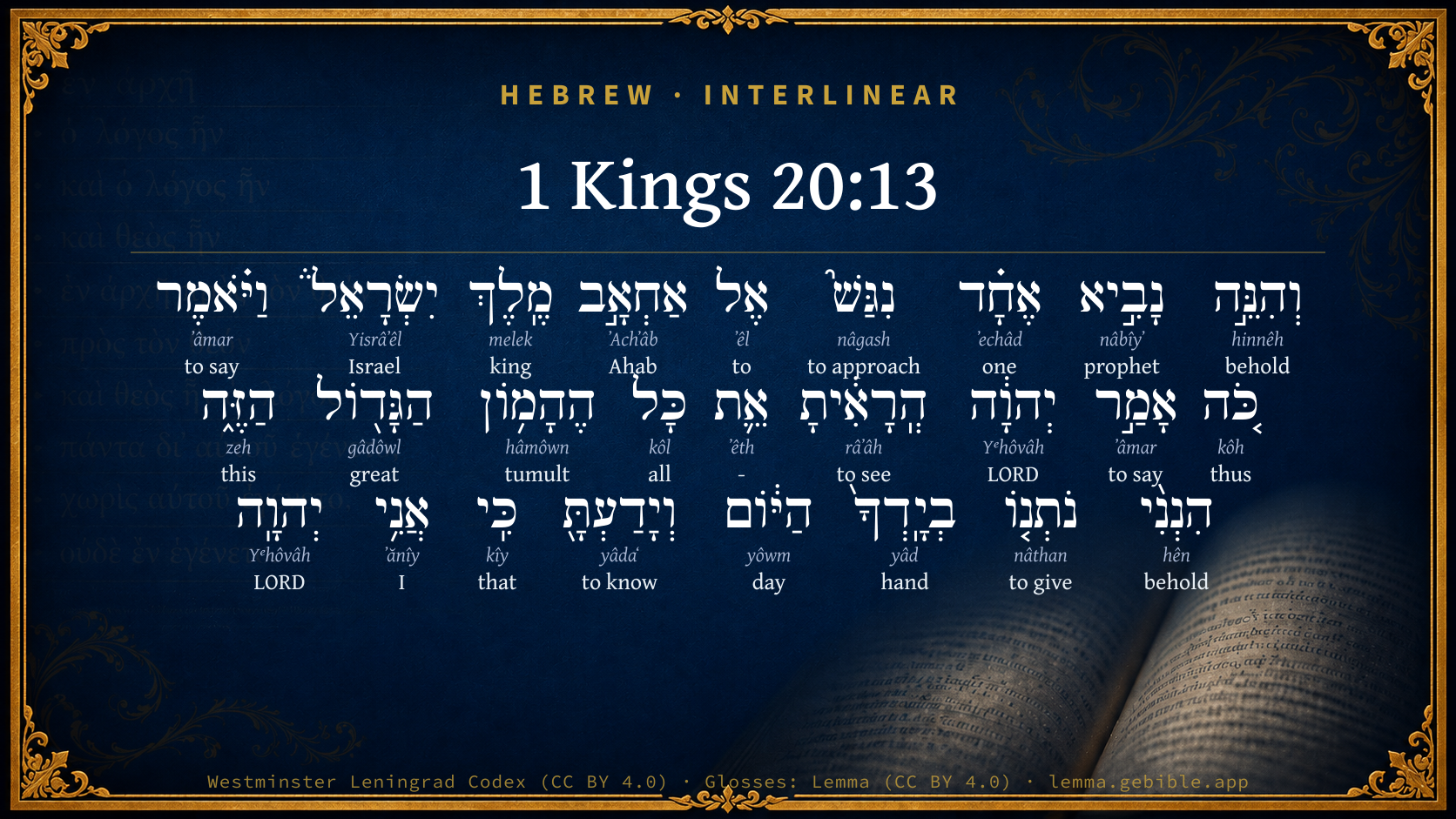
Hebrew (Westminster Leningrad Codex) 1 Kings 20:13 appears in the Hebrew Old Testament. The text above is from the Westminster Leningrad Codex. Each word links to its Strong’s number, a concise gloss, and parsing drawn from the Open Scriptures Hebrew Bible morphology. Click any word for its full Brown-Driver-Briggs (BDB) entry.
Download image
Cite this verse

1 Kings 20:13 (World English Bible). Public Domain. Lemma interlinear Bible study tool, https://lemma.gebible.app/v/1-kings/20/13.

Show BibTeX & RIS
BibTeX
RIS
English Translation
Behold, a prophet came near to Ahab king of Israel, and said, Thus says Yahweh, Have you seen all this great multitude? behold, I will deliver it into your hand this day; and you shall know that I am Yahweh.
World English Bible · Public Domain
Download a study sheet

One document with this verse’s original text, its word-by-word gloss line, the meaning frame, cross-references with their text, attributed commentary, and full source and license credits — printable, and it pastes into notes with its structure intact.

This verse Autodidact and up

Study sheet (.html) Plain text (.txt)

A passage Seminary Student

Up to 50 verses in one chapter. A passage sheet keeps up to 6 commentary sources and 12 cross-references per verse, in the order this page ranks them, and says so on the sheet whenever that leaves anything out. Ask for a single verse and you get the Autodidact verse sheet above.

Everything on this page stays free to read, with no account — the sheet is a download of what is already on screen, not access to it.

Want to remove ads? Support Godless Engineer
Compare translations 3

The same verse in 3 English versions, stacked beneath the original-language interlinear above. Click any original word for its lexicon entry.

Each is an independent rendering of the whole verse — the interlinear is not word-aligned to these translations.

Highlighted words mark where these versions differ — a whole-verse word diff, not a word-by-word alignment.

  • World English Bible Public Domain
    Behold, a prophet came near to Ahab king of Israel, and said, Thus says Yahweh, Have you seen all this great multitude? behold, I will deliver it into your hand this day; and you shall know that I am Yahweh.
  • King James Version Public Domain
    And, behold, there came a prophet unto Ahab king of Israel, saying, Thus saith the LORD, Hast thou seen all this great multitude? behold, I will deliver it into thine hand this day; and thou shalt know that I am the LORD.
  • unfoldingWord Literal Text CC BY-SA 4.0
    And behold, a prophet came near to Ahab, the king of Israel, and he said, “Thus says Yahweh, ‘Have you seen all of this great multitude? Behold me, giving it into your hand today, and you will know that I Yahweh.’”

unfoldingWord Literal Text — © unfoldingWord, licensed CC BY-SA 4.0. Word-aligned USFM3 via Door43 (git.door43.org/unfoldingWord/en_ult).

Versions to compare (up to 4)

3 of 4 selected

Show all 18 translations

Every available English version of this verse, each an independent rendering of the whole verse.

  • World English Bible Public Domain
    Behold, a prophet came near to Ahab king of Israel, and said, Thus says Yahweh, Have you seen all this great multitude? behold, I will deliver it into your hand this day; and you shall know that I am Yahweh.
  • Berean Standard Bible Public Domain
    Meanwhile a prophet approached Ahab king of Israel and declared, “This is what the LORD says: ‘Do you see this entire great army? Behold, I will deliver it into your hand this very day, and you will know that I am the LORD.’”
  • Majority Standard Bible Public Domain
    Meanwhile a prophet approached Ahab king of Israel and declared, “This is what the LORD says: ‘Do you see this entire great army? Behold, I will deliver it into your hand this very day, and you will know that I am the LORD.’”
  • King James Version Public Domain
    And, behold, there came a prophet unto Ahab king of Israel, saying, Thus saith the LORD, Hast thou seen all this great multitude? behold, I will deliver it into thine hand this day; and thou shalt know that I am the LORD.
  • American Standard Version (1901) Public Domain
    And, behold, a prophet came near unto Ahab king of Israel, and said, Thus saith Jehovah, Hast thou seen all this great multitude? behold, I will deliver it into thy hand this day; and thou shalt know that I am Jehovah.
  • Revised Version (1885) Public Domain
    And, behold, a prophet came near unto Ahab king of Israel, and said, Thus saith the LORD, Hast thou seen all this great multitude? behold; I will deliver it into thine hand this day; and thou shalt know that I am the LORD.
  • Geneva Bible (1599) Public Domain
    And beholde, there came a Prophet vnto Ahab King of Israel, saying, Thus sayeth the Lord, Hast thou seene all this great multitude? beholde, I will deliuer it into thine hande this day, that thou mayest knowe, that I am the Lord.
  • Douay-Rheims (1899) Public Domain
    And behold a prophet coming to Achab king of Israel, said to him: Thus saith the Lord: Hast thou seen all this exceeding great multitude, behold I will deliver them into thy hand this day: that thou mayest know that I am the Lord.
  • Young's Literal Translation Public Domain
    And lo, a certain prophet hath come nigh unto Ahab king of Israel, and saith, `Thus said Jehovah, `Hast thou seen all this great multitude? lo, I am giving it into thy hand to-day, and thou hast known that I `am' Jehovah.'
  • Literal Standard Version CC BY-SA 4.0
    And behold, a certain prophet has come near to Ahab king of Israel and says, “Thus said YHWH: Have you seen all this great multitude? Behold, I am giving it into your hand today, and you have known that I [am] YHWH.”
  • Unlocked Literal Bible CC BY-SA 4.0
    Then behold, a prophet came to Ahab king of Israel and said, “Yahweh says, 'Have you seen this great army? Look, I will place it into your hand today, and you will know that I am Yahweh.'”
  • unfoldingWord Literal Text CC BY-SA 4.0
    And behold, a prophet came near to Ahab, the king of Israel, and he said, “Thus says Yahweh, ‘Have you seen all of this great multitude? Behold me, giving it into your hand today, and you will know that I Yahweh.’”
  • Darby Bible Public Domain
    And behold, a prophet drew near to Ahab king of Israel, and said, Thus saith Jehovah: Hast thou seen all this great multitude? behold, I will deliver it into thy hand this day; and thou shalt know that I am Jehovah.
  • World Messianic Bible Public Domain
    Behold, a prophet came near to Ahab king of Israel, and said, “The LORD says, ‘Have you seen all this great multitude? Behold, I will deliver it into your hand today. Then you will know that I am the LORD.’”
  • Webster's Bible Public Domain
    And behold, there came a prophet to Ahab king of Israel, saying, Thus saith the LORD, Hast thou seen all this great multitude? behold, I will deliver it into thy hand this day; and thou shalt know that I am the LORD.
  • Free Bible Version CC BY-SA 4.0
    At the same time a prophet came up to Ahab, king of Israel, and told him, “This is what the Lord says: You see this massive army? Just watch, because I will make you victorious today, and you will be convinced that I am the Lord.”
  • Bible in Basic English Public Domain
    Then a prophet came up to Ahab, king of Israel, and said, The Lord says, Have you seen all this great army? See, I will give it into your hands today, and you will see that I am the Lord.
  • JPS Tanakh (1917) Public Domain
    And, behold, a prophet came near unto Ahab king of Israel, and said: 'Thus saith the LORD: Hast thou seen all this great multitude? behold, I will deliver it into thy hand this day; and thou shalt know that I am the LORD.'

Literal Standard Version (2020), Covenant Press — licensed CC BY-SA 4.0. Text via the HelloAO Bible API (eBible.org). Unlocked Literal Bible (unfoldingWord) — licensed CC BY-SA 4.0. Text via the HelloAO Bible API (eBible.org). unfoldingWord Literal Text — © unfoldingWord, licensed CC BY-SA 4.0. Word-aligned USFM3 via Door43 (git.door43.org/unfoldingWord/en_ult). Free Bible Version, Dr. Jonathan Gallagher — licensed CC BY-SA 4.0. Text via the HelloAO Bible API (eBible.org).

Word by word

More ways to search: Search by grammar → Find every occurrence → Compare this word →

Practice this passage: Drill this verse → Learn its vocabulary →

הֶהָמ֥וֹן
hâmôwn
H1995
“the · tumult”
Particle, Definite Article + Noun, Common, Masculine, Singular, Absolute
Part of Speech
Particle + Noun
Type
Common
Gender
Masculine
Number
Singular
State
Absolute
Full BDB Definition

Origin: from H1993

TWOT: 505a

(Qal) murmur, roar, crowd, abundance, tumult, sound - sound, murmur, rush, roar - tumult, confusion - crowd, multitude - great number, abundance - abundance, wealth
  1. וְהִנֵּ֣ה hinnêh H2009 “and · behold” Conjunction + Particle, Demonstrative
  2. נָבִ֣יא nâbîyʼ H5030 “prophet” Noun, Common, Masculine, Singular, Absolute
  3. אֶחָ֗ד ʼechâd H259 “one” Adjective, Cardinal number, Masculine, Singular, Absolute
  4. נִגַּשׁ֮ nâgash H5066 “to approach” Verb, Niphal, Perfect, 3rd Person, Masculine, Singular
  5. אֶל ʼêl H413 “to” Preposition
  6. אַחְאָ֣ב ʼAchʼâb H256 “Ahab” Noun, Proper
  7. מֶֽלֶךְ melek H4428 “king of” Noun, Common, Masculine, Singular, Construct
  8. יִשְׂרָאֵל֒ Yisrâʼêl H3478 “Israel” Noun, Proper
  9. וַיֹּ֗אמֶר ʼâmar H559 “and · to say” Conjunction + Verb, Qal, Sequential Imperfect, 3rd Person, Masculine, Singular
  10. כֹּ֚ה kôh H3541 “thus” Adverb
  11. אָמַ֣ר ʼâmar H559 “to say” Verb, Qal, Perfect, 3rd Person, Masculine, Singular
  12. יְהוָ֔ה Yᵉhôvâh H3068 “LORD” Noun, Proper
  13. הְֽרָאִ֔יתָ râʼâh H7200 “to see” Particle, Interrogative + Verb, Qal, Perfect, 2nd Person, Masculine, Singular
  14. אֵ֛ת ʼêth H853 “-” Particle, Direct Object
  15. כָּל kôl H3605 “all of” Noun, Common, Masculine, Singular, Construct
  16. הַגָּד֖וֹל gâdôwl H1419 “the · great” Particle, Definite Article + Adjective, Adjective, Masculine, Singular, Absolute
  17. הַזֶּ֑ה zeh H2088 “the · this” Particle, Definite Article + Pronoun, Demonstrative, Masculine, Singular
  18. הִנְנִ֨י hên H2005 “behold · me” Particle, Demonstrative + Suffix, Personal, 1st Person, Common, Singular
  19. נֹתְנ֤וֹ nâthan H5414 “giving · him” Verb, Qal, Participle Active, Masculine, Singular, Construct + Suffix, Personal, 3rd Person, Masculine, Singular
  20. בְיָֽדְךָ֙ yâd H3027 “in/at · hand · your” Preposition + Noun, Common, Both, Singular, Construct + Suffix, Personal, 2nd Person, Masculine, Singular
  21. הַיּ֔וֹם yôwm H3117 “the · day” Particle, Definite Article + Noun, Common, Masculine, Singular, Absolute
  22. וְיָדַעְתָּ֖ yâdaʻ H3045 “and · to know” Conjunction + Verb, Qal, Perfect, 2nd Person, Masculine, Singular
  23. כִּֽי kîy H3588 “that” Conjunction
  24. אֲנִ֥י ʼănîy H589 “I” Pronoun, Personal, 1st Person, Common, Singular
  25. יְהוָֽה Yᵉhôvâh H3068 “LORD” Noun, Proper

About this verse

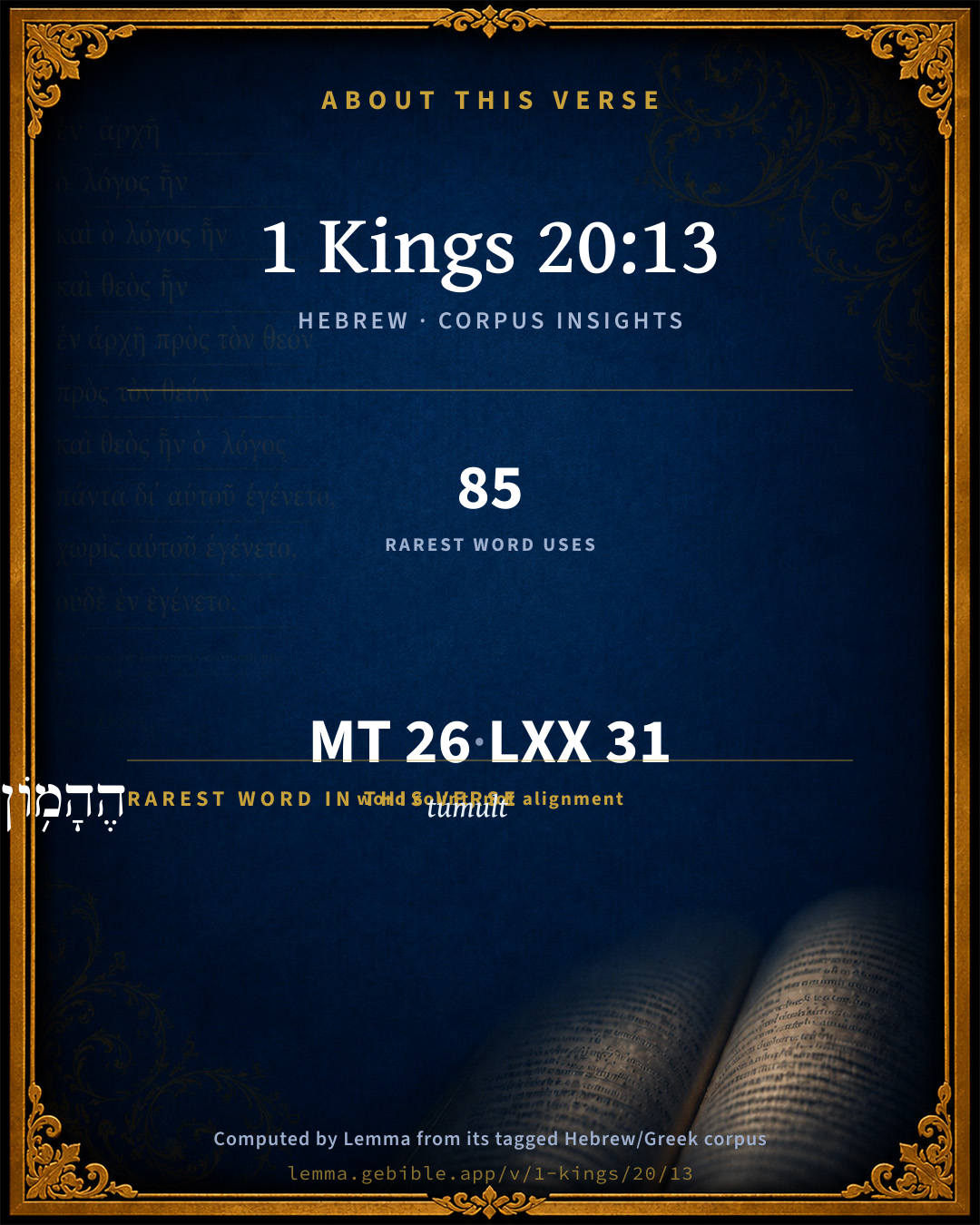
These counts appear in no published source. They are computed here, from the morphology-tagged text and Lemma’s own curated glosses. What Lemma adds →

26
words
24
distinct lemmas
Historical
section

Grammatical profile

  • 6 verbs
  • 10 nouns
  • 2 adjectives
  • 2 pronouns
  • 1 preposition
  • 1 conjunction
  • 1 adverb
  • 3 particles

Verb forms

  • נִגַּשׁ֮ Niphal · Perfect
  • וַיֹּ֗אמֶר Qal · Sequential Imperfect
  • אָמַ֣ר Qal · Perfect
  • הְֽרָאִ֔יתָ Qal · Perfect
  • נֹתְנ֤וֹ Qal · Participle Active
  • וְיָדַעְתָּ֖ Qal · Perfect

Repetition

Words recur within this verse — often emphatic in Hebrew:

  • וַיֹּ֗אמֶר to say H559 ×2
  • יְהוָ֔ה LORD H3068 ×2

Hebrew & Septuagint length

In English translation the verse runs 40 words from the Hebrew and 42 from the Septuagint (LXX English) — closely comparable.

A rough comparison of the two English renderings, which tokenize alike — not a word-level alignment.

Word counts can differ between the Hebrew and the Greek without any difference in meaning — e.g. the Hebrew direct-object marker אֵת has no separate Greek word, and Greek often adds the article ὁ.

In the original languages it is 26 Hebrew tokens and 31 Greek tokens — but the two are counted differently (Hebrew bundles its prefixes and suffixes into one token; the Greek is in lemma form), so that isn’t a like-for-like length.

Cross-references

14

Topical passages linked to 1 Kings 20:13 in the Treasury of Scripture Knowledge — connected by theme and wording, ordered by reader-vote popularity; previews shown in the World English Bible.

  • 1 Kings 20:28 A man of God came near and spoke to the king of Israel, and said, Thus says Yahweh, Because the Syrians have said, Yahweh is a god of the hills, but he is not a god of the valleys; therefore will I deliver all this great multitude into your hand, and you shall know that I am Yahweh.
  • Ezekiel 20:22 Nevertheless I withdrew my hand, and worked for my name's sake, that it should not be profaned in the sight of the nations, in whose sight I brought them forth.
  • Exodus 14:18 The Egyptians shall know that I am Yahweh, when I have gotten myself honor over Pharaoh, over his chariots, and over his horsemen."
  • Exodus 16:12 "I have heard the murmurings of the children of Israel. Speak to them, saying, 'At evening you shall eat meat, and in the morning you shall be filled with bread: and you shall know that I am Yahweh your God.'"
  • 2 Kings 7:1 Elisha said, Hear you the word of Yahweh: thus says Yahweh, Tomorrow about this time shall a measure of fine flour be [sold] for a shekel, and two measures of barley for a shekel, in the gate of Samaria.
  • Isaiah 7:1–9 It happened in the days of Ahaz the son of Jotham, the son of Uzziah, king of Judah, that Rezin the king of Syria, and Pekah the son of Remaliah, king of Israel, went up to Jerusalem to war against it, but could not prevail against it.
  • Isaiah 37:20 Now therefore, Yahweh our God, save us from his hand, that all the kingdoms of the earth may know that you are Yahweh, even you only.
  • Ezekiel 20:14 But I worked for my name's sake, that it should not be profaned in the sight of the nations, in whose sight I brought them out.
  • Joel 3:17 "So you will know that I am Yahweh, your God, Dwelling in Zion, my holy mountain. Then Jerusalem will be holy, And no strangers will pass through her any more.
  • 1 Kings 18:36–37 It happened at the time of the offering of the [evening] offering, that Elijah the prophet came near, and said, Yahweh, the God of Abraham, of Isaac, and of Israel, let it be known this day that you are God in Israel, and that I am your servant, and that I have done all these things at your word.
  • 2 Kings 6:8–12 Now the king of Syria was warring against Israel; and he took counsel with his servants, saying, In such and such a place shall be my camp.
  • 2 Kings 13:23 But Yahweh was gracious to them, and had compassion on them, and had respect to them, because of his covenant with Abraham, Isaac, and Jacob, and would not destroy them, neither cast he them from his presence as yet.
  • Psalms 83:18 That they may know that you alone, whose name is Yahweh, Are the Most High over all the earth.
  • Ezekiel 6:7 The slain shall fall in the midst of you, and you shall know that I am Yahweh.

Cross-references courtesy of OpenBible.info (CC BY 4.0).

Hebrew and Greek witnesses Masoretic Hebrew ↔ Greek Septuagint

The same verse in the two great witnesses to the Old Testament, shown verse-for-verse.

These are two independent witnesses, not word-aligned to each other, and the Septuagint is shown in lemma (dictionary) form.

Hebrew 1 Kings 20:13 Masoretic · Westminster Leningrad Codex

וְהִנֵּ֣ה נָבִ֣יא אֶחָ֗ד נִגַּשׁ֮ אֶל אַחְאָ֣ב מֶֽלֶךְ יִשְׂרָאֵל֒ וַיֹּ֗אמֶר כֹּ֚ה אָמַ֣ר יְהוָ֔ה הְֽרָאִ֔יתָ אֵ֛ת כָּל הֶהָמ֥וֹן הַגָּד֖וֹל הַזֶּ֑ה הִנְנִ֨י נֹתְנ֤וֹ בְיָֽדְךָ֙ הַיּ֔וֹם וְיָדַעְתָּ֖ כִּֽי אֲנִ֥י יְהוָֽה

Behold, a prophet came near to Ahab king of Israel, and said, Thus says Yahweh, Have you seen all this great multitude? behold, I will deliver it into your hand this day; and you shall know that I am Yahweh.

World English Bible · Public Domain

Greek LXX 1 Kings 20:13 Septuagint · lemma form

καί ἔρχομαι δύο ἀνήρ υἱός παράνομος καί καταἵζω ἐκ ἐναντίος αὐτός καί καταμαρτυρέω αὐτός λέγω εὐλογέω θεός καί βασιλεύς καί ἐκἄγω αὐτός ἔξω ὁ πόλις καί λιθοβολέω αὐτός λίθος καί ἀποθνήσκω

And two men, sons of transgressors, came in, and sat opposite him, and bore witness against him, saying, You have blessed God and the king. And they led him forth out of the city, and stoned him with stones, and he died.

LXX2012 (modern English Septuagint) · Public Domain

Hebrew: Westminster Leningrad Codex (CC BY 4.0). Greek: Septuagint (public domain); English from LXX2012 (modern English Septuagint) (Public Domain). How the Septuagint differs from the Hebrew →

Targum (Aramaic paraphrase)

1

The Targum is the ancient Jewish Aramaic paraphrase of the Hebrew Scriptures — an interpretive translation, not the Hebrew text itself. Onkelos (literal) and Pseudo-Jonathan (expansive) render the Torah, and Jonathan the Prophets. Coverage is partial: where no permissively-licensed English translation exists for a verse, only the Aramaic is shown. This is verse-level text, not a word-by-word alignment to the Hebrew.

  1. Targum Jonathan Prophets (Joshua–Malachi)
    וְהָא נְבִיָא חָד קְרֵיב לְוַת אַחְאָב מַלְכָּא דְיִשְׂרָאֵל וַאֲמַר כִּדְנַן אֲמַר יְיָ הַחֲזֵיתָא יַת כָּל הֲמוֹנָא סַגִיאָה הָדֵין הָא אֲנָא מְסַר לֵיהּ בִּידָךְ יוֹמָא דֵין וְתִידַע אֲרֵי אֲנָא יְיָ:

    (no public-domain English translation for this verse)

    Targum Jonathan — Aramaic: “Mikraot Gedolot” (public domain). English: “Sefaria Community Translation” (CC0 1.0 (public-domain dedication)); “London "Chaldee Paraphrase," 1871” (public domain). Text via Sefaria.

Commentary

Notes on 1 Kings 20:13 from classic Christian and Jewish commentators (each source and its license shown beneath its notes). The classic Christian expositions comment on the surrounding passage and are grouped to its opening verse, so a note may address several verses; the Jewish commentaries on the Tanakh (Rashi and others) are per-verse, so they appear only where the commentator wrote on this verse.

Lemma curates 59 commentaries, every one of them public domain or Creative Commons licensed, each selected and text-cleaned for this edition rather than reprinted as found. About our sources →

Jamieson, Fausset & Brown

Robert Jamieson, A. R. Fausset & David Brown

THE SYRIANS ARE SLAIN. (Kg1 20:13-20)

behold, there came a prophet unto Ahab--Though the king and people of Israel had highly offended Him, God had not utterly cast them off. He still cherished designs of mercy towards them, and here, though unasked, gave them a signal proof of His interest in them, by a prophet's animating announcement that the Lord would that day deliver the mighty hosts of the enemy into his hand by means of a small, feeble, inadequate band. Conformably to the prophet's instructions, two hundred thirty-two young men went boldly out towards the camp of the enemy, while seven thousand more, apparently volunteers, followed at some little distance, or posted themselves at the gate, to be ready to reinforce those in front if occasion required it. Ben-hadad and his vassals and princes were already, at that early hour--scarcely midday--deep in their cups; and though informed of this advancing company, yet confiding in his numbers, or it may be, excited with wine, he ordered with indifference the proud intruders to be taken alive, whether they came with peaceful or hostile intentions. It was more easily said than done; the young men smote right and left, making terrible havoc among their intended captors; and their attack, together with the sight of the seven thousand, who soon rushed forward to mingle in the fray, created a panic in the Syrian army, who immediately took up flight. Ben-hadad himself escaped the pursuit of the victors on a fleet horse, surrounded by a squadron of horse guards. This glorious victory, won so easily, and with such a paltry force opposed to overwhelming numbers, was granted that Ahab and his people might know (Kg1 20:13) that God is the Lord. But we do not read of this acknowledgment being made, or of any sacrifices being offered in token of their national gratitude.

Jamieson, Fausset & Brown — Commentary Critical and Explanatory on the Whole Bible (1871) — public domain (CC PDM 1.0). Text via the HelloAO Bible API.

Trapp's Complete Commentary

John Trapp

1Ki 20:13 And, behold, there came a prophet unto Ahab king of Israel, saying, Thus saith the LORD, Hast thou seen all this great multitude? behold, I will deliver it into thine hand this day; and thou shalt know that I [am] the LORD.

Ver. 13. And, behold, there came a prophet.] Michaiah, as some think; or one of those haply that were hid by Obadiah.

Behold, I will deliver it into thine hand.] Ahab was lewd, saith a reverend man, but Benhadad insolent. If therefore Ahab shall be scourged with the rod of Benhadad’s fear, Benhadad shall be smitten with the sword of Ahab’s revenge. Of all things God will not endure a presumptuous and self-confident vaunter. There is no cause to fear him that trusts in himself. {a}

{a} Bishop Hall.

John Trapp, A Commentary or Exposition upon All the Books of the Old and New Testament (1647–1656) — public domain. Text from a community e-Sword module.

Joseph Benson's Commentary

1Ki 20:13. And, behold there came a prophet unto Ahab — One of those, probably, that had been hid, but was now commanded of God to appear and carry a message to Ahab; which the prophet did not fear to do, as he brought him such good news as those which follow. Thus saith the Lord, Hast thou seen this great multitude, &c.? — God, though forsaken and neglected by Ahab, prevents him with his gracious promise of help; that Ahab and the idolatrous Israelites might hereby be fully convinced, or left without excuse; that Ben-hadad’s intolerable pride, and contempt of God, and of his people, might be punished; and that the remnant of his prophets and people, who were involved in the same calamity with the rest of the Israelites, might be preserved and delivered. I am the Lord — And not Baal, because I will deliver thee, which he cannot do.

Joseph Benson's Commentary on the Old and New Testaments (1811–1818) — public domain. Text from a community e-Sword module.

Tyndale Open Study Notes

Tyndale Open Resources

20:13-34 Two distinct battles ensued, one in Samaria (20:13-25) and one at Aphek (20:26-34). The writer included similar details regarding both: (1) pre-battle counsel (20:13-14, 23-25), (2) pre-battle conditions (20:15-16, 26-28), (3) victory for Israel despite the superior numbers of the enemy (20:17-21, 29-30), and (4) post-battle counsel (20:22, 31).

20:13-16 Ahab’s forces attacked about noontime after receiving assurance of victory from an unknown prophet. The Jewish historian Josephus suggested that the prophet was Micaiah (cp. 22:8). The timing of the Israelite attack, during the heat of the day (see Josh 8:14), took the enemy by surprise. Ben-hadad and the . . . allied kings were still drinking, demonstrating their disdain for Ahab’s military capability.

Tyndale Open Study Notes — © Tyndale Open Resources, licensed CC BY-SA 4.0. Text via the HelloAO Bible API.

Geneva Bible (1599)

Geneva Bible translators

Before God went about with signs and miracles to pull Ahab from his impiety, and now again with wonderful victories.

Geneva Bible (1599) marginal notes — public domain. Text via Bolls.life.

Adam Clarke's Commentary

Verse 13. There came a prophet] Who this was we cannot tell; Jarchi says it was Micaiah, son of Imlah. It is strange that on such an occasion we hear nothing of Elijah or Elisha. Is it not possible that this was one of them disguised?

Adam Clarke's Commentary on the Bible (1810–1826) — public domain. Text from a community e-Sword/MySword module.

Ellicott's Commentary for English Readers

(13) There came a prophet.—The appearance of this unknown prophet evidently shows (see also 1Ki_22:6-7) that Ahab’s enmity to the prophetic order was over since the great day at Carmel, and that the schools of the prophets were forming themselves again—perhaps not free from connection with the idolatry of Jeroboam, but safe from all attacks from the worshippers of Baal. It is notable that in all these political functions of prophecy Elijah does not appear, reserving himself for the higher moral and religious mission from God. Ahab receives the prophet’s message with perfect confidence and reverence; he has returned in profession to the allegiance to Jehovah, which he had, perhaps, never wholly relinquished.

A Bible Commentary for English Readers, edited by Charles John Ellicott (1878–1897) — public domain. Text from a community e-Sword module.

The Cambridge Bible for Schools and Colleges

gen. ed. J. J. S. Perowne

13–21. God by a prophet promises the victory to Ahab. The Syrians are defeated (Not in Chronicles)

13. there came a prophet] The Hebrew verb is not the common word for ‘to come.’ The R.V. has therefore translated it here, and in 1Ki_20:22; 1Ki_20:28, by came near, as it is very frequently translated elsewhere in the A.V.

This prophet must have been one of those who were saved at the time of Jezebel’s attempt to destroy them all. Obadiah had saved a hundred, and no doubt others also escaped. When Elijah complained ‘I, even I only, am left,’ the reason was that, through the persecution, a stop had been put to all prophetic activity. In the present strait we need not doubt that any messenger of good tidings would be welcome. So that there is nothing strange about the prophet’s visit. The national thoughts were occupied on other things than the slaughter of Jehovah’s prophets.

The Cambridge Bible for Schools and Colleges (gen. ed. J. J. S. Perowne; Cambridge University Press, 1878–1918) — public domain. Text from a community e-Sword module.

John Gill's Exposition

And, behold, there came a prophet unto Ahab king of Israel,.... Supposed by the Jewish writers to be Micaiah the son of Imlah, Kg1 22:9 one of those perhaps that Obadiah hid in the cave, and now is sent out publicly on an errand to Ahab:

saying, thus saith the Lord, hast thou seen all this great multitude? considered what a vast number Benhadad's army consisted of:

behold, I will deliver it into thine hand this day; as great as it is:

and thou shalt know that I am the Lord; and not Baal, who can save by few as well as by many, and from a great multitude.

John Gill's Exposition of the Whole Bible (1746–1763) — public domain (CC PDM 1.0). Text via the HelloAO Bible API.

Albert Barnes' Notes on the Bible

The rabbinical commentators conjecture that this prophet was Micaiah, the son of Imlah, who is mentioned below 1Ki 22:8.

Hast thou seen all this great multitude? - The boast of Ben-hadad 1Ki 20:10, was not without a basis of truth; his force seems to have exceeded 130, 000 (compare 1Ki 20:25, 1Ki 20:29-30). In his wars with the Assyrians we find him sometimes at the head of 100, 000 men.

Albert Barnes' Notes on the Bible (1834–1885) — public domain. Text from a community e-Sword/MySword module.

Haydock's Catholic Bible Commentary

Prophet. It does not appear who this and the other prophets were who address Achab so boldly during these wars; if indeed they were different persons: Elias is never mentioned. Did Jezabel leave the rest alone? or did these wars break out before she began to persecute them? (Calmet) --- Many suppose that the prophet, who spoke on this occasion, was Micheas. (Menochius) --- But Achab complains that he always brought him evil tidings, chap. xxii. 8. (Salien)

George Leo Haydock (1774–1849), Haydock's Catholic Family Bible and Commentary, 1859 edition — public domain. Excludes Psalms (Douay-Rheims chapter numbering differs from Protestant) and Deuterocanonical books (Catholic canon only).

Matthew Poole's English Annotations

There came a prophet; who having hid himself before, now ventures to come to Ahab, having this welcome message in his mouth.

Thus saith the Lord: God, though forsaken and neglected by Ahab, prevents him with his gracious promise of help; partly that Ahab and the idolatrous Israelites might hereby be fully convinced, and won to God, or left without all excuse; and partly, that Ben-hadad’s intolerable pride, and contempt of God, and of his people, might be repressed and punished; and partly, that the remnant of his prophets and people who were involved in the same calamity with the rest of the Israelites might be preserved and delivered.

Thou shalt know that I am the Lord, and not Baal, because I will deliver thee, which he cannot do.

Matthew Poole's English Annotations on the Holy Bible (1683–1685) — public domain. Text from a community e-Sword/MySword module.

Whedon's Commentary on the Bible

Daniel D. Whedon

13. There came a prophet — From one of the schools of the prophets, sent, probably, by Elijah. Compare 1Ki_20:35.

Daniel D. Whedon (gen. ed.), Commentary on the Old and New Testaments (1874–1909) — public domain. Text from a community e-Sword module.

The Pulpit Commentary

And, behold, there came a prophet Heb. one prophet. Cf. 1Ki_13:11. According to Jewish writers, this was Micaiah, son of Imlah, but 1Ki_22:8 negatives this supposition, This is another proof that all the prophets had not been exterminated. Where Elijah was at this time, or why he was not employed, we have no means of determining. Bahr says that he was "least of all suited for such a message," but not if he had learned the lesson of 1Ki_19:12. At the same time, it is to be remembered that he invariably appears as the minister of wrath. It may also be reasonably asked why this gracious interposition was granted to the kingdom of Samaria at all. Was not this invasion, and would not the sack of the city have been, a just recompense for the gross corruption of the age, for the persecution of the prophets, etc.? But to this it may be replied that Ben-hadad was not then the instrument which God had designed for the correction of Israel (see 1Ki_19:17 1Ki_22:31; 2Ki_10:32) and furthermore that by his brutal tyranny and despotic demands, he had himself merited a chastisement. The city, too, may have been delivered for the sake of the seven thousand (1Ki_19:18; 2Ki_19:34. Cf. Gen_18:26 sqq.) But this gracious help in the time of extremity was primarily designed as a proof of Jehovah"s power over the gods of Syria (cf. vers. 13, 28; 1Ki_18:39; 2Ki_19:22 sqq.) and so as an instrument for the conversion of Israel. His supremacy over the idols of Phoenicia had already been established unto Ahab king of Israel, saying, Thus saith the Lord, Hast thou seen all this great multitude? el. ver. 10. "In Ben-hadad"s wars with the Assyrians, we sometimes find him at the head of nearly 100, 000 men" (Rawlinson). Behold, I will deliver it into thine hand this day; and thou shalt know that I am the Lord. This explains to us the motif of this great deliverance.

The Pulpit Commentary (1880–1919), ed. H.D.M. Spence-Jones & Joseph S. Exell — public domain. Text from a community e-Sword module.

John Wesley's Explanatory Notes

And behold, &c. - God, though forsaken and neglected by Ahab, prevents him with his gracious promise of help: that Ahab and the idolatrous Israelites, might hereby be fully convinced, or left without excuse, that Ben-hadad's intolerable pride, and contempt of God, and of his people, might be punished: and that the remnant of his prophets and people who were involved in the same calamity with the rest of the Israelites, might be preserved and delivered. I am the Lord - And not Baal, because I will deliver thee, which he cannot do.

John Wesley, Explanatory Notes Upon the Whole Bible (1754–1765) — public domain. Text via the GEBible commentary corpus.

unfoldingWord translationNotes

Door43 World Missions Community

Then behold

The word "behold" alerts us to the sudden appearance of a new person in the story. Your language may have a way of doing this.

Have you seen this great army?

Yahweh asks this question to emphasize the size and strength of Ben Hadad's army. AT: "Look at this great army." (See: Rhetorical Question)

Look, I will place it into your hand today

The word "Look" here alerts us to pay attention to the surprising information that follows.

place it into your hand

Here the word "hand" refers to power. AT: "give you victory over that army" (See: Metonymy)

By whom?

Ahab leaves out the words 'will you do this' AT: "By whom will you do this?" (See: Ellipsis)

Ahab mustered the young officers

"Ahab assembled the young officers"

all the soldiers, all the army of Israel

These two phrases mean basically the same thing and are combined for emphasis. (See: Parallelism)

seven thousand

"7,000" (See: Numbers)

translationWords

prophet

Yahweh

hand

know

servant

govern

unfoldingWord translationNotes — © Distant Shores Media and the Door43 World Missions Community, licensed CC BY-SA 4.0. Source: git.door43.org/Door43/en_tn.

Rashi

Rabbi Shlomo Yitzchaki (Rashi)

A certain prophet. That was Michoyhu the son of Yimloh.

Rashi on the Tanakh — English translations: “The Judaica Press complete Tanach with Rashi, translated by A. J. Rosenberg” (CC BY 4.0); “Pentateuch with Rashi's commentary by M. Rosenbaum and A.M. Silbermann, 1929-1934” (public domain); “The Metsudah Tanach series, Lakewood, N.J” (CC BY 4.0); and “The Book of Joshua, Metsudah Publications, 1997” (CC BY 4.0). Text via Sefaria.

Lesson kit

Teaching starters — assembled from the data on this page, not authored interpretation. Every prompt links to the verse data it draws on. Edit before teaching.

1 Kings, in the Historical, opens this verse with 26 words (24 distinct Hebrew lemmas). Its most distinctive word is hâmôwn (“tumult”). A historical commentator’s framing appears above. Read the whole chapter for the surrounding context.

Discussion questions

  1. The word hâmôwn carries the sense “tumult.” How does it shape the verse?
  2. How does 1 Kings 20:28, which shares this passage’s theme, read alongside this verse?
  3. What does the repetition of “to say” (2× in this one verse) do in this verse?
  4. The translations on this page render this verse differently — a whole-verse word diff, not a word-by-word alignment. What might account for the different wordings?
  5. «נִגַּשׁ֮» is a Niphal Perfect verb. How does that grammatical form shape the action described?
  6. Compare how Jamieson, Fausset & Brown and Trapp's Complete Commentary read this verse. Where do they agree or differ?

Things to notice

Reading settings

Reading text

Shown beneath each verse's original-language words.

Old Testament
Old Testament edition

Read the OT as the Masoretic Hebrew (MT) or the Greek Septuagint (LXX).

English shown for the Greek Septuagint (in the Hebrew ↔ Greek comparison).

Comparing translations? Open the Compare panel on any verse page to stack up to four side by side.