
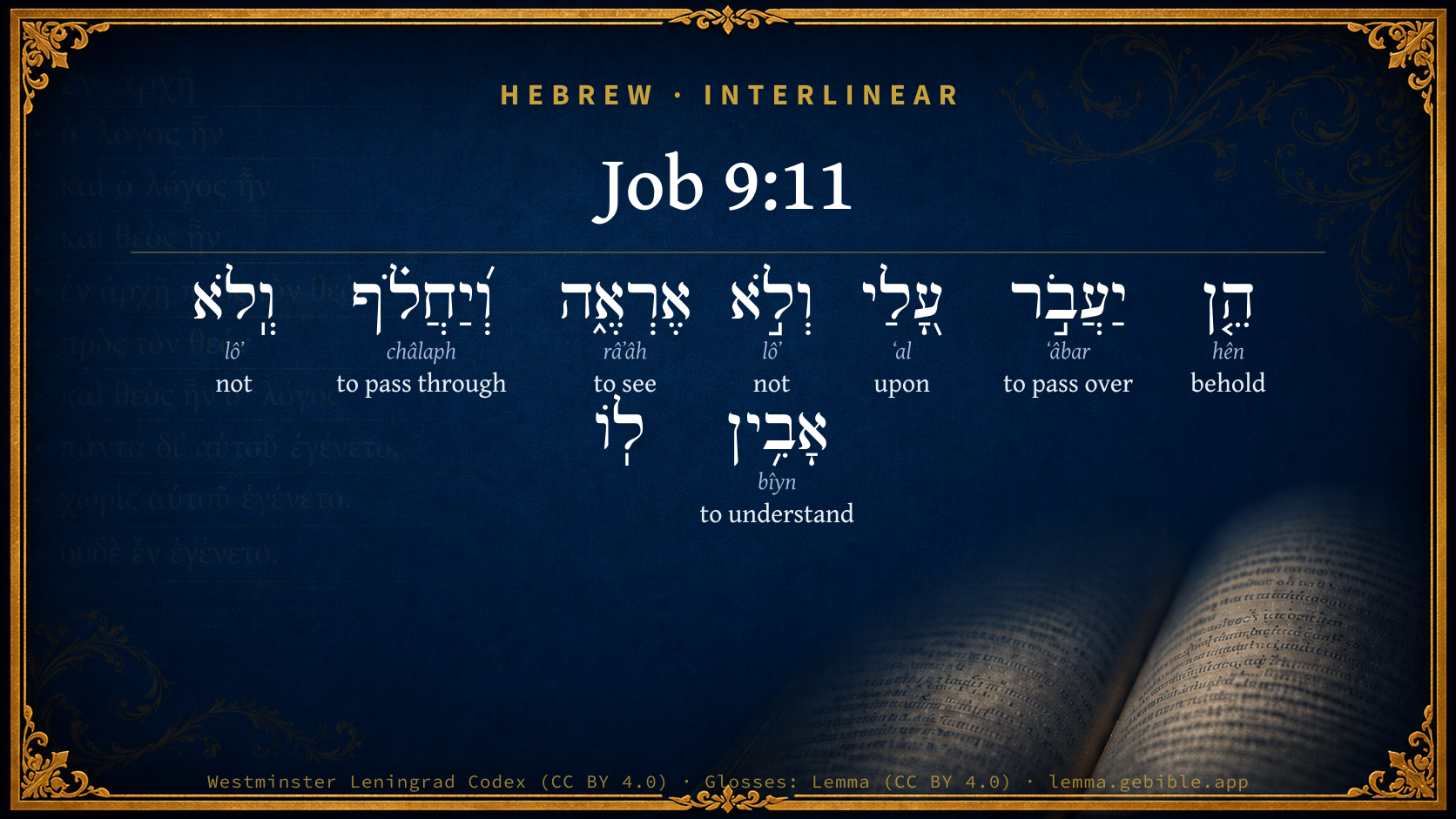
Job 9:11

Hebrew (Westminster Leningrad Codex) Job 9:11 appears in the Hebrew Old Testament. The text above is from the Westminster Leningrad Codex. Each word links to its Strong’s number, a concise gloss, and parsing drawn from the Open Scriptures Hebrew Bible morphology. Click any word for its full Brown-Driver-Briggs (BDB) entry.
Download image
Cite this verse

Job 9:11 (World English Bible). Public Domain. Lemma interlinear Bible study tool, https://lemma.gebible.app/v/job/9/11.

Show BibTeX & RIS
BibTeX
RIS
English Translation
Behold, he goes by me, and I don't see him. He passes on also, but I don't perceive him.
World English Bible · Public Domain
Download a study sheet

One document with this verse’s original text, its word-by-word gloss line, the meaning frame, cross-references with their text, attributed commentary, and full source and license credits — printable, and it pastes into notes with its structure intact.

This verse Autodidact and up

Study sheet (.html) Plain text (.txt)

A passage Seminary Student

Up to 50 verses in one chapter. A passage sheet keeps up to 6 commentary sources and 12 cross-references per verse, in the order this page ranks them, and says so on the sheet whenever that leaves anything out. Ask for a single verse and you get the Autodidact verse sheet above.

Everything on this page stays free to read, with no account — the sheet is a download of what is already on screen, not access to it.

Want to remove ads? Support Godless Engineer
Compare translations 3

The same verse in 3 English versions, stacked beneath the original-language interlinear above. Click any original word for its lexicon entry.

Each is an independent rendering of the whole verse — the interlinear is not word-aligned to these translations.

Highlighted words mark where these versions differ — a whole-verse word diff, not a word-by-word alignment.

  • World English Bible Public Domain
    Behold, he goes by me, and I don't see him. He passes on also, but I don't perceive him.
  • King James Version Public Domain
    Lo, he goeth by me, and I see him not: he passeth on also, but I perceive him not.
  • unfoldingWord Literal Text CC BY-SA 4.0
    Behold, he goes by me, but I do not see, and he passes, but I do not perceive him.

unfoldingWord Literal Text — © unfoldingWord, licensed CC BY-SA 4.0. Word-aligned USFM3 via Door43 (git.door43.org/unfoldingWord/en_ult).

Versions to compare (up to 4)

3 of 4 selected

Show all 18 translations

Every available English version of this verse, each an independent rendering of the whole verse.

  • World English Bible Public Domain
    Behold, he goes by me, and I don't see him. He passes on also, but I don't perceive him.
  • Berean Standard Bible Public Domain
    Were He to pass by me, I would not see Him; were He to move, I would not recognize Him.
  • Majority Standard Bible Public Domain
    Were He to pass by me, I would not see Him; were He to move, I would not recognize Him.
  • King James Version Public Domain
    Lo, he goeth by me, and I see him not: he passeth on also, but I perceive him not.
  • American Standard Version (1901) Public Domain
    Lo, he goeth by me, and I see him not: He passeth on also, but I perceive him not.
  • Revised Version (1885) Public Domain
    Lo, he goeth by me, and I see him not: he passeth on also, but I perceive him not.
  • Geneva Bible (1599) Public Domain
    Lo, when he goeth by me, I see him not: and when he passeth by, I perceiue him not.
  • Douay-Rheims (1899) Public Domain
    If he come to me, I shall not see him: if he depart I shall not understand.
  • Young's Literal Translation Public Domain
    Lo, He goeth over by me, and I see not, And He passeth on, and I attend not to it.
  • Literal Standard Version CC BY-SA 4.0
    Behold, He goes over by me, and I do not see, || And He passes on, and I do not attend to it.
  • Unlocked Literal Bible CC BY-SA 4.0
    See, he goes by me, and I do not see him; he passes on also, but I do not perceive him.
  • unfoldingWord Literal Text CC BY-SA 4.0
    Behold, he goes by me, but I do not see, and he passes, but I do not perceive him.
  • Darby Bible Public Domain
    Lo, he goeth by me, and I see [him] not; and he passeth along, and I perceive him not.
  • World Messianic Bible Public Domain
    Behold, he goes by me, and I don’t see him. He passes on also, but I don’t perceive him.
  • Webster's Bible Public Domain
    Lo, he goeth by me, and I see him not: he passeth on also, but I perceive him not.
  • Free Bible Version CC BY-SA 4.0
    But when he passes by me, I don't see him; when he moves on, he is invisible to me.
  • Bible in Basic English Public Domain
    See, he goes past me and I see him not: he goes on before, but I have no knowledge of him.
  • JPS Tanakh (1917) Public Domain
    Lo, He goeth by me, and I see Him not. He passeth on also, but I perceive Him not.

Literal Standard Version (2020), Covenant Press — licensed CC BY-SA 4.0. Text via the HelloAO Bible API (eBible.org). Unlocked Literal Bible (unfoldingWord) — licensed CC BY-SA 4.0. Text via the HelloAO Bible API (eBible.org). unfoldingWord Literal Text — © unfoldingWord, licensed CC BY-SA 4.0. Word-aligned USFM3 via Door43 (git.door43.org/unfoldingWord/en_ult). Free Bible Version, Dr. Jonathan Gallagher — licensed CC BY-SA 4.0. Text via the HelloAO Bible API (eBible.org).

Word by word

More ways to search: Search by grammar → Find every occurrence → Compare this word →

Practice this passage: Drill this verse → Learn its vocabulary →

וְ֝יַחֲלֹ֗ף
châlaph
H2498
“and · to pass through”
Conjunction + Verb, Qal, Imperfect, 3rd Person, Masculine, Singular
Part of Speech
Conjunction + Verb
Stem
Qal
Form
Imperfect
Person
3rd Person
Gender
Masculine
Number
Singular
Full BDB Definition

Origin: a primitive root

TWOT: 666

to pass on or away, pass through, pass by, go through, grow up, change, to go on from - (Qal) - to pass on quickly - to pass away (vanish) - to come on anew, sprout again (of grass) - to pass through - to overstep, transgress - (Piel) to cause to pass, change - (Hiphil) - to change, substitute, alter, change for better, renew - to show newness (of tree)
  1. הֵ֤ן hên H2005 “behold” Particle, Demonstrative
  2. יַעֲבֹ֣ר ʻâbar H5674 “to pass over” Verb, Qal, Imperfect, 3rd Person, Masculine, Singular
  3. עָ֭לַי ʻal H5921 “upon · me” Preposition + Suffix, Personal, 1st Person, Common, Singular
  4. וְלֹ֣א lôʼ H3808 “and · not” Conjunction + Particle, Negative
  5. אֶרְאֶ֑ה râʼâh H7200 “to see” Verb, Qal, Imperfect, 1st Person, Common, Singular
  6. וְֽלֹא lôʼ H3808 “and · not” Conjunction + Particle, Negative
  7. אָבִ֥ין bîyn H995 “to understand” Verb, Qal, Imperfect, 1st Person, Common, Singular

About this verse

These counts appear in no published source. They are computed here, from the morphology-tagged text and Lemma’s own curated glosses. What Lemma adds →

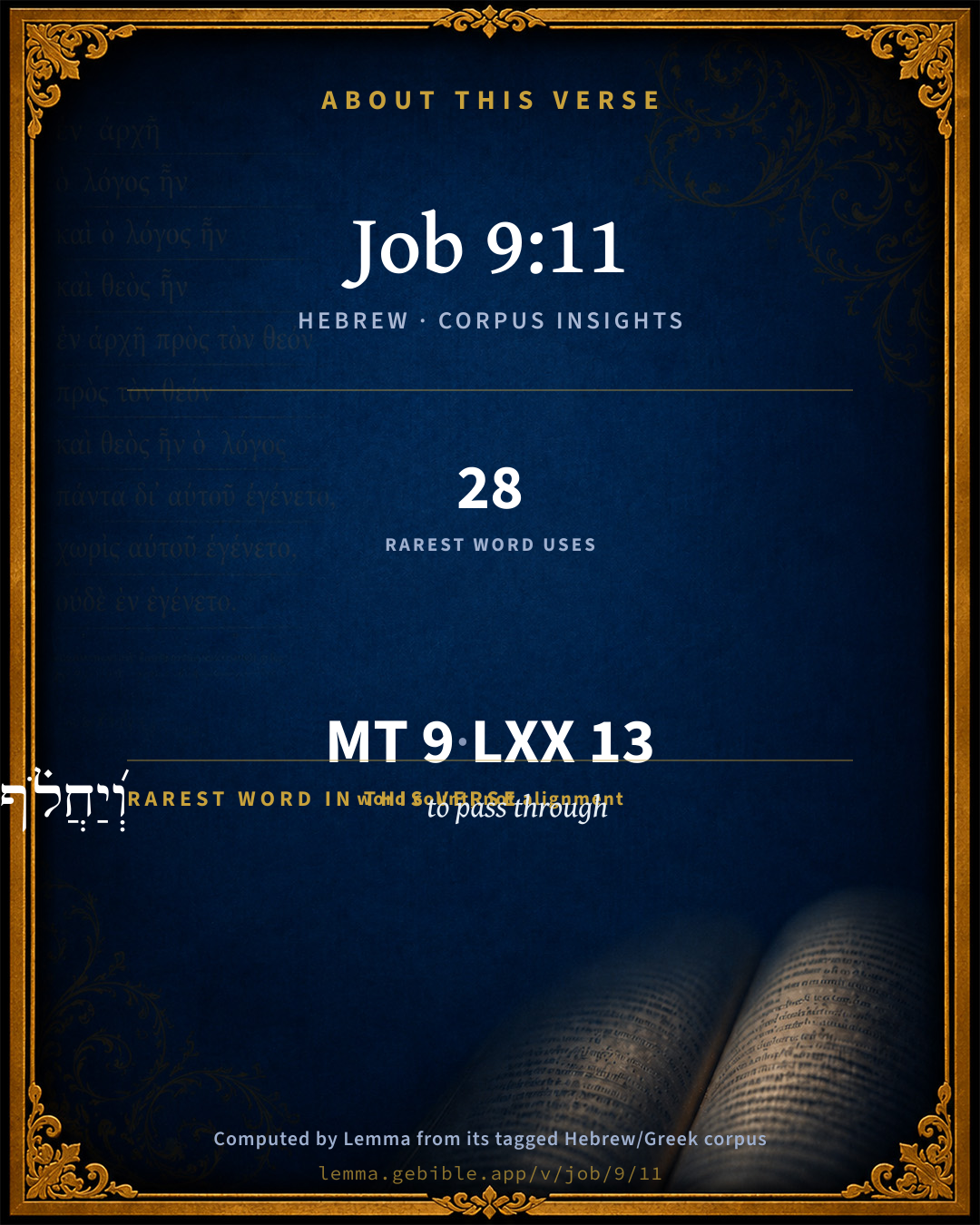
9
words
7
distinct lemmas
Wisdom
section

Shared distinctive vocabulary

וְ֝יַחֲלֹ֗ף to pass through H2498 occurs in 27 verses of the Hebrew Bible. Also found in:

Grammatical profile

  • 4 verbs
  • 2 prepositions
  • 3 particles

Verb forms

  • יַעֲבֹ֣ר Qal · Imperfect
  • אֶרְאֶ֑ה Qal · Imperfect
  • וְ֝יַחֲלֹ֗ף Qal · Imperfect
  • אָבִ֥ין Qal · Imperfect

Repetition

A word recurs within this verse — often emphatic in Hebrew:

  • וְלֹ֣א not H3808 ×2

Hebrew & Septuagint length

In English translation the verse runs 19 words from the Hebrew and 24 from the Septuagint (LXX English) — closely comparable.

A rough comparison of the two English renderings, which tokenize alike — not a word-level alignment.

Word counts can differ between the Hebrew and the Greek without any difference in meaning — e.g. the Hebrew direct-object marker אֵת has no separate Greek word, and Greek often adds the article ὁ.

In the original languages it is 9 Hebrew tokens and 13 Greek tokens — but the two are counted differently (Hebrew bundles its prefixes and suffixes into one token; the Greek is in lemma form), so that isn’t a like-for-like length.

Cross-references

4

Topical passages linked to Job 9:11 in the Treasury of Scripture Knowledge — connected by theme and wording, ordered by reader-vote popularity; previews shown in the World English Bible.

  • Job 23:8–9 "If I go east, he is not there; If west, I can't find him;
  • Job 35:14 How much less when you say you don't see him. The cause is before him, and you wait for him!
  • Psalms 77:19 Your way was through the sea; Your paths through the great waters. Your footsteps were not known.
  • 1 Timothy 6:16 who alone has immortality, dwelling in unapproachable light; whom no man has seen, nor can see: to whom be honor and eternal power. Amen.

Cross-references courtesy of OpenBible.info (CC BY 4.0).

Hebrew and Greek witnesses Masoretic Hebrew ↔ Greek Septuagint

The same verse in the two great witnesses to the Old Testament, shown verse-for-verse.

These are two independent witnesses, not word-aligned to each other, and the Septuagint is shown in lemma (dictionary) form.

Hebrew Job 9:11 Masoretic · Westminster Leningrad Codex

הֵ֤ן יַעֲבֹ֣ר עָ֭לַי וְלֹ֣א אֶרְאֶ֑ה וְ֝יַחֲלֹ֗ף וְֽלֹא אָבִ֥ין לֽוֹ

Behold, he goes by me, and I don't see him. He passes on also, but I don't perceive him.

World English Bible · Public Domain

Greek LXX Job 9:11 Septuagint · lemma form

ἐάν ὑπερβαίνω ἐγώ οὐ μή ὁράω καί ἐάν παραἔρχομαι ἐγώ οὐδέ ὥς γιγνώσκω

If ever he should go beyond me, I shall not see him: if he should pass by me, neither thus have I known it.

LXX2012 (modern English Septuagint) · Public Domain

On this verse, Keil & Delitzsch discusses the Septuagint’s reading. Read the note in Commentary ↓

Hebrew: Westminster Leningrad Codex (CC BY 4.0). Greek: Septuagint (public domain); English from LXX2012 (modern English Septuagint) (Public Domain). How the Septuagint differs from the Hebrew →

Commentary

Notes on Job 9:11 from classic Christian and Jewish commentators (each source and its license shown beneath its notes). The classic Christian expositions comment on the surrounding passage and are grouped to its opening verse, so a note may address several verses; the Jewish commentaries on the Tanakh (Rashi and others) are per-verse, so they appear only where the commentator wrote on this verse.

Lemma curates 59 commentaries, every one of them public domain or Creative Commons licensed, each selected and text-cleaned for this edition rather than reprinted as found. About our sources →

Trapp's Complete Commentary

John Trapp

Job 9:11 Lo, he goeth by me, and I see [him] not: he passeth on also, but I perceive him not.

Ver. 11. Lo, he goeth by me, and I see him not] As he is powerful in his deeds, so he is secret in his designs, passing, and not repassing daily, but yet unseen; he is everywhere present, and not so far from any one of us as the bark is from the tree; for in him we live, move, and have our being; and therefore we had need take heed what we say or think of him in any extremity or misery, for he overheareth us; yea, he knoweth our thoughts long before, Psa 139:2. As a circumspect judge that goeth obscured under some disguise, to hear and see what is said and done by those that are to be judged by him. Or, as the Great Turk standing behind the arras, at the dangerous door, to hear all the debates and decrees of his senate, and to call them to a strict account of all afterwards: God, as he is invisible, too subtle for sinew or sight to seize upon; so he is ολοφθαλμος, All-eye, to survey and look all around us; yea, to see through us: "The Lord is in his holy temple, the Lord’s throne is in heaven"; howbeit, he is not so confined or shut up there (as the Epicures dreamed) but that "his eyes behold, his eyelids try, the children of men," Psa 11:4. The one points out his knowledge, the other his judgment, or his eritical descant; he pryeth into the very entrails of the soul, the heart of the heart; the reins, those seats of lust, and most abstruse parts of the body. No man needs a window in his breast (as the heathen Momus wished) for God to look in at; every man before God is all window, and he, like the optic virtue in the eye, seeth all, and is seen of none. Look to it, therefore, and walk exactly. Cave, spectat Care, Take heed, Care seeth you, was an ancient watchword among the Romans, and a great retentive from vice; how much more should this among all men, Take heed, the Lord looks on! What though he is invisible, and we see him not; he passeth on also, and we perceive him not; shall we, like the foolish bustard, thrust our heads in a hole, and then think that, because we see none, we are therefore seen of none? The whole world is to God as a sea of glass, clear and transparent, Rev 4:6, and his eyes are as a flaming fire, Rev 1:14, that need no outward light, but can see by sending out a ray. God, that fills and sees all (saith Nazianzen), though he lighten the mind, yet flies before the beams thereof, still leaving it as it is able in sight to follow him; and so draws it by degrees to higher things; yet interposeth between it and his incomprehensible essence, as many veils as were over the Tabernacle.

John Trapp, A Commentary or Exposition upon All the Books of the Old and New Testament (1647–1656) — public domain. Text from a community e-Sword module.

The Biblical Illustrator

Joseph S. Exell

Job_9:11

So He goeth by me.

God passing by

These mighty saints of old may have had fewer books to read than we have in our day, but they had one glorious book, the volume of nature, whose ever-open pages, written within and without by the finger of God, were spread out before their wondering eyes. And they read carefully and devoutly the great truths about God these pages were always teaching them. God was passing by them in the grand panorama of His works which their eyes beheld. They dwelt chiefly in tents. They lived much in the open air, under the blue sky of those beautiful Eastern lands. They lived a simple, primitive life, with few wants and few cares. They had far more time than we have for holy thought and heavenly meditation on things spiritual and eternal. Many a sacred tradition may have floated down the quiet stream of time--of the revelation of God made to man, of His will and purpose concerning the race that had so sadly gone astray from Him. They knew that God had not finally abandoned the world and consigned it to utter destruction. They followed their flocks and herds all day in the wild, trackless desert, or in the fertile plain. They lived much of the time alone--and men who are much alone with God become terribly in earnest. They are away from man and all his little ways, and hold communion with God through His works. Men like Moses and Elijah and John the Baptist may be separated from their fellow men; but they are near to, and enjoy wondrous communings with the infinite and eternal God. God is passing by them in a thousand ways. They watch with eager eye every variation in the clouds and in the stars. They could see the glorious play of the forked lightning as it gleamed, in a thousand fantastic forms, on the bosom of the storm-cloud, resting on the distant mountain tops. In the storm God was passing by--that same God whose goings forth have been of old, from everlasting. They knew, it may be, little of the laws of electricity or of sound; but they could hear in the thunder, as it rolled from rock to rock, or shook the earth from pole to pole, the very voice of God (Psa_29:3-8). These mighty saints may have had no formulated system of theology, where God was mapped out with all His perfections, with all the nicety and precision of a mathematical figure; but to them He was the omnipresent God. They saw some rays of His glorious presence reflected from every cloud. They heard His voice in every passing breeze. God was passing by then. God--the same God--is passing by us now. Whatever changes have come or yet may come to His universe, He Himself is unchangeable. In the glorious panorama of the heavens God is passing by us. In the noiseless tread of the seasons God is passing by. Spring and summer, seed time and harvest, autumn and winter, as they quietly come and quietly go, all tell the same story, God is passing by. In the regular succession of day and night, in every rising and setting sun, in every waxing and waning moon, God is near us and passing by us. In every national blessing and every national chastisement God is passing by. When the streams of earthly comforts flow full and strong around our life, and equally when these streams run low or dry, God is passing by us. When war, with all its accompanying desolations, its misery and agony and woe, is sweeping over a country, God is passing by. And no less surely is He passing by for us in our days of peace and our nights of quiet. God is ever near us, though we see Him not. In every beat of our pulse, in every throb of our heart, in every movement of our brain, God is there. He is about our bed and around our path. Above us, behind and before, we are flooded with the omnipresence of Deity as with the noonday sunshine. But because we see Him not with the bodily eye we forget that He is there. He passeth on also, but we perceive Him not. (James Carmichael, D. D.)

Mans ignorance of God

1. That God is invisible in His essence, and incomprehensible in many of His actions. Mans eye cannot see Him. Mans understanding cannot comprehend what He doth.

2. As the Lord in His nature cannot be seen at all; so (such is the weakness of man, that) we cannot see Him fully in His Word or works. Thus we see men, but we seldom see God in the great transactions and motions of kingdoms. And we see Him least of all in the course of spiritual things, in His working upon our hearts. God works wonders in us, and we perceive Him not.

3. Man is not fit to sit as a judge upon the works and dealings of God. Shall we judge God in what He doth, when we cannot apprehend what He doth? A judge must have the full cognisance of the matter before him, how else can he pass sentence about it?

4. It should be matter of great humiliation to Us, that we see so little of God. (J. Caryl.)

Present though invisible

We are reminded of this profound spiritual truth by reading the following account of an occurrence which illustrates an impressive scientific fact touching the invisible. Photographs of the invisible are what M. Zenger calls two pictures which he took about midnight of 17th August from a window looking out upon the Lake of Geneva. They gave faint yet distinct images of the lake and of Mont Blanc, which could not be seen in the darkness. Mr. Bertrand remarks that invisibility is a relative term, the significance of which depends on the power of the observers eye. The photographs were taken with a light of very small intensity, and did not represent an invisible object. So sky photographs, taken in observatories, show stars which cannot be discerned by the most piercing vision. (Homiletic Review.)

The Biblical Illustrator, edited by Joseph S. Exell (c. 1880s–1900s) — public domain. Text from a community e-Sword module.

Joseph Benson's Commentary

Job 9:11. Lo he goeth by me — Or besides, or before me, in my presence; that is, he worketh by his providence in ways of mercy or judgment. And I see him not — I see the effects, but I cannot understand the causes or grounds of his actions, for they are incomprehensible to me, or any other man: for though Job speaks only in his own person, yet he means to affirm it of all men, that such is the weakness of their understandings that they cannot search out God’s counsels and ways. The operations of second causes are commonly obvious to our senses; but, though God works by those causes, we see him not, nor can our finite minds fathom his counsels, apprehend his motions, or comprehend the measures he takes. He passeth on also — He goeth from place to place; from one action to another. But I perceive him not — He passes and acts invisibly and undiscerned.

Joseph Benson's Commentary on the Old and New Testaments (1811–1818) — public domain. Text from a community e-Sword module.

Whedon's Commentary on the Bible

Daniel D. Whedon

Strophe d — After the extended description of the divine Omnipotence, the short, hasty glance which in this strophe is cast on miserable, mortal man makes an impression so much the more pointed. Job_9:11-12. (Schlottmann.)

11. An important disclosure of the spiritual nature of Deity.

Passeth on — Glideth, or sweepeth, by. The mysterious חל, hhalaph, used by Job in Job_4:15, of a spirit; in Job_14:7, of growth in nature; and in Job_11:10 of the solemn march of God to judgment. The word is happily adapted to express the unseen movements of nature and of nature’s God. See also Job_9:26.

Daniel D. Whedon (gen. ed.), Commentary on the Old and New Testaments (1874–1909) — public domain. Text from a community e-Sword module.

Geneva Bible (1599)

Geneva Bible translators

I am not able to comprehend his works, which are common and daily before my eyes, much less in those things, which are hid and secret.

Geneva Bible (1599) marginal notes — public domain. Text via Bolls.life.

Jamieson, Fausset & Brown

Robert Jamieson, A. R. Fausset & David Brown

I see him not: he passeth on--The image is that of a howling wind (Isa 21:1). Like it when it bursts invisibly upon man, so God is felt in the awful effects of His wrath, but is not seen (Joh 3:8). Therefore, reasons Job, it is impossible to contend with Him.

Jamieson, Fausset & Brown — Commentary Critical and Explanatory on the Whole Bible (1871) — public domain (CC PDM 1.0). Text via the HelloAO Bible API.

Adam Clarke's Commentary

Verse 11. Lo, he goeth by me, and I see him not] He is incomprehensible in all his ways, and in all his works; and he must be so it he be GOD, and work as GOD; for his own nature and his operations are past finding out.

Adam Clarke's Commentary on the Bible (1810–1826) — public domain. Text from a community e-Sword/MySword module.

Ellicott's Commentary for English Readers

(11) He passeth on also.—This, again, is an expression Eliphaz had used in Job_4:15. Here in words of great sublimity Job depicts the unapproachable majesty of God omnipotent, but invisible, and shows the utter hopelessness of entering into judgment with Him. Unfortunately, though this is a proposition to which all must assent, yet none is virtually so much repudiated or practically so often contravened. Men still cast about to justify themselves before God, and will do so till the end of time; but it is in teaching such as this that the Book of Job has laid the foundation of the Gospel by preparing for its acceptance by overthrowing man’s natural and habitual standing-ground in himself.

A Bible Commentary for English Readers, edited by Charles John Ellicott (1878–1897) — public domain. Text from a community e-Sword module.

The Cambridge Bible for Schools and Colleges

gen. ed. J. J. S. Perowne

11. This power is subtle and invisible in its presence, felt but impossible to grasp.

11–24. From the operation of this terrible force in the physical world Job passes on to describe its display among creatures, and to shew how it paralyses and crushes them.

The Cambridge Bible for Schools and Colleges (gen. ed. J. J. S. Perowne; Cambridge University Press, 1878–1918) — public domain. Text from a community e-Sword module.

John Gill's Exposition

Behold, he taketh away,.... There are some things God never takes away from his people; he never takes away his love from them, he always rests in that towards them, let them be in what condition they will; he never takes away his grace from them, when once bestowed on them, or wrought in them; he never takes away his special gifts of grace, particularly the unspeakable gift of his son Christ Jesus, which is that good part, when chosen, which shall not be taken away; nor any of the spiritual blessings wherewith they are blessed in Christ; these are irreversible and irrevocable: but temporal blessings he takes away at pleasure; so he had taken away the children, the servants of Job, his substance, wealth, and riches, and also his bodily health, to which he may have a particular respect; yea, when it pleases him, he takes a man out of the world, as the Targum and Gersom interpret it:

who can hinder him? he does what he pleases in heaven and earth; his will is irresistible, his power is uncontrollable; there is no turning his mind, nor staying his hand, nor turning it back; when he works, none can let or hinder. Mr. Broughton translates it, "who shall make him restore?" (l) if a man takes away what he has no right to, he may be obliged by law to restore it; but whatever God takes away he has a right unto, be it relations and friends, health or wealth; if he pleases he can restore, and does; and as he did to Job, to whom he after gave twice as much as he had before; but then he is not obliged to do it, none can force him to it:

who will say unto him, what doest thou? not one that knows what God is, or that knows himself a creature of his; no person will choose or dare to ask what God does, or why he does this and not another thing, or why this in the manner he does it; for he gives no account of his matters to the sons of men, nor is he obliged to it, and it would be insolent in them to require it, see Job 33:13; this expresses his sovereignty.

(l) So Beza, Pagninus, Montanus, Bolducius, Junius & Tremellius, Cocceius.

John Gill's Exposition of the Whole Bible (1746–1763) — public domain (CC PDM 1.0). Text via the HelloAO Bible API.

Albert Barnes' Notes on the Bible

Lo, he goeth by me - That is, he passes along - as in the silent movements of the heavenly bodies. “I see the evidence of his existence. I can see that God must be there - moving along by me in the orbs of night and in the march of the constellations, but I cannot see God himself. He passes by, or rather he passes over me (עלי ‛ālay), as in the majestic movement of the heavenly bodies over my head.” This is, I think, the idea, and the image is exceedingly poetic and beautiful. The heavens are seen to move in silent grandeur. The northern constellation rolls around the pole. The others move on as a marshalled army. They go in silent and solemn order, and God must be there. But, says Job, I cannot see him. I can feel that he must be there, and I look out on the heavens to see him, but my eyes fail, and I cannot behold him. He passes on, and I see him not. Who has ever looked upon the heavens in the still night, and seen the silent grandeur of such movements of the heavenly host, without some such feeling - some emotion of inexpressible awe - as if he, if I may so express it, COULD ALMOST SEE GOD?

Albert Barnes' Notes on the Bible (1834–1885) — public domain. Text from a community e-Sword/MySword module.

Haydock's Catholic Bible Commentary

Understand, as he is a spirit; (Menochius) and not that God is changeable, but his works and judgments are above our comprehension, and we are always liable to change. Hence the proud erroneously think themselves to be in favour; while the humble, on the contrary, keep at a distance, and still sue for pardon, when their sins have been forgiven, Luke xviii. 13., and Ecclesiasticus ii. 1. (Calmet)

George Leo Haydock (1774–1849), Haydock's Catholic Family Bible and Commentary, 1859 edition — public domain. Excludes Psalms (Douay-Rheims chapter numbering differs from Protestant) and Deuterocanonical books (Catholic canon only).

Matthew Poole's English Annotations

He goeth, i.e. he worketh by his providence in ways of mercy or judgment.

By me; or, besides or before me; in my presence.

I see him not; I see the effects, but I cannot understand the causes or grounds of his actions, for they are incomprehensible by me, or by any other men: for though he speaks only in his own person, yet he means it of all men; that such is the weakness of men’s understandings, that they cannot search out God’s counsels and ways: see Act 17:27; Rom 11:33.

He passeth on also; he goeth from place to place, from one action to another. He speaks of God after the manner of men.

Matthew Poole's English Annotations on the Holy Bible (1683–1685) — public domain. Text from a community e-Sword/MySword module.

The Pulpit Commentary

Lo, he goeth by me, and I see him not. Near as God is to us, close as he comes to us, we cannot directly see him, or feel him, or perceive his presence. We know it by faith, we may feel it in our inmost spirits; but there is no manifestation of it to our senses. A sharp line divides the visible and invisible worlds; and this line, if it is ever crossed, is very rarely crossed. Job possibly reflects upon the pretension of Eliphaz to have had a physical consciousness of the visitation of a spirit, (Job_4:15, Job_4:16) and asserts, with a tinge of sarcasm, that it is otherwise with him the spirit-worm passes him by, and he receives no light, no illumination, no miraculous direction from it. He passeth on also. The same verb is used by Eliphaz (Job_4:15) in speaking of his spiritual visitation. But I perceive him not. Eliphaz perceived the presence of the spirit (Job_4:15, Job_4:16) and heard its voice. (Job_4:16-21) Job seems to mean that he is not so favoured.

Vers. 11-20. Job to Bildad: 3. Creator and creature in conflict.

I THE DIVINE ASSAILANT.

1. His mysterious movements. "Lo! he goeth by me, and I see him not: he passeth on also, but I perceive him not" (ver. 11). The language, recalling Eliphaz"s description of the shadowy spectre, (Job_4:15) recognizes:

(1) The personality of God. The Divine Being is not an impalpable abstraction or a dead unintelligent force, but a living, thinking, self conscious Intelligence. Such a Deity is as much a necessity of reason as a postulate of revelation.

(2) The activity of God. Not confounding the Creator and the creature as modern pantheism does, but ever maintaining a separation between the almighty Artificer of the universe and his works, biblical theology (both Hebrew and Christian) is also careful to avoid the error of deism, which, while believing in a Deity, removes him to a distance from his creation, setting him apart in cold, chilling isolation, amid the radiant splendours of a metaphysical perfection, and in particular interjecting between him and the realm of this sublunary sphere a gulf impassable by either him or man. Contrary to this, scriptural theism conceives God as an omnipotent, omniscient, and omnipresent Intelligence, continually superintending the universe he has made, as being ever present and ever active in all parts and places of his dominion. (Ps 130 Jer_23:23, 24 Eph_1:23Jo Eph_5:17)

(3) The nearness of God. In a sense that is very real, God is never far from any one of us. (Act_17:27) Behind the veil which hides the unseen Eternities from mortal vision he continually sits, beholding all that transpires on earth; seeing all things and all persons, but ever remaining himself unseen. The besetting God of the Hebrew psalmist (Psa_139:5) is the God of all men. Were the veil to be uplifted, it would at once be seen that God is always at hand. Sometimes it is lifted; as e.g. to Abraham, (Gen_15:1) to Hagar, (Gen_16:13) to Jacob. (Gen_28:13) And sometimes it is lifted to the soul when it remains closed to the bodily eye. God"s nearness to man received its highest and truest expression when the Eternal Word became incarnate and dwelt among us.

(4) The invisibility of God. Absolutely, i.e. in his uncreated essence, the supreme Deity must always remain invisible to and incomprehensible by, (Job_23:8 Joh_1:18 Joh_6:46 1Ti_6:16 1Jn_4:12) if not also by all finite beings. (Job_11:7 Job_37:23 Isa_14:15) Relatively, he may be said to be visible when the spirit can recognize the working of his almighty finger, and invisible when that working or the reason of it is hid. Job complains that, while he can distinctly apprehend God to be passing by him in the events of providence and the phenomena of his individual experience, he is quite unable to discern God himself, i.e. to understand either the mode or the purpose of his mysterious movements. (Job_11:7-9 Job_37:5, 23 Psa_77:19 Nah_1:3 Mat_11:25)

2. His resistless power.

(1) Invincible. "Behold, he taketh away or," he assails, who can hinder him or, "who shall repel him?" (ver. 12). Impossible for the human soul not to feel overpowered with a sense of weakness and utter defencelessness when God, by the hand of providence, or by the inward stroke of his Spirit, collides with it. It is, however, some mitigation to the soul"s distress, when it is able to recognize that the hand which strikes it is really God"s. (1Sa_3:18 Psa_39:9)

(2) Unchallengeable. Who will say unto him, What doest thou? (ver. 12). The sovereignty of God in removing, as well as in bestowing, creature comforts, such as possessions, children, etc., is as plainly demonstrated by experience as emphatically asserted in Scripture; and should be as cheerfully admitted by all as it was by Job (Job_1:21 Job_2:10) and by Nebuchadnezzar (Dan_4:35) God"s sovereignty, however, does not mean mere arbitrary and imperious behaviour. When God rakes away (as also when he gives), he not only does what he has a perfect right to do, but the reasons present to his mind for doing it are such as cannot be impeached. God"s power always acts for the best, being allied with infinite wisdom; only God explains not his motives to creatures; but saints are ever satisfied that he doeth all things well. (Psa_119:65 Mar_7:37 Rom_8:28)

(3) Implacable. "Eloah restraineth not his anger" (ver. 13); i.e. he never recalls it, never holds it in or turns it back until it has accomplished its purpose; but permits it, like a rising tide or sweeping hurricane, to carry all before it, so that "the proud helpers" (literally, the helpers of Rahab, i.e. "the helpers of pride," meaning probably either combinations of proud rebels, such as the antediluvians, or, "associates of the proud one," viz. the devil, or perhaps simply wicked men who"inspired by pride, think to interpose between the Almighty and the objects of his displeasure; such persons as are described in Psa_73:6-9; but vide Exposition) "stoop under him." The mightiest combinations and confederacies of wicked men and devils are utterly helpless against God. (Psa_2:1-3 Psa_83:5, 8 Jud_1:6) Their source, pride; (Psa_10:2 Psa_10:4) their purpose, opposition to God; (Psa_12:3, Psa_12:4) their end, destruction. (Pro_17:19 Isa_2:11 Isa_13:11)

3. His unanswerable charges.

(1) Because of man"s weakness. "How much less shall I answer him, and choose out my words to reason with him?" (ver. 14). A blessed thought that man is permitted to reason with God, (Isa_1:16 Isa_43:26) if not about his innocence, at least about his pardon and salvation. Persons who avail themselves of such permission should study to find appropriate language in which to state their case. Well-chosen words, if required in addressing man, (Ecc_12:10) are much more indispensable in wrestling with God. Yet they who stand forth to plead with God should be profoundly impressed with a sense of their own unworthiness and insufficiency, (Gen_32:10 Isa_6:5) and should accordingly be clothed with humility. (2Sa_7:18)

(2) Because of God"s greatness. "Whom, though I were righteous, I would not answer, but I would make supplication to my Judge" (ver. 15). A glimpse into the better nature of Job. Though repudiating the calumnies of his friends, and sometimes defending his own innocence with language indicating an approach at least to self-righteous presumption, he here appears overpowered with such a sense of the Divine majesty as to lay him prostrate in silence and self-abasement before him Note the solemn relation in which God stands to all men that of Judge; the character which the best of men bear in his sight unrighteous; the summons which shall one day be addressed to all to stand forth and answer for their sins; the attitude which all men should take towards God in view of that event the attitude of supplication.

II THE HUMAN COMPLAINANT.

1. Mistrusting the Divine condescension. Putting the case that he had summoned God into court, and that God had appeared, Job appears to conceive that a Being so infinitely exalted as he would not listen to the complaint of a frail mortal, or, if for a moment he did, would immediately break off in impatience and decline to listen further (ver. 16). A total misrepresentation of the Divine character, contradicted alike by God"s descriptions of himself, (Isa_57:15, 16 Psa_91:15) and by the saints" experience of his grace. (Psa_34:6 Psa_40:17 Psa_86:13)

2. Impeaching the Divine goodness. Describing the treatment he would meet at God"s hands, Job insinuates that it would be the opposite of kind; that God would "break him with a tempest," "multiply his wounds without cause," "not suffer him to take his breath," "fill him with bitterness" (vers. 17, 18). As a matter of fact, the words present a literal account of Job"s sufferings, and the aspect in which they were beginning to look to himself. Conscious that his calamities were causeless so far as any wickedness on his part was concerned, which God also testified, (Job_2:3) and unable to discern the secret purpose for which he was being subjected to such excruciating tortures, he can only fall back upon the hypothesis that God has turned to be his enemy. Faith would have kept him right; but Job"s faith, though not extinguished, was at this time suffering an eclipse. Sense and reason always misinterpret God. God never treats either saint or sinner as Job describes, aimlessly or maliciously, but always with tender love and for the loftiest ends. (Heb_12:6, Heb_12:10)

3. Challenging the Divine equity. Practically he represents God as stifling the creature"s attempt to maintain his integrity by overpowering him with the dazzling magnificence of his Godhead; by rushing as it were into the open court of justice, and shouting to the poor bewildered appellant, "Is it a question of strength? Here am I Is it a matter of right? Who will challenge me?" (ver. 19). But this, again, was a distorted view of the Divine character. God has no need to be afraid of any investigation into his conduct, and just as little to apprehend that puny man could cure, it his infinite wisdom or overreach his almighty power.

4. Despairing of Divine acceptance. So hopeless does the contest seem to Job between a poor suffering creature like himself and a Being of infinite majesty like God, that he confesses the dire impossibility of being able to establish his innocence before the tribunal of the skies. God"s insufferable glory would so confound and stupefy him, that even if he were innocent, his own mouth would condemn him; were he guiltless, it would betray him (ver. 20); i.e. he would, through sheer terror and amazement, (1Pe_3:6) stumble out his own condemnation, and, conscious of his integrity, would yet confess himself guilty. What Job here asserts concerning his integrity or freedom from such transgression as Eliphaz and Bildad charged against him is certainly correct in the case of every one who would dare to maintain his moral purity in the sight of God. The clear revelation of God"s majesty and holiness imparted to the awakened soul, when it appears as if standing face to face with God, renders it a hard task for man to uphold his sinlessness. If he attempted it, he would only stultify and condemn himself. Nay, he should not know his own soul (ver. 21), but only thereby demonstrate his ignorance of himself. (cf. 1Jn_1:8)

Learn:

1. It is impossible to entertain too exalted a conception of the great and holy God with whom we have to do.

2. It is quite possible, even for the best of men, to misconstrue God"s dealings with the soul, and to regard him as an adversary who is really a Friend.

3. It is well to remember, in every appearance of conflict between the Creator and the creature, that all the right lies upon the side of the former.

4. The nearer saints advance towards perfection, the readier they are to acknowledge their imperfection.

5. A humble and self-abased spirit before God is quite compatible with the maintenance of one"s blamelessness before men.

The Pulpit Commentary (1880–1919), ed. H.D.M. Spence-Jones & Joseph S. Exell — public domain. Text from a community e-Sword module.

John Wesley's Explanatory Notes

Goeth - He works by his providence in ways of mercy or judgment. Passeth - He goeth from place to place: from one action to another: he speaks of God after the manner of men.

John Wesley, Explanatory Notes Upon the Whole Bible (1754–1765) — public domain. Text via the GEBible commentary corpus.

Keil & Delitzsch

C. F. Keil & F. Delitzsch

11 Behold, He goeth by me and I see not,

And passeth by and I perceive Him not.

12 Behold, He taketh away, who will hold Him back?

Who will say to Him: What doest Thou?

13 Eloah restraineth not His anger,

The helpers of Rahab stoop under Him -

14 How much less that I should address Him,

That I should choose the right words in answer to Him;

15 Because, though I were right, I could not answer, -

To Him as my Judge I must make supplication.

God works among men, as He works in nature, with a supreme control over all, invisibly, irresistibly, and is not responsible to any being (Isa 45:9). He does not turn or restrain His anger without having accomplished His purpose. This is a proposition which, thus broadly expressed, is only partially true, as is evident from Psa 78:38. The helpers of Rahab must bow themselves under Him. It is not feasible to understand this in a general sense, as meaning those who are ready with boastful arrogance to yield succour to any against God. The form of expression which follows in Job 9:14, "much less I," supports the assumption that רהב עזרי refers to some well-known extraordinary example of wicked enterprise which had been frustrated, notwithstanding the gigantic strength by which it was supported; and שׁחהוּ may be translated by the present tense, since a familiar fact is used as synonymous with the expression of an universal truth. Elsewhere Rahab as a proper name denotes Egypt (Psa 87:4), but it cannot be so understood here, because direct references to events in the history of Israel are contrary to the character of the book, which, with remarkable consistency, avoids everything that is at all Israelitish. But how has Egypt obtained the name of Rahab? It is evident from Isa 30:7 that it bears this name with reference to its deeds of prowess; but from Psa 89:11; Isa 51:9, it is evident that Rahab properly denotes a sea-monster, which has become the symbol of Egypt, like tannn and leviathan elsewhere. This signification of the word is also supported by Job 26:12, where the lxx actually translate κητος, as here with remarkable freedom, ὑπ ̓ ἀυτοῦ ἐκάμφθησαν κήτη τὰ ὑπ ̓ οὐρανόν. It is not clear whether these "sea-monsters" denote rebels cast down into the sea beneath the sky, or chained upon the sky; but at any rate the consciousness of a distinct mythological meaning in רהב עזרי is expressed by this translation (as also in the still freer translation of Jerome, et sub quo curvantur qui portant orbem); probably a myth connected with such names of the constellations as Κῆτος and Πρίστις (Ewald, Hirz., Schlottm.). The poesy of the book of Job even in other places does not spurn mythological allusions; and the phrase before us reminds one of the Hindu myth of Indras' victory over the dark demon Vritras, who tries to delay the descent of rain, and over his helpers. In Vritras, as in רהב, there is the idea of hostile resistance.

Job compares himself, the feeble one, to these mythical titanic powers in Job 9:14. כּי אף (properly: even that), or even אף alone (Job 4:19), signifies, according as the connection introduces a climax or anti-climax, either quanto magis or quanto minus, as here: how much less can I, the feeble one, dispute with Him! אשׁר, Job 9:15, is best taken, as in Job 5:5, in the signification quoniam. The part. Poel משׁפטי we should more correctly translate "my disputant" than "my judge;" it is Poel which Ewald appropriately styles the conjugation of attack: שׁופט, judicando vel litigando aliquem petere; comp. Ges. 55, 1. The part. Kal denotes a judge, the part. Poel one who is accuser and judge at the same time. On such Poel-forms from strong roots, vid., on Psa 109:10, where wedorschu is to be read, and therefore it is written ודרשׁוּ in correct Codices.

Keil & Delitzsch — Biblical Commentary on the Old Testament (1861–1891) — public domain (CC PDM 1.0). Text via the HelloAO Bible API. (Old Testament only.)

Rashi

Rabbi Shlomo Yitzchaki (Rashi)

Behold, He goes by me I know that all He wishes, He does.

He goes by me Before me, but I do not see Him.

Rashi on the Tanakh — English translations: “The Judaica Press complete Tanach with Rashi, translated by A. J. Rosenberg” (CC BY 4.0); “Pentateuch with Rashi's commentary by M. Rosenbaum and A.M. Silbermann, 1929-1934” (public domain); “The Metsudah Tanach series, Lakewood, N.J” (CC BY 4.0); and “The Book of Joshua, Metsudah Publications, 1997” (CC BY 4.0). Text via Sefaria.

Lesson kit

Teaching starters — assembled from the data on this page, not authored interpretation. Every prompt links to the verse data it draws on. Edit before teaching.

Job, in the Wisdom, opens this verse with 9 words (7 distinct Hebrew lemmas). Its most distinctive word is châlaph (“to pass through”). A historical commentator’s framing appears above. Read the whole chapter for the surrounding context.

Discussion questions

  1. What does “to pass through” (châlaph) contribute to the verse as a whole?
  2. Genesis 31:7 shares the word «to pass through» with this verse. How do the two illuminate each other?
  3. “not” occurs 2× in this one verse. What is the effect of the repetition?
  4. These translations render this verse differently; the difference is in the English rendering, not the original. What questions does that raise?
  5. The verb «יַעֲבֹ֣ר» is Qal Imperfect. How does its form color the action?
  6. Reading how Trapp's Complete Commentary and The Biblical Illustrator read this verse, where do the two commentators agree and where do they part?

Things to notice

Reading settings

Reading text

Shown beneath each verse's original-language words.

Old Testament
Old Testament edition

Read the OT as the Masoretic Hebrew (MT) or the Greek Septuagint (LXX).

English shown for the Greek Septuagint (in the Hebrew ↔ Greek comparison).

Comparing translations? Open the Compare panel on any verse page to stack up to four side by side.