
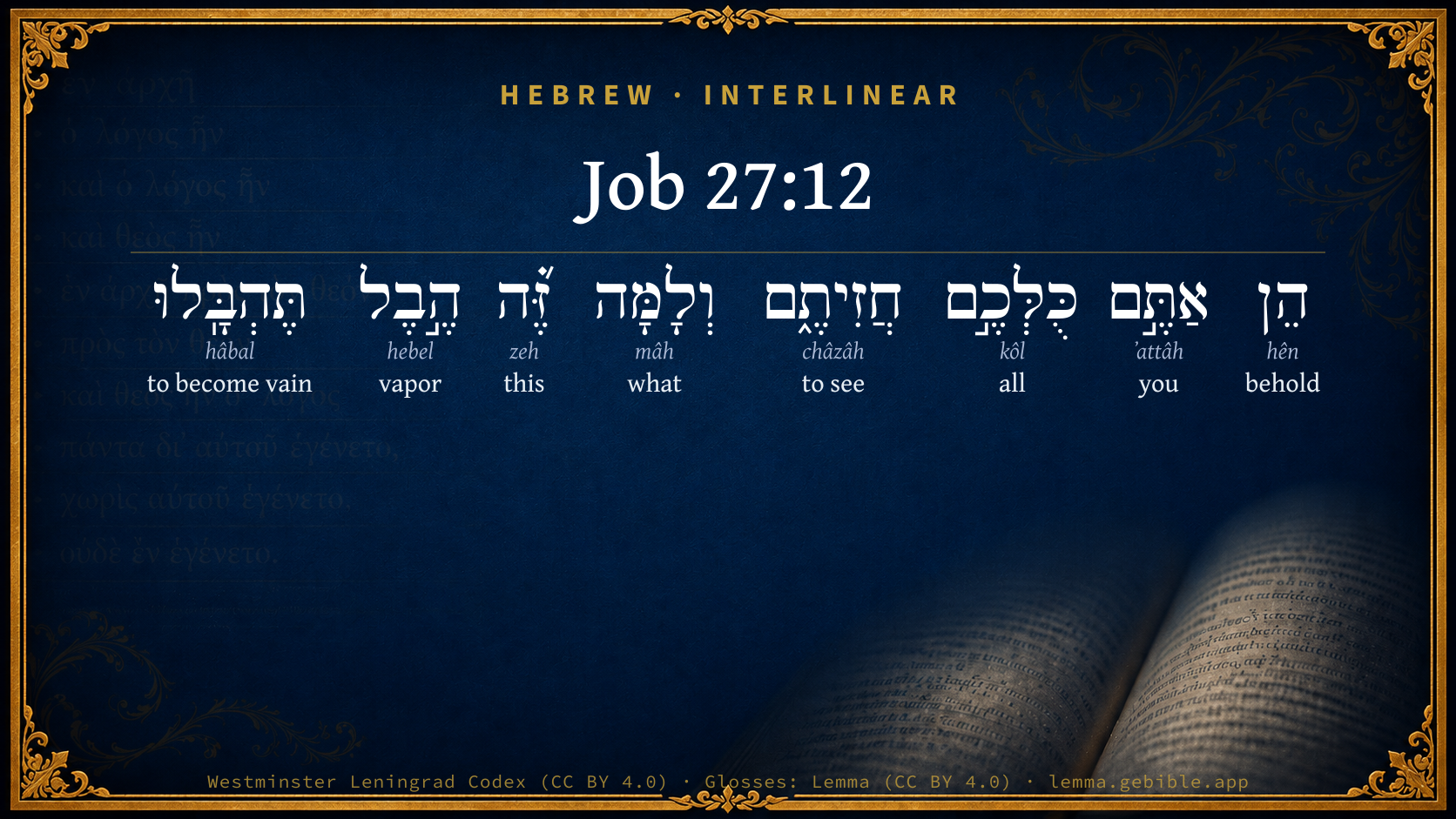
Job 27:12

Hebrew (Westminster Leningrad Codex) Job 27:12 appears in the Hebrew Old Testament. The text above is from the Westminster Leningrad Codex. Each word links to its Strong’s number, a concise gloss, and parsing drawn from the Open Scriptures Hebrew Bible morphology. Click any word for its full Brown-Driver-Briggs (BDB) entry.
Download image
Cite this verse

Job 27:12 (World English Bible). Public Domain. Lemma interlinear Bible study tool, https://lemma.gebible.app/v/job/27/12.

Show BibTeX & RIS
BibTeX
RIS
English Translation
Behold, all of you have seen it yourselves; Why then have you become altogether vain?
World English Bible · Public Domain
Download a study sheet

One document with this verse’s original text, its word-by-word gloss line, the meaning frame, cross-references with their text, attributed commentary, and full source and license credits — printable, and it pastes into notes with its structure intact.

This verse Autodidact and up

Study sheet (.html) Plain text (.txt)

A passage Seminary Student

Up to 50 verses in one chapter. A passage sheet keeps up to 6 commentary sources and 12 cross-references per verse, in the order this page ranks them, and says so on the sheet whenever that leaves anything out. Ask for a single verse and you get the Autodidact verse sheet above.

Everything on this page stays free to read, with no account — the sheet is a download of what is already on screen, not access to it.

Want to remove ads? Support Godless Engineer
Compare translations 3

The same verse in 3 English versions, stacked beneath the original-language interlinear above. Click any original word for its lexicon entry.

Each is an independent rendering of the whole verse — the interlinear is not word-aligned to these translations.

Highlighted words mark where these versions differ — a whole-verse word diff, not a word-by-word alignment.

  • World English Bible Public Domain
    Behold, all of you have seen it yourselves; Why then have you become altogether vain?
  • King James Version Public Domain
    Behold, all ye yourselves have seen it; why then are ye thus altogether vain?
  • unfoldingWord Literal Text CC BY-SA 4.0
    Behold, you have seen yourselves, all of you; why then do you vainly speak this vanity?

unfoldingWord Literal Text — © unfoldingWord, licensed CC BY-SA 4.0. Word-aligned USFM3 via Door43 (git.door43.org/unfoldingWord/en_ult).

Versions to compare (up to 4)

3 of 4 selected

Show all 18 translations

Every available English version of this verse, each an independent rendering of the whole verse.

  • World English Bible Public Domain
    Behold, all of you have seen it yourselves; Why then have you become altogether vain?
  • Berean Standard Bible Public Domain
    Surely all of you have seen it for yourselves. Why then do you keep up this empty talk?
  • Majority Standard Bible Public Domain
    Surely all of you have seen it for yourselves. Why then do you keep up this empty talk?
  • King James Version Public Domain
    Behold, all ye yourselves have seen it; why then are ye thus altogether vain?
  • American Standard Version (1901) Public Domain
    Behold, all ye yourselves have seen it; Why then are ye become altogether vain?
  • Revised Version (1885) Public Domain
    Behold, all ye yourselves have seen it; why then are ye become altogether vain?
  • Geneva Bible (1599) Public Domain
    Beholde, all ye your selues haue seene it: why then doe you thus vanish in vanitie?
  • Douay-Rheims (1899) Public Domain
    Behold you all know it, and why do you speak vain things without cause?
  • Young's Literal Translation Public Domain
    Lo, ye -- all of you -- have seen, And why `is' this -- ye are altogether vain?
  • Literal Standard Version CC BY-SA 4.0
    Behold, you—all of you—have seen, || And why [is] this—you are altogether vain?
  • Unlocked Literal Bible CC BY-SA 4.0
    See, all of you have seen this yourselves; why then have you spoken all this nonsense?
  • unfoldingWord Literal Text CC BY-SA 4.0
    Behold, you have seen yourselves, all of you; why then do you vainly speak this vanity?
  • Darby Bible Public Domain
    Behold, ye yourselves have all seen [it]; and why are ye thus altogether vain?
  • World Messianic Bible Public Domain
    Behold, all of you have seen it yourselves; why then have you become altogether vain?
  • Webster's Bible Public Domain
    Behold, all ye yourselves have seen it; why then are ye thus altogether vain?
  • Free Bible Version CC BY-SA 4.0
    If all of you have recognized this, why do you talk such vain nonsense?
  • Bible in Basic English Public Domain
    Truly, you have all seen it yourselves; why then have you become completely foolish?
  • JPS Tanakh (1917) Public Domain
    Behold, all ye yourselves have seen it; why then are ye become altogether vain?

Literal Standard Version (2020), Covenant Press — licensed CC BY-SA 4.0. Text via the HelloAO Bible API (eBible.org). Unlocked Literal Bible (unfoldingWord) — licensed CC BY-SA 4.0. Text via the HelloAO Bible API (eBible.org). unfoldingWord Literal Text — © unfoldingWord, licensed CC BY-SA 4.0. Word-aligned USFM3 via Door43 (git.door43.org/unfoldingWord/en_ult). Free Bible Version, Dr. Jonathan Gallagher — licensed CC BY-SA 4.0. Text via the HelloAO Bible API (eBible.org).

Word by word

More ways to search: Search by grammar → Find every occurrence → Compare this word →

Practice this passage: Drill this verse → Learn its vocabulary →

About this verse

These counts appear in no published source. They are computed here, from the morphology-tagged text and Lemma’s own curated glosses. What Lemma adds →

8
words
8
distinct lemmas
Wisdom
section

Notable vocabulary

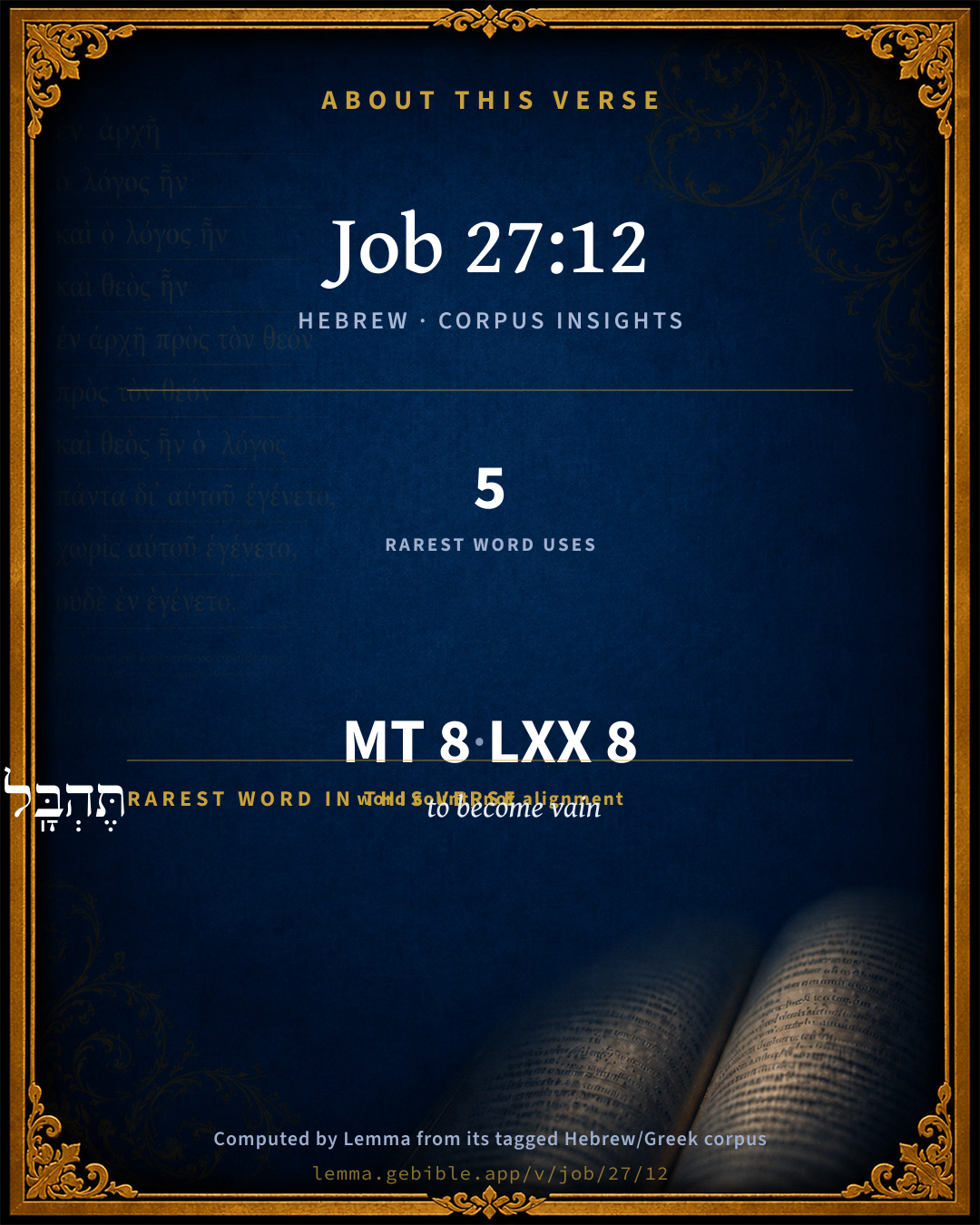
The rarest word here is תֶּהְבָּֽלוּ to become vain H1891 — appearing just 5 times in the whole Hebrew Bible.

Shared distinctive vocabulary

תֶּהְבָּֽלוּ to become vain H1891 occurs in 5 verses of the Hebrew Bible. Also found in:

Grammatical profile

  • 2 verbs
  • 2 nouns
  • 2 pronouns
  • 2 particles

Verb forms

  • חֲזִיתֶ֑ם Qal · Perfect
  • תֶּהְבָּֽלוּ Qal · Imperfect

Hebrew & Septuagint length

In English translation the verse runs 15 words from the Hebrew and 11 from the Septuagint (LXX English) — closely comparable.

A rough comparison of the two English renderings, which tokenize alike — not a word-level alignment.

Word counts can differ between the Hebrew and the Greek without any difference in meaning — e.g. the Hebrew direct-object marker אֵת has no separate Greek word, and Greek often adds the article ὁ.

In the original languages it is 8 Hebrew tokens and 8 Greek tokens — but the two are counted differently (Hebrew bundles its prefixes and suffixes into one token; the Greek is in lemma form), so that isn’t a like-for-like length.

Cross-references

10

Topical passages linked to Job 27:12 in the Treasury of Scripture Knowledge — connected by theme and wording, ordered by reader-vote popularity; previews shown in the World English Bible.

  • Job 16:3 Shall vain words have an end? Or what provokes you that you answer?
  • Job 19:2–3 "How long will you torment me, And crush me with words?
  • Job 21:3 Allow me, and I also will speak; After I have spoken, mock on.
  • Job 6:25–29 How forcible are words of uprightness! But your reproof, what does it reprove?
  • Job 13:4–9 But you are forgers of lies. You are all physicians of no value.
  • Job 17:2 Surely there are mockers with me, My eye dwells on their provocation.
  • Job 21:28–30 For you say, 'Where is the house of the prince? Where is the tent in which the wicked lived?'
  • Job 26:2–4 "How have you helped him who is without power! How have you saved the arm that has no strength!
  • Ecclesiastes 8:14 There is a vanity which is done on the earth, that there are righteous men to whom it happens according to the work of the wicked. Again, there are wicked men to whom it happens according to the work of the righteous. I said that this also is vanity.
  • Ecclesiastes 9:1–3 For all this I laid to my heart, even to explore all this: that the righteous, and the wise, and their works, are in the hand of God; whether it is love or hatred, man doesn't know it; all is before them.

Cross-references courtesy of OpenBible.info (CC BY 4.0).

Hebrew and Greek witnesses Masoretic Hebrew ↔ Greek Septuagint

The same verse in the two great witnesses to the Old Testament, shown verse-for-verse.

These are two independent witnesses, not word-aligned to each other, and the Septuagint is shown in lemma (dictionary) form.

Hebrew Job 27:12 Masoretic · Westminster Leningrad Codex

הֵן אַתֶּ֣ם כֻּלְּכֶ֣ם חֲזִיתֶ֑ם וְלָמָּה זֶּ֝֗ה הֶ֣בֶל תֶּהְבָּֽלוּ

Behold, all of you have seen it yourselves; Why then have you become altogether vain?

World English Bible · Public Domain

Greek LXX Job 27:12 Septuagint · lemma form

ἰδού δή πᾶς οἶδα ὅτι κενός κενός ἐπιβάλλω

Behold, you⌃ all know that you⌃ are adding vanity to vanity.

LXX2012 (modern English Septuagint) · Public Domain

Hebrew: Westminster Leningrad Codex (CC BY 4.0). Greek: Septuagint (public domain); English from LXX2012 (modern English Septuagint) (Public Domain). How the Septuagint differs from the Hebrew →

Commentary

Notes on Job 27:12 from classic Christian and Jewish commentators (each source and its license shown beneath its notes). The classic Christian expositions comment on the surrounding passage and are grouped to its opening verse, so a note may address several verses; the Jewish commentaries on the Tanakh (Rashi and others) are per-verse, so they appear only where the commentator wrote on this verse.

Lemma curates 59 commentaries, every one of them public domain or Creative Commons licensed, each selected and text-cleaned for this edition rather than reprinted as found. About our sources →

Trapp's Complete Commentary

John Trapp

Job 27:12 Behold, all ye yourselves have seen [it]; why then are ye thus altogether vain?

Ver. 12. Behold, all ye yourselves have seen it] And can say as much to it as I can in these sc. that God afflicteth good men as well as bad, &c. Ecce autem cum vos omnes speculationibus (theologicis) operam dederitis, quare tam vanas opiniones habetis? So the Tigurine translation hath it; that is, But behold, whereas all ye have spent your time in theological speculations, how is it that ye have taken up such vain opinions? The Hebrew runs thus, Behold, you all have seen, or are seers (and he that is now called a prophet was before time called a seer, 1Sa 9:9), ye are knowing men, and of great experience, why then do ye go against your own knowledge, by speaking vainly and vilely notwithstanding?

Why then are ye thus altogether vain?] Heb. And why is this that ye are vain in vanity? sc while ye assert that God’s love may be known by prosperity, and his hatred by adversity; and while ye conclude me a hypocrite because afflicted? for so they had all done with one consent. Bildad, Job 8:13; Eliphaz, Job 15:34; and Zophar, Job 20:5. When as yet Job had given sufficient proof to the contrary; the matter was clear enough; but they did, data opera, for the nonce, obscure it: this was a vanity of vanities, and Job tells them as much.

John Trapp, A Commentary or Exposition upon All the Books of the Old and New Testament (1647–1656) — public domain. Text from a community e-Sword module.

Joseph Benson's Commentary

Job 27:12. Ye yourselves have seen it — I speak no false or strange things: but what is known and confirmed by your own experience, and that of others. Why then are ye thus altogether vain? — In maintaining such a foolish and false opinion against your own knowledge and experience?

Why do you so obstinately defend your opinion, and not comply with mine, for the truth of which I appeal to your own consciences?

Joseph Benson's Commentary on the Old and New Testaments (1811–1818) — public domain. Text from a community e-Sword module.

Geneva Bible (1599)

Geneva Bible translators

That is, these secret judgments of God, and yet do not understand them.

Why maintain you then this error?

Geneva Bible (1599) marginal notes — public domain. Text via Bolls.life.

Jamieson, Fausset & Brown

Robert Jamieson, A. R. Fausset & David Brown

"Ye yourselves see" that the wicked often are afflicted (though often the reverse, Job 21:33). But do you "vainly" make this an argument to prove from my afflictions that I am wicked?

Jamieson, Fausset & Brown — Commentary Critical and Explanatory on the Whole Bible (1871) — public domain (CC PDM 1.0). Text via the HelloAO Bible API.

Adam Clarke's Commentary

Verse 12. Ye yourselves have seen it] Your own experience and observation have shown you that the righteous are frequently in affliction, and the wicked in affluence.

Why then are ye thus altogether vain?] The original is very emphatical: הבל תהבלו hebel tehbalu, and well expressed by Mr. Good: "Why then should ye thus babble babblings!" It our language would allow it, we might say vanitize vanity.

Adam Clarke's Commentary on the Bible (1810–1826) — public domain. Text from a community e-Sword/MySword module.

Ellicott's Commentary for English Readers

(12) Behold, all ye yourselves have seen it.—That is, “You have seen me so proclaim the great power of God.”

A Bible Commentary for English Readers, edited by Charles John Ellicott (1878–1897) — public domain. Text from a community e-Sword module.

The Cambridge Bible for Schools and Colleges

gen. ed. J. J. S. Perowne

12. are ye thus altogether vain?] i. e. wherefore do ye cherish and express opinions regarding me so foolish? “Two things are surprising here,” says Dillmann, “first, that Job should undertake to teach the three friends what they had always affirmed; and second, that he should say the opposite of what he had maintained in ch. 21, and 24 of the prosperity of the wicked even to their death.” A third thing might also seem surprising, namely that Job, while now coinciding with his friends in opinion, should reproach them with folly. To appropriate their sentiments and cover the operation by calling them foolish persons was not generous. The connexion, however, of the two clauses in this verse implies that what the three friends had seen of the fate of the wicked (as now to be described by Job , vv13-23) ought to have prevented them from coming to such conclusions regarding Job’s character as they had expressed or insinuated. Obviously to make such a reproach appropriate there must have been a difference clear to the eye between Job’s case and the fate of the wicked. But wherein lay the difference, in Job’s present condition? The three friends might be excused if they did not perceive it. The words do not seem to fit the condition in which Job still remains at the stage of development which the Poem has up to the present reached.

The Cambridge Bible for Schools and Colleges (gen. ed. J. J. S. Perowne; Cambridge University Press, 1878–1918) — public domain. Text from a community e-Sword module.

John Gill's Exposition

This is the portion of a wicked man with God,.... Not to be punished in this life, but after death. This is what Job undertook to teach his friends, and is the purport of what follows in this chapter. A wicked man is not only one that has been so from the womb, and is openly and notoriously a wicked man, but one also that is so secretly, under a mask of sobriety, religion, and godliness, and is an hypocrite, for of such Job speaks in the context; and the portion of such a man is not what he has in this life, which is oftentimes a very affluent one as to the things of this world, but what he has after death, which is banishment from the presence of God, the everlasting portion of his people, a part in the lake which burns with fire and brimstone, the wrath of God to the uttermost, the second death, and a dwelling with devils and wicked men, such as himself, even a portion with hypocrites, which of all is the most dreadful and miserable, Mat 24:51; and this is "with God", is appointed by him; for God has appointed the wicked, the vessels of wrath, fitted by their sins for destruction to the day of evil, to everlasting ruin and destruction; and it is prepared by him for them, as for the devil and his angels, and for them it is reserved among his treasures, even blackness of darkness, damnation, wrath, and vengeance:

and the heritage of oppressors, which they shall receive of the Almighty; these are such who are either oppressors of the poor in their natural and civil rights, taking from or denying to them what of right is their due; or oppressors of the saints in their religious rights and privileges, furious persecutors of them; and who, being powerful, are terrible, as the word signifies: there is an "heritage", or an inheritance for those, which is entailed upon them, and will descend unto them, as the firstborn of their father the devil, as children of disobedience, and so of wrath, and like an inheritance will endure: and this they "shall receive"; it is future, it is wrath to come, and it is certain there is no escaping it; it is their due desert, and they shall receive it; it is in the hands of the almighty God, and he will render it to them, and they shall most assuredly inherit it.

John Gill's Exposition of the Whole Bible (1746–1763) — public domain (CC PDM 1.0). Text via the HelloAO Bible API.

Albert Barnes' Notes on the Bible

Behold, all ye yourselves have seen it - You have had an opportunity of tracing the proofs of the wisdom of God in his works.

Why then are ye thus altogether vain - Why is it that you maintain such opinions - that you evince no more knowledge of his government and plans - that you argue so inconclusively about him and his administration! Why, since you have had an opportunity of observing the course of events, do you maintain that suffering is necessarily a proof of guilt, and that God deals with all people, in this life, according to their character? A close observation of the course of events would have taught you otherwise. Job proceeds to state what he supposes to be the exact truth on the subject, and particularly aims, in the following chapter, to show that the ways of God are inscrutable, and that we cannot be expected to comprehend them, and are not competent to pronounce upon them.

Albert Barnes' Notes on the Bible (1834–1885) — public domain. Text from a community e-Sword/MySword module.

Matthew Poole's English Annotations

I speak no false or strange things, but what is known and confirmed by your own as well as others’ experiences.

Why then are ye thus altogether vain, in maintaining such a foolish and false opinion against your own knowledge and experience? Why do you obstinately defend your opinion, and not comply with mine, for the truth of which I appeal to your own consciences?

Matthew Poole's English Annotations on the Holy Bible (1683–1685) — public domain. Text from a community e-Sword/MySword module.

Whedon's Commentary on the Bible

Daniel D. Whedon

12. Ye yourselves have seen it — The facts he is about to adduce are in keeping with their views. Job has, indeed, several times intimated, what he now expresses, that the prosperity of the wicked is not uninterrupted.

Altogether vain — Literally, Vain in vanity, or vain even to vanity. Their folly partly consisted in making false use of the truth. The words they spoke coined themselves into a corresponding state of the heart, a truth forcibly implied in the verb הבל, “to speak vainly,” (Gesenius,) “to be vain,” (Furst.) “Hollow opinions hollow out the man.” “They followed vanity and became vain.” 2Ki_17:15.

Daniel D. Whedon (gen. ed.), Commentary on the Old and New Testaments (1874–1909) — public domain. Text from a community e-Sword module.

The Pulpit Commentary

Behold, all ye yourselves have seen it. The true Divine scheme of action has been so long and so frequently made manifest openly set forth in the sight o! men that Job cannot believe that those whom he addresses are ignorant of it. They must themselves have seen the scheme at work. Why then are ye thus altogether vain? Why, then, do they not draw true inferences from the facts that come under their notice?

The Pulpit Commentary (1880–1919), ed. H.D.M. Spence-Jones & Joseph S. Exell — public domain. Text from a community e-Sword module.

John Wesley's Explanatory Notes

Have seen - I speak what is confirmed by your own, as well as others experiences. Vain - To condemn me for a wicked man, because I am afflicted.

John Wesley, Explanatory Notes Upon the Whole Bible (1754–1765) — public domain. Text via the GEBible commentary corpus.

Rashi

Rabbi Shlomo Yitzchaki (Rashi)

all of you have seen that this is the portion of a wicked man.

now why do you become altogether vain? To be wicked and hypocritical.

Rashi on the Tanakh — English translations: “The Judaica Press complete Tanach with Rashi, translated by A. J. Rosenberg” (CC BY 4.0); “Pentateuch with Rashi's commentary by M. Rosenbaum and A.M. Silbermann, 1929-1934” (public domain); “The Metsudah Tanach series, Lakewood, N.J” (CC BY 4.0); and “The Book of Joshua, Metsudah Publications, 1997” (CC BY 4.0). Text via Sefaria.

Lesson kit

Teaching starters — assembled from the data on this page, not authored interpretation. Every prompt links to the verse data it draws on. Edit before teaching.

Job, in the Wisdom, opens this verse with 8 words (8 distinct Hebrew lemmas). Its most distinctive word is hâbal (“to become vain”). A historical commentator’s framing appears above. Read the whole chapter for the surrounding context.

Discussion questions

  1. The word hâbal carries the sense “to become vain.” How does it shape the verse?
  2. How does 2 Kings 17:15, which shares the word «to become vain», read alongside this verse?
  3. These translations render this verse differently; the difference is in the English rendering, not the original. What questions does that raise?
  4. «חֲזִיתֶ֑ם» is a Qal Perfect verb. How does that grammatical form shape the action described?
  5. Compare how Trapp's Complete Commentary and Joseph Benson's Commentary read this verse. Where do they agree or differ?

Things to notice

Reading settings

Reading text

Shown beneath each verse's original-language words.

Old Testament
Old Testament edition

Read the OT as the Masoretic Hebrew (MT) or the Greek Septuagint (LXX).

English shown for the Greek Septuagint (in the Hebrew ↔ Greek comparison).

Comparing translations? Open the Compare panel on any verse page to stack up to four side by side.