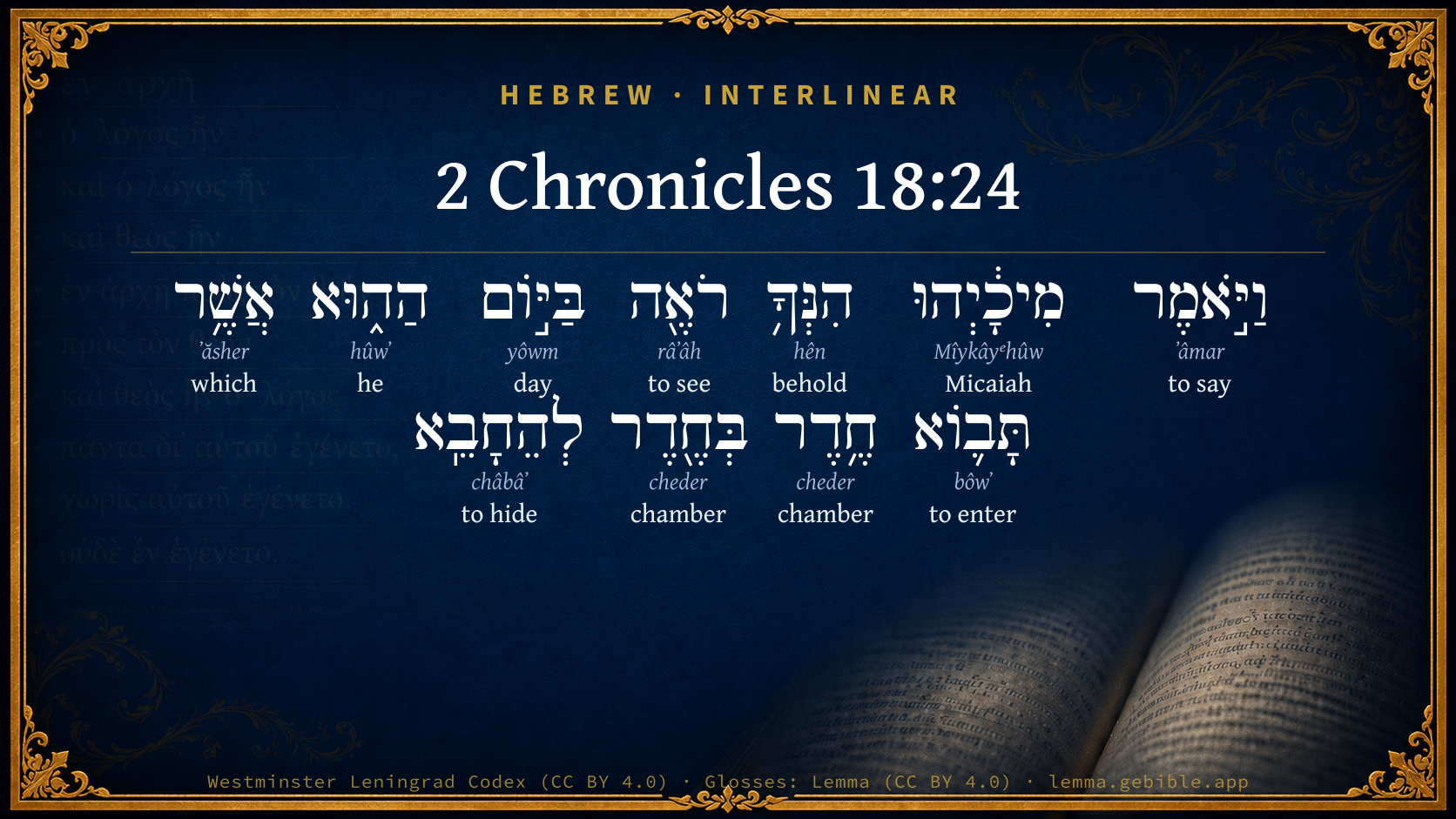
2 Chronicles 18:24

Hebrew (Westminster Leningrad Codex) 2 Chronicles 18:24 appears in the Hebrew Old Testament. The text above is from the Westminster Leningrad Codex. Each word links to its Strong’s number, a concise gloss, and parsing drawn from the Open Scriptures Hebrew Bible morphology. Click any word for its full Brown-Driver-Briggs (BDB) entry.
Download image
Cite this verse

2 Chronicles 18:24 (World English Bible). Public Domain. Lemma interlinear Bible study tool, https://lemma.gebible.app/v/2-chronicles/18/24.

Show BibTeX & RIS
BibTeX
RIS
English Translation
Micaiah said, Behold, you shall see on that day, when you shall go into an inner chamber to hide yourself.
World English Bible · Public Domain
Download a study sheet

One document with this verse’s original text, its word-by-word gloss line, the meaning frame, cross-references with their text, attributed commentary, and full source and license credits — printable, and it pastes into notes with its structure intact.

This verse Autodidact and up

Study sheet (.html) Plain text (.txt)

A passage Seminary Student

Up to 50 verses in one chapter. A passage sheet keeps up to 6 commentary sources and 12 cross-references per verse, in the order this page ranks them, and says so on the sheet whenever that leaves anything out. Ask for a single verse and you get the Autodidact verse sheet above.

Everything on this page stays free to read, with no account — the sheet is a download of what is already on screen, not access to it.

Want to remove ads? Support Godless Engineer
Compare translations 3

The same verse in 3 English versions, stacked beneath the original-language interlinear above. Click any original word for its lexicon entry.

Each is an independent rendering of the whole verse — the interlinear is not word-aligned to these translations.

Highlighted words mark where these versions differ — a whole-verse word diff, not a word-by-word alignment.

  • World English Bible Public Domain
    Micaiah said, Behold, you shall see on that day, when you shall go into an inner chamber to hide yourself.
  • King James Version Public Domain
    And Micaiah said, Behold, thou shalt see on that day when thou shalt go into an inner chamber to hide thyself.
  • unfoldingWord Literal Text CC BY-SA 4.0
    And Micaiah said, “Behold, you will see on that day, when you go chamber by chamber to hide yourself.”

unfoldingWord Literal Text — © unfoldingWord, licensed CC BY-SA 4.0. Word-aligned USFM3 via Door43 (git.door43.org/unfoldingWord/en_ult).

Versions to compare (up to 4)

3 of 4 selected

Show all 18 translations

Every available English version of this verse, each an independent rendering of the whole verse.

  • World English Bible Public Domain
    Micaiah said, Behold, you shall see on that day, when you shall go into an inner chamber to hide yourself.
  • Berean Standard Bible Public Domain
    Micaiah replied, “You will soon see, on that day when you go and hide in an inner room.”
  • Majority Standard Bible Public Domain
    Micaiah replied, “You will soon see, on that day when you go and hide in an inner room.”
  • King James Version Public Domain
    And Micaiah said, Behold, thou shalt see on that day when thou shalt go into an inner chamber to hide thyself.
  • American Standard Version (1901) Public Domain
    And Micaiah said, Behold, thou shalt see on that day, when thou shalt go into an inner chamber to hide thyself.
  • Revised Version (1885) Public Domain
    And Micaiah said, Behold, thou shalt see on that day, when thou shalt go into an inner chamber to hide thyself.
  • Geneva Bible (1599) Public Domain
    And Michaiah saide, Behold, thou shalt see that day when thou shalt goe from chamber to chamber to hide thee.
  • Douay-Rheims (1899) Public Domain
    And Micheas said:Thou thyself shalt see in that day, when thou shalt go in from chamber to chamber, to hide thyself.
  • Young's Literal Translation Public Domain
    And Micaiah saith, `Lo, thou dost see in that day, that thou dost enter into the innermost chamber to be hidden.'
  • Literal Standard Version CC BY-SA 4.0
    And Micaiah says, “Behold, you see in that day that you enter into the innermost chamber to be hidden.”
  • Unlocked Literal Bible CC BY-SA 4.0
    Micaiah said, “Look, you will know that on that day, when you run into some inner room to hide.”
  • unfoldingWord Literal Text CC BY-SA 4.0
    And Micaiah said, “Behold, you will see on that day, when you go chamber by chamber to hide yourself.”
  • Darby Bible Public Domain
    And Micah said, Behold, thou shalt see on that day when thou shalt go from chamber to chamber to hide thyself.
  • World Messianic Bible Public Domain
    Micaiah said, “Behold, you shall see on that day, when you go into an inner room to hide yourself.”
  • Webster's Bible Public Domain
    And Micaiah said, Behold, thou shalt see on that day when thou shalt go into an inner chamber to hide thyself.
  • Free Bible Version CC BY-SA 4.0
    “You'll soon find out when you try and find some secret place to hide!” Micaiah replied.
  • Bible in Basic English Public Domain
    And Micaiah said, Truly, you will see on that day when you go into an inner room to keep yourself safe.
  • JPS Tanakh (1917) Public Domain
    And Micaiah said: 'Behold, thou shalt see on that day, when thou shalt go into an inner chamber to hide thyself.'

Literal Standard Version (2020), Covenant Press — licensed CC BY-SA 4.0. Text via the HelloAO Bible API (eBible.org). Unlocked Literal Bible (unfoldingWord) — licensed CC BY-SA 4.0. Text via the HelloAO Bible API (eBible.org). unfoldingWord Literal Text — © unfoldingWord, licensed CC BY-SA 4.0. Word-aligned USFM3 via Door43 (git.door43.org/unfoldingWord/en_ult). Free Bible Version, Dr. Jonathan Gallagher — licensed CC BY-SA 4.0. Text via the HelloAO Bible API (eBible.org).

Word by word

More ways to search: Search by grammar → Find every occurrence → Compare this word →

Practice this passage: Drill this verse → Learn its vocabulary →

מִיכָ֔יְהוּ
Mîykâyᵉhûw
H4321
“Micaiah”
Noun, Proper
Part of Speech
Noun
Type
Proper
Full BDB Definition

Origin: abbrev. for H4322

TWOT: None

Micah or Micaiah or Michaiah = "who is like God" - an Ephraimite during the period of the judges - son of Imlah and a prophet of Samaria who predicted the defeat and death of king Ahab of Israel - son of Gemariah in the time of Jeremiah
  1. וַיֹּ֣אמֶר ʼâmar H559 “and · to say” Conjunction + Verb, Qal, Sequential Imperfect, 3rd Person, Masculine, Singular
  2. הִנְּךָ֥ hên H2005 “behold · you” Particle, Demonstrative + Suffix, Personal, 2nd Person, Masculine, Singular
  3. רֹאֶ֖ה râʼâh H7200 “seeing” Verb, Qal, Participle Active, Masculine, Singular, Absolute
  4. בַּיּ֣וֹם yôwm H3117 “in/at the · day” Preposition, Determined + Noun, Common, Masculine, Singular, Absolute
  5. הַה֑וּא hûwʼ H1931 “the · he” Particle, Definite Article + Pronoun, Personal, 3rd Person, Masculine, Singular
  6. אֲשֶׁ֥ר ʼăsher H834 “which” Particle, Relative
  7. תָּב֛וֹא bôwʼ H935 “to enter” Verb, Qal, Imperfect, 2nd Person, Masculine, Singular
  8. חֶ֥דֶר cheder H2315 “chamber” Noun, Common, Masculine, Singular, Absolute
  9. בְּחֶ֖דֶר cheder H2315 “in/at · chamber” Preposition + Noun, Common, Masculine, Singular, Absolute
  10. לְהֵחָבֵֽא châbâʼ H2244 “to hide” Preposition + Verb, Niphal, Infinitive Construct

About this verse

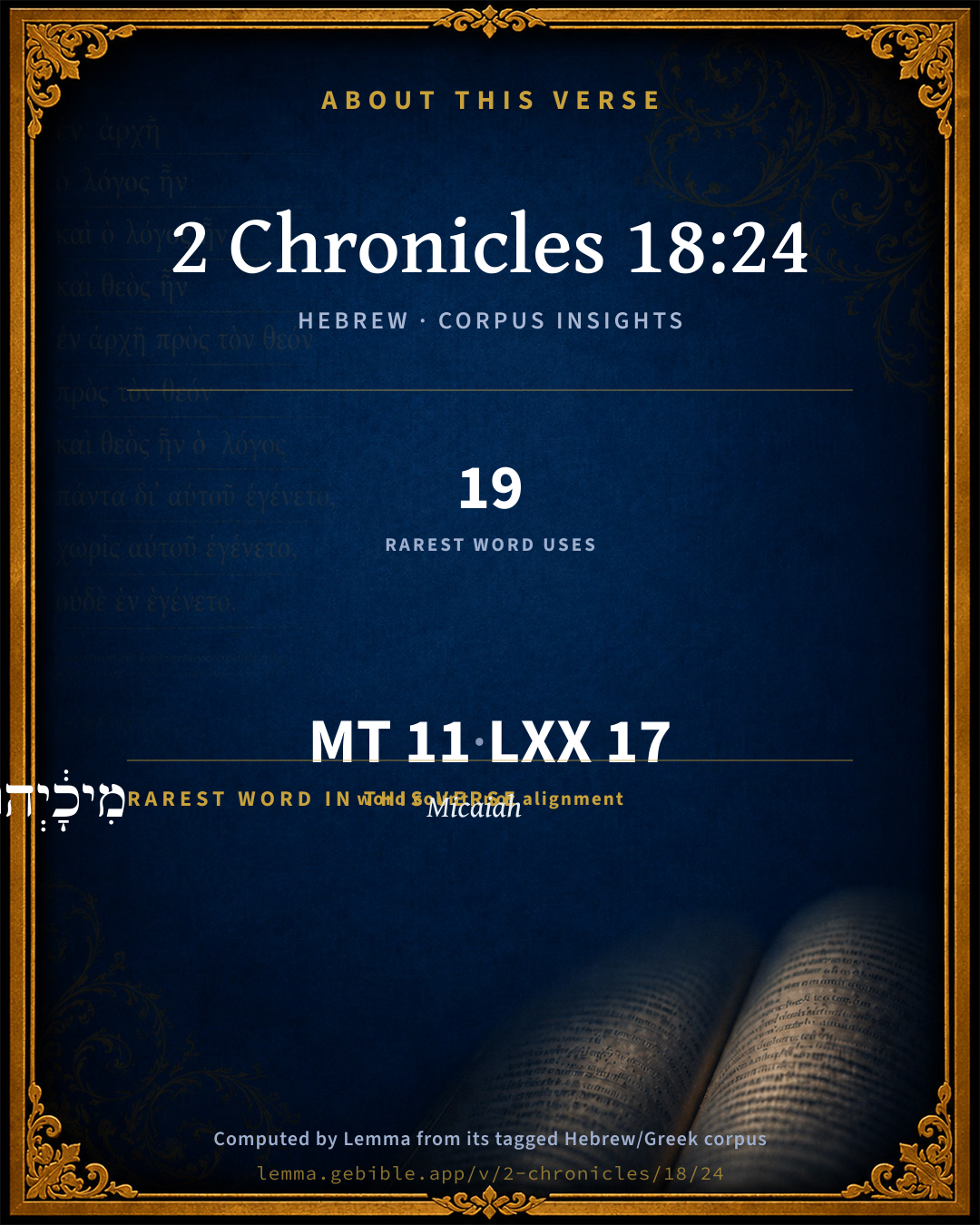
These counts appear in no published source. They are computed here, from the morphology-tagged text and Lemma’s own curated glosses. What Lemma adds →

11
words
10
distinct lemmas
Historical
section

Notable vocabulary

The rarest word here is מִיכָ֔יְהוּ Micaiah H4321 — appearing just 19 times in the whole Hebrew Bible.

Shared distinctive vocabulary

מִיכָ֔יְהוּ Micaiah H4321 occurs in 19 verses of the Hebrew Bible. Also found in:

Grammatical profile

  • 4 verbs
  • 4 nouns
  • 1 pronoun
  • 2 particles

Verb forms

  • וַיֹּ֣אמֶר Qal · Sequential Imperfect
  • רֹאֶ֖ה Qal · Participle Active
  • תָּב֛וֹא Qal · Imperfect
  • לְהֵחָבֵֽא Niphal · Infinitive Construct

Repetition

A word recurs within this verse — often emphatic in Hebrew:

  • חֶ֥דֶר chamber H2315 ×2

Hebrew & Septuagint length

In English translation the verse runs 20 words from the Hebrew and 21 from the Septuagint (LXX English) — closely comparable.

A rough comparison of the two English renderings, which tokenize alike — not a word-level alignment.

Word counts can differ between the Hebrew and the Greek without any difference in meaning — e.g. the Hebrew direct-object marker אֵת has no separate Greek word, and Greek often adds the article ὁ.

In the original languages it is 11 Hebrew tokens and 17 Greek tokens — but the two are counted differently (Hebrew bundles its prefixes and suffixes into one token; the Greek is in lemma form), so that isn’t a like-for-like length.

Cross-references

6

Topical passages linked to 2 Chronicles 18:24 in the Treasury of Scripture Knowledge — connected by theme and wording, ordered by reader-vote popularity; previews shown in the World English Bible.

  • 1 Kings 20:30 But the rest fled to Aphek, into the city; and the wall fell on twenty-seven thousand men who were left. Ben Hadad fled, and came into the city, into an inner chamber.
  • Isaiah 26:11 Yahweh, your hand is lifted up, yet they don't see: but they shall see [your] zeal for the people, and be disappointed; yes, fire shall devour your adversaries.
  • Isaiah 26:20 Come, my people, enter you into your chambers, and shut your doors about you: hide yourself for a little moment, until the indignation be past.
  • Jeremiah 28:16–17 Therefore thus says Yahweh, Behold, I will send you away from off the surface of the earth: this year you shall die, because you have spoken rebellion against Yahweh.
  • Jeremiah 29:21–22 Thus says Yahweh of Hosts, the God of Israel, concerning Ahab the son of Kolaiah, and concerning Zedekiah the son of Maaseiah, who prophesy a lie to you in my name: Behold, I will deliver them into the hand of Nebuchadrezzar king of Babylon; and he shall kill them before your eyes;
  • Jeremiah 29:32 therefore thus says Yahweh, Behold, I will punish Shemaiah the Nehelamite, and his seed; he shall not have a man to dwell among this people, neither shall he see the good that I will do to my people, says Yahweh, because he has spoken rebellion against Yahweh.

Cross-references courtesy of OpenBible.info (CC BY 4.0).

Hebrew and Greek witnesses Masoretic Hebrew ↔ Greek Septuagint

The same verse in the two great witnesses to the Old Testament, shown verse-for-verse.

These are two independent witnesses, not word-aligned to each other, and the Septuagint is shown in lemma (dictionary) form.

Hebrew 2 Chronicles 18:24 Masoretic · Westminster Leningrad Codex

וַיֹּ֣אמֶר מִיכָ֔יְהוּ הִנְּךָ֥ רֹאֶ֖ה בַּיּ֣וֹם הַה֑וּא אֲשֶׁ֥ר תָּב֛וֹא חֶ֥דֶר בְּחֶ֖דֶר לְהֵחָבֵֽא

Micaiah said, Behold, you shall see on that day, when you shall go into an inner chamber to hide yourself.

World English Bible · Public Domain

Greek LXX 2 Chronicles 18:24 Septuagint · lemma form

καί εἶπον μιχαιας ἰδού ὁράω ἐν ὁ ἡμέρα ἐκεῖνος ἐν ὅς εἰςἔρχομαι ταμιεῖον ἐκ ταμιεῖον ὁ κατακρύπτω

And Michaias said, Behold, you shall see in that day, when you shall go from chamber to chamber to hide yourself.

LXX2012 (modern English Septuagint) · Public Domain

Hebrew: Westminster Leningrad Codex (CC BY 4.0). Greek: Septuagint (public domain); English from LXX2012 (modern English Septuagint) (Public Domain). How the Septuagint differs from the Hebrew →

Commentary

Notes on 2 Chronicles 18:24 from classic Christian and Jewish commentators (each source and its license shown beneath its notes). The classic Christian expositions comment on the surrounding passage and are grouped to its opening verse, so a note may address several verses; the Jewish commentaries on the Tanakh (Rashi and others) are per-verse, so they appear only where the commentator wrote on this verse.

Lemma curates 59 commentaries, every one of them public domain or Creative Commons licensed, each selected and text-cleaned for this edition rather than reprinted as found. About our sources →

Ellicott's Commentary for English Readers

(24) Thou shalt see.—Thou art to see, or, destined to see, on that day when thou shalt enter a chamber in a chamber to hide thyself (lĕhçchâbçh”, correctly. Kings, lĕhçchâbçh). Zedekiah’s further history is not recorded—an indication, as Ewald justly observes, that the original narrative contained much more than the present extract from it.

A Bible Commentary for English Readers, edited by Charles John Ellicott (1878–1897) — public domain. Text from a community e-Sword module.

The Cambridge Bible for Schools and Colleges

gen. ed. J. J. S. Perowne

24. Behold, thou shalt see] Micaiah answers Zedekiah’s gibe with the verb “see” (rather than “know”) because of its double meaning, “Behold, thou shalt be a seer, thou shalt possess the power of vision” when it is too late.

go into an inner chamber] “Seek safety in hiding from enemies”; cp. 1Ki_20:30 (same Heb. phrase).

The Cambridge Bible for Schools and Colleges (gen. ed. J. J. S. Perowne; Cambridge University Press, 1878–1918) — public domain. Text from a community e-Sword module.

The Pulpit Commentary

So also, probably, this verse would purport to tell us beforehand distinctly what is not told after the issue of the battle and Ahab"s death, that Zedekiah and his co-prophets did what they could, however vainly, to hide and to elude the vengeance of Jezebel (1Ki_20:30 1Ki_22:25; 2Ki_9:2)

The Pulpit Commentary (1880–1919), ed. H.D.M. Spence-Jones & Joseph S. Exell — public domain. Text from a community e-Sword module.

Rashi

Rabbi Shlomo Yitzchaki (Rashi)

Behold you will see that Ahab will be killed.

Rashi on the Tanakh — English translations: “The Judaica Press complete Tanach with Rashi, translated by A. J. Rosenberg” (CC BY 4.0); “Pentateuch with Rashi's commentary by M. Rosenbaum and A.M. Silbermann, 1929-1934” (public domain); “The Metsudah Tanach series, Lakewood, N.J” (CC BY 4.0); and “The Book of Joshua, Metsudah Publications, 1997” (CC BY 4.0). Text via Sefaria.

Lesson kit

Teaching starters — assembled from the data on this page, not authored interpretation. Every prompt links to the verse data it draws on. Edit before teaching.

2 Chronicles, in the Historical, opens this verse with 11 words (10 distinct Hebrew lemmas). Its most distinctive word is Mîykâyᵉhûw (“Micaiah”). A historical commentator’s framing appears above. Read the whole chapter for the surrounding context.

Discussion questions

  1. What does “Micaiah” (Mîykâyᵉhûw) contribute to the verse as a whole?
  2. How does 1 Kings 22:8, which shares the word «Micaiah», read alongside this verse?
  3. What does the repetition of “chamber” (2× in this one verse) do in this verse?
  4. These translations render this verse differently; the difference is in the English rendering, not the original. What questions does that raise?
  5. «וַיֹּ֣אמֶר» is a Qal Sequential Imperfect verb. How does that grammatical form shape the action described?
  6. Compare how Ellicott's Commentary for English Readers and The Cambridge Bible for Schools and Colleges read this verse. Where do they agree or differ?

Things to notice

Reading settings

Reading text

Shown beneath each verse's original-language words.

Old Testament
Old Testament edition

Read the OT as the Masoretic Hebrew (MT) or the Greek Septuagint (LXX).

English shown for the Greek Septuagint (in the Hebrew ↔ Greek comparison).

Comparing translations? Open the Compare panel on any verse page to stack up to four side by side.