
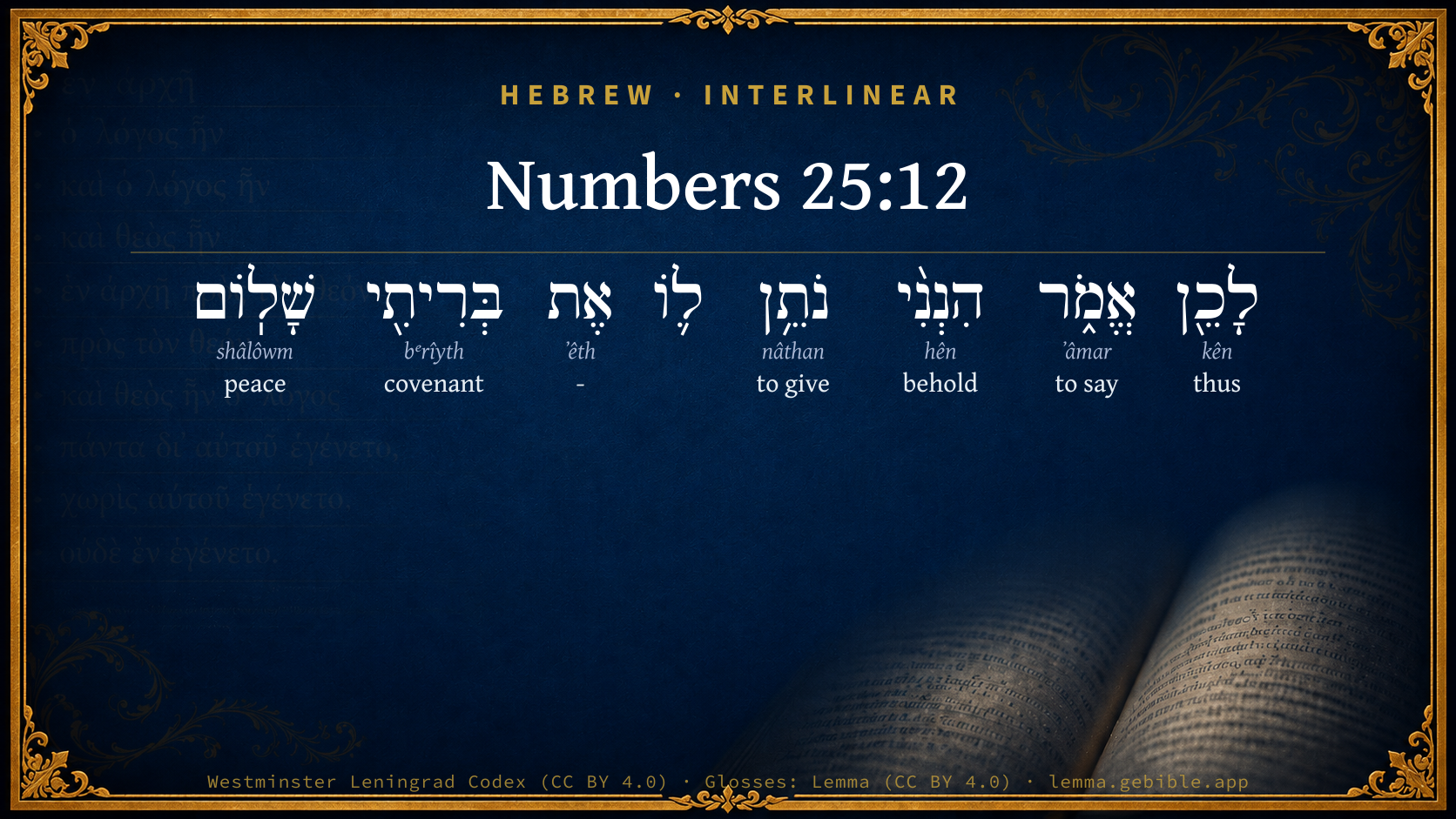
Numbers 25:12

Hebrew (Westminster Leningrad Codex) Numbers 25:12 appears in the Hebrew Old Testament. The text above is from the Westminster Leningrad Codex. Each word links to its Strong’s number, a concise gloss, and parsing drawn from the Open Scriptures Hebrew Bible morphology. Click any word for its full Brown-Driver-Briggs (BDB) entry.
Download image
Cite this verse

Numbers 25:12 (World English Bible). Public Domain. Lemma interlinear Bible study tool, https://lemma.gebible.app/v/numbers/25/12.

Show BibTeX & RIS
BibTeX
RIS
English Translation
Therefore say, Behold, I give to him my covenant of peace:
World English Bible · Public Domain
Download a study sheet

One document with this verse’s original text, its word-by-word gloss line, the meaning frame, cross-references with their text, attributed commentary, and full source and license credits — printable, and it pastes into notes with its structure intact.

This verse Autodidact and up

Study sheet (.html) Plain text (.txt)

A passage Seminary Student

Up to 50 verses in one chapter. A passage sheet keeps up to 6 commentary sources and 12 cross-references per verse, in the order this page ranks them, and says so on the sheet whenever that leaves anything out. Ask for a single verse and you get the Autodidact verse sheet above.

Everything on this page stays free to read, with no account — the sheet is a download of what is already on screen, not access to it.

Want to remove ads? Support Godless Engineer
Compare translations 3

The same verse in 3 English versions, stacked beneath the original-language interlinear above. Click any original word for its lexicon entry.

Each is an independent rendering of the whole verse — the interlinear is not word-aligned to these translations.

Highlighted words mark where these versions differ — a whole-verse word diff, not a word-by-word alignment.

  • World English Bible Public Domain
    Therefore say, Behold, I give to him my covenant of peace:
  • King James Version Public Domain
    Wherefore say, Behold, I give unto him my covenant of peace:
  • unfoldingWord Literal Text CC BY-SA 4.0
    Therefore say, ‘Behold, I am giving to him my covenant of peace.

unfoldingWord Literal Text — © unfoldingWord, licensed CC BY-SA 4.0. Word-aligned USFM3 via Door43 (git.door43.org/unfoldingWord/en_ult).

Versions to compare (up to 4)

3 of 4 selected

Show all 18 translations

Every available English version of this verse, each an independent rendering of the whole verse.

  • World English Bible Public Domain
    Therefore say, Behold, I give to him my covenant of peace:
  • Berean Standard Bible Public Domain
    Declare, therefore, that I am granting him My covenant of peace.
  • Majority Standard Bible Public Domain
    Declare, therefore, that I am granting him My covenant of peace.
  • King James Version Public Domain
    Wherefore say, Behold, I give unto him my covenant of peace:
  • American Standard Version (1901) Public Domain
    Wherefore say, Behold, I give unto him my covenant of peace:
  • Revised Version (1885) Public Domain
    Wherefore say, Behold, I give unto him my covenant of peace:
  • Geneva Bible (1599) Public Domain
    Wherefore say to him, Beholde, I giue vnto him my couenant of peace,
  • Douay-Rheims (1899) Public Domain
    Therefore say to him: Behold I give him the peace of my covenant,
  • Young's Literal Translation Public Domain
    `Therefore say, Lo, I am giving to him My covenant of peace,
  • Literal Standard Version CC BY-SA 4.0
    Therefore say, Behold, I am giving My covenant of peace to him,
  • Unlocked Literal Bible CC BY-SA 4.0
    Therefore say, 'Yahweh says, “Look, I am giving to Phinehas my covenant of peace.
  • unfoldingWord Literal Text CC BY-SA 4.0
    Therefore say, ‘Behold, I am giving to him my covenant of peace.
  • Darby Bible Public Domain
    Therefore say, Behold, I give unto him my covenant of peace!
  • World Messianic Bible Public Domain
    Therefore say, ‘Behold, I give to him my covenant of peace.
  • Webster's Bible Public Domain
    Wherefore say, Behold, I give to him my covenant of peace.
  • Free Bible Version CC BY-SA 4.0
    So make an announcement that I am granting him my peace agreement.
  • Bible in Basic English Public Domain
    So say to them that I will make with him an agreement of peace:
  • JPS Tanakh (1917) Public Domain
    Wherefore say: Behold, I give unto him My covenant of peace;

Literal Standard Version (2020), Covenant Press — licensed CC BY-SA 4.0. Text via the HelloAO Bible API (eBible.org). Unlocked Literal Bible (unfoldingWord) — licensed CC BY-SA 4.0. Text via the HelloAO Bible API (eBible.org). unfoldingWord Literal Text — © unfoldingWord, licensed CC BY-SA 4.0. Word-aligned USFM3 via Door43 (git.door43.org/unfoldingWord/en_ult). Free Bible Version, Dr. Jonathan Gallagher — licensed CC BY-SA 4.0. Text via the HelloAO Bible API (eBible.org).

Word by word

More ways to search: Search by grammar → Find every occurrence → Compare this word →

Practice this passage: Drill this verse → Learn its vocabulary →

שָׁלֽוֹם
shâlôwm
H7965
“peace”
Noun, Common, Masculine, Singular, Absolute
Part of Speech
Noun
Type
Common
Gender
Masculine
Number
Singular
State
Absolute
Full BDB Definition

Origin: from H7999

TWOT: 2401a

completeness, soundness, welfare, peace - completeness (in number) - safety, soundness (in body) - welfare, health, prosperity - peace, quiet, tranquillity, contentment - peace, friendship - of human relationships - with God especially in covenant relationship - peace (from war) - peace (as adjective)
  1. לָכֵ֖ן kên H3651 “to/for · thus” Preposition + Adverb
  2. אֱמֹ֑ר ʼâmar H559 “say” Verb, Qal, Imperative, 2nd Person, Masculine, Singular
  3. הִנְנִ֨י hên H2005 “behold · me” Particle, Interjection + Suffix, Personal, 1st Person, Common, Singular
  4. נֹתֵ֥ן nâthan H5414 “giving” Verb, Qal, Participle Active, Masculine, Singular, Absolute
  5. אֶת ʼêth H853 “-” Particle, Direct Object
  6. בְּרִיתִ֖י bᵉrîyth H1285 “covenant · my” Noun, Common, Feminine, Singular, Construct + Suffix, Personal, 1st Person, Common, Singular

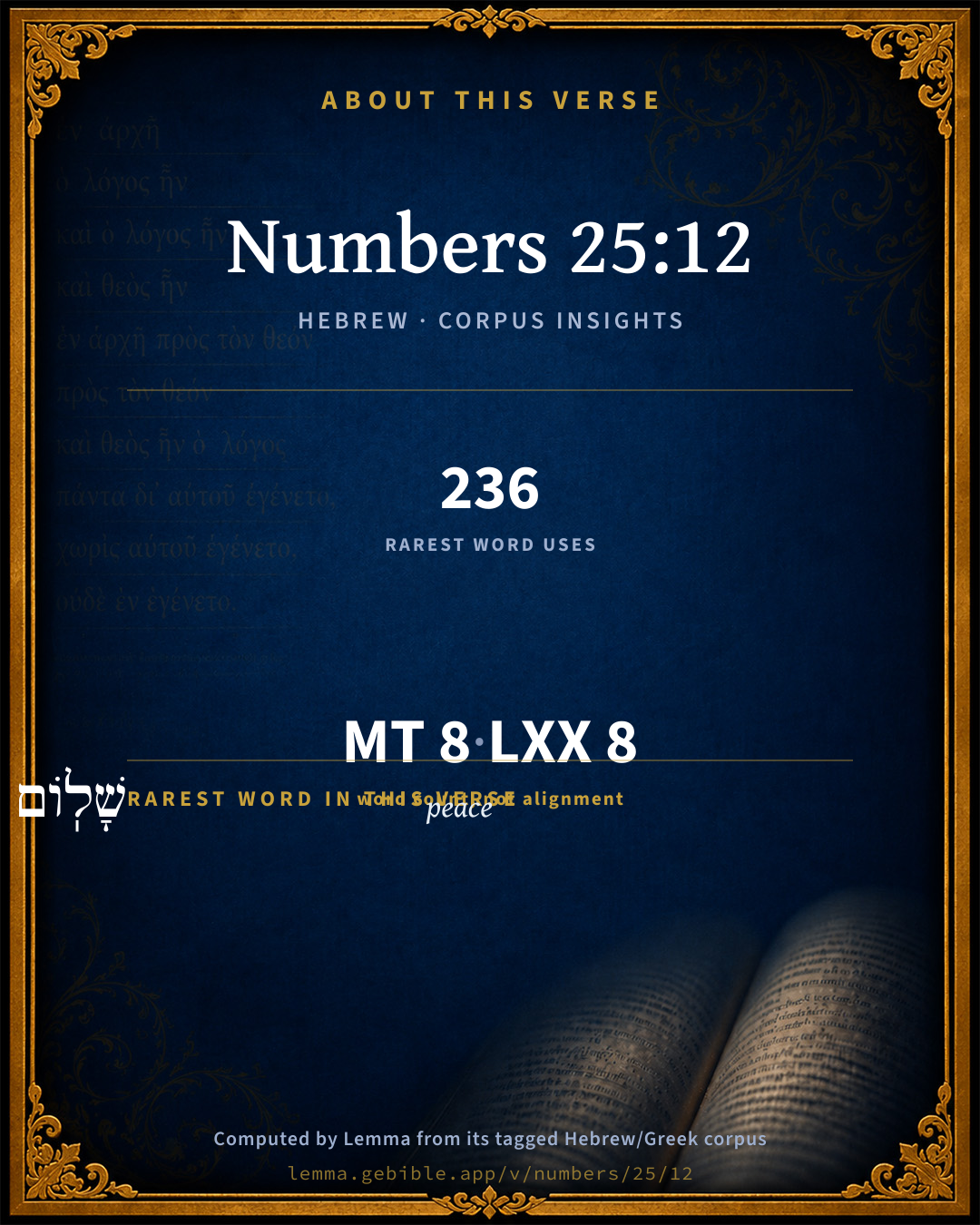
About this verse

These counts appear in no published source. They are computed here, from the morphology-tagged text and Lemma’s own curated glosses. What Lemma adds →

8
words
7
distinct lemmas
Pentateuch
section

Grammatical profile

  • 2 verbs
  • 2 nouns
  • 1 preposition
  • 1 adverb
  • 2 particles

Verb forms

  • אֱמֹ֑ר Qal · Imperative
  • נֹתֵ֥ן Qal · Participle Active

Hebrew & Septuagint length

In English translation the verse runs 11 words from the Hebrew and 14 from the Septuagint (LXX English) — closely comparable.

A rough comparison of the two English renderings, which tokenize alike — not a word-level alignment.

Word counts can differ between the Hebrew and the Greek without any difference in meaning — e.g. the Hebrew direct-object marker אֵת has no separate Greek word, and Greek often adds the article ὁ.

In the original languages it is 8 Hebrew tokens and 8 Greek tokens — but the two are counted differently (Hebrew bundles its prefixes and suffixes into one token; the Greek is in lemma form), so that isn’t a like-for-like length.

Cross-references

5

Topical passages linked to Numbers 25:12 in the Treasury of Scripture Knowledge — connected by theme and wording, ordered by reader-vote popularity; previews shown in the World English Bible.

  • Malachi 2:4–5 You will know that I have sent this commandment to you, that my covenant may be with Levi," says Yahweh of Hosts.
  • Isaiah 54:10 For the mountains may depart, and the hills be removed; but my loving kindness shall not depart from you, neither shall my covenant of peace be removed, says Yahweh who has mercy on you.
  • Malachi 3:1 "Behold, I send my messenger, and he will prepare the way before me; and the Lord, whom you seek, will suddenly come to his temple; and the messenger of the covenant, whom you desire, behold, he comes!" says Yahweh of hosts.
  • Numbers 13:29 Amalek dwells in the land of the South: and the Hittite, and the Jebusite, and the Amorite, dwell in the hill-country; and the Canaanite dwells by the sea, and along by the side of the Jordan.
  • Ezekiel 34:25 I will make with them a covenant of peace, and will cause evil animals to cease out of the land; and they shall dwell securely in the wilderness, and sleep in the woods.

Cross-references courtesy of OpenBible.info (CC BY 4.0).

Hebrew and Greek witnesses Masoretic Hebrew ↔ Greek Septuagint

The same verse in the two great witnesses to the Old Testament, shown verse-for-verse.

These are two independent witnesses, not word-aligned to each other, and the Septuagint is shown in lemma (dictionary) form.

Hebrew Numbers 25:12 Masoretic · Westminster Leningrad Codex

לָכֵ֖ן אֱמֹ֑ר הִנְנִ֨י נֹתֵ֥ן ל֛וֹ אֶת בְּרִיתִ֖י שָׁלֽוֹם

Therefore say, Behold, I give to him my covenant of peace:

World English Bible · Public Domain

Greek LXX Numbers 25:12 Septuagint · lemma form

οὕτως εἶπον ἰδού ἐγώ δίδωμι αὐτός διαθήκη εἰρήνη

Thus do you say to him, Behold, I give him a covenant of peace:

LXX2012 (modern English Septuagint) · Public Domain

Hebrew: Westminster Leningrad Codex (CC BY 4.0). Greek: Septuagint (public domain); English from LXX2012 (modern English Septuagint) (Public Domain). How the Septuagint differs from the Hebrew →

Targum (Aramaic paraphrase)

2

The Targum is the ancient Jewish Aramaic paraphrase of the Hebrew Scriptures — an interpretive translation, not the Hebrew text itself. Onkelos (literal) and Pseudo-Jonathan (expansive) render the Torah, and Jonathan the Prophets. Coverage is partial: where no permissively-licensed English translation exists for a verse, only the Aramaic is shown. This is verse-level text, not a word-by-word alignment to the Hebrew.

  1. Targum Onkelos Torah (Genesis–Deuteronomy)
    בְּכֵן אֵימַר הָא אֲנָא גְזַר לֵיהּ יַת קְיָמִי שְׁלָם

    (no public-domain English translation for this verse)

    Targum Onkelos — Aramaic: “Onkelos Genesis” (public domain); “Onkelos Exodus” (public domain); “Onkelos Leviticus” (public domain); “Onkelos Numbers” (public domain); “Onkelos Deuteronomy” (public domain). English: “Sefaria Community Translation” (CC0 1.0 (public-domain dedication)); “J.W. Etheridge. The Targums of Onkelos and Jonathan Ben Uzziel on the Pentateuch. London: Longmans, Green, 1862” (public domain). Text via Sefaria.

  2. Targum Pseudo-Jonathan Torah (Genesis–Deuteronomy)
    בִּשְׁבוּעָא אֵימַר לֵיהּ מִן שְׁמִי הָאֲנָא גָזַר לֵיהּ יַת קְיָמִי שְׁלַם וְאַעְבְּדִינֵיהּ מַלְאָךְ קְיַים וְיֵיחֵי לְעַלְמָא לִמְבַשְרָא גְאוּלְתָּא בְּסוֹף יוֹמַיָא

    Swearing by My Name, I say to him, Behold, I decree to him My covenant of peace, and will make him an angel of the covenant, that he may ever live, to announce the Redemption at the end of the days.

    Targum Pseudo-Jonathan — Aramaic: “Targum Jonathan on Genesis” (public domain); “Targum Jonathan on Exodus” (public domain); “Targum Jonathan on Leviticus” (public domain); “Targum Jonathan on Numbers” (public domain); “Targum Jonathan on Deuteronomy” (public domain). English: “The Targum of Jonathan ben Uzziel, trans. J. W. Etheridge, London, 1862” (public domain). Text via Sefaria.

Commentary

Notes on Numbers 25:12 from classic Christian and Jewish commentators (each source and its license shown beneath its notes). The classic Christian expositions comment on the surrounding passage and are grouped to its opening verse, so a note may address several verses; the Jewish commentaries on the Tanakh (Rashi and others) are per-verse, so they appear only where the commentator wrote on this verse.

Lemma curates 59 commentaries, every one of them public domain or Creative Commons licensed, each selected and text-cleaned for this edition rather than reprinted as found. About our sources →

Joseph Benson's Commentary

Num 25:12. My covenant of peace — That is, the covenant of an everlasting priesthood, as it is expounded Num 25:13, which is called a covenant of peace, partly with respect to the happy effect of this heroical action of his, whereby he made peace between God and his people, and partly with regard to the principal end of the priestly office, which was constantly to do that which Phinehas now did, even to mediate between God and men, in order to their peace and reconciliation with him, by offering up sacrifices and prayers to God on their behalf; as also by turning them away from iniquity, which is the only peace-breaker; and by teaching and pressing upon them the observation of that law, which is the only bond of their peace.

Joseph Benson's Commentary on the Old and New Testaments (1811–1818) — public domain. Text from a community e-Sword module.

Adam Clarke's Commentary

Verse 12. - 13. My covenant of peace - of an everlasting priesthood] As the word peace implied all kinds of blessings, both spiritual and temporal, it may mean no more here than the promise of God, to grant him and his family the utmost prosperity in reference to both worlds. The everlasting priesthood refers properly to the priesthood of Christ which was shadowed out by the priesthood under the law; no matter in what family it was continued. Therefore the כהנת עולם kehunnath olam, or eternal priesthood, does not merely refer to any sacerdotal ministrations which should be continued in the family of Phinehas, during the Mosaic dispensation, but to that priesthood of Christ typified by that of Aaron and his successors. The priesthood alone is everlasting, and a covenant or grant of that was made to Phinehas, and his descendants. The Jews reckon twelve high priests of the race of Phinehas, from this time to the days of Solomon, nine more from that time to the captivity, (see 1Ch 6:4; 1Ch 6:15), and fifteen from their return to the time of Antiochus Eupator, the last of whom was Onias, slain by Lysias. Ezra, the great priest and scribe, was of this line, Ezr 7:1; Ezr 7:5. The family of Ithamar, uncle of Phinehas, had the priesthood for about 150 years; but it was restored to the family of Phinehas in the person of Zadok the priest, 1Ch 6:50, in which it continued in the whole about 950 years. Probably the Maccabees were of the same family; but though this is not certain, there is no evidence against it. See Calmet. God therefore sufficiently fulfilled his promise; he gave to him and his descendants almost the utmost temporal length that could be given of that priesthood which is, in its own nature, eternal. Here then the word עולם olam means, not a limited time, but what is eternal in its duration. See Clarke on Ge 21:33.

Adam Clarke's Commentary on the Bible (1810–1826) — public domain. Text from a community e-Sword/MySword module.

Ellicott's Commentary for English Readers

(12) My covenant of peace.—Phinehas, as one who was zealous for the honour of God and of the house of the Lord, was a fitting type of Christ, in whom the prediction of the Psalmist received its accomplishment, “The zeal of thine house hath eaten me up” (Psa_69:9; Joh_2:17). The covenant of grace is described in Isa_54:10 and in Mal_2:5 as the covenant of peace.

A Bible Commentary for English Readers, edited by Charles John Ellicott (1878–1897) — public domain. Text from a community e-Sword module.

The Cambridge Bible for Schools and Colleges

gen. ed. J. J. S. Perowne

12. my covenant of peace] Cf. Mal_2:5. The ‘covenant’ here is not a compact between two persons, but an unconditional promise on God’s part.

The Cambridge Bible for Schools and Colleges (gen. ed. J. J. S. Perowne; Cambridge University Press, 1878–1918) — public domain. Text from a community e-Sword module.

John Gill's Exposition

And he shall have it, and his seed after him,.... The covenant, and all the blessings of it; so the covenant stands fast with Christ, and all his spiritual seed, Psa 89:28,

even the covenant of an everlasting priesthood; or this may be read in connection with the preceding words, and the sense be, and he and his shall have the covenant of an everlasting priesthood, beside the covenant of peace before promised to him: the Aaronic priesthood is called everlasting, because it was to continue, and did continue, throughout the whole Jewish dispensation, unto the coming of the Messiah, in whom it had its fulfilling end. Now though Phinehas in course was to have the priesthood at his father's death, yet it is here promised him on account of his zeal, both to assure him that he should survive his father, and that nothing should befall him that should render him incapable of the priesthood; and moreover, that he should have a seed in whom it should be continued; there was indeed an interruption of it in his line for a little while, on some account or other, it being translated into the family of Eli, a son of Ithamar; but then it was restored again in the time of Solomon to the family of Phinehas, where it continued unto the captivity, and even to the times of Herod, and so of the Messiah: in this also Phinehas was a type of Christ, the covenant made with him not only being from everlasting and to everlasting, a covenant that cannot be broken, and will never be removed; but the priesthood founded on it is so too, being established by the oath of God, who swore to him, "thou art a priest for ever after the order of Melchizedek": Christ's priesthood is an unchangeable one, and does not pass from one to another; his sacrifice has a perpetual virtue and efficacy in it to take away sin, and he ever lives to make intercession for his people, Heb 7:21,

because he was zealous for his God, and made an atonement for the children of Israel; by executing judgment upon the delinquents, as Christ has made atonement for the sins of his people by satisfying law and justice: and, besides what has been observed, it may be remarked, that there is an agreement between Phinehas and Christ in his very name; Phinehas signifies either "the face of him that spares", that is, of God, that spares; Christ is the face of God, the express image of his person, even of him, who, though he spared not Christ himself, yet he spares his people for Christ's sake; or else "he shall look that spares", or "and spare" (g); that is, God, who looks upon the person, righteousness, blood, and sacrifice of his Son, and spares his people.

(g) Vid. Hiller. Onomastic. Sacr. p. 476.

John Gill's Exposition of the Whole Bible (1746–1763) — public domain (CC PDM 1.0). Text via the HelloAO Bible API.

Albert Barnes' Notes on the Bible

My covenant of peace - Equivalent to “the covenant of My peace.” God established with Phinehas in particular that covenant which He had made generally with all his people; and among its blessings peace is especially mentioned, because of the peace between God and the congregation which Phinehas had brought about. As an additional gift there is assigned to him and his seed forever the office of peace-making, the legitimate function of the priesthood (compare Eph 2:14); and the covenant was thus to him a covenant not only of peace but of life (compare the marginal reference). Phinehas became highpriest after the death of his father Eleazar, and the office, with a short interruption from the days of Eli to those of David, when for unknown reasons it was filled by the descendants of his uncle Ithamar, was perpetuated in his line; nor indeed is it known to have departed from that line again until the typical priesthood of the sons of Aaron was merged in the actual priesthood of the Saviour of mankind.

Albert Barnes' Notes on the Bible (1834–1885) — public domain. Text from a community e-Sword/MySword module.

Haydock's Catholic Bible Commentary

Peace. He has the honour of restoring the people to peace and to my favour, so that my covenant shall still subsist with them. He shall surely be his father’s successor in the high priesthood, and shall not be prevented by death.

George Leo Haydock (1774–1849), Haydock's Catholic Family Bible and Commentary, 1859 edition — public domain. Excludes Psalms (Douay-Rheims chapter numbering differs from Protestant) and Deuterocanonical books (Catholic canon only).

Matthew Poole's English Annotations

i.e. The covenant of an everlasting priesthood, as it is expounded, Num 25:13, which is called a covenant of peace, partly with respect to the happy effect of this heroical action of his, whereby he made peace between God and his people; and partly with regard to the principal end and use of the priestly office, which was constantly to do that which Phinehas now did, even to mediate between God and men, to obtain and preserve his own and Israel’s peace and reconciliation with God, by offering up sacrifices, and incense, and prayers to God on their behalf, Num 16:47,48, as also by turning them away from iniquity, which is the only peace-breaker, and by teaching and pressing the observation of that law, which is the only bond of their peace, Mal 2:5-7.

Matthew Poole's English Annotations on the Holy Bible (1683–1685) — public domain. Text from a community e-Sword/MySword module.

Whedon's Commentary on the Bible

Daniel D. Whedon

12, 13. My covenant of peace — The promise of an everlasting tenure of the priestly office by the family of Phinehas. This promise was fulfilled until the gradual decay of the Jewish Church through the tyranny of Herod and his successors, excepting a brief transfer to Eli. Note, 1Sa_2:35.

Made an atonement — Reconciliation by which God’s wrath was placated, not by sacrifice, but by executing judgment upon a conspicuous apostate, so that all the children of Israel might be freed from complicity with this sin. It was an atonement, not only because the blood of the chief sinner was shed, but because a holy moral influence went forth from this whole-hearted jealousy for the honour of God, turning Israel from foul idolatry to the sole service of Jehovah. On this account God restrained the fierceness of his consuming wrath and granted the offenders a space for repentance, also forgiveness when their sin was confessed and forsaken. See note, 2Sa_21:3.

Daniel D. Whedon (gen. ed.), Commentary on the Old and New Testaments (1874–1909) — public domain. Text from a community e-Sword module.

John Wesley's Explanatory Notes

My covenant of peace - That is, the covenant of an everlasting priesthood, as it is expounded, ver. 13, which is called a covenant of peace, partly with respect to the happy effect of this heroical action of his, whereby he made peace between God and his people; and partly with regard to the principal end of the priestly office, which was constantly to do that which Phinehas now did, even to meditate between God and men, to obtain and preserve his own and Israel's peace and reconciliation with God, by offering up sacrifices and incense, and prayers, to God on their behalf, as also by turning them away from iniquity, which is the only peace- breaker, and by teaching and pressing the observation of that law, which is the only bond of their peace.

John Wesley, Explanatory Notes Upon the Whole Bible (1754–1765) — public domain. Text via the GEBible commentary corpus.

unfoldingWord translationNotes

Door43 World Missions Community

Therefore say, 'Yahweh says, "Look, I am giving to Phinehas ... the people of Israel."'

This continues Yahweh's speech from the previous verse. This has quotations within quotations. The direct quotations can be stated as indirect quotation. AT: "Therefore say to Phinehas that I am giving to him ... the people of Israel." (See: Quotes Within Quotes and Direct and Indirect Quotations)

translationWords

covenant

peace

descend

eternity

priest

zeal

God

atonement

unfoldingWord translationNotes — © Distant Shores Media and the Door43 World Missions Community, licensed CC BY-SA 4.0. Source: git.door43.org/Door43/en_tn.

Rashi

Rabbi Shlomo Yitzchaki (Rashi)

את בריתי שלום [I GIVE TO HIM] MY COVENANT — PEACE — This means: I give him my covenant that it should be to him as a covenant of peace; just like a man who shows gratitude and friendliness to one who has done him a kindness. So here, too, the Holy One, blessed be He, expressed to him His peaceful feelings towards him.

Rashi on the Tanakh — English translations: “The Judaica Press complete Tanach with Rashi, translated by A. J. Rosenberg” (CC BY 4.0); “Pentateuch with Rashi's commentary by M. Rosenbaum and A.M. Silbermann, 1929-1934” (public domain); “The Metsudah Tanach series, Lakewood, N.J” (CC BY 4.0); and “The Book of Joshua, Metsudah Publications, 1997” (CC BY 4.0). Text via Sefaria.

Lesson kit

Teaching starters — assembled from the data on this page, not authored interpretation. Every prompt links to the verse data it draws on. Edit before teaching.

Numbers, in the Pentateuch, opens this verse with 8 words (7 distinct Hebrew lemmas). Its most distinctive word is shâlôwm (“peace”). A historical commentator’s framing appears above. Read the whole chapter for the surrounding context.

Discussion questions

  1. What does “peace” (shâlôwm) contribute to the verse as a whole?
  2. Malachi 2:4–5 shares this passage’s theme. How do the two illuminate each other?
  3. These translations render this verse differently. What is at stake in choosing one wording over another?
  4. The verb «אֱמֹ֑ר» is Qal Imperative. How does its form color the action?
  5. Reading how Joseph Benson's Commentary and Adam Clarke's Commentary read this verse, where do the two commentators agree and where do they part?

Things to notice

Reading settings

Reading text

Shown beneath each verse's original-language words.

Old Testament
Old Testament edition

Read the OT as the Masoretic Hebrew (MT) or the Greek Septuagint (LXX).

English shown for the Greek Septuagint (in the Hebrew ↔ Greek comparison).

Comparing translations? Open the Compare panel on any verse page to stack up to four side by side.