
2 Kings 22:16

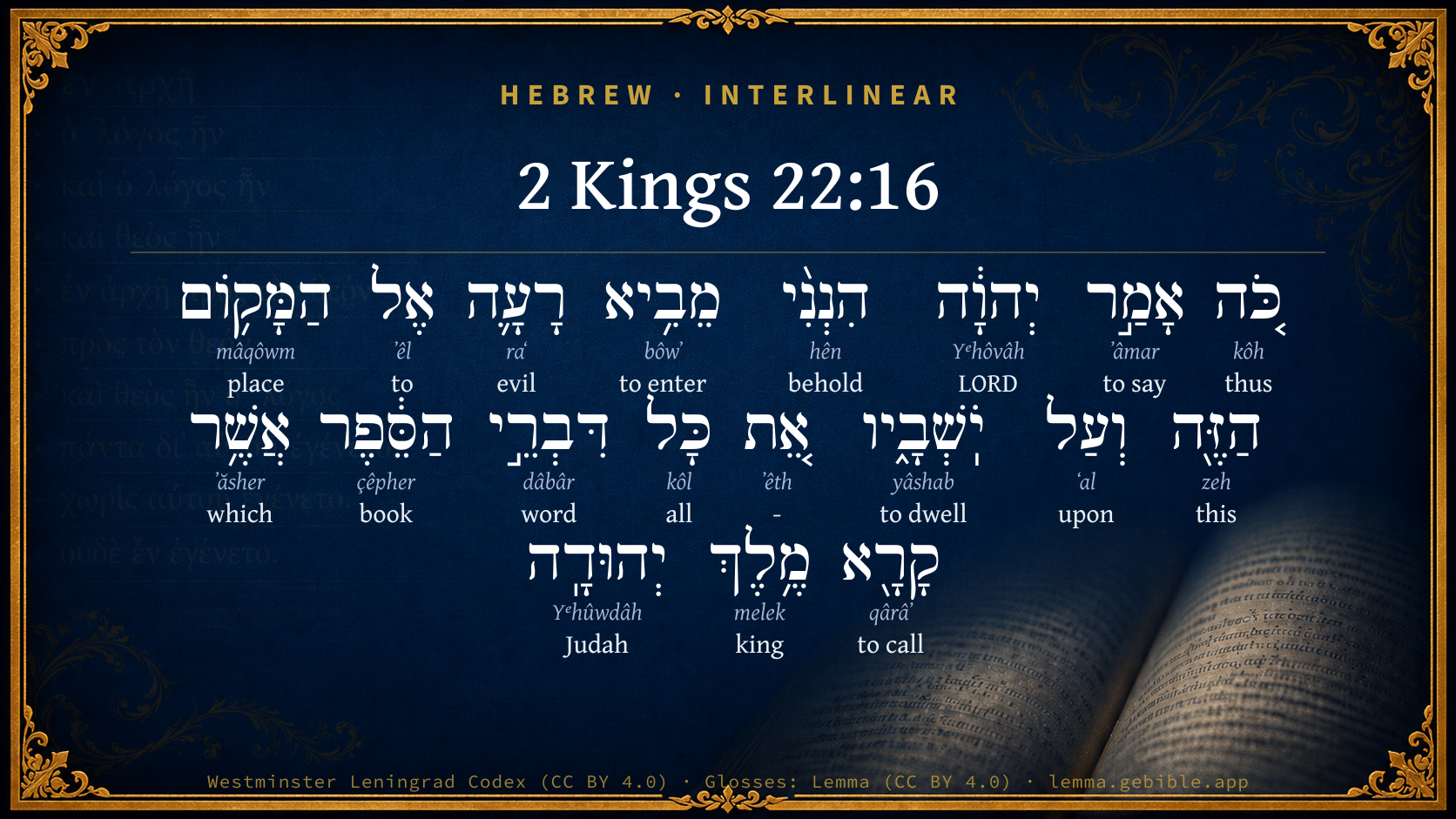
Hebrew (Westminster Leningrad Codex) 2 Kings 22:16 appears in the Hebrew Old Testament. The text above is from the Westminster Leningrad Codex. Each word links to its Strong’s number, a concise gloss, and parsing drawn from the Open Scriptures Hebrew Bible morphology. Click any word for its full Brown-Driver-Briggs (BDB) entry.
Download image
Cite this verse

2 Kings 22:16 (World English Bible). Public Domain. Lemma interlinear Bible study tool, https://lemma.gebible.app/v/2-kings/22/16.

Show BibTeX & RIS
BibTeX
RIS
English Translation
Thus says Yahweh, Behold, I will bring evil on this place, and on the inhabitants of it, even all the words of the book which the king of Judah has read.
World English Bible · Public Domain
Download a study sheet

One document with this verse’s original text, its word-by-word gloss line, the meaning frame, cross-references with their text, attributed commentary, and full source and license credits — printable, and it pastes into notes with its structure intact.

This verse Autodidact and up

Study sheet (.html) Plain text (.txt)

A passage Seminary Student

Up to 50 verses in one chapter. A passage sheet keeps up to 6 commentary sources and 12 cross-references per verse, in the order this page ranks them, and says so on the sheet whenever that leaves anything out. Ask for a single verse and you get the Autodidact verse sheet above.

Everything on this page stays free to read, with no account — the sheet is a download of what is already on screen, not access to it.

Want to remove ads? Support Godless Engineer
Compare translations 3

The same verse in 3 English versions, stacked beneath the original-language interlinear above. Click any original word for its lexicon entry.

Each is an independent rendering of the whole verse — the interlinear is not word-aligned to these translations.

Highlighted words mark where these versions differ — a whole-verse word diff, not a word-by-word alignment.

  • World English Bible Public Domain
    Thus says Yahweh, Behold, I will bring evil on this place, and on the inhabitants of it, even all the words of the book which the king of Judah has read.
  • King James Version Public Domain
    Thus saith the LORD, Behold, I will bring evil upon this place, and upon the inhabitants thereof, even all the words of the book which the king of Judah hath read:
  • unfoldingWord Literal Text CC BY-SA 4.0
    “Thus says Yahweh, ‘Behold me, bringing disaster to this place and upon its inhabitants, all of the words of the scroll that the king of Judah has read,

unfoldingWord Literal Text — © unfoldingWord, licensed CC BY-SA 4.0. Word-aligned USFM3 via Door43 (git.door43.org/unfoldingWord/en_ult).

Versions to compare (up to 4)

3 of 4 selected

Show all 18 translations

Every available English version of this verse, each an independent rendering of the whole verse.

  • World English Bible Public Domain
    Thus says Yahweh, Behold, I will bring evil on this place, and on the inhabitants of it, even all the words of the book which the king of Judah has read.
  • Berean Standard Bible Public Domain
    that this is what the LORD says: I am about to bring calamity on this place and on its people, according to all the words of the book that the king of Judah has read,
  • Majority Standard Bible Public Domain
    that this is what the LORD says: I am about to bring calamity on this place and on its people, according to all the words of the book that the king of Judah has read,
  • King James Version Public Domain
    Thus saith the LORD, Behold, I will bring evil upon this place, and upon the inhabitants thereof, even all the words of the book which the king of Judah hath read:
  • American Standard Version (1901) Public Domain
    Thus saith Jehovah, Behold, I will bring evil upon this place, and upon the inhabitants thereof, even all the words of the book which the king of Judah hath read.
  • Revised Version (1885) Public Domain
    Thus saith the LORD, Behold, I will bring evil upon this place, and upon the inhabitants thereof, even all the words of the book which the king of Judah hath read:
  • Geneva Bible (1599) Public Domain
    Thus sayth the Lord, Behold, I wil bring euill vpon this place, and on the inhabitants thereof, euen al the words of the booke which ye King of Iudah hath read,
  • Douay-Rheims (1899) Public Domain
    Thus saith the Lord: Behold, I will bring evils upon this place, and upon the inhabitants thereof, all the words of the law which the king of Juda hath read:
  • Young's Literal Translation Public Domain
    Thus said Jehovah, Lo, I am bringing in evil unto this place and on its inhabitants, all the words of the book that the king of Judah hath read,
  • Literal Standard Version CC BY-SA 4.0
    Thus said YHWH: Behold, I am bringing in calamity to this place and on its inhabitants, all the words of the scroll that the king of Judah has read,
  • Unlocked Literal Bible CC BY-SA 4.0
    “This is what Yahweh says: 'See, I will bring disaster to this place and to its inhabitants, according to everything written in the book that the king of Judah has read.
  • unfoldingWord Literal Text CC BY-SA 4.0
    “Thus says Yahweh, ‘Behold me, bringing disaster to this place and upon its inhabitants, all of the words of the scroll that the king of Judah has read,
  • Darby Bible Public Domain
    Thus saith Jehovah: Behold, I will bring evil upon this place and upon the inhabitants thereof, all the words of the book that the king of Judah hath read.
  • World Messianic Bible Public Domain
    “The LORD says, ‘Behold, I will bring evil on this place and on its inhabitants, even all the words of the book which the king of Judah has read.
  • Webster's Bible Public Domain
    Thus saith the LORD, Behold, I will bring evil upon this place, and upon its inhabitants, even all the words of the book which the king of Judah hath read:
  • Free Bible Version CC BY-SA 4.0
    this is what the Lord says: I am about to bring disaster down on this place and on its people, in accordance with everything written in the book that has been read to the king of Judah.
  • Bible in Basic English Public Domain
    These are the words of the Lord: See, I will send evil on this place and on its people, even everything which the king of Judah has been reading in the book;
  • JPS Tanakh (1917) Public Domain
    Thus saith the LORD: Behold, I will bring evil upon this place, and upon the inhabitants thereof, even all the words of the book which the king of Judah hath read;

Literal Standard Version (2020), Covenant Press — licensed CC BY-SA 4.0. Text via the HelloAO Bible API (eBible.org). Unlocked Literal Bible (unfoldingWord) — licensed CC BY-SA 4.0. Text via the HelloAO Bible API (eBible.org). unfoldingWord Literal Text — © unfoldingWord, licensed CC BY-SA 4.0. Word-aligned USFM3 via Door43 (git.door43.org/unfoldingWord/en_ult). Free Bible Version, Dr. Jonathan Gallagher — licensed CC BY-SA 4.0. Text via the HelloAO Bible API (eBible.org).

Word by word

More ways to search: Search by grammar → Find every occurrence → Compare this word →

Practice this passage: Drill this verse → Learn its vocabulary →

הַסֵּ֔פֶר
çêpher
H5612
“the · book”
Particle, Definite Article + Noun, Common, Masculine, Singular, Absolute
Part of Speech
Particle + Noun
Type
Common
Gender
Masculine
Number
Singular
State
Absolute
Full BDB Definition

Origin: from H5608

TWOT: 1540a , 1540b

book (noun feminine) - missive, document, writing, book (noun masculine) - missive - letter (of instruction), written order, commission, request, written decree - legal document, certificate of divorce, deed of purchase, indictment, sign - book, scroll - book of prophecies - genealogical register - law-book - book (of poems) - book (of kings) - books of the canon, scripture - record book (of God) - book-learning, writing - be able to read (after verb 'to know')
  1. כֹּ֚ה kôh H3541 “thus” Adverb
  2. אָמַ֣ר ʼâmar H559 “to say” Verb, Qal, Perfect, 3rd Person, Masculine, Singular
  3. יְהוָ֔ה Yᵉhôvâh H3068 “LORD” Noun, Proper
  4. הִנְנִ֨י hên H2005 “behold · me” Particle, Demonstrative + Suffix, Personal, 1st Person, Common, Singular
  5. מֵבִ֥יא bôwʼ H935 “entering” Verb, Hiphil, Participle Active, Masculine, Singular, Absolute
  6. רָעָ֛ה raʻ H7451 “evil” Noun, Common, Feminine, Singular, Absolute
  7. אֶל ʼêl H413 “to” Preposition
  8. הַמָּק֥וֹם mâqôwm H4725 “the · place” Particle, Definite Article + Noun, Common, Masculine, Singular, Absolute
  9. הַזֶּ֖ה zeh H2088 “the · this” Particle, Definite Article + Pronoun, Demonstrative, Masculine, Singular
  10. וְעַל ʻal H5921 “and · upon” Conjunction + Preposition
  11. יֹֽשְׁבָ֑יו yâshab H3427 “dwelling · him” Verb, Qal, Participle Active, Masculine, Plural, Construct + Suffix, Personal, 3rd Person, Masculine, Singular
  12. אֵ֚ת ʼêth H853 “-” Particle, Direct Object
  13. כָּל kôl H3605 “all of” Noun, Common, Masculine, Singular, Construct
  14. דִּבְרֵ֣י dâbâr H1697 “words of” Noun, Common, Masculine, Plural, Construct
  15. אֲשֶׁ֥ר ʼăsher H834 “which” Particle, Relative
  16. קָרָ֖א qârâʼ H7121 “to call” Verb, Qal, Perfect, 3rd Person, Masculine, Singular
  17. מֶ֥לֶךְ melek H4428 “king of” Noun, Common, Masculine, Singular, Construct
  18. יְהוּדָֽה Yᵉhûwdâh H3063 “Judah” Noun, Proper

About this verse

These counts appear in no published source. They are computed here, from the morphology-tagged text and Lemma’s own curated glosses. What Lemma adds →

19
words
19
distinct lemmas
Historical
section

Grammatical profile

  • 4 verbs
  • 8 nouns
  • 1 pronoun
  • 2 prepositions
  • 1 adverb
  • 3 particles

Verb forms

  • אָמַ֣ר Qal · Perfect
  • מֵבִ֥יא Hiphil · Participle Active
  • יֹֽשְׁבָ֑יו Qal · Participle Active
  • קָרָ֖א Qal · Perfect

Hebrew & Septuagint length

In English translation the verse runs 31 words from the Hebrew and 32 from the Septuagint (LXX English) — closely comparable.

A rough comparison of the two English renderings, which tokenize alike — not a word-level alignment.

Word counts can differ between the Hebrew and the Greek without any difference in meaning — e.g. the Hebrew direct-object marker אֵת has no separate Greek word, and Greek often adds the article ὁ.

In the original languages it is 19 Hebrew tokens and 25 Greek tokens — but the two are counted differently (Hebrew bundles its prefixes and suffixes into one token; the Greek is in lemma form), so that isn’t a like-for-like length.

Cross-references

14

Topical passages linked to 2 Kings 22:16 in the Treasury of Scripture Knowledge — connected by theme and wording, ordered by reader-vote popularity; previews shown in the World English Bible.

  • Daniel 9:11–14 Yes, all Israel have transgressed your law, even turning aside, that they should not obey your voice: therefore has the curse been poured out on us, and the oath that is written in the law of Moses the servant of God; for we have sinned against him.
  • Joshua 23:15 It shall happen, that as all the good things are come on you of which Yahweh your God spoke to you, so will Yahweh bring on you all the evil things, until he have destroyed you from off this good land which Yahweh your God has given you.
  • Deuteronomy 28:15–68 But it shall come to pass, if you will not listen to the voice of Yahweh your God, to observe to do all his commandments and his statutes which I command you this day, that all these curses shall come on you, and overtake you.
  • Deuteronomy 29:18–23 lest there should be among you man, or woman, or family, or tribe, whose heart turns away this day from Yahweh our God, to go to serve the gods of those nations; lest there should be among you a root that bears gall and wormwood;
  • Deuteronomy 29:27 therefore the anger of Yahweh was kindled against this land, to bring on it all the curse that is written in this book;
  • Deuteronomy 30:17–18 But if your heart turn away, and you will not hear, but shall be drawn away, and worship other gods, and serve them;
  • Deuteronomy 31:16–18 Yahweh said to Moses, Behold, you shall sleep with your fathers; and this people will rise up, and play the prostitute after the strange gods of the land, where they go to be among them, and will forsake me, and break my covenant which I have made with them.
  • Deuteronomy 32:15–26 But Jeshurun grew fat, and kicked: You have grown fat, you are grown thick, you are become sleek; Then he forsook God who made him, Lightly esteemed the Rock of his salvation.
  • Joshua 23:13 know for a certainty that Yahweh your God will no more drive these nations from out of your sight; but they shall be a snare and a trap to you, and a scourge in your sides, and thorns in your eyes, until you perish from off this good land which Yahweh your God has given you.
  • 2 Kings 20:17 Behold, the days come, that all that is in your house, and that which your fathers have laid up in store to this day, shall be carried to Babylon: nothing shall be left, says Yahweh.
  • 2 Kings 21:12–13 therefore thus says Yahweh, the God of Israel, Behold, I bring such evil on Jerusalem and Judah, that whoever hears of it, both his ears shall tingle.
  • 2 Kings 25:1–4 It happened in the ninth year of his reign, in the tenth month, in the tenth day of the month, that Nebuchadnezzar king of Babylon came, he and all his army, against Jerusalem, and encamped against it; and they built forts against it round about.
  • 2 Chronicles 34:24–25 Thus says Yahweh, Behold, I will bring evil on this place, and on the inhabitants of it, even all the curses that are written in the book which they have read before the king of Judah.
  • Leviticus 26:15–46 and if you shall reject my statutes, and if your soul abhors my ordinances, so that you will not do all my commandments, but break my covenant;

Cross-references courtesy of OpenBible.info (CC BY 4.0).

Hebrew and Greek witnesses Masoretic Hebrew ↔ Greek Septuagint

The same verse in the two great witnesses to the Old Testament, shown verse-for-verse.

These are two independent witnesses, not word-aligned to each other, and the Septuagint is shown in lemma (dictionary) form.

Hebrew 2 Kings 22:16 Masoretic · Westminster Leningrad Codex

כֹּ֚ה אָמַ֣ר יְהוָ֔ה הִנְנִ֨י מֵבִ֥יא רָעָ֛ה אֶל הַמָּק֥וֹם הַזֶּ֖ה וְעַל יֹֽשְׁבָ֑יו אֵ֚ת כָּל דִּבְרֵ֣י הַסֵּ֔פֶר אֲשֶׁ֥ר קָרָ֖א מֶ֥לֶךְ יְהוּדָֽה

Thus says Yahweh, Behold, I will bring evil on this place, and on the inhabitants of it, even all the words of the book which the king of Judah has read.

World English Bible · Public Domain

Greek LXX 2 Kings 22:16 Septuagint · lemma form

ὅδε λέγω κύριος ἰδού ἐγώ ἐπιἄγω κακός ἐπί ὁ τόπος οὗτος καί ἐπί ὁ ἐνοἰκέω αὐτός πᾶς ὁ λόγος ὁ βιβλίον ὅς ἀναγιγνώσκω βασιλεύς ιουδα

Thus says the Lord, Behold, I bring evil upon this place, and upon them that dwell in it, even all the words of the book which the king of Juda has read:

LXX2012 (modern English Septuagint) · Public Domain

On this verse, Ellicott's Commentary for English Readers discusses the Septuagint’s reading. Read the note in Commentary ↓

Hebrew: Westminster Leningrad Codex (CC BY 4.0). Greek: Septuagint (public domain); English from LXX2012 (modern English Septuagint) (Public Domain). How the Septuagint differs from the Hebrew →

Targum (Aramaic paraphrase)

1

The Targum is the ancient Jewish Aramaic paraphrase of the Hebrew Scriptures — an interpretive translation, not the Hebrew text itself. Onkelos (literal) and Pseudo-Jonathan (expansive) render the Torah, and Jonathan the Prophets. Coverage is partial: where no permissively-licensed English translation exists for a verse, only the Aramaic is shown. This is verse-level text, not a word-by-word alignment to the Hebrew.

  1. Targum Jonathan Prophets (Joshua–Malachi)
    כִּדְנַן אֲמַר יְיָ הָא אֲנָא מַיְתֵי בִישְׁתָא עַל אַתְרָא הָדֵין וְעַל יַתְבוֹהִי יַת כָּל פִּתְגָמֵי סַפְרָא דִקְרָא מֶלֶךְ שִׁבְטָא דְבֵית יְהוּדָה:

    (no public-domain English translation for this verse)

    Targum Jonathan — Aramaic: “Mikraot Gedolot” (public domain). English: “Sefaria Community Translation” (CC0 1.0 (public-domain dedication)); “London "Chaldee Paraphrase," 1871” (public domain). Text via Sefaria.

Commentary

Notes on 2 Kings 22:16 from classic Christian and Jewish commentators (each source and its license shown beneath its notes). The classic Christian expositions comment on the surrounding passage and are grouped to its opening verse, so a note may address several verses; the Jewish commentaries on the Tanakh (Rashi and others) are per-verse, so they appear only where the commentator wrote on this verse.

Lemma curates 59 commentaries, every one of them public domain or Creative Commons licensed, each selected and text-cleaned for this edition rather than reprinted as found. About our sources →

Trapp's Complete Commentary

John Trapp

2Ki 22:16 Thus saith the LORD, Behold, I will bring evil upon this place, and upon the inhabitants thereof, [even] all the words of the book which the king of Judah hath read:

Ver. 16. Behold, I will bring evil upon this place.] God is absolute in threatening, because resolute in punishing.

John Trapp, A Commentary or Exposition upon All the Books of the Old and New Testament (1647–1656) — public domain. Text from a community e-Sword module.

Ellicott's Commentary for English Readers

(16) I will bring evil upon . . .—Literally, I am about to bring evil unto . . . Instead of unto, the LXX., Vulg., and Chronicles rightly read upon, which follows in the next phrase.

Which the king of Judah hath read.—The book had been read to him as the chronicler explains. The freedom of expression here warns us against pressing the words of 2Ki_22:8; 2Ki_22:10 (“he read it”).

A Bible Commentary for English Readers, edited by Charles John Ellicott (1878–1897) — public domain. Text from a community e-Sword module.

The Cambridge Bible for Schools and Colleges

gen. ed. J. J. S. Perowne

16. all the words of the book which the king of Judah hath read] The Chronicler says, ‘all the curses that are written in the book which they have read before the king of Judah’. The curses are such as those contained in Deuteronomy 28 already alluded to, and in Lev_26:14-39.

The Cambridge Bible for Schools and Colleges (gen. ed. J. J. S. Perowne; Cambridge University Press, 1878–1918) — public domain. Text from a community e-Sword module.

John Gill's Exposition

Thus saith the Lord, behold, I will bring evil upon this place, and upon the inhabitants of it,.... Destruction to the place, and captivity to the inhabitants of it:

even all the words of the book which the king of Judah hath read; particularly what is contained in Lev 26:14, even all the curses in it, as in Ch2 34:24.

John Gill's Exposition of the Whole Bible (1746–1763) — public domain (CC PDM 1.0). Text via the HelloAO Bible API.

Albert Barnes' Notes on the Bible

All the words of the book - The “words” here intended are no doubt the threatenings of the Law, particularly those of Lev. 26:16-39 and Deut. 28:15-68. Josiah had probably only heard a portion of the Book of the Law; but that portion had contained those awful denunciations of coming woe. Hence, Josiah’s rending of his clothes 2Ki 22:11, and his hurried message to Huldah.

Albert Barnes' Notes on the Bible (1834–1885) — public domain. Text from a community e-Sword/MySword module.

Whedon's Commentary on the Bible

Daniel D. Whedon

16. This place — Jerusalem.

All the words of the book — Chronicles reads all the curses, from which it has naturally been inferred that the words of the law which had especially impressed the king were the curses which are announced in Leviticus 26, and the closing chapters of Deuteronomy, as sure to come, in case of disobedience, upon the sinful nation. Compare note on 2Ki_22:10.

Daniel D. Whedon (gen. ed.), Commentary on the Old and New Testaments (1874–1909) — public domain. Text from a community e-Sword module.

The Pulpit Commentary

Thus saith the Lord, Behold, I will bring evil upon this placei.e. Jerusalemand upon the inhabitants thereof, even all the words of the book which the King of Judah hath read. In the parallel passage of Chronicles (2Ch_34:24) the expression used is stronger, viz, "Behold, I will bring evil upon this place, and upon the inhabitants thereof, even all the curses that are written in the book which they have road before the King of Judah." The passage which most strongly affected Josiah was probably that, already mentioned, in Deuteronomy 28., which began with a series of curses.

The Pulpit Commentary (1880–1919), ed. H.D.M. Spence-Jones & Joseph S. Exell — public domain. Text from a community e-Sword module.

Lesson kit

Teaching starters — assembled from the data on this page, not authored interpretation. Every prompt links to the verse data it draws on. Edit before teaching.

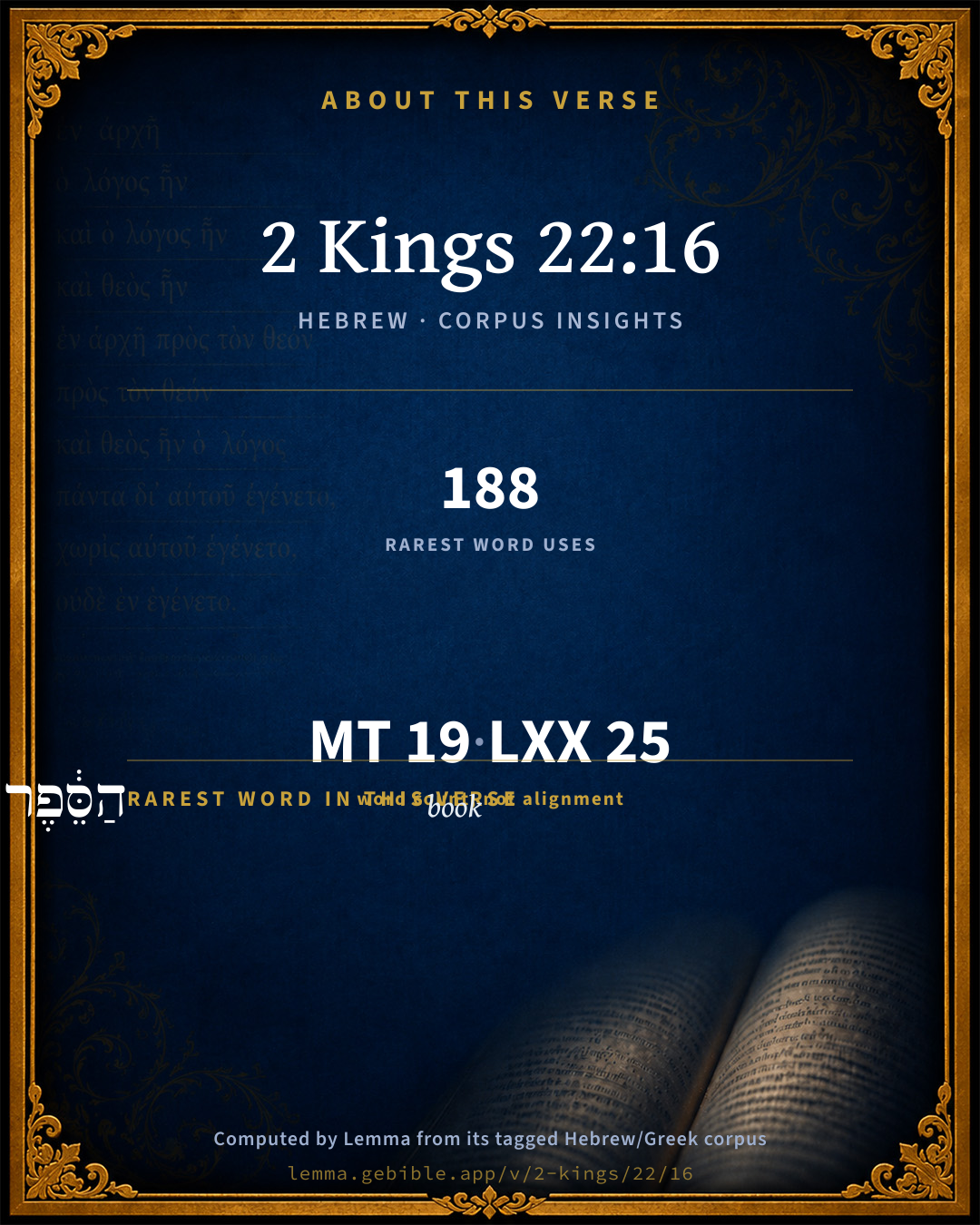
2 Kings, in the Historical, opens this verse with 19 words (19 distinct Hebrew lemmas). Its most distinctive word is çêpher (“book”). A historical commentator’s framing appears above. Read the whole chapter for the surrounding context.

Discussion questions

  1. How does “book” (çêpher) shape what this verse is saying?
  2. How does Daniel 9:11–14, which shares this passage’s theme, read alongside this verse?
  3. The translations on this page render this verse differently — a whole-verse word diff, not a word-by-word alignment. What might account for the different wordings?
  4. «אָמַ֣ר» is a Qal Perfect verb. How does that grammatical form shape the action described?
  5. Compare how Trapp's Complete Commentary and Ellicott's Commentary for English Readers read this verse. Where do they agree or differ?

Things to notice

Reading settings

Reading text

Shown beneath each verse's original-language words.

Old Testament
Old Testament edition

Read the OT as the Masoretic Hebrew (MT) or the Greek Septuagint (LXX).

English shown for the Greek Septuagint (in the Hebrew ↔ Greek comparison).

Comparing translations? Open the Compare panel on any verse page to stack up to four side by side.