
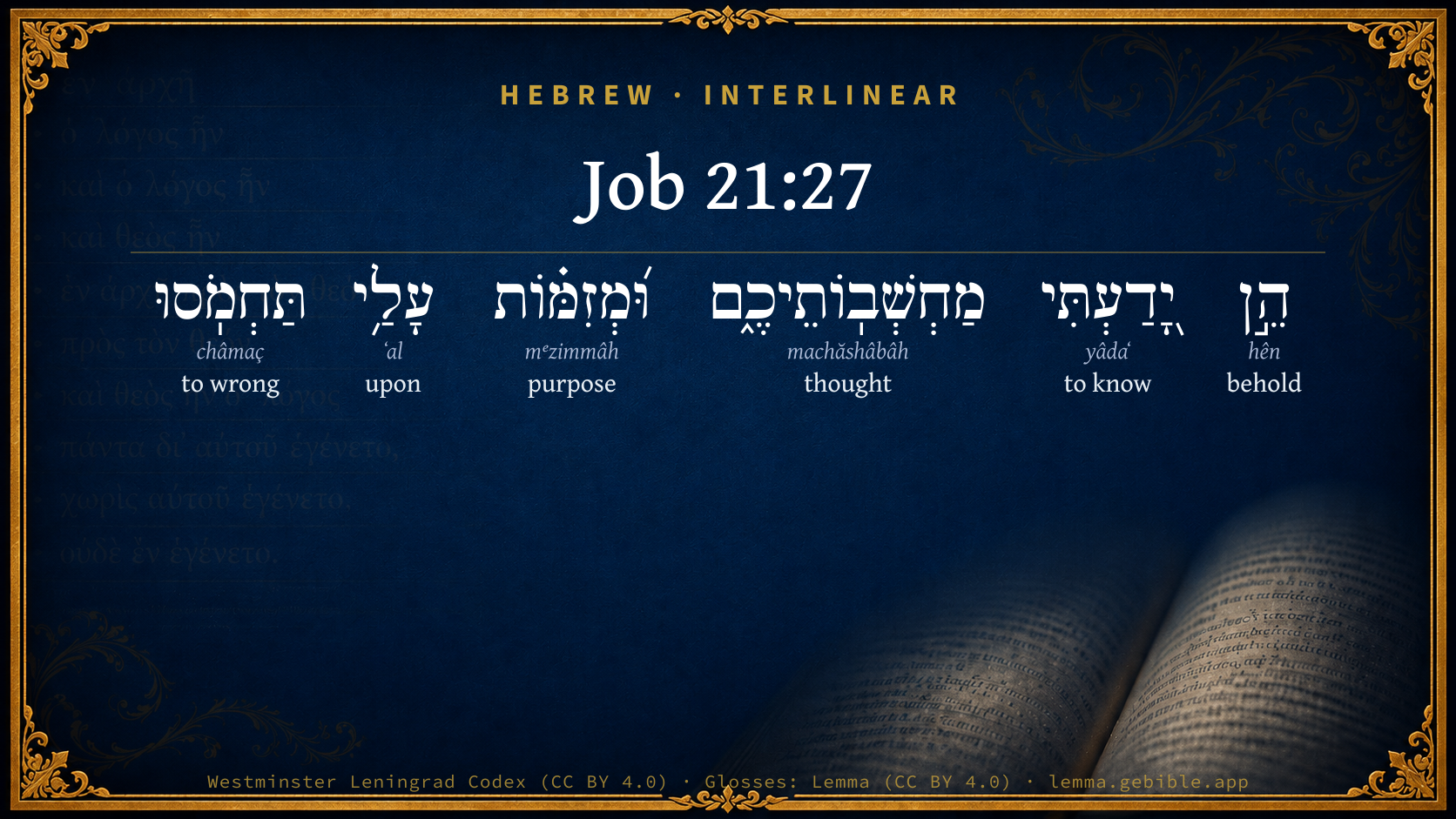
Job 21:27

Hebrew (Westminster Leningrad Codex) Job 21:27 appears in the Hebrew Old Testament. The text above is from the Westminster Leningrad Codex. Each word links to its Strong’s number, a concise gloss, and parsing drawn from the Open Scriptures Hebrew Bible morphology. Click any word for its full Brown-Driver-Briggs (BDB) entry.
Download image
Cite this verse

Job 21:27 (World English Bible). Public Domain. Lemma interlinear Bible study tool, https://lemma.gebible.app/v/job/21/27.

Show BibTeX & RIS
BibTeX
RIS
English Translation
"Behold, I know your thoughts, The devices with which you would wrong me.
World English Bible · Public Domain
Highlights Full analysis ↓
Download a study sheet

One document with this verse’s original text, its word-by-word gloss line, the meaning frame, cross-references with their text, attributed commentary, and full source and license credits — printable, and it pastes into notes with its structure intact.

This verse Autodidact and up

Study sheet (.html) Plain text (.txt)

A passage Seminary Student

Up to 50 verses in one chapter. A passage sheet keeps up to 6 commentary sources and 12 cross-references per verse, in the order this page ranks them, and says so on the sheet whenever that leaves anything out. Ask for a single verse and you get the Autodidact verse sheet above.

Everything on this page stays free to read, with no account — the sheet is a download of what is already on screen, not access to it.

Want to remove ads? Support Godless Engineer
Compare translations 3

The same verse in 3 English versions, stacked beneath the original-language interlinear above. Click any original word for its lexicon entry.

Each is an independent rendering of the whole verse — the interlinear is not word-aligned to these translations.

Highlighted words mark where these versions differ — a whole-verse word diff, not a word-by-word alignment.

  • World English Bible Public Domain
    "Behold, I know your thoughts, The devices with which you would wrong me.
  • King James Version Public Domain
    Behold, I know your thoughts, and the devices which ye wrongfully imagine against me.
  • unfoldingWord Literal Text CC BY-SA 4.0
    Behold, I know your thoughts and the notions you wrest against me.

unfoldingWord Literal Text — © unfoldingWord, licensed CC BY-SA 4.0. Word-aligned USFM3 via Door43 (git.door43.org/unfoldingWord/en_ult).

Versions to compare (up to 4)

3 of 4 selected

Show all 18 translations

Every available English version of this verse, each an independent rendering of the whole verse.

  • World English Bible Public Domain
    "Behold, I know your thoughts, The devices with which you would wrong me.
  • Berean Standard Bible Public Domain
    Behold, I know your thoughts full well, the schemes by which you would wrong me.
  • Majority Standard Bible Public Domain
    Behold, I know your thoughts full well, the schemes by which you would wrong me.
  • King James Version Public Domain
    Behold, I know your thoughts, and the devices which ye wrongfully imagine against me.
  • American Standard Version (1901) Public Domain
    Behold, I know your thoughts, And the devices wherewith ye would wrong me.
  • Revised Version (1885) Public Domain
    Behold, I know your thoughts, and the devices which ye wrongfully imagine against me.
  • Geneva Bible (1599) Public Domain
    Behold, I know your thoughts, and the enterprises, wherewith ye do me wrong.
  • Douay-Rheims (1899) Public Domain
    Surely I know your thoughts, and your unjust judgments against me.
  • Young's Literal Translation Public Domain
    Lo, I have known your thoughts, And the devices against me ye do wrongfully.
  • Literal Standard Version CC BY-SA 4.0
    Behold, I have known your thoughts, || And the schemes against me you do wrongfully.
  • Unlocked Literal Bible CC BY-SA 4.0
    See, I know your thoughts, and the ways in which you wish to wrong me.
  • unfoldingWord Literal Text CC BY-SA 4.0
    Behold, I know your thoughts and the notions you wrest against me.
  • Darby Bible Public Domain
    Lo, I know your thoughts, and the devices ye wrongfully imagine against me.
  • World Messianic Bible Public Domain
    “Behold, I know your thoughts, the plans with which you would wrong me.
  • Webster's Bible Public Domain
    Behold, I know your thoughts, and the devices which ye wrongfully imagine against me.
  • Free Bible Version CC BY-SA 4.0
    Look, I know what you're thinking, and your schemes to do me wrong.
  • Bible in Basic English Public Domain
    See, I am conscious of your thoughts, and of your violent purposes against me;
  • JPS Tanakh (1917) Public Domain
    Behold, I know your thoughts, and the devices which ye wrongfully imagine against me.

Literal Standard Version (2020), Covenant Press — licensed CC BY-SA 4.0. Text via the HelloAO Bible API (eBible.org). Unlocked Literal Bible (unfoldingWord) — licensed CC BY-SA 4.0. Text via the HelloAO Bible API (eBible.org). unfoldingWord Literal Text — © unfoldingWord, licensed CC BY-SA 4.0. Word-aligned USFM3 via Door43 (git.door43.org/unfoldingWord/en_ult). Free Bible Version, Dr. Jonathan Gallagher — licensed CC BY-SA 4.0. Text via the HelloAO Bible API (eBible.org).

Word by word

More ways to search: Search by grammar → Find every occurrence → Compare this word →

Practice this passage: Drill this verse → Learn its vocabulary →

About this verse

These counts appear in no published source. They are computed here, from the morphology-tagged text and Lemma’s own curated glosses. What Lemma adds →

6
words
6
distinct lemmas
Wisdom
section

Notable vocabulary

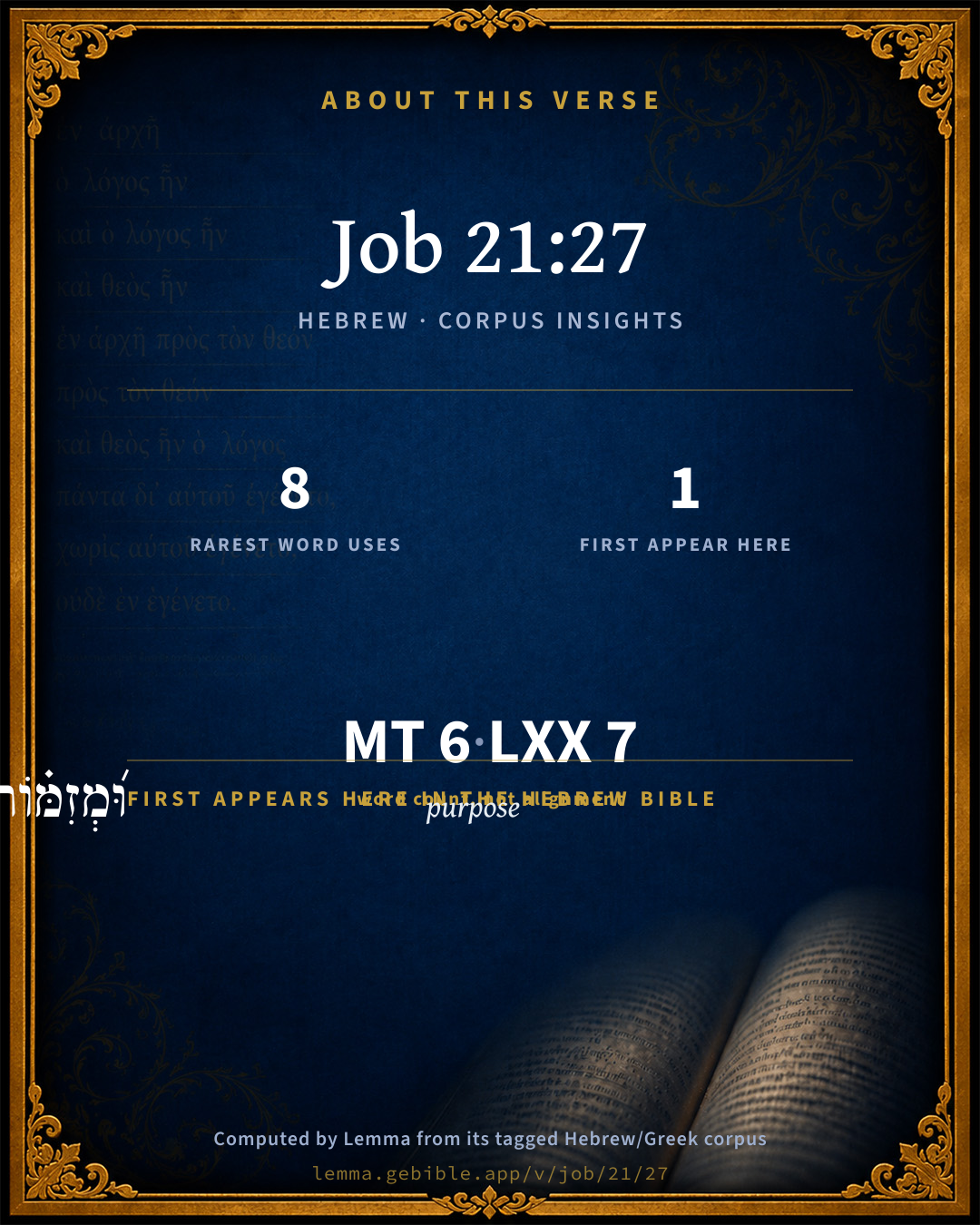
The rarest word here is תַּחְמֹֽסוּ to wrong H2554 — appearing just 8 times in the whole Hebrew Bible.

First appearance in Scripture

This word makes its first canonical appearance in the Hebrew Bible here:

  • וּ֝מְזִמּ֗וֹת purpose H4209

Shared distinctive vocabulary

תַּחְמֹֽסוּ to wrong H2554 occurs in 8 verses of the Hebrew Bible. Also found in:

Grammatical profile

  • 2 verbs
  • 2 nouns
  • 1 preposition
  • 1 particle

Verb forms

  • יָ֭דַעְתִּי Qal · Perfect
  • תַּחְמֹֽסוּ Qal · Imperfect

Hebrew & Septuagint length

In English translation the verse runs 13 words from the Hebrew and 9 from the Septuagint (LXX English) — the Septuagint runs noticeably shorter here. See the side-by-side →

A rough comparison of the two English renderings, which tokenize alike — not a word-level alignment.

Word counts can differ between the Hebrew and the Greek without any difference in meaning — e.g. the Hebrew direct-object marker אֵת has no separate Greek word, and Greek often adds the article ὁ.

In the original languages it is 6 Hebrew tokens and 7 Greek tokens — but the two are counted differently (Hebrew bundles its prefixes and suffixes into one token; the Greek is in lemma form), so that isn’t a like-for-like length.

Cross-references

12

Topical passages linked to Job 21:27 in the Treasury of Scripture Knowledge — connected by theme and wording, ordered by reader-vote popularity; previews shown in the World English Bible.

  • Luke 5:22 But Jesus, perceiving their thoughts, answered them, "Why are you reasoning so in your hearts?
  • Psalms 119:86 All of your commandments are faithful. They persecute me wrongfully. Help me!
  • Job 4:8–11 According to what I have seen, those who plow iniquity, And sow trouble, Reap the same.
  • Job 5:3–5 I have seen the foolish taking root, But suddenly I cursed his habitation.
  • Job 8:3–6 Does God pervert justice? Or does the Almighty pervert righteousness?
  • Job 15:20–35 The wicked man travails with pain all his days, Even the number of years that are laid up for the oppressor.
  • Job 20:5 That the triumphing of the wicked is short, The joy of the godless but for a moment?
  • Job 20:29 This is the portion of a wicked man from God, The heritage appointed to him by God."
  • Job 32:3 Also his wrath was kindled against his three friends, because they had found no answer, and yet had condemned Job.
  • Job 42:7 It was so, that after Yahweh had spoken these words to Job, Yahweh said to Eliphaz the Temanite, "My wrath is kindled against you, and against your two friends; for you have not spoken of me the thing that is right, as my servant Job has.
  • Psalms 59:4 I have done no wrong, yet they are ready to attack me. Rise up, behold, and help me!
  • 1 Peter 2:19 For it is commendable if someone endures pain, suffering unjustly, because of conscience toward God.

Cross-references courtesy of OpenBible.info (CC BY 4.0).

Hebrew and Greek witnesses Masoretic Hebrew ↔ Greek Septuagint

The same verse in the two great witnesses to the Old Testament, shown verse-for-verse.

Here the Septuagint runs noticeably shorter than the Hebrew — LXX2012 (modern English Septuagint) 9 words vs World English Bible 13. A rough length comparison of the two English translations, not a word-level alignment — read both below.

These are two independent witnesses, not word-aligned to each other, and the Septuagint is shown in lemma (dictionary) form.

Hebrew Job 21:27 Masoretic · Westminster Leningrad Codex

הֵ֣ן יָ֭דַעְתִּי מַחְשְׁבֽוֹתֵיכֶ֑ם וּ֝מְזִמּ֗וֹת עָלַ֥י תַּחְמֹֽסוּ

"Behold, I know your thoughts, The devices with which you would wrong me.

World English Bible · Public Domain

Greek LXX Job 21:27 Septuagint · lemma form

ὥστε οἶδα σύ ὅτι τόλμα ἐπικεῖμαι ἐγώ

So I know you, that you⌃ presumptuously attack me:

LXX2012 (modern English Septuagint) · Public Domain

Hebrew: Westminster Leningrad Codex (CC BY 4.0). Greek: Septuagint (public domain); English from LXX2012 (modern English Septuagint) (Public Domain). How the Septuagint differs from the Hebrew →

Commentary

Notes on Job 21:27 from classic Christian and Jewish commentators (each source and its license shown beneath its notes). The classic Christian expositions comment on the surrounding passage and are grouped to its opening verse, so a note may address several verses; the Jewish commentaries on the Tanakh (Rashi and others) are per-verse, so they appear only where the commentator wrote on this verse.

Lemma curates 59 commentaries, every one of them public domain or Creative Commons licensed, each selected and text-cleaned for this edition rather than reprinted as found. About our sources →

Matthew Henry's Commentary

In these verses,

I. Job opposes the opinion of his friends, which he saw they still adhered to, that the wicked are sure to fall into such visible and remarkable ruin as Job had now fallen into, and none but the wicked, upon which principle they condemned Job as a wicked man. "I know your thoughts," says Job (Job 21:27); "I know you will not agree with me; for your judgments are tinctured and biassed by your piques and prejudices against me, and the devices which you wrongfully imagine against my comfort and honour: and how can such men be convinced?" Job's friends were ready to say, in answer to his discourse concerning the prosperity of the wicked, "Where is the house of the prince? Job 21:28. Where is Job's house, or the house of his eldest son, in which his children were feasting? Enquire into the circumstances of Job's house and family, and then ask, Where are the dwelling-places of the wicked? and compare them together, and you will soon see that Job's house is in the same predicament with the houses of tyrants and oppressors, and may therefore conclude that doubtless he was such a one."

II. He lays down his own judgment to the contrary, and, for proof of it, appeals to the sentiments and observations of all mankind. So confident is he that he is in the right that he is willing to refer the cause to the next man that comes by (Job 21:29): "Have you not asked those that go by the way - any indifferent person, any that will answer you? I say not, as Eliphaz (Job 5:1), to which of the saints, but to which of the children of men will you turn? Turn to which you will, and you will find them all of my mind, that the punishment of sinners is designed more for the other world than for this, according to the prophecy of Enoch, the seventh from Adam, Jde 1:14. Do you not know the tokens of this truth, which all that have made any observations upon the providences of God concerning mankind in this world can furnish you with?" Now,

1. What is it that Job here asserts? Two things: - (1.) That impenitent sinners will certainly be punished in the other world, and, usually, their punishment is put off until then. (2.) That therefore we are not to think it strange if they prosper greatly in this world and fall under no visible token of God's wrath. Therefore they are spared now, because they are to be punished then; therefore the workers of iniquity flourish, that they may be destroyed for ever, Psa 92:7. The sinner is here supposed, [1.] To live in a great deal of power, so as to be not only the terror of the mighty in the land of the living (Eze 32:27), but the terror of the wise and good too, whom he keeps in such awe that none dares declare his way to his face, Job 21:31. None will take the liberty to reprove him, to tell him of the wickedness of his way, and what will be in the end thereof; so that he sins securely, and is not made to know either shame or fear. The prosperity of fools destroys them, by setting them (in their own conceit) above reproofs, by which they might be brought to that repentance which alone will prevent their ruin. Those are marked for destruction that are let alone in sin, Hos 4:17. And, if none dares declare his way to his face, much less dare any repay him what he has done and make him refund what he has obtained by injustice. He is one of those great flies which break through the cobwebs of the law, that hold only the little ones. This emboldens sinners in their sinful ways that they can brow-beat justice and make it afraid to meddle with them. But there is a day coming when those shall be told of their faults who now would not bear to hear of them, those shall have their sins set in order before them, and their way declared to their face, to their everlasting confusion, who would not have it done here, to their conviction, and those who would not repay the wrongs they had done shall have them repaid to them. [2.] To die, and be buried in a great deal of pomp and magnificence, Job 21:32, Job 21:33. There is no remedy; he must die; that is the lot of all men; but every thing you can think of shall be done to take off the reproach of death. First, He shall have a splendid funeral - a poor thing for any man to be proud of the prospect of; yet with some it passes for a mighty thing. Well, he shall be brought to the grave in state, surrounded with all the honours of the heralds' office and all the respect his friends can then pay to his remains. The rich man died, and was buried, but no mention is made of the poor man's burial, Luk 16:22. Secondly, He shall have a stately monument erected over him. He shall remain in the tomb with a Hic jacet - Here lies, over him, and a large encomium. Perhaps it is meant of the embalming of his body to preserve it, which was a piece of honour anciently done by the Egyptians to their great men. He shall watch in the tomb (so the word is), shall abide solitary and quiet there, as a watchman in his tower. Thirdly, The clods of the valley shall be sweet to him; there shall be as much done as can be with rich odours to take off the noisomeness of the grave, as by lamps to set aside the darkness of it, which perhaps was referred to in the foregoing phrase of watching in the tomb. But it is all a jest; what is the light, or what the perfume, to a man that is dead? Fourthly, It shall be alleged, for the lessening of the disgrace of death, that it is the common lot: He has only yielded to fate, and every man shall draw after him, as there are innumerable before him. Note, Death is the way of all the earth: when we are to cross that darksome valley we must consider, 1. That there are innumerable before us; it is a tracked road, which may help to take off the terror of it. To die is ire ad plures - to go to the great majority. 2. That every man shall draw after us. As there is a plain track before, so there is a long train behind; we are neither the first nor the last that pass through that dark entry. Every one must go in his own order, the order appointed of God.

2. From all this Job infers the impertinency of their discourses, Job 21:34. (1.) Their foundation is rotten, and they went upon a wrong hypothesis: "In your answers there remains falsehood; what you have said stands not only unproved but disproved, and lies under such an imputation of falsehood as you cannot clear it from." (2.) Their building was therefore weak and tottering: "You comfort me in vain. All you have said gives me no relief; you tell me that I shall prosper again if I turn to God, but you go upon this presumption, that piety shall certainly be crowned with prosperity, which is false; and therefore how can your inference from it yield me any comfort?" Note, Where there is not truth there is little comfort to be expected.

Matthew Henry's Commentary on the Whole Bible (1708–1710) — public domain (CC PDM 1.0). Text via the HelloAO Bible API.

Trapp's Complete Commentary

John Trapp

Job 21:27 Behold, I know your thoughts, and the devices [which] ye wrongfully imagine against me.

Ver. 27. Behold, I know your thoughts] sc. By your words; as it is no hard matter for a wise man to do, Pro 20:5; for otherwise, God only knoweth the heart, 1Pe 1:24 Psa 139:3, it is his royalty. But when men discover their thoughts by their discourses, looks, gestures, &c., we may say, as Job doth here, "I know your thoughts"; and that by the wicked wretch described by you myself is intended; this I am well aware of, though you hover in generals, and speak in a third person. Bartolus writeth of Dr Gabriel Nele, that by the only motion of the lips, without any utterance, he understood any man’s thoughts. The like some say they can do by looks. The Italians have a proverb, That a man with his words close, and his countenance loose, may travel undiscovered all the world over.

And the devices which you wonderfully imagine against me] viz. To take away, as it were by violence, my credit and comfort; this is the foulest theft; avoid it.

John Trapp, A Commentary or Exposition upon All the Books of the Old and New Testament (1647–1656) — public domain. Text from a community e-Sword module.

Joseph Benson's Commentary

Job 21:27-28. Behold, I know your thoughts — I perceive what you think and will object for your own defence; and the devices — Hebrew, ומזמות, umezimmoth, machinationes pravas, the evil thoughts, or, wicked designs and contrivances; which ye wrongfully imagine — תחמסו, thachmosu, wrest, or violently force, for they strained both Job’s words and their own thoughts, which were biased by prejudice and passion; against me — For I well know that your discourses, though they be concerning wicked men in the general, yet are particularly levelled at me, that is, I know what you would insinuate by the speeches which you make, such as this which follows: Where is the house of the prince? — Of Job, or his eldest son, whose house God had lately overthrown; it is nowhere: it is lost and gone. And where are the dwelling-places of the wicked? — רשׁעים, reshagnim, in the plural, of wicked persons in general. Are not their habitations overthrown? Do not they come to ruin? So the meaning of the question is: that it was apparent from common observation, that eminent judgments, even in this life, were sooner or later the portion of all ungodly men.

Joseph Benson's Commentary on the Old and New Testaments (1811–1818) — public domain. Text from a community e-Sword module.

Whedon's Commentary on the Bible

Daniel D. Whedon

Second division — THE REPORT OF TRAVELLERS IS, THAT THE PUNISHMENT OF THE WICKED IS HELD IN ABEYANCE, Job_21:27-34.

Strophe a — If, instead of judging by appearances in this present life the friends had made more extensive research, they would have found that the wicked are held in reserve for future punishment. The element of delayed punishment not only serves to unlock the enigma of retribution, but to relieve Job from dire suspicion, since suffering here is a criterion of virtue rather than of vice, Job_21:27-30.

27. Job’s argument properly closed with the preceding verse; but having perceived (so Kitto thinks) by their interchange of looks that they were not satisfied, he resumes with, “Behold, I know your thoughts,” and proceeds to produce a new species of testimony, which they, learned men as they were, could not deny.

Daniel D. Whedon (gen. ed.), Commentary on the Old and New Testaments (1874–1909) — public domain. Text from a community e-Sword module.

Jamieson, Fausset & Brown

Robert Jamieson, A. R. Fausset & David Brown

Their wrongful thoughts against Job are stated by him in Job 21:28. They do not honestly name Job, but insinuate his guilt.

Jamieson, Fausset & Brown — Commentary Critical and Explanatory on the Whole Bible (1871) — public domain (CC PDM 1.0). Text via the HelloAO Bible API.

Adam Clarke's Commentary

Verse 27. I know your thoughts] Ye still think that, because I am grievously afflicted, I must therefore be a felonious transgressor.

Adam Clarke's Commentary on the Bible (1810–1826) — public domain. Text from a community e-Sword/MySword module.

The Cambridge Bible for Schools and Colleges

gen. ed. J. J. S. Perowne

27. Job knows the covert meaning that lies under his friends’ talk of the fate of the wicked man.

27–34. Finally, still pursuing his argument, Job turns to the insinuations of his friends against himself, which lie under their descriptions of the fate of the wicked. He knows what they mean when they say, Where is the house of the prince? But their conclusions were against the testimony of those who had travelled far and seen much. These testified that the wicked man was preserved in the day of destruction; that he came to an honoured grave, and the clods of the valley lay softly on him; and that his example, so far from being shunned, was followed by the mass of men, as there were multitudes that preceded him in the way he walked.

The Cambridge Bible for Schools and Colleges (gen. ed. J. J. S. Perowne; Cambridge University Press, 1878–1918) — public domain. Text from a community e-Sword module.

John Gill's Exposition

For ye say,.... Or "have said", or "I know that ye say"; or "that ye are about to say" (a); it is in your hearts and minds, and just ready to come out of your lips, and what you will say next:

where is the house of the prince? of the righteous man, as the Syriac and Arabic versions; or "of the good and liberal man", as others (b); of such as are of a princely and ingenuous spirit, who are made willing, free, or princes, in the day of the power of the grace of God upon them; and are endowed and upheld with a free and princely spirit; where is the house, or what is the state and condition, of the families of such? are they the same with that of wicked men in the next clause? is there no difference between the one and the other? according to your way of reasoning, Job, there should not be any: or else this is to be understood rather of a wicked and tyrannical prince, who has built himself a stately palace, which he fancied would continue for ever; but where is it now? it lies in ruins; having respect perhaps to some noted prince of those times: or rather either to Job himself, who had been a prince, and the greatest man in all the east, but in what condition were his house and family now? or else to his eldest son, whose house was blown down with a violent wind:

and where are the dwelling places of the wicked? of the mighty men before the flood, which are now overthrown by it; or of the king and princes, and nobles, and great men of Sodom and Gomorrah, and the other cities of the plain destroyed by fire and brimstone from heaven; or of Job, his tent or tabernacle, and the several apartments in it; or of the rest of his children and servants, respecting rather, as before observed, the state and condition of his family, than his material house: these questions are answered by putting others.

(a) "vos dicere", Junius & Tremellius; "nempe vos dicturos", Piscator; so Schmidt, Schultens. (b) "liberalis", Montanus; "boni et liberalis hominis", Tigurine version; "ingenui", Schultens.

John Gill's Exposition of the Whole Bible (1746–1763) — public domain (CC PDM 1.0). Text via the HelloAO Bible API.

Albert Barnes' Notes on the Bible

Behold, I know your thoughts - That is, “I see that you are not satisfied, and that you are disposed still to maintain your former position. You will be ready to ask, Where “are” the proofs of the prosperity of the wicked? Where “are” the palaces of the mighty? Where “are” the dwelling places of ungodly men!”

And the devices which ye wrongfully imagine against me - The course of sophistical argument which you pursue, the tendency and design of which is to prove that I am a wicked man. You artfully lay down the position, that the wicked must be, and are in fact, overwhelmed with calamities, and then you infer, that because “I” am overwhelmed in this manner, I “must be” a wicked man.

Albert Barnes' Notes on the Bible (1834–1885) — public domain. Text from a community e-Sword/MySword module.

Haydock's Catholic Bible Commentary

Me. I perceive you are not convinced; and what you say respecting the wicked, is pointed at me. (Menochius)

George Leo Haydock (1774–1849), Haydock's Catholic Family Bible and Commentary, 1859 edition — public domain. Excludes Psalms (Douay-Rheims chapter numbering differs from Protestant) and Deuterocanonical books (Catholic canon only).

Matthew Poole's English Annotations

I know your thoughts; I perceive what you think, and will object, and say for your own defence.

The devices, or, evil thoughts; for so this word is oft used, as Pro 12:2; 14:17; Job 24:8; Isa 32:7.

Wrongfully imagine, or wrest, or violently force. For they strained both Job’s words, and their own thoughts, which were biassed by their prejudice and passion against Job.

Against me; for I know very well that your discourses, though they be of wicked men in the general, yet are particularly levelled at me.

Matthew Poole's English Annotations on the Holy Bible (1683–1685) — public domain. Text from a community e-Sword/MySword module.

The Pulpit Commentary

Behold, I know your thoughts, and the devices (or, surmisings) which ye wrongfully imagine against me. I know, i.e. "what you think of me. I am quite aware that you regard me as having brought my afflictions upon myself by wicked deeds, which I have succeeded in keeping secret. You have not openly stated your surmises. but it has been easy for me to "read between the lines," and understand the true meaning of your insinuations, which are all wrongful and unjust.

The Pulpit Commentary (1880–1919), ed. H.D.M. Spence-Jones & Joseph S. Exell — public domain. Text from a community e-Sword module.

John Wesley's Explanatory Notes

Me - I know that your discourses, though they be of wicked, men in general, yet are particularly levelled at me.

John Wesley, Explanatory Notes Upon the Whole Bible (1754–1765) — public domain. Text via the GEBible commentary corpus.

Keil & Delitzsch

C. F. Keil & F. Delitzsch

27 Behold I know your thoughts

And the stratagems, with which ye overpower me!

28 When ye say: Where is the house of the tyrant,

And where the pavilions of the wicked - :

29 Have ye not asked those who travel,

Their memorable things ye could surely not disown:

30 That the wicked was spared in the day of calamity,

In the day of the outburst of wrath they were led away.

31 Who liketh to declare to him his way to his face?

And hath he done aught, who will recompense it to him?

Their thoughts which he sees through, are their secret thoughts that he is such an evil-doer reaping the reward of his deeds. מזמּות (which occurs both of right measures, good wise designs, Pro 5:2; Pro 8:12, and of artful devices, malicious intrigues, Pro 12:2; Pro 14:17, comp. the definition of בּעל מזמּות, Pro 24:8) is the name he gives to the delicately developed reasoning with which they attack him; חמס (comp. Arab. taḥammasa, to act harshly, violently, and overbearingly) is construed with על in the sense of forcing, apart from the idea of overcoming. In Job 21:28, which is the antecedent to Job 21:29, beginning with כּי האמרוּ (as Job 19:28), he refers to words of the friends like Job 8:22; Job 15:34; Job 18:15, Job 18:21. נדיב is prop. the noble man, whose heart impels (נדב, Arab. nadaba) him to what is good, or who is ready and willing, and does spontaneously that which is good (Arab. naduba), vid., Psychol. S. 165; then, however, since the notion takes the reverse way of generosus, the noble man (princely) by birth and station, with which the secondary notion of pride and abuse of power, therefore of a despot or tyrant, is easily as here (parall. רשׁעים, comp. עשׁיר, Isa 53:9, with the same word in the parallel) combined (just so in Isa 13:2, and similarly at least above, Job 12:21, - an anomaly of name and conduct, which will be for the future put aside, according to Isa 32:5). It is not admissible to understand the double question as antithetical, with Wolfson, after Pro 14:11; for the interrogative איּה is not appropriate to the house of the נדיב, in the proper sense of the word. Job 21:28, משׁכנות is not an externally but internally multiplying plur.; perhaps the poet by byt intends a palace in the city, and by אהל משׁכנות a tent among the wandering tribes, rendered prominent by its spaciousness and the splendour of the establishment.

(Note: Although the tents regularly consist of two divisions, one for the men and another for the women, the translation "magnificent pavilion" (Prachtgezelt), disputed by Hirz., is perfectly correct; for even in the present day a Beduin, as he approaches an encampment, knows the tent of the sheikh immediately: it is denoted by its size, often also by the lances planted at the door, and also, as is easily imagined, by the rich arrangement of cushions and carpets. Vid., Layard's New Discoveries, pp. 261 and 171.)

Job thinks the friends reason a priori since they inquire thus; the permanent fact of experience is quite different, as they can learn from ערי דרך, travellers, i.e., here: people who have travelled much, and therefore are well acquainted with the stories of human destinies. The Piel נכּר, proceeding from the radical meaning to gaze fixedly, is an enantio'seemon, since it signifies both to have regard to, Job 34:19, and to disown, Deu 32:27; here it is to be translated: their אתת ye cannot nevertheless deny, ignore (as Arab. nakira and ankara). אתת are tokens, here: remarkable things, and indeed the remarkable histories related by them; Arab. âyatun (collective plur. âyun), signs, is also similarly used in the signification of Arab. ‛ibrat, example, historical teaching.

That the כּי, Job 21:30, as in Job 21:28, introduces the view of the friends, and is the antecedent clause to Job 21:31 : quod (si) vos dicitis, in tempora cladis per iram divinam immissae servari et nescium futuri velut pecudem eo deduci improbum (Bttcher, de fin. 76), has in the double ל an apparent support, which is not to be denied, especially in regard to Job 38:23; it is, however, on account of the omission of the indispensable תאמרו in this instance, an explanation which does violence to the words. The כּי, on the contrary, introduces that which the accounts of the travellers affirm. Further, the ל in ליום indicates here not the terminus ad quem, but as in לערב, in the evening, the terminus quo. And the verb חשׂך, cohibere, signifies here to hold back from danger, as Job 33:18, therefore to preserve uninjured. Ew. translates Job 21:30 erroneously: "in the day when the floods of wrath come on." How tame would this הוּבל, "to be led near," be! This Hoph. signifies elsewhere to be brought and conducted, and occurs in Job 21:32, as in Isa 55:12 and elsewhere, of an honourable escort; here, in accordance with the connection: to be led away out of the danger (somewhat as Lot and his family by the escort of angels). At the time, when streams of wrath (עברה, the overflowing of vexation = outburst of wrath, like the Arab. ‛abrt, the overflowing of the eye = tears) go forth, they remain untouched: they escape them, as being under a special, higher protection.

(Note: This interpretation, however, is unsatisfactory, because it does not do justice to the twofold ל, which seems, according to Job 38:23, to be intended to indicate the terminus ad quem; perhaps Job 21:29 and Job 21:30 are to be transposed. If Job 21:30 followed Job 21:28, it would retain its natural sense as belonging to the view of the friends: "For the wicked is reserved for the day of calamity, and to a day of wrath they are led" (יובלו as Isa 53:7; Jer 11:19). Then והוא לקברות יובל also adds a suitable echo of the contradiction in Job's mouth. Bttch. rightly calls attention to the consonance of יובל with יובלו, and of עברות with קברות.)

Job 21:31 is commonly taken as a reflection on the exemption of the evil-doer: God's mode of action is exalted above all human scrutiny, although it is not reconcilable with the idea of justice, Job 9:12; Job 23:13. But the מי ישׁלּם־לו, who will recompense it to him, which, used of man in relation to God, has no suitable meaning, and must therefore mean: who, after God has left the evil-doer unpunished - for which, however, הוּא עשׂה would be an unsuitable expression - shall recompense him, the evil-doer? is opposed to it. Therefore, against Ew., Hirz., and Hlgst., it must with most expositors be supposed that Job 21:31 is a reflection referable not to God, but to the evil-doer: so powerful is the wicked generally, that no one can oppose his pernicious doings and call him to account for them, much less that any one would venture to repay him according to his desert when he has brought anything to a completion (הוּא עשׂה, intentionally thus seriously expressed, as elsewhere of God, e.g., Isa 38:15). In the next strophe, that which is gathered from the accounts of travellers is continued, and is then followed by a declamatory summing up.

Keil & Delitzsch — Biblical Commentary on the Old Testament (1861–1891) — public domain (CC PDM 1.0). Text via the HelloAO Bible API. (Old Testament only.)

Kretzmann's Popular Commentary

Paul E. Kretzmann

Job Rebukes his Friends for their One-Sidedness.

v. 27. Behold, I know your thoughts, Job knows the plans of their hearts, and the devices, the careful reasonings, the schemes, which ye wrongfully imagine against me, doing violence to him by trying to force him into a confession of guilt.

v. 28. For ye say, Where is the house of the prince, of the mighty and influential nobleman? And where are the dwelling-places of the wicked, literally, "the tent of the dwellings of the wicked"? The text emphasizes the splendor and the spaciousness of the wicked person’s dwelling. Such taunts as this were directed at Job in fastening the blame of wickedness upon him. Upon this sneering question Job answers.

v. 29. Have ye not asked them that go by the way, inquiring of travelers well acquainted with history and human destinies! And do ye not know their tokens, they should not fail to note and to know what such experienced people would be able to tell them of the different fate of men,

v. 30. that the wicked is reserved to the day of destruction, held back, spared in the day of ruin? They shall be brought forth to the day of wrath, led away from the overflowing wrath, taken beyond its reach. Job’s argument is that the wicked must indeed die like every other person, but that he is spared all the misfortune of life, that he is happy to the day of his death.

v. 31. Who shall declare his way to His face? namely, that of God, in questioning His judgments. And who shall repay Him what He hath done? No man will successfully challenge the divine conduct, for God renders to no man an account of His actions.

v. 32. Yet shall he be brought to the grave, Job here brings out the opinion and experience of travelers, and shall remain in the tomb, even after the burial of the wicked his monument or burial mound keeps watch at his tomb and keeps his memory alive.

v. 33. The clods of the valley shall be sweet unto him, the very earth under which he rests being like a soft couch to him, and every man shall draw after him, imitating his example of a happy life and an easy death, as there are innumerable before him.

v. 34. How, then, comfort ye me in vain, seeing in your answers there remaineth falsehood, and nothing else! Since they cast unfounded suspicions upon the character of Job, they were guilty of a perfidious transgression against God, namely, on account of the lack of charity and by reason of the injustice which they exhibited. Note the warning contained in this verse, which bids all men desist from judging and condemning.

Paul E. Kretzmann, Popular Commentary of the Bible (1921–1924) — public domain. Text from a community e-Sword module.

unfoldingWord translationNotes

Door43 World Missions Community

Connecting Statement:

Job continues speaking to his friends.

See

Job uses this phrase to call attention to the statement that follows. AT: "Listen"

Where now is the house of the prince? Where is the tent in which the wicked man once lived?

Job believes his friends will ask these question to scold him. Both questions mean the same thing. AT: "See, the house of the evil ruler is gone. The tent of the wicked man has disappeared." (See: Rhetorical Question and Parallelism)

translationWords

house

prince

tent

evil

life

unfoldingWord translationNotes — © Distant Shores Media and the Door43 World Missions Community, licensed CC BY-SA 4.0. Source: git.door43.org/Door43/en_tn.

Rashi

Rabbi Shlomo Yitzchaki (Rashi)

Lo, I know your thoughts and the devices that you wrongfully think against me You do wrong to think injustice.

Rashi on the Tanakh — English translations: “The Judaica Press complete Tanach with Rashi, translated by A. J. Rosenberg” (CC BY 4.0); “Pentateuch with Rashi's commentary by M. Rosenbaum and A.M. Silbermann, 1929-1934” (public domain); “The Metsudah Tanach series, Lakewood, N.J” (CC BY 4.0); and “The Book of Joshua, Metsudah Publications, 1997” (CC BY 4.0). Text via Sefaria.

Lesson kit

Teaching starters — assembled from the data on this page, not authored interpretation. Every prompt links to the verse data it draws on. Edit before teaching.

Job, in the Wisdom, opens this verse with 6 words (6 distinct Hebrew lemmas). Its most distinctive word is châmaç (“to wrong”). The Greek Septuagint runs shorter here. A historical commentator’s framing appears above. Read the whole chapter for the surrounding context.

Discussion questions

  1. What does “to wrong” (châmaç) contribute to the verse as a whole?
  2. This is the first place “purpose” appears in Scripture (first appears here). What does its debut here establish?
  3. How does Job 15:33, which shares the word «to wrong», read alongside this verse?
  4. The Septuagint runs shorter here than the Hebrew. What might account for the difference?
  5. These translations render this verse differently. What is at stake in choosing one wording over another?
  6. «יָ֭דַעְתִּי» is a Qal Perfect verb. How does that grammatical form shape the action described?
  7. Compare how Matthew Henry's Commentary and Trapp's Complete Commentary read this verse. Where do they agree or differ?

Things to notice

Reading settings

Reading text

Shown beneath each verse's original-language words.

Old Testament
Old Testament edition

Read the OT as the Masoretic Hebrew (MT) or the Greek Septuagint (LXX).

English shown for the Greek Septuagint (in the Hebrew ↔ Greek comparison).

Comparing translations? Open the Compare panel on any verse page to stack up to four side by side.