
Isaiah 33:7

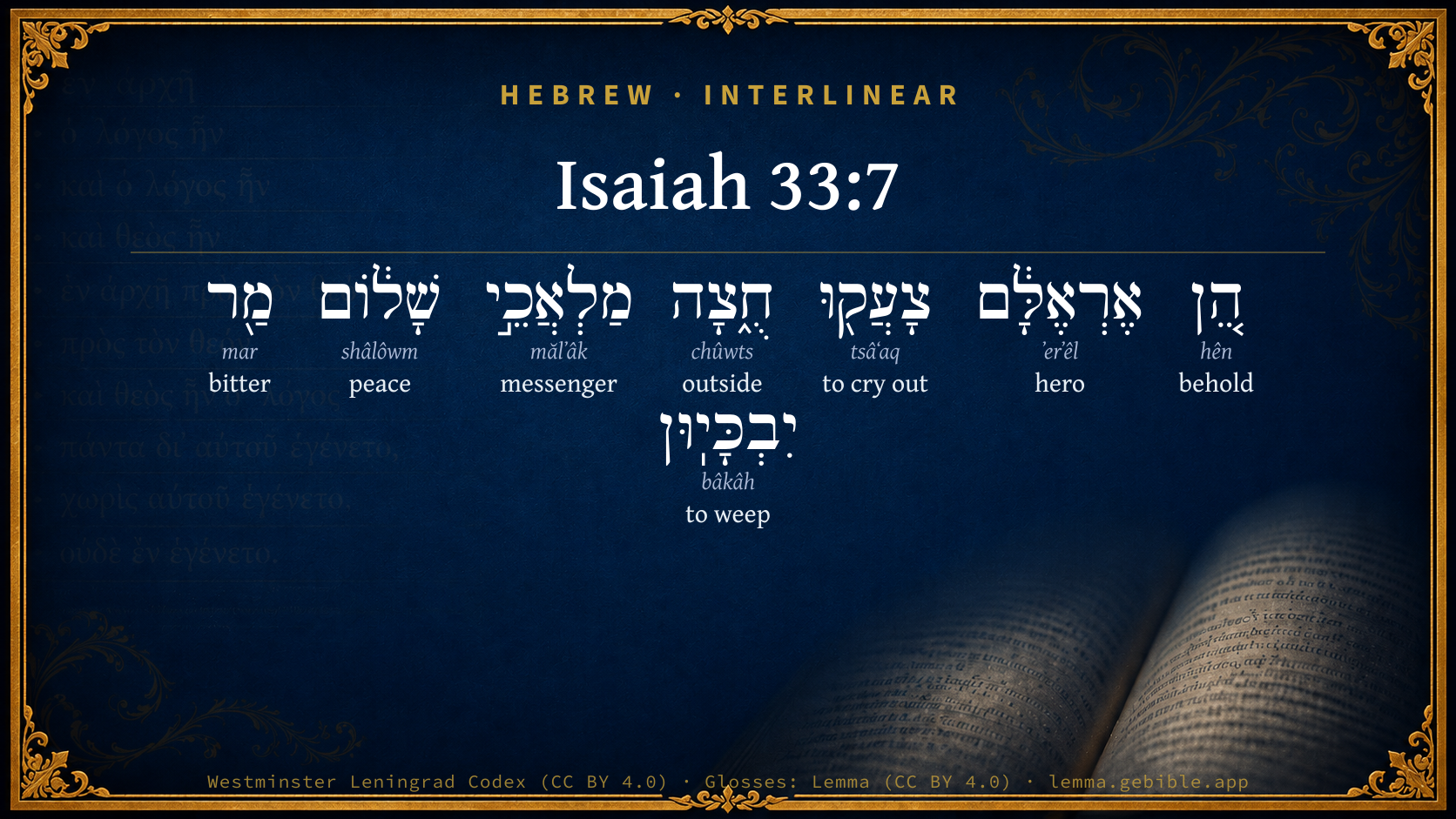
Hebrew (Westminster Leningrad Codex) Isaiah 33:7 appears in the Hebrew Old Testament. The text above is from the Westminster Leningrad Codex. Each word links to its Strong’s number, a concise gloss, and parsing drawn from the Open Scriptures Hebrew Bible morphology. Click any word for its full Brown-Driver-Briggs (BDB) entry.
Download image
Cite this verse

Isaiah 33:7 (World English Bible). Public Domain. Lemma interlinear Bible study tool, https://lemma.gebible.app/v/isaiah/33/7.

Show BibTeX & RIS
BibTeX
RIS
English Translation
Behold, their valiant ones cry outside; the ambassadors of peace weep bitterly.
World English Bible · Public Domain
Highlights Full analysis ↓
Download a study sheet

One document with this verse’s original text, its word-by-word gloss line, the meaning frame, cross-references with their text, attributed commentary, and full source and license credits — printable, and it pastes into notes with its structure intact.

This verse Autodidact and up

Study sheet (.html) Plain text (.txt)

A passage Seminary Student

Up to 50 verses in one chapter. A passage sheet keeps up to 6 commentary sources and 12 cross-references per verse, in the order this page ranks them, and says so on the sheet whenever that leaves anything out. Ask for a single verse and you get the Autodidact verse sheet above.

Everything on this page stays free to read, with no account — the sheet is a download of what is already on screen, not access to it.

Want to remove ads? Support Godless Engineer
Compare translations 3

The same verse in 3 English versions, stacked beneath the original-language interlinear above. Click any original word for its lexicon entry.

Each is an independent rendering of the whole verse — the interlinear is not word-aligned to these translations.

Highlighted words mark where these versions differ — a whole-verse word diff, not a word-by-word alignment.

  • World English Bible Public Domain
    Behold, their valiant ones cry outside; the ambassadors of peace weep bitterly.
  • King James Version Public Domain
    Behold, their valiant ones shall cry without: the ambassadors of peace shall weep bitterly.
  • unfoldingWord Literal Text CC BY-SA 4.0
    Behold, their warriors cry outside; the messengers of peace weep bitterly.

unfoldingWord Literal Text — © unfoldingWord, licensed CC BY-SA 4.0. Word-aligned USFM3 via Door43 (git.door43.org/unfoldingWord/en_ult).

Versions to compare (up to 4)

3 of 4 selected

Show all 18 translations

Every available English version of this verse, each an independent rendering of the whole verse.

  • World English Bible Public Domain
    Behold, their valiant ones cry outside; the ambassadors of peace weep bitterly.
  • Berean Standard Bible Public Domain
    Behold, their valiant ones cry aloud in the streets; the envoys of peace weep bitterly.
  • Majority Standard Bible Public Domain
    Behold, their valiant ones cry aloud in the streets; the envoys of peace weep bitterly.
  • King James Version Public Domain
    Behold, their valiant ones shall cry without: the ambassadors of peace shall weep bitterly.
  • American Standard Version (1901) Public Domain
    Behold, their valiant ones cry without; the ambassadors of peace weep bitterly.
  • Revised Version (1885) Public Domain
    Behold, their valiant ones cry without: the ambassadors of peace weep bitterly.
  • Geneva Bible (1599) Public Domain
    Behold, their messengers shall cry without, and ye ambassadours of peace shall weepe bitterly.
  • Douay-Rheims (1899) Public Domain
    Behold they that see shall cry without, the angels of peace shall weep bitterly.
  • Young's Literal Translation Public Domain
    Lo, `Their Ariel,' they have cried without, Messengers of peace do weep bitterly.
  • Literal Standard Version CC BY-SA 4.0
    Behold, “Their Ariel,” they have cried outside, || Messengers of peace weep bitterly.
  • Unlocked Literal Bible CC BY-SA 4.0
    Look, their envoys cry in the streets; the diplomats hoping for peace weep bitterly.
  • unfoldingWord Literal Text CC BY-SA 4.0
    Behold, their warriors cry outside; the messengers of peace weep bitterly.
  • Darby Bible Public Domain
    Behold, their valiant ones cry without; the messengers of peace weep bitterly.
  • World Messianic Bible Public Domain
    Behold, their valiant ones cry outside; the ambassadors of peace weep bitterly.
  • Webster's Bible Public Domain
    Behold, their valiant ones shall cry without: the embassadors of peace shall weep bitterly.
  • Free Bible Version CC BY-SA 4.0
    But look! Even your bravest soldiers are crying loudly in the street; the messengers you sent to ask for peace are weeping bitterly.
  • Bible in Basic English Public Domain
    See, the men of war are sorrowing outside the town: those who came looking for peace are weeping bitterly.
  • JPS Tanakh (1917) Public Domain
    Behold, their valiant ones cry without; the ambassadors of peace weep bitterly.

Literal Standard Version (2020), Covenant Press — licensed CC BY-SA 4.0. Text via the HelloAO Bible API (eBible.org). Unlocked Literal Bible (unfoldingWord) — licensed CC BY-SA 4.0. Text via the HelloAO Bible API (eBible.org). unfoldingWord Literal Text — © unfoldingWord, licensed CC BY-SA 4.0. Word-aligned USFM3 via Door43 (git.door43.org/unfoldingWord/en_ult). Free Bible Version, Dr. Jonathan Gallagher — licensed CC BY-SA 4.0. Text via the HelloAO Bible API (eBible.org).

Word by word

More ways to search: Search by grammar → Find every occurrence → Compare this word →

Practice this passage: Drill this verse → Learn its vocabulary →

About this verse

These counts appear in no published source. They are computed here, from the morphology-tagged text and Lemma’s own curated glosses. What Lemma adds →

8
words
8
distinct lemmas
Prophets
section

Notable vocabulary

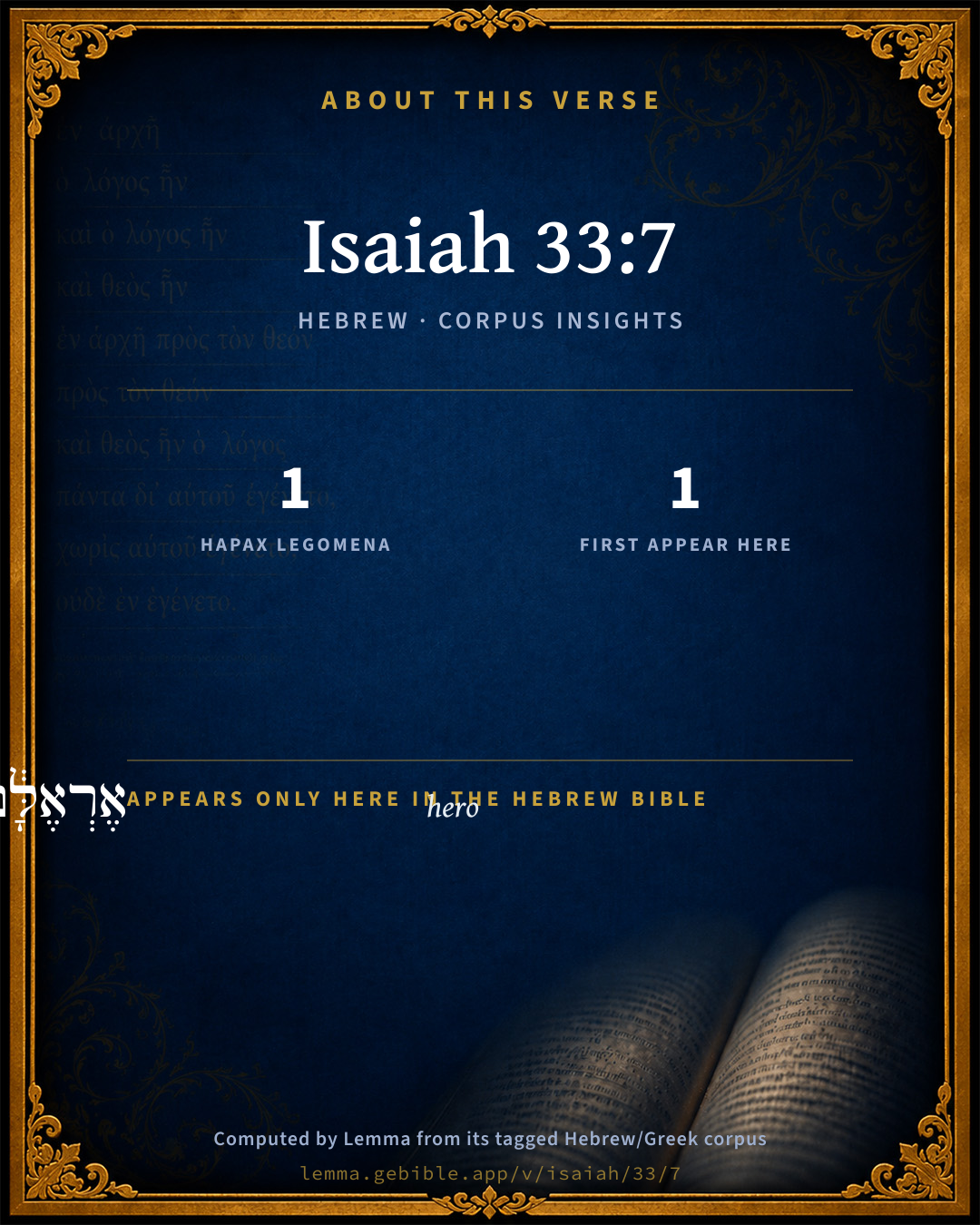
1 hapax legomenon — a word that appears only here in the entire Hebrew Bible:

  • אֶרְאֶלָּ֔ם hero H691

First appearance in Scripture

This word makes its first canonical appearance in the Hebrew Bible here:

  • אֶרְאֶלָּ֔ם hero H691

Shared distinctive vocabulary

מַ֖ר bitter H4751 occurs in 36 verses of the Hebrew Bible. Also found in:

Grammatical profile

  • 2 verbs
  • 4 nouns
  • 1 adjective
  • 1 particle

Verb forms

  • צָעֲק֖וּ Qal · Perfect
  • יִבְכָּיֽוּן Qal · Imperfect

Hebrew & Septuagint length

In English translation the verse runs 12 words from the Hebrew and 29 from the Septuagint (LXX English) — the Septuagint runs noticeably longer here. See the side-by-side →

A rough comparison of the two English renderings, which tokenize alike — not a word-level alignment.

Word counts can differ between the Hebrew and the Greek without any difference in meaning — e.g. the Hebrew direct-object marker אֵת has no separate Greek word, and Greek often adds the article ὁ.

Cross-references

4

Topical passages linked to Isaiah 33:7 in the Treasury of Scripture Knowledge — connected by theme and wording, ordered by reader-vote popularity; previews shown in the World English Bible.

  • 2 Kings 18:18 When they had called to the king, there came out to them Eliakim the son of Hilkiah, who was over the household, and Shebnah the scribe, and Joah the son of Asaph the recorder.
  • 2 Kings 18:37–19:3 Then came Eliakim the son of Hilkiah, who was over the household, and Shebna the scribe, and Joah the son of Asaph the recorder, to Hezekiah with their clothes torn, and told him the words of Rabshakeh.
  • Isaiah 36:22 Then came Eliakim the son of Hilkiah, who was over the household, and Shebna the scribe, and Joah, the son of Asaph, the recorder, to Hezekiah with their clothes torn, and told him the words of Rabshakeh.
  • Isaiah 36:3 Then came forth to him Eliakim the son of Hilkiah, who was over the household, and Shebna the scribe, and Joah, the son of Asaph, the recorder.

Cross-references courtesy of OpenBible.info (CC BY 4.0).

Hebrew and Greek witnesses Masoretic Hebrew ↔ Greek Septuagint

The same verse in the two great witnesses to the Old Testament, shown verse-for-verse.

Here the Septuagint runs noticeably longer than the Hebrew — LXX2012 (modern English Septuagint) 29 words vs World English Bible 12. A rough length comparison of the two English translations, not a word-level alignment — read both below.

These are two independent witnesses, not word-aligned to each other, and the Septuagint is shown in lemma (dictionary) form.

Hebrew Isaiah 33:7 Masoretic · Westminster Leningrad Codex

הֵ֚ן אֶרְאֶלָּ֔ם צָעֲק֖וּ חֻ֑צָה מַלְאֲכֵ֣י שָׁל֔וֹם מַ֖ר יִבְכָּיֽוּן

Behold, their valiant ones cry outside; the ambassadors of peace weep bitterly.

World English Bible · Public Domain

Greek LXX Isaiah 33:7 Septuagint · lemma form

ἰδού δή ἐν ὁ φόβος σύ αὐτός φοβέω ὅς φοβέω φοβέω ἀπό σύ ἄγγελος γάρ ἀποστέλλω ἀξιόω εἰρήνη πικρῶς κλαίω παρακαλέω εἰρήνη

Behold now, these shall be terrified with fear of you: those whom you⌃ feared shall cry out because of you: messengers shall be sent, bitterly weeping, entreating for peace.

LXX2012 (modern English Septuagint) · Public Domain

On this verse, Albert Barnes' Notes on the Bible discusses the Septuagint’s reading. Read the note in Commentary ↓

Hebrew: Westminster Leningrad Codex (CC BY 4.0). Greek: Septuagint (public domain); English from LXX2012 (modern English Septuagint) (Public Domain). How the Septuagint differs from the Hebrew →

Targum (Aramaic paraphrase)

1

The Targum is the ancient Jewish Aramaic paraphrase of the Hebrew Scriptures — an interpretive translation, not the Hebrew text itself. Onkelos (literal) and Pseudo-Jonathan (expansive) render the Torah, and Jonathan the Prophets. Coverage is partial: where no permissively-licensed English translation exists for a verse, only the Aramaic is shown. This is verse-level text, not a word-by-word alignment to the Hebrew.

  1. Targum Jonathan Prophets (Joshua–Malachi)
    הָא כַּד אִתְגְלֵי לְהוֹן יְצַוְחוּן בִּמְסַר אִיזְגַדֵי עַמְמַיָא דַאֲזָלוּ לְבַסָרָא שְׁלָם תָּבוּ לְמֶהֱוֵי בָכָן בִּמְרִיר נְפָשׁ:

    When Thou shalt reveal Thyself to them, the messengers of the nations shall cry bitterly in the street; those who had gone forth to proclaim peace, shall return to weep in the bitterness of soul.

    Targum Jonathan — Aramaic: “Mikraot Gedolot” (public domain). English: “Sefaria Community Translation” (CC0 1.0 (public-domain dedication)); “London "Chaldee Paraphrase," 1871” (public domain). Text via Sefaria.

Commentary

Notes on Isaiah 33:7 from classic Christian and Jewish commentators (each source and its license shown beneath its notes). The classic Christian expositions comment on the surrounding passage and are grouped to its opening verse, so a note may address several verses; the Jewish commentaries on the Tanakh (Rashi and others) are per-verse, so they appear only where the commentator wrote on this verse.

Lemma curates 59 commentaries, every one of them public domain or Creative Commons licensed, each selected and text-cleaned for this edition rather than reprinted as found. About our sources →

Trapp's Complete Commentary

John Trapp

Isa 33:7 Behold, their valiant ones shall cry without: the ambassadors of peace shall weep bitterly.

Ver. 7. Behold their valiant ones.] Or, Their heralds, messengers. Heb., Hen Erelam, behold their Erel, or their Ariel {Isa 29:1-2} - that is, their altar, shall they (i.e., the Assyrians) cry without, sc., in mockery, twitting the Jews with their sacrifices as no way profitable to them. So the profane Papists, when they murdered the poor Protestants at Orleans, sang in scorn, Judge and revenge my cause, O Lord. Others, Have mercy on us, Lord. And when in the late persecution in Bohemia various godly nobles and citizens were carried to prison in Prague, the Papists insultingly cried after them, Why do ye not now sing, "The Lord reigneth?" {a}

The ambassadors of peace.] That went for peace, having for their symbol Pacem te poscimus omnes, We all demand peace from you, but could not effect it.

Weep bitterly.] So that they might be heard before they entered the city. Vide quam vivide, See here how lively things are set forth, and what a lamentable report these ambassadors make of the state of the country, and the present danger of losing all.

{a} Mr Clarke’s Eng. Martyrol.

John Trapp, A Commentary or Exposition upon All the Books of the Old and New Testament (1647–1656) — public domain. Text from a community e-Sword module.

Albert Barnes' Notes on the Bible

Behold - This verse introduces a new subject by a very sudden transition. It is designed, with the two following, to exhibit the desolation of the land on the invasion of Sennacherib, and the consternation that would prevail. For this purpose, the prophet introduces Isa 33:7 the ambassadors who had been sent to sue for peace, as having sought it in vain, and as weeping now bitterly; he represents Isa 33:8 the desolation that abounded, and the fact that Sennacherib refused to come to any terms; and Isa 33:9 the extended desolations that had come upon the fairest portions of the land.

Their valiant ones - The ‘valiant ones’ of the Jews who had been sent to Sennacherib to obtain conditions of pence, or to enter into a negotiation with him to spare the city and the nation. The word which is rendered here ‘valiant ones’ (אראלם 'ere'elâm) has given great perplexity to expositors. It occurs nowhere else in the Scriptures. The Septuagint renders the verse, ‘With the dread of you shall they be terrified; they, of whom you have been afraid, will, for fear of you, raise a grievous cry.’ Jerome renders it, ‘Behold, they seeing, cry without,’ as if the word was derived from ראה râ'âh, to see. The Chaldee renders it, ‘And when it shall be revealed to them, the messengers of the people who went to announce peace, shall cry bitterly.’ The Syriac, ‘If he shall permit himself to be seen by them, they shall weep bitterly.’ Symmachus and Theodotion render it, Ἰδοὺ ὀφθήσομαι αὐτοῖς Idou ophthēsomai autois - ‘Lo, I will appear to them.’ So Aquila, Ὁραθήσομαι αὐτοῖς Horathēsomai autois. Most or all the versions seem to have read it as if it were compounded of לם אראה 'ere'eh lm - ‘I will appear to them.’ But probably the word is formed from אראל 'ăre'el, the same as אריאל 'ărı̂y'êl (Ariel), ‘a hero’ (see the note at Isa 29:1), and means “their hero” in a collective sense, or their heroes; that is, their men who were distinguished as military leaders, and who were sent to propose terms of peace with Sennacherib. The most honorable and valiant men would be selected, of course, for this purpose (compare the note at Isa 30:4), but they had made the effort to obtain peace in vain, and were returning with consternation and alarm.

Shall cry without - They would lift up their voice with weeping as they returned, and publicly proclaim with bitter lamentation that their efforts to obtain peace had failed.

The ambassadors of peace - When Sennacherib invaded fife land, and had advanced as far as to Lachish, Hezekiah sent messengers to him with a rich present, having stripped the temple of its gold, and sent him all the silver which was in his treasury, for the purpose of propitiating his favor, and of inducing him to return to his own land 2Ki 18:14-16. But it was all in vain. Sennacherib sent his generals with a great host against Jerusalem, and was unmoved by all the treasures which Hezekiah had sent to him, and by his solicitations for peace 2Ki 18:17. It was to the failure of this embassy that Isaiah refers in the passage before us.

Albert Barnes' Notes on the Bible (1834–1885) — public domain. Text from a community e-Sword/MySword module.

The Biblical Illustrator

Joseph S. Exell

Isa_33:7

The ambassadors of peace shall weep bitterly

The weeping ambassadors

Tell me not of the removal of statesmen, the falling of generals or admirals in warfare, the removal of princes or monarchs from palaces and thrones--all these may take place and leave, comparatively, no chasm in society, when contrasted with the removal of an ambassador for Jesus.

I. WHAT ARE WE TO UNDERSTAND BY AMBASSADORS OF PEACE? An ambassador of peace must come under a threefold description of character.

1. He is a minister sent of God.

2. He is instructed in the terms of peace.

3. He has to negotiate with sinners who are at war with God.

II. THE LAMENTATION PREDICTED CONCERNING THESE AMBASSADORS. They shall weep bitterly. Not the departed one, but the surviving ones.

1. Because of the impression which they have of the loss of their brother.

2. For sympathy with the Church.

III. THE LIMITATION OF THEIR SORROW. We are not to sorrow as those who are without hope.

1. The election of grace is sure.

2. The redemption of the Church by Christ Jesus is complete.

3. The succession of the ambassadors of peace remains unbroken. (J. Irons.)

Ministers weeping over non-success

The ambassadors of Hezekiah wept bitterly because their embassy was rejected, and because they were sent back by the haughty and imposing invader without accomplishing their object of peace. And very few form any ideas of the deep anxieties, the soul-travail, the spiritual concern, of Gods ambassadors when they see not, as the result of their embassy, the message they have delivered received by precious souls. (J. Irons.)

The Biblical Illustrator, edited by Joseph S. Exell (c. 1880s–1900s) — public domain. Text from a community e-Sword module.

Joseph Benson's Commentary

Isa 33:7-9. Behold, &c. — That the mercy here promised might be duly appreciated and magnified, he gives a lively representation of the great danger and distress in which it found them. Their valiant ones — “Three MSS.,” says Bishop Lowth, “read אראלים, lions of God, or strong lions; so they called valiant men, heroes; which appellation the Arabians and Persians still use.” The Hebrew doctors, however, understand by the word, their heralds, or messengers, namely, those whom Hezekiah sent to treat with the Assyrian commissioners, 2Ki 18:18. Shall cry without — Through grief and fear: the ambassadors of peace — Whom Hezekiah sent to beg peace of the Assyrian; shall weep bitterly — Because they cannot obtain their desire. The wayfaring man ceaseth — Because the Assyrian soldiers possessed and filled the land. He hath broken the covenant — Sennacherib broke his faith given to Hezekiah, of departing for a sum of money, 2Ki 18:14; 2Ki 18:17. He hath despised the cities — The defenced cities of Judah, which he contemned and easily took. He regardeth no man — Either to spare, or to fear, or keep faith with him. He neither feareth God nor reverenceth man. The earth mourneth, &c. — Being desolate and neglected. Lebanon is hewn down — By the Assyrians. Or, as קמלrather signifies, and is here rendered by some withereth, or languisheth, because its trees are spoiled and destroyed by the Assyrians. Sharon is like a wilderness — Although before it was a pleasant and fruitful place. Bashan and Carmel shake off their fruits — Are spoiled of them. These two places, eminent for fertility, and especially for good pastures, are here put for all such places.

Joseph Benson's Commentary on the Old and New Testaments (1811–1818) — public domain. Text from a community e-Sword module.

The Preacher's Complete Homiletical Commentary

Joseph S. Exell (gen. ed.)

GOD AVENGING HIS OWN ELECT

Isa_33:7-12 Behold, their valiant ones shall cry without, &c.

I. A PICTURE OF DESOLATION.

The picture has two distinct points of interest—

1. Man (Isa_33:7). Desolation receives nowhere so strong and pathetic expression as in the strong cries and tears of a man. The purer and nobler the man, so much the more affecting is it to hear his despairing cry and look upon his tears. The child cannot bear to see his father weep, because his father is to him the ideal man. Eliakim’s grief, on returning from the interview with Rabshakeh, would be more grievous to Hezekiah than Shebna’s. Peter’s repentant tears were bitter; but by the cry of the Christ, “Eloi! lama sabacthani?” and His tears at the grave of Lazarus, we are much more affected.

2. Nature (Isa_33:8-9). The world is partly bright and beautiful, because noble men of God dwell in it; Nature reflects and interprets man. The Assyrian invader weighed heavily on Jewish hearts (Isa_36:22, Isa_37:1) and the Jewish land.

II. THE REDRESSER OF WRONG.

“Now will I rise, saith the Lord,” &c.

1. God rules the world in the interests of His people. “Now will I rise.” Democrats are fond of saying, “The Queen may reign, but she does not govern;” but the reins of government are firmly held by the great I Amos

2. God’s interposition comes at the right moment: “Now will I rise.” Man’s extremity is often God’s opportunity; because not until his case is desperate, will he cast himself unreservedly upon God. So man often retards the arrival of the right moment. Meanwhile the innocent (comparatively) suffer for the guilty, the good for the bad, the just for the unjust. If it is the teaching of Scripture that God’s people are “the salt of the earth,” preserving it from destruction, it is no less the doctrine of the Bible that untold sorrows are to the righteous because they dwell on the earth with the wicked. The Isaiahs and Hezekiahs of the world feel something of the weight of the world’s sin. But there is always a “thus far and no farther.” “Now will I rise, saith the Lord.”

III. THE DESOLATOR DESOLATED.

Cf. Luk_18:8; Isa_42:1. The greater wickedness is employed by God to be the scourge of the less, until its own time comes to be scattered as chaff, and destroyed as fire destroys (Isa_33:11-12). To one whose “eyes are in his head,” it is sad to hear the ambassador of Sennacherib saying, “The Lord said unto me, Go up against this land and destroy it.” In the midst of this judgment of God—in which the righteous suffer most—meted out instrumentally by wicked hands, we do well to remember the words of Christ: “Knowest thou not, said Pilate to Him, that I have power to release thee? Jesus answered, Thou couldest have no power at all against Me, except it were given thee from above.”

Note that where the avenging is pictured in this passage, the two sides spoken of in the former part of it—man and nature—are summed up in the terrible destruction of the human. So terrible is this, that a burning world is lost sight of! The first picture of desolation is as nothing to the second; and the woe is seen to reach its intensity in this regard.—J. Macrae Simcock.

The Preacher's Complete Homiletical Commentary (gen. ed. Joseph S. Exell; Funk & Wagnalls, c. 1892) — public domain (pre-1929). A full-Bible homiletical/sermon-outline anthology covering 65 of 66 books (2 John is absent from the source module). Text from a community e-Sword module.

Lange's Commentary on the Holy Scriptures

3. WHERE NEED IS GREATEST HELP IS NEAREST

Isa_33:7-12

7          Behold, their 7valiant ones shall cry without:

The ambassadors of peace shall weep bitterly.

8     The highways lie waste,

The wayfaring man ceaseth:

He hath broken the covenant, he hath despised the cities,

He regardeth no man.

9     The earth mourneth and languisheth:

Lebanon is ashamed and 8 hewn down:

Sharon is like a wilderness;

And Bashan and Carmel shake off their fruits.

10     Now will I rise, saith the Lord;

Now will I be exalted;

Now will I lift up myself.

11     Ye shall conceive chaff, ye shall bring forth stubble:

Your breath, as fire, shall devour you.

12     And the people shall be as the burnings of lime:

As thorns cut up shall they be burned in the fire.

TEXTUAL AND GRAMMATICAL

Isa_33:7. The LXX. have somehow derived אראלם from יָרֵא “to be afraid,” for they translate: “ἔν τᾡ φοβῳ ὑμῶν αὐτοὶ φοβηθήσονται” The other ancient versions refer the word to ראה. Thus the Vulg. ecce videntes clamabunt foris. Symm. and Theod. “ὀφθήσομαι αὐτοῖς” Aquila:ὁραθήσομαι. It appears that they read אֶרְאֶלָּם as if it were אֵרָאֶלָּם (syncopated from אֵרָאֶה לָּהֶם, like מַלַּכֶם from מַה לָּכֶם). Similarly the Chald. and Syr. (comp. Gesen. in loc). But these derivations and explanations are ungrammatical and do not suit the context. In 2Sa_23:30 אֲרִיאֵל seems to serve as designation for heroes, and in fact as nom. propr. though still retaining its fundamental appellative meaning, since it reads there שְׁנֵי אֲרִיאֵל and not אֲרִיאֵלִים or אֲרְיִיִ אֵל. But from אֲרִיאֵל may be derived either אַרְאֵל (like אַבְנֵר from אֲבִינֵר 1Sa_14:50), and this form underlies the patronymic אַרְאֵלִי (Gen_4:16; Num_26:17); or אֶרְאֵל like e.g., אֶבְיָסָף (1Ch_6:8; 1Ch_6:22) from אֲבִיאָסָף (Exo_6:24), אֶבְיָתָר from אֲבִי יָתָר (1Sa_22:20 sq., etc.). From אֶרְאֵל comes our present word. אֲרִיאֵל=“God’s lion,” i.e., hero, a designation that occurs also in the Arabic and Persian (comp. asadallah and schir-choda. Bochart Hieroz. II., p. 7, ed. Rosenmueller, and Gesen. Thes., p.147). But this does not explain the daghesh forte in the ל. I would side with those that read אַרְאֵלִם or אַרְאֵלִם or אַרְאֵלָם, as eight codices actually have אַרְאֵלִים. Taking אֶרְאֵלָם as the mean between the Masoretic reading and what is otherwise demanded, we must in addition construe it as collective (ihre Heldenschaft).—מַר (comp. Isa_5:20; Isa_38:15; Isa_38:17) is as accusative to be regarded as dependent on יבכיון: “they weep bitterness,” i.e., bitter tears (comp. Zep_1:14).—The form יבְכָּיוּן occurs again only Job_31:38; comp. Isa_21:12; Isa_31:3.

Isa_33:8. מָאַם with following accusative Job_9:21; with בְּ, Jdg_9:38; Job_19:18. Comp. Psa_89:39, where מָאַם is used in the same sense as זָנַח.

Isa_33:9. אָבַל in the masculine as a prepositive and remote predicate. Comp. Isa_24:4; Isa_24:7; Isa_26:8; Isa_19:8.—החפיר, direct causative Hiphil=pudorem producit. Isa_54:4.—קָמַל only again Isa_19:6. Pattahh in pause, Gr. § 65 a.

Isa_33:10. אֵרוֹמָם stands for אֶתְרוֹמָם, see Green’s Gr., § 82,5 a.

Isa_33:11. הָרָה with the accusative of fulness: comp. Isa_59:4; Psa_7:15.—חֲשַׁשׁ see Isa_5:24.—קַשׁ see Isa_5:24;Isa_41:2; Isa_47:14.

Isa_33:12. קוצים comp. on Isa_32:13.—כָּסַח is desecare, abscindere: the word only here in Isaiah. Comp. Psa_80:17.—יצַּתּוּ, comp. Isa_9:17; Jer. 41:58; Jer_49:2, Green’s Gram., § 24, c, 149, 1.

EXEGETICAL AND CRITICAL

1. The second wave-circle. It is broader as to I extent than the foregoing, but as regards intensity it is narrower. For it issues from the same point as the first, but extends only to the eve of the saving act. The distress occasioned by the hostile Assyrian is portrayed concretely and visibly, and just as visibly then do we see the Lord, as it were provoked by the intolerable distress, come to the rescue. A respectable embassy that Hezekiah had sent with a ransom had returned without accomplishing anything (Isa_33:7). They could only say that the Assyrian had indeed accepted the ransom, but spite of that ravaged the land (Isa_33:8-9). This is the overweening בָּגַד spoken of in Isa_33:1. Then Jehovah declares that now He will arise against the enemy (Isa_33:10). He threatens them that their plan shall come to naught, yea that it shall turn to their own destruction (Isa_33:11), and that they shall burn up like limestone, yea like dry brushwood (Isa_33:12).

2. Behold their valiant ones—burned with fire.

Isa_33:7-12. By צעקו and יבכיון the Prophet intends to express contrasts. Heroes raise a loud cry of lament; messengers of peace, that should bring and feel joy, weep. Almost all commentators agree that the Prophet means by these heroes and messengers of peace the ambassadors that Hezekiah sent to the Assyrian king to Lacish (2Ki_18:14). They were to purchase the withdrawal of the Assyrians at the cost of subjection and a heavy ransom. Both were accepted. But after the prodigious sum of 300 talents in silver and 30 talents in gold was paid, the Assyrians still would not retire, but demanded beside the surrender of the capital. The ambassadors came back with this sad news, that was afterwards confirmed by the message of Rabshakeh, and with news of all the ruin that the Assyrians had wrought in the land. In verses 8, 9 they give information of the condition of the land as they had found it in consequence of these desolations. The roads lay desolate (comp. Jdg_5:20;) passengers along them had ceased (Psa_8:9; Isa_23:2; Lam_1:12; Lam_2:15); there was no commerce over them. He, i.e., the king of Assyria had broken covenant, in that, spite of the ransom he had accepted, he still did not retire, but made further demands. He treated the cities lightly, that is, not he despised them, but he captured them by his superior force that enabled him to make little account of their resistance. The words contain an intimation of the capture of the cities of Judah of which Isa_36:1; 1Ki_18:13; 2Ch_32:1, speak. Moreover he does not regard man; i.e., he sacrifices human life unsparingly (comp. Isa_2:22; Isa_13:17).

To this point the discourse is prose. Now it becomes poetry. For Isa_33:9 the Prophet personifies things of nature. The general notion earth is specified by naming the particular parts distinguished by their vegetation. First Lebanon, to the north of the Holy Land, is named. It is ashamed, withered. Sharon, rich in flowers, the plain between Cæsarea and Joppa, has become like a steppe (Isa_65:10). The two fruitful elevations east and west, Bashan and Carmel, especially noted for their forests (Isa_2:13) autumnlike shake off their leaves (Isa_52:2, comp. Exo_14:27; Psa_136:15). The sad news of the embassy is at an end. It bows the hearts of the Israelites down deep, but for the Lord it is the signal that now has come the moment to interfere. But with Him the interference is bitter earnest. This appears in the three-membered sentence with its thrice repeated self-summons, Isa_33:10. The Lord announces to the Assyrians the vanity of their purpose, yea its ruin to themselves. “Ye shall conceive hay,” i.e., your plans shall be like hay; not fresh, full of life, but utterly dry, without strength or sap; and hence when they come to the light they shall prove to be dry, dead stubble. That they shall prove their own destruction the Prophet expresses by saying: your puffing (comp. Isa_45:4; Isa_30:28) shall be a fire to devour you (Isa_1:31; Isa_9:17). This is characterized by a two-fold image (Isa_33:12). The first is burning lime. Water poured on lime causes it to sink away without flame (comp. Jer_34:5; Deu_27:2; Deu_27:4; Amo_2:1). But thorns burn with a bright flame, a loud crackling and much smoke. It seems to me the Prophet would say that, in the overthrow of the Assyrians, many nations would disappear in the great conflagration unnoticed and leaving no trace, whereas the fall of others (he means, doubtless, the greater and better known) will make the world wonder at the grand spectacle they present.

Footnotes:

[7]Or, messengers.

[8]Or, withered away.

Lange's Commentary on the Holy Scriptures (Critical, Doctrinal, and Homiletical), ed. John Peter Lange, English translation edited by Philip Schaff (1864–1880) — public domain. Text from a community e-Sword module.

Geneva Bible (1599)

Geneva Bible translators

Whom they of Jerusalem sent to entreat of peace.

Sent from Sennacherib.

Geneva Bible (1599) marginal notes — public domain. Text via Bolls.life.

Jamieson, Fausset & Brown

Robert Jamieson, A. R. Fausset & David Brown

From the vision of future glory Isaiah returns to the disastrous present; the grief of "the valiant ones" (parallel to, and identical with, "the ambassadors of peace"), men of rank, sent with presents to sue for peace, but standing "without" the enemy's camp, their suit being rejected (Kg2 18:14, Kg2 18:18, Kg2 18:37). The highways deserted through fear, the cities insulted, the lands devastated.

cry-- (Isa 15:4).

Jamieson, Fausset & Brown — Commentary Critical and Explanatory on the Whole Bible (1871) — public domain (CC PDM 1.0). Text via the HelloAO Bible API.

Adam Clarke's Commentary

Verse 7. Their valiant ones shall cry without - "The mighty men raise a grievous cry"] Three MSS. read אראלים erelim, that is, lions of God, or strong lions. So they called valiant men heroes; which appellation the Arabians and Persians still use. See Bochart. Hieroz. Part I. lib. iii. cap. 1. "Mahomet, ayant reconnu Hamzeh son oncle pour homme de courage et de valeur, lui donne le titre ou surnom d'Assad Allah, qui signifie le lion de Dieu." D'Herbelot, p. 427. And for חצה chatsah, the Syriac and Chaldee, read קשה kashah, whom I follow. The Chaldee, Syriac, Aquila, Symmachus, and Theodotion read אראה להם ereh lahem, or יראה yireh, with what meaning is not clear.

The word אראלם erellam, which we translate valiant ones, is very difficult; no man knows what it means. Kimchi supposes that it is the name of the angel that smote the Assyrian camp! The Vulgate, and my old MS., translate it seers; and most of the Versions understand it in this way. None of the MSS. give us any help, but as we see above in Lowth.

Adam Clarke's Commentary on the Bible (1810–1826) — public domain. Text from a community e-Sword/MySword module.

Ellicott's Commentary for English Readers

(7) Behold, their valiant ones.—Literally, their lions of God. Heb., Arielam, probably with a reference to the “Ariel” of Isa_29:1, the lion-like heroes of the lion-like city. (Comp. 2Sa_23:20; 1Ch_11:22.) The whole passage paints the panic caused by the approach of Sennacherib.

The ambassadors of peace.—The envoys sent by Hezekiah to Sennacherib at Lachish. They “weep bitterly” at the hard conditions imposed on them, which may be either those of 2Ki_18:14, or some yet harder terms, demanding the surrender of the city.

A Bible Commentary for English Readers, edited by Charles John Ellicott (1878–1897) — public domain. Text from a community e-Sword module.

The Cambridge Bible for Schools and Colleges

gen. ed. J. J. S. Perowne

7. their valiant ones] This word is hopelessly obscure. It is usually translated “God’s lions,” i.e. ‘picked warriors, each as fierce as a lion and as invincible as his God’ (Cheyne: see on Isa_29:1, and cf. 2Sa_23:20; 1Ch_11:22); and this is probably the sense intended by E.V. Another suggestion is that it is a gentilic name, meaning “inhabitants of Ariel.” It is impossible to get beyond conjecture. The reading of the text (’er’ellâm) appears to rest on a false etymology. It should probably be pointed as a simple plural, ’ar’çlîm or (if necessary) ’ǎrî’çlîm. The verbs shall cry and shall weep should both be translated as presents (R.V.).

the ambassadors of peace (omit shall) weep bitterly] Cf. ch. Isa_22:4. Taken in connexion with the last half of Isa_33:8, these words seem to point to the conclusion of a treaty of peace, which had been shamelessly violated by the enemy. Those immediately responsible for the arrangement are naturally loudest in their expression of dismay. We have no certain knowledge of such negotiations between Hezekiah and Sennacherib, although such an incident might very well have happened then.

7–9. For a moment the prophet’s faith seems to relax its hold on the great principles he has enunciated, as he turns to contemplate the misery and desolation of the present. But in reality this is an additional plea for the Divine intervention, to be followed by the exultant outburst of Isa_33:10-13.

The Cambridge Bible for Schools and Colleges (gen. ed. J. J. S. Perowne; Cambridge University Press, 1878–1918) — public domain. Text from a community e-Sword module.

John Gill's Exposition

Behold, their valiant ones shall cry without,.... Or, "in the street": this, and the two following verses Isa 33:8, describe the sad and desolate condition of the people of God, before the above happy times take place; "their valiant ones", such who have been valiant for the truth on earth; or "their angels", as Aben Ezra, Kimchi, and Ben Melech interpret the word; these are the angels and pastors of the churches, the two witnesses that prophesy in sackcloth openly and publicly, and who will be slain, and their bodies lie unburied in the street of the great city, Rev 11:3,

the ambassadors of peace shall weep bitterly; most interpreters understand this of the ambassadors which Hezekiah sent to the king of Assyria to obtain peace, but could not succeed, on account of which they are said to weep bitterly; but the character of "ambassadors of peace" well agrees with the ministers of the Gospel, who are "ambassadors" in Christ's stead, and whose work it is to exhort men to "be reconciled to God", and to preach the Gospel of peace to sinful men; these now will "weep bitterly", when they are removed into corners, and are silenced, and not suffered to deliver their messages of peace, to the comfort of the Lord's people, and the glory of his name; which will be the case at the time of the slaying of the witnesses.

John Gill's Exposition of the Whole Bible (1746–1763) — public domain (CC PDM 1.0). Text via the HelloAO Bible API.

Haydock's Catholic Bible Commentary

Without. The people of the country, and the envoys of Ezechias, 4 Kings xviii. 14. Hebrew, "Behold their Ariel, cried they without," insultingly, (Calmet) pointing at Jerusalem, chap. xxix. 1. At which (Haydock) the envoys rent their garments, &c., chap. xxxvi. 22. (Calmet) --- "Behold I shall appear to them." (Aquila) (St. Jerome) --- Angels. Messengers or deputies sent to negotiate a peace, (Challoner) who wept because they could not obtain it. (Worthington)

George Leo Haydock (1774–1849), Haydock's Catholic Family Bible and Commentary, 1859 edition — public domain. Excludes Psalms (Douay-Rheims chapter numbering differs from Protestant) and Deuterocanonical books (Catholic canon only).

Matthew Poole's English Annotations

Behold: that the mercy here promised might be duly magnified, he makes a lively representation of their great danger and distress, in which it found them.

Their valiant ones; or, their heralds or messengers, as the Hebrew doctors expound the word: either,

1. Those whom the king of Assyria sent to Jerusalem, 2Ki 18:17. Or rather,

2. Those whom Hezekiah sent to treat with the Assyrian commissioners, 2Ki 18:18, as the next clause showeth.

Shall cry without, through grief and fear.

The ambassadors of peace, whom he shall send to beg peace of the Assyrian, shall weep bitterly, because they cannot obtain their desires.

Matthew Poole's English Annotations on the Holy Bible (1683–1685) — public domain. Text from a community e-Sword/MySword module.

Whedon's Commentary on the Bible

Daniel D. Whedon

7. Notwithstanding the great occasion looked for in the choral strain above, there is occasion also for grief.

Their valiant ones — The lion-like heroes, messengers sent to Sennacherib or his officers (see 2Ki_17:14) with the silver and the gold demanded as condition of peace, but which availed nothing with the truce-breaker. These deplore the state of things that would follow, namely, Jerusalem’s destruction, to all earthly view most probable.

Daniel D. Whedon (gen. ed.), Commentary on the Old and New Testaments (1874–1909) — public domain. Text from a community e-Sword module.

The Pulpit Commentary

Vers. 7-12. THE PROPHET ENTERS FURTHER INTO PARTICULARS. Having "sketched the main outlines of his revelation," Isaiah proceeds to "fill in and apply the details" (Cheyne). He first describes the despair and low condition of Judah: the men of war wailing aloud; the ambassadors just returned kern Laehish weeping at the ill success of their embassy; all travelling stopped; the land wasted and made a desert; the Assyrians still ravaging and destroying, despite the peace which had been made. (2Ki_18:14-16) Then suddenly he sees Jehovah rousing himself (ver. 10), and the Assyrians con-stoned, as if with a fire (vers. 11, 12).

Behold, their valiant ones shall cry without. "Their lion-hearts "(Cheyne); "heroes" (Delitzsch). Literally, lions of God. (comp. Isa_29:1) They raise a cry of mourning in the streets, with child-like effusiveness (comp. Herod., 8:99; 9:24). The ambassadors of peace. Hezekiah probably sent several embassies to Sennacherib in the course of the war. One went to Lachish, offering submission, in B.C. 701; (2Ki_18:14) another to Nineveh, with tribute and presents, in the same or the following year. (2Ki_18:15; comp. "Eponym Canon," p. 135) A third probably sought to deprecate Sennacherib"s auger, when he made his second invasion (2Ki_18:17) in B.C. 699(?). These last would seem to be the "ambassadors" of this verse.

Vers. 7-12. The uprising of Jehovah.

I HIS UPRISING IS A FIGURE OF PROVIDENTIAL INTERPOSITION. There are times when he seems to be still, seated, and looking on, and the course of events to defy his will. (Isa_18:4) Men cry, "How long, O Lord? Awake, stir thyself up to deliver!" But he knows his own time; he is not a day too soon, nor too late. When the hour of providence has struck, the scene instantly changes. Now will I rise; now I will lift up myself!" It is not for us to know the times and the seasons. Our part is to tarry, expect, work, and pray.

II GOD UPRISES WHEN MAN IS CAST DOWN. The condition of the land seems hopeless and despairing. The lion-hearted heroes break down in weeping and lamentation, and. the messengers, bewailing the hard conditions of peace, keep them company. The scene is Oriental and passionate. The roads are deserted; the land at the mercy of a perfidious conqueror, who holds his promise in contempt. The land languishing in the wane of the year, and the falling leaves of Bashan and Carmel, seem silently to sympathize with human woe. Yet one word from the Eternal suffices to change the whole situation: it is a word of supreme contempt for all the machinations of man. Their conceptions are as "hay," their pretensions as "stubble," their furious breath as self-devouring fire; and in a great conflagration the people will perish. Worldly passions and worldly might, he that sitteth in the heavens derides; his word abolishes the proud, while it supports the humble. J.

The Pulpit Commentary (1880–1919), ed. H.D.M. Spence-Jones & Joseph S. Exell — public domain. Text from a community e-Sword module.

John Wesley's Explanatory Notes

Behold - That the mercy promised might be duly magnified, he makes a lively representation of their great danger and distress. The ambassadors - Whom he shall send to beg peace of the Assyrian. Shall weep - Because they cannot obtain their desires.

John Wesley, Explanatory Notes Upon the Whole Bible (1754–1765) — public domain. Text via the GEBible commentary corpus.

Keil & Delitzsch

C. F. Keil & F. Delitzsch

The prophet has thus run through the whole train of thought with a few rapid strides, in accordance with the custom which we have already frequently noticed; and now he commences afresh, mourning over the present miserable condition of things, in psalm-like elegiac tones, and weeping with his weeping people. "Behold, their heroes weep without; the messengers of peace weep bitterly. Desolate are roads, disappeared are travellers; he has broken covenant, insulted cities, despised men. The land mourns, languishes; Lebanon stands ashamed, parched; the meadow of Sharon has become like a steppe, and Bashan and Carmel shake their leaves." אראלּם is probably chosen with some allusion to 'Ariel, the name of Jerusalem in chapter 29; but it has a totally different meaning. We have rendered it "heroes," because אראל is here synonymous with אראל in the Nibelung-like piece contained in Sa2 23:20 and Ch1 11:22. This 'ărı̄'ēl, which is here contracted into 'er'el (compare the biblical name 'Ar'ēlı̄ and the post-biblical name of the angels, 'Er'ellı̄m), is compounded of 'arı̄ (a lion) and ‛El (God), and therefore signifies "the lion of God," but in this sense, that El (God) gives to the idea of leonine courage merely the additional force of extraordinary or wonderful; and as a composite word, it contents itself with a singular, with a collective sense according to circumstances, without forming any plural at all. The dagesh is to be explained from the fact that the word (which tradition has erroneously regarded as a compound of להם אראה) is pointed in accordance with the form כּרמל (כרמלּו). The heroes intended by the prophet were the messengers sent to Sennacherib to treat with him for peace. They carried to him the amount of silver and gold which he had demanded as the condition of peace (Kg2 18:14). But Sennacherib broke the treaty, by demanding nothing less than the surrender of Jerusalem itself. Then the heroes of Jerusalem cried aloud, when they arrived at Jerusalem, and had to convey this message of disgrace and alarm to the king and nation; and bitterly weeping over such a breach of faith, such deception and disgrace, the embassy, which had been sent off, to the deep self-humiliation of Judah and themselves, returned to Jerusalem. Moreover, Sennacherib continued to storm the fortified places, in violation of his agreement (on mâ'as ‛arı̄m, see Kg2 18:13). The land was more and more laid waste, the fields were trodden down; and the autumnal aspect of Lebanon, with its faded foliage, and of Bashan and Carmel, with their falling leaves, looked like shame and grief at the calamities of the land. It was in the autumn, therefore, that the prophet uttered these complaints; and the definition of the time given in his prophecy (Isa 32:10) coincides with this. קמל is the pausal form for קמל, just as in other places an ē with the tone, which has sprung from i, easily passes into a in pause; the sharpening of the syllable being preferred to the lengthening of it, not only when the syllable which precedes the tone syllable is an open one, but sometimes even when it is closed (e.g., Jdg 6:19, ויּגּשׁ). Instead of כּערבה we should read כּערבה (without the article), as certain codd. and early editions do.

(Note: We find the same in Zac 14:10, and כּערבים in Isa 44:4, whereas we invariably have בּערבה (see Michlol, 45b), just as we always find בּאבנים, and on the other hand כּבנים.)

Isaiah having mourned in the tone of the Psalms, now comforts himself with the words of a psalm. Like David in Psa 12:6, he hears Jehovah speak. The measure of Asshur's iniquity is full; the hour of Judah's redemption is come; Jehovah has looked on long enough, as though sitting still (Isa 18:4). Isa 33:10 "Now will I arise, saith Jehovah, now exalt myself, now lift up myself." Three times does the prophet repeat the word ‛attâh (now), which is so significant a word with all the prophets, but more especially with Hosea and Isaiah, and which always fixes the boundary-line and turning-point between love and wrath, wrath and love. ארומם (in half pause for ארוממא is contracted from עתרומם (Ges. 54, 2, b). Jehovah would rise up from His throne, and show Himself in all His greatness to the enemies of Israel.

Keil & Delitzsch — Biblical Commentary on the Old Testament (1861–1891) — public domain (CC PDM 1.0). Text via the HelloAO Bible API. (Old Testament only.)

J. A. Alexander on Isaiah

Joseph Addison Alexander

“Behold, their valiant ones cry without; the ambassadors of peace weep bitterly. They fearful cry aloud.” Some here, as in Isa 29:1, give Ariel the sense of altar, but the latest investigations, although still unsatisfactory, tend strongly to confirm the version given in the English Bible. The messengers mentioned in the other clause are probably the three men sent by Hezekiah to Rabshakeh (2Ki 18:18), or perhaps the bearers of the tribute, weeping on account of Sennacherib’s refusal to fulfill his promise. Some suppose them to be called valiant, because they ventured into the enemy’s camp; others because they were probably military chiefs. Their weeping is agreed by all interpreters to be in strict accordance with the ancient usage, as described for example by Homer.

Joseph Addison Alexander, The Prophecies of Isaiah (1846–1847; New York: Scribner, 1870–1878) — public domain. Text from a community e-Sword module.

unfoldingWord translationNotes

Door43 World Missions Community

Look

This word is used here to draw peoples' attention to what is said next. It is also used here to mark a new section in the book. AT: "Listen"

envoys

messengers

the diplomats hoping for peace weep bitterly

This means they weep because they do not succeed in making peace. AT: "the diplomats hope for peace but they do not succeed and so they weep bitterly" (See: Assumed Knowledge and Implicit Information)

The highways are deserted; there are no more travelers

Both of the phrases emphasize that there are no travelers on the highways. These can be combined and stated in active form. AT: "People no longer travel on the highways" (See: Parallelism and Active or Passive)

Covenants are broken, witnesses are despised, and mankind is not respected

This passage may refer to general conditions of corruption in Israel, or it may refer to the nation's inability to make reliable peace treaties with Assyria. This can be stated in active form. AT: "People break covenants that they have made, people ignore the testimony of witnesses, and people do not respect one another" (See: Active or Passive)

translationWords

cry

peace

covenant

testimony

unfoldingWord translationNotes — © Distant Shores Media and the Door43 World Missions Community, licensed CC BY-SA 4.0. Source: git.door43.org/Door43/en_tn.

Rashi

Rabbi Shlomo Yitzchaki (Rashi)

Behold [for] their altar they have cried in the street The prophet was prophesying consolations and saying that the retribution had already been completed, and from now I will rise and exalt Myself to redeem them. Behold for their Arel - that is the altar (see above 29:1) - they have already cried and lamented in their streets and in their squares with weeping and wailing.

ambassadors of peace And the ambassadors whom they send, who were wont to bring tidings of peace, cry bitterly and say, “Highways have become desolate, the wayfarer has stopped.”

Rashi on the Tanakh — English translations: “The Judaica Press complete Tanach with Rashi, translated by A. J. Rosenberg” (CC BY 4.0); “Pentateuch with Rashi's commentary by M. Rosenbaum and A.M. Silbermann, 1929-1934” (public domain); “The Metsudah Tanach series, Lakewood, N.J” (CC BY 4.0); and “The Book of Joshua, Metsudah Publications, 1997” (CC BY 4.0). Text via Sefaria.

Ibn Ezra

Rabbi Abraham ibn Ezra

אראלם According to some their altar; comp. אריאל (29:1); if this were correct, we should have to supply על for, but this explanation is not in accord with the whole context of the chapter. Others say, that אראה להם ═ אראלם I shall see them; this is not probable. I think that it means their messenger, as we may infer from the ambassadors of peace in the second half of the verse. Comp. 2 Sam. 23:20. —All the messengers of the nations, that are desirous of peace, will weep when Assyria has dominion.

Ibn Ezra on the Tanakh — English translations: “Sefaria Community Translation” (CC0 1.0 (public-domain dedication)); “Yalkut, Sifsei Chachomim Chumash, Metsudah Publications, 2009” (CC BY 4.0); and “Commentary of Ibn Ezra on Isaiah - trans. by M. Friedlander, 1873” (public domain). Text via Sefaria.

Lesson kit

Teaching starters — assembled from the data on this page, not authored interpretation. Every prompt links to the verse data it draws on. Edit before teaching.

Isaiah, in the Prophets, opens this verse with 8 words (8 distinct Hebrew lemmas). Its most distinctive word is ʼerʼêl (“hero”). The Greek Septuagint runs longer here. A historical commentator’s framing appears above. Read the whole chapter for the surrounding context.

Discussion questions

  1. The word ʼerʼêl carries the sense “hero.” How does it shape the verse?
  2. This verse holds 1 word here found nowhere else in the Hebrew Bible. What might the rare word draw attention to?
  3. The word “hero” first appears here in Scripture. What is being introduced at this debut?
  4. Genesis 27:34 shares the word «bitter» with this verse. How do the two illuminate each other?
  5. Compared with the Hebrew, the Septuagint runs longer here. What questions does that raise?
  6. These translations render this verse differently; the difference is in the English rendering, not the original. What questions does that raise?
  7. The verb «צָעֲק֖וּ» is Qal Perfect. How does its form color the action?
  8. Reading how Trapp's Complete Commentary and Albert Barnes' Notes on the Bible read this verse, where do the two commentators agree and where do they part?

Things to notice

  • 1 word in this verse appears nowhere else in the Hebrew Bible.
  • 1 word makes its first canonical appearance in Scripture here.
  • These translations choose different wording for 8 words in this verse.
  • 8 distinct Hebrew lemmas span 8 words in this verse.

Reading settings

Reading text

Shown beneath each verse's original-language words.

Old Testament
Old Testament edition

Read the OT as the Masoretic Hebrew (MT) or the Greek Septuagint (LXX).

English shown for the Greek Septuagint (in the Hebrew ↔ Greek comparison).

Comparing translations? Open the Compare panel on any verse page to stack up to four side by side.