Jeremiah 2:10

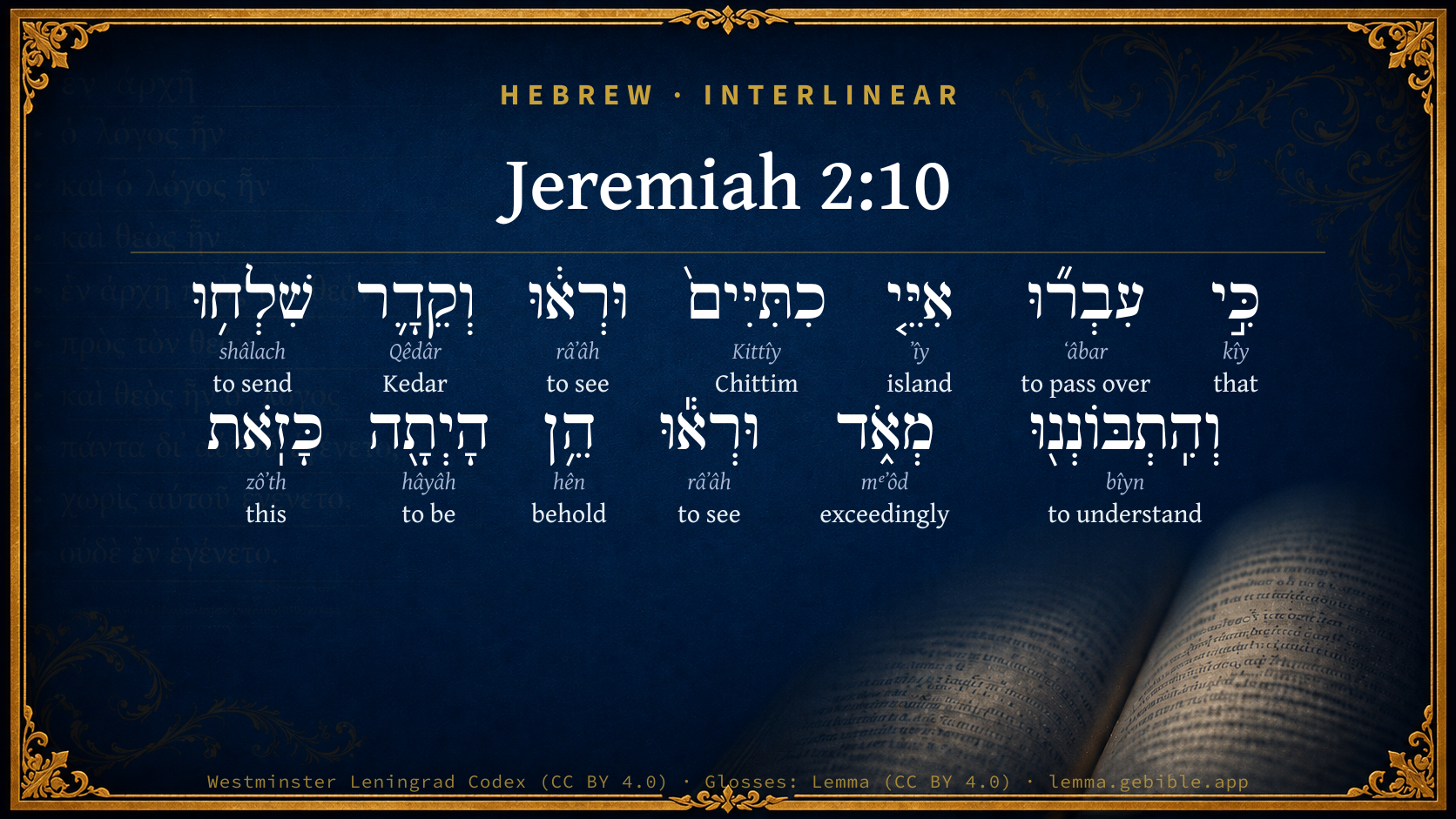
Hebrew (Westminster Leningrad Codex) Jeremiah 2:10 appears in the Hebrew Old Testament. The text above is from the Westminster Leningrad Codex. Each word links to its Strong’s number, a concise gloss, and parsing drawn from the Open Scriptures Hebrew Bible morphology. Click any word for its full Brown-Driver-Briggs (BDB) entry.
Download image
Cite this verse

Jeremiah 2:10 (World English Bible). Public Domain. Lemma interlinear Bible study tool, https://lemma.gebible.app/v/jeremiah/2/10.

Show BibTeX & RIS
BibTeX
RIS
English Translation
For pass over to the isles of Kittim, and see; and send to Kedar, and consider diligently; and see if there has been such a thing.
World English Bible · Public Domain
Download a study sheet

One document with this verse’s original text, its word-by-word gloss line, the meaning frame, cross-references with their text, attributed commentary, and full source and license credits — printable, and it pastes into notes with its structure intact.

This verse Autodidact and up

Study sheet (.html) Plain text (.txt)

A passage Seminary Student

Up to 50 verses in one chapter. A passage sheet keeps up to 6 commentary sources and 12 cross-references per verse, in the order this page ranks them, and says so on the sheet whenever that leaves anything out. Ask for a single verse and you get the Autodidact verse sheet above.

Everything on this page stays free to read, with no account — the sheet is a download of what is already on screen, not access to it.

Want to remove ads? Support Godless Engineer
Compare translations 3

The same verse in 3 English versions, stacked beneath the original-language interlinear above. Click any original word for its lexicon entry.

Each is an independent rendering of the whole verse — the interlinear is not word-aligned to these translations.

Highlighted words mark where these versions differ — a whole-verse word diff, not a word-by-word alignment.

  • World English Bible Public Domain
    For pass over to the isles of Kittim, and see; and send to Kedar, and consider diligently; and see if there has been such a thing.
  • King James Version Public Domain
    For pass over the isles of Chittim, and see; and send unto Kedar, and consider diligently, and see if there be such a thing.
  • unfoldingWord Literal Text CC BY-SA 4.0
    For cross over the coasts of Kittim and look, and Kedar send out and pay very close attention and see if there has been as this!

unfoldingWord Literal Text — © unfoldingWord, licensed CC BY-SA 4.0. Word-aligned USFM3 via Door43 (git.door43.org/unfoldingWord/en_ult).

Versions to compare (up to 4)

3 of 4 selected

Show all 18 translations

Every available English version of this verse, each an independent rendering of the whole verse.

  • World English Bible Public Domain
    For pass over to the isles of Kittim, and see; and send to Kedar, and consider diligently; and see if there has been such a thing.
  • Berean Standard Bible Public Domain
    Cross over to the coasts of Cyprus and take a look; send to Kedar and consider carefully; see if there has ever been anything like this:
  • Majority Standard Bible Public Domain
    Cross over to the coasts of Cyprus and take a look; send to Kedar and consider carefully; see if there has ever been anything like this:
  • King James Version Public Domain
    For pass over the isles of Chittim, and see; and send unto Kedar, and consider diligently, and see if there be such a thing.
  • American Standard Version (1901) Public Domain
    For pass over to the isles of Kittim, and see; and send unto Kedar, and consider diligently; and see if there hath been such a thing.
  • Revised Version (1885) Public Domain
    For pass over to the isles of Kittim, and see; and send unto Kedar, and consider diligently; and see if there hath been such a thing.
  • Geneva Bible (1599) Public Domain
    For goe ye to the yles of Chittim, and beholde, and sende vnto Kedar. and take diligent heede, and see whether there be such things.
  • Douay-Rheims (1899) Public Domain
    Pass over to the isles of Cethim, and see: and send into Cedar, and consider diligently: and see if there hath been done any thing like this.
  • Young's Literal Translation Public Domain
    For, pass to the isles of Chittim, and see, And to Kedar send, and consider well, And see if there hath been like this:
  • Literal Standard Version CC BY-SA 4.0
    For pass to the islands of Chittim and see, || And send to Kedar and consider well, || And see if there has been [anything] like this:
  • Unlocked Literal Bible CC BY-SA 4.0
    For cross over to the coasts of Kittim and look. Send messengers out to Kedar and find out and see if there has ever before been anything like this.
  • unfoldingWord Literal Text CC BY-SA 4.0
    For cross over the coasts of Kittim and look, and Kedar send out and pay very close attention and see if there has been as this!
  • Darby Bible Public Domain
    For pass over to the isles of Chittim, and see; and send unto Kedar, and consider diligently, and see if there have been such a thing.
  • World Messianic Bible Public Domain
    For pass over to the islands of Kittim, and see. Send to Kedar, and consider diligently, and see if there has been such a thing.
  • Webster's Bible Public Domain
    For pass over the isles of Chittim, and see; and send to Kedar, and consider diligently, and see if there is such a thing.
  • Free Bible Version CC BY-SA 4.0
    Travel over to the islands of Cyprus and take a look; go to the land of Kedar and examine carefully to see if anything like this has ever happened before.
  • Bible in Basic English Public Domain
    For go over to the sea-lands of Kittim and see; send to Kedar and give deep thought to it; and see if there has ever been such a thing.
  • JPS Tanakh (1917) Public Domain
    For pass over to the isles of the Kittites, and see, and send unto Kedar, and consider diligently, and see if there hath been such a thing.

Literal Standard Version (2020), Covenant Press — licensed CC BY-SA 4.0. Text via the HelloAO Bible API (eBible.org). Unlocked Literal Bible (unfoldingWord) — licensed CC BY-SA 4.0. Text via the HelloAO Bible API (eBible.org). unfoldingWord Literal Text — © unfoldingWord, licensed CC BY-SA 4.0. Word-aligned USFM3 via Door43 (git.door43.org/unfoldingWord/en_ult). Free Bible Version, Dr. Jonathan Gallagher — licensed CC BY-SA 4.0. Text via the HelloAO Bible API (eBible.org).

Word by word

More ways to search: Search by grammar → Find every occurrence → Compare this word →

Practice this passage: Drill this verse → Learn its vocabulary →

כִתִּיִּים֙
Kittîy
H3794
“Chittim”
Noun, Proper
Part of Speech
Noun
Type
Proper
Full BDB Definition

Origin: patrial from an unused name denoting Cyprus (only in the pl.)

TWOT: None

Chittim or Kittim = "bruisers" - a general term for all islanders of the Mediterranean Sea - the descendants of Javan, the son of Japheth and grandson of Noah
  1. כִּ֣י kîy H3588 “that” Conjunction
  2. עִבְר֞וּ ʻâbar H5674 “pass over” Verb, Qal, Imperative, 2nd Person, Masculine, Plural
  3. אִיֵּ֤י ʼîy H339 “islands of” Noun, Common, Masculine, Plural, Construct
  4. וּרְא֔וּ râʼâh H7200 “and · see” Conjunction + Verb, Qal, Imperative, 2nd Person, Masculine, Plural
  5. וְקֵדָ֛ר Qêdâr H6938 “and · Kedar” Conjunction + Noun, Proper
  6. שִׁלְח֥וּ shâlach H7971 “send” Verb, Qal, Imperative, 2nd Person, Masculine, Plural
  7. וְהִֽתְבּוֹנְנ֖וּ bîyn H995 “and · understand” Conjunction + Verb, Hithpolel, Imperative, 2nd Person, Masculine, Plural
  8. מְאֹ֑ד mᵉʼôd H3966 “exceedingly” Adverb
  9. וּרְא֕וּ râʼâh H7200 “and · see” Conjunction + Verb, Qal, Imperative, 2nd Person, Masculine, Plural
  10. הֵ֥ן hên H2005 “behold” Particle, Demonstrative
  11. הָיְתָ֖ה hâyâh H1961 “to be” Verb, Qal, Perfect, 3rd Person, Feminine, Singular
  12. כָּזֹֽאת zôʼth H2063 “like/as · this” Preposition + Pronoun, Demonstrative, Feminine, Singular

About this verse

These counts appear in no published source. They are computed here, from the morphology-tagged text and Lemma’s own curated glosses. What Lemma adds →

13
words
12
distinct lemmas
Prophets
section

Notable vocabulary

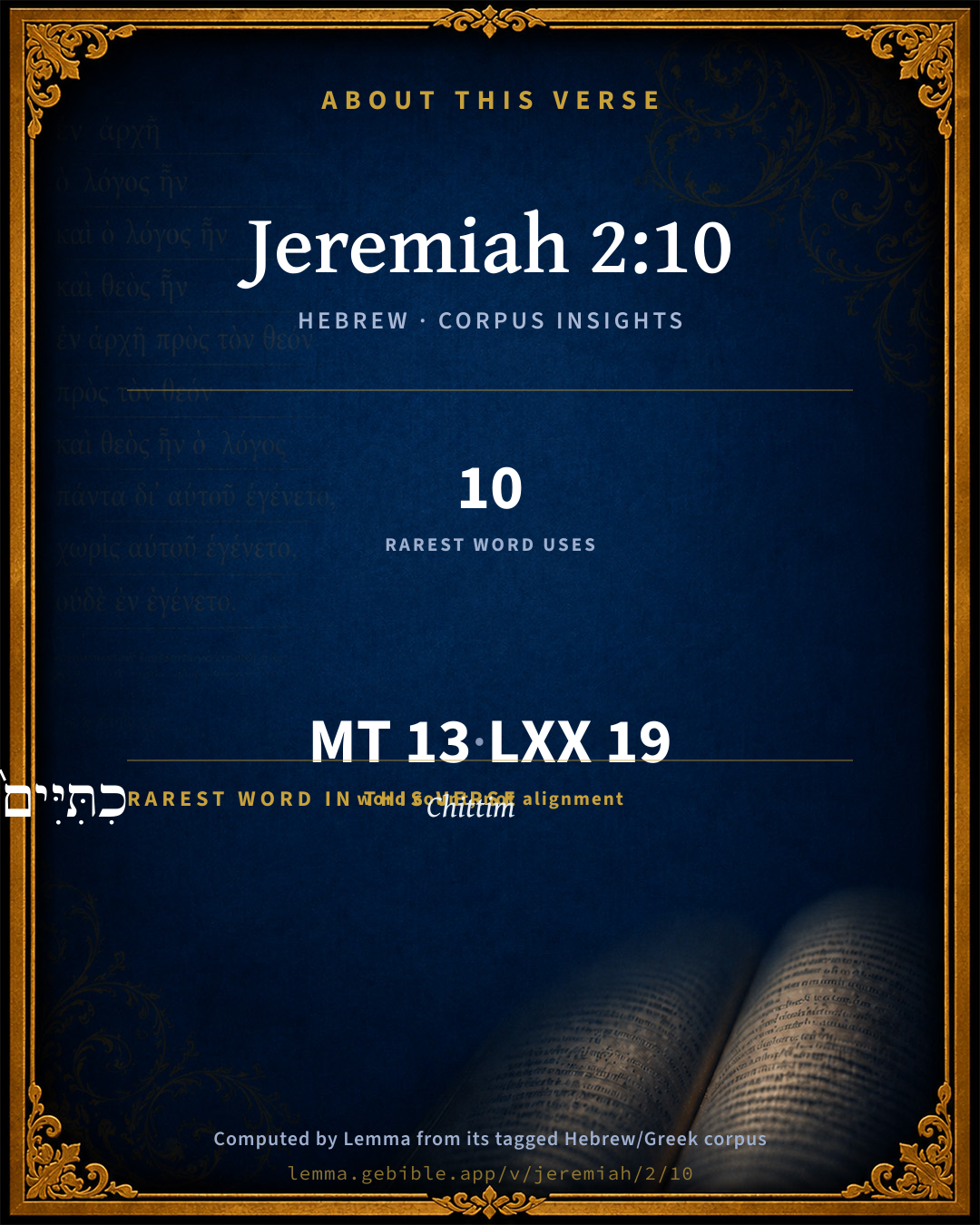
The rarest word here is כִתִּיִּים֙ Chittim H3794 — appearing just 10 times in the whole Hebrew Bible.

Shared distinctive vocabulary

כִתִּיִּים֙ Chittim H3794 occurs in 8 verses of the Hebrew Bible. Also found in:

Grammatical profile

  • 6 verbs
  • 3 nouns
  • 1 pronoun
  • 1 conjunction
  • 1 adverb
  • 1 particle

Verb forms

  • עִבְר֞וּ Qal · Imperative
  • וּרְא֔וּ Qal · Imperative
  • שִׁלְח֥וּ Qal · Imperative
  • וְהִֽתְבּוֹנְנ֖וּ Hithpolel · Imperative
  • וּרְא֕וּ Qal · Imperative
  • הָיְתָ֖ה Qal · Perfect

Repetition

A word recurs within this verse — often emphatic in Hebrew:

  • וּרְא֔וּ to see H7200 ×2

Hebrew & Septuagint length

In the original languages it is 13 Hebrew tokens and 19 Greek tokens — but the two are counted differently (Hebrew bundles its prefixes and suffixes into one token; the Greek is in lemma form), so that isn’t a like-for-like length.

Cross-references

13

Topical passages linked to Jeremiah 2:10 in the Treasury of Scripture Knowledge — connected by theme and wording, ordered by reader-vote popularity; previews shown in the World English Bible.

  • Psalms 120:5 Woe is me, that I live in Meshech, That I dwell among the tents of Kedar!
  • Genesis 10:4–5 The sons of Javan: Elishah, Tarshish, Kittim, and Dodanim.
  • Genesis 25:13 These are the names of the sons of Ishmael, by their names, according to the order of their birth: the firstborn of Ishmael, Nebaioth, then Kedar, Adbeel, Mibsam,
  • Numbers 24:24 But ships [shall come] from the coast of Kittim, They shall afflict Asshur, and shall afflict Eber; He also shall come to destruction.
  • Judges 19:30 It was so, that all who saw it said, There was no such deed done nor seen from the day that the children of Israel came up out of the land of Egypt to this day: consider it, take counsel, and speak.
  • 1 Chronicles 1:7 The sons of Javan: Elishah, and Tarshish, Kittim, and Rodanim.
  • 1 Chronicles 23:1 Now David was old and full of days; and he made Solomon his son king over Israel.
  • 1 Chronicles 23:12 The sons of Kohath: Amram, Izhar, Hebron, and Uzziel, four.
  • Isaiah 21:16 For thus has the Lord said to me, Within a year, according to the years of a hireling, all the glory of Kedar shall fail;
  • Jeremiah 18:13–14 Therefore thus says Yahweh: Ask you now among the nations, who has heard such things; the virgin of Israel has done a very horrible thing.
  • Ezekiel 27:6 Of the oaks of Bashan have they made your oars; they have made your benches of ivory inlaid in boxwood, from the isles of Kittim.
  • Daniel 11:30 For ships of Kittim shall come against him; therefore he shall be grieved, and shall return, and have indignation against the holy covenant, and shall do [his pleasure]: he shall even return, and have regard to those who forsake the holy covenant.
  • 1 Corinthians 5:1 It is actually reported that there is sexual immorality among you, and such sexual immorality as is not even named among the Gentiles, that one has his father's wife.

Cross-references courtesy of OpenBible.info (CC BY 4.0).

Hebrew and Greek witnesses Masoretic Hebrew ↔ Greek Septuagint

The same verse in the two great witnesses to the Old Testament, shown verse-for-verse.

These are two independent witnesses, not word-aligned to each other, and the Septuagint is shown in lemma (dictionary) form.

Hebrew Jeremiah 2:10 Masoretic · Westminster Leningrad Codex

כִּ֣י עִבְר֞וּ אִיֵּ֤י כִתִּיִּים֙ וּרְא֔וּ וְקֵדָ֛ר שִׁלְח֥וּ וְהִֽתְבּוֹנְנ֖וּ מְאֹ֑ד וּרְא֕וּ הֵ֥ן הָיְתָ֖ה כָּזֹֽאת

For pass over to the isles of Kittim, and see; and send to Kedar, and consider diligently; and see if there has been such a thing.

World English Bible · Public Domain

Greek LXX Structure differs

In the Septuagint, Jeremiah is about an eighth shorter than the Hebrew and arranges its material differently — the Oracles Against the Nations (Hebrew chapters 46–51) appear in the middle of the Greek book, after 25:13. Because the chapter and verse boundaries do not line up, a verse-for-verse comparison with the Hebrew is not shown.

A verse-for-verse comparison isn’t shown here because the chapters and verses don’t line up. Switch to the LXX edition with the MT / LXX toggle above to read the Greek directly.

Hebrew: Westminster Leningrad Codex (CC BY 4.0). Greek: Septuagint (public domain); English from a public-domain English Septuagint. How the Septuagint differs from the Hebrew →

Targum (Aramaic paraphrase)

1

The Targum is the ancient Jewish Aramaic paraphrase of the Hebrew Scriptures — an interpretive translation, not the Hebrew text itself. Onkelos (literal) and Pseudo-Jonathan (expansive) render the Torah, and Jonathan the Prophets. Coverage is partial: where no permissively-licensed English translation exists for a verse, only the Aramaic is shown. This is verse-level text, not a word-by-word alignment to the Hebrew.

  1. Targum Jonathan Prophets (Joshua–Malachi)
    אֲרֵי עֲבַרוּ לְנַגְוַת כִּתָּאֵי וַחֲזוֹ וְלִמְדִינַת עֲרָבָאֵי שְׁלָחוּ וְאִסְתַּכָּלוּ לַחֲדָא וַחֲזוֹ עַמְמַיָא דִגְלַן מִכְּרַךְ לִכְרַךְ וּמִמְדִינָה לִמְדִינָה נַטְלִין יַת טַעֲוַתְהוֹן וּמוֹבְלִין לְהוֹן עִמְהוֹן וּבַאֲתַר דְאִינוּן שָׁרָן פַּרְסִין יַת מַשְׁכְּנֵיהוֹן וּמְקַיְימִין יַת טַעֲוַתְהוֹן וְסָגְדִין לְהוֹן אֵידָא הִיא אוּמָה וְלִישָׁן דַעֲבָדַת כְּוַתְכוֹן בֵּית יִשְׂרָאֵל:

    (no public-domain English translation for this verse)

    Targum Jonathan — Aramaic: “Mikraot Gedolot” (public domain). English: “Sefaria Community Translation” (CC0 1.0 (public-domain dedication)); “London "Chaldee Paraphrase," 1871” (public domain). Text via Sefaria.

Commentary

Notes on Jeremiah 2:10 from classic Christian and Jewish commentators (each source and its license shown beneath its notes). The classic Christian expositions comment on the surrounding passage and are grouped to its opening verse, so a note may address several verses; the Jewish commentaries on the Tanakh (Rashi and others) are per-verse, so they appear only where the commentator wrote on this verse.

Lemma curates 59 commentaries, every one of them public domain or Creative Commons licensed, each selected and text-cleaned for this edition rather than reprinted as found. About our sources →

Trapp's Complete Commentary

John Trapp

Jer 2:10 For pass over the isles of Chittim, and see; and send unto Kedar, and consider diligently, and see if there be such a thing.

Ver. 10. For pass over the isles of Chittim.] The western parts of the world - Greece, Italy, Cyprus, &c.

And send unto Kedar.] The eastern parts, where dwell Kedarens, Arabians, Saracens, &c.

John Trapp, A Commentary or Exposition upon All the Books of the Old and New Testament (1647–1656) — public domain. Text from a community e-Sword module.

Joseph Benson's Commentary

Jer 2:10-11. For pass over the isles of Chittim — The neighbouring isles and peninsulas, which lay west of Judea, meaning especially the countries of Greece and Macedonia, and the islands and continents of Europe in general; the countries that were more polite and learned. And send unto Kedar — To Arabia, and the countries to the east and south, as the others lay to the west and north: send to them that are more rude and barbarous. And consider diligently — As a matter well worth your attention; and see if there be such a thing — As if he had said, If you search from east to west, from south to north, you will find no instance of apostacy from the objects of their worship like this of yours. Hath a nation changed their gods? — The gods worshipped by their forefathers? or shown a disposition to change them? Which are yet no gods? — But mere imaginary beings, or images made by men’s hands, or the creatures of the living and true God. But my people have changed their glory, have relinquished the worship of the infinite and eternal Jehovah, their Creator, Preserver, Benefactor, Redeemer, Friend, and Father, to whom they owe their all, and whose worship and service, favour and protection, were their greatest glory. For that which doth not profit — For those idols which never did, nor can, do them any good; that have no essence or power; and of which they must necessarily be ashamed.

Joseph Benson's Commentary on the Old and New Testaments (1811–1818) — public domain. Text from a community e-Sword module.

Tyndale Open Study Notes

Tyndale Open Resources

2:10 Kedar, an Arabic tribe descended from Ishmael, lived in the desert area east of the Jordan River Valley (see 49:28-33; Isa 21:16).

Tyndale Open Study Notes — © Tyndale Open Resources, licensed CC BY-SA 4.0. Text via the HelloAO Bible API.

Geneva Bible (1599)

Geneva Bible translators

Unto Arabia.

Meaning, the Grecians and Italians.

Geneva Bible (1599) marginal notes — public domain. Text via Bolls.life.

Jamieson, Fausset & Brown

Robert Jamieson, A. R. Fausset & David Brown

pass over the isles--rather, "cross over to the isles."

Chittim . . . Kedar--that is, the heathen nations, west and east. Go where you will, you cannot find an instance of any heathen nation forsaking their own for other gods. Israel alone does this. Yet the heathen gods are false gods; whereas Israel, in forsaking Me for other gods, forsake their "glory" for unprofitable idols.

Chittim--Cyprus, colonized by Phœnicians, who built in it the city of Citium, the modern Chitti. Then the term came to be applied to all maritime coasts of the Mediterranean, especially Greece (Num 24:24; Isa 23:1; Dan 11:30).

Kedar--descended from Ishmael; the Bedouins and Arabs, east of Palestine.

Jamieson, Fausset & Brown — Commentary Critical and Explanatory on the Whole Bible (1871) — public domain (CC PDM 1.0). Text via the HelloAO Bible API.

Adam Clarke's Commentary

Verse 10. The isles of Chittim] This is the island of Cyprus, according to Josephus. In 1 Maccabees, 1Mac 8:5, it is taken for Macedonia. Besides this, how they (the Romans) had discomfited in battle Philip and Perseus, king of the Chittims. Chittim was the grandson of Japhet; and Bochart has made it appear that the countries inhabited by the Chittim were Italy and the adjacent provinces of Europe, lying along the coast of the Mediterranean Sea; and probably this is the prophet's meaning.

Send unto Kedar] The name of an Arabian tribe. See if nations either near or remote, cultivated or stupid, have acted with such fickleness and ingratitude as you have done! They have retained their gods to whom they had no obligation; ye have abandoned your God, to whom ye owe your life, breath, and all things!

Adam Clarke's Commentary on the Bible (1810–1826) — public domain. Text from a community e-Sword/MySword module.

John Calvin's Commentaries

Here, by a comparison, he amplifies the wickedness and ingratitude of his own nation, — that they had surpassed in levity all heathen nations; for he says that all nations so agreed in one religion, that each nation followed what it had received from its ancestors. How then was it that the God of Israel was repudiated and rejected by his own people? If there was such persistency in error, why did not truth secure credit among them who had been taught by the mouth of God himself, as though they had been even in heaven? This is the drift of the Prophet’s meaning, when he says, Go into the islands of Chittim, and send into Kedar

He mentions Greece on one side, and the East on the other, and states a part for the whole. The Hebrews, as we have seen in Daniel, called the Greeks Chittim, though they indeed thought that the term belonged properly to the Macedonians; but the Prophet no doubt included in that term not only the whole of Greece and the islands of the Mediterranean, but also the whole of Europe, so as to take in those parts, the whole of France and Spain. There is indeed some difference made in the use of the word; but when taken generally, it was understood by the Hebrews, as I have said, to include France, Spain, Germany, as well as Greece; and they called those countries islands, though distant from the sea, because they carried on no commerce with remote nations: hence they thought the countries beyond the sea to be islands; and the Prophet spoke according to what was customary.

He then bids them to pass into the islands, southward as well as northward; and then he bids them, on the other hand, to send to explore the state of the East, Arabia as well as India, Persia, and other countries; for under the word Kedar he includes all the nations of the East; and as that people were more barbarous than others, he mentions them rather than the Persians or the Medes, or any other more celebrated nation, in order more fully to expose the disgraceful conduct of the Jews. Go then, or send, to all parts of the world, and see and diligently consider, see and see again; as though he said, that so great was the stupidity of the Jews, that they could not be awakened by a single word, or by one admonition. This then is the reason why he bids them carefully to inquire, though the thing itself was very plain and obvious. But this careful inquiry, as I have said, was enforced not on account of the obscurity of the subject, but for the purpose of reproving the sottishness of that perverse nation, which must have been conscious of its gross impiety, and yet indulged itself in its own vices.

John Calvin's Commentaries (1540-1563) — public domain. Text from the Calvin Translation Society English edition (1840s-50s) via the Christian Classics Ethereal Library (ccel.org). Calvin's coverage is partial (roughly two-thirds of the Bible); uncommented books and verses are honest gaps, never fabricated. The 19th-century editor's footnotes and remarks are omitted so the notes are faithfully Calvin's own voice.

Ellicott's Commentary for English Readers

(10) Pass over the isles . . .—Chittim is named as being, from the prophet’s point of view, the furthest country in the west (Gen_10:4; Num_24:24), Kedar (Gen_25:13; Psa_120:5) in the east. The whole earth might be searched without finding a parallel to the guilt of Israel.

A Bible Commentary for English Readers, edited by Charles John Ellicott (1878–1897) — public domain. Text from a community e-Sword module.

The Cambridge Bible for Schools and Colleges

gen. ed. J. J. S. Perowne

10. the isles of Kittim] The Kittim are mentioned as descendants of Javan in Gen_10:4. Josephus (Ant. I. vi. 1) identifies the original seat of the tribe with the town of Citium (Larnaka) in Cyprus. Gradually the name seems to have been extended, so as to include not only the neighbouring islands, but the coastlands of Italy and Greece. In Dan_11:30 the “ships of K.” refer to the Roman expedition to Egypt against Antiochus Epiphanes b.c. 168. The word in 1Ma_1:1; 1Ma_8:5 means Macedonia.

Kedar] As Kittim represented the parts of the world that lay to the westward of Palestine, so Kedar represented those which lay to the eastward. Kedar was the second son of Ishmael (Gen_25:13) and seems from the many subsequent notices of his tribe in the Bible to have been destined to be in his posterity the most distinguished of the twelve brethren, princes, given in the genealogy. They were a pastoral tribe (Isa_42:11; Isa_60:7) and were bowmen (Isa_21:17) living on the north-west of Arabia, and extending to the borders of Palestine. In Psa_120:5 they are spoken of as a barbarous tribe, to dwell amongst whom was to be utterly cut off from the worship of the true God. Even they, however, the Lord declares, do not furnish a parallel for the baseness which appertains to the Jews.

The Cambridge Bible for Schools and Colleges (gen. ed. J. J. S. Perowne; Cambridge University Press, 1878–1918) — public domain. Text from a community e-Sword module.

John Gill's Exposition

Hath a nation changed their gods, which are yet no gods?.... Though they are not by nature gods which they worship, only nominal and fictitious deities, yet they did not change them for others; but when they once embraced the worship of them, continued therein; so did the Chittim, the inhabitants of the isles, who though they traded to distant countries, from place to place; and so the Kedarenes, who dwelt in tents, and fed cattle, and moved from one desert to another, and from one pasture to another, as Jarchi observes; yet they carried their gods with them, and did not exchange them for new ones where they came. The Jewish writers say (b), that the Kedarenes worshipped water, and the Chittim fire; and though they knew that water would quench fire, yet the latter would not change their gods. Kimchi and Abendana relate it just the reverse, and say the Kedarenes worshipped fire, and the Chittim water, which is most likely; and so it is said elsewhere (c).

But my people have changed their glory; the true God, who is glorious in himself, and whom they should have glorified, and have counted it their highest honour and glory that they knew him, and were the worshippers of him; yet they changed him, their glory, into the similitude of an ox that eateth grass, Psa 106:20, wherefore it is justly added,

for that which doth not profit; meaning Baal, and such like idols; see the note on Jer 2:8.

(b) T. Bab. Taanith, fol. 5. 2. (c) Yalkut Simeoni, par. 2. fol. 60. 3.

John Gill's Exposition of the Whole Bible (1746–1763) — public domain (CC PDM 1.0). Text via the HelloAO Bible API.

Albert Barnes' Notes on the Bible

Kedar signifies the whole East, and the isles of Chittim (Isa 23:12 note) the West. If then you traverse all lands from west to east, it will be impossible to find any nation guilty of such apostasy as that committed by Israel.

Albert Barnes' Notes on the Bible (1834–1885) — public domain. Text from a community e-Sword/MySword module.

Haydock's Catholic Bible Commentary

Cethim; Macedon. It here denotes the western nations, as Cedar does those of the east.

George Leo Haydock (1774–1849), Haydock's Catholic Family Bible and Commentary, 1859 edition — public domain. Excludes Psalms (Douay-Rheims chapter numbering differs from Protestant) and Deuterocanonical books (Catholic canon only).

Matthew Poole's English Annotations

The isles of Chittim; a synecdochical expression, extending to all isles in the Mediterranean Sea, or any other the neighbouring coasts; for the Hebrews call all people that are separated from them by the Mediterranean Sea islanders, because they come to them by shipping. See of Chittim, Isa 23:1.

Send unto Kedar; understand Arabia, that lay east-south-east of Judea, as Chittim did more north or north-west: q. d. Go from north to south, east to west, and make the experiment; look to Chittim, the most civilized, or Kedar, the most. barbarous, yet neither have changed their gods.

See if there be such a thing; not that they were to pass over locally, or send messengers thither actually; but, q.d. Cast your eyes thither, and make your observations; by what you have ever seen or heard, did you ever hear of such a prodigious thing? If you should either go or send, you will find it so.

Matthew Poole's English Annotations on the Holy Bible (1683–1685) — public domain. Text from a community e-Sword/MySword module.

Whedon's Commentary on the Bible

Daniel D. Whedon

10. Isles of Chittim — The islands and coastlands of the west, as Kedar is representative of the east. The plain meaning is, that the sin of Israel is unparalleled. Similar is the terrible indictment of Christ in Mat_11:20-24.

Daniel D. Whedon (gen. ed.), Commentary on the Old and New Testaments (1874–1909) — public domain. Text from a community e-Sword module.

The Pulpit Commentary

Justification of Jehovah"s judicial action towards Judah. Consider the heinousness of the offence. Pass over rather, pass over to the isles of Chittim; i.e. the islands and maritime countries of the West, represented by Cyprus. (see on Gen_10:4) For the wide use of Chittim,. (comp. Num_24:24 Dan_11:30) Kedar, in the narrower sense, is a large tribe of Arabian origin, whose haunts were between Arabia Petraea and Babylonia. Here, however, it is used in a wider sense for the Arab tribes in general. (so Jer 28 Isa_21:16, Isa_21:17)

Vers. 10-13. The marvel of unbelief.

A magnificent apostrophe. Yet this is no mere rhetoric. There is a terrible reality in the phenomenon to which attention is directed. Chittim, the general name of the islands and coast of the eastern Mediterranean, stands for the extreme west; and Kedar, the general name of the Arabs of the desert for the extreme east of the "world," with which the prophet and his hearers were familiar. Our "from China to Peru" would represent its meaning to us.

I THE CONSIDERATIONS THAT MAKE IT MARVELLOUS. The people themselves were but dimly conscious of the strangeness of their apostasy. The prophet seeks to rouse their better nature by the most striking comparisons and illustrations.

1. He compares it with the general fixedness of heathen systems. A tendency to subdivide and stereotype life in the family, society, and the state is shown by idolatry. Idolatries reflect and pamper human desires and ideas, and enter into the whole constitution of the people. They undermine the moral life and spiritual strength, and flourish upon the decay they have made. Their victims are helpless because they are moribund or dead. The words of Isaiah are justified in such a case; "from the sole of the foot even unto the head there is no soundness in it," etc. This is the reason of the perpetuation of error and superstition; but the fact is there all the same, and it is in striking contrast to the vacillation and apostasy of God"s people. That which only appears to be good is clung to with reverence and tenacity from age to age. That which is acknowledged to be best, and in part realized to be so, is east aside repeatedly.

2. Look too at the character of him who is forsaken. He has already told them a little of God"s doings (vers. 5-7). Now it is sufficient to describe him as the "Glory" of Israel. The heavens, which look at everything all the world over, are to wonder and to be horror-struck at this unheard-of ingratitude and folly.

3. Disadvantage and dissatisfaction must evidently result. The action of the apostate is twofold negative and positive. Describe the figure. How great the labor of worldliness; and its disappointment!

II How SUCH CONDUCT CAN BE ACCOUNTED FOR. If it were the result of genuine and honest experience, it might be fatal to the claims of Jehovah. But it is explained by:

1. The influence of the near and sensible. The physical side of our nature is more developed than the spiritual. Our need appeals to us first and most strongly on that side. Abraham, who pleaded for Sodom, lied for Sarah. Jacob, the dreamer of Bethel, is the craven at Penuel. How unaccountable the yielding of the man of God to the false prophet! (1Ki 13) After David"s signal escapes and deliverances, he yet said in his heart, I shall now perish one day by the hand of Saul. There is nothing better for me than that I should speedily escape into the land of the Philistines." Elijah, after all his miracles and testimonies, sighs out, "Let me die." Peter, upon whoso witness Christ was to found his Church, is addressed as he is ready to sink at the vessel"s side, "O thou of little faith, wherefore didst thou doubt?" Paul, who had withstood them "that seemed to be pillars," quails beneath the "thorn in the flesh.

2. The demands made by true religion. Self has to be denied. The whole carnal life is condemned. Diligence is insisted upon. We have to "pray without ceasing," to labor and not faint. We have to "press toward the mark for the prize." Patience is demanded, and the Christian profession commits us to indefinite sacrifice. M.

Vers. 10, 11. Heathendom gives an unconscious rebuke to apostate Israel.

From humiliating contrast of the present conduct of Israel with what might have been reasonably expected from the peculiar experiences of the past, God now turns to make a contrast more humiliating still with heathen nations. The request to look back is succeeded by a request to look round. Search through every nation, inquire in every idol temple, watch the religious life of idolaters, and everywhere you will see a fidelity which puts the apostate children of Israel to shame. The heathen gods themselves Jehovah has indeed put to shame, notably the gods of Egypt and Philistia; but in spite of all, the heathen are still clinging to the falsehoods in which they have been taught to believe. Their fanatical devotion is, indeed, a pitiable thing, but even in the midst of all that is pitiable, God can find something to be used for good. This very fidelity to what is so false and degrading may be used to point a keen reproach to those who owe but do not pay allegiance to Jehovah.

There is thus suggested as a topic the UNCONSCIOUS REBUKES WHICH THE WORLD GIVES TO THE CHURCH. The heathendom on which Jehovah bade his people look has long passed away. In spite of the fidelity here indicated, the temples have fallen into ruin and the idols are utterly vanished. Nay, more; increasing signs come in from year to year, that all heathendom is gradually dissolving, so that, in one sense, Jehovah"s words may be said no longer to apply. But we know that, in the spirit of the words, they continue to apply only too forcibly. It is but the form of the idol that passes away; the reality is the same. Thus he who calls himself and wishes to be thought a believer in Christ, does well to look out and see what he can gather by way of spiritual instruction and rebuke from the world. The world has much to teach us if we would only learn. Jesus himself gave the New Testament parallel when he spoke of the children of the world being wiser in their generation than the children of light. And though we should be very foolish to pay any attention to the world, when it puts on the air of a wiseacre and talks with the utmost self-conceit of things it does not understand, there is all the more reason why we should learn all we can by our own divinely directed observation. How the world rebukes us, for instance, every time we see men of science searching after truth! Think of the patient attention given day after day with the telescope, the microscope, and all the apparatus of the experimentalist in physics. Think of the perils and privations of the traveler in tropic and in arctic zones. Think of the unwearied hunting of facts, for possibly a whole lifetime, in order to turn some hypothesis into an established truth. And we also have truth to attain. Jesus and his apostles often spoke of truth which we have to make our own; understanding it, believing it, and making it part of our experience. But that truth assuredly is not to be won without effort. The question may well be asked if such differences would continue to exist among Christians as do exist, provided they only set themselves in reality and humility to discover all that may be known on the subject-matter of their convictions. A man of science, for instance, would not grudge the labor needed to learn another language, if he felt that an increase of knowledge would prove the result to be worth the labor. But how many Christians can be found who have any notion that it might be worth their while to learn the Greek Testament for themselves instead of depending upon even the best of translations? Again, the world rebukes us as we consider the enthusiasm of terrestrial citizenship. There is much for the Christian to learn as he contemplates the spirit breaking forth in many men at the thought of the land that gave them birth. How the feelings of such men glow to fever heat with the exhibition of a national flag, the singing of a national anthem, or the mention of great military and naval triumphs, with the names of the captains who achieved them! Then think of what is better still, the unwearied labors of social reformers, simply from love to their country, to lessen crime, vice, disease, and ignorance. In view of all this deep attachment to the land where the natural man has sprung into existence and is sustained, may not Christ well ask his people, if the heavenly politeia into which they have been introduced by the second birth, is as dear to them? Then, what a rebuke comes to us as we look at the efforts of commercial enterprise. What toil there is here! what daring investments of capital! what quick combinations of the many to attain what cannot be done by the one I what formation of business habits so as to make easy and regular what would otherwise be difficult, perhaps impossible I And yet it is all done to get that wealth on which the Scriptures have so many warning words to speak. As these gods of the nations were no gods, so the wealth men think so much of is really no wealth at all. We are not to look towards the goal of their desires, nor follow in their steps. But as earnestly as they look towards the goal of an earthly fortune, we should look towards that of a heavenly one. As we stand among men clinging to riches which they cannot keep, and clinging none the less firmly because the riches are hollow, let us bear in mind how easy it is for us who are but sinful mortals also to be deluded away into neglect of the true riches. Y.

The Pulpit Commentary (1880–1919), ed. H.D.M. Spence-Jones & Joseph S. Exell — public domain. Text from a community e-Sword module.

John Wesley's Explanatory Notes

Of Chittim - All the isles in the Mediterranean sea, with the neighbouring coasts; for the Hebrew call all people, that separated from them by the sea, islanders, because they came to them by shipping. Kedar - Arabia that lay east-southeast of Judea, as Chittim did more north or northwest; go from north to south, east to west, and make the experiment; look to Chittim the most civilized, or Kedar the most barbarous, yet neither have changed their gods.

John Wesley, Explanatory Notes Upon the Whole Bible (1754–1765) — public domain. Text via the GEBible commentary corpus.

Rashi

Rabbi Shlomo Yitzchaki (Rashi)

the isles of the Kittites To the isles of the Kittites.

איי is (isles in French).

and send to Kedar And send to Kedar to see their custom.

and consider diligently And put your heart to it to consider the matter diligently.

whether Heb. הן, like אם, if. Whether either of those nations exchanged its god although they are no gods, yet My nation exchanged their glory, with which they were honored. The Kittites and the Kedarites were tent dwellers and cattle herders, who would travel, go, and wander from pasture to pasture and from desert to desert, and they carry their gods with them to the place where they encamp. But I carried you until I established you, yet you forsook Me. This is how Jonathan paraphrased it. Our Sages said however: The Kittites worshipped water and the Kedarites worshipped fire. And although they know that water quenches fire, they did not forsake their god.

Rashi on the Tanakh — English translations: “The Judaica Press complete Tanach with Rashi, translated by A. J. Rosenberg” (CC BY 4.0); “Pentateuch with Rashi's commentary by M. Rosenbaum and A.M. Silbermann, 1929-1934” (public domain); “The Metsudah Tanach series, Lakewood, N.J” (CC BY 4.0); and “The Book of Joshua, Metsudah Publications, 1997” (CC BY 4.0). Text via Sefaria.

Lesson kit

Teaching starters — assembled from the data on this page, not authored interpretation. Every prompt links to the verse data it draws on. Edit before teaching.

Jeremiah, in the Prophets, opens this verse with 13 words (12 distinct Hebrew lemmas). Its most distinctive word is Kittîy (“Chittim”). A historical commentator’s framing appears above. Read the whole chapter for the surrounding context.

Discussion questions

  1. What does “Chittim” (Kittîy) contribute to the verse as a whole?
  2. Genesis 10:4 shares the word «Chittim» with this verse. How do the two illuminate each other?
  3. “to see” occurs 2× in this one verse. What is the effect of the repetition?
  4. The translations on this page render this verse differently — a whole-verse word diff, not a word-by-word alignment. What might account for the different wordings?
  5. The verb «עִבְר֞וּ» is Qal Imperative. How does its form color the action?
  6. Reading how Trapp's Complete Commentary and Joseph Benson's Commentary read this verse, where do the two commentators agree and where do they part?

Things to notice

Reading settings

Reading text

Shown beneath each verse's original-language words.

Old Testament
Old Testament edition

Read the OT as the Masoretic Hebrew (MT) or the Greek Septuagint (LXX).

English shown for the Greek Septuagint (in the Hebrew ↔ Greek comparison).

Comparing translations? Open the Compare panel on any verse page to stack up to four side by side.