
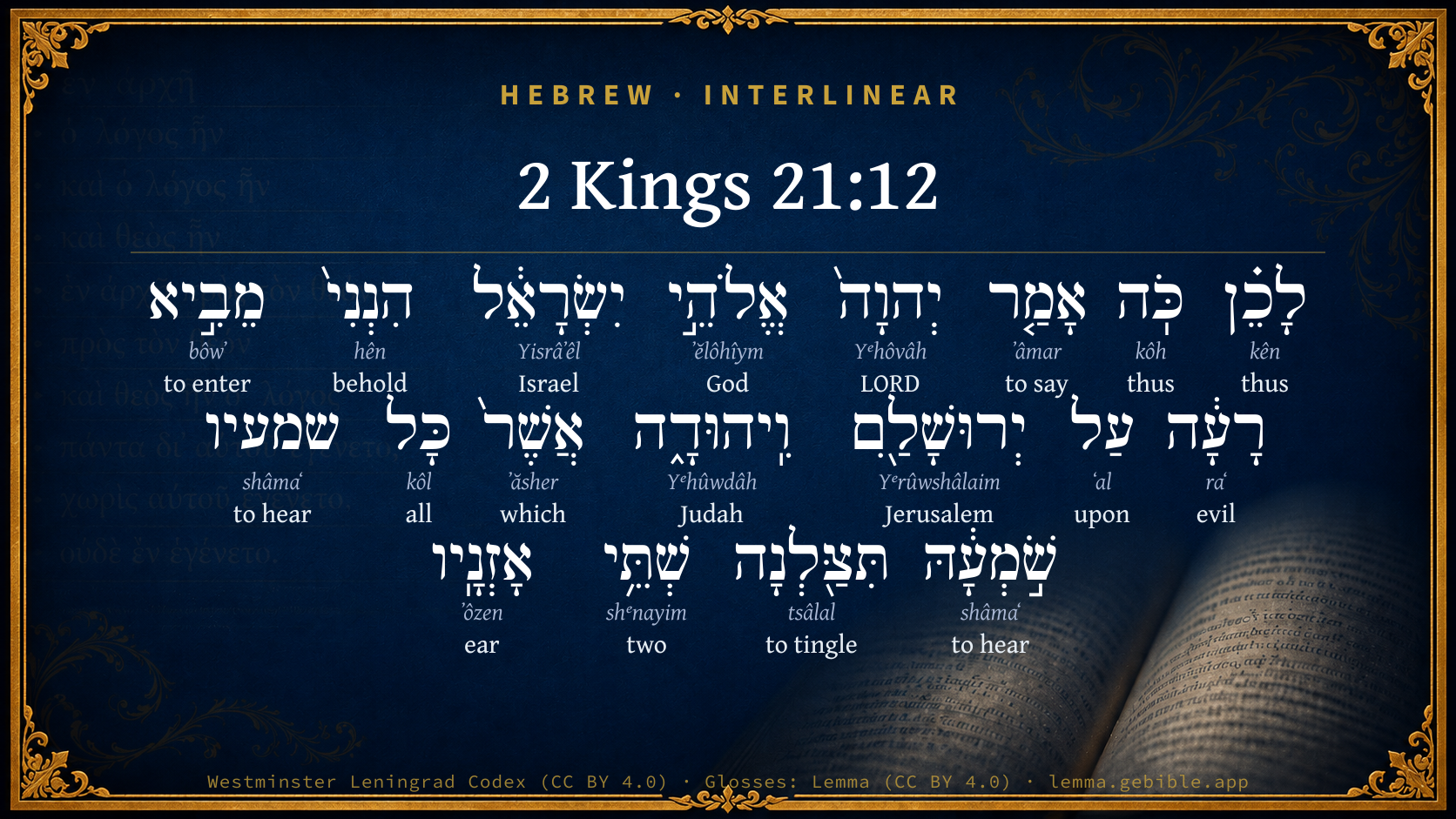
2 Kings 21:12

Hebrew (Westminster Leningrad Codex) 2 Kings 21:12 appears in the Hebrew Old Testament. The text above is from the Westminster Leningrad Codex. Each word links to its Strong’s number, a concise gloss, and parsing drawn from the Open Scriptures Hebrew Bible morphology. Click any word for its full Brown-Driver-Briggs (BDB) entry.
Download image
Cite this verse

2 Kings 21:12 (World English Bible). Public Domain. Lemma interlinear Bible study tool, https://lemma.gebible.app/v/2-kings/21/12.

Show BibTeX & RIS
BibTeX
RIS
English Translation
therefore thus says Yahweh, the God of Israel, Behold, I bring such evil on Jerusalem and Judah, that whoever hears of it, both his ears shall tingle.
World English Bible · Public Domain
Download a study sheet

One document with this verse’s original text, its word-by-word gloss line, the meaning frame, cross-references with their text, attributed commentary, and full source and license credits — printable, and it pastes into notes with its structure intact.

This verse Autodidact and up

Study sheet (.html) Plain text (.txt)

A passage Seminary Student

Up to 50 verses in one chapter. A passage sheet keeps up to 6 commentary sources and 12 cross-references per verse, in the order this page ranks them, and says so on the sheet whenever that leaves anything out. Ask for a single verse and you get the Autodidact verse sheet above.

Everything on this page stays free to read, with no account — the sheet is a download of what is already on screen, not access to it.

Want to remove ads? Support Godless Engineer
Compare translations 3

The same verse in 3 English versions, stacked beneath the original-language interlinear above. Click any original word for its lexicon entry.

Each is an independent rendering of the whole verse — the interlinear is not word-aligned to these translations.

Highlighted words mark where these versions differ — a whole-verse word diff, not a word-by-word alignment.

  • World English Bible Public Domain
    therefore thus says Yahweh, the God of Israel, Behold, I bring such evil on Jerusalem and Judah, that whoever hears of it, both his ears shall tingle.
  • King James Version Public Domain
    Therefore thus saith the LORD God of Israel, Behold, I am bringing such evil upon Jerusalem and Judah, that whosoever heareth of it, both his ears shall tingle.
  • unfoldingWord Literal Text CC BY-SA 4.0
    therefore, thus says Yahweh, the God of Israel, ‘Behold me, bringing disaster on Jerusalem and Judah that everyone hearing it, the two of his ears will tingle.

unfoldingWord Literal Text — © unfoldingWord, licensed CC BY-SA 4.0. Word-aligned USFM3 via Door43 (git.door43.org/unfoldingWord/en_ult).

Versions to compare (up to 4)

3 of 4 selected

Show all 18 translations

Every available English version of this verse, each an independent rendering of the whole verse.

  • World English Bible Public Domain
    therefore thus says Yahweh, the God of Israel, Behold, I bring such evil on Jerusalem and Judah, that whoever hears of it, both his ears shall tingle.
  • Berean Standard Bible Public Domain
    this is what the LORD, the God of Israel, says: ‘Behold, I am bringing such calamity upon Jerusalem and Judah that the news will reverberate in the ears of all who hear it.
  • Majority Standard Bible Public Domain
    this is what the LORD, the God of Israel, says: ‘Behold, I am bringing such calamity upon Jerusalem and Judah that the news will reverberate in the ears of all who hear it.
  • King James Version Public Domain
    Therefore thus saith the LORD God of Israel, Behold, I am bringing such evil upon Jerusalem and Judah, that whosoever heareth of it, both his ears shall tingle.
  • American Standard Version (1901) Public Domain
    therefore thus saith Jehovah, the God of Israel, Behold, I bring such evil upon Jerusalem and Judah, that whosoever heareth of it, both his ears shall tingle.
  • Revised Version (1885) Public Domain
    therefore thus saith the LORD, the God of Israel, Behold, I bring such evil upon Jerusalem and Judah, that whosoever heareth of it, both his ears shall tingle.
  • Geneva Bible (1599) Public Domain
    Therefore thus saith the Lord God of Israel, Beholde, I will bring an euill vpon Ierusalem and Iudah, that who so heareth of it, both his eares shall tingle.
  • Douay-Rheims (1899) Public Domain
    Therefore thus saith the Lord the God of Israel: Behold I will bring on evils upon Jerusalem and Juda: that whosoever shall hear of them, both his ears shall tingle.
  • Young's Literal Translation Public Domain
    therefore thus said Jehovah, God of Israel, Lo, I am bringing in evil on Jerusalem and Judah, that whoever heareth of it, tingle do his two ears.
  • Literal Standard Version CC BY-SA 4.0
    therefore, thus said YHWH, God of Israel: Behold, I am bringing in calamity on Jerusalem and Judah, that whoever hears of it, his two ears tingle.
  • Unlocked Literal Bible CC BY-SA 4.0
    therefore Yahweh, the God of Israel, says this: Look, I am about to bring such evil on Jerusalem and Judah that whoever hears of it, both his ears will tingle.
  • unfoldingWord Literal Text CC BY-SA 4.0
    therefore, thus says Yahweh, the God of Israel, ‘Behold me, bringing disaster on Jerusalem and Judah that everyone hearing it, the two of his ears will tingle.
  • Darby Bible Public Domain
    therefore thus saith Jehovah the God of Israel: Behold, I will bring evil upon Jerusalem and Judah, that whosoever heareth of it, both his ears shall tingle.
  • World Messianic Bible Public Domain
    therefore the LORD the God of Israel says, ‘Behold, I will bring such evil on Jerusalem and Judah that whoever hears of it, both his ears will tingle.
  • Webster's Bible Public Domain
    Therefore thus saith the LORD God of Israel, Behold, I am bringing such evil upon Jerusalem and Judah, that whoever heareth of it, both his ears shall tingle.
  • Free Bible Version CC BY-SA 4.0
    this is what the Lord, the God of Israel, says: Watch out! I am going to bring down upon Jerusalem and Judah such a disaster that it will cause ringing in the ears of everyone who hears it.
  • Bible in Basic English Public Domain
    For this cause, says the Lord, the God of Israel, I will send such evil on Jerusalem and Judah that the ears of all to whom the news comes will be burning.
  • JPS Tanakh (1917) Public Domain
    therefore thus saith the LORD, the God of Israel: Behold, I bring such evil upon Jerusalem and Judah, that whosoever heareth of it, both his ears shall tingle.

Literal Standard Version (2020), Covenant Press — licensed CC BY-SA 4.0. Text via the HelloAO Bible API (eBible.org). Unlocked Literal Bible (unfoldingWord) — licensed CC BY-SA 4.0. Text via the HelloAO Bible API (eBible.org). unfoldingWord Literal Text — © unfoldingWord, licensed CC BY-SA 4.0. Word-aligned USFM3 via Door43 (git.door43.org/unfoldingWord/en_ult). Free Bible Version, Dr. Jonathan Gallagher — licensed CC BY-SA 4.0. Text via the HelloAO Bible API (eBible.org).

Word by word

More ways to search: Search by grammar → Find every occurrence → Compare this word →

Practice this passage: Drill this verse → Learn its vocabulary →

תִּצַּ֖לְנָה
tsâlal
H6750
“to tingle”
Verb, Qal, Imperfect, 3rd Person, Feminine, Plural
Part of Speech
Verb
Stem
Qal
Form
Imperfect
Person
3rd Person
Gender
Feminine
Number
Plural
Full BDB Definition

Origin: a primitive root [identical with H6749 through the idea of vibration]

TWOT: 1919

to tingle, quiver - (Qal) - to tingle (of ears) - to quiver (of fear)
  1. לָכֵ֗ן kên H3651 “to/for · thus” Preposition + Adverb
  2. כֹּֽה kôh H3541 “thus” Adverb
  3. אָמַ֤ר ʼâmar H559 “to say” Verb, Qal, Perfect, 3rd Person, Masculine, Singular
  4. יְהוָה֙ Yᵉhôvâh H3068 “LORD” Noun, Proper
  5. אֱלֹהֵ֣י ʼĕlôhîym H430 “God(s) of” Noun, Common, Masculine, Plural, Construct
  6. יִשְׂרָאֵ֔ל Yisrâʼêl H3478 “Israel” Noun, Proper
  7. הִנְנִי֙ hên H2005 “behold · me” Particle, Demonstrative + Suffix, Personal, 1st Person, Common, Singular
  8. מֵבִ֣יא bôwʼ H935 “entering” Verb, Hiphil, Participle Active, Masculine, Singular, Absolute
  9. רָעָ֔ה raʻ H7451 “evil” Noun, Common, Feminine, Singular, Absolute
  10. עַל ʻal H5921 “upon” Preposition
  11. יְרוּשָׁלִַ֖ם Yᵉrûwshâlaim H3389 “Jerusalem” Noun, Proper
  12. וִֽיהוּדָ֑ה Yᵉhûwdâh H3063 “and · Judah” Conjunction + Noun, Proper
  13. אֲשֶׁר֙ ʼăsher H834 “which” Particle, Relative
  14. כָּל kôl H3605 “all of” Noun, Common, Masculine, Singular, Construct
  15. שמעיו shâmaʻ H8085 “hearing · him” Verb, Qal, Participle Active, Masculine, Plural, Construct + Suffix, Personal, 3rd Person, Masculine, Singular
  16. שֹׁ֣מְעָ֔הּ shâmaʻ H8085 “hearing · her” Verb, Qal, Participle Active, Masculine, Singular, Construct + Suffix, Personal, 3rd Person, Feminine, Singular
  17. שְׁתֵּ֥י shᵉnayim H8147 “two” Adjective, Cardinal number, Feminine, Dual, Construct
  18. אָזְנָֽיו ʼôzen H241 “ears · his” Noun, Common, Feminine, Dual, Construct + Suffix, Personal, 3rd Person, Masculine, Singular

About this verse

These counts appear in no published source. They are computed here, from the morphology-tagged text and Lemma’s own curated glosses. What Lemma adds →

19
words
18
distinct lemmas
Historical
section

Notable vocabulary

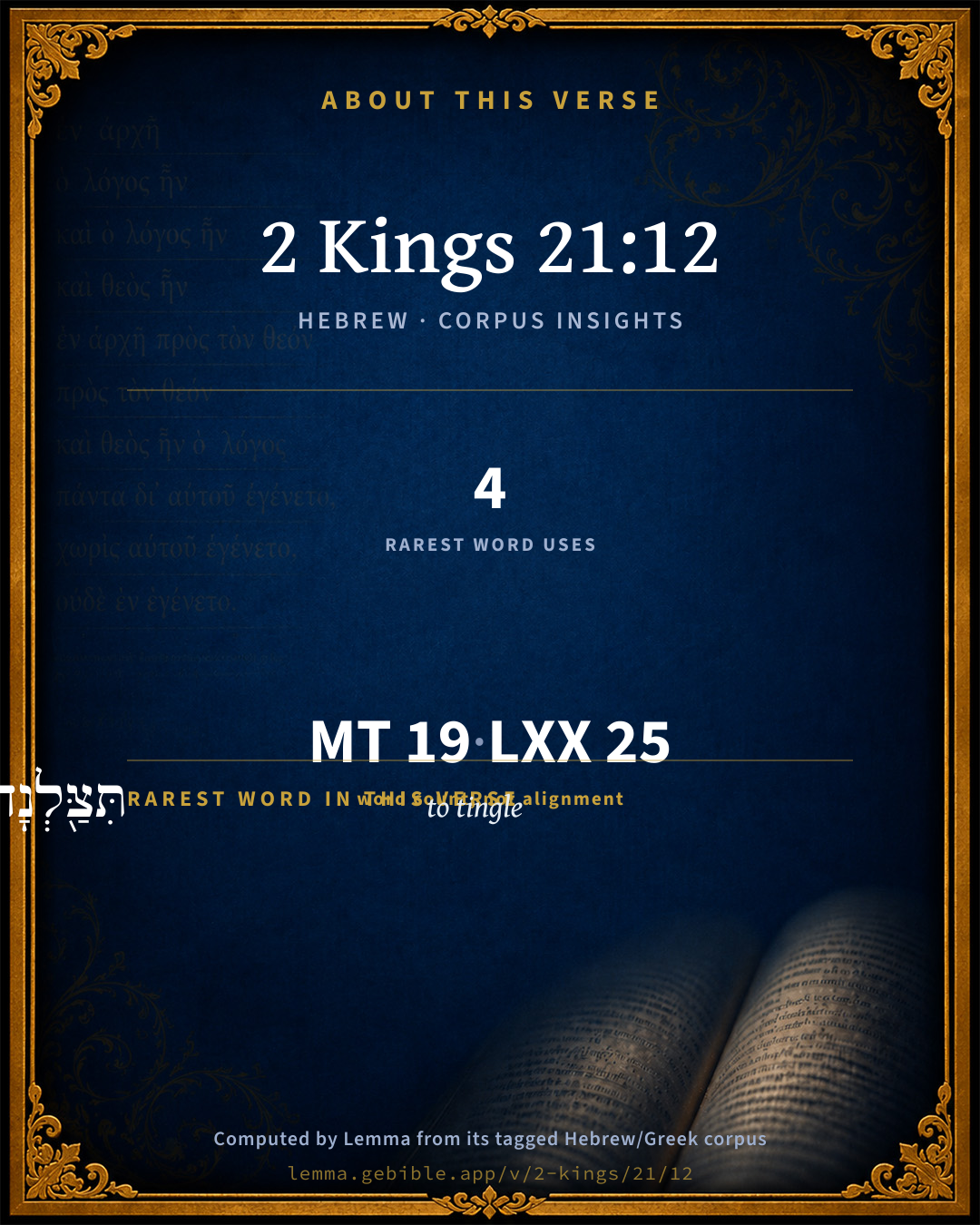
The rarest word here is תִּצַּ֖לְנָה to tingle H6750 — appearing just 4 times in the whole Hebrew Bible.

Shared distinctive vocabulary

תִּצַּ֖לְנָה to tingle H6750 occurs in 4 verses of the Hebrew Bible. Also found in:

Grammatical profile

  • 5 verbs
  • 8 nouns
  • 1 adjective
  • 1 preposition
  • 2 adverbs
  • 2 particles

Verb forms

  • אָמַ֤ר Qal · Perfect
  • מֵבִ֣יא Hiphil · Participle Active
  • שמעיו Qal · Participle Active
  • שֹׁ֣מְעָ֔הּ Qal · Participle Active
  • תִּצַּ֖לְנָה Qal · Imperfect

Repetition

A word recurs within this verse — often emphatic in Hebrew:

  • שמעיו to hear H8085 ×2

Hebrew & Septuagint length

In English translation the verse runs 27 words from the Hebrew and 32 from the Septuagint (LXX English) — closely comparable.

A rough comparison of the two English renderings, which tokenize alike — not a word-level alignment.

Word counts can differ between the Hebrew and the Greek without any difference in meaning — e.g. the Hebrew direct-object marker אֵת has no separate Greek word, and Greek often adds the article ὁ.

In the original languages it is 19 Hebrew tokens and 25 Greek tokens — but the two are counted differently (Hebrew bundles its prefixes and suffixes into one token; the Greek is in lemma form), so that isn’t a like-for-like length.

Cross-references

10

Topical passages linked to 2 Kings 21:12 in the Treasury of Scripture Knowledge — connected by theme and wording, ordered by reader-vote popularity; previews shown in the World English Bible.

  • Jeremiah 19:3 and say, Hear you the word of Yahweh, kings of Judah, and inhabitants of Jerusalem: thus says Yahweh of Hosts, the God of Israel, Behold, I will bring evil on this place, which whoever hears, his ears shall tingle.
  • 1 Samuel 3:11 Yahweh said to Samuel, Behold, I will do a thing in Israel, at which both the ears of everyone who hears it shall tingle.
  • 2 Kings 22:16 Thus says Yahweh, Behold, I will bring evil on this place, and on the inhabitants of it, even all the words of the book which the king of Judah has read.
  • Daniel 9:12 He has confirmed his words, which he spoke against us, and against our judges who judged us, by bringing on us a great evil; for under the whole sky has not been done as has been done on Jerusalem.
  • Amos 3:2 "You only have I chosen of all the families of the earth. Therefore I will punish you for all of your sins."
  • Micah 3:12 Therefore Zion for your sake will be plowed like a field, And Jerusalem will become heaps of rubble, And the mountain of the temple like the high places of a forest.
  • Isaiah 28:16 therefore thus says the Lord Yahweh, Behold, I lay in Zion for a foundation a stone, a tried stone, a precious corner -[stone] of sure foundation: he who believes shall not be in haste.
  • Matthew 24:21–22 for then there will be great oppression, such as has not been from the beginning of the world until now, no, nor ever will be.
  • Luke 23:28–29 But Jesus, turning to them, said, "Daughters of Jerusalem, don't weep for me, but weep for yourselves and for your children.
  • Revelation 6:15–17 The kings of the earth, the princes, the commanding officers, the rich, the strong, and every slave and free person, hid themselves in the caves and in the rocks of the mountains.

Cross-references courtesy of OpenBible.info (CC BY 4.0).

Hebrew and Greek witnesses Masoretic Hebrew ↔ Greek Septuagint

The same verse in the two great witnesses to the Old Testament, shown verse-for-verse.

These are two independent witnesses, not word-aligned to each other, and the Septuagint is shown in lemma (dictionary) form.

Hebrew 2 Kings 21:12 Masoretic · Westminster Leningrad Codex

לָכֵ֗ן כֹּֽה אָמַ֤ר יְהוָה֙ אֱלֹהֵ֣י יִשְׂרָאֵ֔ל הִנְנִי֙ מֵבִ֣יא רָעָ֔ה עַל יְרוּשָׁלִַ֖ם וִֽיהוּדָ֑ה אֲשֶׁר֙ כָּל שמעיו שֹׁ֣מְעָ֔הּ תִּצַּ֖לְנָה שְׁתֵּ֥י אָזְנָֽיו

therefore thus says Yahweh, the God of Israel, Behold, I bring such evil on Jerusalem and Judah, that whoever hears of it, both his ears shall tingle.

World English Bible · Public Domain

Greek LXX 2 Kings 21:12 Septuagint · lemma form

οὐ οὕτως ὅδε λέγω κύριος ὁ θεός ἰσραήλ ἰδού ἐγώ φέρω κακός ἐπί ἰερουσαλήμ καί ἐπί ἰουδά ὥστε πᾶς ἀκούω ἠχέω ἀμφότεροι ὁ οὖς αὐτός

it shall not be so. Thus says the Lord God of Israel, Behold, I bring calamities upon Jerusalem and Juda, so that both the ears of every one that hears shall tingle.

LXX2012 (modern English Septuagint) · Public Domain

On this verse, The Cambridge Bible for Schools and Colleges discusses the Septuagint’s reading. Read the note in Commentary ↓

Hebrew: Westminster Leningrad Codex (CC BY 4.0). Greek: Septuagint (public domain); English from LXX2012 (modern English Septuagint) (Public Domain). How the Septuagint differs from the Hebrew →

Targum (Aramaic paraphrase)

1

The Targum is the ancient Jewish Aramaic paraphrase of the Hebrew Scriptures — an interpretive translation, not the Hebrew text itself. Onkelos (literal) and Pseudo-Jonathan (expansive) render the Torah, and Jonathan the Prophets. Coverage is partial: where no permissively-licensed English translation exists for a verse, only the Aramaic is shown. This is verse-level text, not a word-by-word alignment to the Hebrew.

  1. Targum Jonathan Prophets (Joshua–Malachi)
    בְּכֵן כִּדְנַן אֲמַר יְיָ אֱלָהָא דְיִשְׂרָאֵל הָא אֲנָא מַיְתֵי בִישְׁתָא עַל יְרוּשְׁלֵם וִיהוּדָה דְכָל דְיִשְׁמְעִינֵיהּ יַצְלַן תַּרְתֵּין אוּדְנוֹהִי:

    (no public-domain English translation for this verse)

    Targum Jonathan — Aramaic: “Mikraot Gedolot” (public domain). English: “Sefaria Community Translation” (CC0 1.0 (public-domain dedication)); “London "Chaldee Paraphrase," 1871” (public domain). Text via Sefaria.

Commentary

Notes on 2 Kings 21:12 from classic Christian and Jewish commentators (each source and its license shown beneath its notes). The classic Christian expositions comment on the surrounding passage and are grouped to its opening verse, so a note may address several verses; the Jewish commentaries on the Tanakh (Rashi and others) are per-verse, so they appear only where the commentator wrote on this verse.

Lemma curates 59 commentaries, every one of them public domain or Creative Commons licensed, each selected and text-cleaned for this edition rather than reprinted as found. About our sources →

Trapp's Complete Commentary

John Trapp

2Ki 21:12 Therefore thus saith the LORD God of Israel, Behold, I [am] bringing [such] evil upon Jerusalem and Judah, that whosoever heareth of it, both his ears shall tingle.

Ver. 12. Therefore thus saith the Lord.] God loveth to signify beforehand, saith the historian, and he therefore threateneth that he may not punish, saith a father.

Both his ears shall tingle.] He shall fall into a swoon through horror and dolor. See 1Sa 3:11.

John Trapp, A Commentary or Exposition upon All the Books of the Old and New Testament (1647–1656) — public domain. Text from a community e-Sword module.

Tyndale Open Study Notes

Tyndale Open Resources

21:12 Based on what had happened to the northern kingdom (17:7-23) and to Ahab’s family (9:24-26, 30-37; 10:1-8; 1 Kgs 22:37-38), Manasseh should fully expect God to execute justice against him and the people of Judah.

Tyndale Open Study Notes — © Tyndale Open Resources, licensed CC BY-SA 4.0. Text via the HelloAO Bible API.

Geneva Bible (1599)

Geneva Bible translators

Meaning, that whosoever shall hear of this great plague, shall be astonished.

Geneva Bible (1599) marginal notes — public domain. Text via Bolls.life.

Jamieson, Fausset & Brown

Robert Jamieson, A. R. Fausset & David Brown

whosoever heareth of it, both his ears shall tingle--a strong metaphorical form of announcing an extraordinary and appalling event (see Sa1 3:11; Jer 19:3; also Hab 1:5).

Jamieson, Fausset & Brown — Commentary Critical and Explanatory on the Whole Bible (1871) — public domain (CC PDM 1.0). Text via the HelloAO Bible API.

Adam Clarke's Commentary

Verse 12. Both his ears shall tingle.] תצלנה titstsalnah; something expressive of the sound in what we call, from the same sensation, the tingling of the ears. This is the consequence of having the ears suddenly pierced with a loud and shrill noise; the ears seem to ring for some time after. The prophets spoke to them vehemently, so that the sound seemed to be continued even when they had left off speaking. This was a faithful and solemn testimony.

Adam Clarke's Commentary on the Bible (1810–1826) — public domain. Text from a community e-Sword/MySword module.

Ellicott's Commentary for English Readers

(12) Whosoever heareth of it.—Literally, his hearers. Many MSS. And the Heb. margin read her (i.e., its) hearer.

Both his ears shall tingle.—The dreadful news shall affect him like a sharp piercing sound. (See the same metaphor in 1Sa_3:11; Jer_19:3.)

A Bible Commentary for English Readers, edited by Charles John Ellicott (1878–1897) — public domain. Text from a community e-Sword module.

The Cambridge Bible for Schools and Colleges

gen. ed. J. J. S. Perowne

12. therefore] Here again the LXX. translates the Hebrew word by οὐχ οὑτῶς. See note on 2Ki_1:3.

I am bringing [R.V. I bring] such evil] The R.V. prints ‘such’ in ordinary type. For the expression ‘the ears shall tingle’ cf. 1Sa_3:11; Jer_19:3. In both these passages the phrase is used in connexion with utter overthrow, in the one, of Eli’s house, in the other, of Jerusalem. The sins there enumerated by Jeremiah afford a parallel to the wickedness of Manasseh’s reign.

The Cambridge Bible for Schools and Colleges (gen. ed. J. J. S. Perowne; Cambridge University Press, 1878–1918) — public domain. Text from a community e-Sword module.

John Gill's Exposition

Therefore thus saith the Lord God of Israel,.... Who, though kind and gracious to Israel as their covenant God, is yet just and righteous, as well as he is a sovereign Being and Lord of all:

behold, I am bringing such evil upon Jerusalem and Judah, that whosoever heareth of it, both his ears shall tingle; it will make such a noise in the world, and be so horrible and terrible; and if, he report of it would be so dreadful as to make a man's ears tingle, and his heart tremble, what must it be to endure it! Eze 22:14.

John Gill's Exposition of the Whole Bible (1746–1763) — public domain (CC PDM 1.0). Text via the HelloAO Bible API.

Haydock's Catholic Bible Commentary

Tingle, through astonishment, as if he had been stunned with too loud a noise, 1 Kings iii. 11. (Calmet)

George Leo Haydock (1774–1849), Haydock's Catholic Family Bible and Commentary, 1859 edition — public domain. Excludes Psalms (Douay-Rheims chapter numbering differs from Protestant) and Deuterocanonical books (Catholic canon only).

Matthew Poole's English Annotations

By the great commotion which such terrible reports shall cause in the hearts and heads of the hearers. See Poole "1Sa 3:11"; See Poole "Jer 19:3".

Matthew Poole's English Annotations on the Holy Bible (1683–1685) — public domain. Text from a community e-Sword/MySword module.

Whedon's Commentary on the Bible

Daniel D. Whedon

12. Ears shall tingle — So amazed shall he be at the terrible tidings. Compare 1Sa_3:11, note.

Daniel D. Whedon (gen. ed.), Commentary on the Old and New Testaments (1874–1909) — public domain. Text from a community e-Sword module.

The Pulpit Commentary

Therefore thus saith the Lord God of Israel, Behold, I am bringing such evil upon Jerusalem and Judah, that whosoever heareth of it, both his ears shall tingle. "As a sharp discordant note," says Bahr, "pains one"s ears, so the news of this harsh punishment shall give pain to all who hear of it." The phrase is one never uttered by any other lips than those of Jehovah (1Sa_3:11; Jer_19:3) "It denotes" (Keil) "such a judgment as has never been heard of before, and excites alarm and horror." Not the Jews only, but the other neighboring nations, when they heard of the sufferings endured in the siege, (2Ki_25:8) and the severities exercised upon the king (ver. 7.) and the city (vers. 9, 10) and. the inhabitants (ver. 11), would have a thrill of pain go through them at the hearing, partly unselfish, partly perhaps selfish, since the treatment that was dealt out to others might also be reserved for them.

The Pulpit Commentary (1880–1919), ed. H.D.M. Spence-Jones & Joseph S. Exell — public domain. Text from a community e-Sword module.

Rashi

Rabbi Shlomo Yitzchaki (Rashi)

Will ring. An expression of cymbals, tintiner, in O. F.

Rashi on the Tanakh — English translations: “The Judaica Press complete Tanach with Rashi, translated by A. J. Rosenberg” (CC BY 4.0); “Pentateuch with Rashi's commentary by M. Rosenbaum and A.M. Silbermann, 1929-1934” (public domain); “The Metsudah Tanach series, Lakewood, N.J” (CC BY 4.0); and “The Book of Joshua, Metsudah Publications, 1997” (CC BY 4.0). Text via Sefaria.

Lesson kit

Teaching starters — assembled from the data on this page, not authored interpretation. Every prompt links to the verse data it draws on. Edit before teaching.

2 Kings, in the Historical, opens this verse with 19 words (18 distinct Hebrew lemmas). Its most distinctive word is tsâlal (“to tingle”). A historical commentator’s framing appears above. Read the whole chapter for the surrounding context.

Discussion questions

  1. How does “to tingle” (tsâlal) shape what this verse is saying?
  2. 1 Samuel 3:11 shares the word «to tingle» with this verse. How do the two illuminate each other?
  3. “to hear” occurs 2× in this one verse. What is the effect of the repetition?
  4. The translations on this page render this verse differently — a whole-verse word diff, not a word-by-word alignment. What might account for the different wordings?
  5. The verb «אָמַ֤ר» is Qal Perfect. How does its form color the action?
  6. Reading how Trapp's Complete Commentary and Tyndale Open Study Notes read this verse, where do the two commentators agree and where do they part?

Things to notice

Reading settings

Reading text

Shown beneath each verse's original-language words.

Old Testament
Old Testament edition

Read the OT as the Masoretic Hebrew (MT) or the Greek Septuagint (LXX).

English shown for the Greek Septuagint (in the Hebrew ↔ Greek comparison).

Comparing translations? Open the Compare panel on any verse page to stack up to four side by side.