
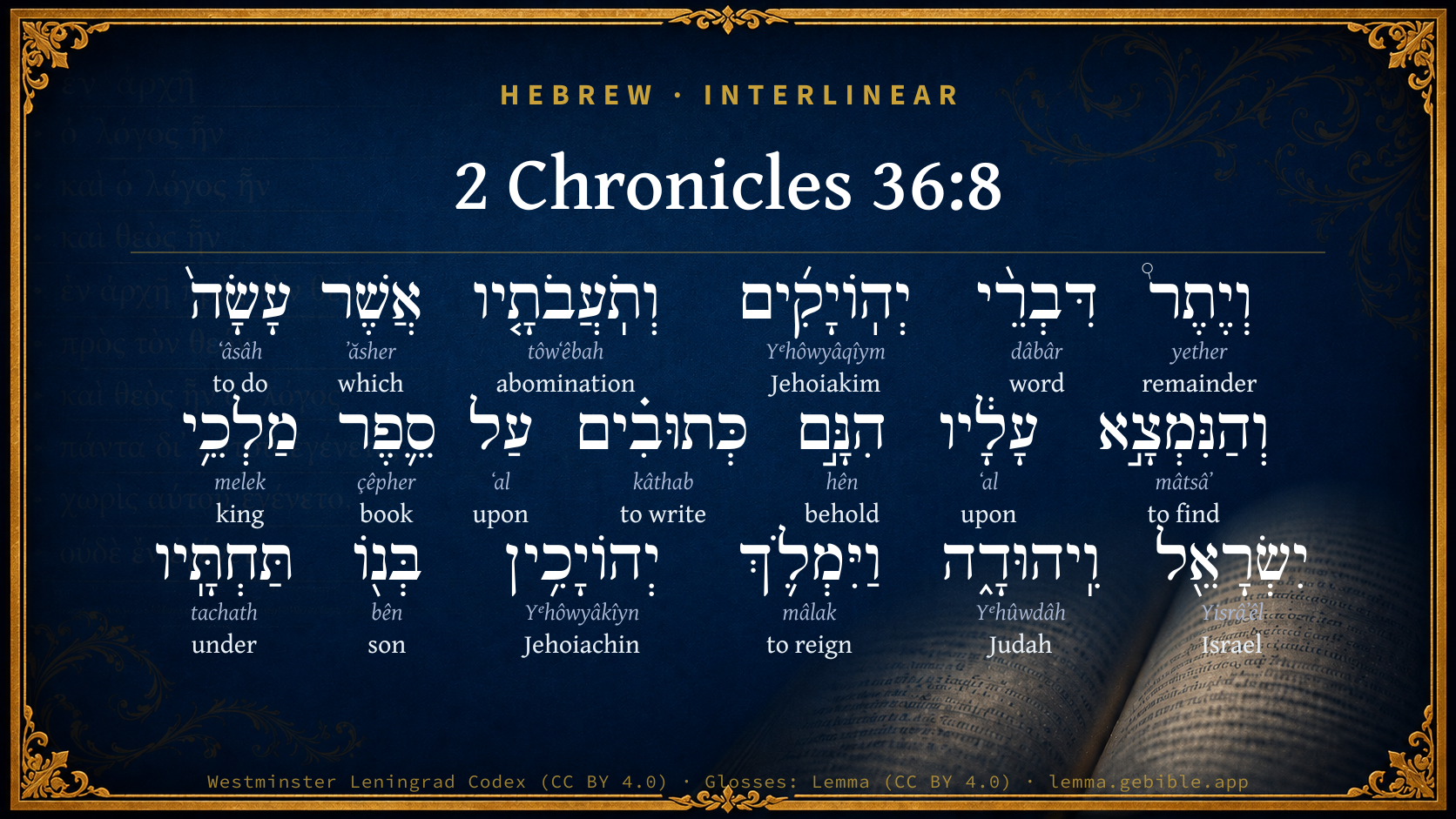
2 Chronicles 36:8

Hebrew (Westminster Leningrad Codex) 2 Chronicles 36:8 appears in the Hebrew Old Testament. The text above is from the Westminster Leningrad Codex. Each word links to its Strong’s number, a concise gloss, and parsing drawn from the Open Scriptures Hebrew Bible morphology. Click any word for its full Brown-Driver-Briggs (BDB) entry.
Download image
Cite this verse

2 Chronicles 36:8 (World English Bible). Public Domain. Lemma interlinear Bible study tool, https://lemma.gebible.app/v/2-chronicles/36/8.

Show BibTeX & RIS
BibTeX
RIS
English Translation
Now the rest of the acts of Jehoiakim, and his abominations which he did, and that which was found in him, behold, they are written in the book of the kings of Israel and Judah: and Jehoiachin his son reigned in his place.
World English Bible · Public Domain
Download a study sheet

One document with this verse’s original text, its word-by-word gloss line, the meaning frame, cross-references with their text, attributed commentary, and full source and license credits — printable, and it pastes into notes with its structure intact.

This verse Autodidact and up

Study sheet (.html) Plain text (.txt)

A passage Seminary Student

Up to 50 verses in one chapter. A passage sheet keeps up to 6 commentary sources and 12 cross-references per verse, in the order this page ranks them, and says so on the sheet whenever that leaves anything out. Ask for a single verse and you get the Autodidact verse sheet above.

Everything on this page stays free to read, with no account — the sheet is a download of what is already on screen, not access to it.

Want to remove ads? Support Godless Engineer
Compare translations 3

The same verse in 3 English versions, stacked beneath the original-language interlinear above. Click any original word for its lexicon entry.

Each is an independent rendering of the whole verse — the interlinear is not word-aligned to these translations.

Highlighted words mark where these versions differ — a whole-verse word diff, not a word-by-word alignment.

  • World English Bible Public Domain
    Now the rest of the acts of Jehoiakim, and his abominations which he did, and that which was found in him, behold, they are written in the book of the kings of Israel and Judah: and Jehoiachin his son reigned in his place.
  • King James Version Public Domain
    Now the rest of the acts of Jehoiakim, and his abominations which he did, and that which was found in him, behold, they are written in the book of the kings of Israel and Judah: and Jehoiachin his son reigned in his stead.
  • unfoldingWord Literal Text CC BY-SA 4.0
    And the remainder of the matters of Jehoiakim, and the abominations that he did, and what was found against him, behold, they are written on the scroll of the kings of Israel and Judah. And Jehoiachin, his son, became king in his place.

unfoldingWord Literal Text — © unfoldingWord, licensed CC BY-SA 4.0. Word-aligned USFM3 via Door43 (git.door43.org/unfoldingWord/en_ult).

Versions to compare (up to 4)

3 of 4 selected

Show all 18 translations

Every available English version of this verse, each an independent rendering of the whole verse.

  • World English Bible Public Domain
    Now the rest of the acts of Jehoiakim, and his abominations which he did, and that which was found in him, behold, they are written in the book of the kings of Israel and Judah: and Jehoiachin his son reigned in his place.
  • Berean Standard Bible Public Domain
    As for the rest of the acts of Jehoiakim, the abominations he committed, and all that was found against him, they are indeed written in the Book of the Kings of Israel and Judah. And his son Jehoiachin reigned in his place.
  • Majority Standard Bible Public Domain
    As for the rest of the acts of Jehoiakim, the abominations he committed, and all that was found against him, they are indeed written in the Book of the Kings of Israel and Judah. And his son Jehoiachin reigned in his place.
  • King James Version Public Domain
    Now the rest of the acts of Jehoiakim, and his abominations which he did, and that which was found in him, behold, they are written in the book of the kings of Israel and Judah: and Jehoiachin his son reigned in his stead.
  • American Standard Version (1901) Public Domain
    Now the rest of the acts of Jehoiakim, and his abominations which he did, and that which was found in him, behold, they are written in the book of the kings of Israel and Judah: and Jehoiachin his son reigned in his stead.
  • Revised Version (1885) Public Domain
    Now the rest of the acts of Jehoiakim, and his abominations which he did, and that which was found in him, behold, they are written in the book of the kings of Israel and Judah: and Jehoiachin his son reigned in his stead.
  • Geneva Bible (1599) Public Domain
    Concerning the rest of the actes of Iehoiakim, and his abominations which he did, and that which was founde vpon him, behold, they are written in the booke of the Kings of Israel and Iudah, and Iehoiachin his sonne reigned in his stead.
  • Douay-Rheims (1899) Public Domain
    But the rest of the acts of Joakim, and his abominations, which he wrought, and the things that were found in him, are contained in the book of the kings of Juda and Israel. And Joachin his son reigned in his stead.
  • Young's Literal Translation Public Domain
    And the rest of the matters of Jehoiakim, and his abominations that he hath done, and that which is found against him, lo, they are written on the book of the kings of Israel and Judah, and reign doth Jehoiachin his son in his stead.
  • Literal Standard Version CC BY-SA 4.0
    And the rest of the matters of Jehoiakim, and his abominations that he has done, and that which is found against him, behold, they are written on the scroll of the kings of Israel and Judah, and his son Jehoiachin reigns in his stead.
  • Unlocked Literal Bible CC BY-SA 4.0
    As for the other matters concerning Jehoiakim, the disgusting things that he did, and what was found against him, behold, they are written in the book of the kings of Judah and Israel. Then Jehoiachin, his son, became king in his place.
  • unfoldingWord Literal Text CC BY-SA 4.0
    And the remainder of the matters of Jehoiakim, and the abominations that he did, and what was found against him, behold, they are written on the scroll of the kings of Israel and Judah. And Jehoiachin, his son, became king in his place.
  • Darby Bible Public Domain
    And the rest of the acts of Jehoiakim, and his abominations which he did, and that which was found in him, behold, they are written in the book of the kings of Israel and Judah. And Jehoiachin his son reigned in his stead.
  • World Messianic Bible Public Domain
    Now the rest of the acts of Jehoiakim, and his abominations which he did, and that which was found in him, behold, they are written in the book of the kings of Israel and Judah; and Jehoiachin his son reigned in his place.
  • Webster's Bible Public Domain
    Now the rest of the acts of Jehoiakim, and his abominations which he did, and that which was found in him, behold, they are written in the book of the kings of Israel and Judah. And Jehoiachin his son reigned in his stead.
  • Free Bible Version CC BY-SA 4.0
    The rest of what Jehoiakim, the disgusting sins he committed, and all the evidence against him, are written down in the Book of the Kings of Israel and Judah. His son Jehoiachin took over as king.
  • Bible in Basic English Public Domain
    Now the rest of the acts of Jehoiakim and the disgusting things he did, and all there is to be said against him, are recorded in the book of the kings of Israel and Judah; and Jehoiachin his son became king in his place.
  • JPS Tanakh (1917) Public Domain
    Now the rest of the acts of Jehoiakim, and his abominations which he did, and that which was found in him, behold, they are written in the book of the kings of Israel and Judah; and Jehoiachin his son reigned in his stead.

Literal Standard Version (2020), Covenant Press — licensed CC BY-SA 4.0. Text via the HelloAO Bible API (eBible.org). Unlocked Literal Bible (unfoldingWord) — licensed CC BY-SA 4.0. Text via the HelloAO Bible API (eBible.org). unfoldingWord Literal Text — © unfoldingWord, licensed CC BY-SA 4.0. Word-aligned USFM3 via Door43 (git.door43.org/unfoldingWord/en_ult). Free Bible Version, Dr. Jonathan Gallagher — licensed CC BY-SA 4.0. Text via the HelloAO Bible API (eBible.org).

Word by word

More ways to search: Search by grammar → Find every occurrence → Compare this word →

Practice this passage: Drill this verse → Learn its vocabulary →

יְהוֹיָכִ֥ין
Yᵉhôwyâkîyn
H3078
“Jehoiachin”
Noun, Proper
Part of Speech
Noun
Type
Proper
Full BDB Definition

Origin: from H3068 and H3559

TWOT: None

Jehoiachin = "Jehovah establishes" - king of Judah, son of Jehoiakim, and the next to last king of Judah before the Babylonian captivity; kingship lasted for 3 months and 10 days before he surrendered to Nebuchadnezzar who took him to Babylon and imprisoned him for 36 years when he was finally released
  1. וְיֶתֶר֩ yether H3499 “and · remainder of” Conjunction + Noun, Common, Masculine, Singular, Construct
  2. דִּבְרֵ֨י dâbâr H1697 “words of” Noun, Common, Masculine, Plural, Construct
  3. יְהֽוֹיָקִ֜ים Yᵉhôwyâqîym H3079 “Jehoiakim” Noun, Proper
  4. וְתֹֽעֲבֹתָ֤יו tôwʻêbah H8441 “and · abominations · his” Conjunction + Noun, Common, Feminine, Plural, Construct + Suffix, Personal, 3rd Person, Masculine, Singular
  5. אֲשֶׁר ʼăsher H834 “which” Particle, Relative
  6. עָשָׂה֙ ʻâsâh H6213 “to do” Verb, Qal, Perfect, 3rd Person, Masculine, Singular
  7. וְהַנִּמְצָ֣א mâtsâʼ H4672 “and · the · finding” Conjunction + Particle, Definite Article + Verb, Niphal, Participle Active, Masculine, Singular, Absolute
  8. עָלָ֔יו ʻal H5921 “upon · him” Preposition + Suffix, Personal, 3rd Person, Masculine, Singular
  9. הִנָּ֣ם hên H2005 “behold · them” Particle, Demonstrative + Suffix, Personal, 3rd Person, Masculine, Plural
  10. כְּתוּבִ֗ים kâthab H3789 “written” Verb, Qal, Participle Passive, Masculine, Plural, Absolute
  11. עַל ʻal H5921 “upon” Preposition
  12. סֵ֛פֶר çêpher H5612 “book of” Noun, Common, Masculine, Singular, Construct
  13. מַלְכֵ֥י melek H4428 “kings of” Noun, Common, Masculine, Plural, Construct
  14. יִשְׂרָאֵ֖ל Yisrâʼêl H3478 “Israel” Noun, Proper
  15. וִֽיהוּדָ֑ה Yᵉhûwdâh H3063 “and · Judah” Conjunction + Noun, Proper
  16. וַיִּמְלֹ֛ךְ mâlak H4427 “and · to reign” Conjunction + Verb, Qal, Sequential Imperfect, 3rd Person, Masculine, Singular
  17. בְּנ֖וֹ bên H1121 “son · his” Noun, Common, Masculine, Singular, Construct + Suffix, Personal, 3rd Person, Masculine, Singular
  18. תַּחְתָּֽיו tachath H8478 “under · him” Preposition + Suffix, Personal, 3rd Person, Masculine, Singular

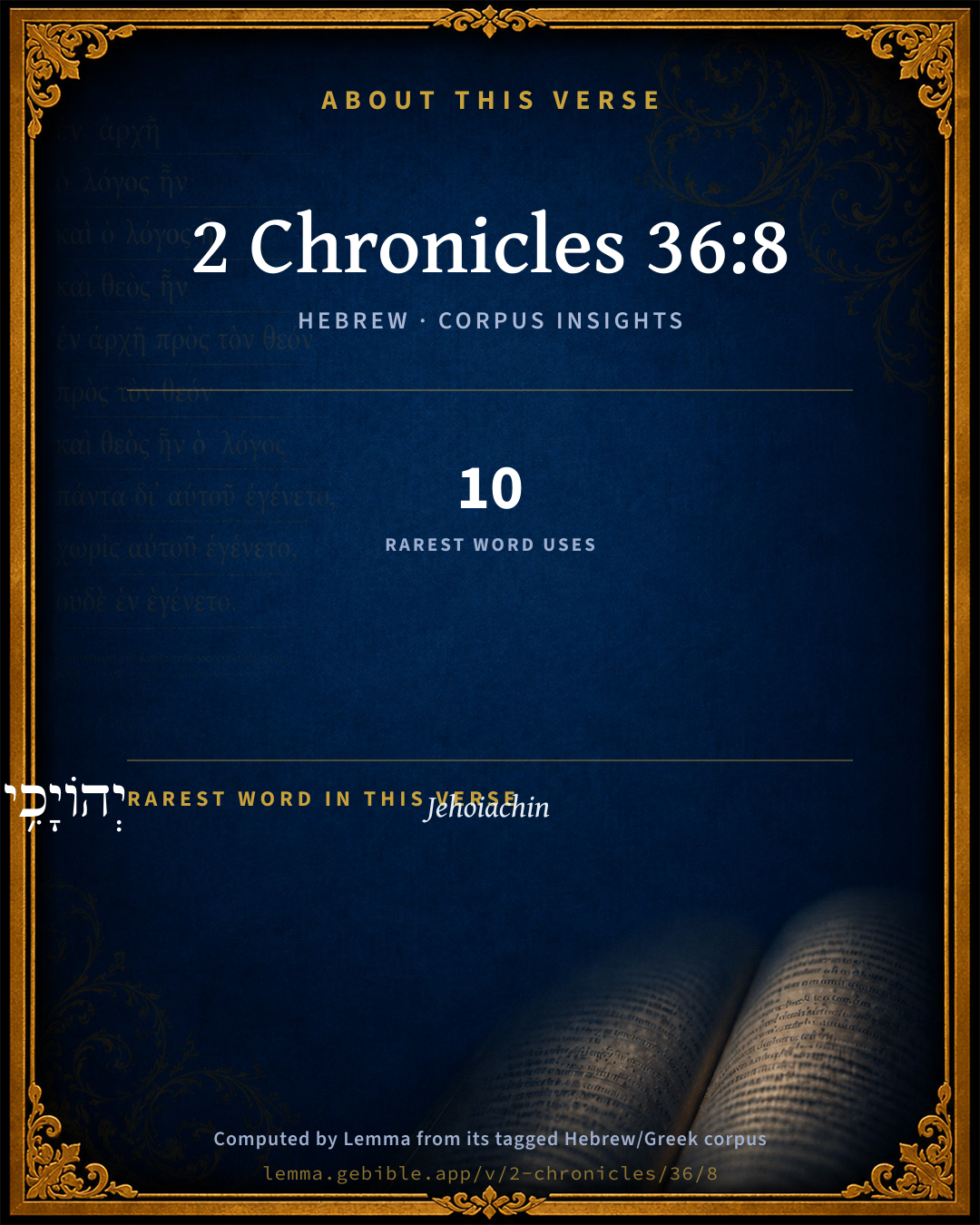
About this verse

These counts appear in no published source. They are computed here, from the morphology-tagged text and Lemma’s own curated glosses. What Lemma adds →

19
words
18
distinct lemmas
Historical
section

Notable vocabulary

The rarest word here is יְהוֹיָכִ֥ין Jehoiachin H3078 — appearing just 10 times in the whole Hebrew Bible.

Shared distinctive vocabulary

יְהוֹיָכִ֥ין Jehoiachin H3078 occurs in 8 verses of the Hebrew Bible. Also found in:

Grammatical profile

  • 4 verbs
  • 10 nouns
  • 3 prepositions
  • 2 particles

Verb forms

  • עָשָׂה֙ Qal · Perfect
  • וְהַנִּמְצָ֣א Niphal · Participle Active
  • כְּתוּבִ֗ים Qal · Participle Passive
  • וַיִּמְלֹ֛ךְ Qal · Sequential Imperfect

Repetition

A word recurs within this verse — often emphatic in Hebrew:

  • עָלָ֔יו upon H5921 ×2

Hebrew & Septuagint length

In English translation the verse runs 43 words from the Hebrew and 52 from the Septuagint (LXX English) — closely comparable.

A rough comparison of the two English renderings, which tokenize alike — not a word-level alignment.

Word counts can differ between the Hebrew and the Greek without any difference in meaning — e.g. the Hebrew direct-object marker אֵת has no separate Greek word, and Greek often adds the article ὁ.

Cross-references

5

Topical passages linked to 2 Chronicles 36:8 in the Treasury of Scripture Knowledge — connected by theme and wording, ordered by reader-vote popularity; previews shown in the World English Bible.

  • 2 Kings 24:5–6 Now the rest of the acts of Jehoiakim, and all that he did, aren't they written in the book of the chronicles of the kings of Judah?
  • 1 Chronicles 3:16–17 The sons of Jehoiakim: Jeconiah his son, Zedekiah his son.
  • Jeremiah 22:24 As I live, says Yahweh, though Coniah the son of Jehoiakim king of Judah were the signet on my right hand, yet would I pluck you there;
  • Jeremiah 22:28 Is this man Coniah a despised broken vessel? is he a vessel in which none delights? why are they cast out, he and his seed, and are cast into the land which they don't know?
  • Matthew 1:11–12 Josiah became the father of Jechoniah and his brothers, at the time of the exile to Babylon.

Cross-references courtesy of OpenBible.info (CC BY 4.0).

Hebrew and Greek witnesses Masoretic Hebrew ↔ Greek Septuagint

The same verse in the two great witnesses to the Old Testament, shown verse-for-verse.

These are two independent witnesses, not word-aligned to each other, and the Septuagint is shown in lemma (dictionary) form.

Hebrew 2 Chronicles 36:8 Masoretic · Westminster Leningrad Codex

וְיֶתֶר֩ דִּבְרֵ֨י יְהֽוֹיָקִ֜ים וְתֹֽעֲבֹתָ֤יו אֲשֶׁר עָשָׂה֙ וְהַנִּמְצָ֣א עָלָ֔יו הִנָּ֣ם כְּתוּבִ֗ים עַל סֵ֛פֶר מַלְכֵ֥י יִשְׂרָאֵ֖ל וִֽיהוּדָ֑ה וַיִּמְלֹ֛ךְ יְהוֹיָכִ֥ין בְּנ֖וֹ תַּחְתָּֽיו

Now the rest of the acts of Jehoiakim, and his abominations which he did, and that which was found in him, behold, they are written in the book of the kings of Israel and Judah: and Jehoiachin his son reigned in his place.

World English Bible · Public Domain

Greek LXX 2 Chronicles 36:8 Septuagint · lemma form

καί ὁ λοιπός ὁ λόγος ιωακιμ καί πᾶς ὅς ποιέω οὐ ἰδού οὗτος γράφω ἐπί βιβλίον λόγος ὁ ἡμέρα ὁ βασιλεύς ἰουδά καί κοιμάω ιωακιμ μετά ὁ πατήρ αὐτός καί ἐν γανοζα μετά ὁ πατήρ αὐτός καί βασιλεύω ιεχονιας υἱός αὐτός ἀντί αὐτός

And the rest of the acts of Joakim, and all that he did, behold, are not these things written in the book of the chronicles of the kings of Juda? And Joakim slept with his fathers, and was buried with his fathers in Ganozae: and Jechonias his son reigned in his stead.

LXX2012 (modern English Septuagint) · Public Domain

On this verse, Ellicott's Commentary for English Readers discusses the Septuagint’s reading. Read the note in Commentary ↓

Hebrew: Westminster Leningrad Codex (CC BY 4.0). Greek: Septuagint (public domain); English from LXX2012 (modern English Septuagint) (Public Domain). How the Septuagint differs from the Hebrew →

Commentary

Notes on 2 Chronicles 36:8 from classic Christian and Jewish commentators (each source and its license shown beneath its notes). The classic Christian expositions comment on the surrounding passage and are grouped to its opening verse, so a note may address several verses; the Jewish commentaries on the Tanakh (Rashi and others) are per-verse, so they appear only where the commentator wrote on this verse.

Lemma curates 59 commentaries, every one of them public domain or Creative Commons licensed, each selected and text-cleaned for this edition rather than reprinted as found. About our sources →

Trapp's Complete Commentary

John Trapp

2Ch 36:8 Now the rest of the acts of Jehoiakim, and his abominations which he did, and that which was found in him, behold, they [are] written in the book of the kings of Israel and Judah: and Jehoiachin his son reigned in his stead.

Ver. 8. And that which was found in him,] i.e., That appeared to be in him after he came to the kingdom; for magistracy showeth a man. The Jewish doctors, and from them other expositors not a few, tell us that on the dead body of this king were found certain brand marks, made in honour of the gods whom he served. Whereupon one crieth out, Quid miserius et infelicius, &c. What could be more wretched and miserable than for a crowned king so far to embase himself as to become a stigmatic of the devil? This was a heathenish practice.

John Trapp, A Commentary or Exposition upon All the Books of the Old and New Testament (1647–1656) — public domain. Text from a community e-Sword module.

Joseph Benson's Commentary

2Ch 36:8. That which was found in him — That crime of rebellion against the king of Babylon, which for a time he kept in his own breast, but when he saw fit, discovered it and was convicted of it.

Joseph Benson's Commentary on the Old and New Testaments (1811–1818) — public domain. Text from a community e-Sword module.

Geneva Bible (1599)

Geneva Bible translators

He meaneth superstitious marks which were found upon his body, when he was dead, which thing declared how deeply idolatry was rooted in his heart, seeing he bare the marks in his flesh.

Geneva Bible (1599) marginal notes — public domain. Text via Bolls.life.

Ellicott's Commentary for English Readers

(8) Now the rest of the acts.—(Comp. 2Ki_24:5.)

And his abominations which he did.—His crimes against God and man, i.e., probably acts of idolatry and tyranny. (Comp. Jer_25:6; Jer_7:5-11; Jer_22:13-19; covetousness, shedding innocent blood, &c. charged against him.)

That which was found in him.—2Ch_19:3. His general character and conduct.

As in the case of Anion (2Ch_33:25), the last particulars about Jehoiakim are omitted in this flying notice of his reign, which was only memorable because of the invasion of Nebuchadnezzar. The LXX., however, gives instead of this verse 2Ki_24:5-6, interpolating in the latter “and was buried with his fathers in the garden of Uzza” (ἐν γανοζαῆ or γανοζάν; see 2Ki_21:26). Thenius says “these words certainly (!) stood in the original text,” but were omitted by the chronicler and the editor of Kings, because they conflict with the prophecy of Jeremiah (Jer_22:18-19, Jer_36:30)—which is apparently the reason why he is so sure of their genuineness.

JEHOIACHIN (2Ch_36:9-10). (Comp. 2Ki_24:8-17; 3 Esdr. 1:41-44; Jer_22:24-30; Eze_19:5-9.)

A Bible Commentary for English Readers, edited by Charles John Ellicott (1878–1897) — public domain. Text from a community e-Sword module.

The Cambridge Bible for Schools and Colleges

gen. ed. J. J. S. Perowne

8. that which was found in him] i.e. his sin (in this context); cp. 1Ki_14:13.

The Cambridge Bible for Schools and Colleges (gen. ed. J. J. S. Perowne; Cambridge University Press, 1878–1918) — public domain. Text from a community e-Sword module.

Albert Barnes' Notes on the Bible

His abominations which he did - See Jer 7:9, Jer 7:30-31; Jer 19:3-13; Jer 25:1 etc.; Jehoiakim appears to have restored all the idolatries which Josiah his father had swept away.

Albert Barnes' Notes on the Bible (1834–1885) — public domain. Text from a community e-Sword/MySword module.

Haydock's Catholic Bible Commentary

In him. The Jews explain this of the diabolical characters forbidden, Lev. xix. 28. Denis the Carthusian; R. Sal., &c. --- But it may simply denote the hidden sins of the king, which God will bring to light, or his rebellious conduct. Amama) Gen. xliv. 16. C.

George Leo Haydock (1774–1849), Haydock's Catholic Family Bible and Commentary, 1859 edition — public domain. Excludes Psalms (Douay-Rheims chapter numbering differs from Protestant) and Deuterocanonical books (Catholic canon only).

Matthew Poole's English Annotations

That which was found in him; that crime of rebellion against the king of Babylon, which for a time he kept in his own breast; but when he saw fit, he discovered it, and was convicted of it. See 2Ki 24:1.

Matthew Poole's English Annotations on the Holy Bible (1683–1685) — public domain. Text from a community e-Sword/MySword module.

The Pulpit Commentary

The rest of the acts of Jehoiakim. As our compiler has literally told us none at all, we need but note his expression here as a convenient formula, indicating his own intentional brevity, and the fact that he was privy to all in the original sources, which he nevertheless now omitted; yet Jer_7:9 Jer_19:13, etc. The telling expression, what was found in him, is too readily to be filled up from the parallel, in its vers. 3, 4. Jehoiachin his son. In 1Ch_3:16 he is called Jeconiah, and in Jer_22:24 he is called Coniah.

Ver. 8. (with Jer_22:18)

An unlamented death.

We learn more of this King of Judah in the prophetic writings of Jeremiah than in these brief annals. There we learn that his foreign policy was not less condemnable than his conduct of home affairs. When his treasury was low by reason of heavy payments to the foreign powers, he must needs build for himself a splendid and costly mansion, (Jer_22:14) and inorder to do this he had to impress the labour of his subjects; (Jer_22:13) he thus excited a strong feeling of just resentment and natural disaffection among them, and brought down upon himself the severe rebuke of the prophet of the Lord. We also learn from Jeremiah that the king acted in daring defiance of God"s holy Law, presuming to cut in two and to burn in the fire the sacred roll. (Jer_36:23) By this wanton and impious action he still further drew down upon him the wrath of Jehovah, and by that act he terribly prejudiced and injured his country. How, then, can we wonder that the Chronicler writes, as in the text, of the abominations which he did"? and how can we wonder that his death excited so different, so opposite a feeling throughout all his kingdom to that which the death of his father called forth? (2Ch_35:24, 2Ch_35:25) We have in him a melancholy instance of an unlamented death. (Jer_22:18)

I A LAMENTABLE ABSENCE OF SORROW. Let no man say lightly or cynically, "I don"t want any tears shed over my grave; I shall be quite content to die without any one sorrowing on my account." There is no true unselfishness, but much thoughtlessness" in such a sentiment. Any minister of religion who has stood at the grave-side, and has been unable to ask for God"s comfort to be granted to those who are left behind, will know how little to be desired is the absence of grief at the death of a man or woman. For what does it mean? It means that God gave to such a man all the opportunities for winning human love, and that he did not gain it; for doing service, and that he left it undone; for rendering help and blessing, and that he did not render it; if means that a human life has been one long act of mean, barren, dreary selfishness, has been an utter failure, condemned of God and man! God forbid that any whom we love should die unlamented; with none to say, "Ah, my brother! ah, my sister!

II A SORROW MUCH TO BE DESIRED. Truly there is sorrow enough and to spare in this world of sin and woe. But there is one sorrow that no wise or good man would wish for one moment to be spared. It is that which we feel when our kindred and our friends are taken from us by death. The hope we have concerning these may chasten and (in time) supersede it. But sorrow there must be and should be. And it is well with us and for us that the heart bleeds freely then. For such sorrow is:

1. The tender tribute we pay to the worth of the departed, to their affection and to their goodness.

2. The proof that this hardening world has not petrified our spirit with its touch.

3. The share we have with all the best and truest of our race, enabling us to sympathize with them and to succour them.

4. The occasion which takes us often to the sympathizing Friend in elevating, chastening communion.

5. The unloosening of the ties which must soon he unbound to set us free. C.

The Pulpit Commentary (1880–1919), ed. H.D.M. Spence-Jones & Joseph S. Exell — public domain. Text from a community e-Sword module.

John Wesley's Explanatory Notes

Found in him - That crime of rebellion against the king of Babylon, which for a time he kept in his own breast, but when he saw fit, discovered it, and was convicted of it.

John Wesley, Explanatory Notes Upon the Whole Bible (1754–1765) — public domain. Text via the GEBible commentary corpus.

unfoldingWord translationNotes

Door43 World Missions Community

the disgusting things that he did

This usually refers to worshiping false gods, which Yahweh hated.

what was found against him

This idiom refers to things that he did for which people could accuse him of wrong. This can be stated in active form. AT: "what people found against him" or "things that he did for which people could accuse him" (See: Idiom and Active or Passive)

behold, they are written

"anyone can look in the book ... Israel and see they are written there"

they are written in the book

This can be stated in active form. AT: "someone has written them in the book" or "you can read of them in the book" (See: Active or Passive)

the book of the kings of Judah and Israel

This is a book that no longer exists. See how you translated this in 2 Chronicles 35:27.

became king in his place

The phrase "in his place" is a metaphor meaning "instead of him." AT: "became king instead of Jehoiakim" (See: Metaphor)

translationWords

kingdom of Israel

Jehoiachin

unfoldingWord translationNotes — © Distant Shores Media and the Door43 World Missions Community, licensed CC BY-SA 4.0. Source: git.door43.org/Door43/en_tn.

Rashi

Rabbi Shlomo Yitzchaki (Rashi)

and the abominations that he was intimate with his mother.

and that which was found upon him This alludes to a tattoo, [something found on the body].

Rashi on the Tanakh — English translations: “The Judaica Press complete Tanach with Rashi, translated by A. J. Rosenberg” (CC BY 4.0); “Pentateuch with Rashi's commentary by M. Rosenbaum and A.M. Silbermann, 1929-1934” (public domain); “The Metsudah Tanach series, Lakewood, N.J” (CC BY 4.0); and “The Book of Joshua, Metsudah Publications, 1997” (CC BY 4.0). Text via Sefaria.

Lesson kit

Teaching starters — assembled from the data on this page, not authored interpretation. Every prompt links to the verse data it draws on. Edit before teaching.

2 Chronicles, in the Historical, opens this verse with 19 words (18 distinct Hebrew lemmas). Its most distinctive word is Yᵉhôwyâkîyn (“Jehoiachin”). A historical commentator’s framing appears above. Read the whole chapter for the surrounding context.

Discussion questions

  1. What does “Jehoiachin” (Yᵉhôwyâkîyn) contribute to the verse as a whole?
  2. How does 2 Kings 24:6, which shares the word «Jehoiachin», read alongside this verse?
  3. What does the repetition of “upon” (2× in this one verse) do in this verse?
  4. These translations render this verse differently; the difference is in the English rendering, not the original. What questions does that raise?
  5. «עָשָׂה֙» is a Qal Perfect verb. How does that grammatical form shape the action described?
  6. Compare how Trapp's Complete Commentary and Joseph Benson's Commentary read this verse. Where do they agree or differ?

Things to notice

Reading settings

Reading text

Shown beneath each verse's original-language words.

Old Testament
Old Testament edition

Read the OT as the Masoretic Hebrew (MT) or the Greek Septuagint (LXX).

English shown for the Greek Septuagint (in the Hebrew ↔ Greek comparison).

Comparing translations? Open the Compare panel on any verse page to stack up to four side by side.