
Ezra 9:15

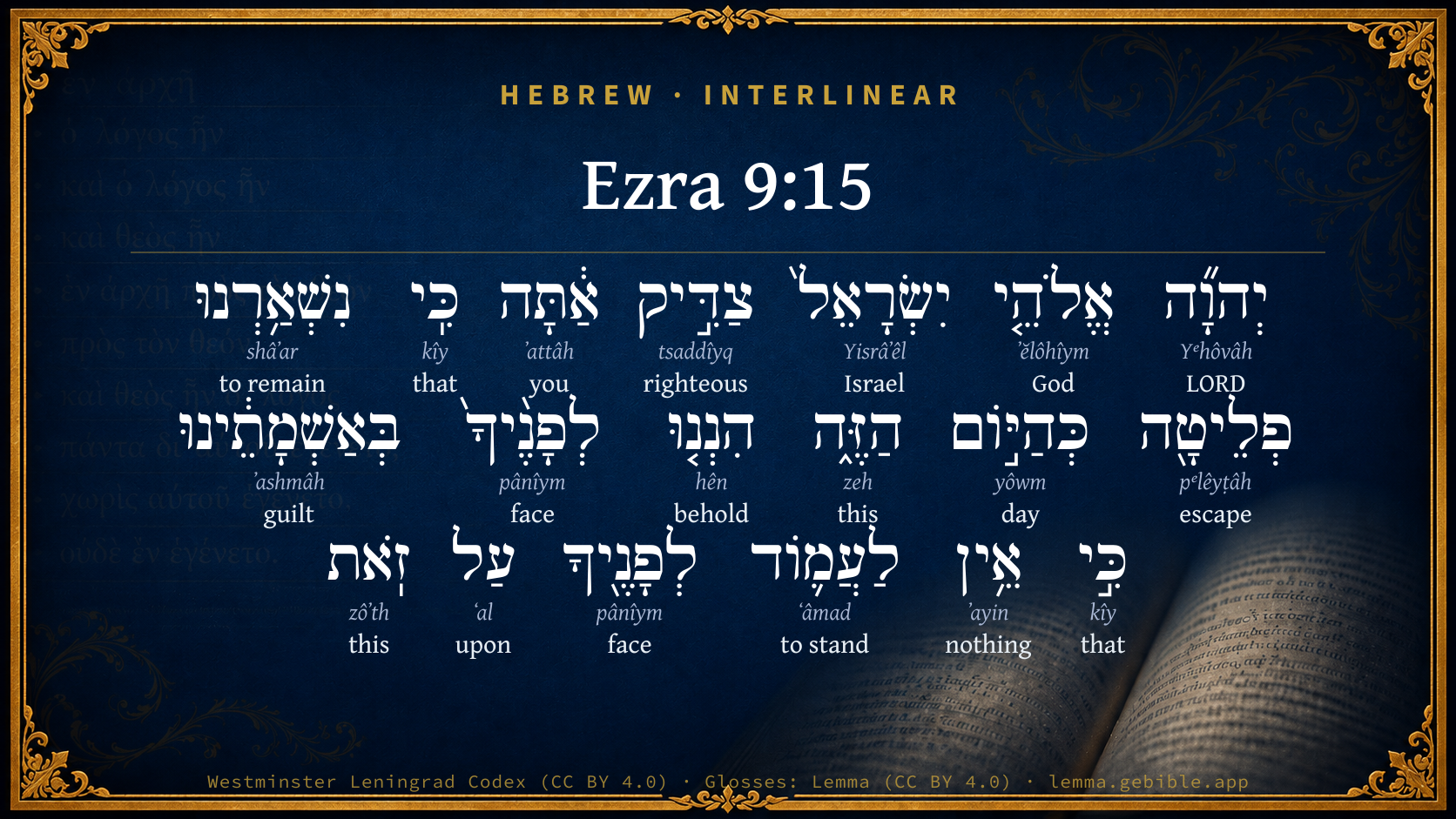
Hebrew (Westminster Leningrad Codex) Ezra 9:15 appears in the Hebrew Old Testament. The text above is from the Westminster Leningrad Codex. Each word links to its Strong’s number, a concise gloss, and parsing drawn from the Open Scriptures Hebrew Bible morphology. Click any word for its full Brown-Driver-Briggs (BDB) entry.
Download image
Cite this verse

Ezra 9:15 (World English Bible). Public Domain. Lemma interlinear Bible study tool, https://lemma.gebible.app/v/ezra/9/15.

Show BibTeX & RIS
BibTeX
RIS
English Translation
Yahweh, the God of Israel, you are righteous; for we are left a remnant that is escaped, as it is this day: behold, we are before you in our guiltiness; for none can stand before you because of this.
World English Bible · Public Domain
Download a study sheet

One document with this verse’s original text, its word-by-word gloss line, the meaning frame, cross-references with their text, attributed commentary, and full source and license credits — printable, and it pastes into notes with its structure intact.

This verse Autodidact and up

Study sheet (.html) Plain text (.txt)

A passage Seminary Student

Up to 50 verses in one chapter. A passage sheet keeps up to 6 commentary sources and 12 cross-references per verse, in the order this page ranks them, and says so on the sheet whenever that leaves anything out. Ask for a single verse and you get the Autodidact verse sheet above.

Everything on this page stays free to read, with no account — the sheet is a download of what is already on screen, not access to it.

Want to remove ads? Support Godless Engineer
Compare translations 3

The same verse in 3 English versions, stacked beneath the original-language interlinear above. Click any original word for its lexicon entry.

Each is an independent rendering of the whole verse — the interlinear is not word-aligned to these translations.

Highlighted words mark where these versions differ — a whole-verse word diff, not a word-by-word alignment.

  • World English Bible Public Domain
    Yahweh, the God of Israel, you are righteous; for we are left a remnant that is escaped, as it is this day: behold, we are before you in our guiltiness; for none can stand before you because of this.
  • King James Version Public Domain
    O LORD God of Israel, thou art righteous: for we remain yet escaped, as it is this day: behold, we are before thee in our trespasses: for we cannot stand before thee because of this.
  • unfoldingWord Literal Text CC BY-SA 4.0
    Yahweh, the God of Israel, you are righteous, for we are left as survivors, as this day. Behold us, before your face in our guilt, for there is none to stand before your face on account of this.”

unfoldingWord Literal Text — © unfoldingWord, licensed CC BY-SA 4.0. Word-aligned USFM3 via Door43 (git.door43.org/unfoldingWord/en_ult).

Versions to compare (up to 4)

3 of 4 selected

Show all 18 translations

Every available English version of this verse, each an independent rendering of the whole verse.

  • World English Bible Public Domain
    Yahweh, the God of Israel, you are righteous; for we are left a remnant that is escaped, as it is this day: behold, we are before you in our guiltiness; for none can stand before you because of this.
  • Berean Standard Bible Public Domain
    O LORD, God of Israel, You are righteous! For we remain this day as a remnant. Here we are before You in our guilt, though because of it no one can stand before You.”
  • Majority Standard Bible Public Domain
    O LORD, God of Israel, You are righteous! For we remain this day as a remnant. Here we are before You in our guilt, though because of it no one can stand before You.”
  • King James Version Public Domain
    O LORD God of Israel, thou art righteous: for we remain yet escaped, as it is this day: behold, we are before thee in our trespasses: for we cannot stand before thee because of this.
  • American Standard Version (1901) Public Domain
    O Jehovah, the God of Israel, thou art righteous; for we are left a remnant that is escaped, as it is this day: behold, we are before thee in our guiltiness; for none can stand before thee because of this.
  • Revised Version (1885) Public Domain
    O LORD, the God of Israel, thou art righteous; for we are left a remnant that is escaped, as it is this day: behold, we are before thee in our guiltiness; for none can stand before thee because of this.
  • Geneva Bible (1599) Public Domain
    O Lord God of Israel, thou art iust, for we haue bene reserued to escape, as appeareth this day: beholde, we are before thee in our trespasse: therfore we canot stand before thee because of it.
  • Douay-Rheims (1899) Public Domain
    O Lord God of Israel, thou art just: for we remain yet to be saved as at this day. Behold we are before thee in our sin, for there can be no standing before thee in this matter.
  • Young's Literal Translation Public Domain
    `O Jehovah, God of Israel, righteous `art' Thou, for we have been left an escape, as `it is' this day; lo, we `are' before Thee in our guilt, for there is none to stand before Thee concerning this.'
  • Literal Standard Version CC BY-SA 4.0
    O YHWH, God of Israel, You [are] righteous, for we have been left an escape, as [it is] this day; behold, we [are] before You in our guilt, for there is none to stand before You concerning this.”
  • Unlocked Literal Bible CC BY-SA 4.0
    Yahweh, God of Israel, you are righteous, for we have remained as a few survivors at this day. Look! We are here before you in our guilt, for there is no one who can stand before you because of this.
  • unfoldingWord Literal Text CC BY-SA 4.0
    Yahweh, the God of Israel, you are righteous, for we are left as survivors, as this day. Behold us, before your face in our guilt, for there is none to stand before your face on account of this.”
  • Darby Bible Public Domain
    Jehovah, God of Israel, thou art righteous; for we are a remnant that is escaped, as [it is] this day. Behold, we are before thee in our trespasses; for there is no standing before thee because of this.
  • World Messianic Bible Public Domain
    LORD, the God of Israel, you are righteous; for we are left a remnant that has escaped, as it is today. Behold, we are before you in our guiltiness; for no one can stand before you because of this.”
  • Webster's Bible Public Domain
    O LORD God of Israel, thou art righteous: for we having escaped, remain yet, as it is this day: behold, we are before thee in our trespasses: for we cannot stand before thee because of this.
  • Free Bible Version CC BY-SA 4.0
    Lord, God of Israel, you do what is right. Today we're all that is left, a remnant. We are before you in our guilt, but no one can stand before you because of it.”
  • Bible in Basic English Public Domain
    O Lord God of Israel, righteousness is yours; we are only a small band which has been kept from death, as at this day: see, we are before you in our sin; for no one may keep his place before you because of this.
  • JPS Tanakh (1917) Public Domain
    O LORD, the God of Israel, Thou art righteous; for we are left a remnant that is escaped, as it is this day; behold, we are before Thee in our guiltiness; for none can stand before Thee because of this.'

Literal Standard Version (2020), Covenant Press — licensed CC BY-SA 4.0. Text via the HelloAO Bible API (eBible.org). Unlocked Literal Bible (unfoldingWord) — licensed CC BY-SA 4.0. Text via the HelloAO Bible API (eBible.org). unfoldingWord Literal Text — © unfoldingWord, licensed CC BY-SA 4.0. Word-aligned USFM3 via Door43 (git.door43.org/unfoldingWord/en_ult). Free Bible Version, Dr. Jonathan Gallagher — licensed CC BY-SA 4.0. Text via the HelloAO Bible API (eBible.org).

Word by word

More ways to search: Search by grammar → Find every occurrence → Compare this word →

Practice this passage: Drill this verse → Learn its vocabulary →

בְּאַשְׁמָתֵ֔ינוּ
ʼashmâh
H819
“in/at · guilt · our”
Preposition + Noun, Common, Feminine, Singular, Construct + Suffix, Personal, 1st Person, Common, Plural
Part of Speech
Preposition + Noun
Type
Common
Gender
Feminine
Number
Singular
State
Construct
Full BDB Definition

Origin: from H817

TWOT: 180c

guiltiness, guilt, offense, sin, wrong-doing - doing wrong, committing a trespass or offense - becoming guilty, guilt - bringing a guilt-offering
  1. יְהוָ֞ה Yᵉhôvâh H3068 “LORD” Noun, Proper
  2. אֱלֹהֵ֤י ʼĕlôhîym H430 “God(s) of” Noun, Common, Masculine, Plural, Construct
  3. יִשְׂרָאֵל֙ Yisrâʼêl H3478 “Israel” Noun, Proper
  4. צַדִּ֣יק tsaddîyq H6662 “righteous” Adjective, Adjective, Masculine, Singular, Absolute
  5. אַ֔תָּה ʼattâh H859 “you” Pronoun, Personal, 2nd Person, Masculine, Singular
  6. כִּֽי kîy H3588 “that” Conjunction
  7. נִשְׁאַ֥רְנוּ shâʼar H7604 “to remain” Verb, Niphal, Perfect, 1st Person, Common, Plural
  8. פְלֵיטָ֖ה pᵉlêyṭâh H6413 “escape” Noun, Common, Feminine, Singular, Absolute
  9. כְּהַיּ֣וֹם yôwm H3117 “like/as · the · day” Preposition + Particle, Definite Article + Noun, Common, Masculine, Singular, Absolute
  10. הַזֶּ֑ה zeh H2088 “the · this” Particle, Definite Article + Pronoun, Demonstrative, Masculine, Singular
  11. הִנְנ֤וּ hên H2005 “behold · us” Particle, Interjection + Suffix, Personal, 1st Person, Common, Plural
  12. לְפָנֶ֨יךָ֙ pânîym H6440 “to/for · face(s) · your” Preposition + Noun, Common, Both, Plural, Construct + Suffix, Personal, 2nd Person, Masculine, Singular
  13. כִּ֣י kîy H3588 “that” Conjunction
  14. אֵ֥ין ʼayin H369 “nothing” Particle, Negative
  15. לַעֲמ֛וֹד ʻâmad H5975 “to stand” Preposition + Verb, Qal, Infinitive Construct
  16. לְפָנֶ֖יךָ pânîym H6440 “to/for · face(s) · your” Preposition + Noun, Common, Both, Plural, Construct + Suffix, Personal, 2nd Person, Masculine, Singular
  17. עַל ʻal H5921 “upon” Preposition
  18. זֹֽאת zôʼth H2063 “this” Pronoun, Demonstrative, Feminine, Singular

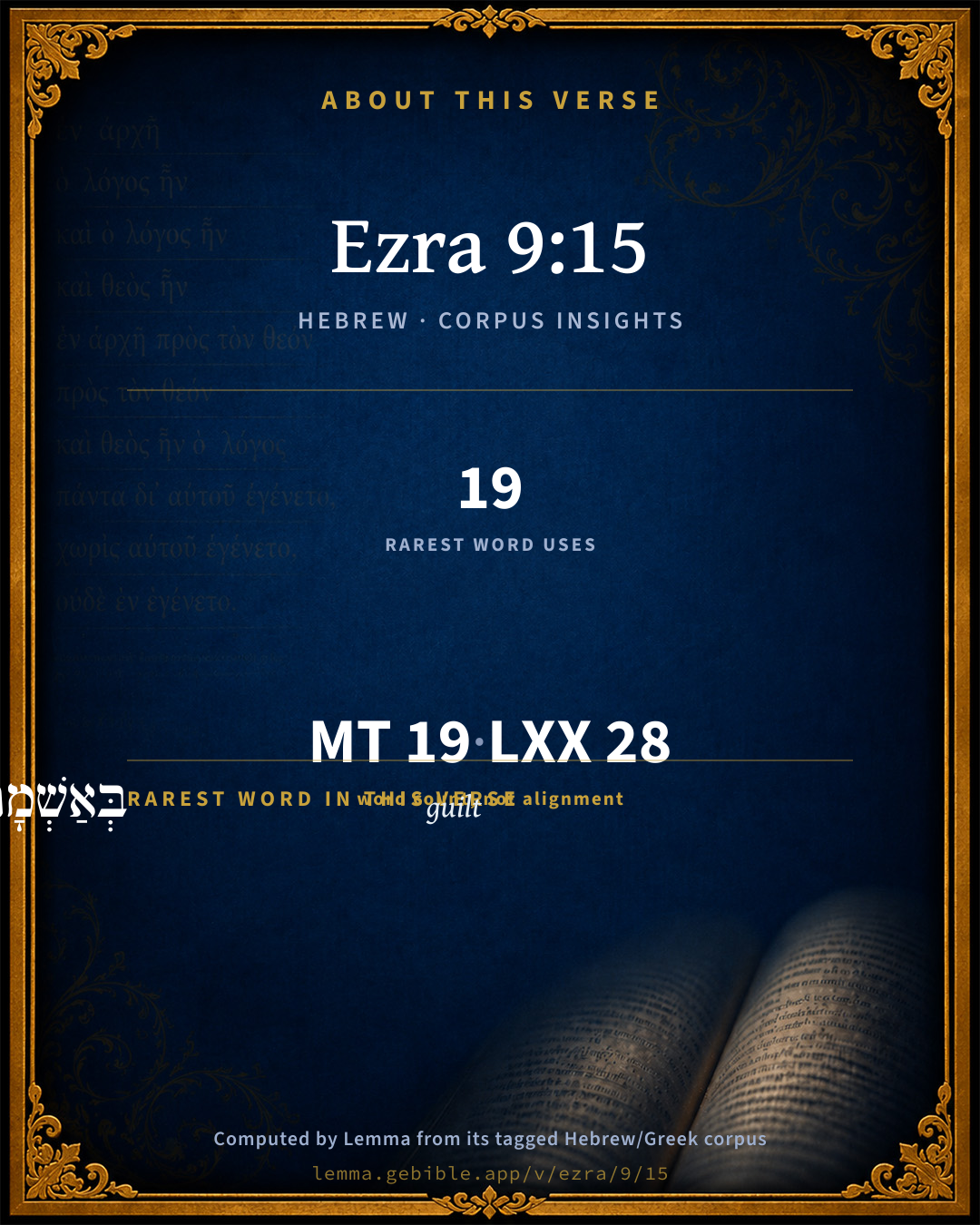
About this verse

These counts appear in no published source. They are computed here, from the morphology-tagged text and Lemma’s own curated glosses. What Lemma adds →

19
words
17
distinct lemmas
Historical
section

Notable vocabulary

The rarest word here is בְּאַשְׁמָתֵ֔ינוּ guilt H819 — appearing just 19 times in the whole Hebrew Bible.

Shared distinctive vocabulary

בְּאַשְׁמָתֵ֔ינוּ guilt H819 occurs in 17 verses of the Hebrew Bible. Also found in:

Grammatical profile

  • 2 verbs
  • 8 nouns
  • 1 adjective
  • 3 pronouns
  • 1 preposition
  • 2 conjunctions
  • 2 particles

Verb forms

  • נִשְׁאַ֥רְנוּ Niphal · Perfect
  • לַעֲמ֛וֹד Qal · Infinitive Construct

Repetition

Words recur within this verse — often emphatic in Hebrew:

  • לְפָנֶ֨יךָ֙ face H6440 ×2
  • כִּֽי that H3588 ×2

Hebrew & Septuagint length

In English translation the verse runs 39 words from the Hebrew and 34 from the Septuagint (LXX English) — closely comparable.

A rough comparison of the two English renderings, which tokenize alike — not a word-level alignment.

Word counts can differ between the Hebrew and the Greek without any difference in meaning — e.g. the Hebrew direct-object marker אֵת has no separate Greek word, and Greek often adds the article ὁ.

In the original languages it is 19 Hebrew tokens and 28 Greek tokens — but the two are counted differently (Hebrew bundles its prefixes and suffixes into one token; the Greek is in lemma form), so that isn’t a like-for-like length.

Cross-references

16

Topical passages linked to Ezra 9:15 in the Treasury of Scripture Knowledge — connected by theme and wording, ordered by reader-vote popularity; previews shown in the World English Bible.

  • Psalms 130:3 If you, Yah, kept a record of sins, Lord, who could stand?
  • John 8:24 I said therefore to you that you will die in your sins; for unless you believe that I am he, you will die in your sins."
  • John 8:21 Jesus said therefore again to them, "I am going away, and you will seek me, and you will die in your sins. Where I go, you can't come."
  • Romans 3:19 Now we know that whatever things the law says, it speaks to those who are under the law, that every mouth may be closed, and all the world may be brought under the judgment of God.
  • Nehemiah 9:33–34 However you are just in all that is come on us; for you have dealt truly, but we have done wickedly;
  • Zechariah 3:3–4 Now Joshua was clothed with filthy garments, and was standing before the angel.
  • Romans 10:3 For being ignorant of God's righteousness, and seeking to establish their own righteousness, they didn't subject themselves to the righteousness of God.
  • Job 9:2–3 "Truly I know that it is so, But how can man be just with God?
  • Psalms 143:2 Don't enter into judgment with your servant, For in your sight no man living is righteous.
  • Isaiah 64:6–7 For we are all become as one who is unclean, and all our righteousness are as a polluted garment: and we all do fade as a leaf; and our iniquities, like the wind, take us away.
  • Jeremiah 12:1 Righteous are you, Yahweh, when I contend with you; yet would I reason the cause with you: why does the way of the wicked prosper? why are all they at ease who deal very treacherously?
  • Lamentations 3:22–23 [It is of] Yahweh's loving kindnesses that we are not consumed, because his compassion doesn't fail.
  • Ezekiel 33:10 You, son of man, tell the house of Israel: Thus you speak, saying, Our transgressions and our sins are on us, and we pine away in them; how then can we live?
  • Daniel 9:7–11 Lord, righteousness belongs to you, but to us confusion of face, as at this day; to the men of Judah, and to the inhabitants of Jerusalem, and to all Israel, who are near, and who are far off, through all the countries where you have driven them, because of their trespass that they have trespassed against you.
  • Daniel 9:14 Therefore has Yahweh watched over the evil, and brought it on us; for Yahweh our God is righteous in all his works which he does, and we have not obeyed his voice.
  • 1 Corinthians 15:17 If Christ has not been raised, your faith is vain; you are still in your sins.

Cross-references courtesy of OpenBible.info (CC BY 4.0).

Hebrew and Greek witnesses Masoretic Hebrew ↔ Greek Septuagint

The same verse in the two great witnesses to the Old Testament, shown verse-for-verse.

These are two independent witnesses, not word-aligned to each other, and the Septuagint is shown in lemma (dictionary) form.

Hebrew Ezra 9:15 Masoretic · Westminster Leningrad Codex

יְהוָ֞ה אֱלֹהֵ֤י יִשְׂרָאֵל֙ צַדִּ֣יק אַ֔תָּה כִּֽי נִשְׁאַ֥רְנוּ פְלֵיטָ֖ה כְּהַיּ֣וֹם הַזֶּ֑ה הִנְנ֤וּ לְפָנֶ֨יךָ֙ בְּאַשְׁמָתֵ֔ינוּ כִּ֣י אֵ֥ין לַעֲמ֛וֹד לְפָנֶ֖יךָ עַל זֹֽאת

Yahweh, the God of Israel, you are righteous; for we are left a remnant that is escaped, as it is this day: behold, we are before you in our guiltiness; for none can stand before you because of this.

World English Bible · Public Domain

Greek LXX Ezra 9:15 Septuagint · lemma form

κύριος ὁ θεός ἰσραήλ δίκαιος σύ ὅτι καταλείπω διασώζω ὡς ὁ ἡμέρα οὗτος ἰδού ἐγώ ἐναντίον σύ ἐν πλημμέλεια ἐγώ ὅτι οὐ εἰμί ἵστημι ἐνώπιος σύ ἐπί οὗτος

O Lord God of Israel, you are righteous; for we remain yet escaped, as at this day: behold, we are before you in our trespasses: for we can’t stand before you on this account.

LXX2012 (modern English Septuagint) · Public Domain

In the Septuagint this is one book — Esdras B (2 Esdras): Ezra is chapters 1–10, Nehemiah 11–23.

Hebrew: Westminster Leningrad Codex (CC BY 4.0). Greek: Septuagint (public domain); English from LXX2012 (modern English Septuagint) (Public Domain). How the Septuagint differs from the Hebrew →

Commentary

Notes on Ezra 9:15 from classic Christian and Jewish commentators (each source and its license shown beneath its notes). The classic Christian expositions comment on the surrounding passage and are grouped to its opening verse, so a note may address several verses; the Jewish commentaries on the Tanakh (Rashi and others) are per-verse, so they appear only where the commentator wrote on this verse.

Lemma curates 59 commentaries, every one of them public domain or Creative Commons licensed, each selected and text-cleaned for this edition rather than reprinted as found. About our sources →

Trapp's Complete Commentary

John Trapp

Ezr 9:15 O LORD God of Israel, thou [art] righteous: for we remain yet escaped, as [it is] this day: behold, we [are] before thee in our trespasses: for we cannot stand before thee because of this.

Ver. 15. O Lord God of Israel] So called, because he is their portion, they his, Deu 32:9. He had avouched them for his; and they him interchangeably, Deu 26:17-18. Seneca could say that the basest people (meaning the Jews) gave laws unto all the world; that is, had the true God, creator of all, for their God.

Thou art righteous] In all thy judgments inflicted upon us; or, thou art faithful and true in thy promises: but we have forfeited thy favour, and deserved destruction.

Behold, we are before thee in our trespasses] Or guiltiness, which is that iniquity of sin (as David calleth it, Psa 32:5) whereby the sinner is bound over to condign punishment.

For we cannot stand before thee] But must needs causa cadere, drop our case, being self-condemned; and such as must needs subscribe to thy perfect justice in our own utter destruction.

John Trapp, A Commentary or Exposition upon All the Books of the Old and New Testament (1647–1656) — public domain. Text from a community e-Sword module.

Joseph Benson's Commentary

Ezr 9:15. O Lord, thou art righteous — A just and holy God, who hatest, and wilt infallibly punish, sin and sinners. Or, thou art merciful, for the Hebrew word here rendered righteous, often signifies merciful. Notwithstanding all our sins, thou hast not utterly destroyed us, but left us a remnant; for we remain yet escaped — Not entirely destroyed, not punished as we deserved. Behold, we are before thee in our trespasses — We are here in thy presence, and so are all our sins; we are arraigning ourselves before thy tribunal, acknowledging thee to be just if thou destroy us. For we cannot stand before thee — In judgment, as that word is often used; we must needs fall and perish at thy presence.

Joseph Benson's Commentary on the Old and New Testaments (1811–1818) — public domain. Text from a community e-Sword module.

Tyndale Open Study Notes

Tyndale Open Resources

9:15 you are just: God’s anger with sin is based on his justice and holiness.

Tyndale Open Study Notes — © Tyndale Open Resources, licensed CC BY-SA 4.0. Text via the HelloAO Bible API.

Geneva Bible (1599)

Geneva Bible translators

He showeth that God is just in punishing his people, and yet merciful in reserving a residue in whom he showeth favor.

Geneva Bible (1599) marginal notes — public domain. Text via Bolls.life.

Adam Clarke's Commentary

Verse 15. Thou art righteous] Thou art merciful; this is one of the many meanings of the word צדק tsedek; and to this meaning St. Paul refers, when he says, God declares his righteousness for the remission of sins that are past, Ro 3:25. See the note there.

We remain yet escaped] Because of this righteousness or mercy.

In our trespasses] We have no righteousness; we are clothed and covered with our trespasses.

We cannot stand before thee because of this.] The parallel place, as noted in the margin, is Ps 130:3: If thou, Lord, shouldest mark iniquities, O Lord, who shall stand? Every man must stand before the judgment-seat of Christ: but who shall stand there with joy? No man against whom the Lord marks iniquities. There is a reference here to the temple service: the priests and Levites stood and ministered before the Lord, but they were not permitted to do so unless pure from all legal pollution; so no man shall stand before the judgment-seat of Christ who is not washed and made white in the blood of the Lamb. Reader, how dost thou expect to stand there?

Adam Clarke's Commentary on the Bible (1810–1826) — public domain. Text from a community e-Sword/MySword module.

The Cambridge Bible for Schools and Colleges

gen. ed. J. J. S. Perowne

15. The prayer ends in expression of complete surrender. There is no excuse to plead. The nation stands in its sin in the presence of the perfect God, and awaits the sentence of ‘righteousness’.

O Lord God of Israel] R.V. O LORD, the God of Israel. See on Ezr_1:3. The prayer had begun ‘O my God’ (Ezr_9:6). It ends, O Lord the God of Israel. The thought of his nation overmastered the supplicant.

thou art righteous] This must not be softened down as if it were ‘thou art gracious’. The words are an acknowledgement of the perfect justice of God’s dealings with Israel in the past. The next sentence ‘for we are left a remnant’ is not uttered in gratitude for the mercy which spared ‘a remnant’, but is added to express the greatness of the catastrophe, which had carried off the whole nation except ‘a remnant’. And yet the visitation had been just. The prayer of Ezra (?) in Nehemiah 9 has a very similar phrase, Neh_9:33 ‘Howbeit thou art just (çaddîq) in all that is come upon us; for thou hast done truly, but we have done wickedly’. Thou art righteous (çaddîq), and we who are left ‘a remnant’ have failed to profit by the righteous judgement of the past. God is called ‘righteous’ in reference to the ‘fixed and unalterable rule of truth and goodness’. Cf. Neh_9:8; 2Ch_12:6; Psa_119:137; Psa_129:4; Psa_145:7. (See Cheyne on Psa_7:17.)

as it is this day] Cf. Ezr_9:7.

we are before thee] i.e. arraigned as it were before thy judgement seat. Ezra was praying ‘before the house of God’ (Ezr_10:2).

in our trespasses] R.V. in our guiltiness. See on Ezr_9:7. Fresh guilt has been added to the old. There is nothing to plead in extenuation. Nor had there been in the past. Righteous as Jehovah was, He had granted ‘a remnant’: now the guiltiness of the remnant seemed to merit its extinction.

for we cannot stand before thee because of this] R.V. for none can stand before thee because of this. None, for all Israelites, innocent as well as guilty, are bound up together in that responsibility for the nation’s guilt. Cf. Psa_76:7 ‘And who may stand in thy sight when once thou art angry?’ Psa_130:3 ‘If thou, Lord, shouldest mark iniquities, O Lord, who shall stand?’ Nah_1:6 ‘Who can stand before his indignation? and who can abide in the fierceness of his anger?’ The Spirit alone gives the power to ‘stand before’ God and to hear His word. Eze_2:1-2.

because of this] See note on Ezr_8:23, Ezr_10:2 : i.e. on account of this last sin, in which the people have once more offended their God.

The Cambridge Bible for Schools and Colleges (gen. ed. J. J. S. Perowne; Cambridge University Press, 1878–1918) — public domain. Text from a community e-Sword module.

John Gill's Exposition

O Lord God of Israel, thou art righteous,.... And would appear to be so, should Israel be entirely cut off, and utterly consumed for their iniquities:

for we remain yet escaped, as it is this day; that they remained yet escaped out of captivity, and escaped the wrath and vengeance of God, was not owing to any deserts of theirs, but to the grace and mercy of God, who had not stirred up all his wrath, as their sins deserved:

behold, we are before thee in our trespasses; to do with us as seems good in thy sight; we have nothing to plead on our behalf, but cast ourselves at thy feet, if so be unmerited favour may be shown us:

for we cannot stand before thee because of this; this evil of contracting affinity with the nations; we cannot defend ourselves; we cannot plead ignorance of the divine commands; we have nothing to say for ourselves why judgment should not be passed upon us; we leave ourselves in thine hands, and at thy mercy.

Next: Ezra Chapter 10

John Gill's Exposition of the Whole Bible (1746–1763) — public domain (CC PDM 1.0). Text via the HelloAO Bible API.

Albert Barnes' Notes on the Bible

Some take “righteous” to mean here “kind” or “merciful.” Others give it the more usual sense of “just,” and understand the full meaning of the passage to be, “Thou art righteous, and hast punished us, because of our sin, the contraction of forbidden marriages, so that we are a mere remnant of what was once a great people.”

Albert Barnes' Notes on the Bible (1834–1885) — public domain. Text from a community e-Sword/MySword module.

Haydock's Catholic Bible Commentary

To be saved from our iniquities, which are still upon us. (Haydock) --- We confess that, if we should be treated according to our deserts, we could expect no redress. But we trust in thy mercies, which have hitherto supported and brought us back from slavery. (Calmet)

George Leo Haydock (1774–1849), Haydock's Catholic Family Bible and Commentary, 1859 edition — public domain. Excludes Psalms (Douay-Rheims chapter numbering differs from Protestant) and Deuterocanonical books (Catholic canon only).

Matthew Poole's English Annotations

Thou art righteous; a just and holy God, who dost hate, and wilt infallibly punish, sin and sinners. Or, thou art merciful, as appears from hence, that notwithstanding all our sins, thou hast not utterly destroyed us, but left a remnant of us. The Hebrew word here rendered righteous, is oft used for merciful; as is well known to all the learned.

For we remain yet escaped; or, though we remain, &c., i.e. though thou hast yet spared us in part, yet thou art righteous, and therefore wilt certainly punish and destroy us according to our deserts, if we do not repent us, and reform this great wickedness.

We are before thee in our trespasses; we are here in thy presence, and so are all our sins; we are arraigning ourselves before thy tribunal, acknowledging ourselves to be vile offenders, and thee to be just, if thou destroy us.

We cannot stand before thee, to wit, in judgment, as that word is oft used, as Psa 130:3; compare Psa 1:5; we must needs fall and perish at thy presence, as the phrase is, Psa 9:3. Because of this; because of this our great guilt, and the aggravations of it.

Matthew Poole's English Annotations on the Holy Bible (1683–1685) — public domain. Text from a community e-Sword/MySword module.

Whedon's Commentary on the Bible

Daniel D. Whedon

15. In our trespasses — Thus he leaves the case with his God, who is eminently righteous. But he does not venture to ask pardon for Israel’s enormous trespasses. It will not do to pray for that until Israel ceases to do evil.

Daniel D. Whedon (gen. ed.), Commentary on the Old and New Testaments (1874–1909) — public domain. Text from a community e-Sword module.

The Pulpit Commentary

Thou art righteous: for we remain yet escaped. Righteousness, in its widest sense, includes mercy; and so the meaning here may be, "Thou art good and gracious; of which thy having spared us is a proof;" or tsaddik may have its more usual sense of "just," and Ezra may mean to say, "Thou art just, and therefore hast brought us to the low estate in which we are to-day, and made us a mere remnant." We are before thee in our trespasses. We are here, in thy presence; here, before thy holy place; (Act_10:1) sinners, with all our sins upon us, confessing our guilt; for we cannot stand before thee we cannot boldly stand up and face thee ("Who shall, stand in thy sight when Thou art angry?, Psa_76:7) because of this our heinous transgression, for which there is no excuse.

The Pulpit Commentary (1880–1919), ed. H.D.M. Spence-Jones & Joseph S. Exell — public domain. Text from a community e-Sword module.

John Wesley's Explanatory Notes

We are - We are here in thy presence, and so are all our sins; we are arraigning ourselves before thy tribunal, acknowledging thee to be just, if thou destroy us. Before thee - In judgment, as that word is often used, we must needs fall and perish at thy presence.

John Wesley, Explanatory Notes Upon the Whole Bible (1754–1765) — public domain. Text via the GEBible commentary corpus.

unfoldingWord translationNotes

Door43 World Missions Community

Look

"Pay attention to what I am about to say"

We are here before you in our guilt

"You can see that we are all guilty"

there is no one who can stand before you

"you do not think that any person is innocent"

translationWords

Yahweh

God

Israel

righteous

guilt

unfoldingWord translationNotes — © Distant Shores Media and the Door43 World Missions Community, licensed CC BY-SA 4.0. Source: git.door43.org/Door43/en_tn.

Rashi

Rabbi Shlomo Yitzchaki (Rashi)

for we cannot lit. for there is nothing; i.e., we do not have the power of good deeds to stand and exist before You, because of this transgression.

Rashi on the Tanakh — English translations: “The Judaica Press complete Tanach with Rashi, translated by A. J. Rosenberg” (CC BY 4.0); “Pentateuch with Rashi's commentary by M. Rosenbaum and A.M. Silbermann, 1929-1934” (public domain); “The Metsudah Tanach series, Lakewood, N.J” (CC BY 4.0); and “The Book of Joshua, Metsudah Publications, 1997” (CC BY 4.0). Text via Sefaria.

Lesson kit

Teaching starters — assembled from the data on this page, not authored interpretation. Every prompt links to the verse data it draws on. Edit before teaching.

Ezra, in the Historical, opens this verse with 19 words (17 distinct Hebrew lemmas). Its most distinctive word is ʼashmâh (“guilt”). A historical commentator’s framing appears above. Read the whole chapter for the surrounding context.

Discussion questions

  1. What does “guilt” (ʼashmâh) contribute to the verse as a whole?
  2. How does Leviticus 4:3, which shares the word «guilt», read alongside this verse?
  3. What does the repetition of “face” (2× in this one verse) do in this verse?
  4. These translations render this verse differently. What is at stake in choosing one wording over another?
  5. «נִשְׁאַ֥רְנוּ» is a Niphal Perfect verb. How does that grammatical form shape the action described?
  6. Compare how Trapp's Complete Commentary and Joseph Benson's Commentary read this verse. Where do they agree or differ?

Things to notice

Reading settings

Reading text

Shown beneath each verse's original-language words.

Old Testament
Old Testament edition

Read the OT as the Masoretic Hebrew (MT) or the Greek Septuagint (LXX).

English shown for the Greek Septuagint (in the Hebrew ↔ Greek comparison).

Comparing translations? Open the Compare panel on any verse page to stack up to four side by side.