
Isaiah 44:11

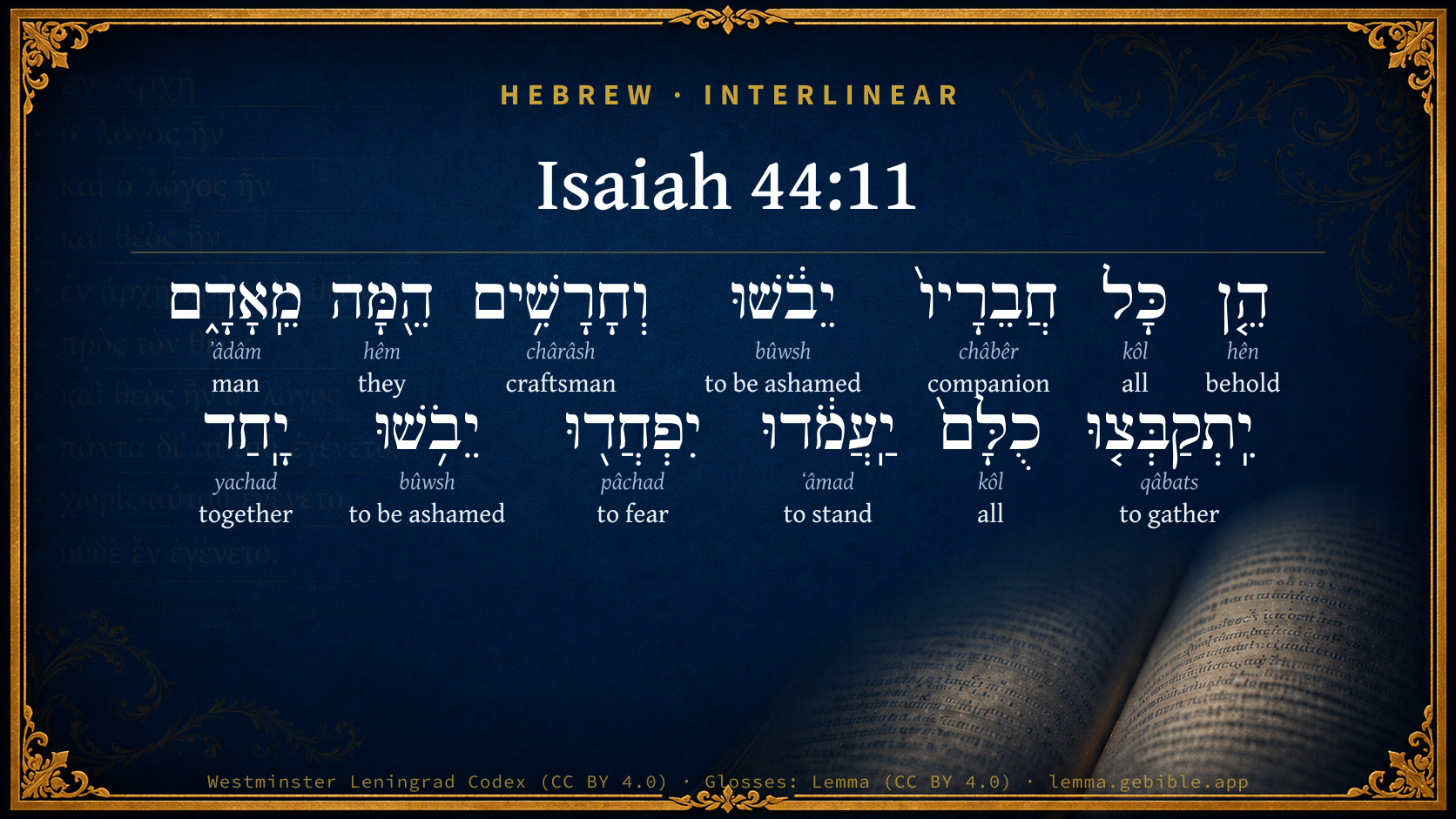
Hebrew (Westminster Leningrad Codex) Isaiah 44:11 appears in the Hebrew Old Testament. The text above is from the Westminster Leningrad Codex. Each word links to its Strong’s number, a concise gloss, and parsing drawn from the Open Scriptures Hebrew Bible morphology. Click any word for its full Brown-Driver-Briggs (BDB) entry.
Download image
Cite this verse

Isaiah 44:11 (World English Bible). Public Domain. Lemma interlinear Bible study tool, https://lemma.gebible.app/v/isaiah/44/11.

Show BibTeX & RIS
BibTeX
RIS
English Translation
Behold, all his fellows shall be disappointed; and the workmen, they are of men: let them all be gathered together, let them stand up; they shall fear, they shall be put to shame together.
World English Bible · Public Domain
Download a study sheet

One document with this verse’s original text, its word-by-word gloss line, the meaning frame, cross-references with their text, attributed commentary, and full source and license credits — printable, and it pastes into notes with its structure intact.

This verse Autodidact and up

Study sheet (.html) Plain text (.txt)

A passage Seminary Student

Up to 50 verses in one chapter. A passage sheet keeps up to 6 commentary sources and 12 cross-references per verse, in the order this page ranks them, and says so on the sheet whenever that leaves anything out. Ask for a single verse and you get the Autodidact verse sheet above.

Everything on this page stays free to read, with no account — the sheet is a download of what is already on screen, not access to it.

Want to remove ads? Support Godless Engineer
Compare translations 3

The same verse in 3 English versions, stacked beneath the original-language interlinear above. Click any original word for its lexicon entry.

Each is an independent rendering of the whole verse — the interlinear is not word-aligned to these translations.

Highlighted words mark where these versions differ — a whole-verse word diff, not a word-by-word alignment.

  • World English Bible Public Domain
    Behold, all his fellows shall be disappointed; and the workmen, they are of men: let them all be gathered together, let them stand up; they shall fear, they shall be put to shame together.
  • King James Version Public Domain
    Behold, all his fellows shall be ashamed: and the workmen, they are of men: let them all be gathered together, let them stand up; yet they shall fear, and they shall be ashamed together.
  • unfoldingWord Literal Text CC BY-SA 4.0
    Behold, all of his companions will have shame, and the craftsmen, they from mankind. Let them gather themselves, all of them; let them stand. They will fear; they will have shame together. q1

unfoldingWord Literal Text — © unfoldingWord, licensed CC BY-SA 4.0. Word-aligned USFM3 via Door43 (git.door43.org/unfoldingWord/en_ult).

Versions to compare (up to 4)

3 of 4 selected

Show all 18 translations

Every available English version of this verse, each an independent rendering of the whole verse.

  • World English Bible Public Domain
    Behold, all his fellows shall be disappointed; and the workmen, they are of men: let them all be gathered together, let them stand up; they shall fear, they shall be put to shame together.
  • Berean Standard Bible Public Domain
    Behold, all his companions will be put to shame, for the craftsmen themselves are only human. Let them all assemble and take their stand; they will all be brought to terror and shame.
  • Majority Standard Bible Public Domain
    Behold, all his companions will be put to shame, for the craftsmen themselves are only human. Let them all assemble and take their stand; they will all be brought to terror and shame.
  • King James Version Public Domain
    Behold, all his fellows shall be ashamed: and the workmen, they are of men: let them all be gathered together, let them stand up; yet they shall fear, and they shall be ashamed together.
  • American Standard Version (1901) Public Domain
    Behold, all his fellows shall be put to shame; and the workmen, they are of men: let them all be gathered together, let them stand up; they shall fear, they shall be put to shame together.
  • Revised Version (1885) Public Domain
    Behold, all his fellows shall be ashamed; and the workmen, they are of men: let them all be gathered together, let them stand up; they shall fear, they shall be ashamed together.
  • Geneva Bible (1599) Public Domain
    Beholde, all that are of the fellowship thereof, shall be confounded: for the workemen themselues are men: let them all be gathered together, and stand vp, yet they shall feare, and be confounded together.
  • Douay-Rheims (1899) Public Domain
    Behold, all the partakers thereof shall be confounded: for the makers are men: they shall all assemble together, they shall stand and fear, and shall be confounded together.
  • Young's Literal Translation Public Domain
    Lo, all his companions are ashamed, As to artizans -- they `are' of men, All of them gather together, they stand up, They fear, they are ashamed together.
  • Literal Standard Version CC BY-SA 4.0
    Behold, all his companions are ashamed, || As for artisans—they [are] of men, || All of them gather together, they stand up, || They fear, they are ashamed together.
  • Unlocked Literal Bible CC BY-SA 4.0
    Look, all his associates will be put to shame; the craftsmen are only men. Let them take their stand together; they will cower and be put to shame.
  • unfoldingWord Literal Text CC BY-SA 4.0
    Behold, all of his companions will have shame, and the craftsmen, they from mankind. Let them gather themselves, all of them; let them stand. They will fear; they will have shame together. q1
  • Darby Bible Public Domain
    Behold, all his fellows shall be ashamed; and the workmen are but men. Let them all be gathered together, let them stand up: they shall fear, they shall be ashamed together.
  • World Messianic Bible Public Domain
    Behold, all his fellows will be disappointed; and the workmen are mere men. Let them all be gathered together. Let them stand up. They will fear. They will be put to shame together.
  • Webster's Bible Public Domain
    Behold, all his fellows shall be ashamed: and the workmen, they are of men: let them all be assembled, let them stand up; yet they shall fear, and they shall be ashamed together.
  • Free Bible Version CC BY-SA 4.0
    Everyone who makes idols should be ashamed of themselves. Idol-makers are just human beings! Bring them all together and have them stand up, trembling in shame.
  • Bible in Basic English Public Domain
    Truly, all those who make use of secret arts will be put to shame, and their words of power are only words of men: let them all come forward together; they will all be in fear and be put to shame.
  • JPS Tanakh (1917) Public Domain
    Behold, all the fellows thereof shall be ashamed; and the craftsmen skilled above men; let them all be gathered together, let them stand up; they shall fear, they shall be ashamed together.

Literal Standard Version (2020), Covenant Press — licensed CC BY-SA 4.0. Text via the HelloAO Bible API (eBible.org). Unlocked Literal Bible (unfoldingWord) — licensed CC BY-SA 4.0. Text via the HelloAO Bible API (eBible.org). unfoldingWord Literal Text — © unfoldingWord, licensed CC BY-SA 4.0. Word-aligned USFM3 via Door43 (git.door43.org/unfoldingWord/en_ult). Free Bible Version, Dr. Jonathan Gallagher — licensed CC BY-SA 4.0. Text via the HelloAO Bible API (eBible.org).

Word by word

More ways to search: Search by grammar → Find every occurrence → Compare this word →

Practice this passage: Drill this verse → Learn its vocabulary →

חֲבֵרָיו֙
châbêr
H2270
“companions · his”
Noun, Common, Masculine, Plural, Construct + Suffix, Personal, 3rd Person, Masculine, Singular
Part of Speech
Noun
Type
Common
Gender
Masculine
Number
Plural
State
Construct
Full BDB Definition

Origin: from H2266

TWOT: 598c

united (adjective) - associate, fellow, worshippers (noun masculine) - companion (noun masculine)
  1. הֵ֤ן hên H2005 “behold” Particle, Demonstrative
  2. כָּל kôl H3605 “all of” Noun, Common, Masculine, Singular, Construct
  3. יֵבֹ֔שׁוּ bûwsh H954 “to be ashamed” Verb, Qal, Imperfect, 3rd Person, Masculine, Plural
  4. וְחָרָשִׁ֥ים chârâsh H2796 “and · craftsmen” Conjunction + Noun, Common, Masculine, Plural, Absolute
  5. הֵ֖מָּה hêm H1992 “they” Pronoun, Personal, 3rd Person, Masculine, Plural
  6. מֵֽאָדָ֑ם ʼâdâm H120 “from · man” Preposition + Noun, Common, Masculine, Singular, Absolute
  7. יִֽתְקַבְּצ֤וּ qâbats H6908 “to gather” Verb, Hithpael, Imperfect, 3rd Person, Masculine, Plural
  8. כֻלָּם֙ kôl H3605 “all · their” Noun, Common, Masculine, Singular, Construct + Suffix, Personal, 3rd Person, Masculine, Plural
  9. יַֽעֲמֹ֔דוּ ʻâmad H5975 “to stand” Verb, Qal, Imperfect, 3rd Person, Masculine, Plural
  10. יִפְחֲד֖וּ pâchad H6342 “to fear” Verb, Qal, Imperfect, 3rd Person, Masculine, Plural
  11. יֵבֹ֥שׁוּ bûwsh H954 “to be ashamed” Verb, Qal, Imperfect, 3rd Person, Masculine, Plural
  12. יָֽחַד yachad H3162 “together” Noun, Common, Masculine, Singular, Absolute

About this verse

These counts appear in no published source. They are computed here, from the morphology-tagged text and Lemma’s own curated glosses. What Lemma adds →

13
words
11
distinct lemmas
Prophets
section

Notable vocabulary

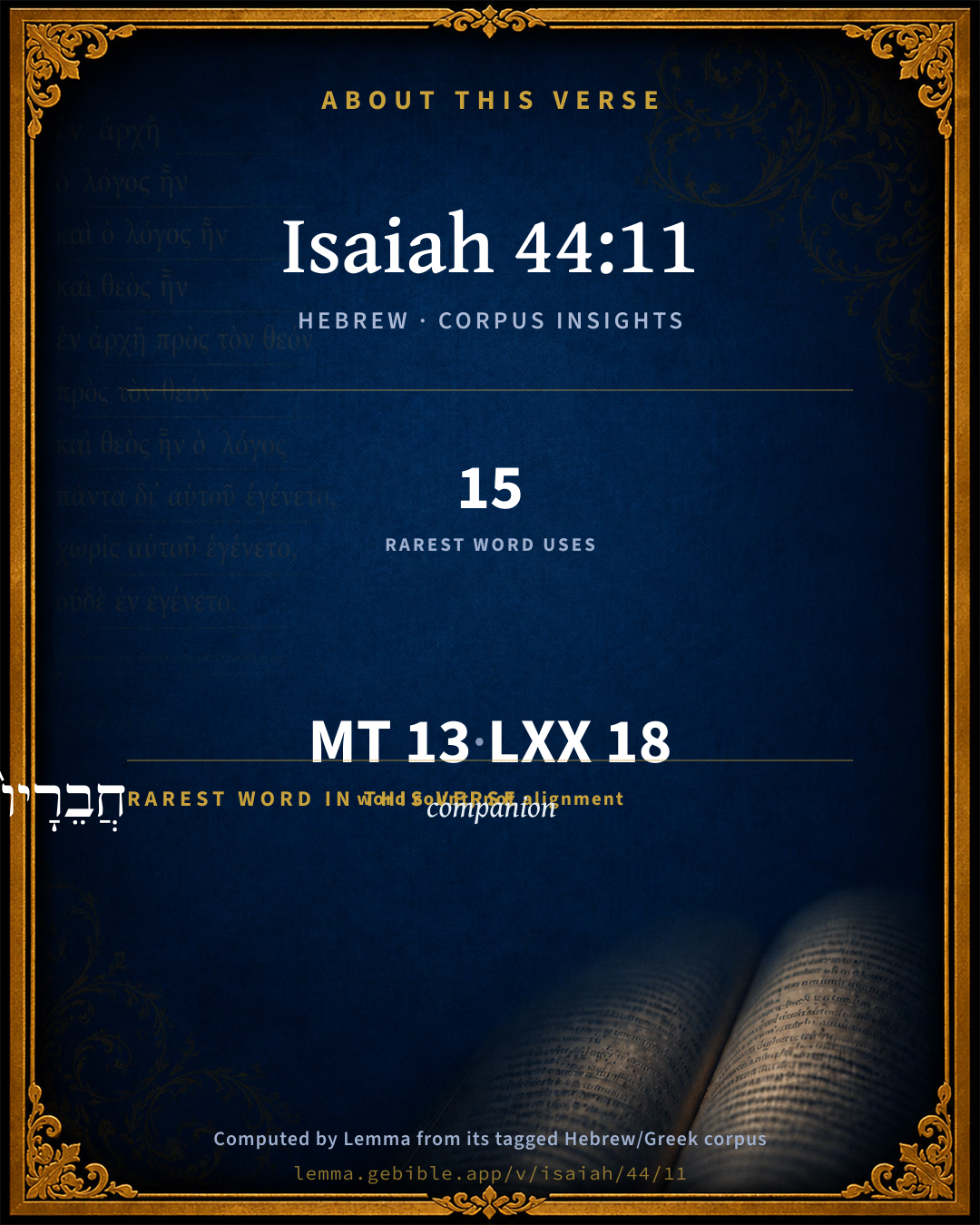
The rarest word here is חֲבֵרָיו֙ companion H2270 — appearing just 15 times in the whole Hebrew Bible.

Shared distinctive vocabulary

חֲבֵרָיו֙ companion H2270 occurs in 11 verses of the Hebrew Bible. Also found in:

Grammatical profile

  • 5 verbs
  • 6 nouns
  • 1 pronoun
  • 1 particle

Verb forms

  • יֵבֹ֔שׁוּ Qal · Imperfect
  • יִֽתְקַבְּצ֤וּ Hithpael · Imperfect
  • יַֽעֲמֹ֔דוּ Qal · Imperfect
  • יִפְחֲד֖וּ Qal · Imperfect
  • יֵבֹ֥שׁוּ Qal · Imperfect

Repetition

Words recur within this verse — often emphatic in Hebrew:

  • כָּל all H3605 ×2
  • יֵבֹ֔שׁוּ to be ashamed H954 ×2

Hebrew & Septuagint length

In English translation the verse runs 34 words from the Hebrew and 32 from the Septuagint (LXX English) — closely comparable.

A rough comparison of the two English renderings, which tokenize alike — not a word-level alignment.

Word counts can differ between the Hebrew and the Greek without any difference in meaning — e.g. the Hebrew direct-object marker אֵת has no separate Greek word, and Greek often adds the article ὁ.

In the original languages it is 13 Hebrew tokens and 18 Greek tokens — but the two are counted differently (Hebrew bundles its prefixes and suffixes into one token; the Greek is in lemma form), so that isn’t a like-for-like length.

Cross-references

18

Topical passages linked to Isaiah 44:11 in the Treasury of Scripture Knowledge — connected by theme and wording, ordered by reader-vote popularity; previews shown in the World English Bible.

  • Isaiah 42:17 They shall be turned back, they shall be utterly disappointed, who trust in engraved images, who tell molten images, You are our gods.
  • Isaiah 45:16 They shall be disappointed, yes, confounded, all of them; they shall go into confusion together who are makers of idols.
  • Psalms 97:7 Let all them be shamed who serve engraved images, Who boast in their idols. Worship him, all you gods!
  • Isaiah 1:29 For they shall be ashamed of the oaks which you have desired, And you shall be confounded for the gardens that you have chosen.
  • Judges 6:29–32 They said one to another, Who has done this thing? When they inquired and asked, they said, Gideon the son of Joash has done this thing.
  • Judges 16:23–30 The lords of the Philistines gathered them together to offer a great sacrifice to Dagon their god, and to rejoice; for they said, Our god has delivered Samson our enemy into our hand.
  • 1 Samuel 5:3–7 When they of Ashdod arose early on the next day, behold, Dagon was fallen on his face to the ground before the ark of Yahweh. They took Dagon, and set him in his place again.
  • 1 Samuel 6:4–5 Then they said, "What shall be the trespass-offering which we shall return to him?" They said, "Five golden tumors, and five golden mice, [according to] the number of the lords of the Philistines; for one plague was on you all, and on your lords.
  • 1 Kings 18:19–29 Now therefore send, and gather to me all Israel to Mount Carmel, and the prophets of Baal four hundred fifty, and the prophets of the Asherah four hundred, who eat at Jezebel's table.
  • 1 Kings 18:40 and Elijah said to them, Take the prophets of Baal; don't let one of them escape. They took them; and Elijah brought them down to the brook Kishon, and killed them there.
  • Isaiah 41:5–7 The isles have seen, and fear; the ends of the earth tremble; they draw near, and come.
  • Jeremiah 2:26–27 As the thief is ashamed when he is found, so is the house of Israel ashamed; they, their kings, their princes, and their priests, and their prophets;
  • Jeremiah 10:14 Every man is become brutish [and is] without knowledge; every goldsmith is disappointed by his engraved image; for his molten image is falsehood, and there is no breath in them.
  • Jeremiah 51:17 Every man is become brutish [and is] without knowledge; every goldsmith is disappointed by his image; for his molten image is falsehood, and there is no breath in them.
  • Daniel 3:1–7 Nebuchadnezzar the king made an image of gold, whose height was sixty cubits, and the breadth of it six cubits: he set it up in the plain of Dura, in the province of Babylon.
  • Daniel 5:1–6 Belshazzar the king made a great feast to a thousand of his lords, and drank wine before the thousand.
  • Acts 19:24–34 For a certain man named Demetrius, a silversmith, who made silver shrines of Artemis, brought no little business to the craftsmen,
  • Revelation 19:19–21 I saw the beast, and the kings of the earth, and their armies, gathered together to make war against him who sat on the horse, and against his army.

Cross-references courtesy of OpenBible.info (CC BY 4.0).

Hebrew and Greek witnesses Masoretic Hebrew ↔ Greek Septuagint

The same verse in the two great witnesses to the Old Testament, shown verse-for-verse.

These are two independent witnesses, not word-aligned to each other, and the Septuagint is shown in lemma (dictionary) form.

Hebrew Isaiah 44:11 Masoretic · Westminster Leningrad Codex

הֵ֤ן כָּל חֲבֵרָיו֙ יֵבֹ֔שׁוּ וְחָרָשִׁ֥ים הֵ֖מָּה מֵֽאָדָ֑ם יִֽתְקַבְּצ֤וּ כֻלָּם֙ יַֽעֲמֹ֔דוּ יִפְחֲד֖וּ יֵבֹ֥שׁוּ יָֽחַד

Behold, all his fellows shall be disappointed; and the workmen, they are of men: let them all be gathered together, let them stand up; they shall fear, they shall be put to shame together.

World English Bible · Public Domain

Greek LXX Isaiah 44:11 Septuagint · lemma form

καί πᾶς ὅθεν γίγνομαι ξηραίνω καί κωφός ἀπό ἄνθρωπος συνἄγω πᾶς καί ἵστημι ἅμα ἐντρέπω καί αἰσχύνω ἅμα

and all by whom they were made are withered: yes, let all the deaf be gathered from among men, and let them stand together; and let them be ashamed and confounded together:

LXX2012 (modern English Septuagint) · Public Domain

Hebrew: Westminster Leningrad Codex (CC BY 4.0). Greek: Septuagint (public domain); English from LXX2012 (modern English Septuagint) (Public Domain). How the Septuagint differs from the Hebrew →

Targum (Aramaic paraphrase)

1

The Targum is the ancient Jewish Aramaic paraphrase of the Hebrew Scriptures — an interpretive translation, not the Hebrew text itself. Onkelos (literal) and Pseudo-Jonathan (expansive) render the Torah, and Jonathan the Prophets. Coverage is partial: where no permissively-licensed English translation exists for a verse, only the Aramaic is shown. This is verse-level text, not a word-by-word alignment to the Hebrew.

  1. Targum Jonathan Prophets (Joshua–Malachi)
    הָא כָּל פָּלְחֵיהוֹן יִבָּהֲתוּן וְאוּמָנִין עוּבְדָנִין מִבְּנֵי אֱנָשָׁא יִתְכַּנְסוּן כּוּלְהוֹן יְקוּמוּן יִתַּבְּרוּן יִבַהֲתוּן כַּחֲדָא:

    Behold, all their worshippers shall be ashamed, and the working artificers are workmen of the sons of men; let them all be gathered together, let them stand up; they shall fear and be confounded together.

    Targum Jonathan — Aramaic: “Mikraot Gedolot” (public domain). English: “Sefaria Community Translation” (CC0 1.0 (public-domain dedication)); “London "Chaldee Paraphrase," 1871” (public domain). Text via Sefaria.

Commentary

Notes on Isaiah 44:11 from classic Christian and Jewish commentators (each source and its license shown beneath its notes). The classic Christian expositions comment on the surrounding passage and are grouped to its opening verse, so a note may address several verses; the Jewish commentaries on the Tanakh (Rashi and others) are per-verse, so they appear only where the commentator wrote on this verse.

Lemma curates 59 commentaries, every one of them public domain or Creative Commons licensed, each selected and text-cleaned for this edition rather than reprinted as found. About our sources →

Trapp's Complete Commentary

John Trapp

Isa 44:11 Behold, all his fellows shall be ashamed: and the workmen, they [are] of men: let them all be gathered together, let them stand up; [yet] they shall fear, [and] they shall be ashamed together.

Ver. 11. Behold all his fellows.] His fellow fools.

Shall be ashamed.] They may be, well enough, of their madness: they shall be, sure enough, of their disappointments.

And the workmen, they are of men.] Not of angels or the heavenly virtues, saith Oecolampadius, but vile varlets.

Let them all be gathered together.] As were, at Ephesus, Demetrius and his associates. {Act 19:24-25}

Yet they shall fear.] As Tullus Hostilius did with his new gods Pavor and Pallor: as Papists do with their Valentine, Antony, Sebastian, &c., whom they worship as the senders of such and such diseases.

John Trapp, A Commentary or Exposition upon All the Books of the Old and New Testament (1647–1656) — public domain. Text from a community e-Sword module.

Geneva Bible (1599)

Geneva Bible translators

Signifying, that the multitude shall not then save the idolaters, when God will take vengeance, although they excuse themselves thereby among men.

That is, which by any way consent either to the making or worshipping.

Geneva Bible (1599) marginal notes — public domain. Text via Bolls.life.

Jamieson, Fausset & Brown

Robert Jamieson, A. R. Fausset & David Brown

his fellows--the associates of him who makes an idol; or of the idol (see Deu 7:26; Psa 115:8; Hos 4:17).

they are of men--They are mortal men themselves; what better, then, can the idol be than its maker?

gathered together . . . stand up--as in a court of justice, to try the issue between God and them (see on Isa 41:1; Isa 41:21).

yet--wrongly inserted in English Version. The issue of the trial shall be, "they shall fear," &c.

Jamieson, Fausset & Brown — Commentary Critical and Explanatory on the Whole Bible (1871) — public domain (CC PDM 1.0). Text via the HelloAO Bible API.

Adam Clarke's Commentary

Verse 11. His fellows] חבריו chaberaiv: but עבדיו abadaiv, his servants or worshippers, is the reading of one of De Rossi's MSS., and of the Chaldee.

And the workmen, they are of men - "Even the workmen themselves shall blush"] I do not know that any one has ever yet interpreted these words to any tolerably good sense: וחרשים המה מאדם vecharashim hemmah meadam. The Vulgate and our translators, have rendered them very fairly, as they are written and pointed in the text: Fabri enim sunt ex hominibus. "And the workmen they are of men." Out of which the commentators have not been able to extract any thing worthy of the prophet. I have given another explanation of the place; agreeable enough to the context, if it can be deduced from the words themselves. I presume that אדם adam, rubuit, may signify erubuit, to be red through shame, as well as from any other cause; though I cannot produce any example of it in that particular sense; and the word in the text I would point מאדם meoddam; or if any one should object to the irregularity of the number, I would read מאדמים meoddamim. But I rather think that the irregularity of the construction has been the cause of the obscurity, and has given occasion to the mistaken punctuation. The singular is sometimes put for the plural. See Ps 68:31; and the participle for the future tense, see Isa 40:11. - L.

Adam Clarke's Commentary on the Bible (1810–1826) — public domain. Text from a community e-Sword/MySword module.

Ellicott's Commentary for English Readers

(11) Behold, all his fellows . . .—The noun has a half-technical sense, as describing a member of a religious guild or fraternity, such as were attached to heathen temples. In this sense “Ephraim was joined to idols” (Hos_4:17). In Hos_6:9, the noun is used for the “company” of priests.

Let them stand up.—The words gain in vividness when we remember that the challenge is addressed to the guild of idol-makers. They are but men; how can they make a god?

A Bible Commentary for English Readers, edited by Charles John Ellicott (1878–1897) — public domain. Text from a community e-Sword module.

The Cambridge Bible for Schools and Colleges

gen. ed. J. J. S. Perowne

11. all his fellows] The word denotes the members of a guild, and is understood by A.V. of the gang of craftsmen employed in the making of the idol. It should rather be interpreted as the “adherents,” the clientèle of the false god himself, as in R.V. marg., “all that join themselves thereto.” Cf. Hos_4:17 (“associated with idols”) and 1Co_10:20. are of men] belong to the category of men (Isa_40:17), and how can men produce a god? Duhm, changing the vowel-points, renders: “Behold all the spells (cf. ch. Isa_47:9; Isa_47:12) are put to shame, and as for enchantments (cf. ch. Isa_3:3), they are of men;” an allusion to the magical process by which, in all systems of idolatry, the manufactured image is transformed into a fetish, the residence of a divinity. Similarly Cheyne (Introd. p. 301).

The Cambridge Bible for Schools and Colleges (gen. ed. J. J. S. Perowne; Cambridge University Press, 1878–1918) — public domain. Text from a community e-Sword module.

John Gill's Exposition

Behold, all his fellows shall be ashamed,.... Either such who join with them in the worship of the molten graven image, or god formed, when they find it is profitable for nothing; so the Targum,

"behold all their worshippers shall be confounded;''

or their fellow workmen, who took their several parts in making the image, and so must be conscious of the vanity and unprofitableness of it, and ashamed when upbraided with it:

and the workmen they are of men; or, "of Adam" (b); they are the sons of Adam, fallen men, sinful, frail, mortal creatures; they are not so much as of the angels in heaven, but of men on earth, and so very unfit to be makers of a god:

let them be gathered together; workmen and worshippers, as Demetrius, and the craftsmen or shrine makers, with others at Ephesus:

let them stand up; and plead for their gods, and say all they can in the behalf of them:

yet they shall fear, and they shall be ashamed together; the light of the Gospel breaking forth in the ministry of the apostles and others, the minds of many were enlightened to see the folly of worshipping idols, which brought them, and the makers of them, into contempt; who not being able to withstand the evidence and force of arguments brought against them, were covered with shame, and filled with fear, lest, should the Gospel still get further ground, their trade of idol making would come to nothing; or lest the vengeance of heaven should fall upon them for their idolatrous practices.

(b) "ipsi ex Adamo, sive ex hominibus", Munster, Pagninus, Montanus, Tigurine version.

John Gill's Exposition of the Whole Bible (1746–1763) — public domain (CC PDM 1.0). Text via the HelloAO Bible API.

Albert Barnes' Notes on the Bible

Behold, all his fellows - All that are joined in making, and in worshipping it, are regarded as the fellows, or the companions (חברין chăbērâyn) of the idol-god (see Hos 4:17 - ‘Ephraim is joined to idols’). They and the idols constitute one company or fellowship, intimately allied to each other.

Shall be, ashamed - Shall be confounded when they find that their idols cannot aid them.

And the workmen - The allusion to the workmen is to show that what they made could not be worthy of the confidence of people as an object of worship.

They are of men - They are mortal people; they must themselves soon die. It is ridiculous, therefore, for them to attempt to make a god that can defend or save, or that should be adored.

Let them all be gathered together - For purposes of trial, or to urge their claims to the power of making an object that should be adored (see the note at Isa 41:1).

Let them stand up - As in a court of justice, to defend their cause (see the note at Isa 41:21).

They shall fear - They shall be alarmed when danger comes. They shall find that their idol-gods cannot defend them.

Albert Barnes' Notes on the Bible (1834–1885) — public domain. Text from a community e-Sword/MySword module.

Matthew Poole's English Annotations

All his fellows; either,

1. The workmen, as it follows, who in this work are companions or partners with him, by whose cost and command the work is done. Or,

2. Those who any way assist and encourage him in this work, and join with him in worshipping the image which he maketh.

They are of men; they are of mankind, and therefore cannot possibly make a god. Or, they are of the meanest sort of men; for so the Hebrew word adam sometimes signifies.

They shall be ashamed together; though all combine together, and stand up with all their might to maintain the cause of their false gods, they shall be filled with fear and confusion, when God shall plead his cause against them.

Matthew Poole's English Annotations on the Holy Bible (1683–1685) — public domain. Text from a community e-Sword/MySword module.

The Pulpit Commentary

All his fellows; or, all its associates"; i.e. all who are associated together in the worship of the idol. The worshippers of a particular idol, or sometimes of a particular god, formed a sort of guild or company, bound together by common participation in certain rites, and under an obligation to defend each other. The prophet says that, though the worshippers and the makers should, all of them, be gathered together, and stand up to help one the ether, yet should they be unable to effect anything. Gathered together against God, they would tremble and be ashamed."

The Pulpit Commentary (1880–1919), ed. H.D.M. Spence-Jones & Joseph S. Exell — public domain. Text from a community e-Sword module.

John Wesley's Explanatory Notes

Men - They are of mankind, and therefore cannot possibly make a God. Together - Tho' all combine together, they shall be filled with fear and confusion, when God shall plead his cause against them.

John Wesley, Explanatory Notes Upon the Whole Bible (1754–1765) — public domain. Text via the GEBible commentary corpus.

J. A. Alexander on Isaiah

Joseph Addison Alexander

“Lo, all his fellows shall be ashamed, and the workmen themselves are of men; they shall assemble all of them, they shall stand, they shall tremble, they shall be ashamed together.” The pronoun ‘his’ refers to the idol itself, and by ‘his fellows’ we are to understand all who have anything to do with it, either as manufacturers or worshippers. (Compare Num 25:3; Deu 11:22; Deu 30:20; Isa 56:3; Isa 56:6; Hos 4:17; 1Co 10:20). ‘Of men,’ (i.e., members of the human family or race). The makers of the idol are themselves mere men, and cannot therefore produce anything divine. The senseless idol and its human makers shall be witnesses against each other, and shall all be involved in the same condemnation and confusion.

Joseph Addison Alexander, The Prophecies of Isaiah (1846–1847; New York: Scribner, 1870–1878) — public domain. Text from a community e-Sword module.

unfoldingWord translationNotes

Door43 World Missions Community

General Information:

Yahweh continues speaking.

all his associates

Possible meanings are 1) this refers to the associates of the craftsman who makes the idol. AT: "all of the craftsman's associates" or 2) this refers to those who associate themselves with the idol by worshiping it. AT: "all those who worship the idol" (See: Assumed Knowledge and Implicit Information)

be put to shame

This can be stated in active form. AT: "will be ashamed" (See: Active or Passive)

Let them take their stand together

"Let them all come together before me"

they will cower

"they will be terrified." To "cower" is to bend over in fear.

translationWords

shame

unfoldingWord translationNotes — © Distant Shores Media and the Door43 World Missions Community, licensed CC BY-SA 4.0. Source: git.door43.org/Door43/en_tn.

Rashi

Rabbi Shlomo Yitzchaki (Rashi)

Behold, all his colleagues of that fashioner and molder of graven images, who join him to worship his creation and his molten image, shall be ashamed.

and they are smiths those fashioners and molders, and they are of men, surely their creation is vanity.

Rashi on the Tanakh — English translations: “The Judaica Press complete Tanach with Rashi, translated by A. J. Rosenberg” (CC BY 4.0); “Pentateuch with Rashi's commentary by M. Rosenbaum and A.M. Silbermann, 1929-1934” (public domain); “The Metsudah Tanach series, Lakewood, N.J” (CC BY 4.0); and “The Book of Joshua, Metsudah Publications, 1997” (CC BY 4.0). Text via Sefaria.

Ibn Ezra

Rabbi Abraham ibn Ezra

His fellows. The priests of Baal, or the artificers of the idols; the latter explanation is the better.

Let them all be gathered together and be ashamed.

Ibn Ezra on the Tanakh — English translations: “Sefaria Community Translation” (CC0 1.0 (public-domain dedication)); “Yalkut, Sifsei Chachomim Chumash, Metsudah Publications, 2009” (CC BY 4.0); and “Commentary of Ibn Ezra on Isaiah - trans. by M. Friedlander, 1873” (public domain). Text via Sefaria.

Lesson kit

Teaching starters — assembled from the data on this page, not authored interpretation. Every prompt links to the verse data it draws on. Edit before teaching.

Isaiah, in the Prophets, opens this verse with 13 words (11 distinct Hebrew lemmas). Its most distinctive word is châbêr (“companion”). A historical commentator’s framing appears above. Read the whole chapter for the surrounding context.

Discussion questions

  1. What does “companion” (châbêr) contribute to the verse as a whole?
  2. How does Judges 20:11, which shares the word «companion», read alongside this verse?
  3. What does the repetition of “all” (2× in this one verse) do in this verse?
  4. The translations on this page render this verse differently — a whole-verse word diff, not a word-by-word alignment. What might account for the different wordings?
  5. «יֵבֹ֔שׁוּ» is a Qal Imperfect verb. How does that grammatical form shape the action described?
  6. Compare how Trapp's Complete Commentary and Geneva Bible (1599) read this verse. Where do they agree or differ?

Things to notice

Reading settings

Reading text

Shown beneath each verse's original-language words.

Old Testament
Old Testament edition

Read the OT as the Masoretic Hebrew (MT) or the Greek Septuagint (LXX).

English shown for the Greek Septuagint (in the Hebrew ↔ Greek comparison).

Comparing translations? Open the Compare panel on any verse page to stack up to four side by side.