
2 Chronicles 33:18

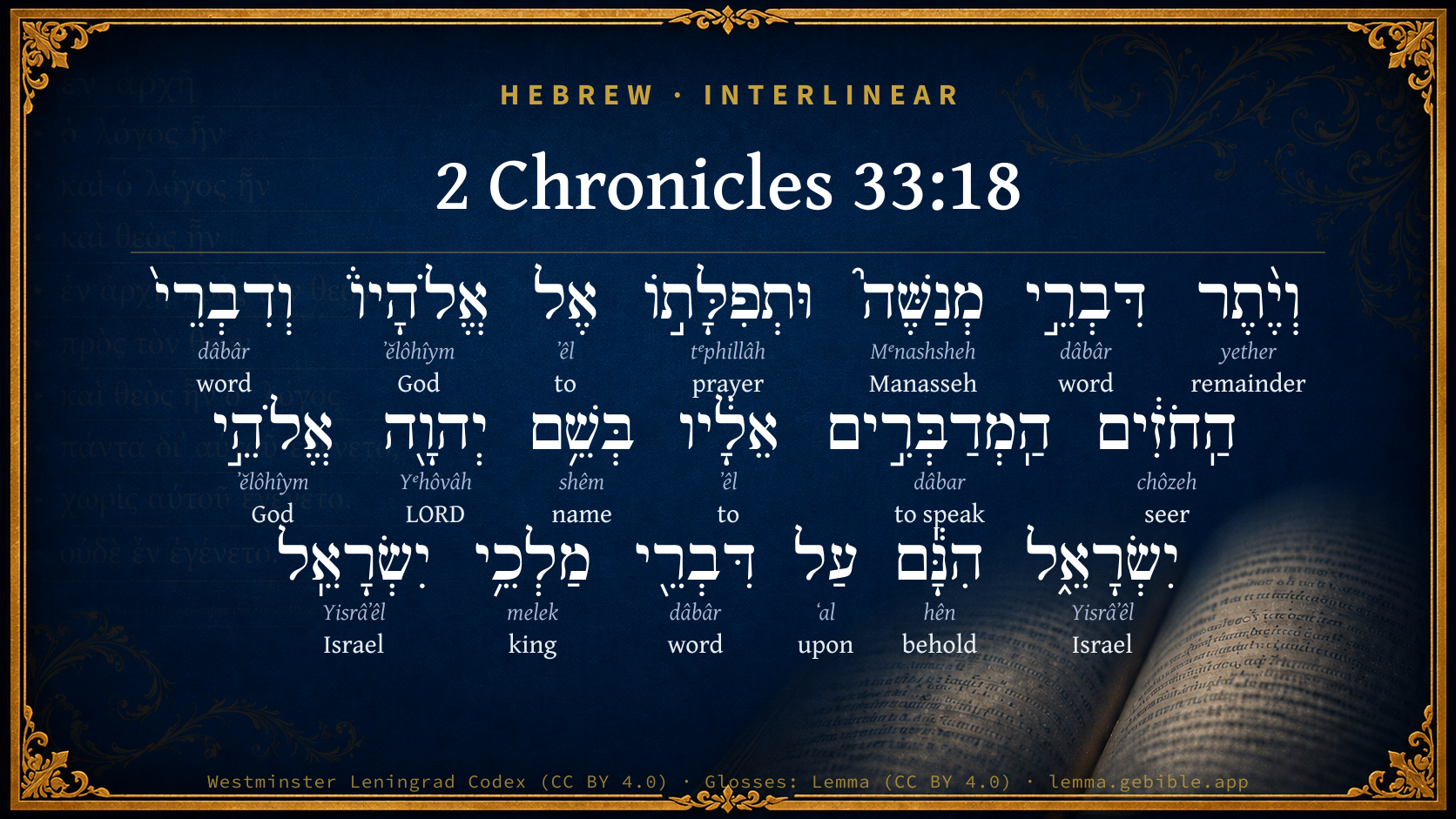
Hebrew (Westminster Leningrad Codex) 2 Chronicles 33:18 appears in the Hebrew Old Testament. The text above is from the Westminster Leningrad Codex. Each word links to its Strong’s number, a concise gloss, and parsing drawn from the Open Scriptures Hebrew Bible morphology. Click any word for its full Brown-Driver-Briggs (BDB) entry.
Download image
Cite this verse

2 Chronicles 33:18 (World English Bible). Public Domain. Lemma interlinear Bible study tool, https://lemma.gebible.app/v/2-chronicles/33/18.

Show BibTeX & RIS
BibTeX
RIS
English Translation
Now the rest of the acts of Manasseh, and his prayer to his God, and the words of the seers who spoke to him in the name of Yahweh, the God of Israel, behold, they are written among the acts of the kings of Israel.
World English Bible · Public Domain
Download a study sheet

One document with this verse’s original text, its word-by-word gloss line, the meaning frame, cross-references with their text, attributed commentary, and full source and license credits — printable, and it pastes into notes with its structure intact.

This verse Autodidact and up

Study sheet (.html) Plain text (.txt)

A passage Seminary Student

Up to 50 verses in one chapter. A passage sheet keeps up to 6 commentary sources and 12 cross-references per verse, in the order this page ranks them, and says so on the sheet whenever that leaves anything out. Ask for a single verse and you get the Autodidact verse sheet above.

Everything on this page stays free to read, with no account — the sheet is a download of what is already on screen, not access to it.

Want to remove ads? Support Godless Engineer
Compare translations 3

The same verse in 3 English versions, stacked beneath the original-language interlinear above. Click any original word for its lexicon entry.

Each is an independent rendering of the whole verse — the interlinear is not word-aligned to these translations.

Highlighted words mark where these versions differ — a whole-verse word diff, not a word-by-word alignment.

  • World English Bible Public Domain
    Now the rest of the acts of Manasseh, and his prayer to his God, and the words of the seers who spoke to him in the name of Yahweh, the God of Israel, behold, they are written among the acts of the kings of Israel.
  • King James Version Public Domain
    Now the rest of the acts of Manasseh, and his prayer unto his God, and the words of the seers that spake to him in the name of the LORD God of Israel, behold, they are written in the book of the kings of Israel.
  • unfoldingWord Literal Text CC BY-SA 4.0
    And the remainder of the matters of Manasseh, and his prayer to his God, and the words of the seers, those speaking to him in the name of Yahweh, the God of Israel, behold, they are on the words of the kings of Israel.

unfoldingWord Literal Text — © unfoldingWord, licensed CC BY-SA 4.0. Word-aligned USFM3 via Door43 (git.door43.org/unfoldingWord/en_ult).

Versions to compare (up to 4)

3 of 4 selected

Show all 18 translations

Every available English version of this verse, each an independent rendering of the whole verse.

  • World English Bible Public Domain
    Now the rest of the acts of Manasseh, and his prayer to his God, and the words of the seers who spoke to him in the name of Yahweh, the God of Israel, behold, they are written among the acts of the kings of Israel.
  • Berean Standard Bible Public Domain
    As for the rest of the acts of Manasseh, along with his prayer to his God and the words of the seers who spoke to him in the name of the LORD, the God of Israel, they are indeed written in the Chronicles of the Kings of Israel.
  • Majority Standard Bible Public Domain
    As for the rest of the acts of Manasseh, along with his prayer to his God and the words of the seers who spoke to him in the name of the LORD, the God of Israel, they are indeed written in the Chronicles of the Kings of Israel.
  • King James Version Public Domain
    Now the rest of the acts of Manasseh, and his prayer unto his God, and the words of the seers that spake to him in the name of the LORD God of Israel, behold, they are written in the book of the kings of Israel.
  • American Standard Version (1901) Public Domain
    Now the rest of the acts of Manasseh, and his prayer unto his God, and the words of the seers that spake to him in the name of Jehovah, the God of Israel, behold, they are written among the acts of the kings of Israel.
  • Revised Version (1885) Public Domain
    Now the rest of the acts of Manasseh, and his prayer unto his God, and the words of the seers that spake to him in the name of the LORD, the God of Israel, behold, they are written among the acts of the kings of Israel.
  • Geneva Bible (1599) Public Domain
    Concerning the rest of the actes of Manasseh, and his prayer vnto his God, and the words of the Seers, that spake to him in ye Name of the Lord God of Israel, beholde, they are written in the booke of the Kings of Israel.
  • Douay-Rheims (1899) Public Domain
    But the rest of the acts of Manasses, and his prayer to his God, and the words of the seers that spoke to him in the name of the Lord the God of Israel, are contained in the words of the kings of Israel.
  • Young's Literal Translation Public Domain
    And the rest of the matters of Manasseh, and his prayer unto his God, and the matters of the seers, those speaking unto him in the name of Jehovah, God of Israel, lo, they are `on the book of' the matters of the kings of Israel;
  • Literal Standard Version CC BY-SA 4.0
    And the rest of the matters of Manasseh, and his prayer to his God, and the matters of the seers, those speaking to him in the Name of YHWH, God of Israel, behold, they are [on the scroll of] the matters of the kings of Israel;
  • Unlocked Literal Bible CC BY-SA 4.0
    As to the other matters concerning Manasseh, his prayer to his God, and the words of the seers who spoke to him in the name of Yahweh, the God of Israel, behold, they are written among the deeds of the kings of Israel.
  • unfoldingWord Literal Text CC BY-SA 4.0
    And the remainder of the matters of Manasseh, and his prayer to his God, and the words of the seers, those speaking to him in the name of Yahweh, the God of Israel, behold, they are on the words of the kings of Israel.
  • Darby Bible Public Domain
    And the rest of the acts of Manasseh, and his prayer to his God, and the words of the seers that spoke to him in the name of Jehovah the God of Israel, behold, they [are written] in the acts of the kings of Israel.
  • World Messianic Bible Public Domain
    Now the rest of the acts of Manasseh, and his prayer to his God, and the words of the seers who spoke to him in the name of the LORD, the God of Israel, behold, they are written among the acts of the kings of Israel.
  • Webster's Bible Public Domain
    Now the rest of the acts of Manasseh, and his prayer to his God, and the words of the seers that spoke to him in the name of the LORD God of Israel, behold, they are written in the book of the kings of Israel.
  • Free Bible Version CC BY-SA 4.0
    The rest of what Manasseh did, along with his prayer to his God and what he was told by the seers who spoke on the Lord's behalf are recorded in the Book of the Kings of Israel.
  • Bible in Basic English Public Domain
    Now the rest of the acts of Manasseh, and his prayer to his God, and the words which the seers said to him in the name of the Lord, the God of Israel, are recorded among the acts of the kings of Israel.
  • JPS Tanakh (1917) Public Domain
    Now the rest of the acts of Manasseh, and his prayer unto his God, and the words of the seers that spoke to him in the name of the LORD, the God of Israel, behold, they are written among the acts of the kings of Israel.

Literal Standard Version (2020), Covenant Press — licensed CC BY-SA 4.0. Text via the HelloAO Bible API (eBible.org). Unlocked Literal Bible (unfoldingWord) — licensed CC BY-SA 4.0. Text via the HelloAO Bible API (eBible.org). unfoldingWord Literal Text — © unfoldingWord, licensed CC BY-SA 4.0. Word-aligned USFM3 via Door43 (git.door43.org/unfoldingWord/en_ult). Free Bible Version, Dr. Jonathan Gallagher — licensed CC BY-SA 4.0. Text via the HelloAO Bible API (eBible.org).

Word by word

More ways to search: Search by grammar → Find every occurrence → Compare this word →

Practice this passage: Drill this verse → Learn its vocabulary →

הַֽחֹזִ֔ים
chôzeh
H2374
“the · seer”
Particle, Definite Article + Verb, Qal, Participle Active, Masculine, Plural, Absolute
Part of Speech
Particle + Verb
Stem
Qal
Form
Participle Active
Gender
Masculine
Number
Plural
State
Absolute
Full BDB Definition

Origin: active participle of H2372

TWOT: 633b

seer - seer - vision
  1. וְיֶ֨תֶר yether H3499 “and · remainder of” Conjunction + Noun, Common, Masculine, Singular, Construct
  2. דִּבְרֵ֣י dâbâr H1697 “words of” Noun, Common, Masculine, Plural, Construct
  3. מְנַשֶּׁה֮ Mᵉnashsheh H4519 “Manasseh” Noun, Proper
  4. וּתְפִלָּת֣וֹ tᵉphillâh H8605 “and · prayer · his” Conjunction + Noun, Common, Feminine, Singular, Construct + Suffix, Personal, 3rd Person, Masculine, Singular
  5. אֶל ʼêl H413 “to” Preposition
  6. אֱלֹהָיו֒ ʼĕlôhîym H430 “God(s) · his” Noun, Common, Masculine, Plural, Construct + Suffix, Personal, 3rd Person, Masculine, Singular
  7. וְדִבְרֵי֙ dâbâr H1697 “and · words of” Conjunction + Noun, Common, Masculine, Plural, Construct
  8. הַֽמְדַבְּרִ֣ים dâbar H1696 “the · speaking” Particle, Definite Article + Verb, Piel, Participle Active, Masculine, Plural, Absolute
  9. אֵלָ֔יו ʼêl H413 “to · him” Preposition + Suffix, Personal, 3rd Person, Masculine, Singular
  10. בְּשֵׁ֥ם shêm H8034 “in/at · name of” Preposition + Noun, Common, Masculine, Singular, Construct
  11. יְהוָ֖ה Yᵉhôvâh H3068 “LORD” Noun, Proper
  12. אֱלֹהֵ֣י ʼĕlôhîym H430 “God(s) of” Noun, Common, Masculine, Plural, Construct
  13. יִשְׂרָאֵ֑ל Yisrâʼêl H3478 “Israel” Noun, Proper
  14. הִנָּ֕ם hên H2005 “behold · them” Particle, Demonstrative + Suffix, Personal, 3rd Person, Masculine, Plural
  15. עַל ʻal H5921 “upon” Preposition
  16. דִּבְרֵ֖י dâbâr H1697 “words of” Noun, Common, Masculine, Plural, Construct
  17. מַלְכֵ֥י melek H4428 “kings of” Noun, Common, Masculine, Plural, Construct
  18. יִשְׂרָאֵֽל Yisrâʼêl H3478 “Israel” Noun, Proper

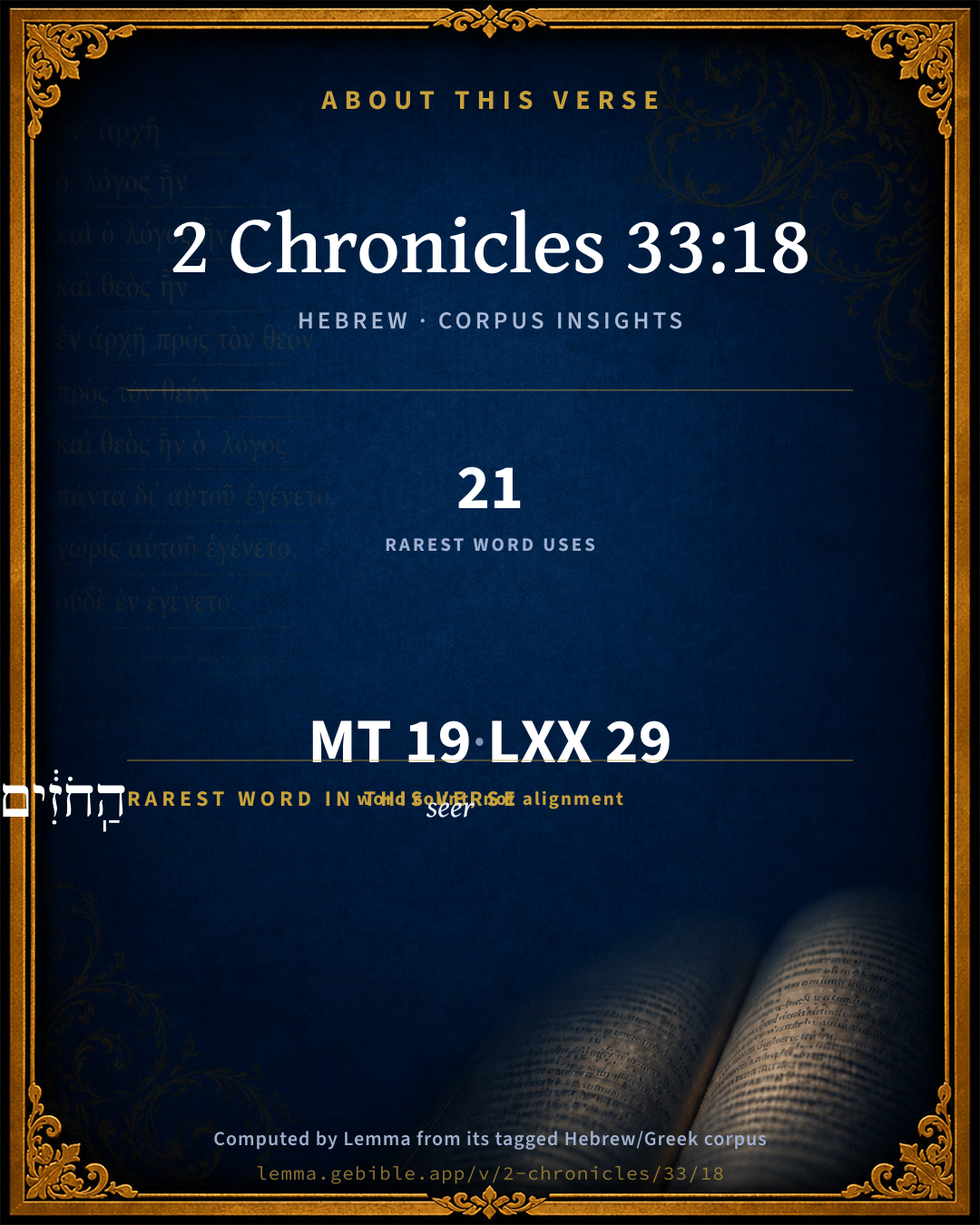
About this verse

These counts appear in no published source. They are computed here, from the morphology-tagged text and Lemma’s own curated glosses. What Lemma adds →

19
words
14
distinct lemmas
Historical
section

Notable vocabulary

The rarest word here is הַֽחֹזִ֔ים seer H2374 — appearing just 21 times in the whole Hebrew Bible.

Shared distinctive vocabulary

הַֽחֹזִ֔ים seer H2374 occurs in 21 verses of the Hebrew Bible. Also found in:

Grammatical profile

  • 2 verbs
  • 13 nouns
  • 3 prepositions
  • 1 particle

Verb forms

  • הַֽחֹזִ֔ים Qal · Participle Active
  • הַֽמְדַבְּרִ֣ים Piel · Participle Active

Repetition

Words recur within this verse — often emphatic in Hebrew:

  • דִּבְרֵ֣י word H1697 ×3
  • אֱלֹהָיו֒ God H430 ×2
  • יִשְׂרָאֵ֑ל Israel H3478 ×2
  • אֶל to H413 ×2

Hebrew & Septuagint length

In English translation the verse runs 45 words from the Hebrew and 31 from the Septuagint (LXX English) — the Septuagint runs noticeably shorter here. See the side-by-side →

A rough comparison of the two English renderings, which tokenize alike — not a word-level alignment.

Word counts can differ between the Hebrew and the Greek without any difference in meaning — e.g. the Hebrew direct-object marker אֵת has no separate Greek word, and Greek often adds the article ὁ.

In the original languages it is 19 Hebrew tokens and 29 Greek tokens — but the two are counted differently (Hebrew bundles its prefixes and suffixes into one token; the Greek is in lemma form), so that isn’t a like-for-like length.

Cross-references

14

Topical passages linked to 2 Chronicles 33:18 in the Treasury of Scripture Knowledge — connected by theme and wording, ordered by reader-vote popularity; previews shown in the World English Bible.

  • 2 Chronicles 33:19 His prayer also, and how [God] was entreated of him, and all his sin and his trespass, and the places in which he built high places, and set up the Asherim and the engraved images, before he humbled himself: behold, they are written in the history of Hozai.
  • 2 Chronicles 33:12–13 When he was in distress, he begged Yahweh his God, and humbled himself greatly before the God of his fathers.
  • 2 Chronicles 20:34 Now the rest of the acts of Jehoshaphat, first and last, behold, they are written in the history of Jehu the son of Hanani, which is inserted in the book of the kings of Israel.
  • Isaiah 30:10 who tell the seers, "Don't see;" and to the prophets, "Don't prophesy to us right things, speak to us smooth things, prophesy deceits,
  • Amos 7:12 Amaziah also said to Amos, "You seer, go, flee away into the land of Judah, and there eat bread, and prophesy there:
  • 1 Samuel 9:9 (In earlier times in Israel, when a man went to inquire of God, thus he said, Come, and let us go to the seer; for he who is now called a Prophet was before called a Seer.)
  • 1 Kings 14:19 The rest of the acts of Jeroboam, how he warred, and how he reigned, behold, they are written in the book of the chronicles of the kings of Israel.
  • 1 Kings 15:31 Now the rest of the acts of Nadab, and all that he did, aren't they written in the book of the chronicles of the kings of Israel?
  • 2 Kings 17:13 Yet Yahweh testified to Israel, and to Judah, by every prophet, and every seer, saying, Turn you from your evil ways, and keep my commandments and my statutes, according to all the law which I commanded your fathers, and which I sent to you by my servants the prophets.
  • 2 Chronicles 32:32 Now the rest of the acts of Hezekiah, and his good deeds, behold, they are written in the vision of Isaiah the prophet the son of Amoz, in the book of the kings of Judah and Israel.
  • 2 Chronicles 33:10 Yahweh spoke to Manasseh, and to his people; but they gave no heed.
  • Isaiah 29:10 For Yahweh has poured out on you the spirit of deep sleep, and has closed your eyes, the prophets; and your heads, the seers, has he covered.
  • Micah 3:7 The seers shall be disappointed, And the diviners confounded. Yes, they shall all cover their lips; For there is no answer from God."
  • 1 Kings 11:41 Now the rest of the acts of Solomon, and all that he did, and his wisdom, aren't they written in the book of the acts of Solomon?

Cross-references courtesy of OpenBible.info (CC BY 4.0).

Hebrew and Greek witnesses Masoretic Hebrew ↔ Greek Septuagint

The same verse in the two great witnesses to the Old Testament, shown verse-for-verse.

Here the Septuagint runs noticeably shorter than the Hebrew — LXX2012 (modern English Septuagint) 31 words vs World English Bible 45. A rough length comparison of the two English translations, not a word-level alignment — read both below.

These are two independent witnesses, not word-aligned to each other, and the Septuagint is shown in lemma (dictionary) form.

Hebrew 2 Chronicles 33:18 Masoretic · Westminster Leningrad Codex

וְיֶ֨תֶר דִּבְרֵ֣י מְנַשֶּׁה֮ וּתְפִלָּת֣וֹ אֶל אֱלֹהָיו֒ וְדִבְרֵי֙ הַֽחֹזִ֔ים הַֽמְדַבְּרִ֣ים אֵלָ֔יו בְּשֵׁ֥ם יְהוָ֖ה אֱלֹהֵ֣י יִשְׂרָאֵ֑ל הִנָּ֕ם עַל דִּבְרֵ֖י מַלְכֵ֥י יִשְׂרָאֵֽל

Now the rest of the acts of Manasseh, and his prayer to his God, and the words of the seers who spoke to him in the name of Yahweh, the God of Israel, behold, they are written among the acts of the kings of Israel.

World English Bible · Public Domain

Greek LXX 2 Chronicles 33:18 Septuagint · lemma form

καί ὁ λοιπός ὁ λόγος μανασσή καί ὁ προσευχή αὐτός ὁ πρός ὁ θεός καί λόγος ὁ ὁράω λαλέω πρός αὐτός ἐπί ὄνομα κύριος θεός ἰσραήλ ἰδού ἐπί λόγος

And the rest of the acts of Manasses, and his prayer to God, and the words of the seers that spoke to him in the name of the God of Israel,

LXX2012 (modern English Septuagint) · Public Domain

On this verse, Ellicott's Commentary for English Readers discusses the Septuagint’s reading. Read the note in Commentary ↓

Hebrew: Westminster Leningrad Codex (CC BY 4.0). Greek: Septuagint (public domain); English from LXX2012 (modern English Septuagint) (Public Domain). How the Septuagint differs from the Hebrew →

Commentary

Notes on 2 Chronicles 33:18 from classic Christian and Jewish commentators (each source and its license shown beneath its notes). The classic Christian expositions comment on the surrounding passage and are grouped to its opening verse, so a note may address several verses; the Jewish commentaries on the Tanakh (Rashi and others) are per-verse, so they appear only where the commentator wrote on this verse.

Lemma curates 59 commentaries, every one of them public domain or Creative Commons licensed, each selected and text-cleaned for this edition rather than reprinted as found. About our sources →

Ellicott's Commentary for English Readers

CONCLUSION OF THE REIGN (2Ch_33:18-20).

(18) His prayer unto his God.—This prayer may or may not have been the basis of the Apocryphal Prayer of Manasses, preserved in the LXX.

The words of the seers that spake to him.—See Note on 2Ch_33:10, supr. These “words of the seers” were incorporated in the great history of the kings, which is mentioned at the end of the verse, and which was one of the chronicler’s principal authorities.

Written.—This word, though wanting in our present Hebrew text, is read in some MSS., and in the Syriac, Targum, and Arabic.

The book.—The history, literally, words. 2Ki_21:17 refers, as usual, to the “Book of the Chronicles of the Kings of Judah.”

A Bible Commentary for English Readers, edited by Charles John Ellicott (1878–1897) — public domain. Text from a community e-Sword module.

Trapp's Complete Commentary

John Trapp

2Ch 33:18 Now the rest of the acts of Manasseh, and his prayer unto his God, and the words of the seers that spake to him in the name of the LORD God of Israel, behold, they [are written] in the book of the kings of Israel.

Ver. 18. And his prayer unto God.] See on 2Ch 33:12.

John Trapp, A Commentary or Exposition upon All the Books of the Old and New Testament (1647–1656) — public domain. Text from a community e-Sword module.

The Biblical Illustrator

Joseph S. Exell

2Ch_33:12; 2Ch_33:18

And when he was in affliction, he besought the Lord his God.

Manassehs wickedness and penitence

I. Mansssehs career in crime.

II. His return to and acceptance of God.

III. The gracious results of his penitence. Improvement.

1. The lamentable wickedness and duplicity of the human heart.

2. The freeness, fulness, and efficacy of Divine grace.

3. The consequences of salvation are reformation and obedience. (T.B. Baker.)

Manasseh

Manasseh is an eminent instance of the power, richness, and freeness of the Divine mercy. Observe--

I. The sins which he committed.

1. Their contributory cause. His early freedom from restraint, his coming to supreme power when only twelve years of age.

2. Their special nature. The catalogue is appalling.

3. Their aggravated nature.

(1) They were committed in defiance of religious education, and of the admonitions and example of his father.

(2) They were of more than common enormity.

(3) They were productive of more than ordinary evil to others.

(4) They were in defiance of the expostulations of the prophets (verse 10).

II. The repentance which he exercised.

1. Its cause.

(1) Its more remote cause was probably his religious education. The case of Manasseh is not discouraging to training children in the way they should go.

(2) The immediate cause was affliction.

2. Its nature.

(1) Deep conviction of sin.

(2) Deep contrition.

(3) Earnest prayer.

(4) Reformation of life.

III. The mercies which manasseh received.

1. Temporal nature.

2. Spiritual He was brought to the spiritual knowledge of the God of his salvation. Then Manasseh knew that the Lord He was God. This knowledge led him to fear, trust, love, and obey. This obedience was accompanied by the deepest self-renunciation and abasement to the end of his life. Lessons.

1. To those who are insensible of their sinfulness.

2. To those who are ready to sink into despair under the weight of their sinfulness.

3. To those who are disposed to presume on the mercy of God. Manassehs son Amon was quickly cut off in the midst of his sins (verses 21-28). He seems to be a beacon set up close by the side of his penitent and accepted father, to warn all persons against presuming on the mercy manifested to Manasseh. (Homilist.)

Manassehs repentance

I. His character as a sinner.

1. He was a notorious sinner.

2. He was not a hopeless sinner.

II. His conduct as a penitent.

1. The period of his repentance is specified. When he was in affliction.

2. The nature of his repentance is described.

(1) Deep humility.

(2) Fervent prayer. These invariably distinguish the conduct of every true penitent (Jer_31:18-19; Luk_18:13; Act_9:11).

III. His salvation as a believer.

1. He obtained the pardoning mercy of God.

2. He received a saving knowledge of God (Sketches of Four Hundred Sermons.)

Manasseh humbled

I. The benefit of afflictions in bringing the sinner to a true sense of his condition and converting him to God.

II. The mercy of God in so bringing and receiving him.

III. The remaining and lasting portion of the evil of sin, even after the individual is pardoned. In the Second Book of Kings it is repeatedly declared that Judah was destroyed on account of the sons of Manasseh.

1. A man looks back with sorrow and contrite concern upon the follies and sins of his youth; but what of his companions in guilt? Some, perhaps, whom he seduced into sin, and many whom he encouraged and confirmed in sin.

2. Some writers have employed their pens in the odious cause of immorality and irreligion. Such persons have lamented their errors; but the publication has done its work; the poison has been circulated, and the corruption is incurable. (J. Slade, M. A.)

The conversion of Manasseh

I. That early advantages may be succeeded by complicated sin.

II. That sin is frequently the cause of severe affliction.

III. That affliction, when sanctified, exalts to prayer, and promotes humiliation.

IV. That prayer and humiliation are always attended with distinguished blessings, and produce valuable effects.

V. From the whole.

1. The patience of God.

2. The sovereignty of God.

3. The wisdom of God in adapting means to the conversion of men.

4. The mercy of God in saving the chief of sinners. (S. Kidd.)

The repentance of Manasseh

We will connect the important change which took place in the mind of Manasseh--

I. With his early advantages. John Newton states somewhere, When I was in the deepest misery, and when I was committing the most atrocious sin, I always seemed to feel the hand of my sainted mother pressing my head.

II. With the afflictions by which it was produced.

III. With the effects which it unfolded.

IV. With the sovereignty of Divine Grace. (A. E. Farrar.)

Manasseh brought to repentance

I. His life of sin.

1. It was in direct contrast to the good reign of his father.

2. His sin involved many in guilt. He made Judah and the inhabitants of Jerusalem to err.

3. He was not moved by the sight of the same wickedness in those whom he despised (2Ki_21:9).

4. His sin was not checked by Gods punishment of others. The heathen had been driven out from the land because of their wickedness. Judah occupied their place and adopted their vice.

II. The life of manasseh under Gods chastisement. We learn from recently discovered Assyrian inscriptions what is meant by among the thorns. The word thus translated means a hook, which was put through the under lips of captives. The depths of Manassehs degradation may be imagined. Yet it was sent in mercy to turn him to God.

III. His repentance and restoration.

IV. His re-establishment of the worship of God. Lessons.

1. Never to be ashamed of repentance.

2. We see the meaning of Gods chastisements.

3. The power of a single man when he has turned from sin to God.

4. The necessity of solitary communion with God.

5. The patient love of God. (Monday Club Sermons.)

The conversion of an aged transgressor

I. Let us attend to the circumstances which by the grace of God led to the conversion of Manasseh.

1. Affliction.

2. Solitary reflection.

3. Prayer.

II. Consider next how the grace of God operated in Manasseh.

1. He humbled himself greatly before the God of his fathers.

2. He was made to know that the Lord was God.

3. He brought forth fruits meet for repentance.

III. The circumstances which made his conversion peculiarly striking.

1. It was the conversion of an atrocious sinner.

2. Of an aged sinner.

3. It took place at a distance from the ordinary means of grace. (H. Belfrage, D.D.)

Manasseh

God contents not Himself to have left on record in His word declarations and promises of grace as beacons of hope to the sinner. We have examples also of His acts of grace. Abounding iniquity, and more abounding grace, are the special features presented to us in this history of Manasseh.

I. Abounding iniquity marked Manassehs course.

1. He was the son of Hezekiah the servant of the Lord. We place this foremost as an aggravation of his sin, that in spite of a fathers example he cast off the fear of the Lord and sinned with a high hand against his God. That father, indeed, was early taken from him, for Manasseh was but twelve years old when he began to reign; still, the memory of Hezekiahs piety could not have been utterly forgotten. Too marked had been the interposition of Jehovah in that fathers deliverance from Assyria and in his recovery from sickness for the report to have passed away. But Manasseh heeded not these things; he wrought much wickedness in the sight of the Lord to provoke Him to anger.

2. Manasseh added to his disregard of a godly parent this iniquity also, that he led his children unto sin, he caused his children to pass through the fire in the valley of the son of Hinnom. . . . Some godless parents have shown a happy inconsistency, in that whilst pursuing themselves that path whose end is destruction, they have desired for their offspring that they should seek the Lord. The force of example, indeed, meeting as it does with the evil that is bound up in the heart of a child, will in such eases often prove too powerful to be withstood. But Manasseh took no such course, but dedicated his children as well as himself to the service of the false gods. Alas, the reproducing power of evil! Thou that art a citizen of the world, intent on gain or pleasure, can it be expected but that thy children should walk after thee in the same destructive road?

3. Manasseh bade defiance to Jehovah in His own sanctuary. Not only did he build again the high places which Hezekiah his father had destroyed, but he set a carved image, the idol which he had made, in the house of God. It was not enough that he himself should bow down to idols, and that his children should also do them homage, but with yet more prsumptuous sin he declared himself, in the face of all Israel, an idolater, and desecrated to this base end the very temple, of which the Lord had said, My Name shall be there. It is the very character of Jehovah that He is a jealous God, His glory will He not give to another.

4. But further, Manasseh shed innocent blood very much, till he had filled Jerusalem from one end to another. The faithful who warned him were doubtless the ones especially sacrificed to his vengeance, and it is supposed that Isaiah suffered death under this fearful persecutor of the Church of God. For the wickedness of Manasseh could not plead this even in palliation that he was unrebuked: The Lord spoke to Manasseh and to his people, but they would not hearken. What depth of malignity is there in the unchanged soul! what pollutions! what ingratitude! what rebellion! Were it not for the restraining grace of God, what a scene of bloodshed and of all enormity would this earth be!

II. More abounding still the grace of God.

1. In chastisement the first faint streak of mercy manifested itself. The voice of plenty had spoken to him in vain, the voice of warning had been treated with neglect, but now the voice of correction speaks in tones not to be gainsaid. The alarm of war is heard in that guilty court.

2. His deep penitence bore witness to the workings of grace. He humbled himself greatly before the God of his fathers That word greatly speaks much as recorded by the Spirit of truth. As with the gospel itself, so with the chastenings of the Lord, they are either a savour of life unto life, or of death unto death.

3. The voice of prayer went up from that prison-house, He besought the Lord . . . and prayed unto Him. Tears, many it may be, fell before one prayer was uttered.

4. Abounding grace, shone forth, too, in the answer granted to prayer. God was intreated of him. He heard his cry, and hope sprung up in his downcast soul.

5. The workings of Gods grace were further evidenced by the fruits of faith in life according to godliness. Manasseh restored to his kingdom, has now but one object in view, the glory of God, and that object he consistently pursued. The idol is east out from the temple, and the altars of the false gods out of the city, and the people are commanded to serve the Lord God of Israel. He turned not aside from his purpose to bring back to Jehovah those whom formerly he had led away to sin; and this godly course he pursued unto the end.

Lessons.

1. The first is, that there is a fulness of grace in God as our reconciled Father in Christ Jesus beyond the power of heart to conceive, or of tongue to utter.

2. But this history also reminds us of the dreadful nature of sin. Deep are its furrows, lasting its effects. Manasseh is pardoned, but,could he repair the evil he had done? (F. Storr, M.A.)

Manasseh

We shall consider Manasseh--

I. As a sinner.

1. He sinned against light, against a pious education and early training. It is a notorious fact that when men do go wrong after a good training they are the worst men in the world. The murder of John Williams at Erromanga was brought about by the evil doings of a trader who had gone to the island, and who was also the son of a missionary. He had become reckless in his habits, and treated the islanders with such barbarity and cruelty that they revenged his conduct upon the next white man who put his foot upon their shore.

2. He was a very bold sinner.

3. He had the power of leading others to a very large extent astray.

II. As an unbeliever. He did not believe that Jehovah was God alone.

1. The unlimited power that Manasseh possessed had a great tendency to make him a disbeliever.

2. His pride was another cause.

3. Another cause was his love for sin.

III. As a convert. He believed in God--

1. Because God had answered his prayer.

2. Because He had forgiven his sin. (C. H. Spurgeon.)

Manassehs repentance

Manasseh is unique alike in extreme wickedness, sincere penitence, and thorough reformation. The reformation of Julius Caesar or of our own Henry V, or to take a different class of instance, the conversion of Paul, was nothing compared to the conversion of Manasseh. It was as though Herod the Great or Caesar Borgia had been checked midway in a career of cruelty and vice, and had thenceforward lived pure and holy lives, glorifying God by ministering to their fellow-men. (W. H. Bennett, M.A.)

He was intreated of him.

Pardon for the greatest guilt

The story of Manasseh is a very valuable one. I feel sure of this, because you meet with it twice in the Word of God. God would have us again and again dwell upon such wonders of sovereign grace as Manasseh presents to us.

I. Let us examine the case before us.

1. Manasseh was the son of a good father.

2. He undid all his fathers actions.

3. He served false gods.

4. He desecrated the Lords courts. There are some to-day who do this; for they make even their attendance at the house of God to be an occasion for evil.

5. He dedicated his children to the devil. Nobody here will dedicate his children to the devil, surely; yet many do. Have I not seen a father dedicate his boy to the devil, as he has encouraged him to drink? And do not many in this great city, dedicate their children to the devil by allowing them to go into all kinds of licentiousness, until they become the victims of vice?

6. He fraternised with the devil, by seeking after all kinds of supernatural witcheries and wizardries.

7. He led others astray.

8. He persecuted the people of God. It is said,--we do not know whether it was so or not,--but it is highly probable, that he caused Isaiah to be cut asunder with a wooden saw.

9. In short, Manasseh was a compound of every sort of wickedness.

10. Notwithstanding all this Manasseh was pardoned. How it came about?

(1) Being in great trouble, he turned to Jehovah his God.

(2) He humbled himself greatly.

(3) He prayed.

II. Let us consider why there should be others like Manasseh. Judging from many probabilities, that God will save other great sinners as He saved Manasseh.

1. Because He speaks to such great sinners and commands them to repent (Isa_1:16-18). Because of the great promises God has given to great sinners.

3. Because of the nature of God.

4. From what I know of the value of the blood of Jesus. (C. H. Spurgeon.)

Then Manasseh knew that the Lord He was God.--

Forgiveness and the knowledge of God

Men first begin to know God when they are forgiven. What did the prodigal know about his father when he asked for the portion of goods that fell to him, or while he was wasting his substance in riotous living? Because love and forgiveness are more strange and unearthly than rebuke and chastisement, the sinner is humbled by pardon far more than by punishment; and his trembling submission to the righteous Judge deepens into profounder reverence and awe for the God who can forgive, who is superior to all vindictiveness, whose infinite resources enable Him to blot out the guilt, to cancel the penalty, and annul the consequences of sin. (W. H. Bennett, M.A.)

The Biblical Illustrator, edited by Joseph S. Exell (c. 1880s–1900s) — public domain. Text from a community e-Sword module.

Joseph Benson's Commentary

2Ch 33:18. The words of the seers that spake to him in the name of the Lord — The reproofs they gave him for his sin, and their exhortations to repentance. Let sinners consider, that how little notice soever they take of them, an account is kept of the words of the seers, that speak to them from God, to admonish them of their sins, and warn them of their danger, and call them to their duty, which words will be produced against them in the great day. They are written in the books of the kings of Israel — Of Judah, often called Israel. He speaks not of the books of Kings, for these things are not mentioned there, but of their public records, whence the most important things were taken by the prophets, and put into those canonical books.

Joseph Benson's Commentary on the Old and New Testaments (1811–1818) — public domain. Text from a community e-Sword module.

Tyndale Open Study Notes

Tyndale Open Resources

33:18 The Book of the Kings of Israel is a record that no longer exists.

Tyndale Open Study Notes — © Tyndale Open Resources, licensed CC BY-SA 4.0. Text via the HelloAO Bible API.

Geneva Bible (1599)

Geneva Bible translators

Which albeit that it is not contained in the Hebrew, yet because it is here mentioned and is written in the Greek, we have placed it in the end of this book.

Geneva Bible (1599) marginal notes — public domain. Text via Bolls.life.

Adam Clarke's Commentary

Verse 18. The words of the seers that spake to him] "Which were spoken to him in the name of the WORD of the Lord God of Israel." - Targum.

Adam Clarke's Commentary on the Bible (1810–1826) — public domain. Text from a community e-Sword/MySword module.

The Cambridge Bible for Schools and Colleges

gen. ed. J. J. S. Perowne

18–20 (cp. 2Ki_21:17-18). The Epilogue of Manasseh’s Reign

18. his prayer] A Prayer of Manasses is given in a collection of hymns appended to the Psalter in the Alexandrine MS. (A) of the LXX.; it is also found in the Latin Vulgate, though the translation is not by Jerome. In the English editions of the Apocrypha it occurs just before 1 Maccabees. Though widely current, it has no claim to be considered authentic, but it is worth reading. Our present Greek text seems to be an original work, and not a translation from the Hebrew (cp. Westcott in Smith’s Dict. of the Bible, s.v. Manasses).

in the book of the kings] R.V. among the acts of the kings.

The Cambridge Bible for Schools and Colleges (gen. ed. J. J. S. Perowne; Cambridge University Press, 1878–1918) — public domain. Text from a community e-Sword module.

John Gill's Exposition

His prayer also,.... Was not only recorded in the above annals, but in the writings of another person after mentioned:

and how God was entreated of him; heard his prayer, and showed him favour both in a temporal and spiritual way; for though the Jews would not allow that he was saved, or had a part in the world to come, eternal life (q), yet there appears no just reason why it should be so thought:

and all his sin, and his trespass; his impieties, idolatries, and murders: and the places wherein he built high places; see Ch2 33:3.

and set up groves; statues in groves:

and graven images, before he was humbled; see Ch2 33:7,

behold, they are written among the sayings of the seers; or of Hosea, the name of a prophet who wrote the history of his own times; so the Targrim and Vulgate Latin version; and, according to the Jewish chronology (r), there was a prophet of this name in the times of Amon the son of Manasseh.

(q) Misn. Sanhedrin, c. 11. sect. 2. (r) Seder Olam Zuta, p. 105. Ed. Meyer.

John Gill's Exposition of the Whole Bible (1746–1763) — public domain (CC PDM 1.0). Text via the HelloAO Bible API.

Albert Barnes' Notes on the Bible

The “prayer of Manasseh,” preserved to us in some manuscripts of the Septuagint, has no claim to be considered the genuine utterance of the Jewish king. It is the composition of a Hellenistic Jew, well acquainted with the Septuagint, writing at a time probably not much anterior to the Christian era.

The words of the seers that spake to him - See 2Ki 21:11-15.

In the book of the kings of Israel - The writer of Chronicles usually speaks of “the book of the kings of, Judah and Israel” (or “Israel and Judah”). Here be designates the same compilation by a more compendious title, without (apparently) any special reason for the change. Compare 2Ch 20:34.

Albert Barnes' Notes on the Bible (1834–1885) — public domain. Text from a community e-Sword/MySword module.

Haydock's Catholic Bible Commentary

Prayer, which is not extant in Hebrew, but in Greek and Latin. As yet it is neither received for canonical, nor rejected by the Church. W. --- Israel. That kingdom had been overturned in the sixth year of Ezechias. There was now no need of distinguishing the kings of Juda from those of Israel. The former seemed to have claimed authority over the whole country, 4 K. xxiii. 19. H.

George Leo Haydock (1774–1849), Haydock's Catholic Family Bible and Commentary, 1859 edition — public domain. Excludes Psalms (Douay-Rheims chapter numbering differs from Protestant) and Deuterocanonical books (Catholic canon only).

Matthew Poole's English Annotations

i.e. Of Judah, oft called Israel, as hath been noted before. He speaks not of that part of the canon, called the

Book of Kings, for these things are not mentioned there; but of their public records, where all things were particularly mentioned, and whence the most important things were taken by the prophets, and put into those canonical books

Matthew Poole's English Annotations on the Holy Bible (1683–1685) — public domain. Text from a community e-Sword/MySword module.

Whedon's Commentary on the Bible

Daniel D. Whedon

18. His prayer unto his God — This seems to have been a memorable document, and worthy of record in the royal annals, but it has not been preserved. The apocryphal “Prayer of Manasseh” is later and spurious.

The words of the seers — The warnings and rebukes which certain unnamed seers or prophets of his time uttered against the king. A specimen is given in 2Ki_21:10-15.

Daniel D. Whedon (gen. ed.), Commentary on the Old and New Testaments (1874–1909) — public domain. Text from a community e-Sword module.

The Pulpit Commentary

The parallel again obtains, (2Ki_21:17, 2Ki_21:18) but in shorter form. His prayer. This is for the present, at any rate, lost, the apocryphal and the Septuagint manuscript version of it alike not genuine. The words of the seers. So again our compiler shows undesigned correspondence with the writer of the parallel, as above quoted. (2Ki_21:10-15) As to the original authorities quoted here, book of the kings, etc., and next verse, "the sayings of the seers," see Introduction, vol. 1.

Vers. 18-20.

Lessons from the life of Manasseh.

I A LURID LIGHT UPON THE NATURAL HISTORY OF SIN. Manasseh"s career brings into prominence certain truths upon the subject of human depravity which in these days of so-called culture and refinement are prone to be pushed aside, ignored, and forgotten.

1. That sin, wickedness, a disposition to go astray from the paths of virtue, is an inborn characteristic of the human soul in its fallen condition; is a native product springing up out of the soil of man"s interior being, and does not simply come upon him from without as the result of his environment, as the combined effect of the circumstances by which he is surrounded and of the examples by which he is directed. This is what theologians are accustomed to call the doctrine of original sin a doctrine which Scripture with perfect clearness announces, (Psa_51:5) which experience everywhere attests (1Ki_8:46; Ecc_7:20) which modern science with its law of heredity strikingly confirms, and which lends peculiar emphasis to the teaching of Christ as to the new birth. (Joh_3:7)

1. That this inborn principle of sin frequently reveals itself at unexpected times and under totally unlooked-for conditions. Concerning Manasseh one would have felt disposed to reason that if ever a child had the chance of being good, or at least of keeping down the evil that was in him, that child was the son of Hezekiah. Yet scarcely had he come to the throne at the early age of twelve than the wickedness of his nature began to break forth in almost full-blown violence. It is a warning to parents not to slacken in their diligence or abate in their efforts to promote the godly education of their children, since the season for impressing them with right views of truth and instilling into them right principles of action is at the longest extremely short, and if neglected may lead to irreparable disaster in afterlife; while it is a much-needed reminder that not even pious parents can infallibly secure the conversion of their children, and that after all these have the determination of their future characters and destinies largely in their own hands.

2. That the development of evil in human hearts and lives is often rapid and always downward. At least it was so with this infatuated prince, who began by exhibiting a singular precocity in sin, and ended not until he had all but exhausted the catalogue of crime. If he proceeded no further in his downward career than sacred story represents, the reason likely was that his ingenuity could devise nothing more atrocious. Indeed, one cannot help discovering in him a prototype of Shakespeare"s Aaron, who says

Tut! I have done a thousand dreadful things As willingly as one would kill a fly! And nothing grieves me heartily indeed, But that I cannot do ten thousand more. ("Titus Andronicus," act 5. sc. 1. )

II VALUABLE COUNSEL AS TO THE MORAL AND SPIRITUAL USES OF ADVERSITY.

1. It is always intended as a means of religious and moral improvement,whether it be laid on saint or sinner. The Lord doth not afflict men willingly, but for their profit, that they might be partakers of his holiness (Lam_3:33; Heb_12:10) In the case of saints it has this for its primary end; (Heb_12:11) but even in the case of sinners this end is not neglected or overlooked. Calamity may fall on them directly as punishment; yet it always aims at their arrestment, reformation, and conversion.

2. It frequently succeeds when every other means of improvement fails. In the case of Manasseh nothing appeared potent enough to arrest him on his mad career not the memory of his good father or of his pious mother, not the infinite folly of the idolatries he was keeping up, not the shame in which his immoralities involved him before the people, not the blood of his innocent victims, not the mourning and lamentation of his bereaved subjects, not the feelings of his own parental bosom, not the reproofs of Jehovah"s prophets, not the terrors of his own conscience, Nor until God put a hook into his nose and led him off to captivity in Babylon did he pause and begin to reflect on his wickedness. And the same function is performed by affliction yet. God frequently employs it to pull up those whom he perceives rushing headlong to perdition, when other and milder methods have been used in vain.

III A SPLENDID ILLUSTRATION OF THE FREENESS AND THE POWER OF DIVINE GRACE,

1. The steps of Manasseh"s recovery.

(1) Penitence. He was awakened to a sense of his by-past ungodly career, and filled with sincere and heartfelt contrition on its account.

(2) Prayer. He was moved to cry for mercy from that God against whom he had offended.

(3) Pardon. The Lord was entreated of him, and he was forgiven. He was restored to his kingdom.

2. The ground of Manassehs recovery.

(1) Certainly not good works in the sense of meritorious actions, because penitence and prayer are both good in the sense of being commanded duties.

(2) Solely the grace or loving-kindness of God, which besides was magnified in pardoning so great a transgressor.

IV NECESSARY INSTRUCTION AS TO THE ONLY SUFFICIENT EVIDENCE OF CONVERSION AND SALVATION.

1. Illumination. "Then Manasseh knew that the Lord he was God." This was true all the same, whether Manasseh knew it or not, and all the while Manasseh was doing his best by the worship of idols to show that he believed the opposite. That which convinced him of his error was his experience of the Divine clemency. Whereas his service of idols had not been able to prevent his deportation to Babylon, no sooner had he transferred his allegiance to Jehovah than his captivity was ended. This sufficed to draw the veil from Manasseh"s eyes. So men never really come to know God till they have been made partakers of his mercy in Christ. That which renders nugatory and worthless much of present-day objection to God and Christ, the Bible and the gospel, is that it commonly proceeds from them that know neither the one nor the other.

2. Reformation. Manasseh"s conversion was authenticated by change of behaviour as well as change of mind. He took away the foreign gods out of the house of the Lord, and removed from both the temple and the city all the altars he had built for their worship. He repaired also the altar of the Lord, and commanded his subjects to serve the Lord God of Israel only. So in all cases of true conversion there must be the putting away of every known sin, the consecration of every individual power, and the performance of every known duty. W.

The Pulpit Commentary (1880–1919), ed. H.D.M. Spence-Jones & Joseph S. Exell — public domain. Text from a community e-Sword module.

John Wesley's Explanatory Notes

Of Israel - Of Judah, often called Israel, he speaks not of the book of Kings, for these things are not mentioned there, but of their publick records, whence the most important things were taken by the prophets, and put into those canonical books.

John Wesley, Explanatory Notes Upon the Whole Bible (1754–1765) — public domain. Text via the GEBible commentary corpus.

Keil & Delitzsch

C. F. Keil & F. Delitzsch

Conclusion of Manasseh's history. His other acts, his prayer, and words of the prophets of the Lord against him, were recorded in the history of the kings of Israel; while special accounts of his prayer, and how it was heard (העתר־לו, the letting Himself be entreated, i.e., how God heard him), of his sons, and the high places, altars, and images which he erected before his humiliation, were contained in the sayings of Hozai (see the Introduction).

Keil & Delitzsch — Biblical Commentary on the Old Testament (1861–1891) — public domain (CC PDM 1.0). Text via the HelloAO Bible API. (Old Testament only.)

unfoldingWord translationNotes

Door43 World Missions Community

behold, they are written among the deeds ... of Israel

"anyone can look among the deeds ... Israel and see that they are written there"

they are written ... they are written about

These phrases can be stated in active form. AT: "men have written them ... men have written about them" (See: Active or Passive)

the deeds of the kings of Israel

This in account of the history of Israel that no longer exists.

the places where he had built high places and set up the Asherah poles and the carved figures

Manasseh did not do the building and construction himself, rather, he commanded his workers to do it. AT: "the place where he had the high places built and the Asherah poles and the carved figures set up" or "the places where he commanded his workers to build the high places and to set up the Asherah poles and carved figures" (See: Metonymy)

the Chronicles of the Seers

This is a book that no longer exists.

So Manasseh slept with his ancestors

This is a euphemism. AT: "So Manasseh died" (See: Euphemism)

in his own house

"in his palace"

Amon

This is the name of a man. (See: How to Translate Names)

king in his place

This is an idiom. AT: "became the next king" or "became the king of Judah" (See: Idiom)

translationWords

pray

Israel

king

sin

trespass

humble

chronicles

unfoldingWord translationNotes — © Distant Shores Media and the Door43 World Missions Community, licensed CC BY-SA 4.0. Source: git.door43.org/Door43/en_tn.

Lesson kit

Teaching starters — assembled from the data on this page, not authored interpretation. Every prompt links to the verse data it draws on. Edit before teaching.

2 Chronicles, in the Historical, opens this verse with 19 words (14 distinct Hebrew lemmas). Its most distinctive word is chôzeh (“seer”). The Greek Septuagint runs shorter here. A historical commentator’s framing appears above. Read the whole chapter for the surrounding context.

Discussion questions

  1. What does “seer” (chôzeh) contribute to the verse as a whole?
  2. How does 2 Samuel 24:11, which shares the word «seer», read alongside this verse?
  3. What does the repetition of “word” (3× in this one verse) do in this verse?
  4. The Septuagint runs shorter here than the Hebrew. What might account for the difference?
  5. The translations on this page render this verse differently — a whole-verse word diff, not a word-by-word alignment. What might account for the different wordings?
  6. «הַֽחֹזִ֔ים» is a Qal Participle Active verb. How does that grammatical form shape the action described?
  7. Compare how Ellicott's Commentary for English Readers and Trapp's Complete Commentary read this verse. Where do they agree or differ?

Things to notice

Reading settings

Reading text

Shown beneath each verse's original-language words.

Old Testament
Old Testament edition

Read the OT as the Masoretic Hebrew (MT) or the Greek Septuagint (LXX).

English shown for the Greek Septuagint (in the Hebrew ↔ Greek comparison).

Comparing translations? Open the Compare panel on any verse page to stack up to four side by side.