Isaiah 13:17

Hebrew (Westminster Leningrad Codex) Isaiah 13:17 appears in the Hebrew Old Testament. The text above is from the Westminster Leningrad Codex. Each word links to its Strong’s number, a concise gloss, and parsing drawn from the Open Scriptures Hebrew Bible morphology. Click any word for its full Brown-Driver-Briggs (BDB) entry.
Download image
Cite this verse

Isaiah 13:17 (World English Bible). Public Domain. Lemma interlinear Bible study tool, https://lemma.gebible.app/v/isaiah/13/17.

Show BibTeX & RIS
BibTeX
RIS
English Translation
Behold, I will stir up the Medes against them, who shall not regard silver, and as for gold, they shall not delight in it.
World English Bible · Public Domain
Download a study sheet

One document with this verse’s original text, its word-by-word gloss line, the meaning frame, cross-references with their text, attributed commentary, and full source and license credits — printable, and it pastes into notes with its structure intact.

This verse Autodidact and up

Study sheet (.html) Plain text (.txt)

A passage Seminary Student

Up to 50 verses in one chapter. A passage sheet keeps up to 6 commentary sources and 12 cross-references per verse, in the order this page ranks them, and says so on the sheet whenever that leaves anything out. Ask for a single verse and you get the Autodidact verse sheet above.

Everything on this page stays free to read, with no account — the sheet is a download of what is already on screen, not access to it.

Want to remove ads? Support Godless Engineer
Compare translations 3

The same verse in 3 English versions, stacked beneath the original-language interlinear above. Click any original word for its lexicon entry.

Each is an independent rendering of the whole verse — the interlinear is not word-aligned to these translations.

Highlighted words mark where these versions differ — a whole-verse word diff, not a word-by-word alignment.

  • World English Bible Public Domain
    Behold, I will stir up the Medes against them, who shall not regard silver, and as for gold, they shall not delight in it.
  • King James Version Public Domain
    Behold, I will stir up the Medes against them, which shall not regard silver; and as for gold, they shall not delight in it.
  • unfoldingWord Literal Text CC BY-SA 4.0
    “Behold me, awakening Media against them, who do not regard silver, and gold, they do not delight in it.

unfoldingWord Literal Text — © unfoldingWord, licensed CC BY-SA 4.0. Word-aligned USFM3 via Door43 (git.door43.org/unfoldingWord/en_ult).

Versions to compare (up to 4)

3 of 4 selected

Show all 18 translations

Every available English version of this verse, each an independent rendering of the whole verse.

  • World English Bible Public Domain
    Behold, I will stir up the Medes against them, who shall not regard silver, and as for gold, they shall not delight in it.
  • Berean Standard Bible Public Domain
    Behold, I will stir up against them the Medes, who have no regard for silver and no desire for gold.
  • Majority Standard Bible Public Domain
    Behold, I will stir up against them the Medes, who have no regard for silver and no desire for gold.
  • King James Version Public Domain
    Behold, I will stir up the Medes against them, which shall not regard silver; and as for gold, they shall not delight in it.
  • American Standard Version (1901) Public Domain
    Behold, I will stir up the Medes against them, who shall not regard silver, and as for gold, they shall not delight in it.
  • Revised Version (1885) Public Domain
    Behold, I will stir up the Medes against them, which shall not regard silver, and as for gold, they shall not delight in it.
  • Geneva Bible (1599) Public Domain
    Beholde, I will stirre vp the Medes against them, which shall not regarde siluer, nor be desirous of golde.
  • Douay-Rheims (1899) Public Domain
    Behold I will stir up the Medes against them, who shall not seek silver, nor desire gold:
  • Young's Literal Translation Public Domain
    Lo, I am stirring up against them the Medes, Who silver esteem not, And gold -- they delight not in it.
  • Literal Standard Version CC BY-SA 4.0
    Behold, I am stirring up the Medes against them, || Who do not esteem silver, || And gold—they do not delight in it.
  • Unlocked Literal Bible CC BY-SA 4.0
    Look, I am about to stir up the Medes to attack them, who will not be concerned about silver, nor do they delight in gold.
  • unfoldingWord Literal Text CC BY-SA 4.0
    “Behold me, awakening Media against them, who do not regard silver, and gold, they do not delight in it.
  • Darby Bible Public Domain
    Behold, I will stir up the Medes against them, who do not regard silver, and as for gold, they have no delight in it.
  • World Messianic Bible Public Domain
    Behold, I will stir up the Medes against them, who will not value silver, and as for gold, they will not delight in it.
  • Webster's Bible Public Domain
    Behold, I will stir up the Medes against them, who shall not regard silver; and as for gold, they shall not delight in it.
  • Free Bible Version CC BY-SA 4.0
    I'm going to get the Medes to attack them, people who don't care about silver or gold.
  • Bible in Basic English Public Domain
    See, I am driving the Medes against them, who put no value on silver and have no pleasure in gold.
  • JPS Tanakh (1917) Public Domain
    Behold, I will stir up the Medes against them, who shall not regard silver, and as for gold, they shall not delight in it.

Literal Standard Version (2020), Covenant Press — licensed CC BY-SA 4.0. Text via the HelloAO Bible API (eBible.org). Unlocked Literal Bible (unfoldingWord) — licensed CC BY-SA 4.0. Text via the HelloAO Bible API (eBible.org). unfoldingWord Literal Text — © unfoldingWord, licensed CC BY-SA 4.0. Word-aligned USFM3 via Door43 (git.door43.org/unfoldingWord/en_ult). Free Bible Version, Dr. Jonathan Gallagher — licensed CC BY-SA 4.0. Text via the HelloAO Bible API (eBible.org).

Word by word

More ways to search: Search by grammar → Find every occurrence → Compare this word →

Practice this passage: Drill this verse → Learn its vocabulary →

מָדָ֑י
Mâday
H4074
“Media”
Noun, Proper
Part of Speech
Noun
Type
Proper
Full BDB Definition

Origin: of foreign derivation

TWOT: None

Media or Medes or Madai = "middle land" - a people descended from the son of Japheth and who inhabited the territory of Media (noun proper masculine) - land inhabited by the descendants of Japheth; located northwest of Persia proper, south and southwest of the Caspian Sea, east of Armenia and Assyria, and west and northwest of the great salt desert of Iram (noun proper locative)
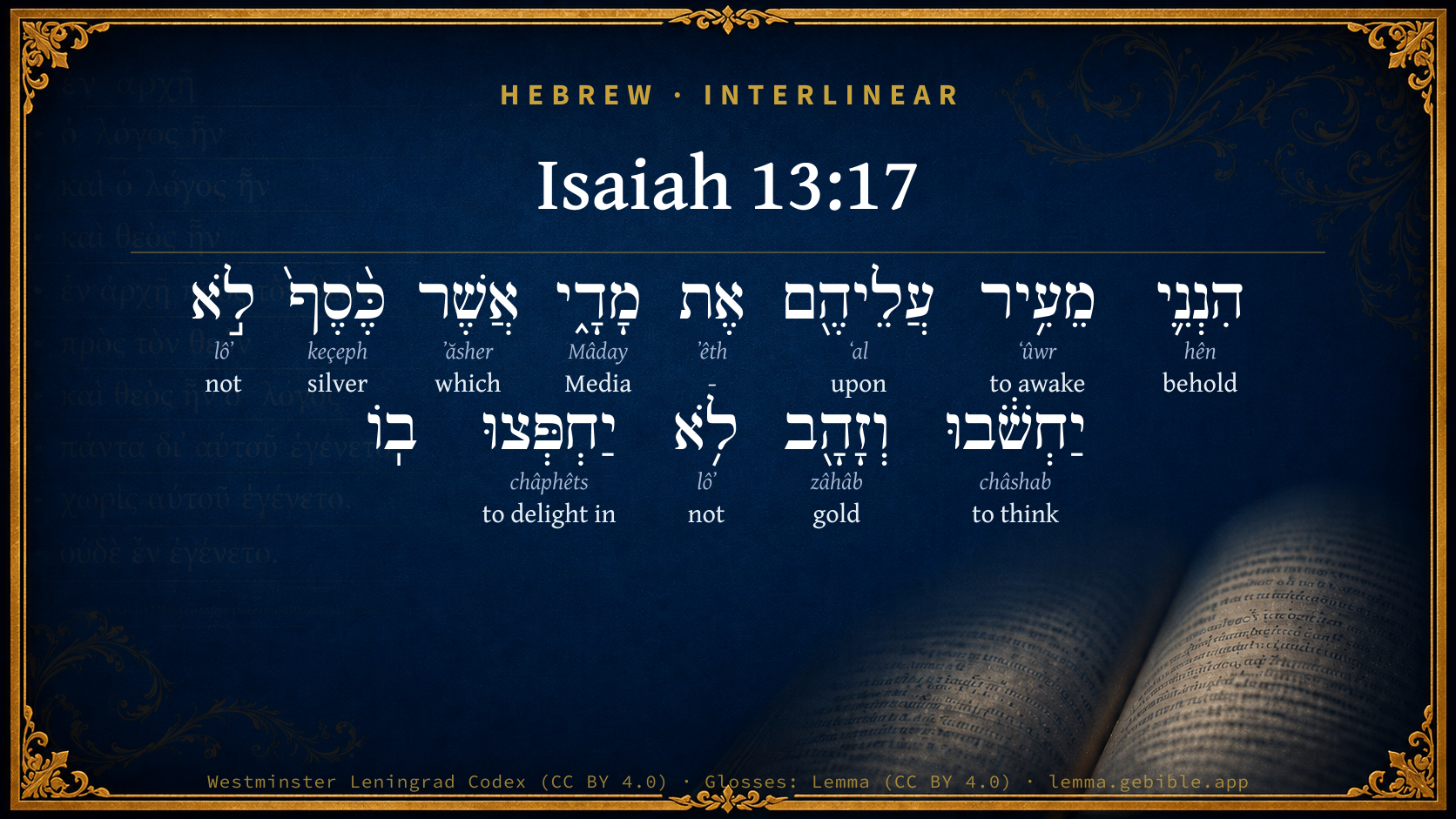
  1. הִנְנִ֛י hên H2005 “behold · me” Particle, Demonstrative + Suffix, Personal, 1st Person, Common, Singular
  2. מֵעִ֥יר ʻûwr H5782 “awaking” Verb, Hiphil, Participle Active, Masculine, Singular, Absolute
  3. עֲלֵיהֶ֖ם ʻal H5921 “upon · them” Preposition + Suffix, Personal, 3rd Person, Masculine, Plural
  4. אֶת ʼêth H853 “-” Particle, Direct Object
  5. אֲשֶׁר ʼăsher H834 “which” Particle, Relative
  6. כֶּ֨סֶף֙ keçeph H3701 “silver” Noun, Common, Masculine, Singular, Absolute
  7. לֹ֣א lôʼ H3808 “not” Particle, Negative
  8. יַחְשֹׁ֔בוּ châshab H2803 “to think” Verb, Qal, Imperfect, 3rd Person, Masculine, Plural
  9. וְזָהָ֖ב zâhâb H2091 “and · gold” Conjunction + Noun, Common, Masculine, Singular, Absolute
  10. לֹ֥א lôʼ H3808 “not” Particle, Negative
  11. יַחְפְּצוּ châphêts H2654 “to delight in” Verb, Qal, Imperfect, 3rd Person, Masculine, Plural

About this verse

These counts appear in no published source. They are computed here, from the morphology-tagged text and Lemma’s own curated glosses. What Lemma adds →

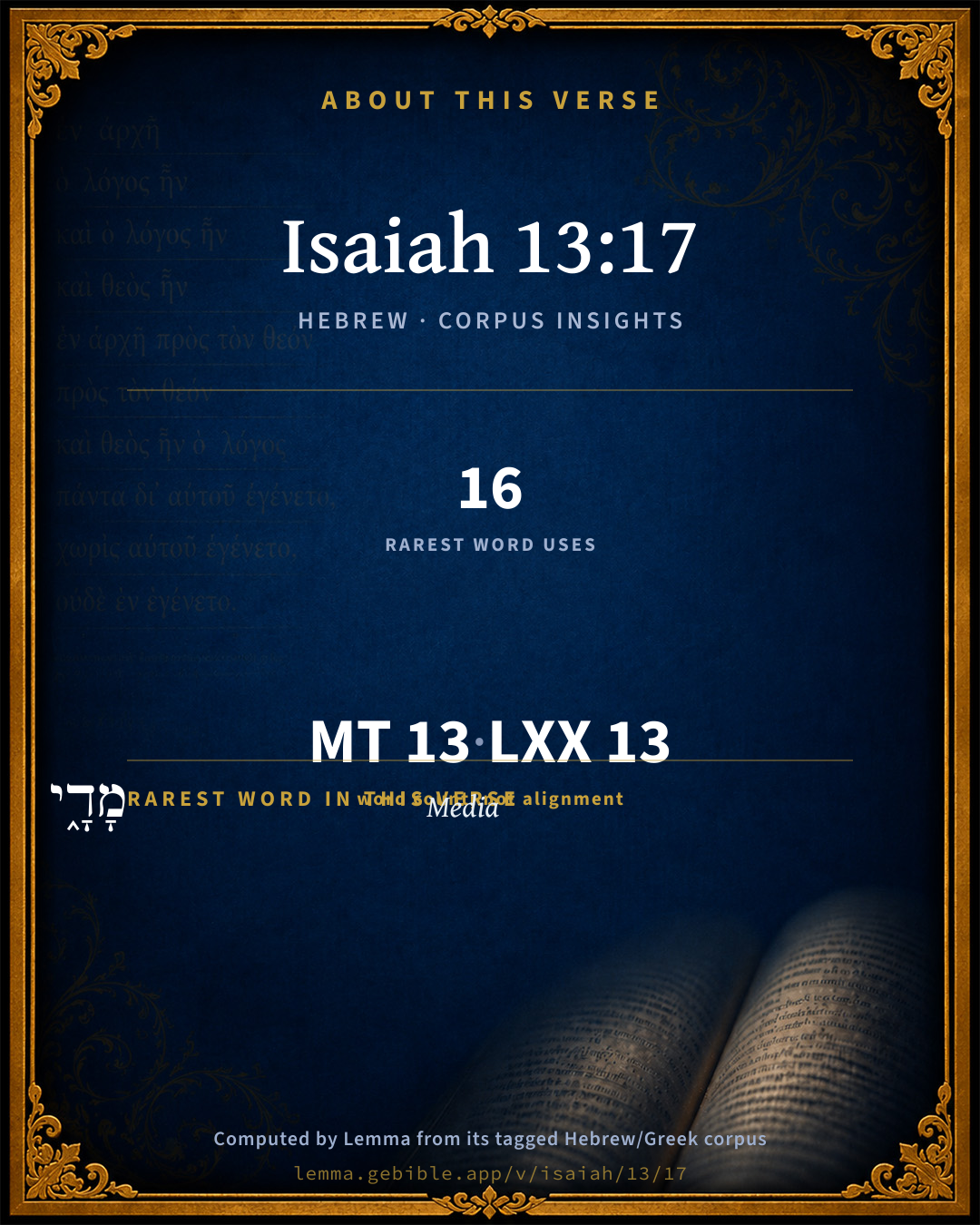
13
words
11
distinct lemmas
Prophets
section

Notable vocabulary

The rarest word here is מָדָ֑י Media H4074 — appearing just 16 times in the whole Hebrew Bible.

Shared distinctive vocabulary

מָדָ֑י Media H4074 occurs in 16 verses of the Hebrew Bible. Also found in:

Grammatical profile

  • 3 verbs
  • 3 nouns
  • 2 prepositions
  • 5 particles

Verb forms

  • מֵעִ֥יר Hiphil · Participle Active
  • יַחְשֹׁ֔בוּ Qal · Imperfect
  • יַחְפְּצוּ Qal · Imperfect

Repetition

A word recurs within this verse — often emphatic in Hebrew:

Hebrew & Septuagint length

In English translation the verse runs 24 words from the Hebrew and 20 from the Septuagint (LXX English) — closely comparable.

A rough comparison of the two English renderings, which tokenize alike — not a word-level alignment.

Word counts can differ between the Hebrew and the Greek without any difference in meaning — e.g. the Hebrew direct-object marker אֵת has no separate Greek word, and Greek often adds the article ὁ.

In the original languages it is 13 Hebrew tokens and 13 Greek tokens — but the two are counted differently (Hebrew bundles its prefixes and suffixes into one token; the Greek is in lemma form), so that isn’t a like-for-like length.

Cross-references

8

Topical passages linked to Isaiah 13:17 in the Treasury of Scripture Knowledge — connected by theme and wording, ordered by reader-vote popularity; previews shown in the World English Bible.

  • Jeremiah 51:11 Make sharp the arrows; hold firm the shields: Yahweh has stirred up the spirit of the kings of the Medes; because his purpose is against Babylon, to destroy it: for it is the vengeance of Yahweh, the vengeance of his temple.
  • Daniel 5:28–31 PERES; your kingdom is divided, and given to the Medes and Persians.
  • Isaiah 41:25 I have raised up one from the north, and he has come; from the rising of the sun one who calls on my name: and he shall come on rulers as on mortar, and as the potter treads clay.
  • Jeremiah 50:9 For, behold, I will stir up and cause to come up against Babylon a company of great nations from the north country; and they shall set themselves in array against her; from there she shall be taken: their arrows shall be as of an expert mighty man; none shall return in vain.
  • Jeremiah 51:27–28 Set up a standard in the land, blow the trumpet among the nations, prepare the nations against her, call together against her the kingdoms of Ararat, Minni, and Ashkenaz: appoint a marshal against her; cause the horses to come up as the rough canker-worm.
  • Proverbs 6:34–35 For jealousy arouses the fury of the husband. He won't spare in the day of vengeance.
  • Isaiah 13:3–5 I have commanded my consecrated ones, yes, I have called my mighty men for my anger, even my proudly exulting ones.
  • Isaiah 21:2 A grievous vision is declared to me; the treacherous man deals treacherously, and the destroyer destroys. Go up, Elam; besiege, Media; all the sighing of it have I made to cease.

Cross-references courtesy of OpenBible.info (CC BY 4.0).

Hebrew and Greek witnesses Masoretic Hebrew ↔ Greek Septuagint

The same verse in the two great witnesses to the Old Testament, shown verse-for-verse.

These are two independent witnesses, not word-aligned to each other, and the Septuagint is shown in lemma (dictionary) form.

Hebrew Isaiah 13:17 Masoretic · Westminster Leningrad Codex

הִנְנִ֛י מֵעִ֥יר עֲלֵיהֶ֖ם אֶת מָדָ֑י אֲשֶׁר כֶּ֨סֶף֙ לֹ֣א יַחְשֹׁ֔בוּ וְזָהָ֖ב לֹ֥א יַחְפְּצוּ בֽוֹ

Behold, I will stir up the Medes against them, who shall not regard silver, and as for gold, they shall not delight in it.

World English Bible · Public Domain

Greek LXX Isaiah 13:17 Septuagint · lemma form

ἰδού ἐπιἐγείρω σύ ὁ μῆδος ὅς οὐ λογίζομαι ἀργύριον οὐδέ χρυσίον χρεία ἔχω

Behold, I will stir up against you the Medes, who do not regard silver, neither have they need of gold.

LXX2012 (modern English Septuagint) · Public Domain

Hebrew: Westminster Leningrad Codex (CC BY 4.0). Greek: Septuagint (public domain); English from LXX2012 (modern English Septuagint) (Public Domain). How the Septuagint differs from the Hebrew →

Targum (Aramaic paraphrase)

1

The Targum is the ancient Jewish Aramaic paraphrase of the Hebrew Scriptures — an interpretive translation, not the Hebrew text itself. Onkelos (literal) and Pseudo-Jonathan (expansive) render the Torah, and Jonathan the Prophets. Coverage is partial: where no permissively-licensed English translation exists for a verse, only the Aramaic is shown. This is verse-level text, not a word-by-word alignment to the Hebrew.

  1. Targum Jonathan Prophets (Joshua–Malachi)
    הָא אֲנָא מַיְתֵי עֲלֵיהוֹן יַת מָדַי דִי בְּכַסְפָּא לָא מְטַקְסִין וְדַהֲבָא לָא מִתְרְעִין בֵּיהּ:

    Behold, I am bringing upon them the Medes, who are not impelled by silver; and as for gold, they delight not in it.

    Targum Jonathan — Aramaic: “Mikraot Gedolot” (public domain). English: “Sefaria Community Translation” (CC0 1.0 (public-domain dedication)); “London "Chaldee Paraphrase," 1871” (public domain). Text via Sefaria.

Commentary

Notes on Isaiah 13:17 from classic Christian and Jewish commentators (each source and its license shown beneath its notes). The classic Christian expositions comment on the surrounding passage and are grouped to its opening verse, so a note may address several verses; the Jewish commentaries on the Tanakh (Rashi and others) are per-verse, so they appear only where the commentator wrote on this verse.

Lemma curates 59 commentaries, every one of them public domain or Creative Commons licensed, each selected and text-cleaned for this edition rather than reprinted as found. About our sources →

Trapp's Complete Commentary

John Trapp

Isa 13:17 Behold, I will stir up the Medes against them, which shall not regard silver; and [as for] gold, they shall not delight in it.

Ver. 17. Behold I will stir up the Medes.] Together with the Persians under the conduct of Darius and Cyrus.

Which shall not regard silver,] sc., For a ransom, but shall kill all they meet, though never so rich, and able to redeem their lives. {Pro 13:8 Jer 41:8}

John Trapp, A Commentary or Exposition upon All the Books of the Old and New Testament (1647–1656) — public domain. Text from a community e-Sword module.

The Biblical Illustrator

Joseph S. Exell

Isa_13:17

Behold, I will stir up the Medes against them

The Medes

The Medes care not for gold, but for blood, though it be the blood of boys and infants.

(Sir E. Strachey, Bart.)

The Medes and gold

Ye Medes and others who now hear me, I well know that you have not accompanied me in this expedition with a view of acquiring wealth.--Speech of Cyrus to his army. (Xenophon, Cyrop. V.)

The Medea

The worst terror that can assail us is the terror of forces, whose character we cannot fathom, who will not stop to parley, who do not understand our language nor our bribes. It was such a power with which the resourceful and luxurious Babylon was threatened. With money the Babylonians did all they wished to do, and believed everything else to be possible. They had subsidised kings, bought over enemies, seduced the peoples of the earth, The foe whom God now sent them was impervious to this influence. From their pure highlands came down upon corrupt civilisation a simple people, whose banner was a leathern apron, whose goal was not booty nor ease but power and mastery, who came not to rob but to displace. (Prof. G. A. Smith, D. D.)

The Biblical Illustrator, edited by Joseph S. Exell (c. 1880s–1900s) — public domain. Text from a community e-Sword module.

Joseph Benson's Commentary

Isa 13:17-18. Behold, &c. — Here follows the second part of this prophecy, in which the calamity which the prophet had foretold, principally in figure, is plainly related and set forth in its causes and consequences. Its causes are stated to be the Medes, raised up by God himself against the Babylonians, and described as being extremely full of cruelty and avidity of revenge, Isa 13:17-18. The consequences are, the desolation of Babylon, and the calamity to be brought upon it, Isa 13:19-22. I will stir up the Medes — Under whom he comprehends the Persians, who were their neighbours and confederates in this expedition. Which shall not regard silver, &c. — That is, comparatively speaking. They shall more eagerly pursue the destruction of the people than the getting of spoil. Their bows also — Under which are comprehended other weapons of war; shall dash the young men to pieces — Or, shall pierce the young men through, as the Chaldee renders it. But, as both Herodotus and Xenophon affirm that the Persians used τοξα μεγαλα, large bows, according to the latter, bows three cubits long, and undoubtedly proportionably strong; we may easily conceive, as Bishop Lowth observes, that, with such bows, especially if made of brass, as bows anciently often were, (see Psa 18:35; Job 20:24,) the soldiers might dash and slay the young men, the weaker and unresisting part of the inhabitants, (here joined with the fruit of the womb and the children,) in the general carnage in taking the city.

Joseph Benson's Commentary on the Old and New Testaments (1811–1818) — public domain. Text from a community e-Sword module.

The Preacher's Complete Homiletical Commentary

Joseph S. Exell (gen. ed.)

THE LOVE OF MONEY

Isa_13:17. The Medes … shall not regard silver; and as for gold, they shall not delight in it.

I. One of the most universal and powerful of all passions is the love of money. Consider—

1. How wide-spread is this passion. The instant men rise above utter barbarism, it manifests itself. Paradoxical as it may sound, it is one of the first signs that civilisation has begun. In every civilised land, and among all classes, it constantly manifests itself [1021] It is one of the inspiring and moulding forces that are always at work.

2. How powerful it is in its operation! It drives men to exhausting toil. It leads them to face appalling dangers. It persuades them to endure distressing privations. It betrays them into the basest crimes. Up to a certain point, it may be said to be a useful servant; it works to promote our welfare, by overbalancing other tendencies that would degrade and ruin us; but when once that limit is overpassed, it transforms itself into a tyrannical master. Like many an Eastern tyrant, it destroys all other lawful passions that might dispute with it the throne (H. E. I., 400, 402).

[1021] In many of those who seem utterly free from the love of money, it is only dormant; like the thirst for blood in that tiger which, captured when a cub, was brought up as a household pet, but showed itself to be a tiger indeed when, licking a slight wound in its master’s hand, it first tasted blood. So, many who appear to be utterly free from the love of money are so simply because they have never possessed more than sufficed for their bare necessities. Let them possess more, and avarice will show itself. This is the explanation of the familiar fact, that many who become prosperous become niggardly; they may continue to give, but it is always in a steadily diminishing proportion to their income (H. E. I., 4013; P. D., 3068, 3488).

II. But this passion, powerful as it is, may be controlled and conquered. “The Medes … shall not regard silver; and as for gold, they shall not delight in it.” This means, not that they should be exempt from the influence of this worldwide passion, but that in them it would be temporarily overborne by another more powerful passion—the passion for revenge. For years the dominion of Babylon over them had been maintained by the most relentless rigour and frightful cruelties; and when the hour for successful revolt came, the one thought of the Medes would be—Revenge! That one intense longing would consume all others; the men on whom it had laid hold would forget their thirst for riches.

This really is only an instance and illustration of what Dr. Chalmers used to call “the expulsive power of a new affection.” Many other affections come up to the human heart, and expel avarice; e.g., love of wife or children, ambition, vanity, &c. We see, therefore, that the love of money can be conquered, and as reasonable men always in danger of being overcome by it, we should ask by what passion or principle it can be conquered most nobly. That principle and that passion is the love of Christ. Of those who are truly possessed by it, it may be truly said that they do not regard silver; and as for gold, they do not delight in it. They may have much money, and by their splendid genius for business may be constantly gaining much more; but they possess it, it does not possess them; they are its masters. By the use of it they are ennobled. Let us pray that our hearts may be garrisoned by this more powerful and noble passion; then all the assaults of avarice upon them shall be made in vain. We shall meet them as Christ Himself met the offer of all the wealth and glory of the world; and the result will be, that we shall possess the true riches which will be valuable in the eternal world (Mat_4:8-10; Mat_6:19-21).

The Preacher's Complete Homiletical Commentary (gen. ed. Joseph S. Exell; Funk & Wagnalls, c. 1892) — public domain (pre-1929). A full-Bible homiletical/sermon-outline anthology covering 65 of 66 books (2 John is absent from the source module). Text from a community e-Sword module.

Keil & Delitzsch

C. F. Keil & F. Delitzsch

With Isa 13:17 the prophecy takes a fresh turn, in which the veil that has hitherto obscured it is completely broken through. We now learn the name of the conquerors. "Behold, I rouse up the Medes over them, who do not regard silver, and take no pleasure in gold." It was the Medes (Darius Medus = Cyaxares II) who put an end to the Babylonian kingdom in combination with the Persians (Cyrus). The Persians are mentioned for the first time in the Old Testament by Ezekiel and Daniel. Consequently Mâdi (by the side of which Elam is mentioned in Isa 21:2) appears to have been a general term applied to the Arian populations of Eran from the most important ruling tribe. Until nearly the end of Hezekiah's reign, the Medes lived scattered about over different districts, and in hamlets (or villages) united together by a constitutional organization. After they had broken away from the Assyrians (714 b.c.) they placed themselves in 709-8 b.c. under one common king, namely Deyoces, probably for the purpose of upholding their national independence; or, to speak more correctly, under a common monarch, for even the chiefs of the villages were called kings.

(Note: See Spiegel's Eran das Land zwischen dem Indus und Tigris (1863), p. 308ff.)

It is in this sense that Jeremiah speaks of "king of Madai;" at any rate, this is a much more probable supposition than that he refers to monarchs in a generic sense. But the kings of Media, i.e., the rulers of the several villages, are mentioned in Jer 25:25 among those who will have to drink the intoxicating cup which Jehovah is about to give to the nations through Nebuchadnezzar. So that their expedition against Babylon is an act of revenge for the disgrace of bondage that has been inflicted upon them. Their disregarding silver and gold is not intended to describe them as a rude, uncultivated people: the prophet simply means that they are impelled by a spirit of revenge, and do not come for the purpose of gathering booty. Revenge drives them on to forgetfulness of all morality, and humanity also.

Keil & Delitzsch — Biblical Commentary on the Old Testament (1861–1891) — public domain (CC PDM 1.0). Text via the HelloAO Bible API. (Old Testament only.)

Tyndale Open Study Notes

Tyndale Open Resources

13:17 The Lord is sovereign and controls history. He can stir up kingdoms to execute his will. • The Medes from northwestern Iran joined Persian King Cyrus in fighting against Babylon in 539 BC.

Tyndale Open Study Notes — © Tyndale Open Resources, licensed CC BY-SA 4.0. Text via the HelloAO Bible API.

Jamieson, Fausset & Brown

Robert Jamieson, A. R. Fausset & David Brown

Medes-- (Isa 21:2; Jer 51:11, Jer 51:28). At that time they were subject to Assyria; subsequently Arbaces, satrap of Media, revolted against the effeminate Sardanapalus, king of Assyria, destroyed Nineveh, and became king of Media, in the ninth century B.C.

not regard silver--In vain will one try to buy his life from them for a ransom. The heathen XENOPHON (Cyropædia, 5,1,10) represents Cyrus as attributing this characteristic to the Medes, disregard of riches. A curious confirmation of this prophecy.

Jamieson, Fausset & Brown — Commentary Critical and Explanatory on the Whole Bible (1871) — public domain (CC PDM 1.0). Text via the HelloAO Bible API.

Adam Clarke's Commentary

Verse 17. Which shall not regard silver - "Who shall hold silver of no account"] That is, who shall not be induced, by large offers of gold and silver for ransom, to spare the lives of those whom they have subdued in battle; their rage and cruelty will get the better of all such motives. We have many examples in the Iliad and in the AEneid of addresses of the vanquished to the pity and avarice of the vanquishers, to induce them to spare their lives.

Est domus alta: jacent penitus defossa talenta

Caelati argenti: sunt auri ponders facti

Infectique mihi: non hic victoria Teucrum

Vertitur; aut anima una dalbit discrimina tanta.

Dixerat: AEneas contra cui talia reddit:

Argenti atque auri memoras quae multa talenta

Gnatis parce tuis.

AEn. x. 526.

"High in my dome are silver talents rolled,

With piles of laboured and unlaboured gold.

These, to procure my ransom, I resign;

The war depends not on a life like mine:

One, one poor life can no such difference yield,

Nor turn the mighty balance of the field.

Thy talents, (cried the prince,) thy treasured store

Keep for thy sons."

Pitt.

It is remarkable that Xenophon makes Cyrus open a speech to his army, and in particular to the Medes, who made the principal part of it, with praising them for their disregard of riches. Ανδρες Μηδοι, και παντες οἱ παροντες, εγω ὑμας οιδα σαφως, ὁτι ουτε χρηματων δεομενοι συν εμοι εξελθετε· "Ye Medes, and others who now hear me, I well know that you have not accompanied me in this expedition with a view of acquiring wealth." - Cyrop. lib. v.

Adam Clarke's Commentary on the Bible (1810–1826) — public domain. Text from a community e-Sword/MySword module.

Ellicott's Commentary for English Readers

(17) Behold, I will stir up the Medes.—The Hebrew form Madai meets us in Gen_10:2, among the descendants of Japheth. Modern researches show them to have been a mixed people, Aryan conquerors having mingled with an earlier Turanian race, and differing in this respect from the Persians, who were pure Iranians, both in race and creed. The early Assyrian inscriptions, from Rimmon Nirari III. onward (Cheyne), name them, as also does Sargon (Records of the Past, xi. 18), among the enemies whom the kings subdued. Their name had been recently brought before the prophet’s notice by Salmaneser’s deportation of the Ten Tribes to the cities of the Medes (2Ki_17:6). In naming the Medes, and not the Persians, as the conquerors of Babylon, Isaiah was probably influenced by the greater prominence of the former, just as the Greeks spoke of them, and used such terms as “Medism” when they came in contact with the Medo-Persian monarchy under Darius and Xerxes. So Ӕschylus (Pers. 760) makes “the Median” the first ruler of the Persians. It is noticeable that they were destined to be the destroyers both of Nineveh and Babylon: of the first under Cyaxares, in alliance with Nabopolassar, and of the second under Cyrus the Persian, and, we may add, the Mede Darius of Dan_5:31. If we accept the history of a yet earlier attack on Nineveh by Arbaces the Mede and Belesis of Babylon, we can sufficiently account for the prominence which Isaiah, looking at Babylon as the representative of Assyrian rather than Chaldæan power, gives to them as its destroyers. (See Lenormant, Anc. Hist., 1, p. 337.)

Which shall not regard silver.—The Medes are represented as a people too fierce to care for the gold and silver in which Babylon exulted. They would take no ransom to stay their work of vengeance. So Xenophon, in his Cyropædia (5:3), represents Cyrus as acknowledging their unbought, unpaid service.

A Bible Commentary for English Readers, edited by Charles John Ellicott (1878–1897) — public domain. Text from a community e-Sword module.

The Cambridge Bible for Schools and Colleges

gen. ed. J. J. S. Perowne

17. the Medes] This Iranian people first became a leading power in Asia when it divided with the Chaldæans the spoils of the Assyrian Empire (b.c. 606), but it was not till the rise of the great conqueror Cyrus that it became a formidable enemy to Babylon. Cyrus, according to the classical historians, was originally a vassal king of the Median Empire, reigning over the narrow territory to which the name Persia or Persis was at first restricted. He is called, however, in Babylonian inscriptions “King of Anzan,” which is explained by Assyriologists to be a small kingdom in the north of Elam. (See Sayce, in Rec. of the Past, l.c.) About the year 549 he overthrew the ruling Median dynasty and placed himself at the head of the whole empire. It has been argued by some scholars that previous to that event there could be no expectation of a conquest of Babylon by the Medes, and that therefore the prophecy must be dated between 549 and 538. Others again hold that if it had been written after 549 the enemy would have been called the Persians. Both inferences, however, are inconclusive. The first overlooks the fact that before the accession of Cyrus the Medes were a powerful nation, and indeed the only probable human agents of a chastisement of Babylon. And against the second it has to be borne in mind that the name Persia, for the united empire, made its way slowly in antiquity. In the Bible it first becomes common in the time of Ezra, although long after that we still read of Medes and Persians (Dan_5:28; Dan_6:8; Dan_6:12) or Persians and Medes (Est_1:3; Est_1:14; Est_1:18). Greek writers also speak of the wars of independence against Xerxes as τὰ Μηδικά. The verse, therefore, furnishes no particular indication of the date of the prophecy.

which shall not regard (regard not) silver …] They cannot be bought off by a ransom. Xenophon puts into the mouth of Cyrus in addressing the Medes the words: οὐ χρημάτων δεόμενοι σὺν ἐμοὶ ἐξήλθετε (Cyrop. Isa_13:1; Isa_13:20).

17, 18. The description of the character of the invaders, perhaps even the mention of their name, is of the nature of a climax to the terrors of the picture.

The Cambridge Bible for Schools and Colleges (gen. ed. J. J. S. Perowne; Cambridge University Press, 1878–1918) — public domain. Text from a community e-Sword module.

John Gill's Exposition

Behold, I will stir up the Medes against them,.... The Babylonians; this explains who are meant by the sanctified and mighty ones, Isa 13:3 the Medes were a people that descended from Medai, one of the sons of Japheth, Gen 10:2 as Josephus observes (i); under these the Persians are included, though they are only mentioned, because Cyrus was sent by Cyaxares king of Media on this expedition against Babylon, and was made by him general of the Medes, and acted as such under him; and when Babylon was taken, and Belshazzar slain, Darius the Median took the kingdom, Dan 5:31 now these are mentioned by name some hundreds of years before the thing came to pass, as Cyrus their general in Isa 45:1 which is a strong proof of the truth of prophecy, and of divine revelation; and, whatever might be the moving causes of this expedition, the affair was of God; it was he that put it into the hearts of the Medes, and stirred up their spirits to make war against Babylon; and though God is not the author of sin, yet he not only suffered the things to be done before and after mentioned, but in his providence ordered them as just punishments on a sinful people:

which shall not regard silver; and as for gold, they shall not delight in it; not but that they had a regard for, gold and silver, as appears by their spoiling of the houses of the Babylonians, Isa 13:16 but that they had not so great a regard for these things as to spare the lives of any for the sake of them; they were so intent upon taking away their lives, that they disregarded their substance; their first work was to slay, and then to spoil; they first destroyed, and then plundered; no man with his gold and silver could obtain a ransom of his life from them. Cyrus (k) in his speech to his army said,

"O ye Medes, and all present, I truly know that not for want of money are ye come out with me,'' &c.

(i) Antiqu. Jud. l. 1. c. 6. sect. 1. (k) Cyropaedia, l. 5. sect. 3.

John Gill's Exposition of the Whole Bible (1746–1763) — public domain (CC PDM 1.0). Text via the HelloAO Bible API.

Albert Barnes' Notes on the Bible

Behold, I will stir up - I will cause them to engage in this enterprise. This is an instance of the control which God claims over the nations, and of his power to excite and direct them as he pleases.

The Medes - This is one of the places in which the prophet specified, “by name,” the instrument of the wrath of God. Cyrus himself is subsequently mentioned Isa 44:28; Isa 45:1 as the agent by which God would accomplish his purposes. It is remarkable, also, that ‘the Medes’ are mentioned here many years before they became a separate and independent nation. It was elsewhere predicted that the Medes would be employed in this siege of Babylon; thus, in Isa 21:2 : ‘Go up, O Elam (that is, Persia), besiege, O Media;’ Jer 51:11 : ‘Jehovah hath raised up the spirit of the kings of the Medes, for his device is against Babylon to destroy it.’ Media was a country east of Assyria, which is supposed to have been populated by the descendants of Madai, son of Japheth Gen 10:2. Ancient Media extended on the west and south of the Caspian Sea, from Armenia, on the north, to Faristan or Persia proper, on the south.

It was one of the most fertile regions of Asia. It was an ancient kingdom. Ninus, the founder of the Assyrian monarchy, is said to have encountered one of its kings, whom he subdued, and whose province he made a part of the Assyrian empire. For 520 years, the Medes were subject to the Assyrians; but, in the time of Tiglath-pileser and Shalmaneser, they revolted, and, by the destruction of the army of Sennacherib before Jerusalem - an event which was itself subsequent to the delivery of this prophecy respecting Babylon - they were enabled to achieve their independence. At the time when this prophecy was uttered, therefore, Media was a dependent province of the kingdom of Assyria. Six years they passed in a sort of anarchy, until, about 700 years b.c., they found in Dejoces an upright statesman, who was proclaimed king by universal consent. His son and successor, Phraortes, subdued the Persians, and all upper Asia, and united them to his kingdom.

He also attacked Assyria, and laid siege to Nineveh, the capital, but was defeated. Nineveh was finally taken by his successor, Cyaxares, with the aid of his ally, the king of Babylon; and Assyria became a province of Media. This widely-extended empire was delivered by him to his son Astyages, the father of Cyrus. Astyages reigned about 35 years, and then delivered the vast kingdom to Cyrus, about 556 years b.c., under whom the prediction of Isaiah respecting Babylon was fulfilled. In this way arose the Medo-Persian kingdom, and henceforward “the laws of the Medes and Persians” are always mentioned together Est 1:9; Est 10:2; Dan 6:8, Dan 6:12. From this time, all their customs, rites, and laws, became amalgamated. - (Herod. i. 95-130). In looking at this prophecy, therefore, we are to bear in mind:

(1) the fact that, when it was uttered, Media was a dependent province of the kingdom of Assyria;

(2) that a long time was yet to elapse before it would become an independent kingdom;

(3) that it was yet to secure its independence by the aid of that very Babylon which it would finally destroy;

(4) that no human foresight could predict these revolutions, and that every circumstance conspired to render this event improbable.

The great strength and resources of Babylon; the fact that Media was a dependent province, and that such great revolutions must occur before this prophecy could be fulfilled, render this one of the most striking and remarkable predictions in the sacred volume.

Which shall not regard silver ... - It is remarkable, says Lowth, that Xenophon makes Cyrus open a speech to his army, and, in particular, to the Medes, who made the principal part of it, with praising them for their disregard of riches. ‘Ye Medes and others who now hear me, I well know, that you have not accompanied me in this expedition with a view of acquiring wealth.’ - (“Cyrop.” v.) That this was the character of the Medes, is further evident from several circumstances. ‘He reckoned, says Xenophon, that his riches belonged not anymore to himself than to his friends. So little did he regard silver, or delight in gold, that Croesus told him that, by his liberality, he would make himself poor, instead of storing up vast treasures for himself. The Medes possessed, in this respect, the spirit of their chief, of which an instance, recorded by Xenophon, is too striking and appropriate to be passed over.

When Gobryas, an Assyrian governor, whose son the king of Babylon had slain, hospitably entertained him and his army, Cyrus appealed to the chiefs of the Medes and Hyrcanians, and to the noblest and most honorable of the Persians, whether, giving first what was due to the gods, and leaving to the rest of the army their portion, they would not overmatch his generosity by ceding to him their whole share of the first and plentiful booty which they had won from the land of Babylon. Loudly applauding the proposal, they immediately and unanimously consented; and one of them said, “Gobryas may have thought us poor, because we came not loaded with coins, and drink not out of golden cups; but by this he will know, that men can be generous even without gold.”’ (“See” Keith “On the Prophecies,” p. 198, Ed. New York, 1833.) This is a remarkable prediction, because this is a very unusual circumstance in the character of conquerors. Their purpose has been chiefly to obtain plunder, and, especially, gold and silver have been objects to them of great value. Few, indeed, have been the invading armies which were not influenced by the hope of spoil; and the want of that characteristic among the Medes is a circumstance which no human sagacity could have foreseen.

Albert Barnes' Notes on the Bible (1834–1885) — public domain. Text from a community e-Sword/MySword module.

Haydock's Catholic Bible Commentary

Medes. Who had set themselves at liberty about twenty years before this. They were not solicitous about gold, Ezechiel vii. 19., and Sophonias i. 18.

George Leo Haydock (1774–1849), Haydock's Catholic Family Bible and Commentary, 1859 edition — public domain. Excludes Psalms (Douay-Rheims chapter numbering differs from Protestant) and Deuterocanonical books (Catholic canon only).

Matthew Poole's English Annotations

The Medes; under whom he comprehends the Persians, who were their neighbours and confederates in this expedition.

They shall not delight in it; which is to be understood comparatively. They shall more eagerly pursue the destruction of the people than the getting of spoil; whereby it shall appear that they are only the executioners of my vengeance against them; they will accept no ransom to save their lives.

Matthew Poole's English Annotations on the Holy Bible (1683–1685) — public domain. Text from a community e-Sword/MySword module.

Whedon's Commentary on the Bible

Daniel D. Whedon

17. Will stir up the Medes against them — That is, “I am he who causeth to arouse as out of sleep,” etc. The Hiphil participle is used of a verb having, according to Gesenius, three, according to Furst, six, several sets of meanings, of which one set chiefly uses the Hiphil with the above characterizing idea. Compare Zec_9:13; Son_2:7; Isa_10:26. The “Medes” are here for the first time mentioned by name, and are alone mentioned, as they were the chief nation to be used, with Persia, in overthrowing Babylon. They had been subject to Assyria till B.C. 708 or 703, or B.C. 650, according to Rawlinson, when they threw off the yoke and became a federation of small kingdoms in their country of mountains and valleys situated east of old Assyria, south of Armenia and the Caspian Sea, and north of Persia, from which they were separated by the desert running out southwest from near the ancient Aryan seats. They had no friendship for their old masters of Mesopotamia. Prosperity and power came to them after they became independent, and were finally organized under one monarchy, and so on till Cyaxares becomes, at length, the probable true founder of the Median dynasty, B.C. 633, and the one who appears to begin what is the truly authentic history of the Medes. See SMITH’S Dictionary of the Bible; SMITH’S History of the World; RAWLINSON’S Five Great Monarchies; RAWLINSON’S Herodotus; LENORMANT’S Manuscript Ancient History, etc. In the final taking of Babylon the Median was chief over the Persian element of the instrumentality, (namely, Cyrus,) because it was really the chief power before Persia was connected with it as an empire. Hence the “Medes” constituted the chief foreseen figure with the prophet in the predicted event of the overthrow of the Babylonian power.

Shall not regard silver — Was this a national characteristic? Xenophon (Cyropaedia) makes Cyrus say to the Medes that they did not join him from a desire of (χρηματων) money.

Daniel D. Whedon (gen. ed.), Commentary on the Old and New Testaments (1874–1909) — public domain. Text from a community e-Sword module.

The Pulpit Commentary

Behold, I will stir up the Medes against them. Isaiah"s knowledge that the Medes should take a leading part in the destruction of Babylon is, no doubt, as surprising a fact as almost any other in the entire range of prophetic foresight, or insight, as set before us in Scripture. The Medes were known to Moses as an ancient nation of some importance; (Gen_10:2) but since his time had been unmentioned by any sacred writer; and, as a living nation, had only just come within the range of Israelite vision, by the fact that, when Sargon deported the Samaritans from Samaria, he placed some of them "in the cities of the Medes". (2Ki_17:6) The Assyrians had become acquainted with them somewhat more than a century earlier, and had made frequent incursions into their country, finding them a weak and divided people, under the government of a large number of petty chiefs. Sargon had conquered a portion of the tribes, and placed prefects in the cities; at the same time planting colonists in them from other parts of the empire. That, when the weakness of Media was being thus made apparent, Isaiah should have foreseen its coming greatness can only be accounted for by his having received a Divine communication on the subject. Subsequently, he had a still more exact and complete communication. (Isa_21:2) Which shall not regard silver. The Medes were not a particularly disinterested people; but in the attack on Babylon, made by Cyrus, the object was not plunder, but conquest and the extension of dominion. The main treasures of Babylon those in the great temple of Bolus were not carried off by Cyrus, as appears both from his own inscriptions, and from Herodotus (1. 181-183).

The Pulpit Commentary (1880–1919), ed. H.D.M. Spence-Jones & Joseph S. Exell — public domain. Text from a community e-Sword module.

John Wesley's Explanatory Notes

Medes - Under whom he comprehends the Persians. Not delight - Which is to be understood comparatively. They shall more eagerly pursue the destruction of the people, than the getting of spoil.

John Wesley, Explanatory Notes Upon the Whole Bible (1754–1765) — public domain. Text via the GEBible commentary corpus.

J. A. Alexander on Isaiah

Joseph Addison Alexander

The Prophet now, for the first time, names the chosen instruments of Babylon’s destruction. “Behold I (am) stirring up against them Madai (Media or the Medes), who will not regard silver, and (as for) gold, they will not take pleasure in it (or desire it).” Here, as in Jer 51:11; Jer 51:28, the Medes alone are mentioned, as the more numerous and hitherto more powerful nation, to which the Persians had long been subject, and were still auxiliary. Or the name may be understood as comprehending both, which has been clearly shown to be the usage of the classical historians. Indeed, all the names of the great oriental powers are used, with more or less latitude and license, by the ancient writers sacred and profane. As the Medes did not become an independent monarchy till after the date of this prediction, it affords a striking instance of prophetic foresight. At the date of this prediction they formed a part of the Assyrian empire, but revolted at the time of the Assyrian invasion of Syria and Israel. Their first king Dejoces was elected about 700 years before the birth of Christ. His son Phraortes conquered Persia, and the united Medes and Persians, with the aid of the Babylonians, subdued Assyria under the conduct of Cyaxares I The conquest of Babylon was effected in the reign of Cyaxares II by the Median army, with an auxiliary force of thirty thousand Persians, under the command of Cyrus, the king’s nephew. The thirst of blood would supersede the thirst of gold in the conquerors of Babylon, so that no one would be able to secure his life by ransom.

Joseph Addison Alexander, The Prophecies of Isaiah (1846–1847; New York: Scribner, 1870–1878) — public domain. Text from a community e-Sword module.

unfoldingWord translationNotes

Door43 World Missions Community

Connecting Statement:

Yahweh continues speaking.

I am about to stir up the Medes to attack them

Making people want to do something is spoken of as stirring them up. AT: "I am about to make the Medes want to attack them" (See: Metaphor)

Their bows will strike down

Here "their bows" is a metonym for the soldiers who use the bows. AT: "Their soldiers will use bows and arrows to kill"

translationWords

Medes

silver

gold

bow and arrow

unfoldingWord translationNotes — © Distant Shores Media and the Door43 World Missions Community, licensed CC BY-SA 4.0. Source: git.door43.org/Door43/en_tn.

Rashi

Rabbi Shlomo Yitzchaki (Rashi)

Behold I stir up Media against them Darius the Mede assassinated Belshazzar. So Scripture states (Dan. 5:30): “On that very night, Belshazzar...was slain”; (ibid. 6:1) “And Darius the Mede acquired the kingdom.”

and do not desire gold They do not care [for anything,] but to kill and to avenge the harm the kings of Babylon did to all the peoples.

Rashi on the Tanakh — English translations: “The Judaica Press complete Tanach with Rashi, translated by A. J. Rosenberg” (CC BY 4.0); “Pentateuch with Rashi's commentary by M. Rosenbaum and A.M. Silbermann, 1929-1934” (public domain); “The Metsudah Tanach series, Lakewood, N.J” (CC BY 4.0); and “The Book of Joshua, Metsudah Publications, 1997” (CC BY 4.0). Text via Sefaria.

Ibn Ezra

Rabbi Abraham ibn Ezra

The Medes, who are the most cruel people.

They shall not regard silver, as being of any value; they shall only desire to slaughter.

Ibn Ezra on the Tanakh — English translations: “Sefaria Community Translation” (CC0 1.0 (public-domain dedication)); “Yalkut, Sifsei Chachomim Chumash, Metsudah Publications, 2009” (CC BY 4.0); and “Commentary of Ibn Ezra on Isaiah - trans. by M. Friedlander, 1873” (public domain). Text via Sefaria.

Lesson kit

Teaching starters — assembled from the data on this page, not authored interpretation. Every prompt links to the verse data it draws on. Edit before teaching.

Isaiah, in the Prophets, opens this verse with 13 words (11 distinct Hebrew lemmas). Its most distinctive word is Mâday (“Media”). A historical commentator’s framing appears above. Read the whole chapter for the surrounding context.

Discussion questions

  1. The word Mâday carries the sense “Media.” How does it shape the verse?
  2. How does Genesis 10:2, which shares the word «Media», read alongside this verse?
  3. What does the repetition of “not” (2× in this one verse) do in this verse?
  4. These translations render this verse differently; the difference is in the English rendering, not the original. What questions does that raise?
  5. «מֵעִ֥יר» is a Hiphil Participle Active verb. How does that grammatical form shape the action described?
  6. Compare how Trapp's Complete Commentary and The Biblical Illustrator read this verse. Where do they agree or differ?

Things to notice

Reading settings

Reading text

Shown beneath each verse's original-language words.

Old Testament
Old Testament edition

Read the OT as the Masoretic Hebrew (MT) or the Greek Septuagint (LXX).

English shown for the Greek Septuagint (in the Hebrew ↔ Greek comparison).

Comparing translations? Open the Compare panel on any verse page to stack up to four side by side.