Jeremiah 10:18

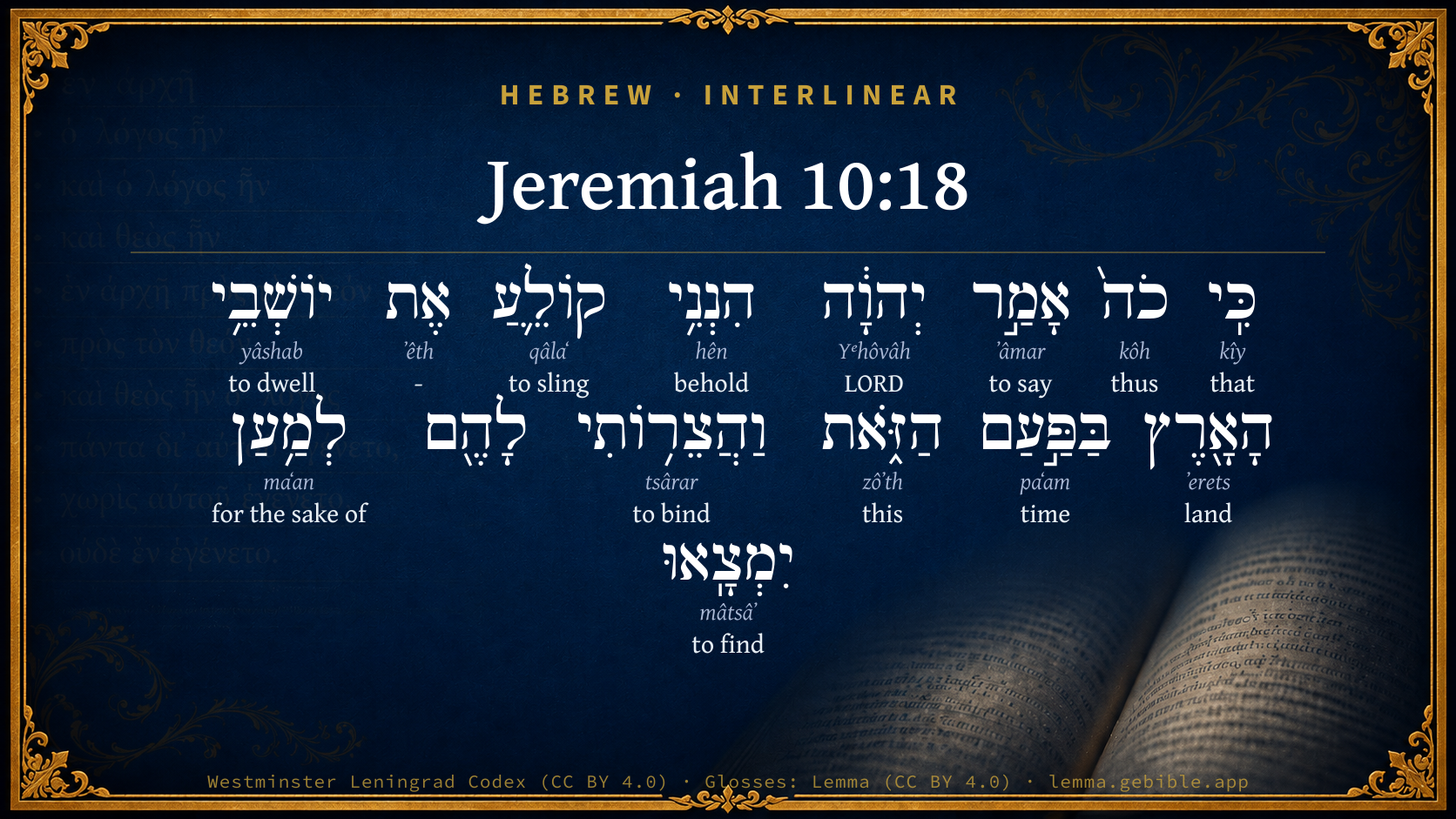
Hebrew (Westminster Leningrad Codex) Jeremiah 10:18 appears in the Hebrew Old Testament. The text above is from the Westminster Leningrad Codex. Each word links to its Strong’s number, a concise gloss, and parsing drawn from the Open Scriptures Hebrew Bible morphology. Click any word for its full Brown-Driver-Briggs (BDB) entry.
Download image
Cite this verse

Jeremiah 10:18 (World English Bible). Public Domain. Lemma interlinear Bible study tool, https://lemma.gebible.app/v/jeremiah/10/18.

Show BibTeX & RIS
BibTeX
RIS
English Translation
For thus says Yahweh, Behold, I will sling out the inhabitants of the land at this time, and will distress them, that they may feel [it].
World English Bible · Public Domain
Download a study sheet

One document with this verse’s original text, its word-by-word gloss line, the meaning frame, cross-references with their text, attributed commentary, and full source and license credits — printable, and it pastes into notes with its structure intact.

This verse Autodidact and up

Study sheet (.html) Plain text (.txt)

A passage Seminary Student

Up to 50 verses in one chapter. A passage sheet keeps up to 6 commentary sources and 12 cross-references per verse, in the order this page ranks them, and says so on the sheet whenever that leaves anything out. Ask for a single verse and you get the Autodidact verse sheet above.

Everything on this page stays free to read, with no account — the sheet is a download of what is already on screen, not access to it.

Want to remove ads? Support Godless Engineer
Compare translations 3

The same verse in 3 English versions, stacked beneath the original-language interlinear above. Click any original word for its lexicon entry.

Each is an independent rendering of the whole verse — the interlinear is not word-aligned to these translations.

Highlighted words mark where these versions differ — a whole-verse word diff, not a word-by-word alignment.

  • World English Bible Public Domain
    For thus says Yahweh, Behold, I will sling out the inhabitants of the land at this time, and will distress them, that they may feel [it].
  • King James Version Public Domain
    For thus saith the LORD, Behold, I will sling out the inhabitants of the land at this once, and will distress them, that they may find it so.
  • unfoldingWord Literal Text CC BY-SA 4.0
    For thus says Yahweh, “Behold, I am slinging the ones who inhabit the land at this time. I will cause them distress in order that they will find.”

unfoldingWord Literal Text — © unfoldingWord, licensed CC BY-SA 4.0. Word-aligned USFM3 via Door43 (git.door43.org/unfoldingWord/en_ult).

Versions to compare (up to 4)

3 of 4 selected

Show all 18 translations

Every available English version of this verse, each an independent rendering of the whole verse.

  • World English Bible Public Domain
    For thus says Yahweh, Behold, I will sling out the inhabitants of the land at this time, and will distress them, that they may feel [it].
  • Berean Standard Bible Public Domain
    For this is what the LORD says: “Behold, at this time I will sling out the inhabitants of the land and bring distress upon them so that they may be captured.”
  • Majority Standard Bible Public Domain
    For this is what the LORD says: “Behold, at this time I will sling out the inhabitants of the land and bring distress upon them so that they may be captured.”
  • King James Version Public Domain
    For thus saith the LORD, Behold, I will sling out the inhabitants of the land at this once, and will distress them, that they may find it so.
  • American Standard Version (1901) Public Domain
    For thus saith Jehovah, Behold, I will sling out the inhabitants of the land at this time, and will distress them, that they may feel `it'.
  • Revised Version (1885) Public Domain
    For thus saith the LORD, Behold, I will sling out the inhabitants of the land at this time, and will distress them, that they may feel it.
  • Geneva Bible (1599) Public Domain
    For thus sayth the Lord, Beholde, at this time I will throwe as with a sling the inhabitants of the lande, and will trouble them, and they shall finde it so.
  • Douay-Rheims (1899) Public Domain
    For thus saith the Lord: Behold I will cast away far off the inhabitants of the land at this time: and I will afflict them, so that they may be found.
  • Young's Literal Translation Public Domain
    For thus said Jehovah: Lo, I am slinging out the inhabitants of the land at this time, And have been an adversary to them, So that they are found out.
  • Literal Standard Version CC BY-SA 4.0
    For thus said YHWH: “Behold, I am slinging out the inhabitants of the land at this time, || And have been an adversary to them, || So that they are found out.”
  • Unlocked Literal Bible CC BY-SA 4.0
    For Yahweh says this, “See, I am about to throw the inhabitants of the land out this time. I will cause them distress, and they will find it to be so.”
  • unfoldingWord Literal Text CC BY-SA 4.0
    For thus says Yahweh, “Behold, I am slinging the ones who inhabit the land at this time. I will cause them distress in order that they will find.”
  • Darby Bible Public Domain
    For thus saith Jehovah: Behold, I will this time sling out the inhabitants of the land, and will distress them, that they may be found.
  • World Messianic Bible Public Domain
    For the LORD says, “Behold, I will sling out the inhabitants of the land at this time, and will distress them, that they may feel it.”
  • Webster's Bible Public Domain
    For thus saith the LORD; Behold, I will sling out the inhabitants of the land at this once, and will distress them that they may find it so.
  • Free Bible Version CC BY-SA 4.0
    because this is what the Lord says: Look! Right now I'm about to throw out the people living in this country, bringing them trouble they will really feel.
  • Bible in Basic English Public Domain
    For the Lord has said, I will send the people in flight like a stone from the land at this time, troubling them so that they will be conscious of it.
  • JPS Tanakh (1917) Public Domain
    For thus saith the LORD: Behold, I will sling out the inhabitants of the land at this time, and will distress them, that they may feel it.

Literal Standard Version (2020), Covenant Press — licensed CC BY-SA 4.0. Text via the HelloAO Bible API (eBible.org). Unlocked Literal Bible (unfoldingWord) — licensed CC BY-SA 4.0. Text via the HelloAO Bible API (eBible.org). unfoldingWord Literal Text — © unfoldingWord, licensed CC BY-SA 4.0. Word-aligned USFM3 via Door43 (git.door43.org/unfoldingWord/en_ult). Free Bible Version, Dr. Jonathan Gallagher — licensed CC BY-SA 4.0. Text via the HelloAO Bible API (eBible.org).

Word by word

More ways to search: Search by grammar → Find every occurrence → Compare this word →

Practice this passage: Drill this verse → Learn its vocabulary →

קוֹלֵ֛עַ
qâlaʻ
H7049
“slinging”
Verb, Qal, Participle Active, Masculine, Singular, Absolute
Part of Speech
Verb
Stem
Qal
Form
Participle Active
Gender
Masculine
Number
Singular
State
Absolute
Full BDB Definition

Origin: a primitive root

TWOT: 2030 , 2031

to sling, hurl forth - (Qal) - to sling - slinger (participle) - (Piel) to sling - (Qal) to carve
  1. כִּֽי kîy H3588 “that” Conjunction
  2. כֹה֙ kôh H3541 “thus” Adverb
  3. אָמַ֣ר ʼâmar H559 “to say” Verb, Qal, Perfect, 3rd Person, Masculine, Singular
  4. יְהוָ֔ה Yᵉhôvâh H3068 “LORD” Noun, Proper
  5. הִנְנִ֥י hên H2005 “behold · me” Particle, Demonstrative + Suffix, Personal, 1st Person, Common, Singular
  6. אֶת ʼêth H853 “-” Particle, Direct Object
  7. יוֹשְׁבֵ֥י yâshab H3427 “dwelling” Verb, Qal, Participle Active, Masculine, Plural, Construct
  8. הָאָ֖רֶץ ʼerets H776 “the · land” Particle, Definite Article + Noun, Common, Both, Singular, Absolute
  9. בַּפַּ֣עַם paʻam H6471 “in/at the · time” Preposition, Determined + Noun, Common, Feminine, Singular, Absolute
  10. הַזֹּ֑את zôʼth H2063 “the · this” Particle, Definite Article + Pronoun, Demonstrative, Feminine, Singular
  11. וַהֲצֵר֥וֹתִי tsârar H6887 “and · to bind” Conjunction + Verb, Hiphil, Sequential Perfect, 1st Person, Common, Singular
  12. לְמַ֥עַן maʻan H4616 “for the sake of” Preposition
  13. יִמְצָֽאוּ mâtsâʼ H4672 “to find” Verb, Qal, Imperfect, 3rd Person, Masculine, Plural

About this verse

These counts appear in no published source. They are computed here, from the morphology-tagged text and Lemma’s own curated glosses. What Lemma adds →

15
words
14
distinct lemmas
Prophets
section

Notable vocabulary

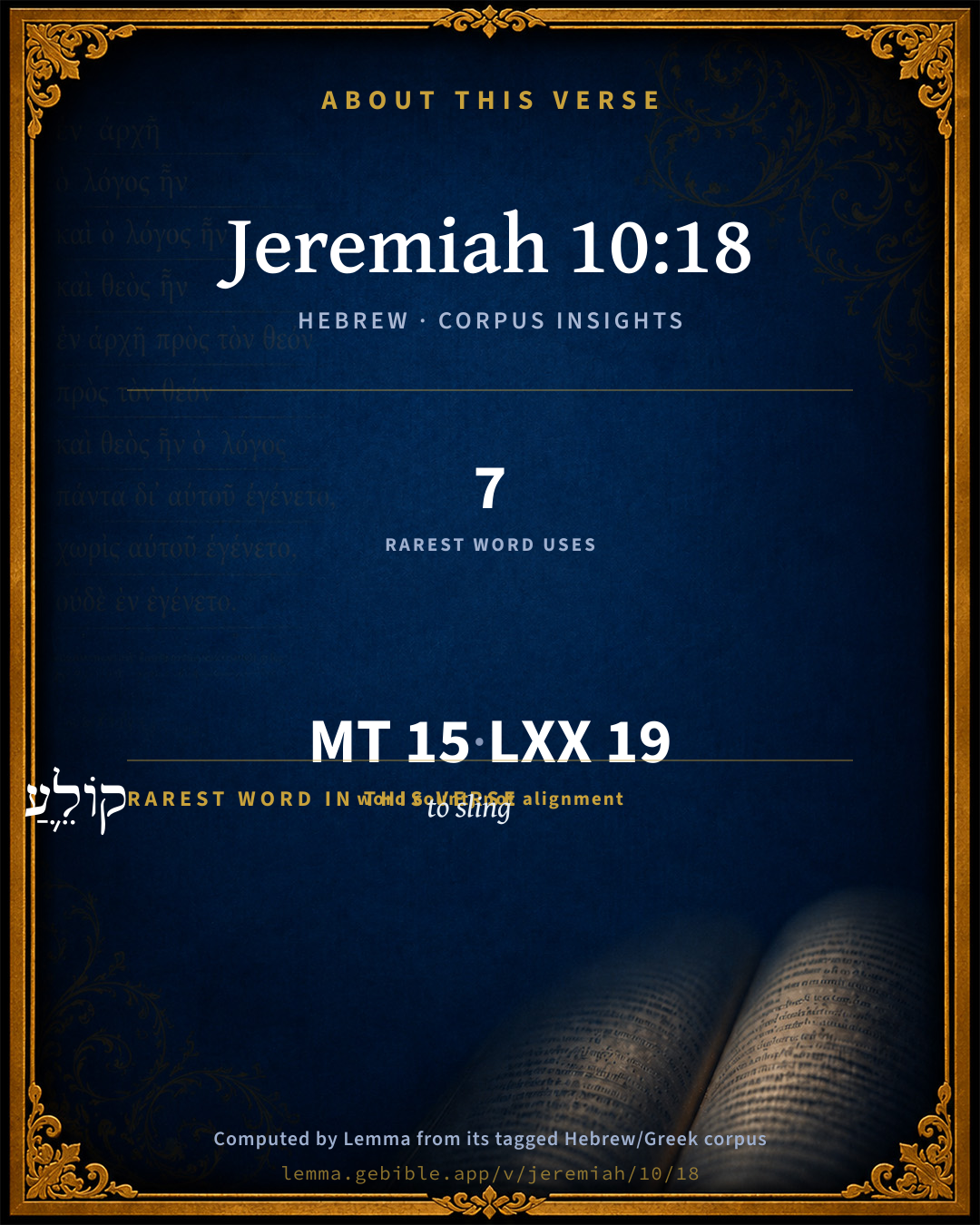
The rarest word here is קוֹלֵ֛עַ to sling H7049 — appearing just 7 times in the whole Hebrew Bible.

Shared distinctive vocabulary

קוֹלֵ֛עַ to sling H7049 occurs in 7 verses of the Hebrew Bible. Also found in:

Grammatical profile

  • 5 verbs
  • 3 nouns
  • 1 pronoun
  • 2 prepositions
  • 1 conjunction
  • 1 adverb
  • 2 particles

Verb forms

  • אָמַ֣ר Qal · Perfect
  • קוֹלֵ֛עַ Qal · Participle Active
  • יוֹשְׁבֵ֥י Qal · Participle Active
  • וַהֲצֵר֥וֹתִי Hiphil · Sequential Perfect
  • יִמְצָֽאוּ Qal · Imperfect

Hebrew & Septuagint length

In the original languages it is 15 Hebrew tokens and 19 Greek tokens — but the two are counted differently (Hebrew bundles its prefixes and suffixes into one token; the Greek is in lemma form), so that isn’t a like-for-like length.

Cross-references

7

Topical passages linked to Jeremiah 10:18 in the Treasury of Scripture Knowledge — connected by theme and wording, ordered by reader-vote popularity; previews shown in the World English Bible.

  • 1 Samuel 25:29 Though men be risen up to pursue you, and to seek your soul, yet the soul of my lord shall be bound in the bundle of life with Yahweh your God; and the souls of your enemies, them shall he sling out, as from the hollow of a sling.
  • Zechariah 1:6 But my words and my decrees, which I commanded my servants the prophets, didn't they overtake your fathers? "Then they repented and said, 'Just as Yahweh of Hosts determined to do to us, according to our ways, and according to our practices, so he has dealt with us.'"
  • Deuteronomy 28:63–64 It shall happen that as Yahweh rejoiced over you to do you good, and to multiply you, so Yahweh will rejoice over you to cause you to perish, and to destroy you; and you shall be plucked from off the land where you go in to possess it.
  • Jeremiah 15:1–2 Then said Yahweh to me, Though Moses and Samuel stood before me, yet my mind would not be toward this people: cast them out of my sight, and let them go forth.
  • Jeremiah 16:13 therefore will I cast you forth out of this land into the land that you have not known, neither you nor your fathers; and there shall you serve other gods day and night; for I will show you no favor.
  • Jeremiah 23:20 The anger of Yahweh shall not return, until he has executed, and until he have performed the intents of his heart: in the latter days you shall understand it perfectly.
  • Ezekiel 6:10 They shall know that I am Yahweh: I have not said in vain that I would do this evil to them.

Cross-references courtesy of OpenBible.info (CC BY 4.0).

Hebrew and Greek witnesses Masoretic Hebrew ↔ Greek Septuagint

The same verse in the two great witnesses to the Old Testament, shown verse-for-verse.

These are two independent witnesses, not word-aligned to each other, and the Septuagint is shown in lemma (dictionary) form.

Hebrew Jeremiah 10:18 Masoretic · Westminster Leningrad Codex

כִּֽי כֹה֙ אָמַ֣ר יְהוָ֔ה הִנְנִ֥י קוֹלֵ֛עַ אֶת יוֹשְׁבֵ֥י הָאָ֖רֶץ בַּפַּ֣עַם הַזֹּ֑את וַהֲצֵר֥וֹתִי לָהֶ֖ם לְמַ֥עַן יִמְצָֽאוּ

For thus says Yahweh, Behold, I will sling out the inhabitants of the land at this time, and will distress them, that they may feel [it].

World English Bible · Public Domain

Greek LXX Structure differs

In the Septuagint, Jeremiah is about an eighth shorter than the Hebrew and arranges its material differently — the Oracles Against the Nations (Hebrew chapters 46–51) appear in the middle of the Greek book, after 25:13. Because the chapter and verse boundaries do not line up, a verse-for-verse comparison with the Hebrew is not shown.

A verse-for-verse comparison isn’t shown here because the chapters and verses don’t line up. Switch to the LXX edition with the MT / LXX toggle above to read the Greek directly.

On this verse, John Gill's Exposition discusses the Septuagint’s reading. Read the note in Commentary ↓

Hebrew: Westminster Leningrad Codex (CC BY 4.0). Greek: Septuagint (public domain); English from a public-domain English Septuagint. How the Septuagint differs from the Hebrew →

Targum (Aramaic paraphrase)

1

The Targum is the ancient Jewish Aramaic paraphrase of the Hebrew Scriptures — an interpretive translation, not the Hebrew text itself. Onkelos (literal) and Pseudo-Jonathan (expansive) render the Torah, and Jonathan the Prophets. Coverage is partial: where no permissively-licensed English translation exists for a verse, only the Aramaic is shown. This is verse-level text, not a word-by-word alignment to the Hebrew.

  1. Targum Jonathan Prophets (Joshua–Malachi)
    אֲרֵי כִדְנַן אֲמַר יְיָ הָא אֲנָא מַיְתִי עָקָא עַל עַמָא הָדֵין וּכְמָה דְשָׁרָן אַבְנָא בְקִלְעָא כֵּן אֱבַדַר יַת יַתְבֵי אַרְעָא בְּזִמְנָא הָדָא וְאָעֵיק לְהוֹן בְדִיל דִיקַבְּלוּן פּוּרְעָנוּת חוֹבֵיהוֹן:

    (no public-domain English translation for this verse)

    Targum Jonathan — Aramaic: “Mikraot Gedolot” (public domain). English: “Sefaria Community Translation” (CC0 1.0 (public-domain dedication)); “London "Chaldee Paraphrase," 1871” (public domain). Text via Sefaria.

Commentary

Notes on Jeremiah 10:18 from classic Christian and Jewish commentators (each source and its license shown beneath its notes). The classic Christian expositions comment on the surrounding passage and are grouped to its opening verse, so a note may address several verses; the Jewish commentaries on the Tanakh (Rashi and others) are per-verse, so they appear only where the commentator wrote on this verse.

Lemma curates 59 commentaries, every one of them public domain or Creative Commons licensed, each selected and text-cleaned for this edition rather than reprinted as found. About our sources →

Trapp's Complete Commentary

John Trapp

Jer 10:18 For thus saith the LORD, Behold, I will sling out the inhabitants of the land at this once, and will distress them, that they may find [it so].

Ver. 18. BehoId, I will sling out the inhabitants of this land.] I will easily and speedily sling them, and sling them into Babylon; so God will one day hurl into hell all the wicked of the earth. {Psa 9:17}

And will distress them, that they may find it so.] Just so as they were foretold it would be, but they could never be drawn to believe it.

John Trapp, A Commentary or Exposition upon All the Books of the Old and New Testament (1647–1656) — public domain. Text from a community e-Sword module.

Jamieson, Fausset & Brown

Robert Jamieson, A. R. Fausset & David Brown

sling out--expressing the violence and suddenness of the removal to Babylon. A similar image occurs in Jer 16:13; Sa1 25:29; Isa 22:17-18.

at this once--at this time, now.

find it so--find it by experience, that is, feel it (Eze 6:10). MICHAELIS translates, "I will bind them together (as in a sling) that they may reach the goal" (Babylon). English Version is best: "that they may find it so as I have said" (Num 23:19; Eze 6:10).

Jamieson, Fausset & Brown — Commentary Critical and Explanatory on the Whole Bible (1871) — public domain (CC PDM 1.0). Text via the HelloAO Bible API.

Adam Clarke's Commentary

Verse 18. I will sling out the inhabitants of the land] I will project you with violence from your country. I will send you all into captivity. This discourse, from Jer 10:17, is supposed to have been delivered in the eleventh year of Jehoiakim.

Adam Clarke's Commentary on the Bible (1810–1826) — public domain. Text from a community e-Sword/MySword module.

John Calvin's Commentaries

Then follows the reason, For thus saith Jehovah, Behold, I will with a sling cast out the inhabitants of the land Land here is to be taken in another sense, even for the whole country. Wherever then the Jews dwelt, the Lord, says the Prophet, will draw them forth, yea, east them out as with a sling. We now then see that the vengeance which the Jews despised is denounced on them, because they remained securely in their own delusions; and what still more provoked God’s wrath, they regarded all that Jeremiah said of his judgment as a fable. But he compares their violent exile to slinging, and represents the Lord as the slinger. We know that when a sling is flung and a stone is cast, the motion is very violent. Such a casting away is then what God here threatens the people with, — that he would violently throw them here and there, like stones when cast by a sling.

And he says at this term or time, in order that the Jews might know that their calamity would be like a sudden storm. For they had often been subject to the assaults of enemies; but at one time they had delivered themselves, at another the Chaldeans and Assyrians had been constrained to turn aside to other quarters; or they had been miraculously delivered by God’s aid. They hoped that it would be the same always; and they thought also that by protracting the war they could disappoint their enemies, as they had often done; and further still, they expected aid from various quarters. Hence the Prophet says, that they would be so taken away, that God would at once cast them all out of the land, and east them out as it were in one day: at this time they, will I fling out the inhabitants of the land

Then he says, And I will straiten them. Some render the verb transitively, as it is in Hiphil, “I will cause them to be besieged by their enemies,” and then, “that their enemies may find them.” But this seems forced. Others more correctly give this explanation of the last clause, “that they may find,” that is, as true, what had been so often foretold them. For, as we have said, the Prophets and their threatenings had been despised, as the Jews had hardened themselves in their impiety: therefore this interpretation may be allowed. But I prefer a more general meaning, — that they may find, even what they had sought; for they had in many and various ways provoked the wrath of God: it was therefore right that they should at last find that which they had by their perverse doings procured for themselves, according to what is said in Isaiah 57:10,

“They shall find the fruit of their own ways.”

The Jews sought nothing less than the calamity which Jeremiah denounced on them: but they had really long sought it; for it was right that they should receive the wages due to their wickedness. Then it is, that they may find, that is, the reward of their own works. It follows —

John Calvin's Commentaries (1540-1563) — public domain. Text from the Calvin Translation Society English edition (1840s-50s) via the Christian Classics Ethereal Library (ccel.org). Calvin's coverage is partial (roughly two-thirds of the Bible); uncommented books and verses are honest gaps, never fabricated. The 19th-century editor's footnotes and remarks are omitted so the notes are faithfully Calvin's own voice.

Ellicott's Commentary for English Readers

(18) I will sling out.—The same bold metaphor, though not the same word, for violent expulsion, is found in the prophecy of the fate of Shebna (Isa_22:18).

That they may find it so.—In the Hebrew, the verb, though transitive, stands by itself, without an object. The ellipsis has been filled up either by “it,” as in the English Version, i.e., may feel it in all its bitterness; or by “me,” as in the Syriac version, i.e., may be led through their misery to seek and find Jehovah. The parallelism of Deu_4:29; Jer_29:13, makes the latter meaning probable (see also Act_17:27); but it may be suggested that the very omission of an object was intended to be suggestive in its abruptness. “They would find . . .;”what they found would depend upon themselves. A possible construction is that they (the enemy) may find them (the people besieged), but this is hardly the natural sequel of the exile of which the previous words speak.

A Bible Commentary for English Readers, edited by Charles John Ellicott (1878–1897) — public domain. Text from a community e-Sword module.

The Cambridge Bible for Schools and Colleges

gen. ed. J. J. S. Perowne

18. sling out] Cp. 1Sa_25:29; also Isa_22:18.

feel] See the mg. The clause is suspicious in form, the verb having no expressed object. It is just possible, but hardly likely, that it may be corrected (by a change of vocalisation) to “that they may be found,” i.e. that disaster may overtake them. But this is a very forced sense for the expression to bear.

The Cambridge Bible for Schools and Colleges (gen. ed. J. J. S. Perowne; Cambridge University Press, 1878–1918) — public domain. Text from a community e-Sword module.

John Gill's Exposition

For thus saith the Lord,.... This is a reason enforcing the exhortation in the preceding verse, and shows that the same people that are spoken of here are addressed there.

Behold, I will sling out the inhabitants of the land at this once; meaning the inhabitants of the land of Judea; or otherwise the prophet would never have expressed such a concern for them as he does in the following verse. Their captivity is signified by the slinging of a stone out of a sling, and shows how sudden, swift, and certain, it would be: and that it would as easily and swiftly be done, and with equal force and rapidity, as a stone is slung out of a sling; and that it would be done by the Lord himself, whoever were the instruments:

and will distress them; or "straiten" (z) them, on every side; it seems to intend the siege; or bring them into great straits and difficulties, through the pestilence, famine, sword, and captivity:

that they may find it; so as he had spoken by his prophets, it coming to pass exactly as they had foretold. The Targum is,

"that they may receive the punishment of their sins;''

and so the Septuagint and Arabic versions, "that thy stroke may be found"; but the Syriac version is very different from either, "that they may seek me and find"; which is an end that is sometimes answered by afflictive dispensations.

(z) "oblidere faciana eos", some in Vatablus; "et angustabo, vel obsidebo eos", Schmidt; "faciam ut obsideant eos", Calvin; "arctum ipsis facium", Cocceius.

John Gill's Exposition of the Whole Bible (1746–1763) — public domain (CC PDM 1.0). Text via the HelloAO Bible API.

Albert Barnes' Notes on the Bible

Sling out - A similar metaphor for violent ejection occurs in Isa 22:18 (see the note).

At this once - Or, “at this time.” Previous invasions had ended either in deliverance, or at most in temporary misfortune. God’s long-suffering is exhausted, and this time Judaea must cease to be an independent nation.

That they may find it so - Omit “so,” and explain either

(1) “I will distress them” with the rigors of a siege “that they may feel it, i. e., the distress; or,

(2) “that they may find” Me, God, that which alone is worth finding.

Albert Barnes' Notes on the Bible (1834–1885) — public domain. Text from a community e-Sword/MySword module.

Haydock's Catholic Bible Commentary

Found by the enemy. Hebrew also, "find" me, being taught by affliction, chap. xxix. 13. (Calmet) --- Entering into sentiments of penance, they shall say, Woe, &c. (Haydock)

George Leo Haydock (1774–1849), Haydock's Catholic Family Bible and Commentary, 1859 edition — public domain. Excludes Psalms (Douay-Rheims chapter numbering differs from Protestant) and Deuterocanonical books (Catholic canon only).

Matthew Poole's English Annotations

I will sling out; it notes with how much violence, and speed, and with ease the Chaldeans shall hurry away the people into Babylon, as the stone doth swiftly and violently pass which is thrown out of a sling, with so much ease, and therefore it is said at at this once; I will not delay, but make one thorough quick work of it; noting not only the time, but implying the clear riddance the he would make of them, 2Ch 36:17-19; they had been often assaulted by enemies, and sometimes they redeemed themselves, sometimes delivered by God, their enemies being sometimes divided; but it should not be so now, but all swept away. That they may find it so; that they may see I am in good earnest, that I have not only said it, but they shall find that I will execute it; and though they would never believe it, yet they shall actually find the truth of my threatenings. See Jer 5:12,13; Eze 6:10.

Matthew Poole's English Annotations on the Holy Bible (1683–1685) — public domain. Text from a community e-Sword/MySword module.

Whedon's Commentary on the Bible

Daniel D. Whedon

18. I will sling out — Compare Isa_22:17-18.

This once — Literally, this time; implying that in contrast with other and more partial judgments the grand catastrophe is hastening on.

That they may find it so — The meaning is doubtful, but this, on the whole, seems preferable. The word rendered distress means to press hard, to close in. The thought, then, is, I will press them hard, (as into a strait place.) that they may find them.

Daniel D. Whedon (gen. ed.), Commentary on the Old and New Testaments (1874–1909) — public domain. Text from a community e-Sword module.

The Pulpit Commentary

I will sling out; a forcible image, to express the violence of the expulsion; comp. Isa_22:17, 18 (Ver. 17 needs correcting). At this once; rather, at this time. (comp. Jer_16:21) Invasion was no novelty to the Jews, but had hitherto merely produced loss of goods rather than of personal liberty. That they may find it so; better, that they may feel it. Others supply as. the subject "Jehovah," comparing Psa_32:6, "In a time of finding (Authorized Version, "When thou mayest be found"). Jeremiah himself says, "Ye shall seek me, and shall find, when ye shall search for me with all your heart". (Jer_29:13 Deu_4:29) Still, these passages are hardly quite parallel, as the object of the verb can be easily supplied from the connection. The Vulgate apparently reads the text with different vowels, for it renders ut inveniantur; the Septuagint has "that thy stroke may be found."

The Pulpit Commentary (1880–1919), ed. H.D.M. Spence-Jones & Joseph S. Exell — public domain. Text from a community e-Sword module.

John Wesley's Explanatory Notes

Sing out - It denotes with how much violence and ease the Chaldeans shall hurry away the people into Babylon. And therefore it is said at this once, I will make one thorough quick work of it. May find it so - Though they would never believe it, yet they shall actually find the truth of my threatenings.

John Wesley, Explanatory Notes Upon the Whole Bible (1754–1765) — public domain. Text via the GEBible commentary corpus.

Rashi

Rabbi Shlomo Yitzchaki (Rashi)

sling as one slings a stone with a slingshot.

that they may find their just deserts.

Rashi on the Tanakh — English translations: “The Judaica Press complete Tanach with Rashi, translated by A. J. Rosenberg” (CC BY 4.0); “Pentateuch with Rashi's commentary by M. Rosenbaum and A.M. Silbermann, 1929-1934” (public domain); “The Metsudah Tanach series, Lakewood, N.J” (CC BY 4.0); and “The Book of Joshua, Metsudah Publications, 1997” (CC BY 4.0). Text via Sefaria.

Lesson kit

Teaching starters — assembled from the data on this page, not authored interpretation. Every prompt links to the verse data it draws on. Edit before teaching.

Jeremiah, in the Prophets, opens this verse with 15 words (14 distinct Hebrew lemmas). Its most distinctive word is qâlaʻ (“to sling”). A historical commentator’s framing appears above. Read the whole chapter for the surrounding context.

Discussion questions

  1. The word qâlaʻ carries the sense “to sling.” How does it shape the verse?
  2. How does Judges 20:16, which shares the word «to sling», read alongside this verse?
  3. These translations render this verse differently; the difference is in the English rendering, not the original. What questions does that raise?
  4. «אָמַ֣ר» is a Qal Perfect verb. How does that grammatical form shape the action described?
  5. Compare how Trapp's Complete Commentary and Jamieson, Fausset & Brown read this verse. Where do they agree or differ?

Things to notice

Reading settings

Reading text

Shown beneath each verse's original-language words.

Old Testament
Old Testament edition

Read the OT as the Masoretic Hebrew (MT) or the Greek Septuagint (LXX).

English shown for the Greek Septuagint (in the Hebrew ↔ Greek comparison).

Comparing translations? Open the Compare panel on any verse page to stack up to four side by side.