
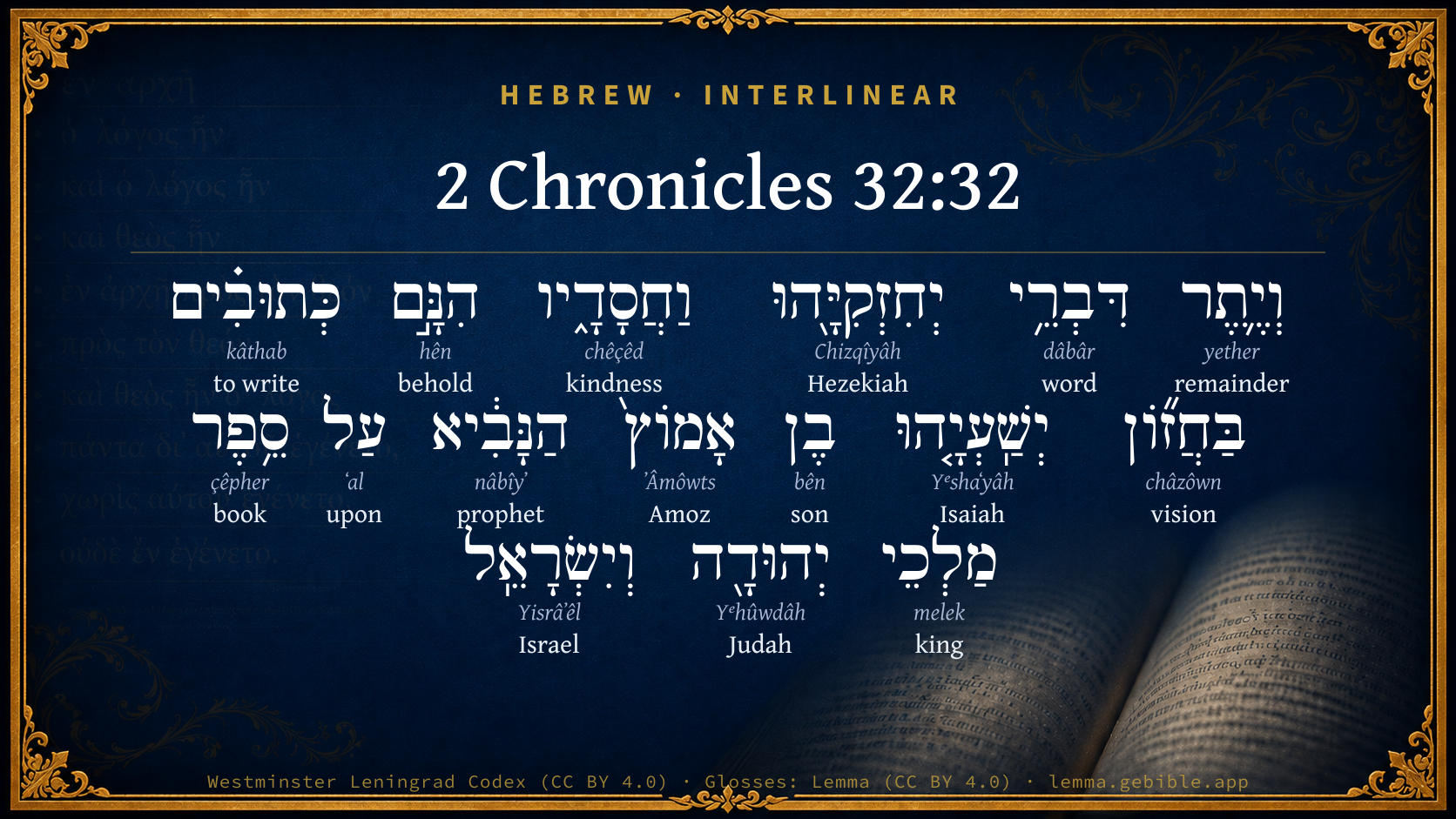
2 Chronicles 32:32

Hebrew (Westminster Leningrad Codex) 2 Chronicles 32:32 appears in the Hebrew Old Testament. The text above is from the Westminster Leningrad Codex. Each word links to its Strong’s number, a concise gloss, and parsing drawn from the Open Scriptures Hebrew Bible morphology. Click any word for its full Brown-Driver-Briggs (BDB) entry.
Download image
Cite this verse

2 Chronicles 32:32 (World English Bible). Public Domain. Lemma interlinear Bible study tool, https://lemma.gebible.app/v/2-chronicles/32/32.

Show BibTeX & RIS
BibTeX
RIS
English Translation
Now the rest of the acts of Hezekiah, and his good deeds, behold, they are written in the vision of Isaiah the prophet the son of Amoz, in the book of the kings of Judah and Israel.
World English Bible · Public Domain
Download a study sheet

One document with this verse’s original text, its word-by-word gloss line, the meaning frame, cross-references with their text, attributed commentary, and full source and license credits — printable, and it pastes into notes with its structure intact.

This verse Autodidact and up

Study sheet (.html) Plain text (.txt)

A passage Seminary Student

Up to 50 verses in one chapter. A passage sheet keeps up to 6 commentary sources and 12 cross-references per verse, in the order this page ranks them, and says so on the sheet whenever that leaves anything out. Ask for a single verse and you get the Autodidact verse sheet above.

Everything on this page stays free to read, with no account — the sheet is a download of what is already on screen, not access to it.

Want to remove ads? Support Godless Engineer
Compare translations 3

The same verse in 3 English versions, stacked beneath the original-language interlinear above. Click any original word for its lexicon entry.

Each is an independent rendering of the whole verse — the interlinear is not word-aligned to these translations.

Highlighted words mark where these versions differ — a whole-verse word diff, not a word-by-word alignment.

  • World English Bible Public Domain
    Now the rest of the acts of Hezekiah, and his good deeds, behold, they are written in the vision of Isaiah the prophet the son of Amoz, in the book of the kings of Judah and Israel.
  • King James Version Public Domain
    Now the rest of the acts of Hezekiah, and his goodness, behold, they are written in the vision of Isaiah the prophet, the son of Amoz, and in the book of the kings of Judah and Israel.
  • unfoldingWord Literal Text CC BY-SA 4.0
    And the remainder of the matters of Hezekiah, and his covenant faithfulnesses, behold, they are written in the vision of Isaiah, the son of Amoz, the prophet, on the scroll of the kings of Judah and Israel.

unfoldingWord Literal Text — © unfoldingWord, licensed CC BY-SA 4.0. Word-aligned USFM3 via Door43 (git.door43.org/unfoldingWord/en_ult).

Versions to compare (up to 4)

3 of 4 selected

Show all 18 translations

Every available English version of this verse, each an independent rendering of the whole verse.

  • World English Bible Public Domain
    Now the rest of the acts of Hezekiah, and his good deeds, behold, they are written in the vision of Isaiah the prophet the son of Amoz, in the book of the kings of Judah and Israel.
  • Berean Standard Bible Public Domain
    As for the rest of the acts of Hezekiah and his deeds of loving devotion, they are indeed written in the vision of the prophet Isaiah son of Amoz in the Book of the Kings of Judah and Israel.
  • Majority Standard Bible Public Domain
    As for the rest of the acts of Hezekiah and his deeds of loving devotion, they are indeed written in the vision of the prophet Isaiah son of Amoz in the Book of the Kings of Judah and Israel.
  • King James Version Public Domain
    Now the rest of the acts of Hezekiah, and his goodness, behold, they are written in the vision of Isaiah the prophet, the son of Amoz, and in the book of the kings of Judah and Israel.
  • American Standard Version (1901) Public Domain
    Now the rest of the acts of Hezekiah, and his good deeds, behold, they are written in the vision of Isaiah the prophet the son of Amoz, in the book of the kings of Judah and Israel.
  • Revised Version (1885) Public Domain
    Now the rest of the acts of Hezekiah, and his good deeds, behold, they are written in the vision of Isaiah the prophet the son of Amoz, in the book of the kings of Judah and Israel.
  • Geneva Bible (1599) Public Domain
    Concerning the rest of the actes of Hezekiah, and his goodnesse, beholde, they are written in the vision of Ishiah the Prophet, the sonne of Amoz, in the booke of the Kings of Iudah and Israel.
  • Douay-Rheims (1899) Public Domain
    Now the rest of the acts of Ezechias, and of his mercies are written in the book of the kings of Juda and Israel.
  • Young's Literal Translation Public Domain
    And the rest of the matters of Hezekiah, and his kind acts, lo, they are written in the vision of Isaiah son of Amoz the prophet, on the book of the kings of Judah and Israel.
  • Literal Standard Version CC BY-SA 4.0
    And the rest of the matters of Hezekiah and his kind acts, behold, they are written in the vision of Isaiah son of Amoz the prophet, on the scroll of the kings of Judah and Israel.
  • Unlocked Literal Bible CC BY-SA 4.0
    As for the other matters concerning Hezekiah, including his actions of covenant loyalty, you can see that they are written in the vision of the prophet Isaiah son of Amoz, and in the book of the kings of Judah and Israel.
  • unfoldingWord Literal Text CC BY-SA 4.0
    And the remainder of the matters of Hezekiah, and his covenant faithfulnesses, behold, they are written in the vision of Isaiah, the son of Amoz, the prophet, on the scroll of the kings of Judah and Israel.
  • Darby Bible Public Domain
    And the rest of the acts of Hezekiah and his good deeds, behold, they are written in the vision of the prophet Isaiah the son of Amoz in the book of the kings of Judah and Israel.
  • World Messianic Bible Public Domain
    Now the rest of the acts of Hezekiah and his good deeds, behold, they are written in the vision of Isaiah the prophet, the son of Amoz, in the book of the kings of Judah and Israel.
  • Webster's Bible Public Domain
    Now the rest of the acts of Hezekiah, and his goodness, behold, they are written in the vision of Isaiah the prophet, the son of Amoz, and in the book of the kings of Judah and Israel.
  • Free Bible Version CC BY-SA 4.0
    The rest of what Hezekiah did, including his acts of loyalty, are recorded in the vision of the prophet Isaiah, son of Amoz, in the Book of the Kings of Judah and Israel.
  • Bible in Basic English Public Domain
    Now the rest of the acts of Hezekiah, and the good he did, are recorded in the vision of Isaiah the prophet, the son of Amoz, and in the book of the kings of Judah and Israel.
  • JPS Tanakh (1917) Public Domain
    Now the rest of the acts of Hezekiah, and his good deeds, behold, they are written in the vision of Isaiah the prophet the son of Amoz, and in the book of the kings of Judah and Israel.

Literal Standard Version (2020), Covenant Press — licensed CC BY-SA 4.0. Text via the HelloAO Bible API (eBible.org). Unlocked Literal Bible (unfoldingWord) — licensed CC BY-SA 4.0. Text via the HelloAO Bible API (eBible.org). unfoldingWord Literal Text — © unfoldingWord, licensed CC BY-SA 4.0. Word-aligned USFM3 via Door43 (git.door43.org/unfoldingWord/en_ult). Free Bible Version, Dr. Jonathan Gallagher — licensed CC BY-SA 4.0. Text via the HelloAO Bible API (eBible.org).

Word by word

More ways to search: Search by grammar → Find every occurrence → Compare this word →

Practice this passage: Drill this verse → Learn its vocabulary →

אָמוֹץ֙
ʼÂmôwts
H531
“Amoz”
Noun, Proper
Part of Speech
Noun
Type
Proper
Full BDB Definition

Origin: from H553

TWOT: None

Amoz = "strong" - father of Isaiah
  1. וְיֶ֛תֶר yether H3499 “and · remainder of” Conjunction + Noun, Common, Masculine, Singular, Construct
  2. דִּבְרֵ֥י dâbâr H1697 “words of” Noun, Common, Masculine, Plural, Construct
  3. יְחִזְקִיָּ֖הוּ Chizqîyâh H2396 “Hezekiah” Noun, Proper
  4. וַחֲסָדָ֑יו chêçêd H2617 “and · kindnesses · his” Conjunction + Noun, Common, Masculine, Plural, Construct + Suffix, Personal, 3rd Person, Masculine, Singular
  5. הִנָּ֣ם hên H2005 “behold · them” Particle, Demonstrative + Suffix, Personal, 3rd Person, Masculine, Plural
  6. כְּתוּבִ֗ים kâthab H3789 “written” Verb, Qal, Participle Passive, Masculine, Plural, Absolute
  7. בַּחֲז֞וֹן châzôwn H2377 “in/at · vision of” Preposition + Noun, Common, Masculine, Singular, Construct
  8. יְשַֽׁעְיָ֤הוּ Yᵉshaʻyâh H3470 “Isaiah” Noun, Proper
  9. בֶן bên H1121 “son of” Noun, Common, Masculine, Singular, Construct
  10. הַנָּבִ֔יא nâbîyʼ H5030 “the · prophet” Particle, Definite Article + Noun, Common, Masculine, Singular, Absolute
  11. עַל ʻal H5921 “upon” Preposition
  12. סֵ֥פֶר çêpher H5612 “book of” Noun, Common, Masculine, Singular, Construct
  13. מַלְכֵי melek H4428 “kings of” Noun, Common, Masculine, Plural, Construct
  14. יְהוּדָ֖ה Yᵉhûwdâh H3063 “Judah” Noun, Proper
  15. וְיִשְׂרָאֵֽל Yisrâʼêl H3478 “and · Israel” Conjunction + Noun, Proper

About this verse

These counts appear in no published source. They are computed here, from the morphology-tagged text and Lemma’s own curated glosses. What Lemma adds →

16
words
16
distinct lemmas
Historical
section

Notable vocabulary

The rarest word here is אָמוֹץ֙ Amoz H531 — appearing just 13 times in the whole Hebrew Bible.

Shared distinctive vocabulary

אָמוֹץ֙ Amoz H531 occurs in 13 verses of the Hebrew Bible. Also found in:

Grammatical profile

  • 1 verb
  • 13 nouns
  • 1 preposition
  • 1 particle

Verb forms

  • כְּתוּבִ֗ים Qal · Participle Passive

Hebrew & Septuagint length

In English translation the verse runs 37 words from the Hebrew and 37 from the Septuagint (LXX English) — the same length.

A rough comparison of the two English renderings, which tokenize alike — not a word-level alignment.

Word counts can differ between the Hebrew and the Greek without any difference in meaning — e.g. the Hebrew direct-object marker אֵת has no separate Greek word, and Greek often adds the article ὁ.

In the original languages it is 16 Hebrew tokens and 27 Greek tokens — but the two are counted differently (Hebrew bundles its prefixes and suffixes into one token; the Greek is in lemma form), so that isn’t a like-for-like length.

Cross-references

3

Topical passages linked to 2 Chronicles 32:32 in the Treasury of Scripture Knowledge — connected by theme and wording, ordered by reader-vote popularity; previews shown in the World English Bible.

  • 2 Kings 18:1–20 Now it happened in the third year of Hoshea son of Elah king of Israel, that Hezekiah the son of Ahaz king of Judah began to reign.
  • Isaiah 36:1–22 Now it happened in the fourteenth year of king Hezekiah, that Sennacherib king of Assyria came up against all the fortified cities of Judah, and took them.
  • 2 Chronicles 31:20–21 Thus did Hezekiah throughout all Judah; and he worked that which was good and right and faithful before Yahweh his God.

Cross-references courtesy of OpenBible.info (CC BY 4.0).

Hebrew and Greek witnesses Masoretic Hebrew ↔ Greek Septuagint

The same verse in the two great witnesses to the Old Testament, shown verse-for-verse.

These are two independent witnesses, not word-aligned to each other, and the Septuagint is shown in lemma (dictionary) form.

Hebrew 2 Chronicles 32:32 Masoretic · Westminster Leningrad Codex

וְיֶ֛תֶר דִּבְרֵ֥י יְחִזְקִיָּ֖הוּ וַחֲסָדָ֑יו הִנָּ֣ם כְּתוּבִ֗ים בַּחֲז֞וֹן יְשַֽׁעְיָ֤הוּ בֶן אָמוֹץ֙ הַנָּבִ֔יא עַל סֵ֥פֶר מַלְכֵי יְהוּדָ֖ה וְיִשְׂרָאֵֽל

Now the rest of the acts of Hezekiah, and his good deeds, behold, they are written in the vision of Isaiah the prophet the son of Amoz, in the book of the kings of Judah and Israel.

World English Bible · Public Domain

Greek LXX 2 Chronicles 32:32 Septuagint · lemma form

καί ὁ κατάλοιπος ὁ λόγος εζεκιας καί ὁ ἔλεος αὐτός ἰδού γράφω ἐν ὁ προφητεία ησαιας υἱός αμως ὁ προφήτης καί ἐπί βιβλίον βασιλεύς ἰουδά καί ἰσραήλ

And the rest of the acts of Ezekias, and his kindness, behold, they are written in the prophecy of Esaias the son of Amos the prophet, and in the book of the kings of Juda and Israel.

LXX2012 (modern English Septuagint) · Public Domain

Hebrew: Westminster Leningrad Codex (CC BY 4.0). Greek: Septuagint (public domain); English from LXX2012 (modern English Septuagint) (Public Domain). How the Septuagint differs from the Hebrew →

Commentary

Notes on 2 Chronicles 32:32 from classic Christian and Jewish commentators (each source and its license shown beneath its notes). The classic Christian expositions comment on the surrounding passage and are grouped to its opening verse, so a note may address several verses; the Jewish commentaries on the Tanakh (Rashi and others) are per-verse, so they appear only where the commentator wrote on this verse.

Lemma curates 59 commentaries, every one of them public domain or Creative Commons licensed, each selected and text-cleaned for this edition rather than reprinted as found. About our sources →

Trapp's Complete Commentary

John Trapp

2Ch 32:32 Now the rest of the acts of Hezekiah, and his goodness, behold, they [are] written in the vision of Isaiah the prophet, the son of Amoz, [and] in the book of the kings of Judah and Israel.

Ver. 32. And his goodness.] Heb., His kindnesses; viz., to God’s people in supplying themwith sacrifices, and setting up the sincere service of God.

In the book of the kings.] Either those now extant, or those larger, long since lost, and out of which these chronicles seem to have been compiled.

John Trapp, A Commentary or Exposition upon All the Books of the Old and New Testament (1647–1656) — public domain. Text from a community e-Sword module.

The Biblical Illustrator

Joseph S. Exell

2Ch_32:32-33

Now the rest of the acts of Hezekiah, and his goodness.

Hezekiahs goodness

I. The genuine goodness shall not want appropriate record and remembrance.

1. God, the inspirer of goodness in the hearts of men, will not forget it.

2. The beneficiaries of goodness will not be unmindful of their benefactors.

3. Sympathetic imitators will mirror forth their goodness, from whom they have derived its idea and impulse. Christian philanthropists like John Howard and Elizabeth Fry are living over again in their practical admirers and copyists.

II. The seasons selected by God for such recognition are often sober and sorrowful.

1. Public calamity. Sennacheribs invasion.

2. Personal affliction. Hezekiahs sickness.

3. Death. Hezekiahs burial. Blessed are the dead. (J. Spencer Hill.)

Goodness of heart

The wind is unseen, but it cools the brow of the fevered one, sweetens the summer atmosphere, and ripples the surface of the lake into silver spangles of beauty. So goodness of heart, though invisible to the material eye, makes its presence felt; and from its effects upon surrounding things we are assured of its existence. And they buried him in the chiefast of the sepulchres of the sons of David.

The life and character of Hezekiah

A very wise and salutary custom prevailed among the ancient Egyptians; that of sitting in judgment upon the life and character of a man after his death, that, according as he had been deserving or undeserving, honourable burial might be granted to him or denied. The Jews appear to have brought something like the same custom out of Egypt, and to have acted upon it in the ease of their wicked kings (1Ki_14:13; 2Ki_9:10; Jer_22:18; Isa_14:19). Hence a burial specially mentioned in the Scriptures signifies honour, approbation, and affectionate remembrance, more distinctly than among us. The funeral of Hezekiah is the proper place for a review of his life and character. Consider--

I. His public zeal for worship of God and the good of his people.

II. The peculiar troubles with which he was exercised.

III. The remarkable deliverances which he experienced.

IV. The singular circumstances under which he passed his closing years.

V. The excellences and defects of his religious character and conduct. (Daniel Katterns.)

.

The Biblical Illustrator, edited by Joseph S. Exell (c. 1880s–1900s) — public domain. Text from a community e-Sword module.

Adam Clarke's Commentary

Verse 32. The vision of Isaiah] See this prophet, chap. 36 to 39.

Adam Clarke's Commentary on the Bible (1810–1826) — public domain. Text from a community e-Sword/MySword module.

Ellicott's Commentary for English Readers

(32) Now the rest of the acts.—See 2Ki_20:20-21.

And his goodness.—His good deeds. So 2Ch_35:26 (Josiah); Neh_13:14.

And in the book of the kings.—Omit and. The “vision of Isaiah” is referred to as a section of the “book of the kings of Judah and Israel.” (See Introduction.) Kings l.c. says, “are they not written in the book of the chronicles of the Kings of Judah?”

A Bible Commentary for English Readers, edited by Charles John Ellicott (1878–1897) — public domain. Text from a community e-Sword module.

The Cambridge Bible for Schools and Colleges

gen. ed. J. J. S. Perowne

32. his goodness] R.V. his good deeds. Cp. 2Ch_35:26 (of Josiah); Neh_13:14 (of Nehemiah).

and in the book] R.V. omits and, the meaning of the Chronicler being that the vision of Isaiah is contained in the Book of Kings.

The Cambridge Bible for Schools and Colleges (gen. ed. J. J. S. Perowne; Cambridge University Press, 1878–1918) — public domain. Text from a community e-Sword module.

Albert Barnes' Notes on the Bible

And in the book - The “and” is not in the original. The meaning is, that the acts were recorded in the prophecy of Isaiah, which formed a part of the compilation known as “the Book of the Kings of Judah and Israel.” See Introduction.

Albert Barnes' Notes on the Bible (1834–1885) — public domain. Text from a community e-Sword/MySword module.

The Pulpit Commentary

In the vision of Isaiah. (so Isa_1:1)

The Pulpit Commentary (1880–1919), ed. H.D.M. Spence-Jones & Joseph S. Exell — public domain. Text from a community e-Sword module.

unfoldingWord translationNotes

Door43 World Missions Community

Hezekiah slept with his ancestors

This was a polite way to tell about him dying. See how you translated this in 2 Chronicles 9:31. AT: "Hezekiah died" (See: Euphemism)

translationWords

covenant faithfulness

written

vision

prophet

Isaiah

bury

grave

descend

die

Manasseh

unfoldingWord translationNotes — © Distant Shores Media and the Door43 World Missions Community, licensed CC BY-SA 4.0. Source: git.door43.org/Door43/en_tn.

Lesson kit

Teaching starters — assembled from the data on this page, not authored interpretation. Every prompt links to the verse data it draws on. Edit before teaching.

2 Chronicles, in the Historical, opens this verse with 16 words (16 distinct Hebrew lemmas). Its most distinctive word is ʼÂmôwts (“Amoz”). A historical commentator’s framing appears above. Read the whole chapter for the surrounding context.

Discussion questions

  1. What does “Amoz” (ʼÂmôwts) contribute to the verse as a whole?
  2. 2 Kings 19:2 shares the word «Amoz» with this verse. How do the two illuminate each other?
  3. These translations render this verse differently; the difference is in the English rendering, not the original. What questions does that raise?
  4. The verb «כְּתוּבִ֗ים» is Qal Participle Passive. How does its form color the action?
  5. Reading how Trapp's Complete Commentary and The Biblical Illustrator read this verse, where do the two commentators agree and where do they part?

Things to notice

Reading settings

Reading text

Shown beneath each verse's original-language words.

Old Testament
Old Testament edition

Read the OT as the Masoretic Hebrew (MT) or the Greek Septuagint (LXX).

English shown for the Greek Septuagint (in the Hebrew ↔ Greek comparison).

Comparing translations? Open the Compare panel on any verse page to stack up to four side by side.