Isaiah 40:15

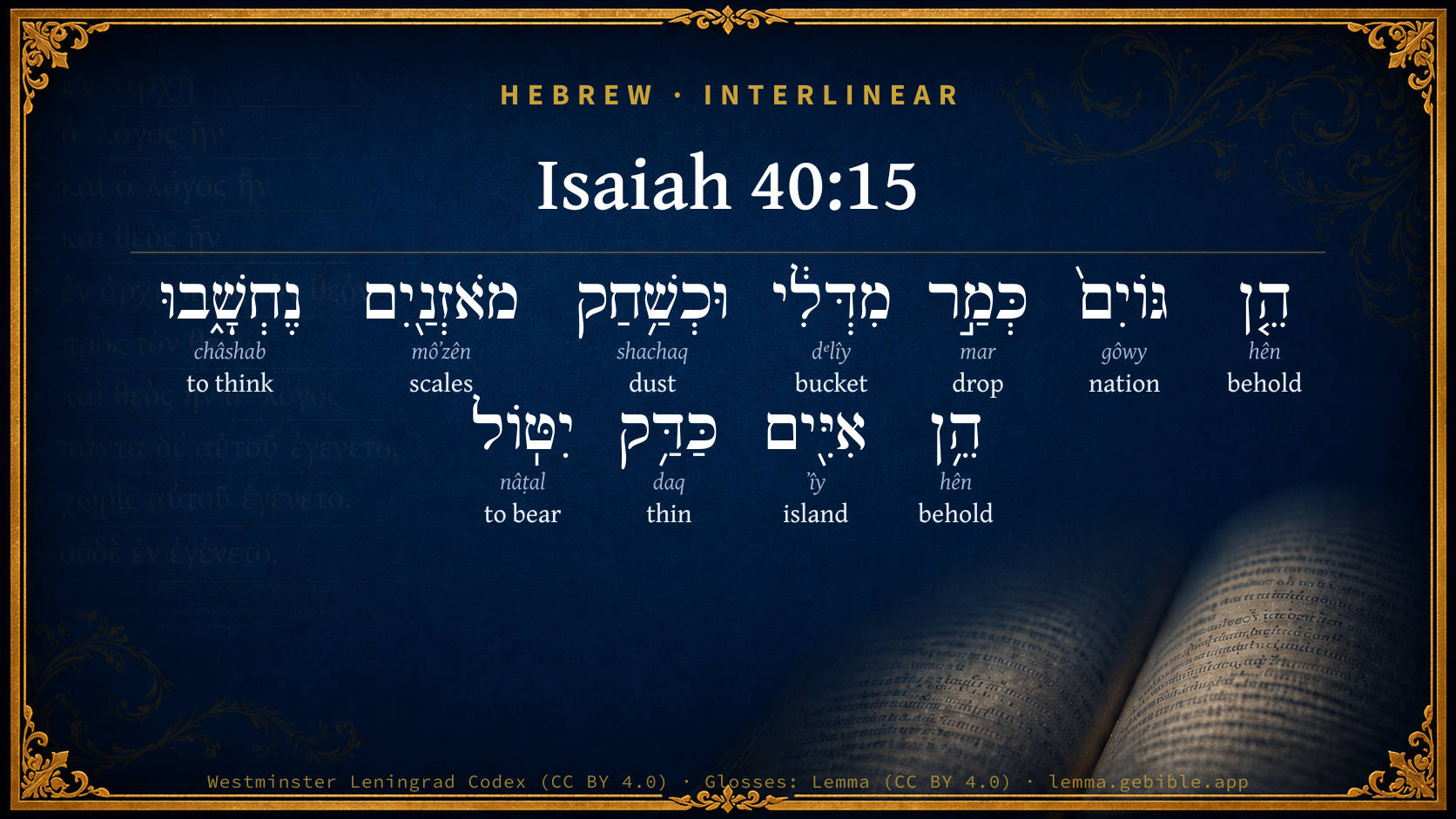
Hebrew (Westminster Leningrad Codex) Isaiah 40:15 appears in the Hebrew Old Testament. The text above is from the Westminster Leningrad Codex. Each word links to its Strong’s number, a concise gloss, and parsing drawn from the Open Scriptures Hebrew Bible morphology. Click any word for its full Brown-Driver-Briggs (BDB) entry.
Download image
Cite this verse

Isaiah 40:15 (World English Bible). Public Domain. Lemma interlinear Bible study tool, https://lemma.gebible.app/v/isaiah/40/15.

Show BibTeX & RIS
BibTeX
RIS
English Translation
Behold, the nations are as a drop of a bucket, and are accounted as the small dust of the balance: Behold, he takes up the isles as a very little thing.
World English Bible · Public Domain
Highlights
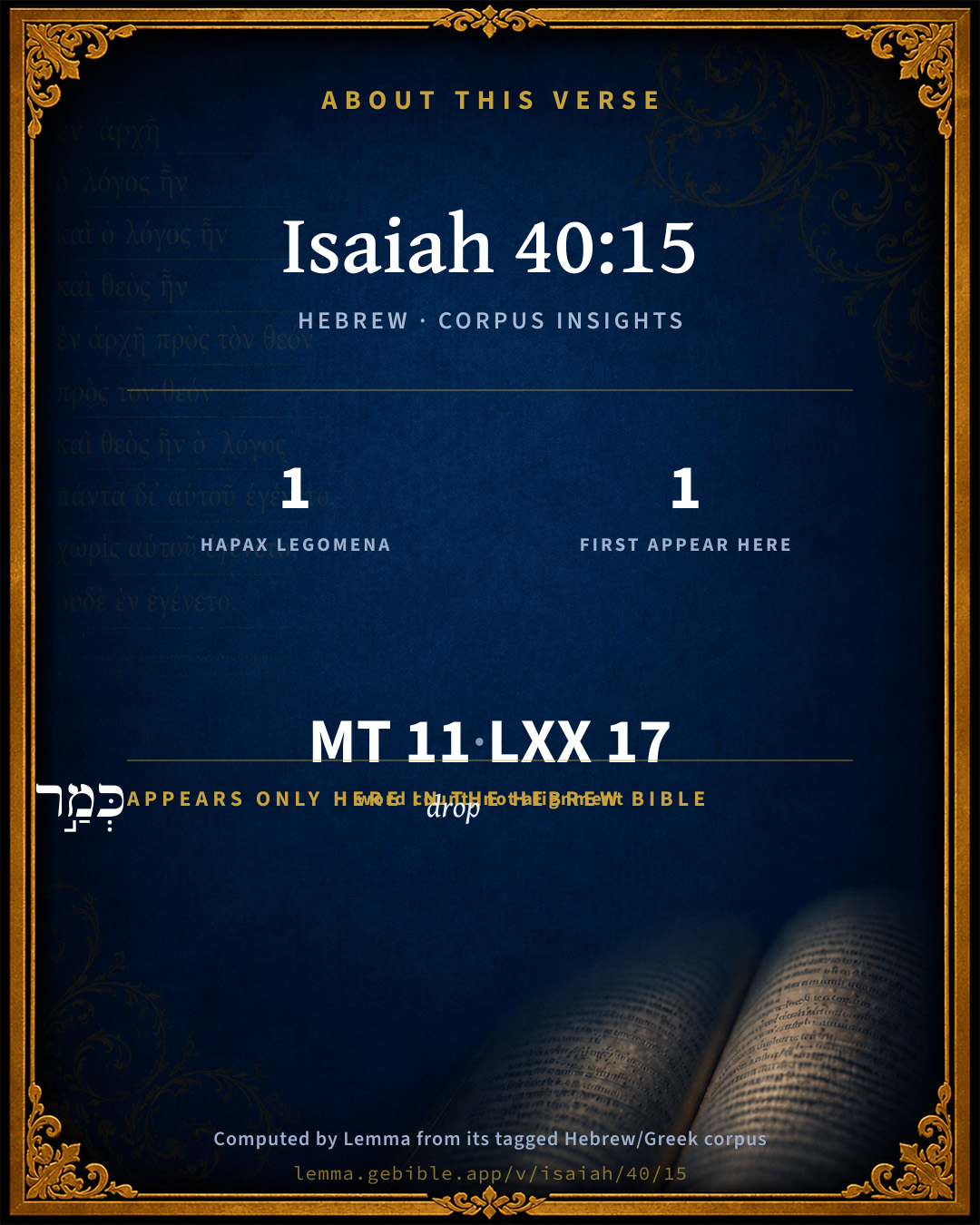
  • 1 hapax legomenon — only here in the Hebrew Bible
  • 1 first appearance in the Hebrew Bible
Full analysis ↓
Download a study sheet

One document with this verse’s original text, its word-by-word gloss line, the meaning frame, cross-references with their text, attributed commentary, and full source and license credits — printable, and it pastes into notes with its structure intact.

This verse Autodidact and up

Study sheet (.html) Plain text (.txt)

A passage Seminary Student

Up to 50 verses in one chapter. A passage sheet keeps up to 6 commentary sources and 12 cross-references per verse, in the order this page ranks them, and says so on the sheet whenever that leaves anything out. Ask for a single verse and you get the Autodidact verse sheet above.

Everything on this page stays free to read, with no account — the sheet is a download of what is already on screen, not access to it.

Want to remove ads? Support Godless Engineer
Compare translations 3

The same verse in 3 English versions, stacked beneath the original-language interlinear above. Click any original word for its lexicon entry.

Each is an independent rendering of the whole verse — the interlinear is not word-aligned to these translations.

Highlighted words mark where these versions differ — a whole-verse word diff, not a word-by-word alignment.

  • World English Bible Public Domain
    Behold, the nations are as a drop of a bucket, and are accounted as the small dust of the balance: Behold, he takes up the isles as a very little thing.
  • King James Version Public Domain
    Behold, the nations are as a drop of a bucket, and are counted as the small dust of the balance: behold, he taketh up the isles as a very little thing.
  • unfoldingWord Literal Text CC BY-SA 4.0
    Behold, the nations like a drop from a bucket, and they are regarded like dust on the scales. Behold, he lifts the coastlands like fine dust.

unfoldingWord Literal Text — © unfoldingWord, licensed CC BY-SA 4.0. Word-aligned USFM3 via Door43 (git.door43.org/unfoldingWord/en_ult).

Versions to compare (up to 4)

3 of 4 selected

Show all 18 translations

Every available English version of this verse, each an independent rendering of the whole verse.

  • World English Bible Public Domain
    Behold, the nations are as a drop of a bucket, and are accounted as the small dust of the balance: Behold, he takes up the isles as a very little thing.
  • Berean Standard Bible Public Domain
    Surely the nations are like a drop in a bucket; they are considered a speck of dust on the scales; He lifts up the islands like fine dust.
  • Majority Standard Bible Public Domain
    Surely the nations are like a drop in a bucket; they are considered a speck of dust on the scales; He lifts up the islands like fine dust.
  • King James Version Public Domain
    Behold, the nations are as a drop of a bucket, and are counted as the small dust of the balance: behold, he taketh up the isles as a very little thing.
  • American Standard Version (1901) Public Domain
    Behold, the nations are as a drop of a bucket, and are accounted as the small dust of the balance: Behold, he taketh up the isles as a very little thing.
  • Revised Version (1885) Public Domain
    Behold, the nations are as a drop of a bucket, and are counted as the small dust of the balance: behold, he taketh up the isles as a very little thing.
  • Geneva Bible (1599) Public Domain
    Beholde, the nations are as a drop of a bucket, and are counted as the dust of the balance: beholde, he taketh away the yles as a litle dust.
  • Douay-Rheims (1899) Public Domain
    Behold the Gentiles are as a drop of a bucket, and are counted as the smallest grain of a balance: behold the islands are as a little dust.
  • Young's Literal Translation Public Domain
    Lo, nations as a drop from a bucket, And as small dust of the balance, have been reckoned, Lo, isles as a small thing He taketh up.
  • Literal Standard Version CC BY-SA 4.0
    Behold, nations [are] as a drop from a bucket, || And have been reckoned as small dust of the balance, || Behold, He takes up islands as a small thing.
  • Unlocked Literal Bible CC BY-SA 4.0
    Look, the nations are like a drop in a bucket, and are regarded like the dust on the scales; see, he weighs the isles as a speck.
  • unfoldingWord Literal Text CC BY-SA 4.0
    Behold, the nations like a drop from a bucket, and they are regarded like dust on the scales. Behold, he lifts the coastlands like fine dust.
  • Darby Bible Public Domain
    Behold, the nations are esteemed as a drop of the bucket, and as the fine dust on the scales; behold, he taketh up the isles as an atom.
  • World Messianic Bible Public Domain
    Behold, the nations are like a drop in a bucket, and are regarded as a speck of dust on a balance. Behold, he lifts up the islands like a very little thing.
  • Webster's Bible Public Domain
    Behold, the nations are as a drop of a bucket, and are counted as the small dust of the balance: behold, he taketh up the isles as a very little thing.
  • Free Bible Version CC BY-SA 4.0
    It's obvious that the nations are just a drop in a bucket. They're like dust on a set of scales. He can pick up islands as if they weigh next to nothing.
  • Bible in Basic English Public Domain
    See, the nations are to him like a drop hanging from a bucket, and like the small dust in the scales: he takes up the islands like small dust.
  • JPS Tanakh (1917) Public Domain
    Behold, the nations are as a drop of a bucket, and are counted as the small dust of the balance; behold the isles are as a mote in weight.

Literal Standard Version (2020), Covenant Press — licensed CC BY-SA 4.0. Text via the HelloAO Bible API (eBible.org). Unlocked Literal Bible (unfoldingWord) — licensed CC BY-SA 4.0. Text via the HelloAO Bible API (eBible.org). unfoldingWord Literal Text — © unfoldingWord, licensed CC BY-SA 4.0. Word-aligned USFM3 via Door43 (git.door43.org/unfoldingWord/en_ult). Free Bible Version, Dr. Jonathan Gallagher — licensed CC BY-SA 4.0. Text via the HelloAO Bible API (eBible.org).

Word by word

More ways to search: Search by grammar → Find every occurrence → Compare this word →

Practice this passage: Drill this verse → Learn its vocabulary →

כְּמַ֣ר
mar
H4752
“like/as · drop”
Preposition + Noun, Common, Masculine, Singular, Absolute
Part of Speech
Preposition + Noun
Type
Common
Gender
Masculine
Number
Singular
State
Absolute
Full BDB Definition

Origin: from H4843 in its original sense of distillation

TWOT: 1249a

a drop, a flowing down
  1. הֵ֤ן hên H2005 “behold” Particle, Demonstrative
  2. גּוֹיִם֙ gôwy H1471 “nations” Noun, Common, Masculine, Plural, Absolute
  3. מִדְּלִ֔י dᵉlîy H1805 “from · bucket” Preposition + Noun, Common, Masculine, Singular, Absolute
  4. וּכְשַׁ֥חַק shachaq H7834 “and · like/as · dust of” Conjunction + Preposition + Noun, Common, Masculine, Singular, Construct
  5. מֹאזְנַ֖יִם môʼzên H3976 “scales” Noun, Common, Masculine, Dual, Absolute
  6. נֶחְשָׁ֑בוּ châshab H2803 “to think” Verb, Niphal, Perfect, 3rd Person, Common, Plural
  7. הֵ֥ן hên H2005 “behold” Particle, Demonstrative
  8. אִיִּ֖ים ʼîy H339 “islands” Noun, Common, Masculine, Plural, Absolute
  9. כַּדַּ֥ק daq H1851 “like/as the · thin” Preposition, Determined + Adjective, Adjective, Masculine, Singular, Absolute
  10. יִטּֽוֹל nâṭal H5190 “to bear” Verb, Qal, Imperfect, 3rd Person, Masculine, Singular

About this verse

These counts appear in no published source. They are computed here, from the morphology-tagged text and Lemma’s own curated glosses. What Lemma adds →

11
words
10
distinct lemmas
Prophets
section

Notable vocabulary

1 hapax legomenon — a word that appears only here in the entire Hebrew Bible:

  • כְּמַ֣ר drop H4752

First appearance in Scripture

This word makes its first canonical appearance in the Hebrew Bible here:

  • כְּמַ֣ר drop H4752

Shared distinctive vocabulary

מִדְּלִ֔י bucket H1805 occurs in 2 verses of the Hebrew Bible. Also found in:

Grammatical profile

  • 2 verbs
  • 6 nouns
  • 1 adjective
  • 2 particles

Verb forms

  • נֶחְשָׁ֑בוּ Niphal · Perfect
  • יִטּֽוֹל Qal · Imperfect

Repetition

A word recurs within this verse — often emphatic in Hebrew:

  • הֵ֤ן behold H2005 ×2

Hebrew & Septuagint length

In English translation the verse runs 31 words from the Hebrew and 25 from the Septuagint (LXX English) — closely comparable.

A rough comparison of the two English renderings, which tokenize alike — not a word-level alignment.

Word counts can differ between the Hebrew and the Greek without any difference in meaning — e.g. the Hebrew direct-object marker אֵת has no separate Greek word, and Greek often adds the article ὁ.

In the original languages it is 11 Hebrew tokens and 17 Greek tokens — but the two are counted differently (Hebrew bundles its prefixes and suffixes into one token; the Greek is in lemma form), so that isn’t a like-for-like length.

Cross-references

11

Topical passages linked to Isaiah 40:15 in the Treasury of Scripture Knowledge — connected by theme and wording, ordered by reader-vote popularity; previews shown in the World English Bible.

  • Isaiah 40:22 [It is] he who sits above the circle of the earth, and the inhabitants of it are as grasshoppers; who stretches out the heavens as a curtain, and spreads them out as a tent to dwell in;
  • Jeremiah 10:10 But Yahweh is the true God; he is the living God, and an everlasting King: at his wrath the earth trembles, and the nations are not able to abide his indignation.
  • Job 34:14–15 If he set his heart on himself, If he gathered to himself his spirit and his breath;
  • Isaiah 11:11 It shall happen in that day, that the Lord will set his hand again the second time to recover the remnant of his people, who shall remain, from Assyria, and from Egypt, and from Pathros, and from Cush, and from Elam, and from Shinar, and from Hamath, and from the islands of the sea.
  • Isaiah 29:5 But the multitude of your foes shall be like small dust, and the multitude of the awesome ones as chaff that passes away: yes, it shall be in an instant suddenly.
  • Genesis 10:5 Of these were the isles of the nations divided in their lands, everyone after his language, after their families, in their nations.
  • Isaiah 41:5 The isles have seen, and fear; the ends of the earth tremble; they draw near, and come.
  • Isaiah 59:18 According to their deeds, accordingly he will repay, wrath to his adversaries, recompense to his enemies; to the islands he will repay recompense.
  • Isaiah 66:19 I will set a sign among them, and I will send such as escape of them to the nations, to Tarshish, Pul, and Lud, who draw the bow, to Tubal and Javan, to the isles afar off, who have not heard my fame, neither have seen my glory; and they shall declare my glory among the nations.
  • Daniel 11:18 After this shall he turn his face to the isles, and shall take many: but a prince shall cause the reproach offered by him to cease; yes, moreover, he shall cause his reproach to turn on him.
  • Zephaniah 2:11 Yahweh will be awesome to them, for he will famish all the gods of the land. Men will worship him, everyone from his place, even all the shores of the nations.

Cross-references courtesy of OpenBible.info (CC BY 4.0).

Hebrew and Greek witnesses Masoretic Hebrew ↔ Greek Septuagint

The same verse in the two great witnesses to the Old Testament, shown verse-for-verse.

These are two independent witnesses, not word-aligned to each other, and the Septuagint is shown in lemma (dictionary) form.

Hebrew Isaiah 40:15 Masoretic · Westminster Leningrad Codex

הֵ֤ן גּוֹיִם֙ כְּמַ֣ר מִדְּלִ֔י וּכְשַׁ֥חַק מֹאזְנַ֖יִם נֶחְשָׁ֑בוּ הֵ֥ן אִיִּ֖ים כַּדַּ֥ק יִטּֽוֹל

Behold, the nations are as a drop of a bucket, and are accounted as the small dust of the balance: Behold, he takes up the isles as a very little thing.

World English Bible · Public Domain

Greek LXX Isaiah 40:15 Septuagint · lemma form

εἰ πᾶς ὁ ἔθνος ὡς σταγών ἀπό κάδος καί ὡς ῥοπή ζυγός λογίζομαι καί ὡς σίελος λογίζομαι

since all the nations are counted as a drop from a bucket, and as the turning of a balance, and shall be counted as spittle?

LXX2012 (modern English Septuagint) · Public Domain

On this verse, John Gill's Exposition discusses the Septuagint’s reading. Read the note in Commentary ↓

Hebrew: Westminster Leningrad Codex (CC BY 4.0). Greek: Septuagint (public domain); English from LXX2012 (modern English Septuagint) (Public Domain). How the Septuagint differs from the Hebrew →

Targum (Aramaic paraphrase)

1

The Targum is the ancient Jewish Aramaic paraphrase of the Hebrew Scriptures — an interpretive translation, not the Hebrew text itself. Onkelos (literal) and Pseudo-Jonathan (expansive) render the Torah, and Jonathan the Prophets. Coverage is partial: where no permissively-licensed English translation exists for a verse, only the Aramaic is shown. This is verse-level text, not a word-by-word alignment to the Hebrew.

  1. Targum Jonathan Prophets (Joshua–Malachi)
    הָא עַמְמַיָא כְּטִפָּא מִדוּל וּכְעִיוּל מוֹזְנַיָא חֲשִׁיבִין הָא נַגְוָתָא כְּדוֹקָא דְפָרַח:

    Behold, the nations are as a drop of a bucket, and are counted as the small dust of the balance: behold, the isles are as fine dust that flieth away.

    Targum Jonathan — Aramaic: “Mikraot Gedolot” (public domain). English: “Sefaria Community Translation” (CC0 1.0 (public-domain dedication)); “London "Chaldee Paraphrase," 1871” (public domain). Text via Sefaria.

Commentary

Notes on Isaiah 40:15 from classic Christian and Jewish commentators (each source and its license shown beneath its notes). The classic Christian expositions comment on the surrounding passage and are grouped to its opening verse, so a note may address several verses; the Jewish commentaries on the Tanakh (Rashi and others) are per-verse, so they appear only where the commentator wrote on this verse.

Lemma curates 59 commentaries, every one of them public domain or Creative Commons licensed, each selected and text-cleaned for this edition rather than reprinted as found. About our sources →

Trapp's Complete Commentary

John Trapp

Isa 40:15 Behold, the nations [are] as a drop of a bucket, and are counted as the small dust of the balance: behold, he taketh up the isles as a very little thing.

Ver. 15. Behold, the nations are as the drop of a bucket.] Quota igitur es tu istius guttae particula? What a small parcel art thou then of that small drop? saith an ancient.

As the small dust of the balance.] That weigheth nothing; yea, all men together laid in the balance with vanity itself will ascend or tilt up. {a} {Psa 62:9}

He taketh up the isles as a very little thing.] Or, He taketh up and throweth away the isles as powder.

{a} Mira igitur superbiae nostrae stultitia. - Oecolamp.

John Trapp, A Commentary or Exposition upon All the Books of the Old and New Testament (1647–1656) — public domain. Text from a community e-Sword module.

The Biblical Illustrator

Joseph S. Exell

Isa_40:15

Behold, the nations are as a drop of a bucket

The greatness of God and His works

I.

THE GREATNESS OF GOD AND HIS WORKS.

II. GOD CONSTANTLY GOVERNETH THE WORLD WHICH HE HATH MADE. And as all creatures from the highest to the lowest have their subsistence in the power of God, so they are each of them noticed by His eye and governed by His providence; that is, by the immediate energy of His own power, or by agents which are under His direction, and who cannot act but by His power. That care of the Supreme Being, by which this general order or stated course of things is preserved, may not unfitly be called a general providence. Consider the great extent of it. It taketh place not only in the frame of the universe, the regular motion of the vast bodies which compose it, by which we have spring and harvest, summer and winter, day and night; not only in the fruitfulness of the earth, and the state of the several kinds of animals which inhabit it, and the manner in which the kinds and the individuals are preserved; but in human affairs likewise. But it is particularly pleasing to observe how minutely this providence of the Supreme Being descendeth, even to the notice and direction of the smallest and most inconsiderable things. Our Saviour, and this according to the justest philosophy that ever appeared in the world, representeth His Heavenly Father as clothing the lilies of the field, and as feeding the ravens; and argues from this, that if He attends to these things, which are comparatively of the smallest account, surely His providence will not neglect His creatures of a nobler order (Luk_12:1-59.). Thus, though God is so great, He humbleth Himself to behold things which are done in heaven and upon earth, and takes notice even of the lowest orders of creatures, and of every individual. For, besides that general order of causes and effects which He hath established, and maintaineth from age to age, there are plain footsteps of a particular providence regarding individual persons. By the interpositions of providence things are so governed and conducted that His purposes are pursued and carried into execution; and manifold are the means by which this may be effected. How important the events which arise out of things which appear to us purely accidental!

III. These reflections naturally lead our thoughts to THE HAPPINESS OF THE SUPREME BEING IN HIS PERFECTIONS AND WORKS, a subject, indeed, as little to be comprehended by us, as we can find out the Almighty unto perfection. Yet we cannot avoid the thought how high, and in all respects perfect, the felicity of the first cause of all things must be; and love to God will make a right heart rejoice and exult in it. Nor let it be objected, that in the universe there is much irregularity, and many evils and sufferings. For what to us hath the appearance of irregularity may be, nay, assuredly is, necessary to the harmony of the whole; and part of a design which was the best and worthiest which could be framed. As for those sufferings which the subjects of a moral government bring upon themselves, they are as necessary as that government itself; which is indeed the glory of Gods creation, and without which, and those orders of creatures which are made to be the subjects of such a government, the universe must have been nothing to what it is now. An universe without angels, without men, without any such orders of intellectual and moral beings, what would it have been? But the glorious Head and Regent of that vast body, which is all harmony, all order and beauty, and in which no part of the grand design hath failed, or ever can fail, what happiness must He taste! Concluding reflections--

1. If our minds are rightly impressed with a sense of the Divine greatness and majesty, how little must what we are apt to call great upon earth appear in our eye!

2. Let us in all things meekly and affectionately submit to the supreme Ruler; in humble obedience to His laws, and in unreserved resignation to His providence.

3. Let us put our trust in God. (J. Duchals, D. D.)

The Biblical Illustrator, edited by Joseph S. Exell (c. 1880s–1900s) — public domain. Text from a community e-Sword module.

Joseph Benson's Commentary

Isa 40:15-17. Behold the nations, &c. — As the drop of a bucket is as nothing when compared with the waters of the immense ocean, so all the nations of the world are as nothing when compared with God; and are counted by him, and in comparison of him, as the small dust which accidentally cleaves to the balance, but makes no alteration of the weight. Behold, he taketh, up the isles, &c. — Those numerous and vast countries, to which they went from Judea by sea, which are commonly called isles in the Scriptures. And Lebanon is not sufficient to burn, &c. — Although he is pleased to accept poor and small sacrifices from his people, yet, if men were to offer a sacrifice suitable to his infinite excellency, the whole forest of Lebanon could not afford either a sufficient number of beasts to be sacrificed, or a sufficient quantity of wood to consume the sacrifice. All nations before him — In his eyes, or being set against him, as נגדו properly and usually signifies; are as nothing — In his judgment; or in comparison of him; less than nothing — Less than a thing of naught, or of no account or worth.

Joseph Benson's Commentary on the Old and New Testaments (1811–1818) — public domain. Text from a community e-Sword module.

Tyndale Open Study Notes

Tyndale Open Resources

40:15 God is sovereign over all the nations of the world and over their human power structures. In comparison to God, they are almost nothing. This included the Babylonian Empire, which was merely a tool in God’s hand. • whole earth: Literally coastlands or islands.

Tyndale Open Study Notes — © Tyndale Open Resources, licensed CC BY-SA 4.0. Text via the HelloAO Bible API.

Jamieson, Fausset & Brown

Robert Jamieson, A. R. Fausset & David Brown

of--rather, (hanging) from a bucket [MAURER].

he taketh up . . . as a very little thing--rather, "are as a mere grain of dust which is taken up," namely, by the wind; literally, "one taketh up," impersonally (Exo 16:14) [MAURER].

isles--rather, "lands" in general, answering to "the nations" in the parallel clause; perhaps lands, like Mesopotamia, enclosed by rivers [JEROME] (so Isa 42:15). However, English Version, "isles" answers well to "mountains" (Isa 40:12), both alike being lifted up by the power of God; in fact, "isles" are mountains upheaved from the bed of the sea by volcanic agency; only that he seems here to have passed from unintelligent creatures (Isa 40:12) to intelligent, as nations and lands, that is, their inhabitants.

Jamieson, Fausset & Brown — Commentary Critical and Explanatory on the Whole Bible (1871) — public domain (CC PDM 1.0). Text via the HelloAO Bible API.

Ellicott's Commentary for English Readers

(15) The nations are as a drop . . .—“Nations” and “isles” bring us into the region of human history, as distinct from that of the material world. “Isles” as elsewhere, stands vaguely for far-off lands, or sea-coasts. The word is that of one who looks on the Mediterranean, and thinks of the unexplored regions that lie in it and around. It is one of Isaiah’s favourite words in this aspect of its meaning.

A drop of a bucket.—Better, on a bucket. Such a drop adds nothing to the weight which the bearer feels; as little do the nations and the isles to the burden which Jehovah bears. The “small dust in the balance” presents another illustration of the same idea.

A Bible Commentary for English Readers, edited by Charles John Ellicott (1878–1897) — public domain. Text from a community e-Sword module.

The Cambridge Bible for Schools and Colleges

gen. ed. J. J. S. Perowne

15–17. The insignificance of collective humanity before Jehovah. The meditation passes from Nature to History, with the same design of encouraging those who doubted Jehovah’s power to save.

a drop of a bucket] Rather: a drop from the bucket; which falls away without appreciably lessening the weight.

the small dust &c.] which does not turn the scale.

the isles] a characteristic word of the second half of Isaiah, occurring 12 times (see Introd. p. xlviii). In the general usage of O.T. it denotes the islands and coastlands of the Mediterranean (comp. the use of the singular by Isaiah in ch. Isa_20:6). Etymologically it probably means simply “habitable lands”; and this prophet uses it with great laxity, hardly distinguishing it from “lands” (see esp. ch. Isa_42:15).

as a very little thing] “a grain of powder,” used of the manna, Exo_16:14.

The Cambridge Bible for Schools and Colleges (gen. ed. J. J. S. Perowne; Cambridge University Press, 1878–1918) — public domain. Text from a community e-Sword module.

John Gill's Exposition

Behold, the nations are as a drop of a bucket,.... Not only the Chaldeans and Babylonians, and other nations most known, and most troublesome to the Jews, but all the nations of the world; these, in comparison of God, of his infinite and immense Being, are but as a drop of water that hangs upon the bucket, or falls from it, when water is drawn by it, or is left in it, when poured out of it; which is nothing in comparison of the well out of which the water is drawn, or even of the water in the bucket drawn out of it:

and are accounted as the small dust of the balance; that is, they are accounted nothing of with God, comparatively speaking, any more than the small dust which hangs upon the balance, and gives it no weight, nor turn one way or another, and so is of no consideration. The Septuagint, Vulgate Latin, Syriac, and Arabic versions, render it, "as the turn of the scale"; and so the Targum; but the other version more strongly expresses the sense:

behold, he taketh up the isles as a very little thing; by which are meant not merely islands, properly so called, which are encompassed by the sea, but all such countries which the Jews used to go to by sea, for all such they called isles; these the Lord can take up, or cast away (u), as some render the word; toss them about, overturn and destroy, as a man may take up the most minute thing and cast it from him. The Targum renders it,

"as chaff which flies away;''

or, as others translate it,

"as the ashes of a coal which fly away.''

The word may signify any light thing, as chaff, straw, stubble, feathers, down of thistles, which are easily carried away with the least force; and so Vitringa renders the words, "behold, the isles are as some little thing which flies away".

(u) "projiciet", Pagninus, Tigurine version; so R. Jonah in Ben Melech.

John Gill's Exposition of the Whole Bible (1746–1763) — public domain (CC PDM 1.0). Text via the HelloAO Bible API.

Albert Barnes' Notes on the Bible

Behold, the nations - All the nations of the earth. This is designed to show the greatness of God, in comparison with that which strikes man as great - a mighty nation; and the main object seems to be, to show that God could accomplish his purposes without their aid, and that they could not resist him in the execution of his plans. If they were as nothing in comparison with him, how easily could he execute his purposes! If they were as nothing, how little could they resist the execution of his plans!

Are as a drop of a bucket - In comparison with him; or are so esteemed by him. The drop that falls from the bucket in drawing water is a trifle. It has no power, and compared with the waters of the ocean it is as nothing. So small is the power of the nations in comparison with God. “And are counted.” Are thought of, regarded, esteemed by him, or in comparison with him.

As the small dust of the balance - The small, fine dust which collects on the best finished and most accurate balance or scales, and which has no effect in making the scales uneven, or making either side preponderate. Nothing can be a more striking representation of the fact that the nations are regarded as nothing in comparison with God.

Behold, he taketh up the isles - Or he is able to do it; he could remove the isles as the fine dust is driven before the whirlwind. A more literal translation of this passage would be, ‘Lo, the isles are as the dust which is taken up,’ or which one takes up; that is, which is taken up, and carried away by the wind. There is something unusual in the expression that God takes up the isles, and the idea is rather that the isles in his sight are regarded as the fine dust which the wind sweeps away. So the Chaldee renders it, ‘Lo, the isles are like ashes which the wind drives away.’ The word ‘isles,’ Vitringa and Jerome regard as denoting not the small portions of land in the sea that are surrounded by water, but lands which are encompassed and enclosed Mesopotamia. But there is no reason why it should not be taken here in its usual signification, as denoting the islands of the sea. They would serve well to be used in connection with mountains and hills in setting forth the vast power of God.

As a very little thing - (כדק keddaq). The word דק daq means theft which is beaten small, or fine; and then fine dust, chaff, or any light thing which the wind easily sweeps away.

Albert Barnes' Notes on the Bible (1834–1885) — public domain. Text from a community e-Sword/MySword module.

Haydock's Catholic Bible Commentary

Dust. Hebrew caddak, (Haydock) "as dok fallen." (Symmachus) --- It may signify an atom. (St. Jerome) --- If all nations be only like a drop, what portion of it do I occupy? (Calmet; ver. 17.)

George Leo Haydock (1774–1849), Haydock's Catholic Family Bible and Commentary, 1859 edition — public domain. Excludes Psalms (Douay-Rheims chapter numbering differs from Protestant) and Deuterocanonical books (Catholic canon only).

Matthew Poole's English Annotations

The nations, all the nations of the world,

are as a drop of a bucket, compared with all the water in the bucket, wherein are innumerable drops: such are they if compared with God.

And are counted by him, and in comparison of him, as the small dust of the balance; which accidentally cleaves to the balance, but makes no alteration in the weight.

The isles; those numerous and vast countries to which they went from Judea by sea, which are commonly called isles, as hath been oft observed.

Matthew Poole's English Annotations on the Holy Bible (1683–1685) — public domain. Text from a community e-Sword/MySword module.

Whedon's Commentary on the Bible

Daniel D. Whedon

15. The nations are as a drop — So far the omnipotence and omniscience of God: — now his exaltation as governor of the universe. Necessarily, all expressions of God’s natural attributes are anthropomorphic, after the limited human way of speaking; and, whatever metaphysicians may say, or attempt to say, Isaiah, the greatest of the prophets intellectually, never attempts to get beyond this. The thought here is, that the great nations of earth are no more a burden resting upon the King of the world than a drop hanging from a bucket is a burden to the man carrying it — no more than the weight in the balances is perceptibly increased by the smallest sand atom that lies upon it.

Isles — Or fragments of the solid continent on which the heathen world is scattered, are to Him who carries the universe like the smallest dust rising in the air. — Delitzch.

Daniel D. Whedon (gen. ed.), Commentary on the Old and New Testaments (1874–1909) — public domain. Text from a community e-Sword module.

The Pulpit Commentary

Behold, the nations are as a drop of a bucket. "From nature," as Mr. Cheyne says, "we pass to history." If God is so great, so apart and by himself in relation to the material universe, what is he in relation to man? What are nations, compared to him, but "as a drop from a bucket," which drips from it, and is of no account? What are they, hut as the small dust of the balance, which lies on it but does not disturb its equilibrium? They are absolutely "as nothing" (ver. 17) vanity and emptiness, He taketh up the isles as a very little thing; literally, he taketh up islands, or perhaps lands generally. As he weighs mountains and hills in his balance (ver. 15), so he can take up in his own hands "lands," or "countries" (Cheyne), with all their inhabitants, and do with them as seemeth him good. They are no burden to him.

The Pulpit Commentary (1880–1919), ed. H.D.M. Spence-Jones & Joseph S. Exell — public domain. Text from a community e-Sword module.

John Wesley's Explanatory Notes

Are counted - By him, and in comparison of him. The dust - Which accidentally cleaves to the balance, but makes no alteration in the weight. The isles - Those numerous and vast countries, to which they went from Judea by sea, which are commonly called isles.

John Wesley, Explanatory Notes Upon the Whole Bible (1754–1765) — public domain. Text via the GEBible commentary corpus.

Keil & Delitzsch

C. F. Keil & F. Delitzsch

From His exaltation as Creator, the prophet now proceeds to His exaltation as Governor of the world. "Behold, nations like a little drop on a bucket, and like a grain of sand in a balance, are they esteemed; behold, islands like an atom of dust that rises in the air." Upon Jehovah, the King of the world, does the burden rest of ruling over the whole human race, which is split up into different nations; but the great masses of people over whom Jehovah rules are no more burden to Him than a drop hanging upon a bucket is a burden to the man who carries it (min is used in the same sense as in Sol 4:1; Sol 6:5), no more than the weight in a balance is perceptibly increased or diminished by a grain of sand that happens to lie upon it (shachaq, from shâchaq, to grind to powder). The islands, those fragments of firm ground in the midst of the ocean (אי = ivy, from אוה, to betake one's self to a place, and remain there), upon which the heathen world was dispersed (Gen 10), are to Him who carries the universe like the small particle of dust (דּק from דּקק, to crush or pulverize), which is lifted up, viz., by the slightest breath of wind (יטּול metaplastic fut. niph. of tūl = nâtal, cf., Isa 63:9). The rendering of Knobel, "dust which is thrown," would require עפר (Isa 41:2); and neither that of Gesenius, viz., "He takes up islands like a particle of dust," nor that of Hitzig, "He carries islands," etc., is admissible, for טוּל = נטל signifies tollere, not portare; and the former, viz., insulas tollit, furnishes no answer to the question, "How so, and to what end?"

Keil & Delitzsch — Biblical Commentary on the Old Testament (1861–1891) — public domain (CC PDM 1.0). Text via the HelloAO Bible API. (Old Testament only.)

J. A. Alexander on Isaiah

Joseph Addison Alexander

“Lo, nations as a drop from a bucket, and as dust on scales are reckoned; lo, islands as an atom He will take up.” He is independent, not only of nature and of individual men, but of nations. Both members of the clause are to be construed with the verb at the end. ‘Dust of the scales or balance,’ (i.e., dust resting on it, but without affecting its equilibrium).

Joseph Addison Alexander, The Prophecies of Isaiah (1846–1847; New York: Scribner, 1870–1878) — public domain. Text from a community e-Sword module.

unfoldingWord translationNotes

Door43 World Missions Community

Look ... see

These words add emphasis to what follows.

the nations are like a drop in a bucket, and are regarded like the dust on the scales

The prophet compares the nations to a drop of water and to dust in order to emphasize how small and insignificant they are to Yahweh. (See: Simile)

like a drop in a bucket

Possible meanings are 1) a drop of water that falls into a bucket or 2) a drop of water that drops out of a bucket.

are regarded like the dust on the scales

This can be stated in active form. AT: "Yahweh regards them as dust on the scales" (See: Active or Passive)

they are regarded by him as nothing

This can be stated in active form. AT: "he regards them as nothing" (See: Active or Passive)

translationWords

nation

Lebanon

burnt offering

unfoldingWord translationNotes — © Distant Shores Media and the Door43 World Missions Community, licensed CC BY-SA 4.0. Source: git.door43.org/Door43/en_tn.

Rashi

Rabbi Shlomo Yitzchaki (Rashi)

Behold the nations are like a drop from a bucket And are not worthy to Him to appoint some of them as prophets to reveal His secret.

like a drop from a bucket Heb. כְּמַר, like a bitter drop that drips from the bottom of the bucket, bitter from the putrid water that is embedded in the bucket and the decay of the wood, limonede in O.F.

and like the dust of a balance for the copper corrodes and wears off.

like fine fine dust.

that blows away [lit. that will be taken.] Like dust that is picked up and goes up through the wind, like fine dust that is carried away.

Rashi on the Tanakh — English translations: “The Judaica Press complete Tanach with Rashi, translated by A. J. Rosenberg” (CC BY 4.0); “Pentateuch with Rashi's commentary by M. Rosenbaum and A.M. Silbermann, 1929-1934” (public domain); “The Metsudah Tanach series, Lakewood, N.J” (CC BY 4.0); and “The Book of Joshua, Metsudah Publications, 1997” (CC BY 4.0). Text via Sefaria.

Ibn Ezra

Rabbi Abraham ibn Ezra

כמר מדלי As a drop of a bucket, as a drop that falls from the bucket. מר drop is hap. leg.

וכשחק And as the small dust. Comp. ושחקת and thou shalt beat (Ex. 30:36).—Since all people are vain before Him, with whom could he have taken counsel?

יטול He throweth; comp. ויטילו and cast Him forth (Jon. 1:5), though of a different root. According to R. Jonah ימול is Niphal, but that is very improbable; it can also be explained He taketh up and compared with נוטל carrying (Mishnah Shab. 17:2). is carried away; but ימול being taken as the Kal of נטל requires no such supplement.

Ibn Ezra on the Tanakh — English translations: “Sefaria Community Translation” (CC0 1.0 (public-domain dedication)); “Yalkut, Sifsei Chachomim Chumash, Metsudah Publications, 2009” (CC BY 4.0); and “Commentary of Ibn Ezra on Isaiah - trans. by M. Friedlander, 1873” (public domain). Text via Sefaria.

Lesson kit

Teaching starters — assembled from the data on this page, not authored interpretation. Every prompt links to the verse data it draws on. Edit before teaching.

Isaiah, in the Prophets, opens this verse with 11 words (10 distinct Hebrew lemmas). Its most distinctive word is mar (“drop”). A historical commentator’s framing appears above. Read the whole chapter for the surrounding context.

Discussion questions

  1. How does “drop” (mar) shape what this verse is saying?
  2. 1 word here appears nowhere else in the Hebrew Bible. Why might the author reach for such rare wording?
  3. This is the first place “drop” appears in Scripture (first appears here). What does its debut here establish?
  4. How does Numbers 24:7, which shares the word «bucket», read alongside this verse?
  5. What does the repetition of “behold” (2× in this one verse) do in this verse?
  6. The translations on this page render this verse differently — a whole-verse word diff, not a word-by-word alignment. What might account for the different wordings?
  7. «נֶחְשָׁ֑בוּ» is a Niphal Perfect verb. How does that grammatical form shape the action described?
  8. Compare how Trapp's Complete Commentary and The Biblical Illustrator read this verse. Where do they agree or differ?

Things to notice

  • 1 word in this verse appears nowhere else in the Hebrew Bible.
  • 1 word makes its first canonical appearance in Scripture here.
  • This verse counts 11 Hebrew ↔ 17 Greek words.
  • These translations choose different wording for 17 words in this verse.
  • “behold” occurs 2× in this single verse.

Reading settings

Reading text

Shown beneath each verse's original-language words.

Old Testament
Old Testament edition

Read the OT as the Masoretic Hebrew (MT) or the Greek Septuagint (LXX).

English shown for the Greek Septuagint (in the Hebrew ↔ Greek comparison).

Comparing translations? Open the Compare panel on any verse page to stack up to four side by side.