
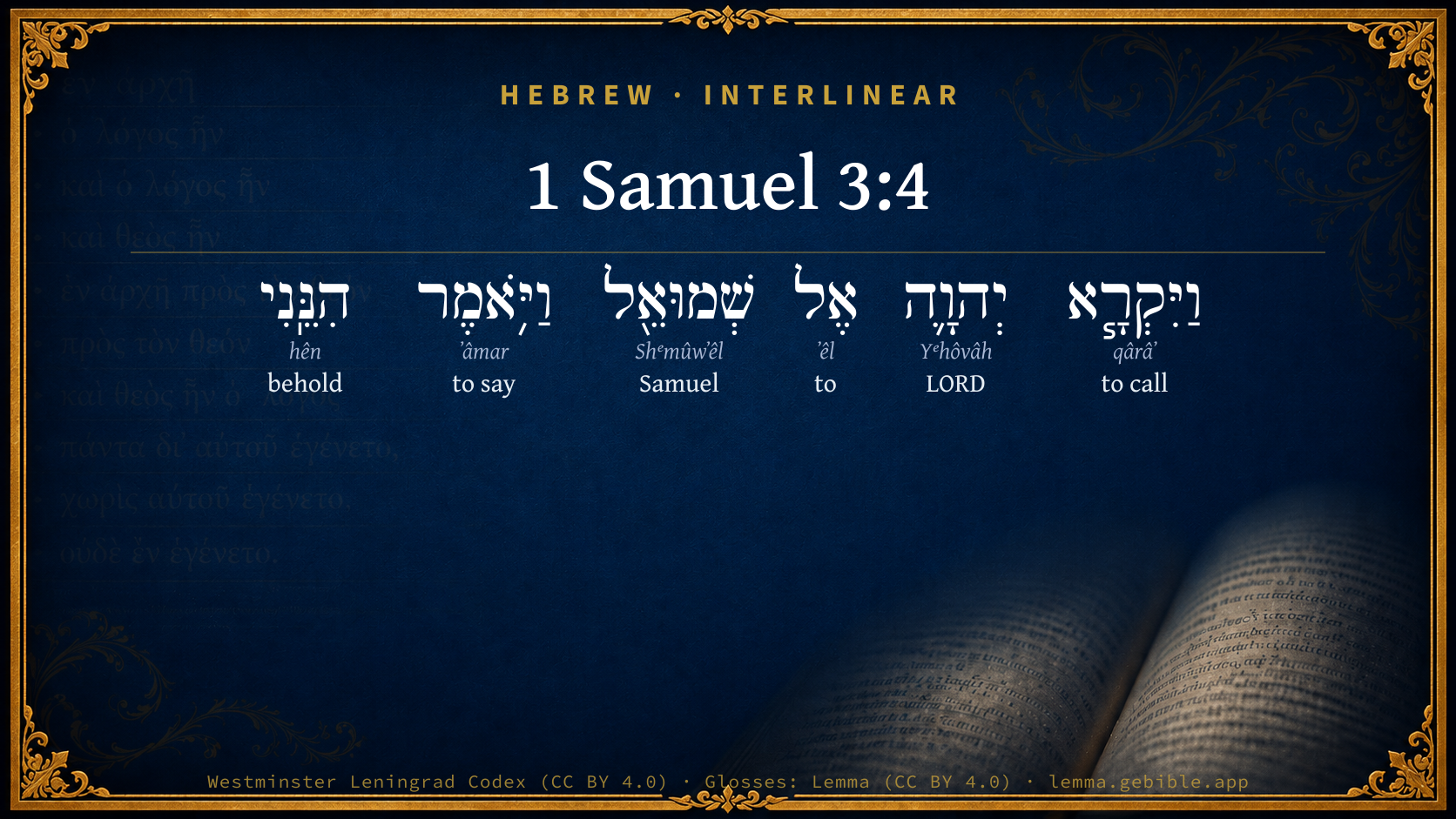
1 Samuel 3:4

Hebrew (Westminster Leningrad Codex) 1 Samuel 3:4 appears in the Hebrew Old Testament. The text above is from the Westminster Leningrad Codex. Each word links to its Strong’s number, a concise gloss, and parsing drawn from the Open Scriptures Hebrew Bible morphology. Click any word for its full Brown-Driver-Briggs (BDB) entry.
Download image
Cite this verse

1 Samuel 3:4 (World English Bible). Public Domain. Lemma interlinear Bible study tool, https://lemma.gebible.app/v/1-samuel/3/4.

Show BibTeX & RIS
BibTeX
RIS
English Translation
that Yahweh called Samuel; and he said, Here am I.
World English Bible · Public Domain
Download a study sheet

One document with this verse’s original text, its word-by-word gloss line, the meaning frame, cross-references with their text, attributed commentary, and full source and license credits — printable, and it pastes into notes with its structure intact.

This verse Autodidact and up

Study sheet (.html) Plain text (.txt)

A passage Seminary Student

Up to 50 verses in one chapter. A passage sheet keeps up to 6 commentary sources and 12 cross-references per verse, in the order this page ranks them, and says so on the sheet whenever that leaves anything out. Ask for a single verse and you get the Autodidact verse sheet above.

Everything on this page stays free to read, with no account — the sheet is a download of what is already on screen, not access to it.

Want to remove ads? Support Godless Engineer
Compare translations 3

The same verse in 3 English versions, stacked beneath the original-language interlinear above. Click any original word for its lexicon entry.

Each is an independent rendering of the whole verse — the interlinear is not word-aligned to these translations.

Highlighted words mark where these versions differ — a whole-verse word diff, not a word-by-word alignment.

  • World English Bible Public Domain
    that Yahweh called Samuel; and he said, Here am I.
  • King James Version Public Domain
    That the LORD called Samuel: and he answered, Here am I.
  • unfoldingWord Literal Text CC BY-SA 4.0
    And Yahweh called to Samuel. And he said, “Behold me.”

unfoldingWord Literal Text — © unfoldingWord, licensed CC BY-SA 4.0. Word-aligned USFM3 via Door43 (git.door43.org/unfoldingWord/en_ult).

Versions to compare (up to 4)

3 of 4 selected

Show all 18 translations

Every available English version of this verse, each an independent rendering of the whole verse.

  • World English Bible Public Domain
    that Yahweh called Samuel; and he said, Here am I.
  • Berean Standard Bible Public Domain
    Then the LORD called to Samuel, and he answered, “Here I am.”
  • Majority Standard Bible Public Domain
    Then the LORD called to Samuel, and he answered, “Here I am.”
  • King James Version Public Domain
    That the LORD called Samuel: and he answered, Here am I.
  • American Standard Version (1901) Public Domain
    that Jehovah called Samuel; and he said, Here am I.
  • Revised Version (1885) Public Domain
    that the LORD called Samuel: and he said, Here am I.
  • Geneva Bible (1599) Public Domain
    Then the Lord called Samuel: and hee said, Here I am.
  • Douay-Rheims (1899) Public Domain
    And the Lord called Samuel. And he answered: Here am I.
  • Young's Literal Translation Public Domain
    and Jehovah calleth unto Samuel, and he saith, `Here `am' I.'
  • Literal Standard Version CC BY-SA 4.0
    and YHWH calls to Samuel, and he says, “Here I [am].”
  • Unlocked Literal Bible CC BY-SA 4.0
    Yahweh called to Samuel, who said, “Here I am.”
  • unfoldingWord Literal Text CC BY-SA 4.0
    And Yahweh called to Samuel. And he said, “Behold me.”
  • Darby Bible Public Domain
    that Jehovah called to Samuel. And he said, Here am I.
  • World Messianic Bible Public Domain
    The LORD called Samuel. He said, “Here I am.”
  • Webster's Bible Public Domain
    That the LORD called Samuel: and he answered, Here am I.
  • Free Bible Version CC BY-SA 4.0
    Then the Lord called, “Samuel!” He answered, “I'm here.”
  • Bible in Basic English Public Domain
    The voice of the Lord said Samuel's name; and he said, Here am I.
  • JPS Tanakh (1917) Public Domain
    that the LORD called Samuel; and he said: 'Here am I.'

Literal Standard Version (2020), Covenant Press — licensed CC BY-SA 4.0. Text via the HelloAO Bible API (eBible.org). Unlocked Literal Bible (unfoldingWord) — licensed CC BY-SA 4.0. Text via the HelloAO Bible API (eBible.org). unfoldingWord Literal Text — © unfoldingWord, licensed CC BY-SA 4.0. Word-aligned USFM3 via Door43 (git.door43.org/unfoldingWord/en_ult). Free Bible Version, Dr. Jonathan Gallagher — licensed CC BY-SA 4.0. Text via the HelloAO Bible API (eBible.org).

Word by word

More ways to search: Search by grammar → Find every occurrence → Compare this word →

Practice this passage: Drill this verse → Learn its vocabulary →

About this verse

These counts appear in no published source. They are computed here, from the morphology-tagged text and Lemma’s own curated glosses. What Lemma adds →

6
words
6
distinct lemmas
Historical
section

Grammatical profile

  • 2 verbs
  • 2 nouns
  • 1 preposition
  • 1 particle

Verb forms

  • וַיִּקְרָ֧א Qal · Sequential Imperfect
  • וַיֹּ֥אמֶר Qal · Sequential Imperfect

Hebrew & Septuagint length

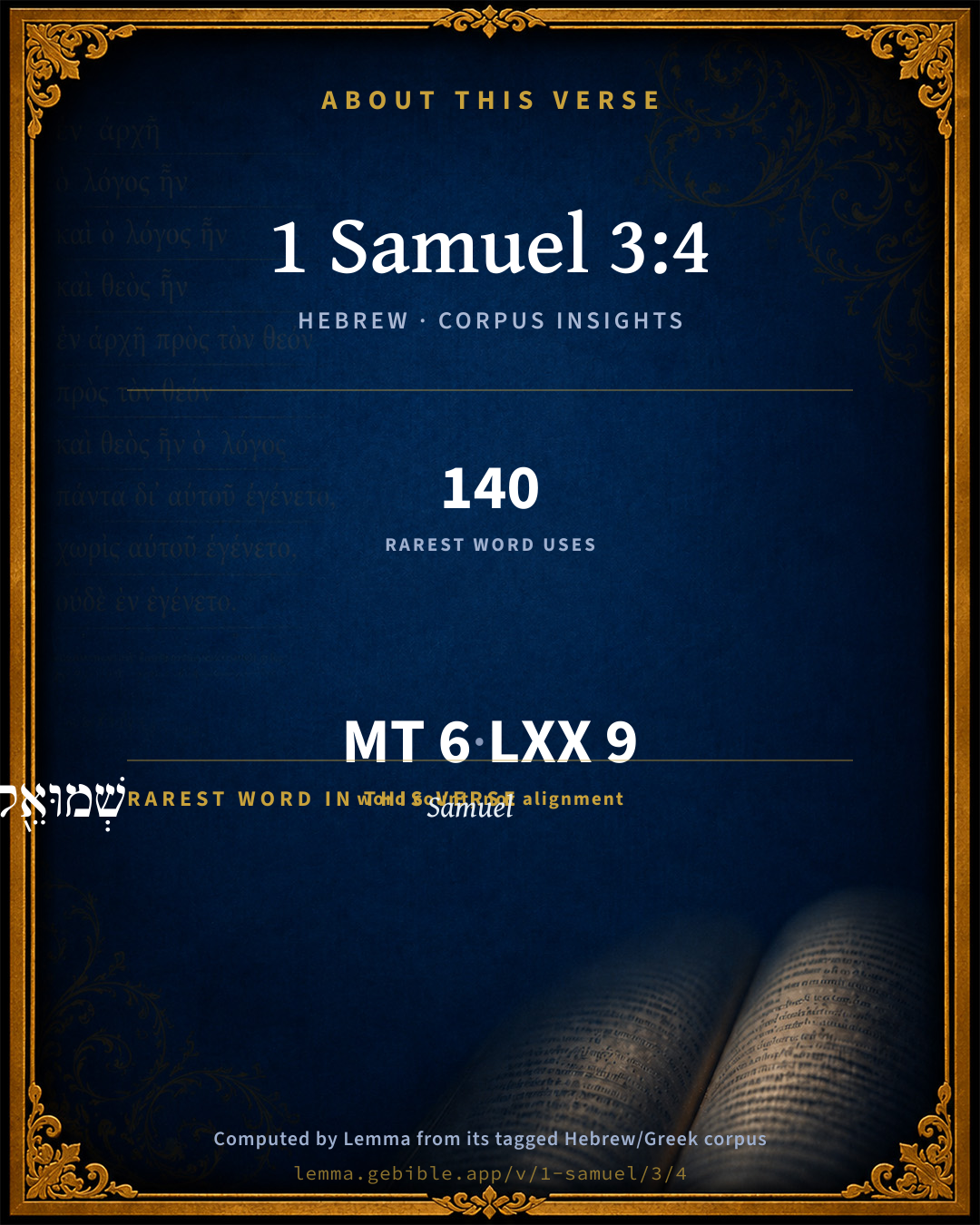
In English translation the verse runs 10 words from the Hebrew and 13 from the Septuagint (LXX English) — closely comparable.

A rough comparison of the two English renderings, which tokenize alike — not a word-level alignment.

Word counts can differ between the Hebrew and the Greek without any difference in meaning — e.g. the Hebrew direct-object marker אֵת has no separate Greek word, and Greek often adds the article ὁ.

In the original languages it is 6 Hebrew tokens and 9 Greek tokens — but the two are counted differently (Hebrew bundles its prefixes and suffixes into one token; the Greek is in lemma form), so that isn’t a like-for-like length.

Cross-references

8

Topical passages linked to 1 Samuel 3:4 in the Treasury of Scripture Knowledge — connected by theme and wording, ordered by reader-vote popularity; previews shown in the World English Bible.

  • Genesis 22:1 It happened after these things, that God tested Abraham, and said to him, "Abraham!" He said, "Here I am."
  • Exodus 3:4 When Yahweh saw that he turned aside to see, God called to him out of the midst of the bush, and said, "Moses! Moses!" He said, "Here I am."
  • Psalms 99:6 Moses and Aaron were among his priests, Samuel among those who call on his name; They called on Yahweh, and he answered them.
  • Isaiah 6:8 I heard the Lord's voice, saying, "Whom shall I send, and who will go for us?" Then I said, "Here I am. Send me!"
  • 1 Corinthians 12:6–11 There are various kinds of workings, but the same God, who works all things in all.
  • Galatians 1:15–16 But when it was the good pleasure of God, who separated me from my mother's womb, and called me through his grace,
  • Acts 9:4 He fell on the earth, and heard a voice saying to him, "Saul, Saul, why do you persecute me?"
  • 1 Corinthians 12:28 God has set some in the assembly: first apostles, second prophets, third teachers, then miracle workers, then gifts of healings, helps, governments, and various kinds of languages.

Cross-references courtesy of OpenBible.info (CC BY 4.0).

Hebrew and Greek witnesses Masoretic Hebrew ↔ Greek Septuagint

The same verse in the two great witnesses to the Old Testament, shown verse-for-verse.

These are two independent witnesses, not word-aligned to each other, and the Septuagint is shown in lemma (dictionary) form.

Hebrew 1 Samuel 3:4 Masoretic · Westminster Leningrad Codex

וַיִּקְרָ֧א יְהוָ֛ה אֶל שְׁמוּאֵ֖ל וַיֹּ֥אמֶר הִנֵּֽנִי

that Yahweh called Samuel; and he said, Here am I.

World English Bible · Public Domain

Greek LXX 1 Samuel 3:4 Septuagint · lemma form

καί καλέω κύριος σαμουηλ σαμουηλ καί εἶπον ἰδού ἐγώ

And the Lord called, Samuel, Samuel; and he said, Behold, here am I.

LXX2012 (modern English Septuagint) · Public Domain

Hebrew: Westminster Leningrad Codex (CC BY 4.0). Greek: Septuagint (public domain); English from LXX2012 (modern English Septuagint) (Public Domain). How the Septuagint differs from the Hebrew →

Targum (Aramaic paraphrase)

1

The Targum is the ancient Jewish Aramaic paraphrase of the Hebrew Scriptures — an interpretive translation, not the Hebrew text itself. Onkelos (literal) and Pseudo-Jonathan (expansive) render the Torah, and Jonathan the Prophets. Coverage is partial: where no permissively-licensed English translation exists for a verse, only the Aramaic is shown. This is verse-level text, not a word-by-word alignment to the Hebrew.

  1. Targum Jonathan Prophets (Joshua–Malachi)
    וּקְרָא יְיָ לִשְׁמוּאֵל וַאֲמַר הָא אֲנָא:

    (no public-domain English translation for this verse)

    Targum Jonathan — Aramaic: “Mikraot Gedolot” (public domain). English: “Sefaria Community Translation” (CC0 1.0 (public-domain dedication)); “London "Chaldee Paraphrase," 1871” (public domain). Text via Sefaria.

Commentary

Notes on 1 Samuel 3:4 from classic Christian and Jewish commentators (each source and its license shown beneath its notes). The classic Christian expositions comment on the surrounding passage and are grouped to its opening verse, so a note may address several verses; the Jewish commentaries on the Tanakh (Rashi and others) are per-verse, so they appear only where the commentator wrote on this verse.

Lemma curates 59 commentaries, every one of them public domain or Creative Commons licensed, each selected and text-cleaned for this edition rather than reprinted as found. About our sources →

Trapp's Complete Commentary

John Trapp

1Sa 3:4 That the LORD called Samuel: and he answered, Here [am] I.

Ver. 4. That the Lord called Samuel] Gratuita et inopinata est vocatio nostra {Eph 1:11} God calleth his people of free grace, and when they least think of it.

And he answered, Here am I.] A hearing ear is a sweet mercy: a heavy ear, a grievous judgment. {Isa 6:9}

John Trapp, A Commentary or Exposition upon All the Books of the Old and New Testament (1647–1656) — public domain. Text from a community e-Sword module.

The Biblical Illustrator

Joseph S. Exell

1Sa_3:4-10

Then the Lord called Samuel: and he answered, Here am I.

The child Samuel

Child is not a precise equivalent for the Hebrew word so rendered, which is considerably wider in meaning, and includes adolescence. Samuel was probably a youth when called. He had been growing quietly in ago and goodness, while Elis sons were growing in licentiousness. The two growths are strikingly contrasted in the previous chapter, where, after each statement as to their wickedness, a clause comes in telling how Samuel advanced in his ministry before the Lord. His word was precious, which does not mean highly valued, but seldom heard, because ears were too much clogged with earth, and there was no prophetic vision open--that is, widely spread--because there were few eyes purged to see it. A prophet was needed to arrest the growing evil, and the needed prophet was in training. The best place for a young life to dwell is the temple of God. They that are planted in the house of the Lord will grow fair and straight, and be sheltered from distorting influences, and from many a gnawing enemy that works havoc among the young shoots. A youth that keeps austerely remote from the vileness of Elis sons will be saved from their fate, and will receive messages from the ark as authentic as that which woke Samuel. The Lord called Samuel. No magnificent apocalypse of divine glory shone on the youths opening eyes. Simply his name was spoken in the tone of one bespeaking his attention and about to give him commands. Whoever spoke knew him, claimed authority over him, and had something for him to do. In a word, the speaker was his master, and needed him. God often assimilates His call to the voices with which we are familiar. A stage comes in every young life when the sense of responsibility is wakened, when the thought of a vocation to battle for the truth starts up. Samuels mistake tells a great deal, both as to the nature of the voice he heard and as to his relations to Eli. Evidently he had been accustomed to be roused from sleep, to attend to the old man whose blindness would make him need kindly ministrations. As evidently, he had been accustomed cheerfully to answer the call. His loving readiness to spring from sleep and do whatever was needed, are seen in his running to Eli. No holier office can be entrusted to youth than to care for helpless age; and even if the dependent old man or woman has failings, as Eli had, which the younger hates, the duty of service is still plain, and its blessedness will be the greater, But Samuels mistake has another lesson; for we, too, may think that it is only Eli speaking, when it is really God. There is something very pathetic and beautiful in Elis quick and ungrudging recognition of Gods call to his young attendant. He had had no such communications himself, but he knew them when they came to others. Poor Eli had a bitter pill to swallow when he knew that the boy whom he had trained as his attendant was elevated to the position of a prophet; but he was not offended nor jealous. There is dignity and peace for the old when they heartily acquiesce in the Divine choice of the young to carry his work a stage farther. Samuel had no thought of anything extraordinary, and the explanation of his slowness of apprehension is given in the statement that he did not yet know the Lord, which can only mean that he had not received any Divine communications; for absolute ignorance cannot be supposed in one who had ministered to the Lord all his life. Youth should be slow to believe that its impressions are divine messages. They must be tested well before they are trusted as such. One test, though an imperfect one, is their persistency. When some conviction of duty keeps returning again and again, and forcing us to hear it, we should at least not dismiss it without careful consideration; for it may be the voice of the patient God, who does not let our carelessness silence him. Thy servant heareth--an open ear for Gods commands and revelations will never be left empty. Speak, Lord, is a prayer; and it is never offered in vain when it is accompanied, as Samuels was, by For thy servant hears. Such a disposition is a prevailing reason with God. If we are ready to listen and obey, He is more than ready to speak. (A. Maclaren, D. D.)

The call of Samuel

I. The circumstances of Samuels call.

1. When the state of the Church was in a very low ebb: The word of prophecy was very precious at that time (1Sa_3:1), a prophet was very rare then, and few or none appeared with open vision by name, though mention be made in general of a prophet (Jdg_6:8). And of a man of God before (1Sa_2:27).

2. At that time (1Sa_3:2) when the Lord had sent the day before that Man of God mentioned (1Sa_2:27), with heavy tidings to Eli, then the very next day God calls and sends Samuel with the same sad message.

3. In that time of the natural day (1Sa_3:3), when the lamps of the golden candlestick were not yet extinguished, which had been lighted the evening before (Exo_27:21; Lev_24:8, 2Ch_13:11). So that this was betimes in the morning, and before day that God called Samuel. The place where, in the temple or tabernacle.

II. The substance of this word of prophecy revealed to Samuel.

III. The gracious carriage of this young prophet, when so high and honourable a preferment is put upon him by the Lord.

1. His humility.

2. His modesty, His modesty most appeared, both in his doing the former office of a doorkeeper (opening the doors in the morning), though he were now called of God to be a prophet. And likewise he was not forward, but fearful to reveal the Divine oracle to Eli, which yet he might not conceal (1Sa_3:15).

3. His faithfulness also here is manifest in not hiding anything (of that which God had spoke to him) from his master Eli: He told him every whirl (1Sa_3:18). Though there was not one drachm of comfort in the whole oracle.

IV. Elis reception of this rigid revelation from God by Samuel. Eli was conscious to himself of great guilt, both in his villainous sons, and in himself for indulging their villany, his conscience was a sore conscience, but theirs were seared consciences, and therefore could he presage no good from God; hereupon he advises his pupil to hide nothing from him, but to tell his tutor all that God had told him (1Sa_1:16-17). When Eli had heard Gods severe sentence he calmly crieth, It is the Lord, let him do what seemeth him good (1Sa_3:18), as if he had said the Lord Jehovah hath a sovereign absolute power over all the sons and daughters of men, and may dispose of me and mine, and of all created beings according to his good pleasure, unto which I freely submit, well knowing there be better things in Gods will than in my own. (C. Ness.)

The Biblical Illustrator, edited by Joseph S. Exell (c. 1880s–1900s) — public domain. Text from a community e-Sword module.

Whedon's Commentary on the Bible

Daniel D. Whedon

4. The Lord called Samuel — In an audible voice, by pronouncing his name. Compare Gen_22:1; Exo_3:4.

Daniel D. Whedon (gen. ed.), Commentary on the Old and New Testaments (1874–1909) — public domain. Text from a community e-Sword module.

Geneva Bible (1599)

Geneva Bible translators

Josephus writeth that Samuel was 12 years old, when the Lord appeared to him.

Geneva Bible (1599) marginal notes — public domain. Text via Bolls.life.

Adam Clarke's Commentary

Verse 4. The Lord called Samuel] The voice probably came from the holy place, near to which Eli and Samuel were both lying.

Adam Clarke's Commentary on the Bible (1810–1826) — public domain. Text from a community e-Sword/MySword module.

The Cambridge Bible for Schools and Colleges

gen. ed. J. J. S. Perowne

4. Here am I] Heb. Behold me, the regular formula for expressing attention to a call and readiness to obey. Cp. Gen_22:1; Isa_6:8.

The Cambridge Bible for Schools and Colleges (gen. ed. J. J. S. Perowne; Cambridge University Press, 1878–1918) — public domain. Text from a community e-Sword module.

John Gill's Exposition

That the Lord called Samuel,.... By a voice which came forth from the most holy place, from between the cherubim, the seat of the divine Majesty:

and he answered, here am I; which was not intended to declare the place where he was, but to express his readiness and cheerfulness to do any thing that was required of him.

John Gill's Exposition of the Whole Bible (1746–1763) — public domain (CC PDM 1.0). Text via the HelloAO Bible API.

Rashi

Rabbi Shlomo Yitzchaki (Rashi)

Adonoy called. And a voice emanated from the Temple of God, from the Holy of Holies, which called, "Shmuel!" The end of the above verse is connected to the verse that follows. This is what is inferred by the verse, "the Lord thunders wonderously with His voice." Eili was a kohein, and was watching from within, while Shmuel was a Levite and lying without. Yet, the voice [of 'ה] jumped over Eili to Shmuel.

Rashi on the Tanakh — English translations: “The Judaica Press complete Tanach with Rashi, translated by A. J. Rosenberg” (CC BY 4.0); “Pentateuch with Rashi's commentary by M. Rosenbaum and A.M. Silbermann, 1929-1934” (public domain); “The Metsudah Tanach series, Lakewood, N.J” (CC BY 4.0); and “The Book of Joshua, Metsudah Publications, 1997” (CC BY 4.0). Text via Sefaria.

Lesson kit

Teaching starters — assembled from the data on this page, not authored interpretation. Every prompt links to the verse data it draws on. Edit before teaching.

1 Samuel, in the Historical, opens this verse with 6 words (6 distinct Hebrew lemmas). Its most distinctive word is Shᵉmûwʼêl (“Samuel”). A historical commentator’s framing appears above. Read the whole chapter for the surrounding context.

Discussion questions

  1. What does “Samuel” (Shᵉmûwʼêl) contribute to the verse as a whole?
  2. How does Genesis 22:1, which shares this passage’s theme, read alongside this verse?
  3. The translations on this page render this verse differently — a whole-verse word diff, not a word-by-word alignment. What might account for the different wordings?
  4. «וַיִּקְרָ֧א» is a Qal Sequential Imperfect verb. How does that grammatical form shape the action described?
  5. Compare how Trapp's Complete Commentary and The Biblical Illustrator read this verse. Where do they agree or differ?

Things to notice

Reading settings

Reading text

Shown beneath each verse's original-language words.

Old Testament
Old Testament edition

Read the OT as the Masoretic Hebrew (MT) or the Greek Septuagint (LXX).

English shown for the Greek Septuagint (in the Hebrew ↔ Greek comparison).

Comparing translations? Open the Compare panel on any verse page to stack up to four side by side.