
2 Kings 7:13

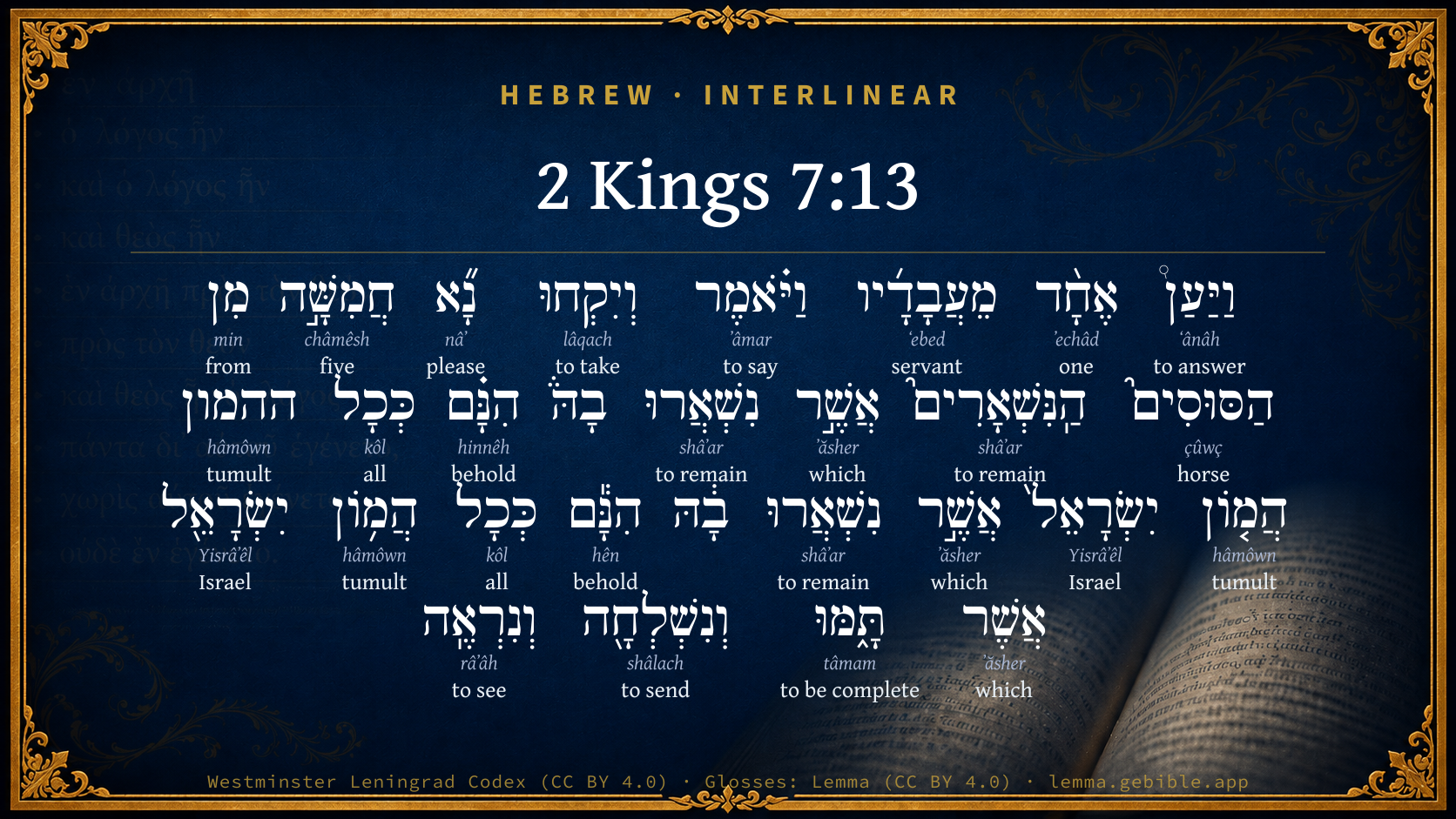
Hebrew (Westminster Leningrad Codex) 2 Kings 7:13 appears in the Hebrew Old Testament. The text above is from the Westminster Leningrad Codex. Each word links to its Strong’s number, a concise gloss, and parsing drawn from the Open Scriptures Hebrew Bible morphology. Click any word for its full Brown-Driver-Briggs (BDB) entry.
Download image
Cite this verse

2 Kings 7:13 (World English Bible). Public Domain. Lemma interlinear Bible study tool, https://lemma.gebible.app/v/2-kings/7/13.

Show BibTeX & RIS
BibTeX
RIS
English Translation
One of his servants answered, Please let some take five of the horses that remain, which are left in the city (behold, they are as all the multitude of Israel who are left in it; behold, they are as all the multitude of Israel who are consumed); and let us send and see.
World English Bible · Public Domain
Download a study sheet

One document with this verse’s original text, its word-by-word gloss line, the meaning frame, cross-references with their text, attributed commentary, and full source and license credits — printable, and it pastes into notes with its structure intact.

This verse Autodidact and up

Study sheet (.html) Plain text (.txt)

A passage Seminary Student

Up to 50 verses in one chapter. A passage sheet keeps up to 6 commentary sources and 12 cross-references per verse, in the order this page ranks them, and says so on the sheet whenever that leaves anything out. Ask for a single verse and you get the Autodidact verse sheet above.

Everything on this page stays free to read, with no account — the sheet is a download of what is already on screen, not access to it.

Want to remove ads? Support Godless Engineer
Compare translations 3

The same verse in 3 English versions, stacked beneath the original-language interlinear above. Click any original word for its lexicon entry.

Each is an independent rendering of the whole verse — the interlinear is not word-aligned to these translations.

Highlighted words mark where these versions differ — a whole-verse word diff, not a word-by-word alignment.

  • World English Bible Public Domain
    One of his servants answered, Please let some take five of the horses that remain, which are left in the city (behold, they are as all the multitude of Israel who are left in it; behold, they are as all the multitude of Israel who are consumed); and let us send and see.
  • King James Version Public Domain
    And one of his servants answered and said, Let some take, I pray thee, five of the horses that remain, which are left in the city, (behold, they are as all the multitude of Israel that are left in it: behold, I say, they are even as all the multitude of the Israelites that are consumed:) and let us send and see.
  • unfoldingWord Literal Text CC BY-SA 4.0
    And one from his servants answered and said, “Now please let us take five of the remaining horses that remain in it. Behold them, like all of the multitude of Israel who remain in it. Behold them, like all of the multitude of Israel who have finished. So let us send, and let us see.”

unfoldingWord Literal Text — © unfoldingWord, licensed CC BY-SA 4.0. Word-aligned USFM3 via Door43 (git.door43.org/unfoldingWord/en_ult).

Versions to compare (up to 4)

3 of 4 selected

Show all 18 translations

Every available English version of this verse, each an independent rendering of the whole verse.

  • World English Bible Public Domain
    One of his servants answered, Please let some take five of the horses that remain, which are left in the city (behold, they are as all the multitude of Israel who are left in it; behold, they are as all the multitude of Israel who are consumed); and let us send and see.
  • Berean Standard Bible Public Domain
    But one of his servants replied, “Please, have scouts take five of the horses that remain in the city. Their plight will be no worse than all the Israelites who are left here. You can see that all the Israelites here are doomed. So let us send them and find out.”
  • Majority Standard Bible Public Domain
    But one of his servants replied, “Please, have scouts take five of the horses that remain in the city. Their plight will be no worse than all the Israelites who are left here. You can see that all the Israelites here are doomed. So let us send them and find out.”
  • King James Version Public Domain
    And one of his servants answered and said, Let some take, I pray thee, five of the horses that remain, which are left in the city, (behold, they are as all the multitude of Israel that are left in it: behold, I say, they are even as all the multitude of the Israelites that are consumed:) and let us send and see.
  • American Standard Version (1901) Public Domain
    And one of his servants answered and said, Let some take, I pray thee, five of the horses that remain, which are left in the city (behold, they are as all the multitude of Israel that are left in it; behold, they are as all the multitude of Israel that are consumed); and let us send and see.
  • Revised Version (1885) Public Domain
    And one of his servants answered and said, Let some take, I pray thee, five of the horses that remain, which are left in the city, (behold, they are as all the multitude of Israel that are left in it; behold, they are as all the multitude of Israel that are consumed:) and let us send and see.
  • Geneva Bible (1599) Public Domain
    And one of his seruants answered, and said, Let me take now fiue of the horses that remaine, and are left in the citie, (behold, they are euen as all the multitude of Israel that are left therein: beholde, I say, they are as the multitude of the Israelites that are consumed) and we wil send to see.
  • Douay-Rheims (1899) Public Domain
    And one of his servants answered: Let us take the five horses that are remaining in the city (because there are no more in the whole multitude of Israel, for the rest are consumed,) and let us send and see.
  • Young's Literal Translation Public Domain
    And one of his servants answereth and saith, `Then let them take, I pray thee, five of the horses that are left, that have been left in it -- lo, they `are' as all the multitude of Israel who have been left in it; lo, they are as all the multitude of Israel who have been consumed -- and we send and see.'
  • Literal Standard Version CC BY-SA 4.0
    And one of his servants answers and says, “Then please let them take five of the horses that are left, that have been left in it—behold, they [are] as all the multitude of Israel who have been left in it; behold, they are as all the multitude of Israel who have been consumed—and we send and see.”
  • Unlocked Literal Bible CC BY-SA 4.0
    One of the king's servants answered and said, “I beg you, let some men take five of the horses that remain, which are left in the city. They are like all the rest of the population of Israel who are left—most are now dead; let us send them and see.”
  • unfoldingWord Literal Text CC BY-SA 4.0
    And one from his servants answered and said, “Now please let us take five of the remaining horses that remain in it. Behold them, like all of the multitude of Israel who remain in it. Behold them, like all of the multitude of Israel who have finished. So let us send, and let us see.”
  • Darby Bible Public Domain
    And one of his servants answered and said, Let some one take, I pray thee, five of the horses that remain, which are left in the city (behold, they are as all the multitude of Israel that are left in it: behold, they are even as all the multitude of the Israelites that have perished), and let us send and see.
  • World Messianic Bible Public Domain
    One of his servants answered, “Please let some people take five of the horses that remain, which are left in the city. Behold, they are like all the multitude of Israel who are left in it. Behold, they are like all the multitude of Israel who are consumed. Let’s send and see.”
  • Webster's Bible Public Domain
    And one of his servants answered and said, Let some take, I pray thee, five of the horses that remain, which are left in the city, (behold, they are as all the multitude of Israel that are left in it: behold, I say, they are even as all the multitude of the Israelites that are consumed:) and let us send and see.
  • Free Bible Version CC BY-SA 4.0
    One of his officers suggested, “Have some men take five of the remaining horses in the city. What happens to them will be the same as that of all the Israelites left here, All the Israelites here are doomed. Let's send them to find out what's going on.”
  • Bible in Basic English Public Domain
    And one of his servants said in answer, Send men and let them take five of the horses which we still have in the town; if they keep their lives they will be the same as those of Israel who are still living here; if they come to their death they will be the same as all those of Israel who have gone to destruction: let us send and see.
  • JPS Tanakh (1917) Public Domain
    And one of his servants answered and said: 'Let some take, I pray thee, five of the horses that remain, which are left in the city — behold, they are as all the multitude of Israel that are left in it; behold, they are as all the multitude of Israel that are consumed — and let us send and see.'

Literal Standard Version (2020), Covenant Press — licensed CC BY-SA 4.0. Text via the HelloAO Bible API (eBible.org). Unlocked Literal Bible (unfoldingWord) — licensed CC BY-SA 4.0. Text via the HelloAO Bible API (eBible.org). unfoldingWord Literal Text — © unfoldingWord, licensed CC BY-SA 4.0. Word-aligned USFM3 via Door43 (git.door43.org/unfoldingWord/en_ult). Free Bible Version, Dr. Jonathan Gallagher — licensed CC BY-SA 4.0. Text via the HelloAO Bible API (eBible.org).

Word by word

More ways to search: Search by grammar → Find every occurrence → Compare this word →

Practice this passage: Drill this verse → Learn its vocabulary →

תָּ֑מּוּ
tâmam
H8552
“to be complete”
Verb, Qal, Perfect, 3rd Person, Common, Plural
Part of Speech
Verb
Stem
Qal
Form
Perfect
Person
3rd Person
Gender
Common
Number
Plural
Full BDB Definition

Origin: a primitive root

TWOT: 2522

to be complete, be finished, be at an end - (Qal) - to be finished, be completed - completely, wholly, entirely (as auxiliary with verb) - to be finished, come to an end, cease - to be complete (of number) - to be consumed, be exhausted, be spent - to be finished, be consumed, be destroyed - to be complete, be sound, be unimpaired, be upright - to complete, finish - to be completely crossed over - (Niphal) to be consumed - (Hiphil) - to finish, complete, perfect - to finish, cease doing, leave off doing - to complete, sum up, make whole - to destroy (uncleanness) - to make sound - (Hithpael) to deal in integrity, act uprightly
  1. וַיַּעַן֩ ʻânâh H6030 “and · to answer” Conjunction + Verb, Qal, Sequential Imperfect, 3rd Person, Masculine, Singular
  2. אֶחָ֨ד ʼechâd H259 “one” Adjective, Cardinal number, Masculine, Singular, Absolute
  3. מֵעֲבָדָ֜יו ʻebed H5650 “from · servants · his” Preposition + Noun, Common, Masculine, Plural, Construct + Suffix, Personal, 3rd Person, Masculine, Singular
  4. וַיֹּ֗אמֶר ʼâmar H559 “and · to say” Conjunction + Verb, Qal, Sequential Imperfect, 3rd Person, Masculine, Singular
  5. וְיִקְחוּ lâqach H3947 “and · to take” Conjunction + Verb, Qal, Jussive, 3rd Person, Masculine, Plural
  6. נָ֞א nâʼ H4994 “please” Particle, Exhortation
  7. חֲמִשָּׁ֣ה châmêsh H2568 “five” Adjective, Cardinal number, Masculine, Singular, Absolute
  8. מִן min H4480 “from” Preposition
  9. הַסּוּסִים֮ çûwç H5483 “the · horses” Particle, Definite Article + Noun, Common, Masculine, Plural, Absolute
  10. הַֽנִּשְׁאָרִים֮ shâʼar H7604 “the · remaining” Particle, Definite Article + Verb, Niphal, Participle Active, Masculine, Plural, Absolute
  11. אֲשֶׁ֣ר ʼăsher H834 “which” Particle, Relative
  12. נִשְׁאֲרוּ shâʼar H7604 “to remain” Verb, Niphal, Perfect, 3rd Person, Common, Plural
  13. הִנָּ֗ם hinnêh H2009 “behold · them” Particle, Demonstrative + Suffix, Personal, 3rd Person, Masculine, Plural
  14. כְּכָל kôl H3605 “like/as · all of” Preposition + Noun, Common, Masculine, Singular, Construct
  15. ההמון hâmôwn H1995 “the · tumult” Particle, Definite Article + Noun, Common, Masculine, Singular, Absolute
  16. הֲמ֤וֹן hâmôwn H1995 “tumult of” Noun, Common, Masculine, Singular, Construct
  17. יִשְׂרָאֵל֙ Yisrâʼêl H3478 “Israel” Noun, Proper
  18. אֲשֶׁ֣ר ʼăsher H834 “which” Particle, Relative
  19. נִשְׁאֲרוּ shâʼar H7604 “to remain” Verb, Niphal, Perfect, 3rd Person, Common, Plural
  20. הִנָּ֕ם hên H2005 “behold · them” Particle, Demonstrative + Suffix, Personal, 3rd Person, Masculine, Plural
  21. כְּכָל kôl H3605 “like/as · all of” Preposition + Noun, Common, Masculine, Singular, Construct
  22. הֲמ֥וֹן hâmôwn H1995 “tumult of” Noun, Common, Masculine, Singular, Construct
  23. יִשְׂרָאֵ֖ל Yisrâʼêl H3478 “Israel” Noun, Proper
  24. אֲשֶׁר ʼăsher H834 “which” Particle, Relative
  25. וְנִשְׁלְחָ֖ה shâlach H7971 “and · to send” Conjunction + Verb, Qal, Cohortative, 1st Person, Common, Plural
  26. וְנִרְאֶֽה râʼâh H7200 “and · to see” Conjunction + Verb, Qal, Cohortative, 1st Person, Common, Plural

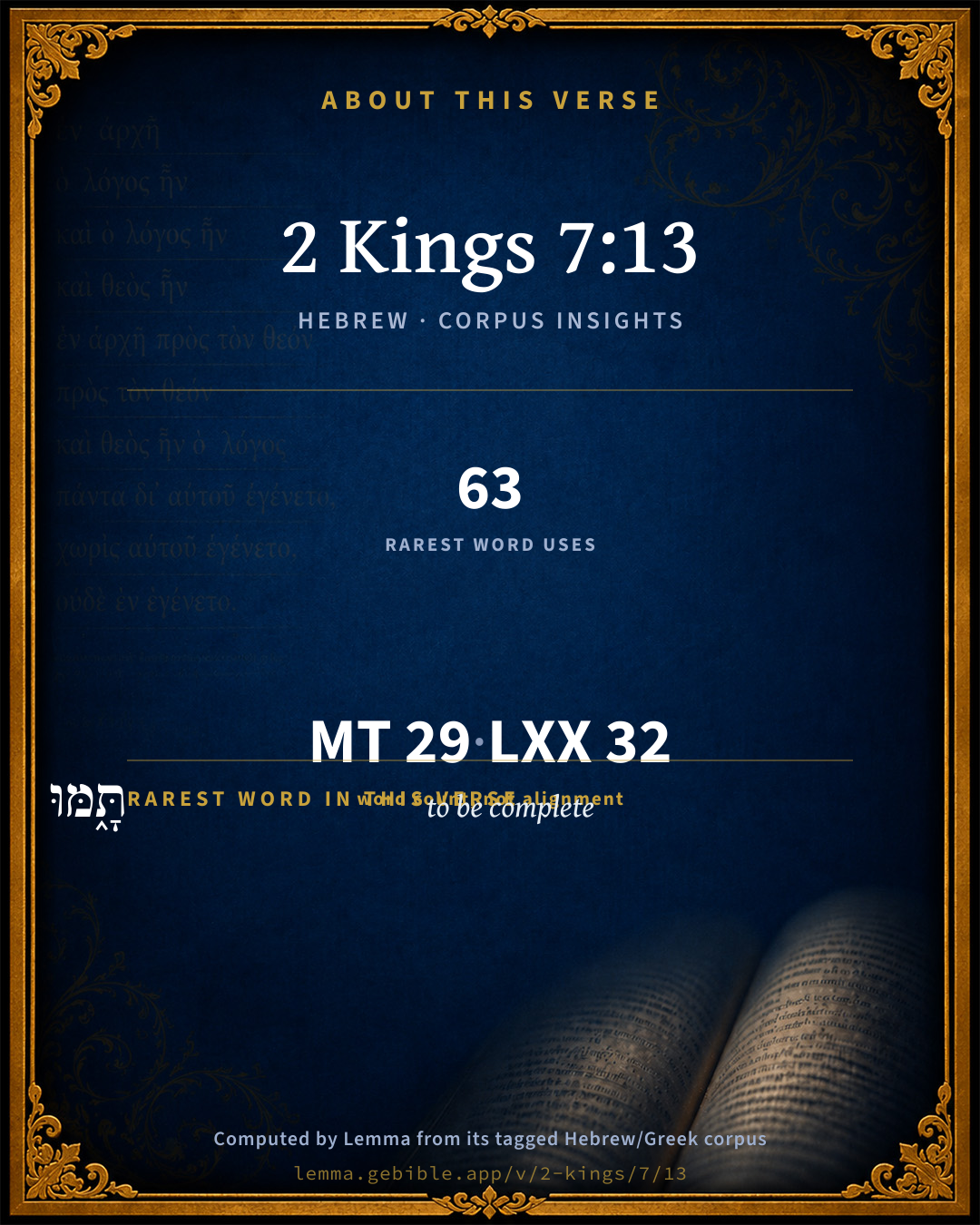
About this verse

These counts appear in no published source. They are computed here, from the morphology-tagged text and Lemma’s own curated glosses. What Lemma adds →

29
words
19
distinct lemmas
Historical
section

Grammatical profile

  • 9 verbs
  • 9 nouns
  • 2 adjectives
  • 3 prepositions
  • 6 particles

Verb forms

  • וַיַּעַן֩ Qal · Sequential Imperfect
  • וַיֹּ֗אמֶר Qal · Sequential Imperfect
  • וְיִקְחוּ Qal · Jussive
  • הַֽנִּשְׁאָרִים֮ Niphal · Participle Active
  • נִשְׁאֲרוּ Niphal · Perfect
  • נִשְׁאֲרוּ Niphal · Perfect
  • תָּ֑מּוּ Qal · Perfect
  • וְנִשְׁלְחָ֖ה Qal · Cohortative
  • וְנִרְאֶֽה Qal · Cohortative

Repetition

Words recur within this verse — often emphatic in Hebrew:

  • הַֽנִּשְׁאָרִים֮ to remain H7604 ×3
  • ההמון tumult H1995 ×3
  • כְּכָל all H3605 ×2
  • יִשְׂרָאֵל֙ Israel H3478 ×2
  • אֲשֶׁ֣ר which H834 ×3

Hebrew & Septuagint length

In English translation the verse runs 53 words from the Hebrew and 42 from the Septuagint (LXX English) — closely comparable.

A rough comparison of the two English renderings, which tokenize alike — not a word-level alignment.

Word counts can differ between the Hebrew and the Greek without any difference in meaning — e.g. the Hebrew direct-object marker אֵת has no separate Greek word, and Greek often adds the article ὁ.

In the original languages it is 29 Hebrew tokens and 32 Greek tokens — but the two are counted differently (Hebrew bundles its prefixes and suffixes into one token; the Greek is in lemma form), so that isn’t a like-for-like length.

Cross-references

5

Topical passages linked to 2 Kings 7:13 in the Treasury of Scripture Knowledge — connected by theme and wording, ordered by reader-vote popularity; previews shown in the World English Bible.

  • 2 Kings 5:13 His servants came near, and spoke to him, and said, My father, if the prophet had bid you do some great thing, wouldn't you have done it? how much rather then, when he says to you, Wash, and be clean?
  • 2 Kings 6:33 While he was yet talking with them, behold, the messenger came down to him: and he said, Behold, this evil is of Yahweh; why should I wait for Yahweh any longer?
  • 2 Kings 7:4 If we say, We will enter into the city, then the famine is in the city, and we shall die there; and if we sit still here, we die also. Now therefore come, and let us fall to the host of the Syrians: if they save us alive, we shall live; and if they kill us, we shall but die.
  • Jeremiah 14:18 If I go forth into the field, then, behold, the slain with the sword! and if I enter into the city, then, behold, those who are sick with famine! for both the prophet and the priest go about in the land, and have no knowledge.
  • Lamentations 4:9 Those who are killed with the sword are better than those who are killed with hunger; For these pine away, stricken through, for want of the fruits of the field.

Cross-references courtesy of OpenBible.info (CC BY 4.0).

Hebrew and Greek witnesses Masoretic Hebrew ↔ Greek Septuagint

The same verse in the two great witnesses to the Old Testament, shown verse-for-verse.

These are two independent witnesses, not word-aligned to each other, and the Septuagint is shown in lemma (dictionary) form.

Hebrew 2 Kings 7:13 Masoretic · Westminster Leningrad Codex

וַיַּעַן֩ אֶחָ֨ד מֵעֲבָדָ֜יו וַיֹּ֗אמֶר וְיִקְחוּ נָ֞א חֲמִשָּׁ֣ה מִן הַסּוּסִים֮ הַֽנִּשְׁאָרִים֮ אֲשֶׁ֣ר נִשְׁאֲרוּ בָהּ֒ הִנָּ֗ם כְּכָל ההמון הֲמ֤וֹן יִשְׂרָאֵל֙ אֲשֶׁ֣ר נִשְׁאֲרוּ בָ֔הּ הִנָּ֕ם כְּכָל הֲמ֥וֹן יִשְׂרָאֵ֖ל אֲשֶׁר תָּ֑מּוּ וְנִשְׁלְחָ֖ה וְנִרְאֶֽה

One of his servants answered, Please let some take five of the horses that remain, which are left in the city (behold, they are as all the multitude of Israel who are left in it; behold, they are as all the multitude of Israel who are consumed); and let us send and see.

World English Bible · Public Domain

Greek LXX 2 Kings 7:13 Septuagint · lemma form

καί ἀποκρίνω εἷς ὁ παῖς αὐτός καί εἶπον λαμβάνω δή πέντε ὁ ἵππος ὁ ὑπολείπω ὅς καταλείπω ὧδε ἰδού εἰμί πρός πᾶς ὁ πλῆθος ἰσραήλ ὁ ἐκλείπω καί ἀποστέλλω ἐκεῖ καί ὁράω

And one of his servants answered and said, Let them now take five of the horses that were left, which were left here; behold, they are the number left to all the multitude of Israel; and we will send there and see.

LXX2012 (modern English Septuagint) · Public Domain

On this verse, Adam Clarke's Commentary discusses the Septuagint’s reading. Read the note in Commentary ↓

Hebrew: Westminster Leningrad Codex (CC BY 4.0). Greek: Septuagint (public domain); English from LXX2012 (modern English Septuagint) (Public Domain). How the Septuagint differs from the Hebrew →

Targum (Aramaic paraphrase)

1

The Targum is the ancient Jewish Aramaic paraphrase of the Hebrew Scriptures — an interpretive translation, not the Hebrew text itself. Onkelos (literal) and Pseudo-Jonathan (expansive) render the Torah, and Jonathan the Prophets. Coverage is partial: where no permissively-licensed English translation exists for a verse, only the Aramaic is shown. This is verse-level text, not a word-by-word alignment to the Hebrew.

  1. Targum Jonathan Prophets (Joshua–Malachi)
    וַאֲתֵיב חַד מֵעַבְדוֹהִי וַאֲמַר וְיִדְבְּרוּן כְּעַן חַמְשָׁא מִן סוּסְוָתָא מִן שַׁאֲרָא דְאִשְׁתַּאֲרוּ בָהּ הָא אִינוּן כְּכָל הֲמוֹנָא דְיִשְׂרָאֵל דְאִשְׁתַּאֲרוּ בָהּ אִם יֵבְדוּן הָא אִינוּן כְּכָל הֲמוֹנָא דְיִשְׂרָאֵל דְסָפוּ וְנִשְׁלַח וְנֶחְזֵי:

    (no public-domain English translation for this verse)

    Targum Jonathan — Aramaic: “Mikraot Gedolot” (public domain). English: “Sefaria Community Translation” (CC0 1.0 (public-domain dedication)); “London "Chaldee Paraphrase," 1871” (public domain). Text via Sefaria.

Commentary

Notes on 2 Kings 7:13 from classic Christian and Jewish commentators (each source and its license shown beneath its notes). The classic Christian expositions comment on the surrounding passage and are grouped to its opening verse, so a note may address several verses; the Jewish commentaries on the Tanakh (Rashi and others) are per-verse, so they appear only where the commentator wrote on this verse.

Lemma curates 59 commentaries, every one of them public domain or Creative Commons licensed, each selected and text-cleaned for this edition rather than reprinted as found. About our sources →

Trapp's Complete Commentary

John Trapp

2Ki 7:13 And one of his servants answered and said, Let [some] take, I pray thee, five of the horses that remain, which are left in the city, (behold, they [are] as all the multitude of Israel that are left in it: behold, [I say], they [are] even as all the multitude of the Israelites that are consumed:) and let us send and see.

Ver. 13. Five of the horses.] These five were either all or the most that remained alive, and haply uneaten.

Behold, they are all,] q.d., We need not scruple the doing of it; for, alas! all, both horses and men, are in a perishing condition.

John Trapp, A Commentary or Exposition upon All the Books of the Old and New Testament (1647–1656) — public domain. Text from a community e-Sword module.

Joseph Benson's Commentary

2Ki 7:13. Let some, I pray thee, take five of the horses, &c. — The sense seems to be, We may well venture these five horses, though we have no more, because both they and we are ready to perish with hunger: let us, therefore, use them while we may, for our common good, or to make the discovery. Behold, they are as the multitude of Israel — The words may be rendered, Behold, they are of a truth (the Hebrew prefix, Caph, being not here a note of similitude, but an affirmation of the truth and certainty of the things, as it is taken Num 11:1; Deu 9:10) all the multitude of the horses of Israel that are left in it: behold, I say, they are even all the multitude of the horses of the Israelites, which (which multitude) are consumed, reduced to this small number, all consumed except these five. And this was indeed worthy of a double behold, to show what mischief the famine had done both upon men and beasts, and to what a low ebb the king of Israel was come, that all his troops of horses, to which he had trusted, were shrunk to so small a number.

Joseph Benson's Commentary on the Old and New Testaments (1811–1818) — public domain. Text from a community e-Sword module.

Tyndale Open Study Notes

Tyndale Open Resources

7:13-17 The trail of abandoned articles confirmed the Arameans’ rush to escape, and the Israelites plundered the Aramean camp. True to Elisha’s prophecy, food supplies were now readily available, and Joram’s doubting officer was knocked down and trampled to death.

Tyndale Open Study Notes — © Tyndale Open Resources, licensed CC BY-SA 4.0. Text via the HelloAO Bible API.

Geneva Bible (1599)

Geneva Bible translators

There are no more left, but they, or the rest are consumed with the famine, as the rest of the people.

Geneva Bible (1599) marginal notes — public domain. Text via Bolls.life.

Adam Clarke's Commentary

Verse 13. And one of his servants answered] This is a very difficult verse, and the great variety of explanations given of it cast but little light on the subject. I am inclined to believe, with Dr. Kennicott, that there is an interpolation here which puzzles, if not destroys, the sense. "Several instances," says he, "have been given of words improperly repeated by Jewish transcribers, who have been careless enough to make such mistakes, and yet cautious not to alter or erase, for fear of discovery. This verse furnishes another instance in a careless repetition of seven Hebrew words, thus: -

הנשארים אשר נשארו בה הנם ככל ההמון ישראל אשר נשארו בה הנם ככל המון ישראל אשר תמי

The exact English of this verse is this: And the servant said, Let them take now five of the remaining horses, which remain in it; behold they are as all the multitude of Israel, which [remain in it; behold they are as all the multitude of Israel which] are consumed; and let us send and see.

"Whoever considers that the second set of these seven words is neither in the Septuagint nor Syriac versions, and that those translators who suppose these words to be genuine alter them to make them look like sense, will probably allow them to have been at first an improper repetition; consequently to be now an interpolation strangely continued in the Hebrew text." They are wanting in more than forty of Kennicott's and De Rossi's MSS. In some others they are left without points; in others they have been written in, and afterwards blotted out; and in others four, in others five, of the seven words are omitted. De Rossi concludes thus: Nec verba haec legunt LXX., Vulg., Syrus simplex, Syrus Heptaplaris Parisiensis, Targum. They stand on little authority, and the text should be read, omitting the words enclosed by brackets, as above.

They are consumed] The words אשר תמו asher tamu should be translated, which are perfect; i.e., fit for service. The rest of the horses were either dead of the famine, killed for the subsistence of the besieged, or so weak as not to be able to perform such a journey.

Adam Clarke's Commentary on the Bible (1810–1826) — public domain. Text from a community e-Sword/MySword module.

Ellicott's Commentary for English Readers

(13) Let some take.—Literally, And (i.e., then) let them take. (Comp. 2Ki_2:9; 2Ki_4:41.)

Five.—Used as an indefinite small number, like our “half a dozen.” (Comp. Lev_26:8; Isa_30:17.) The actual number taken was two pairs (2Ki_7:14).

The horses that remain, which are left in the city.—Literally, the remaining horses that remain in it. The repetition dwells pathetically on the fewness of those that survive. Instead of “in it,” the LXX. and Arabic read “here,” which may be right, as the two Hebrew terms closely resemble each other.

Behold, they are as all . . . consumed.—The king’s adviser supposes two contingencies: the horses (and their drivers) may return safe, in which case they share the fortune of “all the multitude of Israel that are left” (i.e., have survived the famine, but are likely to die of it); or they may be taken and slain by the enemy, in which case they will be “even as all the multitude that are consumed” (i.e., by the famine and fighting). The sense is thus the same as in 2Ki_7:4. The servant is not much more sanguine than the king: he says, “They have to perish in any case; whether here by famine, or there by the sword, makes little difference.” “However it may turn out, nothing worse can happen to the men we send out than has already happened to many others, or than will yet happen to the rest.” But perhaps Reuss is right in seeing here simply a reference to the wretched condition of the horses. “Qu’attendre de chevaux qui sont exténues de faim?” A natural doubt whether the starving animals are adequate to the service required of them. “Consumed,” then, means spent, exhausted.

The multitude of Israel.—The article with the first word in the Hebrew is the error of a transcriber, who, as often occurs, wrote the same letter twice.

The Israelites.—Israel. Syriac: “Let them bring five of the horsemen who are left: if they are taken, they are accounted of as all the people of Israel who have perished; and let us send and see.”

A Bible Commentary for English Readers, edited by Charles John Ellicott (1878–1897) — public domain. Text from a community e-Sword module.

The Cambridge Bible for Schools and Colleges

gen. ed. J. J. S. Perowne

13. five of the horses] ‘Five’ is probably used indefinitely to mean some small number. That ‘five’ may be thus used seems likely from Gen_43:34; Num_11:19.

behold, they are as all the multitude] The sense of the speaker seems to be: the men sent out as spies, if they be taken and slain, will be no worse off than those that remain behind, for these are consumed with famine and will soon be dead. And if they find the news true they are enough to make sure of the matter, and to bring word into the city.

The Cambridge Bible for Schools and Colleges (gen. ed. J. J. S. Perowne; Cambridge University Press, 1878–1918) — public domain. Text from a community e-Sword module.

John Gill's Exposition

And one of his servants answered and said, let some take, I pray thee, five of the horses that remain, which are left in the city,.... Not having died through the famine as the rest:

behold, they are as all the multitude of Israel that are left in it; behold, I say, they are even as the multitude of Israel that are consumed; signifying, there was a like consumption among the horses as among the people, and they that remained were starving as they were; so that should those horses, and the men, fall into the hands of the Syrians, and perish, it would be no great matter; the loss would not be much, since they must perish if they continue in the city: according to the Vulgate Latin version, these five horses were all that were left:

and let us send and see; whether the report of the lepers is true or not.

John Gill's Exposition of the Whole Bible (1746–1763) — public domain (CC PDM 1.0). Text via the HelloAO Bible API.

Albert Barnes' Notes on the Bible

Behold ... - The Septuagint and a large number of the Hebrew MSS. omit the clause, “behold, they are as all the multitude of Israel that are left in it.” But the text followed by our translators, which is that of the best maunscripts, is intelligible and needs no alteration. It is merely a prolix way of stating that the horsemen will incur no greater danger by going to reconnoitre than the rest of their countrymen by remaining in the city, since the whole multitude is perishing.

Albert Barnes' Notes on the Bible (1834–1885) — public domain. Text from a community e-Sword/MySword module.

Haydock's Catholic Bible Commentary

Consumed, for food. (Menochius) --- Septuagint, "Let them take five of the horses left. Those which are left here, behold they are to all the remaining multitude of Israel, and let us send them." They have read in a different manner from the present Hebrew, which has, "Let them take five of the horses there remaining; behold they are like all the multitude of Israel who are lost; let us send them." Arabic, "Let us send thither five horsemen who remain; if they escape, we shall look upon them as those Israelites who continue alive; if they perish, they well be numbered with the other Israelites who are dead." Both horses and horsemen were dreadfully lean, and they could not expect a better fate than those already consumed by famine. (Calmet) --- The truth of the report ought at least to be fully ascertained. By following the timid advice of the king no prospect of redress appeared. At last the king consented to send two horsemen. (Haydock) (Septuagint, ver. 14.) (Junius, &c.)

George Leo Haydock (1774–1849), Haydock's Catholic Family Bible and Commentary, 1859 edition — public domain. Excludes Psalms (Douay-Rheims chapter numbering differs from Protestant) and Deuterocanonical books (Catholic canon only).

Matthew Poole's English Annotations

So the sense is, We may well venture these horses, though we have no more, because both they and we are ready to perish through hunger; and therefore let us use them whilst we may for our common good, or to make the discovery. But the repetition of the phrase seems to imply something more emphatical and significant than the saving of four or five horses, for which it is not probable they would be so much concerned in their circumstances. The words therefore may be reordered otherwise, Behold, they are of a truth (the Hebrew prefix caph being not here a note of similitude, as the other translations make it, and as it is commonly used; but an affirmation of the truth and certainty of the things, as it is taken Num 11:1; Deu 9:10; Hos 4:4; 5:10; Joh 1:14)

all the multitude of the horses of Israel that are left in it (to wit, in the city); behold, I say, they are even all the multitude of the horses of the Israelites which (i.e. which multitude) are consumed, i.e. reduced to this small number, all consumed except these five. And thus the vulgar Latin, and some others, understand it. And this was indeed a memorable passage, and worthy of a double

behold, to show what mischief the famine had done both upon men and beasts, and to what a low ebb the king of Israel was come, that all his troops of horses, to which he had trusted, were shrunk to so small a number.

Matthew Poole's English Annotations on the Holy Bible (1683–1685) — public domain. Text from a community e-Sword/MySword module.

Whedon's Commentary on the Bible

Daniel D. Whedon

13. They are as all the multitude — Or, they will be as all the multitude — That is, all of us in this city are about to perish with famine, and they who go forth to spy the camp of the enemy can fare no worse than we. In the worst that may befall them they will not be likely to suffer more than the rest of us who remain. This reasoning was like that of the lepers in 2Ki_7:4.

Behold, I say — This repetition is wanting in the Septuagint and Syriac versions, and in several Hebrew MSS, and some have thought it spurious, and to be omitted. But it seems to have been purposely inserted to intensify the thought of the deplorable and perishing condition of the inhabitants of Samaria.

Daniel D. Whedon (gen. ed.), Commentary on the Old and New Testaments (1874–1909) — public domain. Text from a community e-Sword module.

The Pulpit Commentary

And one of his servants answered and said, Let some take, I pray thee, five of the horses that remain. One of Jehoram"s "servants," i.e. of the officers attached to his person, suggested that a small body of horse (four or five) should be sent out to reconnoiter. The besieged had still some horses left, though apparently not many. Note the phrase, "five of the horses that remain." The majority had died of want, or been killed to furnish food to the garrison. (Behold, they are as all the multitude of Israel that are left in it i.e. in Samariabehold, I say, they are even as all the multitude of the Israelites that are consumed); i.e. they will run no more risk than the other troops who remain in the city, for these, too, "are consumed," i.e. are on the point of perishing. Supposing that they fall into the enemy"s hands, it will go no harder with them than with the "multitude" which is on the point of starvation. And let us send and see. We can do nothing until we know whether the siege is really raised, or whether the pretended withdrawal is a mere ruse. We must send and have this matter made clear.

The Pulpit Commentary (1880–1919), ed. H.D.M. Spence-Jones & Joseph S. Exell — public domain. Text from a community e-Sword module.

John Wesley's Explanatory Notes

Behold, &c. - The words may be rendered, Behold, they are of a truth (the Hebrew prefix, Caph, being not here a note of similitude, but an affirmation of the truth and certainty of the things, as it is taken Num. xi, 1 Deut. ix, 10,) all the multitude of the horses of Israel that are left in it: behold, I say, they are even all the multitude of the horses of the Israelites, which (which multitude) are consumed, reduced to this small number, all consumed except these five. And this was indeed worthy of a double behold, to shew what mischief the famine had done both upon men and beasts, and to what a low ebb the king of Israel was come, that all his troops of horses, to which he had trusted, were shrunk to so small a number.

John Wesley, Explanatory Notes Upon the Whole Bible (1754–1765) — public domain. Text via the GEBible commentary corpus.

Rashi

Rabbi Shlomo Yitzchaki (Rashi)

That are left in it [the city]. Within the city, that did not die of hunger.

Behold, they are like all the multitude of Yisroel that are left in [the city]. If they will say that they are in danger of being killed by the Aromeans, behold, [if they remain] in this city they are in danger like the rest of all the multitude of Yisroel that are left there, and if they die, they are like all the multitude of Yisroel that have perished from hunger.

Rashi on the Tanakh — English translations: “The Judaica Press complete Tanach with Rashi, translated by A. J. Rosenberg” (CC BY 4.0); “Pentateuch with Rashi's commentary by M. Rosenbaum and A.M. Silbermann, 1929-1934” (public domain); “The Metsudah Tanach series, Lakewood, N.J” (CC BY 4.0); and “The Book of Joshua, Metsudah Publications, 1997” (CC BY 4.0). Text via Sefaria.

Lesson kit

Teaching starters — assembled from the data on this page, not authored interpretation. Every prompt links to the verse data it draws on. Edit before teaching.

2 Kings, in the Historical, opens this verse with 29 words (19 distinct Hebrew lemmas). Its most distinctive word is tâmam (“to be complete”). A historical commentator’s framing appears above. Read the whole chapter for the surrounding context.

Discussion questions

  1. What does “to be complete” (tâmam) contribute to the verse as a whole?
  2. How does 2 Kings 5:13, which shares this passage’s theme, read alongside this verse?
  3. What does the repetition of “to remain” (3× in this one verse) do in this verse?
  4. The translations on this page render this verse differently — a whole-verse word diff, not a word-by-word alignment. What might account for the different wordings?
  5. «וַיַּעַן֩» is a Qal Sequential Imperfect verb. How does that grammatical form shape the action described?
  6. Compare how Trapp's Complete Commentary and Joseph Benson's Commentary read this verse. Where do they agree or differ?

Things to notice

Reading settings

Reading text

Shown beneath each verse's original-language words.

Old Testament
Old Testament edition

Read the OT as the Masoretic Hebrew (MT) or the Greek Septuagint (LXX).

English shown for the Greek Septuagint (in the Hebrew ↔ Greek comparison).

Comparing translations? Open the Compare panel on any verse page to stack up to four side by side.