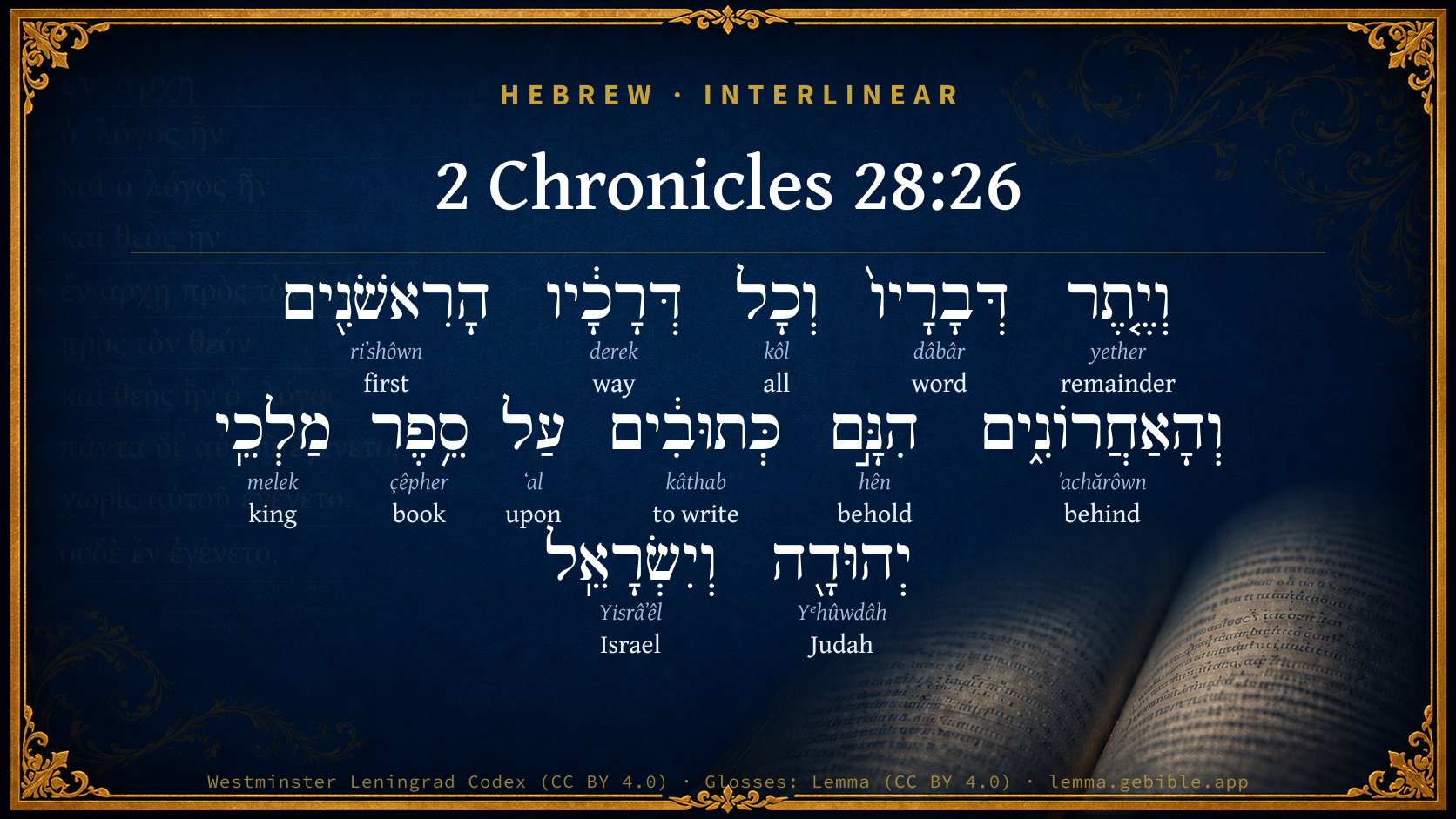
2 Chronicles 28:26

Hebrew (Westminster Leningrad Codex) 2 Chronicles 28:26 appears in the Hebrew Old Testament. The text above is from the Westminster Leningrad Codex. Each word links to its Strong’s number, a concise gloss, and parsing drawn from the Open Scriptures Hebrew Bible morphology. Click any word for its full Brown-Driver-Briggs (BDB) entry.
Download image
Cite this verse

2 Chronicles 28:26 (World English Bible). Public Domain. Lemma interlinear Bible study tool, https://lemma.gebible.app/v/2-chronicles/28/26.

Show BibTeX & RIS
BibTeX
RIS
English Translation
Now the rest of his acts, and all his ways, first and last, behold, they are written in the book of the kings of Judah and Israel.
World English Bible · Public Domain
Download a study sheet

One document with this verse’s original text, its word-by-word gloss line, the meaning frame, cross-references with their text, attributed commentary, and full source and license credits — printable, and it pastes into notes with its structure intact.

This verse Autodidact and up

Study sheet (.html) Plain text (.txt)

A passage Seminary Student

Up to 50 verses in one chapter. A passage sheet keeps up to 6 commentary sources and 12 cross-references per verse, in the order this page ranks them, and says so on the sheet whenever that leaves anything out. Ask for a single verse and you get the Autodidact verse sheet above.

Everything on this page stays free to read, with no account — the sheet is a download of what is already on screen, not access to it.

Want to remove ads? Support Godless Engineer
Compare translations 3

The same verse in 3 English versions, stacked beneath the original-language interlinear above. Click any original word for its lexicon entry.

Each is an independent rendering of the whole verse — the interlinear is not word-aligned to these translations.

Highlighted words mark where these versions differ — a whole-verse word diff, not a word-by-word alignment.

  • World English Bible Public Domain
    Now the rest of his acts, and all his ways, first and last, behold, they are written in the book of the kings of Judah and Israel.
  • King James Version Public Domain
    Now the rest of his acts and of all his ways, first and last, behold, they are written in the book of the kings of Judah and Israel.
  • unfoldingWord Literal Text CC BY-SA 4.0
    And the remainder of his matters and all his ways, the first things and the last things, behold, they are written on the scroll of the kings of Judah and Israel.

unfoldingWord Literal Text — © unfoldingWord, licensed CC BY-SA 4.0. Word-aligned USFM3 via Door43 (git.door43.org/unfoldingWord/en_ult).

Versions to compare (up to 4)

3 of 4 selected

Show all 18 translations

Every available English version of this verse, each an independent rendering of the whole verse.

  • World English Bible Public Domain
    Now the rest of his acts, and all his ways, first and last, behold, they are written in the book of the kings of Judah and Israel.
  • Berean Standard Bible Public Domain
    As for the rest of the acts of Ahaz and all his ways, from beginning to end, they are indeed written in the Book of the Kings of Judah and Israel.
  • Majority Standard Bible Public Domain
    As for the rest of the acts of Ahaz and all his ways, from beginning to end, they are indeed written in the Book of the Kings of Judah and Israel.
  • King James Version Public Domain
    Now the rest of his acts and of all his ways, first and last, behold, they are written in the book of the kings of Judah and Israel.
  • American Standard Version (1901) Public Domain
    Now the rest of his acts, and all his ways, first and last, behold, they are written in the book of the kings of Judah and Israel.
  • Revised Version (1885) Public Domain
    Now the rest of his acts, and all his ways, first and last, behold, they are written in the book of the kings of Judah and Israel.
  • Geneva Bible (1599) Public Domain
    Concerning the rest of his actes, and all his wayes first and last, beholde, they are written in the booke of the Kings of Iudah, and Israel.
  • Douay-Rheims (1899) Public Domain
    But the rest of his acts, and all his works first and last are written in the book of the kings of Juda and Israel.
  • Young's Literal Translation Public Domain
    And the rest of his matters, and all his ways, the first and the last, lo, they are written on the book of the kings of Judah and Israel.
  • Literal Standard Version CC BY-SA 4.0
    And the rest of his matters, and all his ways, the first and the last, behold, they are written on the scroll of the kings of Judah and Israel.
  • Unlocked Literal Bible CC BY-SA 4.0
    Now the rest of his deeds, and all his ways, first and last, see, they are written in the book of the kings of Judah and Israel.
  • unfoldingWord Literal Text CC BY-SA 4.0
    And the remainder of his matters and all his ways, the first things and the last things, behold, they are written on the scroll of the kings of Judah and Israel.
  • Darby Bible Public Domain
    And the rest of his acts, and all his ways, first and last, behold, they are written in the book of the kings of Judah and Israel.
  • World Messianic Bible Public Domain
    Now the rest of his acts, and all his ways, first and last, behold, they are written in the book of the kings of Judah and Israel.
  • Webster's Bible Public Domain
    Now the rest of his acts and of all his ways, first and last, behold, they are written in the book of the kings of Judah and Israel.
  • Free Bible Version CC BY-SA 4.0
    The rest of what Ahaz did, from beginning to end, is written down in the Book of the Kings of Judah and Israel.
  • Bible in Basic English Public Domain
    Now the rest of his acts and all his ways, first and last, are recorded in the book of the kings of Judah and Israel.
  • JPS Tanakh (1917) Public Domain
    Now the rest of his acts, and all his ways, first and last, behold, they are written in the book of the kings of Judah and Israel.

Literal Standard Version (2020), Covenant Press — licensed CC BY-SA 4.0. Text via the HelloAO Bible API (eBible.org). Unlocked Literal Bible (unfoldingWord) — licensed CC BY-SA 4.0. Text via the HelloAO Bible API (eBible.org). unfoldingWord Literal Text — © unfoldingWord, licensed CC BY-SA 4.0. Word-aligned USFM3 via Door43 (git.door43.org/unfoldingWord/en_ult). Free Bible Version, Dr. Jonathan Gallagher — licensed CC BY-SA 4.0. Text via the HelloAO Bible API (eBible.org).

Word by word

More ways to search: Search by grammar → Find every occurrence → Compare this word →

Practice this passage: Drill this verse → Learn its vocabulary →

וְהָאַחֲרוֹנִ֑ים
ʼachărôwn
H314
“and · the · behind”
Conjunction + Particle, Definite Article + Adjective, Adjective, Masculine, Plural, Absolute
Part of Speech
Conjunction + Particle + Adjective
Type
Adjective
Gender
Masculine
Number
Plural
State
Absolute
Full BDB Definition

Origin: from H309

TWOT: 68e

behind, following, subsequent, western - behind, hindermost, western (of location) - later, subsequent, latter, last (of time)
  1. וְיֶ֤תֶר yether H3499 “and · remainder of” Conjunction + Noun, Common, Masculine, Singular, Construct
  2. דְּבָרָיו֙ dâbâr H1697 “words · his” Noun, Common, Masculine, Plural, Construct + Suffix, Personal, 3rd Person, Masculine, Singular
  3. וְכָל kôl H3605 “and · all of” Conjunction + Noun, Common, Masculine, Singular, Construct
  4. דְּרָכָ֔יו derek H1870 “ways · his” Noun, Common, Both, Plural, Construct + Suffix, Personal, 3rd Person, Masculine, Singular
  5. הָרִאשֹׁנִ֖ים riʼshôwn H7223 “the · first” Particle, Definite Article + Adjective, Adjective, Masculine, Plural, Absolute
  6. הִנָּ֣ם hên H2005 “behold · them” Particle, Demonstrative + Suffix, Personal, 3rd Person, Masculine, Plural
  7. כְּתוּבִ֔ים kâthab H3789 “written” Verb, Qal, Participle Passive, Masculine, Plural, Absolute
  8. עַל ʻal H5921 “upon” Preposition
  9. סֵ֥פֶר çêpher H5612 “book of” Noun, Common, Masculine, Singular, Construct
  10. מַלְכֵֽי melek H4428 “kings of” Noun, Common, Masculine, Plural, Construct
  11. יְהוּדָ֖ה Yᵉhûwdâh H3063 “Judah” Noun, Proper
  12. וְיִשְׂרָאֵֽל Yisrâʼêl H3478 “and · Israel” Conjunction + Noun, Proper

About this verse

These counts appear in no published source. They are computed here, from the morphology-tagged text and Lemma’s own curated glosses. What Lemma adds →

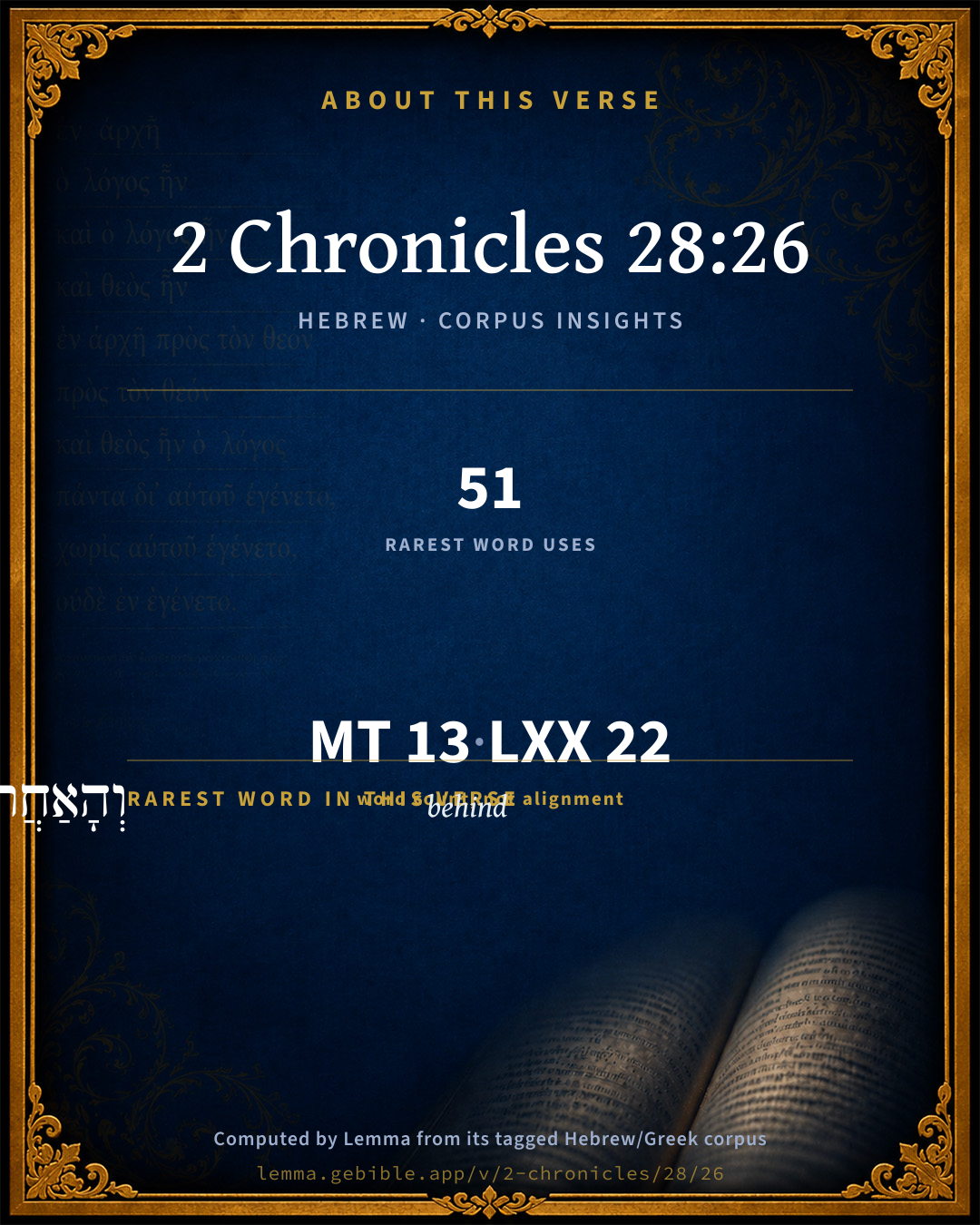
13
words
13
distinct lemmas
Historical
section

Shared distinctive vocabulary

וְהָאַחֲרוֹנִ֑ים behind H314 occurs in 48 verses of the Hebrew Bible. Also found in:

Grammatical profile

  • 1 verb
  • 8 nouns
  • 2 adjectives
  • 1 preposition
  • 1 particle

Verb forms

  • כְּתוּבִ֔ים Qal · Participle Passive

Hebrew & Septuagint length

In English translation the verse runs 27 words from the Hebrew and 28 from the Septuagint (LXX English) — closely comparable.

A rough comparison of the two English renderings, which tokenize alike — not a word-level alignment.

Word counts can differ between the Hebrew and the Greek without any difference in meaning — e.g. the Hebrew direct-object marker אֵת has no separate Greek word, and Greek often adds the article ὁ.

In the original languages it is 13 Hebrew tokens and 22 Greek tokens — but the two are counted differently (Hebrew bundles its prefixes and suffixes into one token; the Greek is in lemma form), so that isn’t a like-for-like length.

Cross-references

3

Topical passages linked to 2 Chronicles 28:26 in the Treasury of Scripture Knowledge — connected by theme and wording, ordered by reader-vote popularity; previews shown in the World English Bible.

  • 2 Kings 16:19–20 Now the rest of the acts of Ahaz which he did, aren't they written in the book of the chronicles of the kings of Judah?
  • 2 Chronicles 20:34 Now the rest of the acts of Jehoshaphat, first and last, behold, they are written in the history of Jehu the son of Hanani, which is inserted in the book of the kings of Israel.
  • 2 Chronicles 27:7–9 Now the rest of the acts of Jotham, and all his wars, and his ways, behold, they are written in the book of the kings of Israel and Judah.

Cross-references courtesy of OpenBible.info (CC BY 4.0).

Hebrew and Greek witnesses Masoretic Hebrew ↔ Greek Septuagint

The same verse in the two great witnesses to the Old Testament, shown verse-for-verse.

These are two independent witnesses, not word-aligned to each other, and the Septuagint is shown in lemma (dictionary) form.

Hebrew 2 Chronicles 28:26 Masoretic · Westminster Leningrad Codex

וְיֶ֤תֶר דְּבָרָיו֙ וְכָל דְּרָכָ֔יו הָרִאשֹׁנִ֖ים וְהָאַחֲרוֹנִ֑ים הִנָּ֣ם כְּתוּבִ֔ים עַל סֵ֥פֶר מַלְכֵֽי יְהוּדָ֖ה וְיִשְׂרָאֵֽל

Now the rest of his acts, and all his ways, first and last, behold, they are written in the book of the kings of Judah and Israel.

World English Bible · Public Domain

Greek LXX 2 Chronicles 28:26 Septuagint · lemma form

καί ὁ λοιπός λόγος αὐτός καί ὁ πρᾶξις αὐτός ὁ πρῶτος καί ὁ ἔσχατος ἰδού γράφω ἐπί βιβλίον βασιλεύς ἰουδά καί ἰσραήλ

And the rest of his acts, and his deeds, the first and the last, behold, they are written in the book of the kings of Juda and Israel.

LXX2012 (modern English Septuagint) · Public Domain

Hebrew: Westminster Leningrad Codex (CC BY 4.0). Greek: Septuagint (public domain); English from LXX2012 (modern English Septuagint) (Public Domain). How the Septuagint differs from the Hebrew →

Commentary

Notes on 2 Chronicles 28:26 from classic Christian and Jewish commentators (each source and its license shown beneath its notes). The classic Christian expositions comment on the surrounding passage and are grouped to its opening verse, so a note may address several verses; the Jewish commentaries on the Tanakh (Rashi and others) are per-verse, so they appear only where the commentator wrote on this verse.

Lemma curates 59 commentaries, every one of them public domain or Creative Commons licensed, each selected and text-cleaned for this edition rather than reprinted as found. About our sources →

Ellicott's Commentary for English Readers

CLOSING NOTICES (2Ch_28:26-27. Comp. 2Ki_16:19-20).

(26) Now the rest of his acts, and of all his ways.—The chronicler has varied the usual formula. (See chapter 25:26, 26:7, &c., and comp. 2Ki_16:19.)

But (for) they brought him not into the sepulchres of the kings of Israel.—Wanting in Kings. (See Note on chaps, 21:20, 26:23.) Thenius supposes that this statement is founded either upon mistake, or upon zeal for the Law. But why not upon a written authority?

A Bible Commentary for English Readers, edited by Charles John Ellicott (1878–1897) — public domain. Text from a community e-Sword module.

Trapp's Complete Commentary

John Trapp

2Ch 28:26 Now the rest of his acts and of all his ways, first and last, behold, they [are] written in the book of the kings of Judah and Israel.

Ver. 26. And all his ways.] See 2Ch 27:7.

John Trapp, A Commentary or Exposition upon All the Books of the Old and New Testament (1647–1656) — public domain. Text from a community e-Sword module.

Tyndale Open Study Notes

Tyndale Open Resources

28:26 Samaria, the capital of the northern kingdom of Israel, fell to Assyria in 722 BC, during the twenty-first year of Ahaz’s reign in Judah (2 Kgs 17:1-6). The Chronicler, with his emphasis on the southern kingdom, does not even mention this event.

Tyndale Open Study Notes — © Tyndale Open Resources, licensed CC BY-SA 4.0. Text via the HelloAO Bible API.

The Pulpit Commentary

The book of the kings of Judah and Israel. Parallel (ver. 19), "the book of the chronicles of the kings of Judah."

The Pulpit Commentary (1880–1919), ed. H.D.M. Spence-Jones & Joseph S. Exell — public domain. Text from a community e-Sword module.

Keil & Delitzsch

C. F. Keil & F. Delitzsch

The liberation of the prisoners. - In Samaria there was a prophet of the Lord (i.e., not of the Jahve there worshipped in the calf images, but of the true God, like Hosea, who also at that time laboured in the kingdom of the ten tribes), Oded by name. He went forth to meet the army returning with the prisoners and the booty, as Azariha-ben-Oded (Ch2 15:2) once went to meet Asa; pointed out to the warriors the cruelty of their treatment of their brethren, and the guilt, calling to Heaven for vengeance, which they thereby incurred; and exhorted them to turn away the anger of God which was upon them, by sending back the prisoners. To soften the hearts of the rude warriors, and to gain them for his purpose, he tells them (Ch2 28:9), "Because the Lord God of your fathers was wroth, He gave them (the men of Judah) into your hand:" your victory over them is consequently not the fruit of your power and valour, but the work of the God of your fathers, whose wrath Judah has drawn upon itself by its defection from Him. This you should have considered, and so have had pity upon those smitten by the wrath of God; "but he have slaughtered among them with a rage which reacheth up to heaven," i.e., not merely with a rage beyond all measure, but a rage which calls to God for vengeance; cf. Ezr 9:6.

Ch2 28:10

"And now the sons of Judah and Jerusalem ye purpose to subject to yourselves for bondmen and bondwomen!" יהוּדה בּני is accus., and precedes as being emphatic; i.e., your brethren, whom the wrath of God has smitten, you purpose to keep in subjection. אתּם also is emphatically placed, and then is again emphasized at the end of the sentence by the suffix in לכם: "Are there not, only concerning you, with you, sins with Jahve your God?" i.e., Have you, to regard only you, not also burdened yourselves with many sins against the Lord? The question הלא, is a lively way of expressing assurance as to a matter which is not at all doubtful.

Ch2 28:11

After thus quickening the conscience, he calls upon them to send back the prisoners which they had carried away from among their brethren, because the anger of Jahve was upon them. Already in their pitiless butchery of their brethren they had committed a sin which cried to heaven, which challenged God's anger and His punishments; but by the carrying away of the women and children from their brethren they had filled up the measure of their sin, so that God's anger and rage must fall upon them.

Ch2 28:12-13

This speech made a deep impression. Four of the heads of the Ephraimites, here mentioned by name, - according to Ch2 28:12, four princes at the head of the assembled people, - came before those coming from the army (על קוּם, to come forward before one, to meet one), and said, Ch2 28:13, "Bring not the captives hither; for in order that a sin of Jahve come upon us, do you purpose (do you intend) to add to our sins and to our guilt?" i.e., to increase our sins and our guilt by making these prisoners slaves; "for great is our guilt, and fierce wrath upon Israel."

Ch2 28:14

Then the armed men (החלוּץ, cf. Ch1 12:23) who had escorted the prisoners to Samaria left the prisoners and the booty before the princes and the whole assembly.

Ch2 28:15

Keil & Delitzsch — Biblical Commentary on the Old Testament (1861–1891) — public domain (CC PDM 1.0). Text via the HelloAO Bible API. (Old Testament only.)

unfoldingWord translationNotes

Door43 World Missions Community

all his ways, first and last

Ahaz's actions are spoken of as if they were a path upon which he walked. The phrase "first and last" refers to those extremes and everything in between. AT: "all that he did from the beginning of his reign to the end of his reign" (See: Metaphor and Merism)

see, they are written in the book ... Israel

"anyone can look at the book ... Israel and see that they are written there"

they are written in the book

This can be stated in active form. AT: "someone has written them in the book" or "you can read of them in the book" (See: Active or Passive)

the book of the kings of Judah and Israel

This is a book that no longer exists.

Ahaz slept with his ancestors

Ahaz dying is spoken of as if he had fallen asleep. AT: "Ahaz died" (See: Metaphor and Euphemism)

they buried him

"people buried him"

became king in his place

The phrase "in his place" is a metaphor meaning "instead of him." AT: "became king instead of Ahaz" (See: Metaphor)

translationWords

works

written

king

kingdom of Judah

kingdom of Israel

grave

Hezekiah

unfoldingWord translationNotes — © Distant Shores Media and the Door43 World Missions Community, licensed CC BY-SA 4.0. Source: git.door43.org/Door43/en_tn.

Lesson kit

Teaching starters — assembled from the data on this page, not authored interpretation. Every prompt links to the verse data it draws on. Edit before teaching.

2 Chronicles, in the Historical, opens this verse with 13 words (13 distinct Hebrew lemmas). Its most distinctive word is ʼachărôwn (“behind”). A historical commentator’s framing appears above. Read the whole chapter for the surrounding context.

Discussion questions

  1. How does “behind” (ʼachărôwn) shape what this verse is saying?
  2. Genesis 33:2 shares the word «behind» with this verse. How do the two illuminate each other?
  3. The translations on this page render this verse differently — a whole-verse word diff, not a word-by-word alignment. What might account for the different wordings?
  4. The verb «כְּתוּבִ֔ים» is Qal Participle Passive. How does its form color the action?
  5. Reading how Ellicott's Commentary for English Readers and Trapp's Complete Commentary read this verse, where do the two commentators agree and where do they part?

Things to notice

Reading settings

Reading text

Shown beneath each verse's original-language words.

Old Testament
Old Testament edition

Read the OT as the Masoretic Hebrew (MT) or the Greek Septuagint (LXX).

English shown for the Greek Septuagint (in the Hebrew ↔ Greek comparison).

Comparing translations? Open the Compare panel on any verse page to stack up to four side by side.