Isaiah 50:9

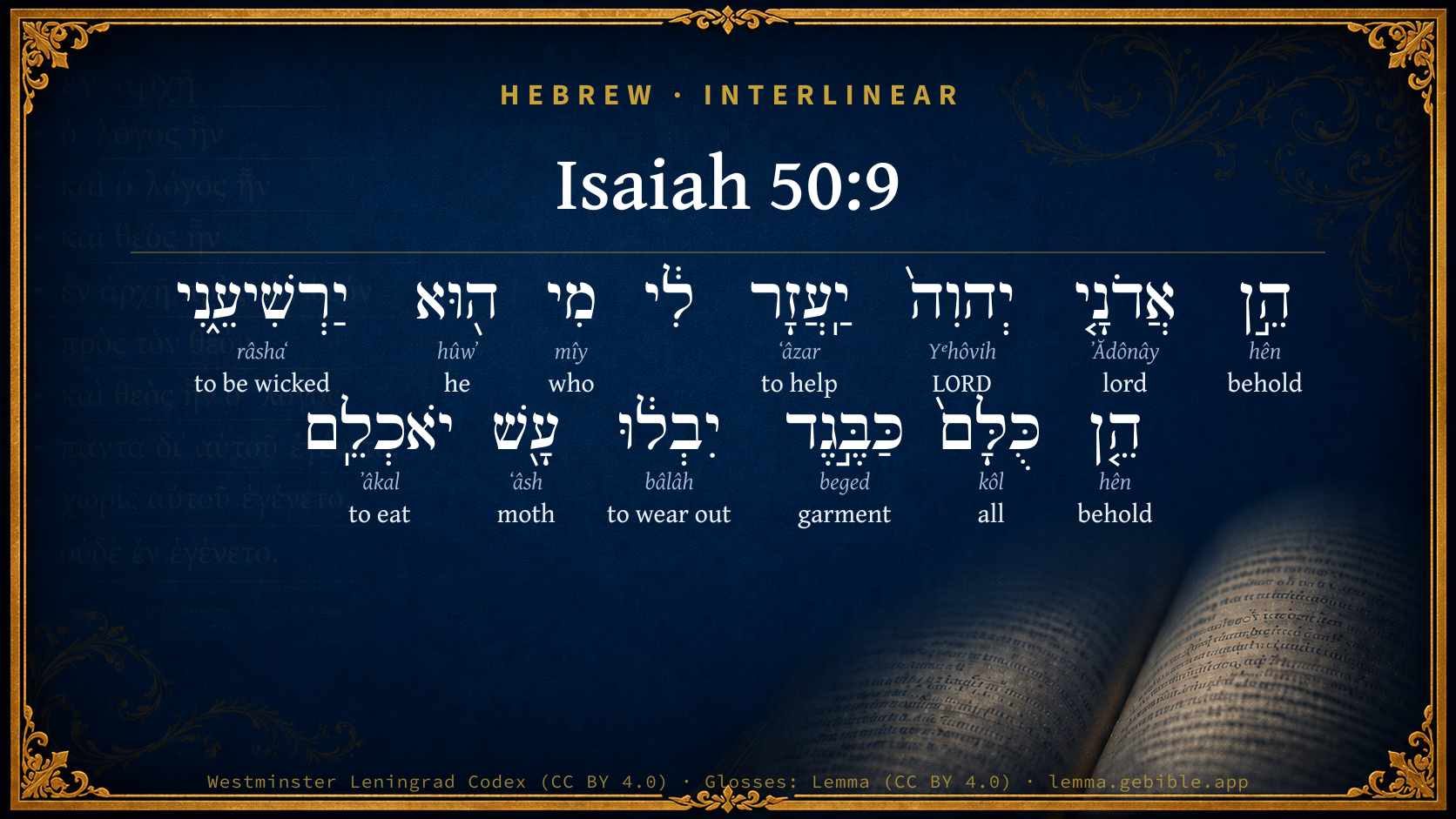
Hebrew (Westminster Leningrad Codex) Isaiah 50:9 appears in the Hebrew Old Testament. The text above is from the Westminster Leningrad Codex. Each word links to its Strong’s number, a concise gloss, and parsing drawn from the Open Scriptures Hebrew Bible morphology. Click any word for its full Brown-Driver-Briggs (BDB) entry.
Download image
Cite this verse

Isaiah 50:9 (World English Bible). Public Domain. Lemma interlinear Bible study tool, https://lemma.gebible.app/v/isaiah/50/9.

Show BibTeX & RIS
BibTeX
RIS
English Translation
Behold, the Lord Yahweh will help me; who is he who shall condemn me? Behold, all they shall wax old as a garment, the moth shall eat them up.
World English Bible · Public Domain
Download a study sheet

One document with this verse’s original text, its word-by-word gloss line, the meaning frame, cross-references with their text, attributed commentary, and full source and license credits — printable, and it pastes into notes with its structure intact.

This verse Autodidact and up

Study sheet (.html) Plain text (.txt)

A passage Seminary Student

Up to 50 verses in one chapter. A passage sheet keeps up to 6 commentary sources and 12 cross-references per verse, in the order this page ranks them, and says so on the sheet whenever that leaves anything out. Ask for a single verse and you get the Autodidact verse sheet above.

Everything on this page stays free to read, with no account — the sheet is a download of what is already on screen, not access to it.

Want to remove ads? Support Godless Engineer
Compare translations 3

The same verse in 3 English versions, stacked beneath the original-language interlinear above. Click any original word for its lexicon entry.

Each is an independent rendering of the whole verse — the interlinear is not word-aligned to these translations.

Highlighted words mark where these versions differ — a whole-verse word diff, not a word-by-word alignment.

  • World English Bible Public Domain
    Behold, the Lord Yahweh will help me; who is he who shall condemn me? Behold, all they shall wax old as a garment, the moth shall eat them up.
  • King James Version Public Domain
    Behold, the Lord GOD will help me; who is he that shall condemn me? lo, they all shall wax old as a garment; the moth shall eat them up.
  • unfoldingWord Literal Text CC BY-SA 4.0
    Behold, the Lord Yahweh will help me. Who he condemns me? Behold, all of them will wear out like a garment; the moth will devour them. q1

unfoldingWord Literal Text — © unfoldingWord, licensed CC BY-SA 4.0. Word-aligned USFM3 via Door43 (git.door43.org/unfoldingWord/en_ult).

Versions to compare (up to 4)

3 of 4 selected

Show all 18 translations

Every available English version of this verse, each an independent rendering of the whole verse.

  • World English Bible Public Domain
    Behold, the Lord Yahweh will help me; who is he who shall condemn me? Behold, all they shall wax old as a garment, the moth shall eat them up.
  • Berean Standard Bible Public Domain
    Surely the Lord GOD helps Me. Who is there to condemn Me? See, they will all wear out like a garment; the moths will devour them.
  • Majority Standard Bible Public Domain
    Surely the Lord GOD helps Me. Who is there to condemn Me? See, they will all wear out like a garment; the moths will devour them.
  • King James Version Public Domain
    Behold, the Lord GOD will help me; who is he that shall condemn me? lo, they all shall wax old as a garment; the moth shall eat them up.
  • American Standard Version (1901) Public Domain
    Behold, the Lord Jehovah will help me; who is he that shall condemn me? behold, all they shall wax old as a garment, the moth shall eat them up.
  • Revised Version (1885) Public Domain
    Behold, the Lord GOD will help me; who is he that shall condemn me? behold, they all shall wax old as a garment; the moth shall eat them up.
  • Geneva Bible (1599) Public Domain
    Beholde, the Lord God will helpe me: who is he that can condemne me? loe, they shall waxe olde as a garment: the mothe shall eate them vp.
  • Douay-Rheims (1899) Public Domain
    Behold the Lord God is my helper: who is he that shall condemn me? Lo, they shall all be destroyed as a garment, the moth shall eat them up.
  • Young's Literal Translation Public Domain
    Lo, the Lord Jehovah giveth help to me, Who `is' he that declareth me wicked? Lo, all of them as a garment wear out, A moth doth eat them.
  • Literal Standard Version CC BY-SA 4.0
    Behold, Lord YHWH gives help to Me, || Who [is] he that declares Me wicked? Behold, all of them wear out as a garment, || A moth eats them.
  • Unlocked Literal Bible CC BY-SA 4.0
    See, the Lord Yahweh will help me. Who will declare me guilty? See, they will all wear out like a garment; the moth will eat them up.
  • unfoldingWord Literal Text CC BY-SA 4.0
    Behold, the Lord Yahweh will help me. Who he condemns me? Behold, all of them will wear out like a garment; the moth will devour them. q1
  • Darby Bible Public Domain
    Behold, the Lord Jehovah will help me; who is he that shall condemn me? Behold, they all shall grow old as a garment; the moth shall eat them up.
  • World Messianic Bible Public Domain
    Behold, the Lord GOD will help me! Who is he who will condemn me? Behold, they will all grow old like a garment. The moths will eat them up.
  • Webster's Bible Public Domain
    Behold the Lord GOD will help me; who is he that shall condemn me? lo, they all shall wax old as a garment; the moth shall eat them up.
  • Free Bible Version CC BY-SA 4.0
    The Lord God defends me. Who is going to declare me guilty? Look! Those who try will fall apart like old clothing, eaten up by moths.
  • Bible in Basic English Public Domain
    See, the Lord God is my helper; who will give a decision against me? truly, all of them will become old like a robe; they will be food for the worm.
  • JPS Tanakh (1917) Public Domain
    Behold, the Lord GOD will help me; who is he that shall condemn me? Behold, they all shall wax old as a garment, the moth shall eat them up.

Literal Standard Version (2020), Covenant Press — licensed CC BY-SA 4.0. Text via the HelloAO Bible API (eBible.org). Unlocked Literal Bible (unfoldingWord) — licensed CC BY-SA 4.0. Text via the HelloAO Bible API (eBible.org). unfoldingWord Literal Text — © unfoldingWord, licensed CC BY-SA 4.0. Word-aligned USFM3 via Door43 (git.door43.org/unfoldingWord/en_ult). Free Bible Version, Dr. Jonathan Gallagher — licensed CC BY-SA 4.0. Text via the HelloAO Bible API (eBible.org).

Word by word

More ways to search: Search by grammar → Find every occurrence → Compare this word →

Practice this passage: Drill this verse → Learn its vocabulary →

עָ֖שׁ
ʻâsh
H6211
“moth”
Noun, Common, Masculine, Singular, Absolute
Part of Speech
Noun
Type
Common
Gender
Masculine
Number
Singular
State
Absolute
Full BDB Definition

Origin: from H6244

TWOT: 1715a , 1617 , 2931

moth - herbage, grass
  1. הֵ֣ן hên H2005 “behold” Particle, Demonstrative
  2. אֲדֹנָ֤י ʼĂdônây H136 “Lord · my” Noun, Common, Masculine, Plural, Construct + Suffix, Personal, 1st Person, Common, Singular
  3. יְהוִה֙ Yᵉhôvih H3069 “LORD” Noun, Proper
  4. יַֽעֲזָר ʻâzar H5826 “to help” Verb, Qal, Imperfect, 3rd Person, Masculine, Singular
  5. מִי mîy H4310 “who” Particle, Interrogative
  6. ה֖וּא hûwʼ H1931 “he” Pronoun, Personal, 3rd Person, Masculine, Singular
  7. יַרְשִׁיעֵ֑נִי râshaʻ H7561 “to be wicked · me” Verb, Hiphil, Imperfect, 3rd Person, Masculine, Singular + Suffix, Personal, 1st Person, Common, Singular
  8. הֵ֤ן hên H2005 “behold” Particle, Demonstrative
  9. כֻּלָּם֙ kôl H3605 “all · their” Noun, Common, Masculine, Singular, Construct + Suffix, Personal, 3rd Person, Masculine, Plural
  10. כַּבֶּ֣גֶד beged H899 “like/as the · garment” Preposition, Determined + Noun, Common, Masculine, Singular, Absolute
  11. יִבְל֔וּ bâlâh H1086 “to wear out” Verb, Qal, Imperfect, 3rd Person, Masculine, Plural
  12. יֹאכְלֵֽם ʼâkal H398 “to eat · them” Verb, Qal, Imperfect, 3rd Person, Masculine, Singular + Suffix, Personal, 3rd Person, Masculine, Plural

About this verse

These counts appear in no published source. They are computed here, from the morphology-tagged text and Lemma’s own curated glosses. What Lemma adds →

14
words
12
distinct lemmas
Prophets
section

Notable vocabulary

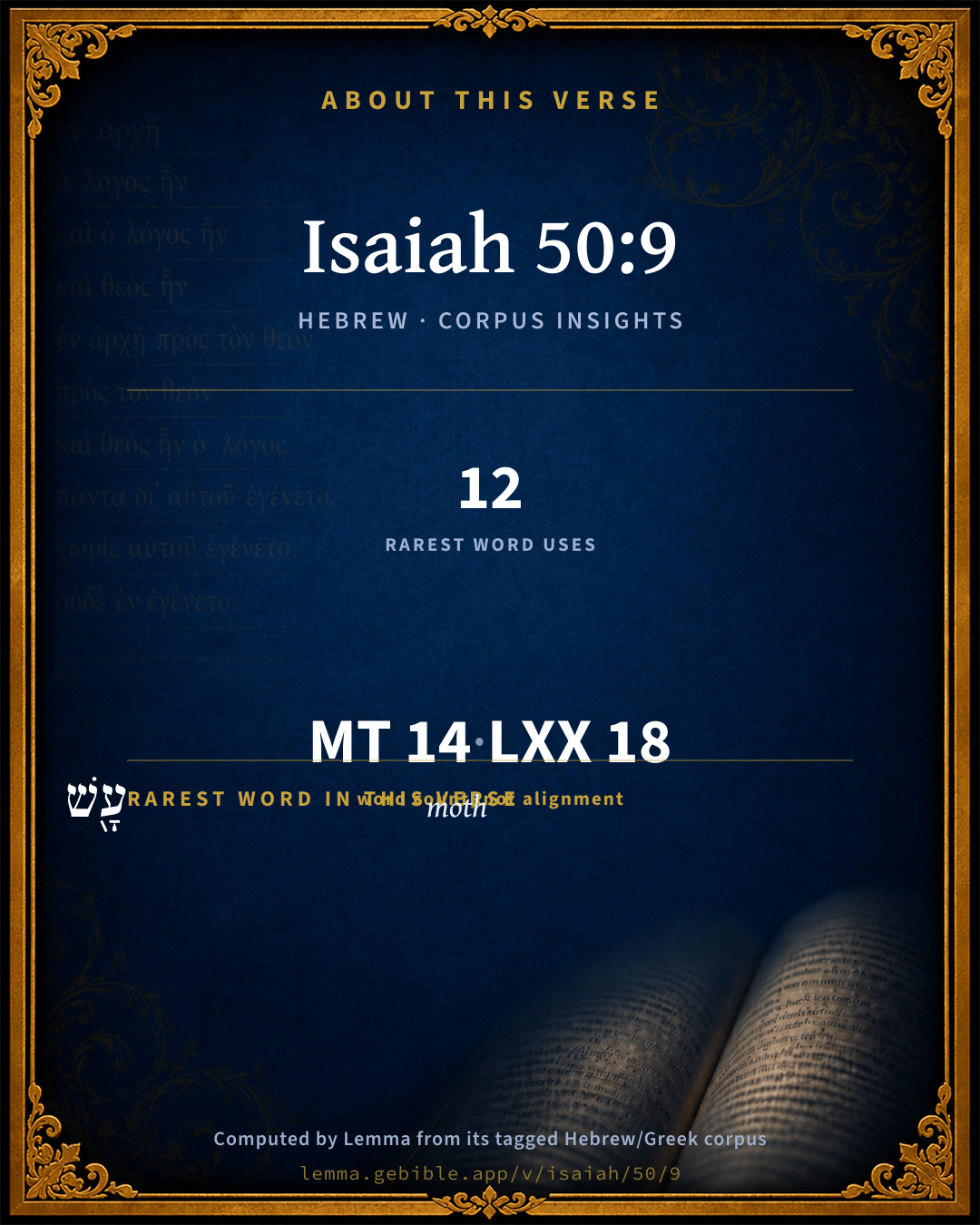
The rarest word here is עָ֖שׁ moth H6211 — appearing just 12 times in the whole Hebrew Bible.

Shared distinctive vocabulary

עָ֖שׁ moth H6211 occurs in 12 verses of the Hebrew Bible. Also found in:

Grammatical profile

  • 4 verbs
  • 5 nouns
  • 1 pronoun
  • 1 preposition
  • 3 particles

Verb forms

  • יַֽעֲזָר Qal · Imperfect
  • יַרְשִׁיעֵ֑נִי Hiphil · Imperfect
  • יִבְל֔וּ Qal · Imperfect
  • יֹאכְלֵֽם Qal · Imperfect

Repetition

A word recurs within this verse — often emphatic in Hebrew:

  • הֵ֣ן behold H2005 ×2

Hebrew & Septuagint length

In English translation the verse runs 29 words from the Hebrew and 27 from the Septuagint (LXX English) — closely comparable.

A rough comparison of the two English renderings, which tokenize alike — not a word-level alignment.

Word counts can differ between the Hebrew and the Greek without any difference in meaning — e.g. the Hebrew direct-object marker אֵת has no separate Greek word, and Greek often adds the article ὁ.

In the original languages it is 14 Hebrew tokens and 18 Greek tokens — but the two are counted differently (Hebrew bundles its prefixes and suffixes into one token; the Greek is in lemma form), so that isn’t a like-for-like length.

Cross-references

6

Topical passages linked to Isaiah 50:9 in the Treasury of Scripture Knowledge — connected by theme and wording, ordered by reader-vote popularity; previews shown in the World English Bible.

  • Job 13:28 Though I am decaying like a rotten thing, Like a garment that is moth-eaten.
  • Psalms 102:26 They will perish, but you will endure. Yes, all of them will wear out like a garment. You will change them like a cloak, and they will be changed.
  • Isaiah 41:10 Don't you be afraid, for I am with you; don't be dismayed, for I am your God; I will strengthen you; yes, I will help you; yes, I will uphold you with the right hand of my righteousness.
  • Hebrews 1:11–12 They will perish, but you continue. They all will grow old like a garment does.
  • Psalms 39:11 When you rebuke and correct man for iniquity, You consume his wealth like a moth. Surely every man is but a breath." Selah.
  • Isaiah 51:6–8 Lift up your eyes to the heavens, and look on the earth beneath; for the heavens shall vanish away like smoke, and the earth shall wax old like a garment; and those who dwell therein shall die in like manner: but my salvation shall be forever, and my righteousness shall not be abolished.

Cross-references courtesy of OpenBible.info (CC BY 4.0).

Hebrew and Greek witnesses Masoretic Hebrew ↔ Greek Septuagint

The same verse in the two great witnesses to the Old Testament, shown verse-for-verse.

These are two independent witnesses, not word-aligned to each other, and the Septuagint is shown in lemma (dictionary) form.

Hebrew Isaiah 50:9 Masoretic · Westminster Leningrad Codex

הֵ֣ן אֲדֹנָ֤י יְהוִה֙ יַֽעֲזָר לִ֔י מִי ה֖וּא יַרְשִׁיעֵ֑נִי הֵ֤ן כֻּלָּם֙ כַּבֶּ֣גֶד יִבְל֔וּ עָ֖שׁ יֹאכְלֵֽם

Behold, the Lord Yahweh will help me; who is he who shall condemn me? Behold, all they shall wax old as a garment, the moth shall eat them up.

World English Bible · Public Domain

Greek LXX Isaiah 50:9 Septuagint · lemma form

ἰδού κύριος βοηθέω ἐγώ τίς κακόω ἐγώ ἰδού πᾶς σύ ὡς ἱμάτιον παλαιόω καί ὡς σής καταἐσθίω σύ

Behold, the Lord, the Lord, will help me; who will hurt me? behold, all you⌃ shall wax old as a garment, and a moth shall devour you.

LXX2012 (modern English Septuagint) · Public Domain

Hebrew: Westminster Leningrad Codex (CC BY 4.0). Greek: Septuagint (public domain); English from LXX2012 (modern English Septuagint) (Public Domain). How the Septuagint differs from the Hebrew →

Targum (Aramaic paraphrase)

1

The Targum is the ancient Jewish Aramaic paraphrase of the Hebrew Scriptures — an interpretive translation, not the Hebrew text itself. Onkelos (literal) and Pseudo-Jonathan (expansive) render the Torah, and Jonathan the Prophets. Coverage is partial: where no permissively-licensed English translation exists for a verse, only the Aramaic is shown. This is verse-level text, not a word-by-word alignment to the Hebrew.

  1. Targum Jonathan Prophets (Joshua–Malachi)
    הָא יְיָ אֱלֹהִים סָעִיד לִי מַן הוּא דִי יְחַיְבִינַנִי הָא כוּלְהוֹן כִּלְבוּשָׁא דִבְלִי וּכְעָשָׁא אָכִיל לֵהּ:

    Behold, the Lord God is my helper; who is he that shall condemn me? lo, they all shall be as a garment that waxeth old, yea, as when the moth eateth it.

    Targum Jonathan — Aramaic: “Mikraot Gedolot” (public domain). English: “Sefaria Community Translation” (CC0 1.0 (public-domain dedication)); “London "Chaldee Paraphrase," 1871” (public domain). Text via Sefaria.

Commentary

Notes on Isaiah 50:9 from classic Christian and Jewish commentators (each source and its license shown beneath its notes). The classic Christian expositions comment on the surrounding passage and are grouped to its opening verse, so a note may address several verses; the Jewish commentaries on the Tanakh (Rashi and others) are per-verse, so they appear only where the commentator wrote on this verse.

Lemma curates 59 commentaries, every one of them public domain or Creative Commons licensed, each selected and text-cleaned for this edition rather than reprinted as found. About our sources →

Trapp's Complete Commentary

John Trapp

Isa 50:9 Behold, the Lord GOD will help me; who [is] he [that] shall condemn me? lo, they all shall wax old as a garment; the moth shall eat them up.

Ver. 9. Behold, the Lord God will help me.] See Isa 50:7.

Who is he that shall condemn me.] {a} If Libanius could say of his friend Basil (though of a different religion), Let but him praise me, and I care not who dispraiseth me; how much better might Christ, and may every good Christian say the same of God!

Lo, they shall all wax old as a garment.] The scribes and Pharisees (those old cankered carles) shall; for of them Jerome, Cyril, and others understand it. The Romans - according as they feared, and therefore crucified Christ {Joh 11:48} - came upon them, and took away both them and their nation.

The moth shall eat them up,] i.e., They shall be irrecoverably ruined, being once laid aside by God as an old wornout garment, which is made thereby food for moths. Thus it befell Pilate (saith Lyra here), banished by Tiberius; and thus it befell the priests, who were burned by Titus in the temple; who also added that it was fit that those which served in the temple should perish together with it.

{a} Kατα παντας εχω τα νικητηρια.

John Trapp, A Commentary or Exposition upon All the Books of the Old and New Testament (1647–1656) — public domain. Text from a community e-Sword module.

Tyndale Open Study Notes

Tyndale Open Resources

50:9 Who will declare me guilty? The implied answer to this rhetorical question is, “No one!” This answer foreshadows the New Testament understanding of justification (see Rom 8:31-35).

Tyndale Open Study Notes — © Tyndale Open Resources, licensed CC BY-SA 4.0. Text via the HelloAO Bible API.

Jamieson, Fausset & Brown

Robert Jamieson, A. R. Fausset & David Brown

(Compare "deal," or "proper," Isa 52:13, Margin; Isa 53:10; Psa 118:6; Jer 23:5).

as a garment-- (Isa 51:6, Isa 51:8; Psa 102:26). A leading constituent of wealth in the East is change of raiment, which is always liable to the inroads of the moth; hence the frequency of the image in Scripture.

Jamieson, Fausset & Brown — Commentary Critical and Explanatory on the Whole Bible (1871) — public domain (CC PDM 1.0). Text via the HelloAO Bible API.

Ellicott's Commentary for English Readers

(9) They all shall wax old as a garment.—An echo of Job_13:28; Psa_102:26; reproduced in Isa_51:6.

A Bible Commentary for English Readers, edited by Charles John Ellicott (1878–1897) — public domain. Text from a community e-Sword module.

The Cambridge Bible for Schools and Colleges

gen. ed. J. J. S. Perowne

9. who is he that shall condemn me?] Comp. Rom_8:33 f.

wax old (better, be worn out) as a garment; the moth &c.] Common images of gradual but inevitable destruction (cf. ch. Isa_51:6; Isa_51:8; Psa_39:11; Psa_102:26; Job_13:28 &c.).

Two striking parallels to the latter part of this discourse occur in the Book of Jeremiah. See ch. Jer_17:17 f.; “Thou art my refuge in the day of evil. Let them be ashamed that persecute me, but let not me be ashamed … bring upon them the day of evil, and destroy them with double destruction”: and Jer_20:7; Jer_20:11 ff.: “I am become a laughingstock all the day, every one mocketh me.…” “But the Lord is with me as a mighty one and a terrible; therefore my persecutors shall stumble, and they shall not prevail; they shall be greatly ashamed” &c. Cf. also Jer_22:6-21.

The Cambridge Bible for Schools and Colleges (gen. ed. J. J. S. Perowne; Cambridge University Press, 1878–1918) — public domain. Text from a community e-Sword module.

John Gill's Exposition

Behold, the Lord God will help me,.... This is repeated from Isa 50:7; see Gill on Isa 50:7; to show the certainty of it, the strength of his faith in it, and to discourage his enemies:

who is he that shall condemn me? make me out a wicked person (c), prove me guilty, and pass sentence upon me, when thus acquitted and justified by the Lord God? The Apostle Paul seems to have some reference to this passage in Rom 8:33,

lo, they all shall waste old as doth a garment; his enemies, those that accused him, the Scribes, Pharisees, and chief priests; and those that condemned him, the Jewish sanhedrim, and the Roman governor:

the moth shall eat them up; they shall be like a worn out or motheaten garment, that can never be used more. The phrases denote how secret, insensible, and irrecoverable, their ruin should be, both in their civil and church state, all being abolished and done away.

(c) "quis ipse impium faciet me", Pagninus, Montanus; "impium vel praevaricatorem et iniquum faciet me", Vatablus.

John Gill's Exposition of the Whole Bible (1746–1763) — public domain (CC PDM 1.0). Text via the HelloAO Bible API.

Albert Barnes' Notes on the Bible

The Lord God will help me - (See Isa 50:7). In the Hebrew this is, ‘The Lord Jehovah,’ as it is in Isa 50:7 also, and these are among the places where our translators have improperly rendered the word יהוה yehovâh (Jehovah) by the word ‘God.’

Who is he that shall condemn me? - If Yahweh is my advocate and friend, my cause must be right. Similar language is used by the apostle Paul: ‘If God be for us, who can be against us?’ Rom 8:31; and in Psa 118:6 :

Jehovah is on my side; I will not fear:

What can man do unto me?

They all shall wax old - All my enemies shall pass away, as a garment is worn out and cast aside. The idea is, that the Messiah would survive all their attacks; his cause, his truth and his reputation would live, while all the power, the influence, the reputation of his adversaries, would vanish as a garment that is worn out and then thrown away. The same image respecting his enemies is used again in Isa 51:8.

The moth shall eat them up - The moth is a well known insect attached particularly to woolen clothes, and which soon consumes them (see the note at Job 4:19). In eastern countries, where wealth consisted much in changes of raiment, the depredations of the moth would be particularly to be feared, and hence, it is frequently referred to in the Bible. The sense here is, that the adversaries of the Messiah would be wholly destroyed.

Albert Barnes' Notes on the Bible (1834–1885) — public domain. Text from a community e-Sword/MySword module.

Matthew Poole's English Annotations

That shall condemn me; that dare attempt it, or can justly do it.

They all, mine accusers and enemies,

shall wax old as a garment; the moth shall eat them up: shall pine away in their iniquity, as God threatened, Lev 26:39; shall be cut off and consumed by a secret curse and judgment of God, which is compared to a

moth, Hos 5:12, whilst I shall survive and flourish, and the pleasure of God shall prosper in my hands, as is said, Isa 53:10.

Matthew Poole's English Annotations on the Holy Bible (1683–1685) — public domain. Text from a community e-Sword/MySword module.

John Wesley's Explanatory Notes

They - Mine accusers and enemies. The moth - Shall be cut off and consumed by a secret curse.

John Wesley, Explanatory Notes Upon the Whole Bible (1754–1765) — public domain. Text via the GEBible commentary corpus.

J. A. Alexander on Isaiah

Joseph Addison Alexander

“Behold, the Lord Jehovah will help me; who (is) he (that) will condemn me?” The help specifically meant is that afforded by an advocate or judge to an injured party. The potential meaning (can condemn) is included in the future (will condemn), though not directly much less exclusively expressed by it. The last clause adds to the assurance of His own safety that of the destruction of His enemies. “All they (or all of them, his adversaries, not expressly mentioned but referred to in the questions which precede) like the garment shall grow old (or be worn out), (i.e., like the garment which is worn out or decays). The moth shall devour them.” By a perfectly natural and common transition, the writer passes from comparison to metaphor, and having first transformed them into garments, says directly that the moth shall devour them, not as men, in which light he no longer views them, but as old clothes. This is a favorite comparison in Scripture to express a gradual but sure decay. (Compare Isa 51:8 and Hos 5:12) In Job 13:28; Psa 39:12, it seems to denote the effect of pining sickness.

Joseph Addison Alexander, The Prophecies of Isaiah (1846–1847; New York: Scribner, 1870–1878) — public domain. Text from a community e-Sword module.

Rashi

Rabbi Shlomo Yitzchaki (Rashi)

a moth Heb. עָשׁ, the worm of the clothing.

Rashi on the Tanakh — English translations: “The Judaica Press complete Tanach with Rashi, translated by A. J. Rosenberg” (CC BY 4.0); “Pentateuch with Rashi's commentary by M. Rosenbaum and A.M. Silbermann, 1929-1934” (public domain); “The Metsudah Tanach series, Lakewood, N.J” (CC BY 4.0); and “The Book of Joshua, Metsudah Publications, 1997” (CC BY 4.0). Text via Sefaria.

Ibn Ezra

Rabbi Abraham ibn Ezra

Behold the Lord, etc. Since God assists me, who will condemn me? And all those that condemn me by their words, they will wax old as a garment. יבלו They shall wax old. They shall perish.

Ibn Ezra on the Tanakh — English translations: “Sefaria Community Translation” (CC0 1.0 (public-domain dedication)); “Yalkut, Sifsei Chachomim Chumash, Metsudah Publications, 2009” (CC BY 4.0); and “Commentary of Ibn Ezra on Isaiah - trans. by M. Friedlander, 1873” (public domain). Text via Sefaria.

Lesson kit

Teaching starters — assembled from the data on this page, not authored interpretation. Every prompt links to the verse data it draws on. Edit before teaching.

Isaiah, in the Prophets, opens this verse with 14 words (12 distinct Hebrew lemmas). Its most distinctive word is ʻâsh (“moth”). A historical commentator’s framing appears above. Read the whole chapter for the surrounding context.

Discussion questions

  1. How does “moth” (ʻâsh) shape what this verse is saying?
  2. How does Job 4:19, which shares the word «moth», read alongside this verse?
  3. What does the repetition of “behold” (2× in this one verse) do in this verse?
  4. These translations render this verse differently; the difference is in the English rendering, not the original. What questions does that raise?
  5. «יַֽעֲזָר» is a Qal Imperfect verb. How does that grammatical form shape the action described?
  6. Compare how Trapp's Complete Commentary and Tyndale Open Study Notes read this verse. Where do they agree or differ?

Things to notice

Reading settings

Reading text

Shown beneath each verse's original-language words.

Old Testament
Old Testament edition

Read the OT as the Masoretic Hebrew (MT) or the Greek Septuagint (LXX).

English shown for the Greek Septuagint (in the Hebrew ↔ Greek comparison).

Comparing translations? Open the Compare panel on any verse page to stack up to four side by side.