
Exodus 8:26

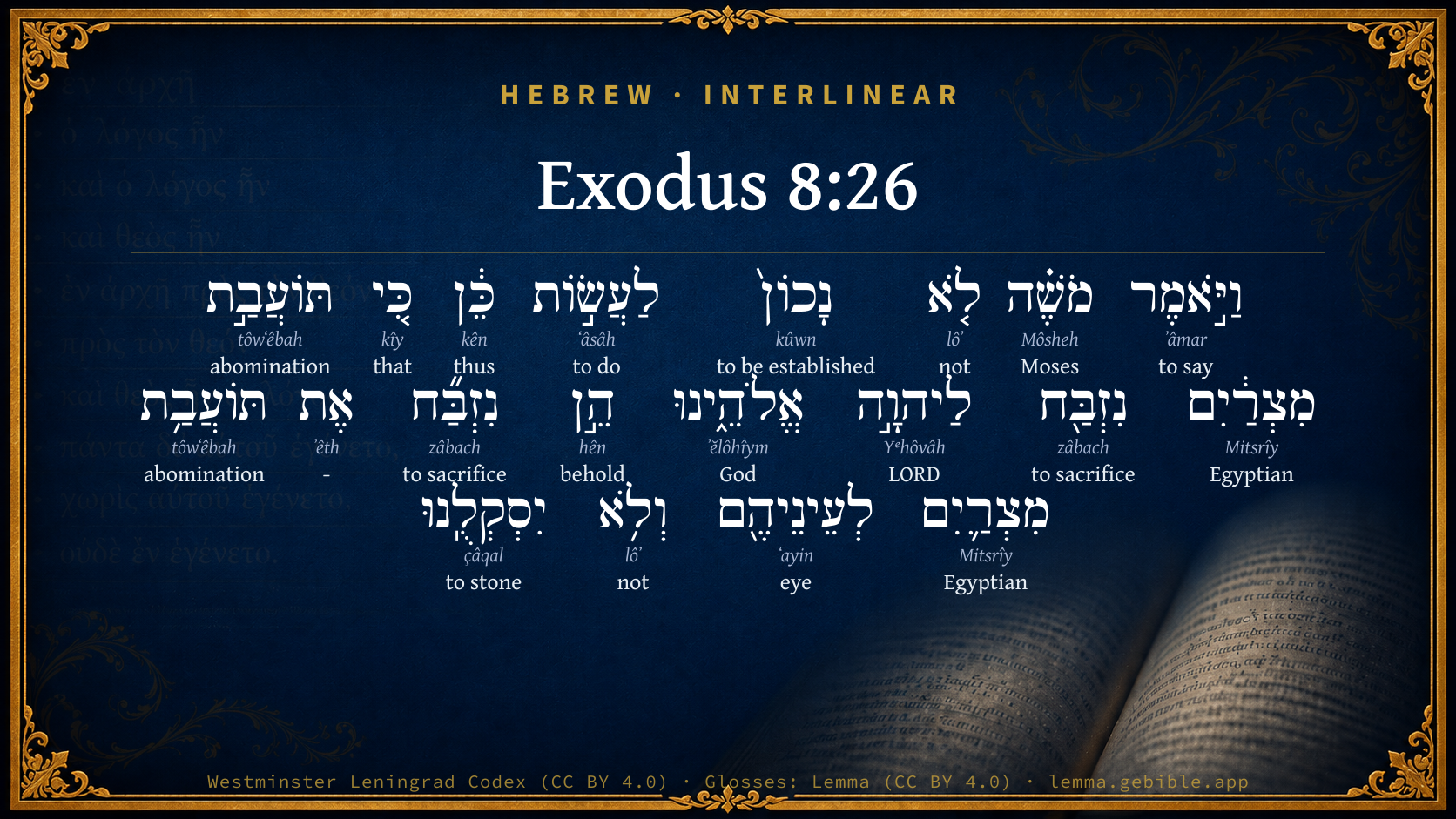
Hebrew (Westminster Leningrad Codex) Exodus 8:26 appears in the Hebrew Old Testament. The text above is from the Westminster Leningrad Codex. Each word links to its Strong’s number, a concise gloss, and parsing drawn from the Open Scriptures Hebrew Bible morphology. Click any word for its full Brown-Driver-Briggs (BDB) entry.
Download image
Cite this verse

Exodus 8:26 (World English Bible). Public Domain. Lemma interlinear Bible study tool, https://lemma.gebible.app/v/exodus/8/26.

Show BibTeX & RIS
BibTeX
RIS
English Translation
Moses said, "It isn't appropriate to do so; for we shall sacrifice the abomination of the Egyptians to Yahweh our God. Behold, shall we sacrifice the abomination of the Egyptians before their eyes, and won't they stone us?
World English Bible · Public Domain
Highlights
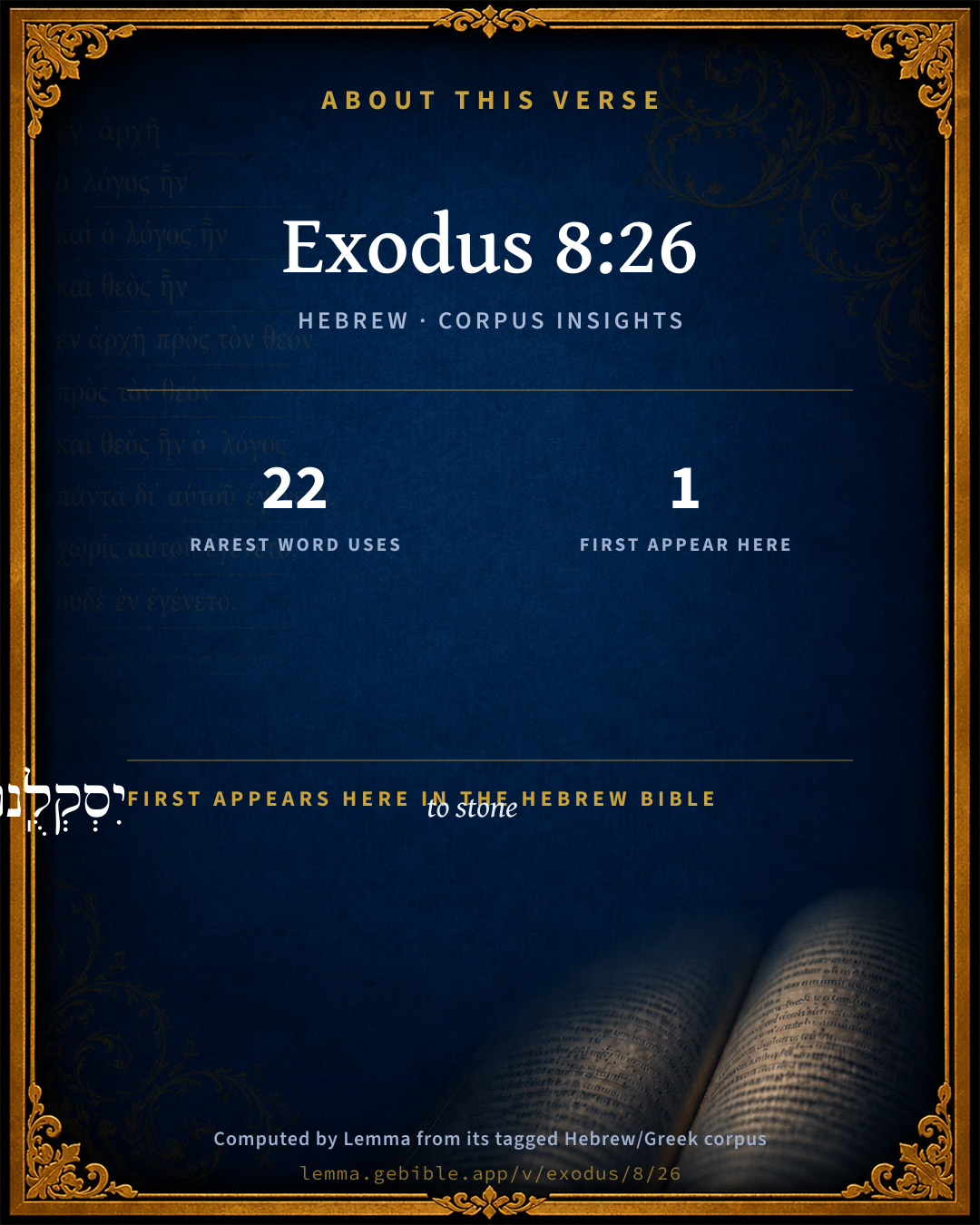
  • 1 first appearance in the Hebrew Bible
Full analysis ↓
Download a study sheet

One document with this verse’s original text, its word-by-word gloss line, the meaning frame, cross-references with their text, attributed commentary, and full source and license credits — printable, and it pastes into notes with its structure intact.

This verse Autodidact and up

Study sheet (.html) Plain text (.txt)

A passage Seminary Student

Up to 50 verses in one chapter. A passage sheet keeps up to 6 commentary sources and 12 cross-references per verse, in the order this page ranks them, and says so on the sheet whenever that leaves anything out. Ask for a single verse and you get the Autodidact verse sheet above.

Everything on this page stays free to read, with no account — the sheet is a download of what is already on screen, not access to it.

Want to remove ads? Support Godless Engineer
Compare translations 3

The same verse in 3 English versions, stacked beneath the original-language interlinear above. Click any original word for its lexicon entry.

Each is an independent rendering of the whole verse — the interlinear is not word-aligned to these translations.

Highlighted words mark where these versions differ — a whole-verse word diff, not a word-by-word alignment.

  • World English Bible Public Domain
    Moses said, "It isn't appropriate to do so; for we shall sacrifice the abomination of the Egyptians to Yahweh our God. Behold, shall we sacrifice the abomination of the Egyptians before their eyes, and won't they stone us?
  • King James Version Public Domain
    And Moses said, It is not meet so to do; for we shall sacrifice the abomination of the Egyptians to the LORD our God: lo, shall we sacrifice the abomination of the Egyptians before their eyes, and will they not stone us?
  • unfoldingWord Literal Text CC BY-SA 4.0
    And Moses said, “It would not be right to do so, because we will sacrifice an abomination of the Egyptians to Yahweh our God. Look, we would sacrifice an abomination of the Egyptians before their eyes, and would they not stone us?

unfoldingWord Literal Text — © unfoldingWord, licensed CC BY-SA 4.0. Word-aligned USFM3 via Door43 (git.door43.org/unfoldingWord/en_ult).

Versions to compare (up to 4)

3 of 4 selected

Show all 18 translations

Every available English version of this verse, each an independent rendering of the whole verse.

  • World English Bible Public Domain
    Moses said, "It isn't appropriate to do so; for we shall sacrifice the abomination of the Egyptians to Yahweh our God. Behold, shall we sacrifice the abomination of the Egyptians before their eyes, and won't they stone us?
  • Berean Standard Bible Public Domain
    But Moses replied, “It would not be right to do that, because the sacrifices we offer to the LORD our God would be detestable to the Egyptians. If we offer sacrifices that are detestable before the Egyptians, will they not stone us?
  • Majority Standard Bible Public Domain
    But Moses replied, “It would not be right to do that, because the sacrifices we offer to the LORD our God would be detestable to the Egyptians. If we offer sacrifices that are detestable before the Egyptians, will they not stone us?
  • King James Version Public Domain
    And Moses said, It is not meet so to do; for we shall sacrifice the abomination of the Egyptians to the LORD our God: lo, shall we sacrifice the abomination of the Egyptians before their eyes, and will they not stone us?
  • American Standard Version (1901) Public Domain
    And Moses said, It is not meet so to do; for we shall sacrifice the abomination of the Egyptians to Jehovah our God: lo, shall we sacrifice the abomination of the Egyptians before their eyes, and will they not stone us?
  • Revised Version (1885) Public Domain
    And Moses said, It is not meet so to do; for we shall sacrifice the abomination of the Egyptians to the LORD our God: lo, shall we sacrifice the abomination of the Egyptians before their eyes, and will they not stone us?
  • Geneva Bible (1599) Public Domain
    But Moses answered, It is not meete to do so: for then we shoulde offer vnto the Lord our God that, which is an abomination vnto the Egyptians. Loe, can we sacrifice the abomination of the Egyptians before their eyes, and they not stone vs?
  • Douay-Rheims (1899) Public Domain
    And Moses said: It cannot be so: for we shall sacrifice the abominations of the Egyptians to the Lord our God: now if we kill those things which the Egyptians worship, in their presence, they will stone us.
  • Young's Literal Translation Public Domain
    and Moses saith, `Not right to do so, for the abomination of the Egyptians we do sacrifice to Jehovah our God; lo, we sacrifice the abomination of the Egyptians before their eyes -- and they do not stone us!
  • Literal Standard Version CC BY-SA 4.0
    and Moses says, “[It is] not right to do so—for us to sacrifice the abomination of the Egyptians to our God YHWH; behold, we sacrifice the abomination of the Egyptians before their eyes—and they do not stone us!
  • Unlocked Literal Bible CC BY-SA 4.0
    Moses said, “It is not right for us to do so, for the sacrifices we make to Yahweh our God are something disgusting to the Egyptians. If we make sacrifices right before their eyes that are disgusting to the Egyptians, will they not stone us?
  • unfoldingWord Literal Text CC BY-SA 4.0
    And Moses said, “It would not be right to do so, because we will sacrifice an abomination of the Egyptians to Yahweh our God. Look, we would sacrifice an abomination of the Egyptians before their eyes, and would they not stone us?
  • Darby Bible Public Domain
    And Moses said, It is not proper to do so; for we should sacrifice the abomination of the Egyptians to Jehovah our God: lo, if we sacrificed the abomination of the Egyptians before their eyes, would they not stone us?
  • World Messianic Bible Public Domain
    Moses said, “It isn’t appropriate to do so; for we shall sacrifice the abomination of the Egyptians to the LORD our God. Behold, if we sacrifice the abomination of the Egyptians before their eyes, won’t they stone us?
  • Webster's Bible Public Domain
    And Moses said, It is not meet so to do; for we shall sacrifice the abomination of the Egyptians to the LORD our God: Lo, shall we sacrifice the abomination of the Egyptians before their eyes, and will they not stone us?
  • Free Bible Version CC BY-SA 4.0
    “No, that wouldn't be the right thing to do,” Moses replied. “The sacrifices we offer to the Lord our God would be offensive to Egyptians. If we went ahead and offered sacrifices offensive to Egyptians, they'd stone us!
  • Bible in Basic English Public Domain
    And Moses said, It is not right to do so; for we make our offerings of that to which the Egyptians give worship; and if we do so before their eyes, certainly we will be stoned.
  • JPS Tanakh (1917) Public Domain
    (8-22) And Moses said: 'It is not meet so to do; for we shall sacrifice the abomination of the Egyptians to the LORD our God; lo, if we sacrifice the abomination of the Egyptians before their eyes, will they not stone us?

Literal Standard Version (2020), Covenant Press — licensed CC BY-SA 4.0. Text via the HelloAO Bible API (eBible.org). Unlocked Literal Bible (unfoldingWord) — licensed CC BY-SA 4.0. Text via the HelloAO Bible API (eBible.org). unfoldingWord Literal Text — © unfoldingWord, licensed CC BY-SA 4.0. Word-aligned USFM3 via Door43 (git.door43.org/unfoldingWord/en_ult). Free Bible Version, Dr. Jonathan Gallagher — licensed CC BY-SA 4.0. Text via the HelloAO Bible API (eBible.org).

Word by word

More ways to search: Search by grammar → Find every occurrence → Compare this word →

Practice this passage: Drill this verse → Learn its vocabulary →

יִסְקְלֻֽנוּ
çâqal
H5619
“to stone · us”
Verb, Qal, Imperfect, 3rd Person, Masculine, Plural + Suffix, Personal, 1st Person, Common, Plural
Part of Speech
Verb
Stem
Qal
Form
Imperfect
Person
3rd Person
Gender
Masculine
Number
Plural
Full BDB Definition

Origin: a primitive root

TWOT: 1541

to stone (to death), put to death by stoning - (Qal) to pelt with stones, stone to death - (Niphal) to be stoned to death - (Piel) - to stone, pelt with stones - to free from stones (of vineyard, highway) - (Pual) to be stoned to death
  1. וַיֹּ֣אמֶר ʼâmar H559 “and · to say” Conjunction + Verb, Qal, Sequential Imperfect, 3rd Person, Masculine, Singular
  2. מֹשֶׁ֗ה Môsheh H4872 “Moses” Noun, Proper
  3. לֹ֤א lôʼ H3808 “not” Particle, Negative
  4. נָכוֹן֙ kûwn H3559 “being established” Verb, Niphal, Participle Active, Masculine, Singular, Absolute
  5. לַעֲשׂ֣וֹת ʻâsâh H6213 “to do” Preposition + Verb, Qal, Infinitive Construct
  6. כֵּ֔ן kên H3651 “thus” Particle, Demonstrative
  7. כִּ֚י kîy H3588 “that” Conjunction
  8. תּוֹעֲבַ֣ת tôwʻêbah H8441 “abomination of” Noun, Common, Feminine, Singular, Construct
  9. מִצְרַ֔יִם Mitsrîy H4713 “Egyptian” Noun, Proper
  10. נִזְבַּ֖ח zâbach H2076 “to sacrifice” Verb, Qal, Imperfect, 1st Person, Common, Plural
  11. לַיהוָ֣ה Yᵉhôvâh H3068 “to/for · LORD” Preposition + Noun, Proper
  12. אֱלֹהֵ֑ינוּ ʼĕlôhîym H430 “God(s) · our” Noun, Common, Masculine, Plural, Construct + Suffix, Personal, 1st Person, Common, Plural
  13. הֵ֣ן hên H2005 “behold” Particle, Demonstrative
  14. נִזְבַּ֞ח zâbach H2076 “to sacrifice” Verb, Qal, Imperfect, 1st Person, Common, Plural
  15. אֶת ʼêth H853 “-” Particle, Direct Object
  16. תּוֹעֲבַ֥ת tôwʻêbah H8441 “abomination of” Noun, Common, Feminine, Singular, Construct
  17. מִצְרַ֛יִם Mitsrîy H4713 “Egyptian” Noun, Proper
  18. לְעֵינֵיהֶ֖ם ʻayin H5869 “to/for · eyes · their” Preposition + Noun, Common, Both, Dual, Construct + Suffix, Personal, 3rd Person, Masculine, Plural
  19. וְלֹ֥א lôʼ H3808 “and · not” Conjunction + Particle, Negative

About this verse

These counts appear in no published source. They are computed here, from the morphology-tagged text and Lemma’s own curated glosses. What Lemma adds →

20
words
16
distinct lemmas
Pentateuch
section

Notable vocabulary

The rarest word here is יִסְקְלֻֽנוּ to stone H5619 — appearing just 22 times in the whole Hebrew Bible.

First appearance in Scripture

This word makes its first canonical appearance in the Hebrew Bible here:

  • יִסְקְלֻֽנוּ to stone H5619

Shared distinctive vocabulary

יִסְקְלֻֽנוּ to stone H5619 occurs in 20 verses of the Hebrew Bible. Also found in:

Grammatical profile

  • 6 verbs
  • 8 nouns
  • 1 conjunction
  • 5 particles

Verb forms

  • וַיֹּ֣אמֶר Qal · Sequential Imperfect
  • נָכוֹן֙ Niphal · Participle Active
  • לַעֲשׂ֣וֹת Qal · Infinitive Construct
  • נִזְבַּ֖ח Qal · Imperfect
  • נִזְבַּ֞ח Qal · Imperfect
  • יִסְקְלֻֽנוּ Qal · Imperfect

Repetition

Words recur within this verse — often emphatic in Hebrew:

  • תּוֹעֲבַ֣ת abomination H8441 ×2
  • מִצְרַ֔יִם Egyptian H4713 ×2
  • נִזְבַּ֖ח to sacrifice H2076 ×2
  • לֹ֤א not H3808 ×2

Hebrew & Septuagint length

In English translation the verse runs 38 words from the Hebrew and 36 from the Septuagint (LXX English) — closely comparable.

A rough comparison of the two English renderings, which tokenize alike — not a word-level alignment.

Word counts can differ between the Hebrew and the Greek without any difference in meaning — e.g. the Hebrew direct-object marker אֵת has no separate Greek word, and Greek often adds the article ὁ.

Cross-references

10

Topical passages linked to Exodus 8:26 in the Treasury of Scripture Knowledge — connected by theme and wording, ordered by reader-vote popularity; previews shown in the World English Bible.

  • Genesis 43:32 They served him by himself, and them by themselves, and the Egyptians, that ate with him, by themselves, because the Egyptians don't eat bread with the Hebrews, for that is an abomination to the Egyptians.
  • Genesis 46:34 that you shall say, 'Your servants have been keepers of cattle from our youth even until now, both we, and our fathers:' that you may dwell in the land of Goshen; for every shepherd is an abomination to the Egyptians."
  • Exodus 3:18 They will listen to your voice, and you shall come, you and the elders of Israel, to the king of Egypt, and you shall tell him, 'Yahweh, the God of the Hebrews, has met with us. Now please let us go three days' journey into the wilderness, that we may sacrifice to Yahweh, our God.'
  • Deuteronomy 7:25–26 The engraved images of their gods shall you burn with fire: you shall not covet the silver or the gold that is on them, nor take it to you, lest you be snared therein; for it is an abomination to Yahweh your God.
  • Deuteronomy 12:30–31 take heed to yourself that you not be ensnared to follow them, after that they are destroyed from before you; and that you not inquire after their gods, saying, How do these nations serve their gods? even so will I do likewise.
  • 1 Kings 11:5–7 For Solomon went after Ashtoreth the goddess of the Sidonians, and after Milcom the abomination of the Ammonites.
  • 2 Kings 23:13 The high places that were before Jerusalem, which were on the right hand of the mountain of corruption, which Solomon the king of Israel had built for Ashtoreth the abomination of the Sidonians, and for Chemosh the abomination of Moab, and for Milcom the abomination of the children of Ammon, did the king defile.
  • Ezra 9:1 Now when these things were done, the princes drew near to me, saying, The people of Israel, and the priests and the Levites, have not separated themselves from the peoples of the lands, [doing] according to their abominations, even of the Canaanites, the Hittites, the Perizzites, the Jebusites, the Ammonites, the Moabites, the Egyptians, and the Amorites.
  • Isaiah 44:19 None calls to mind, neither is there knowledge nor understanding to say, I have burned part of it in the fire; yes, also I have baked bread on the coals of it; I have roasted flesh and eaten it: and shall I make the residue of it an abomination? shall I fall down to the stock of a tree?
  • 2 Corinthians 6:14–17 Don't be unequally yoked with unbelievers, for what fellowship have righteousness and iniquity? Or what communion has light with darkness?

Cross-references courtesy of OpenBible.info (CC BY 4.0).

Hebrew and Greek witnesses Masoretic Hebrew ↔ Greek Septuagint

The same verse in the two great witnesses to the Old Testament, shown verse-for-verse.

These are two independent witnesses, not word-aligned to each other, and the Septuagint is shown in lemma (dictionary) form.

Hebrew Exodus 8:26 Masoretic · Westminster Leningrad Codex

וַיֹּ֣אמֶר מֹשֶׁ֗ה לֹ֤א נָכוֹן֙ לַעֲשׂ֣וֹת כֵּ֔ן כִּ֚י תּוֹעֲבַ֣ת מִצְרַ֔יִם נִזְבַּ֖ח לַיהוָ֣ה אֱלֹהֵ֑ינוּ הֵ֣ן נִזְבַּ֞ח אֶת תּוֹעֲבַ֥ת מִצְרַ֛יִם לְעֵינֵיהֶ֖ם וְלֹ֥א יִסְקְלֻֽנוּ

Moses said, "It isn't appropriate to do so; for we shall sacrifice the abomination of the Egyptians to Yahweh our God. Behold, shall we sacrifice the abomination of the Egyptians before their eyes, and won't they stone us?

World English Bible · Public Domain

Greek LXX Exodus 8:26 Septuagint · lemma form

ἐκἔρχομαι δέ μωυσῆς ἀπό φαραώ καί εὔχομαι πρός ὁ θεός

And Moses said, It can’t be so, for we shall sacrifice to the Lord our God the abominations of the Egyptians; for if we sacrifice the abominations of the Egyptians before them, we shall be stoned.

LXX2012 (modern English Septuagint) · Public Domain

Hebrew: Westminster Leningrad Codex (CC BY 4.0). Greek: Septuagint (public domain); English from LXX2012 (modern English Septuagint) (Public Domain). How the Septuagint differs from the Hebrew →

Targum (Aramaic paraphrase)

2

The Targum is the ancient Jewish Aramaic paraphrase of the Hebrew Scriptures — an interpretive translation, not the Hebrew text itself. Onkelos (literal) and Pseudo-Jonathan (expansive) render the Torah, and Jonathan the Prophets. Coverage is partial: where no permissively-licensed English translation exists for a verse, only the Aramaic is shown. This is verse-level text, not a word-by-word alignment to the Hebrew.

  1. Targum Onkelos Torah (Genesis–Deuteronomy)
    וּנְפַק משֶׁה מִן קֳדָם פַּרְעֹה וְצַלִי קֳדָם יְיָ:

    (no public-domain English translation for this verse)

    Targum Onkelos — Aramaic: “Onkelos Genesis” (public domain); “Onkelos Exodus” (public domain); “Onkelos Leviticus” (public domain); “Onkelos Numbers” (public domain); “Onkelos Deuteronomy” (public domain). English: “Sefaria Community Translation” (CC0 1.0 (public-domain dedication)); “J.W. Etheridge. The Targums of Onkelos and Jonathan Ben Uzziel on the Pentateuch. London: Longmans, Green, 1862” (public domain). Text via Sefaria.

  2. Targum Pseudo-Jonathan Torah (Genesis–Deuteronomy)
    וּנְפַק משֶׁה מִלְוַת פַּרְעה וְצַלִי קֳדָם יְיָ

    And Mosheh went out from Pharoh, and prayed before the Lord;

    Targum Pseudo-Jonathan — Aramaic: “Targum Jonathan on Genesis” (public domain); “Targum Jonathan on Exodus” (public domain); “Targum Jonathan on Leviticus” (public domain); “Targum Jonathan on Numbers” (public domain); “Targum Jonathan on Deuteronomy” (public domain). English: “The Targum of Jonathan ben Uzziel, trans. J. W. Etheridge, London, 1862” (public domain). Text via Sefaria.

Commentary

Notes on Exodus 8:26 from classic Christian and Jewish commentators (each source and its license shown beneath its notes). The classic Christian expositions comment on the surrounding passage and are grouped to its opening verse, so a note may address several verses; the Jewish commentaries on the Tanakh (Rashi and others) are per-verse, so they appear only where the commentator wrote on this verse.

Lemma curates 59 commentaries, every one of them public domain or Creative Commons licensed, each selected and text-cleaned for this edition rather than reprinted as found. About our sources →

Trapp's Complete Commentary

John Trapp

Exo 8:26 And Moses said, It is not meet so to do; for we shall sacrifice the abomination of the Egyptians to the LORD our God: lo, shall we sacrifice the abomination of the Egyptians before their eyes, and will they not stone us?

Ver. 26. Will they not stone us?] Superstition is cruel; witness the Popish Inquisition to Lithgow, who, in ten hours, received seventy various torments. And the massacre of Paris, wherein they poisoned the Queen of Navarre, murdered the most part of the peerless nobility in France, their wives and children, with a great sort of the common people, a hundred thousand in one year in various parts of the realm; some say three hundred thousand! The bloody and barbarous persecutions of the religious abroad in Bohemia, the Valtoline, Piedmont, and Netherlands; the Marian dog-days here at home; are better known than I need to mention them.

John Trapp, A Commentary or Exposition upon All the Books of the Old and New Testament (1647–1656) — public domain. Text from a community e-Sword module.

Joseph Benson's Commentary

Exo 8:26. We should sacrifice the abomination of the Egyptians — That which they abominated to see killed, because they worshipped as gods the animals which the Hebrews were wont to offer in sacrifice. From this it seems probable, and from no mention being made of any, that the Israelites had omitted to offer sacrifices from their first coming into Egypt.

Joseph Benson's Commentary on the Old and New Testaments (1811–1818) — public domain. Text from a community e-Sword module.

Tyndale Open Study Notes

Tyndale Open Resources

8:26-27 Moses pointed out the impossibility of what Pharaoh was asking on the grounds of the Egyptians’ own prejudice: They considered all Semites to be uncultured and uncouth (see Gen 43:32). • The Hebrews were leaving Egypt in order to worship God (see, e.g., Exod 5:1; 7:16; 8:1, 20). God’s purpose for the Exodus was to lead his people into a proper relationship with him.

Tyndale Open Study Notes — © Tyndale Open Resources, licensed CC BY-SA 4.0. Text via the HelloAO Bible API.

Geneva Bible (1599)

Geneva Bible translators

For the Egyptians worshipped divers beasts, as the ox, the sheep and such like which the Israelites offered in sacrifice, which thing the Egyptians abhorred to see.

Geneva Bible (1599) marginal notes — public domain. Text via Bolls.life.

Adam Clarke's Commentary

Verse 26. We shall sacrifice the abomination of the Egyptians] That is, The animals which they hold sacred, and will not permit to be slain, are those which our customs require us to sacrifice to our God; and should we do this in Egypt the people would rise in a mass, and stone us to death. Perhaps few people were more superstitious than the Egyptians. Almost every production of nature was an object of their religious worship: the sun, moon, planets, stars, the river Nile, animals of all sorts, from the human being to the monkey, dog, cat, and ibis, and even the onions and leeks which grew in their gardens. Jupiter was adored by them under the form of a ram, Apollo under the form of a crow, Bacchus under that of a goat, and Juno under that of a heifer. The reason why the Egyptians worshipped those animals is given by Eusebius, viz., that when the giants made war on the gods, they were obliged to take refuge in Egypt, and assume the shapes or disguise themselves under different kinds of animals in order to escape. Jupiter hid himself in the body of a ram, Apollo in that of a crow, Bacchus in a goat, Diana in a cat, Juno in a white heifer, Venus in a fish, and Mercury in the bird ibis; all which are summoned up by Ovid in the following lines: -

Duxque gregis fit Jupiter -------------

Delius in corvo, proles Semeleia capro,

Fele soror Phoebi, nivea Saturnia vacca,

Pisce Venus latuit, Cyllenius ibidis alis.

METAM., l. v., fab. v., 1. 326.

How the gods fled to Egypt's slimy soil,

And hid their heads beneath the banks of Nile;

How Typhon from the conquer'd skies pursued

Their routed godheads to the seven-mouth'd flood;

Forced every god, his fury to escape,

Some beastly form to take, or earthly shape.

Jove, so she sung, was changed into a ram,

From whence the horns of Libyan Ammon came;

Bacchus a goat, Apollo was a crow,

Phoebe a cat, the wife of Jove a cow,

Whose hue was whiter than the falling snow;

Mercury, to a nasty ibis turn'd,

The change obscene, afraid of Typhon mourn'd,

While Venus from a fish protection craves,

And once more plunges in her native waves.

MAYNWARING.

These animals therefore became sacred to them on account of the deities, who, as the fable reports, had taken refuge in them. Others suppose that the reason why the Egyptians would not sacrifice or kill those creatures was their belief in the doctrine of the metempsychosis, or transmigration of souls; for they feared lest in killing an animal they should kill a relative or a friend. This doctrine is still held by the Hindoos.

Adam Clarke's Commentary on the Bible (1810–1826) — public domain. Text from a community e-Sword/MySword module.

Ellicott's Commentary for English Readers

(26) It is not meet so to do.—Pressed to remain “in the land,” and sacrifice, Moses deemed it right to explain to the king why this was impossible. The Israelites would have to “sacrifice the abomination of the Egyptians”—i.e., animals of which the Egyptians abominated the killing; and if they did this in the presence of Egyptians, a riot would be certain to break out—perhaps a civil war would ensue. The animal worship of the Egyptians is a certain, and generally recognised, fact. It seemed to the Greeks and Romans the most striking characteristic of the Egyptian reliction. (See Herod, ii. 65-76; Diod. Sic. i. 82-84; Cic. De Nat. Deor. i. 36; &c.) The sacrificial animals of the Hebrews—sheep, goats, and cattle—were all of them sacred animals, either to the Egyptians generally, or to the inhabitants of certain districts. A Theban could not endure the sacrifice of a sheep, nor a Men-desian that of a goat (Herod. ii. 42). White cows and heifers—perhaps cows and heifers generally—were sacred to Isis-Athor. Any bull-calf might be an Apis; and it could not be known whether he was Apis or not till the priests had examined him (Herod. iii. 28). The extent to which the Egyptians carried their rage when a sacred animal was killed in their presence is illustrated by many facts in history. On one occasion a Roman ambassador, who had accidentally killed a cat, was torn to pieces by the populace (Diod. Sic. i. 83). On another, war broke out between the Oxyrinchites and the Cynopolites, because the latter had eaten one of the fish considered sacred by the former (Plutarch, De Isid. et Osir. § 44). The fear of Moses was thus not at all groundless.

Will they not stone us?—This is the first mention of “stoning” in Scripture or elsewhere. It was not a legalised Egyptian punishment; but probably it was everywhere one of the earliest, as it would be one of the simplest, modes of wreaking popular vengeance. Æschylus mentions it (Sept. 100 Th. 183), also Herodotus (v. 38). It was known in ancient Persia (Ctes. Fr. 50).

A Bible Commentary for English Readers, edited by Charles John Ellicott (1878–1897) — public domain. Text from a community e-Sword module.

The Cambridge Bible for Schools and Colleges

gen. ed. J. J. S. Perowne

26. Moses objects that, if they do this, they will arouse the religious susceptibilities of the Egyptians, and be in danger of their lives.

meet] i.e. suitable, proper; an archaism, not unfrequent in AV., RV.: see e.g. Gen_2:18, Mat_3:8 (AV.: RV. worthy), Exo_15:26.

the abomination of the Egyptians] i.e. animals which the Egyptians deemed it unlawful to sacrifice, and the sacrifice of which would consequently shock them: as the cow (which was sacred to Isis), the bull (which, according to Hdt. ii. 41, was only sacrificed by them when it was ‘clean,’ i.e. free from the sacred marks of Apis), sheep at Thebes, and goats (according to Wiedemann, an error for rams) at Mendes: see Hdt. ii. 38, 41, 42, 46; cf. Wilk.-Birch, ii. Exo 460, iii. 108 f., 304 f.; Wiedemann, Herodots Zweites Buch, pp. 180–3, 187 f., 196 f., 218 f.

The Cambridge Bible for Schools and Colleges (gen. ed. J. J. S. Perowne; Cambridge University Press, 1878–1918) — public domain. Text from a community e-Sword module.

John Gill's Exposition

We will go three days' journey into the wilderness,.... As was first insisted on, and from which demand they should not depart:

and sacrifice unto the Lord our God, as he shall command us; both what sacrifices shall be offered, and the manner in which they shall be done, both which seemed for the present in a good measure undetermined and unknown; and therefore it was possible, and very probable, that in one or the other they should give offence to the Egyptians, should they sacrifice among them, being at all events resolved to do as the Lord should command them.

John Gill's Exposition of the Whole Bible (1746–1763) — public domain (CC PDM 1.0). Text via the HelloAO Bible API.

Albert Barnes' Notes on the Bible

The abomination - i. e. an animal which the Egyptians held it sacrilegious to slay. The ox, bull, or cow, is meant. The cow was never sacrificed in Egypt, being sacred to Isis, and from a very early age the ox was worshipped throughout Egypt, and more especially at Heliopolis and Memphis under various designations, Apis, Mnevis, Amen-Ehe, as the symbol or manifestation of their greatest deities, Osiris, Atum, Ptah, and Isis.

Albert Barnes' Notes on the Bible (1834–1885) — public domain. Text from a community e-Sword/MySword module.

Haydock's Catholic Bible Commentary

The abominations, &c. That is, the things they worship for gods: oxen, rams, &c. It is the usual style of the Scriptures to call all idols and false gods, abominations; to signify how much the people of God ought to detest and abhor them. (Challoner) --- The Egyptians adored the stars, and even the vilest creatures, on account of some advantage which they derived from them. (Cicero, N. Deor. i.) They sometimes sacrificed animals; though, at first, "they offered only prayer and incense." (Macrobius, Satur. i. 7; Genesis xliii. 16.) Their belief in the transmigration of souls, perhaps, induced them to abstain from the immolation of beasts. (Calmet)

George Leo Haydock (1774–1849), Haydock's Catholic Family Bible and Commentary, 1859 edition — public domain. Excludes Psalms (Douay-Rheims chapter numbering differs from Protestant) and Deuterocanonical books (Catholic canon only).

Matthew Poole's English Annotations

It is not meet, Heb. not right, neither in God’s eyes, who hath appointed us the place as well as the thing; nor in the Egyptians’ eyes, as it follows.

The abomination of the Egyptians; that which the Egyptians abhor to kill, or to see killed; as not only Scripture, but profane authors, as Diodorus, and Tully, and Juvenal, witness, because they worshipped them as gods, as is notoriously known. Their fear was just; for when once a Roman had but killed a cat, though imprudently, the people tumultuously met together, and beset his house, and killed him in spite of the king and his princes, who used their utmost power and diligence to prevent it.

Matthew Poole's English Annotations on the Holy Bible (1683–1685) — public domain. Text from a community e-Sword/MySword module.

Whedon's Commentary on the Bible

Daniel D. Whedon

26. The abomination of the Egyptians — The Egyptians would not allow them to worship in the land according to Jehovah’s will. Some, as Hengstenberg, understand the text to mean that the manner of their worship would be abominable to the Egyptians — that they would not observe the manifold rigid sacrificial regulations of the Egyptian priests, but the Targum of Onkelos translates, “the animal which the Egyptians worship,” that is, the ox, which as Apis and Mnevis was so specially adored. So the Vulgate renders, “the animals which the Egyptians worship.” This is a characteristic Hebrew phraseology. Idols are often styled “abominations” in the Old Testament. Thus, in 2Ki_23:13, the god Chemosh is called “the abomination of Moab,” and Ashtoreth “the abomination of the Zidonians.” So the ox is here called “the abomination of the Egyptians,” not as abominated by them, not because it was abominable in their eyes to kill it, but because this worship of the ox was an abomination to Jehovah. This was doubtless bold language for Moses to use to Pharaoh, (styling his god an “abomination,”) but his boldness has greatly increased since he deprecated his stammering tongue, and the same spirit is seen in the pungent rebuke and exhortation of the twenty-ninth verse, “Let not Pharaoh deal deceitfully any more.”

The sacred bull was specially worshipped at Memphis, the great city of Lower Egypt, where he had palatial stalls and temples. In the above engraving the bull is crowned with a circle representing Ra, or the sun, and also wears on his forehead the asp, the symbol of majesty.

Will they not stone us — The animal-worship of the Egyptians is frequently dwelt upon by classical writers, so that it became a proverb that in Egypt it was easier to meet a god than a man. The text is well illustrated by the statement of Herodotus, that it was a capital crime in Egypt to kill one of the sacred animals; and Diodorus and Cicero relate that this was the case in their time. (Herod., 2:65; Cic., Tusc. Disp., 5:27; Diod., 1:83.) So modern Hinduism makes it a mortal sin to kill a cow. (Butler’s Land of the Veda, chap. 2.) The Egyptians, however, killed oxen for food, beef and goose being their chief meats. The same animals were not sacred through all Egypt, but each had his special district, and the ox or heifer, one of the animals specially designated for sacrifice in the Mosaic economy, was, as we have seen, particularly worshipped in the district where the Israelites dwelt. Apis was the sacred bull of Memphis, and Mnevis, second only in rank to Apis, and by Plutarch called his sire, was the sacred bull of Heliopolis. (Wilkinson’s Anc. Egypt, chap. iv,) and these were the two leading cities of Lower Egypt. Thus the fear expressed by Moses, “Will they not stone us?” is just what might have been expected in Egypt above all other lands, and in this district above all others of Egypt.

Daniel D. Whedon (gen. ed.), Commentary on the Old and New Testaments (1874–1909) — public domain. Text from a community e-Sword module.

The Pulpit Commentary

It is not meet so to do. So many animals were held sacred by the Egyptians, some universally, some partially, that, if they held a great festival anywhere in Egypt, the Israelites could not avoid offending the religious feelings of their neighbours. Some animals would be sure to be sacrificed white cows, or heifers, for instance by some of the people, which the Egyptians regarded it as sacrilegious to put to death. A bloody conflict, or even a civil war, might be the consequence. By the abomination of the Egyptians seems to be meant animals of which the Egyptians would abominate the killing. It has generally been supposed that either cows alone, or "cows, bulls and oxen" are meant; but recent researches seem to show that it was only white cows which it was absolutely unlawful to sacrifice. (See "Records of the Past," vol. 2. pp. 90, 96, 99; vol. 10. pp. 44, 62, etc.) Will they not stone us? Death was the legal penalty for wilfully killing any sacred animal in Egypt (Heb 2:65). On one occasion even a Roman ambassador was put to death for accidentally killing to eat (Diod. Sic. 1:88). Stoning does not appear to have been a legal punishment in Egypt, so that we must suppose Moses to have feared the people present taking the law into their own hands, seizing the sacrificers, and killing them by this ready method.

The Pulpit Commentary (1880–1919), ed. H.D.M. Spence-Jones & Joseph S. Exell — public domain. Text from a community e-Sword module.

John Wesley's Explanatory Notes

The abomination of the Egyptians - That which they abominate to see killed, because they worshipped them as gods.

John Wesley, Explanatory Notes Upon the Whole Bible (1754–1765) — public domain. Text via the GEBible commentary corpus.

Rashi

Rabbi Shlomo Yitzchaki (Rashi)

ויעתר אל ה׳ AND ENTREATED THE LORD (the verb is the Kal) — he concentrated his energies on prayer. So, too, if it had wished to use the term וַיַעְתִּיר (the Hiphil) it could have used it, and that would have signified, “and he increased words in prayer”. But when it uses an expression denoting “and he did something” (the Kal) it signifies “he prayed much (devoutly)”.

Rashi on the Tanakh — English translations: “The Judaica Press complete Tanach with Rashi, translated by A. J. Rosenberg” (CC BY 4.0); “Pentateuch with Rashi's commentary by M. Rosenbaum and A.M. Silbermann, 1929-1934” (public domain); “The Metsudah Tanach series, Lakewood, N.J” (CC BY 4.0); and “The Book of Joshua, Metsudah Publications, 1997” (CC BY 4.0). Text via Sefaria.

Lesson kit

Teaching starters — assembled from the data on this page, not authored interpretation. Every prompt links to the verse data it draws on. Edit before teaching.

Exodus, in the Pentateuch, opens this verse with 20 words (16 distinct Hebrew lemmas). Its most distinctive word is çâqal (“to stone”). A historical commentator’s framing appears above. Read the whole chapter for the surrounding context.

Discussion questions

  1. What does “to stone” (çâqal) contribute to the verse as a whole?
  2. The word “to stone” first appears here in Scripture. What is being introduced at this debut?
  3. Exodus 17:4 shares the word «to stone» with this verse. How do the two illuminate each other?
  4. “abomination” occurs 2× in this one verse. What is the effect of the repetition?
  5. The translations on this page render this verse differently — a whole-verse word diff, not a word-by-word alignment. What might account for the different wordings?
  6. The verb «וַיֹּ֣אמֶר» is Qal Sequential Imperfect. How does its form color the action?
  7. Reading how Trapp's Complete Commentary and Joseph Benson's Commentary read this verse, where do the two commentators agree and where do they part?

Things to notice

  • 1 word makes its first canonical appearance in Scripture here.
  • These translations choose different wording for 14 words in this verse.
  • “abomination” occurs 2× in this single verse.
  • 16 distinct Hebrew lemmas span 20 words in this verse.

Reading settings

Reading text

Shown beneath each verse's original-language words.

Old Testament
Old Testament edition

Read the OT as the Masoretic Hebrew (MT) or the Greek Septuagint (LXX).

English shown for the Greek Septuagint (in the Hebrew ↔ Greek comparison).

Comparing translations? Open the Compare panel on any verse page to stack up to four side by side.