
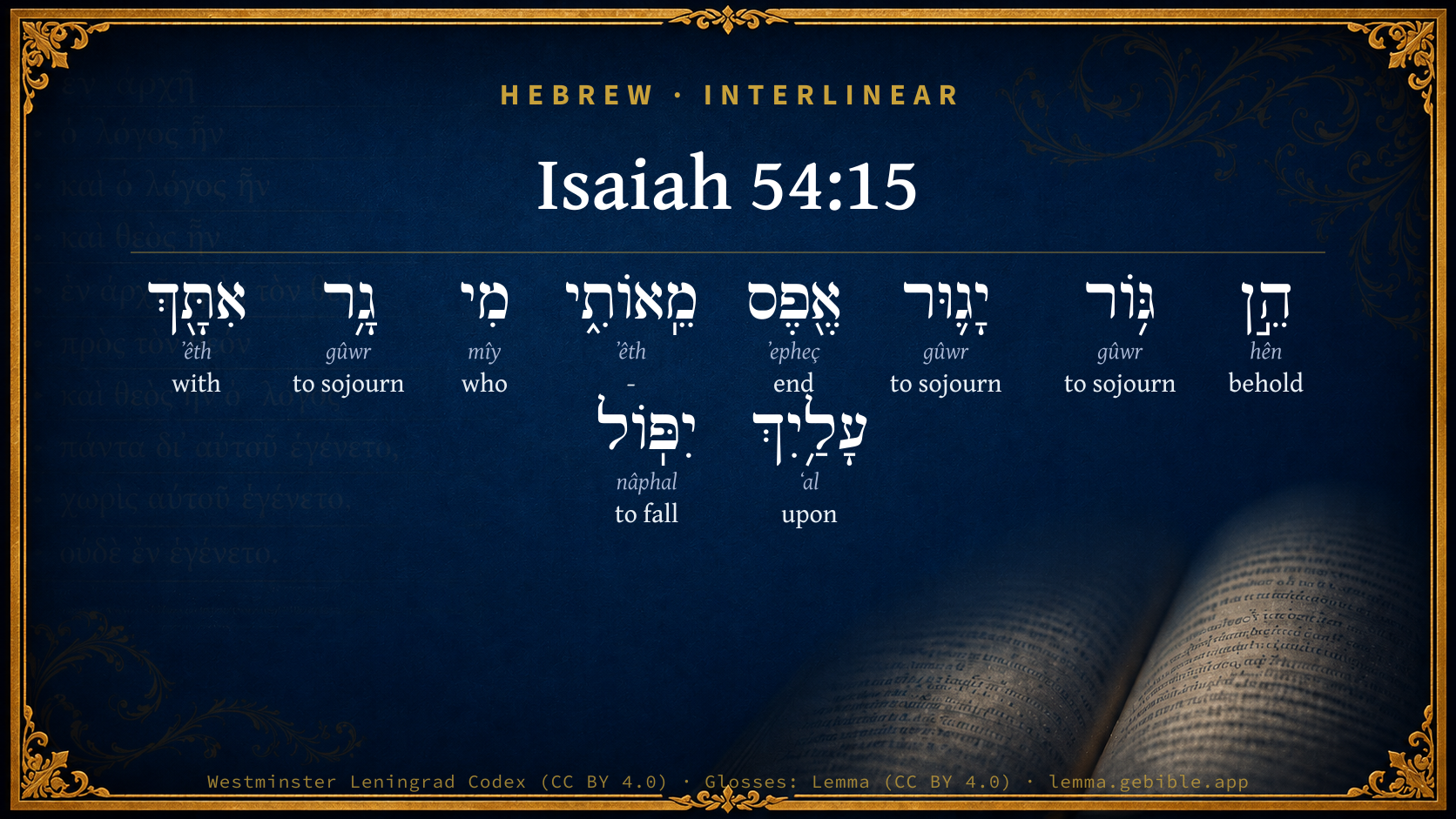
Isaiah 54:15

Hebrew (Westminster Leningrad Codex) Isaiah 54:15 appears in the Hebrew Old Testament. The text above is from the Westminster Leningrad Codex. Each word links to its Strong’s number, a concise gloss, and parsing drawn from the Open Scriptures Hebrew Bible morphology. Click any word for its full Brown-Driver-Briggs (BDB) entry.
Download image
Cite this verse

Isaiah 54:15 (World English Bible). Public Domain. Lemma interlinear Bible study tool, https://lemma.gebible.app/v/isaiah/54/15.

Show BibTeX & RIS
BibTeX
RIS
English Translation
Behold, they may gather together, but not by me: whoever shall gather together against you shall fall because of you.
World English Bible · Public Domain
Download a study sheet

One document with this verse’s original text, its word-by-word gloss line, the meaning frame, cross-references with their text, attributed commentary, and full source and license credits — printable, and it pastes into notes with its structure intact.

This verse Autodidact and up

Study sheet (.html) Plain text (.txt)

A passage Seminary Student

Up to 50 verses in one chapter. A passage sheet keeps up to 6 commentary sources and 12 cross-references per verse, in the order this page ranks them, and says so on the sheet whenever that leaves anything out. Ask for a single verse and you get the Autodidact verse sheet above.

Everything on this page stays free to read, with no account — the sheet is a download of what is already on screen, not access to it.

Want to remove ads? Support Godless Engineer
Compare translations 3

The same verse in 3 English versions, stacked beneath the original-language interlinear above. Click any original word for its lexicon entry.

Each is an independent rendering of the whole verse — the interlinear is not word-aligned to these translations.

Highlighted words mark where these versions differ — a whole-verse word diff, not a word-by-word alignment.

  • World English Bible Public Domain
    Behold, they may gather together, but not by me: whoever shall gather together against you shall fall because of you.
  • King James Version Public Domain
    Behold, they shall surely gather together, but not by me: whosoever shall gather together against thee shall fall for thy sake.
  • unfoldingWord Literal Text CC BY-SA 4.0
    Behold, quarreling, one may quarrel, not from with me; whoever quarrels with you will fall before you. q1

unfoldingWord Literal Text — © unfoldingWord, licensed CC BY-SA 4.0. Word-aligned USFM3 via Door43 (git.door43.org/unfoldingWord/en_ult).

Versions to compare (up to 4)

3 of 4 selected

Show all 18 translations

Every available English version of this verse, each an independent rendering of the whole verse.

  • World English Bible Public Domain
    Behold, they may gather together, but not by me: whoever shall gather together against you shall fall because of you.
  • Berean Standard Bible Public Domain
    If anyone attacks you, it is not from Me; whoever assails you will fall before you.
  • Majority Standard Bible Public Domain
    If anyone attacks you, it is not from Me; whoever assails you will fall before you.
  • King James Version Public Domain
    Behold, they shall surely gather together, but not by me: whosoever shall gather together against thee shall fall for thy sake.
  • American Standard Version (1901) Public Domain
    Behold, they may gather together, but not by me: whosoever shall gather together against thee shall fall because of thee.
  • Revised Version (1885) Public Domain
    Behold, they may gather together, but not by me: whosoever shall gather together against thee shall fall because of thee.
  • Geneva Bible (1599) Public Domain
    Beholde, the enemie shall gather himselfe, but without me: whosoeuer shall gather himselfe in thee, against thee, shall fall.
  • Douay-Rheims (1899) Public Domain
    Behold, an inhabitant shall come, who was not with me, he that was a stranger to thee before, shall be joined to thee.
  • Young's Literal Translation Public Domain
    Lo, he doth diligently assemble without My desire, Who hath assembled near thee? By thee he falleth!
  • Literal Standard Version CC BY-SA 4.0
    Behold, he diligently assembles without My desire, || Whoever has assembled near you falls by you!
  • Unlocked Literal Bible CC BY-SA 4.0
    Look, if anyone stirs up trouble, it will not be from me; anyone who stirs up trouble with you will fall in defeat.
  • unfoldingWord Literal Text CC BY-SA 4.0
    Behold, quarreling, one may quarrel, not from with me; whoever quarrels with you will fall before you. q1
  • Darby Bible Public Domain
    Behold, they shall surely gather together, [but] not by me: whosoever gathereth together against thee shall fall because of thee.
  • World Messianic Bible Public Domain
    Behold, they may gather together, but not by me. Whoever gathers together against you will fall because of you.
  • Webster's Bible Public Domain
    Behold, they shall surely assemble but not by me: whoever shall assemble against thee shall fall for thy sake.
  • Free Bible Version CC BY-SA 4.0
    If any invader comes to attack you, I didn't send them; you will defeat anyone who attacks you.
  • Bible in Basic English Public Domain
    See, they may be moved to war, but not by my authority: all those who come together to make an attack on you, will be broken against you.
  • JPS Tanakh (1917) Public Domain
    Behold, they may gather together, but not by Me; whosoever shall gather together against thee shall fall because of thee.

Literal Standard Version (2020), Covenant Press — licensed CC BY-SA 4.0. Text via the HelloAO Bible API (eBible.org). Unlocked Literal Bible (unfoldingWord) — licensed CC BY-SA 4.0. Text via the HelloAO Bible API (eBible.org). unfoldingWord Literal Text — © unfoldingWord, licensed CC BY-SA 4.0. Word-aligned USFM3 via Door43 (git.door43.org/unfoldingWord/en_ult). Free Bible Version, Dr. Jonathan Gallagher — licensed CC BY-SA 4.0. Text via the HelloAO Bible API (eBible.org).

Word by word

More ways to search: Search by grammar → Find every occurrence → Compare this word →

Practice this passage: Drill this verse → Learn its vocabulary →

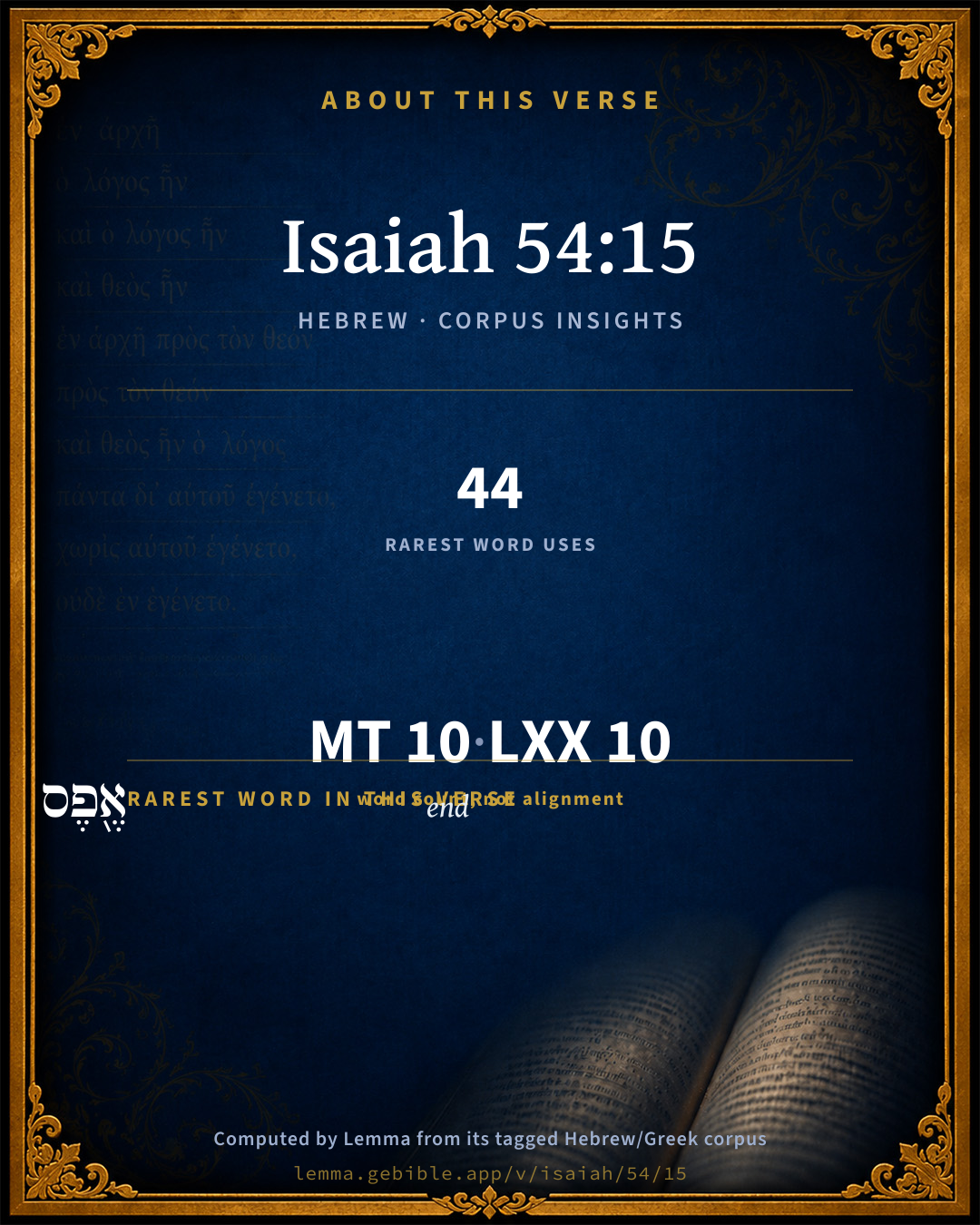
About this verse

These counts appear in no published source. They are computed here, from the morphology-tagged text and Lemma’s own curated glosses. What Lemma adds →

10
words
8
distinct lemmas
Prophets
section

Shared distinctive vocabulary

אֶ֖פֶס end H657 occurs in 43 verses of the Hebrew Bible. Also found in:

Grammatical profile

  • 4 verbs
  • 1 noun
  • 2 prepositions
  • 3 particles

Verb forms

  • גּ֥וֹר Qal · Infinitive Absolute
  • יָג֛וּר Qal · Imperfect
  • גָ֥ר Qal · Participle Active
  • יִפּֽוֹל Qal · Imperfect

Repetition

A word recurs within this verse — often emphatic in Hebrew:

  • גּ֥וֹר to sojourn H1481 ×3

Hebrew & Septuagint length

In English translation the verse runs 20 words from the Hebrew and 20 from the Septuagint (LXX English) — the same length.

A rough comparison of the two English renderings, which tokenize alike — not a word-level alignment.

Word counts can differ between the Hebrew and the Greek without any difference in meaning — e.g. the Hebrew direct-object marker אֵת has no separate Greek word, and Greek often adds the article ὁ.

In the original languages it is 10 Hebrew tokens and 10 Greek tokens — but the two are counted differently (Hebrew bundles its prefixes and suffixes into one token; the Greek is in lemma form), so that isn’t a like-for-like length.

Cross-references

12

Topical passages linked to Isaiah 54:15 in the Treasury of Scripture Knowledge — connected by theme and wording, ordered by reader-vote popularity; previews shown in the World English Bible.

  • Isaiah 41:11–16 Behold, all those who are incensed against you shall be disappointed and confounded: those who strive with you shall be as nothing, and shall perish.
  • Psalms 37:12–13 The wicked plots against the just, And gnashes at him with his teeth.
  • Zechariah 12:9 It will happen in that day, that I will seek to destroy all the nations that come against Jerusalem.
  • Zechariah 2:8 For thus says Yahweh of hosts: 'For honor he has sent me to the nations which plundered you; for he who touches you touches the apple of his eye.
  • Isaiah 43:3–4 For I am Yahweh your God, the Holy One of Israel, your Savior; I have given Egypt as your ransom, Ethiopia and Seba in your place.
  • Zechariah 14:2–3 For I will gather all nations against Jerusalem to battle; and the city will be taken, the houses rifled, and the women ravished. half of the city will go out into captivity, and the rest of the people will not be cut off from the city.
  • Revelation 20:8–9 and he will come out to deceive the nations which are in the four corners of the earth, Gog and Magog, to gather them together to the war; the number of whom is as the sand of the sea.
  • Isaiah 43:14 Thus says Yahweh, your Redeemer, the Holy One of Israel: For your sake I have sent to Babylon, and I will bring down all of them as fugitives, even the Chaldeans, in the ships of their rejoicing.
  • Ezekiel 38:8–23 After many days you shall be visited: in the latter years you shall come into the land that is brought back from the sword, that is gathered out of many peoples, on the mountains of Israel, which have been a continual waste; but it is brought forth out of the peoples, and they shall dwell securely, all of them.
  • Zechariah 12:3 It will happen in that day, that I will make Jerusalem a burdensome stone for all the peoples. All who burden themselves with it will be severely wounded, and all the nations of the earth will be gathered together against it.
  • Revelation 16:14 for they are spirits of demons, performing signs; which go forth to the kings of the whole inhabited earth, to gather them together for the war of that great day of God, the Almighty.
  • Joel 3:9–14 Proclaim this among the nations: Prepare war. Stir up the mighty men. Let all the warriors draw near. Let them come up.

Cross-references courtesy of OpenBible.info (CC BY 4.0).

Hebrew and Greek witnesses Masoretic Hebrew ↔ Greek Septuagint

The same verse in the two great witnesses to the Old Testament, shown verse-for-verse.

These are two independent witnesses, not word-aligned to each other, and the Septuagint is shown in lemma (dictionary) form.

Hebrew Isaiah 54:15 Masoretic · Westminster Leningrad Codex

הֵ֣ן גּ֥וֹר יָג֛וּר אֶ֖פֶס מֵֽאוֹתִ֑י מִי גָ֥ר אִתָּ֖ךְ עָלַ֥יִךְ יִפּֽוֹל

Behold, they may gather together, but not by me: whoever shall gather together against you shall fall because of you.

World English Bible · Public Domain

Greek LXX Isaiah 54:15 Septuagint · lemma form

ἰδού προσήλυτος προςἔρχομαι σύ διά ἐγώ καί ἐπί σύ καταφεύγω

Behold, strangers shall come to you by me, and shall sojourn with you, and shall run to you for refuge.

LXX2012 (modern English Septuagint) · Public Domain

On this verse, Albert Barnes' Notes on the Bible discusses the Septuagint’s reading. Read the note in Commentary ↓

Hebrew: Westminster Leningrad Codex (CC BY 4.0). Greek: Septuagint (public domain); English from LXX2012 (modern English Septuagint) (Public Domain). How the Septuagint differs from the Hebrew →

Targum (Aramaic paraphrase)

1

The Targum is the ancient Jewish Aramaic paraphrase of the Hebrew Scriptures — an interpretive translation, not the Hebrew text itself. Onkelos (literal) and Pseudo-Jonathan (expansive) render the Torah, and Jonathan the Prophets. Coverage is partial: where no permissively-licensed English translation exists for a verse, only the Aramaic is shown. This is verse-level text, not a word-by-word alignment to the Hebrew.

  1. Targum Jonathan Prophets (Joshua–Malachi)
    הָא אִתְכַּנָשָׁא יִתְכַּנְשׁוּן לִיךְ גַלְוַת עַמִיךְ לְסוֹפָא מַלְכֵי עַמְמַיָא דְמִתְכַּנְשִׁין לַאֲעָקָא לִיךְ יְרוּשְׁלֵם בְּגַוִיךְ יִתְרְמוּן:

    Behold, the captivity of thy people shall surely be gathered unto thee: in the end, the kings of the nations, who are gathered together to oppress thee, O Jerusalem, shall be cast down in the midst of thee.

    Targum Jonathan — Aramaic: “Mikraot Gedolot” (public domain). English: “Sefaria Community Translation” (CC0 1.0 (public-domain dedication)); “London "Chaldee Paraphrase," 1871” (public domain). Text via Sefaria.

Commentary

Notes on Isaiah 54:15 from classic Christian and Jewish commentators (each source and its license shown beneath its notes). The classic Christian expositions comment on the surrounding passage and are grouped to its opening verse, so a note may address several verses; the Jewish commentaries on the Tanakh (Rashi and others) are per-verse, so they appear only where the commentator wrote on this verse.

Lemma curates 59 commentaries, every one of them public domain or Creative Commons licensed, each selected and text-cleaned for this edition rather than reprinted as found. About our sources →

Trapp's Complete Commentary

John Trapp

Isa 54:15 Behold, they shall surely gather together, [but] not by me: whosoever shall gather together against thee shall fall for thy sake.

Ver. 15. Behold, they shall surely (or sedulously) gather together,] {a} Heb., He shall, gathering, gather together, i.e., the enemies, as one man. Some understand it as heretics and hypocrites, who shall dwell together with the Church, so they render it; but shall be evil affected toward it, but to their own ruin,

Whosoever shall gather together against thee.] Qui accolit tecum contra te. Such are those renegade Jesuits that run over to the Lutherans, pretending to be converts, when it is only to keep up the bitter contention that is between them and us.

{a} Commorabuntur.

John Trapp, A Commentary or Exposition upon All the Books of the Old and New Testament (1647–1656) — public domain. Text from a community e-Sword module.

The Biblical Illustrator

Joseph S. Exell

Isa_54:15

Behold, they shall surely gather together

The adversaries of the Church defeated

The unwearied mischievous attempts of the adversaries of Gods people in the world, as they are made without God, so they shall end in shame to themselves.

I. THE ADVERSARIES OF GODS PEOPLE WILL BE UNWEARIEDLY ATTEMPTING MISCHIEF AGAINST THEM. They shall surely gather together. This is sure upon various grounds.

1. He who foreknows all their thoughts, inclinations and purposed from everlasting hath foretold it.

2. So long as there are any of the children of the devil out of hell, he will be inspiring them with malice against the Church of God on earth.

3. The very defeats and disappointments which the enemies of the Church receive make them renew their attempts with greater violence and fury. They are not the more disheartened, but the more exasperated.

4. The fearful expectation of future vengeance is a spur to their diligent use of all the present opportunities of sinning.

II. THESE ATTEMPTS ARE WITHOUT GOD. Not by Me.

1. The Churchs enemies can neither do nor contrive the doing of anything absolutely without God. No creature can subsist, no faculty can perform any of its operations, if Providence did not concur. All the plots which are formed beneath prove vain and fruitless unless there be permission given from above.

2. The enemies of the Church can do nothing effectually but as God really employs them to be the instruments of HIS just displeasure (Hab Psa_17:13-14; Isa_10:5; Isa_01:17; Isa_13:5).

3. The attempts of enemies against Gods people are, notwithstanding, without His approbation.

4. The attempts of enemies, when they have most success, are without Gods truly favourable presence.

5. The attempts of enemies at the time which the prophet here refers to will be without Gods assistance, and consequently without success.

III. THESE ATTEMPTS WILL ISSUE IN RUIN TO THEMSELVES. Whosoever shall gather together, etc.

1. The greatest attempt which was ever made by the devil against the Church, in the Person of Christ Himself, became the means of subverting his own kingdom.

2. The standing of the Churchs enemies is the most precarious and uncertain thing.

3. All that they have, or can have, to support and defend them, will not be sufficient when their appointed destruction comes (Isa_31:3).

4. The enemies of the Church are raised up for this purpose that God may honour himself upon them.

5. The greatest of enemies that the Church of God ever yet had have fallen, though once as likely to stand as any now or hereafter can be.

6. The present enemies of the Church have indeed begun to fall, which is a hopeful token that they shall surely fall.

IV. WHY SHALL THE ATTEMPTS OF THE ENEMIES OF GODS PEOPLE END THUS IN THEIR OWN RUIN? For thy sake.

1. Some read the words, They shall fall before thee, that thou mayest see it.

2. For thy sake cannot mean for thy merit, but for thy benefit.

3. For thy sake may mean, for the kindness and care which I bear to thee.

V. USE.

1. Security and distrust are sinful extremes and both to be avoided.

2. A people dear to God and peculiarly interested in Him, are in a far more blessed condition than all the earth besides.

3. The greatest danger which Gods people are or can be in, is when they engage God against them by sin, and provoke Him to favour their adversaries.

4. The obstructions of mercy are on our part, not on Gods.

5. The memorials of past mercies are to be preserved for our support in future difficulties. (T. Cruso.)

The Biblical Illustrator, edited by Joseph S. Exell (c. 1880s–1900s) — public domain. Text from a community e-Sword module.

Joseph Benson's Commentary

Isa 54:15-17. Behold, they shall gather together — It is true, some will combine, and make an attempt against thee. But not by me — As they will do this without any such commission from me as Sennacherib and Nebuchadnezzar had, so they shall not have my help in it, without which all their endeavours will be in vain. Whosoever shall gather together — To fight against, or persecute thee; shall fall for thy sake — Through that respect and love which I bear to thee. Or, before thee, as the Hebrew may be rendered, so as thine eyes shall behold it.

Behold, I have created the smith, &c. — Both the smith that makes warlike instruments, and the soldier that uses them, are my creatures, and totally at my command, and therefore they cannot hurt you without my leave. I have created the waster, &c. — To destroy only whom and when I please. No weapon formed against thee shall prosper — As they cannot do any thing against thee without my leave, so I assure thee I will not suffer them really to injure thee; and every tongue, &c., shalt thou condemn — And I will deliver thee, not only from the fury of war, but also from the strife of tongues. This is the heritage of the servants of the Lord — This blessed condition is the portion allotted them by me. And their righteousness — The reward of their righteousness; is of me — I give it, and I will continue it to them.

Joseph Benson's Commentary on the Old and New Testaments (1811–1818) — public domain. Text from a community e-Sword module.

Tyndale Open Study Notes

Tyndale Open Resources

54:15 God gives assurance that no nation can defeat his people . The Lord has promised to protect them, just as he had promised Abraham (Gen 12:3; see Isa 49:25).

Tyndale Open Study Notes — © Tyndale Open Resources, licensed CC BY-SA 4.0. Text via the HelloAO Bible API.

Geneva Bible (1599)

Geneva Bible translators

And therefore shall not prevail.

Meaning, the domestical enemies of the Church, as are the hypocrites.

Geneva Bible (1599) marginal notes — public domain. Text via Bolls.life.

Jamieson, Fausset & Brown

Robert Jamieson, A. R. Fausset & David Brown

gather together, &c.--that is, If it should happen that enemies "gather together" against thee (Psa 2:2), they will not have been sent by Me (compare Hos 8:4) as instruments of My wrath (nay, it will be with My disapproval); for "whosoever shall gather together," &c. (Psa 59:3).

fall for thy sake--rather, "shall come over to thy side" [LOWTH]. Literally, "fall to thee" (Jer 21:9; Jer 39:9). To be fully fulfilled to Jerusalem hereafter (Zac 14:16).

Jamieson, Fausset & Brown — Commentary Critical and Explanatory on the Whole Bible (1871) — public domain (CC PDM 1.0). Text via the HelloAO Bible API.

Adam Clarke's Commentary

Verse 15. Shall fall for thy sake - "Shall come over to thy side."] For יפול yippol, twenty-eight MSS. (eight ancient) have יפל yipal, in its more common form. For the meaning of the word in this place, see Jer 37:13.

Adam Clarke's Commentary on the Bible (1810–1826) — public domain. Text from a community e-Sword/MySword module.

Ellicott's Commentary for English Readers

(15) But not by me . . .—Another contrast with Isaiah’s experience. The power of Sargon and Sennacherib rested on the fact that they were instruments in God’s hands (Isa_10:15; Isa_37:26). Against the new Jerusalem no command would be given such as had been given to them.

A Bible Commentary for English Readers, edited by Charles John Ellicott (1878–1897) — public domain. Text from a community e-Sword module.

The Cambridge Bible for Schools and Colleges

gen. ed. J. J. S. Perowne

15. The verse is somewhat difficult. The rendering “gather together” can hardly be defended, and moreover it does not suit the construction (“against,” in the second line, is really “with”). The verb is perhaps best explained as a by-form of a root meaning to “stir up” (strife) or pick a quarrel (Pro_15:18). The sense would be: If (any) should stir up strife (it is) not of me; whosoever stirs up strife with thee shall fall &c. (see R.V. and marg.)

fall because of thee] or perhaps “fall upon thee” to his own ruin (cf. ch. Isa_8:14 f.). R.V. marg. suggests “fall away to thee,” i.e. go over to thy side, which is the sense given by some of the ancient versions. The phrase has this meaning in Jer_21:9; Jer_37:14 (“fall away to the Chaldæans”), but it is little appropriate in this verse.

The Cambridge Bible for Schools and Colleges (gen. ed. J. J. S. Perowne; Cambridge University Press, 1878–1918) — public domain. Text from a community e-Sword module.

John Gill's Exposition

Behold, they shall surely gather together, but not by me,.... Not by the Lord, by his command or order to do his will, and execute his pleasure, which sometimes was the case, as in Sennacherib, Nebuchadnezzar, and others; but so it shall not be, when the enemies of Christ and his people gather together against them in the latter day; this will be by the means of three unclean spirits like frogs that will come out of the mouth of the dragon, beast, and false prophet; even spirits of devils, Popish priests, and Jesuits, who will instigate, stir up, and get together the antichristian kings of the earth to the battle of almighty God, Rev 16:14. Aben Ezra, Kimchi, and Ben Melech, interpret them of Gog and Magog:

whosoever shall gather together against thee shall fall for thy sake; because of the love that I bear to thee, they shall not succeed, or do thee any hurt, but shall perish; or, "shall fall to thee" (c); so far from doing thee any hurt, they shall come over to thee, and be on thy side; be joined to thee, as the Vulgate Latin version; that is, the remnant that shall escape, and be converted, and give glory to God, Rev 11:13 or rather, "shall fall before thee" (d), in thy sight; or, as the Targum, in the midst of thee; which remarkably paraphrases the words thus,

"at the end the kings of the nations, which are gathered together to afflict thee, O Jerusalem, shall fall in the midst of thee;''

for the kings of the earth that shall be gathered together against Christ and his church shall fall in battle before them, and their flesh shall become meat for the fowls of the heaven; the beast and false prophet, in company with them, will be taken and cast alive into the lake of fire, and the remnant be slain with the sword of Christ, Rev 19:17.

(c) "ad te cadet", Cocceius. (d) "Cotam te cadet", Grotius, Gataker.

John Gill's Exposition of the Whole Bible (1746–1763) — public domain (CC PDM 1.0). Text via the HelloAO Bible API.

Albert Barnes' Notes on the Bible

Behold, they shall surely gather together - The idea in this verse is, that the enemies of the people of God would indeed form alliances and compacts against them, but it would not be under the divine direction, and they would not be able to prevail against the church. The word rendered here ‘gather together’ (גור gûr) means properly ‘to turn aside from the way’; then to sojourn for a time; then to assemble against anyone. It seems here to refer to the gathering together of hostile forces to form an alliance, or to wage war. Great variety, however, has prevailed in the interpretation of the passage, but this seems to be the sense of it. Jerome renders it, ‘Lo, a foreigner shall come who was not with me, the stranger shall hereafter be joined to thee,’ and seems to understand it of the proselytes that should be made. This sense is found expressly in the Septuagint, ‘Lo, proselytes shall come to thee through me, and they shall sojourn with thee, and fly to thee’ The Chaldee renders it, ‘Lo, the captivity of thy people shall be surely gathered unto thee, and in the end the kings of the people which were assembled to afflict thee, O Jerusalem, shall fall in the midst of thee.’ But the above seems to be the correct sense. Alliances would be formed; compacts would be entered into; leagues would be made by the enemies of the people of God, and they would be assembled to destroy the church. This has often been done. Formidable confederations have been entered into for the purpose, and deep-laid plans have been devised to destroy the friends of the Most High. See Psa 2:2 : ‘The kings of the earth set themselves, and the rulers take counsel together against the Lord, and against his Anointed.’ No small part of history is a record of the combinations and alliances which have been entered into for the purpose of driving the true religion from the world.

But not by me - Not under my direction, or by my command.

Shall fall for thy sake - Hebrew, עליך ‛âlaı̂yk - ‘Shall fall unto thee.’ Lowth, ‘Shall come over to thy side.’ The phrase seems to mean that they should ‘fall to them,’ that is, that they should lay aside their opposition, break up their alliances against the church, and come over to it. In proof of this interpretation, Rosenmuller appeals to the following places: 1Ch 12:19-20; 2Ch 15:9; Jer 21:9; Jer 39:9. The passage, therefore, looks to the future conversion of the enemies of the church to the true faith. It has, doubtless, been partially fulfilled in the conversion of nations that have been leagued against the gospel of the Redeemer. There was a striking fulfillment in the times that succeeded the persecutions of Christians in the Roman empire. After all the power of the empire had been enlisted in ten successive persecutions to destroy the church, the very empire that had thus opposed the church was converted to the Christian faith. In a still more signal manner will this be fulfilled when all the powers of the earth now leagued against the gospel shall be brought under the influences of the true religion.

Albert Barnes' Notes on the Bible (1834–1885) — public domain. Text from a community e-Sword/MySword module.

Haydock's Catholic Bible Commentary

To thee, in the inheritance. This was verified in the Church. We have no accout of many being converted before.

George Leo Haydock (1774–1849), Haydock's Catholic Family Bible and Commentary, 1859 edition — public domain. Excludes Psalms (Douay-Rheims chapter numbering differs from Protestant) and Deuterocanonical books (Catholic canon only).

Matthew Poole's English Annotations

They shall surely gather together; it is true, there will not want some that shall combine and make an attempt against thee.

But not by me; as they do this without any such commission from me, as Sennacherib and Nebuchadnezzar had, Isa 10:6,7; Jer 25:9; so they shall not have my help in it, without which all their endeavours will be vain and unsuccessful.

Whosoever shall gather together to battle, as is manifest from the following words, of which kind of gathering this word is used, Psa 140:2, and elsewhere. Against thee, Heb. with thee. But to fight with a man is all one with fighting against him.

Shall fall for thy sake; for that respect and love which I bear to thee. Or before thee, as this particle is sometimes used, so as thine eyes shall behold it.

Matthew Poole's English Annotations on the Holy Bible (1683–1685) — public domain. Text from a community e-Sword/MySword module.

Whedon's Commentary on the Bible

Daniel D. Whedon

15. They shall surely gather together — That is, enemies, or opposing companies. Compacts shall still be formed against Zion.

But not by me — Not by my appointment. I may not hinder — I may permit for a time.

Whosoever… against thee shall fall for thy sake — The scene presented seems to imply that Zion all along shall still have opposers. If God permits these oppositions, the spirit and power of his providence is, nevertheless, against them, and their opposition shall be ineffectual. Many opposers shall themselves fail and go to perdition, they having first fulfilled a permitted persecution to discipline Zion’s people, and thus strengthen their faith and fidelity. Others shall give up the strife and become friends of God: shall fall unto thee: a sense many of the later interpreters adopt. The Septuagint and Vulgate Versions, and some of the Targums, vary from this interpretation, but not seriously nor at all essentially. Since this day the Messianic period has advanced more than 2000 years further in history, and the interpretation has thus become general in its terms.

Daniel D. Whedon (gen. ed.), Commentary on the Old and New Testaments (1874–1909) — public domain. Text from a community e-Sword module.

The Pulpit Commentary

Behold, they shall surely gather together, etc.; rather, behold, should they gather themselves together; i.e. should enemies collect and threaten thee with harm, be assured that the attack is not by me not my doing and that, therefore, it will come to nought. All those who gather together against thee shall falli.e. stumble and be overthrown through striking against thee. The rendering of the Authorized Version, "for thy sake," is quite indefensible.

The Pulpit Commentary (1880–1919), ed. H.D.M. Spence-Jones & Joseph S. Exell — public domain. Text from a community e-Sword module.

John Wesley's Explanatory Notes

Behold - It is true some will combine and make an attempt against thee. But - Without any such commission from me, as Sennacherib and Nebuchadnezzar had.

John Wesley, Explanatory Notes Upon the Whole Bible (1754–1765) — public domain. Text via the GEBible commentary corpus.

J. A. Alexander on Isaiah

Joseph Addison Alexander

“Lo, they shall gather, they shall gather, not at my sign (or signal). Who has gathered against thee! He shall fall away to thee.” The promise of the preceding verse is here so modified as to provide for every possible contingency. If enemies should be assembled, it will not be by divine command (compare Isa 10:5; Isa 47:6) and they shall end by coming over to the side of those whom they assail. This, on the whole, appears to be the meaning, although every expression has received a different explanation. The promise is not that they should never be assailed, but that they should never be conquered. ‘Not by my sign or signal’, (i.e., not by my authority or not at my command).

Joseph Addison Alexander, The Prophecies of Isaiah (1846–1847; New York: Scribner, 1870–1878) — public domain. Text from a community e-Sword module.

unfoldingWord translationNotes

Door43 World Missions Community

General Information:

Yahweh continue speaking to the people of Jerusalem.

stirs up trouble

This is an idiom. AT: "causes trouble" or "troubles you" (See: Idiom)

will fall in defeat

This is an idiom. AT: "you will defeat them in battle" (See: Idiom)

translationWords

trouble

create

works

unfoldingWord translationNotes — © Distant Shores Media and the Door43 World Missions Community, licensed CC BY-SA 4.0. Source: git.door43.org/Door43/en_tn.

Rashi

Rabbi Shlomo Yitzchaki (Rashi)

Behold, the one with whom I am not, shall fear Heb. גּוֹר יָגוּר. Behold, he shall fear and dread evil decrees, he with whom I am not, i.e., Esau. ([Mss. read:] the wicked Esau and his ilk.)

whoever mobilizes against you Heb. גָר. Whoever mobilizes against you for war. Alternatively, מִי גָר [means:] whoever contends with you (וְנִתְגָּרֶה). And our Rabbis explained it as referring to the proselytes (גֵּרִים), [i.e.,] to say that we will not accept proselytes in Messianic times. And even according to the simple meaning of the verse it is possible to explain: whoever became sojourners with you in your poverty, shall dwell with you in your wealth. Comp. (Gen. 25:18) “In the presence of all his brethren he dwelt (נָפָל).”

Rashi on the Tanakh — English translations: “The Judaica Press complete Tanach with Rashi, translated by A. J. Rosenberg” (CC BY 4.0); “Pentateuch with Rashi's commentary by M. Rosenbaum and A.M. Silbermann, 1929-1934” (public domain); “The Metsudah Tanach series, Lakewood, N.J” (CC BY 4.0); and “The Book of Joshua, Metsudah Publications, 1997” (CC BY 4.0). Text via Sefaria.

Ibn Ezra

Rabbi Abraham ibn Ezra

גור יגור. According to R. Jonah: they will surely gather together; comp. ממגורות barns, (Joel 1:17). The meaning of the whole verse is accordingly: Is it possible, that any alliance should be made except with my permission? (The alliance between Gog and Magog is here referred to.)

He who is now thy ally, and will then become thy enemy, will fall. I take גור יגור in its usual meaning and explain the verse thus: Can there dwell any stranger with thee in my land, except it be with my will; he who desires to dwell with thee in my land, עליך יפול must surrender to thee. The verb נפל has here the same meaning as in אל הכשדים אתה נופל thou fallest away to the Chaldӕans (Jer. 37:13); and in על פני כל אחיו נפל he surrendered to all his brethren (Gen. 25:18); namely: to submit to the authority of.

Ibn Ezra on the Tanakh — English translations: “Sefaria Community Translation” (CC0 1.0 (public-domain dedication)); “Yalkut, Sifsei Chachomim Chumash, Metsudah Publications, 2009” (CC BY 4.0); and “Commentary of Ibn Ezra on Isaiah - trans. by M. Friedlander, 1873” (public domain). Text via Sefaria.

Lesson kit

Teaching starters — assembled from the data on this page, not authored interpretation. Every prompt links to the verse data it draws on. Edit before teaching.

Isaiah, in the Prophets, opens this verse with 10 words (8 distinct Hebrew lemmas). Its most distinctive word is ʼepheç (“end”). A historical commentator’s framing appears above. Read the whole chapter for the surrounding context.

Discussion questions

  1. What does “end” (ʼepheç) contribute to the verse as a whole?
  2. Numbers 13:28 shares the word «end» with this verse. How do the two illuminate each other?
  3. “to sojourn” occurs 3× in this one verse. What is the effect of the repetition?
  4. These translations render this verse differently; the difference is in the English rendering, not the original. What questions does that raise?
  5. The verb «גּ֥וֹר» is Qal Infinitive Absolute. How does its form color the action?
  6. Reading how Trapp's Complete Commentary and The Biblical Illustrator read this verse, where do the two commentators agree and where do they part?

Things to notice

Reading settings

Reading text

Shown beneath each verse's original-language words.

Old Testament
Old Testament edition

Read the OT as the Masoretic Hebrew (MT) or the Greek Septuagint (LXX).

English shown for the Greek Septuagint (in the Hebrew ↔ Greek comparison).

Comparing translations? Open the Compare panel on any verse page to stack up to four side by side.