
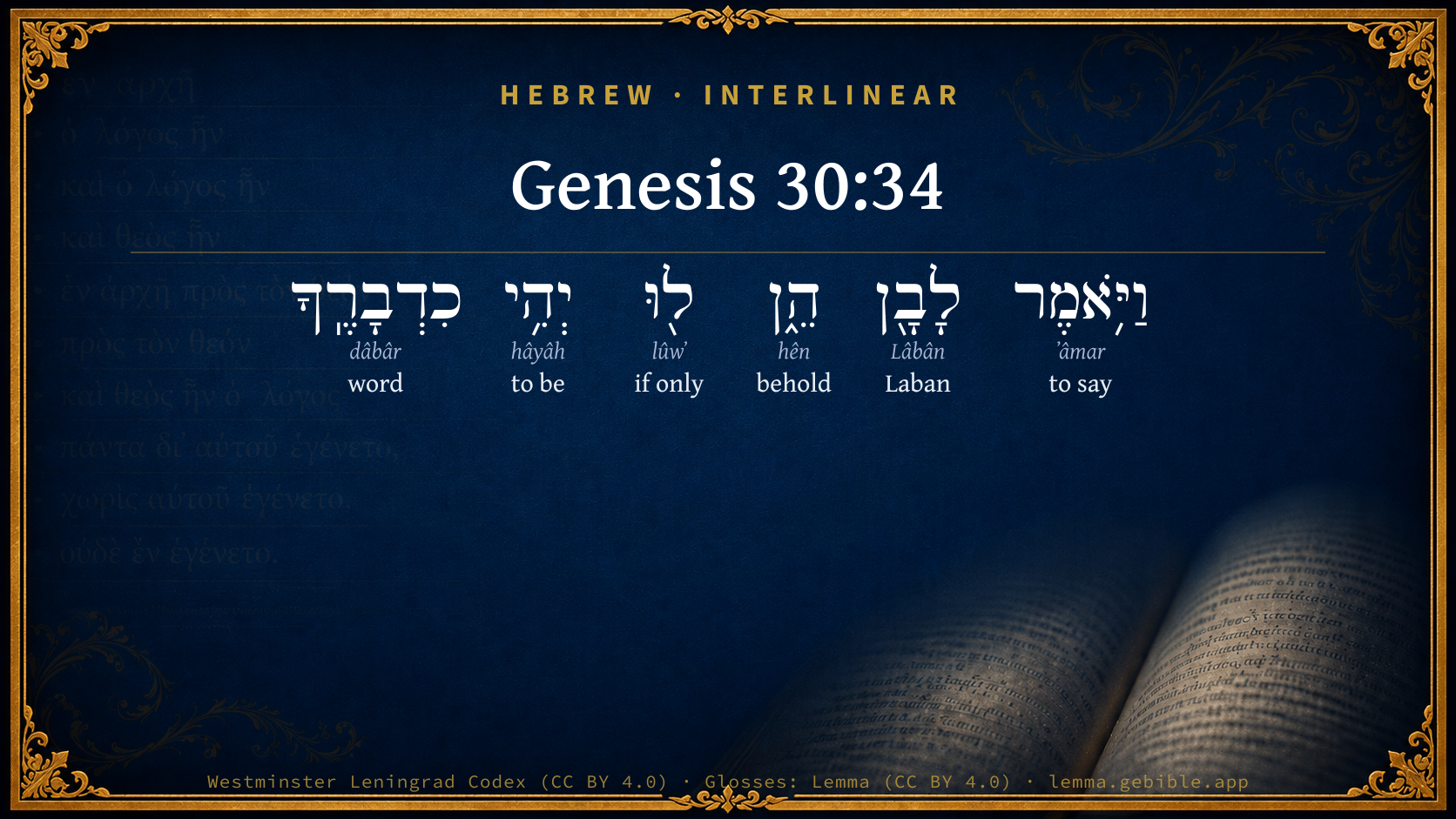
Genesis 30:34

Hebrew (Westminster Leningrad Codex) Genesis 30:34 appears in the Hebrew Old Testament. The text above is from the Westminster Leningrad Codex. Each word links to its Strong’s number, a concise gloss, and parsing drawn from the Open Scriptures Hebrew Bible morphology. Click any word for its full Brown-Driver-Briggs (BDB) entry.
Download image
Cite this verse

Genesis 30:34 (World English Bible). Public Domain. Lemma interlinear Bible study tool, https://lemma.gebible.app/v/genesis/30/34.

Show BibTeX & RIS
BibTeX
RIS
English Translation
Laban said, "Behold, I desire it to be according to your word."
World English Bible · Public Domain
Download a study sheet

One document with this verse’s original text, its word-by-word gloss line, the meaning frame, cross-references with their text, attributed commentary, and full source and license credits — printable, and it pastes into notes with its structure intact.

This verse Autodidact and up

Study sheet (.html) Plain text (.txt)

A passage Seminary Student

Up to 50 verses in one chapter. A passage sheet keeps up to 6 commentary sources and 12 cross-references per verse, in the order this page ranks them, and says so on the sheet whenever that leaves anything out. Ask for a single verse and you get the Autodidact verse sheet above.

Everything on this page stays free to read, with no account — the sheet is a download of what is already on screen, not access to it.

Want to remove ads? Support Godless Engineer
Compare translations 3

The same verse in 3 English versions, stacked beneath the original-language interlinear above. Click any original word for its lexicon entry.

Each is an independent rendering of the whole verse — the interlinear is not word-aligned to these translations.

Highlighted words mark where these versions differ — a whole-verse word diff, not a word-by-word alignment.

  • World English Bible Public Domain
    Laban said, "Behold, I desire it to be according to your word."
  • King James Version Public Domain
    And Laban said, Behold, I would it might be according to thy word.
  • unfoldingWord Literal Text CC BY-SA 4.0
    And Laban said, “Behold, let it be according to your word.”

unfoldingWord Literal Text — © unfoldingWord, licensed CC BY-SA 4.0. Word-aligned USFM3 via Door43 (git.door43.org/unfoldingWord/en_ult).

Versions to compare (up to 4)

3 of 4 selected

Show all 18 translations

Every available English version of this verse, each an independent rendering of the whole verse.

  • World English Bible Public Domain
    Laban said, "Behold, I desire it to be according to your word."
  • Berean Standard Bible Public Domain
    “Agreed,” said Laban. “Let it be as you have said.”
  • Majority Standard Bible Public Domain
    “Agreed,” said Laban. “Let it be as you have said.”
  • King James Version Public Domain
    And Laban said, Behold, I would it might be according to thy word.
  • American Standard Version (1901) Public Domain
    And Laban said, Behold, I would it might be according to thy word.
  • Revised Version (1885) Public Domain
    And Laban said, Behold, I would it might be according to thy word.
  • Geneva Bible (1599) Public Domain
    Then Laban sayde, Goe to, woulde God it might be according to thy saying.
  • Douay-Rheims (1899) Public Domain
    And Laban said: I like well what thou demandest.
  • Young's Literal Translation Public Domain
    And Laban saith, `Lo, O that it were according to thy word;'
  • Literal Standard Version CC BY-SA 4.0
    And Laban says, “Behold, O that it were according to your word”;
  • Unlocked Literal Bible CC BY-SA 4.0
    Laban said, “Agreed. Let it be according to your word.”
  • unfoldingWord Literal Text CC BY-SA 4.0
    And Laban said, “Behold, let it be according to your word.”
  • Darby Bible Public Domain
    And Laban said, Well, let it be according to thy word.
  • World Messianic Bible Public Domain
    Laban said, “Behold, let it be according to your word.”
  • Webster's Bible Public Domain
    And Laban said, Behold, I would it might be according to thy word.
  • Free Bible Version CC BY-SA 4.0
    “Very good,” Laban agreed. “We'll do as you say.”
  • Bible in Basic English Public Domain
    And Laban said, Let it be as you say.
  • JPS Tanakh (1917) Public Domain
    And Laban said: 'Behold, would it might be according to thy word.'

Literal Standard Version (2020), Covenant Press — licensed CC BY-SA 4.0. Text via the HelloAO Bible API (eBible.org). Unlocked Literal Bible (unfoldingWord) — licensed CC BY-SA 4.0. Text via the HelloAO Bible API (eBible.org). unfoldingWord Literal Text — © unfoldingWord, licensed CC BY-SA 4.0. Word-aligned USFM3 via Door43 (git.door43.org/unfoldingWord/en_ult). Free Bible Version, Dr. Jonathan Gallagher — licensed CC BY-SA 4.0. Text via the HelloAO Bible API (eBible.org).

Word by word

More ways to search: Search by grammar → Find every occurrence → Compare this word →

Practice this passage: Drill this verse → Learn its vocabulary →

About this verse

These counts appear in no published source. They are computed here, from the morphology-tagged text and Lemma’s own curated glosses. What Lemma adds →

6
words
6
distinct lemmas
Pentateuch
section

Notable vocabulary

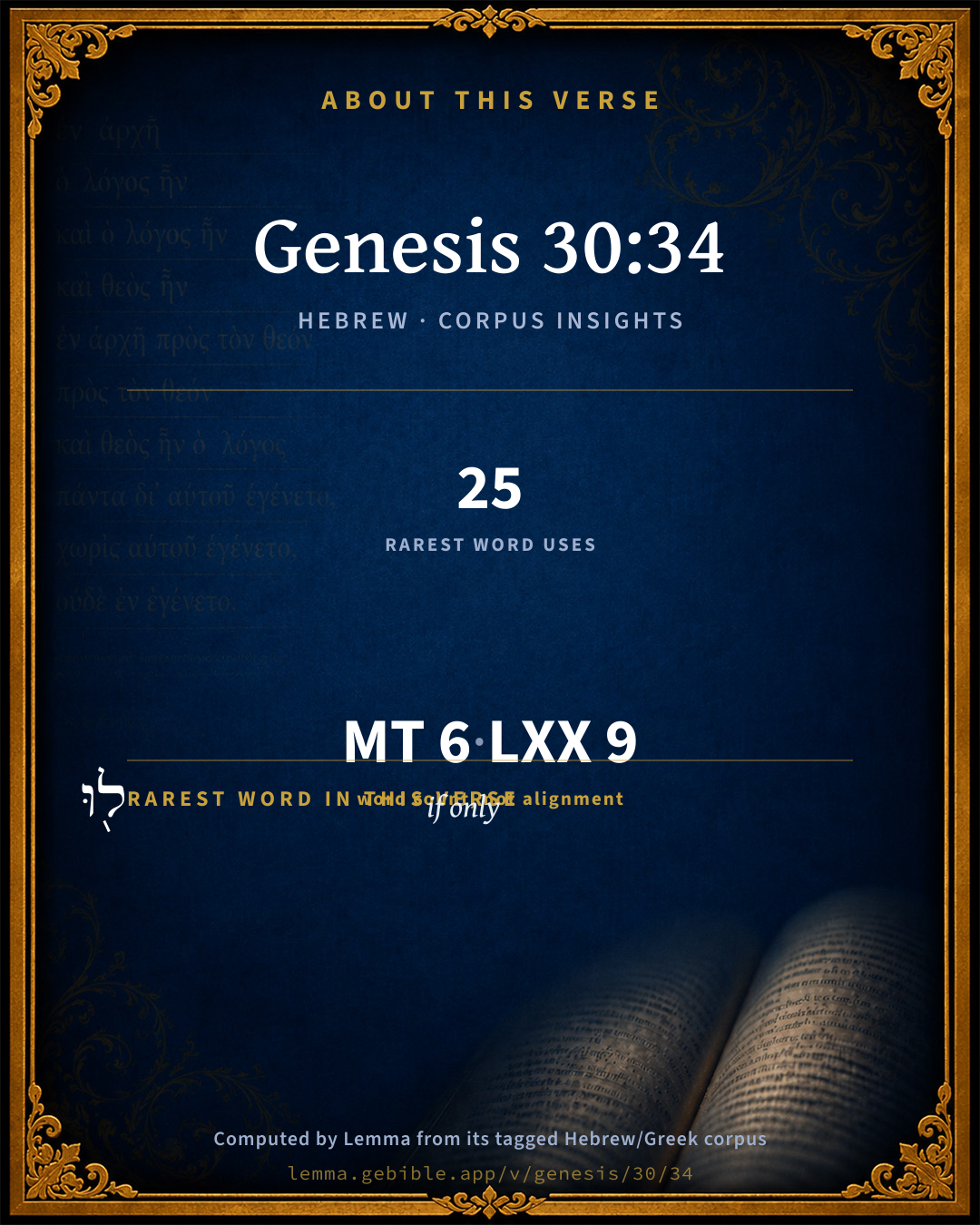
The rarest word here is ל֖וּ if only H3863 — appearing just 25 times in the whole Hebrew Bible.

Shared distinctive vocabulary

ל֖וּ if only H3863 occurs in 22 verses of the Hebrew Bible. Also found in:

Grammatical profile

  • 2 verbs
  • 2 nouns
  • 1 conjunction
  • 1 particle

Verb forms

  • וַיֹּ֥אמֶר Qal · Sequential Imperfect
  • יְהִ֥י Qal · Imperfect

Hebrew & Septuagint length

In English translation the verse runs 12 words from the Hebrew and 12 from the Septuagint (LXX English) — the same length.

A rough comparison of the two English renderings, which tokenize alike — not a word-level alignment.

Word counts can differ between the Hebrew and the Greek without any difference in meaning — e.g. the Hebrew direct-object marker אֵת has no separate Greek word, and Greek often adds the article ὁ.

In the original languages it is 6 Hebrew tokens and 9 Greek tokens — but the two are counted differently (Hebrew bundles its prefixes and suffixes into one token; the Greek is in lemma form), so that isn’t a like-for-like length.

Cross-references

4

Topical passages linked to Genesis 30:34 in the Treasury of Scripture Knowledge — connected by theme and wording, ordered by reader-vote popularity; previews shown in the World English Bible.

  • Numbers 22:29 Balaam said to the donkey, Because you have mocked me, I would there were a sword in my hand, for now I had killed you.
  • 1 Corinthians 7:7 Yet I wish that all men were like me. However each man has his own gift from God, one of this kind, and another of that kind.
  • 1 Corinthians 14:5 Now I desire to have you all speak with other languages, but rather that you would prophesy. For he is greater who prophesies than he who speaks with other languages, unless he interprets, that the assembly may be built up.
  • Galatians 5:12 I wish that those who disturb you would cut themselves off.

Cross-references courtesy of OpenBible.info (CC BY 4.0).

Hebrew and Greek witnesses Masoretic Hebrew ↔ Greek Septuagint

The same verse in the two great witnesses to the Old Testament, shown verse-for-verse.

These are two independent witnesses, not word-aligned to each other, and the Septuagint is shown in lemma (dictionary) form.

Hebrew Genesis 30:34 Masoretic · Westminster Leningrad Codex

וַיֹּ֥אמֶר לָבָ֖ן הֵ֑ן ל֖וּ יְהִ֥י כִדְבָרֶֽךָ

Laban said, "Behold, I desire it to be according to your word."

World English Bible · Public Domain

Greek LXX Genesis 30:34 Septuagint · lemma form

εἶπον δέ αὐτός λαβαν εἰμί κατά ὁ ῥῆμα σύ

And Laban said to him, Let it be according to your word.

LXX2012 (modern English Septuagint) · Public Domain

Hebrew: Westminster Leningrad Codex (CC BY 4.0). Greek: Septuagint (public domain); English from LXX2012 (modern English Septuagint) (Public Domain). How the Septuagint differs from the Hebrew →

Targum (Aramaic paraphrase)

2

The Targum is the ancient Jewish Aramaic paraphrase of the Hebrew Scriptures — an interpretive translation, not the Hebrew text itself. Onkelos (literal) and Pseudo-Jonathan (expansive) render the Torah, and Jonathan the Prophets. Coverage is partial: where no permissively-licensed English translation exists for a verse, only the Aramaic is shown. This is verse-level text, not a word-by-word alignment to the Hebrew.

  1. Targum Onkelos Torah (Genesis–Deuteronomy)
    וַאֲמַר לָבָן בְּרַם לְוַי יְהֵי כְפִתְגָּמָךְ

    (no public-domain English translation for this verse)

    Targum Onkelos — Aramaic: “Onkelos Genesis” (public domain); “Onkelos Exodus” (public domain); “Onkelos Leviticus” (public domain); “Onkelos Numbers” (public domain); “Onkelos Deuteronomy” (public domain). English: “Sefaria Community Translation” (CC0 1.0 (public-domain dedication)); “J.W. Etheridge. The Targums of Onkelos and Jonathan Ben Uzziel on the Pentateuch. London: Longmans, Green, 1862” (public domain). Text via Sefaria.

  2. Targum Pseudo-Jonathan Torah (Genesis–Deuteronomy)
    וַאֲמַר לָבָן יָאוּת לְוָאֵי דִיהִי כְּפִתְגָמָךְ

    And Laban said to him, Well, let it be according to thy word.

    Targum Pseudo-Jonathan — Aramaic: “Targum Jonathan on Genesis” (public domain); “Targum Jonathan on Exodus” (public domain); “Targum Jonathan on Leviticus” (public domain); “Targum Jonathan on Numbers” (public domain); “Targum Jonathan on Deuteronomy” (public domain). English: “The Targum of Jonathan ben Uzziel, trans. J. W. Etheridge, London, 1862” (public domain). Text via Sefaria.

Commentary

Notes on Genesis 30:34 from classic Christian and Jewish commentators (each source and its license shown beneath its notes). The classic Christian expositions comment on the surrounding passage and are grouped to its opening verse, so a note may address several verses; the Jewish commentaries on the Tanakh (Rashi and others) are per-verse, so they appear only where the commentator wrote on this verse.

Lemma curates 59 commentaries, every one of them public domain or Creative Commons licensed, each selected and text-cleaned for this edition rather than reprinted as found. About our sources →

Trapp's Complete Commentary

John Trapp

Gen 30:34 And Laban said, Behold, I would it might be according to thy word.

Ver. 34. Behold, I would it might be.] He was glad to have him on the hip for a bad bargain, but is fairly deceived himself. God will see to his servants, that they shall not lose all: though the world think it neither sin nor pity to defraud them of their due.

John Trapp, A Commentary or Exposition upon All the Books of the Old and New Testament (1647–1656) — public domain. Text from a community e-Sword module.

Joseph Benson's Commentary

Gen 30:34. Laban was willing to consent to this bargain, because he thought, that if those few he had that were now speckled and spotted were separated from the rest, the body of the flock, which Jacob was to tend, being of one colour, either all black or all white, would produce few or none of mixed colours, and so he should have Jacob’s service for nothing, or next to nothing.

Joseph Benson's Commentary on the Old and New Testaments (1811–1818) — public domain. Text from a community e-Sword module.

Tyndale Open Study Notes

Tyndale Open Resources

30:34-36 Laban verbally agreed with Jacob’s plan, but he tried to prevent Jacob from accruing wealth by removing animals from the flock that would fulfill the agreement. • Laban’s deception with his goats reminds us of Jacob’s deception of Esau (cp. 27:9; see study note on 29:14-30).

Tyndale Open Study Notes — © Tyndale Open Resources, licensed CC BY-SA 4.0. Text via the HelloAO Bible API.

John Gill's Exposition

And he set the rods which he had pilled before the flocks,.... Opposite them, in the view of them:

in the gutters in the watering troughs, when the flocks came to drink; that is, in places of water, where troughs or vessels were made, into which the water ran convenient for the cattle to drink out of; and here he placed his party coloured rods right over against the flocks:

that they should conceive when they came to drink; as it was most likely they should when they were together at the water, and had refreshed themselves with it; and being "heated" (q), as the word signifies, with a desire of copulation, might conceive in sight of the above rods; which were set to move upon their imagination at the time of their conception, in order to produce cattle of different colours; to which no doubt he was directed of God, and it had, through his blessing, the wished for success, as follows:

(q) "incalescebant", Montanus, Vatablus, Drusius; "ut incalescerent", Junius & Tremellius.

John Gill's Exposition of the Whole Bible (1746–1763) — public domain (CC PDM 1.0). Text via the HelloAO Bible API.

Matthew Poole's English Annotations

Laban trusted to the course of nature, whereby cattle usually bring forth their young of their own colour; and Jacob relied upon the providence of an Almighty God, and his gracious Father.

Matthew Poole's English Annotations on the Holy Bible (1683–1685) — public domain. Text from a community e-Sword/MySword module.

The Pulpit Commentary

And Laban said, Behold, I would it might be according to thy word. Jacob s chances of obtaining speckled animals by this arrangement were so small that Laban, with his customary selfishness, had no difficulty in closing with the offered bargain. As originally proposed by Jacob it seems to have been an honest desire on his part to commit the question of wages to the decision rather of God"s providence than of his kiss-man"s greed. That at this time Jacob"s mind "had already formed the whole fraudulent procedure by which he acquired his wealth" (Kalisch) does not accord with the statement subsequently made.

The Pulpit Commentary (1880–1919), ed. H.D.M. Spence-Jones & Joseph S. Exell — public domain. Text from a community e-Sword module.

John Wesley's Explanatory Notes

Laban was willing to consent to this bargain, because he thought if those few he had that were now speckled and spotted were separated from the rest, which was to be done immediately, the body of the flock which Jacob was to tend, being of one colour, either all black or all white, would produce few or none of mixt colours, and so he should have Jacob's service for nothing, or next to nothing. According to this bargain, those few that were party-coloured were separated, and put into the hands of Laban's sons, and sent three days journey off: so great was Laban's jealouly lest any of those should mix with the rest of the flock to the advantage of Jacob.

John Wesley, Explanatory Notes Upon the Whole Bible (1754–1765) — public domain. Text via the GEBible commentary corpus.

Keil & Delitzsch

C. F. Keil & F. Delitzsch

Laban cheerfully accepted the proposal, but did not leave Jacob to make the selection. He undertook that himself, probably to make more sure, and then gave those which were set apart as Jacob's wages to his own sons to tend, since it was Jacob's duty to take care of Laban's flock, and "set three days' journey betwixt himself and Jacob," i.e., between the flock to be tended by himself through his sons, and that to be tended by Jacob, for the purpose of preventing any copulation between the animals of the two flocks. Nevertheless he was overreached by Jacob, who adopted a double method of increasing the wages agreed upon. In the first place (Gen 30:37-39), he took fresh rods of storax, maple, and walnut-trees, all of which have a dazzling white wood under their dark outside, and peeled white stripes upon them, הלּבן מחשׂף (the verbal noun instead of the inf. abs. חשׂף), "peeling the white naked in the rods." These partially peeled, and therefore mottled rods, he placed in the drinking-troughs (רהטים lit., gutters, from רהט = רוּץ to run, is explained by המּים שׁקתות water-troughs), to which the flock came to drink, in front of the animals, in order that, if copulation took place at the drinking time, it might occur near the mottled sticks, and the young be speckled and spotted in consequence. ויּחמנה a rare, antiquated form for ותּחמנה from חמם, and ויּחמוּ for ויּחמוּ imperf. Kal of יחם = חמם. This artifice was founded upon a fact frequently noticed, particularly in the case of sheep, that whatever fixes their attention in copulation is marked upon the young (see the proofs in Bochart, Hieroz. 1, 618, and Friedreich zur Bibel 1, 37ff.). - Secondly (Gen 30:40), Jacob separated the speckled animals thus obtained from those of a normal colour, and caused the latter to feed so that the others would be constantly in sight, in order that he might in this way obtain a constant accession of mottled sheep. As soon as these had multiplied sufficiently, he formed separate flocks (viz., of the speckled additions), "and put them not unto Laban's cattle;" i.e., he kept them apart in order that a still larger number of speckled ones might be procured, through Laban's one-coloured flock having this mottled group constantly in view.

Keil & Delitzsch — Biblical Commentary on the Old Testament (1861–1891) — public domain (CC PDM 1.0). Text via the HelloAO Bible API. (Old Testament only.)

Rashi

Rabbi Shlomo Yitzchaki (Rashi)

הן WELL! — an expression denoting agreement with a statement.

לו יהי כדברך I WOULD IT MIGHT BE ACCORDING TO THY WORD — Would that you will remain satisfied with this!

Rashi on the Tanakh — English translations: “The Judaica Press complete Tanach with Rashi, translated by A. J. Rosenberg” (CC BY 4.0); “Pentateuch with Rashi's commentary by M. Rosenbaum and A.M. Silbermann, 1929-1934” (public domain); “The Metsudah Tanach series, Lakewood, N.J” (CC BY 4.0); and “The Book of Joshua, Metsudah Publications, 1997” (CC BY 4.0). Text via Sefaria.

Lesson kit

Teaching starters — assembled from the data on this page, not authored interpretation. Every prompt links to the verse data it draws on. Edit before teaching.

Genesis, in the Pentateuch, opens this verse with 6 words (6 distinct Hebrew lemmas). Its most distinctive word is lûwʼ (“if only”). A historical commentator’s framing appears above. Read the whole chapter for the surrounding context.

Discussion questions

  1. How does “if only” (lûwʼ) shape what this verse is saying?
  2. Genesis 17:18 shares the word «if only» with this verse. How do the two illuminate each other?
  3. These translations render this verse differently; the difference is in the English rendering, not the original. What questions does that raise?
  4. The verb «וַיֹּ֥אמֶר» is Qal Sequential Imperfect. How does its form color the action?
  5. Reading how Trapp's Complete Commentary and Joseph Benson's Commentary read this verse, where do the two commentators agree and where do they part?

Things to notice

Reading settings

Reading text

Shown beneath each verse's original-language words.

Old Testament
Old Testament edition

Read the OT as the Masoretic Hebrew (MT) or the Greek Septuagint (LXX).

English shown for the Greek Septuagint (in the Hebrew ↔ Greek comparison).

Comparing translations? Open the Compare panel on any verse page to stack up to four side by side.