2 Chronicles 16:11

Hebrew (Westminster Leningrad Codex) 2 Chronicles 16:11 appears in the Hebrew Old Testament. The text above is from the Westminster Leningrad Codex. Each word links to its Strong’s number, a concise gloss, and parsing drawn from the Open Scriptures Hebrew Bible morphology. Click any word for its full Brown-Driver-Briggs (BDB) entry.
Download image
Cite this verse

2 Chronicles 16:11 (World English Bible). Public Domain. Lemma interlinear Bible study tool, https://lemma.gebible.app/v/2-chronicles/16/11.

Show BibTeX & RIS
BibTeX
RIS
English Translation
Behold, the acts of Asa, first and last, behold, they are written in the book of the kings of Judah and Israel.
World English Bible · Public Domain
Download a study sheet

One document with this verse’s original text, its word-by-word gloss line, the meaning frame, cross-references with their text, attributed commentary, and full source and license credits — printable, and it pastes into notes with its structure intact.

This verse Autodidact and up

Study sheet (.html) Plain text (.txt)

A passage Seminary Student

Up to 50 verses in one chapter. A passage sheet keeps up to 6 commentary sources and 12 cross-references per verse, in the order this page ranks them, and says so on the sheet whenever that leaves anything out. Ask for a single verse and you get the Autodidact verse sheet above.

Everything on this page stays free to read, with no account — the sheet is a download of what is already on screen, not access to it.

Want to remove ads? Support Godless Engineer
Compare translations 3

The same verse in 3 English versions, stacked beneath the original-language interlinear above. Click any original word for its lexicon entry.

Each is an independent rendering of the whole verse — the interlinear is not word-aligned to these translations.

Highlighted words mark where these versions differ — a whole-verse word diff, not a word-by-word alignment.

  • World English Bible Public Domain
    Behold, the acts of Asa, first and last, behold, they are written in the book of the kings of Judah and Israel.
  • King James Version Public Domain
    And, behold, the acts of Asa, first and last, lo, they are written in the book of the kings of Judah and Israel.
  • unfoldingWord Literal Text CC BY-SA 4.0
    And behold, the matters of Asa, the first things and the last things, behold, they are written on the scroll of the kings of Judah and Israel.

unfoldingWord Literal Text — © unfoldingWord, licensed CC BY-SA 4.0. Word-aligned USFM3 via Door43 (git.door43.org/unfoldingWord/en_ult).

Versions to compare (up to 4)

3 of 4 selected

Show all 18 translations

Every available English version of this verse, each an independent rendering of the whole verse.

  • World English Bible Public Domain
    Behold, the acts of Asa, first and last, behold, they are written in the book of the kings of Judah and Israel.
  • Berean Standard Bible Public Domain
    Now the rest of the acts of Asa, from beginning to end, are indeed written in the Book of the Kings of Judah and Israel.
  • Majority Standard Bible Public Domain
    Now the acts of Asa, from beginning to end, are indeed written in the Book of the Kings of Judah and Israel.
  • King James Version Public Domain
    And, behold, the acts of Asa, first and last, lo, they are written in the book of the kings of Judah and Israel.
  • American Standard Version (1901) Public Domain
    And, behold, the acts of Asa, first and last, lo, they are written in the book of the kings of Judah and Israel.
  • Revised Version (1885) Public Domain
    And, behold, the acts of Asa, first and last, lo, they are written in the book of the kings of Judah and Israel.
  • Geneva Bible (1599) Public Domain
    And behold, the actes of Asa first and last, loe, they are written in the booke of the Kings of Iudah and Israel.
  • Douay-Rheims (1899) Public Domain
    But the works of Asa the first and last are written in the book of the kings of Juda and Israel.
  • Young's Literal Translation Public Domain
    And lo, the matters of Asa, the first and the last, lo, they are written on the book of the kings of Judah and Israel.
  • Literal Standard Version CC BY-SA 4.0
    And behold, the matters of Asa, the first and the last, behold, they are written on the scroll of the kings of Judah and Israel.
  • Unlocked Literal Bible CC BY-SA 4.0
    Behold, the deeds of Asa, from first to last, behold, they are written in the book of the kings of Judah and Israel.
  • unfoldingWord Literal Text CC BY-SA 4.0
    And behold, the matters of Asa, the first things and the last things, behold, they are written on the scroll of the kings of Judah and Israel.
  • Darby Bible Public Domain
    And behold the acts of Asa, first and last, behold, they are written in the book of the kings of Judah and Israel.
  • World Messianic Bible Public Domain
    Behold, the acts of Asa, first and last, behold, they are written in the book of the kings of Judah and Israel.
  • Webster's Bible Public Domain
    And behold, the acts of Asa, first and last, lo, they are written in the book of the kings of Judah and Israel.
  • Free Bible Version CC BY-SA 4.0
    The rest of what Asa did, from beginning to end, is written down in the Book of the Kings of Judah and Israel.
  • Bible in Basic English Public Domain
    Now the acts of Asa, first and last, are recorded in the book of the kings of Judah and Israel.
  • JPS Tanakh (1917) Public Domain
    And, behold, the acts of Asa, first and last, lo, they are written in the book of the kings of Judah and Israel.

Literal Standard Version (2020), Covenant Press — licensed CC BY-SA 4.0. Text via the HelloAO Bible API (eBible.org). Unlocked Literal Bible (unfoldingWord) — licensed CC BY-SA 4.0. Text via the HelloAO Bible API (eBible.org). unfoldingWord Literal Text — © unfoldingWord, licensed CC BY-SA 4.0. Word-aligned USFM3 via Door43 (git.door43.org/unfoldingWord/en_ult). Free Bible Version, Dr. Jonathan Gallagher — licensed CC BY-SA 4.0. Text via the HelloAO Bible API (eBible.org).

Word by word

More ways to search: Search by grammar → Find every occurrence → Compare this word →

Practice this passage: Drill this verse → Learn its vocabulary →

וְהָאַחֲרוֹנִ֑ים
ʼachărôwn
H314
“and · the · behind”
Conjunction + Particle, Definite Article + Adjective, Adjective, Masculine, Plural, Absolute
Part of Speech
Conjunction + Particle + Adjective
Type
Adjective
Gender
Masculine
Number
Plural
State
Absolute
Full BDB Definition

Origin: from H309

TWOT: 68e

behind, following, subsequent, western - behind, hindermost, western (of location) - later, subsequent, latter, last (of time)
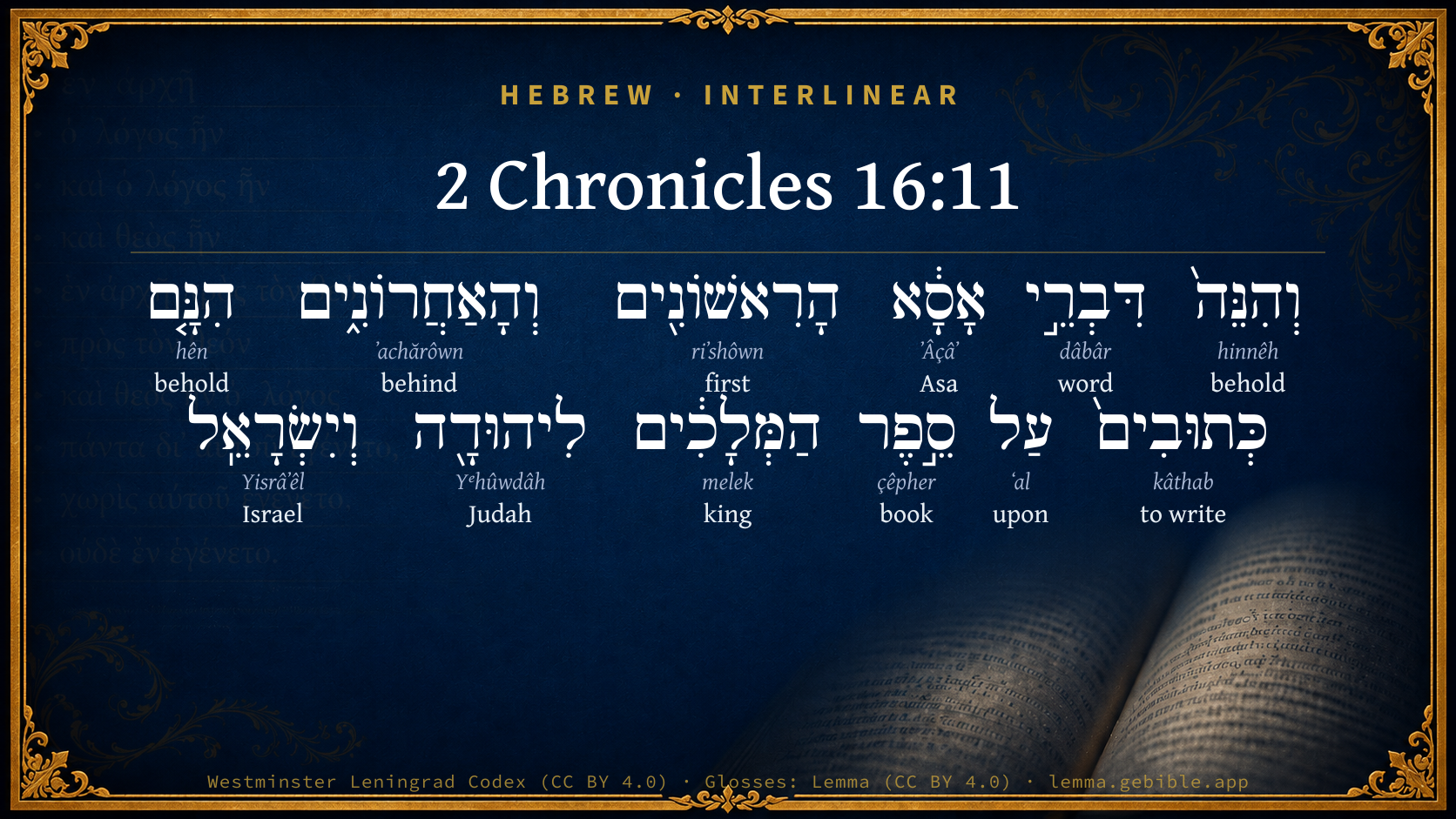
  1. וְהִנֵּה֙ hinnêh H2009 “and · behold” Conjunction + Particle, Demonstrative
  2. דִּבְרֵ֣י dâbâr H1697 “words of” Noun, Common, Masculine, Plural, Construct
  3. אָסָ֔א ʼÂçâʼ H609 “Asa” Noun, Proper
  4. הָרִאשׁוֹנִ֖ים riʼshôwn H7223 “the · first” Particle, Definite Article + Adjective, Ordinal number, Masculine, Plural, Absolute
  5. הִנָּ֤ם hên H2005 “behold · them” Particle, Demonstrative + Suffix, Personal, 3rd Person, Masculine, Plural
  6. כְּתוּבִים֙ kâthab H3789 “written” Verb, Qal, Participle Passive, Masculine, Plural, Absolute
  7. עַל ʻal H5921 “upon” Preposition
  8. סֵ֣פֶר çêpher H5612 “book of” Noun, Common, Masculine, Singular, Construct
  9. הַמְּלָכִ֔ים melek H4428 “the · kings” Particle, Definite Article + Noun, Common, Masculine, Plural, Absolute
  10. לִיהוּדָ֖ה Yᵉhûwdâh H3063 “to/for · Judah” Preposition + Noun, Proper
  11. וְיִשְׂרָאֵֽל Yisrâʼêl H3478 “and · Israel” Conjunction + Noun, Proper

About this verse

These counts appear in no published source. They are computed here, from the morphology-tagged text and Lemma’s own curated glosses. What Lemma adds →

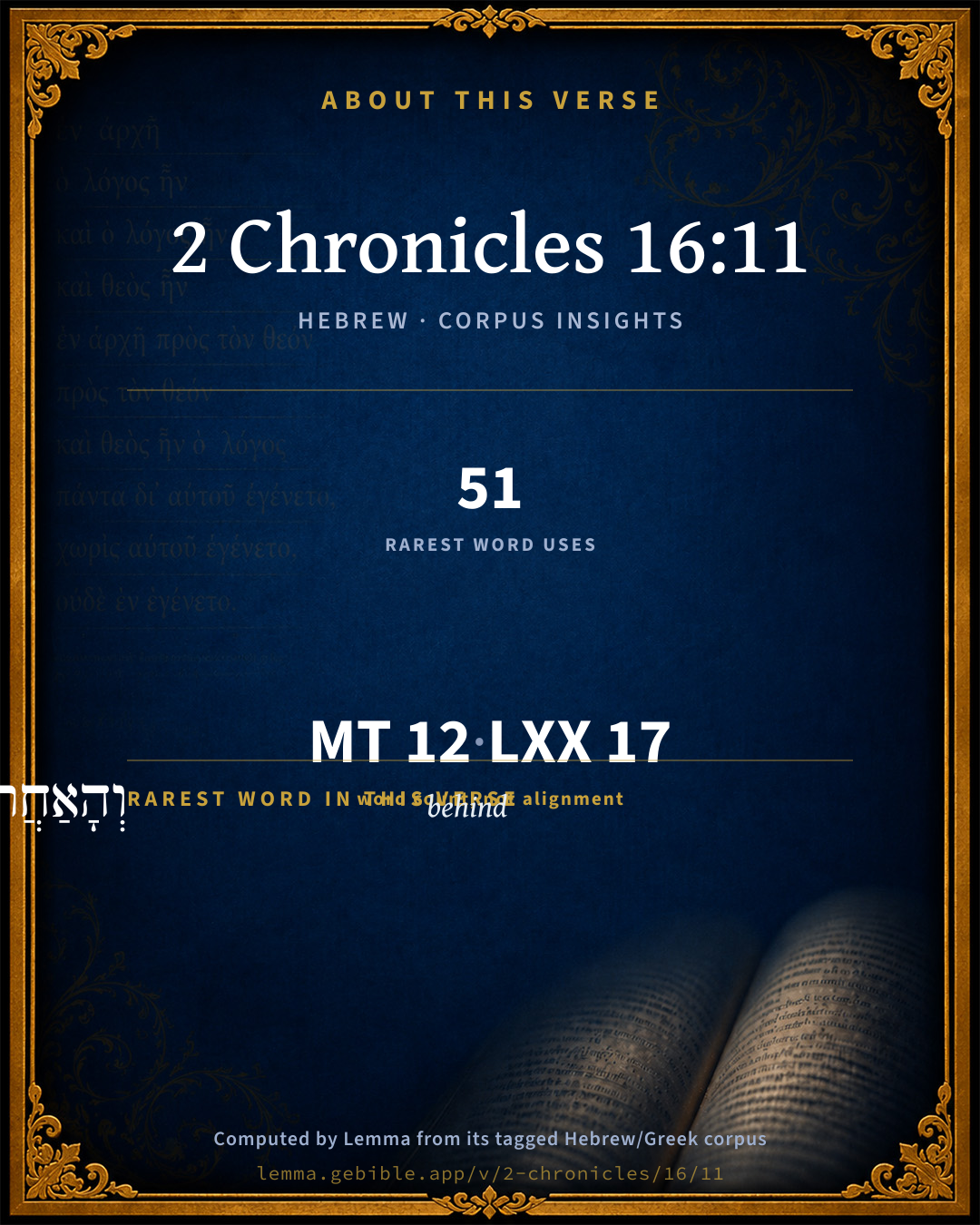
12
words
12
distinct lemmas
Historical
section

Shared distinctive vocabulary

וְהָאַחֲרוֹנִ֑ים behind H314 occurs in 48 verses of the Hebrew Bible. Also found in:

Grammatical profile

  • 1 verb
  • 6 nouns
  • 2 adjectives
  • 1 preposition
  • 2 particles

Verb forms

  • כְּתוּבִים֙ Qal · Participle Passive

Hebrew & Septuagint length

In English translation the verse runs 22 words from the Hebrew and 23 from the Septuagint (LXX English) — closely comparable.

A rough comparison of the two English renderings, which tokenize alike — not a word-level alignment.

Word counts can differ between the Hebrew and the Greek without any difference in meaning — e.g. the Hebrew direct-object marker אֵת has no separate Greek word, and Greek often adds the article ὁ.

In the original languages it is 12 Hebrew tokens and 17 Greek tokens — but the two are counted differently (Hebrew bundles its prefixes and suffixes into one token; the Greek is in lemma form), so that isn’t a like-for-like length.

Cross-references

10

Topical passages linked to 2 Chronicles 16:11 in the Treasury of Scripture Knowledge — connected by theme and wording, ordered by reader-vote popularity; previews shown in the World English Bible.

  • 1 Kings 15:23–24 Now the rest of all the acts of Asa, and all his might, and all that he did, and the cities which he built, aren't they written in the book of the chronicles of the kings of Judah? But in the time of his old age he was diseased in his feet.
  • 2 Chronicles 9:29 Now the rest of the acts of Solomon, first and last, aren't they written in the history of Nathan the prophet, and in the prophecy of Ahijah the Shilonite, and in the visions of Iddo the seer concerning Jeroboam the son of Nebat?
  • 2 Chronicles 12:15 Now the acts of Rehoboam, first and last, aren't they written in the histories of Shemaiah the prophet and of Iddo the seer, after the manner of genealogies? There were wars between Rehoboam and Jeroboam continually.
  • 2 Chronicles 20:34 Now the rest of the acts of Jehoshaphat, first and last, behold, they are written in the history of Jehu the son of Hanani, which is inserted in the book of the kings of Israel.
  • 2 Chronicles 25:26 Now the rest of the acts of Amaziah, first and last, behold, aren't they written in the book of the kings of Judah and Israel?
  • 2 Chronicles 26:22 Now the rest of the acts of Uzziah, first and last, did Isaiah the prophet, the son of Amoz, write.
  • 2 Chronicles 27:7 Now the rest of the acts of Jotham, and all his wars, and his ways, behold, they are written in the book of the kings of Israel and Judah.
  • 2 Chronicles 32:32 Now the rest of the acts of Hezekiah, and his good deeds, behold, they are written in the vision of Isaiah the prophet the son of Amoz, in the book of the kings of Judah and Israel.
  • 2 Chronicles 34:18 Shaphan the scribe told the king, saying, Hilkiah the priest has delivered me a book. Shaphan read therein before the king.
  • 2 Chronicles 35:27 and his acts, first and last, behold, they are written in the book of the kings of Israel and Judah.

Cross-references courtesy of OpenBible.info (CC BY 4.0).

Hebrew and Greek witnesses Masoretic Hebrew ↔ Greek Septuagint

The same verse in the two great witnesses to the Old Testament, shown verse-for-verse.

These are two independent witnesses, not word-aligned to each other, and the Septuagint is shown in lemma (dictionary) form.

Hebrew 2 Chronicles 16:11 Masoretic · Westminster Leningrad Codex

וְהִנֵּה֙ דִּבְרֵ֣י אָסָ֔א הָרִאשׁוֹנִ֖ים וְהָאַחֲרוֹנִ֑ים הִנָּ֤ם כְּתוּבִים֙ עַל סֵ֣פֶר הַמְּלָכִ֔ים לִיהוּדָ֖ה וְיִשְׂרָאֵֽל

Behold, the acts of Asa, first and last, behold, they are written in the book of the kings of Judah and Israel.

World English Bible · Public Domain

Greek LXX 2 Chronicles 16:11 Septuagint · lemma form

καί ἰδού ὁ λόγος ασα ὁ πρῶτος καί ὁ ἔσχατος γράφω ἐν βιβλίον βασιλεύς ἰουδά καί ἰσραήλ

And, behold, the acts of Asa, the first and the last, are written in the book of the kings of Juda and Israel.

LXX2012 (modern English Septuagint) · Public Domain

Hebrew: Westminster Leningrad Codex (CC BY 4.0). Greek: Septuagint (public domain); English from LXX2012 (modern English Septuagint) (Public Domain). How the Septuagint differs from the Hebrew →

Commentary

Notes on 2 Chronicles 16:11 from classic Christian and Jewish commentators (each source and its license shown beneath its notes). The classic Christian expositions comment on the surrounding passage and are grouped to its opening verse, so a note may address several verses; the Jewish commentaries on the Tanakh (Rashi and others) are per-verse, so they appear only where the commentator wrote on this verse.

Lemma curates 59 commentaries, every one of them public domain or Creative Commons licensed, each selected and text-cleaned for this edition rather than reprinted as found. About our sources →

Ellicott's Commentary for English Readers

CONCLUSION OF THE REIGN (2Ch_16:11-14).

Comp. 1Ki_15:23-24.

(11) The acts of Asa.—Or, history.

The book of the kings of Judah and Israel.—See Introduction, and 1Ki_15:23. The mention in that verse of his “might” or “prowess,” and of “the cities that he built,” confirms the account in 2 Chronicles 14 concerning his defensive measures and the invasion of Zerah.

A Bible Commentary for English Readers, edited by Charles John Ellicott (1878–1897) — public domain. Text from a community e-Sword module.

Trapp's Complete Commentary

John Trapp

2Ch 16:11 And, behold, the acts of Asa, first and last, lo, they [are] written in the book of the kings of Judah and Israel.

Ver. 11. First and last.] He did his best at first: but the end of a thing should be better than the beginning.

John Trapp, A Commentary or Exposition upon All the Books of the Old and New Testament (1647–1656) — public domain. Text from a community e-Sword module.

The Biblical Illustrator

Joseph S. Exell

2Ch_16:11-12

And, behold, the acts of Asa, first and last, lo, they are written in the books of the kings.

Asa; or failure at the last

Asas case is a Scriptural declaration, that one who has begun well, who has even done much for God, may fall miserably, may fail at last. What were the causes of his fall?

I. He was tried by great success. Nothing is more liable than success to produce self-confidence, and neglect of Him who bestoweth on the wise their wisdom and on the strong their strength. Unless s man watches himself very narrowly, pride will insinuate itself even into the midst of his thanksgivings; complacent thoughts of his own foresight underlie his recognition of Gods providence; confessions of his own good desert qualify his confessions of sin.

II. He was placed in the perilous position of having to guide and instruct others. This is a great snare to any one. The mother who teaches her child to pray; the father who watches over his sons moral progress; the master who is a strict censor of the behaviour of his servants; the Scripture-reader, the district visitor, the nurse of the sick, the almoner of the poor; yea, even the minister of God who has professionally to bring before his people the means of grace and hope of glory; these persons are all in danger of neglecting themselves--of placing themselves, as it were, ab extra, to the duties which they have to inculcate. They are tempted to forget themselves, to abate their self-discipline, and when the novelty of their employment has passed away, to fall back on other things; it may be, to end with languor, disgust, or carelessness, if not with utter faithlessness and sin. (D. Hessey.)

The Biblical Illustrator, edited by Joseph S. Exell (c. 1880s–1900s) — public domain. Text from a community e-Sword module.

Keil & Delitzsch

C. F. Keil & F. Delitzsch

The end of Asa's reign; cf. Kg1 15:23-24. - On Ch2 16:11, cf. the Introduction.

Ch2 16:12-13

In the thirty-ninth year of his reign Asa became diseased in his feet, and that in a high degree. The words חיו עד־למעלה are a circumstantial clause: to a high degree was his sickness. "And also in his sickness (as in the war against Baasha) he sought not Jahve, but turned to the physicians." דּרשׁ is primarily construed with the accus., as usually in connection with יהוה or אלהים, to seek God, to come before Him with prayer and supplication; then with בּ, as usually of an oracle, or seeking help of idols (cf. Sa1 28:7; Kg2 1:2.; Ch1 10:14), and so here of superstitious trust in the physicians. Consequently it is not the mere inquiring of the physicians which is here censured, but only the godless manner in which Asa trusted in the physicians.

Ch2 16:14

The Chronicle gives a more exact account of Asa's burial than Kg1 15:24. He was buried in the city of David; not in the general tomb of the kings, however, but in a tomb which he had caused to be prepared for himself in that place. And they laid him upon the bed, which had been filled with spices (בּשׂמים, see Exo 30:23), and those of various kinds, mixed for an anointing mixture, prepared. זנים from זן, kind, species; וּזנים, et varia quidem. מרקּח in Piel only here, properly spiced, from רקח, to spice, usually to compound an unguent of various spices. מרקחת, the compounding of ointment; so also Ch1 9:30, where it is usually translated by unguent. מעשׂה, work, manufacture, is a shortened terminus technicus for רוקח מעשׂה, manufacture of the ointment-compounder (cf. Exo 30:25, Exo 30:35), and the conjecture that רוקח has been dropped out of the text by mistake is unnecessary. "And they kindled for him a great, very great burning," cf. Ch2 21:19 and Jer 34:5, whence we gather that the kindling of a burning, i.e., the burning of odorous spices, was customary at the burials of kings. Here it is only remarked that at Asa's funeral an extraordinary quantity of spices was burnt. A burning of the corpse, or of the bed or clothes of the dead, is not to be thought of here: the Israelites were in the habit of burying their dead, not of burning them. That occurred only in extraordinary circumstances-as, for example, in the case of the bodies of Saul and his sons; see on Sa1 31:12. The kindling and burning of spices at the solemn funerals of persons of princely rank, on the other hand, occurred also among other nations, e.g., among the Romans; cf. Plinii hist. nat. xii. 18, and M. Geier, de luctu Hebr. c. 6.

Keil & Delitzsch — Biblical Commentary on the Old Testament (1861–1891) — public domain (CC PDM 1.0). Text via the HelloAO Bible API. (Old Testament only.)

The Cambridge Bible for Schools and Colleges

gen. ed. J. J. S. Perowne

11–14 (= 1Ki_15:23-24). The Epilogue of Asa’s Reign

11. of Judah and Israel] In 1 Kin. the appeal is to “the book of the chronicles of the kings of Judah.”

The Cambridge Bible for Schools and Colleges (gen. ed. J. J. S. Perowne; Cambridge University Press, 1878–1918) — public domain. Text from a community e-Sword module.

John Gill's Exposition

And Asa slept with his fathers, and died in the forty first year of his reign. See Kg1 15:10.

2 Chronicles 16:14

John Gill's Exposition of the Whole Bible (1746–1763) — public domain (CC PDM 1.0). Text via the HelloAO Bible API.

The Pulpit Commentary

This verse, with the following three, is represented by the very summarized but sufficiently significant parallel of 1Ki_15:23, 1Ki_15:24. Note that the reference work cited in this verse as the book of the kings of Judah and Israel, is in the paralled cited as "the book of the chronicles of the kings of Judah." Of course, the latter citation was much the earlier in point of time.

Vers. 11-14.

The career of Asa.

I HIS LIFE.

1. The length of his reign. Forty-one years. His father, whose heart was not perfect" towards God, (1Ki_15:3) reigned only three years. (2Ch_13:3) The Old Testament promised long life as a reward to piety. (Psa_34:12-14) But, even without a special promise, a religious life is calculated to prolong days. "Fear God, and keep his commandments," is the first rule of health.

1. The incidents of his reign.

1. The reformation of religion. (2Ch_14:3)

2. The building of fortresses. (2Ch_14:6)

3. The preparation of an army. (2Ch_14:8)

4. The defeat of Zerah the Ethiopian. (2Ch_14:9)

5. The formation of a grand national covenant. (2Ch_15:8)

6. The making of a league with Benhadad. (2Ch_16:1)

7. The oppression of his people. (2Ch_16:10)

8. The character of his reign.

(1) Peaceful. It began with ten years of quiet; (2Ch_14:1) and, with the two exceptions above specified, it had no more hostile invasions to repel.

(2) Prosperous. Since the days of Solomon the kingdom had not attained to such a pinnacle of excellence of material strength and religious consolidation as it did under the son of Abijah.

II HIS DEATH.

1. The date of it. In the forty-first year of his reign; most likely he was over sixty at the time of his decease.

2. The cause of it. Twofold.

(1) Disease, Two years before his end he became diseased exceedingly in his feet; probably with gout (Clarke, Jamiesen). Whatever its nature, it was fatal. Disease a sure precursor of death, of which every ailment should be a monitor.

(2) Unbelief. Had he consulted Jehovah about his malady (the Chronicler suggests), he might have been cured; but, as in repelling Baasha"s attack he relied more on Benhadad than on Jehovah, so in his illness he repaired to the physicians instead of to Jehovah. To infer from this that Asa sinned in consulting a doctor, and that Christians should abstain from calling in medical advisers when out of health, is unreasonable. Asa"s error lay, not in consulting the physicians, but in reposing trust in them to the exclusion of the Lord; and, as Paul took Luke the physician with him on his missionary journeys (Col_4:14; 2Ti_4:11) it may be argued that he at least did not regard it as inconsistent with religious principle to either give or accept medical advice. Still, what the doctors could not do for Asa, Jehovah could have done had he been consulted (Exo_15:26; Psa_103:3) so that unbelief was a real cause of Asa"s death. Perhaps it is the cause of many deaths still. Without hinting that many practitioners are no better than those of whom the Gospels tell (Mar_5:26; Luk_8:43) it is still true that physicians cannot cure without the Divine blessing; and, doubtless, in cases that is withheld, because it is not asked either by the physician or his patient.

III HIS BURIAL.

1. The place of his sepulture. The city of David, where his fathers slept, (1Ki_15:24) yet not in the general tomb of the kings, but in his own sepulchres;" in a tomb he had specially caused to be excavated for himself (ver. 14). Joseph of Arimathaea hewed out a tomb for himself. (Luk_23:53) The first thing a Pharaoh of Egypt did on ascending the throne was to construct for himself and descendants a royal mausoleum (Harkness, "Egyptian Life and History." p. 57).

2. The manner of his entombment.

(1) His corpse was embalmed. The bed on which it was laid was filled with sweet odours and spices of divers kinds, prepared by the apothecaries" art. Strictly speaking, this was only an imitation of the Egyptian practice (Keil, Archaologie," Riehm, art. "Begrianis"). Compare the embalmments of Jacob (Gen_50:2) and of Jesus. (Joh_19:39, Joh_19:40)

(2) A very great burning was made for him. This burning was not of the body (A. Clarke), which, among the Hebrews, was commonly interred the burning of the bodies of Saul and his sons (1Sa_31:12) being exceptional but of the prepared spices. Other nations practised similar rites at the funerals of kings. Jehoram (2Ch_21:19) and Jehoiakim, (Jer_22:18) on account of their wickedness, were denied such honours; Zedekiah was promised them, (Jer_34:5) perhaps, on account of his misfortunes.

IV HIS CHARACTER.

1. A good man. His heart was perfect (2Ch_15:7; 1Ki_15:14) if his life was not. (2Ch_16:10) The general tenor of his conduct was upright, though he erred somewhat towards the close of his career. "It was thought a high eulogy on Jehoshaphat his son that he walked in all the way of his father" (Rawlinson); while the honours paid Asa on dying showed that his countrymen esteemed him to have been an honourable prince. His "faults and follies" may suggest that no man is perfect, and that "in many things we all offend.

2. An ardent reformer. He removed the altars and.the high places of the strange gods or foreign divinities, (2Ch_14:3) though he left standing those belonging to Jehovah (2Ch_15:17; 1Ki_15:14) He "commanded Judah to seek the Lord God of their fathers", (2Ch_14:4) and bound mere by a solemn league and covenant so to do, (2Ch_15:14) though he himself, in old age, declined a little from his early faith. (2Ch_16:2, 2Ch_16:12)

3. A valiant soldier. That with his piety he combined courage, his encounter with Zerah the Ethiopian evinced. If he was genuinely good, he was also conspicuously great. W.

The Pulpit Commentary (1880–1919), ed. H.D.M. Spence-Jones & Joseph S. Exell — public domain. Text from a community e-Sword module.

unfoldingWord translationNotes

Door43 World Missions Community

from first to last

This is an idiom. AT: "from the first thing that he did to the last thing that he did" or "everything he did" (See: Idiom)

the book of the kings of Judah and Israel

This is a book that no longer exists.

the thirty-ninth year

"year 39" (See: Numbers)

Asa was afflicted with a disease in his feet

This can be stated in active form. AT: "Asa had a disease in his feet" (See: Active or Passive)

translationWords

works

written

king

Judah

Israel

Yahweh

unfoldingWord translationNotes — © Distant Shores Media and the Door43 World Missions Community, licensed CC BY-SA 4.0. Source: git.door43.org/Door43/en_tn.

Lesson kit

Teaching starters — assembled from the data on this page, not authored interpretation. Every prompt links to the verse data it draws on. Edit before teaching.

2 Chronicles, in the Historical, opens this verse with 12 words (12 distinct Hebrew lemmas). Its most distinctive word is ʼachărôwn (“behind”). A historical commentator’s framing appears above. Read the whole chapter for the surrounding context.

Discussion questions

  1. How does “behind” (ʼachărôwn) shape what this verse is saying?
  2. How does Genesis 33:2, which shares the word «behind», read alongside this verse?
  3. The translations on this page render this verse differently — a whole-verse word diff, not a word-by-word alignment. What might account for the different wordings?
  4. «כְּתוּבִים֙» is a Qal Participle Passive verb. How does that grammatical form shape the action described?
  5. Compare how Ellicott's Commentary for English Readers and Trapp's Complete Commentary read this verse. Where do they agree or differ?

Things to notice

Reading settings

Reading text

Shown beneath each verse's original-language words.

Old Testament
Old Testament edition

Read the OT as the Masoretic Hebrew (MT) or the Greek Septuagint (LXX).

English shown for the Greek Septuagint (in the Hebrew ↔ Greek comparison).

Comparing translations? Open the Compare panel on any verse page to stack up to four side by side.