
Job 12:15

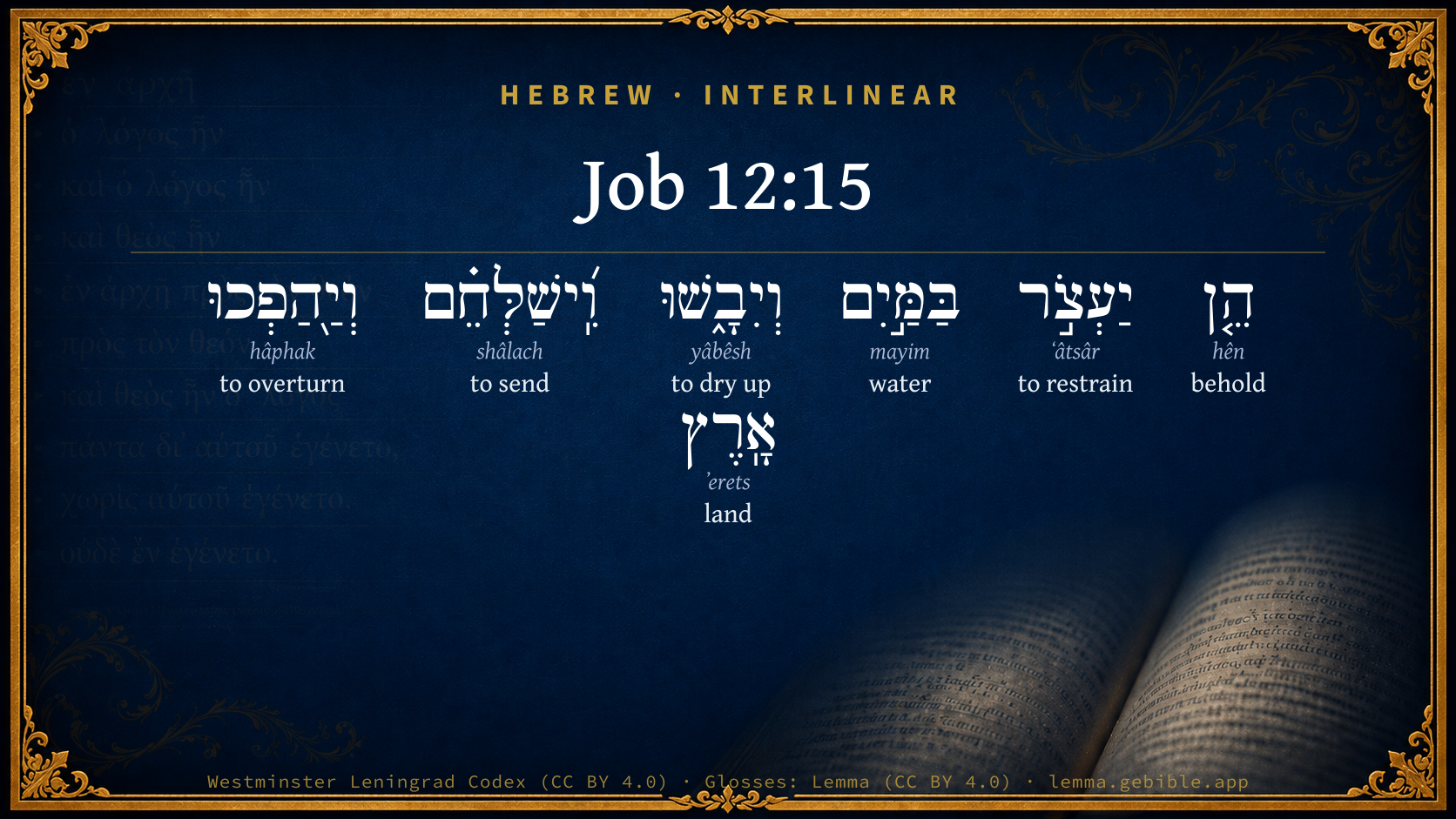
Hebrew (Westminster Leningrad Codex) Job 12:15 appears in the Hebrew Old Testament. The text above is from the Westminster Leningrad Codex. Each word links to its Strong’s number, a concise gloss, and parsing drawn from the Open Scriptures Hebrew Bible morphology. Click any word for its full Brown-Driver-Briggs (BDB) entry.
Download image
Cite this verse

Job 12:15 (World English Bible). Public Domain. Lemma interlinear Bible study tool, https://lemma.gebible.app/v/job/12/15.

Show BibTeX & RIS
BibTeX
RIS
English Translation
Behold, he withholds the waters, and they dry up; Again, he sends them out, and they overturn the earth.
World English Bible · Public Domain
Download a study sheet

One document with this verse’s original text, its word-by-word gloss line, the meaning frame, cross-references with their text, attributed commentary, and full source and license credits — printable, and it pastes into notes with its structure intact.

This verse Autodidact and up

Study sheet (.html) Plain text (.txt)

A passage Seminary Student

Up to 50 verses in one chapter. A passage sheet keeps up to 6 commentary sources and 12 cross-references per verse, in the order this page ranks them, and says so on the sheet whenever that leaves anything out. Ask for a single verse and you get the Autodidact verse sheet above.

Everything on this page stays free to read, with no account — the sheet is a download of what is already on screen, not access to it.

Want to remove ads? Support Godless Engineer
Compare translations 3

The same verse in 3 English versions, stacked beneath the original-language interlinear above. Click any original word for its lexicon entry.

Each is an independent rendering of the whole verse — the interlinear is not word-aligned to these translations.

Highlighted words mark where these versions differ — a whole-verse word diff, not a word-by-word alignment.

  • World English Bible Public Domain
    Behold, he withholds the waters, and they dry up; Again, he sends them out, and they overturn the earth.
  • King James Version Public Domain
    Behold, he withholdeth the waters, and they dry up: also he sendeth them out, and they overturn the earth.
  • unfoldingWord Literal Text CC BY-SA 4.0
    Behold, he withholds the waters and they dry up, and he sends them out and they overthrow the land.

unfoldingWord Literal Text — © unfoldingWord, licensed CC BY-SA 4.0. Word-aligned USFM3 via Door43 (git.door43.org/unfoldingWord/en_ult).

Versions to compare (up to 4)

3 of 4 selected

Show all 18 translations

Every available English version of this verse, each an independent rendering of the whole verse.

  • World English Bible Public Domain
    Behold, he withholds the waters, and they dry up; Again, he sends them out, and they overturn the earth.
  • Berean Standard Bible Public Domain
    If He holds back the waters, they dry up, and if He releases them, they overwhelm the land.
  • Majority Standard Bible Public Domain
    If He holds back the waters, they dry up, and if He releases them, they overwhelm the land.
  • King James Version Public Domain
    Behold, he withholdeth the waters, and they dry up: also he sendeth them out, and they overturn the earth.
  • American Standard Version (1901) Public Domain
    Behold, he withholdeth the waters, and they dry up; Again, he sendeth them out, and they overturn the earth.
  • Revised Version (1885) Public Domain
    Behold, he withholdeth the waters, and they dry up; again, he sendeth them out, and they overturn the earth.
  • Geneva Bible (1599) Public Domain
    Beholde, he withholdeth the waters, and they drie vp: but when he sendeth them out, they destroy the earth.
  • Douay-Rheims (1899) Public Domain
    If he withhold the waters, all things shall be dried up: and if he send them out, they shall overturn the earth.
  • Young's Literal Translation Public Domain
    Lo, He keepeth in the waters, and they are dried up, And he sendeth them forth, And they overturn the land.
  • Literal Standard Version CC BY-SA 4.0
    Behold, He keeps in the waters, and they are dried up, || And He sends them forth, || And they overturn the land.
  • Unlocked Literal Bible CC BY-SA 4.0
    See, if he withholds the waters, they dry up; and if he sends them out, they overwhelm the land.
  • unfoldingWord Literal Text CC BY-SA 4.0
    Behold, he withholds the waters and they dry up, and he sends them out and they overthrow the land.
  • Darby Bible Public Domain
    Behold, he withholdeth the waters, and they dry up; and he sendeth them out, and they overturn the earth.
  • World Messianic Bible Public Domain
    Behold, he withholds the waters, and they dry up. Again, he sends them out, and they overturn the earth.
  • Webster's Bible Public Domain
    Behold, he withholdeth the waters, and they dry up: also he sendeth them out, and they overturn the earth.
  • Free Bible Version CC BY-SA 4.0
    If God holds back the waters, everything dries up; if he releases the waters, the earth floods.
  • Bible in Basic English Public Domain
    Truly, he keeps back the waters and they are dry; he sends them out and the earth is overturned.
  • JPS Tanakh (1917) Public Domain
    Behold, He withholdeth the waters, and they dry up; also He sendeth them out, and they overturn the earth.

Literal Standard Version (2020), Covenant Press — licensed CC BY-SA 4.0. Text via the HelloAO Bible API (eBible.org). Unlocked Literal Bible (unfoldingWord) — licensed CC BY-SA 4.0. Text via the HelloAO Bible API (eBible.org). unfoldingWord Literal Text — © unfoldingWord, licensed CC BY-SA 4.0. Word-aligned USFM3 via Door43 (git.door43.org/unfoldingWord/en_ult). Free Bible Version, Dr. Jonathan Gallagher — licensed CC BY-SA 4.0. Text via the HelloAO Bible API (eBible.org).

Word by word

More ways to search: Search by grammar → Find every occurrence → Compare this word →

Practice this passage: Drill this verse → Learn its vocabulary →

About this verse

These counts appear in no published source. They are computed here, from the morphology-tagged text and Lemma’s own curated glosses. What Lemma adds →

7
words
7
distinct lemmas
Wisdom
section

Shared distinctive vocabulary

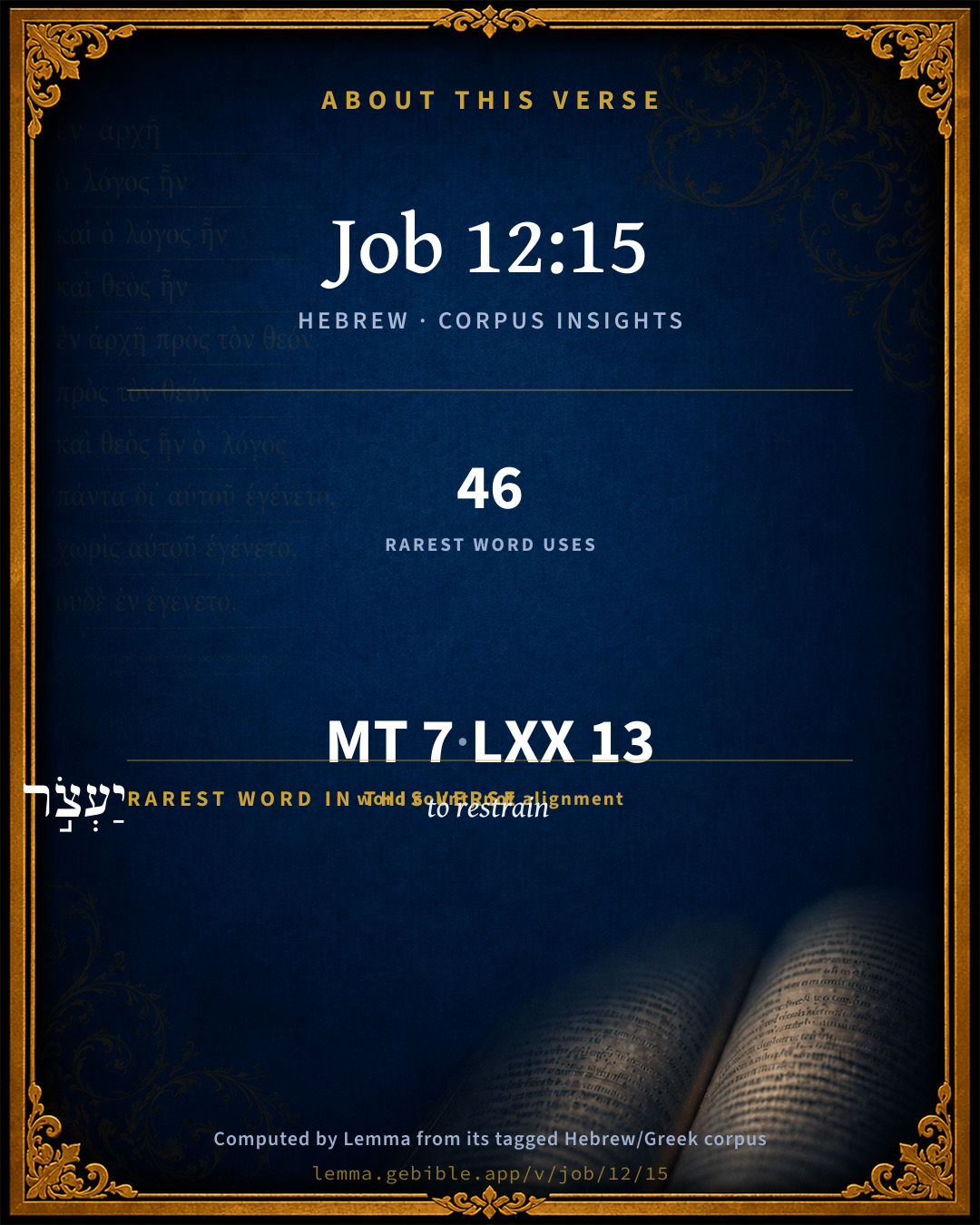
יַעְצֹ֣ר to restrain H6113 occurs in 45 verses of the Hebrew Bible. Also found in:

Grammatical profile

  • 4 verbs
  • 2 nouns
  • 1 particle

Verb forms

  • יַעְצֹ֣ר Qal · Imperfect
  • וְיִבָ֑שׁוּ Qal · Imperfect
  • וִֽ֝ישַׁלְּחֵ֗ם Piel · Imperfect
  • וְיַ֖הַפְכוּ Qal · Imperfect

Hebrew & Septuagint length

In English translation the verse runs 19 words from the Hebrew and 23 from the Septuagint (LXX English) — closely comparable.

A rough comparison of the two English renderings, which tokenize alike — not a word-level alignment.

Word counts can differ between the Hebrew and the Greek without any difference in meaning — e.g. the Hebrew direct-object marker אֵת has no separate Greek word, and Greek often adds the article ὁ.

In the original languages it is 7 Hebrew tokens and 13 Greek tokens — but the two are counted differently (Hebrew bundles its prefixes and suffixes into one token; the Greek is in lemma form), so that isn’t a like-for-like length.

Cross-references

14

Topical passages linked to Job 12:15 in the Treasury of Scripture Knowledge — connected by theme and wording, ordered by reader-vote popularity; previews shown in the World English Bible.

  • 1 Kings 17:1 Elijah the Tishbite, who was of the foreigners of Gilead, said to Ahab, As Yahweh, the God of Israel, lives, before whom I stand, there shall not be dew nor rain these years, but according to my word.
  • Amos 5:8 Seek him who made the Pleiades and Orion, And turns the shadow of death into the morning, And makes the day dark with night; Who calls for the waters of the sea, And pours them out on the surface of the earth, Yahweh is his name,
  • Genesis 6:13 God said to Noah, "The end of all flesh has come before me, for the earth is filled with violence through them. Behold, I will destroy them with the earth.
  • Genesis 6:17 I, even, I do bring the flood of waters on this earth, to destroy all flesh having the breath of life from under the sky. Everything that is in the earth will die.
  • Genesis 7:11–8:2 In the six hundredth year of Noah's life, in the second month, on the seventeenth day of the month, on the same day all the fountains of the great deep were burst open, and the sky's windows were opened.
  • 1 Kings 8:35–36 When the sky is shut up, and there is no rain, because they have sinned against you; if they pray toward this place, and confess your name, and turn from their sin, when you do afflict them:
  • Job 12:10 In whose hand is the life of every living thing, The breath of all mankind?
  • Psalms 104:7–9 At your rebuke they fled. At the voice of your thunder they hurried away.
  • Jeremiah 14:22 Are there any among the vanities of the nations that can cause rain? or can the sky give showers? Aren't you he, Yahweh our God? therefore we will wait for you; for you have made all these things.
  • Nahum 1:4 He rebukes the sea, and makes it dry, and dries up all the rivers. Bashan languishes, and Carmel; and the flower of Lebanon languishes.
  • Luke 4:25 But truly I tell you, there were many widows in Israel in the days of Elijah, when the sky was shut up three years and six months, when a great famine came over all the land.
  • James 5:17–18 Elijah was a man with a nature like ours, and he prayed earnestly that it might not rain, and it didn't rain on the earth for three years and six months.
  • Revelation 11:6 These have the power to shut up the sky, that it may not rain during the days of their prophecy. They have power over the waters, to turn them into blood, and to strike the earth with every plague, as often as they desire.
  • Deuteronomy 11:17 and the anger of Yahweh be kindled against you, and he shut up the sky, so that there shall be no rain, and the land shall not yield its fruit; and you perish quickly from off the good land which Yahweh gives you.

Cross-references courtesy of OpenBible.info (CC BY 4.0).

Hebrew and Greek witnesses Masoretic Hebrew ↔ Greek Septuagint

The same verse in the two great witnesses to the Old Testament, shown verse-for-verse.

These are two independent witnesses, not word-aligned to each other, and the Septuagint is shown in lemma (dictionary) form.

Hebrew Job 12:15 Masoretic · Westminster Leningrad Codex

הֵ֤ן יַעְצֹ֣ר בַּמַּ֣יִם וְיִבָ֑שׁוּ וִֽ֝ישַׁלְּחֵ֗ם וְיַ֖הַפְכוּ אָֽרֶץ

Behold, he withholds the waters, and they dry up; Again, he sends them out, and they overturn the earth.

World English Bible · Public Domain

Greek LXX Job 12:15 Septuagint · lemma form

ἐάν κωλύω ὁ ὥδωρ ξηραίνω ὁ γῆ ἐάν δέ ἐπιἀφίημι ἀποὀλλύω αὐτός καταστρέφω

If he should withhold the water, he will dry the earth: and if he should let it loose, he overthrows and destroys it.

LXX2012 (modern English Septuagint) · Public Domain

Hebrew: Westminster Leningrad Codex (CC BY 4.0). Greek: Septuagint (public domain); English from LXX2012 (modern English Septuagint) (Public Domain). How the Septuagint differs from the Hebrew →

Commentary

Notes on Job 12:15 from classic Christian and Jewish commentators (each source and its license shown beneath its notes). The classic Christian expositions comment on the surrounding passage and are grouped to its opening verse, so a note may address several verses; the Jewish commentaries on the Tanakh (Rashi and others) are per-verse, so they appear only where the commentator wrote on this verse.

Lemma curates 59 commentaries, every one of them public domain or Creative Commons licensed, each selected and text-cleaned for this edition rather than reprinted as found. About our sources →

Trapp's Complete Commentary

John Trapp

Job 12:15 Behold, he withholdeth the waters, and they dry up: also he sendeth them out, and they overturn the earth.

Ver. 15. Behold, he withholdeth the waters, and they dry up] He not only, when he pleaseth, imprisoneth men, but waters also, that they cannot get out of the clouds, those bottles of rain, those airy sponges, vessels as thin as the liquor that is contained in them; it is from the power of God that they dissolve not upon us at once, and overwhelm us. Bartholinus reports that in the year of grace 1551 a great number of men and cattle were drowned by the sudden breaking of a cloud; various vineyards, stone walls, strong houses, were destroyed and ruined. At sea, sometimes, ships are by the same means sunk; seamen call it a water spout. Again, it is by the anger and judgments of God that the clouds are sometimes so closed up, that they yield no more water than iron or adamant. "If I shut up heaven," saith he, "that there be no rain," 2Ch 7:13 Deu 28:23-24. God threateneth, as a punishment of men’s sins, that the heavens over their heads shall be brass, and the earth under them shall be iron; that the rain of their land shall be made powder and dust; from heaven shall it come down upon them, &c., by exceeding great drought, grains of dust shall ascend into the air with the wind, and come down as the drops of rain in a shower when it is kindly weather. Thus it was in Ahab’s days, 1Ki 18:1; {See Trapp on "Joe 1:20"}

And they dry up] The rivers, fruits of the earth, roots of trees, all dry up, languish, and perish; fevers also, and other acute diseases, abound.

Also he sendeth them out, and they overturn the earth] They did so with an accent in the general deluge, and in Deucalion’s flood in Thessaly, besides many other great tracts and parts of the earth overturned by water. Pliny and Seneca give us sundry instances of towns and countries laid waste by water (Plin. Nat. Hist., lib. ii. cap. 90, 92; Sen. Nat. Quaest., lib. vi. cap. 23). What great damage was lately done about Amsterdam by water, and what breaking down of bridges, mills, and other houses, by excessive rain and floods thereupon, besides marring of grounds and rotting of cattle in many places among us, needeth not here to be related.

John Trapp, A Commentary or Exposition upon All the Books of the Old and New Testament (1647–1656) — public domain. Text from a community e-Sword module.

Joseph Benson's Commentary

Job 12:15. He withholdeth the waters — Which are reserved in the clouds, that they may not fall upon the earth; and they dry up — Namely, the waters upon the earth, springs, brooks, and rivers dry up, as after the general deluge, to which here is a manifest allusion.

Joseph Benson's Commentary on the Old and New Testaments (1811–1818) — public domain. Text from a community e-Sword module.

Jamieson, Fausset & Brown

Robert Jamieson, A. R. Fausset & David Brown

Probably alluding to the flood.

Jamieson, Fausset & Brown — Commentary Critical and Explanatory on the Whole Bible (1871) — public domain (CC PDM 1.0). Text via the HelloAO Bible API.

Adam Clarke's Commentary

Verse 15. He withholdeth the waters] This is, I think, an allusion to the third day's work of the creation, Ge 1:9: And God said, Let the waters be gathered together unto one place, and let the dry land appear. Thus the earth was drained, and the waters collected into seas, and bound to their particular places.

Also he sendeth them out] Here is also an allusion to the flood, for when he broke up the fountains of the great deep, then the earth was overturned.

Adam Clarke's Commentary on the Bible (1810–1826) — public domain. Text from a community e-Sword/MySword module.

The Cambridge Bible for Schools and Colleges

gen. ed. J. J. S. Perowne

15. withholdeth the waters] In droughts. The second half of the verse refers to floods and cataclysms.

The Cambridge Bible for Schools and Colleges (gen. ed. J. J. S. Perowne; Cambridge University Press, 1878–1918) — public domain. Text from a community e-Sword module.

John Gill's Exposition

With him is strength and wisdom,.... Which is repeated from Job 12:13; though different words are used but expressive of the same things; of the greatest strength might, and power of God, as the above instances show and of his most consummate, solid and substantial wisdom, as appears by what follows:

the deceived and the deceiver are his: the wisdom, knowledge, sagacity and penetration into affairs, which the one has not, and the other has are from him; he withholds them from the one, who are simple and void of understanding, and so are easily imposed upon and deceived, and he given them to others, who make as ill use of them, deceive their fellow creatures some are deceivers in civil things, in the business and affairs of life, who circumvent, trick, cheat, and defraud their neighbours in buying and selling, using deceitful weights and measures, and by many other artful methods; others are deceivers in religious affairs, such are false teachers, deceitful workers, that lie in wait deceive; their intention into deceive, they do it knowingly, and on purpose; they walk in craftiness, and handle the word of God deceitfully; there were many of these in the times of the apostles that had then entered into the world, but never more than now; the great impostor and deceiver of all is. Satan, to whom Jarchi restrains the words, who beguiled Eve, and indeed deceives the whole world, Rev 12:9. Multitudes are deceived by him, as well as by, his emissaries, false teachers, and by their own hearts lusts; and even God's elect themselves, while in a state of unregeneracy, bear this character of "deceived, serving divers lusts and pleasures", Tit 3:3. Now these are "his", the Lord's; which Mr. Broughton interprets, "from him", "by him", and "for him"; the wit, wisdom, subtlety, and sagacity of deceivers, are from him; gifts of nature, in themselves good, bestowed on them by him; the ill use they make of it is from themselves, and owing to the vitiosity of their nature; nay, it is not only by his permission, but according to his ordination and will, that there are such persons in the world: in some cases they appear not only to have leave or permission, but an order to seduce, as to the, lying spirit sent forth to seduce Ahab, Kg1 22:20; yea, the princes of Noph being deceived, and they seducing Egypt, it is ascribed to the Lord's mingling a perverse spirit in the midst thereof, Isa 19:13; nay, when a prophet is deceived, God himself is said to deceive that prophet, Eze 14:9; so much is there of the permissive and efficacious will of God in this matter; not that he is the author of error and deceit, or infuses these into men, only the orderer, disposer, and, overruler of these things to some purposes orb is; he has power over them, and counterworks them, when he pleases; he can and does restrain them, and stops them, that they shall proceed no further, than he wills; false teachers would, if possible, deceive the very elect, Mat 24:24, but they cannot, and the reason is, God hinders them; Satan can go on no longer deceiving the world than it is the pleasure of God; a notorious instance of, hindering and, restraining him may be seen in Rev 20:3; and all the deceptions that are suffered to be among men they are all, wisely ordered, and overruled to good purposes, so as to issue well; the deception of our first parents was suffered and willed, that the grace of God might be displayed in the salvation of, men; errors and heresies are and must be for the trial and discovery of sound believers that they which are approved might be manifest; and men that like not to retain God in their knowledge reject both the light of nature and revelation, are left in righteous judgment to a reprobate mind, to give heed to seducing spirits, and are given up to strong delusions to believe a lie, that they might be damned, see Co1 11:19, Rom 1:28. Now all this shows the infinite and consummate wisdom of God; it is brought to prove, not only that he "knows" deceivers, and all their arts and tricks, through which men are deceived by them, as Aben Ezra interprets it, and so the Vulgate Latin version renders it; but he is the fountain of all that wisdom and knowledge in them, superior to others, which they abuse, nor can they use it without his leave; and he can and does counterwork them, and restrains them as he pleases, and makes all to work for and issue in his own glory.

John Gill's Exposition of the Whole Bible (1746–1763) — public domain (CC PDM 1.0). Text via the HelloAO Bible API.

Albert Barnes' Notes on the Bible

He withholdeth the waters - From the clouds and springs. He has control over the rains and the fountains; and when these are withheld, rivers and lakes become dry. The Syriac renders this, - “if he rebuke the waters,” supposing that there might perhaps be an allusion to the drying up of the Red Sea, or the formation of a passage for the Israelites. But it is remarkable that in the argument here there is no allusion to any historical fact, not to the flood, or to the destruction of Sodom and Gomorrah, or to the passage through the Red Sea, though these occurrences would have furnished so appropriate illustrations of the points under discussion. Is it to be inferred that Job had never heard of any of those events? Or may it have been that the lessons which they were adapted to teach had been actually embodied in the proverbs which he was using, and furnished well-known illustrations or the basis of such apothegms?

He sendeth them out, and they overturn the earth - Such inundations may have occurred in the swollen torrents of Arabia, and indeed are so common everywhere as to furnish a striking illustration of the power and sovereign agency of God.

Albert Barnes' Notes on the Bible (1834–1885) — public domain. Text from a community e-Sword/MySword module.

Matthew Poole's English Annotations

He withholdeth the waters; which are reserved in the clouds, that they may not fall upon the earth.

They dry up, i.e. the waters upon the earth, ponds, and springs, and brooks, and rivers.

Matthew Poole's English Annotations on the Holy Bible (1683–1685) — public domain. Text from a community e-Sword/MySword module.

Whedon's Commentary on the Bible

Daniel D. Whedon

15. Is thought by some to refer to the deluge. Compare Psa_104:29-30.

Daniel D. Whedon (gen. ed.), Commentary on the Old and New Testaments (1874–1909) — public domain. Text from a community e-Sword module.

The Pulpit Commentary

Behold, he withholdeth the waters, and they dry up. God, at his pleasure, causes great droughts, which are among the worst calamities that can happen. He withholds the blessed rain from heaven, (Deu_11:17 1Ki_8:35 1Ki_17:1) and the springs shrink, and the rivers dry up, and a fruitful land is turned into a desert, and famine stalks through the land, and men perish by thousands. Also he sendeth them out, and they overturn the earth; i.e. he causes floods and inundations. Once upon a time he overwhelmed the whole earth, and destroyed almost the entire race of mankind, by a deluge of an extraordinary character, which so fixed itself in the human consciousness, that traces of it are to be found in the traditions of almost all the various races of men. But, beside this great occasion, he also in ten thousand other cases, causes, by means of floods, tremendous ruin and devastation, sweeping away crops and cattle, and even villages and cities, sometimes even "overturning the earth," causing lakes to burst, rivers to change their course, vast tracts of land to be permanently submerged, and the contour of coasts to be altered.

The Pulpit Commentary (1880–1919), ed. H.D.M. Spence-Jones & Joseph S. Exell — public domain. Text from a community e-Sword module.

John Wesley's Explanatory Notes

The waters - Which are reserved its the clouds, that they may not fall upon the earth. They - The waters upon the earth, springs, and brooks, and rivers. As at the time of the general deluge, to which here is a manifest allusion.

John Wesley, Explanatory Notes Upon the Whole Bible (1754–1765) — public domain. Text via the GEBible commentary corpus.

Rashi

Rabbi Shlomo Yitzchaki (Rashi)

He sends it away and it overturns the earth As His agents, as He did to the generation of Enosh, when He inundated a third of the world.

Rashi on the Tanakh — English translations: “The Judaica Press complete Tanach with Rashi, translated by A. J. Rosenberg” (CC BY 4.0); “Pentateuch with Rashi's commentary by M. Rosenbaum and A.M. Silbermann, 1929-1934” (public domain); “The Metsudah Tanach series, Lakewood, N.J” (CC BY 4.0); and “The Book of Joshua, Metsudah Publications, 1997” (CC BY 4.0). Text via Sefaria.

Lesson kit

Teaching starters — assembled from the data on this page, not authored interpretation. Every prompt links to the verse data it draws on. Edit before teaching.

Job, in the Wisdom, opens this verse with 7 words (7 distinct Hebrew lemmas). Its most distinctive word is ʻâtsâr (“to restrain”). A historical commentator’s framing appears above. Read the whole chapter for the surrounding context.

Discussion questions

  1. The word ʻâtsâr carries the sense “to restrain.” How does it shape the verse?
  2. Genesis 16:2 shares the word «to restrain» with this verse. How do the two illuminate each other?
  3. These translations render this verse differently. What is at stake in choosing one wording over another?
  4. The verb «יַעְצֹ֣ר» is Qal Imperfect. How does its form color the action?
  5. Reading how Trapp's Complete Commentary and Joseph Benson's Commentary read this verse, where do the two commentators agree and where do they part?

Things to notice

Reading settings

Reading text

Shown beneath each verse's original-language words.

Old Testament
Old Testament edition

Read the OT as the Masoretic Hebrew (MT) or the Greek Septuagint (LXX).

English shown for the Greek Septuagint (in the Hebrew ↔ Greek comparison).

Comparing translations? Open the Compare panel on any verse page to stack up to four side by side.