Isaiah 58:4

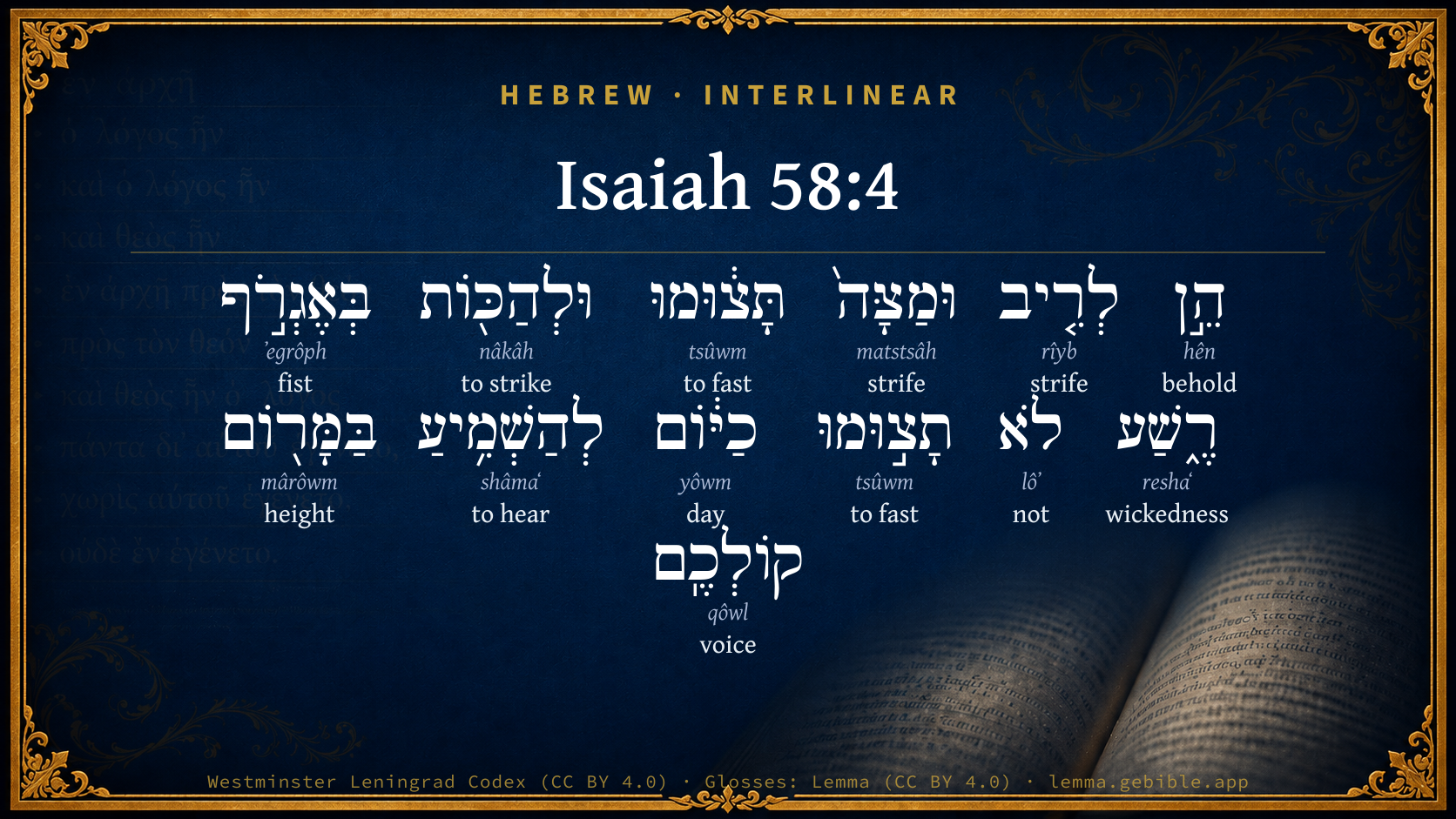
Hebrew (Westminster Leningrad Codex) Isaiah 58:4 appears in the Hebrew Old Testament. The text above is from the Westminster Leningrad Codex. Each word links to its Strong’s number, a concise gloss, and parsing drawn from the Open Scriptures Hebrew Bible morphology. Click any word for its full Brown-Driver-Briggs (BDB) entry.
Download image
Cite this verse

Isaiah 58:4 (World English Bible). Public Domain. Lemma interlinear Bible study tool, https://lemma.gebible.app/v/isaiah/58/4.

Show BibTeX & RIS
BibTeX
RIS
English Translation
Behold, you fast for strife and contention, and to strike with the fist of wickedness: you don't fast this day so as to make your voice to be heard on high.
World English Bible · Public Domain
Download a study sheet

One document with this verse’s original text, its word-by-word gloss line, the meaning frame, cross-references with their text, attributed commentary, and full source and license credits — printable, and it pastes into notes with its structure intact.

This verse Autodidact and up

Study sheet (.html) Plain text (.txt)

A passage Seminary Student

Up to 50 verses in one chapter. A passage sheet keeps up to 6 commentary sources and 12 cross-references per verse, in the order this page ranks them, and says so on the sheet whenever that leaves anything out. Ask for a single verse and you get the Autodidact verse sheet above.

Everything on this page stays free to read, with no account — the sheet is a download of what is already on screen, not access to it.

Want to remove ads? Support Godless Engineer
Compare translations 3

The same verse in 3 English versions, stacked beneath the original-language interlinear above. Click any original word for its lexicon entry.

Each is an independent rendering of the whole verse — the interlinear is not word-aligned to these translations.

Highlighted words mark where these versions differ — a whole-verse word diff, not a word-by-word alignment.

  • World English Bible Public Domain
    Behold, you fast for strife and contention, and to strike with the fist of wickedness: you don't fast this day so as to make your voice to be heard on high.
  • King James Version Public Domain
    Behold, ye fast for strife and debate, and to smite with the fist of wickedness: ye shall not fast as ye do this day, to make your voice to be heard on high.
  • unfoldingWord Literal Text CC BY-SA 4.0
    Behold, you fast for contention and quarrel, and to strike with a fist of wickedness. You shall not fast as today to make hear your voice in the height!

unfoldingWord Literal Text — © unfoldingWord, licensed CC BY-SA 4.0. Word-aligned USFM3 via Door43 (git.door43.org/unfoldingWord/en_ult).

Versions to compare (up to 4)

3 of 4 selected

Show all 18 translations

Every available English version of this verse, each an independent rendering of the whole verse.

  • World English Bible Public Domain
    Behold, you fast for strife and contention, and to strike with the fist of wickedness: you don't fast this day so as to make your voice to be heard on high.
  • Berean Standard Bible Public Domain
    You fast with contention and strife to strike viciously with your fist. You cannot fast as you do today and have your voice be heard on high.
  • Majority Standard Bible Public Domain
    You fast with contention and strife to strike viciously with your fist. You cannot fast as you do today and have your voice be heard on high.
  • King James Version Public Domain
    Behold, ye fast for strife and debate, and to smite with the fist of wickedness: ye shall not fast as ye do this day, to make your voice to be heard on high.
  • American Standard Version (1901) Public Domain
    Behold, ye fast for strife and contention, and to smite with the fist of wickedness: ye fast not this day so as to make your voice to be heard on high.
  • Revised Version (1885) Public Domain
    Behold, ye fast for strife and contention, and to smite with the fist of wickedness: ye fast not this day so as to make your voice to be heard on high.
  • Geneva Bible (1599) Public Domain
    Beholde, ye fast to strife and debate, and to smite with the fist of wickednesse: ye shall not fast as ye doe to day, to make your voyce to be heard aboue.
  • Douay-Rheims (1899) Public Domain
    Behold you fast for debates and strife. and strike with the fist wickedly. Do not fast as you have done until this day, to make your cry to be heard on high.
  • Young's Literal Translation Public Domain
    Lo, for strife and debate ye fast, And to smite with the fist of wickedness, Ye fast not as `to'-day, To sound in the high place your voice.
  • Literal Standard Version CC BY-SA 4.0
    Behold, you fast for strife and debate, || And to strike with the fist of wickedness, || You do not fast as [this] day, || To sound your voice in the high place.
  • Unlocked Literal Bible CC BY-SA 4.0
    Look, you fast to quarrel and fight, and to hit with your fist of wickedness; you do not fast today to make your voice heard above.
  • unfoldingWord Literal Text CC BY-SA 4.0
    Behold, you fast for contention and quarrel, and to strike with a fist of wickedness. You shall not fast as today to make hear your voice in the height!
  • Darby Bible Public Domain
    Behold, ye have fasted for strife and debate, and to smite with the fist of wickedness; ye do not at present fast, to cause your voice to be heard on high.
  • World Messianic Bible Public Domain
    Behold, you fast for strife and contention, and to strike with the fist of wickedness. You don’t fast today so as to make your voice to be heard on high.
  • Webster's Bible Public Domain
    Behold, ye fast for strife and debate, and to smite with the fist of wickedness: ye shall not fast as ye do this day, to make your voice to be heard on high.
  • Free Bible Version CC BY-SA 4.0
    Can't you see that when you're fasting you quarrel and argue, and end up having a vicious fistfight? When you fast like this you can't expect your prayers to be heard on high!
  • Bible in Basic English Public Domain
    If keeping from food makes you quickly angry, ready for fighting and giving blows with evil hands; your holy days are not such as to make your voice come to my ears on high.
  • JPS Tanakh (1917) Public Domain
    Behold, ye fast for strife and contention, and to smite with the fist of wickedness; ye fast not this day so as to make your voice to be heard on high.

Literal Standard Version (2020), Covenant Press — licensed CC BY-SA 4.0. Text via the HelloAO Bible API (eBible.org). Unlocked Literal Bible (unfoldingWord) — licensed CC BY-SA 4.0. Text via the HelloAO Bible API (eBible.org). unfoldingWord Literal Text — © unfoldingWord, licensed CC BY-SA 4.0. Word-aligned USFM3 via Door43 (git.door43.org/unfoldingWord/en_ult). Free Bible Version, Dr. Jonathan Gallagher — licensed CC BY-SA 4.0. Text via the HelloAO Bible API (eBible.org).

Word by word

More ways to search: Search by grammar → Find every occurrence → Compare this word →

Practice this passage: Drill this verse → Learn its vocabulary →

בְּאֶגְרֹ֣ף
ʼegrôph
H106
“in/at · fist of”
Preposition + Noun, Common, Masculine, Singular, Construct
Part of Speech
Preposition + Noun
Type
Common
Gender
Masculine
Number
Singular
State
Construct
Full BDB Definition

Origin: from H1640 (in the sense of grasping)

TWOT: 385a

fist
  1. הֵ֣ן hên H2005 “behold” Particle, Demonstrative
  2. לְרִ֤יב rîyb H7379 “to/for · strife” Preposition + Noun, Common, Both, Singular, Absolute
  3. וּמַצָּה֙ matstsâh H4683 “and · strife” Conjunction + Noun, Common, Feminine, Singular, Absolute
  4. תָּצ֔וּמוּ tsûwm H6684 “to fast” Verb, Qal, Imperfect, 2nd Person, Masculine, Plural
  5. וּלְהַכּ֖וֹת nâkâh H5221 “and · to strike” Conjunction + Preposition + Verb, Hiphil, Infinitive Construct
  6. רֶ֑שַׁע reshaʻ H7562 “wickedness” Noun, Common, Masculine, Singular, Absolute
  7. לֹא lôʼ H3808 “not” Particle, Negative
  8. תָצ֣וּמוּ tsûwm H6684 “to fast” Verb, Qal, Imperfect, 2nd Person, Masculine, Plural
  9. כַיּ֔וֹם yôwm H3117 “like/as the · day” Preposition, Determined + Noun, Common, Masculine, Singular, Absolute
  10. לְהַשְׁמִ֥יעַ shâmaʻ H8085 “to hear” Preposition + Verb, Hiphil, Infinitive Construct
  11. בַּמָּר֖וֹם mârôwm H4791 “in/at the · height” Preposition, Determined + Noun, Common, Masculine, Singular, Absolute
  12. קוֹלְכֶֽם qôwl H6963 “voice · your” Noun, Common, Masculine, Singular, Construct + Suffix, Personal, 2nd Person, Masculine, Plural

About this verse

These counts appear in no published source. They are computed here, from the morphology-tagged text and Lemma’s own curated glosses. What Lemma adds →

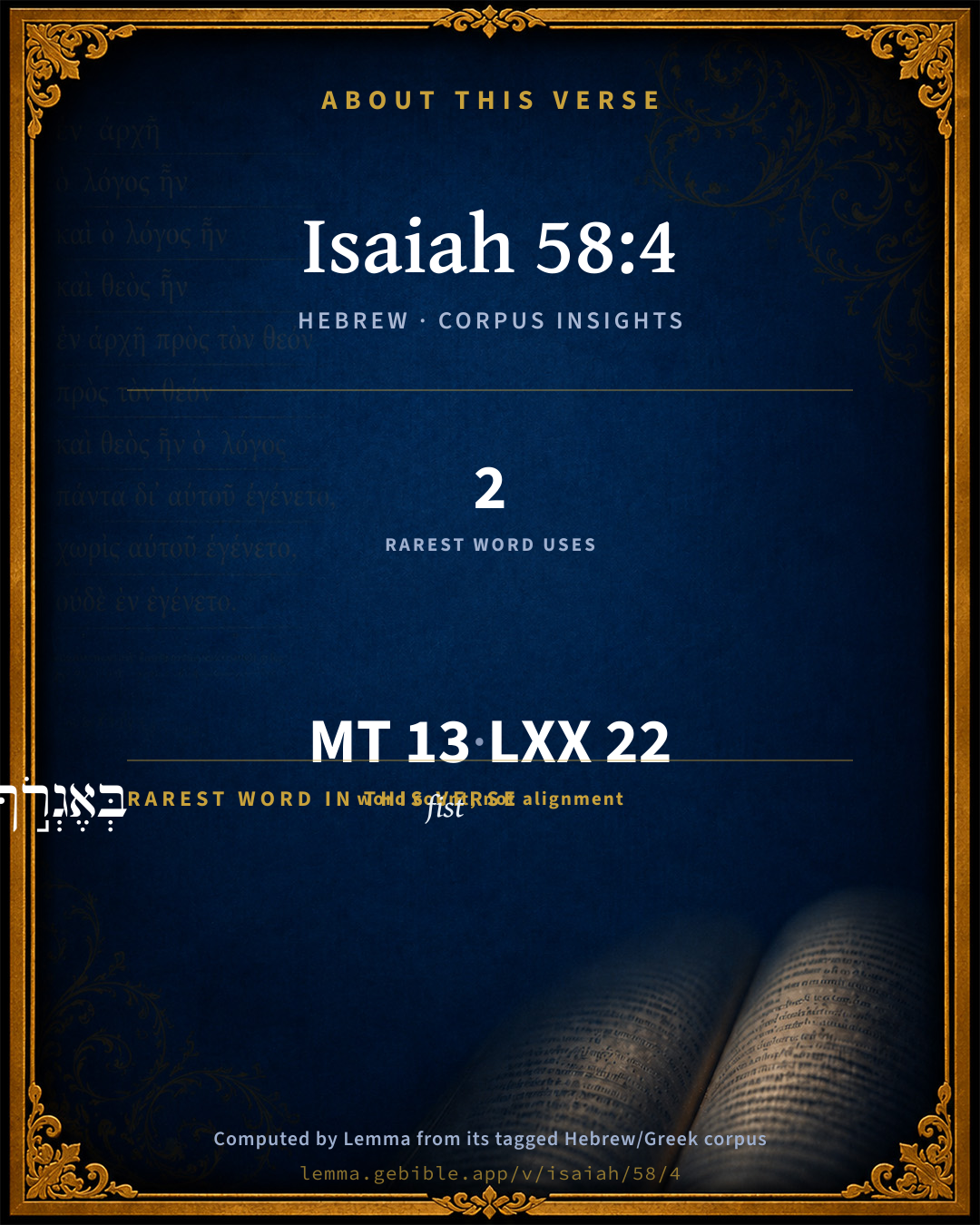
13
words
12
distinct lemmas
Prophets
section

Notable vocabulary

The rarest word here is בְּאֶגְרֹ֣ף fist H106 — appearing just 2 times in the whole Hebrew Bible.

Shared distinctive vocabulary

בְּאֶגְרֹ֣ף fist H106 occurs in 2 verses of the Hebrew Bible. Also found in:

Grammatical profile

  • 4 verbs
  • 7 nouns
  • 2 particles

Verb forms

  • תָּצ֔וּמוּ Qal · Imperfect
  • וּלְהַכּ֖וֹת Hiphil · Infinitive Construct
  • תָצ֣וּמוּ Qal · Imperfect
  • לְהַשְׁמִ֥יעַ Hiphil · Infinitive Construct

Repetition

A word recurs within this verse — often emphatic in Hebrew:

  • תָּצ֔וּמוּ to fast H6684 ×2

Hebrew & Septuagint length

In English translation the verse runs 31 words from the Hebrew and 34 from the Septuagint (LXX English) — closely comparable.

A rough comparison of the two English renderings, which tokenize alike — not a word-level alignment.

Word counts can differ between the Hebrew and the Greek without any difference in meaning — e.g. the Hebrew direct-object marker אֵת has no separate Greek word, and Greek often adds the article ὁ.

In the original languages it is 13 Hebrew tokens and 22 Greek tokens — but the two are counted differently (Hebrew bundles its prefixes and suffixes into one token; the Greek is in lemma form), so that isn’t a like-for-like length.

Cross-references

12

Topical passages linked to Isaiah 58:4 in the Treasury of Scripture Knowledge — connected by theme and wording, ordered by reader-vote popularity; previews shown in the World English Bible.

  • 1 Kings 21:9–13 She wrote in the letters, saying, Proclaim a fast, and set Naboth on high among the people:
  • Proverbs 21:27 The sacrifice of the wicked is an abomination: How much more, when he brings it with a wicked mind!
  • Isaiah 59:2 but your iniquities have separated between you and your God, and your sins have hidden his face from you, so that he will not hear.
  • Matthew 6:16–18 "Moreover when you fast, don't be like the hypocrites, with sad faces. For they disfigure their faces, that they may be seen by men to be fasting. Most assuredly I tell you, they have received their reward.
  • Isaiah 59:6 Their webs shall not become garments, neither shall they cover themselves with their works: their works are works of iniquity, and the act of violence is in their hands.
  • Joel 2:13–14 Tear your heart, and not your garments, And turn to Yahweh, your God; For he is gracious and merciful, Slow to anger, and abundant in loving kindness, And relents from sending calamity.
  • Jonah 3:7 He made a proclamation and published through Nineveh by the decree of the king and his nobles, saying, "Let neither man nor animal, herd nor flock, taste anything; let them not feed, nor drink water;
  • Matthew 23:13 "Woe to you, scribes and Pharisees, hypocrites! For you devour widows' houses, and as a pretense you make long prayers. Therefore you will receive greater condemnation.
  • Luke 20:47 who devour widows' houses, and for a pretense make long prayers: these will receive greater condemnation."
  • John 18:28 They led Jesus therefore from Caiaphas into the Praetorium. It was early, and they themselves didn't enter into the Praetorium, that they might not be defiled, but might eat the Passover.
  • Acts 23:1–2 Paul, looking steadfastly at the council, said, "Brothers, I have lived before God in all good conscience until this day."
  • Philippians 1:14–15 and that most of the brothers in the Lord, being confident through my bonds, are more abundantly bold to speak the word of God without fear.

Cross-references courtesy of OpenBible.info (CC BY 4.0).

Hebrew and Greek witnesses Masoretic Hebrew ↔ Greek Septuagint

The same verse in the two great witnesses to the Old Testament, shown verse-for-verse.

These are two independent witnesses, not word-aligned to each other, and the Septuagint is shown in lemma (dictionary) form.

Hebrew Isaiah 58:4 Masoretic · Westminster Leningrad Codex

הֵ֣ן לְרִ֤יב וּמַצָּה֙ תָּצ֔וּמוּ וּלְהַכּ֖וֹת בְּאֶגְרֹ֣ף רֶ֑שַׁע לֹא תָצ֣וּמוּ כַיּ֔וֹם לְהַשְׁמִ֥יעַ בַּמָּר֖וֹם קוֹלְכֶֽם

Behold, you fast for strife and contention, and to strike with the fist of wickedness: you don't fast this day so as to make your voice to be heard on high.

World English Bible · Public Domain

Greek LXX Isaiah 58:4 Septuagint · lemma form

εἰ εἰς κρίσις καί μάχη νηστεύω καί τύπτω πυγμή ταπεινός ἵνα τίς ἐγώ νηστεύω ὡς σήμερον ἀκούω ἐν κραυγή ὁ φωνή σύ

If you⌃ fast for quarrels and strifes, and strike the lowly with your fists, therefore do you⌃ fast to me as you⌃ do this day, so that your voice may be heard in crying?

LXX2012 (modern English Septuagint) · Public Domain

On this verse, Adam Clarke's Commentary discusses the Septuagint’s reading. Read the note in Commentary ↓

Hebrew: Westminster Leningrad Codex (CC BY 4.0). Greek: Septuagint (public domain); English from LXX2012 (modern English Septuagint) (Public Domain). How the Septuagint differs from the Hebrew →

Targum (Aramaic paraphrase)

1

The Targum is the ancient Jewish Aramaic paraphrase of the Hebrew Scriptures — an interpretive translation, not the Hebrew text itself. Onkelos (literal) and Pseudo-Jonathan (expansive) render the Torah, and Jonathan the Prophets. Coverage is partial: where no permissively-licensed English translation exists for a verse, only the Aramaic is shown. This is verse-level text, not a word-by-word alignment to the Hebrew.

  1. Targum Jonathan Prophets (Joshua–Malachi)
    הֵן לְתַחֲרוּ וּלְמַצוּ אַתּוּן צַיְמִין וּלְמִמְחֵי בְּכוּרְמֵיזָא דְרִשְׁעָא לָא תִתְעֲנוּן תַּעֲנִין כְּאִלֵין לְאַשְׁמָעָא בִמְרוֹמָא קָלְכוֹן:

    Behold, ye fast for provocation and strife, and to smite with the fist of wickedness; ye shall not fast a fast as if to make your voice to be heard on high.

    Targum Jonathan — Aramaic: “Mikraot Gedolot” (public domain). English: “Sefaria Community Translation” (CC0 1.0 (public-domain dedication)); “London "Chaldee Paraphrase," 1871” (public domain). Text via Sefaria.

Commentary

Notes on Isaiah 58:4 from classic Christian and Jewish commentators (each source and its license shown beneath its notes). The classic Christian expositions comment on the surrounding passage and are grouped to its opening verse, so a note may address several verses; the Jewish commentaries on the Tanakh (Rashi and others) are per-verse, so they appear only where the commentator wrote on this verse.

Lemma curates 59 commentaries, every one of them public domain or Creative Commons licensed, each selected and text-cleaned for this edition rather than reprinted as found. About our sources →

Trapp's Complete Commentary

John Trapp

Isa 58:4 Behold, ye fast for strife and debate, and to smite with the fist of wickedness: ye shall not fast as [ye do this] day, to make your voice to be heard on high.

Ver. 4. Behold.] Take notice whence it is, that ye so miscarry in your services, and leave muttering against me.

Ye fast for strife and debate.] Or, Unto strife and debate - i.e., On your fast days ye contend and quarrel; being hungry, you are angry, as emptiness whetteth choler. Sed quid prodest pallor in ore, si sit livor in corde? to what purpose is a pale face and a spiteful spirit? and what is a humbling day without a humbled heart! not only an irreligious incongruity, but a high provocation; like Zimri’s act, when all the congregation were weeping before the door of the tabernacle. Get thee behind, saith Jehu to the messenger, "what hast thou to do with peace?" Confessions and prayers are our messengers; but if the heart be not broken, there is no peace to such wicked.

And to smite with the fist of wickedness,] scil., Your servants or your debtors, as Mat 18:28. They should have had, on such a day especially, Pacem cum hominibus, cum vitiis bellum (which was Otho II’s motto), Peace with men, and war with their wickednesses.

Ye shall not fast as ye do this day.] For ye fast not to God, {Zec 7:5; Zec 7:11-12} but bear fruit to yourselves, like that "empty vine" Ephraim, {Hos 10:1} and so are not a button the better for all you do; Jer 14:12, "When they fast, I will not hear their cry."

To make your voices to be heard on high.] Out of ostentation of devotion; but secrecy here were a better argument of sincerity. Or, do you think to be heard on high, i.e., in heaven, for such outside services?

John Trapp, A Commentary or Exposition upon All the Books of the Old and New Testament (1647–1656) — public domain. Text from a community e-Sword module.

Joseph Benson's Commentary

Isa 58:4-5. Behold, ye fast for strife — Your fasting days, wherein you ought, in a special manner, to implore the mercy of God, and to show compassion to men, you employ in injuring or quarrelling with your brethren, your servants, or debtors, or in contriving mischief against them. Or the meaning is, that “their fasting increased their self-preference, and excited them to fierce controversies or bitter resentments.” And to smite with the fist of wickedness — It was “the cloak of, and commutation for, their exactions and oppressions of the poor, whom they most unjustly smote and abused for not complying in every thing with their inclinations.” — Scott. Ye shall not fast as ye do this day — Such a fast as this I cannot accept of as an act of worship, or bless as a means of grace. To make your voice to be heard on high — In strife and debate, or by way of ostentation. Is it such a fast that I have chosen? — That is, which I approve of, accept, or delight in, because we delight in what we freely choose. A day for a man to afflict his soul — To keep himself low, or to chastise himself by depriving his body of food, as a means to produce inward sorrow for sin, and true humiliation of soul before God. The prophet seems to have delivered this discourse upon, or to have intended it for, some extraordinary day of humiliation, when it was usual for the prophets to give public exhortations to the people. Is it to bow down his head as a bulrush? — Here the prophet notices those external gestures, postures, and signs of penitence, which the Jews of his time, and in after ages, (Mat 6:16,) joined with their hypocritical fasts. And to spread sackcloth and ashes under him — The Jews, to express their sorrow, made use of sackcloth and ashes two ways: 1st, Sometimes by putting sackcloth upon their bodies, as 1Ki 21:27; Psa 69:11; and casting ashes upon their heads, 2Sa 13:19 : and, 2d, By spreading sackcloth under them, and lying down upon ashes, Est 4:3; Job 2:8. The intent of putting on sackcloth was to afflict the body by its unpleasing harshness, and the ashes were meant to represent their own vileness, as being but dust and ashes; and their lying on them to signify that they abhorred and were ashamed of themselves. Wilt thou call this a fast? — Canst thou, upon rational grounds, believe or suppose it to be so? Surely it has nothing in it but the lifeless form, empty shadow, or dumb signs of a fast: nothing of deep humiliation appearing in it, or real reformation proceeding from it. Not that the prophet blames them for afflicting themselves by these external rites, for these are elsewhere commanded of God; but that which he condemns is their hypocrisy in separating true humiliation from them, and contenting themselves with using these signs, while they stopped short of the thing signified by them. And an acceptable day to the Lord — A day that God will approve of. Hebrew, ויום רצון, A day of acceptance, or that will turn to a good account on your behalf.

Joseph Benson's Commentary on the Old and New Testaments (1811–1818) — public domain. Text from a community e-Sword module.

The Preacher's Complete Homiletical Commentary

Joseph S. Exell (gen. ed.)

PERIODICAL FASTS

Isa_58:4. Ye shall not fast as ye do this day.

Periodical fasts, such as the Ritualists would have us keep in Lent, instead of being well pleasing in the sight of God, are offensive to Him.

I. THEY ARE BASED UPON A FALSE CONCEPTION OF THE CHARACTER OF GOD. Their promoters say: “This is to be a season of special religiousness; therefore it is to be a time of mortification, fasting, and gloom. This is a season in which to do special honour to God; therefore let His altars and priests be clad in sad vestments, and let His people weep and lament.” This view makes God find a pleasure in the self-inflicted grievance of His creatures. It implies that blessings which He has lavishly scattered around us are given rather as tests of our faith and self-denial; that they are here, not for us to rejoice in the works of His hands, but by renouncing them to show our love and loyalty to Him. How is such a view at all reconcilable with the love of the Divine Father? Is it thus that we should deal with our children! Is it credible that any parent, of true and loving heart, would take a studious son into a library of books, every one of which were calling to him to come and enrich himself on its treasures; or a child with rich and cultured musical gifts into a room where were exquisite instruments from which he longed to draw forth strains of sweet melody; or a daughter with a passionate love of flowers into a garden which was one blaze of beauty, and then say, “These are yours; but you will please me best if you do not gratify the desire which would lead you to use them? It is not that you would thus impoverish me, for I could easily supply the place of any you might appropriate; but it will please me if you look at them, long for them, and yet abstain from them. I know it will be a great trial; I have little doubt it will make you miserable; but it is that which will please me.” No father, worthy of the name, would be guilty of such heartlessness. Yet it is just this which men ascribe to God, when they fancy that He is pleased if we afflict our souls, bow down our head like a bulrush, and spread sackcloth and ashes under us.

II. THEY ARE BASED UPON, AND PROMOTE FALSE VIEWS OF HUMAN DUTY.

1. Their evident tendency is to encourage the old notion of the sinfulness of the material world, the body, and all by which it is nourished and refreshed. It is true that in the New Testament “the flesh” is represented as the natural and deadly foe of the spirit; but “the flesh” denotes not the bodily nature, but the passions and lusts of an unrenewed heart. No doubt these are inflamed by the bodily senses; and if a man finds that fasting helps him to subdue them, let him fast. But to fast under the idea that the body is sinful, and that the more we can mortify it the better—to fast at the cost of physical health and energy is something more than a mistake; it is a sin to sacrifice that health which is one of God’s most precious gifts, and which is so essential to enable us to do the service in the world which He requires at our hands.

2. They lead to a substitution of an outward and bodily for an inward and spiritual service. Bodily fasting is put in the place of that spirit of moderation, self-conquest, and self-sacrifice, which the prophet describes as the true fast. To their selfishness, passion, and worldly pride, the misguided religionists add the pride of self-righteousness, and so their last state is worse than the first. Let us use all aids which can advance us in likeness to Christ, and remember that all religious services which have not this result, whatever else they may have to recommend them, are but as “sounding brass and a tinkling cymbol.”—J. G. Rogers, B.A.: Christian World Pulpit, ii. 145–148.

The Preacher's Complete Homiletical Commentary (gen. ed. Joseph S. Exell; Funk & Wagnalls, c. 1892) — public domain (pre-1929). A full-Bible homiletical/sermon-outline anthology covering 65 of 66 books (2 John is absent from the source module). Text from a community e-Sword module.

Geneva Bible (1599)

Geneva Bible translators

So long as you use contention and oppression, your fasting and prayers shall not be heard.

Geneva Bible (1599) marginal notes — public domain. Text via Bolls.life.

Jamieson, Fausset & Brown

Robert Jamieson, A. R. Fausset & David Brown

ye shall not fast--rather, "ye do not fast at this time, so as to make your voice to be heard on high," that is, in heaven; your aim in fasting is strife, not to gain the ear of God [MAURER] (Kg1 21:9, Kg1 21:12-13). In English Version the sense is, If you wish acceptance with God, ye must not fast as ye now do, to make your voice heard high in strife.

Jamieson, Fausset & Brown — Commentary Critical and Explanatory on the Whole Bible (1871) — public domain (CC PDM 1.0). Text via the HelloAO Bible API.

Adam Clarke's Commentary

Verse 4. Ye fast for strife and debate] How often is this the case! A whole nation are called to fast to implore God's blessing on wars carried on for the purposes of wrath and ambition.

To smite with the fist of wickedness: ye shall not fast as ye do this day - "To smite with the fist the poor. Wherefore fast ye unto me in this manner"] I follow the version of the Septuagint, which gives a much better sense than the present reading of the Hebrew. Instead of רשע לא resha lo, they seem to have read in their copy רש על מה לי rash al mah lli. The four first letters are the same, but otherwise divided in regard to the words; the four last are lost, and א aleph added in their place, in order to make some sort of sense with רשע ל. The version of the Septuagint is, και τυπτετε τυγμαις ταπεινον· ἱνα τι μοι νηστευετε - as above.

Adam Clarke's Commentary on the Bible (1810–1826) — public domain. Text from a community e-Sword/MySword module.

Ellicott's Commentary for English Readers

(4) Behold, ye fast for strife and debate.—The words possibly point to the psychological fact that an unspiritual fasting irritates the nerves and embitters the temper. Extremes meet, and the disputes of fasting controversialists are often as fierce as those of drunken disputants. (Comp. the conspiracy of Act_23:21.)

A Bible Commentary for English Readers, edited by Charles John Ellicott (1878–1897) — public domain. Text from a community e-Sword module.

The Cambridge Bible for Schools and Colleges

gen. ed. J. J. S. Perowne

4. ye fast for strife and contention (R.V.)] The fasting made them as irritable as Arabs in the month of Ramadan; it produced a quarrelsome temper which even led to open violence,—“smiting with godless fist.”

ye shall not fast &c.] Render: ye do not fast at present so as to make &c., i.e. “with your present mode of fasting, your prayers can never reach the ear of Jehovah.”

“My words fly up, my thoughts remain below:

Words without thoughts never to heaven go.”

Hamlet, Act iii. Scene iii. 97 f.

The Cambridge Bible for Schools and Colleges (gen. ed. J. J. S. Perowne; Cambridge University Press, 1878–1918) — public domain. Text from a community e-Sword module.

John Gill's Exposition

Behold, ye fast for strife and debate,.... Brawling with their servants for not doing work enough; or quarrelling with their debtors for not paying their debts; or the main of their religion lay in contentions and strifes about words, vain hot disputations about rites and ceremonies in worship, as is well known to have been the case of the reformed churches:

and to smite with the fist of wickedness; their servants or their debtors; or rather it may design the persecution of such whose consciences would not suffer them to receive the doctrines professed; or submit to ordinances as administered; or comply with rites and ceremonies enjoined by the said churches; for which they have smitten their brethren that dissented from them with the fist, or have persecuted them in a violent manner by imprisonment, confiscation of goods, &c.; all which is no other than a fist of wickedness, and highly displeasing to God, and renders all their services unacceptable in his sight; see Mat 24:49,

ye shall not fast as ye do this day; or, "as this day"; after this manner; this is not right:

to make your voice to be heard on high; referring either to their noisy threatening of their servants for not doing their work; or their clamorous demands upon their debtors; or to their loud prayers, joined with their fasting, which they expected to be heard in the highest heaven, but would be mistaken; for such services, attended with the above evils, are not wellpleasing to God.

John Gill's Exposition of the Whole Bible (1746–1763) — public domain (CC PDM 1.0). Text via the HelloAO Bible API.

Albert Barnes' Notes on the Bible

Behold, ye fast for strife and debate - This is a third characteristic of their manner of fasting, and a third reason why God did not regard and accept it. They were divided into parties and factions, and probably made their fastings an occasion of augmented contention and strife. How often has this been seen! Contending denominations of Christians fast, not laying aside their strifes; contending factions in the church fast in order to strengthen their party with the solemn sanctions of religion. One of the most certain ways for bigots to excite persecution against those who are opposed to them is to ‘proclaim a fast;’ and when together, their passions are easily inflamed, their flagging zeal excited by inflammatory harangues, and their purpose formed to regard and treat their dissentient brethren as incorrigible heretics and irreconcilable foes. It may be added, also, that it is possible thus to prostitute all the sacred institutions of religion for party and inflammatory purposes. Even the ordinance of the Lord’s Supper may be thus abused, and violent partisans may come around the sacred memorials of a Saviour’s body and blood, to bind themselves more closely together in some deed of persecution or violence, and to animate their drooping courage with the belief that what has been in fact commenced with a view to power, is carried on from a regard to the honor of God.

And to smite with the fist of wickedness - Lowth renders this, in accordance with the Septuagint. ‘To smite with the fist the poor;’ but this translation can be obtained only by a most violent and wholly unauthorized change in the Hebrew text. The idea is plain, that ‘even when fasting’ they were guilty of strife and personal combats. Their passions were unsubdued, and they gave vent to them in disgraceful personal encounters. This manifests a most extraordinary state of society, and is a most melancholy instance to show how much people may keep up the forms of religion, and even be punctual and exact in them, when the most violent and ungovernable passions are raging in their bosoms, and when they seem to be unconscious of any discrepancy between the religious service and the unsubdued passions of the soul.

Ye shall not fast ... - It is not acceptable to God. It must be offensive in his sight.

To make your voice to be heard on high - That is, in strife and contention. So to contend and strive, says Grotius, that your voice can be heard on the mountain top. Rosenmuller, however, supposes that it means, that their fast was so conducted that they could not expect that their prayers would ascend to heaven and be heard by God. But it seems to me that the former is the correct interpretation. Their fastings were accompanied with the loud and hoarse voice of contention and strife, and on that account could not be acceptable to God.

Albert Barnes' Notes on the Bible (1834–1885) — public domain. Text from a community e-Sword/MySword module.

Haydock's Catholic Bible Commentary

Strife. The usual works were interrupted. The Church formerly forbade law-suits on fast-days. --- Fist. Matthew xviii. 28. --- Wickedly. Septuagint, "the humble."

George Leo Haydock (1774–1849), Haydock's Catholic Family Bible and Commentary, 1859 edition — public domain. Excludes Psalms (Douay-Rheims chapter numbering differs from Protestant) and Deuterocanonical books (Catholic canon only).

Matthew Poole's English Annotations

Ye fast for strife and debate; your fasting days, wherein you ought in a special manner to implore the mercy of God, and to show compassion to men, you employ in a great measure in injuring or quarrelling with your brethren, your servants, or debtors, or in contriving mischief against them, as if the design of your fasting and praying to God were only to obtain a licence to oppress men. Compare Mat 23:14.

With the fist of wickedness; or, with a wicked fist; a genitive of the adjunct. To deal rigorously and injuriously with your servants or debtors; which servants, it may be, had sold themselves to the year of redemption, Exo 21:2; Lev 25:39,40,50. You handle them with a hard hand; the word is used for fist, Exo 21:18; the LXX. add the humble, poor, or inferior person; and that not only their debtors, with a summum jus, exact rigour, which seems elsewhere to be expressed by grinding the face; Isa 3:15, and in that parable by taking by the throat, Mat 18:28; but also their servants out of mere will and pleasure, and in contempt of them, treating them opprobriously, as Christ was handled in contempt and scorn, Mat 26:67,68; Joh 18:22.

Your voice; either,

1. In strife and debate, in which men’s passions show themselves by loud clamours. Or,

2. So as to cause the cry of the oppressed, by reason of your injuries, of what kind soever, to enter into the ears of God; which is a crying sin, whether it proceed from unmercifulness, Exo 22:25-27, which sometimes increaseth to rage, 2Ch 28:9; or from injustice, Isa 5:7; or from fraud and deceit, Jam 5:4. The Scripture doth frequently express whatever sin is against charity in special, as also general complex sins, by crying, Gen 18:20,21; Jon 1:2. Or,

3. By way of ostentation, to note their hypocrisy; they love to be taken notice of by others, Mt 6 2,5,16; or their folly, supposing that they shall be heard for their much speaking, upon which account Baal’s priests are mocked by Elijah, 1Ki 18:27,28 4. Voice here relates principally to their prayer; it is a synecdoche of the kind: so the sense is, This is not the way to have your prayers heard; if you desire that, you must first in another manner, and abstain from all kind of oppression. And this seems best to suit the context, which is to show what kind of fast the Lord reproves, and what he approves in the following verses.

Matthew Poole's English Annotations on the Holy Bible (1683–1685) — public domain. Text from a community e-Sword/MySword module.

The Pulpit Commentary

Ye fast for strife and debate. Delitzsch explains, "When fasting, they are doubly irritable and ill tempered; and this leads to quarrelling and strife, even to striking with angry fists." This is quite a possible explanation. Or there may have been two parties, one for, the other against, fasting; and those who practised fasting may have done it, as some preached Christ, "of envy and strife" (Php_1:15) to provoke the opposite side. Ye shall not fast as ye do this day, to make your voice to be heard on high; i.e. "ye must not fast as ye do at present, if ye would have your voices heard in heaven." God will not hear the prayer of which such a fast is the accompaniment.

The Pulpit Commentary (1880–1919), ed. H.D.M. Spence-Jones & Joseph S. Exell — public domain. Text from a community e-Sword module.

John Wesley's Explanatory Notes

Behold - Your fasting days, wherein you ought in a special manner to implore the mercy of God, and to shew compassion to men, you employ in injuring or quarrelling with your brethren, your servants or debtors, or in contriving mischief against them. Heard - In strife and debate. By way of ostentation.

John Wesley, Explanatory Notes Upon the Whole Bible (1754–1765) — public domain. Text via the GEBible commentary corpus.

J. A. Alexander on Isaiah

Joseph Addison Alexander

“Behold, for strife and contention ye will fast, and to smite with the fist of wickedness; ye shall not (or ye will not) fast to-day (so as) to make your voice heard on high.” Some understand this as a further reason why their fasts were not acceptable to God; others suppose the same to be continued, and refer what is here said to the maltreatment of the laborers or debtors mentioned in the verse preceding. ‘To smite with the fist of wickedness’ is a periphrasis for ‘fighting’, no doubt borrowed from the provision of the law in Exo 21:18. Some early writers understand the last clause as a prohibition of noisy quarrels, ‘to make the voice heard on high’ being taken as equivalent to letting it be heard in the street (Isa 42:2). The later writers give it a meaning altogether different, by taking in the sense of heaven (Isa 57:15), and the whole clause as a declaration that such fasting would not have the desired effect of gaining audience and acceptance for their prayers.

Joseph Addison Alexander, The Prophecies of Isaiah (1846–1847; New York: Scribner, 1870–1878) — public domain. Text from a community e-Sword module.

unfoldingWord translationNotes

Door43 World Missions Community

General Information:

Yahweh continues speaking to the people of Israel by answering their challenging question.

Look

"Behold!" or "Pay attention." Yahweh confronts their questioning by telling them to pay attention.

fist of wickedness

"wicked fist." This shows that they fight viciously. "Fist" represents anger that is physically violent. (See: Metonymy)

Is this really the kind of fast that I would want ... under himself?

Yahweh uses a question to scold the people. They act like they are humble before God, but they are hurting other people. AT: "This is not the kind of fast I want ... under himself." (See: Rhetorical Question)

A day for anybody to humble himself, for him to bow down his head like a reed

This means the person is bowing down, but he is not truly humble. "A reed" represents a weak plant that bends easily. (See: Simile)

Do you really call this a fast, a day that pleases Yahweh?

Yahweh uses a question to scold the people. AT: "Surely you do not think this kind of fast pleases me!" (See: Rhetorical Question)

translationWords

fast

evil

voice

humble

bow

sackcloth

Yahweh

unfoldingWord translationNotes — © Distant Shores Media and the Door43 World Missions Community, licensed CC BY-SA 4.0. Source: git.door43.org/Door43/en_tn.

Rashi

Rabbi Shlomo Yitzchaki (Rashi)

Do not fast like this day like the manner of this day, to break your hearts in order that your voice be heard on high.

Rashi on the Tanakh — English translations: “The Judaica Press complete Tanach with Rashi, translated by A. J. Rosenberg” (CC BY 4.0); “Pentateuch with Rashi's commentary by M. Rosenbaum and A.M. Silbermann, 1929-1934” (public domain); “The Metsudah Tanach series, Lakewood, N.J” (CC BY 4.0); and “The Book of Joshua, Metsudah Publications, 1997” (CC BY 4.0). Text via Sefaria.

Ibn Ezra

Rabbi Abraham ibn Ezra

אגרף Some hard thing to strike with. In this sense it is used in Rabbinical literature. Comp. בעלי אגרפין men with force (Pesachim 53); compare besides באגרף (Ex. 21:18). Others render it a piece of hard earth, and connect it with מגרפותיהם their clods (Joel 1:17).

כיום הזה═כיום As ye do this day.

Ibn Ezra on the Tanakh — English translations: “Sefaria Community Translation” (CC0 1.0 (public-domain dedication)); “Yalkut, Sifsei Chachomim Chumash, Metsudah Publications, 2009” (CC BY 4.0); and “Commentary of Ibn Ezra on Isaiah - trans. by M. Friedlander, 1873” (public domain). Text via Sefaria.

Lesson kit

Teaching starters — assembled from the data on this page, not authored interpretation. Every prompt links to the verse data it draws on. Edit before teaching.

Isaiah, in the Prophets, opens this verse with 13 words (12 distinct Hebrew lemmas). Its most distinctive word is ʼegrôph (“fist”). A historical commentator’s framing appears above. Read the whole chapter for the surrounding context.

Discussion questions

  1. The word ʼegrôph carries the sense “fist.” How does it shape the verse?
  2. Exodus 21:18 shares the word «fist» with this verse. How do the two illuminate each other?
  3. “to fast” occurs 2× in this one verse. What is the effect of the repetition?
  4. The translations on this page render this verse differently — a whole-verse word diff, not a word-by-word alignment. What might account for the different wordings?
  5. The verb «תָּצ֔וּמוּ» is Qal Imperfect. How does its form color the action?
  6. Reading how Trapp's Complete Commentary and Joseph Benson's Commentary read this verse, where do the two commentators agree and where do they part?

Things to notice

Reading settings

Reading text

Shown beneath each verse's original-language words.

Old Testament
Old Testament edition

Read the OT as the Masoretic Hebrew (MT) or the Greek Septuagint (LXX).

English shown for the Greek Septuagint (in the Hebrew ↔ Greek comparison).

Comparing translations? Open the Compare panel on any verse page to stack up to four side by side.