
Proverbs 24:12

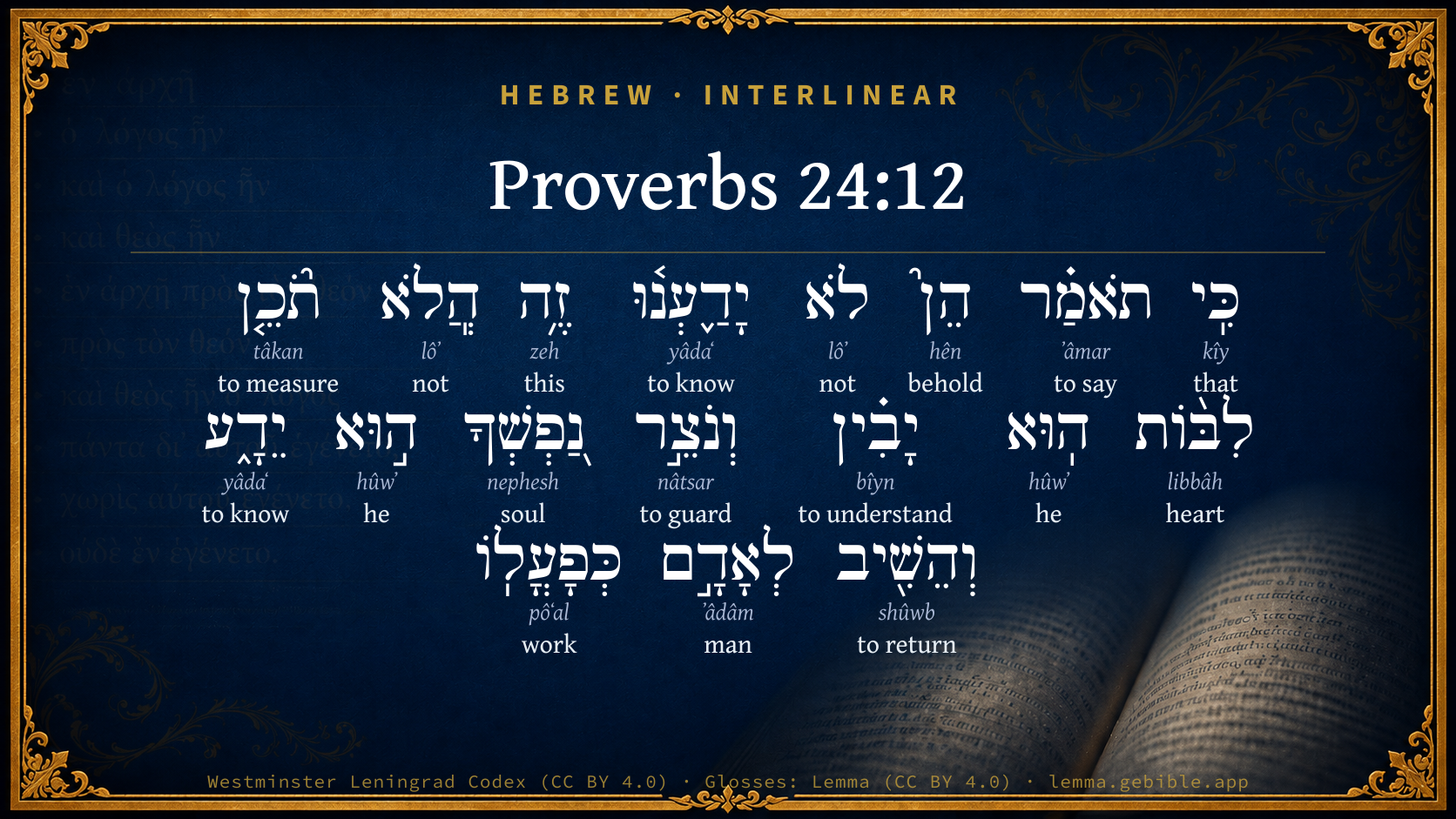
Hebrew (Westminster Leningrad Codex) Proverbs 24:12 appears in the Hebrew Old Testament. The text above is from the Westminster Leningrad Codex. Each word links to its Strong’s number, a concise gloss, and parsing drawn from the Open Scriptures Hebrew Bible morphology. Click any word for its full Brown-Driver-Briggs (BDB) entry.
Download image
Cite this verse

Proverbs 24:12 (World English Bible). Public Domain. Lemma interlinear Bible study tool, https://lemma.gebible.app/v/proverbs/24/12.

Show BibTeX & RIS
BibTeX
RIS
English Translation
If you say, "Behold, we didn't know this;" Doesn't he who weighs the hearts consider it? He who keeps your soul, doesn't he know it? Shall he not render to every man according to his work?
World English Bible · Public Domain
Download a study sheet

One document with this verse’s original text, its word-by-word gloss line, the meaning frame, cross-references with their text, attributed commentary, and full source and license credits — printable, and it pastes into notes with its structure intact.

This verse Autodidact and up

Study sheet (.html) Plain text (.txt)

A passage Seminary Student

Up to 50 verses in one chapter. A passage sheet keeps up to 6 commentary sources and 12 cross-references per verse, in the order this page ranks them, and says so on the sheet whenever that leaves anything out. Ask for a single verse and you get the Autodidact verse sheet above.

Everything on this page stays free to read, with no account — the sheet is a download of what is already on screen, not access to it.

Want to remove ads? Support Godless Engineer
Compare translations 3

The same verse in 3 English versions, stacked beneath the original-language interlinear above. Click any original word for its lexicon entry.

Each is an independent rendering of the whole verse — the interlinear is not word-aligned to these translations.

Highlighted words mark where these versions differ — a whole-verse word diff, not a word-by-word alignment.

  • World English Bible Public Domain
    If you say, "Behold, we didn't know this;" Doesn't he who weighs the hearts consider it? He who keeps your soul, doesn't he know it? Shall he not render to every man according to his work?
  • King James Version Public Domain
    If thou sayest, Behold, we knew it not; doth not he that pondereth the heart consider it? and he that keepeth thy soul, doth not he know it? and shall not he render to every man according to his works?
  • unfoldingWord Literal Text CC BY-SA 4.0
    If you say, “Behold, we did not know this,” does not he, the examiner of hearts, understand, and he, the guard of your life, know, and he, give back to a man according to his work?

unfoldingWord Literal Text — © unfoldingWord, licensed CC BY-SA 4.0. Word-aligned USFM3 via Door43 (git.door43.org/unfoldingWord/en_ult).

Versions to compare (up to 4)

3 of 4 selected

Show all 18 translations

Every available English version of this verse, each an independent rendering of the whole verse.

  • World English Bible Public Domain
    If you say, "Behold, we didn't know this;" Doesn't he who weighs the hearts consider it? He who keeps your soul, doesn't he know it? Shall he not render to every man according to his work?
  • Berean Standard Bible Public Domain
    If you say, “Behold, we did not know about this,” does not He who weighs hearts consider it? Does not the One who guards your life know? Will He not repay a man according to his deeds?
  • Majority Standard Bible Public Domain
    If you say, “Behold, we did not know about this,” does not He who weighs hearts consider it? Does not the One who guards your life know? Will He not repay a man according to his deeds?
  • King James Version Public Domain
    If thou sayest, Behold, we knew it not; doth not he that pondereth the heart consider it? and he that keepeth thy soul, doth not he know it? and shall not he render to every man according to his works?
  • American Standard Version (1901) Public Domain
    If thou sayest, Behold, we knew not this; Doth not he that weigheth the hearts consider it? And he that keepeth thy soul, doth not he know it? And shall not he render to every man according to his work?
  • Revised Version (1885) Public Domain
    If thou sayest, Behold, we knew not this: doth not he that weigheth the hearts consider it? and he that keepeth thy soul, doth not he know it? and shall not he render to every man according to his work?
  • Geneva Bible (1599) Public Domain
    If thou say, Beholde, we knew not of it: he that pondereth the heartes, doeth not hee vnderstand it? and hee that keepeth thy soule, knoweth he it not? will not he also recompense euery man according to his workes?
  • Douay-Rheims (1899) Public Domain
    If thou say: I have not strength enough: he that seeth into the heart, he understandeth, and nothing deceiveth the keeper of thy soul, end he shall render to a man according to his works.
  • Young's Literal Translation Public Domain
    When thou sayest, `Lo, we knew not this.' Is not the Ponderer of hearts He who understandeth? And the Keeper of thy soul He who knoweth? And He hath rendered to man according to his work.
  • Literal Standard Version CC BY-SA 4.0
    When you say, “Behold, we did not know this.” Is the Ponderer of hearts not He who understands? And the Keeper of your soul He who knows? And He has rendered to man according to his work.
  • Unlocked Literal Bible CC BY-SA 4.0
    If you say, “Behold, we knew nothing about this,” does not the one who weighs the heart understand what you are saying? The one who guards your life, does he not know it? Will God not give to each one what he deserves?
  • unfoldingWord Literal Text CC BY-SA 4.0
    If you say, “Behold, we did not know this,” does not he, the examiner of hearts, understand, and he, the guard of your life, know, and he, give back to a man according to his work?
  • Darby Bible Public Domain
    If thou sayest, Behold, we knew it not, will not he that weigheth the hearts consider it? And he that preserveth thy soul, he knoweth it; and he rendereth to man according to his work.
  • World Messianic Bible Public Domain
    If you say, “Behold, we didn’t know this,” doesn’t he who weighs the hearts consider it? He who keeps your soul, doesn’t he know it? Shall he not give to every man according to his work?
  • Webster's Bible Public Domain
    If thou sayest, Behold, we knew it not; doth not he that pondereth the heart consider it? and he that keepeth thy soul, doth not he know it? and will not he render to every man according to his works?
  • Free Bible Version CC BY-SA 4.0
    If you say, “Look, we didn't know anything about this,” don't you think the God who judges your motives will see what's happening? He who watches over you knows, and he will pay people back for what they've done.
  • Bible in Basic English Public Domain
    If you say, See, we had no knowledge of this: does not the tester of hearts give thought to it? and he who keeps your soul, has he no knowledge of it? and will he not give to every man the reward of his work?
  • JPS Tanakh (1917) Public Domain
    If thou sayest: 'Behold, we knew not this', doth not He that weigheth the hearts consider it? And He that keepeth thy soul, doth not He know it? And shall not He render to every man according to his works?

Literal Standard Version (2020), Covenant Press — licensed CC BY-SA 4.0. Text via the HelloAO Bible API (eBible.org). Unlocked Literal Bible (unfoldingWord) — licensed CC BY-SA 4.0. Text via the HelloAO Bible API (eBible.org). unfoldingWord Literal Text — © unfoldingWord, licensed CC BY-SA 4.0. Word-aligned USFM3 via Door43 (git.door43.org/unfoldingWord/en_ult). Free Bible Version, Dr. Jonathan Gallagher — licensed CC BY-SA 4.0. Text via the HelloAO Bible API (eBible.org).

Word by word

More ways to search: Search by grammar → Find every occurrence → Compare this word →

Practice this passage: Drill this verse → Learn its vocabulary →

לִבּ֨וֹת
libbâh
H3826
“hearts”
Noun, Common, Feminine, Plural, Absolute
Part of Speech
Noun
Type
Common
Gender
Feminine
Number
Plural
State
Absolute
Full BDB Definition

Origin: from H3820

TWOT: 1071b

heart
  1. כִּֽי kîy H3588 “that” Conjunction
  2. תֹאמַ֗ר ʼâmar H559 “to say” Verb, Qal, Imperfect, 2nd Person, Masculine, Singular
  3. הֵן֮ hên H2005 “behold” Particle, Demonstrative
  4. לֹא lôʼ H3808 “not” Particle, Negative
  5. יָדַ֪עְנ֫וּ yâdaʻ H3045 “to know” Verb, Qal, Perfect, 1st Person, Common, Plural
  6. זֶ֥ה zeh H2088 “this” Pronoun, Demonstrative, Masculine, Singular
  7. הֲֽלֹא lôʼ H3808 “not” Particle, Interrogative + Particle, Negative
  8. תֹ֘כֵ֤ן tâkan H8505 “measuring” Verb, Qal, Participle Active, Masculine, Singular, Absolute
  9. הֽוּא hûwʼ H1931 “he” Pronoun, Personal, 3rd Person, Masculine, Singular
  10. יָבִ֗ין bîyn H995 “to understand” Verb, Qal, Imperfect, 3rd Person, Masculine, Singular
  11. וְנֹצֵ֣ר nâtsar H5341 “and · guarding” Conjunction + Verb, Qal, Participle Active, Masculine, Singular, Absolute
  12. נַ֭פְשְׁךָ nephesh H5315 “soul · your” Noun, Common, Both, Singular, Construct + Suffix, Personal, 2nd Person, Masculine, Singular
  13. ה֣וּא hûwʼ H1931 “he” Pronoun, Personal, 3rd Person, Masculine, Singular
  14. יֵדָ֑ע yâdaʻ H3045 “to know” Verb, Qal, Imperfect, 3rd Person, Masculine, Singular
  15. וְהֵשִׁ֖יב shûwb H7725 “and · to return” Conjunction + Verb, Hiphil, Sequential Perfect, 3rd Person, Masculine, Singular
  16. לְאָדָ֣ם ʼâdâm H120 “to/for · man” Preposition + Noun, Common, Masculine, Singular, Absolute
  17. כְּפָעֳלֽוֹ pôʻal H6467 “like/as · work · his” Preposition + Noun, Common, Masculine, Singular, Construct + Suffix, Personal, 3rd Person, Masculine, Singular

About this verse

These counts appear in no published source. They are computed here, from the morphology-tagged text and Lemma’s own curated glosses. What Lemma adds →

18
words
15
distinct lemmas
Wisdom
section

Notable vocabulary

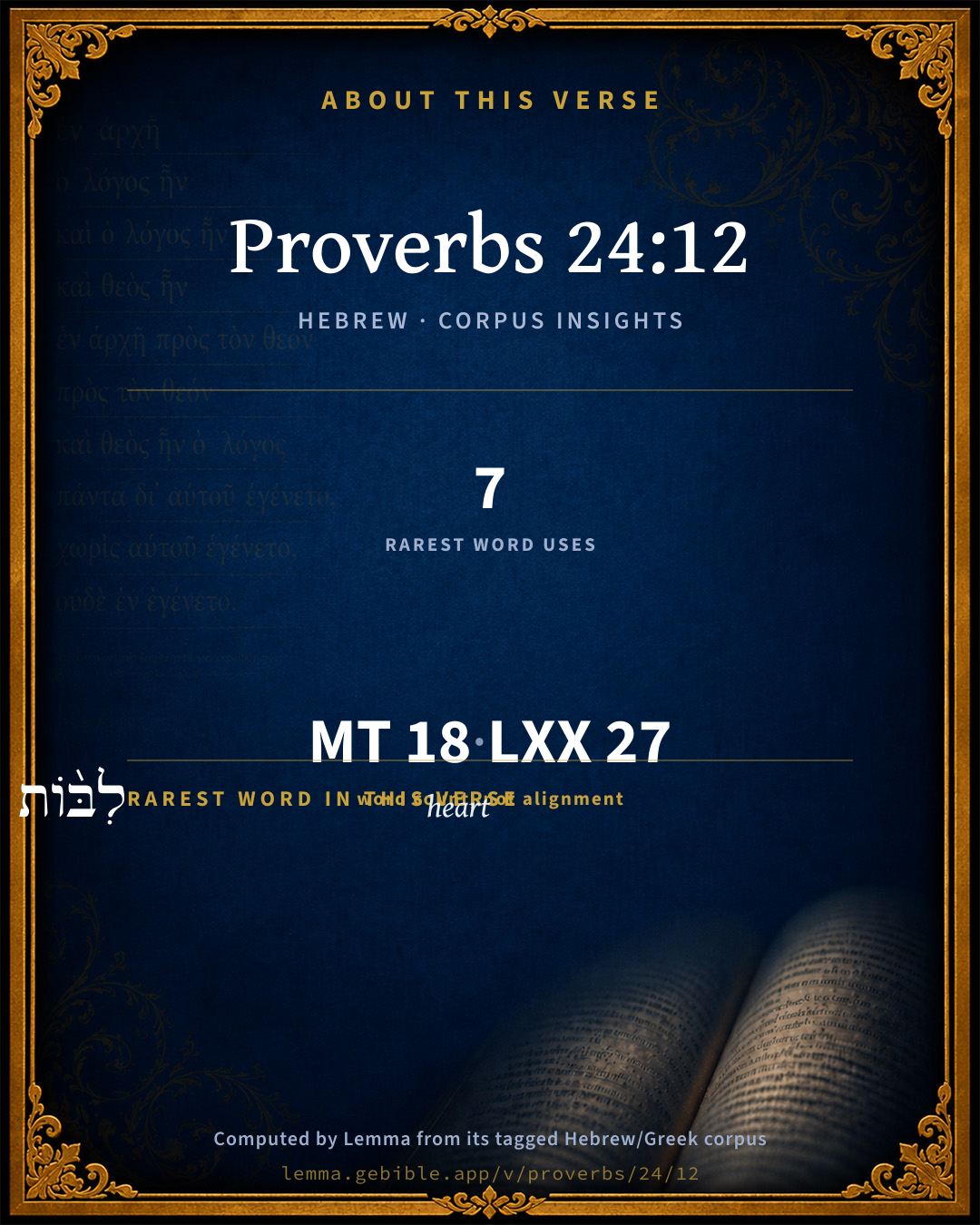
The rarest word here is לִבּ֨וֹת heart H3826 — appearing just 7 times in the whole Hebrew Bible.

Shared distinctive vocabulary

לִבּ֨וֹת heart H3826 occurs in 7 verses of the Hebrew Bible. Also found in:

Grammatical profile

  • 7 verbs
  • 4 nouns
  • 3 pronouns
  • 1 conjunction
  • 3 particles

Verb forms

  • תֹאמַ֗ר Qal · Imperfect
  • יָדַ֪עְנ֫וּ Qal · Perfect
  • תֹ֘כֵ֤ן Qal · Participle Active
  • יָבִ֗ין Qal · Imperfect
  • וְנֹצֵ֣ר Qal · Participle Active
  • יֵדָ֑ע Qal · Imperfect
  • וְהֵשִׁ֖יב Hiphil · Sequential Perfect

Repetition

Words recur within this verse — often emphatic in Hebrew:

  • יָדַ֪עְנ֫וּ to know H3045 ×2
  • לֹא not H3808 ×2
  • הֽוּא he H1931 ×2

Hebrew & Septuagint length

In English translation the verse runs 36 words from the Hebrew and 39 from the Septuagint (LXX English) — closely comparable.

A rough comparison of the two English renderings, which tokenize alike — not a word-level alignment.

Word counts can differ between the Hebrew and the Greek without any difference in meaning — e.g. the Hebrew direct-object marker אֵת has no separate Greek word, and Greek often adds the article ὁ.

In the original languages it is 18 Hebrew tokens and 27 Greek tokens — but the two are counted differently (Hebrew bundles its prefixes and suffixes into one token; the Greek is in lemma form), so that isn’t a like-for-like length.

Cross-references

29

Topical passages linked to Proverbs 24:12 in the Treasury of Scripture Knowledge — connected by theme and wording, ordered by reader-vote popularity; previews shown in the World English Bible.

  • Job 34:11 For the work of a man will he render to him, And cause every man to find according to his ways.
  • Jeremiah 17:10 I, Yahweh, search the mind, I try the heart, even to give every man according to his ways, according to the fruit of his doings.
  • Revelation 2:23 I will kill her children with Death, and all the assemblies will know that I am he who searches the minds and hearts. I will give to each one of you according to your deeds.
  • 1 Samuel 16:7 But Yahweh said to Samuel, "Don't look on his face, or on the height of his stature; because I have rejected him: for [Yahweh sees] not as man sees; for man looks at the outward appearance, but Yahweh looks at the heart."
  • Psalms 121:8 Yahweh will keep your going out and your coming in, From this time forth, and forevermore.
  • Proverbs 21:2 Every way of a man is right in his own eyes, But Yahweh weighs the hearts.
  • Romans 2:6 who "will pay back to everyone according to their works:"
  • Psalms 121:3 He will not allow your foot to be moved. He who keeps you will not slumber.
  • Ecclesiastes 5:8 If you see the oppression of the poor, and the violent taking away of justice and righteousness in a district, don't marvel at the matter: for one official is eyed by a higher one; and there are officials over them.
  • Psalms 17:3 You have proved my heart; you have visited me in the night; You have tried me, and found nothing; I have resolved that my mouth shall not disobey.
  • Psalms 62:12 Also to you, Lord, belongs loving kindness, For you reward every man according to his work.
  • 1 Samuel 2:6 Yahweh kills, and makes alive: He brings down to Sheol, and brings up.
  • 1 Samuel 25:29 Though men be risen up to pursue you, and to seek your soul, yet the soul of my lord shall be bound in the bundle of life with Yahweh your God; and the souls of your enemies, them shall he sling out, as from the hollow of a sling.
  • Psalms 7:9 Oh let the wickedness of the wicked come to an end, But establish the righteous; Their minds and hearts are searched by the righteous God.
  • Psalms 44:21 Won't God search this out? For he knows the secrets of the heart.
  • Psalms 66:9 Who preserves our life among the living, And doesn't allow our feet to be moved.
  • Proverbs 5:21 For the ways of man are before the eyes of Yahweh. He examines all his paths.
  • Jeremiah 32:19 great in counsel, and mighty in work; whose eyes are open on all the ways of the sons of men, to give everyone according to his ways, and according to the fruit of his doings:
  • Daniel 5:23 but have lifted up yourself against the Lord of heaven; and they have brought the vessels of his house before you, and you and your lords, your wives and your concubines, have drunk wine from them; and you have praised the gods of silver and gold, of brass, iron, wood, and stone, which don't see, nor hear, nor know; and the God in whose hand your breath is, and whose are all your ways, you have not glorified.
  • Matthew 16:27 For the Son of Man will come in the glory of his Father with his angels, and then he will render to everyone according to his deeds.
  • Acts 17:28 'For in him we live, and move, and have our being.' As some of your own poets have said, 'For we are also his offspring.'
  • Romans 2:16 in the day when God will judge the secrets of men, according to my Gospel, by Jesus Christ.
  • 1 Corinthians 4:5 Therefore judge nothing before the time, until the Lord comes, who will both bring to light the hidden things of darkness, and reveal the counsels of the hearts. Then each man will get his praise from God.
  • 2 Corinthians 5:10 For we must all be revealed before the judgment seat of Christ; that each one may receive the things in the body, according to what he has done, whether good or bad.
  • Hebrews 4:12–13 For the word of God is living, and active, and sharper than any two-edged sword, and piercing even to the dividing of soul and spirit, of both joints and marrow, and is able to discern the thoughts and intentions of the heart.
  • Revelation 1:18 and the Living one. I was dead, and behold, I am alive forevermore. Amen. I have the keys of Death and of Hades.
  • Revelation 2:18 "To the angel of the assembly in Thyatira write: "The Son of God, who has his eyes like a flame of fire, and his feet are like burnished brass, says these things:
  • Revelation 20:12–15 I saw the dead, the great and the small, standing before the throne, and they opened books. Another book was opened, which is the book of life. The dead were judged out of the things which were written in the books, according to their works.
  • Revelation 22:12 "Behold, I come quickly. My reward is with me, to repay to each man according to his work.

Cross-references courtesy of OpenBible.info (CC BY 4.0).

Hebrew and Greek witnesses Masoretic Hebrew ↔ Greek Septuagint

The same verse in the two great witnesses to the Old Testament, shown verse-for-verse.

These are two independent witnesses, not word-aligned to each other, and the Septuagint is shown in lemma (dictionary) form.

Hebrew Proverbs 24:12 Masoretic · Westminster Leningrad Codex

כִּֽי תֹאמַ֗ר הֵן֮ לֹא יָדַ֪עְנ֫וּ זֶ֥ה הֲֽלֹא תֹ֘כֵ֤ן לִבּ֨וֹת הֽוּא יָבִ֗ין וְנֹצֵ֣ר נַ֭פְשְׁךָ ה֣וּא יֵדָ֑ע וְהֵשִׁ֖יב לְאָדָ֣ם כְּפָעֳלֽוֹ

If you say, "Behold, we didn't know this;" Doesn't he who weighs the hearts consider it? He who keeps your soul, doesn't he know it? Shall he not render to every man according to his work?

World English Bible · Public Domain

Greek LXX Proverbs 24:12 Septuagint · lemma form

ἐάν δέ εἶπον οὐ οἶδα οὗτος γιγνώσκω ὅτι κύριος καρδία πᾶς γιγνώσκω καί ὁ πλάσσω πνοή πᾶς αὐτός οἶδα πᾶς ὅς ἀποδίδωμι ἕκαστος κατά ὁ ἔργον αὐτός

But if you should say, I know not this man; know that the Lord knows the hearts of all; and he that formed breath for all, he knows all things, who renders to every man according to his works.

LXX2012 (modern English Septuagint) · Public Domain

On this verse, The Pulpit Commentary discusses the Septuagint’s reading. Read the note in Commentary ↓

Hebrew: Westminster Leningrad Codex (CC BY 4.0). Greek: Septuagint (public domain); English from LXX2012 (modern English Septuagint) (Public Domain). How the Septuagint differs from the Hebrew →

Commentary

Notes on Proverbs 24:12 from classic Christian and Jewish commentators (each source and its license shown beneath its notes). The classic Christian expositions comment on the surrounding passage and are grouped to its opening verse, so a note may address several verses; the Jewish commentaries on the Tanakh (Rashi and others) are per-verse, so they appear only where the commentator wrote on this verse.

Lemma curates 59 commentaries, every one of them public domain or Creative Commons licensed, each selected and text-cleaned for this edition rather than reprinted as found. About our sources →

Trapp's Complete Commentary

John Trapp

Pro 24:12 If thou sayest, Behold, we knew it not; doth not he that pondereth the heart consider [it]? and he that keepeth thy soul, doth [not] he know [it]? and shall [not] he render to [every] man according to his works?

Ver. 12. If thou sayest, Behold, we knew it not, &c.] As no wool is so coarse but will take some colour; so there is no sin so foul but will admit some excuse. Ignorance is commonly pleaded, - We know not this man’s case, the justice of his cause, the means of his rescue, &c. But "be not deceived, God is not mocked." They that would mock him imposturum faciunt et patientur, defraud themselves, as the emperor said of him that sold glass for pearl. Deo obscura clarent, muta respondent, silentium confitetur. {a} God’s "eyes behold, his eyelids try the children of men." {Psa 11:4} The former points out his knowledge, the latter his critical descant.

Doth not he that pondereth the heart consider?] No man needs a window in his breast - as the heathen Momus wished - for God to look in at; for every man before God is all window, {Job 34:22} and his "eyes are as a flaming fire," {Rev 1:14} that need no outward light, that see extra mittendo by sending out a ray, &c., that see through that transparent body, the world, called "a sea of glass." {Rev 4:6}

{a} Isidor.

John Trapp, A Commentary or Exposition upon All the Books of the Old and New Testament (1647–1656) — public domain. Text from a community e-Sword module.

Ellicott's Commentary for English Readers

(12) If thou sayest, Behold, we knew it not.—Man being too much inclined to answer after the manner of Cain (Gen_4:9), “Am I my brother’s keeper?” when he might give aid to those who need it.

A Bible Commentary for English Readers, edited by Charles John Ellicott (1878–1897) — public domain. Text from a community e-Sword module.

The Cambridge Bible for Schools and Colleges

gen. ed. J. J. S. Perowne

12. knew it not] Lit. knew not this (thing, or man).

The Cambridge Bible for Schools and Colleges (gen. ed. J. J. S. Perowne; Cambridge University Press, 1878–1918) — public domain. Text from a community e-Sword module.

John Gill's Exposition

My son, eat thou honey, because it is good,.... It is good for food; there was plenty of it in Palestine, and it was eaten for food, not only by children, but grown persons; and was very nourishing, strengthening, and refreshing to them, as Samson, Jonathan, John the Baptist, and others; and is good for medicine, is healthful and salutary, and useful in many diseases: it is said (m) to conduce much to prolong life and preserve from diseases; it has been observed that those who have much used it have lived to a great age;

and the honeycomb, which is sweet to thy taste; because it is so, as all honey is, and especially that which is immediately squeezed or drops from the honeycomb; this is said not so much on account of honey, and the eating of that, as for what follows concerning the knowledge of wisdom, which is comparable to it for pleasure and profit; see Pro 16:24 (n).

(m) Athenaei Deipnosophist. l. 2. c. 7. p. 46, 47. so Pierius Valerian. apud Steeb. Coelum Sephirot Heb. c. 7. s. 5. p. 132. (n) Vid. Maimon. Moreh Nevochim, par. 1. c. 30. p. 37.

John Gill's Exposition of the Whole Bible (1746–1763) — public domain (CC PDM 1.0). Text via the HelloAO Bible API.

Albert Barnes' Notes on the Bible

As Pro 24:11 warned men against acquiescing in an unrighteous tyranny, so this denounces the tendency to hush up a wrong with the false plea of ignorance. Compare Ecc 5:8. Pro 24:10-12 thus forms a complete and connected whole.

Albert Barnes' Notes on the Bible (1834–1885) — public domain. Text from a community e-Sword/MySword module.

Haydock's Catholic Bible Commentary

I have. Hebrew, "behold, we know not this man." (Pagnin) (Haydock) --- He is a stranger. But all mankind are brethren, and have a charge to assist one another, even though they be enemies, Ecclesiasticus xvii. 12., and Exodus xxiii. 4. (Calmet) --- Keeper. Hebrew notser, "preserver." As thou hast received many good things from God, shew mercy to thy neighbour.

George Leo Haydock (1774–1849), Haydock's Catholic Family Bible and Commentary, 1859 edition — public domain. Excludes Psalms (Douay-Rheims chapter numbering differs from Protestant) and Deuterocanonical books (Catholic canon only).

Matthew Poole's English Annotations

We knew it not; I was ignorant either of his innocency, or of his extreme danger, or of my power to relieve him.

Consider it; that this is only a frivolous excuse, and that the true reason of thy neglect was thy want of true love to thy brother, whose life thou wast by the law of God and of nature obliged to preserve, and thy sinful self-love, and a carnal fear of some mischief or trouble which might befall thee in the discharge of thy duty.

He that keepeth thy soul; God, who is the preserver of men, Job 7:20, who daily doth, and who only can, keep thee both in and from the greatest dangers. And this favour of God may be here mentioned, partly, as a strong obligation upon him to preserve him who is made after God’s image, and whom God hath commanded him to love and preserve; partly, as an encouragement to the performance of his duty herein from the consideration of God’s special care and watchfulness over those that do their duty; and partly, to intimate to them the danger of the neglect of this duty, whereby they will forfeit God’s protection over themselves, and expose themselves to manifold dangers and calamities. Or, as others render it, and as the Hebrew verb is frequently used, he that observeth thy soul, that seeth all the secret thoughts and inward motions of the heart; which exposition is favoured both by the following words, doth not he know it? which agrees better to God’s observing than to his preserving a man’s soul; and by the former clause, to which this translation doth more exactly answer, the same thing being here repeated in other words, after the manner of these sacred writers.

Shall not he render to every man according to his works? God will certainly deal with thee as thou hast dealt with him, either rewarding thy performance of this duty, or punishing thy neglect of it.

Matthew Poole's English Annotations on the Holy Bible (1683–1685) — public domain. Text from a community e-Sword/MySword module.

The Pulpit Commentary

If thou sayest, Behold, we knew it not. The disciple of Wisdom may excuse himself from making any effort for the prisoners" release, by saying he had not heard of the case. St. Jerome makes the excuse to be inability, vires non suppetunt. The LXX makes it a personal matter, ignoring the plural form of the previous paragraph. "I know him not, he is no friend of mine; why should I trouble myself about him?" Such a selfish person, like the priest and Levite in the parable, would "pass by on the other side." Doth not he that pondereth the heart consider it? God knows the truth knows that the excuse is vain; for he is the Weigher and Searcher of hearts. (Pro_16:2 Pro_21:2) Cain"s plea, "Am I my brother"s keeper?" is unavailable; the law of love is limited by no circumstances. He that keepeth thy soul, doth not he know it? The expression, "keeping the soul," may be equivalent to "preserving the life;" but it more probably means watching, observing, the inmost secrets of the nature. (Job_7:20) The verb used is rxn (natsar), which has both significations. The sense of "forming." which some give it, seems not allowable. (For "heart" (leb) and "soul" (nephesh), see note on Pro_2:10) Shall not he render to every man according to his works? Knowing the heart and the motive, God deals out retributive justice. (Pro_12:14 Psa_62:12 Rom_2:6) Septuagint, "But if thou say, I know not this man, know that the Lord knoweth the hearts of air; and he who formed (plasav ) breath for all, himself knoweth all things, who rendereth to every man according to his works."

The Pulpit Commentary (1880–1919), ed. H.D.M. Spence-Jones & Joseph S. Exell — public domain. Text from a community e-Sword module.

John Wesley's Explanatory Notes

Consider - That this is only a frivolous excuse.

John Wesley, Explanatory Notes Upon the Whole Bible (1754–1765) — public domain. Text via the GEBible commentary corpus.

Kretzmann's Popular Commentary

Paul E. Kretzmann

v. 12. if thou sayest, Behold, we knew it not, the one addressed trying to salve his conscience with a poor excuse, doth not He that pondereth the heart consider it? And He that keepeth thy soul, familiar with the innermost thoughts of the mind, doth not He know it? And shall not He render to every man according to his works? The last is a direct statement: He will requite man according to his deeds, His retributive justice cannot be avoided by a profession of ignorance. cf Proverbs 31:8. 9.

Paul E. Kretzmann, Popular Commentary of the Bible (1921–1924) — public domain. Text from a community e-Sword module.

Rashi

Rabbi Shlomo Yitzchaki (Rashi)

will you say Heb. כי תאמר. And this instance of כי is used as an expression of “perhaps.”

Rashi on the Tanakh — English translations: “The Judaica Press complete Tanach with Rashi, translated by A. J. Rosenberg” (CC BY 4.0); “Pentateuch with Rashi's commentary by M. Rosenbaum and A.M. Silbermann, 1929-1934” (public domain); “The Metsudah Tanach series, Lakewood, N.J” (CC BY 4.0); and “The Book of Joshua, Metsudah Publications, 1997” (CC BY 4.0). Text via Sefaria.

Lesson kit

Teaching starters — assembled from the data on this page, not authored interpretation. Every prompt links to the verse data it draws on. Edit before teaching.

Proverbs, in the Wisdom, opens this verse with 18 words (15 distinct Hebrew lemmas). Its most distinctive word is libbâh (“heart”). A historical commentator’s framing appears above. Read the whole chapter for the surrounding context.

Discussion questions

  1. The word libbâh carries the sense “heart.” How does it shape the verse?
  2. Psalms 7:9 shares the word «heart» with this verse. How do the two illuminate each other?
  3. “to know” occurs 2× in this one verse. What is the effect of the repetition?
  4. These translations render this verse differently. What is at stake in choosing one wording over another?
  5. The verb «תֹאמַ֗ר» is Qal Imperfect. How does its form color the action?
  6. Reading how Trapp's Complete Commentary and Ellicott's Commentary for English Readers read this verse, where do the two commentators agree and where do they part?

Things to notice

Reading settings

Reading text

Shown beneath each verse's original-language words.

Old Testament
Old Testament edition

Read the OT as the Masoretic Hebrew (MT) or the Greek Septuagint (LXX).

English shown for the Greek Septuagint (in the Hebrew ↔ Greek comparison).

Comparing translations? Open the Compare panel on any verse page to stack up to four side by side.