
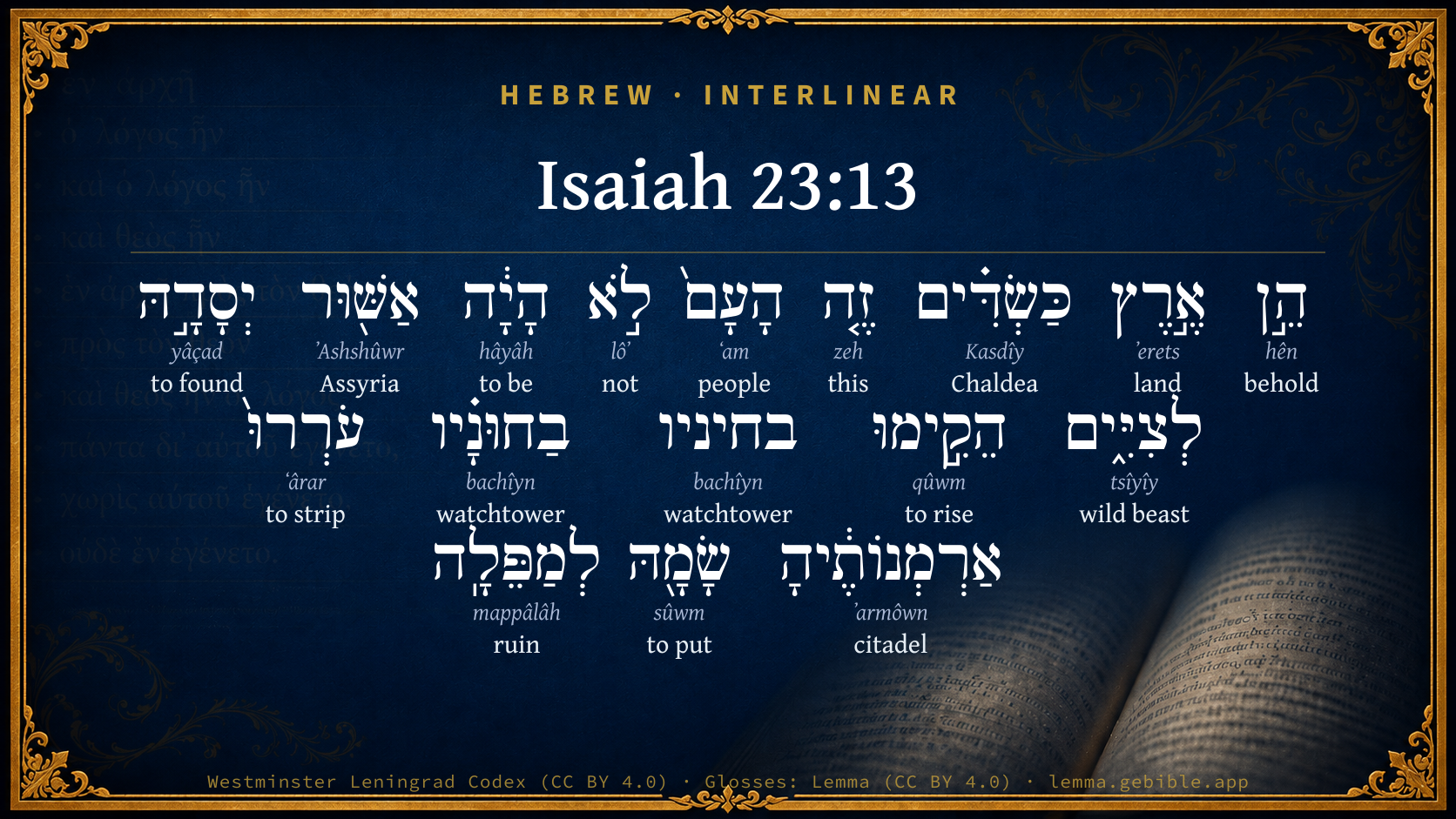
Isaiah 23:13

Hebrew (Westminster Leningrad Codex) Isaiah 23:13 appears in the Hebrew Old Testament. The text above is from the Westminster Leningrad Codex. Each word links to its Strong’s number, a concise gloss, and parsing drawn from the Open Scriptures Hebrew Bible morphology. Click any word for its full Brown-Driver-Briggs (BDB) entry.
Download image
Cite this verse

Isaiah 23:13 (World English Bible). Public Domain. Lemma interlinear Bible study tool, https://lemma.gebible.app/v/isaiah/23/13.

Show BibTeX & RIS
BibTeX
RIS
English Translation
Behold, the land of the Chaldeans: this people was not; the Assyrian founded it for those who dwell in the wilderness; they set up their towers; they overthrew the palaces of it; they made it a ruin.
World English Bible · Public Domain
Highlights Full analysis ↓
Download a study sheet

One document with this verse’s original text, its word-by-word gloss line, the meaning frame, cross-references with their text, attributed commentary, and full source and license credits — printable, and it pastes into notes with its structure intact.

This verse Autodidact and up

Study sheet (.html) Plain text (.txt)

A passage Seminary Student

Up to 50 verses in one chapter. A passage sheet keeps up to 6 commentary sources and 12 cross-references per verse, in the order this page ranks them, and says so on the sheet whenever that leaves anything out. Ask for a single verse and you get the Autodidact verse sheet above.

Everything on this page stays free to read, with no account — the sheet is a download of what is already on screen, not access to it.

Want to remove ads? Support Godless Engineer
Compare translations 3

The same verse in 3 English versions, stacked beneath the original-language interlinear above. Click any original word for its lexicon entry.

Each is an independent rendering of the whole verse — the interlinear is not word-aligned to these translations.

Highlighted words mark where these versions differ — a whole-verse word diff, not a word-by-word alignment.

  • World English Bible Public Domain
    Behold, the land of the Chaldeans: this people was not; the Assyrian founded it for those who dwell in the wilderness; they set up their towers; they overthrew the palaces of it; they made it a ruin.
  • King James Version Public Domain
    Behold the land of the Chaldeans; this people was not, till the Assyrian founded it for them that dwell in the wilderness: they set up the towers thereof, they raised up the palaces thereof; and he brought it to ruin.
  • unfoldingWord Literal Text CC BY-SA 4.0
    Behold, the land of the Chaldeans. This people is not. Assyria founded it for desert creatures. They set up its towers; they stripped its palaces; one made it a ruin.

unfoldingWord Literal Text — © unfoldingWord, licensed CC BY-SA 4.0. Word-aligned USFM3 via Door43 (git.door43.org/unfoldingWord/en_ult).

Versions to compare (up to 4)

3 of 4 selected

Show all 18 translations

Every available English version of this verse, each an independent rendering of the whole verse.

  • World English Bible Public Domain
    Behold, the land of the Chaldeans: this people was not; the Assyrian founded it for those who dwell in the wilderness; they set up their towers; they overthrew the palaces of it; they made it a ruin.
  • Berean Standard Bible Public Domain
    Look at the land of the Chaldeans—a people now of no account. The Assyrians destined it for the desert creatures; they set up their siege towers and stripped its palaces. They brought it to ruin.
  • Majority Standard Bible Public Domain
    Look at the land of the Chaldeans—a people now of no account. The Assyrians destined it for the desert creatures; they set up their siege towers and stripped its palaces. They brought it to ruin.
  • King James Version Public Domain
    Behold the land of the Chaldeans; this people was not, till the Assyrian founded it for them that dwell in the wilderness: they set up the towers thereof, they raised up the palaces thereof; and he brought it to ruin.
  • American Standard Version (1901) Public Domain
    Behold, the land of the Chaldeans: this people was not; the Assyrian founded it for them that dwell in the wilderness; they set up their towers; they overthrew the palaces thereof; they made it a ruin.
  • Revised Version (1885) Public Domain
    Behold, the land of the Chaldeans; this people is no more; the Assyrian hath appointed it for the beasts of the wilderness: they set up their towers, they overthrew the palaces thereof; he made it a ruin.
  • Geneva Bible (1599) Public Domain
    Behold the lande of the Caldeans: this was no people: Asshur founded it by the inhabitantes of the wildernesse: they set vp the towers thereof: they raised the palaces thereof and hee brought it to ruine.
  • Douay-Rheims (1899) Public Domain
    Behold the land of the Chaldeans, there was not such a people, the Assyrian founded it: they have led away the strong ones thereof into captivity, they have destroyed the houses thereof, they have brought it to ruin.
  • Young's Literal Translation Public Domain
    Lo, the land of the Chaldeans -- this people was not, Asshur founded it for the Ziim, They raised its watch-towers, They lifted up her palaces, -- He hath appointed her for a ruin!
  • Literal Standard Version CC BY-SA 4.0
    Behold, the land of the Chaldeans—this people was not, || Asshur founded it for desert-dwellers, || They raised its watchtowers, || They lifted up her palaces—He has appointed her for a ruin!
  • Unlocked Literal Bible CC BY-SA 4.0
    See the land of the Chaldeans. This people has ceased to be; the Assyrians have made it a wilderness for wild animals. They set up their siege towers; they demolished its palaces; they made it a heap of ruins.
  • unfoldingWord Literal Text CC BY-SA 4.0
    Behold, the land of the Chaldeans. This people is not. Assyria founded it for desert creatures. They set up its towers; they stripped its palaces; one made it a ruin.
  • Darby Bible Public Domain
    Behold the land of the Chaldeans: this people did not exist; the Assyrian founded it for the dwellers in the desert: they set up their towers, they destroyed the palaces thereof; he brought it to ruin.
  • World Messianic Bible Public Domain
    Behold, the land of the Kasdim. This people didn’t exist. The Assyrians founded it for those who dwell in the wilderness. They set up their towers. They overthrew its palaces. They made it a ruin.
  • Webster's Bible Public Domain
    Behold the land of the Chaldeans; this people was not, till the Assyrian founded it for them that dwell in the wilderness: they set up its towers, they raised up its palaces; and he brought it to ruin.
  • Free Bible Version CC BY-SA 4.0
    Look at the country of the Babylonians, this people that are not as they used to be! The Assyrians have turned it into a place for desert animals. They set up their siege towers, they demolished the fortresses, and ruined the country.
  • Bible in Basic English Public Domain
    ...
  • JPS Tanakh (1917) Public Domain
    Behold, the land of the Chaldeans — this is the people that was not, when Asshur founded it for shipmen — they set up their towers, they overthrew the palaces thereof; it is made a ruin.

Literal Standard Version (2020), Covenant Press — licensed CC BY-SA 4.0. Text via the HelloAO Bible API (eBible.org). Unlocked Literal Bible (unfoldingWord) — licensed CC BY-SA 4.0. Text via the HelloAO Bible API (eBible.org). unfoldingWord Literal Text — © unfoldingWord, licensed CC BY-SA 4.0. Word-aligned USFM3 via Door43 (git.door43.org/unfoldingWord/en_ult). Free Bible Version, Dr. Jonathan Gallagher — licensed CC BY-SA 4.0. Text via the HelloAO Bible API (eBible.org).

Word by word

More ways to search: Search by grammar → Find every occurrence → Compare this word →

Practice this passage: Drill this verse → Learn its vocabulary →

בחיניו
bachîyn
H971
“watchtowers · his”
Noun, Common, Masculine, Plural, Construct + Suffix, Personal, 3rd Person, Masculine, Singular
Part of Speech
Noun
Type
Common
Gender
Masculine
Number
Plural
State
Construct
Full BDB Definition

Origin: another form of H975

TWOT: 230c

siege-towers, watchtower
  1. הֵ֣ן hên H2005 “behold” Particle, Demonstrative
  2. אֶ֣רֶץ ʼerets H776 “land of” Noun, Common, Both, Singular, Construct
  3. כַּשְׂדִּ֗ים Kasdîy H3778 “Chaldea” Noun, Proper
  4. זֶ֤ה zeh H2088 “this” Pronoun, Demonstrative, Masculine, Singular
  5. הָעָם֙ ʻam H5971 “the · people” Particle, Definite Article + Noun, Common, Masculine, Singular, Absolute
  6. לֹ֣א lôʼ H3808 “not” Particle, Negative
  7. הָיָ֔ה hâyâh H1961 “to be” Verb, Qal, Perfect, 3rd Person, Masculine, Singular
  8. אַשּׁ֖וּר ʼAshshûwr H804 “Assyria” Noun, Proper
  9. יְסָדָ֣הּ yâçad H3245 “to found · her” Verb, Qal, Perfect, 3rd Person, Masculine, Singular + Suffix, Personal, 3rd Person, Feminine, Singular
  10. לְצִיִּ֑ים tsîyîy H6728 “to/for · wild beasts” Preposition + Noun, Common, Masculine, Plural, Absolute
  11. הֵקִ֣ימוּ qûwm H6965 “to rise” Verb, Hiphil, Perfect, 3rd Person, Common, Plural
  12. בַחוּנָ֗יו bachîyn H971 “watchtowers · his” Noun, Common, Masculine, Plural, Construct + Suffix, Personal, 3rd Person, Masculine, Singular
  13. עֹרְרוּ֙ ʻârar H6209 “to strip” Verb, Poel, Perfect, 3rd Person, Common, Plural
  14. אַרְמְנוֹתֶ֔יהָ ʼarmôwn H759 “citadels · her” Noun, Common, Masculine, Plural, Construct + Suffix, Personal, 3rd Person, Feminine, Singular
  15. שָׂמָ֖הּ sûwm H7760 “to put · her” Verb, Qal, Perfect, 3rd Person, Masculine, Singular + Suffix, Personal, 3rd Person, Feminine, Singular
  16. לְמַפֵּלָֽה mappâlâh H4654 “to/for · ruin” Preposition + Noun, Common, Feminine, Singular, Absolute

About this verse

These counts appear in no published source. They are computed here, from the morphology-tagged text and Lemma’s own curated glosses. What Lemma adds →

17
words
16
distinct lemmas
Prophets
section

Notable vocabulary

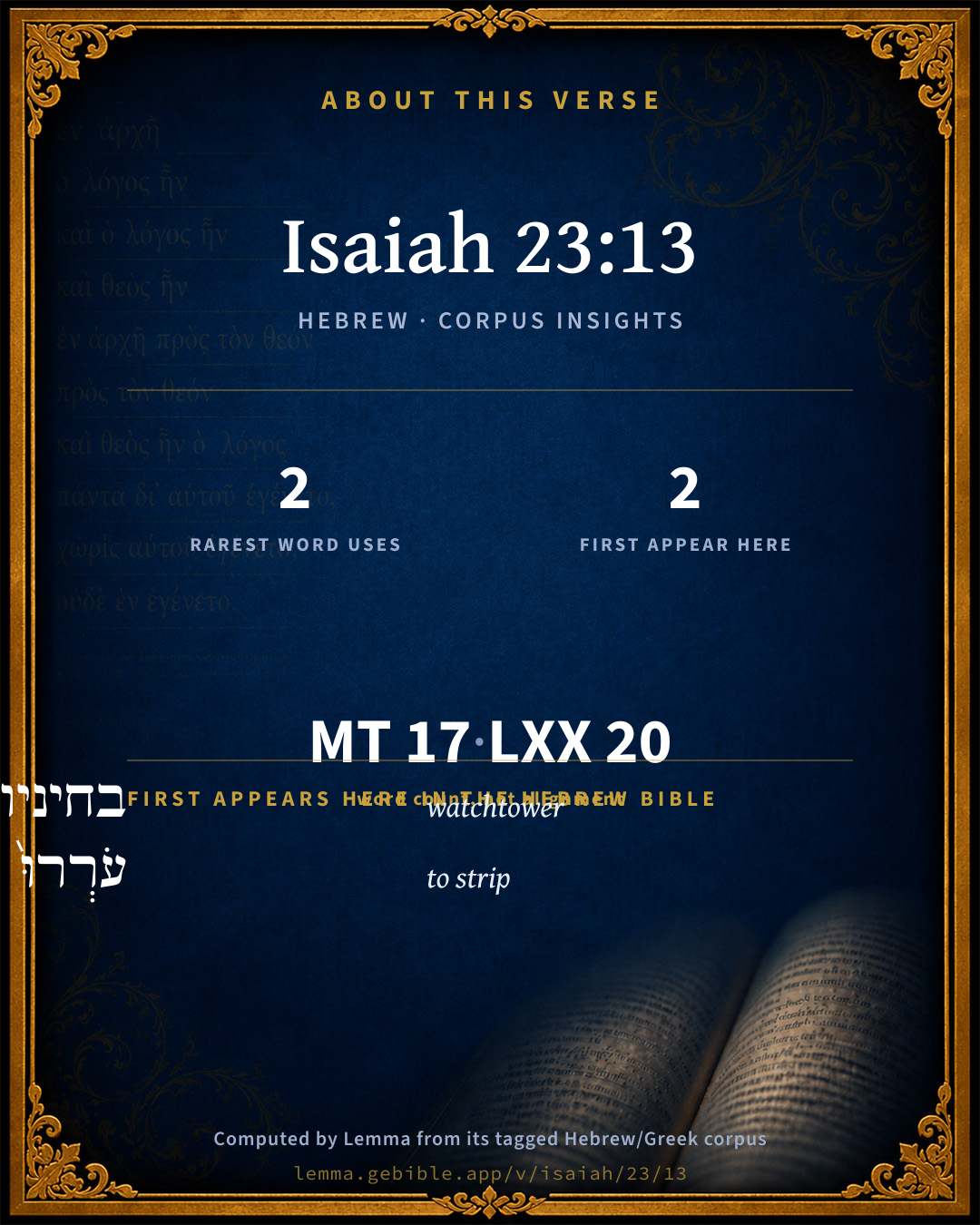
The rarest word here is בחיניו watchtower H971 — appearing just 2 times in the whole Hebrew Bible.

First appearance in Scripture

These words make their first canonical appearance in the Hebrew Bible here:

  • בחיניו watchtower H971
  • עֹרְרוּ֙ to strip H6209

Grammatical profile

  • 5 verbs
  • 9 nouns
  • 1 pronoun
  • 2 particles

Verb forms

  • הָיָ֔ה Qal · Perfect
  • יְסָדָ֣הּ Qal · Perfect
  • הֵקִ֣ימוּ Hiphil · Perfect
  • עֹרְרוּ֙ Poel · Perfect
  • שָׂמָ֖הּ Qal · Perfect

Repetition

A word recurs within this verse — often emphatic in Hebrew:

  • בחיניו watchtower H971 ×2

Hebrew & Septuagint length

In English translation the verse runs 37 words from the Hebrew and 23 from the Septuagint (LXX English) — the Septuagint runs noticeably shorter here. See the side-by-side →

A rough comparison of the two English renderings, which tokenize alike — not a word-level alignment.

Word counts can differ between the Hebrew and the Greek without any difference in meaning — e.g. the Hebrew direct-object marker אֵת has no separate Greek word, and Greek often adds the article ὁ.

In the original languages it is 17 Hebrew tokens and 20 Greek tokens — but the two are counted differently (Hebrew bundles its prefixes and suffixes into one token; the Greek is in lemma form), so that isn’t a like-for-like length.

Cross-references

19

Topical passages linked to Isaiah 23:13 in the Treasury of Scripture Knowledge — connected by theme and wording, ordered by reader-vote popularity; previews shown in the World English Bible.

  • Habakkuk 1:6 For, behold, I raise up the Chaldeans, that bitter and hasty nation, that march through the breadth of the earth, to possess dwelling places that are not theirs.
  • Genesis 2:14 The name of the third river is Hiddekel: this is the one which flows in front of Assyria. The fourth river is the Euphrates.
  • Genesis 10:10–11 The beginning of his kingdom was Babel, Erech, Accad, and Calneh, in the land of Shinar.
  • Genesis 11:9 Therefore the name of it was called Babel, because Yahweh confused the language of all the earth, there. From there, Yahweh scattered them abroad on the surface of all the earth.
  • Genesis 11:28 Haran died before his father Terah in the land of his birth, in Ur of the Chaldees.
  • Genesis 11:31 Terah took Abram his son, Lot the son of Haran, his son's son, and Sarai his daughter-in-law, his son Abram's wife. They went forth from Ur of the Chaldees, to go into the land of Canaan. They came to Haran, and lived there.
  • 2 Kings 17:24 The king of Assyria brought men from Babylon, and from Cuthah, and from Avva, and from Hamath and Sepharvaim, and placed them in the cities of Samaria instead of the children of Israel; and they possessed Samaria, and lived in the cities of it.
  • 2 Kings 20:12 At that time Berodach-baladan the son of Baladan, king of Babylon, sent letters and a present to Hezekiah; for he had heard that Hezekiah had been sick.
  • 2 Chronicles 33:11 Therefore Yahweh brought on them the captains of the host of the king of Assyria, who took Manasseh in chains, and bound him with fetters, and carried him to Babylon.
  • Ezra 4:9–10 then [wrote] Rehum the chancellor, and Shimshai the scribe, and the rest of their companions, the Dinaites, and the Apharsathchites, the Tarpelites, the Apharsites, the Archevites, the Babylonians, the Shushanchites, the Dehaites, the Elamites,
  • Job 1:17 While he was still speaking, there came also another, and said, "The Chaldeans made three bands, and swept down on the camels, and have taken them away, yes, and killed the servants with the edge of the sword; and I alone have escaped to tell you."
  • Psalms 72:9 Those who dwell in the wilderness shall bow before him. His enemies shall lick the dust.
  • Isaiah 10:5 Ho Assyrian, the rod of my anger, the staff in whose hand is my indignation!
  • Isaiah 10:7 However he doesn't mean so, neither does his heart think so; but it is in his heart to destroy, and to cut off not a few nations.
  • Isaiah 13:19 Babylon, the glory of kingdoms, the beauty of the Chaldeans' pride, shall be as when God overthrew Sodom and Gomorrah.
  • Ezekiel 26:7–21 For thus says the Lord Yahweh: Behold, I will bring on Tyre Nebuchadrezzar king of Babylon, king of kings, from the north, with horses, and with chariots, and with horsemen, and a company, and much people.
  • Ezekiel 29:18 Son of man, Nebuchadrezzar king of Babylon caused his army to serve a great service against Tyre: every head was made bald, and every shoulder was worn; yet had he no wages, nor his army, from Tyre, for the service that he had served against it.
  • Daniel 4:30 The king spoke and said, Is not this great Babylon, which I have built for the royal dwelling-place, by the might of my power and for the glory of my majesty?
  • Acts 7:4 Then he came out of the land of the Chaldaeans, and lived in Haran. From there, when his father was dead, God moved him into this land, where you are now living.

Cross-references courtesy of OpenBible.info (CC BY 4.0).

Hebrew and Greek witnesses Masoretic Hebrew ↔ Greek Septuagint

The same verse in the two great witnesses to the Old Testament, shown verse-for-verse.

Here the Septuagint runs noticeably shorter than the Hebrew — LXX2012 (modern English Septuagint) 23 words vs World English Bible 37. A rough length comparison of the two English translations, not a word-level alignment — read both below.

These are two independent witnesses, not word-aligned to each other, and the Septuagint is shown in lemma (dictionary) form.

Hebrew Isaiah 23:13 Masoretic · Westminster Leningrad Codex

הֵ֣ן אֶ֣רֶץ כַּשְׂדִּ֗ים זֶ֤ה הָעָם֙ לֹ֣א הָיָ֔ה אַשּׁ֖וּר יְסָדָ֣הּ לְצִיִּ֑ים הֵקִ֣ימוּ בחיניו בַחוּנָ֗יו עֹרְרוּ֙ אַרְמְנוֹתֶ֔יהָ שָׂמָ֖הּ לְמַפֵּלָֽה

Behold, the land of the Chaldeans: this people was not; the Assyrian founded it for those who dwell in the wilderness; they set up their towers; they overthrew the palaces of it; they made it a ruin.

World English Bible · Public Domain

Greek LXX Isaiah 23:13 Septuagint · lemma form

καί εἰς γῆ χαλδαῖος καί οὗτος ἐρημόω ἀπό ὁ ἀσσύριος οὐδέ ἐκεῖ σύ ἀνάπαυσις εἰμί ὅτι ὁ τοῖχος αὐτός πίπτω

And if you depart to the land of the Chaldeans, this also is laid waste by the Assyrians, for her wall is fallen.

LXX2012 (modern English Septuagint) · Public Domain

Hebrew: Westminster Leningrad Codex (CC BY 4.0). Greek: Septuagint (public domain); English from LXX2012 (modern English Septuagint) (Public Domain). How the Septuagint differs from the Hebrew →

Targum (Aramaic paraphrase)

1

The Targum is the ancient Jewish Aramaic paraphrase of the Hebrew Scriptures — an interpretive translation, not the Hebrew text itself. Onkelos (literal) and Pseudo-Jonathan (expansive) render the Torah, and Jonathan the Prophets. Coverage is partial: where no permissively-licensed English translation exists for a verse, only the Aramaic is shown. This is verse-level text, not a word-by-word alignment to the Hebrew.

  1. Targum Jonathan Prophets (Joshua–Malachi)
    הָא אַרְעָא כַּסְדָאֵי דֵין עַמָא כַּד לָא הֲוָה אַתּוּרָאָה שַׁכְלְלָהּ לְנַגְוַן אֲקִימוּ חֶזְוָתָהָא פַּגְרוּ בִרְנְיָתָהָא שַׁוְיוּהָא לִדְמְחַמְרָא:

    Behold the land of the Chaldeans, this is the people that formerly did not exist; the Assyrians founded it in the islands; they raised up her beacons, they destroyed her palaces, they have made her a ruinous heap.

    Targum Jonathan — Aramaic: “Mikraot Gedolot” (public domain). English: “Sefaria Community Translation” (CC0 1.0 (public-domain dedication)); “London "Chaldee Paraphrase," 1871” (public domain). Text via Sefaria.

Commentary

Notes on Isaiah 23:13 from classic Christian and Jewish commentators (each source and its license shown beneath its notes). The classic Christian expositions comment on the surrounding passage and are grouped to its opening verse, so a note may address several verses; the Jewish commentaries on the Tanakh (Rashi and others) are per-verse, so they appear only where the commentator wrote on this verse.

Lemma curates 59 commentaries, every one of them public domain or Creative Commons licensed, each selected and text-cleaned for this edition rather than reprinted as found. About our sources →

Trapp's Complete Commentary

John Trapp

Isa 23:13 Behold the land of the Chaldeans; this people was not, [till] the Assyrian founded it for them that dwell in the wilderness: they set up the towers thereof, they raised up the palaces thereof; [and] he brought it to ruin.

Ver. 13. Behold the land of the Chaldeans,] q.d., The Chaldees were once no such considerable people, but lay hid under the grandeur of the Assyrian monarchy, which did set them up. Howbeit in time the Assyrians at length were devoured by the Chaldees, Nineveh by Babylon; Filia devoravit matrem, as the proverb is. And why may not the like be done to Tyre? Others make this to be the prophet’s speech to the Chaldees, Behold, O land of the Chaldees! This people, of Tyre, was not, however they boast of their antiquity, till the Assyrians, those monarchs of the world, founded it, Ut esset statio carinis, to be a fit place for shipping, or for barbarians. See 2Ki 17:24. Down with it, therefore; bring it to vastity. {a}

{a} Calvin.

John Trapp, A Commentary or Exposition upon All the Books of the Old and New Testament (1647–1656) — public domain. Text from a community e-Sword module.

Joseph Benson's Commentary

Isa 23:13. Behold the land of the Chaldeans, &c. — This verse, in which there is much obscurity, will admit of different interpretations. One adopted by Dr. Lightfoot and some others, is to this purpose. Behold, how easily the land of the Chaldeans was destroyed by the Assyrians, though their own hands founded it, set up the tower of Babylon, and raised up its palaces; yet he, the Assyrian, brought it to ruin: the king of Assyria having lately taken Babylon, and made it tributary to the Assyrian empire. Another and more probable interpretation is thus stated by Poole, and adopted by Lowth: “You Tyrians, who think your city impregnable, cast your eyes upon the land and empire of the Chaldeans, or Babylonians; which though now it be a flourishing kingdom, and shall shortly become more glorious and potent, yet shall certainly be brought to utter ruin: and therefore your presumption is unreasonable and vain.” The last clause especially, in the original, שׂמה למפלה, he hath placed, or appointed, it for ruin, seems evidently to favour this interpretation. Bishop Newton, however, (with whom Bishop Lowth, Dr. Waterland, and many others agree,) understands the prophet as speaking in this clause, not of the ruin of Babylon, but of Tyre. He therefore interprets the verse thus: “Behold — An exclamation, that he is going to utter something new and extraordinary; the land of the Chaldeans — That is, Babylon, and the country about Babylon; this people was not — Was of no note or eminence; till the Assyrian founded it for them that dwell in the wilderness — They dwelt before in tents, and led a wandering life in the wilderness, till the Assyrians built Babylon for their reception. They set up the towers thereof, they raised up the palaces thereof — Herodotus, Ctesias, and other ancient historians agree, that the kings of Assyria fortified and beautified Babylon; and he — That is, this people,” (as Bishop Lowth renders it,) “mentioned before, the Chaldeans or Babylonians, brought it to ruin — That is, Tyre, which is the subject of the whole prophecy. The Assyrians were at that time the great monarchs of the East; the Chaldeans were their slaves and subjects; and therefore it is the more extraordinary that the prophet should, so many years beforehand, foresee the successes and conquests of the Chaldeans.”

Joseph Benson's Commentary on the Old and New Testaments (1811–1818) — public domain. Text from a community e-Sword module.

Keil & Delitzsch

C. F. Keil & F. Delitzsch

The prophet now proceeds to describe the fate of Phoenicia. "Behold the Chaldean land: this people that has not been (Asshur - it hath prepared the same for desert beasts) - they set up their siege-towers, destroy the palaces of Kena'an, make it a heap of ruins. Mourn, he ships of Tarshish: for your fortress is laid waste." The general meaning of Isa 23:13, as the text now runs, is that the Chaldeans have destroyed Kenaēan, and in fact Tyre. הקימוּ (they set up) points to the plural idea of "this people," and בּחוּניו (chethib בּחיניו) to the singular idea of the same; on the other hand, the feminine suffixes relate to Tyre. "They (the Chaldeans) have laid bare the palaces ('armenoth, from 'armoneth) of Tyre," i.e., have thrown them down, or burned them down to their very foundations (עורר, from ערר = ערה, Psa 137:7, like ערער in Jer 51:58); it (the Chaldean people) has made her (Tyre) a heap of rubbish. So far the text is clear, and there is no ground for hesitation. But the question arises, whether in the words לציּים יסדהּ אשּׁוּר Asshur is the subject or the object. In the former case the prophet points to the land of the Chaldeans, for the purpose of describing the instruments of divine wrath; and having called them "a nation which has not been" (היה לא), explains this by saying that Asshur first founded the land which the Chaldeans now inhabit for them, i.e., wild hordes (Psa 72:9); or better still (as tziyyim can hardly signify mountain hordes), that Asshur has made it (this nation, עם fem., as in Jer 8:5; Exo 5:16) into dwellers in steppes (Knobel), which could not be conceived of in any other way than that Asshur settled the Chaldeans, who inhabited the northern mountains, in the present so-called land of Chaldea, and thus made the Chaldeans into a people, i.e., a settled, cultivated people, and a people bent on conquest and taking part in the history of the world (according to Knobel, primarily as a component part of the Assyrian army). But this view, which we meet with even in Calvin, is exposed to a grave difficulty. It is by no means improbable, indeed, that the Chaldeans, who were descendants of Nahor, according to Gen 22:22, and therefore of Semitic descent,

(Note: Arpachshad (Gen 10:22), probably the ancestor of the oldest Chaldeans, was also Semitic, whether his name is equivalent to Armachshad (the Chaldean high-land) or not. Arrapachitis rings like Albagh, the name of the table-land between the lake of Urmia and that of Van, according to which shad was the common Armenian termination for names of places.)

came down from the mountains which bound Armenia, Media, and Assyria, having been forced out by the primitive migration of the Arians from west to east; although the more modern hypothesis, which represents them as a people of Tatar descent, and as mixing among the Shemites of the countries of the Euphrates and Tigris, has no historical support whatever, the very reverse being the case, according to Gen 10, since Babylon was of non-Semitic or Cushite origin, and therefore the land of Chaldea, as only a portion of Babylonia (Strabo, xvi. 1, 6), was the land of the Shemites. But the idea that the Assyrians brought them down from the mountains into the lowlands, though not under Ninus and Semiramis,

(Note: The same view is held by Oppert, though he regards the Casdim as the primitive Turanian (Tatar) inhabitants of Shinar, and supposes this passage to relate to their subjugation by the Semitic Assyrians.)

as Vitringa supposes, but about the time of Shalmanassar (Ges., Hitzig, Knobel, and others),

(Note: For an impartial examination of this migration or transplantation hypothesis, which is intimately connected with the Scythian hypothesis, see M. V. Niebuhr's Geschichte Assurs und Babels seit Phul (1857, pp. 152-154). Rawlinson (Monarchies, i. 71-74) decidedly rejects the latter as at variance with the testimonies of Scripture, of Berosus, and of the monuments.)

is pure imagination, and merely an inference drawn from this passage. For this reason I have tried to give a different interpretation to the clause לציּים יסדהּ אשּׁוּר in my Com. on Habakkuk (p. 22), viz., "Asshur - it has assigned the same to the beasts of the desert." That Asshur may be used not only pre-eminently, but directly, for Nineveh (like Kena‛an for Tzor), admits of no dispute, since even at the present day the ruins are called Arab. 'l-âṯūr, and this is probably a name applied to Nineveh in the arrow-headed writings also (Layard, Nineveh and its Remains).

The word tziyyim is commonly applied to beasts of the wilderness (e.g., Isa 13:21), and לציּים יסד for ציּה שׂם (used of Nineveh in Zep 2:13-14) may be explained in accordance with Psa 104:8. The form of the parenthetical clause, however, would be like that of the concluding clause of Amo 1:11. But what makes me distrustful even of this view is not a doctrinal ground (Winer, Real Wrterbuch, i. 218), but one taken from Isaiah's own prophecy. Isaiah undoubtedly sees a Chaldean empire behind the Assyrian; but this would be the only passage in which he prophesied (and that quite by the way) how the imperial power would pass from the latter to the former. It was the task of Nahum and Zephaniah to draw this connecting line. It is true that this argument is not sufficient to outweigh the objections that can be brought against the other view, which makes the text declare a fact that is never mentioned anywhere else; but it is important nevertheless. For this reason it is possible, indeed, that Ewald's conjecture is a right one, and that the original reading of the text was כּנענים ארץ הן. Read in this manner, the first clause runs thus: "Behold the land of the Canaaneans: this people has come to nothing; Asshur has prepared it (their land) for the beasts of the desert." It is true that היה לא generally means not to exist, or not to have been (Oba 1:16); but there are also cases in which לא is used as a kind of substantive (cf., Jer 33:25), and the words mean to become or to have become nothing (Job 6:21; Eze 21:32, and possibly also Isa 15:6). Such an alteration of the text is not favoured, indeed, by any of the ancient versions. For our own part, we still abide by the explanation we have given in the Commentary on Habakkuk, not so much for this reason, as because the seventy years mentioned afterwards are a decisive proof that the prophet had the Chaldeans and not Asshur in view, as the instruments employed in executing the judgment upon Tyre. The prophet points out the Chaldeans - that nation which (although of primeval antiquity, Jer 5:15) had not yet shown itself as a conqueror of the world (cf., Hab 1:6), having been hitherto subject to the Assyrians; but which had now gained the mastery after having first of all destroyed Asshur, i.e., Nineveh

(Note: This destruction of Nineveh was really such an one as could be called yesor l'ziyyim (a preparation for beasts of the desert), for it has been ever since a heap of ruins, which the earth gradually swallowed up; so that when Xenophon went past it, he was not even told that these were the ruins of the ancient Ninus. On the later buildings erected upon the ruins, see Marcus v. Niebuhr, p. 203.)

(namely, with the Medo-Babylonian army under Nabopolassar, the founder of the Neo-Babylonian empire, in 606 b.c.) - as the destroyers of the palaces of Tyre. With the appeal to the ships of Tarshish to pour out their lamentation, the prophecy returns in Isa 23:14 to the opening words in Isa 23:1. According to Isa 23:4, the fortress here is insular Tyre. As the prophecy thus closes itself by completing the circle, Isa 23:15-18 might appear to be a later addition. This is no more the case, however, here, than in the last part of chapter 19. Those critics, indeed, who do not acknowledge any special prophecies that are not vaticinia post eventum, are obliged to assign Isa 23:15-18 to the Persian era.

Keil & Delitzsch — Biblical Commentary on the Old Testament (1861–1891) — public domain (CC PDM 1.0). Text via the HelloAO Bible API. (Old Testament only.)

Tyndale Open Study Notes

Tyndale Open Resources

23:13 Babylonia was stripped and looted by the Assyrians under Sennacherib (689 BC); eventually it rose to be a mighty empire once again.

Tyndale Open Study Notes — © Tyndale Open Resources, licensed CC BY-SA 4.0. Text via the HelloAO Bible API.

Geneva Bible (1599)

Geneva Bible translators

The people of the Chaldeans destroyed the Assyrians: whereby the Prophet meaneth, that seeing the Chaldeans were able to overcome the Assyrians which were so great a nation, much more shall these two nations of Chaldea and Assyria be able to overthrow Tyre.

The Chaldeans which dwelt in tents in the wilderness, were gathered by the Assyrians into cities.

Geneva Bible (1599) marginal notes — public domain. Text via Bolls.life.

Jamieson, Fausset & Brown

Robert Jamieson, A. R. Fausset & David Brown

Behold--Calling attention to the fact, so humiliating to Tyre, that a people of yesterday, like the Chaldees, should destroy the most ancient of cities, Tyre.

was not--had no existence as a recognized nation; the Chaldees were previously but a rude, predatory people (Job 1:17).

Assyrian founded it--The Chaldees ("them that dwell in the wilderness") lived a nomadic life in the mountains of Armenia originally (Arphaxad, in Gen 10:22, refers to such a region of Assyria near Armenia), north and east of Assyria proper. Some may have settled in Mesopotamia and Babylonia very early and given origin to the astrologers called Chaldees in later times. But most of the people had been transferred only a little before the time of this prophecy from their original seats in the north to Mesopotamia, and soon afterwards to South Babylonia. "Founded it," means "assigned it (the land) to them who had (heretofore) dwelt in the wilderness" as a permanent settlement (so in Psa 104:8) [MAURER]. It was the Assyrian policy to infuse into their own population of the plain the fresh blood of hardy mountaineers, for the sake of recruiting their armies. Ultimately the Chaldees, by their powerful priest-caste, gained the supremacy and established the later or Chaldean empire. HORSLEY refers it to Tyre, founded by an Assyrian race.

towers thereof--namely, of Babylon, whose towers, HERODOTUS says, were "set up" by the Assyrians [BARNES]. Rather, "The Chaldees set up their siege-towers" against Tyre, made for the attack of high walls, from which the besiegers hurled missiles, as depicted in the Assyrian sculptures [G. V. SMITH].

raised up--rather, "They lay bare," namely, the foundations of "her (Tyre's) palaces," that is, utterly overthrew them (Psa 137:7).

Jamieson, Fausset & Brown — Commentary Critical and Explanatory on the Whole Bible (1871) — public domain (CC PDM 1.0). Text via the HelloAO Bible API.

Adam Clarke's Commentary

Verse 13. Behold the land of the Chaldeans] This verse is extremely obscure; the obscurity arises from the ambiguity of the agents, which belong to the verbs, and of the objects expressed by the pronouns; from the change of number of the verbs, and of gender in the pronouns. The MSS. give us no assistance, and the ancient Versions very little. The Chaldee and Vulgate read שמוה samoah, in the plural number. I have followed the interpretation which, among many different ones, seemed to be most probable, that of Perizonius and Vitringa.

The Chaldeans, Chasdim, are supposed to have had their origin, and to have taken their name, from Chesed, the son of Nachor, the brother of Abraham. They were known by that name in the time of Moses, who calls Ur in Mesopotamia, from whence Abraham came, to distinguish it from other places of the same name, Ur of the Chaldeans. And Jeremiah calls them an ancient nation. This is not inconsistent with what Isaiah here says of them: "This people was not," that is, they were of no account, (see De 32:21;) they were not reckoned among the great and potent nations of the world till of later times; they were a rude, uncivilized, barbarous people, without laws, without settled habitations; wandering in a wide desert country (ציים tsiyim) and addicted to rapine like the wild Arabians. Such they are represented to have been in the time of Job, Job 1:17, and such they continued to be till Assur, some powerful king of Assyria, gathered them together, and settled them in Babylon in the neighbouring country. This probably was Ninus, whom I suppose to have lived in the time of the Judges. In this, with many eminent chronologers, I follow the authority of Herodotus, who says that the Assyrian monarchy lasted but five hundred and twenty years. Ninus got possession of Babylon from the Cuthean Arabians; the successors of Nimrod in that empire collected the Chaldeans, and settled a colony of them there to secure the possession of the city, which he and his successors greatly enlarged and ornamented. They had perhaps been useful to him in his wars, and might be likely to be farther useful in keeping under the old inhabitants of that city, and of the country belonging to it; according to the policy of the Assyrian kings, who generally brought new people into the conquered countries; see Isa 36:17; 2Kg 17:6; 2Kg 17:24. The testimony of Dicaearchus, a Greek historian contemporary with Alexander, (apud. Steph. de Urbibus, in voc. Χαλδαιος,) in regard to the fact is remarkable, though he is mistaken in the name of the king he speaks of. He says that "a certain king of Assyria, the fourteenth in succession from Ninus, (as he might be, if Ninus is placed, as in the common chronology, eight hundred years higher than we have above set him,) named, as it is said, Chaldaeus, having gathered together and united all the people called Chaldeans, built the famous city, Babylon, upon the Euphrates." - L.

Adam Clarke's Commentary on the Bible (1810–1826) — public domain. Text from a community e-Sword/MySword module.

Ellicott's Commentary for English Readers

(13) Behold, the land of the Chaldeans.—Heb., land of Kasdim. The prophet points to the destruction of one power that had resisted Assyria as an example of what Tyre might expect. The Assyrian inscriptions record the conquests referred to. Sargon relates his victory over the “perverse and rebellious Chaldæans,” who had rebelled under Merôdach-baladan (Records of the Past, vii. 41, 45). Towns were pillaged, 80,570 men carried away captive from a single city. Sennacherib (ibid., p. 59) boasts of having plundered Babylon itself, and all the “strong cities and castles of the land of the Chaldæans”; and again, of having crushed another revolt under Suzab the Babylonian (ibid., i. 47-49). The words that follow on this survey are better rendered: This people is no more: Asshur appointeth it for the desert beasts. They set up their towers, they destroy its palaces. The “towers are those of the Assyrian besiegers attacking Babylon; the palaces, those of the attacked. The words have, however, often been interpreted as pointing to the origin and migration of the Chaldæans, as having had scarcely any national existence till Assyria had brought them into the plains of the Euphrates. The English version seems based upon this interpretation of the passage. It is obvious, however, that such a fragment of ethnological history does not cohere well with the context, and gives a less satisfactory meaning. It is doubtful, too, whether the supposed history itself rests on any adequate evidence.

A Bible Commentary for English Readers, edited by Charles John Ellicott (1878–1897) — public domain. Text from a community e-Sword module.

The Cambridge Bible for Schools and Colleges

gen. ed. J. J. S. Perowne

13. Every attempt to extract a meaning from the verse as it stands is beset by insuperable difficulties. Perhaps the best suggestion is that the fate of Chaldæa is mentioned as a warning example to Tyre: “Behold the land of the Chaldæans; this people is no more; the Assyrian hath appointed it for the beasts of the wilderness, &c.” (so R.V.). This is a fairly good sense; only, “this people is no more” is hardly a possible rendering of the Hebrew. The reference is supposed to be to one (probably the last) of Sennacherib’s three conquests of Babylonia, which were certainly carried out with a thoroughness which would justify the terms of the prophecy. But is there any evidence that Babylonia was known as the “land of the Chaldæans” before the rise of the Chaldæan Empire? There is none in the Bible.—The text is certainly in disorder, and there is little hope of recovering the original reading. Ewald’s attractive emendation of “Canaanites” for “Chaldæans” fails to meet the case, for the exclamation “Behold the land of the Canaanites” surely comes too late after so much has been said of the ruin of this very land. The most acute analysis of the verse is that of Duhm, although, as is usual with this commentator, it involves an extensive manipulation of the text. To the original prophecy he assigns only the first and last clauses, and for “Chaldæans” he substitutes “Chittim”: Behold the land of Chittim, he (Jehovah) hath made it a ruin”—a continuation of the thought of the preceding verse. The intermediate clauses are regarded as an interpolation and are ingeniously explained as follows: “this is the people that was founded by the sea-farers (cf. Num_24:24), they erected its watch-towers, its cities and its palaces.” It seems a pity that so good a sentence should be denied to the prophet.

The Cambridge Bible for Schools and Colleges (gen. ed. J. J. S. Perowne; Cambridge University Press, 1878–1918) — public domain. Text from a community e-Sword module.

John Gill's Exposition

Behold the land of the Chaldeans,.... Not Tyre, as some think, so called, because founded by the Chaldeans, who finding it a proper place for "ships", so they render the word "tziim", afterward used, and which is so interpreted by Jarchi, built the city of Tyre; but the country called Chaldea is here meant, and the Babylonish empire and monarchy, particularly Babylon, the head of it:

this people was not; a people, or of any great note and figure:

till the Assyrian founded it for them that dwell in the wilderness; Nimrod was the first builder of Babel, in the land of Shinar, and from that land went forth Ashur, and built Nineveh, the city Rehoboth, and Calah, which were built for people that lived scattered up and down in fields and desert places; so that the Assyrians were the first founders of Chaldea; and after it had been inhabited by the Chaldeans, it was seized upon by the Assyrians, and became a province of theirs:

they set up the towers thereof; the towers of Babylon, not of Tyre. Jarchi interprets it of building bulwarks against Tyre:

they raised up the palaces thereof; the stately buildings of Babylon; or razed them; so Jarchi; also the Targum,

"they destroyed the palaces thereof:''

and he brought it to ruin: or he will do it; the past tense for the future, i.e. God will bring Babylon to ruin; and therefore it need not seem strange that Tyre should be destroyed, since this would be the case of Babylon. Sir John Marsham (g) interprets the words thus,

"look upon Babylon, the famous metropolis of the Chaldeans; the people, that possess that city, not along ago dwelt in deserts, having no certain habitation; Nabonassar the Assyrian brought men thither, the Scenites (the inhabitants of Arabia Deserta, so called from their dwelling in tents); he fortified the city, he raised up towers, and built palaces; such now was this city, founded by the Assyrian; yet God hath brought it to ruin; Babylon shall be destroyed as Tyre;''

and this instance is brought to show that a city and a people, more ancient and powerful than Tyre, either had been or would be destroyed; and therefore need not call in question the truth or credibility of the prophecy relating to Tyre; but the sense of the whole, according to Vitringa, seems rather to be this: "behold the land of the Chaldeans"; the country they now inhabit; take notice of what is now about to be said; it may seem strange and marvellous: "this people was not"; not that they were of a late original, for they were an ancient people, who descended from Chesed, the son of Nahor, but for a long time of no account, that lived scattered up and down in desert places: till "the Assyrian founded it for them that dwell in the wilderness"; he drove out the Arabians from Mesopotamia, and translated the Chaldeans thither, who before inhabited the wilderness: "they set up the towers thereof, they raised up the palaces"; that is, the Assyrians fortified and adorned the city of Babylon, the metropolis of the country; so Herodotus (h) says the Assyrian kings adorned the walls and temples of Babylon; now behold this land of the Chaldeans, or the people that inhabit it, as poor and as low as they have been, who owe their all to the Assyrians, even these "shall bring" Tyre "to ruin"; so that the instruments of the ruin of Tyre are here described; which, when this prophecy was delivered, might seem improbable, the Assyrians being possessors of monarchy.

(g) Canon. Chronic. Egypt, &c. p. 509. Ed. 4to. (h) Clio, sive l. 1. c. 184.

John Gill's Exposition of the Whole Bible (1746–1763) — public domain (CC PDM 1.0). Text via the HelloAO Bible API.

Albert Barnes' Notes on the Bible

Behold the land of the Chaldeans - This is a very important verse, as it expresses the source from where these calamities were coming upon Tyre; and as it states some historical facts of great interest respecting the rise of Babylon. In the previous verses the prophet had foretold the certain destruction of Tyre, and had said that whoever was the agent, it was to be traced to the overruling providence of God. He here states distinctly that the agent in accomplishing all this would be the Chaldeans - a statement which fixes the time to the siege of Nebuchadnezzar, and proves that it does not refer to the conquest by Alexander the Great. A part of this verse should be read as a parenthesis, and its general sense has been well expressed by Lowth, who has followed Vitringa:

‘Behold the land of the Chaldeans;

This people was of no account;

(The Assyrian founded it for the inhabitants of the desert;

They raised the watch towers, they set up the palaces thereof;)

This people hath reduced her to a ruin.’

Behold - Indicating that what he was about to say was something unusual, remarkable, and not to be expected in the ordinary course of events. That which was so remarkable was the fact that a people formerly so little known, would rise to such power as to be able to overturn the ancient and mighty city of Tyre.

The land of the Chaldeans - Nebuchadnezzar was the king of Chaldea or Babylonia. The names Babylon and Chaldea are often interchanged as denoting the same kingdom and people (see Isa 48:14, Isa 48:20; Jer 50:1; Jer 51:24; Eze 12:13). The sense is, ‘Lo! the power of Chaldea shall be employed in your overthrow.’

This people - The people of Babylonia or Chaldea.

Was not - Was not known; had no government or power; was a rude, nomadic, barbarous, feeble, and illiterate people. The same phrase occurs in Deu 32:21, where it also means a people unknown, rude, barbarous, wandering. That this was formerly the character of the Chaldeans is apparent from Job 1:17, where they are described as a nomadic race, having no established place of abode, and living by plunder.

Till the Assyrian - Babylon was probably founded by Nimrod (see the notes at Isa. 13), but it was long before it rose to splendor. Belus or Bel, the Assyrian, is said to have reigned at Babylon A.M. 2682, or 1322 b.c., in the time of Shamgar, judge of Israel. He was succeeded by Ninus and Semiramis, who gave the principal celebrity and splendor to the city and kingdom, and who may be said to have been its founders. They are probably referred to here.

Founded it - Semiramis reclaimed it from the waste of waters; built dikes to confine the Euphrates in the proper channel; and made it the capital of the kingdom. This is the account given by Herodotus (Hist. i.): ‘She (Semiramis) built mounds worthy of admiration, where before the river was accustomed to spread like a sea through the whole plain.’

For them that dwell in the wilderness - Hebrew, לציים letsiyiym - ‘For the tsiim.’ This word (from צי tsiy or ציה tsiyah, a waste or desert) denotes properly the inhabitants of the desert or waste places, and is applied to people in Psa 72:9; Psa 74:14; and to animals in Isa 13:21 (notes); Isa 34:14. Here it denotes, I suppose, those who had been formerly inhabitants of the deserts around Babylon - the wandering, rude, uncultivated, and predatory people, such as the Chaldeans were Job 1:17; and means that the Assyrian who founded Babylon collected this rude and predatory people, and made use of them in building the city. The same account Arrian gives respecting Philip of Macedon, the father of Alexander the Great, who says, that ‘Philip found them wandering and unsettled (πλανήτας καὶ ἀπόρους planētas kai aporous), feeding small flocks of sheep upon the mountains, that he gave them coats of mail instead of their shepherd’s dress, and led them from the mountain to the plain, and gave them cities to dwell in, and established them with good and wholesome laws.’ (Hist. Alex vii.)

They set up the towers thereof - That is, the towers in Babylon, not in Tyre (see the notes at Isa. 13) Herodotus expressly says that the Assyrians built the towers and temples of Babylon (i. 84).

And he brought it to ruin - That is, the Babylonian or Chaldean brought Tyre to ruin: to wit, Nebuchadnezzar, the king of a people formerly unknown and rude, would be employed to destroy the ancient and magnificent city of Tyre.

Albert Barnes' Notes on the Bible (1834–1885) — public domain. Text from a community e-Sword/MySword module.

Haydock's Catholic Bible Commentary

It. Hebrew adds, "for fishermen." It was formerly covered with water. (Eusebius, præp. ix.) --- Ruin. The fall of Babylon has been denounced, chap. xiii.

George Leo Haydock (1774–1849), Haydock's Catholic Family Bible and Commentary, 1859 edition — public domain. Excludes Psalms (Douay-Rheims chapter numbering differs from Protestant) and Deuterocanonical books (Catholic canon only).

Matthew Poole's English Annotations

Behold the land of the Chaldeans; you Tyrians, who think your city impregnable, cast your eyes upon the land and empire of the Chaldeans, or Babylonians; which though now it be a flourishing kingdom, and shall shortly grow far more glorious and potent, even the glory of kingdoms, as it is called, Isa 13:19, yet. shall certainly be brought to utter ruin; and therefore your presumption is most vain and unreasonable.

This people was not: the Chaldeans at first were not a people, not formed into any commonwealth or kingdom.

Till the Assyrian founded it for them that dwell in the wilderness; till Nimrod, the head and founder of the Assyrian monarchy, built Babel, Gen 10:10, now the head of the Chaldean monarchy, which he built for those people, who then lived in tents, and were dispersed here and there in wild and waste places, that he might bring them into order, and under government, and thereby establish and promote his own empire.

They set up the towers thereof, they raised up the palaces thereof; the Chaldeans being by this means brought together into a body, fell to the work of building their city, and its towers and palaces, and thereby got power and dominion over their neighbours, till at last they grew the greatest of all the monarchies that then were upon earth.

He; the Lord, who is expressed before, and is frequently designed in Scripture by this indefinite pronoun he, as hath been many times observed; whereby he insinuates the true reason why neither the Chaldeans nor the Tyrians should be able to stand, because the Almighty God was engaged against them. Brought it to ruin; will infallibly bring that great empire to ruin. He speaks of a future thing as if it were already past, as the prophets use to do. The Chaldeans shall now return to their first nothing, and become no people again.

Matthew Poole's English Annotations on the Holy Bible (1683–1685) — public domain. Text from a community e-Sword/MySword module.

Whedon's Commentary on the Bible

Daniel D. Whedon

13. Behold — Something important to be said.

Land of the Chaldeans — Originally these were wild tribes in the mountains of Armenia. (Gesenius.)

Was not — Had no existence as an organized nation.

Till the Assyrian founded it — That is, transplanted colonies of them on the plains of Babylonia. If this be the meaning, the event was in the very earliest days of Assyrian power and conquest, and remnants of those ancient tribes have survived to this day under the name of Koords. Xenophon, in his Anabasis, says these primitive tribes followed a nomadic life in Armenia. By some they are held to be of Cushite origin.

Set up… towers… raised… palaces — They established, or were blended in with, Babylonian civilization, and became, under Nebuchadnezzar, warriors to set up siege “towers” in Tyre and to destroy her “palaces.”

He — The Chaldean general and army. Though the results of that siege are not historically known, this verse declares the city crippled, and for the time being destroyed; destroyed beyond immediate regain of her old prestige.

Daniel D. Whedon (gen. ed.), Commentary on the Old and New Testaments (1874–1909) — public domain. Text from a community e-Sword module.

The Pulpit Commentary

Behold the land of the Chaldeans. (comp. Isa_13:19 Isa_47:1, 5 48:14, 20) Like Jeremiah and Ezekiel, Isaiah knows the people as Chahleans (Kasdim), the capital as Babylon. Kaldi, in the inscriptions, is a rare word, and the name of a not very important tribe. Yet Berosus uses the term to designate the whole nation. This people was not; rather, is not; i.e. "is no more a people ceased to exist." Sargon conquered Babylon in B.C. 710, and made himself king, ruling it, together with Assyria, until B.C. 705, when it rebelled and recovered its independence. Sennacherib reconquered it in B.C. 704, and again in B.C. 700, when he made his eldest son viceroy. Esarhaddon ruled over both countries, as did Asshur-bani-pal. Though later (about B.C. 620-610) Babylon reasserted her independence, and became a great empire, yet Isaiah was justified, at almost any period of his life after B.C. 710, in speaking of her as nonexistent. Till the Assyrian founded it for them that dwell in the wilderness. There is no "till" in the original. The clause is separate and independent, not connected grammatically with the preceding. Nor does it assert that the Assyrians "founded" Babylon for any one, but only that they "established" it, or "appointed" it to be a habitation for "the beasts of the desert". (comp. Isa_13:21 Isa_34:14 Jer_1:3-9, etc.) The prophet views the Assyrians as intending to reduce Babylon to ruins, and leave it waste and uninhabited. The towers thereof; i.e. the siege-towers requisite for reducing so strong a city. They raised up; rather, they made bare. (cf. Hab_3:9) He brought it to ruin. "He" is "the Assyrian." The case of Babylon is adduced to increase the alarm of Tyro, by reminding the inhabitants of what the Assyrians had done to a town greater and stronger than their own. The allusion is probably to certain severities of Sargon"s in B.C. 710, which, however, are rhetorically exaggerated. It was never the policy of the Assyrians to depopulate or destroy Babylon.

The Pulpit Commentary (1880–1919), ed. H.D.M. Spence-Jones & Joseph S. Exell — public domain. Text from a community e-Sword module.

John Wesley's Explanatory Notes

Behold - Thou Tyrians, cast your eyes upon the Chaldeans or Babylonians; who tho' now flourishing, grow far more glorious and potent, even the glory of kingdoms, yet shall certainly be brought to utter ruin. This people - The Chaldeans at first were not a people, not formed into any commonwealth or kingdom, 'till Nimrod, the head and founder of the Assyrian monarchy, built Babel, Gen. x, 9, 10, now the head of the Chaldean monarchy; which he built for those people, who then lived in tents, and were dispersed here and there in waste places. He - The Lord. To ruin - Will infallibly bring that great empire to ruin. He speaks of a future thing as if it were already past.

John Wesley, Explanatory Notes Upon the Whole Bible (1754–1765) — public domain. Text via the GEBible commentary corpus.

J. A. Alexander on Isaiah

Joseph Addison Alexander

“Behold the land of the Chaldees; this people was not; Assyria founded it for dwellers in the wilderness; they have set up his towers; they have roused up her palaces; he has put it for (or rendered it) a ruin.” This difficult verse has been very variously understood. Some apply it exclusively to the destruction of Tyre by the Assyrians; but this can only be effected by an arbitrary change of text. The great majority, both of the older and the later writers, leave the text unaltered, and suppose that the Prophet here brings the Chaldees into view as the instruments of Tyre’s destruction. The second clause will then be a parenthesis, containing an allusion to a historical fact not expressly mentioned elsewhere, but agreeing well with other facts of history, to wit, that the Chaldees were not the aboriginal inhabitants of Babylonia, but were brought thither from the mountains of Armenia or Kurdistan by the Assyrians in the days of their supremacy. This accounts for the fact that Xenophon speaks of the Chaldees as northern mountaineers, while in the sacred history we find them in possession of the great plain of Shinar. The former statement has respect, no doubt, to that portion of the people who were left behind in their original territory. This incidental statement, it may also be observed, is in strict accordance with the Assyrian policy of peopling their own provinces with conquered nations. But why should this fact in the history of the Chaldees be referred to here? Because the recent origin and present insignificance of the chosen instruments made the conquest more humiliating to the Tyrians. When Isaiah wrote, Assyria was the ruling power of the world; whatever changes were expected, were expected from that quarter. But here the conquest of Phoenicia is ascribed to a people then but little known, if known at all. It was perfectly natural therefore to say negatively, that it was not to be effected by Assyria, as well as positively, that it was to be effected by Chaldea. In like manner, if the fall of the Roman state had been foretold during the period of the Persian wars, how naturally might the Prophet have said that it should fall, not before the Carthaginians, but before the Goths.

Joseph Addison Alexander, The Prophecies of Isaiah (1846–1847; New York: Scribner, 1870–1878) — public domain. Text from a community e-Sword module.

unfoldingWord translationNotes

Door43 World Missions Community

See the land of the Chaldeans

"Chaldeans" here is another name for Babylonians. AT: "See what happened to the land of the Babylonians" or "See what has happened to Babylonia"

siege towers

Soldiers built towers or dirt ramps to attack over the walls of a city.

Howl, you ships of Tarshish

Here "ships" represents the men on the ships. See how you translated this in Isaiah 23:1. (See: Metonymy)

for your refuge has been destroyed

This can be stated in active form. AT: "for enemies have destroyed your refuge" (See: Active or Passive)

translationWords

Chaldea

Assyria

desert

siege

ruin

Tarshish

refuge

unfoldingWord translationNotes — © Distant Shores Media and the Door43 World Missions Community, licensed CC BY-SA 4.0. Source: git.door43.org/Door43/en_tn.

Rashi

Rabbi Shlomo Yitzchaki (Rashi)

Behold the land of the Chaldees, this people has never been It was not to be a people, for they are called, (Habakkuk 1:6) “bitter, impetuous nation.” They are a foolish nation, of the creatures that the Holy One, blessed be He, (so to speak,) regrets (creating) them. [Tractate Sukkah (52b)].

Assyria established it to station his fleets therein, his ships, huge battle ships, as (infra 33:21): “A mighty fleet (צִי).”

they erected its towers They shall erect their fortifications (var., their siege towers) upon Tyre. (Heb.) בַּחוּנָיו, an expression similar to (infra 32:14): “tower and bastion (בֹּחַן),” bajjpred in O.F., which they erect for a siege against walled cities.

destroyed its palaces (עוֹרְרוּ). They shall destroy. (This is) an expression like (Psalms 137:7): “Raze it, raze it (עָרוּ עָרוּ),” an expression of demolition until the very foundation.

Rashi on the Tanakh — English translations: “The Judaica Press complete Tanach with Rashi, translated by A. J. Rosenberg” (CC BY 4.0); “Pentateuch with Rashi's commentary by M. Rosenbaum and A.M. Silbermann, 1929-1934” (public domain); “The Metsudah Tanach series, Lakewood, N.J” (CC BY 4.0); and “The Book of Joshua, Metsudah Publications, 1997” (CC BY 4.0). Text via Sefaria.

Ibn Ezra

Rabbi Abraham ibn Ezra

The land. The inhabitants of the land.

This people. The people of the Chaldæans.

לא היה There was none like them. Comp. לא היה פחד There was no fear like it (Ps. 53:6). According to others: Would that it were not; for it founded the kingdom of Assyria for wild beasts, that is, the Chaldsæans laid Assyria waste, and it became the habitation of wild beasts. לציים For the little wild beasts that live in the land. They set up the towers thereof etc. Although they, viz., the Assyrians, have set up the towers for defence, etc.

בחוניו The towers thereof. Comp. בוחן tower (32:14). More correctly, the suffix in בחוניו refers to the people of the Chaldæans: when they, viz., the Chaldæans, set up their towers of siege. עוררו They raised up. It is a transitive verb. The palaces thereof. It was as if the towers stirred up the palaces, but before they awoke, he brought her to ruin, that is, the Chaldæan brought Assyria to ruin.

Ibn Ezra on the Tanakh — English translations: “Sefaria Community Translation” (CC0 1.0 (public-domain dedication)); “Yalkut, Sifsei Chachomim Chumash, Metsudah Publications, 2009” (CC BY 4.0); and “Commentary of Ibn Ezra on Isaiah - trans. by M. Friedlander, 1873” (public domain). Text via Sefaria.

Lesson kit

Teaching starters — assembled from the data on this page, not authored interpretation. Every prompt links to the verse data it draws on. Edit before teaching.

Isaiah, in the Prophets, opens this verse with 17 words (16 distinct Hebrew lemmas). Its most distinctive word is bachîyn (“watchtower”). The Greek Septuagint runs shorter here. A historical commentator’s framing appears above. Read the whole chapter for the surrounding context.

Discussion questions

  1. What does “watchtower” (bachîyn) contribute to the verse as a whole?
  2. 2 words here appear for the first time in Scripture. What is being introduced at this debut?
  3. Habakkuk 1:6 shares this passage’s theme. How do the two illuminate each other?
  4. “watchtower” occurs 2× in this one verse. What is the effect of the repetition?
  5. Compared with the Hebrew, the Septuagint runs shorter here. What questions does that raise?
  6. The translations on this page render this verse differently — a whole-verse word diff, not a word-by-word alignment. What might account for the different wordings?
  7. The verb «הָיָ֔ה» is Qal Perfect. How does its form color the action?
  8. Reading how Trapp's Complete Commentary and Joseph Benson's Commentary read this verse, where do the two commentators agree and where do they part?

Things to notice

Reading settings

Reading text

Shown beneath each verse's original-language words.

Old Testament
Old Testament edition

Read the OT as the Masoretic Hebrew (MT) or the Greek Septuagint (LXX).

English shown for the Greek Septuagint (in the Hebrew ↔ Greek comparison).

Comparing translations? Open the Compare panel on any verse page to stack up to four side by side.